Ganagapur Datta Mandir
गाणगापुर दत्त मंदिर
The chief kshetra of the Datta tradition, where Nrisimha Saraswati left his nirguna padukas by the river confluence
Ganagapur, Karnataka, India
Gāṇagāpura Datta KṣetraAlso known as: Ganagapur Datta Mandir, Ganagapura, Nrisimha Saraswati Kshetra, Datta Kshetra Ganagapur
युग
Bound to Nrisimha Saraswati, revered as the second avatar of Dattatreya, held by tradition to have stayed here in the medieval period; the shrine of the nirguna padukas is the focus of the Datta Sampradaya
वास्तुकला
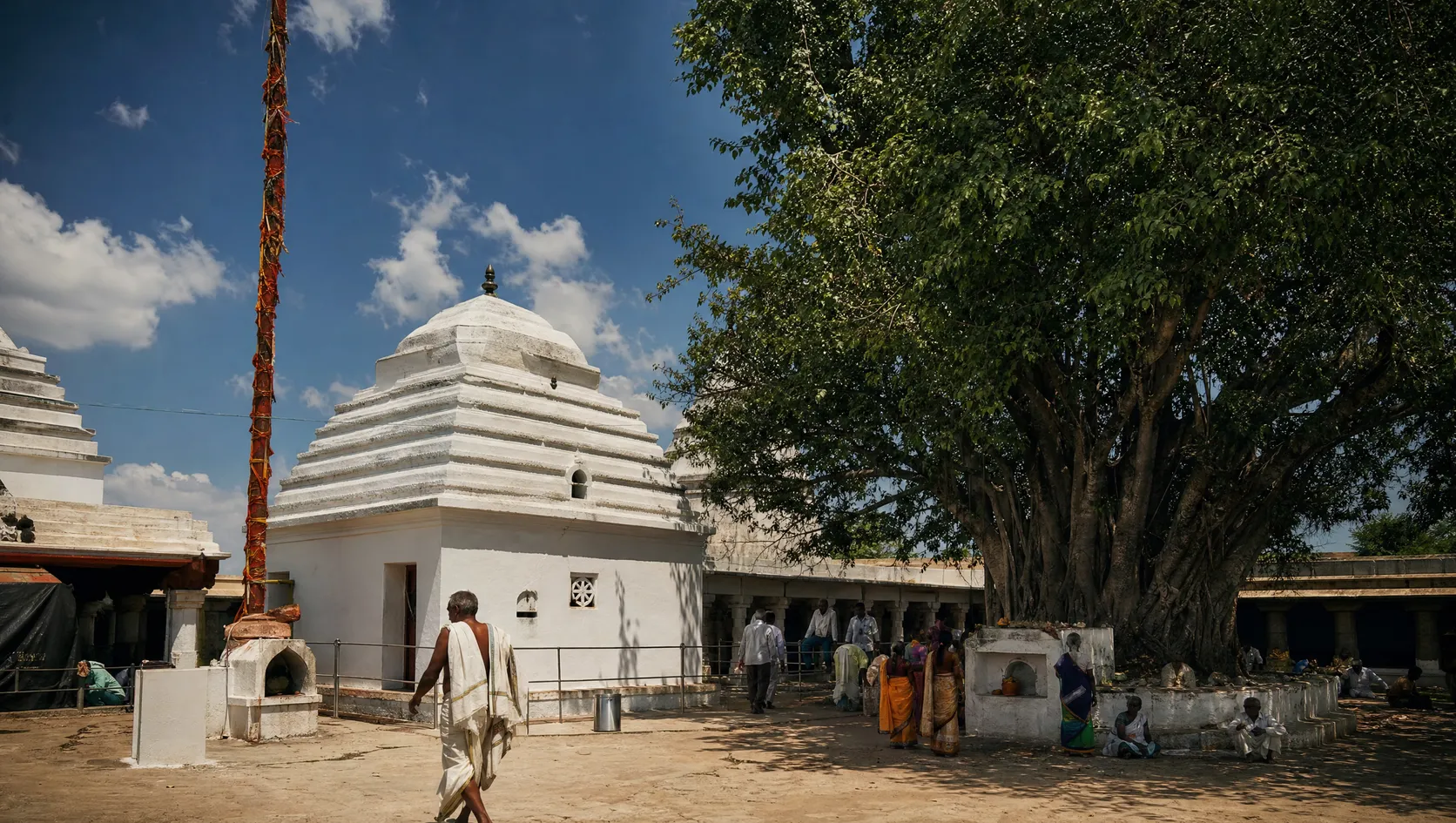
A Datta pilgrimage town centred on the shrine of the nirguna padukas, with the river sangam, the sacred audumbara and associated shrines, in the plain Deccan idiom
विशेष
The shrine keeps the daily worship of the nirguna padukas with its rounds of abhishekha, aarti and the offering of bhasma, and the town lives by the rhythm of the pilgrims' anushthana, above all the recitation of the Sri Guru Charitra. Timings are set by the shrine and vary with the ritual calendar.
पवित्र कथा · पवित्र कथा
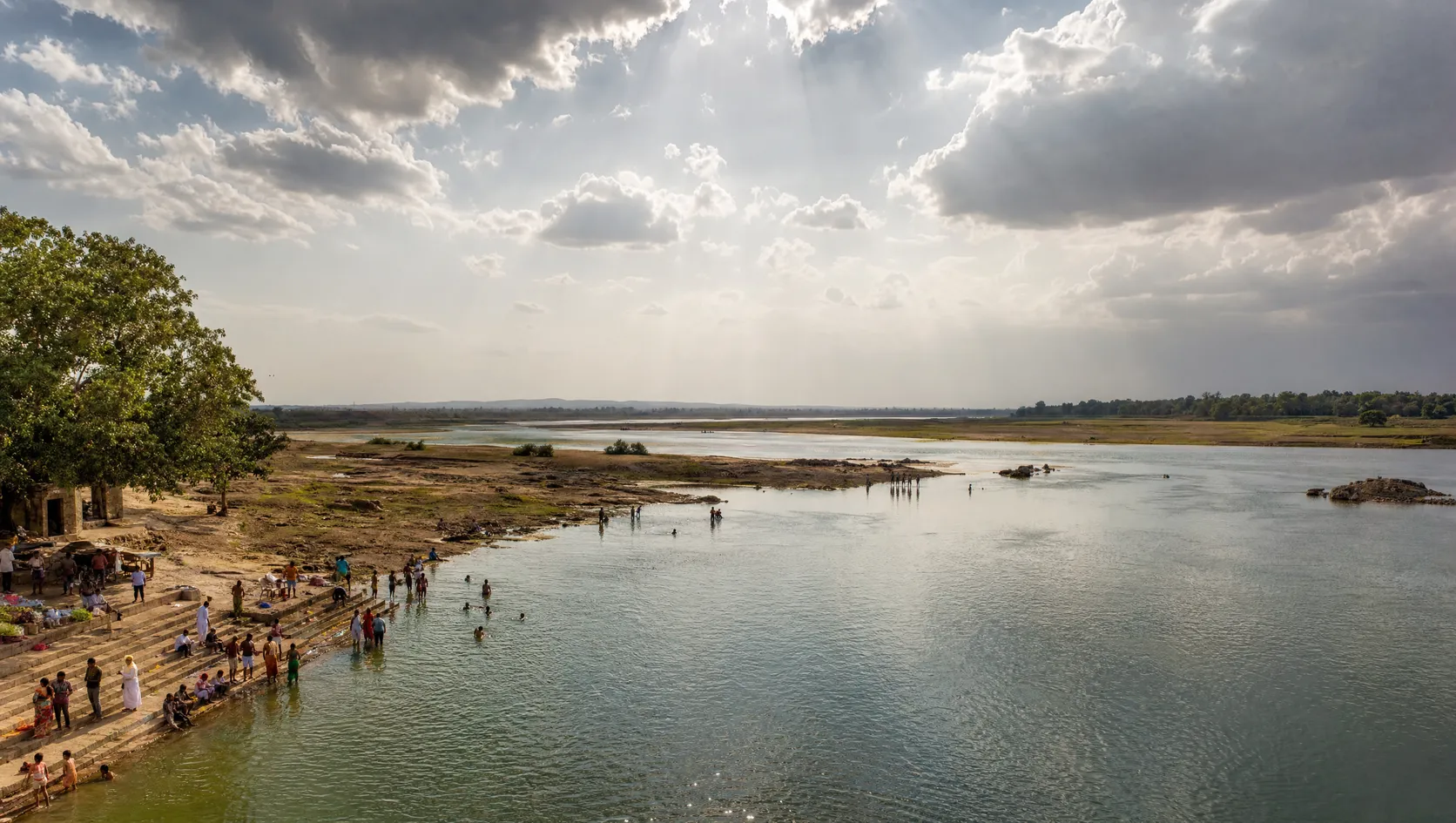
In the tradition of Dattatreya, the guru who is held to be the three great gods in one, no place stands higher than Ganagapur. Here Nrisimha Saraswati, revered as the second avatar of Dattatreya, is said to have lived for more than twenty years, and here, when he departed, he left behind his nirguna padukas, the footprint-impressions through which he is worshipped to this day, so that the guru is present not as a carved image but as the mark of his own feet. Dattatreya is the son of the sage Atri and the pure Anasuya, worshipped as the union of Brahma, Vishnu and Shiva in one form, the Adi Guru, the first and archetypal teacher. His tradition, the Datta Sampradaya, tells its story in the Sri Guru Charitra, a Marathi scripture that narrates the lives of two avatars, Sripad Srivallabha and Nrisimha Saraswati, and Ganagapur is the place most bound to the second, the kshetra where the guru made his long stay. Set at the confluence of the Bhima and Amaraja rivers in the Karnataka country near the Maharashtra border, Ganagapur is above all a place of practice: pilgrims come not for a quick darshan but to stay, to bathe at the sangam, to beg their food as alms in the way the guru prescribed, and to recite the Guru Charitra, in the belief that Nrisimha Saraswati is present still, unseen, moving among his devotees.
Sacred Designationपवित्र पदनाम
Sacred Origin Storyपवित्र उत्पत्ति कथा
Source: The Datta Sampradaya and the Sri Guru Charitra, the life of Nrisimha Saraswati
The Sri Guru Charitra, the great scripture of the Datta tradition, tells that Dattatreya took birth in the world as Nrisimha Saraswati to restore dharma and to teach, the second of his avatars after Sripad Srivallabha. In his wanderings the guru came to Ganagapur, at the confluence of the Bhima and Amaraja, and there he made his longest stay, more than twenty years, teaching, granting boons, and performing the deeds recounted in the Charitra: the barren given children, the poor made rich, the suffering healed, the dead restored, the proud humbled and the devoted raised.
When his work was done, the guru announced his departure. He did not die in the ordinary sense; the tradition holds that he set out upon the river and passed from sight toward Sri Shailam, promising that he would remain present at Ganagapur unseen, and that whoever came in faith and served him there would find him. As the sign and vehicle of that continuing presence he left his nirguna padukas, the impressions of his feet, and it is these, not an image of his form, that are worshipped in the sanctum.
So Ganagapur is a place where the guru is held to be living still, invisibly. The tradition tells that Nrisimha Saraswati continues to accept the madhukari, the alms begged from five houses in the town, and to move among the pilgrims; and the whole practice of the kshetra, the bathing at the sangam, the begging of food, the recitation of the Charitra, is built on the conviction that he is present, and that to serve him at Ganagapur is to be in the company of the guru himself.
उद्धृत स्रोत:
- Sri Guru Charitra
- Datta Sampradaya tradition of Ganagapur
- Oral and textual tradition of Nrisimha Saraswati
विद्वत संदर्भ
The Datta Sampradaya, the devotional tradition of Dattatreya, is a major current of Deccan religion, especially in Maharashtra and northern Karnataka, and its central text is the Sri Guru Charitra, a Marathi work traditionally ascribed to Saraswati Gangadhar and generally dated to the medieval period. The Charitra narrates the lives of two figures held to be avatars of Dattatreya, Sripad Srivallabha and Nrisimha Saraswati, and it is the framework within which the network of Datta kshetras, including Ganagapur, is understood. Ganagapur is regarded as the principal kshetra of Nrisimha Saraswati, the place of his long residence, and the shrine of the nirguna padukas is its focus. The worship of padukas, the footwear or footprint-impressions of a guru, rather than an anthropomorphic image, is characteristic of the guru-centred devotion of the tradition: the object of worship is the presence of the teacher, held to continue after his visible departure. Scholars treat the Datta tradition as an important instance of the guru-as-God devotion of the Deccan, in which a line of historical or semi-historical teachers is woven into the worship of a pan-Indian deity, and in which the practice, above all the recitation of the Sri Guru Charitra and the disciplines undertaken at the kshetras, is as central as doctrine. Ganagapur, as the chief of these kshetras, is among the most important living pilgrimage centres of the tradition.
Historyइतिहास
Ganagapur is the foremost kshetra of the Datta Sampradaya, the tradition of Dattatreya, and is bound above all to Nrisimha Saraswati, revered as the second avatar of Dattatreya in the Sri Guru Charitra. The tradition holds that the guru made his longest residence here, more than twenty years, at the confluence of the Bhima and Amaraja rivers, and that on his departure he left his nirguna padukas, the footprint-impressions through which he is worshipped, promising his continuing unseen presence.
The history of Ganagapur is inseparable from the Sri Guru Charitra, the Marathi scripture that narrates the lives of Sripad Srivallabha and Nrisimha Saraswati and that has shaped the whole Datta tradition of the Deccan. Around the shrine of the padukas grew the pilgrimage town, and around the memory of the guru's residence developed the distinctive practices of the kshetra: the bathing at the sangam, the begging of alms as madhukari, and above all the recitation of the Charitra.
Over the centuries Ganagapur has been sustained not by royal grandeur but by the unbroken devotion of the Datta tradition, drawing pilgrims from across Maharashtra and Karnataka who come to stay, to undertake vows and recitations, and to serve the guru held to be present still. The shrine and its worship have continued through the generations, kept by the community of devotees and the traditions of the kshetra rather than by monumental building.
In the modern period Ganagapur remains the chief living centre of the Datta Sampradaya, its importance undiminished, drawing great numbers especially on Datta Jayanti and the days sacred to the guru. Its character is that of a place of practice rather than of spectacle: a town whose life is the service of an unseen guru, where the deeds recounted in the Sri Guru Charitra are held to continue for those who come in faith.
Historical Timelineऐतिहासिक कालक्रम
Nrisimha Saraswati, revered as the second avatar of Dattatreya, is held by tradition to have made his longest residence at Ganagapur, at the confluence of the Bhima and Amaraja, teaching and performing the deeds recounted in the Sri Guru Charitra.
The traditional dating of Nrisimha Saraswati is held within the Datta tradition; the Sri Guru Charitra is the principal source for his life.
On his departure the guru leaves his nirguna padukas, the footprint-impressions through which he is worshipped, and promises to remain present at Ganagapur unseen for those who come in faith.
The nirguna padukas, rather than an anthropomorphic image, are the object of worship, characteristic of the guru-centred devotion of the tradition.
The Sri Guru Charitra spreads across the Deccan and becomes the central scripture of the Datta Sampradaya, establishing Ganagapur as the chief kshetra of Nrisimha Saraswati in the tradition's own map of itself.
The Charitra is traditionally ascribed to Saraswati Gangadhar and is central to the whole Datta tradition of Maharashtra and Karnataka.
The distinctive practices of the kshetra take enduring shape: bathing at the Bhima-Amaraja sangam, the begging of alms as madhukari, the reverence of the sacred audumbara, and the recitation of the Sri Guru Charitra over a set number of days.
The madhukari, alms begged from five houses in imitation of the guru, is among the kshetra's most characteristic practices.
The tradition holds that Nrisimha Saraswati continues to accept the madhukari and to move unseen among the pilgrims, and the town's whole life develops around the service of a guru believed to be present still.
Ganagapur and the Datta tradition are recorded in colonial-era accounts of the religious life of the Deccan, which note the kshetra's importance and the practices of its pilgrims.
The Datta Sampradaya flourishes in the modern period, and Ganagapur remains its chief kshetra, its worship and its distinctive disciplines continuing unbroken as the tradition spreads through Maharashtra and Karnataka.
Ganagapur remains the foremost living centre of the Datta tradition, drawing pilgrims year-round and great numbers on Datta Jayanti and the days sacred to the guru, who come to stay, to bathe at the sangam, to beg alms and to recite the Sri Guru Charitra.
What You'll Seeदर्शन में
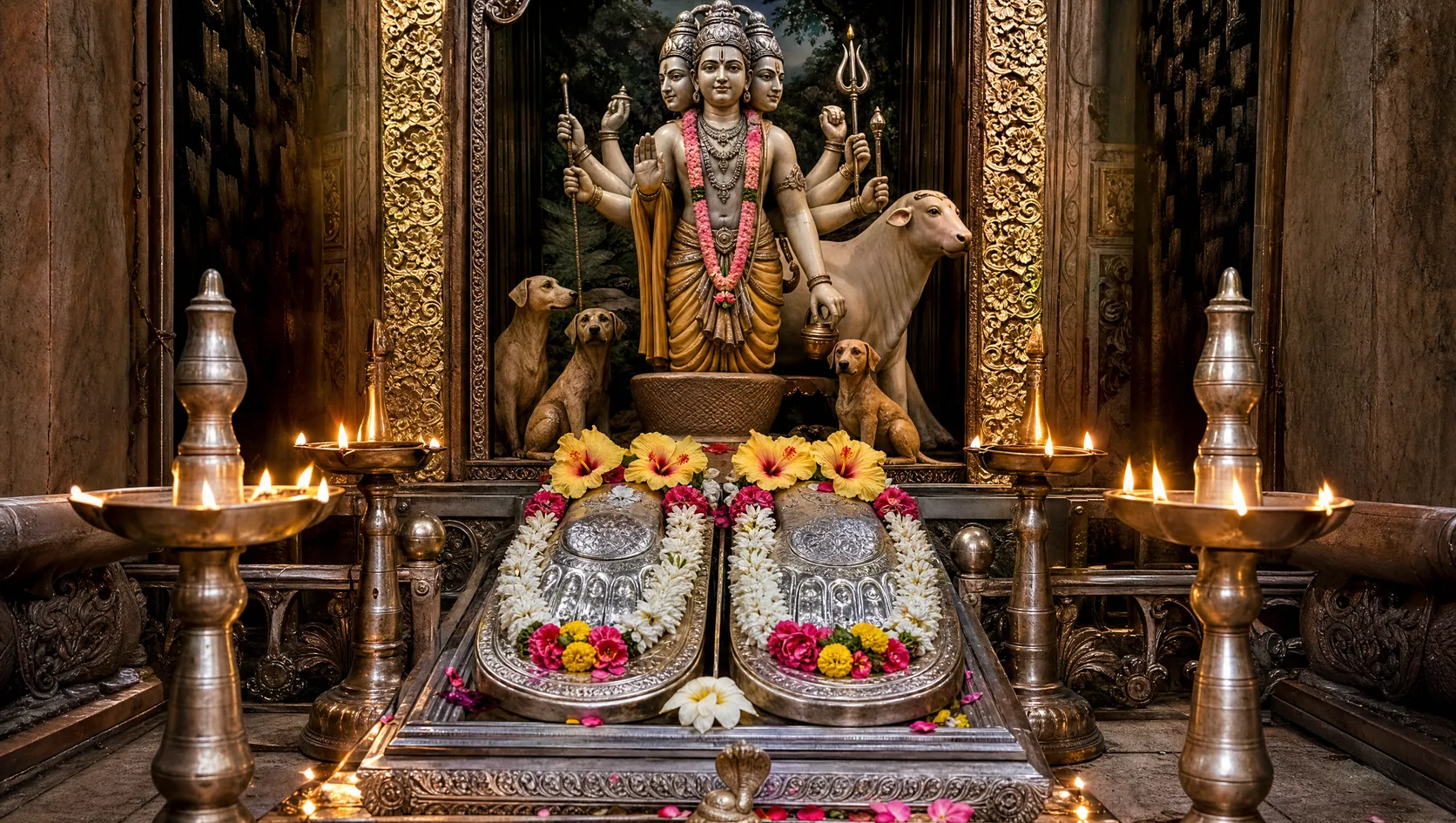
The object of worship at Ganagapur is not an anthropomorphic image of the guru but his nirguna padukas, the footprint-impressions held to be left by Nrisimha Saraswati himself. Nirguna means without form or attribute, and the padukas are worshipped precisely as the formless presence of the guru, the mark of his feet standing for the teacher who is held to be present though unseen. This is the deepest icon of the place: a god worshipped in the trace of his own footsteps.
The wider iconography of the Datta tradition surrounds this centre. Dattatreya himself is depicted with three heads, for Brahma, Vishnu and Shiva united in the one guru, and six hands bearing their emblems, accompanied by four dogs, understood as the four Vedas, and a cow, the earth or the wish-granting Kamadhenu, and standing by the audumbara, the cluster fig sacred to him. Images of Dattatreya in this form are venerated in the tradition, and the sacred audumbara is honoured at the kshetra as the tree of the guru.
Around the padukas the town holds the sangam of the Bhima and Amaraja, where pilgrims bathe, and the shrines and sacred spots associated with the guru's residence. But the controlling image remains the nirguna padukas: the whole practice of Ganagapur, the service, the recitation, the alms, is offered to the footprints, in the conviction that the guru who left them is present to receive it.
Distinctive Practicesविशिष्ट परंपराएँ
Madhukari (Begging Alms from Five Houses)
मधुकरी (पाँच घरों से भिक्षा)
Undertaken by pilgrims during their stay
In the way the guru is held to have prescribed, pilgrims at Ganagapur beg their food as madhukari, alms gathered from five houses in the town, eating what is given rather than food bought or cooked for themselves, in imitation of the renunciate's begging and of the guru who is said to accept the madhukari still.
Madhukari, named for the bee that takes a little nectar from many flowers without harming any, is the classic discipline of the renunciate: to depend not on one's own provision but on what is freely given, and to eat without preference or attachment. To beg one's food at Ganagapur is to set aside, for the days of the stay, the security of owning one's meal, and to place oneself in the guru's own way of living; the tradition holds that in doing so the pilgrim comes closest to the presence of Nrisimha Saraswati, who is said to walk the town accepting the same alms.
Recitation of the Sri Guru Charitra
श्री गुरु चरित्र का पाठ
Undertaken as a saptaha (seven-day) or set-day parayana
Pilgrims undertake the parayana, the disciplined recitation of the Sri Guru Charitra, the central scripture of the tradition, often as a saptaha over seven days, reading its account of the lives and deeds of the Datta avatars as an act of worship and a means of the guru's grace.
In the Datta tradition the recitation of the Sri Guru Charitra is itself a sadhana, a spiritual practice, held to bring the guru's grace and to fulfil the reciter's needs, much as the deeds it recounts fulfilled the needs of those who came to the guru in his life. To read the Charitra at Ganagapur, where the guru lived and is held to be present, is to bring the text and the place together, the account of his deeds recited in the very town where they are said to have been done, so that the reading is felt not as recollection but as a present appeal to a living guru.
Bathing at the Sangam and Reverence of the Audumbara
संगम पर स्नान और औदुम्बर की श्रद्धा
Daily, for pilgrims at the kshetra
Pilgrims bathe at the sangam of the Bhima and Amaraja rivers as the purifying rite of the kshetra before worship, and revere the sacred audumbara, the cluster fig held to be the tree of Dattatreya, which is honoured wherever the Datta tradition is practised.
The confluence of rivers is held sacred across the tradition as a place of purification, and to bathe at the Bhima-Amaraja sangam before serving the guru is to come clean to his presence. The audumbara is bound to Dattatreya as the pipal is to Vishnu or the bilva to Shiva; the tradition holds that the guru is present at the foot of the audumbara, so that the tree is not a symbol but a dwelling, and its reverence a way of drawing near to him.
Did You Know?क्या आप जानते हैं?
Ganagapur is the foremost kshetra of the Datta Sampradaya, the tradition of Dattatreya, bound above all to Nrisimha Saraswati, revered as the second avatar of Dattatreya.
Datta Sampradaya tradition
The guru is worshipped here not through an image of his form but through his nirguna padukas, the footprint-impressions held to mark his continuing, unseen presence.
Sri Guru Charitra; kshetra tradition
Pilgrims at Ganagapur beg their food as madhukari, alms gathered from five houses, in imitation of the guru, who is said to accept the same alms unseen to this day.
Kshetra tradition of Ganagapur
The kshetra stands at the confluence of the Bhima and Amaraja rivers, where pilgrims bathe before serving the guru, and honours the sacred audumbara, the cluster fig tree of Dattatreya.
Kshetra tradition
The tradition's central scripture is the Sri Guru Charitra, a Marathi work narrating the lives of the Datta avatars Sripad Srivallabha and Nrisimha Saraswati, recited by pilgrims as a spiritual practice.
Sri Guru Charitra
Dattatreya is depicted with three heads for Brahma, Vishnu and Shiva united in one guru, accompanied by four dogs held to be the four Vedas and a cow, standing by the audumbara tree.
Datta iconographic tradition
The tradition holds that Nrisimha Saraswati did not die but set out upon the river toward Sri Shailam, leaving his padukas and promising his continuing presence at Ganagapur.
Sri Guru Charitra
Visitor Accessप्रवेश जानकारी
The shrine is open to devotees, and traditional dress and conduct are expected as at a working kshetra. Footwear is removed at the shrine, and photography is generally not permitted at the padukas. Ganagapur is a place of stay rather than of quick darshan: many pilgrims come for several days to undertake the disciplines of the kshetra, the bathing at the sangam, the madhukari, and the recitation of the Sri Guru Charitra. The town is geared to this, with facilities for pilgrims who stay. The kshetra keeps its own daily ritual round and its distinctive observances, and its rhythm is set by the practices of the pilgrims as much as by fixed timings. Confirm current arrangements locally, especially around Datta Jayanti and the days sacred to the guru, when numbers are very large.
Plan Ganagapur as a stay rather than a passing visit: most pilgrims come for one or more nights to bathe at the Bhima-Amaraja sangam, to beg the madhukari, and to recite the Sri Guru Charitra, often as a seven-day saptaha. Arrange lodging in the town in advance, especially around Datta Jayanti. Dress traditionally, remove footwear at the shrine, and respect the ban on photography at the padukas. Carry a change of clothes for the sangam bath. The kshetra is reached via Ganagapur Road railway station or by road from Kalaburagi, Solapur and Akkalkot, and is commonly combined with Akkalkot and the other Datta kshetras of the region. Come in the spirit of the tradition, prepared to observe its conventions and, if you wish, to undertake its disciplines.
Festivalsत्योहार
Datta Jayanti
दत्त जयंती
Nov-Dec (Margashirsha Purnima)
The birth-anniversary of Dattatreya, the great festival of the whole Datta tradition, observed at Ganagapur with special worship, recitation and immense gatherings, the central day of the kshetra's year.
Nrisimha Saraswati observances
नृसिंह सरस्वती अनुष्ठान
Varies (days sacred to the guru)
The days marking the life and departure of Nrisimha Saraswati, the guru of Ganagapur, are kept with special worship of the nirguna padukas and recitation of the Sri Guru Charitra, honouring the avatar to whom the kshetra is bound.
Guru Purnima
गुरु पूर्णिमा
Jun-Jul (Ashadha Purnima)
The day dedicated to the guru is of particular importance in a tradition centred on the guru principle, observed at Ganagapur with the worship of Dattatreya, the Adi Guru, and of Nrisimha Saraswati.
Guru Dwadashi (Nrisimha Saraswati's departure)
गुरु द्वादशी (नृसिंह सरस्वती का प्रस्थान)
Jan-Feb (Magha, the guru's nija-ananda gamana)
The day marking the departure of Nrisimha Saraswati, when the guru is held to have set out upon the river leaving his padukas, is kept at Ganagapur as a solemn observance with special worship of the nirguna padukas and recitation of the Sri Guru Charitra, honouring the moment the guru's continuing unseen presence began.
Pournima and Amavasya gatherings
पूर्णिमा और अमावस्या समागम
Monthly (the full-moon and new-moon days)
The full-moon and new-moon days each month draw pilgrims to Ganagapur for special worship of the padukas and the sangam bath, so that beyond the great annual festivals the kshetra keeps a monthly rhythm of gatherings for the service of the guru.
Traditional Offeringsपारंपरिक अर्पण
प्राथमिक अर्पण
Service to the nirguna padukas
निर्गुण पादुकाओं की सेवा
The central offering at Ganagapur is service to the nirguna padukas, the footprint-impressions of the guru: their abhishekha, their adornment and the reverence offered before them, given to the padukas as to the living presence of Nrisimha Saraswati himself.
Bhasma (sacred ash)
भस्म (पवित्र भस्म)
Bhasma, the sacred ash of the kshetra, is offered and received as the prasada of the guru, held to carry his grace and his healing; the ash of Ganagapur is especially revered in the Datta tradition and taken home by pilgrims.
Madhukari (begged alms)
मधुकरी (माँगी भिक्षा)
The pilgrim's own begging of food as madhukari is itself an offering, the setting aside of self-provision in the guru's way; the alms gathered and eaten are received as the guru's own giving, and the discipline is offered to him as a service.
Lamps, incense and the audumbara
दीप, धूप और औदुम्बर
Lamps and incense are offered in the daily worship of the padukas and at the sacred audumbara, the cluster fig of Dattatreya, marking the ritual rhythm of the kshetra. Reverence at the foot of the audumbara is offered as worship of the guru held present there.
इस मंदिर की विशेषता
The Offering of the Guru Charitra Parayana
गुरु चरित्र पारायण की भेंट
What is particular to Ganagapur, and to the Datta tradition, is that its highest offering is the parayana of the Sri Guru Charitra, the disciplined recitation of the guru's own scripture. The reading is itself a sadhana, an act of worship offered to the guru and held to bring his grace, and to undertake it at Ganagapur, where he lived and is held present, is the offering above all others. A pilgrim serves the padukas, receives the bhasma and begs the madhukari, but the offering the tradition holds highest is the recitation of the Charitra, often over seven days, carried out in the guru's own kshetra. The offering and the blessing meet in the reading: the devotee gives the discipline of the recitation, and Nrisimha Saraswati, held present still, is believed to grant from it as he granted to those who came to him in his life.
Offerings at Ganagapur follow the Datta tradition, centred on the service of the nirguna padukas, the receiving of bhasma, the begging of madhukari and, above all, the recitation of the Sri Guru Charitra. The kshetra is a place of practice, and its offerings are as much disciplines undertaken as substances given. Eternal Raga presents these practices as a devotional tradition; specific arrangements should be confirmed at the kshetra.
How to Reachकैसे पहुँचें
Ganagapur lies at the confluence of the Bhima and Amaraja rivers in Kalaburagi (Gulbarga) district of northern Karnataka, near the Maharashtra border, and is reached from the towns of the region.
By air: Kalaburagi Airport is roughly 40 km away with limited connections; Hyderabad and Pune are larger airports at a greater distance.
By rail: Ganagapur Road railway station, on the Solapur-Kalaburagi line, is about 20 km from the temple town and is the usual railhead; from there the town is reached by road. Kalaburagi (Gulbarga) is the major junction of the region.
By road: Ganagapur is connected by road to Kalaburagi, Solapur and Akkalkot, served by buses and taxis; the town is a short drive from Ganagapur Road station. Many Datta pilgrims combine it with Akkalkot and the other Datta kshetras of the region.
Because Ganagapur is a place of stay, pilgrims usually plan for one or more nights rather than a passing visit, and arrange lodging in the town.
Plan Your Visitयात्रा की योजना
🌤 सर्वोत्तम मौसम
October to March is the most comfortable time to visit, with milder temperatures in the northern Karnataka plain. Datta Jayanti, in November or December, is the great festival of the kshetra and its busiest time, when the town fills with pilgrims. April to June is hot in this part of the Deccan, and the middle of the day is best avoided. The monsoon brings rain and can raise the rivers at the sangam, so those planning to bathe should note the season's conditions. For those undertaking the disciplines of the kshetra, the cooler months allow the days of stay, bathing and recitation to be kept in more comfort; the great festival days are spiritually charged but very crowded.
👘 पहनावे का नियम
Traditional and modest dress is expected at the kshetra, as at a working religious centre. Men commonly wear a dhoti or trousers with a shirt; women a saree or salwar kameez. Footwear is removed at the shrine, and those bathing at the sangam should carry a change of clothes.
📱 फोन और फोटोग्राफी
Photography is generally not permitted at the nirguna padukas and within the sanctum, and phones should be silenced across the shrine premises. Follow the directions of the shrine and the conventions of the kshetra, which is a place of practice rather than sightseeing.
🏨 आवास
As a place of stay, Ganagapur has lodging geared to pilgrims, including dharamshalas, bhakta nivas and guest houses maintained for those who come to undertake the disciplines of the kshetra, along with basic amenities in the town. Standards are simple, suited to the devotional character of the place. Demand rises sharply around Datta Jayanti and the days sacred to the guru, when booking or arriving early is advisable. Larger towns such as Kalaburagi and Solapur, within reach by road, offer a fuller range of hotels for those who prefer to stay outside the town and visit.
Sacred Soundsपवित्र ध्वनि
क्या आप जानते हैं? · Did You Know?
वही अनुवाद त्रुटि जिसने हिन्दू धर्म में '33 कोटि' को '33 करोड़' बनाया, बौद्ध धर्म में भी हुई। बौद्ध ग्रन्थों के चीनी अनुवाद ने 'सप्त कोटि बुद्ध' (7 श्रेष्ठ बुद्ध) का अनुवाद '7 करोड़ बुद्ध' कर दिया। तिब्बती अनुवाद ने सही किया: 7 प्रकार, 7 करोड़ नहीं। एक संस्कृत शब्द, दो प्रमुख विश्व धर्मों में गलत पढ़ा गया, ने दो एकसमान भ्रम स्वतन्त्र रूप से उत्पन्न किए।
Related Contentसंबंधित सामग्री
Related Scriptures
Community Reflections
🕉️
Be the first to share your reflection.