Gangotri Temple
गंगोत्री मंदिर
The river herself, Goddess Ganga at her place of descent in the Garhwal Himalayas
Gangotri, Uttarakhand, India
GaṅgotrīAlso known as: Gangotri Dham, Bhagirathi Mandir, Ganga Mata Mandir, Gangotri Mata Mandir
युग
Pilgrimage site referenced in the Mahabharata's Vana Parva, the Skanda Purana's Kedara Khanda, the Ramayana, and the Brahmavaivarta Purana's Ganga Khanda; current temple structure substantively from the early 19th century, built by the Gorkha general Amar Singh Thapa; renovations and partial reconstructions through the 19th and 20th centuries
वास्तुकला
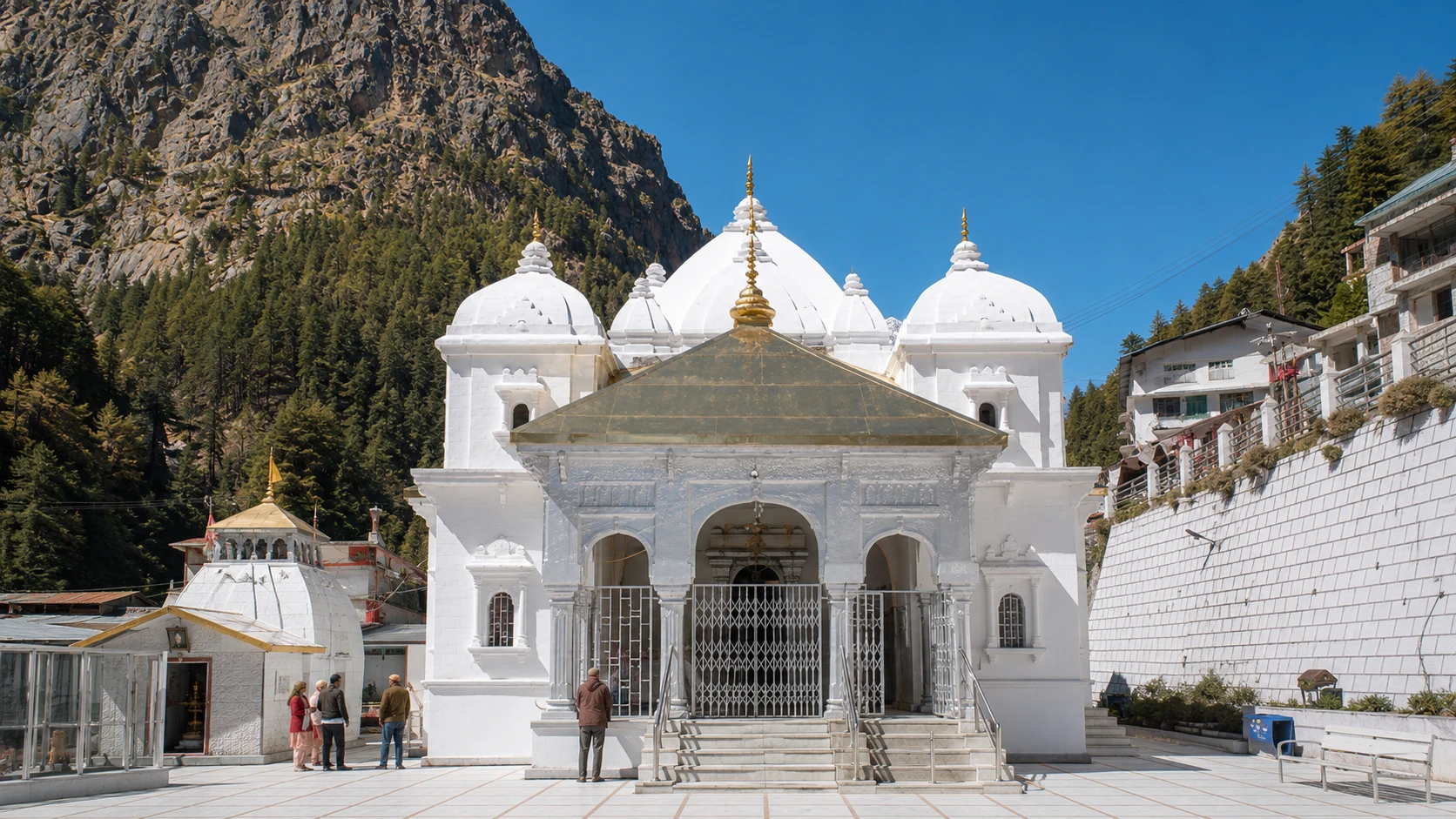
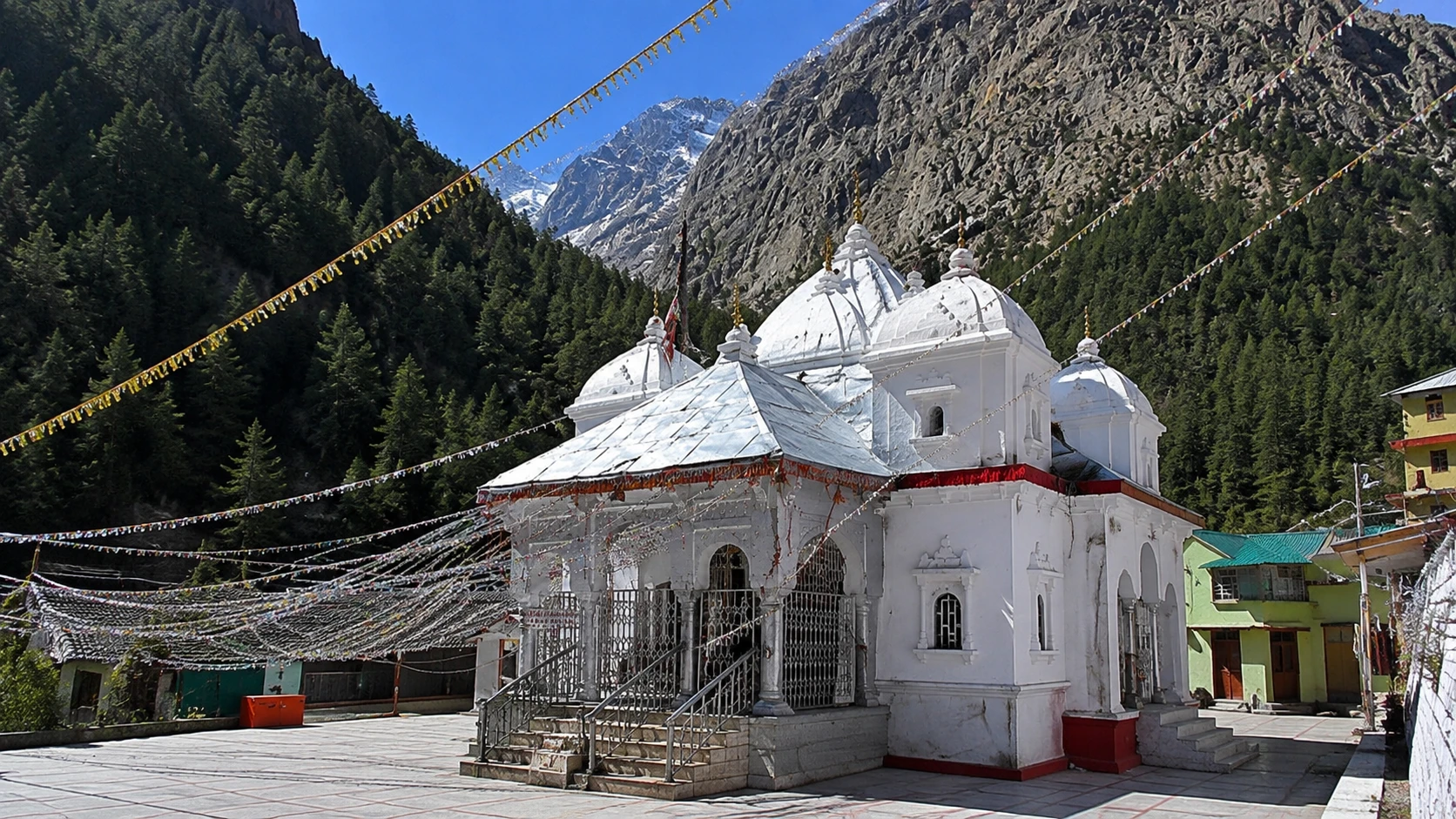
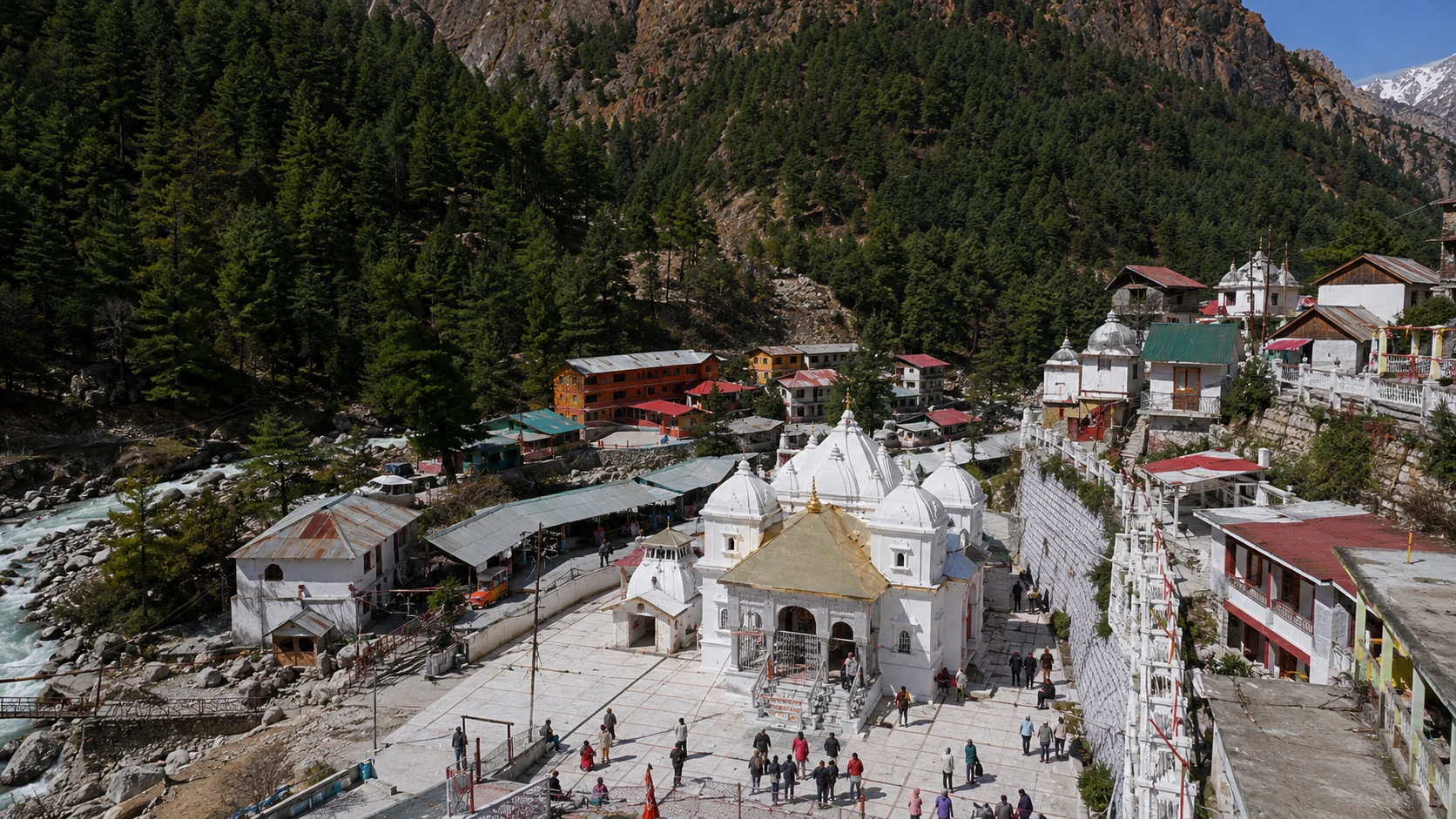
Garhwali Pahari with Nagara stylistic elements; small white granite structure approximately 6 metres in height, situated immediately on the banks of the Bhagirathi with a stepped ghat descending to the river, scaled for the high-altitude setting and the seasonal pilgrim flow
खुला
Approx. 06:30 (Mangala Aarti onwards) during the open yatra season – Approx. 21:30 (Shayan Aarti); the temple is closed for kapaat-band for six months in winter, opening on Akshay Tritiya (late April / early May) and closing the day after Diwali / Govardhan Puja (October, November); winter worship continues at Mukhba village (about 20 km below Gangotri) where the utsava-murti of Ganga is taken in formal procession
आरती
06:30 Mangala Aarti · 08:30 Snan Aarti at the river · 12:00 Madhyahna Bhog · 19:30 Sandhya Aarti · 21:30 Shayan Aarti
विशेष
Kapaat opening on Akshay Tritiya (procession from Mukhba bringing the utsava-murti of Ganga up to Gangotri, accompanied by the local Garhwal traditional bands); Ganga Saptami (the day Ganga is held to have appeared on earth); Ganga Dussehra (the day of her actual descent); the kapaat closing ceremony, these dates are announced annually by the Gangotri Temple Committee in coordination with the Uttarakhand state administration
पवित्र कथा · पवित्र कथा
Gangotri is where the Ganga is worshipped not as the river that flows to the sea but as the goddess at her place of descent, where Bhagirath's three-generation tapasya brought the celestial river down from the heavens, where Shiva's matted locks broke her fall to keep the earth from shattering, and where she emerges from the Gangotri glacier to flow as the Bhagirathi until she meets the Alaknanda at Devprayag and becomes the Ganga that crosses the subcontinent. The temple stands on the banks of the Bhagirathi at 3,100 metres in the Garhwal Himalayas, and like its Chota Char Dham siblings to the east, Kedarnath and Badrinath, closes for six months in winter, the goddess descending to her seasonal seat at Mukhba village while the temple itself stands locked in snow. The small white granite shrine that pilgrims see today was built in the early 19th century by Amar Singh Thapa, the Gorkha general whose campaigns reached the western Himalayas in the years before the Anglo-Nepalese War; what came before at this site was a smaller wooden shrine remembered in pilgrim records but whose physical form has not survived. Eighteen kilometres further upstream, where the Gangotri glacier ends, lies Gaumukh, 'cow's mouth', the actual physical source of the river. Pilgrims who walk to Gaumukh stand at the geographical origin of the river the texts call the most sacred in the world.
Sacred Designationपवित्र पदनाम
Sacred Origin Storyपवित्र उत्पत्ति कथा
Source: Mahabharata (Vana Parva), Ramayana (Bala Kanda, Vishvamitra's narration to Rama), Bhagavata Purana, Vishnu Purana, Brahmavaivarta Purana (Ganga Khanda), Skanda Purana (Kedara Khanda), Devi Bhagavata Purana, widely-attested across the major epics and Puranic literature
In an age before this age, King Sagara of Ayodhya performed the great Ashvamedha, the horse sacrifice that establishes a king's universal sovereignty. Indra, jealous of Sagara's power, stole the sacrificial horse and hid it at the ashram of the sage Kapila in the depths of the earth.
Sagara's sixty thousand sons, charged with finding the horse, dug deep into the earth and discovered Kapila in meditation with the stolen horse beside him. Believing Kapila to be the thief, they confronted him. The sage opened his eyes; the fire of his accumulated tapas blazed forth and reduced all sixty thousand to ash on the spot.
Their ashes lay in the netherworld. Without water, specifically, without the celestial waters of the heavenly Ganga, their souls could not be liberated. They wandered as restless presences for generations.
Two royal generations passed. Sagara's grandson Anshuman tried, then Anshuman's son Dilip, both performed tapasya for Ganga's descent and both died with the goal unmet. The third generation fell to Bhagirath, Dilip's son and the great-grandson of Sagara, who renounced his kingdom and went to the Himalayas.
There, on the rock that pilgrims to Gangotri are still shown today, the Bhagirath Shila, beside the Bhagirathi a few steps from the temple, he stood for a thousand years in unmoving tapasya, single-pointed in his prayer that the goddess of the celestial waters consent to come to earth.
Ganga relented. But she warned: 'I am the celestial river. If I descend in my full force, the earth itself will be shattered by the impact of my fall. You must arrange for someone to receive me as I come down, a being capable of holding back the cosmos.' Bhagirath then performed a second tapasya, this one for Shiva, Shiva alone could withstand the impact. Shiva agreed.
He stood on the Himalayas with his matted locks open; Ganga came down with all the force of a heavenly river meeting the earth, and his locks caught her, held her, slowed her, and meted her out in seven gentle streams that became the seven sacred rivers of the subcontinent.
Bhagirath, on his chariot, then led Ganga across the plains of north India to where his ancestors' ashes lay. Her waters touched the ashes; the sixty thousand were liberated. The river then flowed on to the sea, becoming what the texts call the goddess of the world, the river whose waters can wash away even the gravest karma, the mother of all sacred rivers.
Gangotri marks the descent point on earth. The Bhagirathi flows from the Gangotri glacier at Gaumukh, eighteen kilometres above the temple, and becomes the Ganga formally only at Devprayag where she meets the Alaknanda flowing down from Badrinath.
But here, where Bhagirath stood and where Shiva's locks first released the celestial waters, the goddess is held by tradition to first touch the earth, and here she is worshipped as Ganga Mata, mother of the rivers, liberator of ancestors, the most sacred of waters in any Hindu tradition.
उद्धृत स्रोत:
- Mahabharata, Vana Parva (Aranyaka Parva, Sagara, Anshuman, Dilip, and Bhagirath sequence)
- Ramayana, Bala Kanda (Vishvamitra's narration of the Ganga descent to Rama)
- Bhagavata Purana, Skandhas 5 and 9
- Vishnu Purana, Book 4
- Brahmavaivarta Purana, Ganga Khanda (the most extensive Puranic treatment)
- Skanda Purana, Kedara Khanda
- Devi Bhagavata Purana, Books 9 and 12 (the Goddess-centric account of Ganga)
विद्वत संदर्भ
Modern scholarship treats Gangotri as a convergence of three threads. The first is textual: the Bhagirath narrative is among the most consistently rendered stories across the Mahabharata, the Ramayana, and the major Puranas, with very limited variation between sources, making it one of the most stable major Puranic narratives in the Hindu canon. A complementary tradition, found in the Vamana avatar narratives, holds that Ganga's heavenly origin lies in the water that flowed from Vishnu's foot when, in his Trivikrama (three-strides) form, he stepped across the upper world; the two accounts are sequential rather than competing, with the Vamana story explaining Ganga's heavenly origin and the Bhagirath story her terrestrial descent. The second thread is the temple's documented architectural history: the present white granite shrine was built in the early 19th century by Amar Singh Thapa (1751, 1816), the Gorkha military commander who led the western Himalayan expansion of the Gorkhali state in the years before the 1814, 1816 Anglo-Nepalese War; what came before at this site was a smaller wooden structure consistent with the higher-altitude shrines of the broader Garhwal region, and pre-Gorkha continuity is recorded in pilgrim accounts but not in surviving fabric. The Adi Shankaracharya tradition that links Gangotri to the larger Vedantic monastic geography (via Jyotirmath / Joshimath, the northern matha) is institutional rather than architectural and is well-documented from later Garhwali records. The third thread is contemporary glaciology: the Gangotri glacier, which feeds the Bhagirathi at Gaumukh, has been documented as retreating at a rate variously estimated between 15 and 30 metres per year through the 20th century, with recent measurements (Wadia Institute of Himalayan Geology, NRSC) suggesting that the rate has moderated but the cumulative retreat is significant, a contemporary fact that has begun to find devotional expression in pilgrim concern for the river's source.
Historyइतिहास
Gangotri's documented history begins with its place in early Sanskrit literature, the Mahabharata, the Ramayana, and the major Puranas all treat the Bhagirath shila and the Ganga descent point as established Himalayan pilgrimage geography from very ancient times, but the first phase of institutional consolidation belongs to Adi Shankaracharya's late-8th- or early-9th-century reorganisation of pan-Indian Hindu monastic geography.
Tradition associates Shankara with restoring formal worship at all four sites that would later constitute the Chota Char Dham of Uttarakhand, and with the establishment of Jyotirmath (Joshimath) as the northern matha that would administer the wider Garhwal pilgrimage.
The continuous Garhwali Brahmin tradition of priesthood at Gangotri, held by the Semwal Brahmin family for many generations, is recorded from at least the medieval Garhwali kingdom period.
Through the medieval period, Gangotri was a high-altitude pilgrimage site approached seasonally by ascetics and householders making the longer Garhwal pilgrimage circuit; permanent stone temple architecture at this elevation was unfeasible given the half-year snowpack, and the worship took place at a smaller wooden shrine.
The Tehri Garhwal kingdom held nominal patronage from the 14th century onwards.
The present white granite temple was built by Amar Singh Thapa (1751, 1816), the Gorkha military commander whose campaigns in the years immediately before the Anglo-Nepalese War of 1814, 1816 took the Gorkhali state to its westernmost extent.
The construction is variously dated to the early 1800s, sources differ on whether the work was completed before, during, or after the 1815 Anglo-Nepalese War. Following the Treaty of Sugauli (1816), British authority over the Garhwal region was formalised, and the temple came under the patronage of the British-recognised Tehri Garhwal kingdom, which administered it through the 19th century with hereditary priestly families continuing the seva.
The 20th century saw multiple renovations following Himalayan seismic events, most notably the 1991 Uttarkashi earthquake (M6.8) which damaged structures across the upper Bhagirathi valley including some elements of the Gangotri precinct.
Modern administration is vested in the Gangotri Temple Committee under the Government of Uttarakhand's Devasthan framework, with the hereditary Semwal Brahmin priesthood retaining the daily seva. The 2013 Uttarakhand floods, while concentrated in the Mandakini valley around Kedarnath, also damaged road infrastructure on the Gangotri yatra route; reconstruction continued through 2014, 2018.
The Char Dham Pariyojana, a Government of India highway expansion project to provide all-weather road access to all four Uttarakhand dhams, initiated 2016, has been under construction since on the Rishikesh, Gangotri leg and remains in stages of completion.
The Uttarakhand Char Dham Shrine Management Act of 2019, which created a Devasthanam Management Board to centralise administration of the four dhams, was repealed in November 2021 following sustained protests by the priest collectives, and traditional administration was restored.
The retreat of the Gangotri glacier, documented systematically since the 1930s, has become an increasing matter of pilgrim and ecological concern; the snout of the glacier at Gaumukh has retreated by approximately one and a half kilometres in the last century.
Historical Timelineऐतिहासिक कालक्रम
References to the Bhagirath narrative and the Ganga descent at this site span the Mahabharata's Vana Parva, the Ramayana's Bala Kanda, and the major Puranas. The Bhagirath Shila, the rock where Bhagirath is said to have performed his thousand-year tapasya, is shown to pilgrims at Gangotri to this day, beside the Bhagirathi a few steps from the temple. The pre-medieval form of worship is understood by historians as seasonal high-altitude pilgrimage to a sacred geography rather than as continuous shrine activity at this elevation.
The dating of these Sanskrit texts in their current redacted forms is the subject of ongoing scholarship; the Bhagirath narrative's near-uniform rendering across the major texts is itself unusual and supports an early stabilisation of the story. The mythological geography of Gangotri predates any current physical structure on the site.
Adi Shankaracharya's reorganisation of pan-Indian Hindu monastic geography, including the establishment of Jyotirmath (Joshimath) as the northern of his four cardinal mathas, brings Gangotri institutionally within the Vedantic framework. Tradition associates Shankara with restoring formal worship at all four Chota Char Dham sites of Uttarakhand. The administrative connection between Gangotri and the Joshimath matha is preserved through subsequent centuries.
The dating of Adi Shankara's life remains debated (traditional 788, 820 CE; some modern scholars argue earlier dates). The Chota Char Dham institutional consolidation under Shankara is consistent across hagiographic sources; pre-Shankara worship at this site is well-attested in the Sanskrit literature, but Shankara's specific architectural or institutional intervention at Gangotri is hagiographic tradition rather than independently documented.
Construction of the present white granite temple at Gangotri by Amar Singh Thapa (1751, 1816), the Gorkha military commander who led the western Himalayan expansion of the Gorkhali state in the years before the Anglo-Nepalese War of 1814, 1816. The small wooden shrine that preceded it on the site is replaced by a stone structure approximately six metres in height, suited to the high-altitude environment and the seasonal pilgrim flow. The construction's exact dating remains uncertain in the historical record, sources differ on whether it was completed before, during, or after the Anglo-Nepalese War.
Amar Singh Thapa's role in commissioning the Gangotri temple is consistently recorded in Garhwali and British sources, though precise construction dates remain imprecise. The temple's ascription to him is well-attested; the architectural execution may have continued under Tehri Garhwal patronage after his death.
Following the Treaty of Sugauli (1816), British authority over the Garhwal region is formalised; Tehri Garhwal continues as a princely state under the British Raj and administers the Gangotri temple through the hereditary Semwal Brahmin priesthood. The 19th and early 20th centuries see the gradual development of pilgrim infrastructure on the Rishikesh, Gangotri route, including the construction of the road network through Uttarkashi. Multiple smaller renovations of the temple structure are recorded, particularly after harsh winter damage and seismic shaking.
The 1991 Uttarkashi earthquake (M6.8, October 1991) damages structures across the upper Bhagirathi valley, including parts of the Gangotri precinct; reconstruction follows over the subsequent years. The 2013 Uttarakhand floods, while concentrated in the Mandakini valley around Kedarnath, also damage road infrastructure on the Gangotri yatra route, prompting reconstruction through 2014, 2018. The Char Dham Pariyojana highway expansion (initiated 2016) continues on the Rishikesh, Gangotri leg. The Uttarakhand Char Dham Shrine Management Act of 2019 places Gangotri (with the other three Chota Char Dham temples) under a centralised Devasthanam Management Board; the Act is repealed in November 2021 after sustained priest-collective protests, restoring traditional administration. The Gangotri glacier, systematically monitored since the 1930s by the Geological Survey of India and from the 1990s by the Wadia Institute of Himalayan Geology and the National Remote Sensing Centre, has retreated by approximately 1.5 km at the Gaumukh snout in the 20th century, with ongoing implications for the sacred geography of the river's source.
Glacier retreat estimates vary by methodology and observation window; the figure of ~1.5 km cumulative retreat at the Gaumukh snout over the 20th century is widely cited but specific decadal rates have varied. Recent measurements suggest the rate of retreat has moderated in the 2010s relative to the 1980s, 2000s, but cumulative loss continues to be substantial. The implications for the sacred status of the river's source, and for the future location of Gaumukh itself, are an active matter of pilgrim and ecological discussion.
What You'll Seeदर्शन में
Inside the small white granite temple at Gangotri, the principal murti is a silver-faced image of Goddess Ganga seated on her vahana, the makara, a mythological aquatic creature usually depicted as a crocodile-dolphin composite.
The murti is roughly half a metre in height, with Ganga shown in classical Devi iconography: four-armed, holding a kalasha (water pot), a lotus, and the kalasha-mudra blessing gesture, with the makara emerging from beneath her seat.
Beside her stand smaller subsidiary murtis of Yamuna (her sister), Saraswati, Lakshmi, Annapurna, and Bhagirath, with the Bhagirath murti in the gesture of his thousand-year tapasya, single-pointed prayer for the goddess's descent.
The deity is dressed in white or saffron silks daily, with chunaris of red and gold offered by pilgrims on her behalf; in winter, the entire image is taken in palanquin to Mukhba village twenty kilometres below, where winter worship continues. But the central iconographic element at Gangotri is not the metal murti inside the temple, it is the river herself.
Pilgrims approach the temple through a stepped ghat that descends directly to the Bhagirathi; the morning Snan Aarti is performed at the river's edge, with the goddess in her metal form watching from inside while the goddess in her water form flows past at the priest's feet.
The understanding is that the form in the temple is the deity's icon; the form in the river is the deity herself, present in volume, in motion, in cold mountain water touched by Shiva's locks before it reaches you. Photography is permitted in the outer courtyard and at the river-side ghat; inside the small sanctum, photography during aarti and bhog is discouraged, and pilgrims are asked to keep phones pocketed.
Distinctive Practicesविशिष्ट परंपराएँ
Snan Aarti at the Bhagirathi, daily worship of the river herself
भागीरथी पर स्नान आरती, स्वयं नदी की दैनिक पूजा
Daily during the open yatra season; the morning Snan Aarti at approximately 08:30, additional aartis at the river's edge through the day
The defining practice at Gangotri is not the seva to the metal murti inside the sanctum but the seva to the river herself. The temple's stepped ghat descends directly to the Bhagirathi a few metres from the inner shrine, and the morning Snan Aarti is performed at the riverside: the priest stands on the stone steps, the river flows past at his feet, and the aarti-flame is moved in circles over the water itself. Pilgrims gather on the steps and the surrounding rocks; they bathe in the icy current (the water temperature in summer rarely exceeds 8°C); they fill copper and brass containers with Ganga-jal to take home. The presiding form of the deity for this aarti is not the temple murti but the moving water. The unique theological move is that pilgrims worship the goddess in volume, in the cold weight of the river touching their feet, rather than only as image.
Ganga is among very few major Hindu deities whose worship is fundamentally hydrological rather than iconographic. The texts call her not merely a goddess but the river itself, Ganga and the Ganga are not different things. At Gangotri, where the river is at her purest and most newly-descended, this identity is most directly available: the worshipper stands at her source and worships her in her actual physical body. The metal murti inside the sanctum is the secondary form; the river is the primary. This is the inverse of most Hindu temple theology, where the murti is the consecrated focus and the surrounding nature is merely the setting.
Pind daan and tarpan at the Bhagirath Shila, ancestor liberation rites at the source
भगीरथ शिला पर पिंडदान और तर्पण, उद्गम पर पूर्वज-मुक्ति अनुष्ठान
Year-round during the open yatra season; particularly performed during Pitru Paksha (the fortnight of ancestral rites, September) and on family death anniversaries
The Bhagirath Shila, the rock where Bhagirath is said to have stood for his thousand-year tapasya, sits beside the Bhagirathi, a few steps from the temple. The original purpose of Ganga's descent, in the Puranic narrative, was the liberation of Bhagirath's sixty thousand ancestors whose ashes lay in the netherworld. Pilgrims who perform pind daan (rice-ball offerings to ancestors) and tarpan (water libations) at the Bhagirath Shila are performing the rites at the most direct geographical and narrative point in the Hindu tradition: where the river first touched the earth, for the express purpose for which she descended. Specialised purohits associated with the temple guide the rituals; family members typically perform the offerings together, with the river receiving the offerings as the goddess herself rather than via the standard intermediary of fire.
Pind daan at any Ganga ghat is held to liberate ancestors; the practice is universal across Hindu tradition. But the Bhagirath Shila offers what no other Ganga site can: the ritual at the original location of the original purpose. The texts say the sixty thousand were liberated when Ganga's waters first touched their ashes; pilgrims who come here perform the rite at the same coordinates and through the same mechanism, addressing their own ancestors with the same liturgical logic. The proximity to the source, the freshness and mountain-cold purity of the water, adds an intensity to the rite that the lower-Ganga sites at Haridwar, Varanasi, and Allahabad cannot match.
Six-month seasonal kapaat opening and closing procession from Mukhba
मुखबा से छह माह कपाट उद्घाटन और समापन यात्रा
Annual: opening on Akshay Tritiya (April, May), closing the day after Diwali / Govardhan Puja (October, November)
On Akshay Tritiya, the temple's doors are ceremonially opened by the Semwal Brahmin priests in a procession that brings the utsava-murti of Ganga from her winter seat at Mukhba village (about 20 km below Gangotri) up the road to the temple. The murti travels in a palanquin accompanied by traditional Garhwali musicians; the local Mukhba residents, for whom the goddess's six-month presence in the village is the defining religious continuity of the year, accompany her up to a point and then return. At Gangotri, the rawat (head priest) performs the kapaat opening and the first puja of the season at dawn. On the closing day in autumn, the procession reverses: the utsava-murti is carried down to Mukhba, where she becomes the village's resident deity for the winter, and the temple at Gangotri is locked for six months while snow accumulates around it. The arrangement mirrors the Badrinath, Pandukeshwar and Kedarnath, Ukhimath cycles to the east; the goddess's six-month residence in a village rather than at the high-altitude shrine is a continuous lived tradition for the Mukhba community.
Like Badrinath and Kedarnath, Gangotri follows the Himalayan rhythm: the deity opens with the spring and closes with the snowfall. But the Gangotri arrangement carries an additional theological weight specific to the river. The Bhagirathi flows year-round even when the temple is locked; the goddess does not actually leave her physical form at Gaumukh and the river. The descent of the utsava-murti to Mukhba is the institutional acknowledgement that the temple-image is one form of the deity, but the river-form continues without interruption, the deity is in two places at once for half the year, and this is theologically natural rather than paradoxical. Pilgrims who reach Gangotri in the open season understand the kapaat-opening as a re-uniting of the two forms in the same place.
Did You Know?क्या आप जानते हैं?
Eighteen kilometres upstream from the Gangotri temple, where the Gangotri glacier ends, lies Gaumukh, 'cow's mouth', the actual physical source of the Bhagirathi (and therefore of the Ganga). The trek to Gaumukh climbs from 3,100 m at Gangotri to 4,000 m at the snout of the glacier, requires a Gangotri National Park permit, and is generally completed as a two- or three-day round-trip from the temple. The glacier itself has retreated by approximately one and a half kilometres at the snout in the last century, systematically documented since the 1930s by the Geological Survey of India and from the 1990s by the Wadia Institute of Himalayan Geology, a continuing process of which the contemporary pilgrim is a witness.
Geological Survey of India and Wadia Institute of Himalayan Geology monitoring reports; National Remote Sensing Centre (NRSC) Himalayan glacier inventories; Gangotri National Park records
A short walk from the Gangotri temple lies the Bhagirath Shila, the flat-topped rock where King Bhagirath is said to have stood for a thousand years in unmoving tapasya, single-pointed in his prayer that Ganga consent to descend from heaven. The rock is shown to pilgrims, who often perform pind daan (offerings to ancestors) here, the ritual at the most direct geographical point in the entire Hindu tradition for the original purpose of Ganga's descent: the liberation of ancestors.
Mahabharata, Vana Parva; Ramayana, Bala Kanda; pilgrim tradition recorded in Gangotri Temple Committee guides; Atkinson, 'The Himalayan Gazetteer' (1882)
Gangotri is the only major temple in India where the principal devotional form of the deity is held to be the river herself rather than the metal murti inside the sanctum. The morning Snan Aarti is performed at the Bhagirathi's edge with the priest standing on the ghat steps, the aarti-flame moved over the moving water. Pilgrims worship the goddess in volume, the cold weight of the river touching their feet, rather than only as image; the metal murti inside the temple is treated as the deity's icon, the river as the deity herself.
Diana L. Eck, 'Banaras: City of Light' (1982) and 'India: A Sacred Geography' (2012) on Ganga as goddess; David Haberman, 'River of Love in an Age of Pollution' (2006) on sacred-river theology
Like Badrinath and Kedarnath, Gangotri closes for six months each winter and the goddess descends to a village seat, in this case, Mukhba (also called Markandeyapuri), about 20 kilometres below Gangotri. Through the snowed-in months from late October or November to Akshay Tritiya, daily worship of the utsava-murti continues at Mukhba; the village's economy and religious life is structured around this six-month residence. On Akshay Tritiya, the murti is carried in formal palanquin procession back up to Gangotri to mark the kapaat opening.
Gangotri Temple Committee annual schedules; Atul Saklani, 'The History of a Himalayan Princely State' (1987); Government of Uttarakhand Devasthan Department records
Two short walks from Gangotri lie satellite sites that pilgrims typically include in the temple visit: Surya Kund, a small natural waterfall where the Bhagirathi cascades over a rock formation a few hundred metres downstream of the temple, said in tradition to be the spot where Ganga's force was first met by the earth, and the Pancha Pandav Gufa, a cave where the Pandavas are said to have meditated during their final journey. The wider geography also includes the Pandava Gufa near Harsil and the Gauri Kund tradition. The complete pilgrim circuit at Gangotri thus extends from the temple itself to several adjacent sites within walking distance.
Survey of India topographic sheets; Garhwal pilgrimage gazetteers; E. T. Atkinson, 'The Himalayan Gazetteer' (1882); Gangotri Temple Committee published guides
Visitor Accessप्रवेश जानकारी
Gangotri sits at 3,100 m (10,200 ft), and altitude sickness (acute mountain sickness, AMS) is a real risk for elderly pilgrims, those with cardiovascular conditions, pregnant women, and anyone arriving rapidly from the plains; pilgrims are advised to break the journey at Uttarkashi (about 1,158 m) and ideally at Harsil (about 2,620 m) for at least one acclimatisation halt before the final climb. The state government mandates yatra registration through the official Tourist Care Uttarakhand portal before pilgrims may begin the road climb; daily caps may apply at peak season. The temple is closed for six months each winter (kapaat-band), outside the open season the road above Harsil is largely closed and the temple precinct is buried in snow. The Gaumukh trek requires a separate Gangotri National Park permit, available at the Park entry near the temple; quotas are enforced (currently 150 pilgrims per day for Gaumukh trek beyond the temple, though this is set by the Forest Department and changes year to year). Photography is permitted in the temple courtyard and at the river ghat; the small inner sanctum is more restricted during aartis. Mobile signal at Gangotri is limited; ATMs are scarce and pilgrims should carry sufficient cash.
आध्यात्मिक आधार
The seasonal closure is not an access restriction in the conventional sense, it is the deity's own withdrawal into the village seat at Mukhba for the winter, while the river-form continues without interruption. The Gaumukh trek's cap on daily entries is an environmental protection measure imposed by the Forest Department to limit damage to the high-altitude meadows around the glacier snout, and is consistent with the broader pilgrim tradition that treats the source as a place to approach with care rather than to overrun. Altitude itself, and the bodily preparation it demands, has long been part of Gangotri's traditional teaching: like Badrinath and Kedarnath, the temple is meant to be earned by the journey.
Festivalsत्योहार
Akshay Tritiya / Kapaat Opening
अक्षय तृतीया / कपाट उद्घाटन
April, May (Vaishakha Shukla Tritiya; exact date announced annually by the Gangotri Temple Committee)
The day the doors of Gangotri open after six months of winter closure. The procession from Mukhba village carrying the utsava-murti of Ganga, accompanied by traditional Garhwali musicians and the local Mukhba community, climbs to Gangotri on the morning of opening; the rawat performs the first puja, the akhand jyoti is rekindled, and the yatra season begins. The same day marks the kapaat opening at Yamunotri (the other Chota Char Dham western pair), making Akshay Tritiya the institutional start of the Uttarakhand yatra season.
Ganga Saptami
गंगा सप्तमी
April, May (Vaishakha Shukla Saptami)
The day Ganga is held by tradition to have first appeared on earth, the moment of her acceptance of Bhagirath's tapasya and her preliminary descent into Brahma's kamandalu before the full descent at Ganga Dussehra. At Gangotri the festival is observed with special abhishek of the Ganga murti, riverside aarti at the Bhagirathi, and recitation of the Ganga Stotra. Pilgrim numbers are smaller than at Akshay Tritiya, making it a popular date for serious devotional pilgrimage.
Ganga Dussehra
गंगा दशहरा
May, June (Jyestha Shukla Dashami)
The actual day of Ganga's descent to earth, when her waters first touched the ashes of Sagara's sons. Ganga Dussehra is the goddess's principal annual festival across the entire Hindu world, celebrated wherever the Ganga flows, but at Gangotri, the descent point itself, the day carries a particular intensity. Special abhishek with offerings of milk, sandalwood, and floral garlands; processional aartis at the riverside; recitation of the entire Ganga descent narrative from the Mahabharata. The 10-day festival opens 10 days earlier on Jyestha Shukla Pratipada and culminates on the Dashami; pilgrims who time their visit for the full ten days receive darshan across the entire Bhagirath-tapasya cycle in liturgical reading.
Diwali / Kapaat Closing
दीवाली / कपाट समापन
October, November (the day after Govardhan Puja, which falls the day after Diwali; exact date announced annually)
The closing ceremony, the inverse of the Akshay Tritiya opening. The rawat performs the final pujas of the season; the utsava-murti of Ganga is placed in the palanquin and carried in procession down to Mukhba village, where she will reside through the winter. The akhand jyoti is preserved by the priestly tradition (its continuity through six closed months is a matter of priestly tradition rather than externally verifiable claim); the doors are sealed with snow already beginning to fall on the upper slopes. The closing ceremony takes place under the shortest daylight of the open season, the contrast between the autumnal Diwali festivities still echoing in the plains and the snowed-in deity moving down a Garhwal road is one of the most affecting moments in the Char Dham calendar.
Traditional Offeringsपारंपरिक अर्पण
प्राथमिक अर्पण
Ganga-jal, taking the river herself home
गंगा-जल, स्वयं नदी को घर ले जाना
गङ्गाजल
The single most important offering at Gangotri is also the act of taking, the filling of copper or brass containers with Ganga-jal directly from the Bhagirathi at the riverside ghat. The water is taken home by virtually every pilgrim and used for years afterward in domestic puja, in religious rites at births and weddings, and especially at the moment of death, a few drops of Gangotri-sourced jal placed on the lips of the dying is held to liberate the soul. Sealed bottles of Ganga-jal are also available at the trust counter for those who cannot collect it themselves.
Chunari and Vastra (red-and-gold sari/cloth offerings)
चुनरी और वस्त्र (लाल-और-स्वर्ण साड़ी/कपड़ा अर्पण)
Red and gold chunaris (long stoles) and sari-lengths are offered to the goddess by pilgrims and used by the priests to dress the murti. The colour combination is the standard Devi-iconographic palette across the Hindu world; at Gangotri the chunaris are layered on the murti by the priests during the day's aartis and replaced as new offerings come. Sponsoring a chunari for a specific aarti is a popular seva.
Sindur (vermilion) and Haldi (turmeric)
सिंदूर और हल्दी
The standard Devi offerings of sindur (vermilion powder) and haldi (turmeric) are applied to the goddess's forehead and feet during the daily seva. Pilgrims may sponsor specific applications and may take home small quantities of consecrated sindur from the trust counter for use at home altars.
Ghee for the akhand jyoti
अखंड ज्योति हेतु घी
Pure cow's ghee is offered for the akhand jyoti, the continuous flame inside the sanctum during the open season. Pilgrims may sponsor a portion of the daily or seasonal jyoti through the trust office; the ghee, untouched by leather or animal contact, is consolidated for use through the day. Sponsorship certificates are issued.
Coconut, fruit, and sweets
नारियल, फल, और मिठाई
Standard Hindu puja items, whole coconuts, seasonal fruits, and traditional sweets including pedhas and ladoos, are offered at the temple counter and incorporated into the daily bhog. The bhog-prasad distributed afterward is among the most-sought take-homes from a Gangotri visit.
इस मंदिर की विशेषता
Pind Daan / Tarpan sponsorship at Bhagirath Shila
भगीरथ शिला पर पिंडदान / तर्पण प्रायोजन
Specialised purohits associated with the Gangotri temple guide pilgrims through the pind daan (rice-ball offerings to ancestors) and tarpan (water libations) ritual at the Bhagirath Shila, the rock where Bhagirath's tapasya brought Ganga down for this exact purpose. The ritual is performed in family groups, with the river herself receiving the offerings as the goddess. Sponsorship covers the purohit's guidance, the materials (pinda, jal, tila), and the ceremonial recitation; arrangements are made through the trust office or directly with the temple's panda registry.
Akhand Jyoti sponsorship
अखंड ज्योति प्रायोजन
Sponsorship of a portion of the akhand jyoti, the continuous flame inside the sanctum during the open season, traditionally said to be preserved through the closed months at the Mukhba seat. Sponsorship covers the ghee for one day, one week, or one full open season; certificates are issued. This is among the most spiritually valued offerings at the temple.
Pilgrims may bring chunaris, fruit, mishri, sindur, and pure ghee from outside, but most purchase trust-vetted offering packets at the BKTC-style counter near the temple entrance, the trust packets are inspected and ensure the offering reaches the seva. Pind daan arrangements at Bhagirath Shila should be made through the temple's panda registry rather than through unsolicited offers from individuals on the riverside ghat; only the temple-recognised purohits are authorised to perform the rite formally. The principal take-home from Gangotri is the Ganga-jal itself, collected directly from the river or purchased in sealed bottles at the trust counter.
How to Reachकैसे पहुँचें
Gangotri sits in Uttarkashi district, Uttarakhand, in the Garhwal Himalayas. The temple is reachable by road only, there is no rail line and no airport at altitude. Most pilgrims approach via Haridwar or Rishikesh as the staging hubs, both well-connected by Indian Railways to all major North Indian cities.
By rail: The nearest railway stations are Rishikesh (~250 km, 9, 10 hours by mountain road) and Haridwar Junction (~270 km, 10, 11 hours). Haridwar has more train connections from across India; Rishikesh sits closer to the road network into Garhwal.
Onward travel from either station is by shared taxi, private taxi, or Uttarakhand Transport Corporation buses; the road climbs through Tehri (about 75 km from Rishikesh, with the Tehri Dam reservoir in view), Uttarkashi (about 175 km, the principal overnight halt), Harsil (about 225 km, an army-cantonment village at 2,620 m), and on to Gangotri.
By road: NH-34 (formerly NH-108) is the main road artery. The road is fully tarmac in dry conditions but is subject to landslides during and after the monsoon (July, September); winter sections beyond Harsil are closed by snow. Most pilgrims break the journey at Uttarkashi for one or two nights for acclimatisation before the final climb.
The state government regulates traffic flow on the upper road during yatra season.
By air: The nearest airport is Jolly Grant near Dehradun (~245 km, 9 hours by road). For pilgrims who want to reduce the road distance, seasonal helicopter services operating under DGCA permission run from Sahastradhara Helipad in Dehradun to Harsil (about 25 km below Gangotri), with onward road connection to the temple.
Operators rotate annually; booking is through the official Uttarakhand state portal.
Yatra registration: All pilgrims to any Uttarakhand Char Dham must register through the state's official Tourist Care Uttarakhand portal (registrationandtouristcare.uk.gov.in) before travel; identity verification takes place at registration counters in Haridwar and Rishikesh before pilgrims are permitted onto the upper road. Daily pilgrim caps may apply during peak season.
For the Gaumukh trek: a separate Gangotri National Park permit is required, obtained at the Park entry checkpoint near the temple. Quotas are enforced; the trek is typically completed as a two- or three-day round trip with overnight halts at Bhojbasa or Chirbasa.
From Delhi: The total Delhi-to-Gangotri drive (~480 km via NH-334 / NH-7 / NH-34) is typically broken across two days, with overnight halts at Rishikesh and Uttarkashi.
Plan Your Visitयात्रा की योजना
🌤 सर्वोत्तम मौसम
The kapaat-open window, Akshay Tritiya through the day after Diwali (late April / early May to October, November), defines the entire visiting season; outside this window the temple is closed and the upper road beyond Harsil is largely shut. Within the open season, May to early June and mid-September to mid-October are the most settled periods. July and August see the south-west monsoon, landslides and road closures are common, daily rainfall is heavy, and pilgrim numbers thin out. Mid-June is one of the busiest weeks (Ganga Dussehra, school holidays). November onward is too cold for general pilgrimage; even before the official closure, snow has often begun to fall on the upper slopes and night temperatures drop below zero. Pilgrims with health concerns should avoid the highest-altitude, lowest-temperature shoulders of the season; pilgrims attempting the Gaumukh trek should plan for May, June or September, October when the trail is at its most reliable.
👘 पहनावे का नियम
Modest dress is expected, but the binding constraint is the cold and the river. Even during summer, daytime temperatures at Gangotri rarely exceed 18°C and night temperatures fall to 4, 10°C; the river bank is colder still due to glacial-fed water. Layered woollens and a windproof outer shell are essential year-round; rainwear during monsoon. Inside the sanctum the standard temple modesty applies, full-length trousers or salwar/saree, covered shoulders. For pilgrims bathing in the Bhagirathi at the riverside ghat, additional clothing for changing should be carried; the icy water is exhilarating but exposure is real. Footwear is removed at the outer step. A head covering is recommended (though not mandated) for both men and women in the sanctum and at the riverside aarti.
📱 फोन और फोटोग्राफी
Mobile photography is permitted in the temple's outer courtyard, on the steps leading to the sanctum, and at the riverside ghat. Inside the small inner sanctum during aarti and bhog, photography is discouraged; the priests will ask pilgrims to keep phones pocketed. The trust asks for silenced phones during all aartis. Mobile signal at Gangotri is limited; BSNL has the strongest coverage at altitude, and even on supported networks data is intermittent, pilgrims should not rely on real-time connectivity for navigation, payments, or emergency contact. The yatra registration card and trek permits should be carried as physical printouts.
🏨 आवास
Garhwal Mandal Vikas Nigam (GMVN), the state tourism corporation, runs Tourist Rest Houses (TRHs) at Gangotri and at Uttarkashi (the standard halt before the climb); GMVN bookings are made through their official portal. A range of private hotels, ashrams, and dharamshalas operate during the open season, capacity is limited at Gangotri itself due to the small village footprint, and most pilgrims base at Harsil or Uttarkashi for substantive accommodation and visit Gangotri as a day trip or one-night halt. During festival peaks (Akshay Tritiya, Ganga Dussehra), advance booking by several weeks is essential and same-day availability at Gangotri itself is rare. Note that Joshimath (further east) has been the subject of subsidence concerns since 2023; pilgrims combining Gangotri with Badrinath should verify Joshimath accommodation availability separately.
Book a Pujaपूजा बुक करें
The Gangotri Mandir Samiti does not currently operate a single canonical online portal for seva booking; pilgrims should be cautious of websites and intermediaries claiming to offer Gangotri-specific bookings online. Multiple fraudulent websites mimic Char Dham branding and accept payments for sevas they cannot deliver, the Government of Uttarakhand has issued repeated public advisories warning against these. The only verified online process for any Uttarakhand Char Dham pilgrimage is yatra registration on the official state portal at registrationandtouristcare.uk.gov.in. Do not pay any fee for a Char Dham yatra registration that claims to be 'expedited' or 'guaranteed' through a third party. Helicopter ticketing for Harsil/Gangotri sector is operated through the state portal only; rotating private operators publish availability there each season. Pind daan and tarpan arrangements at Bhagirath Shila should be made through the temple's panda registry on site rather than through individuals on the riverside ghat. Phone numbers and email contacts for the Gangotri Mandir Samiti are not currently published in a single canonical place; pilgrims should plan to arrive at Uttarkashi a day in advance to arrange specific sevas in person.
Managed by: Gangotri Mandir Samiti (Gangotri Temple Committee), under the Government of Uttarakhand Devasthan framework; the hereditary Semwal Brahmin priesthood retains the daily seva
Ganga Aarti participation (riverside Snan Aarti)
गंगा आरती सहभागिता (नदी-तट स्नान आरती)
Mahabhishek Puja
महा अभिषेक पूजा
Pind Daan / Tarpan at Bhagirath Shila (with temple-recognised purohit)
भगीरथ शिला पर पिंडदान / तर्पण (मंदिर-मान्य पुरोहित के साथ)
Vishesh Puja (special seasonal puja)
विशेष पूजा (विशेष ऋतुजन्य पूजा)
Akhand Jyoti Sponsorship (one-day, weekly, or full season)
अखंड ज्योति प्रायोजन (एक-दिवसीय, साप्ताहिक, या पूर्ण सीज़न)
Kapaat Opening / Closing Procession participation (Akshay Tritiya / Diwali-after)
कपाट उद्घाटन / समापन यात्रा सहभागिता (अक्षय तृतीया / दीवाली-पश्चात)
Booking information verified: 2026-05-07
Sacred Soundsपवित्र ध्वनि
क्या आप जानते हैं? · Did You Know?
वही अनुवाद त्रुटि जिसने हिन्दू धर्म में '33 कोटि' को '33 करोड़' बनाया, बौद्ध धर्म में भी हुई। बौद्ध ग्रन्थों के चीनी अनुवाद ने 'सप्त कोटि बुद्ध' (7 श्रेष्ठ बुद्ध) का अनुवाद '7 करोड़ बुद्ध' कर दिया। तिब्बती अनुवाद ने सही किया: 7 प्रकार, 7 करोड़ नहीं। एक संस्कृत शब्द, दो प्रमुख विश्व धर्मों में गलत पढ़ा गया, ने दो एकसमान भ्रम स्वतन्त्र रूप से उत्पन्न किए।
Related Contentसंबंधित सामग्री
Related Scriptures
Community Reflections
🕉️
Be the first to share your reflection.