Pashupatinath Temple
पशुपतिनाथ मंदिर
Nepal's national deity, and a river where the living and the dead share one bank
Kathmandu, Bagmati, Nepal
PaśupatināthaAlso known as: Pashupati, Pashupatinath Mandir, Lord of All Living Beings
युग
Attested from the Licchavi period through inscriptions, with the site's sanctity considerably older in tradition; the present principal structure dates substantially to a late seventeenth-century rebuilding
वास्तुकला
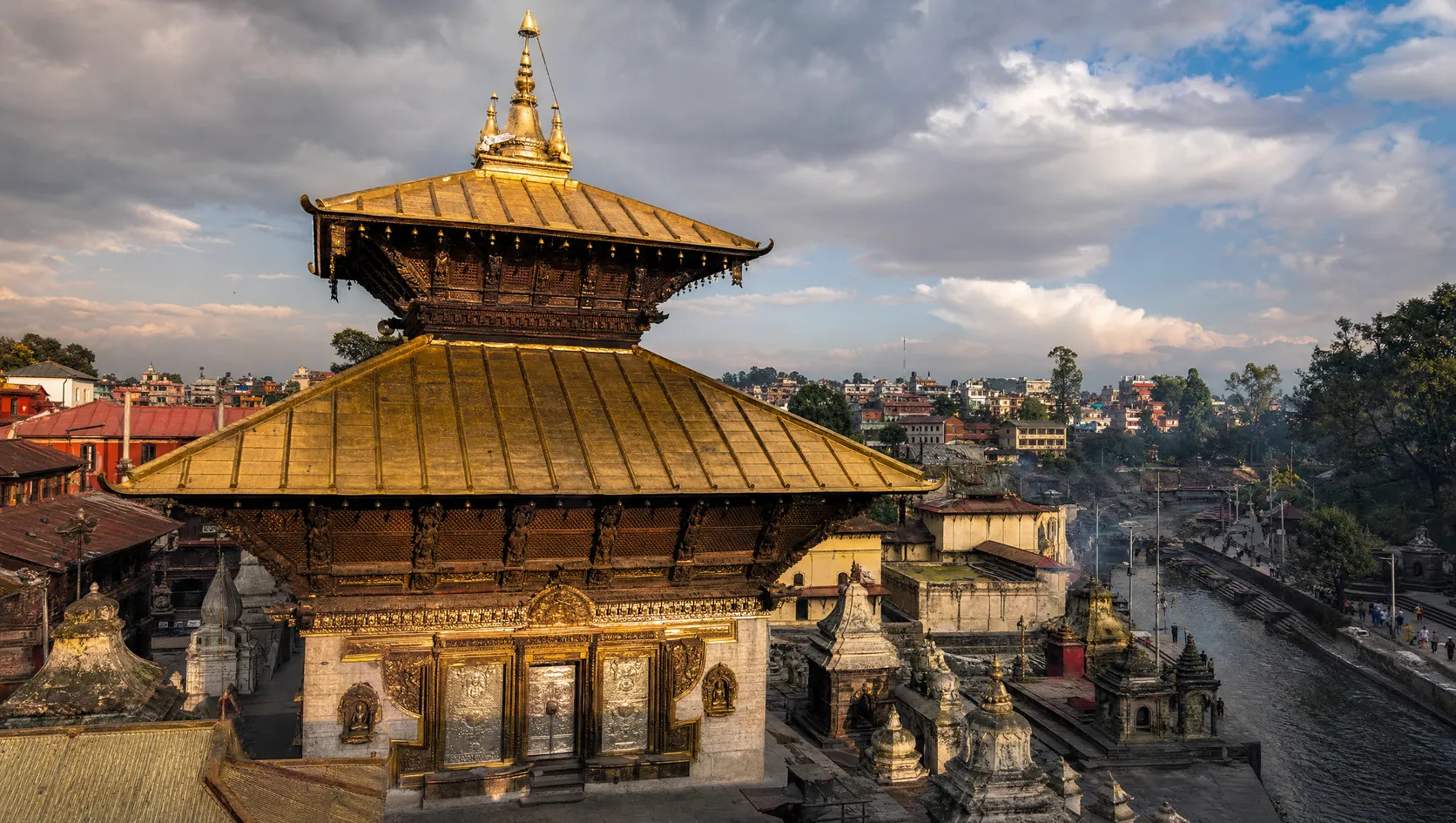
Nepalese pagoda, with a two-tiered gilded roof, gilt finial and silver-clad doors, set within a large walled complex of subsidiary shrines
विशेष
The evening Bagmati aarti on the ghats is among the most attended observances at the site and is visible to all visitors, including those not permitted inside the main sanctum.
पवित्र कथा · पवित्र कथा
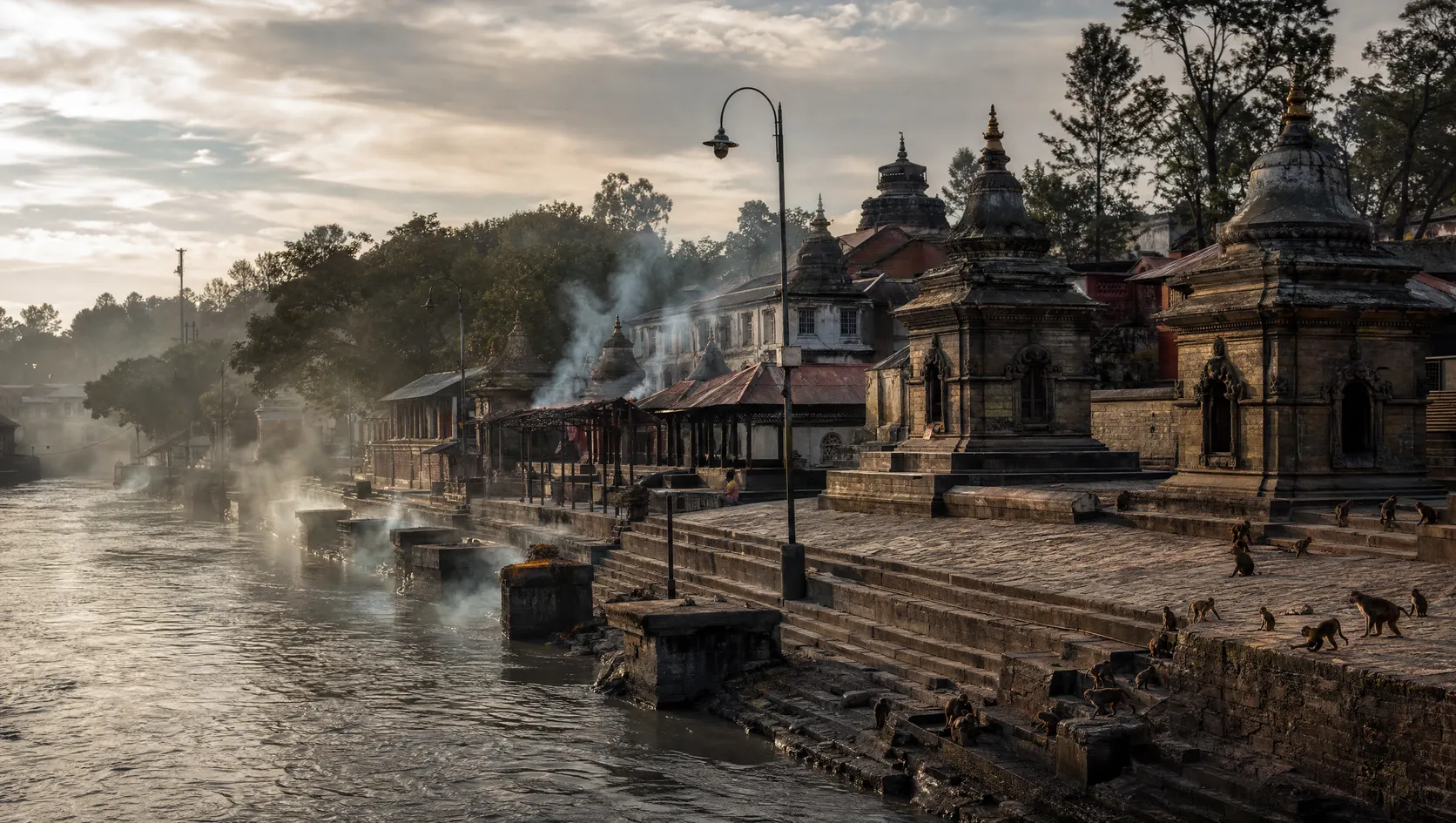
Pashupati means lord of pashu, and pashu is usually translated as animals. But in Shaiva philosophy the word is technical. Pashu is the bound soul, tethered by pasha, the noose of attachment and ignorance, and Pashupati is the one who holds the tether and can release it. The name is not pastoral. It is a statement about bondage. Which is why the geography matters. The Bagmati runs past the temple, and on its banks the cremations never stop. Families burn their dead on the Arya Ghat within sight of the shrine, and the smoke crosses the water while worship continues on the other side. Most traditions keep death at a distance from the sanctum. Here the tether is cut in the open, a few metres from the god named for holding it.
Sacred Designationपवित्र पदनाम
Sacred Origin Storyपवित्र उत्पत्ति कथा
Source: The Sleshmantak forest account preserved in Nepalese Shaiva tradition and regional Puranic material
The account most often told has Shiva growing weary. Not of anything in particular, and not because of a crisis; simply tired of Kailasa and of being consulted, of Parvati and of the obligations that attend a god who is the resort of everyone else's difficulties.
So he left. He came down to the Bagmati valley, to a forest called Sleshmantak, and took the form of a deer to live there unrecognised. He grazed. He did nothing of consequence. By the terms of the story this went on for some time and he was content.
The other gods eventually found him and were not sympathetic. They tried to force him back to Kailasa and he refused, so they laid hands on him. In the struggle one of them seized him by the horn and it broke.
The fragment that stayed behind became the object of worship, and the place where it fell became the shrine. Shiva returned to his own form and to his responsibilities, but he declared that whoever came to this place would be released from the cycle of rebirth as an animal.
What is striking is the motive the tradition assigns. He did not come to destroy anything, or to grant a boon, or to test a devotee. He came because he wanted to stop being Shiva for a while, and he was dragged back by a horn that snapped in the process. The greatest Shaiva shrine outside India commemorates a god's failed attempt to be left alone.
उद्धृत स्रोत:
- Nepala Mahatmya
- Himavatkhanda of the Skanda Purana
- Nepalese Shaiva tradition of the Sleshmantak forest
विद्वत संदर्भ
The site's antiquity is established by Licchavi-period inscriptions, which place an important shrine here in the first millennium and make Pashupatinath one of the better-documented early religious centres of the Himalayan region. The Sleshmantak narrative belongs to the Nepala Mahatmya and related regional material and is later than the inscriptional evidence for the shrine itself. Scholars note the distinctive shape of Shaiva development in the valley. The Nepalese pagoda form, the Bhatta priesthood drawn from South India, and the integration of the cremation ghats into the temple complex are each locally particular, and together they mark Pashupatinath as a centre that developed its own idiom rather than importing one wholesale. The temple's standing as national deity, and its role in Nepalese state ceremonial, is documented in administrative and constitutional history rather than only in devotional sources.
Historyइतिहास
Pashupatinath's documented history runs through the Licchavi period, whose inscriptions attest to the shrine's standing in the Kathmandu valley, and the site's sanctity is held in tradition to be considerably older still. Successive Nepalese dynasties treated it as the pre-eminent shrine of the realm, and it became the national deity of Nepal, invoked in state contexts as well as personal devotion.
The Malla period brought substantial patronage and the accumulation of subsidiary shrines around the main temple. In the fourteenth century the valley suffered a damaging raid from Bengal under Sultan Shamsuddin Ilyas, in which shrines including Pashupatinath were attacked; the temple was subsequently restored.
The present principal structure is largely the result of a late seventeenth-century rebuilding, undertaken after the earlier building was found to be badly damaged by termites. The complex around it accumulated over centuries: subsidiary shrines, rest houses, ghats and the Guhyeshwari temple nearby, revered as a Shakti Peeth. The whole forms part of the Kathmandu Valley UNESCO World Heritage property, inscribed in 1979.
After Prithvi Narayan Shah's unification of Nepal in the eighteenth century the temple's position as state shrine was consolidated, and Rana-period patronage in the nineteenth century added further to the complex.
A distinctive feature of the temple's administration is its priesthood. By long-standing tradition the main priests, the Bhattas, are drawn from South India rather than from Nepal, a practice attributed in tradition to Adi Shankaracharya. The arrangement has been maintained across centuries and has periodically become a matter of public and political controversy in Nepal, most visibly in 2009 when an attempt to appoint Nepali priests met with protest and legal challenge, and the traditional arrangement was ultimately retained.
The 2015 Nepal earthquake devastated much of the Kathmandu Valley's heritage architecture. The main Pashupatinath temple came through comparatively well, though parts of the wider complex and many other valley monuments did not, and restoration work across the property continued for years afterwards.
Historical Timelineऐतिहासिक कालक्रम
Inscriptions from the Licchavi era attest to the shrine's established standing in the Kathmandu valley, making Pashupatinath one of the better-documented early religious centres of the Himalayan region.
The inscriptional record establishes the shrine's importance independently of the later Sleshmantak narrative.
The Sleshmantak account and the identification of the site with Shiva's residence as a deer take shape in the Nepala Mahatmya and related regional material.
The narrative post-dates the earliest inscriptional evidence for the shrine.
Malla-period patronage supports the temple and the accumulation of subsidiary shrines and rest houses across the complex.
The Kathmandu valley suffers a damaging raid from Bengal under Sultan Shamsuddin Ilyas, in which shrines including Pashupatinath are attacked. The temple is subsequently restored.
Chronicle accounts of the raid vary in detail; the fact of significant damage to valley shrines is generally accepted.
The principal temple is rebuilt after the earlier structure is found to be badly damaged by termites. This rebuilding gives the shrine much of its present form.
Prithvi Narayan Shah completes the unification of Nepal, and Pashupatinath's position as the state shrine of the new kingdom is consolidated.
Rana-period patronage adds further structures and endowments to the complex, and the temple's ceremonial role in Nepalese state life is formalised.
The Kathmandu Valley, including Pashupatinath, is inscribed as a UNESCO World Heritage property.
The Pashupati Area Development Trust is established to administer the temple and the surrounding heritage area, consolidating management of the complex and its conservation.
Nepal becomes a republic, ending the monarchy that had held a formal ceremonial relationship with the temple. The shrine's standing as national deity persists, but the constitutional framework around it changes.
An attempt to appoint Nepali priests in place of the traditional South Indian Bhattas meets with protest and legal challenge. The traditional arrangement is ultimately retained.
The episode illustrates that the Bhatta arrangement, though centuries old, is actively contested rather than passively inherited.
The Nepal earthquake devastates much of the valley's heritage architecture. The main temple survives comparatively well, but parts of the wider complex are damaged and restoration continues for years.
The main shrine's relative survival is attributed in part to its construction and maintenance history rather than to chance alone.
What You'll Seeदर्शन में
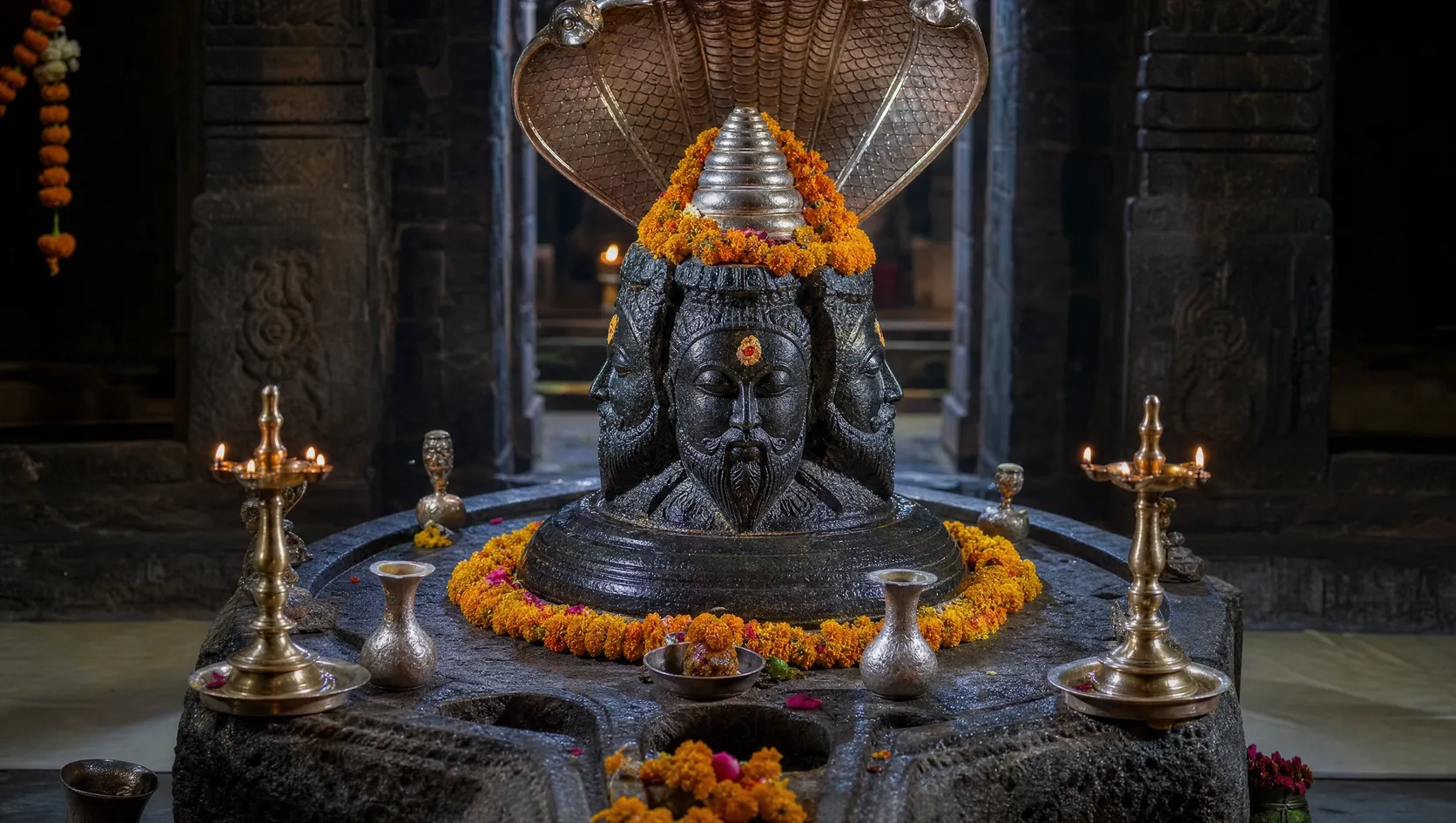
The object of worship is a linga, and it is chaturmukha, four-faced, with a fifth aspect understood above. Each of the four faces looks to a cardinal direction and carries its own name and character in Shaiva theology: Sadyojata to the west, Vamadeva to the north, Aghora to the south, Tatpurusha to the east, with Ishana as the formless fifth understood upward. These are not decorative variations but the five aspects through which Shaiva Siddhanta describes the deity's functions, so the linga is a compact statement of the whole system.
The faces are covered with a gold sheath, and each of the four silver-clad doors of the sanctum opens toward one of them.
The temple itself is a Nepalese pagoda rather than a North Indian shikhara or a Dravidian vimana, with a two-tiered gilded roof, a gilt finial and silver-clad doors on four sides. Struts beneath the roof carry carved figures. The idiom is distinctly of the valley, and it is one of the clearest architectural markers that Shaiva worship here developed its own regional form rather than importing one.
A large gilded Nandi faces the sanctum, positioned as at Shiva temples elsewhere but cast in the valley's own metalwork tradition. The wider complex holds many subsidiary shrines and lingas accumulated over centuries, and the Guhyeshwari temple, revered as a Shakti Peeth, lies a short walk away.
Distinctive Practicesविशिष्ट परंपराएँ
Cremation on the Arya Ghat
आर्य घाट पर दाह-संस्कार
Continuous
Cremations are performed on the ghats along the Bagmati beside the temple, and continue through the day. The ghats are open, and the rites are visible from the opposite bank, where visitors and pilgrims gather. The Arya Ghat, closest to the temple, has historically been reserved for particular rites including royal cremations.
The Bagmati's waters are held to join the Ganga, and dying or being cremated within sight of Pashupatinath is understood to release the bound soul from the tether the deity's own name describes. Death is not kept away from the shrine; it is brought to its edge deliberately, so that the doctrine and the practice occupy the same ground.
The Bhatta Priesthood from South India
दक्षिण भारत से भट्ट पुरोहित
Long-standing tradition, continuing
The main priests of the temple, the Bhattas, are traditionally drawn from South India rather than from Nepal, and only they may perform the principal rites and touch the linga. The practice is attributed in tradition to Adi Shankaracharya and has been maintained across centuries.
The arrangement binds a Himalayan shrine institutionally to the Dravidian south, and is read as a continuing expression of Shankaracharya's project of tying the subcontinent's Shaiva centres into a single network. That it has periodically been contested in Nepal makes it a living arrangement rather than an inherited formality.
Maha Shivaratri Gathering
महाशिवरात्रि समागम
Feb-Mar, annually
Maha Shivaratri draws enormous crowds, including sadhus who travel from across India and remain on the grounds for days before and after. The complex fills with ascetics, night-long vigil, bonfires and continuous worship, and the Nepalese state makes special arrangements for the numbers.
The night is held to be Shiva's own, and the gathering of ascetics from beyond Nepal's borders marks Pashupatinath's standing as a shrine of the whole Shaiva world rather than of one country. The sadhus who arrive are not visitors to a foreign temple; by the terms of the tradition they are coming to their own.
Worship at the Four Doors
चारों द्वारों पर उपासना
Daily ritual sequence
The sanctum has four silver-clad doors, each opening toward one face of the chaturmukha linga. The daily ritual sequence addresses the faces in turn rather than treating the linga as a single undifferentiated object.
Each face names a distinct aspect through which Shaiva Siddhanta describes the deity's action in the world, so moving between the doors is a movement through the system's categories. The worshipper does not address one god from one position but the same god under four descriptions.
Did You Know?क्या आप जानते हैं?
Pashupati is a technical term before it is a title. Pashu is the bound soul and pasha the noose of attachment, so Pashupati means the one who holds and can release the tether, not simply a lord of animals.
Shaiva Siddhanta terminology (pati, pashu, pasha)
The temple's chief priests have traditionally been brought from South India rather than appointed locally, a practice attributed to Adi Shankaracharya and maintained for centuries at a Himalayan shrine. An attempt to change it in 2009 met with protest and was reversed.
Temple administrative tradition; Nepalese court proceedings, 2009
The linga is chaturmukha, and its four faces are the named aspects of Shaiva Siddhanta: Sadyojata, Vamadeva, Aghora and Tatpurusha, with Ishana understood as the formless fifth. The object of worship is a compact statement of an entire theological system.
Shaiva Siddhanta and the temple's own iconographic tradition
Pashupatinath is the national deity of Nepal, and the shrine has historically held a constitutional and ceremonial standing in the state beyond ordinary temple status, which persisted in altered form after Nepal became a republic in 2008.
Nepalese state and ceremonial practice
In the tradition Shiva came here not to accomplish anything but to stop being Shiva for a while, and was dragged back by a horn that broke in the struggle. The shrine commemorates a failed attempt at solitude.
Nepala Mahatmya; Sleshmantak forest tradition
The main temple came through the 2015 earthquake comparatively well, although much of the Kathmandu Valley's heritage architecture, including parts of the wider complex, was severely damaged.
Post-2015 earthquake heritage assessments of the Kathmandu Valley
The Guhyeshwari temple, a short walk from the main shrine, is revered as a Shakti Peeth, so the complex holds a major Shaiva and a major Shakta centre within the same riverside precinct.
Shakti Peeth tradition; Kathmandu Valley temple topography
Visitor Accessप्रवेश जानकारी
Entry to the main temple courtyard is restricted to Hindus, and this is enforced at the gates. Visitors who are not permitted inside may view the temple from the eastern bank of the Bagmati, which is open to all and gives a clear view of the complex and the ghats. The cremation ghats are active and in constant use by grieving families. Photography of cremations is intrusive and widely resented, whatever the local signage may or may not say; treat the ghats as a funeral in progress rather than a viewpoint. Monkeys are numerous throughout the complex and will take food and loose belongings. Footwear is removed at shrine entrances, and there are the usual security and bag arrangements at the gates. Entry rules and any visitor fees are set by the temple trust and Nepalese authorities and should be confirmed before travelling.
आध्यात्मिक आधार
The restriction on sanctum entry follows from the Bhatta arrangement and the ritual status of the linga: only the appointed priests may touch it, and access to the courtyard is governed by the same logic of ritual eligibility rather than by exclusion for its own sake. The openness of the ghats works the other way. Death here is not screened off, because the doctrine holds that the tether is cut at precisely this place. To hide the cremations would be to hide the thing the shrine is for.
समकालीन संदर्भ
Pashupatinath sits at the intersection of active worship, a major heritage property and a significant tourist circuit, and the three do not always sit easily together. The ghats in particular draw photographers, and the resulting friction with mourning families is a real and recurring problem rather than a hypothetical one. The complex is also home to sadhus, some resident and some seasonal, and visitors are frequently approached for photographs in exchange for money. This is a transaction rather than an encounter with renunciation, and it is reasonable to decline. Post-2015 restoration is ongoing across the wider Kathmandu Valley property, so scaffolding and closed sections should be expected somewhere in the complex.
व्यावहारिक मार्गदर्शन
Early morning and the hour of the evening aarti are the two best times. The complex is large and spread across both banks, so allow two to three hours rather than a quick visit. Do not photograph cremations. If in doubt about whether something may be photographed, assume not. Keep bags closed and food out of sight because of the monkeys. Combine the visit with Guhyeshwari, a short walk away, and with Boudhanath, which is nearby, if making a day of the eastern side of Kathmandu.
Festivalsत्योहार
Maha Shivaratri
महाशिवरात्रि
Feb-Mar (Phalgun Krishna Chaturdashi)
The greatest observance at Pashupatinath, drawing very large crowds and sadhus who travel from across India and remain on the grounds for days. Night-long vigil, continuous worship and bonfires mark the festival, and the state makes special arrangements for the numbers. For many of the visiting ascetics this is the principal gathering of their year, and the complex takes on the character of a temporary encampment as much as a temple.
Teej
तीज
Aug-Sep (Bhadrapada Shukla Tritiya)
Women gather at the temple in very large numbers, traditionally in red, observing the fast and the associated rites, singing and dancing in the precincts. It is among the most visually distinctive gatherings of the Nepalese year and the queues can extend far beyond the complex.
Bala Chaturdashi
बाला चतुर्दशी
Nov-Dec (Margashirsha Krishna Chaturdashi)
Observed in remembrance of the dead, with a night-long vigil and the scattering of seeds along a prescribed route through the temple grounds and the Sleshmantak forest the following morning. Those who have lost someone in the preceding year take part. At a shrine built where the tether between life and death is held to be cut, the observance for the dead is not an adjunct but close to the centre.
Shrawan Mondays
श्रावण के सोमवार
Jul-Aug (Shrawan)
Each Monday of the month of Shrawan draws heavy attendance, with devotees offering water and milk to the linga. The month is held to be Shiva's own, and the queues on these days are among the longest of the ordinary year.
Traditional Offeringsपारंपरिक अर्पण
प्राथमिक अर्पण
Bel Patra (Bilva leaves)
बेल पत्र
बिल्व पत्र
The three leaflets of the bilva are read as the three eyes of Shiva and the three prongs of his trident, and the leaf is the offering most closely associated with him. The Shiva Purana holds that a single bilva leaf offered with devotion surpasses elaborate ritual. At Pashupatinath bilva is offered at the four doors along with water, and the leaf is among the few offerings a visitor can bring without arrangement.
Water and milk for abhishekam
अभिषेक हेतु जल और दूध
Pouring water or milk over the linga is the central act of Shiva worship, understood as cooling the fierce aspect and as the simplest offering available to anyone. In Shrawan the practice intensifies and the Monday queues are given over almost entirely to it. Because only the Bhatta priests may touch the linga, offerings are made through them or at the doors rather than directly by the devotee.
Rudraksha
रुद्राक्ष
रुद्राक्ष
The seed of the rudraksha tree, worn as a mala and offered at Shiva shrines, is held to have arisen from Shiva's own tears. Nepal is among the principal sources of rudraksha, and the beads sold and offered around Pashupatinath are part of a trade centred on the country's eastern hills. The offering and the local economy are therefore the same object, which is unusual and worth noticing.
Bhasma (sacred ash)
भस्म
भस्म
Ash is applied to the forehead and offered in Shaiva worship, and at Pashupatinath its meaning is unusually direct: the cremation grounds are metres away, and ash is what remains when the body has finished. The substance is a reminder rather than a decoration. Wearing it marks acceptance of the same end that is being enacted on the ghats below.
इस मंदिर की विशेषता
Offerings at the Four Silver Doors
चारों रजत द्वारों पर भेंट
The sanctum's four silver-clad doors each open toward one face of the chaturmukha linga, and offerings are made at the doors in turn rather than at a single point. The arrangement means a full offering here involves circumambulating the sanctum and addressing the deity four times under four names. What is offered is the same; what changes is which aspect of Shiva is being addressed, so the act carries the structure of Shaiva Siddhanta in its physical form.
Offerings are commonly bought from stalls immediately outside the complex, and bilva, flowers, milk and lamps are all readily available there. Because only the Bhatta priests may touch the linga, offerings intended for it pass through them. Visitors not permitted into the courtyard can still make offerings at the many subsidiary shrines across the complex and along the riverbank, which are not subject to the same restriction.
How to Reachकैसे पहुँचें
Pashupatinath is on the eastern edge of Kathmandu, at Deopatan, and is straightforward to reach from anywhere in the city.
By air: Tribhuvan International Airport is roughly 4 km away, which makes the temple one of the closest major sites to the airport. Kathmandu has direct connections to Indian cities and across Asia and the Gulf.
By road within Kathmandu: Taxis and ride-hailing operate throughout the city, and local buses serve the area. Traffic is heavy and air quality poor at some times of year, so allow more time than the distance suggests.
Overland from India: the usual crossings are Sunauli (for Gorakhpur) and Raxaul (for Patna), followed by a long road journey to Kathmandu, typically a full day or more. Kakarbhitta serves travellers from West Bengal and the northeast. Journey times lengthen considerably in the monsoon when landslides affect the hill roads.
Border formalities: this is an international frontier. Passport and visa requirements apply and vary by nationality; Indian nationals travel under separate long-standing arrangements. Confirm current requirements before setting out.
Within the complex: the site is large and spread across both banks of the Bagmati, connected by bridges. Guhyeshwari temple lies a short walk away, and Boudhanath is nearby.
Plan Your Visitयात्रा की योजना
🌤 सर्वोत्तम मौसम
October and November are the clearest and most comfortable months in the Kathmandu valley, with settled weather and mountain views, followed by March and April. The monsoon, roughly June to September, brings heavy rain; the Bagmati runs high and dirty, and overland travel from India is slower. Winter mornings are cold but clear, and the valley's winter air pollution is at its worst in the mornings of the coldest months. Maha Shivaratri (Feb-Mar) is the most extraordinary time to be there and also by far the most crowded, with movement through the complex slow and the grounds occupied by visiting sadhus. Shrawan Mondays (Jul-Aug) bring the longest ordinary queues of the year. Early morning and the hour of the evening Bagmati aarti are the two most rewarding windows on an ordinary day.
👘 पहनावे का नियम
Modest traditional dress is expected, and shoulders and legs should be covered. There is no code as prescriptive as at the strictest South Indian temples, but shorts and sleeveless tops are inappropriate and may attract objection. Footwear is removed at shrine entrances. Given the size of the complex and the amount of walking between shrines and across bridges, comfortable shoes that come off easily are the practical choice.
📱 फोन और फोटोग्राफी
Photography is not permitted inside the main sanctum. In the wider complex it is generally allowed, with one absolute exception: do not photograph cremations, or mourning families, at any distance. This is stated plainly because it is the single most common failure of conduct at the site. The ghats are visible and open, which some visitors read as permission; the families using them do not.
🏨 आवास
There is no large-scale pilgrim accommodation at the temple itself. Kathmandu offers the full range, from guest houses in Thamel to hotels near the airport, and the temple is easily reached from anywhere in the city. Staying on the eastern side, near Boudhanath or the airport, puts you closest and makes an early-morning visit straightforward. Demand across the city rises sharply around Maha Shivaratri and in the October to November trekking season, so book ahead for those periods.
Sacred Soundsपवित्र ध्वनि
क्या आप जानते हैं? · Did You Know?
वही अनुवाद त्रुटि जिसने हिन्दू धर्म में '33 कोटि' को '33 करोड़' बनाया, बौद्ध धर्म में भी हुई। बौद्ध ग्रन्थों के चीनी अनुवाद ने 'सप्त कोटि बुद्ध' (7 श्रेष्ठ बुद्ध) का अनुवाद '7 करोड़ बुद्ध' कर दिया। तिब्बती अनुवाद ने सही किया: 7 प्रकार, 7 करोड़ नहीं। एक संस्कृत शब्द, दो प्रमुख विश्व धर्मों में गलत पढ़ा गया, ने दो एकसमान भ्रम स्वतन्त्र रूप से उत्पन्न किए।
Related Contentसंबंधित सामग्री
Related Scriptures
Community Reflections
🕉️
Be the first to share your reflection.