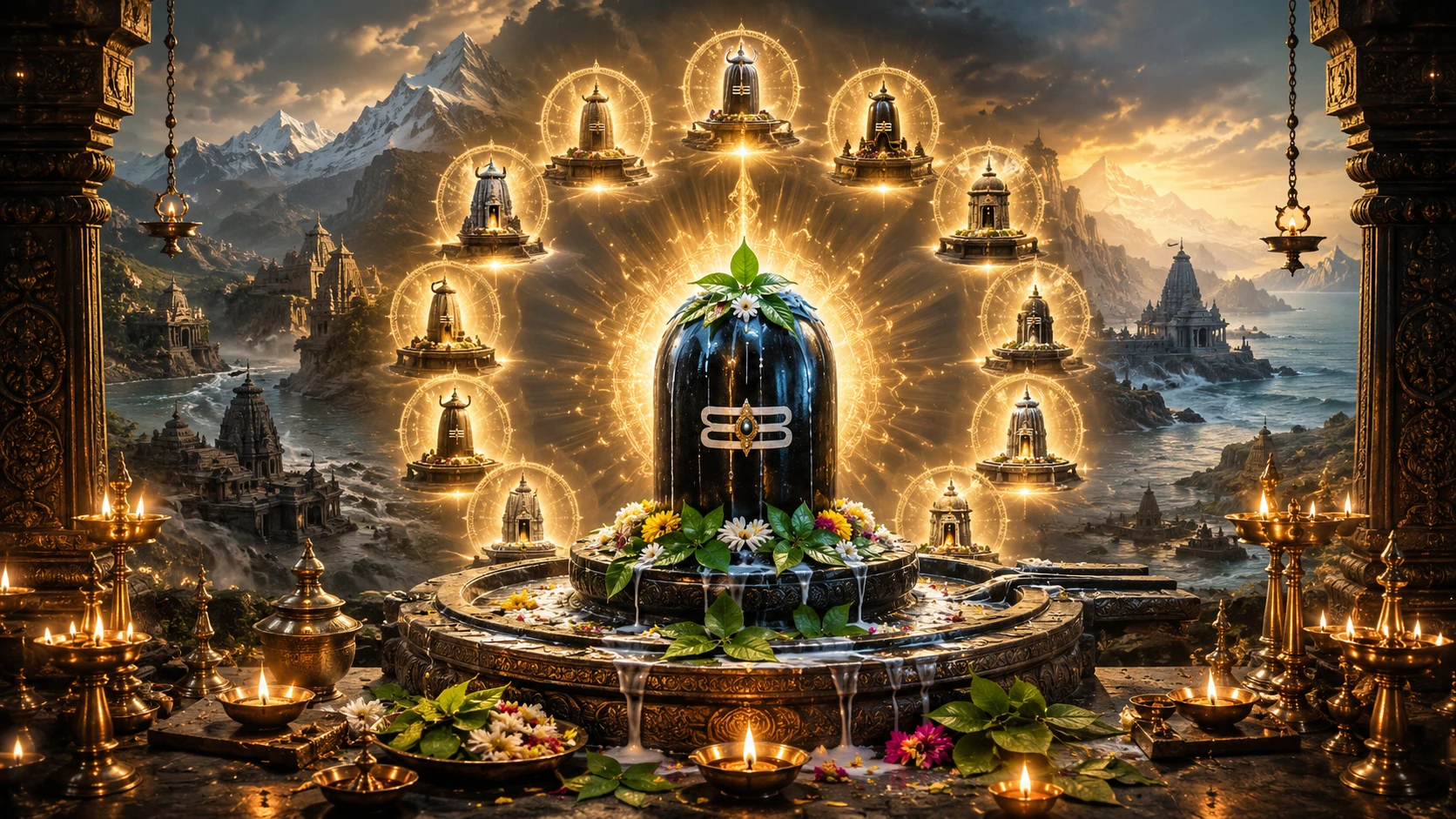
Twelve temples across India mark the spots where Shiva appeared as an endless pillar of light. Each Jyotirlinga carries its own geography, its own legend, and its own texture of worship. This is a pilgrim's guide for those who cannot yet travel, and a reminder for those who have.
A Pillar of Light With No End
The story begins with an argument. Brahma and Vishnu each claimed to be supreme. To settle the matter, Shiva appeared between them as a column of fire that stretched beyond sight in both directions. Brahma flew upward as a swan to find the top. Vishnu dove downward as a boar to find the base. Neither found an end. The column was infinite, and the twelve places where it touched the earth became the Jyotirlinga (lingas of light), the sites where Shiva's presence is said to be self-manifested rather than installed by human hands.
Twelve temples mark these sites. They span the subcontinent from the Arabian Sea coast of Gujarat to the Bay of Bengal shore of Tamil Nadu, from the Himalayan snow line at Kedarnath to the Deccan plateau at Grishneshwar. No single pilgrimage circuit covers all twelve easily. That is part of the point. A complete Jyotirlinga yatra (pilgrimage) is a life's work, not a holiday.
Somnath -- Gujarat
Somnath stands where the Arabian Sea meets the western tip of Gujarat, at Prabhas Patan near Veraval. The temple has been destroyed and rebuilt at least six times across twelve centuries, and what stands today is a 1951 reconstruction in Chalukya style. The sound that defines Somnath is the sea. You hear it inside the sanctum, a low steady roar beneath the bells and the chanting, the ocean pressing against the temple's back wall as it has for a thousand years.
Mallikarjuna -- Andhra Pradesh
Mallikarjuna sits on Shri Shaila, a flat-topped hill in the Nallamala range of Andhra Pradesh. The climb from the base takes you through dry deciduous forest thick with the smell of neem and tamarind. The temple is one of the few sites in India where both a Jyotirlinga and a Shakti Peetha occupy the same complex, making it a shared pilgrimage for devotees of both Shiva and Parvati.
Mahakaleshwar -- Madhya Pradesh
Mahakaleshwar is in Ujjain, the city that hosts the Kumbh Mela every twelve years. The temple's defining ritual is the Bhasma Aarti, performed before dawn, where the lingam is covered in fresh ash from cremation grounds. Devotees who attend the 4 AM ceremony describe the same thing: the smell of ash and sandalwood in a cold, dark sanctum, and the feeling of time stopping as the priests begin.
Omkareshwar -- Madhya Pradesh
Omkareshwar sits on Mandhata island in the Narmada river, and the island itself is shaped like the syllable Om when seen from above. The temple is reached by a footbridge over the Narmada. The water beneath is green, slow, and surprisingly cold. Pilgrims who complete the parikrama (circumambulation) of the island walk seven kilometres along a path that follows the river's edge, with the temple always visible across the water.
Kedarnath -- Uttarakhand
Kedarnath stands at 3,583 metres in the Garhwal Himalayas, behind the Mandakini river, backed by snow peaks. The temple opens only six months a year, from April to November. The remaining months it sits buried in snow, with the deity moved to Ukhimath village for winter worship. The trek from Gaurikund is sixteen kilometres uphill. By the time you reach the temple, your legs know you have earned the darshan. The air is thin, the wind is sharp, and the stone walls of the sanctum hold a cold that does not leave.
Bhimashankar -- Maharashtra
Bhimashankar is in the Western Ghats, a few hours from Pune, surrounded by dense forest that is now a wildlife sanctuary. The temple sits at the source of the Bhima river. During monsoon, the green is so thick that the path to the temple disappears into mist and dripping leaves. The Nagara-style architecture is modest compared to Somnath or Rameshwaram, but the setting, raw and wet and green, is among the most striking of any Jyotirlinga.
Kashi Vishwanath -- Uttar Pradesh
Kashi Vishwanath is in Varanasi, the city that never closes. The temple stands in the dense lanes of the old city, a few hundred metres from the Ganga ghats. After the 2021 Kashi Vishwanath Corridor reconstruction, the temple complex opens directly onto the river for the first time in centuries. The morning aarti at this temple draws thousands. The sensory signature is unmistakable: marigold garlands, wet stone, sandalwood paste, and the press of bodies in a narrow passage leading to the sanctum.
Trimbakeshwar -- Maharashtra
Trimbakeshwar is near Nashik, at the source of the Godavari river. The lingam here has three faces representing Brahma, Vishnu, and Shiva. The temple hosts a Kumbh Mela of its own, the Nashik-Trimbak Simhastha, every twelve years. The town is small and quiet between festivals, and the walk from the temple to the Godavari source at Brahmagiri hill takes less than an hour through open farmland.
Vaidyanath -- Jharkhand
Vaidyanath (also called Baba Baidyanath Dham) is in Deoghar, Jharkhand. The temple is the endpoint of a 108-kilometre Kanwar Yatra that begins at Sultanganj on the Ganga, where devotees carry river water on foot to pour over the lingam. During Shravan, the road between Sultanganj and Deoghar becomes a continuous procession of saffron-clad pilgrims walking in single file, often through the night.
Nageshwar -- Gujarat
Nageshwar is between Dwarka and the island of Bet Dwarka on the Gujarat coast. The temple is quieter than Somnath and less visited, which gives it a stillness the busier Jyotirlingas do not have. A 25-metre Shiva statue sits in the open grounds outside, visible from the highway. Inside, the sanctum is underground, and the descent into the dim, cool lower chamber feels like entering a different climate.
Rameshwaram -- Tamil Nadu
Rameshwaram sits on Pamban Island off the southeastern tip of India, connected to the mainland by a rail bridge that opens in the middle to let ships pass. The Ramanathaswamy temple holds the longest corridor of any Hindu temple in India. Pilgrims bathe in twenty-two sacred wells inside the temple complex before darshan, each well carrying water of a different temperature. The salt air, the long pillared halls, and the sound of water being poured over stone stay with you after you leave.
Grishneshwar -- Maharashtra
Grishneshwar is near Ellora, a kilometre from the UNESCO cave temples in Aurangabad district. It is the smallest of the twelve Jyotirlinga temples. The red stone structure is compact, and the darshan line moves quickly. If you visit the Ellora caves, Grishneshwar is a ten-minute walk away. Many pilgrims visit both in a single morning, stepping from Buddhist and Jain cave art into a living Shaiva temple without changing their shoes.
When You Cannot Travel
Not everyone can walk to Kedarnath or drive to Rameshwaram. Hindu tradition has always recognised this. The concept of manasika tirtha (mental pilgrimage) allows a devotee to visit a temple through prayer, visualisation, and recitation of the temple's associated mantra. A grandmother in a Jaipur flat reciting Om Namah Shivaya while thinking of Kashi Vishwanath is, within the tradition, performing a form of darshan.
The twelve Jyotirlinga temples are documented in the Temple section of Eternal Raga, with history, location, significance, and associated mantras for each. Whether you visit in person or through prayer, the pillar of light the tradition describes has no walls around it.
Explore All 12 Jyotirlinga Temples
Jyotirlinga Temples on Eternal Raga
All 12 Jyotirlinga temples with history, location details, significance, and associated Shiva mantras. Plan your pilgrimage or begin a manasika tirtha from where you are.
Explore on Eternal RagaTags
Community Reflections
🕉️
Be the first to share your reflection.