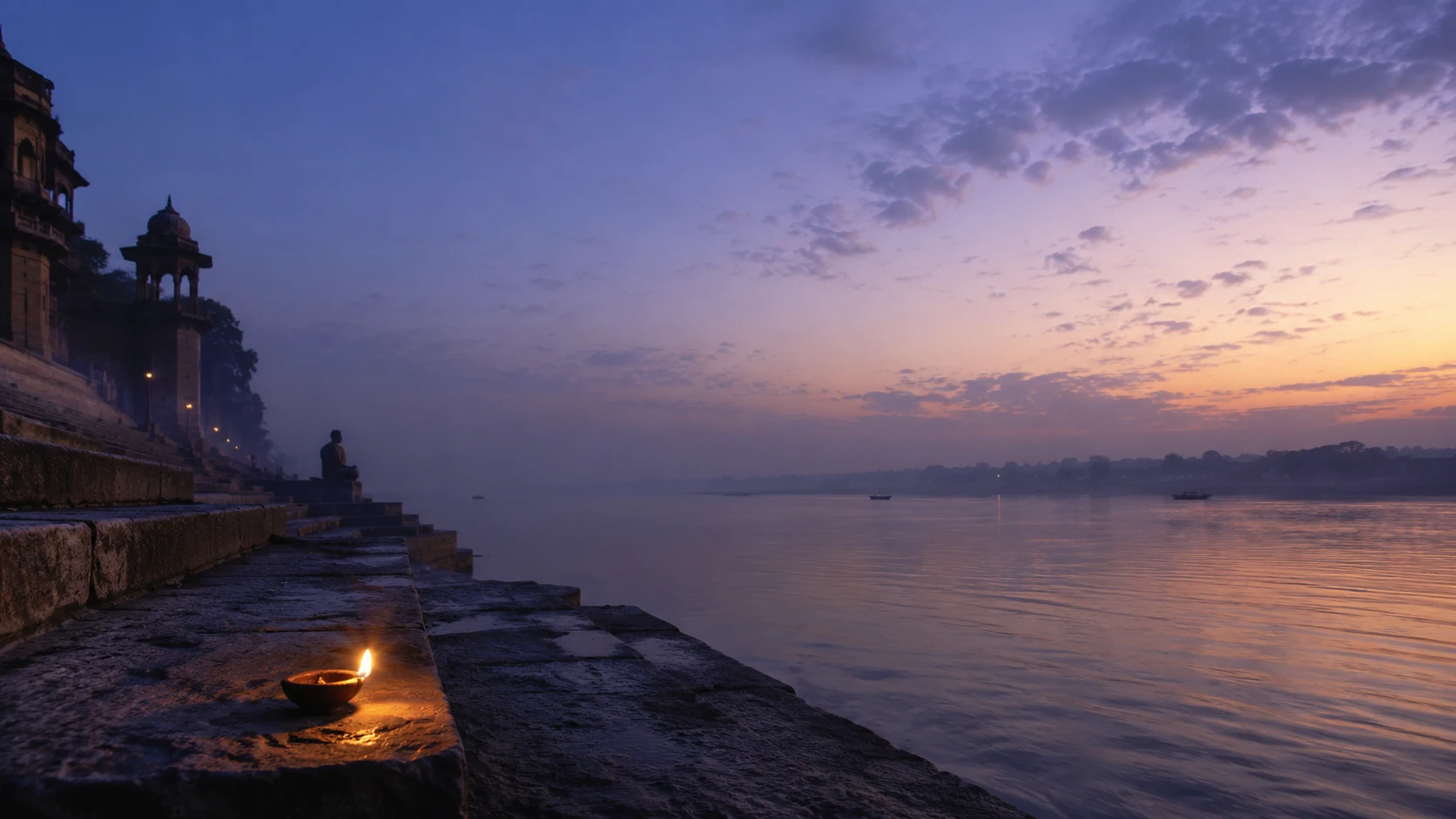
Social media has turned Brahma Muhurta into a productivity hack: wake at 4 AM, activate your pineal gland, synchronize with the Universe. Most of these claims would not survive a conversation with either a Sanskrit scholar or a sleep researcher. The tradition says something simpler, older, and more useful than any of that.
A *muhurta* is a Vedic unit of time equal to forty-eight minutes. The day contains thirty muhurtas, fifteen for the day half and fifteen for the night half. Brahma Muhurta is the second-to-last muhurta of the night: it begins ninety-six minutes before sunrise and ends forty-eight minutes before sunrise. If the sun rises at 6:00 AM, Brahma Muhurta runs from 4:24 AM to 5:12 AM. The name breaks into two parts: "Brahma" (here meaning knowledge or the creative principle, not the deity Brahma specifically) and "muhurta" (a measured period of time). The *Ashtanga Hridayam*, one of the foundational Ayurvedic texts, prescribes waking during this window. The *Sushruta Samhita* agrees. So do multiple Dharmashastra texts. The instruction is old, consistent, and specific down to the minute.
What does the tradition claim about this window? The *Ashtanga Hridayam* (Sutrasthana, Chapter 2) states that a person who wakes during Brahma Muhurta to protect their health and lifespan will not be afflicted by disease. The framing is Ayurvedic, not mystical: the text treats early waking as a health prescription alongside dietary rules and seasonal regimens. It does not mention pineal glands, nascent oxygen, or cosmic synchronization. The Sankhya framework offers a second lens. In Sankhya philosophy, all matter is composed of three gunas: *sattva* (clarity, lightness), *rajas* (activity, agitation), and *tamas* (inertia, heaviness). The pre-dawn hours, by this framework, are sattvic: the environment is still, noise is low, and the mind has not yet filled with the day's inputs. The tradition's claim is that the quality of mental activity during a sattvic period is different from the quality during a rajasic afternoon or a tamasic late night. This is a philosophical framework, not a scientific measurement. It describes a subjective quality of experience, and most people who have sat in meditation at 4:30 AM and again at 10 PM will confirm that the two sessions feel different.
ब्राह्मे मुहूर्ते उत्तिष्ठेत् स्वस्थो रक्षार्थमायुषः
One who is healthy should wake during Brahma Muhurta to protect their lifespan.
Now set the texts aside and look at what sleep science says about the same window. The human body runs on a circadian clock governed by a cluster of neurons in the hypothalamus called the suprachiasmatic nucleus. This clock regulates, among other things, two hormones relevant to the Brahma Muhurta discussion. Melatonin, which promotes sleep, begins declining in the early morning hours as the body prepares for wakefulness. Cortisol, which promotes alertness, begins rising in what researchers call the cortisol awakening response, typically starting thirty to forty-five minutes before habitual wake time. The overlap between melatonin's decline and cortisol's rise creates a transitional window in which the brain moves through lighter sleep stages. EEG studies show increased alpha and theta wave activity during this transition: these are the brainwave patterns associated with relaxed alertness, the state between sleep and full waking. None of this is specific to 4:24 AM. The timing follows each individual's circadian rhythm and light exposure. But for someone sleeping by 10 PM in a region where the sun rises around 6 AM, the biological transition aligns closely with the Brahma Muhurta window. The tradition did not have EEGs. It had centuries of practitioners reporting that the pre-dawn mind was different.
Here is where popular accounts go wrong. The carousel versions of Brahma Muhurta claim that pre-dawn air contains "nascent oxygen (O3)" that floods the atmosphere and energizes cells. O3 is ozone. At ground level, ozone is a respiratory irritant classified as a pollutant by every environmental agency in the world. Pre-dawn air is not flooded with it, and breathing it does not boost hemoglobin. The early morning air does tend to be cleaner in Indian cities because traffic has not yet started and thermal inversions that trap pollution often lift after sunrise. That is a real and measurable benefit. It is not the same as "nascent oxygen" entering your bloodstream. Similarly, the claim that the pineal gland "secretes a specific fluid that enhances intuition" during Brahma Muhurta has no basis in endocrinology. The pineal gland produces melatonin. Melatonin regulates sleep. It does not confer intuition. Wrapping a real gland in a false function and calling it "yogic science" discredits both yoga and science.
The tradition does not need these additions. The Ayurvedic claim (wake early to protect health) aligns with sleep research showing that consistent early wake times improve metabolic markers, mood regulation, and cardiovascular health. The Sankhya claim (the pre-dawn environment is sattvic) aligns with common experience: the hours before the city wakes are quieter, cooler, and less interrupted. The practical claim (this is the optimal time for sadhana) aligns with what every meditator knows: a mind that has not yet opened its inbox sits still more easily than one that has. You do not need to claim that the brain is "200% more efficient" or that billionaires have discovered what the rishis always knew. The case for Brahma Muhurta is strong enough without pseudoscience propping it up.
If you want to start waking at Brahma Muhurta, the practical advice is simple and does not require invoking the Universe. Do not jump from 8 AM to 4 AM tomorrow. You will fail, and you will abandon the effort within a week. Move your alarm back by fifteen minutes every three days. At that pace, an 8 AM waker reaches 5 AM in about seven weeks. The key variable is not the alarm. It is bedtime. Waking at 4:30 AM requires sleeping by 10 PM. That means no screens after 9 PM, or at minimum, no bright screens without a blue-light filter. Melatonin production responds to light: a bright phone screen at 10 PM delays sleep onset by suppressing the hormone your body needs to fall asleep on schedule. The tradition did not know about melatonin, but it prescribed early sleeping and early rising as a unit, not just early rising. The *Ashtanga Hridayam* prescribes the full cycle. Most Instagram posts about Brahma Muhurta skip the bedtime half.
One final correction. The carousel genre loves to claim that Tim Cook, Oprah, and Indra Nooyi all "swear by" the 4 AM window, and then draw a line to the Vedic rishis. This framing treats Brahma Muhurta as a productivity tool validated by billionaire endorsement. It is not. The tradition does not prescribe early waking so you can answer emails before your competitors. It prescribes early waking because the pre-dawn mind is less cluttered, and a less cluttered mind does better work in meditation, mantra, and self-study. The goal is not to be ahead of your competition. The goal is to spend forty-eight minutes in a state where competition does not exist. That is what the rishis meant. That is what the texts say. The rest is Instagram.
Start a Brahma Muhurta Sadhana
A guided 15-minute morning practice with timed pranayama, japa, and dhyana segments. Designed to work within the Brahma Muhurta window.
Explore on Eternal RagaTags
Community Reflections
🕉️
Be the first to share your reflection.