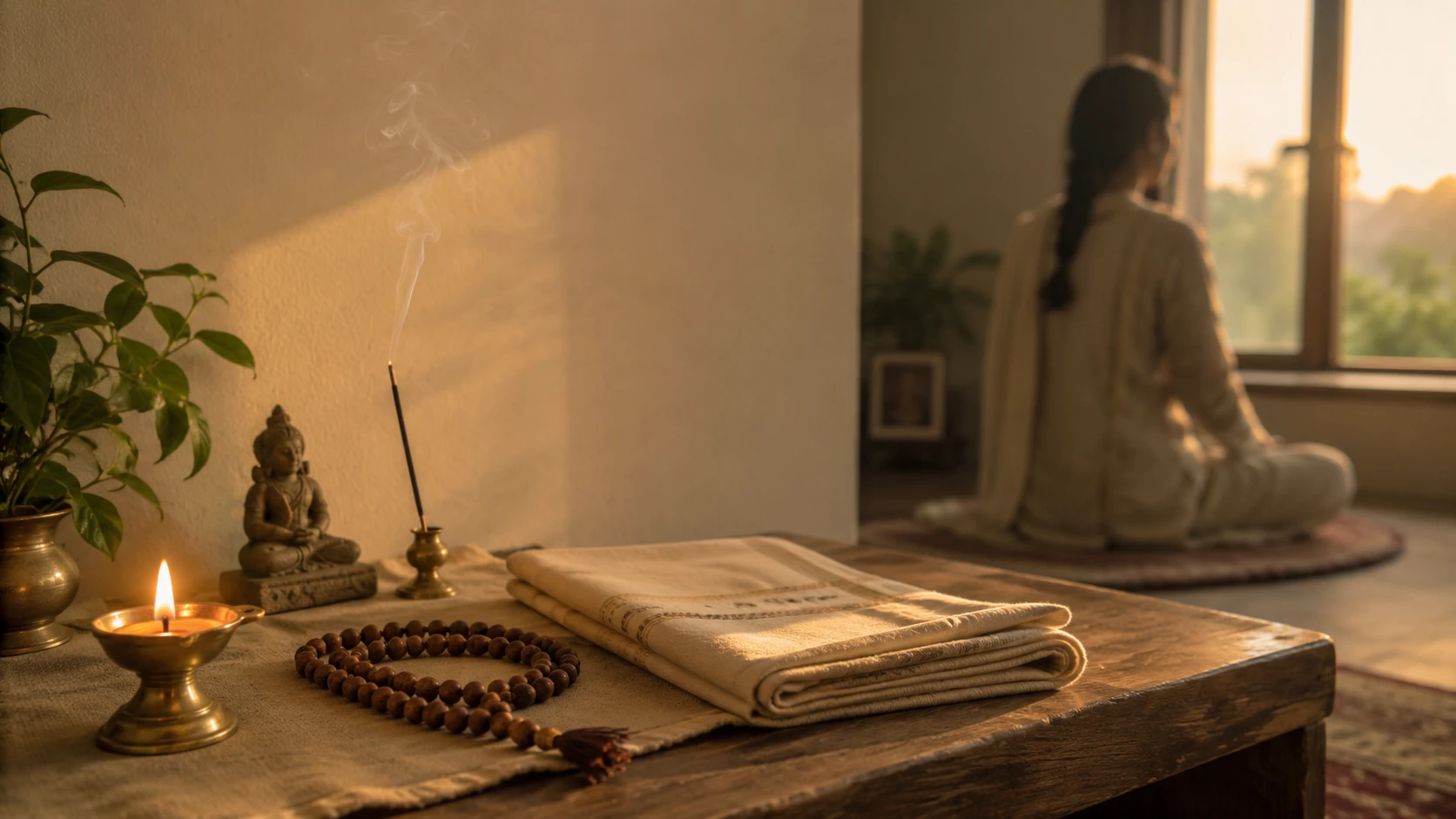
The most common reason people do not have a daily practice is not laziness. It is ambition. They imagine sadhana as a ninety-minute pre-dawn ritual with a full puja setup, and since they cannot do that on a Tuesday in Bengaluru with a 9 AM standup call, they do nothing. Fifteen minutes is enough. It has always been enough. The tradition says so explicitly.
A *sadhana* is a daily spiritual practice done at the same time, in the same place, in the same sequence. The word comes from the root *sadh*, to accomplish, and the accomplishment it points to is not a single event but a direction: the practitioner moves, day by day, toward steadiness of mind. The tradition does not require a temple room, a silver lamp, or two free hours before sunrise. What it requires is regularity. The *Yoga Sutras* of Patanjali define practice (abhyasa) as effort sustained over a long time, without interruption, and with devotion. Fifteen minutes every morning for a year carries more weight than three hours once a month. The consistency is the practice. Everything else is furniture.
Choose a fixed spot. It does not need to be a separate room. A corner of a bedroom works. A balcony works if the weather is stable. What matters is that you sit in the same place every day. The body learns location. After a week, sitting in that corner will begin to feel different from sitting on the sofa. This is not suggestion. It is conditioning. The *Hatha Yoga Pradipika* specifies that the practice space should be clean, quiet, and free of insects. It does not specify size, grandeur, or a brass collection. A clean cotton cloth on the floor, a small cushion if your knees protest, and enough space to sit without touching a wall. That is the setup.
The fifteen minutes divide into three segments of five minutes each. The first five minutes are pranayama, breath regulation. The second five minutes are japa, mantra repetition. The third five minutes are dhyana, silent sitting. This is not an invention. It follows the classical sequence found across multiple texts: prepare the body (through breath), focus the mind (through sound), then release both into stillness. Each segment does a different job, and the order matters.
Pranayama. Sit with your spine straight. Close your eyes. Begin with *Nadi Shodhana*, alternate-nostril breathing. Close the right nostril with your right thumb. Inhale through the left nostril for a count of four. Close both nostrils (thumb on right, ring finger on left) and hold for a count of four. Release the right nostril and exhale for a count of four. Now inhale through the right nostril for four, hold for four, exhale through the left for four. That is one cycle. Do this for five minutes, which will give you roughly twelve to fifteen cycles depending on your natural pace. By the end of five minutes, your heart rate will have dropped, your breathing will have slowed, and the mental chatter from your commute or your inbox will have thinned. This is not relaxation. It is preparation. The pranayama clears the channel so the mantra has somewhere to land.
Japa. Pick one mantra and stay with it. Do not rotate mantras weekly. The tradition is clear that a single mantra deepens with repetition; switching resets the process. If you have received a mantra through diksha (initiation), use that one. If you have not, three mantras work for anyone without initiation. Om Namah Shivaya (five syllables, Shaiva tradition). Om Namo Narayanaya (eight syllables, Vaishnava tradition). The Gayatri Mantra (twenty-four syllables, universal). Pick the one that feels closest to your family practice or personal inclination. Hold your mala in your right hand. Chant softly, at a pace where you can hear each syllable. Five minutes will give you between one and two full rounds of 108, depending on the mantra's length and your speed. If you finish a round before time, start the next. If time runs out mid-round, stop where you are. The mala remembers your place.
Dhyana. Put the mala down. Place your hands on your knees, palms down. Do nothing. This is the part that feels wrong to beginners because it seems like you are wasting time. You are not. The pranayama settled the body. The japa occupied the mind with a single sound. Now you withdraw both props and let the mind sit with whatever remains. Some days, stillness comes in thirty seconds. Other days, it does not come at all, and you spend five minutes watching your thoughts flicker like a bad tube light. Both are fine. The tradition calls this *sakshi bhava*, witness awareness: you watch your thoughts without climbing inside them. You are not trying to stop thinking. You are trying to stop reacting. Five minutes of this, even on a bad day, changes the texture of the hour that follows.
Timing matters. The tradition identifies two optimal windows: *Brahma Muhurta* (roughly ninety minutes before sunrise, between 4:30 and 5:30 AM in most of India) and sandhya kala (the transition minutes around sunrise and sunset). Brahma Muhurta is considered the highest-quality time because the mind is fresh from sleep, the environment is quiet, and the body's cortisol cycle has not yet begun its morning spike. If you cannot sit at Brahma Muhurta, sit at sunrise. If you cannot sit at sunrise, sit before your first screen of the day. The worst time is late evening when the body is tired and the mind is full. The best time is the time you will actually do it. A sadhana done at 7 AM every day for six months defeats a Brahma Muhurta sadhana abandoned after two weeks.
Two additions are optional but worth considering once the core fifteen minutes are stable. The first is lighting a diya or incense at the start. This takes thirty seconds and gives the practice a physical beginning: the match strikes, the flame rises, the fragrance arrives, and the body registers that something different is about to happen. The second is a closing shloka or prayer. The *Shanti Mantra* (Om Sahana Vavatu, from the Taittiriya Upanishad) takes fifteen seconds to chant and marks the end of practice the way the diya marks the beginning. Neither is required. Both help. The tradition uses sensory anchors because the mind responds to physical signals faster than to intentions.
ॐ सह नाववतु। सह नौ भुनक्तु। सह वीर्यं करवावहै। तेजस्वि नावधीतमस्तु मा विद्विषावहै। ॐ शान्तिः शान्तिः शान्तिः
Om. May we be protected together. May we be nourished together. May we work together with energy. May our study be full of light. May we not oppose each other. Om, peace, peace, peace.
The hardest part is not the practice. It is the morning after you miss a day. The mind will say: you broke the chain, so why bother starting again? This is the exact moment that matters. The tradition has a word for this: *punaraarambha*, beginning again. Every text on sadhana acknowledges that the practitioner will lapse. The instruction is the same everywhere: sit down again. Do not add extra time to compensate. Do not punish yourself with a longer session. Sit for fifteen minutes, in the same corner, in the same sequence, as if yesterday happened exactly the way it should have. Regularity is a direction, not a record. You are not building a streak. You are building a habit that outlasts any single interruption.
Start Your 15-Minute Sadhana with Guided Audio
A guided session with timed segments for pranayama, japa, and dhyana. Choose your mantra and follow along at your own pace.
Explore on Eternal RagaTags
Community Reflections
🕉️
Be the first to share your reflection.