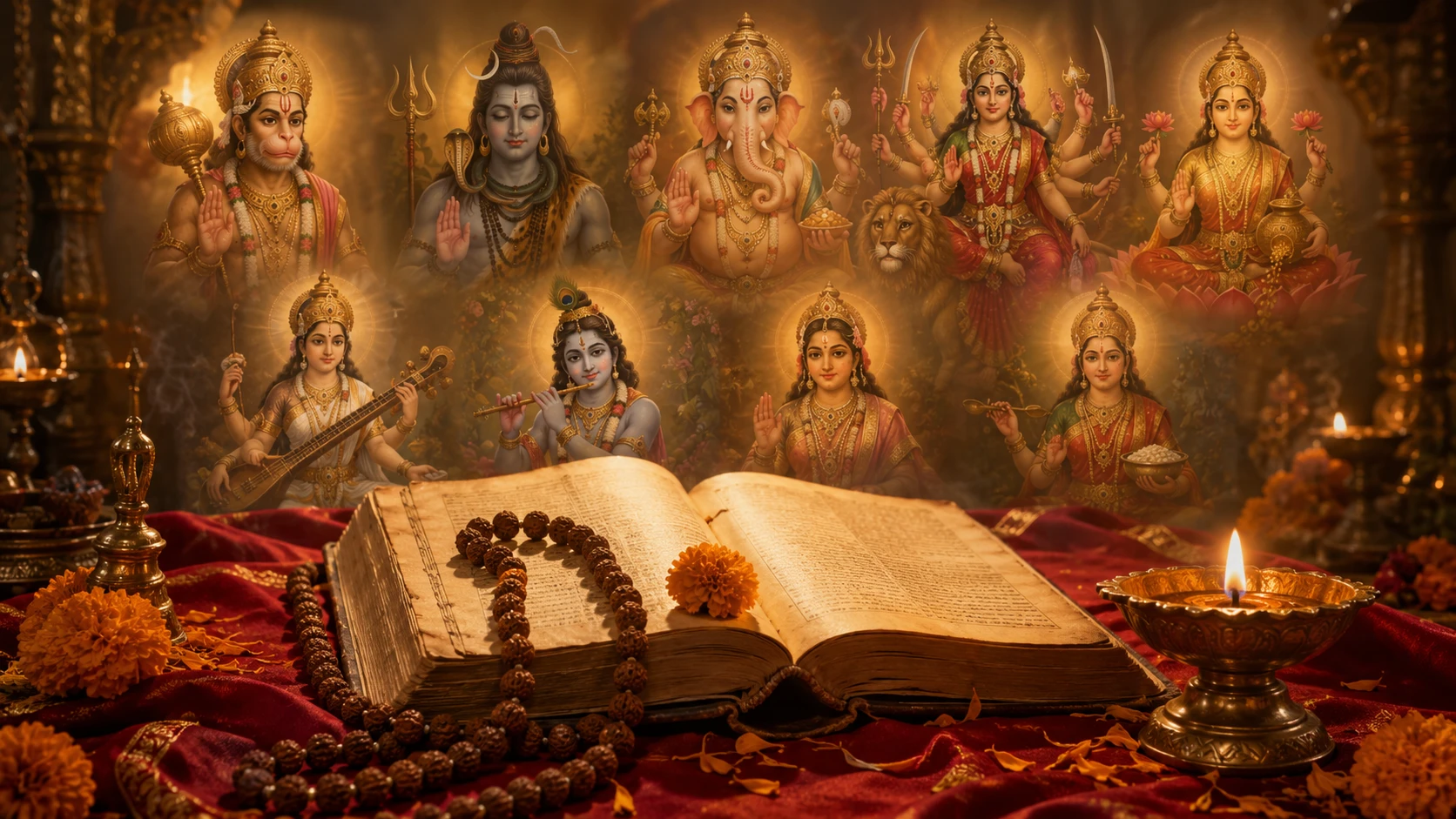
Most people know the Hanuman Chalisa by heart. Fewer know that eight other Chalisas exist in the same tradition, each addressed to a different deity, each carrying its own weight and occasion. This article introduces all nine.
Forty Verses, One Form
The word chalisa comes from chalis, the Hindi word for forty. A Chalisa is a devotional poem of exactly forty verses, composed in Awadhi or Braj Bhasha, addressed to a single deity. It opens with a doha (couplet) that sets the invocation, moves through forty chaupais (quatrains) that praise the deity's qualities and deeds, and closes with another doha that seals the prayer.
The form gained its widest popularity through Tulsidas, who composed the Hanuman Chalisa in the sixteenth century. But the structure proved so effective that poets across centuries wrote Chalisas for other deities using the same template. Today, nine Chalisas circulate widely in Hindu households and temple practice. Most families know one or two. Few know all nine.
What follows is an introduction to each, not a ranking. Every Chalisa addresses a different face of the divine. The one that speaks to you depends on what you carry to it.
Hanuman Chalisa
The Hanuman Chalisa is the one you already know, or at least the one you have heard a hundred times. Auto-rickshaw drivers play it on loop through tinny speakers in morning traffic. Families recite it on Tuesdays and Saturdays. Students whisper it before exam halls. Tulsidas composed it in Awadhi, and its opening lines, Shri Guru Charan Saroj Raj, are among the most recited words in the Hindi-speaking world. The Chalisa invokes Hanuman as the remover of difficulty: not difficulty in the abstract, but the specific, physical kind. Illness, fear, obstacles that sit between you and the thing you must do.
Shiv Chalisa
The Shiv Chalisa addresses Shiva as both ascetic and householder, the god who sits in meditation on Kailash and also dances the Tandava that dissolves creation. Devotees recite it on Mondays, during Shravan (the monsoon month sacred to Shiva), and on Mahashivratri.
Where the Hanuman Chalisa asks for strength against obstacles, the Shiv Chalisa asks for something quieter: detachment, inner stillness, release from patterns that no longer serve. In temples across Varanasi and Ujjain, you hear it before the morning aarti, when the city is still half-asleep and the Ganga or the Shipra is running cold.
Ganesh Chalisa
Ganesha is the deity invoked at every beginning, and the Ganesh Chalisa carries that same energy. Families recite it before starting a new business, before a child's first day at school, before signing the paperwork on a new flat. The Chalisa praises Ganesha as Vighnaharta (remover of obstacles) and Pratham Pujya (the one worshipped first).
Wednesday is the day traditionally associated with Ganesha. In Pune, which hosts India's largest Ganesh Chaturthi celebration, groups gather in housing societies on Wednesday evenings to recite it together. The tone of this Chalisa is lighter, warmer, almost affectionate. Ganesha is approached as family before he is approached as god.
Durga Chalisa
The Durga Chalisa invokes the goddess as warrior and protector. It recounts her victories over Mahishasura and other asuras, and praises her nine forms, the Navadurga. Families recite it during Navratri, the nine-night festival in autumn and spring, and on Fridays.
This is the Chalisa people turn to when the threat is external: injustice, harm, a situation where something is bearing down and you need the ground to hold. In Kolkata during Durga Puja, in Gujarat during Navratri garba nights, in a Delhi kitchen where a mother reads it quietly on a Friday morning, the Durga Chalisa carries the same request: protect what I cannot protect alone.
Lakshmi Chalisa
The Lakshmi Chalisa is recited on Fridays and during Diwali, when Lakshmi is welcomed into the home with rangoli, sweets, and open doors. The Chalisa addresses her not only as the goddess of wealth but also of well-being, stability, and the kind of abundance that keeps a household running.
This is the Chalisa of the pragmatic devotee. The shopkeeper in Chandni Chowk who recites it before opening the shutters at dawn. The chartered accountant who reads it on Dhanteras before entering the new financial year's figures. The grandmother who insists the house must be swept spotless on Friday because Lakshmi does not enter a dirty threshold. The Lakshmi Chalisa does not ask for windfalls. It asks for steadiness.
Saraswati Chalisa
The Saraswati Chalisa addresses the goddess of knowledge, speech, and the arts. Students across North India recite it during exam season, on Basant Panchami (the spring festival that marks Saraswati's day), and on Thursdays.
Saraswati is not approached for material gain. She is approached for clarity: the ability to understand what you are reading, to speak without stumbling, to find the right word at the right time. The engineering student in Kota reciting it before the JEE paper and the Bharatanatyam student in Chennai reciting it before stepping onto the stage are asking for the same thing. Not success, but readiness.
Krishna Chalisa
The Krishna Chalisa moves through Krishna's life in sequence: the butter-stealing child of Vrindavan, the flute-player on the banks of the Yamuna, the friend and counselor of Arjuna at Kurukshetra. It is recited on Wednesdays, during Janmashtami, and in Vaishnava households as part of daily practice.
Krishna is approached as the deity who meets you where you are. The mother sees the child. The lover sees the beloved. The warrior sees the strategist. The philosopher sees the teacher of the Gita. The Krishna Chalisa holds all these faces without resolving them into one.
Parvati Chalisa
The Parvati Chalisa addresses the goddess as wife, mother, and tapasvi (one who performs austerity). It recounts Parvati's long penance to win Shiva as her husband, a story that frames devotion not as passive waiting but as active, focused effort sustained over years.
Women recite it for marital harmony and family well-being, on Mondays and during the Hartalika Teej festival. But the teaching extends beyond marriage. Parvati's penance succeeded because she held her resolve when everyone, including the gods, told her to stop.
Annapurna Chalisa
Annapurna is the goddess of food and nourishment, a form of Parvati who feeds Shiva himself. The Annapurna Chalisa is the least known of the nine, but in households where it is recited, it holds a specific place: before meals, during the annual Annapurna Puja, and in kitchen mandirs across Varanasi, where the Annapurna Devi temple stands as one of the city's oldest.
Food in Hindu tradition is not fuel. It is prasad (an offering returned). The act of cooking is a form of seva (service), and feeding someone is a form of worship. The Annapurna Chalisa asks that the household never face scarcity, not of food alone, but of the generosity that makes a home a place where anyone who arrives is fed before they are asked why they came.
Nine Doors, One House
No single Chalisa replaces another. A family might recite the Hanuman Chalisa on Tuesdays and the Lakshmi Chalisa on Fridays, the Saraswati Chalisa in exam season and the Durga Chalisa during Navratri. The practice shifts with the need, the season, and the stage of life.
What holds all nine together is the form itself: forty verses, a single address, a structure compact enough to memorise and carry without a book. The Chalisa tradition understood something about how devotion works in a busy life. It gave people a practice that fits inside a morning commute, a lunch break, a ten-minute pause before sleep. You do not need a temple. You need the words and a few minutes of attention.
All nine Chalisas are available in the Mantras section on Eternal Raga, with Sanskrit text, Hindi transliteration, and verse-by-verse meaning. Start with the one that feels closest to where you are right now.
Explore All Nine Chalisas
Chalisas on Eternal Raga
All nine Chalisas with Sanskrit text, Hindi transliteration, and verse-by-verse meaning. Audio recitations available for Hanuman, Shiv, and Durga Chalisas.
Explore on Eternal RagaRelated Gyan · सम्बन्धित ज्ञान
Tags
Community Reflections
🕉️
Be the first to share your reflection.