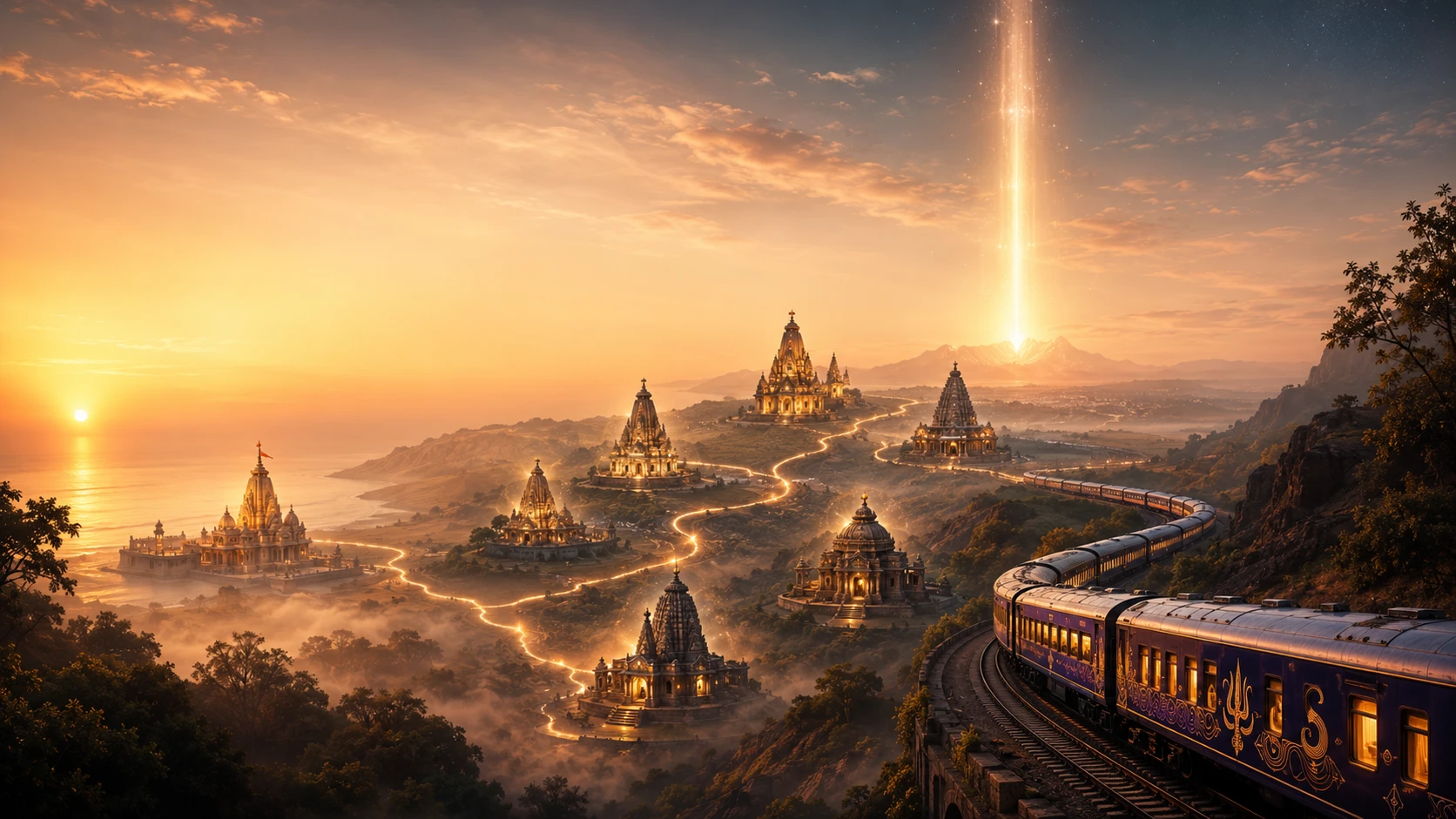
Indian Railways now runs a packaged train that covers seven of the twelve Jyotirlingas in a single trip. Here is which seven, why they sit close enough to string together, and what the package actually includes.
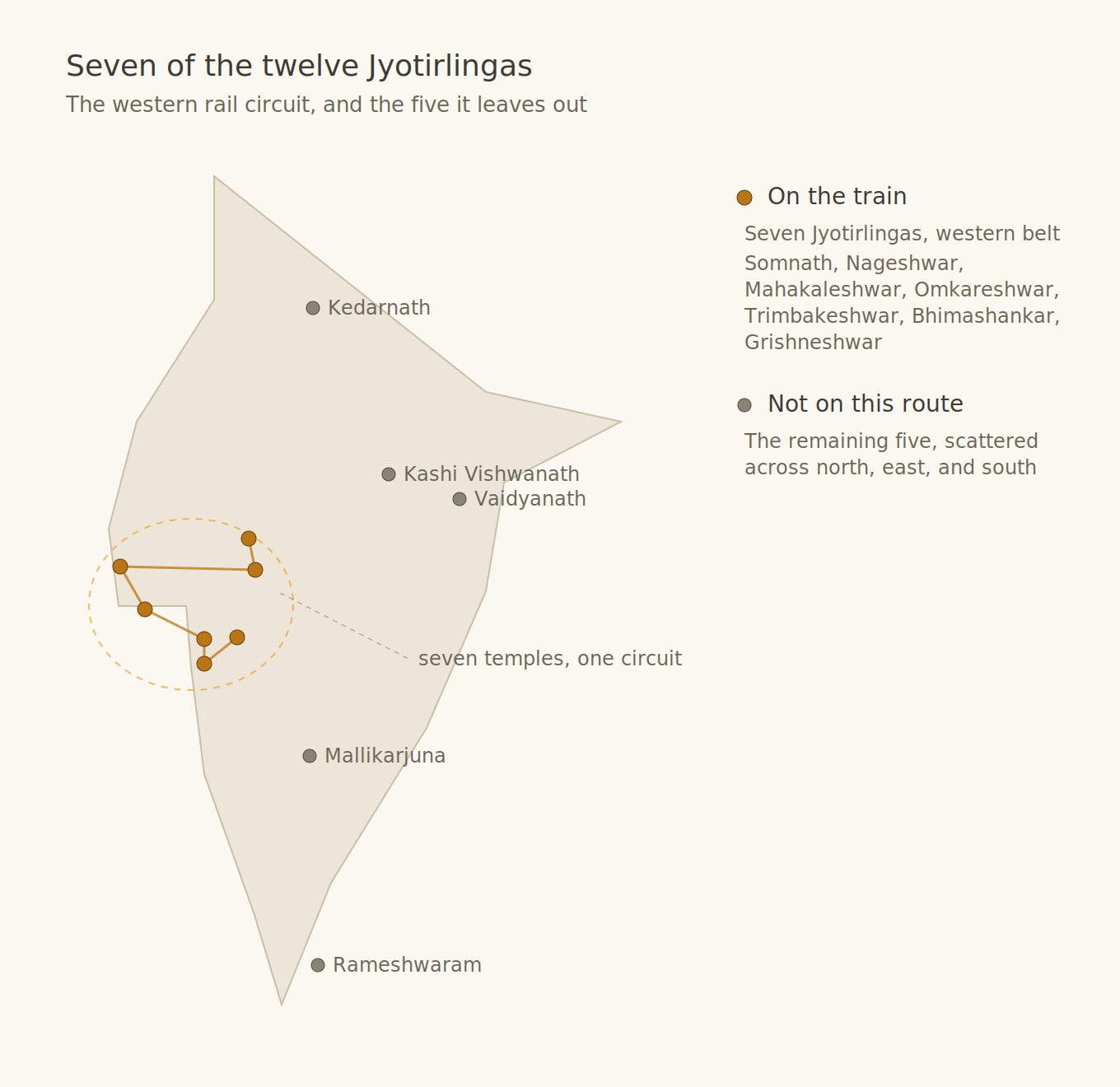
India has twelve Jyotirlingas, the shrines where Shiva is worshipped as a *jyotirlinga*, a pillar of light rather than a carved image. They sit far apart, from the Himalayan height of Kedarnath to the southern shore of Rameshwaram. Seeing all twelve has long meant separate trips spread over years. Look at a map, though, and one thing stands out. Seven of the twelve cluster together in the west, across Gujarat, Madhya Pradesh and Maharashtra. That cluster sits close enough that a single train can string the seven into one trip, which is what Indian Railways now offers.
The word *linga* means a mark or sign, the form in which Shiva is honoured in nearly all Shiva temples. A jyotirlinga is a particular kind, tied to the story in the *Shiva Purana* where Shiva appears as an endless column of light to settle a quarrel between Brahma and Vishnu over who is greater. Neither can find its top or its bottom. The story teaches that the divine has no measurable limit. Twelve places on the Indian map are remembered as spots where that column of light stood, and the tradition treats all twelve as equal in standing, so no pilgrim ranks one above another.
सौराष्ट्रे सोमनाथं च श्रीशैले मल्लिकार्जुनम्। उज्जयिन्यां महाकालम् ओंकारममलेश्वरम्॥
saurāṣṭre somanāthaṃ ca śrīśaile mallikārjunam, ujjayinyāṃ mahākālam oṃkāram-amaleśvaram
In Saurashtra stands Somnath, at Shrishaila Mallikarjuna, in Ujjain Mahakala, and Omkareshwar at Amaleshwar.
— Dvadasha Jyotirlinga Stotram, traditionally attributed to Adi Shankaracharya
Why do seven of the twelve sit so close? Geography and history. The western and central belt held important temple towns for centuries, from Ujjain on the Shipra river to the coast of Saurashtra. The other five scatter to the corners. Kedarnath sits high in the Uttarakhand mountains. Kashi Vishwanath stands on the Ganga at Varanasi. Vaidyanath is in Jharkhand, Mallikarjuna in the hills of Andhra Pradesh, and Rameshwaram at the very tip of Tamil Nadu. No single rail loop can reach all of them in under two weeks. It can manage the western seven, and that is the trip on offer.
मार्ग के सात मंदिर
| मंदिर | कहाँ स्थित है | क्या देखें |
|---|---|---|
| सोमनाथ | गुजरात के तट पर, वेरावल में | समुद्र किनारे का मंदिर, जिसे इतिहास में कई बार तोड़ा और फिर बनाया गया। |
| नागेश्वर | द्वारका के पास, गुजरात | ज़मीन से नीचे बना गर्भगृह, बाहर शिव की विशाल बैठी प्रतिमा। |
| महाकालेश्वर | उज्जैन, मध्य प्रदेश, शिप्रा के किनारे | भोर की भस्म आरती, जिसमें लिंग को पवित्र भस्म से पूजा जाता है। |
| ओंकारेश्वर | नर्मदा में एक द्वीप पर, मध्य प्रदेश | कहा जाता है कि द्वीप का आकार ही ओम अक्षर जैसा है। |
| त्रिंबकेश्वर | नासिक के पास, महाराष्ट्र | गोदावरी के उद्गम के पास, और इसके लिंग पर तीन मुख दिखते हैं। |
| भीमाशंकर | सह्याद्रि की पहाड़ियाँ, महाराष्ट्र | जंगल के भीतर बना मंदिर, जो अब वन्यजीव अभयारण्य है। |
| घृष्णेश्वर | एलोरा की गुफ़ाओं के पास, महाराष्ट्र | लाल ज्वालामुखीय पत्थर से बना, गुफ़ाओं से थोड़ी दूर। |
The train is an IRCTC package on the Bharat Gaurav scheme, not a regular service you board at a station counter. You book the whole tour in advance. The fare covers the rail travel, hotel stays, vegetarian meals, road transfers to each temple, travel insurance, and a tour manager who handles the logistics. A recent Delhi departure ran twelve days and started at around twenty three thousand rupees in sleeper class, rising with the cabin class you choose. Dates and fares change with each departure, and seats go on a first come, first served basis, so check the IRCTC tourism site for the live schedule before you plan. The package suits a particular traveller well: an older pilgrim, or a family booking for parents, who wants the seven temples without assembling trains, hotels and taxis across three states alone.
Seven temples across three states in twelve days means early mornings and full days. The train covers the long stretches at night, and your days go to temple visits and road transfers. It is darshan, the act of beholding the deity, at a steady pace, not a slow retreat. Knowing that in advance helps you pack light and keep your expectations matched to a moving schedule.
क्या आप जानते हैं?
बारह ज्योतिर्लिंगों के नाम गिनाने वाला *स्तोत्र* अपने आप में एक तीर्थयात्रा है। परंपरा मानती है कि इसे ध्यान से पढ़ने पर बारहों के दर्शन का पुण्य मिलता है, इसलिए जो भक्त यात्रा नहीं कर पाता, वह भी हर सुबह घर के पूजा स्थान पर पूरे मार्ग को जीवित रखता है।
The map also tells you what you are not seeing on this train. The five that remain ask for trips of their own. Kedarnath opens only for part of the year and rewards a hard climb in the Himalaya. Kashi Vishwanath sits in the lanes of Varanasi by the Ganga. Vaidyanath draws crowds during the Shravan month in Jharkhand. Mallikarjuna shares its hill at Srisailam with a Shakti shrine, and Rameshwaram closes the set at the southern edge of the country, where pilgrims bathe before darshan. Seven by train, five by your own planning. Together they make the full set of twelve, and the western route is the easiest way to begin.
Explore Sacred Temples
Browse our complete temple guides — history, pilgrimage details, and the stories guidebooks leave out.
Explore on Eternal RagaTags
Community Reflections
🕉️
Be the first to share your reflection.