Ekambareswarar
एकाम्बरेश्वर
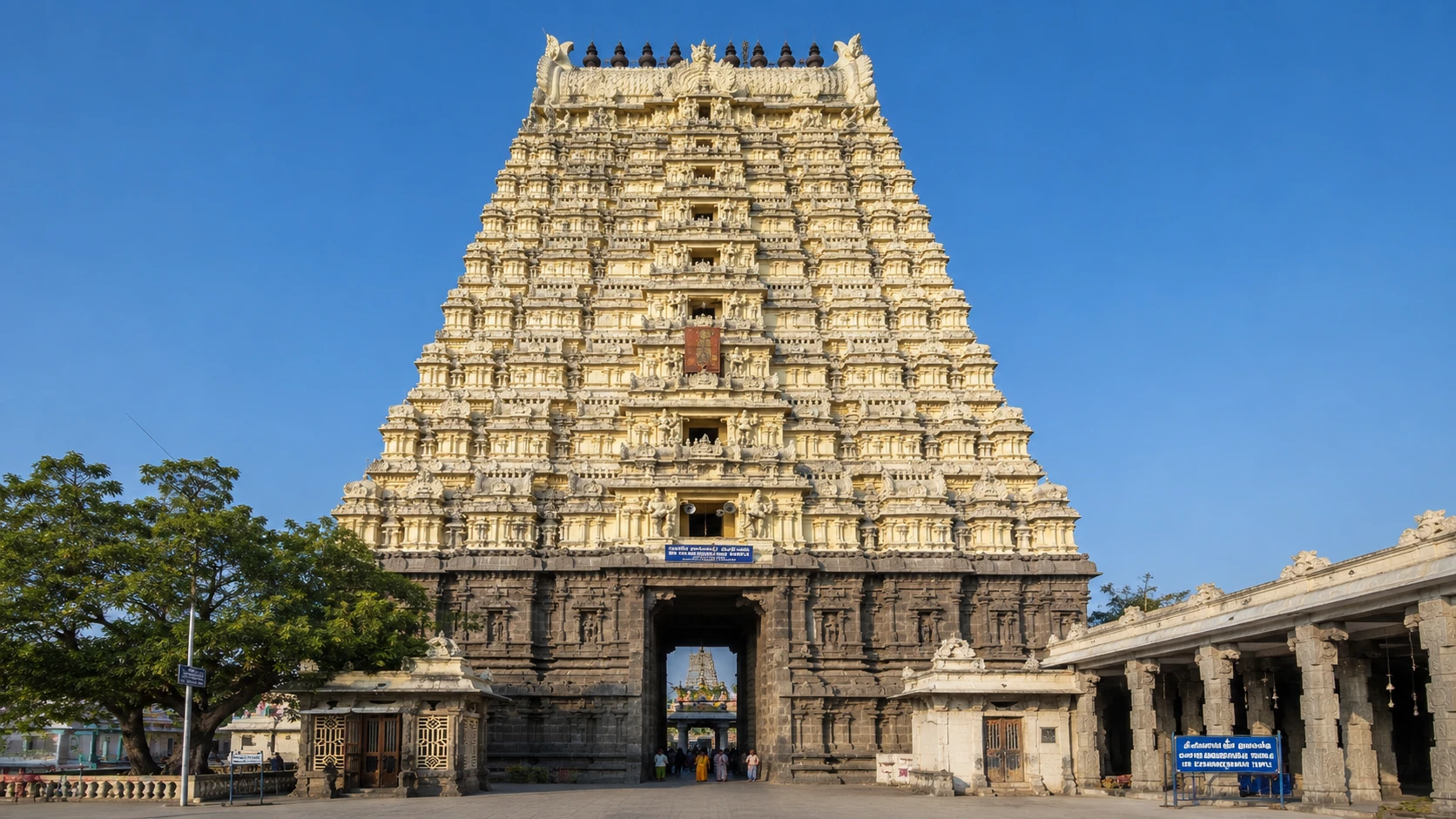
The Ekambareswarar Temple at Kanchipuram — the canonical Pṛthvī (Earth) Sthalam of the Pañca Bhūta Sthalam five-elements Tamil Śaiva framework, the fifth and final element-shrine completing the canonical pañca-bhūta circuit; located in the canonical Sapt Puri Mokṣapuri sacred-city of Kāñcīpuram, Tamil Nadu (approximately 75 km south-west of Chennai); home to the corpus-distinctive Pṛthvī Liṅga ('Earth Liṅga') canonically held to be canonically composed of sacred sand/earth — canonically vulnerable to canonical water-immersion abhiṣekam such that the canonical liṅga canonically receives the canonical jala-abhiṣekam through the canonical adjacent liturgical infrastructure rather than directly upon the canonical liṅga; the canonical Pārvatī's tapas narrative anchor — the canonical foundational mythology recording canonical Goddess Pārvatī canonically creating the canonical Pṛthvī Liṅga from canonical sacred sand under the canonical 3,500+ year canonical sacred mango tree (Ekāmra sthala-vṛkṣa) and canonically embracing the canonical liṅga to canonically protect it from the canonical Vegavati river flood, with the canonical embrace canonically visible on the canonical liṅga; the fifth Tier A entry and the canonical concluding entry of the Eternal Raga Pañca Bhūta Sthalam sweep
Kanchipuram, Tamil Nadu, India
EkāmbareśvaraAlso known as: Ekambareswarar Temple, Ekāmranatha Temple, Ekāmbaranātha Temple, Eka-Āmra-Nātha ('Lord of the One Mango Tree,' canonical etymological form reflecting the canonical mango-tree sthala-vṛkṣa), Pṛthvī Liṅga Kṣetra (canonical 'Earth Liṅga Place' designation), Pārthiva Liṅga Kṣetra (canonical Sanskrit alternate, 'Earthen Liṅga Place'), Kāñcī Ekāmranātha (canonical regional Tamil Śaiva designation), Tiru-Ēkāmpam (canonical Tamil canonical form preserved in the canonical Tēvāram corpus)
युग
Pre-canonical Sangam-era Tamil cultural-religious attestation through canonical regional Tamil literary references to the canonical Kāñcī Tamil Śaiva tradition; substantive canonical Tēvāram corpus attestation (6th–9th c. CE) of the canonical Tiru-Ēkāmpam Tamil Śaiva tradition; foundational canonical Pallava-period (4th–9th centuries CE, with Kanchipuram operating as the canonical Pallava dynasty capital) architectural patronage; substantive canonical Cōḻa-period (9th–13th centuries) elaboration; canonical Pāṇḍya-period subsequent patronage; canonical Vijayanagara empire-era major elaboration (15th–17th c.) with canonical Vijayanagara emperor Kṛṣṇadevarāya (1509–1529 CE) canonically constructing the canonical principal Rāja-Gōpuram in the early 16th century; canonical Nāyak dynasty patronage; canonical British colonial period administration; canonical post-Independence canonical Tamil Nadu Hindu Religious and Charitable Endowments Department (HR&CE) administrative framework since 1959
वास्तुकला
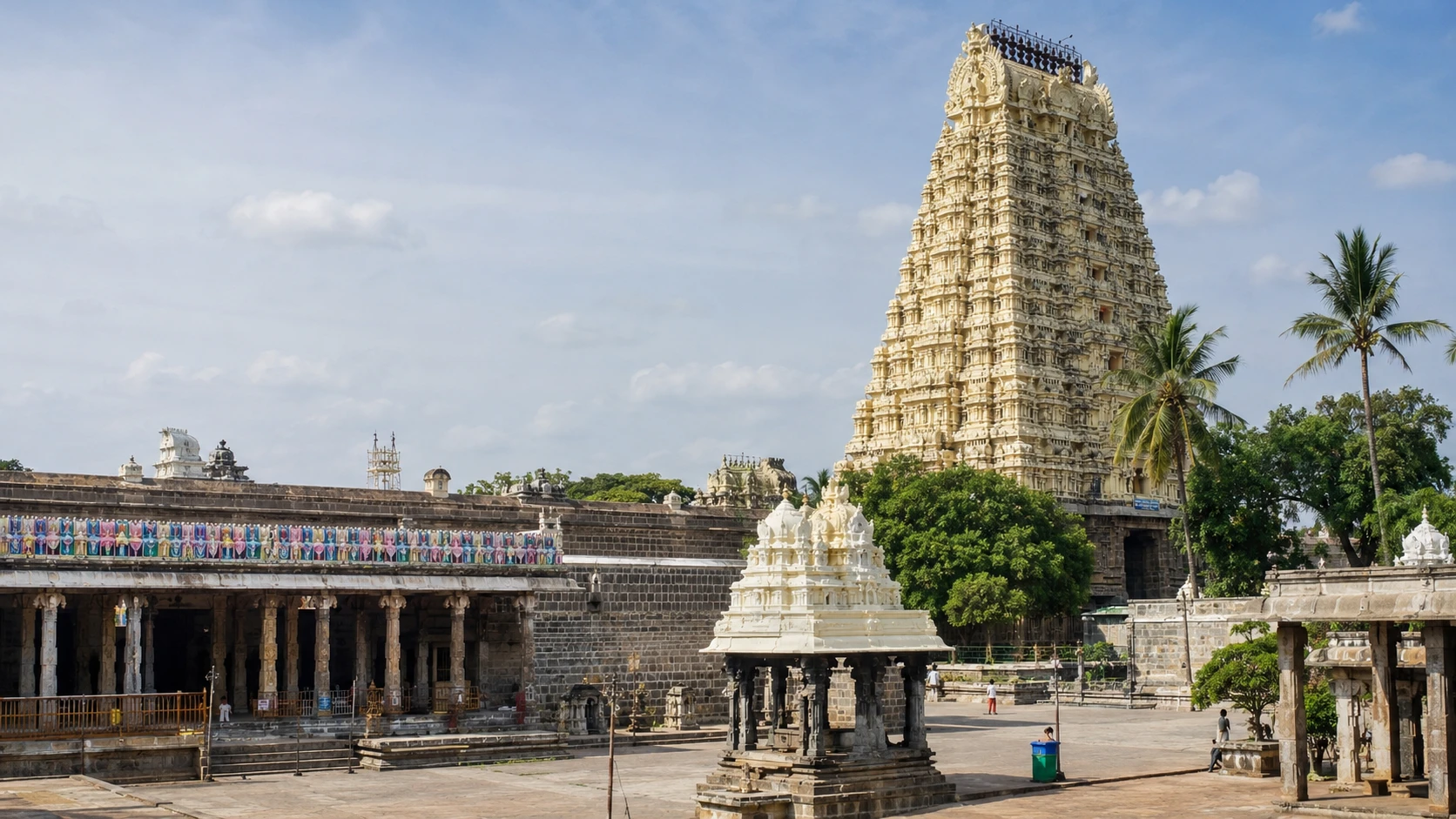
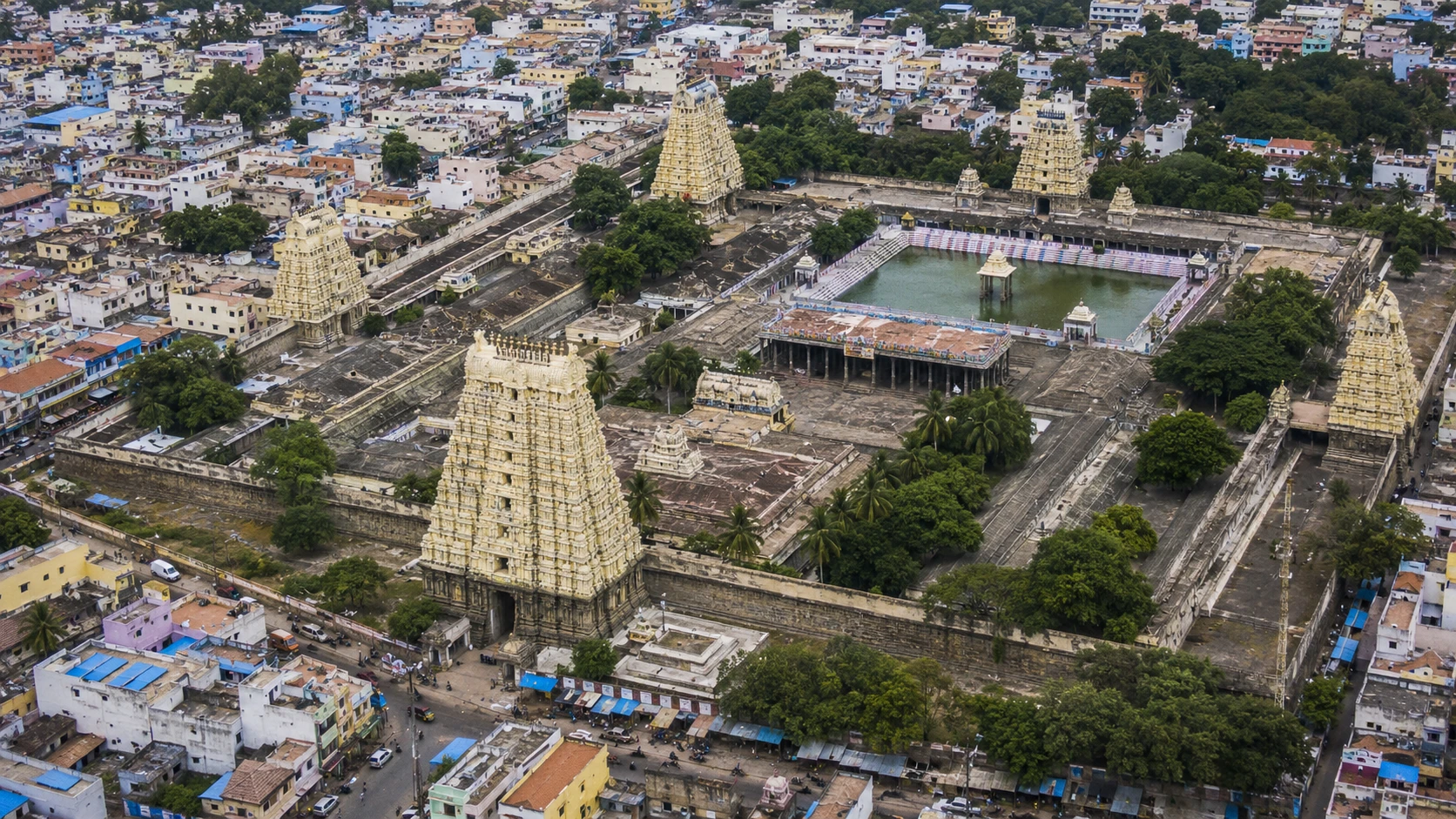
Tamil Drāviḍa (Dravidian) temple-construction style with substantive canonical Pallava-Cōḻa-Pāṇḍya-Vijayanagara-Nāyak architectural elaboration. The canonical Ekambareswarar temple-complex (approximately 25 acres at the canonical northern zone of Kanchipuram town) is one of the most architecturally elaborate canonical Tamil Drāviḍa temple-complexes. Distinctive architectural elements include: the canonical principal Rāja-Gōpuram (the canonical Vijayanagara-period entrance gopuram, canonically reaching approximately 59 meters in canonical height, one of the canonical tallest gopurams in pan-India, canonically constructed under canonical Vijayanagara emperor Kṛṣṇadevarāya's patronage in the early 16th century); the canonical four cardinal gopurams; the canonical Āyiram Kāl Maṇḍapam (canonical 1000-Pillared Hall); the canonical Pṛthvī Liṅga inner sanctum (canonically housing the canonical sacred-sand Pṛthvī Liṅga with the corpus-distinctive sand-composition iconographic register and the canonical Pārvatī-embrace canonical marks on the canonical liṅga); the canonical Ekāmra sthala-vṛkṣa sub-precinct (the canonical 3,500+ year canonical sacred mango tree, canonically preserved within the canonical temple-complex envelope as the canonical living theological-iconographic anchor of the canonical site); the canonical Devī sub-shrine (the canonical canonical consort Devī shrine, canonically situated within the canonical temple-complex envelope, canonically integrated with the canonical broader Kanchipuram canonical paired Kāmākṣī Amman Temple framework); the canonical Kalyāṇa Maṇḍapam (the canonical wedding-hall maṇḍapa, canonically housing the canonical annual canonical Pankuni Brahmotsavam canonical kalyāṇotsavam reenactment of the canonical Śiva-Pārvatī marriage); and the canonical multi-pillared maṇḍapas and sub-shrine infrastructure operating across the canonical temple-precinct envelope. The temple-complex envelope is sited at the canonical northern zone of Kanchipuram town, with the canonical Kāmākṣī Amman Temple operating canonically at the canonical central zone of Kanchipuram (approximately 1 km from Ekambareswarar) and the canonical Varadarāja Perumāḷ Temple operating canonically at the canonical southern zone of Kanchipuram (the canonical Little Kanchipuram zone, approximately 3 km from Ekambareswarar)
खुला
06:00 – 21:00
आरती
06:30 · 10:00 · 11:30 · 18:00 · 20:30
विशेष
The canonical daily worship cycle at the Ekambareswarar Temple operates across the canonical daily framework: Suprabhātam / morning awakening worship (approximately 06:30); morning aarati (approximately 10:00); noon worship (approximately 11:30); evening aarati (approximately 18:00); night-worship (approximately 20:30, including the canonical evening culminating darshan). The corpus-distinctive Pṛthvī Liṅga NON-direct-water-abhiṣekam liturgical convention operates across the canonical daily worship cycle — the canonical sacred-sand liṅga is canonically protected through the canonical adjacent-liturgical-infrastructure abhiṣekam framework rather than direct water-immersion. The canonical principal annual festival programming centers on the canonical Pankuni Brahmotsavam (March-April, the canonical 13-day Brahmotsavam featuring the canonical kalyāṇotsavam reenactment of the canonical Śiva-Pārvatī marriage), the canonical Mahā Śivarātri (February-March), the canonical Vinayaka Chaturthi (the canonical Ganesha-festival, August-September), and the broader canonical Tamil Śaiva canonical festival cycle
पवित्र कथा · पवित्र कथा
The Ekambareswarar Temple at Kanchipuram, Tamil Nadu, occupies a structurally singular position within the canonical Pañca Bhūta Sthalam five-elements Tamil Śaiva framework as the canonical Pṛthvī (Earth) Sthalam — the canonical fifth and canonical final element-shrine completing the canonical pañca-bhūta circuit (Chidambaram = Ākāśa, Srikalahasti = Vāyu, Thiruvannamalai = Agni, Thiruvanaikaval = Apas, Kanchipuram-Ekambareśvara = Pṛthvī, in the canonical sequence of subtle-to-gross elemental densification). The canonical temple-complex (situated in the canonical Sapt Puri Mokṣapuri sacred-city of Kāñcīpuram, Tamil Nadu, approximately 75 km south-west of Chennai, in the canonical Kanchipuram district) operates as the canonical theological-iconographic seat of the canonical Pañca Bhūta Sthalam Pṛthvī-framework. The site's canonical theological centerpiece — the canonical Pṛthvī Liṅga ('Earth Liṅga'), a canonical swayambhu-and-Pārvatī-installed liṅga form of Śiva embodying the canonical earth-element — is canonically distinguished by the corpus-distinctive sacred-sand composition: the canonical liṅga is canonically held to be canonically composed of sacred sand / earth, canonically created by Goddess Pārvatī from the canonical earth-substance at the canonical site. The canonical sacred-sand composition operates as the canonical iconographic-theological proof-text of the canonical earth-element divine presence at the canonical Pṛthvī Sthalam framework. The canonical sand-composition iconographic feature is corpus-distinctive within the broader Pañca Bhūta Sthalam framework — the four other Pañca Bhūta Sthalam sites canonically house canonical stone or canonical natural-formation liṅgas (Chidambaram's Cidambara Rahasyam lingam-less Ākāśa-Liṅga, Srikalahasti's stone Vāyu Liṅga, Thiruvannamalai's mountain-as-Agni-Liṅga, Thiruvanaikaval's water-immersed stone Appu Liṅga) whereas Ekambareswarar's canonical Pṛthvī Liṅga is canonically held to be canonically composed of sacred sand. The canonical sand-composition canonically renders the canonical liṅga canonically vulnerable to canonical water-immersion abhiṣekam — the canonical liṅga is canonically protected through the canonical liturgical convention of canonical NON-direct-water-abhiṣekam, with the canonical jala-abhiṣekam canonically performed at the canonical adjacent liturgical infrastructure rather than directly upon the canonical liṅga. The canonical Pārvatī's tapas narrative operates as the canonical foundational mythology of the canonical site. The canonical narrative records that canonical Goddess Pārvatī canonically committed a canonical playful transgression at canonical Mount Kailāsa — canonically covering canonical Śiva's canonical eyes with her canonical hands, canonically causing canonical cosmic darkness across the canonical universe. Canonical Śiva, canonically displeased with the canonical cosmic disruption, canonically required canonical Pārvatī to canonically perform canonical extreme tapas at the canonical Kanchipuram site to canonically atone for the canonical transgression. Canonical Pārvatī canonically traveled to Kanchipuram and canonically established her canonical tapas under the canonical sacred mango tree (the canonical Ekāmra sthala-vṛkṣa, the canonical 3,500+ year canonical sacred mango tree canonically held in the canonical regional Tamil Śaiva tradition to be one of the canonical oldest living trees in canonical pan-India, with the canonical mango tree's canonical four branches canonically bearing fruit of canonical four different varieties per the canonical regional tradition). Canonical Pārvatī canonically created a canonical liṅga from the canonical sacred sand at the canonical site to canonically engage canonical Śiva-worship as part of her canonical tapas — the canonical sand-liṅga thus canonically becoming the canonical Pṛthvī Liṅga that operates as the canonical iconographic centerpiece of the canonical Ekambareswarar Temple. Canonical Śiva canonically tested canonical Pārvatī's canonical devotion by canonically sending the canonical Vegavati river to canonically flood the canonical liṅga — the canonical flood canonically threatening to canonically dissolve the canonical sand-liṅga. Canonical Pārvatī canonically embraced the canonical liṅga with her canonical body to canonically protect the canonical liṅga from the canonical floodwaters, canonically holding the canonical liṅga close against her canonical breast and canonical body to canonically preserve the canonical sand-composition. The canonical embrace canonically left canonical marks on the canonical liṅga — the canonical marks of canonical Pārvatī's canonical body canonically visible on the canonical liṅga, particularly the canonical canonical impression-marks of the canonical breast and the canonical hands canonically embracing the canonical liṅga. Canonical Śiva, canonically moved by canonical Pārvatī's canonical devotion and the canonical sacrifice of her canonical body to protect the canonical liṅga, canonically appeared at the canonical site and canonically accepted canonical Pārvatī as his canonical consort in marriage — the canonical marriage canonically celebrated at the canonical Kanchipuram site and canonically operating as the canonical foundational narrative anchor of the canonical Tamil Śaiva canonical Śiva-Pārvatī marriage theological framework. The canonical narrative integrates with the canonical broader Kanchipuram canonical Sapt Puri Mokṣapuri sacred-city framework — Kāñcīpuram is canonically held to be one of the canonical seven Mokṣapuri (canonical Sapt Puri) sites in pan-India per the canonical Garuda Purāṇa, the canonical seven sacred-cities canonically held to canonically bestow mokṣa upon canonical pilgrims who canonically engage canonical sacred-city darshan (the canonical Sapt Puri framework: Ayodhyā, Mathurā, Māyā/Haridvāra, Kāśī/Vārāṇasī, Kāñcī/Kanchipuram, Avantikā/Ujjain, Dvārakā). The canonical Kanchipuram Sapt Puri framework operates as the canonical broader sacred-geography framework within which the canonical Ekambareswarar Pṛthvī Sthalam is embedded, alongside the canonical paired Kāmākṣī Amman Temple (canonical principal Devī tradition anchor at the canonical center of Kanchipuram, the canonical paired Devī temple to the canonical Ekambareswarar) and the canonical paired Varadarāja Perumāḷ Temple (canonical principal Vaiṣṇava-tradition Divya Desam at Kanchipuram). The canonical Kanchipuram canonical triadic pan-temple framework — canonical Ekambareswarar (Śaiva principal) + canonical Kāmākṣī Amman (Śākta principal) + canonical Varadarāja Perumāḷ (Vaiṣṇava principal) — operates as the canonical foundational canonical sacred-geography framework of the canonical Sapt Puri sacred-city of Kanchipuram. The site operates as the fifth Tier A entry and the canonical concluding entry of the Eternal Raga Pañca Bhūta Sthalam sweep, with the canonical integrated four-framework convergence (Pṛthvī Sthalam + sand-liṅga Pṛthvī Liṅga + Pārvatī's tapas narrative under the canonical sacred mango tree + Kanchipuram Sapt Puri Mokṣapuri sacred-city + canonical triadic Kāmākṣī Amman / Varadarāja Perumāḷ paired tradition).
Sacred Designationपवित्र पदनाम
Pancha Bhoota
तत्व: earth
Sacred Origin Storyपवित्र उत्पत्ति कथा
Source: Regional Tamil Śaiva canonical Sthala Purāṇa tradition preserving the canonical Pārvatī's tapas narrative and the canonical sand-liṅga creation; canonical Tēvāram corpus (canonical hymns of Tirunāvukkaracar / Appar, Tiruñāṉacampantar / Sambandar, and Cuntarar / Sundaramūrti on the canonical Tiru-Ēkāmpam Tamil Śaiva tradition); canonical Skanda Purāṇa references to the canonical Ekambareswarar Pṛthvī Sthalam framework; canonical Garuda Purāṇa Sapt Puri sacred-city framework reference; canonical Pallava-Cōḻa-Pāṇḍya-Vijayanagara-Nāyak inscriptional record at the canonical Ekambareswarar Temple
The canonical regional Tamil Śaiva canonical Sthala Purāṇa tradition preserves the canonical Ekambareswarar theological narrative as the integrated Pārvatī's tapas + sand-liṅga creation + Vegavati flood + canonical Pārvatī-embrace + canonical Śiva-Pārvatī marriage canonical narrative framework. The canonical narrative records that canonical Goddess Pārvatī, canonically residing with canonical Śiva at canonical Mount Kailāsa, canonically committed a canonical playful transgression — canonically covering canonical Śiva's canonical eyes with her canonical hands from behind in a canonical moment of canonical playful affection. The canonical eyes of canonical Śiva canonically operate as the canonical cosmic-luminary anchors of the canonical universe (the canonical sun, the canonical moon, and the canonical fire-element being canonically held to canonically emerge from canonical Śiva's canonical three eyes per the canonical Śaiva canonical theological framework), and canonical Pārvatī's canonical covering of the canonical eyes canonically caused canonical cosmic darkness across the canonical universe. Canonical Śiva, canonically displeased with the canonical cosmic disruption that canonical Pārvatī's canonical playful act canonically caused, canonically required canonical Pārvatī to canonically perform canonical extreme tapas on canonical earth to canonically atone for the canonical transgression. Canonical Pārvatī canonically departed from canonical Kailāsa and canonically traveled to the canonical site of Kāñcīpuram (canonically held to be a canonical pre-existent sacred-site at the canonical southern Pallava-region zone), canonically establishing her canonical tapas at the canonical site under the canonical sacred mango tree (the canonical Ekāmra sthala-vṛkṣa — the canonical Sanskrit 'eka-āmra' = 'one mango tree,' the canonical mango tree canonically held in the canonical regional Tamil Śaiva tradition to be canonically 3,500+ years old, with the canonical mango tree's canonical four branches canonically bearing fruit of canonical four different varieties per the canonical regional tradition, the canonical four varieties canonically held to canonically correspond to the canonical four Vedas in the canonical canonical theological framework). Canonical Pārvatī canonically engaged the canonical tapas observance with canonical extreme austerity — canonically subsisting on canonical minimal sustenance and canonically engaging in canonical continuous canonical Śiva-meditation. As part of her canonical tapas observance, canonical Pārvatī canonically created a canonical liṅga from the canonical sacred sand at the canonical site to canonically engage canonical Śiva-worship — canonically gathering the canonical earth-substance and canonically shaping the canonical sand into the canonical liṅga form. The canonical sand-liṅga thus canonically became the canonical Pṛthvī Liṅga that operates as the canonical iconographic-theological centerpiece of the canonical Ekambareswarar Temple. Canonical Śiva, canonically observing canonical Pārvatī's canonical tapas from canonical Kailāsa, canonically tested canonical Pārvatī's canonical devotion through the canonical Vegavati river flood episode — canonical Śiva canonically caused the canonical Vegavati river (a canonical regional river canonically flowing through the canonical Kanchipuram regional zone) to canonically swell and canonically flood the canonical site, canonically threatening to canonically dissolve the canonical sand-liṅga. The canonical floodwaters canonically rose around the canonical sand-liṅga, canonically threatening the canonical immediate destruction of the canonical liṅga that canonical Pārvatī had canonically crafted. Canonical Pārvatī, canonically observing the canonical threat to the canonical liṅga and canonically refusing to canonically allow her canonical devotional creation to be canonically destroyed, canonically embraced the canonical liṅga with her canonical body — canonically pressing the canonical liṅga close against her canonical breast and canonical body and canonically wrapping her canonical arms around the canonical liṅga in canonical protective embrace. The canonical embrace canonically protected the canonical liṅga from the canonical floodwaters, with canonical Pārvatī's canonical body operating as the canonical canonical barrier against the canonical water and canonically preserving the canonical sand-composition of the canonical liṅga. The canonical embrace canonically left canonical impression-marks on the canonical liṅga — the canonical marks of canonical Pārvatī's canonical breast and canonical hands canonically visible on the canonical liṅga at the canonical inner sanctum, the canonical impression-marks canonically operating as the canonical permanent iconographic register of the canonical Pārvatī-embrace narrative. Canonical Śiva, canonically moved by the canonical depth of canonical Pārvatī's canonical devotion and the canonical sacrifice of her canonical body to canonically protect the canonical sand-liṅga, canonically appeared at the canonical site in his canonical anthropomorphic form. Canonical Śiva canonically forgave canonical Pārvatī for the canonical Kailāsa transgression and canonically accepted canonical Pārvatī as his canonical consort in canonical marriage — the canonical marriage canonically celebrated at the canonical Kanchipuram site with canonical cosmic-grandeur, with canonical all canonical celestial beings canonically attending the canonical marriage. The canonical Śiva-Pārvatī marriage at Kanchipuram operates as the canonical foundational narrative anchor of the canonical Tamil Śaiva canonical Śiva-Pārvatī marriage theological framework, with the canonical annual Pankuni Brahmotsavam canonical kalyāṇotsavam reenactment canonically commemorating the canonical marriage at the canonical Ekambareswarar Temple. The canonical Pārvatī-embrace canonical marks on the canonical liṅga + the canonical sand-composition + the canonical Pārvatī-tapas-under-the-mango-tree framework operate as the integrated canonical foundational theological narrative of the canonical site. The canonical sacred mango tree (the canonical Ekāmra sthala-vṛkṣa) operates as the canonical living theological-iconographic anchor preserving the canonical Pārvatī-tapas narrative — canonical pilgrims canonically engage the canonical mango tree as the canonical canonical site of canonical Pārvatī's canonical tapas, with the canonical four-branches-four-fruit-varieties framework operating as the canonical canonical four-Vedas theological-iconographic register.
उद्धृत स्रोत:
- Regional Tamil Śaiva canonical Sthala Purāṇa tradition preserving the canonical Pārvatī's tapas + sand-liṅga creation + Vegavati flood + Pārvatī-embrace + Śiva-Pārvatī marriage narrative framework
- Tēvāram corpus — canonical hymns of Tirunāvukkaracar / Appar, Tiruñāṉacampantar / Sambandar, and Cuntarar / Sundaramūrti on the canonical Tiru-Ēkāmpam Tamil Śaiva tradition
- Skanda Purāṇa references to the canonical Ekambareswarar Pṛthvī Sthalam framework
- Garuda Purāṇa — canonical Sapt Puri sacred-city framework reference (Kāñcī as one of the canonical seven Mokṣapuri sites)
- Pallava-Cōḻa-Pāṇḍya-Vijayanagara-Nāyak inscriptional record at the canonical Ekambareswarar Temple
- Peterson, Indira Viswanathan, 'Poems to Siva: The Hymns of the Tamil Saints' (Princeton University Press, 1989)
- Shulman, David Dean, 'Tamil Temple Myths: Sacrifice and Divine Marriage in the South Indian Saiva Tradition' (Princeton University Press, 1980)
- Mahalingam, T. V., 'Kanchipuram in Early South Indian History' (Asia Publishing House, 1969)
- Nilakanta Sastri, K. A., 'A History of South India' (Oxford University Press, 1955)
अन्य परंपराएँ · अन्य परंपराएँ
Kanchipuram Sapt Puri Mokṣapuri sacred-city framework narrative — canonical pan-Indian sacred-geography canonical seven-cities framework integration narrative
The canonical Kanchipuram Sapt Puri Mokṣapuri sacred-city framework narrative at Ekambareswarar operates as a canonical broader sacred-geography framework integrated with the canonical primary Pārvatī's tapas narrative. The canonical Garuda Purāṇa preserves the canonical Sapt Puri framework — the canonical seven Mokṣapuri sites in pan-India canonically held to canonically bestow mokṣa upon canonical pilgrims who canonically engage canonical sacred-city darshan. The canonical seven Sapt Puri sites are: (1) Ayodhyā (the canonical Rāma-Janma-bhūmi sacred-city in canonical Uttar Pradesh); (2) Mathurā (the canonical Kṛṣṇa-Janma-bhūmi sacred-city in canonical Uttar Pradesh); (3) Māyā / Haridvāra (the canonical Ganges canonical pilgrimage gateway sacred-city in canonical Uttarakhand); (4) Kāśī / Vārāṇasī (the canonical Viśvanātha Jyotirliṅga + canonical pan-Hindu mokṣa-anchor sacred-city in canonical Uttar Pradesh); (5) Kāñcī / Kanchipuram (the canonical canonical sacred-city in canonical Tamil Nadu housing canonical Ekambareswarar Pṛthvī Sthalam + canonical Kāmākṣī Amman canonical Devī anchor + canonical Varadarāja Perumāḷ canonical Divya Desam — the canonical only canonical Sapt Puri site located in canonical South India); (6) Avantikā / Ujjain (the canonical Mahākāleśvara Jyotirliṅga + canonical Mahā Kumbh Melā sacred-city in canonical Madhya Pradesh); (7) Dvārakā (the canonical Kṛṣṇa-Dvārakādhīśa sacred-city in canonical Gujarat). The canonical Kanchipuram Sapt Puri framework operates as the canonical broader sacred-geography framework within which the canonical Ekambareswarar Pṛthvī Sthalam is embedded. The canonical Kanchipuram Sapt Puri status is canonically anchored in the canonical pan-temple framework of Kanchipuram: canonical Ekambareswarar Temple (Śaiva principal, the canonical Pṛthvī Sthalam, this entry), canonical Kāmākṣī Amman Temple (Śākta principal, canonical principal Devī tradition anchor at the canonical center of Kanchipuram, operating canonically as the canonical Sapt Puri Devī anchor), and canonical Varadarāja Perumāḷ Temple (Vaiṣṇava principal, canonical Divya Desam, operating canonically as the canonical Sapt Puri Vaiṣṇava anchor). The canonical Kanchipuram triadic pan-temple framework — canonical Ekambareswarar + canonical Kāmākṣī Amman + canonical Varadarāja Perumāḷ — operates as the canonical foundational canonical sacred-geography framework of the canonical Sapt Puri Mokṣapuri sacred-city of Kanchipuram. Canonical pilgrims canonically engaging the canonical Sapt Puri pilgrimage circuit canonically engage canonical Ekambareswarar as one of the canonical principal anchors at Kanchipuram alongside the canonical Kāmākṣī Amman and canonical Varadarāja Perumāḷ darshan within the canonical broader Sapt Puri sacred-city framework.
Pañca Bhūta Sthalam canonical framework integration narrative — Tamil Śaiva five-elements framework canonical concluding-element narrative
The canonical Pañca Bhūta Sthalam framework integration at Ekambareswarar operates through the canonical Pṛthvī (Earth) Sthalam designation that integrates Ekambareswarar as the canonical fifth and canonical final of the five canonical Tamil Śaiva canonical shrines each embodying one of the five mahābhūta classical elements (Chidambaram Ākāśa + Srikalahasti Vāyu + Thiruvannamalai Agni + Thiruvanaikaval Apas + Kanchipuram-Ekambareśvara Pṛthvī). The canonical Ekambareswarar Pṛthvī Sthalam canonically completes the canonical Pañca Bhūta Sthalam circuit — canonical pilgrims undertaking the canonical full canonical Pañca Bhūta Sthalam pilgrim-circuit canonically conclude with the canonical Ekambareswarar darshan as the canonical canonical concluding element-anchor. The canonical sand-composition Pṛthvī Liṅga operates as the canonical canonical earth-element divine presence proof-text — the canonical liṅga's canonical sacred-sand composition canonically integrating the canonical earth-element substance directly into the canonical iconographic framework, with the canonical Pārvatī-embrace canonical marks operating as the canonical embodied-devotional anchor of the canonical earth-element framework. The canonical Pañca Bhūta Sthalam framework's canonical concluding-element anchoring at Ekambareswarar carries the canonical canonical theological weight of completing the canonical pañca-bhūta circuit — canonical pilgrims canonically engaging the canonical full circuit canonically integrate the canonical five elements in the canonical canonical pilgrim engagement framework. The Pañca Bhūta Sthalam framework integration at Ekambareswarar is canonically devotionally compatible with the primary Pārvatī's tapas narrative and the canonical Kanchipuram Sapt Puri framework.
Pallava-period Kanchipuram capital + canonical Tēvāram canonical Tamil Śaiva poet-saint canonical hymnal attestation narrative
The canonical Pallava-period Kanchipuram capital + canonical Tēvāram canonical Tamil Śaiva poet-saint canonical hymnal attestation narrative at Ekambareswarar operates as the canonical historical-textual framework integrated with the canonical primary Pārvatī's tapas narrative. The canonical Pallava dynasty (4th–9th centuries CE) canonically established Kanchipuram as its canonical principal capital across the canonical Pallava-period dynasty framework, with the canonical city operating as the canonical principal canonical Pallava cultural-religious-administrative center. The canonical Pallava-period architectural-cultural patronage at Kanchipuram included canonical substantive elaboration at the canonical Ekambareswarar Temple alongside the canonical broader pan-Kanchipuram canonical temple-tradition infrastructure (including the canonical Kailāsanāthar Temple — the canonical 7th-8th century canonical Pallava Śaiva temple — and the canonical Vaikunṭha Perumāḷ Temple — the canonical 7th-8th century canonical Pallava Vaiṣṇava temple). The canonical Tēvāram corpus's canonical Tamil Śaiva poet-saint canonical hymnal attestation operates through the canonical hymns of all three canonical principal Nāyaṉmārs of the canonical first canonical 63-Nāyaṉmār triad: Tirunāvukkaracar / Appar (c. 7th c. CE), Tiruñāṉacampantar / Sambandar (c. 7th c. CE), and Cuntarar / Sundaramūrti (c. 8th–9th c. CE) who canonically sang of the canonical 'Tiru-Ēkāmpam' Tamil Śaiva tradition at Ekambareswarar. The canonical Ekambareswarar canonical Tamil Śaiva tradition is canonically integrated into the canonical broader Tamil Śaiva canonical Pāḍal-Peṟṟa Sthalam canonical pilgrimage framework. The canonical Tēvāram corpus's canonical Tiru-Ēkāmpam canonical hymns operate as the canonical foundational textual anchor for the canonical Ekambareswarar canonical Tamil Śaiva tradition alongside the canonical regional Tamil Śaiva canonical Sthala Purāṇa tradition.
विद्वत संदर्भ
The Ekambareswarar Temple at Kanchipuram occupies a structurally singular position in the corpus and is the fifth Tier A entry and the canonical concluding entry of the Eternal Raga Pañca Bhūta Sthalam sweep. The canonical theological framework operates through the integrated four-framework convergence: (1) the canonical Pṛthvī (Earth) Sthalam of the Pañca Bhūta Sthalam framework, with the corpus-distinctive Pṛthvī Liṅga + canonical sacred-sand composition canonically rendering the canonical liṅga canonically vulnerable to canonical water-immersion abhiṣekam (the canonical NON-direct-water-abhiṣekam liturgical convention operating as the canonical protective framework) + canonical Pārvatī-embrace canonical marks canonically visible on the canonical liṅga; (2) the canonical Pārvatī's tapas narrative anchored at the canonical 3,500+ year canonical sacred mango tree (Ekāmra sthala-vṛkṣa) with the canonical four-branches-four-fruit-varieties framework canonically operating as the canonical four-Vedas theological-iconographic register, integrating the canonical Vegavati flood + canonical Pārvatī-embrace + canonical Śiva-Pārvatī marriage narrative framework; (3) the canonical Kanchipuram Sapt Puri Mokṣapuri sacred-city framework — Kāñcīpuram is canonically one of the canonical seven Mokṣapuri sites in pan-India per the canonical Garuda Purāṇa (alongside Ayodhyā, Mathurā, Māyā/Haridvāra, Kāśī/Vārāṇasī, Avantikā/Ujjain, Dvārakā), with the canonical Kanchipuram Sapt Puri status canonically anchored in the canonical triadic pan-temple framework (canonical Ekambareswarar Śaiva principal + canonical Kāmākṣī Amman Śākta principal + canonical Varadarāja Perumāḷ Vaiṣṇava principal); (4) the canonical Pallava-period Kanchipuram capital + canonical Tēvāram canonical Tamil Śaiva poet-saint canonical hymnal attestation narrative integrating the canonical historical-textual framework. The site's historical depth — pre-canonical Sangam-era Tamil cultural-religious attestation, substantive canonical Tēvāram corpus attestation (6th–9th c. CE), foundational canonical Pallava-period (4th–9th centuries CE, with Kanchipuram operating as the canonical Pallava dynasty capital) architectural patronage, substantive canonical Cōḻa-period (9th–13th c.) elaboration, canonical Pāṇḍya-period subsequent patronage, canonical Vijayanagara empire-era major elaboration (15th–17th c.) with canonical Vijayanagara emperor Kṛṣṇadevarāya (1509–1529 CE) canonically constructing the canonical principal Rāja-Gōpuram in the early 16th century, canonical Nāyak dynasty patronage, canonical British colonial period administration, and the canonical post-Independence canonical Tamil Nadu HR&CE administrative framework — operates within the broader pan-Tamil regional historical framework documented through Stein 1980/1989, Nilakanta Sastri 1955, Peterson 1989, Shulman 1980, Mahalingam 1969, Eck 2012, Bhardwaj 1973, and the broader canonical Tamil-Śaiva canonical scholarly framework. The corpus documents the site as a Tier A canonical Pañca Bhūta Sthalam Pṛthvī Sthalam concluding entry within the Phase 4 Pañca Bhūta Sthalam sweep, with the canonical integrated four-framework convergence operating as the canonical theological-historical-iconographic-operational framework documented within the corpus's editorial framework. Three alternate accounts are surfaced under the mythology section: (1) the canonical Kanchipuram Sapt Puri Mokṣapuri sacred-city framework narrative; (2) the canonical Pañca Bhūta Sthalam framework integration narrative (with Ekambareswarar canonically operating as the canonical concluding element-anchor of the canonical pañca-bhūta circuit); and (3) the canonical Pallava-period Kanchipuram capital + canonical Tēvāram canonical Tamil Śaiva poet-saint canonical hymnal attestation narrative. All three alternate accounts are canonically devotionally compatible with the primary Pārvatī's tapas narrative framework. The corpus-distinctive sacred-sand Pṛthvī Liṅga operates as the canonical real-time iconographic register of the canonical earth-element divine presence, with the canonical liturgical convention of canonical NON-direct-water-abhiṣekam operating as the canonical protective framework canonically integrated with the canonical Pārvatī-tapas-and-embrace narrative anchor.
Historyइतिहास
Kanchipuram's historical depth as a sacred site integrates with the broader canonical northern Tamil Nadu canonical Śaiva-Śākta-Vaiṣṇava temple-tradition framework and the canonical Pallava-dynasty historical framework. Kanchipuram operates as one of the canonical principal canonical historical-religious centers of canonical South India, with the canonical city's canonical pre-canonical Sangam-era Tamil cultural-religious attestation preserved through canonical regional Tamil literary references to the canonical Kāñcī Tamil Śaiva tradition. The canonical city operates as the canonical Pallava dynasty's canonical principal capital (4th–9th centuries CE), with the canonical Pallava-period architectural-cultural-administrative patronage establishing the canonical city as the canonical canonical center of canonical Tamil-Śaiva-Śākta-Vaiṣṇava integrated canonical religious-cultural heritage. The substantive canonical Ekambareswarar temple-tradition historical attestation commences in the canonical Tēvāram corpus (c. 6th–9th centuries CE) — the canonical hymns of Tirunāvukkaracar / Appar (c. 7th c. CE), Tiruñāṉacampantar / Sambandar (c. 7th c. CE), and Cuntarar / Sundaramūrti (c. 8th–9th c. CE) — the canonical first three of the canonical 63 Nāyaṉmārs — preserve the canonical earliest substantive Tamil Śaiva poetic-devotional attestation of the canonical 'Tiru-Ēkāmpam' Tamil Śaiva tradition at Ekambareswarar. The foundational canonical Pallava-period architectural patronage (4th–9th centuries CE) operates as the canonical principal early architectural anchor of the canonical Ekambareswarar Temple, with the canonical Pallava dynasty's canonical canonical capital-city patronage program canonically extending substantive elaboration to the canonical Ekambareswarar site alongside the canonical broader Kanchipuram canonical temple-tradition infrastructure (including the canonical Kailāsanāthar Temple — the canonical 7th-8th century canonical Pallava Śaiva temple constructed under canonical king Narasiṃhavarman II Rājasiṃha — and the canonical Vaikunṭha Perumāḷ Temple — the canonical 7th-8th century canonical Pallava Vaiṣṇava temple — operating as canonical secondary canonical Pallava-period architectural anchors at Kanchipuram alongside the canonical Ekambareswarar principal anchor). The canonical Cōḻa-period (9th–13th centuries) brought substantive canonical elaboration at the canonical Ekambareswarar Temple, with the canonical Cōḻa dynasty's canonical Tamil Śaiva temple-tradition patronage program canonically extending elaboration to the canonical Ekambareswarar site within the broader canonical Cōḻa-period pan-Tamil canonical Śaiva temple-tradition framework. The canonical Cōḻa-period inscriptional record at Ekambareswarar documents the canonical Cōḻa dynasty's canonical patronage including canonical liturgical infrastructure development, canonical sub-shrine elaboration, and the canonical foundational architectural-iconographic register that would receive subsequent canonical Pāṇḍya-, Vijayanagara-, and Nāyak-period elaboration. The canonical Pāṇḍya dynasty patronage period (10th–14th centuries) continued canonical patronage and canonical architectural-devotional infrastructure development. The canonical Vijayanagara empire-era (mid-14th c. CE onwards) brought the most substantive canonical architectural elaboration at the canonical Ekambareswarar Temple. The canonical Vijayanagara emperor Kṛṣṇadevarāya (1509–1529 CE) — one of the canonical principal patrons of the canonical Vijayanagara empire's Tamil-Telugu canonical Śaiva temple-tradition framework — canonically constructed the canonical principal Rāja-Gōpuram at Ekambareswarar in the early 16th century, with the canonical Rāja-Gōpuram canonically reaching approximately 59 meters in canonical height and operating as one of the canonical tallest gopurams in pan-India. The canonical Kṛṣṇadevarāya patronage of Ekambareswarar integrated the canonical site into the broader canonical Vijayanagara empire-era Tamil canonical Śaiva temple-tradition canonical architectural framework, with substantive canonical gopuram, canonical maṇḍapa, and canonical sub-shrine elaboration. The canonical Nāyak dynasty (16th–17th centuries) continued canonical architectural-devotional infrastructure development at the canonical Ekambareswarar Temple. The canonical British colonial period (1801 onwards) brought the canonical temple-complex into the colonial administrative arrangements as part of the canonical Madras Presidency. The canonical Post-Independence period (1947–present) placed the canonical Ekambareswarar Temple within the canonical Madras State and subsequently canonical Tamil Nadu state framework, with the canonical contemporary administrative arrangements operating under the canonical Tamil Nadu Hindu Religious and Charitable Endowments Department (HR&CE) since the canonical 1959 HR&CE Act framework. The canonical contemporary canonical Ekambareswarar Temple administration coordinates the canonical daily worship cycle (including the canonical distinctive NON-direct-water-abhiṣekam convention reflecting the canonical sacred-sand Pṛthvī Liṅga's canonical liturgical preservation framework), the canonical Pankuni Brahmotsavam annual festival (the canonical 13-day Brahmotsavam featuring the canonical kalyāṇotsavam reenactment of the canonical Śiva-Pārvatī marriage), the canonical Mahā Śivarātri annual festival, the canonical Vinayaka Chaturthi annual festival, and the broader canonical Tamil Śaiva festival cycle. The canonical temple's substantial pilgrim flow (5,000–15,000 daily average, substantially higher festival-period crowds including the canonical Pankuni Brahmotsavam festival peak) requires coordinated canonical pilgrim management infrastructure. The canonical Kanchipuram canonical triadic pan-temple framework — canonical Ekambareswarar Temple (Śaiva principal, the canonical Pṛthvī Sthalam) operating alongside the canonical Kāmākṣī Amman Temple (Śākta principal, canonical principal Devī tradition anchor) and the canonical Varadarāja Perumāḷ Temple (Vaiṣṇava principal, canonical Divya Desam) — draws substantial canonical Sapt Puri pilgrim flow undertaking the canonical canonical Sapt Puri Mokṣapuri sacred-city darshan engaging the canonical three canonical principal Kanchipuram temple anchors collectively. The canonical Pañca Bhūta Sthalam pilgrim-circuit pilgrim flow canonically converges at Ekambareswarar as the canonical concluding element-anchor of the canonical pañca-bhūta circuit, with canonical pilgrims canonically completing the canonical full five-site circuit canonically concluding with the canonical Ekambareswarar Pṛthvī Sthalam darshan.
Historical Timelineऐतिहासिक कालक्रम
Canonical Tēvāram corpus attestation of the canonical Tiru-Ēkāmpam canonical Tamil Śaiva tradition at Ekambareswarar. The canonical hymns of Tirunāvukkaracar / Appar (c. 7th c. CE), Tiruñāṉacampantar / Sambandar (c. 7th c. CE), and Cuntarar / Sundaramūrti (c. 8th–9th c. CE) — the canonical first three of the canonical 63 Nāyaṉmārs — canonically sang of the canonical Tiru-Ēkāmpam canonical Tamil Śaiva tradition at Ekambareswarar, preserving the canonical earliest substantive Tamil Śaiva poetic-devotional attestation of the canonical site and integrating the canonical site into the canonical Pāḍal-Peṟṟa Sthalam canonical pilgrimage framework. The canonical Tēvāram corpus's canonical Tiru-Ēkāmpam canonical hymns operate as the canonical foundational textual anchor for the canonical Ekambareswarar canonical Tamil Śaiva tradition.
Canonical Pallava dynasty Kanchipuram capital establishment and canonical foundational architectural patronage at the canonical Ekambareswarar Temple. The canonical Pallava dynasty (4th–9th centuries CE) canonically established Kanchipuram as its canonical principal capital across the canonical Pallava-period dynasty framework, with the canonical city operating as the canonical principal canonical Pallava cultural-religious-administrative center. The canonical Pallava-period architectural-cultural patronage at Kanchipuram included canonical substantive elaboration at the canonical Ekambareswarar Temple alongside the canonical broader pan-Kanchipuram canonical temple-tradition infrastructure (including the canonical Kailāsanāthar Temple — the canonical 7th-8th century canonical Pallava Śaiva temple constructed under canonical king Narasiṃhavarman II Rājasiṃha — and the canonical Vaikunṭha Perumāḷ Temple — the canonical 7th-8th century canonical Pallava Vaiṣṇava temple — operating as canonical secondary canonical Pallava-period architectural anchors at Kanchipuram alongside the canonical Ekambareswarar principal anchor). The canonical Pallava-period architectural-cultural-administrative patronage operates as the canonical foundational anchor of the canonical Kanchipuram pan-temple framework.
Canonical Cōḻa-period elaboration at the canonical Ekambareswarar Temple. The canonical Cōḻa dynasty's (9th–13th centuries) canonical Tamil Śaiva temple-tradition patronage program canonically extended substantive elaboration to the canonical Ekambareswarar site, with the canonical Cōḻa-period architectural-devotional infrastructure development integrating Ekambareswarar into the canonical broader Cōḻa-period pan-Tamil canonical Śaiva temple-tradition framework. The canonical Cōḻa-period inscriptional record at Ekambareswarar documents the canonical Cōḻa dynasty's canonical patronage of the canonical site alongside the canonical broader Cōḻa-period Tamil Śaiva temple-tradition canonical infrastructure framework. The canonical Cōḻa-period elaboration included canonical liturgical infrastructure development, canonical sub-shrine elaboration, and the canonical foundational architectural-iconographic register that would receive subsequent canonical Pāṇḍya-, Vijayanagara-, and Nāyak-period elaboration.
Canonical Pāṇḍya dynasty patronage period at the canonical Ekambareswarar Temple. The canonical Pāṇḍya dynasty (canonical Imperial Pāṇḍya period, 10th–14th centuries) canonically extended continued canonical patronage and canonical architectural-devotional infrastructure development at the canonical Ekambareswarar Temple, integrating the canonical site into the canonical broader Pāṇḍya-period pan-Tamil canonical Śaiva temple-tradition canonical regional patronage program.
Canonical Vijayanagara emperor Kṛṣṇadevarāya (reigned 1509–1529 CE) construction of the canonical principal Rāja-Gōpuram at Ekambareswarar in the early 16th century. The canonical Rāja-Gōpuram was canonically constructed at approximately 59 meters in canonical height, operating as one of the canonical tallest gopurams in pan-India. The canonical Kṛṣṇadevarāya patronage of Ekambareswarar integrated the canonical site into the broader canonical Vijayanagara empire-era Tamil canonical Śaiva temple-tradition canonical architectural framework. The canonical Kṛṣṇadevarāya canonical patronage program at Ekambareswarar operates as one of the canonical principal documented Vijayanagara-period elaboration anchors of the canonical site, with the canonical Rāja-Gōpuram operating as the canonical principal architectural feature of the canonical temple-complex envelope.
Canonical Nāyak dynasty patronage and canonical British colonial period administrative arrangements at Ekambareswarar. The canonical Nāyak dynasty (16th–17th centuries) continued canonical architectural-devotional infrastructure development at the canonical Ekambareswarar Temple, with the canonical multi-pillared maṇḍapa infrastructure and the broader canonical temple-precinct elaboration operating across the canonical Nāyak-period framework. The canonical British colonial period (1801 onwards) brought the canonical temple-complex into the colonial administrative arrangements as part of the canonical Madras Presidency, with the canonical Madras Government Hindu Religious Endowments framework operating as the canonical administrative anchor. The canonical Tiru-Ēkāmpam canonical Tamil Śaiva tradition operations continued throughout the canonical colonial period with the canonical Tamil Śaiva canonical liturgical framework canonically preserved.
Canonical Tamil Nadu Hindu Religious and Charitable Endowments Department (HR&CE) administrative framework at the canonical Ekambareswarar Temple. The canonical 1959 Tamil Nadu HR&CE Act framework canonically established the canonical contemporary administrative arrangements at the canonical Ekambareswarar Temple as part of the canonical Tamil Nadu HR&CE administrative framework operating at most major canonical Tamil Nadu canonical Hindu temple-complexes. The canonical HR&CE administration coordinates the canonical daily worship cycle (including the canonical distinctive NON-direct-water-abhiṣekam convention reflecting the canonical sacred-sand Pṛthvī Liṅga's canonical liturgical preservation framework), the canonical Pankuni Brahmotsavam annual festival, the canonical Mahā Śivarātri annual festival, the canonical Vinayaka Chaturthi annual festival, and the broader canonical Tamil Śaiva festival cycle.
Contemporary canonical Tamil Nadu HR&CE administrative framework at the canonical Ekambareswarar Temple. The canonical Tamil Nadu HR&CE Department continues canonical temple operations under the canonical post-Independence administrative framework. The 21st century has brought substantial canonical infrastructure improvements including: coordinated canonical pilgrim management during the canonical Pankuni Brahmotsavam annual 13-day festival (March-April) featuring the canonical kalyāṇotsavam reenactment of the canonical Śiva-Pārvatī marriage; coordinated canonical Mahā Śivarātri annual festival pilgrim management; coordinated canonical Kanchipuram Sapt Puri Mokṣapuri sacred-city regional pilgrim-circuit infrastructure (integrating the canonical Ekambareswarar Temple with the canonical Kāmākṣī Amman Temple and the canonical Varadarāja Perumāḷ Temple triadic pan-temple framework); coordinated canonical Pañca Bhūta Sthalam pilgrim-circuit infrastructure (with Ekambareswarar canonically operating as the canonical concluding element-anchor of the canonical pañca-bhūta circuit); expanded canonical festival cycle programming. The canonical temple's substantial pilgrim flow (5,000–15,000 daily average, substantially higher festival-period crowds) requires coordinated canonical pilgrim management infrastructure operating across the canonical daily liturgical cycle. The canonical Kanchipuram triadic pan-temple framework draws substantial canonical Sapt Puri pilgrim flow undertaking the canonical canonical Sapt Puri Mokṣapuri sacred-city darshan engaging the canonical three canonical principal Kanchipuram temple anchors collectively, alongside the canonical Pañca Bhūta Sthalam pilgrim-circuit pilgrim flow canonically converging at Ekambareswarar as the canonical concluding circuit-anchor.
What You'll Seeदर्शन में
The Ekambareswarar Temple at Kanchipuram preserves the corpus-distinctive integrated iconographic register — the canonical Pṛthvī Liṅga (sacred-sand Earth Liṅga) with the canonical Pārvatī-embrace canonical marks + the canonical Ekāmra sthala-vṛkṣa (3,500+ year sacred mango tree) + the canonical Devī sub-shrine + the canonical Kalyāṇa Maṇḍapam wedding-hall + the canonical Vijayanagara-period Rāja-Gōpuram + the canonical Āyiram Kāl Maṇḍapam 1000-Pillared Hall. The principal Pṛthvī Liṅga inner sanctum houses the canonical sacred-sand Pṛthvī Liṅga ('Earth Liṅga') embodying the canonical earth-element. The canonical Pṛthvī Liṅga is canonically distinguished by the corpus-distinctive sacred-sand composition: the canonical liṅga is canonically held to be canonically composed of sacred sand / earth, canonically created by Goddess Pārvatī from the canonical earth-substance at the canonical site during her canonical tapas under the canonical Ekāmra sacred mango tree. The canonical sacred-sand composition canonically renders the canonical liṅga canonically vulnerable to canonical water-immersion — the canonical liturgical convention of canonical NON-direct-water-abhiṣekam operates as the canonical protective framework, with the canonical jala-abhiṣekam canonically performed at the canonical adjacent liturgical infrastructure rather than directly upon the canonical liṅga. The canonical Pārvatī-embrace canonical marks are canonically visible on the canonical liṅga — the canonical impression-marks of canonical Pārvatī's canonical breast and canonical hands canonically left on the canonical liṅga when canonical Pārvatī canonically embraced the canonical liṅga to canonically protect it from the canonical Vegavati river flood. The canonical marks are canonically observed by canonical pilgrims engaging the canonical inner sanctum darshan, with the canonical marks canonically operating as the canonical permanent iconographic register of the canonical Pārvatī-embrace narrative. The canonical Ekāmra sthala-vṛkṣa (canonical sacred mango tree) operates as a corpus-distinctive living theological-iconographic anchor preserved within the canonical temple-complex envelope. The canonical mango tree is canonically held in the canonical regional Tamil Śaiva tradition to be canonically 3,500+ years old — canonically operating as one of the canonical oldest living trees in canonical pan-India — with the canonical mango tree's canonical four branches canonically bearing fruit of canonical four different varieties per the canonical regional tradition. The canonical four varieties are canonically held to canonically correspond to the canonical four Vedas in the canonical theological framework (canonical Ṛk, canonical Yajur, canonical Sāma, canonical Atharva). Canonical pilgrims canonically engage the canonical mango tree darshan as the canonical canonical site of canonical Pārvatī's canonical tapas. The canonical Devī sub-shrine (canonical canonical consort Devī shrine within the canonical Ekambareswarar temple-complex envelope) houses the canonical canonical consort Devī mūrti. The canonical Kanchipuram canonical paired Kāmākṣī Amman Temple operates as the canonical principal Devī tradition anchor at Kanchipuram at the canonical central zone of the canonical city, with the canonical canonical Devī tradition framework canonically integrated across the canonical Kanchipuram triadic pan-temple framework. The canonical Kalyāṇa Maṇḍapam (canonical wedding-hall maṇḍapa) operates as the canonical principal architectural anchor for the canonical Pankuni Brahmotsavam annual kalyāṇotsavam reenactment of the canonical Śiva-Pārvatī marriage — the canonical maṇḍapa canonically housing the canonical canonical marriage-festival reenactment liturgical infrastructure across the canonical 13-day Brahmotsavam festival programming. The broader canonical temple-complex's architectural-iconographic register includes: the canonical principal Rāja-Gōpuram (the canonical Vijayanagara-period entrance gopuram, canonically constructed under canonical Kṛṣṇadevarāya's patronage in the early 16th century, approximately 59 meters in canonical height, one of the canonical tallest gopurams in pan-India); the canonical four cardinal gopurams; the canonical Āyiram Kāl Maṇḍapam (canonical 1000-Pillared Hall, a substantial canonical pillared hall used for canonical festival processions); the canonical multi-pillared maṇḍapas and sub-shrine infrastructure operating across the canonical temple-precinct envelope; the canonical Vegavati riverbed canonical site-reference anchor (canonically associated with the canonical Vegavati flood episode); and the canonical Subramaṇya, Gaṇeśa, Navagraha, and broader canonical sub-shrine infrastructure operating across the canonical 25-acre temple-precinct envelope.
Distinctive Practicesविशिष्ट परंपराएँ
Pṛthvī Liṅga Sacred-Sand Darshan + NON-Direct-Water-Abhiṣekam Liturgical Convention (Corpus-Distinctive Earth-Element Visual Proof-Text Liturgical Observance + Preservation Framework)
पृथ्वी लिङ्ग पवित्र-बालू दर्शन + NON-प्रत्यक्ष-जल-अभिषेक धार्मिक परंपरा
Daily across the canonical worship cycle and integrated into all canonical Pṛthvī Liṅga sanctum darshan observances; particularly weighted during the canonical Pankuni Brahmotsavam annual festival and the canonical Mahā Śivarātri festival
The corpus-distinctive Pṛthvī Liṅga sacred-sand darshan + NON-direct-water-abhiṣekam liturgical convention at the Ekambareswarar Temple operates as the integrated canonical real-time visual proof-text observance of the canonical earth-element divine presence + the canonical protective framework preserving the canonical sacred-sand liṅga. The canonical observance operates through coordinated devotional practices: (a) canonical Pṛthvī Liṅga sanctum darshan engaging the canonical principal inner sanctum, with the canonical pilgrim canonically positioned to canonically observe the canonical sacred-sand composition of the canonical liṅga and the canonical Pārvatī-embrace canonical marks visible on the canonical liṅga at the canonical inner sanctum; (b) canonical NON-direct-water-abhiṣekam liturgical convention observance — the canonical priests canonically perform canonical jala-abhiṣekam at the canonical adjacent liturgical infrastructure rather than directly upon the canonical liṅga, with the canonical convention canonically operating as the canonical protective framework preserving the canonical sand-composition of the canonical liṅga, and canonical pilgrims canonically witnessing the canonical canonical adjacent-liturgical-infrastructure abhiṣekam framework as the canonical distinctive liturgical observance; (c) canonical alternative abhiṣekam material — the canonical Ekambareswarar canonical liturgical infrastructure canonically uses canonical alternative abhiṣekam materials canonically compatible with the canonical sand-composition framework (canonical sandalwood paste, canonical flower-offerings, canonical kuṅkuma, canonical other canonical non-aqueous canonical ritual materials) for canonical direct-liṅga offerings; (d) canonical earth-element mantra recitation alongside the canonical Pṛthvī Liṅga darshan — canonical pilgrims canonically recite canonical Pṛthvī-invocation mantras (canonical 'Om Pṛthivyai Namaḥ' and canonical broader canonical pṛthvī-Devatā mantra-recitation) integrating the canonical iconographic observance with the canonical liturgical-mantra framework; (e) canonical Pārvatī-embrace marks darshan engagement — canonical pilgrims canonically engage the canonical Pārvatī-embrace canonical marks as the canonical permanent iconographic register of the canonical Pārvatī-tapas narrative anchor.
The canonical sacred-sand Pṛthvī Liṅga operates as the canonical visual proof-text of the canonical earth-element divine presence at the canonical Pṛthvī Sthalam framework, with the canonical NON-direct-water-abhiṣekam liturgical convention canonically operating as the canonical protective framework preserving the canonical sand-composition of the canonical liṅga and the canonical Pārvatī-embrace canonical marks operating as the canonical permanent iconographic register of the canonical Pārvatī-tapas narrative anchor.
Ekāmra Sacred Mango Tree Darshan + Four-Vedas Theological-Iconographic Engagement (Corpus-Distinctive 3,500+ Year Living Sthala-Vṛkṣa Engagement Framework)
एकाम्र पवित्र आम्र वृक्ष दर्शन + चार-वेद सैद्धान्तिक-प्रतिमा-शास्त्रीय संलग्नता
Year-round canonical daily engagement at the canonical Ekāmra sthala-vṛkṣa sub-precinct within the canonical Ekambareswarar temple-complex envelope; particularly weighted during the canonical Pankuni Brahmotsavam annual festival and the canonical mango-fruiting seasons
The corpus-distinctive Ekāmra sacred mango tree darshan + four-Vedas theological-iconographic engagement at the Ekambareswarar Temple operates through the canonical 3,500+ year canonical sacred mango tree preserved within the canonical temple-complex envelope. The canonical engagement operates through coordinated devotional practices: (a) canonical Ekāmra sthala-vṛkṣa darshan engaging the canonical sacred mango tree sub-precinct, with the canonical mango tree canonically operating as the canonical canonical site of canonical Pārvatī's canonical tapas and the canonical living theological-iconographic anchor preserving the canonical Pārvatī-tapas narrative; (b) canonical four-Vedas theological-iconographic engagement — the canonical mango tree's canonical four branches canonically bearing fruit of canonical four different varieties per the canonical regional tradition, with the canonical four varieties canonically held to canonically correspond to the canonical four Vedas (canonical Ṛk, canonical Yajur, canonical Sāma, canonical Atharva). Canonical pilgrims canonically engage the canonical four-branches-four-fruit-varieties framework as the canonical four-Vedas theological-iconographic register; (c) canonical Pārvatī-tapas narrative engagement — canonical pilgrims canonically engage the canonical mango tree as the canonical canonical site of canonical Pārvatī's canonical tapas, with the canonical narrative framework canonically operating as the canonical foundational mythology of the canonical site; (d) canonical mango-fruit prasad engagement — canonical canonical mango-fruit prasad is canonically distributed at the canonical temple-complex on canonical specific canonical liturgical occasions, with the canonical fruit canonically operating as the canonical canonical sacred-fruit prasad of the canonical Ekambareswarar Temple; (e) canonical pilgrim engagement with the canonical living-tree canonical longevity-anchor — canonical pilgrims canonically engage the canonical 3,500+ year canonical mango tree as the canonical canonical living-tree canonical longevity-anchor of the canonical site, with the canonical mango tree's canonical continuous canonical living-presence operating as the canonical canonical continuity-of-divine-presence framework. The corpus-distinctive 3,500+ year canonical sacred mango tree is the principal documented living sthala-vṛkṣa engagement framework within the broader corpus.
The canonical Ekāmra sacred mango tree operates as the canonical living theological-iconographic anchor preserving the canonical Pārvatī-tapas narrative + the canonical four-Vedas theological framework, with the canonical 3,500+ year canonical continuous canonical living-presence canonically operating as the canonical canonical continuity-of-divine-presence framework at the canonical site.
Pankuni Brahmotsavam Kalyāṇotsavam Reenactment of Śiva-Pārvatī Marriage Engagement
पङ्गुनि ब्रह्मोत्सवम् कल्याणोत्सवम् शिव-पार्वती विवाह पुनः-प्रदर्शन संलग्नता
Annual canonical engagement during the canonical Pankuni Brahmotsavam (March-April per the canonical Tamil and Hindu calendars), the canonical 13-day Brahmotsavam festival cycle featuring the canonical kalyāṇotsavam reenactment of the canonical Śiva-Pārvatī marriage
The canonical Pankuni Brahmotsavam Kalyāṇotsavam Reenactment of Śiva-Pārvatī Marriage Engagement at the Ekambareswarar Temple operates through the canonical 13-day Pankuni Brahmotsavam festival programming culminating in the canonical kalyāṇotsavam reenactment of the canonical Śiva-Pārvatī marriage at the canonical Kanchipuram site (the canonical foundational narrative anchor of the canonical Tamil Śaiva canonical Śiva-Pārvatī marriage theological framework). The canonical engagement operates through coordinated devotional practices: (a) canonical 13-day Brahmotsavam festival programming participation — canonical pilgrims canonically participate in the canonical 13-day Brahmotsavam sequence, with the canonical successive canonical processional liturgical infrastructure operating across the canonical 13 festival days; (b) canonical kalyāṇotsavam reenactment engagement — the canonical kalyāṇotsavam (canonical wedding-festival reenactment of the canonical Śiva-Pārvatī marriage) operates as the canonical principal culminating canonical observance of the canonical Pankuni Brahmotsavam, canonically commemorating the canonical Kanchipuram canonical foundational narrative anchor of the canonical Śiva-Pārvatī marriage; (c) canonical Kalyāṇa Maṇḍapam darshan — canonical pilgrims canonically engage the canonical Kalyāṇa Maṇḍapam wedding-hall maṇḍapa as the canonical principal architectural anchor of the canonical kalyāṇotsavam reenactment; (d) canonical mūrti-procession engagement — canonical pilgrims canonically engage the canonical mūrti-processions across the canonical broader Kanchipuram canonical processional infrastructure including the canonical canonical processional streets surrounding the canonical temple-complex; (e) canonical marriage-blessing offering pattern — canonical pilgrims canonically engage the canonical Pankuni Brahmotsavam Kalyāṇotsavam observance for canonical marriage-blessing-related canonical devotional framework, canonically integrating the canonical foundational Śiva-Pārvatī marriage narrative anchor with the canonical canonical pilgrim canonical marriage-blessing framework.
The canonical Pankuni Brahmotsavam Kalyāṇotsavam Reenactment of the canonical Śiva-Pārvatī marriage operates as the canonical principal annual canonical observance commemorating the canonical Kanchipuram canonical foundational narrative anchor of the canonical Śiva-Pārvatī marriage.
Kanchipuram Sapt Puri Triadic Pan-Temple Framework Engagement (Canonical Sacred-City Mokṣapuri Triadic Darshan Framework)
काञ्चीपुरम् सप्त पुरि त्रयात्मक पैन-मंदिर ढाँचा संलग्नता
Year-round canonical engagement integrated into the canonical Kanchipuram canonical sacred-city pilgrimage framework
The canonical Kanchipuram Sapt Puri Triadic Pan-Temple Framework Engagement at the Ekambareswarar Temple operates through the canonical canonical triadic pan-temple framework anchored at Kanchipuram. The canonical engagement operates through coordinated devotional practices: (a) canonical Ekambareswarar Temple darshan engaging the canonical principal Śaiva-anchor of the canonical Kanchipuram triadic framework + the canonical Pañca Bhūta Sthalam Pṛthvī Sthalam concluding-element-anchor; (b) canonical Kāmākṣī Amman Temple darshan engaging the canonical principal Śākta-anchor of the canonical Kanchipuram triadic framework (the canonical principal Devī tradition anchor at the canonical center of Kanchipuram, canonically operating as the canonical Sapt Puri Devī anchor at Kanchipuram, approximately 1 km from Ekambareswarar); (c) canonical Varadarāja Perumāḷ Temple darshan engaging the canonical principal Vaiṣṇava-anchor of the canonical Kanchipuram triadic framework (the canonical principal Divya Desam at Kanchipuram, canonically operating as the canonical Sapt Puri Vaiṣṇava anchor at Kanchipuram, approximately 3 km from Ekambareswarar at the canonical Little Kanchipuram zone); (d) canonical Kanchipuram canonical sacred-city sacred-geography framework engagement — canonical pilgrims canonically engage the canonical Kanchipuram triadic pan-temple framework as the canonical canonical foundational sacred-geography framework of the canonical Sapt Puri Mokṣapuri sacred-city of Kanchipuram, integrating the canonical Śaiva + Śākta + Vaiṣṇava canonical integrated tradition framework; (e) canonical Sapt Puri canonical pan-Indian sacred-city framework integration — canonical pilgrims canonically engage the canonical Ekambareswarar darshan as one of the canonical principal canonical Sapt Puri sacred-city anchors in pan-India alongside Ayodhyā, Mathurā, Māyā/Haridvāra, Kāśī/Vārāṇasī, Avantikā/Ujjain, Dvārakā. The canonical Kanchipuram triadic pan-temple framework operates as a corpus-distinctive canonical Śaiva-Śākta-Vaiṣṇava integrated sacred-geography framework rare in pan-South-India.
The canonical Kanchipuram Sapt Puri Triadic Pan-Temple Framework operates as the canonical foundational sacred-geography framework of the canonical Sapt Puri Mokṣapuri sacred-city of Kanchipuram, integrating the canonical Śaiva + Śākta + Vaiṣṇava canonical integrated tradition framework with the canonical pan-Indian Sapt Puri canonical sacred-city framework.
Did You Know?क्या आप जानते हैं?
The corpus-distinctive Pṛthvī Liṅga ('Earth Liṅga') at the Ekambareswarar Temple is canonically distinguished by the canonical sacred-sand composition — the canonical liṅga is canonically held to be canonically composed of sacred sand / earth, canonically created by Goddess Pārvatī from the canonical earth-substance at the canonical site during her canonical tapas under the canonical Ekāmra sacred mango tree. The canonical sand-composition canonically renders the canonical liṅga canonically vulnerable to canonical water-immersion — the canonical liturgical convention of canonical NON-direct-water-abhiṣekam operates as the canonical protective framework, with the canonical jala-abhiṣekam canonically performed at the canonical adjacent liturgical infrastructure rather than directly upon the canonical liṅga. Ekambareswarar is the only Pañca Bhūta Sthalam site where the canonical elemental-liṅga is canonically composed of sand/earth substance and where the canonical NON-direct-water-abhiṣekam liturgical convention operates as the canonical protective framework.
Regional Tamil Śaiva canonical Sthala Purāṇa tradition; Tēvāram corpus; contemporary canonical Tamil Nadu HR&CE Department documentation
The canonical Pārvatī-embrace canonical marks are canonically visible on the canonical Pṛthvī Liṅga at the Ekambareswarar inner sanctum — the canonical impression-marks of canonical Pārvatī's canonical breast and canonical hands canonically left on the canonical liṅga when canonical Pārvatī canonically embraced the canonical liṅga to canonically protect it from the canonical Vegavati river flood. The canonical marks canonically operate as the canonical permanent iconographic register of the canonical Pārvatī-embrace narrative + the canonical foundational mythology of the canonical Pārvatī-tapas-and-Śiva-Pārvatī-marriage canonical theological framework.
The canonical Ekāmra sthala-vṛkṣa (canonical sacred mango tree) at the Ekambareswarar Temple is canonically held in the canonical regional Tamil Śaiva tradition to be canonically 3,500+ years old — canonically operating as one of the canonical oldest living trees in canonical pan-India. The canonical mango tree's canonical four branches canonically bear fruit of canonical four different varieties per the canonical regional tradition, with the canonical four varieties canonically held to canonically correspond to the canonical four Vedas (canonical Ṛk, canonical Yajur, canonical Sāma, canonical Atharva) in the canonical theological framework. The canonical name 'Ekāmra' / 'Ekambareswarar' canonically derives from the canonical Sanskrit 'eka-āmra' = 'one mango tree,' canonically reflecting the canonical foundational mango-tree sthala-vṛkṣa anchor.
Kanchipuram is canonically one of the canonical seven Mokṣapuri (canonical Sapt Puri) sacred-cities in pan-India per the canonical Garuda Purāṇa — canonically the only canonical Sapt Puri site located in canonical South India (the canonical other six Sapt Puri sites — Ayodhyā, Mathurā, Māyā/Haridvāra, Kāśī/Vārāṇasī, Avantikā/Ujjain, Dvārakā — are canonically located in canonical North, Central, and Western India). The canonical Kanchipuram Sapt Puri status is canonically anchored in the canonical triadic pan-temple framework: canonical Ekambareswarar Temple (Śaiva principal, the canonical Pṛthvī Sthalam), canonical Kāmākṣī Amman Temple (Śākta principal, canonical principal Devī tradition anchor at the canonical center of Kanchipuram), and canonical Varadarāja Perumāḷ Temple (Vaiṣṇava principal, canonical Divya Desam).
The Kanchipuram canonical triadic pan-temple framework — canonical Ekambareswarar (Śaiva) + canonical Kāmākṣī Amman (Śākta) + canonical Varadarāja Perumāḷ (Vaiṣṇava) — operates as a corpus-distinctive canonical Śaiva-Śākta-Vaiṣṇava integrated sacred-geography framework rare in pan-South-India. The canonical three temples are canonically situated at the canonical northern (Ekambareswarar), canonical central (Kāmākṣī Amman), and canonical southern Little Kanchipuram (Varadarāja Perumāḷ) zones of Kanchipuram, with the canonical canonical triadic framework canonically operating as the canonical canonical foundational sacred-geography framework of the canonical Sapt Puri Mokṣapuri sacred-city of Kanchipuram. The canonical Kāmākṣī Amman Temple operates as the canonical principal Devī tradition anchor alongside the broader pan-South-Indian Devī tradition framework (canonical Madurai Mīnākṣī, canonical Akhilāṇḍeśvarī at Thiruvanaikaval, canonical Kanyākumārī).
Kanchipuram operates as the canonical Pallava dynasty's canonical principal capital across the canonical 4th–9th centuries CE, with the canonical Pallava-period architectural-cultural-administrative heritage substantively preserved across the canonical broader Kanchipuram regional zone. The canonical Pallava-period architectural anchors at Kanchipuram include canonical Ekambareswarar Temple (the canonical principal canonical Pallava-period Śaiva-anchor at Kanchipuram), canonical Kailāsanāthar Temple (the canonical 7th-8th century canonical Pallava Śaiva temple constructed under canonical king Narasiṃhavarman II Rājasiṃha), and canonical Vaikunṭha Perumāḷ Temple (the canonical 7th-8th century canonical Pallava Vaiṣṇava temple). The canonical Pallava-period Kanchipuram canonical canonical capital-city framework operates as the canonical foundational anchor of the canonical Kanchipuram canonical canonical religious-cultural heritage framework.
The canonical principal Rāja-Gōpuram of the Ekambareswarar Temple — canonically constructed under canonical Vijayanagara emperor Kṛṣṇadevarāya's patronage (reigned 1509–1529 CE) in the early 16th century — reaches approximately 59 meters (194 feet) in canonical height, operating as one of the canonical tallest gopurams in pan-India alongside the canonical Rajagopuram of the canonical Ranganathaswamy Temple at Srirangam (approximately 73 meters), the canonical Rāja-Gōpuram of the canonical Arunachaleswara Temple at Thiruvannamalai (approximately 66 meters), and the canonical Rajagopuram-cluster of the canonical Meenakshi Temple at Madurai (canonical 14 gopurams in the canonical architectural envelope). The canonical Ekambareswarar Rāja-Gōpuram operates as the canonical principal architectural anchor of the canonical Ekambareswarar Temple and one of the canonical principal canonical Kṛṣṇadevarāya-patronage architectural anchors in pan-Tamil-Nadu.
Visitor Accessप्रवेश जानकारी
The temple-complex is open to all pilgrims regardless of background. Photography and videography are restricted inside the principal Pṛthvī Liṅga inner sanctum particularly during aarti and the canonical festival-period observances; mobile phones should be carried switched off or deposited at the designated counter when entering the inner sanctum infrastructure. Footwear is removed at the entrance to the temple precinct. The temple operates from approximately 06:00 to 21:00 with the canonical daily worship cycle. The canonical NON-direct-water-abhiṣekam liturgical convention operates at the canonical sacred-sand Pṛthvī Liṅga sanctum — canonical pilgrims canonically engage the canonical convention as the canonical distinctive liturgical observance reflecting the canonical sand-composition framework. The canonical Ekāmra sthala-vṛkṣa sub-precinct is canonically accessible to canonical pilgrims for canonical sacred mango tree darshan.
आध्यात्मिक आधार
The canonical photography prohibition reflects the canonical standard major canonical Hindu temple-complex sanctum-photography policy, with particular sanctum-specific sensitivity at the canonical sacred-sand Pṛthvī Liṅga iconographic register and the canonical Pārvatī-embrace canonical marks.
समकालीन संदर्भ
The Ekambareswarar Temple operates under the canonical Tamil Nadu HR&CE Department administrative framework since the canonical 1959 HR&CE Act framework. The 21st century has brought substantial canonical infrastructure improvements including: coordinated canonical pilgrim management during the canonical Pankuni Brahmotsavam annual 13-day festival (March-April) featuring the canonical kalyāṇotsavam reenactment of the canonical Śiva-Pārvatī marriage; coordinated canonical Mahā Śivarātri annual festival pilgrim management; coordinated canonical Kanchipuram Sapt Puri Mokṣapuri sacred-city regional pilgrim-circuit infrastructure (integrating the canonical Ekambareswarar Temple with the canonical Kāmākṣī Amman Temple and the canonical Varadarāja Perumāḷ Temple triadic pan-temple framework); coordinated canonical Pañca Bhūta Sthalam pilgrim-circuit infrastructure (with Ekambareswarar canonically operating as the canonical concluding element-anchor of the canonical pañca-bhūta circuit); expanded canonical festival cycle programming. The canonical temple's substantial pilgrim flow (5,000–15,000 daily average, substantially higher festival-period crowds) requires coordinated canonical pilgrim management infrastructure operating across the canonical daily liturgical cycle. The canonical Kanchipuram triadic pan-temple framework draws substantial canonical Sapt Puri pilgrim flow undertaking the canonical Sapt Puri Mokṣapuri sacred-city darshan engaging the canonical three canonical principal Kanchipuram temple anchors collectively, alongside the canonical Pañca Bhūta Sthalam pilgrim-circuit pilgrim flow canonically converging at Ekambareswarar as the canonical concluding circuit-anchor.
व्यावहारिक मार्गदर्शन
Allow approximately 2-4 hours at the Ekambareswarar Temple for the canonical Pṛthvī Liṅga inner sanctum darshan + Ekāmra sthala-vṛkṣa sub-precinct + Devī sub-shrine + broader canonical 25-acre temple-complex engagement during off-peak periods (substantially longer during major festival peaks, particularly the canonical Pankuni Brahmotsavam in March-April). Pilgrims undertaking the canonical paired Kanchipuram triadic darshan typically allocate 1-2 full days for the canonical Ekambareswarar + Kāmākṣī Amman + Varadarāja Perumāḷ triadic engagement across the canonical Kanchipuram town zones (canonical northern Ekambareswarar + canonical central Kāmākṣī Amman + canonical southern Little Kanchipuram Varadarāja Perumāḷ). Pilgrims undertaking the canonical Pañca Bhūta Sthalam pilgrim circuit typically allocate 7–10 days for the canonical extended circuit covering all five sites, with Ekambareswarar canonically operating as the canonical concluding element-anchor. Modest, traditional dress is expected; the canonical Tamil temple convention preserves traditional dress for the canonical inner sanctum darshan participation. Men entering the canonical Pṛthvī Liṅga inner sanctum are canonically expected to remove the canonical shirt/upper garment per the canonical traditional Tamil Śaiva sanctum-decorum convention. Northern Tamil Nadu's tropical climate brings warm-and-humid summers (April-June, with 35-42°C highs and high humidity), moderate north-east monsoon (October-December, with substantial rainfall to the canonical Kanchipuram regional zone), and mild winters (December-February, with comfortable 18-28°C range).
Festivalsत्योहार
Pankuni Brahmotsavam (Canonical Principal Annual 13-Day Brahmotsavam Festival with Kalyāṇotsavam Reenactment of Śiva-Pārvatī Marriage)
पङ्गुनि ब्रह्मोत्सवम् (प्रामाणिक प्रमुख वार्षिक 13-दिवसीय ब्रह्मोत्सवम् उत्सव शिव-पार्वती विवाह कल्याणोत्सवम् पुनः-प्रदर्शन के साथ)
Pankuni / Phālguna (March-April per the canonical Tamil and Hindu lunar calendars), canonical 13-day festival sequence
The canonical Pankuni Brahmotsavam at the Ekambareswarar Temple is the canonical principal annual festival programming — the canonical 13-day Brahmotsavam festival cycle featuring the canonical canonical culminating kalyāṇotsavam reenactment of the canonical Śiva-Pārvatī marriage at the canonical Kanchipuram site (the canonical foundational narrative anchor of the canonical Tamil Śaiva canonical Śiva-Pārvatī marriage theological framework). The canonical festival features canonical processional liturgical infrastructure including canonical mūrti-processions across the canonical broader Kanchipuram town and the canonical four canonical processional streets surrounding the canonical temple-complex, canonical kalyāṇotsavam wedding-festival reenactment, and the canonical broader canonical Tamil Śaiva canonical festival programming. The canonical festival draws substantial canonical pilgrim flow across the canonical 13 days, with the canonical festival peak operating on the canonical kalyāṇotsavam culminating day. The canonical Pankuni Brahmotsavam operates as the canonical principal annual canonical pilgrim engagement framework anchored in the canonical Kanchipuram canonical foundational Śiva-Pārvatī marriage narrative.
Mahā Śivarātri (Canonical Annual Śaiva Festival)
महा शिवरात्रि (प्रामाणिक वार्षिक शैव उत्सव)
Phālguna (February-March per the canonical Hindu lunar calendar), on the canonical Caturdaśī (fourteenth night) of the canonical Kṛṣṇa-pakṣa (dark fortnight) of Phālguna
Mahā Śivarātri at the Ekambareswarar Temple is the canonical pan-Hindu Śaiva 'Great Night of Śiva' observance featuring canonical all-night vigil, canonical four-prahar (four-watch) worship with canonical successive abhiṣekas at the canonical adjacent liturgical infrastructure (canonically reflecting the canonical sacred-sand Pṛthvī Liṅga's canonical NON-direct-water-abhiṣekam preservation framework), canonical Pṛthvī Liṅga sanctum darshan throughout the canonical night, and canonical comprehensive festival liturgical infrastructure. The canonical festival draws substantial canonical pilgrim flow alongside the canonical Pankuni Brahmotsavam festival peak as a secondary major annual festival programming.
Vinayaka Chaturthi (Canonical Annual Gaṇeśa Festival)
विनायक चतुर्थी (प्रामाणिक वार्षिक गणेश उत्सव)
Bhādrapada (August-September per the canonical Hindu lunar calendar), on the canonical Caturthī (fourth day) of the canonical Śukla-pakṣa (bright fortnight) of Bhādrapada
Vinayaka Chaturthi at the Ekambareswarar Temple is the canonical pan-Hindu Gaṇeśa observance featuring canonical canonical Gaṇeśa sub-shrine darshan and canonical festival liturgical programming. The canonical festival draws substantial canonical pilgrim flow at the canonical Gaṇeśa sub-shrine within the canonical Ekambareswarar temple-complex envelope alongside the canonical broader pan-South-Indian Vinayaka Chaturthi canonical festival framework.
Skanda Ṣaṣṭhī (Canonical Annual Subramaṇya / Kārttikeya Festival)
स्कन्द षष्ठी (प्रामाणिक वार्षिक सुब्रमण्य / कार्तिकेय उत्सव)
Aippasi (October-November per the canonical Tamil calendar), canonical six-day Skanda Ṣaṣṭhī festival programming
The canonical Skanda Ṣaṣṭhī at the Ekambareswarar Temple is the canonical regional Tamil Śaiva canonical Subramaṇya / Kārttikeya observance featuring canonical Subramaṇya sub-shrine darshan and canonical festival liturgical programming. The canonical festival operates as a secondary annual festival programming alongside the canonical Pankuni Brahmotsavam, the canonical Mahā Śivarātri, and the canonical Vinayaka Chaturthi primary festival framework.
Broader Tamil Śaiva Canonical Festival Cycle Coordinated Programming + Kanchipuram Sapt Puri Triadic Pan-Temple Coordinated Observances
व्यापक तमिल शैव प्रामाणिक उत्सव चक्र समन्वित कार्यक्रम + काञ्चीपुरम् सप्त पुरि त्रयात्मक पैन-मंदिर समन्वित आचरण
Various dates per the canonical Tamil and Hindu canonical calendars
The broader canonical Tamil Śaiva canonical festival cycle's coordinated programming at the Ekambareswarar Temple integrates the canonical pan-Hindu Śaiva framework with the canonical regional Tamil canonical cultural-religious framework. Key festivals include: canonical Pradoṣa (canonical bi-monthly Śiva observance on the canonical 13th day of each fortnight); canonical Tamil New Year (April, the canonical regional Tamil calendrical observance); canonical Karthikai Deepam (November-December, the canonical regional Tamil festival-of-lights observance); canonical Adi Pūram (July-August, integrated with the canonical paired Kāmākṣī Amman Devī tradition framework at the canonical paired Kāmākṣī Amman Temple); and the broader canonical Tamil Śaiva canonical festival cycle operating throughout the year. The canonical Kanchipuram Sapt Puri Triadic Pan-Temple Coordinated Observances integrate the canonical Ekambareswarar festival cycle with the canonical Kāmākṣī Amman Temple festival cycle (canonical Adi Pūram, canonical Navarātri, canonical Devī tradition framework) and the canonical Varadarāja Perumāḷ Temple festival cycle (canonical Brahmotsavam, canonical Vaiṣṇava tradition framework) in the canonical canonical Sapt Puri Mokṣapuri sacred-city pilgrimage framework.
Traditional Offeringsपारंपरिक अर्पण
प्राथमिक अर्पण
Bilva (Vilvam) leaves — the canonical sacred bilva-leaf offering, the canonical principal Śaiva botanical offering
बिल्व (विल्वम्) पत्तियाँ — प्रामाणिक पवित्र बिल्व-पत्र अर्पण
बिल्व-पत्र
The canonical bilva (vilvam) leaf is the canonical principal Śaiva botanical offering, canonically offered at the canonical adjacent liturgical infrastructure at the canonical Ekambareswarar Pṛthvī Liṅga sanctum reflecting the canonical NON-direct-water-abhiṣekam liturgical convention.
Sandalwood paste, flower offerings, and kuṅkuma — canonical non-aqueous offerings
चन्दन-पेस्ट, पुष्प अर्पण, और कुङ्कुम — प्रामाणिक गैर-जलीय अर्पण
चन्दन-पुष्प-कुङ्कुम
The canonical non-aqueous offerings at the Ekambareswarar Temple are canonically used as canonical direct-liṅga offerings reflecting the canonical sand-composition framework — the canonical NON-direct-water-abhiṣekam liturgical convention canonically protecting the canonical sand-composition of the canonical Pṛthvī Liṅga while the canonical non-aqueous offerings canonically operate as the canonical canonical canonical direct-liṅga offering material.
Vibhūti (sacred ash) — the canonical sacred-ash offering
विभूति (पवित्र भस्म)
विभूति
Vibhūti is the canonical principal Śaiva sacred-ash offering, applied as canonical tilak on the canonical pilgrim's forehead at the canonical three horizontal-stripe tripuṇḍra pattern.
Coconut — offered whole at the sanctum
नारियल
नारिकेल
The canonical coconut offering follows the canonical standard Tamil canonical Hindu temple convention.
Akhaṇḍa-Jyot ghee and wicks for the canonical sanctum continuously-burning lamps
अखण्ड-ज्योत हेतु घी और बत्तियाँ
अखण्ड-ज्योतिः घृत-वर्तिका
The canonical Ekambareswarar Temple maintains continuously-burning lamps at the canonical inner sanctum and across the canonical sub-shrine infrastructure.
इस मंदिर की विशेषता
Pṛthvī Liṅga Sacred-Sand Darshan + NON-Direct-Water-Abhiṣekam Coordinated Offering (Corpus-Distinctive Earth-Element Liturgical Offering Framework)
पृथ्वी लिङ्ग पवित्र-बालू दर्शन + NON-प्रत्यक्ष-जल-अभिषेक समन्वित अर्पण
The corpus-distinctive Pṛthvī Liṅga sacred-sand darshan + NON-direct-water-abhiṣekam coordinated offering at the Ekambareswarar Temple operates through the canonical sacred-sand liṅga preservation framework. The offering operates through coordinated devotional practices: (a) canonical non-aqueous offering material (sandalwood paste, flowers, kuṅkuma) canonically engaged with the canonical direct-liṅga offering framework; (b) canonical jala-abhiṣekam offering material canonically engaged with the canonical adjacent liturgical infrastructure rather than directly upon the canonical liṅga; (c) canonical Pārvatī-embrace canonical marks darshan engagement; (d) canonical earth-element mantra-recitation alongside the canonical offering observance.
Ekāmra Sacred Mango Tree Four-Vedas Engagement Coordinated Offering
एकाम्र पवित्र आम्र वृक्ष चार-वेद संलग्नता समन्वित अर्पण
The corpus-distinctive Ekāmra sacred mango tree four-Vedas engagement coordinated offering at the Ekambareswarar Temple operates through the canonical 3,500+ year canonical sacred mango tree preserved within the canonical temple-complex envelope. The offering operates through coordinated devotional practices: (a) canonical Ekāmra sthala-vṛkṣa offering material engaged at the canonical sacred mango tree sub-precinct; (b) canonical four-Vedas theological-iconographic engagement (canonical Ṛk, canonical Yajur, canonical Sāma, canonical Atharva — canonically corresponding to the canonical mango tree's canonical four branches canonically bearing fruit of canonical four different varieties); (c) canonical Pārvatī-tapas narrative engagement; (d) canonical mango-fruit prasad framework engagement.
Pankuni Brahmotsavam Kalyāṇotsavam Reenactment Coordinated Offering
पङ्गुनि ब्रह्मोत्सवम् कल्याणोत्सवम् पुनः-प्रदर्शन समन्वित अर्पण
The canonical Pankuni Brahmotsavam Kalyāṇotsavam reenactment coordinated offering at the Ekambareswarar Temple operates through the canonical 13-day festival programming and the canonical canonical culminating kalyāṇotsavam reenactment of the canonical Śiva-Pārvatī marriage. The offering operates through coordinated devotional practices: (a) canonical 13-day festival programming participation offering material; (b) canonical kalyāṇotsavam reenactment offering pattern; (c) canonical Kalyāṇa Maṇḍapam darshan offering; (d) canonical marriage-blessing-related canonical pilgrim canonical devotional framework engagement.
Kanchipuram Sapt Puri Triadic Pan-Temple Framework Coordinated Offering
काञ्चीपुरम् सप्त पुरि त्रयात्मक पैन-मंदिर ढाँचा समन्वित अर्पण
The canonical Kanchipuram Sapt Puri triadic pan-temple framework coordinated offering operates through the canonical canonical triadic pan-temple framework engagement (canonical Ekambareswarar + canonical Kāmākṣī Amman + canonical Varadarāja Perumāḷ). The offering operates through coordinated devotional practices: (a) canonical Ekambareswarar canonical Pañca Bhūta Sthalam Pṛthvī Sthalam offering engagement; (b) canonical paired Kāmākṣī Amman Temple Devī tradition darshan offering pattern; (c) canonical paired Varadarāja Perumāḷ Temple Vaiṣṇava tradition darshan offering pattern; (d) canonical Sapt Puri canonical sacred-city sacred-geography framework engagement offering.
Offerings may be brought from outside or purchased at vendor counters near the canonical temple-complex precinct. The integrated Pṛthvī Liṅga sacred-sand darshan + NON-direct-water-abhiṣekam coordinated offering + Ekāmra sacred mango tree four-Vedas engagement coordinated offering + Pankuni Brahmotsavam Kalyāṇotsavam reenactment coordinated offering + Kanchipuram Sapt Puri triadic pan-temple framework coordinated offering frameworks are corpus-distinctive at the Ekambareswarar Temple. The canonical Tamil Nadu HR&CE Department coordinates the canonical offering ecology including the canonical Pankuni Brahmotsavam festival-period coordinated offering arrangements, the canonical Mahā Śivarātri festival-period coordinated offering arrangements, the canonical Vinayaka Chaturthi festival-period coordinated offering arrangements, and the canonical daily worship cycle coordinated offering framework.
How to Reachकैसे पहुँचें
The Ekambareswarar Temple at Kanchipuram is well-accessible from the broader pan-Indian transport network. By air, Chennai International Airport (MAA) — approximately 75 km north-east of Kanchipuram — provides comprehensive domestic and international connectivity as India's principal regional South Indian hub serving as the primary international gateway; Bengaluru International Airport (BLR) — approximately 270 km north-west — provides comprehensive domestic and international connectivity; Tirupati International Airport (TIR) — approximately 100 km north — provides substantial domestic connectivity (Chennai, Bengaluru, Hyderabad, Vijayawada, and the broader pan-Indian domestic network) and limited international connectivity; Puducherry Airport (PNY) — approximately 130 km south-east — provides limited domestic connectivity (primarily Chennai-Pondicherry-Hyderabad-Bengaluru regional flights). By rail, Kanchipuram Railway Station (CJ) — approximately 2 km from the canonical Ekambareswarar temple-complex — is on the Southern Railway's canonical Chennai-Tirupati-Bengaluru regional corridor with canonical connectivity from Chennai (approximately 2 hours by train) and Tirupati. Chengalpattu Junction — approximately 35 km south-east of Kanchipuram — operates as the canonical principal regional railway hub providing canonical major-train connectivity from Chennai, Bengaluru, Tirupati, Madurai, and the broader pan-Indian rail network. From Kanchipuram Railway Station, the canonical Ekambareswarar Temple is reached by local auto-rickshaw, taxi, or cycle-rickshaw services in approximately 5-10 minutes. By road, Kanchipuram is connected via National Highway 48 (the canonical Chennai-Bengaluru corridor segment) and the regional Tamil Nadu state highway network — Tamil Nadu State Transport Corporation (TNSTC) and the broader regional bus services operate from Chennai (75 km, approximately 1.5-2 hours by road), Bengaluru (270 km, approximately 5-6 hours), Tirupati (100 km, approximately 2.5 hours), Vellore (75 km, approximately 1.5 hours), Pondicherry (130 km, approximately 3 hours), and the broader regional South Indian transport network. Pilgrims undertaking the canonical Kanchipuram triadic darshan typically arrange local transport linking the canonical Ekambareswarar Temple (canonical northern Kanchipuram), the canonical Kāmākṣī Amman Temple (canonical central Kanchipuram, approximately 1 km from Ekambareswarar), and the canonical Varadarāja Perumāḷ Temple (canonical southern Little Kanchipuram, approximately 3 km from Ekambareswarar). Pilgrims undertaking the canonical Pañca Bhūta Sthalam pilgrim circuit typically arrange hired multi-day road transport linking Ekambareswarar (Pṛthvī, the canonical concluding circuit-anchor) with the broader Pañca Bhūta Sthalam sites — Chidambaram (Ākāśa, approximately 165 km south of Kanchipuram), Srikalahasti (Vāyu, approximately 95 km north of Kanchipuram), Thiruvannamalai (Agni, approximately 130 km south-west of Kanchipuram), and Thiruvanaikaval (Apas, approximately 310 km south-west of Kanchipuram near Tiruchirappalli).
Plan Your Visitयात्रा की योजना
🌤 सर्वोत्तम मौसम
October through March offers the most agreeable weather in northern Tamil Nadu for the Ekambareswarar Temple darshan and the broader canonical Kanchipuram triadic pan-temple framework engagement — moderate temperatures with the canonical north-east monsoon's gradual recession through December–February, and mild winter weather through March. The canonical principal annual festival — Pankuni Brahmotsavam during March-April — falls at the canonical transition into the warm pre-summer season but operates during the canonical agreeable late-winter weather period. The hot dry summer months (April-June, with 35-42°C highs) and the active monsoon period (October-November, with substantial rainfall to the canonical Kanchipuram regional zone) require pilgrims' planning consideration.
👘 पहनावे का नियम
Modest, traditional attire is expected at the Ekambareswarar Temple, particularly for the canonical Pṛthvī Liṅga inner sanctum darshan participation. The canonical Tamil temple convention preserves traditional dress (saree/sari for women, dhoti/veshti for men) for the canonical inner sanctum darshan, with modern modest dress also accepted at the outer prākāras. Men entering the canonical Pṛthvī Liṅga inner sanctum are canonically expected to remove the canonical shirt/upper garment per the canonical traditional Tamil Śaiva sanctum-decorum convention. For the canonical Pankuni Brahmotsavam Kalyāṇotsavam observance, traditional Tamil regional attire is the canonical pilgrim festival convention.
📱 फोन और फोटोग्राफी
Mobile phones must be deposited at the cloak counter before entering the principal Pṛthvī Liṅga inner sanctum, or carried in switched-off state during the canonical inner sanctum darshan. Photography and videography are restricted within the inner sanctum infrastructure particularly during aarti and the canonical festival-period observances. Photography is generally permitted at the outer prākāras, on the temple-complex's open-air precincts (the canonical Rāja-Gōpuram, the canonical four cardinal gopurams, the canonical Āyiram Kāl Maṇḍapam, the canonical Kalyāṇa Maṇḍapam, the canonical multi-pillared maṇḍapa infrastructure, the canonical Ekāmra sthala-vṛkṣa sub-precinct), and across the broader Kanchipuram canonical triadic pan-temple town framework.
🏨 आवास
Kanchipuram has substantial accommodation infrastructure supporting the canonical Kanchipuram triadic pan-temple pilgrim flow. Accommodation options include: (1) the canonical Tamil Nadu Tourism Development Corporation (TTDC) Hotel Tamil Nadu Kanchipuram; (2) substantial private accommodation infrastructure across all budget categories in the canonical Kanchipuram town including canonical pilgrim-tier lodges, canonical mid-range hotels, and canonical premium accommodation supporting the canonical canonical Sapt Puri pilgrim flow; (3) Chennai-based accommodation across all budget categories for pilgrims undertaking the canonical day-trip Kanchipuram engagement from Chennai (75 km, approximately 1.5-2 hours by road); (4) substantial accommodation infrastructure across the broader Kanchipuram regional zone. During the canonical Pankuni Brahmotsavam festival (March-April), accommodation demand substantially elevates; advance booking is recommended (often weeks ahead for premium accommodation). Chennai is canonically recommended as the canonical fallback base-city for canonical pilgrims requiring substantial premium accommodation infrastructure beyond the canonical immediate Kanchipuram temple-vicinity zone. Pilgrims undertaking the canonical Pañca Bhūta Sthalam pilgrim circuit typically use hired multi-day road transport with rotating overnight stays across the five canonical sites' regional accommodation infrastructure.
Book a Pujaपूजा बुक करें
The Ekambareswarar Temple at Kanchipuram draws substantial canonical pilgrim flow averaging 5,000–15,000 daily, with the canonical Pankuni Brahmotsavam annual 13-day festival (March-April, featuring the canonical kalyāṇotsavam reenactment of the canonical Śiva-Pārvatī marriage) bringing substantially elevated canonical festival-period crowds, alongside the canonical Kanchipuram Sapt Puri triadic pan-temple framework's substantial multi-site pilgrim flow and the canonical Pañca Bhūta Sthalam pilgrim-circuit pilgrim flow canonically converging at Ekambareswarar as the canonical concluding circuit-anchor. The substantial pilgrim concentration creates corresponding substantial vulnerability to third-party fraud. Third-party activity to navigate with care includes: informal-pandit intermediaries at the canonical temple-complex entrance soliciting 'authenticated Pankuni Brahmotsavam VIP coordination,' 'priority Pṛthvī Liṅga VIP darshan,' 'guaranteed Kalyāṇotsavam VIP marriage-blessing packages,' or 'authenticated Ekāmra sacred mango tree VIP coordination' at high cost outside the canonical official Tamil Nadu HR&CE priest-roster — pilgrims should engage ONLY the canonical official Tamil Nadu HR&CE administered priest-roster for canonical ritual coordination; travel-agency operators offering 'Kanchipuram Sapt Puri triadic pan-temple integrated VIP packages' combining the Ekambareswarar Temple with the Kāmākṣī Amman Temple and the Varadarāja Perumāḷ Temple — verify against the canonical Tamil Nadu HR&CE administrative framework (for the Ekambareswarar Temple and the Varadarāja Perumāḷ Temple) and the canonical Kāmākṣī Amman Temple administrative framework before payment given the canonical separate administrative infrastructure of the three temples; travel-agency operators offering 'South Indian Pañca Bhūta Sthalam pilgrim circuit packages' combining the Ekambareswarar Temple with the broader Pañca Bhūta Sthalam network — verify all multi-site circuit operators against each site's respective administrative office recognition before payment; online booking aggregators selling 'guaranteed Pankuni Brahmotsavam Kalyāṇotsavam VIP coordination slots' outside the canonical official Tamil Nadu HR&CE coordinated portal infrastructure — these are particularly common around major festival periods and should be approached with substantial caution. Any third-party website or service claiming to offer 'guaranteed Ekambareswarar VIP darshan,' 'authenticated Pankuni Brahmotsavam VIP integrated coordination,' 'priority Kanchipuram Sapt Puri triadic VIP integrated coordination,' or 'guaranteed Pañca Bhūta Sthalam concluding-anchor VIP integrated coordination' should be verified through the canonical Tamil Nadu HR&CE Department channels before any payment.
Managed by: Ekambareswarar Temple, administered under the canonical Tamil Nadu Hindu Religious and Charitable Endowments Department (HR&CE) since the canonical 1959 Tamil Nadu HR&CE Act framework. The canonical Tamil Nadu HR&CE Department coordinates the canonical daily worship cycle (including the canonical distinctive NON-direct-water-abhiṣekam convention reflecting the canonical sacred-sand Pṛthvī Liṅga's canonical liturgical preservation framework), the canonical Pankuni Brahmotsavam annual 13-day festival programming (featuring the canonical kalyāṇotsavam reenactment of the canonical Śiva-Pārvatī marriage), the canonical Mahā Śivarātri annual festival programming, the canonical Vinayaka Chaturthi annual festival programming, the canonical Skanda Ṣaṣṭhī annual festival programming, and the broader canonical Tamil Śaiva festival cycle. The canonical administration further coordinates the canonical Kanchipuram Sapt Puri Mokṣapuri sacred-city regional pilgrim-circuit infrastructure (integrating the canonical Ekambareswarar Temple with the canonical Kāmākṣī Amman Temple and the canonical Varadarāja Perumāḷ Temple triadic pan-temple framework) and the canonical Pañca Bhūta Sthalam pilgrim-circuit infrastructure (with Ekambareswarar canonically operating as the canonical concluding element-anchor of the canonical pañca-bhūta circuit)
Booking information verified: 2026-05-19
Sacred Soundsपवित्र ध्वनि
Regional Tamil Śaiva canonical Sthala Purāṇa tradition recitation — the canonical regional Tamil Śaiva canonical Sthala Purāṇa preserving the canonical Pārvatī's tapas + sand-liṅga creation + Vegavati flood + Pārvatī-embrace + Śiva-Pārvatī marriage narrative framework. The canonical Sthala Purāṇa operates as the canonical foundational regional Tamil Śaiva textual anchor for the canonical Ekambareswarar theological framework
purana
Canonical Tēvāram corpus hymns on Tiru-Ēkāmpam — the canonical hymns of Tirunāvukkaracar / Appar (c. 7th c. CE), Tiruñāṉacampantar / Sambandar (c. 7th c. CE), and Cuntarar / Sundaramūrti (c. 8th–9th c. CE), the canonical first three of the canonical 63 Nāyaṉmārs, canonically singing of the canonical Tiru-Ēkāmpam canonical Tamil Śaiva tradition. The Tēvāram corpus operates as the canonical foundational textual anchor for the canonical Ekambareswarar canonical Tamil Śaiva tradition
stotram
Periya Purāṇam of Sēkkiḻār (12th c. CE) — canonical Tamil Śaiva hagiographic corpus celebrating the canonical 63 Nāyaṉmārs with canonical references to the canonical Tiru-Ēkāmpam canonical Tamil Śaiva tradition
purana
Skanda Purāṇa references to the canonical Ekambareswarar Pṛthvī Sthalam framework — canonical Sanskrit Purāṇic references integrating the canonical Ekambareswarar canonical Pañca Bhūta Sthalam Pṛthvī Sthalam framework with the canonical broader pan-Indian Śaiva canonical theological framework
purana
Garuda Purāṇa — canonical Sapt Puri sacred-city framework, the canonical Sanskrit Purāṇic anchor preserving the canonical seven Mokṣapuri (canonical Sapt Puri) sacred-cities framework including canonical Kāñcī (Kanchipuram) as the canonical only canonical Sapt Puri site located in canonical South India
purana
Pañca Bhūta Sthalam canonical Tamil Śaiva canonical five-elements framework corpus — canonical regional Tamil Śaiva canonical textual-theological corpus preserving the canonical Pañca Bhūta Sthalam framework (Chidambaram Ākāśa, Srikalahasti Vāyu, Thiruvannamalai Agni, Thiruvanaikaval Apas, Kanchipuram-Ekambareswarar Pṛthvī)
philosophical
Pṛthvī-invocation mantras — canonical Sanskrit mantra-recitation invoking the canonical Pṛthvī-Devatā (canonical 'Om Pṛthivyai Namaḥ' and canonical broader canonical pṛthvī-Devatā mantra framework), canonically recited at the canonical Pṛthvī Liṅga darshan and integrated into the canonical Pañca Bhūta Sthalam Pṛthvī Sthalam liturgical framework. The canonical Pṛthvī-invocation mantras integrate the canonical Vedic canonical Pṛthvī-Devatā corpus with the canonical Pañca Bhūta Sthalam canonical Pṛthvī Sthalam framework
mantra
Om Namaḥ Śivāya — the canonical Pañcākṣarī (five-syllable) mantra of Śiva, the canonical foundational Śaiva mantra suitable for canonical universal recitation. The canonical Pañcākṣarī is canonically recited at the Ekambareswarar Temple by canonical pilgrims engaging the canonical Pṛthvī Liṅga inner sanctum darshan and the canonical daily worship cycle
mantra
108 Japa Practice
Om Namaḥ Śivāya — Pañcākṣarī (Five-Syllable Śiva Mantra)
Chant 108 times in the spirit of this temple
क्या आप जानते हैं? · Did You Know?
वही अनुवाद त्रुटि जिसने हिन्दू धर्म में '33 कोटि' को '33 करोड़' बनाया, बौद्ध धर्म में भी हुई। बौद्ध ग्रन्थों के चीनी अनुवाद ने 'सप्त कोटि बुद्ध' (7 श्रेष्ठ बुद्ध) का अनुवाद '7 करोड़ बुद्ध' कर दिया। तिब्बती अनुवाद ने सही किया: 7 प्रकार, 7 करोड़ नहीं। एक संस्कृत शब्द, दो प्रमुख विश्व धर्मों में गलत पढ़ा गया, ने दो एकसमान भ्रम स्वतन्त्र रूप से उत्पन्न किए।
Related Contentसंबंधित सामग्री
Related Scriptures
Related Temples
Community Reflections
🕉️
Be the first to share your reflection.