Thillai Nataraja
नटराज मंदिर
The Thillai Naṭarāja Temple at Chidambaram, the canonical Ākāśa (Space) Sthalam of the Pañca Bhūta Sthalam five-elements Tamil Śaiva framework and the canonical Kanaka Sabhā (Golden Hall) principal anchor of the Pañca Sabhā five-dance-halls Tamil Śaiva framework; the canonical seat of Śiva-Naṭarāja's Ānanda Tāṇḍava (Dance of Bliss); home to the corpus-distinctive Cidambara Rahasyam (the 'Secret of Chidambaram'), the lingam-less inner sanctum that operates as the canonical visual statement of formless, attributeless (nirguṇa) divinity within the canonical saguṇa temple framework; the opening Tier A entry of the Eternal Raga Pañca Bhūta Sthalam sweep
Chidambaram, Tamil Nadu, India
Citambaram / NaṭarājaAlso known as: Chidambaram, Thillai, Tillai, Thillai Naṭarāja Koyil, Chidambaram Naṭarāja Temple, Sri Sabhanayagar Temple (canonical official temple administrative designation), Koyil ('The Temple', the Tamil Śaiva canonical convention by which Chidambaram is referred to in the canonical Tēvāram and Tirumuṟai corpus simply as 'Koyil,' reflecting the site's status as the principal canonical Tamil Śaiva temple-of-temples), Puliyūr (the canonical Sanskrit-Tamil dual-name form, 'Tiger-Town,' from the canonical Vyāghrapāda penance narrative), Cidambaram (canonical IAST transliteration; from Sanskrit cit = consciousness + ambara = sky/space, reflecting the canonical Ākāśa-sthalam theological identity)
युग
Pre-canonical Sangam-era (approximately 3rd century BCE, 3rd century CE) Tamil cultural-religious attestation through indirect canonical references; substantive canonical Tēvāram corpus attestation (6th, 9th c. CE); canonical Maṇikkavācakar period (9th c. CE); foundational canonical Cōḻa dynasty patronage period (9th, 13th centuries) with Āditya Cōḻa I (871, 907 CE) credited with major canonical reconstruction and Parāntaka I (907, 955 CE) gilding the canonical Cit Sabhā roof in gold; canonical Cōḻa Naṭarāja bronze tradition flourishing (10th, 11th c.); canonical Kulottuṅga II Cōḻa (1133, 1150 CE) Govindarāja removal; canonical Pāṇḍya dynasty subsequent patronage; 14th-c. invasion-disruption period through the canonical Malik Kafur invasion (1311 CE); Vijayanagara-era reconstruction with canonical Kṛṣṇadevarāya / Acyutadevarāya restoring the canonical Govindarāja Perumāḷ Vaiṣṇava sub-shrine in 1539 CE; Nāyak dynasty patronage (16th, 17th c.); colonial period with continued canonical Dīkṣitar self-administration; canonical 2014 Supreme Court of India judgment restoring canonical Dīkṣitar administrative autonomy after the canonical 2009 Tamil Nadu HR&CE takeover attempt
वास्तुकला
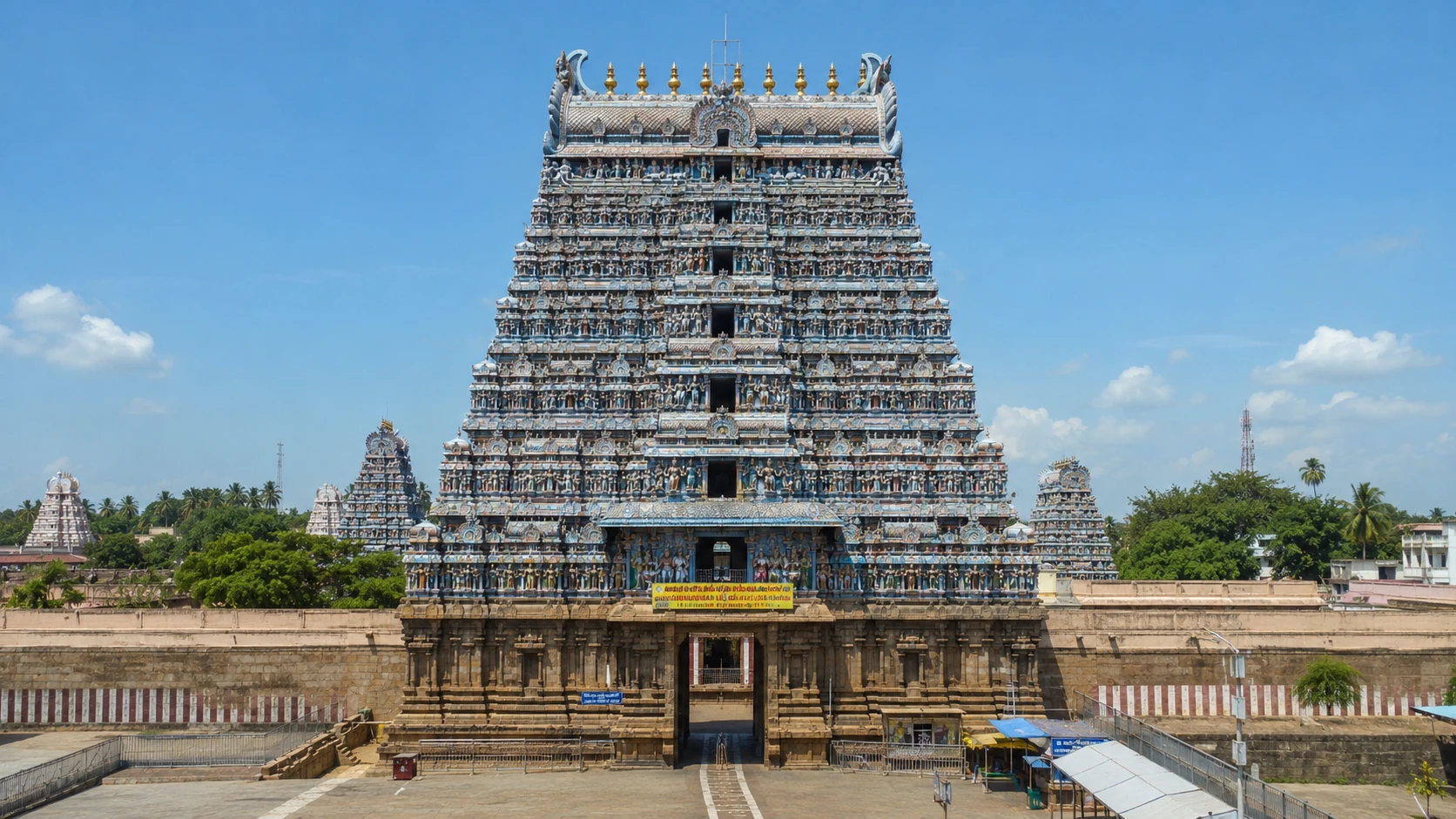
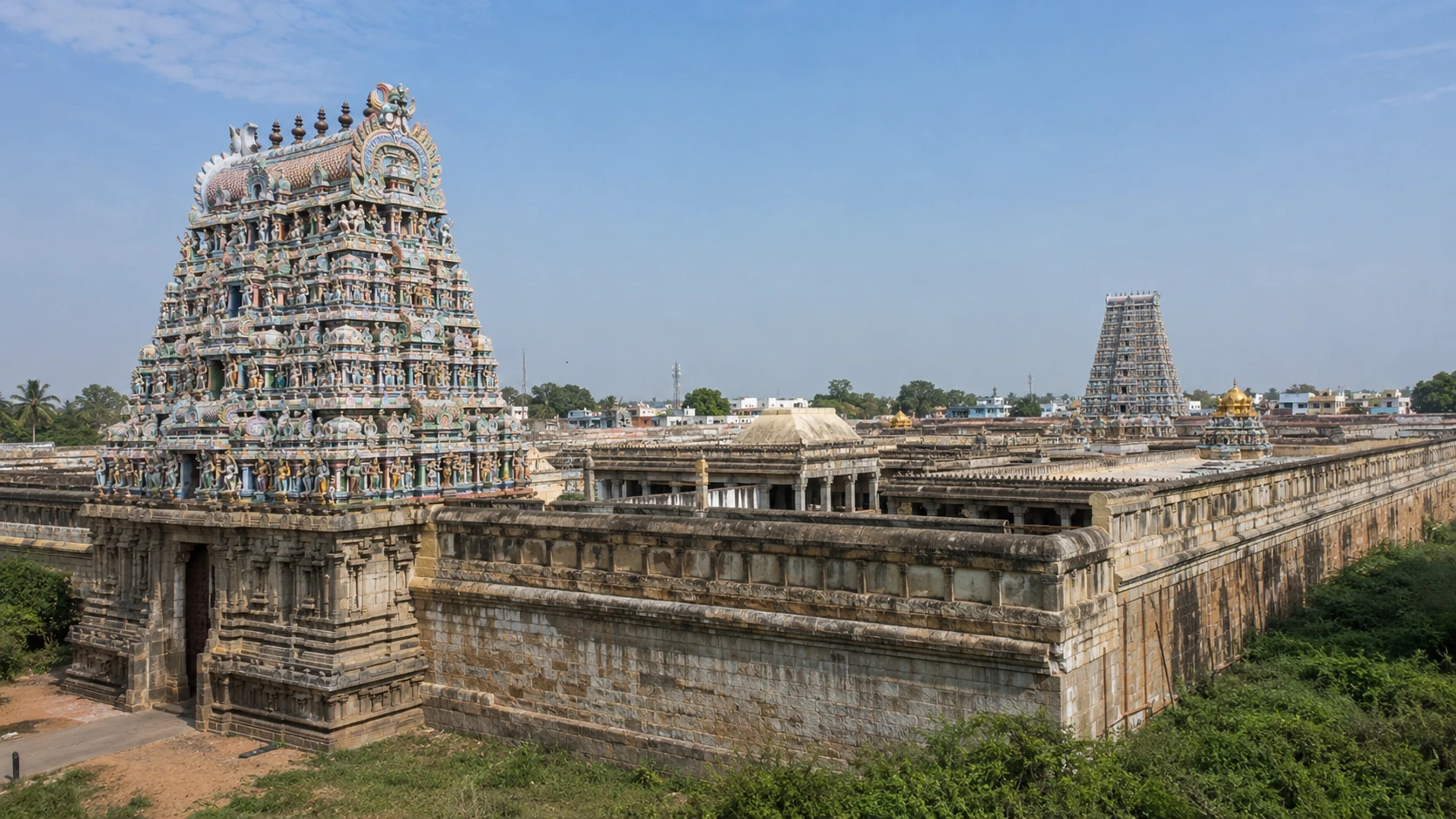
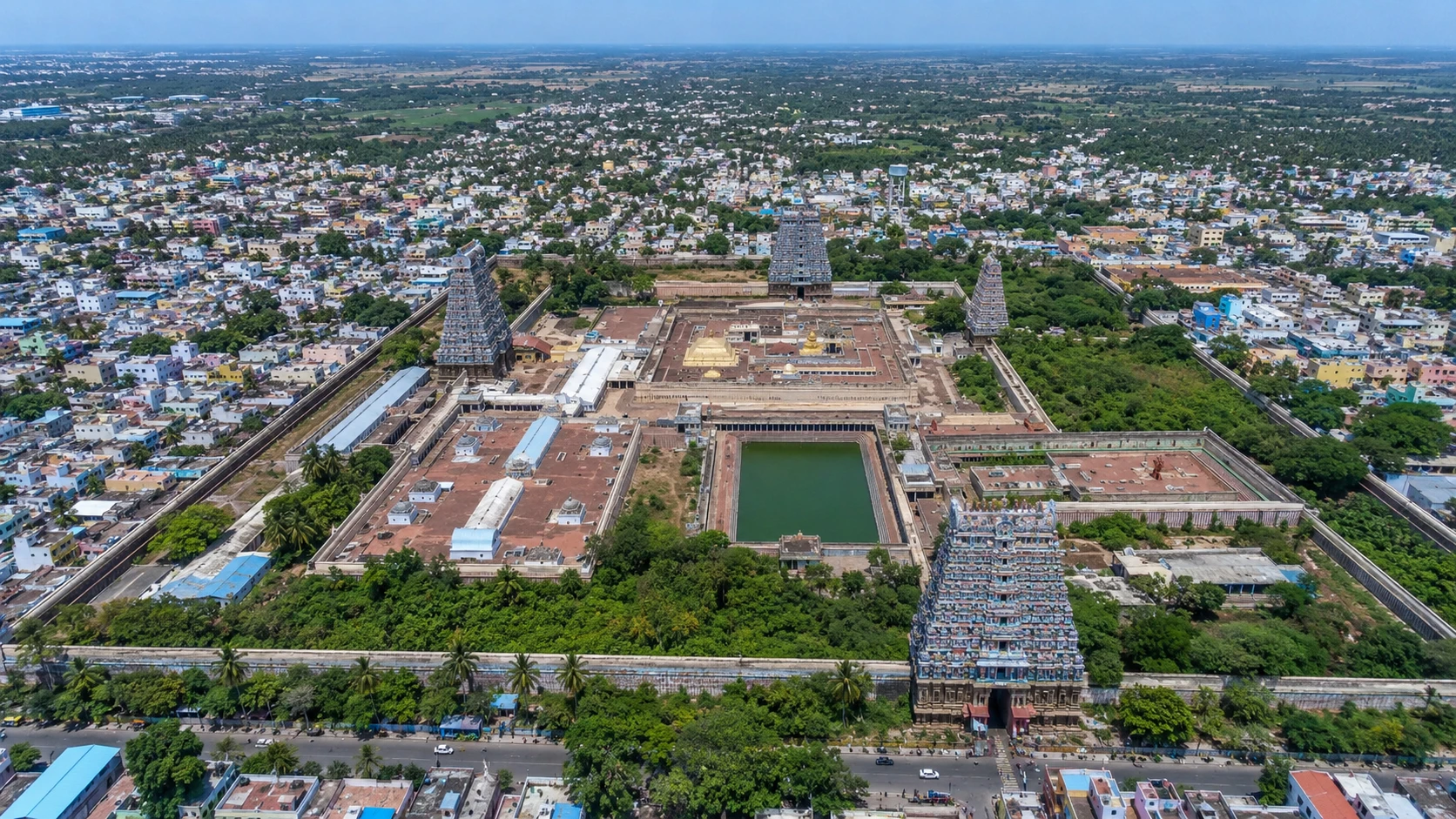
Tamil Drāviḍa (Dravidian) temple-construction style with substantive canonical Cōḻa-period (9th, 13th centuries) architectural foundation and subsequent canonical Pāṇḍya-, Vijayanagara-, and Nāyak-period architectural elaboration. The canonical temple-complex (approximately 40 acres at the heart of Chidambaram town) is one of the most architecturally elaborate canonical Tamil Drāviḍa temple-complexes, structured around the canonical Cit Sabhā (Hall of Consciousness, the canonical inner sanctum housing the Naṭarāja mūrti) and the integrated canonical Kanaka Sabhā (Golden Hall, the canonical gold-tile-roofed structural envelope of the Cit Sabhā). Distinctive architectural elements include: the canonical four cardinal gopurams (East, West, North, South, each reaching approximately 40, 50 meters in height; the canonical East gopuram is the canonical principal pilgrim-entrance gopuram and bears the canonical 108-karaṇa sculptural register depicting all 108 canonical dance-postures from the canonical Nāṭyaśāstra of Bharata Muni, the corpus-distinctive most-complete sculptural representation of the canonical Bharatanāṭyam karaṇa repertoire); the canonical Cit Sabhā / Kanaka Sabhā gold-tile-roofed inner sanctum (traditionally held to comprise 21,600 gold tiles fixed by 72,000 gold nails, the canonical numerical symbolism representing the 21,600 daily breaths and 72,000 nāḍīs / subtle-channels of the canonical haṭha-yoga subtle-anatomy framework, the architectural register thus operating as the canonical macrocosm-microcosm correspondence in physical-architectural register); the canonical Nṛtya Sabhā ('Hall of Dance,' a separate canonical pillared hall depicting the canonical Tāṇḍava narrative); the canonical Rāja Sabhā / Thousand-Pillared Hall (Āyiram Kāl Maṇḍapam, a substantial pillared hall used for canonical festival processions); the canonical Govindarāja Perumāḷ Vaiṣṇava sub-shrine (the canonical Tirucitrakūṭam Divya Desam shrine, integrated within the canonical Naṭarāja temple-complex envelope as the canonical Vaiṣṇava-Śaiva co-veneration architectural feature); the canonical Śivakāmasundarī (Pārvatī) sub-shrine; the canonical Subramaṇya and Gaṇeśa sub-shrines; and the canonical Śivagaṅgā sacred-tank infrastructure. The integrated 40-acre architectural envelope is the canonical principal Tamil Śaiva Pañca Sabhā architectural anchor and operates as one of the most theologically dense canonical Tamil Drāviḍa temple-complex envelopes in South India
खुला
06:00 – 22:00
आरती
07:00 · 09:00 · 10:30 · 12:00 · 18:00 · 20:00
विशेष
The canonical six-kāla daily worship cycle (Ṣaṭ-kāla pūjā) at the Thillai Naṭarāja Temple is the canonical Dīkṣitar-administered liturgical infrastructure operating across the canonical daily framework: Palliyezhucci (canonical awakening worship, approximately 06:30); Mahā-Aarati / Kāla Sandhi (morning worship, approximately 07:00, 09:00); Iraṇḍāṁ Kāla (mid-morning worship, approximately 10:30); Uccikāla (noon worship, approximately 12:00); Sāyaratchai (evening worship, approximately 18:00); Arda-Jāma (night-worship, approximately 20:00, 22:00, including the canonical final Cidambara Rahasyam dīpa-darśana when the canonical curtain is drawn and the canonical Ākāśa Liṅga ākāśa-darshan is presented to pilgrims for the canonical evening culminating ākāśa-meditation observance). The canonical principal annual festival programming centers on the canonical Mārgaḻi Tiruvādhirai / Ārudra Darśanam (Dec-Jan, the canonical full-moon-Tiruvādhirai-nakṣatra night of the canonical Mārgaḻi Tamil month, the canonical principal annual festival reenacting the canonical Ānanda Tāṇḍava and drawing pilgrim flow exceeding 100,000+ at festival peak) and the canonical six annual abhiṣekam observances (Citrai Tiruvōṇam, Vaikāsi Viśākham, Āni Tirumañjanam, Āvaṇi Caturthī, Puraṭṭāsi Kārttikai, Mārgaḻi Tiruvādhirai)
पवित्र कथा · पवित्र कथा
The Thillai Naṭarāja Temple at Chidambaram, Tamil Nadu, occupies a structurally singular position within the canonical Tamil Śaiva temple-tradition framework and the broader pan-Hindu temple-tradition framework. The canonical temple-complex (approximately 40 acres at the heart of Chidambaram town, Cuddalore district, in the central-coastal Tamil Nadu region) is one of the most theologically dense and architecturally elaborate canonical Tamil Drāviḍa temple-complexes, integrating multiple distinct canonical theological frameworks into a single co-located devotional infrastructure: (1) the canonical Ākāśa (Space) Sthalam of the Pañca Bhūta Sthalam (the five Tamil Śaiva canonical shrines each embodying one of the five mahābhūta classical elements, Chidambaram = Space, Srikalahasti = Air, Tiruvannamalai = Fire, Thiruvanaikaval = Water, Kanchipuram-Ekambareśvara = Earth); (2) the canonical Kanaka Sabhā (Golden Hall) principal anchor of the Pañca Sabhā five-dance-halls Tamil Śaiva canonical framework (Chidambaram = Kanaka Sabhā / Golden Hall, Madurai = Velli Ambalam / Rajata Sabhā / Silver Hall, Tirunelveli-Kutralam = Tāmra Sabhā / Copper Hall, Tiruvalankadu = Ratna Sabhā / Ruby Hall, Tiruvannamalai = Citra Sabhā / Painting Hall); (3) the canonical Cit Sabhā (Hall of Consciousness) housing the canonical Naṭarāja mūrti, the iconographic-and-theological seat of Śiva's Ānanda Tāṇḍava (Dance of Bliss); and (4) the canonical Cidambara Rahasyam, the lingam-less inner sanctum that operates as the canonical visual-theological statement of formless, attributeless (nirguṇa) ākāśa-divinity within the canonical saguṇa temple framework. The site's canonical theological centerpiece, Śiva-Naṭarāja in the canonical Ānanda Tāṇḍava posture, is the canonical visual register through which the Hindu philosophical-theological tradition has, since at least the Cōḻa-period bronze tradition (10th, 11th centuries CE), articulated the canonical cosmic-dance theology: Śiva's right upper hand bearing the canonical ḍamaru (the hourglass-drum, sounding the canonical primordial cosmic vibration of creation); the right lower hand in the canonical abhaya mudrā (the gesture of fearlessness, granting devotional refuge); the left upper hand bearing the canonical agni (the flame of dissolution); the left lower hand in the canonical gaja-hasta (the elephant-trunk gesture pointing to the canonical raised left foot of liberating grace); the canonical right foot pressed down upon the canonical Apasmāra puruṣa (the canonical demon-of-ignorance, the canonical theological figure of avidyā subdued through the cosmic dance); the canonical left foot raised in the canonical liberation-posture; surrounded by the canonical prabhāmaṇḍala (the ring of flames representing the canonical cosmic-arc of creation, sustenance, and dissolution); the canonical matted-hair locks fanning outward bearing the canonical Gaṅgā and the canonical crescent moon; and the canonical ardhanārīśvara-implication carried through the canonical earring asymmetry (one canonical male makara-kuṇḍala, one canonical female taṭaṅka, the canonical Cōḻa-period iconographic register integrating the canonical Ardhanārīśvara cosmic-androgyne theology into the canonical Naṭarāja iconographic framework). The corpus-distinctive Cidambara Rahasyam, situated directly adjacent to the canonical Naṭarāja shrine in the Cit Sabhā, behind a canonical curtain, operates as the canonical site's most theologically distinctive feature: behind the canonical curtain there is NO conventional iconographic register (no liṅga, no mūrti, no anthropomorphic representation); instead, a canonical garland of golden bilva-leaves (vilvam) hangs marking the canonical Ākāśa Liṅga, the canonical formless space-as-divinity that constitutes the canonical iconographic-and-theological statement of the canonical Ākāśa Sthalam framework. The Cidambara Rahasyam ('the Secret of Chidambaram') has, across the canonical Tamil Śaiva theological tradition, operated as the canonical visual-theological proof-text for the canonical nirguṇa Brahman framework embedded within the canonical saguṇa temple architecture, the corpus's most theologically distinctive co-located saguṇa-nirguṇa devotional infrastructure. The site is administered by the canonical Pōdhu Dīkṣitar hereditary brahmin priestly community ('the Tillai Vāḻ Andhaṇar,' the canonical 'Brahmins-Who-Live-At-Thillai'), a corpus-distinctive hereditary co-trustee priestly community of approximately 360 families historically that has administered the canonical temple-complex on a rotational service framework across at least a millennium of canonical documented continuity. The Dīkṣitar administration constitutes a structurally singular feature within the corpus's broader temple-administration framework: unlike most major South Indian canonical Hindu temple-complexes (which operate under the canonical Tamil Nadu Hindu Religious and Charitable Endowments Department administrative framework or comparable state-administrative frameworks), the Thillai Naṭarāja Temple has historically operated under canonical Dīkṣitar self-administration, with the canonical 2014 Supreme Court of India judgment (Dr. Subramanian Swamy v. State of Tamil Nadu) restoring canonical Dīkṣitar administrative autonomy after the canonical 2009 Tamil Nadu HR&CE takeover attempt. The site is the canonical opening entry of the Eternal Raga Pañca Bhūta Sthalam sweep, operating as the principal canonical theological anchor of both the Pañca Bhūta Sthalam and Pañca Sabhā frameworks within the canonical Tamil Śaiva temple-tradition.
Sacred Designationपवित्र पदनाम
Pancha Bhoota
तत्व: space
Sacred Origin Storyपवित्र उत्पत्ति कथा
Source: Kōyil Purāṇam (canonical Tamil Sthala Purāṇa of Chidambaram by Umāpati Śivācārya, 14th c.) integrating the canonical Tamil Śaiva canonical theological framework; Cidambara Māhātmyam (canonical Sanskrit Sthala Purāṇa of Chidambaram, c. 12th c.) preserving the canonical Sanskrit canonical theological framework; canonical Tēvāram corpus (canonical hymns of Tirunāvukkaracar / Appar, Tiruñāṉacampantar / Sambandar, and Cuntarar / Sundaramūrti, the canonical first three of the canonical 63 Nāyaṉmārs, all of whom canonically sang of Chidambaram in the canonical Tēvāram); Maṇikkavācakar's Tiruvācakam and Tirukkōvaiyār (canonical 9th-century Tamil Śaiva poet-saint who canonically attained mukti at Chidambaram and whose canonical hymns operate as a canonical site-specific liturgical anchor); Tirumūlar's Tirumantiram (canonical Tamil Śaiva yogic-tantric foundational text); canonical Cōḻa-period inscriptional record
The canonical Kōyil Purāṇam preserves the canonical Chidambaram theological narrative as the integrated Patañjali-and-Vyāghrapāda penance narrative culminating in Śiva's canonical Ānanda Tāṇḍava (Dance of Bliss) at Thillai.
The canonical narrative records that the canonical sage Vyāghrapāda, born of the canonical sage Madhyandina as a canonical brahmin, whose canonical name ('Tiger-Footed,' from vyāghra = tiger + pāda = foot) reflects the canonical theological narrative, performed canonical austerity at the canonical Thillai forest with one canonical request: that he be granted the canonical capacity to gather, before sunrise (so that the canonical bilva-leaves and flowers would remain pristine for the canonical morning worship), the canonical pristine vilvam-leaves growing on the canonical tall Thillai trees beneath which canonical Śiva had manifested.
Canonical Śiva, moved by the canonical austerity, granted the canonical sage canonical tiger-feet (with claws to grip the canonical tree-trunks) and canonical lyre-eyes (with night-vision to see in the pre-dawn darkness), the canonical iconographic origin of Vyāghrapāda's canonical name. Vyāghrapāda then settled at Thillai performing canonical worship of canonical Śiva.
Subsequently, the canonical sage Patañjali, born of the canonical sage Atri's daughter Gōnikā through canonical Ādiśeṣa (the canonical thousand-headed serpent), thus born with the canonical lower body of a serpent and the canonical upper body of a brahmin (the canonical iconographic register of the canonical Patañjali sage-form), descended from the canonical Anantāsana of Mahāviṣṇu to the canonical Thillai forest, where the canonical Ādiśeṣa-form Patañjali joined Vyāghrapāda in canonical austerity, both seeking the canonical darśana of Śiva's canonical cosmic-dance.
Canonical Śiva, accompanied by canonical Pārvatī, descended to the canonical Thillai forest and performed the canonical Ānanda Tāṇḍava (the canonical Dance of Bliss) before the canonical assembly, the canonical Patañjali-Vyāghrapāda pair plus the canonical 3,000 brahmin-sages who had been performing canonical austerity at Thillai.
The site of the canonical Ānanda Tāṇḍava became the canonical Cit Sabhā (Hall of Consciousness), the canonical principal inner sanctum of the canonical Thillai Naṭarāja Temple. The canonical Naṭarāja mūrti enshrined at the canonical Cit Sabhā operates as the canonical iconographic-and-theological register of the canonical Ānanda Tāṇḍava, preserving the canonical cosmic-dance theology in canonical permanent visual register.
Adjacent to the canonical Naṭarāja shrine in the Cit Sabhā, behind a canonical curtain, the canonical Cidambara Rahasyam ('the Secret of Chidambaram') operates as the canonical theological supplement to the canonical Naṭarāja iconographic register, the canonical Ākāśa Liṅga (the canonical formless space-as-divinity, marked by a canonical garland of golden bilva-leaves) operating as the canonical visual statement that beyond the canonical anthropomorphic Naṭarāja form lies the canonical formless nirguṇa Brahman framework, the canonical theological union of the canonical Naṭarāja saguṇa-iconographic register with the canonical Ākāśa-Sthalam-formless-divinity framework.
The canonical narrative further integrates the canonical Tillai-Kāḷi narrative, in which canonical Kāḷi, the canonical fierce-Devī aspect, contested canonical Śiva for canonical primacy at Thillai through a canonical dance-contest; canonical Śiva performed the canonical Ūrdhva Tāṇḍava (the canonical upward-foot-raised dance posture, in which the canonical right foot is raised to the canonical ear level, a canonical posture canonically held to be inaccessible to the canonical Devī due to canonical modesty constraints); canonical Kāḷi conceded the canonical contest, and the canonical Tillai-Kāḷi shrine was established at a separate location north of the canonical Thillai Naṭarāja Temple.
The corpus documents the canonical Patañjali-Vyāghrapāda primary narrative as the canonical principal theological framework, with the canonical Tillai-Kāḷi narrative operating as a canonical supplementary canonical regional Tamil Śaiva tradition narrative.
उद्धृत स्रोत:
- Kōyil Purāṇam (canonical Tamil Sthala Purāṇa of Chidambaram by Umāpati Śivācārya, 14th century)
- Cidambara Māhātmyam (canonical Sanskrit Sthala Purāṇa of Chidambaram, c. 12th century)
- Tēvāram corpus, hymns of Tirunāvukkaracar / Appar, Tiruñāṉacampantar / Sambandar, and Cuntarar / Sundaramūrti (canonical first three of the 63 Nāyaṉmārs)
- Maṇikkavācakar, Tiruvācakam and Tirukkōvaiyār (9th-century Tamil Śaiva poet-saint who canonically attained mukti at Chidambaram)
- Tirumūlar, Tirumantiram (canonical foundational Tamil Śaiva yogic-tantric text)
- Cōḻa-period inscriptional record at the canonical Thillai Naṭarāja Temple
- Smith, David, 'The Dance of Siva: Religion, Art and Poetry in South India' (Cambridge University Press, 1996)
- Younger, Paul, 'The Home of Dancing Sivan: The Traditions of the Hindu Temple in Citamparam' (Oxford University Press, 1995)
- Kulke, Hermann, 'Cidambaramāhātmya' (Otto Harrassowitz, 1970)
- Natarajan, B., 'The City of the Cosmic Dance: Chidambaram' (Orient Longman, 1974)
- Dehejia, Vidya, 'The Sensuous and the Sacred: Chola Bronzes from South India' (American Federation of Arts / Mapin Publishing, 2002)
- Coomaraswamy, Ananda K., 'The Dance of Siva' (Sunwise Turn, 1918)
- Srinivasan, Sharada, 'Cosmic Dance: The Symbolism and Cultural History of the Chola Bronze Nataraja'
- Vatsyayan, Kapila, 'The Square and the Circle of the Indian Arts' (Roli Books, 1997)
अन्य परंपराएँ · अन्य परंपराएँ
Tillai-Kāḷi canonical dance-contest narrative, canonical Devī-Śiva canonical regional Tamil Śaiva-Shakta narrative
The canonical Tillai-Kāḷi narrative operates as a canonical supplementary canonical regional Tamil Śaiva tradition account preserving the canonical Devī-Śiva dance-contest theological framework at Thillai. The canonical narrative records that canonical Kāḷi, the canonical fierce-Devī aspect canonically residing in the Thillai forest prior to Śiva's canonical Ānanda Tāṇḍava manifestation, contested canonical Śiva for canonical primacy at Thillai through a canonical dance-contest.
Canonical Śiva and canonical Kāḷi engaged in extended canonical dance-by-dance contest, each performing canonical successive dance-postures from the canonical Tāṇḍava repertoire. The canonical contest reached its canonical culmination when canonical Śiva performed the canonical Ūrdhva Tāṇḍava, the canonical upward-foot-raised dance posture in which the canonical right foot is raised to the canonical ear level.
The canonical Ūrdhva Tāṇḍava posture is, in the canonical theological framework, canonically held to be inaccessible to the canonical Devī due to canonical modesty constraints (the posture is canonically held to require the canonical raising of the foot above the canonical waist-level in a manner that canonical Devī-comportment cannot canonically replicate).
Canonical Kāḷi accordingly conceded the canonical contest. The canonical Tillai-Kāḷi shrine (the canonical Tillai-Kāḷi Amman Koyil) was subsequently established at a separate location north of the canonical Thillai Naṭarāja Temple, the canonical fierce-Devī aspect being separately consecrated outside the canonical Naṭarāja temple-complex envelope.
The canonical Tillai-Kāḷi narrative operates as the canonical Tamil Śaiva-Shakta tradition's narrative-theological framework for the canonical separation of the canonical Naṭarāja-Cit-Sabhā devotional infrastructure from the canonical fierce-Devī devotional infrastructure within the canonical Chidambaram canonical regional zone.
Govindarāja Perumāḷ Vaiṣṇava sub-shrine narrative, canonical Vaiṣṇava co-veneration narrative within the canonical Śaiva temple-complex
The canonical Govindarāja Perumāḷ Vaiṣṇava sub-shrine, situated immediately adjacent to the canonical Naṭarāja Cit Sabhā within the canonical temple-complex envelope, operates as the canonical co-located Vaiṣṇava devotional infrastructure integrated within the canonical Śaiva Naṭarāja temple-complex framework.
The canonical Govindarāja Perumāḷ shrine is canonically recognized as one of the canonical 108 Divya Desam Vaiṣṇava sacred shrines (the canonical Tirucitrakūṭam Divya Desam) celebrated in the canonical Nālāyira Divya Prabandham corpus of canonical Tamil Vaiṣṇava-tradition hymns.
The canonical shrine houses the canonical reclining (anantaśāyī) Viṣṇu mūrti in the canonical Tamil Vaiṣṇava iconographic register, with the canonical Tirumaṅgai Āḻvār, the canonical Kulaśēkhara Āḻvār, and additional canonical Āḻvārs canonically singing the canonical shrine's praises in the canonical Nālāyira Divya Prabandham.
The canonical historical record documents that the canonical Cōḻa-period emperor Kulottuṅga II (1133, 1150 CE) removed the canonical Govindarāja Perumāḷ mūrti from the canonical temple-complex (the canonical mūrti's relocation operating as the canonical principal historical disruption of the canonical co-veneration framework, with the canonical Vaiṣṇava tradition holding that the canonical mūrti was canonically relocated to the canonical Tirupati region).
The canonical Vijayanagara-period emperor Kṛṣṇadevarāya (1509, 1529 CE) canonically initiated the canonical restoration of the canonical Govindarāja Perumāḷ mūrti, with his canonical successor Acyutadevarāya canonically executing the canonical restoration in 1539 CE.
The canonical Vaiṣṇava sub-shrine has continued canonical operations alongside the canonical Śaiva Naṭarāja Cit Sabhā within the integrated canonical temple-complex envelope since the canonical 1539 restoration. The canonical Govindarāja Perumāḷ shrine operates as the canonical principal Vaiṣṇava-Śaiva co-veneration architectural feature at Chidambaram and is the corpus's principal documented Vaiṣṇava sub-shrine integrated within a major canonical Śaiva temple-complex envelope.
Maṇikkavācakar mukti narrative, canonical Tamil Śaiva poet-saint canonical attainment narrative at Chidambaram
The canonical Maṇikkavācakar narrative operates as the canonical Tamil Śaiva poet-saint canonical attainment narrative at Chidambaram. Maṇikkavācakar, the canonical 9th-century Tamil Śaiva poet-saint, canonically held to be one of the canonical 'four canonical samayācāryas' of the canonical Tamil Śaiva-Siddhānta tradition (alongside Appar, Sambandar, and Sundarar), canonically composed the canonical Tiruvācakam (the canonical 'Sacred Utterances,' a canonical Tamil Śaiva poetic-devotional corpus of approximately 656 hymns) and the canonical Tirukkōvaiyār (the canonical 'Sacred Garland,' a canonical 400-verse poetic work integrating canonical Tamil literary akam-and-puṟam conventions with canonical Tamil Śaiva theological framework) in canonical part at Chidambaram.
The canonical Maṇikkavācakar tradition holds that the canonical poet-saint, having canonically debated the canonical Buddhist scholars at Chidambaram, performed canonical poetic composition before the canonical Naṭarāja shrine, with canonical Śiva canonically appearing as canonical scribe (the canonical 'Tirupperundurai' canonical narrative episode) to transcribe the canonical poetic composition.
The canonical Maṇikkavācakar tradition further holds that the canonical poet-saint canonically attained mukti at the canonical Cit Sabhā at Chidambaram, the canonical poet-saint canonically merging with the canonical Naṭarāja form upon canonical death.
The canonical Maṇikkavācakar mukti narrative operates as the canonical Tamil Śaiva tradition's principal canonical Chidambaram-anchored mukti narrative, with the canonical Maṇikkavācakar tradition's canonical Tiruvācakam and Tirukkōvaiyār operating as the canonical site-specific liturgical anchors at the canonical Thillai Naṭarāja Temple.
The canonical Tiruvācakam's canonical verses are canonically recited at the canonical six-kāla daily worship cycle as part of the canonical Dīkṣitar liturgical infrastructure.
विद्वत संदर्भ
The Thillai Naṭarāja Temple at Chidambaram occupies a structurally singular position in the corpus and is the canonical opening Tier A entry of the Eternal Raga Pañca Bhūta Sthalam sweep. The canonical theological framework operates through the integrated four-framework convergence: (1) the canonical Ākāśa (Space) Sthalam of the Pañca Bhūta Sthalam framework, with the corpus-distinctive Cidambara Rahasyam lingam-less iconographic register operating as the canonical visual statement of the canonical formless ākāśa-divinity; (2) the canonical Kanaka Sabhā (Golden Hall) principal anchor of the Pañca Sabhā framework, with the canonical Cit Sabhā / Kanaka Sabhā operating as the canonical principal site of Śiva-Naṭarāja's Ānanda Tāṇḍava; (3) the canonical Naṭarāja iconographic-and-theological framework, with the canonical Cōḻa-period Naṭarāja bronze tradition (10th, 11th centuries) operating as the canonical visual register through which the Hindu philosophical-theological tradition has articulated the canonical cosmic-dance theology; and (4) the canonical Dīkṣitar hereditary administrative framework, with the canonical Pōdhu Dīkṣitar community operating the canonical temple-complex on a hereditary co-trustee basis distinct from the canonical Tamil Nadu HR&CE administrative framework that operates at most major South Indian canonical Hindu temple-complexes. Smith 1996 ('The Dance of Siva: Religion, Art and Poetry in South India') and Younger 1995 ('The Home of Dancing Sivan: The Traditions of the Hindu Temple in Citamparam') provide the principal modern academic treatments of the canonical Chidambaram canonical theological-historical-iconographic framework. Kulke 1970 provides the canonical foundational German-language academic treatment of the Cidambara Māhātmyam textual tradition. Dehejia 2002 and Srinivasan provide the canonical Cōḻa Naṭarāja bronze tradition scholarly framework. Coomaraswamy 1918 ('The Dance of Siva') provides the canonical foundational early-20th-century scholarly treatment of the Naṭarāja iconographic-theological register. Vatsyayan 1997 and the broader canonical Bharatanāṭyam-Nāṭyaśāstra scholarly framework integrate with the canonical 108-karaṇa sculptural register of the canonical East gopuram. The site's historical depth, pre-canonical Sangam-era references, foundational canonical Cōḻa-period (9th, 13th centuries) patronage with Āditya Cōḻa I, Parāntaka I, Rājarāja Cōḻa I, Rājendra Cōḻa I, Kulottuṅga II, and the broader canonical Cōḻa dynasty operating as the canonical principal patronage anchor; canonical Pāṇḍya-period patronage; canonical Vijayanagara-period restoration (notably the canonical Kṛṣṇadevarāya / Acyutadevarāya restoration of the Govindarāja Perumāḷ shrine in 1539 CE); canonical Nāyak-period elaboration; canonical Dīkṣitar continuous administration; canonical 2014 Supreme Court of India judgment restoring canonical Dīkṣitar administrative autonomy, operates within the broader Tamil regional historical framework documented through the canonical Cōḻa-period inscriptional record, Stein 1980/1989, Heitzman 1997, and the broader canonical Tamil regional historical scholarship. The corpus documents the site as a Tier A canonical Tamil Śaiva temple within the Pañca Bhūta Sthalam sweep, with the canonical integrated four-framework convergence (Ākāśa Sthalam + Kanaka Sabhā + Naṭarāja iconographic anchor + Dīkṣitar hereditary administration) operating as the canonical theological-administrative framework documented within the corpus's editorial framework. Three alternate accounts are surfaced under the mythology section: (1) the canonical Tillai-Kāḷi dance-contest narrative, the canonical Devī-Śiva canonical regional Tamil Śaiva-Shakta narrative; (2) the canonical Govindarāja Perumāḷ Vaiṣṇava sub-shrine narrative, the canonical Vaiṣṇava co-veneration narrative within the canonical Śaiva temple-complex; and (3) the canonical Maṇikkavācakar mukti narrative, the canonical Tamil Śaiva poet-saint canonical attainment narrative at Chidambaram. All three alternate accounts are canonically devotionally compatible with the primary Patañjali-Vyāghrapāda narrative.
Historyइतिहास
Chidambaram's historical depth as a sacred site integrates with the broader canonical Tamil Śaiva temple-tradition heartland historical framework. The pre-canonical layer (Tamil Sangam-era attestation, approximately 3rd century BCE through 3rd century CE) preserves indirect canonical Sangam-era references to the canonical Thillai canonical Tamil Śaiva cultural-religious infrastructure, though the canonical Sangam-era literary record does not preserve substantive direct attestation of the canonical Chidambaram temple itself.
The substantive canonical Chidambaram temple-tradition historical attestation commences in the canonical Tēvāram corpus (c. 6th, 9th centuries CE), the canonical hymns of Tirunāvukkaracar / Appar, Tiruñāṉacampantar / Sambandar, and Cuntarar / Sundaramūrti (the canonical first three of the canonical 63 Nāyaṉmārs) preserve the canonical earliest substantive Tamil Śaiva poetic-devotional attestation of the canonical Thillai canonical Tamil Śaiva tradition.
Maṇikkavācakar's Tiruvācakam and Tirukkōvaiyār (canonical 9th century) preserve the canonical Tamil Śaiva poet-saint canonical attainment narrative at Chidambaram and operate as the canonical site-specific liturgical anchor.
The foundational canonical Cōḻa dynasty patronage period (9th, 13th centuries) operates as the canonical principal historical patronage phase. Āditya Cōḻa I (871, 907 CE) is canonically credited with major canonical reconstruction of the canonical Thillai Naṭarāja Temple.
Parāntaka I (907, 955 CE) canonically gilded the canonical Cit Sabhā roof in gold, establishing the canonical Kanaka Sabhā ('Golden Hall') canonical iconographic-architectural register that has continued to canonical present day.
The canonical Cōḻa-period (10th, 11th centuries) Naṭarāja bronze tradition operates as the canonical visual register through which the Hindu philosophical-theological tradition has articulated the canonical cosmic-dance theology, with the canonical Cōḻa Naṭarāja bronze form operating as one of the most internationally recognized canonical Hindu iconographic registers in art history, with major canonical examples preserved at the Government Museum Chennai, the British Museum London, the Metropolitan Museum of Art New York, the Museum Rietberg Zürich, and the broader canonical museum network.
Rājarāja Cōḻa I (985, 1014 CE) and Rājendra Cōḻa I (1014, 1044 CE) continued the canonical Cōḻa patronage of Chidambaram alongside their broader canonical Tamil Śaiva temple-tradition patronage program (including the canonical Bṛhadīśvara temple at Thanjavur and the canonical Gangaikondacholapuram temple).
Kulottuṅga II Cōḻa (1133, 1150 CE) canonically removed the canonical Govindarāja Perumāḷ Vaiṣṇava sub-shrine mūrti from the canonical Chidambaram temple-complex (the canonical Vaiṣṇava tradition holding that the canonical mūrti was canonically relocated to the canonical Tirupati region).
The canonical Cōḻa-period inscriptional record at Chidambaram operates as one of the most substantively-documented canonical Tamil temple-tradition inscriptional corpora in South India. The subsequent canonical Pāṇḍya dynasty patronage period continued canonical patronage.
The 14th-century invasion-disruption period brought canonical infrastructure disruption: the canonical Malik Kafur invasion (1311 CE, the canonical Delhi Sultanate's southern campaign under Alauddin Khilji) reached the southern Tamil regions, with documented disruption of canonical Tamil Śaiva temple-tradition operations across the broader regional canonical zone.
The Vijayanagara empire's southern campaigns (mid-14th century) reconquered the broader Tamil regional zone, with canonical Vijayanagara-period patronage of Chidambaram commencing in the late 14th century. The canonical Vijayanagara-period emperor Kṛṣṇadevarāya (1509, 1529 CE) and his canonical successor Acyutadevarāya canonically restored the canonical Govindarāja Perumāḷ Vaiṣṇava sub-shrine in 1539 CE, restoring the canonical Vaiṣṇava-Śaiva co-veneration architectural framework at Chidambaram.
The Nāyak dynasty patronage period (16th, 17th centuries) brought additional canonical architectural elaboration at the canonical temple-complex. The British colonial period (1801 onwards, with continued direct administration from 1858 through 1947 as part of the Madras Presidency) brought the canonical temple-complex into the colonial administrative arrangements; however, the canonical Pōdhu Dīkṣitar hereditary brahmin priestly community continued canonical self-administration of the temple-complex throughout the colonial period (unlike most major canonical South Indian Hindu temple-complexes which came under colonial-period direct administrative oversight).
The post-Independence period (1947, present) continued canonical Dīkṣitar self-administration. The canonical 2009 Tamil Nadu HR&CE takeover attempt, in which the canonical Tamil Nadu Hindu Religious and Charitable Endowments Department sought to bring the canonical Thillai Naṭarāja Temple under canonical HR&CE direct administration, was canonically challenged in the Supreme Court of India.
The canonical 2014 Supreme Court of India judgment (Dr. Subramanian Swamy v. State of Tamil Nadu) canonically restored canonical Dīkṣitar administrative autonomy, with the canonical court holding that the canonical Pōdhu Dīkṣitar community constituted a canonical denominational religious community entitled to canonical Article 26 constitutional protections under the canonical Indian constitutional framework.
The contemporary canonical Pōdhu Dīkṣitar administration continues canonical temple operations under the canonical 2014 Supreme Court framework. The temple draws canonical pilgrim flow exceeding 10,000, 20,000 daily on average and substantially higher festival-period crowds (the canonical Mārgaḻi Tiruvādhirai / Ārudra Darśanam festival peak crowds canonically exceeding 100,000+), making the Thillai Naṭarāja Temple one of the most-visited canonical Tamil Śaiva temple sites in South India and a substantively-significant canonical cultural-religious destination within the broader pan-Indian Hindu temple-tradition framework.
The canonical 108-karaṇa sculptural register of the canonical East gopuram has been substantially studied by the canonical Bharatanāṭyam-Nāṭyaśāstra scholarly tradition, operating as the canonical principal sculptural-iconographic anchor for the canonical classical Tamil dance-tradition scholarly framework.
Historical Timelineऐतिहासिक कालक्रम
Canonical Tēvāram corpus attestation of the canonical Thillai canonical Tamil Śaiva tradition. The canonical hymns of Tirunāvukkaracar / Appar (c. 7th c. CE), Tiruñāṉacampantar / Sambandar (c. 7th c. CE), and Cuntarar / Sundaramūrti (c. 8th, 9th c. CE), the canonical first three of the canonical 63 Nāyaṉmārs, canonically sang of the canonical Thillai canonical Tamil Śaiva tradition, preserving the canonical earliest substantive Tamil Śaiva poetic-devotional attestation of the canonical Chidambaram canonical Tamil Śaiva tradition. The canonical Tēvāram corpus operates as the canonical foundational textual anchor for the canonical Chidambaram canonical Tamil Śaiva tradition and as the canonical earliest substantive attestation framework for the canonical Thillai canonical Tamil Śaiva infrastructure.
Canonical Maṇikkavācakar period at Chidambaram. The canonical 9th-century Tamil Śaiva poet-saint Maṇikkavācakar, canonically held to be one of the canonical 'four canonical samayācāryas' of the canonical Tamil Śaiva-Siddhānta tradition (alongside Appar, Sambandar, and Sundarar), canonically composed substantive portions of the canonical Tiruvācakam (approximately 656 hymns) and the canonical Tirukkōvaiyār (400 verses) at Chidambaram, with the canonical Maṇikkavācakar tradition holding that the canonical poet-saint canonically attained mukti at the canonical Cit Sabhā. The canonical Maṇikkavācakar tradition's canonical Tiruvācakam and Tirukkōvaiyār operate as the canonical site-specific liturgical anchor at the canonical Thillai Naṭarāja Temple and are canonically recited at the canonical six-kāla daily worship cycle.
Foundational canonical Cōḻa dynasty patronage of the canonical Thillai Naṭarāja Temple. Āditya Cōḻa I (reigned 871, 907 CE) is canonically credited with major canonical reconstruction of the canonical Thillai Naṭarāja Temple, establishing the canonical foundational architectural framework that would receive subsequent canonical Cōḻa-period and post-Cōḻa elaboration. Parāntaka I (reigned 907, 955 CE) canonically gilded the canonical Cit Sabhā roof in gold, establishing the canonical Kanaka Sabhā ('Golden Hall') canonical iconographic-architectural register that has continued to canonical present day. The canonical numerical symbolism of the canonical gold-tile roof (traditionally held to comprise 21,600 gold tiles fixed by 72,000 gold nails, the canonical 21,600 representing canonical daily breaths and 72,000 representing canonical nāḍīs / subtle-channels of the canonical haṭha-yoga subtle-anatomy framework) operates as the canonical macrocosm-microcosm correspondence in physical-architectural register. The foundational Cōḻa patronage period operates as the canonical principal historical anchor of the canonical Chidambaram canonical Tamil Śaiva temple-tradition.
Canonical Cōḻa-period Naṭarāja bronze tradition flourishing. The canonical Cōḻa-period (particularly 10th, 11th centuries) Naṭarāja bronze tradition operates as the canonical visual register through which the Hindu philosophical-theological tradition has articulated the canonical cosmic-dance theology. The canonical Cōḻa Naṭarāja bronze form, depicting Śiva in the canonical Ānanda Tāṇḍava posture (ḍamaru in right upper hand, agni in left upper hand, abhaya mudrā in right lower hand, gaja-hasta in left lower hand, right foot pressed on the Apasmāra puruṣa, left foot raised in liberation-posture, encircled by the prabhāmaṇḍala flame-ring), operates as one of the most internationally recognized canonical Hindu iconographic registers in art history. Major canonical Cōḻa Naṭarāja bronze examples are preserved at the Government Museum Chennai, the British Museum London, the Metropolitan Museum of Art New York, the Museum Rietberg Zürich, and across the broader canonical museum network. Rājarāja Cōḻa I (985, 1014 CE) and Rājendra Cōḻa I (1014, 1044 CE) continued the canonical Cōḻa patronage of Chidambaram alongside their broader canonical Tamil Śaiva temple-tradition patronage program (including the canonical Bṛhadīśvara temple at Thanjavur and the canonical Gangaikondacholapuram temple).
Canonical Kulottuṅga II Cōḻa removal of the Govindarāja Perumāḷ Vaiṣṇava sub-shrine. Kulottuṅga II Cōḻa (reigned 1133, 1150 CE) canonically removed the canonical Govindarāja Perumāḷ Vaiṣṇava sub-shrine mūrti from the canonical Chidambaram temple-complex. The canonical removal operates as the canonical principal historical disruption of the canonical Vaiṣṇava-Śaiva co-veneration framework at Chidambaram. The canonical Vaiṣṇava tradition holds that the canonical mūrti was canonically relocated to the canonical Tirupati region and integrated into the canonical Tirumala canonical Vaiṣṇava-tradition framework. The canonical Kulottuṅga II removal narrative operates as one of the most substantively-documented canonical Vaiṣṇava-Śaiva sectarian-historical events in canonical South Indian temple-tradition history, with the canonical Tamil Vaiṣṇava tradition (particularly through the canonical Rāmānuja school) preserving the canonical narrative as a canonical marker of the canonical Cōḻa-period Vaiṣṇava-Śaiva tension framework. The canonical historical record includes scholarly debate on the exact circumstances and the extent of the canonical removal; the canonical Tamil Vaiṣṇava tradition's canonical narrative operates alongside the canonical Tamil Śaiva tradition's canonical narrative within the canonical historical scholarly framework.
The canonical Kulottuṅga II removal narrative has been substantively debated in modern academic scholarship. Some scholars view the canonical event as a canonical sectarian Vaiṣṇava-Śaiva conflict episode; other scholars view the canonical event as a canonical sub-shrine reorganization within the canonical temple-complex's broader architectural-administrative framework. The corpus documents the canonical narrative as preserved in the canonical Tamil Vaiṣṇava tradition while acknowledging the canonical historical scholarly debate.
14th-century invasion-disruption period at the broader canonical Tamil regional zone. The canonical Malik Kafur invasion (1311 CE, the canonical Delhi Sultanate's southern campaign under Alauddin Khilji) reached the southern Tamil regions, with documented disruption of canonical Tamil Śaiva and canonical Tamil Vaiṣṇava temple-tradition operations across the broader regional canonical zone. The canonical Chidambaram canonical temple-tradition experienced canonical disruption during this period within the broader regional disruption framework, though the canonical Chidambaram temple-complex's specific damage profile during the canonical invasion period is less substantively documented than the canonical Madurai, Srirangam, and broader Tamil regional canonical temple-tradition disruption profile. The Vijayanagara empire's southern campaigns (mid-14th century) reconquered the broader Tamil regional zone, with canonical Vijayanagara-period patronage of Chidambaram commencing in the late 14th century.
Canonical Vijayanagara-period restoration of the Govindarāja Perumāḷ Vaiṣṇava sub-shrine. The canonical Vijayanagara-period emperor Kṛṣṇadevarāya (1509, 1529 CE) initiated the canonical restoration program; his canonical successor Acyutadevarāya (1529, 1542 CE) canonically executed the canonical Govindarāja Perumāḷ Vaiṣṇava sub-shrine restoration in 1539 CE. The canonical restoration operates as the canonical principal restoration historical anchor for the canonical Vaiṣṇava-Śaiva co-veneration framework at Chidambaram. The canonical Govindarāja Perumāḷ shrine has continued canonical operations alongside the canonical Śaiva Naṭarāja Cit Sabhā within the integrated canonical temple-complex envelope since the canonical 1539 restoration. The canonical Vaiṣṇava-Śaiva co-veneration architectural framework at Chidambaram operates as the corpus's principal documented Vaiṣṇava sub-shrine integration within a major canonical Śaiva temple-complex envelope.
Canonical Tamil Nadu HR&CE takeover attempt of the canonical Thillai Naṭarāja Temple. The canonical Tamil Nadu Hindu Religious and Charitable Endowments Department in 2009 sought to bring the canonical Thillai Naṭarāja Temple under canonical HR&CE direct administration, displacing the canonical Pōdhu Dīkṣitar hereditary administrative framework that had operated the canonical temple-complex for at least a millennium of canonical documented continuity. The canonical takeover attempt was canonically challenged in the courts by the canonical Pōdhu Dīkṣitar community and by canonical petitioners including Dr. Subramanian Swamy, with the canonical challenge proceeding through the canonical Madras High Court to the canonical Supreme Court of India.
Canonical 2014 Supreme Court of India judgment restoring canonical Dīkṣitar administrative autonomy. The canonical Supreme Court of India in Dr. Subramanian Swamy v. State of Tamil Nadu (Civil Appeal No. 10621 of 2013), decided on 6 January 2014, canonically restored canonical Dīkṣitar administrative autonomy. The canonical court held that the canonical Pōdhu Dīkṣitar community constituted a canonical denominational religious community entitled to canonical Article 26 constitutional protections under the canonical Indian constitutional framework, Article 26 of the canonical Constitution of India protecting the canonical 'right of every religious denomination or any section thereof' to canonically 'manage its own affairs in matters of religion.' The canonical 2014 judgment operates as the canonical principal contemporary administrative anchor of the canonical Thillai Naṭarāja Temple, with the canonical contemporary Pōdhu Dīkṣitar administration continuing canonical temple operations under the canonical 2014 Supreme Court framework. The canonical Dīkṣitar administrative framework is corpus-distinctive within the broader South Indian canonical Hindu temple-tradition administrative framework, most major canonical South Indian canonical Hindu temple-complexes operate under canonical state-administrative frameworks (the canonical Tamil Nadu HR&CE framework, the canonical Andhra Pradesh Endowments framework, the canonical Karnataka Muzrai framework, the canonical Kerala Devaswom Boards framework). The canonical Thillai Naṭarāja Temple is the principal documented major canonical South Indian temple-complex operating under canonical hereditary brahmin priestly community administration in the contemporary canonical Indian administrative framework.
What You'll Seeदर्शन में
The Thillai Naṭarāja Temple at Chidambaram preserves the corpus-distinctive integrated four-framework iconographic register, the canonical Naṭarāja iconographic anchor + the canonical Cidambara Rahasyam lingam-less Ākāśa-Liṅga + the canonical Kanaka Sabhā / Cit Sabhā architectural envelope + the canonical 108-karaṇa sculptural-iconographic register.
The principal Cit Sabhā (Hall of Consciousness) houses the canonical Naṭarāja mūrti, the canonical iconographic-and-theological seat of Śiva's Ānanda Tāṇḍava (Dance of Bliss). The canonical Naṭarāja iconographic register operates in the canonical Cōḻa-period bronze tradition's canonical form: Śiva depicted in the canonical Ānanda Tāṇḍava posture with the canonical four-armed standing form bearing the canonical ḍamaru (the hourglass-drum sounding the canonical primordial cosmic vibration of creation) in the canonical right upper hand; the canonical abhaya mudrā (the gesture of fearlessness, granting devotional refuge) in the canonical right lower hand; the canonical agni (the flame of dissolution) in the canonical left upper hand; the canonical gaja-hasta (the elephant-trunk gesture pointing to the canonical raised left foot of liberating grace) in the canonical left lower hand; the canonical right foot pressed down upon the canonical Apasmāra puruṣa (the canonical demon-of-ignorance, the canonical theological figure of avidyā subdued through the cosmic dance); the canonical left foot raised in the canonical liberation-posture; surrounded by the canonical prabhāmaṇḍala (the ring of flames representing the canonical cosmic-arc of creation, sustenance, and dissolution); the canonical matted-hair locks (jaṭā) fanning outward bearing the canonical Gaṅgā (as a small canonical Devī-figure) and the canonical crescent moon; and the canonical ardhanārīśvara-implication carried through the canonical earring asymmetry (one canonical male makara-kuṇḍala, one canonical female taṭaṅka).
The canonical Naṭarāja mūrti is accompanied at the canonical Cit Sabhā by the canonical Śivakāmasundarī mūrti, the canonical Pārvatī form bearing the canonical witness-posture as the canonical primary witness of the canonical Ānanda Tāṇḍava.
Directly adjacent to the canonical Naṭarāja shrine in the canonical Cit Sabhā, behind a canonical curtain, lies the corpus-distinctive Cidambara Rahasyam ('the Secret of Chidambaram'), the canonical lingam-less iconographic register.
Behind the canonical curtain there is NO conventional iconographic register (no liṅga, no mūrti, no anthropomorphic representation); instead, a canonical garland of golden bilva-leaves (vilvam) hangs marking the canonical Ākāśa Liṅga, the canonical formless space-as-divinity that constitutes the canonical iconographic-and-theological statement of the canonical Ākāśa Sthalam framework.
The Cidambara Rahasyam is canonically revealed to canonical pilgrims during the canonical evening Arda-Jāma (night-worship, approximately 20:00, 22:00) when the canonical curtain is drawn for the canonical dīpa-darśana (the canonical lamp-darshan, in which the canonical Dīkṣitar priests canonically wave the canonical lighted lamps before the canonical Ākāśa-Liṅga register for the canonical pilgrims' canonical ākāśa-meditation observance).
The integrated Cit Sabhā / Kanaka Sabhā gold-tile-roofed inner sanctum operates as the canonical architectural envelope housing both the canonical Naṭarāja iconographic register and the canonical Cidambara Rahasyam Ākāśa-Liṅga lingam-less register, the integrated saguṇa-iconographic + nirguṇa-formless framework operating as the corpus-distinctive co-located saguṇa-nirguṇa devotional infrastructure.
The canonical Kanaka Sabhā gold-tile-roof (traditionally held to comprise 21,600 gold tiles fixed by 72,000 gold nails, the canonical numerical symbolism representing the 21,600 daily breaths and 72,000 nāḍīs / subtle-channels of the canonical haṭha-yoga subtle-anatomy framework) operates as the canonical architectural register integrating the canonical macrocosm-microcosm correspondence in physical-architectural form.
The broader canonical temple-complex's architectural-iconographic register includes: the canonical four cardinal gopurams (East, West, North, South, each reaching approximately 40, 50 meters in height); the canonical East gopuram's 108-karaṇa sculptural register, the corpus-distinctive most-complete sculptural representation of the canonical 108 dance-postures from the canonical Nāṭyaśāstra of Bharata Muni (each karaṇa depicted as a canonical sculptural panel with the canonical Sanskrit name inscribed alongside, operating as the canonical principal sculptural-iconographic anchor for the canonical classical Tamil dance-tradition scholarly framework and a canonical foundational visual reference for the canonical Bharatanāṭyam classical Indian dance tradition); the canonical Nṛtya Sabhā ('Hall of Dance,' a separate canonical pillared hall depicting the canonical Tāṇḍava narrative, including the canonical Ūrdhva Tāṇḍava posture from the canonical Tillai-Kāḷi narrative); the canonical Rāja Sabhā / Thousand-Pillared Hall (Āyiram Kāl Maṇḍapam, a substantial pillared hall used for canonical festival processions); the canonical Govindarāja Perumāḷ Vaiṣṇava sub-shrine (the canonical Tirucitrakūṭam Divya Desam shrine, housing the canonical reclining anantaśāyī Viṣṇu mūrti in the canonical Tamil Vaiṣṇava iconographic register); the canonical Śivakāmasundarī (Pārvatī) sub-shrine; the canonical Subramaṇya and Gaṇeśa sub-shrines; the canonical Bhairava sub-shrine; and the canonical Śivagaṅgā sacred-tank infrastructure providing the canonical bathing-observance anchor for canonical pilgrims.
The integrated 40-acre architectural envelope is one of the most architecturally elaborate and theologically dense canonical Hindu temple-complex envelopes in South India.
Distinctive Practicesविशिष्ट परंपराएँ
Canonical Cidambara Rahasyam Dīpa-Darśana (Ākāśa-Liṅga Lamp-Darshan), Corpus-Distinctive Lingam-less Ākāśa-Sthalam Liturgical Observance
प्रामाणिक चिदम्बर रहस्यम् दीप-दर्शन (आकाश-लिङ्ग दीप-दर्शन), संग्रह-विशिष्ट लिङ्ग-रहित आकाश-स्थलम् धार्मिक आचरण
Daily during the canonical Arda-Jāma night-worship (approximately 20:00, 22:00) and at additional canonical kāla-times during the canonical Mārgaḻi Tiruvādhirai festival period; the canonical Cidambara Rahasyam darśana is the canonical evening culminating ākāśa-meditation observance
The corpus-distinctive Cidambara Rahasyam Dīpa-Darśana at the Thillai Naṭarāja Temple operates as the canonical lingam-less Ākāśa-Liṅga darshan observance that constitutes the canonical theological centerpiece of the canonical Ākāśa Sthalam framework. The canonical observance operates through coordinated devotional practices: (a) canonical curtain-drawing, at the canonical Arda-Jāma night-worship the canonical Dīkṣitar priests canonically draw the canonical curtain that conceals the canonical Cidambara Rahasyam from canonical daytime view, revealing the canonical Ākāśa-Liṅga register (the canonical garland of golden bilva-leaves marking the canonical formless space-as-divinity); (b) canonical dīpa-waving, the canonical Dīkṣitar priests canonically wave the canonical lighted ghee-lamps before the canonical Ākāśa-Liṅga register, the canonical light operating as the canonical visual register through which the canonical formless ākāśa is canonically illuminated for canonical pilgrim darshan; (c) canonical Tiruvācakam recitation, the canonical Tiruvācakam hymns of Maṇikkavācakar are canonically recited alongside the canonical dīpa-darśana, operating as the canonical site-specific liturgical anchor; (d) canonical ākāśa-meditation observance, canonical pilgrims canonically engage the canonical Ākāśa-Liṅga register in canonical meditation, the canonical observance operating as the canonical theological-meditative culmination of the canonical daily six-kāla worship cycle. The corpus-distinctive Cidambara Rahasyam Dīpa-Darśana is the principal documented lingam-less Ākāśa-Sthalam liturgical pattern within the broader corpus.
The canonical Cidambara Rahasyam operates as the canonical visual statement that beyond the canonical anthropomorphic Naṭarāja form lies the canonical formless nirguṇa Brahman framework, the canonical Ākāśa-Liṅga lingam-less register operating as the canonical iconographic-and-theological proof-text for the canonical formless-divinity framework within the canonical saguṇa temple architecture.
Canonical Mārgaḻi Tiruvādhirai / Ārudra Darśanam Festival Observance, Canonical Annual Ānanda Tāṇḍava Reenactment
प्रामाणिक मार्गऴि तिरुवाधिरै / आरुद्र दर्शनम् उत्सव आचरण, प्रामाणिक वार्षिक आनन्द ताण्डव पुनः-प्रदर्शन
Annually during the canonical Mārgaḻi Tamil month (December-January), with the canonical principal observance falling on the canonical Tiruvādhirai nakṣatra night of the canonical full-moon
The canonical Mārgaḻi Tiruvādhirai / Ārudra Darśanam festival is the canonical principal annual festival observance at the Thillai Naṭarāja Temple, the canonical annual reenactment of the canonical Ānanda Tāṇḍava (Dance of Bliss) drawing pilgrim flow exceeding 100,000+ at festival peak. The canonical festival operates through coordinated devotional practices: (a) canonical pre-dawn Ārudra Darśanam, the canonical festival reaches its canonical culmination at the canonical pre-dawn hour of the canonical Tiruvādhirai nakṣatra night when the canonical Naṭarāja mūrti is canonically brought out in canonical processional darshan; (b) canonical 10-day festival sequence, the canonical festival cycle includes the canonical mūrti-processions across the canonical four canonical Chidambaram streets surrounding the temple-complex, with the canonical Dīkṣitar priests canonically performing the canonical processional liturgical infrastructure; (c) canonical pan-South-Indian pilgrim flow, the canonical festival draws substantial canonical pilgrim flow from across the broader Tamil Nadu, Kerala, Andhra Pradesh, Karnataka regional zone, with festival-period crowds substantially exceeding the daily-average canonical pilgrim flow; (d) canonical Tāṇḍava-narrative reenactment, the canonical festival liturgical infrastructure includes the canonical Tāṇḍava-narrative reenactment through canonical Naṭarāja iconographic procession and canonical dance-performance offerings by canonical visiting Bharatanāṭyam classical Indian dance practitioners; (e) canonical Pancha Sabhai pilgrim-circuit coordination, the canonical festival is canonically the principal Pancha Sabhai canonical pilgrim-circuit festival, with canonical pilgrims undertaking the canonical broader Pancha Sabhai circuit canonically converging at Chidambaram for the canonical Ārudra Darśanam observance.
The canonical Mārgaḻi Tiruvādhirai / Ārudra Darśanam festival operates as the canonical annual reenactment of the canonical Ānanda Tāṇḍava theological narrative, with the canonical Tiruvādhirai nakṣatra night canonically held to be the canonical anniversary of Śiva's canonical Ānanda Tāṇḍava performance at Thillai before the canonical Patañjali-Vyāghrapāda assembly.
Pōdhu Dīkṣitar Hereditary Brahmin Priestly Community Administration, Corpus-Distinctive Hereditary Co-Trustee Liturgical Infrastructure
पोधु दीक्षितर वंशानुगत ब्राह्मण पुरोहित समुदाय प्रशासन, संग्रह-विशिष्ट वंशानुगत सह-न्यासी धार्मिक अवसंरचना
Year-round canonical daily liturgical infrastructure operating across the canonical six-kāla daily worship cycle and the canonical annual festival programming
The corpus-distinctive Pōdhu Dīkṣitar hereditary brahmin priestly community administration at the Thillai Naṭarāja Temple operates as the canonical hereditary co-trustee liturgical infrastructure that has administered the canonical temple-complex on a rotational service framework across at least a millennium of canonical documented continuity. The canonical administration operates through coordinated structural features: (a) canonical hereditary brahmin priestly community, the canonical Pōdhu Dīkṣitar community (the canonical 'Tillai Vāḻ Andhaṇar,' the canonical 'Brahmins-Who-Live-At-Thillai') comprises approximately 360 families historically operating as canonical co-trustees of the canonical temple-complex; the canonical priesthood is canonically transmitted through the canonical patrilineal hereditary framework, with canonical Dīkṣitar male initiates canonically receiving the canonical priestly ordination from approximately age 5 and canonically participating in the canonical priestly rotational service framework; (b) canonical rotational service framework, the canonical Pōdhu Dīkṣitar community canonically operates the canonical six-kāla daily worship cycle on a canonical rotational basis, with canonical Dīkṣitar families canonically serving in canonical rotation across the canonical liturgical year; (c) canonical Article 26 constitutional protections, the canonical 2014 Supreme Court of India judgment (Dr. Subramanian Swamy v. State of Tamil Nadu) canonically held that the canonical Pōdhu Dīkṣitar community constituted a canonical denominational religious community entitled to canonical Article 26 constitutional protections, canonically restoring canonical Dīkṣitar administrative autonomy after the canonical 2009 Tamil Nadu HR&CE takeover attempt; (d) canonical self-administered temple-complex, the Thillai Naṭarāja Temple is the principal documented major canonical South Indian temple-complex operating under canonical hereditary brahmin priestly community administration in the contemporary canonical Indian administrative framework, distinct from the canonical Tamil Nadu HR&CE administrative framework that operates at most major canonical South Indian Hindu temple-complexes.
The canonical Pōdhu Dīkṣitar hereditary brahmin priestly community administration preserves the canonical Tamil Śaiva canonical priestly continuity infrastructure across at least a millennium of canonical documented continuity, operating as the canonical structural anchor of the canonical Thillai canonical Tamil Śaiva canonical theological-administrative framework.
108-Karaṇa Sculptural-Iconographic Register on the East Gopuram, Corpus-Distinctive Bharatanāṭyam Foundational Sculptural Anchor
पूर्व गोपुरम पर 108-करण मूर्तिकला-प्रतिमा-शास्त्रीय स्तर, संग्रह-विशिष्ट भरतनाट्यम् मूलभूत मूर्तिकला आधार
Year-round canonical iconographic engagement; canonical Bharatanāṭyam classical Indian dance scholarly framework canonical reference; canonical pilgrim photographic and meditative engagement
The corpus-distinctive 108-karaṇa sculptural-iconographic register on the canonical East gopuram of the Thillai Naṭarāja Temple operates as the canonical most-complete sculptural representation of the canonical 108 karaṇas (dance-postures) from the canonical Nāṭyaśāstra of Bharata Muni (the canonical foundational Sanskrit treatise on canonical Indian classical dance, drama, and music, c. 2nd c. BCE, 2nd c. CE). The canonical sculptural register operates through coordinated structural features: (a) canonical complete 108-karaṇa enumeration, each canonical karaṇa is canonically depicted as a canonical sculptural panel on the canonical East gopuram, with the canonical Sanskrit name of each karaṇa canonically inscribed alongside the canonical sculptural register; (b) canonical Bharatanāṭyam foundational anchor, the canonical 108-karaṇa sculptural register operates as the canonical principal sculptural-iconographic anchor for the canonical classical Tamil dance-tradition scholarly framework and a canonical foundational visual reference for the canonical Bharatanāṭyam classical Indian dance tradition; (c) canonical Vatsyayan-and-broader-canonical-scholarly framework, Vatsyayan 1997 ('The Square and the Circle of the Indian Arts') and the broader canonical Bharatanāṭyam-Nāṭyaśāstra scholarly framework canonically integrate with the canonical 108-karaṇa sculptural register; (d) canonical pilgrim-and-scholar engagement, canonical pilgrims and canonical classical dance practitioners-and-scholars canonically engage the canonical 108-karaṇa register in canonical photographic, meditative, and scholarly engagement, operating as the canonical Chidambaram-anchored canonical visual reference for the canonical classical Indian dance tradition.
The canonical 108-karaṇa sculptural register operates as the canonical iconographic register integrating the canonical Naṭarāja cosmic-dance theology with the canonical classical Indian dance-tradition framework, the canonical Chidambaram East gopuram operating as the canonical visual reference anchor for the canonical pan-Indian classical dance tradition's canonical Tamil-anchored scholarly framework.
Did You Know?क्या आप जानते हैं?
The corpus-distinctive Cidambara Rahasyam ('the Secret of Chidambaram') at the Thillai Naṭarāja Temple is the canonical lingam-less inner sanctum that operates as the canonical visual-theological statement of formless, attributeless (nirguṇa) ākāśa-divinity within the canonical saguṇa temple framework. Behind the canonical curtain in the canonical Cit Sabhā there is NO conventional iconographic register, no liṅga, no mūrti, no anthropomorphic representation, but a canonical garland of golden bilva-leaves (vilvam) marks the canonical Ākāśa Liṅga, the canonical formless space-as-divinity. The Cidambara Rahasyam is the corpus-distinctive lingam-form expression of the Ākāśa Sthalam framework: the absence of conventional iconography IS the canonical iconographic register. The canonical observance is canonically revealed to canonical pilgrims during the canonical evening Arda-Jāma night-worship (approximately 20:00, 22:00) when the canonical Dīkṣitar priests canonically draw the canonical curtain for the canonical dīpa-darśana (lamp-darshan).
Kōyil Purāṇam; Cidambara Māhātmyam; Smith 'The Dance of Siva' (1996); Younger 'The Home of Dancing Sivan' (1995)
The canonical Cit Sabhā / Kanaka Sabhā gold-tile-roofed inner sanctum at Chidambaram is traditionally held to comprise 21,600 gold tiles fixed by 72,000 gold nails. The canonical numerical symbolism is canonically held to represent the 21,600 daily breaths and 72,000 nāḍīs / subtle-channels of the canonical haṭha-yoga subtle-anatomy framework, the architectural register thus operating as the canonical macrocosm-microcosm correspondence in physical-architectural register. The canonical Kanaka Sabhā gold-tile-roof was canonically gilded by Parāntaka I Cōḻa (reigned 907, 955 CE) and has continued to canonical present day as the canonical iconographic-architectural anchor of the canonical Pañca Sabhā framework's canonical 'Golden Hall' designation.
Cōḻa-period inscriptional record; Younger 'The Home of Dancing Sivan' (1995); Smith 'The Dance of Siva' (1996)
The Thillai Naṭarāja Temple at Chidambaram is the principal documented major canonical South Indian temple-complex operating under canonical hereditary brahmin priestly community administration in the contemporary canonical Indian administrative framework. The canonical Pōdhu Dīkṣitar community (the canonical 'Tillai Vāḻ Andhaṇar,' the canonical 'Brahmins-Who-Live-At-Thillai') comprises approximately 360 families historically operating as canonical co-trustees on a rotational service framework. The canonical 2014 Supreme Court of India judgment (Dr. Subramanian Swamy v. State of Tamil Nadu) canonically held that the canonical Pōdhu Dīkṣitar community constituted a canonical denominational religious community entitled to canonical Article 26 constitutional protections, canonically restoring canonical Dīkṣitar administrative autonomy after the canonical 2009 Tamil Nadu HR&CE takeover attempt. The canonical Dīkṣitar administrative framework is corpus-distinctive within the broader South Indian canonical Hindu temple-tradition administrative framework, most major canonical South Indian canonical Hindu temple-complexes operate under canonical state-administrative frameworks (Tamil Nadu HR&CE, Andhra Pradesh Endowments, Karnataka Muzrai, Kerala Devaswom Boards).
Dr. Subramanian Swamy v. State of Tamil Nadu, SC of India (2014); Constitution of India Article 26; Younger 'The Home of Dancing Sivan' (1995)
The canonical 108-karaṇa sculptural register on the canonical East gopuram of the Thillai Naṭarāja Temple is the canonical most-complete sculptural representation of the canonical 108 karaṇas (dance-postures) from the canonical Nāṭyaśāstra of Bharata Muni (the canonical foundational Sanskrit treatise on Indian classical dance, c. 2nd c. BCE, 2nd c. CE). Each canonical karaṇa is canonically depicted as a canonical sculptural panel with the canonical Sanskrit name inscribed alongside, operating as the canonical principal sculptural-iconographic anchor for the canonical classical Tamil dance-tradition scholarly framework and a canonical foundational visual reference for the canonical Bharatanāṭyam classical Indian dance tradition.
Bharata Muni Nāṭyaśāstra; Vatsyayan 'The Square and the Circle of the Indian Arts' (1997); Smith 'The Dance of Siva' (1996)
The canonical Cōḻa-period (10th, 11th centuries) Naṭarāja bronze tradition operates as one of the most internationally recognized canonical Hindu iconographic registers in art history. The canonical Cōḻa Naṭarāja bronze form, depicting Śiva in the canonical Ānanda Tāṇḍava posture (ḍamaru in right upper hand, agni in left upper hand, abhaya mudrā in right lower hand, gaja-hasta in left lower hand, right foot pressed on the Apasmāra puruṣa demon-of-ignorance, left foot raised in liberation-posture, encircled by the prabhāmaṇḍala flame-ring), is preserved in major canonical examples at the Government Museum Chennai, the British Museum London, the Metropolitan Museum of Art New York, the Museum Rietberg Zürich, and across the broader canonical museum network. The canonical bronze form was canonically used by physicist Fritjof Capra in 'The Tao of Physics' (1975) as the canonical visual analogy for the canonical cosmic-dance of subatomic particles, and a canonical Cōḻa Naṭarāja bronze has been canonically installed at CERN (the European Organization for Nuclear Research) in Geneva.
Dehejia 'The Sensuous and the Sacred' (2002); Srinivasan 'Cosmic Dance'; Coomaraswamy 'The Dance of Siva' (1918); Capra 'The Tao of Physics' (1975)
The canonical Govindarāja Perumāḷ Vaiṣṇava sub-shrine within the canonical Thillai Naṭarāja Temple is one of the canonical 108 Divya Desam Vaiṣṇava sacred shrines (the canonical Tirucitrakūṭam Divya Desam) celebrated in the canonical Nālāyira Divya Prabandham corpus of canonical Tamil Vaiṣṇava-tradition hymns. The canonical Vaiṣṇava sub-shrine, situated immediately adjacent to the canonical Naṭarāja Cit Sabhā, operates as the canonical principal Vaiṣṇava-Śaiva co-veneration architectural feature at Chidambaram. The canonical historical record documents that the canonical Cōḻa-period emperor Kulottuṅga II (1133, 1150 CE) removed the canonical Govindarāja Perumāḷ mūrti from the canonical temple-complex; the canonical Vijayanagara-period emperor Kṛṣṇadevarāya / Acyutadevarāya canonically restored the canonical mūrti in 1539 CE.
Nālāyira Divya Prabandham; Cōḻa-period and Vijayanagara-period inscriptional records; Younger 'The Home of Dancing Sivan' (1995); Smith 'The Dance of Siva' (1996)
Visitor Accessप्रवेश जानकारी
The temple-complex is open to all Hindu pilgrims regardless of caste or background. Non-Hindu visitors are canonically permitted at the canonical outer prākāra and the canonical broader temple-complex perimeter; canonical access to the canonical Cit Sabhā / Kanaka Sabhā inner sanctum is canonically restricted to Hindus per the canonical Pōdhu Dīkṣitar administrative convention. Photography and videography are restricted inside the principal Cit Sabhā / Kanaka Sabhā inner sanctum and at the canonical Cidambara Rahasyam dīpa-darśana observance; mobile phones should be carried switched off or deposited at the designated counter when entering the inner sanctum infrastructure. Footwear is removed at the entrance to the temple precinct. The temple operates from approximately 06:00 to 12:30 and 16:30 to 22:00 with six canonical aarti times across the canonical Ṣaṭ-kāla pūjā framework.
आध्यात्मिक आधार
The canonical Hindu-only restriction at the canonical Cit Sabhā / Kanaka Sabhā inner sanctum operates under the canonical Pōdhu Dīkṣitar administrative convention reflecting the canonical traditional Tamil Śaiva temple-tradition canonical sanctum-access framework. The canonical photography prohibition reflects the standard major canonical Hindu temple-complex sanctum-photography policy.
समकालीन संदर्भ
The Thillai Naṭarāja Temple operates under the canonical Pōdhu Dīkṣitar hereditary administrative framework restored by the canonical 2014 Supreme Court of India judgment, distinct from the canonical Tamil Nadu HR&CE administrative framework operating at most major canonical South Indian canonical Hindu temple-complexes. The 21st century has brought substantial canonical infrastructure improvements including coordinated pilgrim management during the canonical Mārgaḻi Tiruvādhirai / Ārudra Darśanam festival (December-January, drawing pilgrim flow exceeding 100,000+ at festival peak), the canonical six annual abhiṣekam observances (Citrai Tiruvōṇam, Vaikāsi Viśākham, Āni Tirumañjanam, Āvaṇi Caturthī, Puraṭṭāsi Kārttikai, Mārgaḻi Tiruvādhirai), and the broader canonical Tamil Śaiva-festival cycle. The canonical Hindu-only sanctum-access convention continues per the canonical Pōdhu Dīkṣitar administrative framework. The temple's substantial daily pilgrim flow (10,000, 20,000 average, substantially higher festival-period crowds) requires coordinated pilgrim management infrastructure operating across the canonical daily liturgical cycle.
व्यावहारिक मार्गदर्शन
Allow approximately 2, 4 hours at the Thillai Naṭarāja Temple for the integrated Cit Sabhā / Kanaka Sabhā darshan + broader canonical temple-complex engagement during off-peak periods (substantially longer during major festival peaks, particularly the canonical Mārgaḻi Tiruvādhirai festival). Pilgrims engaging the canonical Cidambara Rahasyam dīpa-darśana should plan an evening visit during the canonical Arda-Jāma night-worship (approximately 20:00, 22:00). Pilgrims undertaking the canonical Pañca Bhūta Sthalam pilgrim circuit typically allocate 7, 10 days for the canonical extended circuit covering all five sites (Chidambaram Ākāśa + Srikalahasti Vāyu + Tiruvannamalai Agni + Thiruvanaikaval Apas + Kanchipuram-Ekambareśvara Pṛthvī); pilgrims undertaking the canonical Pañca Sabhā pilgrim circuit canonically converge at Chidambaram as the canonical principal Pancha Sabhai anchor. Modest, traditional dress is expected; the canonical Tamil temple convention preserves traditional dress (saree/sari for women, dhoti/veshti for men) for the canonical Cit Sabhā / Kanaka Sabhā inner sanctum darshan participation. Men entering the canonical inner sanctum are canonically expected to remove the canonical shirt/upper garment per the canonical traditional Tamil Śaiva sanctum-decorum convention. Central-coastal Tamil Nadu's tropical climate brings warm-and-humid summers (April-June, with 32-38°C highs and high humidity), substantial north-east monsoon (October-December, with substantial rainfall to the broader Coromandel Coast zone), and mild winters (December-February, with comfortable 20-28°C range).
Festivalsत्योहार
Mārgaḻi Tiruvādhirai / Ārudra Darśanam (Canonical Principal Annual Ānanda Tāṇḍava Reenactment Festival)
मार्गऴि तिरुवाधिरै / आरुद्र दर्शनम् (प्रामाणिक प्रमुख वार्षिक आनन्द ताण्डव पुनः-प्रदर्शन उत्सव)
Mārgaḻi (December-January per the canonical Tamil calendar), with the canonical principal observance falling on the canonical Tiruvādhirai nakṣatra night of the canonical full-moon
Mārgaḻi Tiruvādhirai / Ārudra Darśanam is the canonical principal annual festival programming at the Thillai Naṭarāja Temple, the canonical annual reenactment of Śiva's canonical Ānanda Tāṇḍava (Dance of Bliss) at Thillai, the canonical 10-day festival sequence culminating at the canonical pre-dawn Ārudra Darśanam darshan-event on the canonical Tiruvādhirai nakṣatra night. The canonical festival draws substantial canonical pilgrim flow exceeding 100,000+ at festival peak. The canonical festival is the canonical principal Pancha Sabhai canonical pilgrim-circuit festival, with canonical pilgrims undertaking the canonical broader Pancha Sabhai circuit canonically converging at Chidambaram for the canonical Ārudra Darśanam observance.
Āni Tirumañjanam (Canonical Secondary Annual Abhiṣekam Festival)
आनि तिरुमंजनम् (प्रामाणिक द्वितीयक वार्षिक अभिषेकम् उत्सव)
Āni (June-July per the canonical Tamil calendar)
Āni Tirumañjanam is the canonical secondary annual abhiṣekam festival at the Thillai Naṭarāja Temple, operating as one of the canonical six annual abhiṣekam observances. The canonical festival features the canonical major abhiṣekam of the canonical Naṭarāja mūrti by the canonical Pōdhu Dīkṣitar priests, with the canonical festival drawing substantial canonical regional pilgrim flow.
Citrai Tiruvōṇam (Canonical Vasanta-Season Annual Abhiṣekam Festival)
चित्तिरै तिरुवोणम् (प्रामाणिक वसंत-ऋतु वार्षिक अभिषेकम् उत्सव)
Citrai (April-May per the canonical Tamil calendar)
Citrai Tiruvōṇam is the canonical Vasanta-season annual abhiṣekam festival at the Thillai Naṭarāja Temple, operating as one of the canonical six annual abhiṣekam observances. The canonical festival's spring-season scheduling integrates with the broader canonical Tamil festival calendar's coordinated programming.
Avani Caturthī (Canonical Late-Summer Annual Abhiṣekam Festival)
अवनि चतुर्थी (प्रामाणिक उत्तर-ग्रीष्म वार्षिक अभिषेकम् उत्सव)
Āvaṇi (August-September per the canonical Tamil calendar)
Avani Caturthī is the canonical late-summer annual abhiṣekam festival at the Thillai Naṭarāja Temple, operating as one of the canonical six annual abhiṣekam observances.
Mahā Śivarātri and Broader Tamil Śaiva Canonical Festival Cycle's Coordinated Programming
महा शिवरात्रि और व्यापक तमिल शैव प्रामाणिक उत्सव चक्र का समन्वित कार्यक्रम
Various dates per the canonical Tamil calendar
The canonical Mahā Śivarātri (February-March, the canonical pan-Hindu Śaiva observance) brings substantial canonical liturgical engagement at the canonical Cit Sabhā / Kanaka Sabhā. The canonical Vaikāsi Viśākham (May-June) and the canonical Puraṭṭāsi Kārttikai (September-October) operate as additional canonical annual abhiṣekam observances within the canonical six-festival annual cycle. The canonical Karthikai Deepam (November-December, the canonical regional Tamil festival-of-lights observance) brings the canonical regional Tamil cultural-religious framework's coordinated festival programming. The broader regional Tamil canonical calendar's coordinated programming operates throughout the year alongside the canonical principal Mārgaḻi Tiruvādhirai festival.
Traditional Offeringsपारंपरिक अर्पण
प्राथमिक अर्पण
Bilva (vilvam) leaves, the canonical sacred bilva-leaf offering, the canonical principal Śaiva botanical offering
बिल्व (विल्वम्) पत्तियाँ, प्रामाणिक पवित्र बिल्व-पत्र अर्पण, प्रामाणिक प्रमुख शैव वनस्पति अर्पण
बिल्व-पत्र
The canonical bilva (vilvam) leaf is the canonical principal Śaiva botanical offering and is canonically central to the canonical Chidambaram devotional infrastructure, the canonical Vyāghrapāda narrative (which recounts the canonical sage's canonical austerity for the canonical capacity to gather pristine bilva-leaves for canonical morning worship) operates as the canonical site-specific bilva-leaf theological anchor. The canonical Cidambara Rahasyam itself is marked by a canonical garland of golden bilva-leaves (the canonical Ākāśa-Liṅga register), reflecting the canonical bilva-leaf's centrality to the canonical site's iconographic-theological framework. Canonical pilgrims canonically offer fresh bilva-leaves at the canonical Cit Sabhā Naṭarāja shrine.
Pañcāmṛta (the canonical five-fold elixir) abhiṣekam offering, milk, yogurt, ghee, honey, sugar
पञ्चामृत (प्रामाणिक पञ्च-नेक्तर) अभिषेक अर्पण, दूध, दही, घी, मधु, शर्करा
पञ्चामृत
The canonical pañcāmṛta abhiṣekam offering is the canonical principal Śaiva abhiṣekam infrastructure, particularly central to the canonical six annual abhiṣekam observances (Citrai Tiruvōṇam, Vaikāsi Viśākham, Āni Tirumañjanam, Āvaṇi Caturthī, Puraṭṭāsi Kārttikai, Mārgaḻi Tiruvādhirai) at the Thillai Naṭarāja Temple. The canonical Pōdhu Dīkṣitar priests canonically perform the canonical abhiṣekam at the canonical Cit Sabhā Naṭarāja mūrti during the canonical festival programming.
Vibhūti (sacred ash), the canonical sacred-ash offering, applied as tilak by canonical pilgrims
विभूति (पवित्र भस्म), प्रामाणिक पवित्र-भस्म अर्पण, प्रामाणिक तीर्थयात्रियों द्वारा तिलक के रूप में लगाई जाती
विभूति
Vibhūti (sacred ash) is the canonical principal Śaiva sacred-ash offering, applied as tilak on the canonical pilgrim's forehead at the canonical three horizontal-stripe tripuṇḍra pattern reflecting the canonical Śaiva tripuṇḍra-tilak convention. The canonical vibhūti returned as prasad carries the canonical Śaiva-presence consecration.
Coconut, offered whole at the sanctum, representing the egoic self surrendered to Śiva
नारियल, गर्भगृह पर साबुत अर्पित, शिव को समर्पित अहंकार का प्रतीक
नारिकेल
The canonical coconut offering follows the canonical standard Tamil canonical Hindu temple convention, with the canonical broken coconut's interior fluid canonically used as part of the canonical abhiṣekam-supplementary infrastructure.
Akhaṇḍa-Jyot ghee and wicks for the continuously-burning lamps
अखण्ड-ज्योत हेतु घी और बत्तियाँ
अखण्ड-ज्योतिः घृत-वर्तिका
The canonical temple-complex maintains continuously-burning lamps at the canonical Cit Sabhā, the canonical Kanaka Sabhā architectural envelope, and across the broader canonical sub-shrine infrastructure. The canonical lamps operate centrally during the canonical Cidambara Rahasyam dīpa-darśana observance, with the canonical Dīkṣitar priests canonically waving the canonical lighted ghee-lamps before the canonical Ākāśa-Liṅga register.
इस मंदिर की विशेषता
Cidambara Rahasyam Dīpa-Darśana Coordinated Offering (Corpus-Distinctive Ākāśa-Sthalam Lamp-Darshan Offering)
चिदम्बर रहस्यम् दीप-दर्शन समन्वित अर्पण (संग्रह-विशिष्ट आकाश-स्थलम् दीप-दर्शन अर्पण)
The corpus-distinctive Cidambara Rahasyam Dīpa-Darśana coordinated offering at the Thillai Naṭarāja Temple operates through the canonical evening Arda-Jāma night-worship (approximately 20:00, 22:00) lamp-darshan liturgical infrastructure. The offering operates through coordinated devotional practices: (a) canonical Tiruvācakam-recitation offering coordinated with the canonical dīpa-darśana sequence; (b) canonical ghee-lamp offering material engaged with the canonical Pōdhu Dīkṣitar priests' canonical lamp-waving liturgical infrastructure; (c) canonical ākāśa-meditation observance engaging the canonical Ākāśa-Liṅga register; (d) canonical golden-bilva-leaf garland-renewal offerings supporting the canonical Ākāśa-Liṅga register's continued canonical iconographic-architectural maintenance. The corpus-distinctive Cidambara Rahasyam offering is the principal documented lingam-less Ākāśa-Sthalam liturgical offering pattern within the broader corpus.
Pañca Bhūta Sthalam + Pañca Sabhā Integrated Coordinated Offering, Integrated Multi-Framework Devotional Offering
पंच भूत स्थलम् + पंच सभा एकीकृत समन्वित अर्पण
The corpus-distinctive Pañca Bhūta Sthalam + Pañca Sabhā integrated coordinated offering at the Thillai Naṭarāja Temple operates through the canonical integrated four-framework convergence at Chidambaram (Ākāśa Sthalam + Kanaka Sabhā + Naṭarāja iconographic anchor + Dīkṣitar hereditary administration). The offering operates through coordinated devotional practices: (a) canonical Pañca Bhūta Sthalam pilgrim-circuit coordinated offering, pilgrims undertaking the canonical Pañca Bhūta Sthalam pilgrim circuit (Chidambaram Ākāśa + Srikalahasti Vāyu + Tiruvannamalai Agni + Thiruvanaikaval Apas + Kanchipuram-Ekambareśvara Pṛthvī) bring coordinated offerings across the canonical multi-site network; (b) canonical Pañca Sabhā pilgrim-circuit coordinated offering, pilgrims undertaking the canonical Pañca Sabhā pilgrim circuit canonically converge at Chidambaram as the canonical principal anchor with coordinated offerings across the canonical five-site Tamil Śaiva canonical dance-hall framework; (c) canonical Mārgaḻi Tiruvādhirai festival-period multi-framework coordinated offering during the canonical principal annual festival programming.
Naṭarāja Abhiṣekam Festival-Period Offering (Six Annual Abhiṣekam Coordinated Liturgical Offering)
नटराज अभिषेक उत्सव-कालीन अर्पण (छह वार्षिक अभिषेक समन्वित धार्मिक अर्पण)
The corpus-distinctive Naṭarāja Abhiṣekam festival-period offering at the Thillai Naṭarāja Temple operates through the canonical six annual abhiṣekam observances (Citrai Tiruvōṇam, Vaikāsi Viśākham, Āni Tirumañjanam, Āvaṇi Caturthī, Puraṭṭāsi Kārttikai, Mārgaḻi Tiruvādhirai). The offering operates through coordinated devotional practices: (a) canonical pañcāmṛta offering material engaged with the canonical Pōdhu Dīkṣitar priests' canonical abhiṣekam liturgical infrastructure at the canonical Cit Sabhā Naṭarāja mūrti; (b) canonical Naṭarāja Aṣṭakam recitation coordinated with the canonical abhiṣekam sequence; (c) canonical festival-period pilgrim flow coordination, the canonical Mārgaḻi Tiruvādhirai / Ārudra Darśanam festival operates as the canonical principal annual abhiṣekam festival, with festival-period crowds exceeding 100,000+ at festival peak.
Offerings may be brought from outside or purchased at vendor counters near the canonical temple-complex precinct. The integrated Cidambara Rahasyam Dīpa-Darśana coordinated offering + Pañca Bhūta Sthalam + Pañca Sabhā integrated coordinated offering + Naṭarāja Abhiṣekam festival-period offering frameworks are corpus-distinctive at the Thillai Naṭarāja Temple. The canonical Pōdhu Dīkṣitar hereditary brahmin priestly community coordinates the canonical offering ecology including the canonical multi-component ritual materials and the festival-period coordinated offering arrangements, operating under the canonical 2014 Supreme Court of India judgment's restored canonical Dīkṣitar administrative framework.
How to Reachकैसे पहुँचें
The Thillai Naṭarāja Temple at Chidambaram is well-accessible from the broader pan-Indian transport network. By air, Pondicherry Airport (PNY), approximately 70 km north of Chidambaram, provides limited domestic connectivity (primarily Chennai-Pondicherry-Hyderabad-Bengaluru regional flights); Tiruchirappalli International Airport (TRZ), approximately 155 km south-west, provides full domestic and international connectivity (particularly Gulf and Sri Lanka international routes); Chennai International Airport (MAA), approximately 245 km north, provides comprehensive domestic and international connectivity as India's principal regional South Indian hub serving as the primary international gateway.
By rail, Chidambaram Railway Station (CDM), approximately 1 km from the temple, is on the Southern Railway's broader Chennai-Tiruchirappalli-Madurai main-line corridor with comprehensive connectivity from Chennai (approximately 4-5 hours by train), Tiruchirappalli, Madurai, Tirunelveli, Trivandrum, Bengaluru, Mumbai, and the broader pan-Indian rail network.
From the railway station, the Thillai Naṭarāja Temple is reached by walking, local auto-rickshaw, or cycle-rickshaw services in approximately 10, 15 minutes. By road, Chidambaram is connected via the canonical East Coast Road (ECR, the canonical Chennai-Pondicherry-Chidambaram-Nagapattinam coastal corridor), National Highway 32 (the canonical Tamil Nadu coastal NH), and the regional Tamil Nadu state highway network, Tamil Nadu State Transport Corporation (TNSTC) and the broader regional bus services operate from Chennai (240 km, approximately 5-6 hours by road), Pondicherry (60 km, approximately 1.5 hours), Tiruchirappalli (170 km), Madurai (290 km), Bengaluru (430 km), and the broader regional South Indian transport network.
Pilgrims undertaking the canonical Pañca Bhūta Sthalam pilgrim circuit typically arrange hired multi-day road transport linking Chidambaram (Ākāśa) with the broader Pañca Bhūta Sthalam sites, Srikalahasti (Vāyu, approximately 300 km north-west of Chidambaram), Tiruvannamalai (Agni, approximately 180 km west of Chidambaram), Thiruvanaikaval (Apas, approximately 165 km south-west of Chidambaram near Tiruchirappalli), and Kanchipuram-Ekambareśvara (Pṛthvī, approximately 240 km north of Chidambaram).
Pilgrims undertaking the canonical Pancha Sabhai pilgrim circuit similarly arrange multi-day road transport linking Chidambaram (Kanaka Sabhā) with the broader Pancha Sabhai network sites.
Plan Your Visitयात्रा की योजना
🌤 सर्वोत्तम मौसम
October through March offers the most agreeable weather in central-coastal Tamil Nadu for the Thillai Naṭarāja Temple darshan and the broader regional pilgrim engagement, moderate temperatures with the canonical north-east monsoon's gradual recession through December, February, and mild winter weather through March. The canonical principal festival period, Mārgaḻi Tiruvādhirai / Ārudra Darśanam during the canonical Tamil month of Mārgaḻi (December-January), falls within the agreeable winter weather period and draws substantial pan-South-Indian pilgrim flow. The canonical Cidambara Rahasyam dīpa-darśana evening observance is particularly atmospheric during the canonical cooler winter months when the canonical evening Arda-Jāma night-worship is most comfortably attended. The hot dry summer months (April-June, with 35-40°C highs) and the active monsoon period (October-November, with substantial rainfall) require pilgrims' planning consideration; the canonical Citrai Tiruvōṇam festival (April-May) operates during the warm pre-summer season.
👘 पहनावे का नियम
Modest, traditional attire is expected at the Thillai Naṭarāja Temple, particularly for the canonical Cit Sabhā / Kanaka Sabhā inner sanctum darshan participation. The canonical Tamil temple convention preserves traditional dress (saree/sari for women, dhoti/veshti for men) for the canonical Cit Sabhā inner sanctum darshan, with modern modest dress also accepted at the outer prākāra. Men entering the canonical inner sanctum are canonically expected to remove the canonical shirt/upper garment per the canonical traditional Tamil Śaiva sanctum-decorum convention. For the canonical Mārgaḻi Tiruvādhirai festival and the broader canonical Tamil festival observances, traditional Tamil regional attire is the canonical pilgrim festival convention.
📱 फोन और फोटोग्राफी
Mobile phones must be deposited at the cloak counter before entering the principal Cit Sabhā / Kanaka Sabhā inner sanctum, or carried in switched-off state during the canonical Cidambara Rahasyam dīpa-darśana observance. Photography and videography are restricted within the inner sanctum infrastructure particularly during aarti and the canonical festival-period observances. Photography is generally permitted at the outer prākāra, on the temple-complex's open-air precincts (the canonical 4 gopuram outer infrastructure including the canonical 108-karaṇa East gopuram register, the canonical Rāja Sabhā / Thousand-Pillared Hall, the canonical Nṛtya Sabhā, and the canonical Śivagaṅgā sacred-tank infrastructure), and across the broader Chidambaram town framework.
🏨 आवास
Chidambaram has modest accommodation infrastructure as a smaller temple town, including the canonical Tamil Nadu Tourism Development Corporation (TTDC) Hotel Tamil Nadu, smaller private hotels in the temple-vicinity zone, and several pilgrim-tier lodges. For more substantial accommodation options, pilgrims typically use Pondicherry (60 km north, with comprehensive accommodation infrastructure across all budget categories including the canonical heritage-tier French-colonial-quarter accommodation) or Tiruchirappalli (170 km south-west, with comprehensive regional accommodation infrastructure) as base cities, undertaking day-trips or short overnight stays at Chidambaram. During the canonical Mārgaḻi Tiruvādhirai festival (December-January), accommodation demand at Chidambaram substantially exceeds standard supply; advance booking is strongly recommended (often months ahead for premium accommodation, and accommodation at Pondicherry / Cuddalore / Tiruchirappalli is the canonical recommended fallback). Pilgrims undertaking the canonical Pañca Bhūta Sthalam pilgrim circuit typically use hired multi-day road transport with rotating overnight stays across the five canonical sites' regional accommodation infrastructure.
Book a Pujaपूजा बुक करें
The Thillai Naṭarāja Temple at Chidambaram draws substantial canonical pilgrim flow exceeding 10,000, 20,000 daily on average, with the canonical Mārgaḻi Tiruvādhirai / Ārudra Darśanam festival (December-January) bringing canonical festival-period peak crowds exceeding 100,000+. The substantial pilgrim concentration creates corresponding substantial vulnerability to third-party fraud across the canonical Cit Sabhā / Kanaka Sabhā devotional infrastructure. Third-party activity to navigate with care includes: informal-pandit intermediaries at the canonical temple-complex entrance soliciting 'authenticated Dīkṣitar VIP darshan' or 'priority Cidambara Rahasyam VIP coordination' at high cost outside the canonical official Pōdhu Dīkṣitar administration priest-roster, pilgrims should engage ONLY the canonical official Pōdhu Dīkṣitar administration priest roster for canonical ritual coordination, with the canonical Dīkṣitar administration operating distinct from the canonical Tamil Nadu HR&CE administrative framework that operates at most major South Indian canonical Hindu temple-complexes; travel-agency operators offering 'South Indian Pañca Bhūta Sthalam pilgrim circuit packages' combining the Thillai Naṭarāja Temple with the broader Pañca Bhūta Sthalam network, verify all multi-site circuit operators against each site's respective administrative office recognition before payment; online booking aggregators selling 'guaranteed Mārgaḻi Tiruvādhirai VIP darshan' or 'guaranteed Cidambara Rahasyam VIP dīpa-darśana access' outside official canonical Dīkṣitar administration channels, these are particularly common around major festival periods and should be approached with substantial caution given the canonical Dīkṣitar administration's primarily in-person coordination framework; informal-vendor intermediaries near the canonical temple-complex selling 'authenticated Naṭarāja-blessed prasad' or 'pre-prepared canonical six-kāla coordinated puja-thali ready-prepared sets', pilgrims seeking these items should source through reputable Chidambaram vendors rather than informal sellers. Any third-party website or service claiming to offer 'guaranteed Chidambaram VIP darshan,' 'authenticated Pañca Bhūta Sthalam VIP integrated coordination,' or 'priority Mārgaḻi Tiruvādhirai VIP integrated coordination' should be verified through the canonical Pōdhu Dīkṣitar administration channels via canonical in-person consultation before any payment.
Managed by: Pōdhu Dīkṣitars / Sri Sabhanayagar Temple administration, operating under the canonical 2014 Supreme Court of India judgment (Dr. Subramanian Swamy v. State of Tamil Nadu, Civil Appeal No. 10621 of 2013, decided 6 January 2014) restoring canonical Dīkṣitar administrative autonomy. The canonical Pōdhu Dīkṣitar community (the canonical 'Tillai Vāḻ Andhaṇar') operates as the canonical hereditary co-trustee priestly community of approximately 360 families historically, administering the canonical temple-complex on a canonical rotational service framework distinct from the canonical Tamil Nadu HR&CE administrative framework that operates at most major canonical South Indian canonical Hindu temple-complexes. The canonical administration coordinates festival programming during the canonical six annual abhiṣekam observances (Citrai Tiruvōṇam, Vaikāsi Viśākham, Āni Tirumañjanam, Āvaṇi Caturthī, Puraṭṭāsi Kārttikai, Mārgaḻi Tiruvādhirai) and the broader canonical Tamil Śaiva festival cycle
Booking information verified: 2026-05-19
Sacred Soundsपवित्र ध्वनि
Maṇikkavācakar's Tiruvācakam ('Sacred Utterances'), the canonical 9th-century Tamil Śaiva poetic-devotional corpus of approximately 656 hymns composed in canonical part at Chidambaram, operating as the canonical site-specific liturgical anchor at the Thillai Naṭarāja Temple and canonically recited across the canonical six-kāla daily worship cycle by the canonical Pōdhu Dīkṣitar priests
stotram
Maṇikkavācakar's Tirukkōvaiyār ('Sacred Garland'), the canonical 9th-century Tamil Śaiva 400-verse poetic work integrating canonical Tamil literary akam-and-puṟam conventions with canonical Tamil Śaiva theological framework, composed in canonical part at Chidambaram and operating alongside the canonical Tiruvācakam as a canonical site-specific liturgical anchor
stotram
Canonical Tēvāram corpus hymns on Chidambaram, the canonical hymns of Tirunāvukkaracar / Appar (c. 7th c. CE), Tiruñāṉacampantar / Sambandar (c. 7th c. CE), and Cuntarar / Sundaramūrti (c. 8th, 9th c. CE), the canonical first three of the canonical 63 Nāyaṉmārs, canonically singing of the canonical Thillai canonical Tamil Śaiva tradition. The Tēvāram corpus operates as the canonical foundational textual anchor for the canonical Chidambaram canonical Tamil Śaiva tradition
stotram
Kōyil Purāṇam recitation, the canonical Tamil Sthala Purāṇa of Chidambaram by Umāpati Śivācārya (14th c.) preserving the canonical Chidambaram theological narrative including the canonical Patañjali-Vyāghrapāda penance narrative culminating in Śiva's canonical Ānanda Tāṇḍava (Dance of Bliss) at Thillai, alongside the canonical Tillai-Kāḷi dance-contest narrative
purana
Cidambara Māhātmyam recitation, the canonical Sanskrit Sthala Purāṇa of Chidambaram (c. 12th c.) preserving the canonical Chidambaram theological-devotional framework in canonical Sanskrit register, operating alongside the canonical Kōyil Purāṇam as the canonical Sanskrit textual anchor of the site. The canonical text was scholarly-treated by Kulke 1970 as the canonical foundational German-language academic treatment of the Cidambara Māhātmyam textual tradition
purana
Tirumūlar's Tirumantiram, the canonical foundational Tamil Śaiva yogic-tantric text (compositional dates debated; canonically held to be c. 5th, 8th c. CE), with the canonical Cidambara theological framework operating as a recurring canonical reference. The canonical Tirumantiram operates as the canonical Tamil Śaiva-Siddhānta tradition's principal canonical yogic-tantric textual anchor
philosophical
Naṭarāja Aṣṭakam, canonical eight-verse Sanskrit Devī-stotra invoking Śiva-Naṭarāja in his canonical Cit Sabhā Ānanda Tāṇḍava form (attributed to Patañjali in the canonical Sanskrit Naṭarāja-stotra corpus, with the canonical stotra operating as the canonical Naṭarāja-specific devotional liturgical anchor at the Thillai Naṭarāja Temple)
stotram
Om Namaḥ Śivāya, the canonical Pañcākṣarī (five-syllable) mantra of Śiva, the canonical foundational Śaiva mantra suitable for canonical universal recitation. The canonical Pañcākṣarī is canonically recited at the Thillai Naṭarāja Temple by canonical pilgrims engaging the canonical Cit Sabhā darshan and the canonical Cidambara Rahasyam dīpa-darśana observance
mantra
108 Japa Practice
Om Namaḥ Śivāya, Pañcākṣarī (Five-Syllable Śiva Mantra)
Chant 108 times in the spirit of this temple
क्या आप जानते हैं? · Did You Know?
वही अनुवाद त्रुटि जिसने हिन्दू धर्म में '33 कोटि' को '33 करोड़' बनाया, बौद्ध धर्म में भी हुई। बौद्ध ग्रन्थों के चीनी अनुवाद ने 'सप्त कोटि बुद्ध' (7 श्रेष्ठ बुद्ध) का अनुवाद '7 करोड़ बुद्ध' कर दिया। तिब्बती अनुवाद ने सही किया: 7 प्रकार, 7 करोड़ नहीं। एक संस्कृत शब्द, दो प्रमुख विश्व धर्मों में गलत पढ़ा गया, ने दो एकसमान भ्रम स्वतन्त्र रूप से उत्पन्न किए।
Related Contentसंबंधित सामग्री
Related Scriptures
Related Temples
Sri Kalahasti
श्री कालहस्ती
Srikalahasti, Andhra Pradesh
Arunachaleswara
अरुणाचलेश्वर
Thiruvannamalai, Tamil Nadu
Jambukeswara
जम्बुकेश्वर
Thiruvanaikaval, Tamil Nadu
Ekambareswarar
एकाम्बरेश्वर
Kanchipuram, Tamil Nadu
Meenakshi Temple
मीनाक्षी मंदिर
Madurai, Tamil Nadu
Rameshwaram
रामेश्वरम्
Rameshwaram, Tamil Nadu
Community Reflections
🕉️
Be the first to share your reflection.