Rameshwaram
रामेश्वरम्
The eleventh Jyotirlinga and the southern Dham, where Rama worshipped Shiva to atone for brahmahatya
Rameshwaram, Tamil Nadu, India
RāmeśvaramAlso known as: Ramanathaswamy, Ramanathar (Tamil), Ramesvaram, Rameswaram, Setu Rameshwaram, Dakshina Dham
युग
Pre-medieval references in 7th, 9th century Tevaram hymns of the Saiva Nayanar tradition; main temple structure consolidated through Pandya, Chola, and Sethupathi (Marava) patronage from the 12th century; the famed third prakaram (the longest temple corridor in the world) added under Sethupathi rulers in the 17th, 18th centuries
वास्तुकला
Dravidian, distinguished by the world's longest temple corridor (the third prakaram, ~1,212 m / ~3,975 ft of granite-pillared passage), and by the dual main lingams (Ramanatha and Vishwanatha) within a single sanctum
खुला
05:00 – 21:00
आरती
05:00 · 07:00 · 10:00 · 12:00 · 18:00 · 20:30
विशेष
22-theertham snanam (sacred bathing at the 22 wells inside the temple); Maha Shivaratri all-night darshan; Ganga-jal abhishekam from Kashi-circuit pilgrims; the Hanuman-lingam-first ritual sequence is unique to this temple
पवित्र कथा · पवित्र कथा
Rameshwaram is the eleventh Jyotirlinga and one of only two sites in the canonical correspondence that hold a second canonical status of equal weight, here, the southern anchor of Adi Shankara's Char Dham, the four-direction pilgrimage that maps the Indian subcontinent's sacred geography to the cardinal points. The Skanda Purana and the post-yuddha sections of the Ramayana tradition place the Jyotirlinga's origin in the moment of Rama's return from Lanka: bearing the karmic burden of brahmahatya, the killing of a brahmin, since Ravana was of Pulastya's lineage, Rama wished to atone through worship of Shiva. He sent Hanuman to Mount Kailash to fetch a lingam; when Hanuman delayed past the auspicious muhurta, Sita gathered sand from the shore and shaped a small Shivling with her own hands, and Rama installed and worshipped it. This sand-lingam became the Ramanatha Jyotirlinga, the swayambhu lingam at Rameshwaram. When Hanuman returned with the Kailash Vishwanatha lingam, Rama enshrined it beside Sita's sand-lingam and decreed that Hanuman's lingam be worshipped first by every pilgrim, a ritual primacy granted to honour the bhakta even though the swayambhu lingam was Sita's. The temple sits on Pamban Island in the Gulf of Mannar, opposite the traditional starting point of the Rama Setu, the bridge Hanuman's vanaras built across the sea, and is the canonical southern anchor of the Kashi, Rameshwaram pilgrimage axis that has organized Hindu sacred geography for at least a millennium. To complete a Kashi visit by carrying its Ganga water to Rameshwaram, and to take Rameshwaram sand back to Kashi, is the most widely-attested Hindu pilgrimage circuit on the subcontinent.
Sacred Designationपवित्र पदनाम
बारह ज्योतिर्लिंगों में 11वें
बारह ज्योतिर्लिंगों में 11th
South Dham (Dakshina Dham)
चार धाम
Sacred Origin Storyपवित्र उत्पत्ति कथा
Source: Skanda Purana (Setu Mahatmya), Ramayana post-yuddha-kanda regional traditions, and Tevaram hymns, widely-attested
When the war on Lanka ended and Ravana lay dead, Rama did not feel the simple joy of victory. Ravana had been of Pulastya's lineage, a brahmin by birth, however dark his deeds, and Rama, a Kshatriya who had killed a brahmin in war, carried the karmic stain of brahmahatya. To return to Ayodhya unfreed of this burden was unthinkable.
Rama would atone, here on the Indian shore, through worship of Shiva.
The army returned across the Setu, the bridge that Hanuman's vanara engineers had built across the sea, stone by floating stone. They reached the Indian mainland at the southern tip, on the island we now call Rameshwaram. Rama announced his intention to install a Shivling and worship Shiva at the auspicious muhurta the sages identified.
He asked Hanuman, swiftest of his servants, to fly north to Mount Kailash and bring back a Shivling worthy of the Lord's own abode. Hanuman bowed and was gone. Across mountains and rivers, across forests and plains, Hanuman flew north toward the white peaks. He found Kailash, found a magnificent lingam, lifted it, and turned to fly south.
But the muhurta was passing. Sita, watching the angle of the sun, saw the auspicious moment approach and Hanuman not yet returned. She did not panic. She walked to the seashore. She bent down. She gathered the wet sand of the Gulf of Mannar in her own hands and shaped it, patiently, palms working, into a small Shivling.
Rama returned from his preparations and saw her holding the lingam. He understood at once. He took the sand-lingam from his wife, placed it on the prepared altar, and at the precise moment of muhurta, he installed it and offered it the abhishekam of his atonement. The sin of brahmahatya lifted from his shoulders.
Sita's lingam, the swayambhu Ramanatha Jyotirlinga, became the eleventh Jyotirlinga, sacred from that hour forward.
It was then that Hanuman returned, the magnificent Kailash lingam in his arms, his great heart full of the gift he had brought for his Lord.
He saw the worship completed. He saw the small sand-lingam at the centre of the altar. He saw that he was late. The grief that fell on Hanuman was the grief of every devotee who has ever offered the best of themselves and found that the moment had passed. He set the Kailash lingam on the ground and was silent.
Then, in a desperate gesture, he tried to dislodge the sand lingam. He coiled his tail around it and pulled. The lingam did not move. Hanuman, who had once carried Mount Sanjivani through the air, who had crossed the ocean in a single leap, who had set Lanka ablaze with the burning tip of that same tail, he could not move what Sita had made.
He pulled until the village of Rameshwaram shook. The lingam stood as if carved from rock.
Rama watched. When Hanuman at last fell still, Rama came forward. He laid his hand on his servant's head. 'My beloved,' he said. 'You went to Kailash for me. You brought the lingam I asked for. Sita's lingam was made for the muhurta, but the Kailash lingam you carry is no less sacred, and your devotion in bringing it is itself an offering I will not allow to be unrewarded.'
Rama installed the Vishwanatha lingam, Hanuman's Kailash lingam, beside Sita's sand-lingam in the same sanctum. Then he made a decree: 'From this day, every pilgrim who comes to this temple shall first take darshan of the Vishwanatha lingam. Only after honouring Hanuman's offering shall they approach the Ramanatha lingam.
My beloved bhakta's gift shall not be without primacy in any soul's worship of this place.'
The ritual sequence that Rama set down has held for as long as the temple has existed. Pilgrims approach the Vishwanatha lingam first, then the Ramanatha, Hanuman's lingam before Sita's, the bhakta honoured before the divine consort.
Few stories in the Hindu corpus end with such a deliberate gesture of grace toward a servant: the Lord's own vow that his beloved devotee's offering will not be diminished by chronology.
The Skanda Purana places this Jyotirlinga as the eleventh among the twelve and identifies it with the southern shore of India, where Rama crossed back from Lanka. The Setu, the floating-stone bridge, extends from this island toward Sri Lanka and is, in the geological reality, the chain of limestone shoals known as Adam's Bridge.
Whether one approaches the Setu through Puranic tradition or through marine geology, the temple at Rameshwaram is the place where Rama returned and atoned, where Sita's hands shaped the swayambhu lingam, and where Hanuman's grief was answered with a vow that endures in the daily ritual of the temple to this day.
उद्धृत स्रोत:
- Skanda Purana, Setu Mahatmya, extensive treatment of the Rameshwaram origin
- Ramayana, post-yuddha-kanda regional traditions (Valmiki Ramayana and the Adhyatma Ramayana)
- Tevaram hymns of Tirugnana Sambandar, Appar, and Sundarar (7th, 9th century CE)
- Linga Purana, Jyotirlinga origin sections
अन्य परंपराएँ · अन्य परंपराएँ
Pre-war installation variant
Some regional traditions, particularly in the southern Tamil Saiva corpus, place the lingam installation before Rama's invasion of Lanka rather than after his return. In this variant, Rama installs the Shivling at Rameshwaram to seek Shiva's blessing for the campaign, and the worship is intended both as petition for victory and as preemptive atonement for the karmic burdens the war will incur.
The Hanuman/Kailash and Sita-sand sequence in this variant is preserved, but the muhurta is set on the eve of crossing rather than on the day of return. This variant is found in some Tevaram-tradition expositions and in regional Tamil Sthala Purana literature; the post-war atonement reading remains the dominant pan-Indian Skanda Purana tradition.
विद्वत संदर्भ
Unlike Vaidyanath and Nageshwar, both of which carry serious competing site-claims, Rameshwaram is one of the few Jyotirlingas whose canonical site has remained essentially uncontested across regional traditions. The Skanda Purana's Setu Mahatmya, the Tevaram hymns of Tirugnana Sambandar (7th century), the post-yuddha-kanda regional traditions, and the canonical Dwadasha Jyotirlinga Stotram all converge on the Pamban Island site. The temple's dual canonical status, as the eleventh Jyotirlinga and as Adi Shankara's southern Char Dham, has reinforced its singular geographic identification. Modern scholarship (Diana Eck, 'India: A Sacred Geography', 2012) treats Rameshwaram as the southern anchor of the Hindu sacred-geography axis that runs from Kashi southward, with the Kashi-Rameshwaram pilgrimage circuit as the most widely-attested pan-Indian devotional axis. The temple is also one of the 275 Paadal Petra Sthalams (Tevaram-praised Shiva sites of the Tamil Saiva tradition), reinforcing its integration into the regional Saiva canon alongside its Jyotirlinga status.
Historyइतिहास
Rameshwaram is one of the most thoroughly documented Jyotirlingas in pre-modern Indian sources, owing to its dual canonical status (Jyotirlinga + Char Dham + Paadal Petra Sthalam) and to the unbroken pilgrimage tradition that has organized the Kashi, Rameshwaram axis for over a millennium.
The earliest substantial references are the Tevaram hymns of the three principal Saiva Nayanar saints, Tirugnana Sambandar, Appar, and Sundarar, who sang at Rameshwaram between the 7th and 9th centuries CE, making the temple one of the 275 Paadal Petra Sthalams of Tamil Saiva tradition.
By the time of these hymns, the shrine was already an established pilgrimage destination, suggesting an antiquity well predating the 7th century.
The documented architectural history of the present temple complex begins in the 12th century, when Pandya rulers undertook major stone construction at the site. The earliest surviving structural elements, including the inner sanctum and the first prakaram, are attributed to this Pandya phase.
Subsequent Chola suzerainty over the southern Tamil region brought further additions, though the Pandyas remained the principal long-term patrons.
The defining transformation of the temple's modern form is the work of the Sethupathi (Marava) chieftains of Ramanathapuram, who held hereditary trusteeship of the temple from the 16th century onwards. The Sethupathis, whose name itself means 'Lord of the Setu' (the Rama Setu / Adam's Bridge), reflecting their ancestral guardianship of the bridge region, undertook successive expansions of the prakaram structure across the 16th, 17th, and 18th centuries.
The third prakaram, completed during this Sethupathi era, is the longest temple corridor in the world, measuring approximately 1,212 metres (~3,975 feet) of granite-pillared passage. Each pillar in the third prakaram is individually sculpted, and the corridor's scale, even by the standards of the great Dravidian temples, is structurally singular.
Nayak rulers of Madurai contributed to the temple's expansions in the 16th, 17th centuries, often in coordination with the Sethupathi trustees. Under British paramountcy, the Sethupathi trusteeship continued, with colonial-era District Gazetteer documentation (notably the Madras Presidency series) treating Rameshwaram as one of the highest-volume pilgrim destinations in southern India.
In the post-Independence era, the temple's administration transitioned from the Sethupathi hereditary trusteeship to the Hindu Religious & Charitable Endowments (HR&CE) Department of the Government of Tamil Nadu, which oversees the temple today.
Major modern interventions include the 1914 opening of the original Pamban cantilever rail bridge, which transformed pilgrim access by replacing the previous boat-only crossing with a regular rail connection from the mainland, and the 1988 opening of the Indira Gandhi Road Bridge for vehicular traffic.
The most recent transformative event is the inauguration of the new Pamban Vertical Lift Rail Bridge in early 2024, replacing the century-old cantilever structure. The new bridge's central span lifts vertically to allow ships to pass beneath, preserving the engineering inheritance of the original 1914 bridge while modernizing the rail infrastructure.
The Sethusamudram Shipping Canal Project (proposed in the 2000s), which would have cut through the Rama Setu, generated a major public-religious controversy from 2007 onwards; the project was effectively halted following extensive litigation and remains in suspension.
The 2004 Indian Ocean tsunami struck the Pamban coast and significantly affected the surrounding fishing communities, though the temple itself, set back from the immediate shore, sustained limited structural damage.
Historical Timelineऐतिहासिक कालक्रम
Tirugnana Sambandar, Appar, and Sundarar, the three principal Saiva Nayanar saints of the Tamil Bhakti movement, sing Tevaram hymns at Rameshwaram during their pilgrimages, making the temple one of the 275 Paadal Petra Sthalams ('places that received song') of Tamil Saiva tradition. The hymns establish Rameshwaram as a major regional pilgrimage destination by the early medieval period, well predating the substantial stone construction of the Pandya era. The Tevaram references are the earliest dated literary attestations of the temple's existing pilgrimage tradition.
Pandya rulers undertake the major stone construction of the present temple's earliest surviving structural elements, including the inner sanctum and the first prakaram. The Pandya patronage of Rameshwaram is consistent with the dynasty's broader role as principal patrons of the Saiva temples of southern Tamil Nadu, and the architectural style of the inner shrines is recognizably early-Pandya Dravidian. Subsequent Chola suzerainty over the region brought further additions but the Pandyas remained the principal long-term patrons of the temple.
The Sethupathi (Marava) chieftains of Ramanathapuram, whose dynastic name means 'Lord of the Setu,' reflecting their hereditary guardianship of the Rama Setu / Adam's Bridge region, develop the Rameshwaram temple complex through successive expansions of the prakaram (corridor) structure across three centuries. The third prakaram, completed during this Sethupathi era, is the longest temple corridor in the world, measuring approximately 1,212 metres (~3,975 feet) of granite-pillared passage. Each pillar is individually sculpted in characteristic Dravidian-Nayak style. Nayak rulers of Madurai contribute to the expansions in the 16th, 17th centuries in coordination with the Sethupathi trustees. The Sethupathis hold hereditary trusteeship of the temple from the 16th century until the post-Independence transition to HR&CE administration.
The original Pamban cantilever rail bridge opens, connecting Pamban Island (Rameswaram Island) to the Tamil Nadu mainland by rail for the first time. The bridge, a remarkable engineering achievement, with a central Scherzer rolling lift span that opened to allow ships passage between the Gulf of Mannar and the Palk Strait, fundamentally transforms pilgrim access to Rameshwaram. The previous reliance on boat crossings, weather-dependent and seasonally restricted, gives way to year-round rail connectivity, and pilgrim volumes increase substantially in the decades following. The 1914 bridge remains in service for over a century before being replaced.
The new Pamban Vertical Lift Rail Bridge, replacing the 1914 cantilever bridge, is structurally completed; commercial rail service across the new bridge is inaugurated in subsequent months. The new bridge's central span lifts vertically (rather than rolling horizontally as the original Scherzer span did) to allow ships to pass beneath, preserving the engineering principle of the original 1914 bridge while modernizing the rail infrastructure with a higher load capacity and longer expected service life. The bridge is a significant infrastructure event for Rameshwaram pilgrimage, replacing the century-old structure that had become a constraint on rail capacity.
The new bridge was structurally completed in early 2024 and entered commercial rail service in stages over the following months; specific operational dates vary across sources. The transition from the 1914 bridge to the new vertical-lift bridge is the most recent major infrastructure event in the temple's modern pilgrimage context.
What You'll Seeदर्शन में
The defining iconographic feature of the Ramanathaswamy temple is its dual sanctum, two principal Shivlings within the same garbhagriha, set in close proximity rather than at separate shrines. The Ramanatha lingam, the swayambhu form shaped from the Gulf of Mannar sand by Sita's hands, occupies the central position; the Vishwanatha lingam, the Kailash form brought by Hanuman, stands alongside it.
The configuration is unique among the twelve Jyotirlingas: nowhere else in the canonical correspondence are the swayambhu lingam and a deuterically-installed lingam paired in this way, and nowhere else is the second lingam given ritual primacy over the first by explicit divine decree.
The ritual sequence is the iconographic logic in motion. Pilgrims approach the Vishwanatha lingam first, Hanuman's offering, the bhakta's gift, and only then take darshan of the Ramanatha lingam. Both lingams receive abhishekam through the same morning ritual sequence, but the Vishwanatha lingam is offered first in honour of Rama's vow that Hanuman's devotion would not be diminished by chronology.
The visual experience for the pilgrim is of two lingams side by side, modest in their physical presence, neither is large or elaborately encased, bound together by the daily re-enactment of Rama's grace toward his devotee.
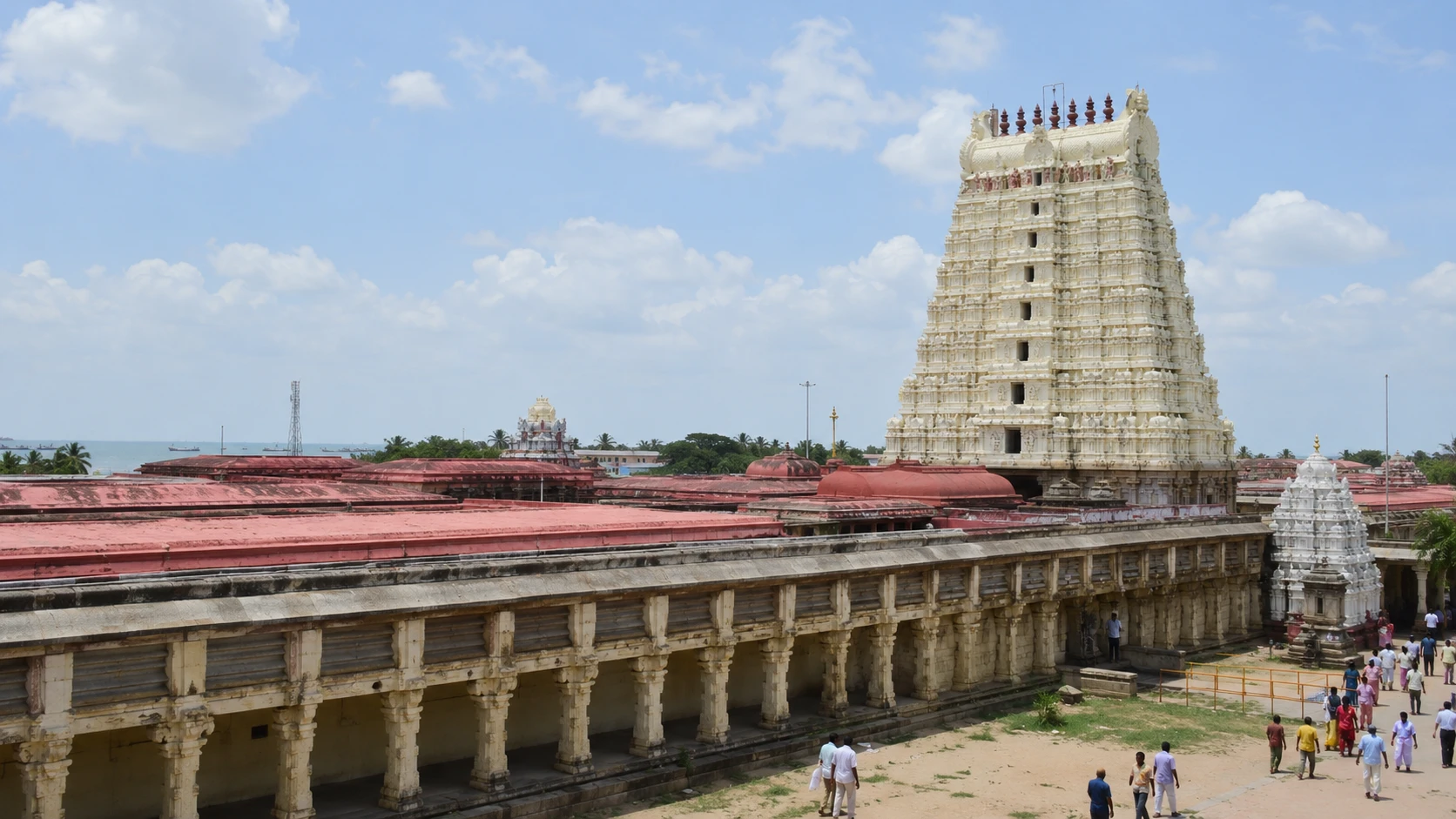
The temple's most architecturally famous feature is its third prakaram (corridor), the longest temple corridor in the world, measuring approximately 1,212 metres (~3,975 feet) of continuous granite-pillared passage that wraps around the inner shrines in a great rectangular circuit.
Each pillar in the corridor is individually sculpted with Dravidian-Nayak iconographic motifs, yali figures, deva-deities, Saiva narrative panels, and the corridor's scale produces an effect that has no parallel in any other Hindu temple.
To walk the third prakaram is to traverse a structured architectural event of a length unmatched anywhere in the canon, and pilgrims often complete this circumambulation as a meditative practice unto itself.
The complex also contains 22 theerthams, sacred wells set within the prakarams, each named for a specific Puranic association and each held to confer a specific spiritual or curative benefit. The theerthams range from the Mahalakshmi Theertham (associated with prosperity blessings) and the Savitri Theertham (associated with purification of sins) to the Brahmahatya Vimochana Theertham (the well of release from the sin of brahmin-killing, directly tied to Rama's atonement narrative).
Pilgrims customarily bathe at all 22 in sequence before sanctum darshan; temple staff with brass buckets draw water from each well and pour it over the pilgrim's head in a continuous moving line.
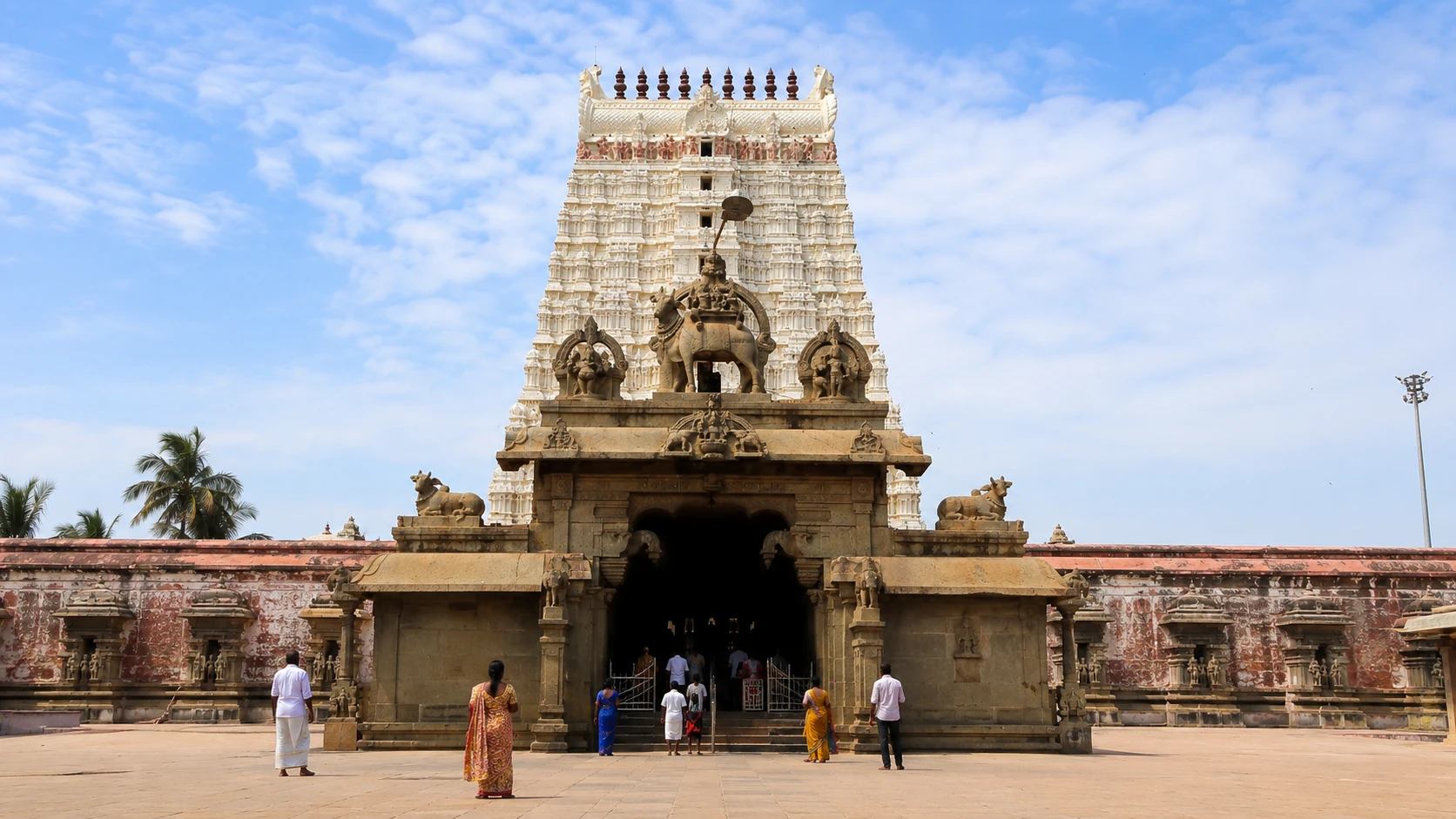
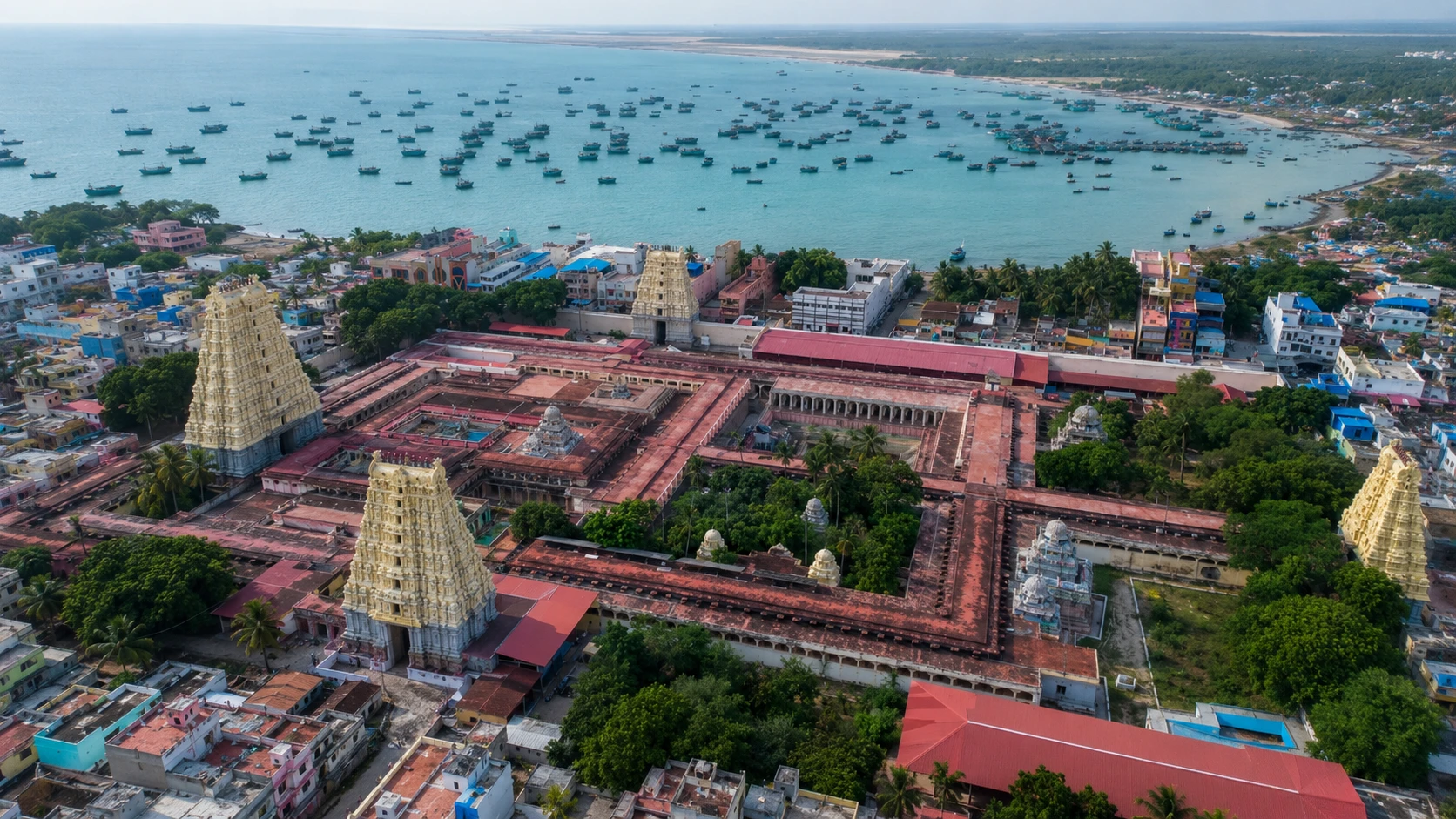
The outer architecture is classical Dravidian, three concentric prakarams enclosed by towering gopurams (gateway pyramids) at the four cardinal entrances. The eastern gopuram is the principal entry; the western gopuram opens toward the sea and the traditional viewpoint of the Rama Setu.
The temple sits at the heart of Pamban Island, set back about a kilometre from the sea on either side, with the Gulf of Mannar to the south and the Palk Strait to the north, a coastal location whose sacred geography is itself part of the temple's iconographic context.
Distinctive Practicesविशिष्ट परंपराएँ
22-Theertham Snanam (Sacred Bathing at the 22 Wells)
22-तीर्थम स्नानम् (22 कुओं पर पवित्र स्नान)
Year-round, customarily before sanctum darshan; particularly observed during Aadi Amavasai and Maha Shivaratri
The temple complex contains 22 theerthams, sacred wells set within the prakarams, each named for a specific Puranic association and each held to confer a specific spiritual or curative benefit. Pilgrims customarily bathe at all 22 in sequence before sanctum darshan, beginning at the Mahalakshmi Theertham and concluding at the Koti Theertham. The bathing is performed not by entering the wells (which are stone-lined and deep) but by temple staff drawing water from each well in a brass bucket and pouring it over the pilgrim's head in a continuous moving line. The full 22-theertham circuit takes approximately 90 minutes and is the temple's signature pilgrim ritual, no other Jyotirlinga has anything like this number of internal sacred waters or this elaborated bathing sequence.
Each theertham corresponds to a specific Puranic episode, the Brahmahatya Vimochana Theertham, for instance, is the well of release from the sin of brahmin-killing, directly tied to Rama's own atonement narrative at this site. The bathing sequence is structured as a graduated purification: the pilgrim's body is rinsed at each well in turn, with each rinsing carrying the spiritual weight of the corresponding Puranic association. By the time the pilgrim reaches the sanctum, the sequence has prepared body and mind for the dual-lingam darshan that completes the visit. The 22-theertham snanam is one of the most spatially elaborated pre-darshan rituals in any Hindu temple.
Hanuman-First Darshan (Vishwanatha-Before-Ramanatha)
हनुमान-प्रथम दर्शन (विश्वनाथ-पूर्व-रामनाथ)
Every darshan, every day, the ritual primacy applies universally and without exception
The Rameshwaram darshan sequence is unique among the twelve Jyotirlingas: pilgrims must take darshan of the Vishwanatha lingam (Hanuman's Kailash lingam) before the Ramanatha lingam (Sita's swayambhu sand-lingam). The rule originates in Rama's own decree, made when Hanuman returned with the Kailash lingam after the muhurta had passed and Sita's sand-lingam had already been worshipped. To honour Hanuman's devotion despite the chronology, Rama installed the Kailash lingam beside the swayambhu and ordained that every future pilgrim worship the Vishwanatha first. The rule is observed strictly to this day, temple priests, sequence guides, and the physical layout of the sanctum all enforce the order, and pilgrims who attempt to approach Ramanatha first are gently redirected.
The Hanuman-first sequence is the iconographic logic of the temple in ritual form: it is the daily, pilgrim-by-pilgrim re-enactment of Rama's grace toward his devotee. Few stories in the Hindu corpus are so directly translated into a continuing ritual practice, the worship at Rameshwaram is, every morning, the public keeping of a vow that Rama made to Hanuman millennia ago. For the Vaishnava-leaning pilgrim, this is the temple where the Lord himself ensures that bhakti is honoured even when chronology fails it. For the Shaiva-leaning pilgrim, this is the temple where Shiva accepts both the muhurta-installation and the late-arrived offering with equal grace. The dual reading is part of the temple's broader role as the bridge between Shaivism and Vaishnavism in the Hindu sacred-geography canon.
Kashi-Rameshwaram Pilgrimage Axis
काशी-रामेश्वरम् तीर्थयात्रा अक्ष
Year-round; the formal Kashi-to-Rameshwaram journey is a multi-week pilgrimage undertaken by devotees making explicit vow
The pilgrimage that has organized Hindu sacred geography for at least a millennium is the Kashi-Rameshwaram axis, the carrying of Ganga water from Kashi (Varanasi) southward to Rameshwaram for abhishekam at the Ramanatha lingam, paired with the carrying of Rameshwaram sand back northward to Kashi for offering at the Kashi Vishwanath temple. The exchange is a complete devotional circuit, north to south to north, and is canonically considered the two-temple completion of any major Shaiva vrat. At Rameshwaram, the Kashi-jal arriving from the Ganga is poured over the Ramanatha sand-lingam (Sita's lingam), a ritual that returns the Ganga's water to the sand of the southern shore, completing a cycle that connects two of the most sacred sites in the Hindu canon. The reverse offering at Kashi consists of pouring Rameshwaram sea-sand at the Kashi Vishwanath. Few pilgrim traditions in any religion are structured around a return-loop of this scale.
The Kashi-Rameshwaram axis is the cardinal axis of pan-Indian Shaiva pilgrimage. It is structurally distinct from the Char Dham (which has four directional anchors) and from the Jyotirlinga circuit (which has twelve nodes); the Kashi-Rameshwaram pair is a two-point line that organizes the subcontinent's north-south Shaiva geography into a single devotional unit. To complete it is to enact, at the bodily level of carrying water and sand across thousands of kilometres, the integration of the Indian peninsula's two greatest Shaiva sites into a single circuit of grace. At Rameshwaram itself, the practice has shaped the temple's daily ritual rhythm: the morning abhishekam at the Ramanatha lingam can include Kashi-jal brought by visiting pilgrims, and the temple's pilgrim shops sell sealed sea-sand for the return journey.
Did You Know?क्या आप जानते हैं?
The third prakaram (corridor) of the Ramanathaswamy temple is the longest temple corridor in the world, measuring approximately 1,212 metres (~3,975 feet) of continuous granite-pillared passage that wraps around the inner shrines in a great rectangular circuit. Each pillar is individually sculpted in Dravidian-Nayak style. The corridor was completed under the Sethupathi rulers of Ramanathapuram across the 17th, 18th centuries and remains the temple's most architecturally renowned feature, no other Hindu temple has anything approaching this length.
Archaeological Survey of India structural surveys; Tamil Nadu State Archaeology Department records
Rameshwaram is the only Jyotirlinga whose primary sanctum contains two principal Shivlings worshipped in mandatory sequence: Vishwanatha (Hanuman's Kailash lingam, worshipped first by every pilgrim) and Ramanatha (Sita's swayambhu sand-lingam, worshipped second). The ritual primacy was set down by Rama himself in the temple's origin narrative, in honour of Hanuman's devotion, and is observed without exception to this day. No other Jyotirlinga has this dual-lingam sanctum or this divinely-decreed ritual ordering.
Skanda Purana, Setu Mahatmya; Trust ritual documentation
The temple complex contains 22 theerthams, sacred wells set within the prakarams, at which pilgrims customarily bathe in sequence before sanctum darshan. Each theertham has a specific Puranic association and a specific spiritual or curative property: the Brahmahatya Vimochana Theertham, for instance, is the well of release from the sin of brahmin-killing, directly tied to Rama's own atonement narrative at the temple. The full 22-theertham snanam takes approximately 90 minutes and is unique among the twelve Jyotirlingas in its scale and elaborateness.
Skanda Purana, Setu Mahatmya; Trust ritual documentation; Tamil Sthala Purana literature on the 22 theerthams
Rameshwaram holds three concurrent canonical statuses across major Hindu pilgrimage frameworks: the eleventh of the twelve Jyotirlingas, the southern (Dakshina) anchor of Adi Shankara's Char Dham, and one of the 275 Paadal Petra Sthalams (Tevaram-praised Saiva sites of the Tamil Bhakti tradition). No other Jyotirlinga in the canonical correspondence holds three such overlapping statuses simultaneously, the triple integration is part of what makes Rameshwaram structurally singular.
Adi Shankara's Char Dham canonical tradition; Tevaram corpus; Dwadasha Jyotirlinga Stotram
The Kashi-Rameshwaram pilgrimage axis, the carrying of Ganga water from Kashi southward to Rameshwaram for abhishekam, paired with the carrying of Rameshwaram sand back northward to Kashi, is the most widely-attested pan-Indian Hindu pilgrimage circuit, organizing the subcontinent's north-south Shaiva geography for over a millennium. At Rameshwaram, the temple's pilgrim shops formally sell sealed sea-sand for the return journey, and the morning abhishekam at the Ramanatha lingam regularly incorporates Kashi-jal brought by visiting pilgrims. No other Hindu pilgrimage involves a return-loop of this geographic scale built into its core ritual structure.
Pan-Indian Shaiva pilgrimage tradition; Diana Eck, 'India: A Sacred Geography' (2012)
Visitor Accessप्रवेश जानकारी
Rameshwaram welcomes devotees broadly, with one traditional restriction common across major Tamil Nadu temples: the inner sanctum (garbhagriha) where the Ramanatha and Vishwanatha lingams are housed reserves entry for those of the Hindu faith, in keeping with longstanding Tamil temple practice. Non-Hindu visitors are welcomed in the prakarams, the gopurams, the third corridor (the world's longest temple corridor), the 22 theerthams area, and the broader temple complex, only the innermost sanctum has this restriction, and signage at the relevant doorways indicates the policy. There are no caste, gender, or age restrictions on darshan for Hindu pilgrims; the post-Independence reforms standardized full-caste access to the sanctum decades ago. Footwear must be removed at the temple entrance. Photography is prohibited inside the inner sanctum and during abhishekam, but is permitted in the prakarams, at the gopurams, and along the third-prakaram corridor.
आध्यात्मिक आधार
The traditional 'Hindus only' policy in the inner sanctum is maintained across most major Tamil Nadu temples and reflects a longstanding administrative practice rather than a Puranic injunction. The HR&CE Department of Tamil Nadu administers the policy uniformly across the major shrines under its oversight; the restriction is to the innermost garbhagriha only, and the broader temple is open to all visitors regardless of faith. The policy is informational rather than enforced through challenge, visitors who self-identify as non-Hindu are simply directed to the prakaram-and-corridor experience.
समकालीन संदर्भ
The temple is administered under the Hindu Religious & Charitable Endowments (HR&CE) Department of the Government of Tamil Nadu, which oversees most of the major Tamil temples. Pilgrim infrastructure has been progressively modernized, VIP queue (Sigappu) tickets are available, the 22-theertham snanam can be arranged through the official ticket counters, and special abhishekam slots for individual devotees can be booked. The temple operates with both a free general queue and paid priority queues; rates and slot availability vary by season and should be confirmed at the on-site counter. The 2024 inauguration of the new Pamban Vertical Lift Rail Bridge has materially expanded rail capacity to Rameswaram and reduced bottleneck constraints on pilgrim flow during peak seasons.
व्यावहारिक मार्गदर्शन
Plan to spend at least half a day at the temple, the 22-theertham snanam alone takes ~90 minutes, and a complete Char Dham-style visit including the third-prakaram circumambulation and dual-lingam darshan extends to 3, 4 hours minimum. Carry a change of clothes if planning the theertham bathing (the water rinses thoroughly soak the upper body). Bring small denomination cash for the theertham temple-staff dakshina (modest offerings to the staff who draw water at each well, typical practice across Tamil temples). Wear a dhoti/veshti (men) or saree/half-saree (women) for the most authentic experience; modern dress is broadly tolerated except in the inner sanctum where traditional attire is preferred. Avoid scheduling the visit during peak summer (April, June) without acclimation to the coastal heat. Accommodation in Rameshwaram town has improved considerably since the 1990s but remains modest in standard compared to Madurai or Tiruchirappalli.
Festivalsत्योहार
Maha Shivaratri
महाशिवरात्रि
Feb-Mar (Phalgun Krishna Chaturdashi)
The most important Shaiva festival of the year, observed at Rameshwaram with all-night darshan and continuous abhishekam through the four watches (pahar) of the night. Both lingams, Vishwanatha and Ramanatha, receive abhishekam through every watch, with the Hanuman-first ritual sequence preserved throughout. Devotees fast through the day and offer water, bilva, and ghee diyas; many combine Maha Shivaratri darshan with the full 22-theertham snanam, treating the day as a comprehensive Saiva-vrat completion. The temple's third prakaram is illuminated through the night with traditional oil lamps, producing one of the most visually distinctive Shivaratri observances in southern India.
Thirukalyanam (Ramanathaswamy-Parvathavarthini Wedding Festival)
तिरुकल्याणम् (रामनाथस्वामी-पार्वतवर्धिनी विवाह उत्सव)
Annual; specific dates vary by traditional astrological calculation, typically in the Tamil months of Aadi or Aippasi
The Thirukalyanam is the annual ritual re-enactment of the divine wedding of Ramanathaswamy (Shiva at Rameshwaram) and his consort Parvathavarthini Amman (the temple's Devi). The festival extends across multiple days, with elaborate processions of the temple's utsava-murtis (festival idols) through the streets surrounding the complex, and a culminating wedding ritual in which the lingam-deity and the Devi are ceremonially joined. The Thirukalyanam carries particular regional significance as the public, town-wide enactment of the Shiva-Shakti union, the streets of Rameshwaram fill with devotees, traditional musicians, and the characteristic Tamil-temple festival atmosphere of incense, brass instruments, and devotional song.
Rama Navami
राम नवमी
Mar-Apr (Chaitra Shukla Navami)
Rama Navami, the celebration of Lord Rama's birth, has special significance at Rameshwaram given the temple's foundation in Rama's own atonement narrative. The day's observance includes special parayanas (recitations) of the Ramayana, particularly the Yuddha Kanda and the post-yuddha return passages that lead directly to the temple's installation story. Devotees combine Rama Navami darshan with sea-bathing on the Pamban shore, treating the celebration as a Vaishnava festival within the Shaiva temple context, a doubling that reflects Rameshwaram's role as a bridge between Shaivism and Vaishnavism in the Hindu canon.
Aadi Amavasai (New Moon of Aadi)
आदि अमावस्या
Jul-Aug (new moon of the Tamil month of Aadi)
Aadi Amavasai is one of the most important sea-bathing days in the Tamil pilgrim calendar, with special significance at Rameshwaram given the temple's coastal location and its association with the ancestor-rites that this lunar day governs. Pilgrims bathe in the Agni Theertham, the seashore approach immediately east of the temple, performing tarpanam (ancestor-libations) for departed family members. The 22-theertham snanam is observed in conjunction with the sea-bathing, and the day draws very large pilgrim crowds from across Tamil Nadu, Kerala, and the broader southern Indian Saiva-Vaishnava devotional region. The Aadi Amavasai sea-bathing tradition is among the temple's annual events with the most concentrated single-day pilgrim volume.
Traditional Offeringsपारंपरिक अर्पण
प्राथमिक अर्पण
Bel Patra (Bilva leaves)
बेल पत्र
बिल्व पत्र
The three leaflets of the bilva tree represent the three eyes of Shiva, the trident he wields, and the cosmic functions of creation, preservation, and dissolution. The Shiva Purana states that even a single bilva leaf, offered with devotion, surpasses elaborate rituals. At Rameshwaram, bilva is offered to both lingams in the morning ritual sequence, first to the Vishwanatha (Hanuman's Kailash lingam), then to the Ramanatha (Sita's swayambhu sand-lingam), preserving the Hanuman-first ritual primacy across every offering.
Ganga Jal, particularly Kashi-jal from the Kashi-Rameshwaram axis
गंगा जल, विशेषकर काशी-रामेश्वरम् अक्ष से काशी-जल
गङ्गा जल
Ganga water is the canonical abhishekam offering at all Jyotirlingas, but at Rameshwaram it carries unique significance: pilgrims undertaking the Kashi-Rameshwaram axis pilgrimage carry sealed Ganga water from Kashi (Varanasi) southward across the subcontinent specifically to pour over the Ramanatha lingam, a return of the river that flows from Shiva's matted locks to the southern shore where Sita shaped her sand-lingam. The morning abhishekam at Ramanatha regularly incorporates Kashi-jal brought by visiting pilgrims, with the priest accepting and pouring the offering as part of the ordinary darshan ritual. No other Jyotirlinga has Ganga-jal abhishekam built into its core devotional axis in this way.
Panchamrit (Five sacred substances)
पंचामृत
पञ्चामृत
The ritual bathing of the lingam with five sacred substances, milk, curd, honey, ghee, and sugar, is performed at Rameshwaram through the resident HR&CE-administered priesthood. Each substance has symbolic meaning: milk for purity, curd for prosperity, honey for sweet speech, ghee for victory, and sugar for happiness. The five together represent the five elements (panchabhuta) returning to their cosmic source. At Rameshwaram, panchamrit abhishekam is offered to both lingams in the Hanuman-first sequence; the same panchamrit prepared in the morning is poured first over the Vishwanatha and then over the Ramanatha.
Vibhuti (Sacred ash)
विभूति
विभूति
Sacred ash applied to the lingams and to the devotee's forehead. Vibhuti represents the ultimate truth that all material existence eventually returns to ash, a constant reminder of impermanence. Three horizontal lines (tripundra) drawn across the forehead with vibhuti symbolize the three realms Shiva governs and the three gunas of nature. At Rameshwaram, vibhuti is distributed as prasad after darshan; many pilgrims carry small portions home for daily worship. Tamil-tradition pilgrims often combine the vibhuti tripundra with the Vaishnava namam in honour of the Shiva-Vishnu integration that the temple's origin narrative encodes.
Coconut
नारियल
नारिकेल
The coconut symbolizes the human ego, which must be broken before Shiva for spiritual progress. At Rameshwaram, the coconut is part of the standard arpan bundle alongside bilva and flowers, and is broken in the temple courtyard before the inner-sanctum darshan. Some pilgrims offer separate coconuts for the Vishwanatha and Ramanatha lingams to honour the dual-lingam structure of the sanctum.
Dhatura flowers
धतूरा के फूल
धत्तूर
The trumpet-shaped dhatura flower, despite the plant's toxicity, is sacred to Shiva. The plant is said to have emerged when Shiva consumed the halahala poison during the churning of the cosmic ocean, the flower represents Shiva's capacity to transform poison into something offered back to him in worship. At Rameshwaram, dhatura is offered as part of the standard floral bundle and is available from the temple-perimeter vendor stalls.
इस मंदिर की विशेषता
Pamban Sea-Sand (for the Kashi-Rameshwaram return offering)
पम्बन समुद्री बालू (काशी-रामेश्वरम् वापसी अर्पण के लिए)
Pilgrims completing the Kashi-Rameshwaram axis pilgrimage carry sealed sea-sand from the Pamban Island shore (collected immediately east of the temple at the Agni Theertham seashore) back northward to Kashi (Varanasi) for offering at the Kashi Vishwanath temple. The sand is the Rameshwaram side of the great two-temple loop: Ganga water travels south, Pamban sand travels north, and the two offerings together complete the canonical pan-Indian Shaiva pilgrimage circuit. The temple's pilgrim shops formally sell sealed sand for the return journey, and the practice of taking Rameshwaram sand back to Kashi is one of the most distinctive offerings in the entire Hindu pilgrimage corpus.
22-Theertham Tirtha-Jal (collected from the temple's sacred wells)
22-तीर्थम तीर्थ-जल (मंदिर के पवित्र कुओं से एकत्रित)
Water collected from one or more of the temple's 22 internal theerthams is taken home by pilgrims as a household offering. Each theertham has its own specific Puranic association and curative property, devotees seeking healing from particular afflictions often draw water specifically from the theertham associated with their need (e.g. the Brahmahatya Vimochana Theertham for purification, the Mahalakshmi Theertham for prosperity). Small brass or copper vessels are sold at the temple-perimeter stalls for collecting and sealing the tirtha-jal for the journey home. The 22-theertham water is among the temple's most-collected prasad-offerings, distinct from any other Jyotirlinga's sacred-water tradition.
Vada-Mala (Garlands of fried lentil cakes)
वडा-माला (तले हुए दाल केकों की मालाएँ)
A Tamil-tradition offering popular at Rameshwaram and at Hanuman shrines across southern India: garlands of medu vadas (fried urad-dal savoury doughnuts) strung together and offered to Hanuman, who in this temple receives the ritual primacy over Shiva himself in the Vishwanatha-first darshan. Vada-mala offerings are traditionally made by devotees seeking specific bhakta-blessings (devotion-strengthening prayers) and are presented either at the Vishwanatha lingam side of the sanctum or at the temple's separate Hanuman shrines within the prakaram complex. The practice is particularly Tamil regional and is not found at the other northern Jyotirlingas in this form.
Devotees may bring offerings from outside; vendor stalls along the approach roads to the temple sell pre-assembled bundles of bilva, flowers, dhatura, and a small coconut, alongside vada-mala garlands and brass vessels for tirtha-jal collection. Sealed Pamban sea-sand for the Kashi return-offering is sold at official temple shops; the seal should remain intact until the pilgrim arrives at Kashi for the offering at Kashi Vishwanath. The HR&CE-administered priesthood permits walk-in abhishekam during designated darshan windows; specific abhishekam slots can be booked through the on-site ticket counters. Photography during abhishekam is not permitted. Pilgrims arriving with sealed Kashi-jal for the Ramanatha lingam should keep the seal intact until the priest accepts the vessel, in the same convention as the Vaidyanath Sultanganj-jal practice.
How to Reachकैसे पहुँचें
Rameshwaram lies on Pamban Island in the Gulf of Mannar, off the southeast coast of Tamil Nadu, in Ramanathapuram district. The temple is accessed exclusively across the Pamban Bridge, either the Indira Gandhi Road Bridge (vehicular, opened 1988) or the new Pamban Vertical Lift Rail Bridge (rail, inaugurated 2024, replacing the 1914 cantilever).
By rail, Rameswaram Railway Station (~2 km from the temple) is the terminus of the Pamban rail line, with direct services from Madurai (~170 km, ~3.5 hours), Chennai (~570 km, ~12 hours overnight via Sethu Express), Mumbai (via Chennai), and several major Indian cities. The new Pamban Vertical Lift Rail Bridge has materially expanded the rail capacity since 2024.
For mainline connections from northern India, Madurai Junction (~170 km) is the practical hub, virtually all long-distance trains from Delhi, Mumbai, and the broader north change at Chennai or Madurai before continuing to Rameswaram on regional services.
By air, Madurai Airport (~170 km, ~3.5, 4 hour drive) is the primary domestic connection with daily flights from Chennai, Bangalore, Mumbai, Delhi, and Hyderabad. Tuticorin Airport (~140 km) and Tiruchirappalli Airport (~250 km, also has limited international services to Singapore and Malaysia) are secondary options.
For international entries, Chennai Airport (~570 km) is the standard choice; many international pilgrims fly into Chennai, take the overnight train or a domestic flight to Madurai, and continue by road or rail to Rameswaram.
By road, Rameshwaram is connected by NH-87 to Madurai, with continuing connections to the broader Tamil Nadu state highway network. Government-run TNSTC buses and private operators run regularly from Madurai (~170 km, ~3.5 hours), Tiruchirappalli (~250 km, ~5 hours), Chennai (~570 km, ~11 hours overnight), Bangalore (~620 km, ~12 hours), and Kanyakumari (~310 km, ~6 hours).
The Indira Gandhi Road Bridge, a 2.3 km low-rise sea bridge, is the road-traffic crossing onto Pamban Island; the bridge has scheduled lift-openings during the day to allow ship passage between the Gulf of Mannar and Palk Strait.
A Char Dham completion itinerary often combines Rameshwaram with Kanyakumari (the southern tip of India), Madurai (Meenakshi Amman temple), and Tirupati (the Vaishnava Tier-A site north on the eastern Andhra-Tamil border).
Pilgrims undertaking the Kashi-Rameshwaram axis pilgrimage typically arrive after a multi-week journey from Varanasi by rail, with a structured Tamil southern circuit closing the journey.
Plan Your Visitयात्रा की योजना
🌤 सर्वोत्तम मौसम
October to March is the most comfortable period for Rameshwaram darshan. Coastal weather in this window is dry, with temperatures ranging from 22, 30°C, low humidity, and the post-monsoon clarity that is characteristic of the Tamil Nadu southern coast. November to February is particularly pleasant, clear skies, sea breeze, and the broader Char Dham completion-circuit traffic at its highest. Avoid April to June if heat is a concern: pre-monsoon coastal Tamil Nadu reaches 32, 38°C with high humidity, making the third-prakaram circumambulation and the open-air theertham snanam physically demanding for elderly pilgrims and small children. The northeast monsoon (October to December) brings rainfall and occasional cyclone risk; the temple operates normally during the monsoon but pilgrim flow can be disrupted by Pamban Bridge weather closures or rail-service interruptions during severe weather events.
👘 पहनावे का नियम
Traditional dress is preferred and is considered most appropriate for sanctum entry, dhoti/veshti with upper-cloth (men) or saree/half-saree with full-coverage (women). Some pilgrims undertake the 22-theertham snanam in wet clothes that are then changed before sanctum darshan; carry a separate change of clothing if planning the full bathing sequence. Avoid leather items inside the temple. Modern dress is broadly tolerated in the prakarams and corridors; the inner sanctum is the part of the visit where traditional attire matters most. Light cotton clothing is recommended given the coastal humidity year-round.
📱 फोन और फोटोग्राफी
Mobile phones must be on silent within the temple complex. Photography with phones is permitted in the prakarams, at the gopurams, and along the third-prakaram corridor (which is one of the most-photographed architectural sites in southern India), but is strictly prohibited inside the inner sanctum (garbhagriha) and during abhishekam. Photography of the 22-theertham snanam in progress is generally not permitted out of respect for the bathing pilgrims; photography of the empty wells is acceptable. Mobile network coverage on Pamban Island is generally good, all major Indian carriers have signal at the temple, though pilgrims should expect intermittent coverage during the bridge crossing in weather events.
🏨 आवास
Rameshwaram town has a wide range of accommodation, from HR&CE-administered pilgrim guesthouses and dharamshalas (modest, subsidised, and convenient for early-morning sanctum darshan) to mid-range hotels along the temple-approach roads, and a small selection of business-class properties. The Tamil Nadu Tourism Development Corporation (TTDC) operates a hotel near the temple with reasonable amenities. For more comfortable stays, Madurai (~170 km) offers the full range of urban accommodation including 4-star and 5-star properties; many Char Dham circuit pilgrims base themselves in Madurai and take a one or two-night Rameshwaram side-trip. During Maha Shivaratri, Aadi Amavasai, and the Tamil Nadu school holiday months (April, May), advance booking in Rameshwaram is strongly recommended. The HR&CE pilgrim accommodation is the most authentic option for traditionally-minded pilgrims and books quickly.
Sacred Soundsपवित्र ध्वनि
क्या आप जानते हैं? · Did You Know?
वही अनुवाद त्रुटि जिसने हिन्दू धर्म में '33 कोटि' को '33 करोड़' बनाया, बौद्ध धर्म में भी हुई। बौद्ध ग्रन्थों के चीनी अनुवाद ने 'सप्त कोटि बुद्ध' (7 श्रेष्ठ बुद्ध) का अनुवाद '7 करोड़ बुद्ध' कर दिया। तिब्बती अनुवाद ने सही किया: 7 प्रकार, 7 करोड़ नहीं। एक संस्कृत शब्द, दो प्रमुख विश्व धर्मों में गलत पढ़ा गया, ने दो एकसमान भ्रम स्वतन्त्र रूप से उत्पन्न किए।
Related Contentसंबंधित सामग्री
Related Scriptures
Community Reflections
🕉️
Be the first to share your reflection.