Mahakaleshwar
महाकालेश्वर
Lord of Time, where the lingam faces south
Ujjain, Madhya Pradesh, India
MahākāleśvaraAlso known as: Mahakal, Mahakala, Avantika, Avantikapuri Jyotirlinga, Shree Mahakaleshwar Jyotirlinga
युग
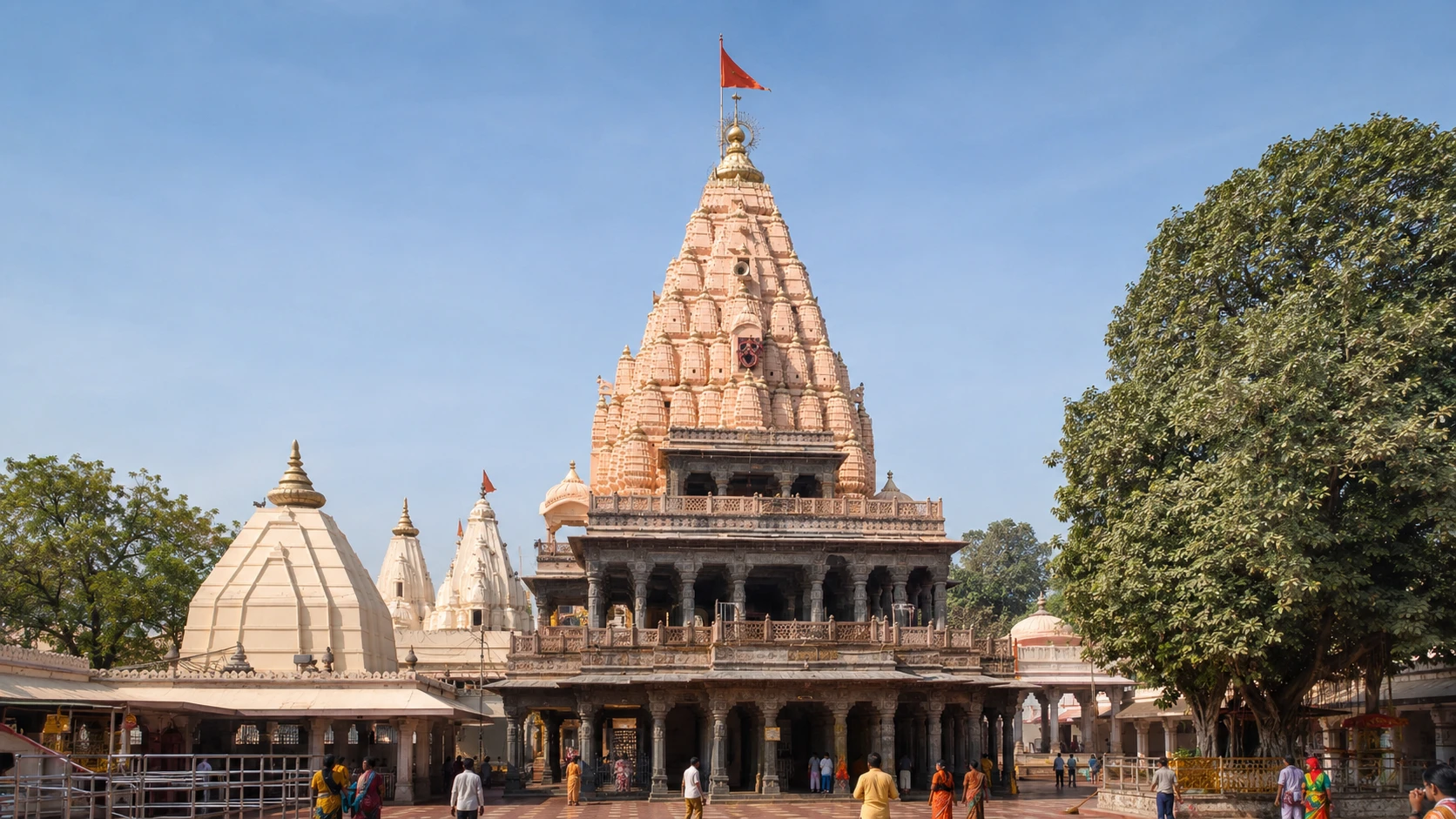
Origin pre-historic per Puranic tradition; literary attestation from c. 5th century (Kalidasa's Meghaduta); current structure rebuilt 1734, 1736 by Maratha general Ranoji Shinde
वास्तुकला
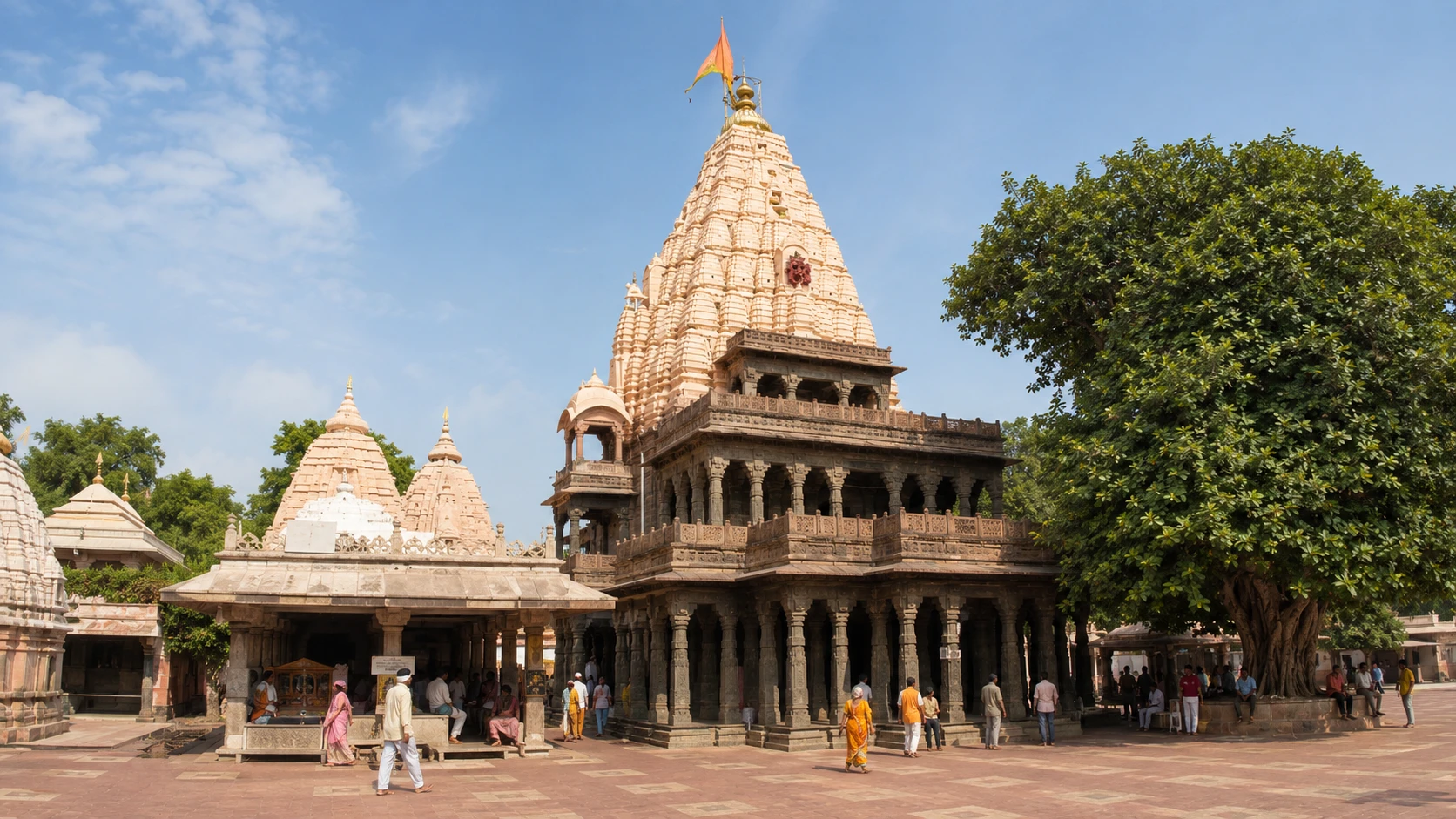
Bhumija and Maratha (current structure); earlier Paramara-era foundation
खुला
03:00 – 23:00
आरती
04:00 · 07:30 · 10:30 · 17:00 · 19:30 · 22:30
विशेष
Bhasma Aarti at 04:00, the only Jyotirlinga performing this ritual; advance booking required. Sawari (Royal Procession of Mahakal) every Monday in Shravan month, traversing Ujjain on a silver palanquin.
पवित्र कथा · पवित्र कथा
Mahakaleshwar is the Jyotirlinga of time itself, the temple where Shiva sits as Mahakala, the destroyer who consumes even Yama. It is the only Jyotirlinga whose lingam faces south, the direction of death; the only Jyotirlinga that is svayambhu (self-manifested, never installed by human hands); and the only Jyotirlinga where the deity is daubed daily with sacred ash drawn from the cycle of mortality, in a 4 AM ritual called the Bhasma Aarti. In Ujjain, the ancient Avantika, one of the seven sacred cities of moksha, the Mahakal lingam has been worshipped since the time of Kalidasa, who described pilgrims pausing here in his Meghaduta fifteen centuries ago.
Sacred Designationपवित्र पदनाम
बारह ज्योतिर्लिंगों में 3वें
बारह ज्योतिर्लिंगों में 3rd
सप्त मुक्ति नगरों में से एकसप्त पुरी
Sacred Origin Storyपवित्र उत्पत्ति कथा
Source: Shiva Purana (Koti Rudra Samhita) and Skanda Purana (Avantya Khanda), widely-attested. The Avantya Khanda of the Skanda Purana is dedicated specifically to Ujjain and Mahakaleshwar.
In the city of Avantika, on the eastern bank of the Shipra, there lived a Brahmin named Vedapriya. He had four sons, Devapriya, Priyamedha, Suvrata, and Suvarchas, and the family was renowned across the region for their devotion to Shiva.
Each morning the Brahmins would bathe in the Shipra, gather flowers and bilva leaves, and perform abhishekam on a Shiva lingam they had installed in their home. They were poor in material wealth but rich in tapas; their worship was unceasing, their conduct unbroken.
Far to the south, in the dark forest of Ratnamala, lived an asura named Dushana. He had performed a long penance and received a boon from Brahma, that no god, no man, no weapon could kill him. Drunk on this boon, he began to terrorise the worshippers of the gods. Yajnas were disrupted, sacred fires extinguished, Brahmins driven from their homes.
Eventually his attention turned to Avantika and the Brahmins of the Shipra.
Dushana came to Vedapriya's house and demanded that the Brahmins abandon their worship. They refused. They continued chanting Shiva's names, continued offering bilva, continued the abhishekam, for they had vowed never to interrupt their devotion. Dushana, enraged, raised his weapon to strike them down.
In that moment the earth split open. From a great pit at the centre of the courtyard, Shiva himself emerged in his most terrible form, Mahakala, the consumer of time, fanged, fierce-eyed, garlanded with skulls, his body smeared with the ash of the cremation ground. With a single roar, the roar that ends ages, he reduced Dushana and his demon army to ash.
The boon held: no god, no man, no weapon had killed the demon. Mahakala had killed him with the very fire of dissolution that ends all things.
The Brahmins, trembling, fell at Shiva's feet. They begged him: Lord, do not leave us. Stay here in Avantika. Let this be your seat. Let the people of this city know that you yourself have walked among them. Shiva agreed. He sank back into the earth, but not entirely.
He left behind, at the spot where he had emerged, a self-formed lingam, svayambhu, never installed by mortal hands. This is the Mahakaleshwar Jyotirlinga.
Because Shiva had emerged from the south, from the direction of Yama and death, the lingam has remained dakshinamukhi, south-facing, to this day. This is the only Jyotirlinga in the twelve where the lingam faces south, and devotees who circumambulate it are said to be released from the fear of untimely death (akala mrityu).
Mahakala is not just the destroyer of demons; he is the destroyer of time itself, the one before whom even Yama bows. To stand before this lingam is to stand before the source from which time flows and into which it returns.
The Skanda Purana adds that Avantika is one of the seven cities granting moksha (Sapta Mokshapuri), Ayodhya, Mathura, Maya (Haridwar), Kashi, Kanchi, Avantika (Ujjain), and Dvaravati (Dwarka). Of these seven, Avantika is the city that holds death's master, and to die in Ujjain, or even to be carried to Ujjain at the end of life, is said to grant liberation directly through Mahakala's grace.
उद्धृत स्रोत:
- Shiva Purana, Koti Rudra Samhita, Chapters on Mahakaleshwar Jyotirlinga (variously chapters 16, 17 in different recensions)
- Skanda Purana, Avantya Khanda, the entire khanda is dedicated to Ujjain and Mahakaleshwar (over 70 chapters)
- Linga Purana, Section on Jyotirlinga origins
- Matsya Purana, chapters on Avantika tirtha
- Bhavishya Purana, references to Avanti Mahatmya
विद्वत संदर्भ
Modern scholarship (Diana Eck, 'India: A Sacred Geography', 2012; Hans T. Bakker on the Vakataka and early Hindu temple traditions; G.S. Ghurye on the seven Mokshapuris) places Ujjain among the most ancient continuously-active Hindu pilgrimage sites in India. The literary attestation by Kalidasa in his Meghaduta (c. 5th century), where the cloud-messenger is instructed to detour through Avanti specifically to behold the temple of Mahakala, is the earliest non-Puranic reference to the temple as an established institution, suggesting that worship at the site predates documented chronicles by several centuries. The 'Mahakala' name itself (literally 'great time / great death') aligns with Ujjain's astronomical significance as the prime meridian of ancient Indian time-keeping (the Tropic of Cancer passes near Ujjain, and the Indian zero-meridian was historically calculated through it).
Historyइतिहास
Mahakaleshwar's documented history is among the deepest of any Jyotirlinga. Ujjain, the ancient Avantika, was the capital of the Avanti mahajanapada in the pre-Mauryan period and remained a major political and cultural centre under successive empires: the Mauryas (Ashoka served as governor of Ujjain before his accession), the Shungas, the Western Kshatrapas, and most luminously the Gupta empire under Chandragupta II Vikramaditya, whose court at Ujjain housed Kalidasa.
Kalidasa's Meghaduta (c. 5th century) contains the earliest surviving literary description of the temple. In the poem, the lovelorn yaksha instructs his cloud-messenger to detour over Avanti specifically to behold the 'lord whose terrible flame consumes the city's sins.' The cloud is told to pause at the temple at sunset to witness the evening aarti, a passage that suggests the rituals of Mahakaleshwar a thousand five hundred years ago were already substantially as they are now.
Through the early medieval period the temple flourished under the Paramara dynasty (9th, 13th century), whose capital Dhar was nearby and whose kings, particularly Bhoja Paramara (r. 1010, 1055), were major patrons of Ujjain. The Paramaras endowed the temple with land, supported its festival calendar, and contributed to its architectural elaboration.
In 1234, 35 the temple was destroyed during the raid of Sultan Iltutmish of the Delhi Sultanate. The episode is recorded in the Persian chronicle Tabaqat-i-Nasiri by Minhaj-i-Siraj. Local tradition holds that the original svayambhu lingam was thrown into the Kotitirtha Kund, a sacred tank within the temple complex, and was retrieved by devotees once the army had withdrawn.
The Persian chronicles confirm the destruction; the tradition of recovery and reinstallation comes through local memory and later Sanskrit sthala-purana texts.
Reconstruction was sporadic over the following centuries under regional patrons. The current structure of the temple owes its form to the early 18th century reconstruction by Ranoji Shinde, the Maratha general who founded the Scindia dynasty of Gwalior, working under the authority of Peshwa Bajirao I.
The reconstruction was carried out between 1734 and 1736, with later additions by Daulatrao Shinde in the early 19th century.
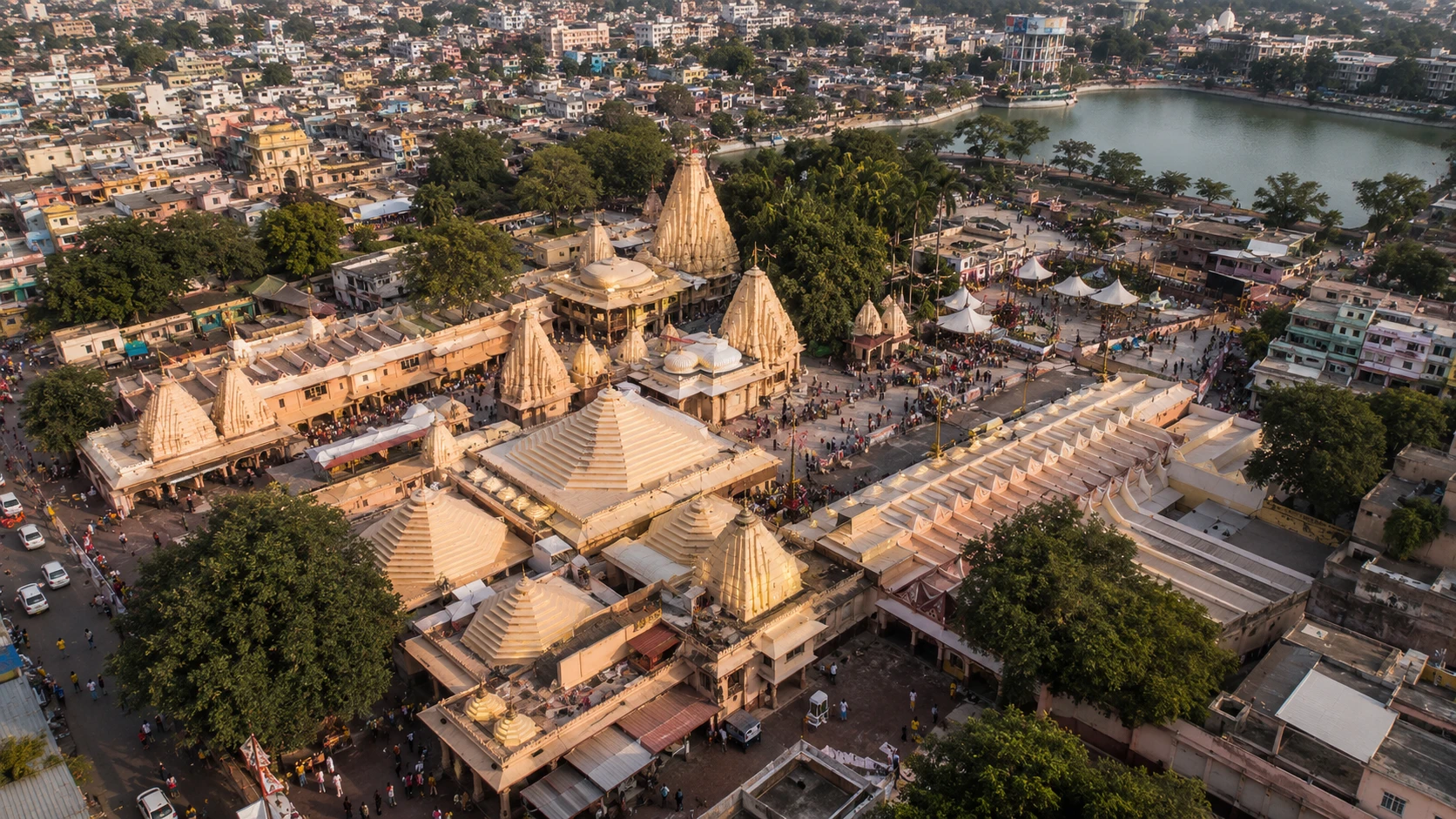
The Mahakaleshwar Mandir Prabandhan Samiti, the temple management committee, was constituted under the Madhya Pradesh state government and manages the temple today. The most consequential recent development was the inauguration of the Mahakal Lok corridor on 11 October 2022, a 900-metre pedestrian plaza connecting the temple to the Rudrasagar lake, lined with sandstone sculptures depicting episodes from the Shiva Purana.
The corridor reorganised the entire approach to the temple and substantially expanded its capacity for the millions of pilgrims who visit each year, particularly during the Simhastha Kumbh Mela (held at Ujjain every twelve years; last in 2016, next in 2028).
Historical Timelineऐतिहासिक कालक्रम
Ujjain (Avantika) functions as a major political and cultural capital, first as capital of the Avanti mahajanapada, then under the Mauryas (with Ashoka serving as governor before his accession), Shungas, and Western Kshatrapas. Worship at Mahakaleshwar is implied by inscriptional and numismatic references to Avanti as a sacred site in this period.
Direct epigraphic attestation of the Mahakaleshwar temple specifically (as opposed to Ujjain as a sacred city) is harder to date this early; what is well-established is that Ujjain was a continuously-occupied religious-political centre from at least the 6th century BCE.
Kalidasa's Meghaduta describes the Mahakala temple at Ujjayini in vivid detail, instructing the cloud-messenger to detour through Avanti and pause for the evening aarti. This is the earliest surviving non-Puranic literary attestation of the temple and confirms it as a major established pilgrimage site by the Gupta period.
Sustained patronage of the temple by the Paramara dynasty of Malwa, particularly under Bhoja Paramara (r. 1010, 1055). The temple receives major land grants, festival endowments, and architectural elaboration during this period.
Destruction of the temple during the Ujjain campaign of Sultan Shams-ud-din Iltutmish of the Delhi Sultanate. According to local tradition, the original svayambhu lingam was thrown into the Kotitirtha Kund within the temple complex; devotees retrieved it after the army's withdrawal.
The Persian chronicles confirm the temple's destruction during Iltutmish's campaign but do not describe the lingam's fate in detail; the specific tradition of the lingam being thrown into Kotitirtha Kund and retrieved by devotees comes through local memory and later sthala-purana texts. Modern scholarship (Romila Thapar, 'Past Before Us', 2013; Cynthia Talbot on medieval Hindu memory of invasions) treats the recovery tradition as part of the temple's living narrative rather than independently corroborated history. The destruction itself is not in scholarly dispute.
Reconstruction of the current temple structure by Maratha general Ranoji Shinde, founder of the Scindia dynasty of Gwalior, under the authority of Peshwa Bajirao I. The new temple was built on the original consecrated site in a regional Maratha style integrating Bhumija architectural elements.
Major renovations and additions to the temple complex by Daulatrao Shinde, including expansion of the front mandapa and consolidation of the temple's outer walls and the Kotitirtha Kund precinct.
Inauguration of the Mahakal Lok corridor on 11 October 2022 by Prime Minister Narendra Modi, a 900-metre pedestrian plaza connecting the temple to the Rudrasagar lake, lined with 108 sandstone pillars and a series of sculptures depicting episodes from the Shiva Purana. Phase 2 of the redevelopment, including approach roads and pilgrim facilities, has continued in subsequent years.
What You'll Seeदर्शन में
The Mahakaleshwar Jyotirlinga is housed in the lowest of three tiered sanctums in the temple. The lingam is svayambhu, self-manifested, never installed by mortal hands, and is unique among the twelve Jyotirlingas in being dakshinamukhi, facing south rather than the conventional east.
The lingam itself is a smooth, dark stone of uneven natural form, embedded in a circular silver-clad yoni-pitha. It is not adorned with elaborate metalwork the way some other Jyotirlingas are; the svayambhu form is preserved as it manifested.
During the Bhasma Aarti at 4 AM, the lingam is bathed with water and panchamrit, then daubed with bhasma, sacred ash, by the priests in a ritual unique to this temple. The bhasma is applied across the entire surface of the lingam, transforming it into an ash-grey form during the predawn hours; later in the day the bhasma is replaced with vibhuti, kumkum, and bilva.
Above the Mahakaleshwar sanctum is a second-tier shrine to Omkareshwar (a smaller lingam representing the Omkareshwar Jyotirlinga's presence). Above that is the third-tier sanctum of Nagchandreshwar, Shiva reclining on a serpent, with Parvati and Ganesha, which is opened to the public only one day each year, on Nag Panchami.
The garbhagriha is small and intentionally low-ceilinged; devotees must stoop slightly to enter, a posture of reverence built into the architecture. The walls are clad in silver, and oil lamps burn continuously around the lingam.
The directional orientation, south-facing, with the priest's seat positioned to the north, gives the sanctum a distinctive atmosphere among Shiva temples.
Distinctive Practicesविशिष्ट परंपराएँ
Bhasma Aarti
भस्म आरती
Daily, 04:00 (lasting approximately 90 minutes)
The Bhasma Aarti is the temple's signature ritual and the only one of its kind among the twelve Jyotirlingas. Performed by the temple priests in the predawn hours, the ceremony begins with the lingam being bathed in water, followed by panchamrit (milk, curd, honey, ghee, sugar). The bhasma, sacred ash, is then applied across the entire surface of the lingam to the chanting of mantras, while pradeeps (oil lamps) are circulated and bells rung continuously. Devotees are seated within the sanctum in designated areas; entry requires advance registration and photo ID. Dress code is strictly enforced: men in dhoti and uttariya, women in saree.
The bhasma is a meditation on impermanence, the recognition that all corporeal existence ends in ash. By beginning the day with this ritual, Mahakaleshwar enacts the truth at the heart of the temple's theology: that Mahakala is the consumer of time, and the very stuff of mortality is what is offered to him. Traditionally the bhasma was sourced from cremation grounds (chitabhasma); in modern practice it is prepared from purified cow-dung cake ash (vibhuti) through a sanctified process, a change in material that preserves the symbolism while complying with contemporary hygiene and legal requirements. To witness the Bhasma Aarti is, in the temple's own theological language, to watch Mahakala awaken, and to be reminded that one's own ash will one day be offered somewhere, by someone, in some form.
Mahakal Sawari (Royal Procession)
महाकाल सवारी
Every Monday during Shravan and Bhadrapad months (typically July, August)
On every Monday of the Shravan and Bhadrapad months, an utsav-murti (festival idol) of Mahakaleshwar is taken in a silver palanquin in royal procession through the streets of Ujjain. The procession passes from the temple to Ramghat on the Shipra river, where the deity is given a ritual bath, then returns through the city's main thoroughfares. The route is lined with devotees offering bilva, flowers, and water; the city's population swells dramatically on these Mondays. The grand finale, the Shahi Sawari (royal procession) on the last Monday of Shravan, features additional palanquins, Nandi, and elaborate decorations.
The Sawari embodies a theological inversion at the heart of Mahakaleshwar's tradition: Mahakala is not merely the deity of the temple, he is the king of Ujjain. Local tradition holds that no ruler, however powerful, can stay in Ujjain on a Monday in Shravan, because Mahakala himself is the city's reigning sovereign on those days. The procession enacts this kingship: the deity leaves his temple to inspect his realm, his subjects line the roads in homage, and then he returns to his palace-temple at the day's end. To witness the Sawari is to remember that the divine is not absent from the political, that in Avantika, the throne of time itself moves through the streets each Shravan Monday.
Nagchandreshwar Darshan
नागचंद्रेश्वर दर्शन
Annual, on Nag Panchami (Shravan Shukla Panchami, July, August), the only day this sanctum opens
The third-tier sanctum at the top of the temple, dedicated to Nagchandreshwar (Shiva reclining on the serpent Vasuki, with Parvati and Ganesha), is opened to the public only once each year, on Nag Panchami. The murti, depicting Shiva, Parvati, and Ganesha together on the coiled body of Vasuki, is rare in iconography; in most depictions, the snake is on Shiva, not Shiva on the snake. The 24-hour darshan window beginning at midnight on Nag Panchami draws hundreds of thousands of pilgrims; queues stretch for kilometres around the Mahakal Lok corridor.
The annual opening creates a darshan that is, by deliberate design, scarce. Most temples seek to widen access; Nagchandreshwar narrows it to a single night each year. This scarcity is itself the practice: pilgrims structure their entire spiritual calendar around being at Mahakaleshwar on Nag Panchami, and the experience of finally arriving at the upper sanctum after waiting in line for hours is treated as a particular grace, not casually obtained, not repeatable for at least another year. The murti's iconography (Shiva resting on the serpent rather than wearing it) reverses the usual relationship between Shiva and the cosmic snake, suggesting an inwardness, a Shiva who is not displaying his control over kala (time / death / serpent) but resting within it.
Shipra Snan and Ujjain Antarvedi Parikrama
शिप्रा स्नान और उज्जैन अंतर्वेदी परिक्रमा
Year-round; particularly observed during Simhastha Kumbh, Shravan, and Kartik Purnima
Pilgrimage to Mahakaleshwar traditionally begins not at the temple but at the Shipra river. Devotees perform snan (ritual bathing) at the Ramghat or Datt Akhada ghats before darshan. A more elaborate practice is the Antarvedi parikrama, a circumambulation of the inner sacred zone of Ujjain that visits 84 (or sometimes 108) shrines of Shiva, Devi, Ganesha, and other deities scattered through the old city, with Mahakaleshwar as the journey's anchor and culmination. The full antarvedi takes a full day on foot; abbreviated versions visiting eight or twelve key shrines are common.
The antarvedi parikrama treats Ujjain itself as a temple-mandala rather than a city with a temple in it. By circumambulating the city's sacred sites with Mahakaleshwar at the centre, the pilgrim performs darshan not just of the deity but of the entire consecrated geography, Avantika as a yantra in space. This is consistent with the Skanda Purana's framing of Avantika as one of the seven Mokshapuris: the city is the path; Mahakaleshwar is its centre; the parikrama is how a pilgrim inscribes the path on his own body through walking.
Did You Know?क्या आप जानते हैं?
Mahakaleshwar is the only one among the twelve Jyotirlingas where the lingam faces south (dakshinamukhi) rather than the conventional east. South is the direction of Yama, lord of death, and the orientation reflects the deity's identity as Mahakala, the consumer of death itself.
Shiva Purana, Koti Rudra Samhita; Skanda Purana, Avantya Khanda
The Mahakaleshwar lingam is svayambhu, self-manifested. Among the twelve Jyotirlingas, several are described as svayambhu in tradition, but at Mahakaleshwar the claim is structurally evident: the lingam's irregular natural form has been deliberately preserved rather than dressed in metal cladding, leaving the worshipper to see what 'self-manifested' actually looks like.
Mahakaleshwar Mandir Prabandhan Samiti; Skanda Purana descriptions
Mahakaleshwar is one of the few temples whose existence is attested in classical Sanskrit literature beyond Puranic genres. Kalidasa's Meghaduta, composed around the 5th century, describes the temple in vivid detail and instructs its cloud-protagonist to pause at sunset for the evening aarti, confirming that the rituals practiced today have a continuous lineage of at least 1,500 years.
Meghaduta, Purvamegha verses 30, 35; Mallinatha's commentary
Ujjain was historically the prime meridian of Indian astronomy and time-keeping, the longitude through Ujjain (approximately 75.8° E) served as the zero meridian for the Surya Siddhanta and other Sanskrit astronomical treatises. The presence of Mahakaleshwar, the 'Lord of Time', at this geographic axis is treated by the tradition as no coincidence: the deity of time sits at the meridian from which Indian time itself was measured.
Surya Siddhanta; Aryabhatiya commentary tradition; G.S. Ghurye on Hindu sacred geography
The temple is built in three vertical tiers, Mahakaleshwar (main lingam) on the lowest level, Omkareshwar on the middle level, and Nagchandreshwar at the top. The Nagchandreshwar shrine opens to the public only one day each year, on Nag Panchami, making it among the most temporally restricted darshan windows of any major Hindu temple.
Mahakaleshwar Mandir Prabandhan Samiti architectural records
Ujjain is one of the four cities that hosts the Kumbh Mela (called Simhastha Mela here). The Simhastha is held every twelve years on the banks of the Shipra river, when Jupiter enters the constellation Leo. The 2016 Simhastha drew an estimated 75 million pilgrims over its month-long duration; the next is scheduled for 2028.
Madhya Pradesh State Tourism Department; Kumbh Mela Adhikari Office, Ujjain
Local tradition holds that no king or political ruler may stay overnight in Ujjain on a Monday during Shravan, because Mahakala himself is considered the sovereign of the city on those days. The tradition is observed even today by Madhya Pradesh political figures, who typically depart Ujjain before the Sawari procession on Shravan Mondays.
Madhya Pradesh State protocol traditions; documented in regional gazetteers
Visitor Accessप्रवेश जानकारी
Mahakaleshwar welcomes devotees of all backgrounds for darshan. There are no entry restrictions based on gender, age, religion, or origin. Photography is permitted in the outer courtyards and the Mahakal Lok corridor, but is strictly prohibited in the inner sanctum (garbhagriha) and during the Bhasma Aarti. Mobile phones must be deposited at lockers before entering the sanctum during Bhasma Aarti; outside Bhasma Aarti hours, phones may be carried but not used for photography in the sanctum. Footwear must be removed before entering the temple complex.
Bhasma Aarti requires advance booking through the official trust portal, slots fill 60, 90 days in advance during Shravan and around Maha Shivratri. Photo ID is mandatory. Bhasma Aarti dress code is strictly enforced: men in dhoti and uttariya (no stitched garments above the waist), women in saree (no salwar suits or western wear). The trust provides dhotis for rent at the entrance for those without. VIP / Shighra Darshan tickets at INR 250 per person allow priority queue access during regular hours. Cameras, large bags, and electronics are deposited at the Mahakal Lok cloak rooms before entry.
Festivalsत्योहार
Maha Shivratri (Shivnavratri)
महाशिवरात्रि (शिवनवरात्रि)
Feb-Mar (Phalgun Krishna Chaturdashi); a 9-day buildup is observed at Mahakaleshwar starting Phalgun Krishna Panchami
Mahakaleshwar observes a unique 9-day Shivnavratri leading up to Maha Shivratri itself, among the few Shiva temples to do so. Each day features a distinct shringar (decoration) of the lingam: Chandramauli, Sheshnag, Ghatatop, Chhabina, Holkar, and culminating on the night of Shivratri with the famed 'Sehra' shringar, a royal ornamental decoration where Mahakaleshwar is presented as a king. The night-long vigil draws devotees in numbers that exceed the Sawari season; the city of Ujjain operates around the temple's schedule for the entire fortnight.
Shravan Sawari
श्रावण सवारी
Jul-Aug (Shravan); every Monday, with the climactic Shahi Sawari on the last Shravan Monday
The Shravan Sawari, the royal procession of Mahakaleshwar through Ujjain on Shravan Mondays, is the temple's signature public festival. Each Monday features additional escorting deities: the first Monday is Mahakal alone in his palanquin; subsequent Mondays add Manmahesh, Chandramauli, Shivtandav, and on the climactic Shahi Sawari, six palanquins move together with full traditional escort including Nandi, hatti (elephant), drummers, and sadhus. The route from the temple to Ramghat and back stretches several kilometres; pilgrims line the streets continuously.
Nag Panchami
नाग पंचमी
Jul-Aug (Shravan Shukla Panchami)
The single day each year on which the Nagchandreshwar shrine, the third-tier sanctum atop the temple, is opened to public darshan. The 24-hour window from midnight on Nag Panchami draws hundreds of thousands of pilgrims; queues stretch for kilometres around the Mahakal Lok corridor. The murti depicts Shiva, Parvati, and Ganesha together reclining on the serpent Vasuki, an iconography found virtually nowhere else among major Shiva temples. Devotees who manage to reach the upper sanctum often plan their pilgrimage a year in advance for this single darshan.
Harihara Milan (Vaikuntha Chaturdashi)
हरिहर मिलन (वैकुंठ चतुर्दशी)
Nov (Kartik Shukla Chaturdashi)
On Vaikuntha Chaturdashi night, the deity of Mahakaleshwar (Hara, Shiva) is taken in procession to the Gopal Mandir on the other side of Ujjain to meet the deity of Vishnu (Hari). The midnight meeting, Harihara Milan, symbolises the unity of the Shaiva and Vaishnava streams; offerings to one are made by the priests of the other, and a single aarti is performed for Hari and Hara together. The deities then return to their respective temples before dawn. The festival is observed annually and is among the few in Hinduism that ritualises the Hari-Hara unity directly.
Simhastha Kumbh Mela
सिंहस्थ कुंभ मेला
Once every 12 years, when Jupiter enters Leo (next: 2028); the mela typically runs for approximately one month
Ujjain's Kumbh Mela, called Simhastha because it occurs when Brihaspati (Jupiter) is in Simha rashi (Leo), is one of the four Kumbh sites. The mela centres on ritual bathing in the Shipra river at the four shahi snan (royal bath) dates, with Mahakaleshwar darshan integral to the pilgrim's journey. The 2016 Simhastha drew an estimated 75 million pilgrims; the next Simhastha is scheduled for 2028. The temple's operations during Simhastha months are dramatically expanded, additional darshan windows, extra security, and full-time crowd management.
Traditional Offeringsपारंपरिक अर्पण
प्राथमिक अर्पण
Bel Patra (Bilva leaves)
बेल पत्र
बिल्व पत्र
The three leaflets of the bilva tree represent the three eyes of Shiva, the trident he wields, and the cosmic functions of creation, preservation, and dissolution. The Shiva Purana states that even a single bilva leaf, offered with devotion, surpasses elaborate rituals. At Mahakaleshwar, fresh bilva is offered throughout the day across all six aartis, and is among the most commonly carried pilgrim offerings.
Shipra Jal (water from the Shipra river)
शिप्रा जल
क्षिप्रा जल
The Shipra is one of the seven sacred rivers of Hinduism and the local tirtha of Mahakaleshwar. Devotees traditionally bathe in the Shipra at one of its ghats, Ramghat, Datt Akhada, or Gauri Ghat, and carry a small kalash of Shipra water to the temple for use in the abhishekam. The water is considered to carry the river's sanctity to the lingam directly. This is a Mahakaleshwar-specific practice; Shipra water is the river of Avantika as Ganga water is the river of Kashi.
Bhasma (Sacred ash)
भस्म
भस्म
While bhasma is offered at all major Shiva temples, at Mahakaleshwar the bhasma takes a singular ritual centrality through the daily 4 AM Bhasma Aarti. The bhasma represents the truth that all corporeal existence ends in ash, and Mahakala, as the consumer of time, is the deity to whom that truth is offered. The trust prepares bhasma through a sanctified process from purified cow-dung cake ash; pilgrims who cannot witness the Bhasma Aarti often carry small consecrated bhasma packets home from the temple counters. Tripundra (three horizontal lines) drawn on the forehead with this bhasma is considered Mahakaleshwar's distinctive prasad mark.
Panchamrit (Five sacred substances)
पंचामृत
पञ्चामृत
Panchamrit abhishekam, the ritual bathing of the lingam with milk, curd, honey, ghee, and sugar, is performed at all major Shiva temples and at Mahakaleshwar precedes the bhasma application during the morning aarti. Each substance carries symbolic meaning: milk for purity, curd for prosperity, honey for sweet speech, ghee for victory, and sugar for happiness. The five together represent the five elements (panchabhuta) returning to their cosmic source through Mahakala.
Dhatura flowers and fruit
धतूरा के फूल और फल
धत्तूर
The trumpet-shaped dhatura flower and its spiked fruit, despite being toxic, are sacred to Shiva. The plant is said to have emerged when Shiva consumed the halahala poison during the churning of the cosmic ocean; the flower represents Shiva's capacity to transform poison into something offered back to him in worship. Offering dhatura at Mahakaleshwar, Lord of death itself, is said to remove the devotee's fear of mortality. Dhatura is widely available at the temple's offering counters and at vendors lining the approach to Mahakal Lok.
Akhand Jyot (continuous lamp)
अखंड ज्योत
Devotees sponsor an akhand jyot, a continuously-burning oil lamp, for periods ranging from a single day to a full year. The lamp is lit by the priests in a designated area near the sanctum and burns without interruption for the sponsored duration; the trust maintains a register of every sponsored lamp and the family for whom it burns. The akhand jyot represents the unbroken flame of devotion linking the devotee's home to Mahakala's sanctum across time.
इस मंदिर की विशेषता
Bhasma Aarti participation
भस्म आरती सहभागिता
The most distinctive Mahakaleshwar offering is participation in the Bhasma Aarti itself, not a material offering but the offering of one's presence at the predawn ritual. Booking a slot for the Bhasma Aarti requires advance registration, photo ID, and adherence to the strict dress code; for many pilgrims this single experience is the central purpose of their journey to Ujjain. The trust formalises this through tickets and registration but the experience itself is treated as the offering: the devotee gives 4 AM, gives the silence of the predawn city, gives their full attention to the ritual that no other Jyotirlinga performs.
Annakuta and Mahaprasad
अन्नकूट और महाप्रसाद
The temple kitchen prepares a daily mahaprasad consecrated through the noon and evening aartis, a simple meal of dal, rice, sabzi, roti, and a sweet, served from the trust's annapurna seva counters at subsidised rates and freely on major festival days. Sponsoring annadaan (food donation) for one day's mahaprasad distribution is among the most popular non-puja offerings; the trust maintains a calendar of annadaan sponsors. Devotees eating the mahaprasad participate in the consecrated cycle of the temple's daily life.
Devotees may bring offerings from outside, but the Mahakaleshwar Mandir Prabandhan Samiti maintains official offering counters within the temple complex with pre-packaged bilva, dhatura, panchamrit kits, and bhasma packets. The trust prefers natural offerings and discourages plastic-wrapped or synthetic items. During Bhasma Aarti, only specific offerings designated by the priests are accepted directly into the sanctum; other offerings must be deposited at the outer aarti counter. Photography of any offering ritual within the sanctum is strictly forbidden.
How to Reachकैसे पहुँचें
Ujjain sits in the Malwa region of western Madhya Pradesh and is well-connected by rail, road, and air through nearby Indore. The closest railway station is Ujjain Junction, just 2 km from the temple, Ujjain has direct trains from Mumbai, Delhi, Ahmedabad, Howrah (Kolkata), Chennai, Bengaluru, and most major cities; it sits on the busy Mumbai, Delhi rail corridor and is one of the most accessible pilgrim destinations in central India.
Auto-rickshaws and pre-paid taxis are abundant at Ujjain Junction; a ride to the temple takes 10, 15 minutes.
By air, the closest airport is Devi Ahilyabai Holkar Airport in Indore (55 km, ~1.5 hour drive). Indore has direct flights from all metro cities and is the main air gateway. Bhopal Airport (190 km, ~3.5 hour drive) is an alternative for those routing through Bhopal. Pre-arranged taxis from Indore Airport to Ujjain are the standard option; buses also run regularly.
By road, Ujjain is accessible by Madhya Pradesh state buses and private operators from Indore (55 km, ~1.5 hours), Bhopal (190 km, ~3.5 hours), Ahmedabad (400 km, ~7 hours), Mumbai (660 km, ~12 hours, typically broken into two days), and Delhi (770 km). The Indore, Ujjain road is wide and well-maintained; the others vary by stretch.
Many pilgrims combine Mahakaleshwar with Omkareshwar (the 4th Jyotirlinga, 130 km south on the Narmada river, about 3 hours by road) into a single Madhya Pradesh Jyotirlinga Yatra. Ujjain itself contains over 80 additional shrines that pilgrims often visit alongside Mahakaleshwar, Kal Bhairav (the city's kotwal), Harsiddhi Shakti Peeth, Bade Ganesh, Sandipani Ashram (where Krishna is said to have studied), Mangalnath (the birthplace of Mars), and the various Shipra ghats.
During Shravan Mondays, Maha Shivratri, and the Simhastha Kumbh, all approach roads to Ujjain experience heavy congestion. The trust and Madhya Pradesh state government issue advisories during these periods; pilgrims are urged to arrive 1, 2 days early and rely on the government-run shuttle services rather than private vehicles.
Plan Your Visitयात्रा की योजना
🌤 सर्वोत्तम मौसम
October to March is the most comfortable period, temperatures range from 10, 28°C with low humidity. April, June is the peak summer (35, 43°C); the city is hot and dusty, though pilgrim traffic continues. The monsoon (July, September) brings the Shravan Sawari season, the most spiritually charged but also by far the most crowded period; pilgrim numbers can multiply tenfold on Shravan Mondays. Maha Shivratri (February-March) is the peak festival window. For first-time pilgrims seeking unhurried darshan, late October through December is ideal. For those who want to witness the temple in its festival fullness, plan around either Shravan or Maha Shivratri but expect long queues and book Bhasma Aarti slots well in advance.
👘 पहनावे का नियम
Modest dress is expected throughout the temple complex. For general darshan, men should wear full-length trousers or dhotis with shirts or kurtas; women should wear sarees, salwar suits, or long skirts with covered shoulders. For Bhasma Aarti, the dress code is significantly stricter and rigorously enforced: men must wear a dhoti and uttariya only, with no stitched garments above the waist (shirts are not permitted in the sanctum during Bhasma Aarti); women must wear a saree (no salwar suits, kurtas, or western wear permitted). The trust rents traditional dhotis and uttariyas at the entrance for those who arrive without them. Head coverings are not required but are commonly worn during prayer. Shoes are removed at the cloak rooms before entering the inner complex.
📱 फोन और फोटोग्राफी
Mobile phones are not permitted in the inner sanctum (garbhagriha) at any time. During the Bhasma Aarti, all electronic devices including phones, smartwatches, cameras, and powerbanks must be deposited at the dedicated cloak rooms before entering the sanctum. Outside Bhasma Aarti hours, phones may be carried into the outer halls but cannot be used for photography or video within the sanctum. Photography is freely permitted in the Mahakal Lok corridor, the temple courtyards, and the Kotitirtha Kund precinct. Free locker facilities are available at the cloak rooms; for valuables, paid lockers offer additional security.
🏨 आवास
The Mahakaleshwar Mandir Prabandhan Samiti operates several trust dharamshalas around the temple complex providing clean, basic accommodation at subsidised rates, booking is on first-come basis, with priority for Bhasma Aarti booking holders. Beyond the trust accommodation, Ujjain offers a wide range of options: budget hotels and dharamshalas concentrated near Ujjain Junction and around the temple (within walking distance), mid-range hotels along the Indore Road, and a small number of upscale properties. During Shravan, Maha Shivratri, and (in 2028) Simhastha, accommodation must be booked weeks to months in advance, last-minute walk-ins are nearly impossible during these periods. Indore (55 km) is a fallback option with abundant hotel inventory and is well-connected to Ujjain by road and rail; many pilgrims with longer trip schedules base in Indore and make day trips.
Book a Pujaपूजा बुक करें
Booking links and phone numbers are verified periodically but may change without notice. Always confirm the destination URL belongs to the official Shri Mahakaleshwar Mandir Prabandhan Samiti (shrimahakaleshwar.com) before payment. Phone numbers and email addresses listed here are provided by the official temple authority where available; verify on the trust's official website before contacting. Multiple fraudulent websites with similar URLs and unofficial 'darshan agents' operate around Ujjain, book Bhasma Aarti and other sevas ONLY through the verified shrimahakaleshwar.com domain or in person at the trust's official counter inside the temple complex. The trust does not authorise any third-party reseller.
Managed by: Shri Mahakaleshwar Mandir Prabandhan Samiti, Ujjain
Bhasma Aarti Darshan (per person)
भस्म आरती दर्शन (प्रति व्यक्ति)
Shighra Darshan (priority queue)
शीघ्र दर्शन (प्राथमिकता कतार)
Rudrabhishek Puja
रुद्राभिषेक पूजा
Maha Mrityunjaya Jaap (1.25 lakh repetitions)
महामृत्युंजय जाप (सवा लाख)
Akhand Jyot, annual sponsorship
अखंड ज्योत, वार्षिक प्रायोजन
Annadaan (food donation, one day's distribution)
अन्नदान (एक दिन का वितरण)
Booking information verified: 2026-05-03
Sacred Soundsपवित्र ध्वनि
क्या आप जानते हैं? · Did You Know?
वही अनुवाद त्रुटि जिसने हिन्दू धर्म में '33 कोटि' को '33 करोड़' बनाया, बौद्ध धर्म में भी हुई। बौद्ध ग्रन्थों के चीनी अनुवाद ने 'सप्त कोटि बुद्ध' (7 श्रेष्ठ बुद्ध) का अनुवाद '7 करोड़ बुद्ध' कर दिया। तिब्बती अनुवाद ने सही किया: 7 प्रकार, 7 करोड़ नहीं। एक संस्कृत शब्द, दो प्रमुख विश्व धर्मों में गलत पढ़ा गया, ने दो एकसमान भ्रम स्वतन्त्र रूप से उत्पन्न किए।
Related Contentसंबंधित सामग्री
Related Scriptures
Community Reflections
🕉️
Be the first to share your reflection.