Bhimashankar
भीमाशंकर
The sixth Jyotirlinga, where Shiva's sweat became a river
Bhimashankar, Maharashtra, India
BhīmaśaṅkaraAlso known as: Bhimashankara, Bhimashankar Mahadev, Moteshwar Mahadev, Bhima-Shankar Jyotirlinga
युग
Sanctum attributed to 13th, 14th century Hemadpanthi style; sabhamandap and major additions traditionally attributed to the late 18th-century patronage of Nana Phadnavis
वास्तुकला
Nagara, Hemadpanthi sub-style of Maharashtra
खुला
04:30 – 21:30
आरती
04:30 · 12:00 · 19:30 · 21:30
विशेष
Maha Shivaratri all-night darshan; Sawan/Shravan Mondays draw the largest crowds; sanctuary access governed by Maharashtra Forest Department rules
पवित्र कथा · पवित्र कथा
Bhimashankar is the sixth Jyotirlinga and one of only two perched in the Sahyadri's misted heights, a temple cradled within a wildlife sanctuary, where the Bhima river is born from the rock at Shiva's very feet. The Shiva Purana places this Jyotirlinga's origin in a battle between Shiva and the rakshasa Bhima, the son of Kumbhakarna, raised in these hills by his widowed mother and consumed by vengeance against the gods who had aided Rama. When the demon raised his sword against a king's clay Shivling, the lingam split open and Shiva himself emerged in cosmic fury. The sweat that ran from his body in that battle is said to have flowed down the slope and become the Bhima river, which today still rises beside the temple, threads its way for hundreds of miles through Maharashtra and Karnataka, and joins the Krishna near Raichur. To stand at Bhimashankar is to stand at the source of a river the Puranas call sacred, in the only Jyotirlinga whose surrounding forest is itself a state-protected sanctuary.
Sacred Designationपवित्र पदनाम
बारह ज्योतिर्लिंगों में 6वें
बारह ज्योतिर्लिंगों में 6th
Sacred Origin Storyपवित्र उत्पत्ति कथा
Source: Shiva Purana, Koti Rudra Samhita, widely-attested
In a forgotten age, in the deep forests of the Sahyadri, there lived a rakshasa named Bhima. He was the son of Kumbhakarna, Ravana's mighty brother who had been slain by Rama in the war of Lanka, and a rakshasi named Karkati who had carried him in her womb after his father's death.
Bhima grew up in a cave-fastness in these hills, knowing nothing of his lineage, his father, or the events that had bereaved his mother.
One day, finding his mother weeping, Bhima demanded the cause of her sorrow. Karkati told him the truth at last: that he was the son of Kumbhakarna, that his father had been killed by Rama and the gods who supported him, and that she had hidden him here to keep him from the gods' wrath. The young rakshasa swore vengeance.
Bhima retreated to a deeper recess of the forest and performed long austerities to Brahma. Pleased with his devotion, Brahma granted him a boon of immense strength, strength enough to overpower the gods themselves. Armed with this boon, Bhima emerged from the forest and began his campaign of conquest.
He defeated the Devas, drove Indra from heaven, and brought the three worlds under his dominion.
Among those he tormented was a king named Kamarupeshwar, a great devotee of Shiva. Bhima imprisoned the king and forbade his worship. But Kamarupeshwar would not be deterred. In his prison cell, he shaped a small Shivling from clay and continued his daily worship.
When Bhima learned of this defiance, he stormed into the prison with his sword raised, intent on shattering the lingam and killing the king who worshipped it. As his sword descended upon the Shivling, the lingam split open, and from it emerged Lord Shiva himself, in a form of cosmic fury that the world had rarely seen.
A battle followed of such intensity that the very mountains shook. The sweat ran from Shiva's body and gathered at his feet, flowing down the slope as a stream. At last Shiva, with a single thunderous syllable, reduced the rakshasa to ashes. The gods, watching from above, descended and praised the Lord.
They begged him to remain at this spot, for here he had appeared in answer to a devotee's faith, and here his presence should be eternal.
Shiva agreed. The lingam that the imprisoned king had worshipped, the same Shivling that had split open to reveal the Lord, became the Bhimashankar Jyotirlinga, sixth among the twelve. The stream that had flowed from Shiva's sweat became the Bhima river, which today rises beside the temple and flows for hundreds of miles before joining the Krishna near Raichur.
The name 'Bhimashankar' means 'Shankar of Bhima', both because the asura was named Bhima and because the river of that name is born here. The Shiva Purana places this temple as the Jyotirlinga where the Lord destroyed a demon's pride and answered a devotee's last cry.
उद्धृत स्रोत:
- Shiva Purana, Koti Rudra Samhita, Chapter 19 (Bhimashankar Jyotirlinga origin)
- Skanda Purana, Sahyadri Khanda, references to the Bhima river origin
- Linga Purana, section on Jyotirlinga origins
अन्य परंपराएँ · अन्य परंपराएँ
Maharashtra regional variant, Tripurasura conflation
Some Maharashtra regional traditions identify the demon slain at this site not as Bhima son of Kumbhakarna, but as Tripurasura, the asura whose three flying cities Shiva destroyed with a single arrow in a separate Puranic narrative.
This variant emphasizes Shiva's epithet 'Tripurari' (slayer of Tripura) and treats the Bhimashankar shrine as the spot where the Tripurari battle was fought. The story-elements (a battle of cosmic intensity, sweat-river, a slain asura, a Shivling that reveals the Lord) overlap closely with the canonical Bhima narrative, and the conflation likely arose because both narratives circulated in early medieval Maharashtra.
Kashipur (Uttarakhand) tradition, alternate Jyotirlinga claim
A separate temple at Kashipur in Uttarakhand, known as the Bhimashankar Mahadev Mandir or sometimes 'Bhima Shankar of Dakini,' asserts that it, and not the Maharashtra site, is the true sixth Jyotirlinga. Local Kumaoni tradition holds that the Pandavas built or rediscovered the lingam here during their forest exile and that the canonical Stotram's reference to 'Dakiniyam' (the Dakini region) refers to this Himalayan site.
The Kashipur claim is grounded in regional devotional history rather than Puranic textual authority and is not endorsed by the Bhimashankar Devasthan in Maharashtra, by the Government-of-Maharashtra-recognized Devasthan registry, or by mainstream Shaiva pontificates aligned with the BKTC framework.
It nonetheless carries genuine devotional significance in the Kumaon region, where pilgrimage to the Kashipur shrine is locally regarded as Jyotirlinga darshan.
Bhimpur / Pamohi (Assam) tradition, alternate Jyotirlinga claim
A further claim originates in Assam, where shrines near Bhimpur and Pamohi (in the Brahmaputra valley around Guwahati) are sometimes presented in local tradition as the true sixth Jyotirlinga. Proponents of this claim cross-cite the asura Bhima's reputed origin in Kamarupa (the ancient Sanskrit name for Assam) and treat the Kamarupeshwar narrative as anchoring the Jyotirlinga geographically in northeastern India rather than in the Sahyadri.
As with the Kashipur claim, this is a regionally significant devotional tradition rather than a textual-canonical one; the Eternal Raga corpus follows the manifest's Maharashtra-canonical attribution while flagging the Assamese variant.
विद्वत संदर्भ
The canonical Dwadasha Jyotirlinga Stotram (traditionally attributed to Adi Shankaracharya) refers to this Jyotirlinga as 'in Dakini' (डाकिन्यां भीमशङ्करं), a phrase that is the textual hinge for the regional disputes. Mainstream Shaiva commentary, supported by Maratha-era and modern Devasthan traditions, reads 'Dakini' as referring to the Sahyadri forest belt, which was historically described in Sanskrit literature as a habitat of forest spirits including Dakinis and Shakinis. The Government of Maharashtra recognizes the Khed-taluka site as the canonical Bhimashankar Jyotirlinga; the Bharatiya Kalashetra Trust and most pan-Indian pilgrimage circuits route the sixth-Jyotirlinga darshan to this site. The Kashipur and Bhimpur claims are documented but not part of mainstream canonical correspondence. Modern scholarship (Diana Eck, 'India: A Sacred Geography', 2012) treats the multiplicity of Jyotirlinga claims as a feature of the tradition's living regional reception rather than as a contradiction to be resolved.
Historyइतिहास
Bhimashankar's documented history is comparatively thin compared to Somnath or Kashi, a function of its Sahyadri remoteness, the absence of a major imperial patron in the early medieval period, and the loss of regional records during the Bahmani, Mughal, Maratha transitions.
The earliest material attribution is to the Hemadpanthi tradition: a 13th-century architectural style associated with Hemadri Pandit, minister in the Yadava court of Devagiri, characterized by dry-masonry stone construction without mortar.
The sanctum's lower courses retain this character, suggesting the present shrine was consolidated in the late Yadava or early Bahmani period (c. 13th, 14th century), though earlier wooden or stone shrines may have stood here.
The temple's modern form dates largely from the 18th century, during the Maratha Peshwa period. Local tradition strongly attributes the sabhamandap (assembly hall) and several major additions to Nana Phadnavis (1742, 1800), the influential Maratha statesman based at nearby Menavali.
While precise dated inscriptions tying him personally to Bhimashankar are sparse, the architectural style and stone-quarrying patterns of these additions are consistent with the late 18th-century Maratha temple-building idiom that Phadnavis is documented as patronizing elsewhere.
A datable artifact connects the temple to one of the most documented military events of the era: the large bell suspended in the temple courtyard, bearing a Latin inscription, is one of several church bells brought from the Portuguese fort at Vasai (Bassein) by Chimaji Appa, Peshwa Bajirao I's brother, after the Maratha victory at the Battle of Vasai in May 1739.
The bell remains at Bhimashankar today as material evidence of the Maratha, Portuguese encounter and the practice of redistributing fort-bells to patron temples.
The Sahyadri remoteness that thinned Bhimashankar's documentary record also protected it from the destruction-and-reconstruction cycle that shaped Somnath, Kashi, and Mahakaleshwar. No medieval invasion records its sack; the temple's continuity is, by Indian standards, unusually unbroken.
In the late 20th century, Bhimashankar's status as a Jyotirlinga drew growing pilgrimage and infrastructure attention. In 1985 the Government of Maharashtra notified the Bhimashankar Wildlife Sanctuary, encompassing approximately 131 sq km of the surrounding hills, primarily to protect the Indian Giant Squirrel (Ratufa indica), Maharashtra's state animal.
The sanctuary boundary places the temple within a Protected Area, regulating vehicular access, commercial development, and infrastructure expansion through the Maharashtra Forest Department alongside the Devasthan Trust.
Today the temple is administered by the Shree Bhimashankar Devasthan, with daily ritual conducted by the resident priesthood, and remains a major Maharashtrian pilgrimage destination, especially during Shravan and Maha Shivaratri.
Historical Timelineऐतिहासिक कालक्रम
Sanctum and original shrine consolidated in the Hemadpanthi style associated with the Yadava-era minister Hemadri Pandit (Hemadpant). The lower courses of the present garbhagriha and the adhishtana (plinth) retain dry-masonry stone construction without mortar, a hallmark of this tradition. Earlier shrines may have stood at the site, but no datable structures predating the Hemadpanthi layer have been documented archaeologically.
The 'Hemadpanthi' attribution to the 13th-century Yadava minister is itself a stylistic tradition; the dry-masonry technique was practiced beyond Hemadri Pandit's lifetime. Datable inscriptions tying the Bhimashankar sanctum to a specific patron are not preserved, so 'c. 13th, 14th century' should be read as an architectural-style estimate rather than a precise documentary date.
Following Chimaji Appa's victory at the Battle of Vasai (May 1739), in which the Maratha forces of Peshwa Bajirao I expelled the Portuguese from their stronghold at Vasai (Bassein) on the Konkan coast, several large church bells captured from the fort were transported inland to be installed at Maratha-patronized temples. One of these bells, bearing a Latin inscription, was suspended at Bhimashankar, where it remains hanging in the temple courtyard today as material evidence of the campaign and of the Maratha practice of redistributing fort-bells to patron shrines.
The sabhamandap (assembly hall), the entrance porch, and several structural additions to the temple complex are traditionally attributed to Nana Phadnavis (1742, 1800), the powerful Maratha statesman of the Pune Peshwa court. Phadnavis is also documented as a patron of nearby Menavali (Wai) Shiva temples, and stylistic continuity links the Bhimashankar additions to the late-18th-century Maratha temple-building idiom. The attribution rests on architectural style and Maratha-era oral tradition rather than on a single dated inscription tying him personally to this site.
The Nana Phadnavis attribution is widely accepted in popular tradition and Maharashtra Devasthan literature, but specific dated inscriptions tying him to Bhimashankar are not preserved. Caution is appropriate when citing precise dates for these additions; the safe formulation is 'late 18th century, traditionally attributed to Nana Phadnavis.'
Government of Maharashtra notifies the Bhimashankar Wildlife Sanctuary, covering approximately 131 sq km of the surrounding Sahyadri hills, primarily to protect the Indian Giant Squirrel (Ratufa indica), Maharashtra's state animal, and the area's montane forest ecosystem. The notification places the temple within a Protected Area, with vehicular access, commercial development, and infrastructure expansion governed by the Maharashtra Forest Department alongside the Shree Bhimashankar Devasthan. The sanctuary status materially shapes the modern pilgrim experience: parking and approach are regulated, single-use plastics are restricted within the boundary, and the surrounding forest remains one of the few intact Sahyadri ecosystems accessible to the general public.
What You'll Seeदर्शन में
The Bhimashankar Jyotirlinga is a swayambhu (self-manifested) lingam, formed of dark stone, broader and stockier than the typical tall, narrow Shivling found at most major shrines. This characteristic shape, wider at the base than it is tall, in some descriptions called 'Mota Lingam', is part of the temple's distinctive identity.
The lingam rests on a low yoni-pitha and is partially encased in silver kavach during ceremonial darshan, with the upper face left exposed for abhishekam.
The garbhagriha is unusually accessed by descending a short flight of stone steps from the sabhamandap level, most major temples elevate the sanctum, but Bhimashankar's sanctum sits below the surrounding floor, reflecting both the temple's location in a depression of the Sahyadri ridgeline and the swayambhu lingam's emergence from below ground in the origin narrative.
The sanctum is small, windowless, and dimly lit by oil lamps and ghee diyas; the air carries the cool damp of the surrounding rock and the scent of bilva leaves continuously offered.
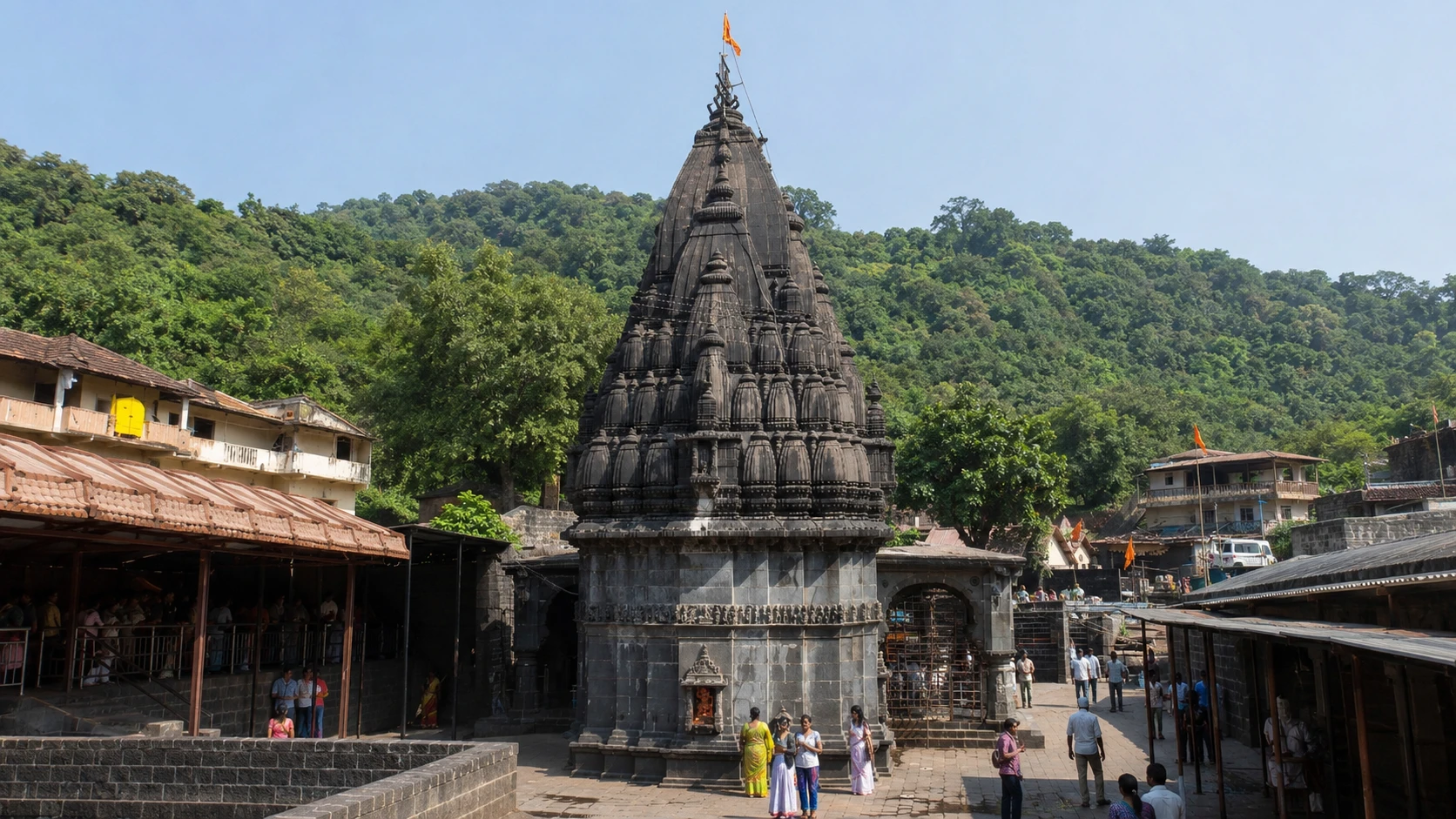
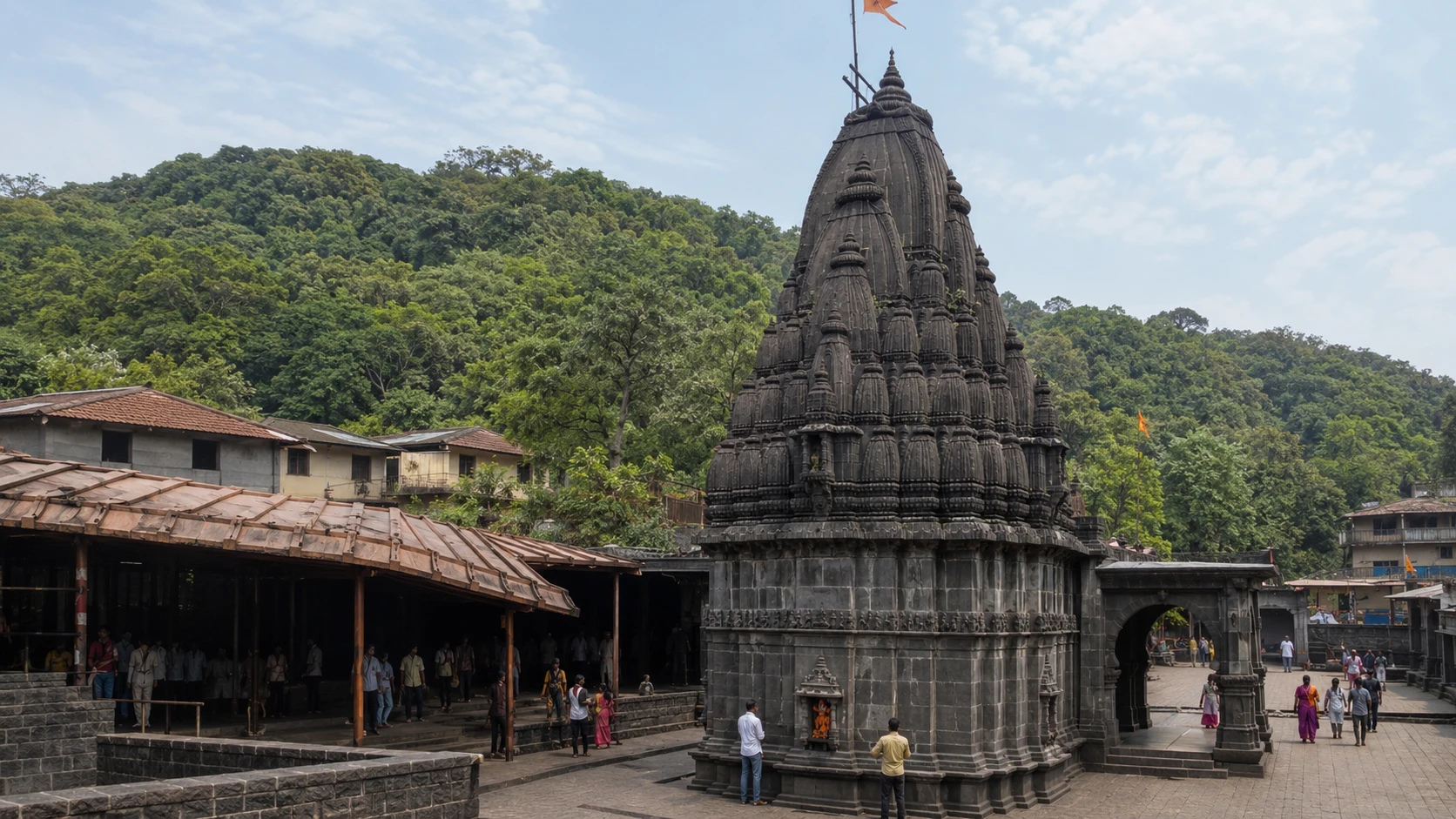
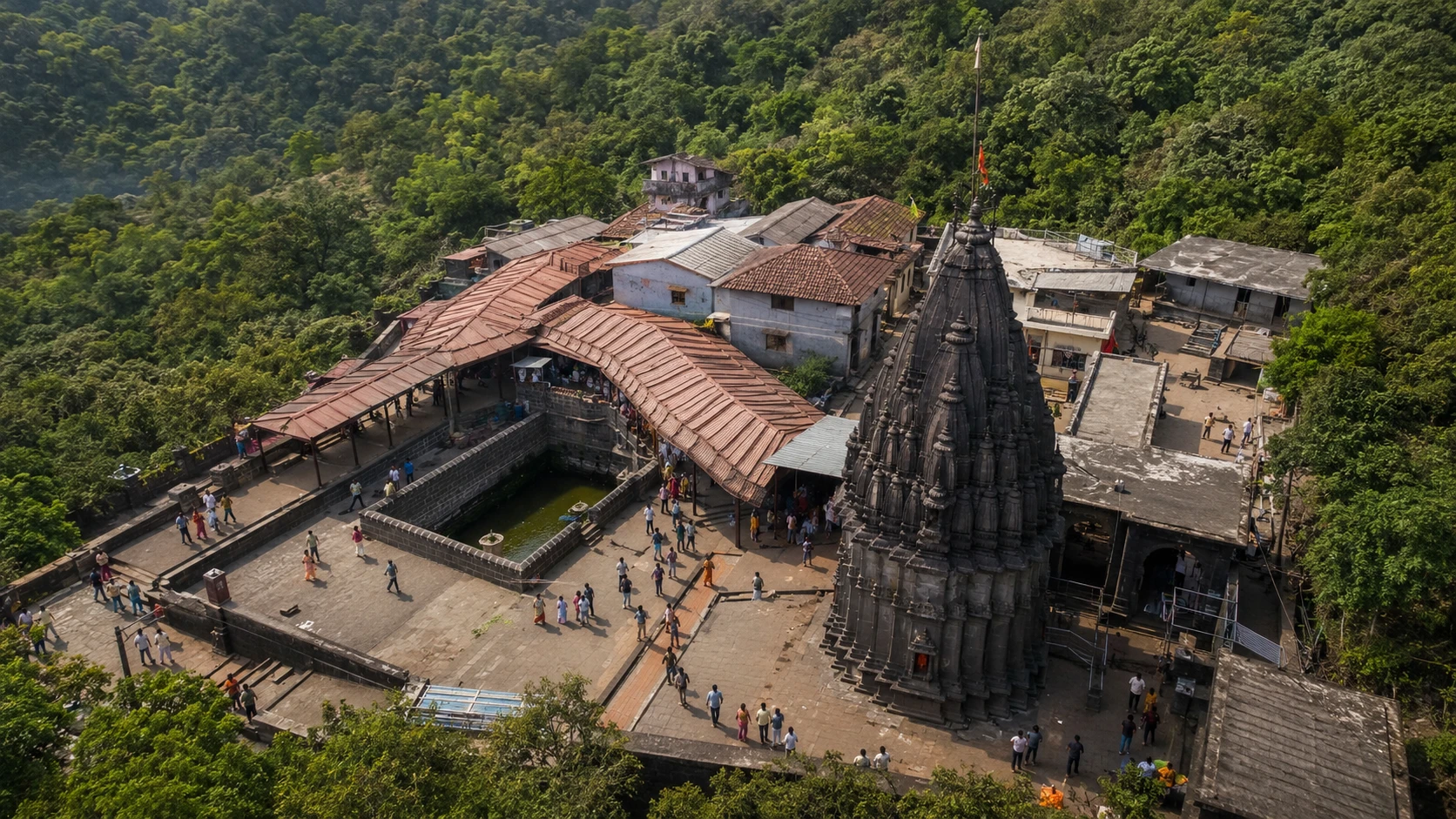
The shikhara above the sanctum is a Hemadpanthi-Nagara composite, simpler in profile than the elaborate Nagara towers of north India and stockier than the soaring Dravidian gopurams of the south, characteristic of the Deccan-Maharashtra temple-building idiom.
The shikhara is topped by an amalaka stone, a kalasha, and a brass dhwaj that catches the sun on clear days above the forest canopy.
The sabhamandap (assembly hall) is a wood-and-stone Maratha-era construction, with carved teak pillars and brackets attributed to the late 18th-century renovations. From its courtyard hangs the Vasai bell, bearing a Latin inscription from the Portuguese era, suspended from a stone arch.
Devotees ring this bell on entering and exiting, a daily continuation of a 1739 victory's afterlife.
Directly outside the temple, to the east, the Bhima Kund, a perennial spring, emerges from the rock. Tradition identifies this as the birth-point of the Bhima river. The water collects in a small stone tank and then begins its descent down the Sahyadri's eastern slope.
Devotees customarily take darshan of the Kund either before or after the Jyotirlinga, completing the spatial recital of the origin story: the lingam where Shiva manifested, the spring where his sweat flowed.
Distinctive Practicesविशिष्ट परंपराएँ
Descending to Darshan (Reverse Sanctum Approach)
अवरोहण दर्शन (विपरीत गर्भगृह दृष्टिकोण)
All darshan visits
Most major Hindu temples elevate the sanctum, requiring devotees to ascend to the deity. At Bhimashankar, the path inverts: pilgrims descend a short flight of stone steps from the sabhamandap level into the garbhagriha. The orientation reflects both the temple's setting in a depression of the Sahyadri ridgeline and the swayambhu lingam's emergence from below ground in the origin story. The descent is brief but spatially distinctive, a feature noted in pilgrim-account literature for centuries.
The descent symbolizes the devotee's lowering of ego before the swayambhu Lord. Where most temple architecture asks the pilgrim to climb upward, Bhimashankar asks them to bow downward, the lingam's appearance from below the earth is met by the devotee's own movement toward the earth.
Bhima Kund Snan and Tirtha-Jal Offering
भीमा कुंड स्नान और तीर्थ-जल अर्पण
Year-round; particularly at sunrise during Shravan and Maha Shivaratri
Just east of the temple, the Bhima Kund, a perennial rock spring, is identified by tradition as the source of the Bhima river and the very point where Shiva's sweat is said to have flowed in the battle with the asura Bhima. Devotees customarily take darshan of the Kund either before or after the Jyotirlinga, sprinkle Kund water over their head, and carry a small portion home in a brass or copper vessel. The Kund water is offered as abhishekam to the Jyotirlinga in the same ceremony, completing a cycle: water that flowed from Shiva returns to Shiva.
The Kund water is regarded as direct continuity with the Puranic narrative, not symbolic but identical with the river of Shiva's sweat. Carrying Kund water home, like Ganga jal from Kashi, is a way to extend the temple's grace into daily ritual.
Sahyadri Forest Circuit, Gupt Bhimashankar and Hanuman Talav
सह्याद्रि वन परिक्रमा, गुप्त भीमाशंकर और हनुमान तलाव
Daylight hours; subject to Forest Department access rules
Beyond the main temple, a traditional Sahyadri pilgrim circuit threads through the Bhimashankar Wildlife Sanctuary to two further sacred sites: Gupt Bhimashankar, a smaller, older Shivling along the upper Bhima river, set among rocks and called 'gupt' (hidden) for its secluded location; and Hanuman Talav, a forest lake associated by tradition with Hanuman's pause during the Sanjivani-mountain journey. The circuit, traditionally walked by sadhus and trekking pilgrims, takes 2, 4 hours depending on weather and visibility, and passes through prime habitat of the Indian Giant Squirrel (Maharashtra's state animal) and resident bird species.
The circuit reflects an older Sahyadri pilgrim grammar in which the temple is not a single point but a landscape of associated sites, the cave where Bhima the asura was born, the spring where Shiva's sweat first emerged, the lake where Hanuman paused. Walking the circuit traces the origin story across the geography that holds it.
Did You Know?क्या आप जानते हैं?
Bhimashankar is the only Jyotirlinga whose surroundings are governed by the Wild Life (Protection) Act. The 1985 notification of the Bhimashankar Wildlife Sanctuary brought the temple's approach forest under Forest Department jurisdiction, regulating commercial development, traffic, and infrastructure expansion in ways that no other Jyotirlinga shrine experiences.
Government of Maharashtra notification under the Wild Life (Protection) Act 1972; Maharashtra Forest Department records
The Bhima river, one of the major tributaries of the Krishna and a lifeline of southern Maharashtra and northern Karnataka, rises here at the temple. The river flows approximately 860 km through Maharashtra, Karnataka, and a small section of Andhra Pradesh before joining the Krishna near Raichur. Devotees who come to Bhimashankar are also at the headwaters of one of peninsular India's most important rivers.
Central Water Commission, Government of India, Bhima river basin reports; Maharashtra State irrigation records
The bell hanging in the temple courtyard is a Portuguese church bell, bearing a Latin inscription dated to 1729, captured at the Battle of Vasai in May 1739 by Chimaji Appa, brother of Peshwa Bajirao I. The Marathas brought several such bells inland after the campaign and distributed them among patron temples; the Bhimashankar bell remains hanging at the site nearly three centuries later, a continuous material link between Maratha military history and the temple's daily ritual.
Peshwa Daftar campaign records (Pune); G.S. Sardesai, 'New History of the Marathas', Vol. II
Unlike the typical tall, narrow Shivling found at most major shrines, the Bhimashankar Jyotirlinga is a swayambhu lingam that is broader at the base than it is tall, a stocky form sometimes called 'Mota Lingam' in Marathi devotional vocabulary. The shape is part of the temple's distinctive identity and reflects the Puranic narrative in which the lingam emerged from the earth in answer to the imprisoned king Kamarupeshwar's worship rather than being shaped by human hands.
Bhimashankar Devasthan records; Marathi devotional literature on the temple's iconography
Pilgrims approaching Bhimashankar through the sanctuary forest may encounter the Indian Giant Squirrel (Ratufa indica), Maharashtra's state animal, locally known as the Shekru. The species is endemic to the Western Ghats and the Bhimashankar sanctuary is among its most-protected habitats; the 1985 sanctuary notification was issued specifically to safeguard this population. Few other Hindu pilgrim destinations carry their state animal as part of the journey itself.
Wildlife Institute of India sanctuary surveys; Bombay Natural History Society publications on the Indian Giant Squirrel
Visitor Accessप्रवेश जानकारी
Bhimashankar welcomes devotees of all backgrounds for darshan, there are no entry restrictions based on gender, age, or origin. Footwear must be removed before the temple complex; mobile phones must be silenced. Photography is prohibited in the inner sanctum (garbhagriha) and during abhishekam, but is permitted in the outer courtyards and the Bhima Kund area. Because the temple sits within the Bhimashankar Wildlife Sanctuary, additional sanctuary rules apply: single-use plastics are restricted, littering is heavily penalized, and the Forest Department checkpost may regulate vehicle entry during peak crowd days. Pilgrims walking the forest circuit to Gupt Bhimashankar should respect Forest Department guidance and avoid early-morning or late-evening hours when wildlife movement is highest.
Carry your own water bottle (refillable; single-use plastic is restricted). Wear sturdy walking shoes if planning the forest circuit; the trek route from Khandas village requires proper trekking footwear and 4, 5 hours one-way. Photo ID is generally not required for darshan but is useful for any guesthouse stay. The Bhima Kund area can be slippery during and after monsoon; small children should be supervised closely. Mobile network is spotty within the sanctuary, download maps and inform someone of your itinerary before entering.
Festivalsत्योहार
Maha Shivaratri
महाशिवरात्रि
Feb-Mar (Phalgun Krishna Chaturdashi)
The most important festival at any Shiva temple, observed at Bhimashankar with an all-night vigil and the four-pahar (four-watch) puja sequence performed continuously through the night. Lakhs of pilgrims arrive by road from Pune and Mumbai; many undertake the 4, 5 hour trek from Khandas village in the days approaching the festival. The Sahyadri location and the surrounding forest add a particular character to the night-vigil experience, the temple bells, the lit oil lamps, and the cool forest air combine into one of the most atmospheric Shivaratri observances in Maharashtra.
Shravan Somvar (Sawan Mondays)
श्रावण सोमवार
Jul-Aug (Shravan)
Each of the four (sometimes five) Mondays of Shravan draws enormous monsoon-season crowds. The Sahyadri is at its lushest in this period, waterfalls active on every slope, the Bhima Kund overflowing, and the dripping forest and saffron-clad pilgrims trekking up from Khandas village have become emblematic monsoon imagery for Maharashtrian devotees. Continuous abhishekam runs through each Monday, and the queue typically extends well beyond the temple courtyard.
Tripuri Purnima (Kartik Purnima)
त्रिपुरी पूर्णिमा (कार्तिक पूर्णिमा)
Nov (Kartik Shukla Purnima)
Tripuri Purnima commemorates Shiva's destruction of the demon Tripurasura and his three flying cities, a narrative that, in the Maharashtra regional variant of the Bhimashankar origin story, is sometimes overlaid on the Jyotirlinga itself. The temple is specially illuminated for this full-moon night; deepamala (lamp-tower) ceremonies are conducted at the entrance, and devotees offer ghee diyas in the Bhima Kund. The convergence of the Tripurari narrative with the temple's primary Bhima narrative makes this observance especially layered at Bhimashankar compared to other Shiva sites.
Pradosh Vrat
प्रदोष व्रत
Twice every lunar month (Trayodashi tithi, Krishna and Shukla pakshas)
Pradosh, the dusk-hour observance on the thirteenth lunar day of each fortnight, is observed at Bhimashankar with extended evening worship in the hour-and-a-half before and after sunset. The trayodashi-pradosh window is considered Shiva's preferred hour, and at Bhimashankar the small sanctum and dim oil-lamp light make this an especially intimate observance compared with the larger Jyotirlinga shrines. Som-pradosh (when pradosh falls on a Monday) is the most auspicious; many devotees make a dedicated visit on these days.
Traditional Offeringsपारंपरिक अर्पण
प्राथमिक अर्पण
Bel Patra (Bilva leaves)
बेल पत्र
बिल्व पत्र
The three leaflets of the bilva tree represent the three eyes of Shiva, the trident he wields, and the cosmic functions of creation, preservation, and dissolution. The Shiva Purana states that even a single bilva leaf, offered with devotion, surpasses elaborate rituals. At Bhimashankar, the surrounding Sahyadri forest harbours wild bilva trees, and devotees often gather a few leaves directly from the sanctuary perimeter (where Forest Department rules permit) to offer at the Jyotirlinga.
Bhima Kund Tirtha-Jal
भीमा कुंड तीर्थ-जल
भीमा कुण्ड तीर्थ जल
Water from the Bhima Kund, the perennial spring just east of the temple identified by tradition as the source of the Bhima river and the very point where Shiva's sweat flowed in the battle with the asura Bhima, is the most temple-specific abhishekam offering at Bhimashankar. Devotees draw a small quantity from the Kund and offer it directly to the Jyotirlinga as part of the morning ritual, completing a Puranic cycle: water that flowed from Shiva returns to Shiva. Devotees often also carry a sealed portion home for household worship, similar to Ganga jal from Kashi.
Panchamrit (Five sacred substances)
पंचामृत
पञ्चामृत
The ritual bathing of the lingam with five sacred substances, milk, curd, honey, ghee, and sugar, is performed at all major Shiva temples. Each substance has symbolic meaning: milk for purity, curd for prosperity, honey for sweet speech, ghee for victory, and sugar for happiness. The five together represent the five elements (panchabhuta) returning to their cosmic source. At Bhimashankar, the abhishekam is conducted in the small descended sanctum, the panchamrit poured over the swayambhu lingam by the resident priesthood.
Vibhuti (Sacred ash)
विभूति
विभूति
Sacred ash applied to the lingam and to the devotee's forehead. Vibhuti represents the ultimate truth that all material existence eventually returns to ash, a constant reminder of impermanence. Three horizontal lines (tripundra) drawn across the forehead with vibhuti symbolize the three realms Shiva governs and the three gunas of nature. At Bhimashankar, vibhuti is offered to devotees as prasad after darshan; many carry small quantities home for daily worship.
Dhatura flowers and Aak (Calotropis)
धतूरा और आक के फूल
धत्तूर अर्क
The trumpet-shaped dhatura flower and the bunched mauve flowers of the aak (Calotropis) shrub, both of which grow wild on the dry slopes of the Western Ghats and the Deccan, are sacred to Shiva despite (or because of) their toxic nature. Both plants are said to have emerged when Shiva consumed the halahala poison during the churning of the cosmic ocean; the flowers represent Shiva's capacity to transform poison into something offered back to him in worship. Both are commonly available from devotional vendors at Bhimashankar and the Pune-side approach villages.
Coconut
नारियल
नारिकेल
The coconut symbolizes the human ego, which must be broken before Shiva for spiritual progress. At Bhimashankar, devotees often offer a coconut along with a bilva-and-flower bundle as a complete arpan (offering) at the temple's outer steps before descending to the sanctum.
इस मंदिर की विशेषता
Bhima Kund Tirtha-Jal Abhishekam
भीमा कुंड तीर्थ-जल अभिषेकम
The Bhimashankar-specific practice of drawing water from the Bhima Kund, the spring identified as the source of the Bhima river and the geological/Puranic point of Shiva's sweat, and offering it back to the Jyotirlinga as abhishekam. This circular offering is unique to Bhimashankar among the twelve Jyotirlingas; nowhere else in the canon is the abhishekam water itself directly identified with the Lord's bodily presence in the origin narrative.
Sahyadri Wildflower Garlands (seasonal)
सह्याद्रि वन्य फूलों की मालाएँ (मौसमी)
During the post-monsoon months (September, November), the Sahyadri forest around Bhimashankar bursts into flower with seasonal endemics, Sonki (Senecio bombayensis) yellow blooms, Karvi (Strobilanthes callosa) mauve clusters that bloom only once every seven to eight years, and Mickey Mouse plant (Ochna) crimson seeds. Local devotees and forest pilgrims weave seasonal garlands from these wildflowers as Bhimashankar-specific offerings, distinct from the cultivated marigolds and jasmines used at most temples. Forest Department rules apply: gathering is restricted to small quantities, only outside the core sanctuary zone, and never of protected or rare species.
Devotees may bring offerings from outside; small vendor stalls along the approach road and at Bhimashankar village sell pre-assembled bundles of bilva, flowers, and a small coconut. The Devasthan permits walk-in abhishekam offerings during designated darshan windows, conducted by the resident priesthood. The Forest Department's sanctuary rules apply to any wildflower or leaf gathering done within the protected boundary, devotees should buy from authorized vendors rather than gather from inside the sanctuary core. Photography during abhishekam is not permitted.
How to Reachकैसे पहुँचें
Bhimashankar lies in the Khed taluka of Pune district, ~110 km northwest of Pune in the Sahyadri range of the Western Ghats. The most common approach is by road from Pune via Manchar and Ghodegaon, a 110 km drive of roughly 3, 3.5 hours, climbing steadily into the hills over the final hour.
From Mumbai, the temple is approximately 220 km away, most reliably reached via Pune (4, 5 hours total), or alternatively via the Karjat, Khopoli, Khandas route for those wanting to combine the visit with the Khandas trekking trail.
By rail, Pune Junction (~110 km) is the practical nearest mainline station, with direct trains from Mumbai, Delhi, Hyderabad, Bengaluru, and most major Indian cities. Karjat (~102 km via the southern approach) is closer in line distance for Mumbai-side pilgrims but the road from Karjat is more difficult than the Pune route.
Pre-paid taxis and shared cabs are available from Pune Junction.
By air, Pune Airport (~125 km) is the closest, with daily flights from most Indian metros and a few international connections. Mumbai (Chhatrapati Shivaji Maharaj International) Airport (~220 km) offers a wider international network for those flying in from abroad.
Maharashtra State Road Transport Corporation (MSRTC) buses run regularly from Pune (Shivajinagar bus station and Swargate), Manchar, and Ghodegaon to Bhimashankar village. Private operators run mini-bus services on festival days.
The last stretch into Bhimashankar passes through the wildlife sanctuary; Forest Department checkposts may regulate vehicle entry during peak crowd days such as Maha Shivaratri and Shravan Mondays.
For adventure-minded pilgrims, the trekking route from Khandas village via Ganesh Ghat (the gentler, traditional pilgrim route) or Shidi Ghat (the steeper route) is a 4, 5 hour ascent through dense Sahyadri forest, popular especially in the post-monsoon months. The trek should not be attempted in heavy monsoon, slopes become dangerously slippery and visibility drops sharply.
Many pilgrims combine Bhimashankar with the Ashtavinayak circuit (the eight Ganesha shrines of Maharashtra, several within day-trip distance) and with the Trimbakeshwar Jyotirlinga (~210 km north near Nashik), forming a Shiva-Ganesha pilgrimage of western Maharashtra.
Plan Your Visitयात्रा की योजना
🌤 सर्वोत्तम मौसम
October to March is the most comfortable period, temperatures in the Sahyadri hover between 12, 25°C with clear skies and excellent forest views. November to February is particularly pleasant. The monsoon (June, September) transforms the sanctuary into a misted, waterfall-laced landscape that is extraordinarily beautiful but practically demanding: roads can be washed out, the trek route from Khandas becomes dangerously slippery, leeches are common in the forest, and visibility on the final ghat road can be very poor. Despite this, Shravan (July, August) is one of the most spiritually charged times to visit, and many pilgrims accept the monsoon difficulties as part of the observance. April, May is hot at the lower elevations but cooler at the temple itself; the forest is drier and less green.
👘 पहनावे का नियम
Modest, traditional dress is preferred, sarees, salwar suits, dhotis, or full-length trousers with covered shoulders. Avoid leather items inside the temple complex. If you plan to walk any portion of the forest circuit, bring sturdy walking shoes; smooth-soled fashion footwear is unsafe on the rock paths and especially treacherous in monsoon. A light shawl or jacket is useful year-round at the temple itself given the higher elevation, even when the lower plains are warm.
📱 फोन और फोटोग्राफी
Mobile phones must be on silent within the temple complex. Photography with phones is permitted in the outer courtyards and in the Bhima Kund area, but is strictly prohibited inside the inner sanctum (garbhagriha) and during abhishekam. Mobile network coverage is uneven within the wildlife sanctuary, some carriers have intermittent or no signal in the temple core. Download offline maps before arriving, and inform someone outside of your itinerary if you are walking the forest circuit.
🏨 आवास
Accommodation at Bhimashankar village itself is limited and basic, small dharamshalas and a few simple guesthouses operated by the Bhimashankar Devasthan and private parties, mostly catering to next-day darshan rather than extended stays. The Maharashtra Tourism Development Corporation (MTDC) operates a resort near the temple with better facilities; advance booking is essential during festival seasons. For more comfortable stays, Manchar (~50 km away) and Ghodegaon offer mid-range hotels, and Pune (~110 km) provides the full range of urban accommodation. Pilgrims combining Bhimashankar with the Ashtavinayak circuit often base themselves in Pune and make day trips. Trekkers using the Khandas route can find basic homestays and a forest guesthouse at Khandas village.
Sacred Soundsपवित्र ध्वनि
क्या आप जानते हैं? · Did You Know?
वही अनुवाद त्रुटि जिसने हिन्दू धर्म में '33 कोटि' को '33 करोड़' बनाया, बौद्ध धर्म में भी हुई। बौद्ध ग्रन्थों के चीनी अनुवाद ने 'सप्त कोटि बुद्ध' (7 श्रेष्ठ बुद्ध) का अनुवाद '7 करोड़ बुद्ध' कर दिया। तिब्बती अनुवाद ने सही किया: 7 प्रकार, 7 करोड़ नहीं। एक संस्कृत शब्द, दो प्रमुख विश्व धर्मों में गलत पढ़ा गया, ने दो एकसमान भ्रम स्वतन्त्र रूप से उत्पन्न किए।
Related Contentसंबंधित सामग्री
Related Scriptures
Community Reflections
🕉️
Be the first to share your reflection.