Grishneshwar
घृष्णेश्वर
The twelfth and final Jyotirlinga, where a woman's daily devotion brought her son back from death
Verul, Maharashtra, India
Ghr̥ṣṇeśvaraAlso known as: Ghushmeshwar, Ghrishneshwar, Ghrushneshwar, Kusumeshwar, Verul Jyotirlinga
युग
References in Shiva Purana and Linga Purana; current temple structure substantially dates from the late-16th-century reconstruction traditionally attributed to Maloji Bhosale (Shivaji Maharaj's grandfather) and from the late-18th-century renovation undertaken by Ahilyabai Holkar of Indore as part of her broader pan-Indian temple-restoration programme
वास्तुकला
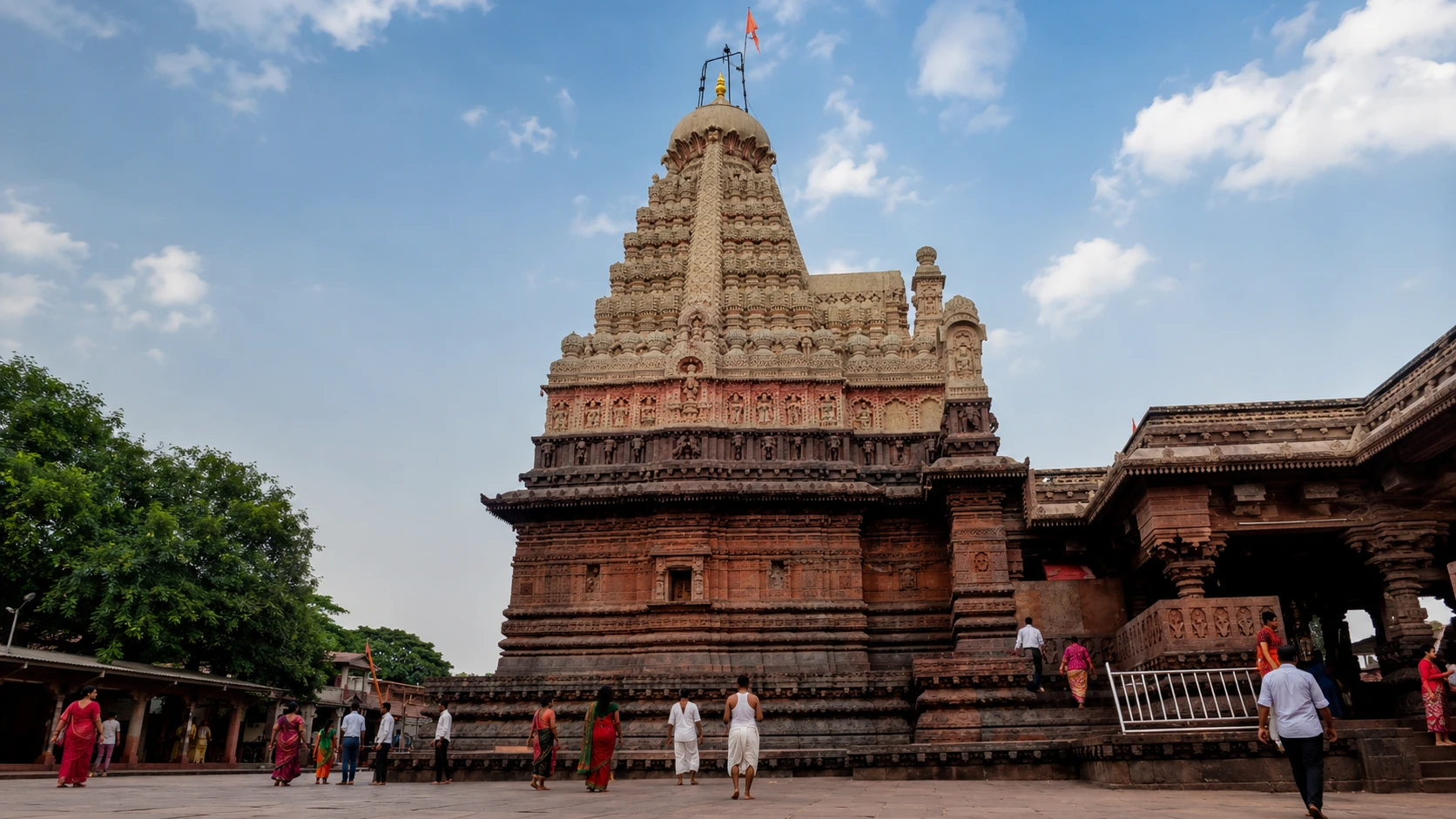
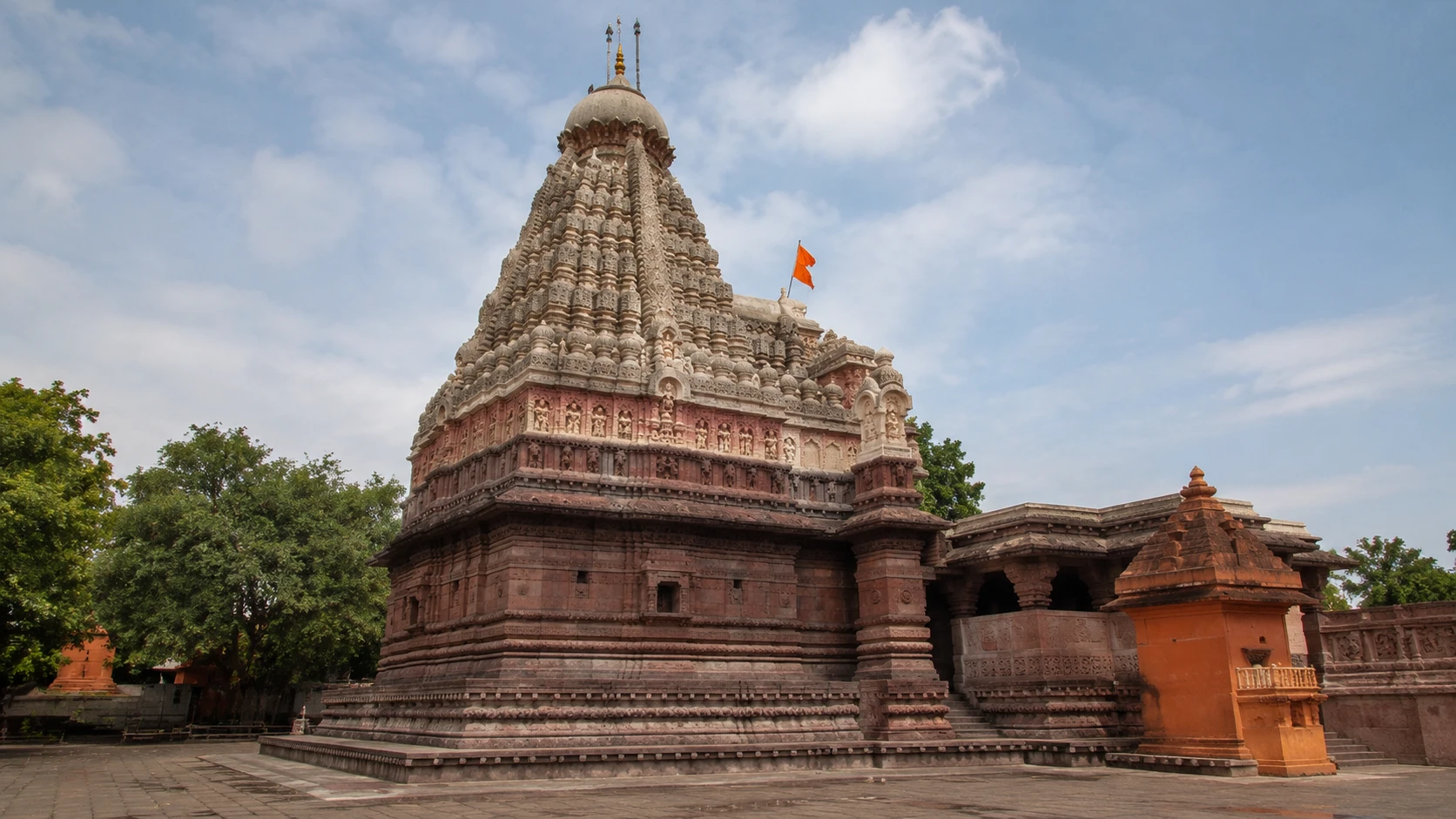
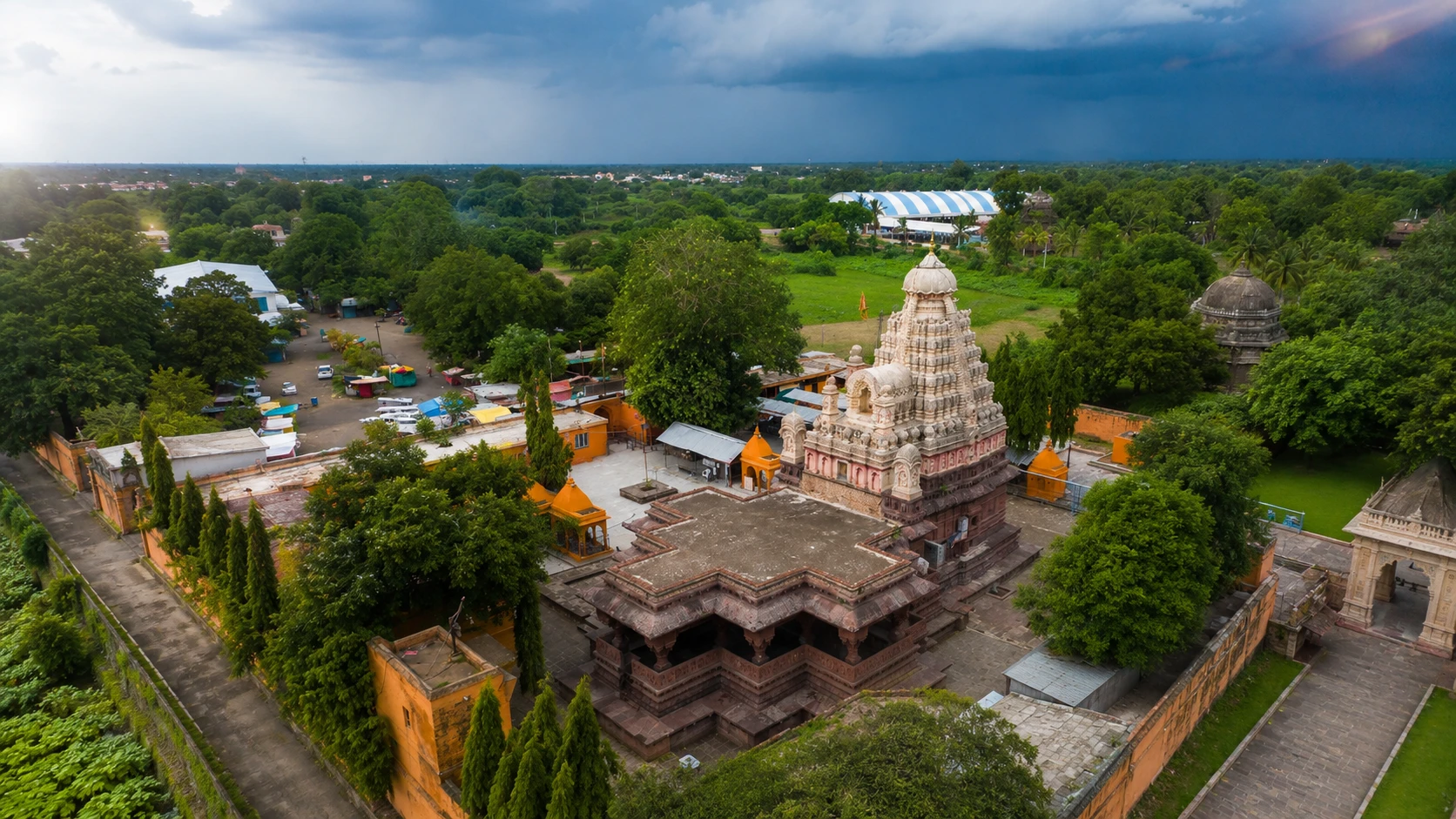
Hemadpanthi-influenced Maratha-Maharashtrian Nagara, with a five-tiered (panchatala) shikhara; modest in physical scale by Jyotirlinga standards but characterized by densely-carved sandstone and basalt sculptural panels along the prakaram walls
खुला
05:30 – 21:30
आरती
05:30 · 08:00 · 11:00 · 12:00 · 19:30 · 22:00
विशेष
Maha Shivaratri all-night darshan; Shravan Mondays with continuous abhishekam; the clay-lingam re-enactment tradition observed on Pradosh days and during Shravan; combined Grishneshwar, Ellora Caves visit is the standard pilgrim itinerary
पवित्र कथा · पवित्र कथा
Grishneshwar is the twelfth and final Jyotirlinga in the canonical Dwadasha Jyotirlinga Stotram order, the closing site of the canonical sequence and, in physical scale, the most modest of the twelve. It sits in Verul village in Maharashtra's Marathwada region, immediately adjacent to the Ellora Caves UNESCO World Heritage Site, where the 8th-century Kailasa Temple, the largest monolithic Hindu temple carved from a single rock, stands less than a kilometre away. Grishneshwar's distinctiveness is not architectural; it is narrative. The Shiva Purana places its origin not in a sage's tapasya, a king's patronage, an asura's defeat, or a cosmic battle, but in the daily devotional practice of a brahmin woman named Ghushma, who shaped 101 clay Shivlings each morning and dissolved them in the village pond each evening, and through whose unbroken devotion, when her son was murdered by a jealous co-wife, Shiva himself restored him to life. Ghushma asked for forgiveness for her sister rather than punishment, and Shiva, moved past hesitation, remained at this spot as the twelfth Jyotirlinga. No other Jyotirlinga origin narrative centres on a woman; no other turns on the daily, small, domestic act of clay-shaping rather than on austerity or war. To complete the Dwadasha Jyotirlinga Yatra here is to close the canonical circuit at the place where the cosmic Lord answered the smallest of repeated offerings before any of the great ones.
Sacred Designationपवित्र पदनाम
बारह ज्योतिर्लिंगों में 12वें
बारह ज्योतिर्लिंगों में 12th
Sacred Origin Storyपवित्र उत्पत्ति कथा
Source: Shiva Purana (Koti Rudra Samhita, Chapters 32, 33), widely-attested
In the Devagiri country, the highland tract that today's pilgrim crosses to reach Verul, there once lived a brahmin couple named Sudharma and Sudeha. Sudharma was learned in the Vedas and mild in temperament; Sudeha was the daughter of a noble brahmin family. They lived in modest comfort. But a single sorrow shadowed their household: they had no child.
Years passed. Sudeha grew older, and the absence of a child became unbearable to her. One day she came to her husband and said: 'My sister Ghushma is younger than I am. She is devoted, hardworking, beautiful. Marry her. Let her give us the child that I cannot. I shall raise him as my own.'
Sudharma resisted. To take a second wife while the first was still loved seemed dishonourable to him. But Sudeha insisted, and the family, including Ghushma herself, who consented willingly, arranged the marriage. Ghushma came to live in the household.
Ghushma was a great devotee of Shiva. She had no learned tapasya, no fierce austerities, no royal sponsorship for grand worship. What she had was a daily practice that asked of her only patience and devotion. Each morning, after the household chores, she would walk down to the small pond near the village, gather wet clay, and shape it into 101 small Shivlings.
She would worship each one, bilva leaves, water, brief recitation, prostration, and at the end of the day she would carry them down to the pond and dissolve them in the water, returning the clay to the earth as the lingams returned to the cosmic source from which all forms come.
She did this every day. Years passed. And then, in time, Ghushma conceived and bore a son.
The household rejoiced. Sudeha embraced the child as her own at first, exactly as she had said she would. But the child was Ghushma's, and the resemblance was Ghushma's, and the boy's eyes followed his mother in the way that mothers know. Sudeha's joy curdled, slowly, over the years.
The child grew. He was given an education befitting a brahmin son, married into a good family, and brought his young wife into the household. The wedding was held in Sudharma's home, with the full festivities of the Devagiri country, and the family seemed at last to be complete.
That night, while the household slept, Sudeha rose. The poison that had grown in her over the years had become an illness, and the illness had become a plan. She went to the bedchamber where her sister's son lay beside his new wife. She killed him there, quietly, in the way of those who have rehearsed the act in their minds a thousand times, and carried his body to the pond.
The same pond where Ghushma went each morning. She threw him in. She walked back to her bed.
The next morning, the household woke to a horror. The bride could not find her husband. The bedclothes were stained with blood. The search began.
Ghushma did not wait for the search to lead her to the pond. She did what she did every morning. She walked to the pond, gathered her clay, shaped her 101 Shivlings, and worshipped them. She did not let the household's panic turn her away from the practice that had been her life for decades.
When the worship was complete, she carried the lingams to the water and began to dissolve them, one by one, as she always did.
When she dissolved the last lingam, she heard her son's voice. He emerged from the pond, alive, unharmed, walking up out of the water as if he had simply gone for a swim and was returning. The wound that should have killed him was gone. Death itself had been refused.
Behind him, Shiva appeared.
The Lord stood at the edge of the pond and asked Ghushma to name her boon. He had been moved past speaking by what he had seen: a woman who, finding her son murdered, had not abandoned her daily devotion; a woman whose practice was so steady that even grief could not interrupt it; a woman whose 101st clay lingam had dissolved into the water carrying with it a request she had never spoken, her son's life.
Ghushma did not ask for revenge against her sister. She did not ask for wealth, or learning, or release from samsara. She asked one thing: that Sudeha be forgiven.
Shiva agreed. He said to Ghushma: 'Your devotion has ended my hesitation. From this day, I shall remain at this place as a Jyotirlinga, the twelfth and final among the canonical sites of my presence. Pilgrims who come here will come not to a battle-victory shrine, not to a king's foundation, not to a sage's tapasya site, but to the place where a woman's daily clay-shaping reached me before the world's other forms of devotion could.
This shall be the Ghushmeshwar Jyotirlinga, the Lord of Ghushma, and the pond where you dissolve your lingams shall be sacred for as long as devotees walk to it.'
The pond is the Shivalaya Tank, immediately west of the temple. Pilgrims still bathe in it before darshan. The clay-lingam tradition of Ghushma is still observed on Pradosh days and during Shravan, when the temple's priesthood and lay devotees together shape and dissolve small clay lingams in the pond, re-enacting the practice that brought the Lord to this place.
The Shiva Purana places this Jyotirlinga as the twelfth among the canonical twelve, and the canonical Dwadasha Jyotirlinga Stotram closes its enumeration here, at the place where a woman's grief did not interrupt her devotion, and where Shiva's grace answered the daily small offering before answering the world's great ones.
उद्धृत स्रोत:
- Shiva Purana, Koti Rudra Samhita, Chapters 32, 33 (Ghushmeshwar Jyotirlinga origin)
- Linga Purana, Jyotirlinga origin sections
- Skanda Purana, regional Marathwada and Devagiri tract references
अन्य परंपराएँ · अन्य परंपराएँ
Kusumeshwar variant, alternate name and minor narrative variations
Some regional traditions name the woman devotee Kusuma rather than Ghushma, giving rise to the alternate temple name 'Kusumeshwar.' The narrative arc is preserved in this variant, clay-lingam practice, son's murder by jealous co-wife, restoration through devotion, forgiveness rather than revenge, but the protagonist's name and small narrative details vary.
Some Marathwada-regional variants give the daily lingam count as 108 rather than 101, mirroring the standard Hindu sacred-number convention; the dominant Shiva Purana text uses 101. Both number-variants are observed in current ritual practice, with the temple's clay-lingam re-enactment tradition accommodating both.
विद्वत संदर्भ
Grishneshwar is among the few Jyotirlingas whose canonical site is essentially uncontested across regional traditions; the Shiva Purana, the Linga Purana, and the canonical Dwadasha Jyotirlinga Stotram all converge on the Verul site, and the temple's identification with the Ghushma narrative has remained stable across the medieval and modern periods. What makes Grishneshwar distinctive in scholarly terms is its narrative singularity rather than its geographic dispute-status: among the twelve canonical Jyotirlinga origin narratives, Grishneshwar's is the only one whose primary protagonist is a woman, and the only one whose central devotional practice is daily domestic ritual rather than tapasya, royal patronage, or cosmic battle. Modern feminist Hindu scholarship (Vasudha Narayanan, others) has noted Ghushma's narrative as one of the few canonical Shaiva origin-stories in which a woman's devotion is the structural foundation of a major pilgrimage site rather than a supporting element. The temple's adjacency to the Ellora Caves UNESCO Heritage Site, particularly Cave 16, the 8th-century Kailasa Temple, the largest monolithic rock-cut Hindu temple in the world, also places Grishneshwar at the heart of one of South Asia's densest Shaiva archaeological landscapes, though the surviving structure of the Jyotirlinga temple itself postdates the Ellora monoliths by nearly a millennium.
Historyइतिहास
Grishneshwar's documented history is shaped by two patronages, one Maratha-noble, one Maratha-queen, that together account for substantially the entire visible structure of the present temple. The Puranic references in the Shiva Purana and Linga Purana establish the site's antiquity in textual terms, but the surviving architectural fabric does not extend pre-medieval; whatever earlier shrines stood at Verul were either superseded or destroyed during the medieval period, when the Devagiri-Daulatabad region (in which Verul sits) passed through repeated political transitions under the Yadavas, the Khalji-Tughlaq sultanates, the Bahmanis, the Ahmadnagar Sultanate, and ultimately the Mughal-Maratha contestation.
The earliest documented reconstruction of the present temple is traditionally attributed to Maloji Bhosale (c. 1552, 1607), the grandfather of Chhatrapati Shivaji Maharaj and a Watandar Maratha noble who held lands in the Verul-Daulatabad area under the Ahmadnagar Sultanate.
Maloji's reconstruction is generally placed in the late 16th century, around 1568, 1590, though specific dated inscriptions tying him personally to the temple are sparse. The attribution rests primarily on Bhosale-family tradition, regional Marathi devotional literature, and architectural-style continuity with other Bhosale-era Maharashtra temples.
By the time of Chhatrapati Shivaji Maharaj's lifetime in the mid-17th century, the temple was an established Maratha-Shaiva pilgrimage site within the Bhosale ancestral region.
The defining transformation of the temple's modern form is the work of Ahilyabai Holkar (1725, 1795), the legendary Maratha queen of Indore (Malwa) who ruled from 1767 to 1795 and is documented to have undertaken the restoration or reconstruction of dozens of Hindu temples across the Indian subcontinent during her reign, including Kashi Vishwanath (1780), Somnath (1782/83), and the Vishnupad Temple at Gaya, among many others.
The Grishneshwar restoration is part of this broader programme, generally dated to the late 18th century during her active patronage period, though specific dated inscriptions are not preserved. The five-tiered shikhara, the prakaram walls with their sculpted sandstone and basalt panels, and the principal architectural fabric of the present complex are widely attributed to Ahilyabai's restoration phase, building upon the late-16th-century Bhosale-era foundation.
Across the colonial era, Grishneshwar remained a regionally significant pilgrimage site without external administrative intervention. The Hyderabad Nizam's territory (Hyderabad State, in which Aurangabad-Verul sat under princely-state arrangements until 1948) administered the temple through local Devasthan structures rather than direct interference.
Following the integration of Hyderabad State with the Indian Union in 1948 and the subsequent Bombay State / Maharashtra reorganization in 1956 and 1960, the temple came under the administrative umbrella of the Maharashtra Devasthan framework and the Trust structures that govern most Maharashtra Jyotirlingas today.
In the late 20th century, the Ellora Caves complex, immediately adjacent to the temple, was inscribed on the UNESCO World Heritage List in 1983, transforming the surrounding region's tourism and infrastructure context. Pilgrim flow to Grishneshwar has been substantially reshaped by the Ellora Caves visitor traffic: the standard pilgrim itinerary now combines Grishneshwar darshan with an Ellora Caves visit (particularly Cave 16, the Kailasa Temple), often as a single half-day excursion from Aurangabad/Chhatrapati Sambhajinagar.
In 2022, the Government of Maharashtra renamed Aurangabad city and district as Chhatrapati Sambhajinagar, after Shivaji Maharaj's son and successor; Grishneshwar now formally falls within the renamed Chhatrapati Sambhajinagar district. The temple is administered today by a Trust under Maharashtra state oversight, with daily ritual conducted by the resident priesthood.
Historical Timelineऐतिहासिक कालक्रम
Puranic references to the Ghushmeshwar Jyotirlinga at Verul appear in the Shiva Purana (Koti Rudra Samhita), the Linga Purana, and regional Skanda Purana sections covering the Devagiri tract. These references establish the site's antiquity in textual terms, the Ghushma narrative and the Verul site identification are stable across the surviving Puranic corpus, but no datable architectural fabric from the pre-medieval period survives at the present temple. Whatever earlier shrines stood at the site were superseded or destroyed during the medieval Devagiri-Daulatabad political transitions; the present visible temple structure is post-16th-century.
Pre-modern documentary evidence for Grishneshwar is genuinely thin compared to Somnath, Kashi Vishwanath, or Mahakaleshwar. The site's Puranic textual foundation is well-attested, but the architectural-historical record begins effectively in the late 16th century with the Maloji Bhosale reconstruction. This is consistent with the broader Devagiri-Daulatabad region's medieval political instability and the loss of pre-modern records during repeated dynastic transitions.
Reconstruction of the temple is traditionally attributed to Maloji Bhosale (c. 1552, 1607), the grandfather of Chhatrapati Shivaji Maharaj and a Watandar Maratha noble who held lands in the Verul-Daulatabad area under the Ahmadnagar Sultanate. The reconstruction is generally placed around 1568, 1590. Specific dated inscriptions tying Maloji personally to the temple are sparse; the attribution rests on Bhosale-family tradition, regional Marathi devotional literature, and architectural-style continuity with other Bhosale-era Maharashtra Shaiva temples. By Chhatrapati Shivaji Maharaj's mid-17th-century lifetime, the temple was an established Maratha-Shaiva pilgrimage site within the Bhosale ancestral region.
The Maloji Bhosale attribution is widely accepted in popular tradition and in regional Marathi devotional and Devasthan literature, but specific dated inscriptions are not preserved. The safer formulation is 'late 16th century, traditionally attributed to Maloji Bhosale,' rather than a precise single-year reconstruction. The exact date and the proportion of the surviving fabric attributable to Maloji versus to the subsequent Ahilyabai Holkar restoration are difficult to disentangle from architectural evidence alone.
Ahilyabai Holkar (1725, 1795), the Maratha queen of Indore (Malwa), undertakes the major restoration of the Grishneshwar temple as part of her broader pan-Indian Hindu temple-restoration programme. Ahilyabai is documented to have restored, reconstructed, or sponsored the construction of dozens of major Hindu temples across the subcontinent during her reign, including Kashi Vishwanath (1780), Somnath (1782/1783), the Vishnupad temple at Gaya, and shrines at Dwarka, Ujjain, Pushkar, and Haridwar, among many others. The Grishneshwar restoration is part of this programme. The five-tiered (panchatala) shikhara, the prakaram walls with their sculpted sandstone and basalt panels, and the principal architectural fabric of the present complex are widely attributed to this Holkar-era restoration phase, building upon the earlier Bhosale-era foundation. Specific dated inscriptions tying her personally to the Grishneshwar restoration are sparse; the attribution rests on the broader documentation of her pan-Indian patronage programme and on architectural-style consistency with her other restoration projects.
Ahilyabai Holkar's pan-Indian temple restoration programme is one of the best-documented patronages of any pre-colonial Indian ruler, but the specific date of her Grishneshwar restoration is less precisely fixed than her well-known Kashi Vishwanath (1780) and Somnath (1782/83) projects. The safer formulation is 'late 18th century during her rule (1767, 1795)' rather than a specific year. The restoration is uncontested in attribution but imprecisely dated.
The adjacent Ellora Caves complex, including the 8th-century Cave 16 (Kailasa Temple), the largest monolithic rock-cut Hindu temple in the world, is inscribed on the UNESCO World Heritage List. The inscription transforms the surrounding region's tourism and infrastructure context, bringing international visitor traffic to Verul that intersects directly with the Grishneshwar pilgrim flow. The standard Grishneshwar pilgrim itinerary is reshaped around this period to combine darshan at the temple with a visit to the Ellora Caves (particularly Cave 16), often as a single half-day excursion from Aurangabad/Chhatrapati Sambhajinagar.
The Government of Maharashtra renames Aurangabad city and district as Chhatrapati Sambhajinagar, after Sambhaji Maharaj, the son and successor of Chhatrapati Shivaji Maharaj. Verul village, and the Grishneshwar temple, now formally fall within the renamed Chhatrapati Sambhajinagar district. The rename is administratively significant for the temple's modern context: the district nomenclature aligns with the Bhosale-family heritage that produced Maloji Bhosale, the temple's late-16th-century reconstruction patron, deepening the Maratha-Shaiva narrative woven through the temple's modern documentary identity.
What You'll Seeदर्शन में
The Grishneshwar Jyotirlinga is a swayambhu (self-manifested) lingam of dark stone, set in the small central garbhagriha of the modest temple complex. The lingam is east-facing, the standard auspicious orientation in classical Hindu temple iconography, and rests on a low yoni-pitha within a sanctum that is, by Jyotirlinga standards, deliberately compact.
The temple is the smallest of the twelve Jyotirlingas in physical scale, and the sanctum's intimacy is part of its devotional character: where the great Pandya-Sethupathi prakaram corridors of Rameshwaram or the towering Hemadpanthi shikharas of Bhimashankar express scale through architecture, Grishneshwar expresses presence through proximity.
Pilgrims approach the lingam closely; the dual-lingam grandeur of Rameshwaram or the dramatic Naga-iconography of Nageshwar has no counterpart here, at Grishneshwar the offering is the lingam itself, simple and unadorned, in the manner of the clay-lingams of Ghushma's daily practice from which the Lord first emerged.
The shikhara above the sanctum is a five-tiered (panchatala) Hemadpanthi-influenced Maratha-Maharashtrian Nagara structure, attributed substantially to the late-18th-century Ahilyabai Holkar restoration. The lower tiers are densely sculpted with sandstone and basalt panels depicting the Dashavatara of Vishnu, scenes from the Shiva mythology, Ganesha and Kartikeya figures, and dvarapala (door-guardian) reliefs flanking the shikhara entrances.
The carving programme is regionally characteristic of the post-Bhosale, pre-modern Maharashtra Devasthan idiom, denser and more narrative-figural than the Hemadpanthi austerity of earlier centuries, less elaborated than the high-Vijayanagara-Nayak corpus of southern India.
The Shivalaya Tank, the pond where, in the Ghushma narrative, the devotee shaped and dissolved her 101 daily clay-lingams and where her son was restored to life, lies immediately west of the temple. The tank is rectangular, stone-lined, and held to be sacred in continuity with the Puranic narrative; pilgrims customarily bathe at the tank before entering the temple, and on Pradosh days and during Shravan, both temple priests and lay devotees together shape small clay lingams and dissolve them in the tank's waters in re-enactment of Ghushma's practice.
No other Jyotirlinga has an associated water-body whose ritual function is this directly tied to a specific narrative episode of the temple's origin.
The surrounding landscape is part of the temple's iconographic context. The Ellora Caves, including the 8th-century Kailasa Temple (Cave 16), the largest monolithic rock-cut Hindu temple in the world, stand less than a kilometre from the Grishneshwar sanctum.
The adjacency means that the visible Shaiva sculptural programme of Verul extends from the modest five-tiered shikhara of the Jyotirlinga to the colossal Kailasa monolith next door, a juxtaposition of architectural scales, separated by approximately a millennium, that is unique in South Asian sacred geography.
Distinctive Practicesविशिष्ट परंपराएँ
Clay-Lingam Re-enactment at the Shivalaya Tank
शिवालय कुंड पर मिट्टी-लिंग पुनः-अधिनियमन
Pradosh days (twice every lunar month) and throughout the lunar month of Shravan; also performed by individual devotees year-round on personal visits
The Shivalaya Tank, the pond where, in the temple's origin narrative, Ghushma shaped and dissolved her 101 daily clay-lingams, is the site of a continuing ritual practice unique to Grishneshwar among the twelve Jyotirlingas. On Pradosh days (the dusk-hour of the trayodashi tithi, observed twice each lunar month) and throughout Shravan, the temple's priesthood and lay devotees together gather wet clay from the tank's banks, shape small Shivlings, worship them at the tank's edge with bilva leaves and water, and at the close of the worship dissolve them back into the water, directly re-enacting the practice that, in the Puranic narrative, brought Shiva himself to this place. Individual pilgrims may also undertake the practice on any visit, with priests at the tank guiding the shaping and dissolution. The ritual is the temple's most distinctive ceremonial element and is structurally unrepeatable elsewhere in the Jyotirlinga circuit: only Grishneshwar's origin story centres on this practice, and only here is the practice continued as a daily-recoverable devotional act.
Ghushma's clay-lingam practice was, in the Puranic narrative, the smallest and most domestic of devotional acts, accessible to a household woman with no learned tapasya, no royal patronage, no fierce austerity. That this small daily act brought the Lord to this place is the temple's central theological claim. The continuing re-enactment is not symbolic but operational: it keeps the original devotional gesture alive in the temple's daily life, and any pilgrim, householder, child, woman, man, of any background, can perform it without specialized initiation. The practice is structurally democratic in a way that few Jyotirlinga rituals are.
Shirtless-Male Sanctum Entry (Maratha Devasthan tradition)
शर्ट-रहित पुरुष गर्भगृह प्रवेश (मराठा देवस्थान परंपरा)
Every darshan, every day, the practice applies universally for male sanctum entry
Grishneshwar observes the Maratha Devasthan tradition, shared with several other Maharashtra Jyotirlingas, most notably Trimbakeshwar, that men entering the inner sanctum (garbhagriha) for direct lingam darshan must remove their upper-body garments and enter bare-chested, in keeping with the older Hindu temple-entry convention that the upper body should be unobstructed during direct sanctum approach. The sacred-thread (janeu) for those who wear it remains in place; only the shirt or other upper garment is removed. Women's dress conventions are not affected by this rule and standard temple-attire applies for women. The shirtless-male rule applies only to inner-sanctum entry; the prakaram, the Shivalaya Tank, the surrounding courtyards, and the pre-sanctum darshan zones do not require it. Devotees who prefer not to enter the inner sanctum bare-chested take darshan from the prakaram approach without the rule applying.
The shirtless-male sanctum convention is older than the modern temple shirt-and-trouser norms and reflects the upper-body-bare formal-darshan tradition observed in many parts of the subcontinent before the colonial-era shift in temple-attire conventions. At Grishneshwar (and at sister sites including Trimbakeshwar), the rule is preserved as part of the Maharashtra Devasthan continuity rather than as a sectarian or restrictive policy; the rule's intent is ritual-purity-of-approach rather than gatekeeping. Pilgrims for whom the rule is uncomfortable simply take darshan from the prakaram without entering the inner sanctum, and no other access is restricted.
Combined Grishneshwar, Ellora Caves Pilgrim Itinerary
संयुक्त घृष्णेश्वर, एलोरा गुफा तीर्थयात्री यात्रा कार्यक्रम
Year-round; concentrates during the post-monsoon Maharashtra-tourism months (October, February)
Grishneshwar's adjacency to the Ellora Caves UNESCO World Heritage Site, the cave temple of Cave 16 (Kailasa Temple) stands less than a kilometre from the Jyotirlinga sanctum, has shaped a distinctive combined pilgrim itinerary unavailable at any other Jyotirlinga. The conventional sequence is morning darshan at Grishneshwar (with the Shivalaya Tank circumambulation and, where the day permits, clay-lingam re-enactment), followed by the day-long Ellora Caves visit (focusing on Cave 16, the 8th-century Rashtrakuta-period Kailasa monolith, itself a Shaiva sculptural-architectural masterpiece, and then the surrounding Buddhist, Hindu, and Jain caves). Many pilgrims close the day with a return to Grishneshwar for evening aarti. The combined visit lets a single pilgrimage encompass the modest 18th-century Maratha-era Jyotirlinga shrine and the colossal 8th-century Rashtrakuta-era rock-cut temple, two architectural responses to the same Shaiva devotional tradition, separated by approximately a millennium and standing within walking distance of each other.
The combined visit is not just a tourism convenience; it is a particular kind of devotional experience available only at Verul. To stand at the Grishneshwar sanctum, where Ghushma's small clay-lingams brought the Lord to this place, and to walk from there to the colossal Kailasa monolith next door, where 200,000 tonnes of basalt were carved away from a single hillside to reveal the temple of the same Lord, is to encounter, in a single morning's walk, the Shaiva tradition's full range of architectural response, from the most modest devotional gesture to the most ambitious. Few sites in any religious tradition encompass such a span of scale within walking distance.
Did You Know?क्या आप जानते हैं?
Grishneshwar is the twelfth and final Jyotirlinga in the canonical Dwadasha Jyotirlinga Stotram order. The Stotram closes its enumeration here, and a Dwadasha Jyotirlinga Yatra (the formal pilgrimage to all twelve in canonical sequence) traditionally ends at Verul. The temple's role as the closing site of the canonical sequence gives it a structural significance beyond its physical scale, Grishneshwar is where the sequence reaches its narrative completion, with Ghushma's domestic devotion as the closing image of the twelve-temple devotional cycle.
Dwadasha Jyotirlinga Stotram (traditionally attributed to Adi Shankaracharya); Shiva Purana, Koti Rudra Samhita
Grishneshwar is the only Jyotirlinga in the canonical correspondence whose origin narrative centres on a woman protagonist. The Shiva Purana's Ghushma narrative, the brahmin woman who shaped 101 clay Shivlings each day, whose son was murdered by her jealous co-wife, and through whose unbroken devotion Shiva himself restored him to life, is structurally distinct from every other Jyotirlinga origin story, all of which centre on male sages, kings, devotees, or asuras. Modern feminist Hindu scholarship has noted Ghushma's narrative as one of the few canonical Shaiva origin-stories in which a woman's devotion is the structural foundation of a major pilgrimage site rather than a supporting element.
Shiva Purana, Koti Rudra Samhita, Chapters 32, 33; Vasudha Narayanan and other modern feminist Hindu scholarship
Grishneshwar stands less than a kilometre from the Ellora Caves UNESCO World Heritage Site, including Cave 16, the 8th-century Kailasa Temple, the largest monolithic rock-cut Hindu temple in the world. The Kailasa Temple was carved from a single basalt hillside under the Rashtrakuta dynasty (~756, 774 CE under King Krishna I) and required the removal of an estimated 200,000 tonnes of rock to reveal its multi-storey internal structure. The juxtaposition of the modest 18th-century Grishneshwar Jyotirlinga and the colossal 8th-century Kailasa monolith, both Shaiva, separated by approximately a millennium and standing within walking distance, is unique in South Asian sacred geography.
UNESCO World Heritage List documentation on the Ellora Caves; Archaeological Survey of India records on Cave 16 (Kailasa Temple)
Grishneshwar's late-18th-century restoration was undertaken by Ahilyabai Holkar (1725, 1795), the legendary Maratha queen of Indore, the same patron whose pan-Indian temple-restoration programme also produced the Kashi Vishwanath restoration (1780), the Somnath restoration (1782/83), and the Vishnupad temple at Gaya, among many others. Three of the twelve canonical Jyotirlingas, Somnath, Kashi Vishwanath, and Grishneshwar, bear her direct restoration imprint, making Ahilyabai the single most important pre-colonial patron of the Jyotirlinga circuit's modern fabric.
Holkar State records; John Keay, 'India: A History' (2000); Ahilyabai Holkar's documented patronage corpus
The temple's earlier-than-Holkar reconstruction is traditionally attributed to Maloji Bhosale (c. 1552, 1607), the grandfather of Chhatrapati Shivaji Maharaj. The Bhosale-family lineage that produced India's most famous Maratha king has its own ancestral connection to this Jyotirlinga, and the 2022 renaming of the surrounding district from Aurangabad to Chhatrapati Sambhajinagar, after Shivaji's son Sambhaji Maharaj, has formally aligned the temple's modern administrative geography with this Bhosale heritage. Few Jyotirlingas have such a direct, named Maratha-royal patronage lineage running through both their pre-modern reconstruction and their contemporary administrative context.
Bhosale-family historical tradition; G.S. Sardesai, 'New History of the Marathas'; Government of Maharashtra 2022 district-renaming notification
Visitor Accessप्रवेश जानकारी
Grishneshwar welcomes devotees of all backgrounds for darshan, with one observed Maratha Devasthan tradition that distinguishes it from most northern Jyotirlingas: men entering the inner sanctum (garbhagriha) for direct lingam darshan must remove their upper-body garments and enter bare-chested, in keeping with the older Hindu temple-entry convention shared with several Maharashtra Devasthan Jyotirlingas (most notably Trimbakeshwar). The sacred-thread (janeu) for those who wear it remains in place; only the shirt or other upper garment is removed. Women's dress conventions are not affected, standard temple-attire applies for women, who take darshan with no comparable rule. The shirtless-male rule applies only to the inner-sanctum approach; the prakaram, the Shivalaya Tank, the surrounding courtyards, and the pre-sanctum darshan zones do not require it, and pilgrims who prefer not to enter the sanctum bare-chested take darshan from the prakaram approach without the rule applying. There are no caste, gender, or origin restrictions on darshan beyond this dress convention. Footwear must be removed at the temple entrance. Photography is prohibited inside the inner sanctum and during abhishekam, but is permitted in the outer courtyards, at the Shivalaya Tank, and at the surrounding Ellora Caves complex.
आध्यात्मिक आधार
The shirtless-male sanctum convention reflects the upper-body-bare formal-darshan tradition observed in many parts of pre-colonial India, preserved in the Maratha Devasthan continuity at Grishneshwar and at sister sites. The rule's intent is ritual-purity-of-approach during direct lingam darshan rather than gatekeeping, and it does not extend beyond the inner sanctum.
समकालीन संदर्भ
The temple is administered today by a Trust under Maharashtra state Devasthan oversight; pilgrim infrastructure has been progressively modernized in coordination with the broader Ellora-Verul tourism context that developed after the 1983 UNESCO Heritage inscription of the adjacent caves. Daily darshan operates with both a free general queue and paid abhishekam slots arranged through on-site Trust counters. Compared to high-fraud-risk sites like Vaidyanath or Trimbakeshwar, Grishneshwar's third-party booking-fraud ecosystem is less developed, the temple's smaller pilgrim volume and the legitimate Maharashtra-tourism circuit operators handle the bulk of organized pilgrim flow with minimal intermediary scams. Standard rates and slot availability vary by season and should be confirmed at the on-site counter rather than via third-party agents.
व्यावहारिक मार्गदर्शन
Plan the temple visit as part of a Verul-Ellora half-day or full-day combined itinerary rather than as an isolated stop. The morning sequence (Grishneshwar darshan with Shivalaya Tank circumambulation) followed by the day-long Ellora Caves visit is the standard pilgrim flow; many add a return to Grishneshwar for evening aarti. Carry sun protection, Marathwada midday heat is significant from March through October. Drinking water is available at Trust-managed counters. Men planning inner-sanctum darshan should arrange to remove and store their upper-body garments at the cloak-room facilities near the entry; carry a clean upper-cloth (uttariya) if you prefer to drape rather than enter completely bare-chested. Photography of the Shivalaya Tank and the Ellora Caves is permitted; photography of the inner-sanctum darshan and abhishekam is not.
Festivalsत्योहार
Maha Shivaratri
महाशिवरात्रि
Feb-Mar (Phalgun Krishna Chaturdashi)
The most important Shaiva festival of the year, observed at Grishneshwar with all-night darshan and continuous abhishekam through the four watches (pahar) of the night. The Shivalaya Tank receives a special clay-lingam re-enactment ceremony on this night, with priests and devotees together shaping and dissolving lingams in elaborated form, making Maha Shivaratri at Grishneshwar one of the few Jyotirlinga-Shivaratri observances where the temple's signature distinctive practice is woven into the festival's main rituals. The temple's modest scale means that Shivaratri crowds, while large by Verul standards, do not approach the Vaidyanath-Mela or Trimbakeshwar-Sawan volumes; the night retains a comparatively intimate character.
Shravan Somvar (Sawan Mondays)
श्रावण सोमवार
Jul-Aug (Shravan)
Each of the four (sometimes five) Mondays of Shravan draws large crowds at Grishneshwar, with continuous abhishekam through the day and extended sanctum darshan windows. The Shravan crowd profile combines local Marathwada-region pilgrims with day-trippers from Aurangabad/Chhatrapati Sambhajinagar and broader western Maharashtra. The clay-lingam re-enactment at the Shivalaya Tank is observed throughout the lunar month, with Shravan Mondays seeing the highest participation. The combination with the Pradosh observances that fall within Shravan makes the lunar month the temple's busiest non-Shivaratri period in the annual calendar.
Pradosh Vrat (with Clay-Lingam Re-enactment)
प्रदोष व्रत (मिट्टी-लिंग पुनः-अधिनियमन के साथ)
Twice every lunar month (Trayodashi tithi, Krishna and Shukla pakshas)
Pradosh, the dusk-hour observance on the thirteenth lunar day of each fortnight, has unique significance at Grishneshwar above other Shiva temples because the temple's signature distinctive practice (the clay-lingam re-enactment at the Shivalaya Tank) is most fully observed on Pradosh days. Pilgrims and priests gather at the tank's edge in the dusk hour, shape small clay Shivlings, worship them with bilva and water, and dissolve them back into the tank as the lunar day closes. Som-pradosh (when Pradosh falls on a Monday) is the most auspicious; many devotees plan their Grishneshwar visits to coincide specifically with Som-pradosh days. The Pradosh-clay-lingam combination is structurally unique to this temple in the Jyotirlinga circuit.
Tripuri Purnima (Kartik Purnima)
त्रिपुरी पूर्णिमा (कार्तिक पूर्णिमा)
Nov (Kartik Shukla Purnima)
Tripuri Purnima commemorates Shiva's destruction of the demon Tripurasura. At Grishneshwar, the full-moon night sees the temple specially illuminated with deepamala (lamp-tower) ceremonies in the prakaram and along the Shivalaya Tank's edges. Devotees offer ghee diyas at both the temple and the tank, the dual illumination of the sanctum and the water-body that is part of the temple's origin narrative is a visually distinctive feature of the Tripuri Purnima observance here, less elaborate than at the larger Jyotirlingas but particularly atmospheric given the temple's modest scale and the tank's reflective surface.
Traditional Offeringsपारंपरिक अर्पण
प्राथमिक अर्पण
Bel Patra (Bilva leaves)
बेल पत्र
बिल्व पत्र
The three leaflets of the bilva tree represent the three eyes of Shiva, the trident he wields, and the cosmic functions of creation, preservation, and dissolution. The Shiva Purana states that even a single bilva leaf, offered with devotion, surpasses elaborate rituals. At Grishneshwar, bilva is offered to the lingam in the morning ritual sequence and is also used in the clay-lingam re-enactment at the Shivalaya Tank, devotees place a bilva leaf on each small clay Shivling they shape, mirroring Ghushma's original practice of offering bilva to her 101 daily clay lingams.
Shivalaya Tank Tirtha-Jal
शिवालय कुंड तीर्थ-जल
Water drawn from the Shivalaya Tank, the pond where, in the temple's origin narrative, Ghushma dissolved her 101 daily clay-lingams and where her son was restored to life, is the tirtha-jal of choice for Grishneshwar abhishekam. The tank's water is held to be sacred in continuity with the Puranic narrative; it is drawn from the tank's edge by the priesthood and used in the morning lingam abhishekam, and pilgrims often collect small quantities of the tank water in brass or copper vessels to take home as a household offering. No other Jyotirlinga has an associated water-body whose sacredness is this directly tied to a specific narrative episode, at most Jyotirlingas the abhishekam jal comes from a generic temple-tank or from external sources (Sultanganj jal at Vaidyanath, Kashi jal at Rameshwaram); at Grishneshwar the tank itself is a primary tirtha.
Panchamrit (Five sacred substances)
पंचामृत
पञ्चामृत
The ritual bathing of the lingam with five sacred substances, milk, curd, honey, ghee, and sugar, is performed at Grishneshwar through the resident priesthood. Each substance has symbolic meaning: milk for purity, curd for prosperity, honey for sweet speech, ghee for victory, and sugar for happiness. The five together represent the five elements (panchabhuta) returning to their cosmic source. At Grishneshwar, panchamrit abhishekam typically follows the Shivalaya Tank tirtha-jal abhishekam in the morning ritual sequence.
Vibhuti (Sacred ash)
विभूति
विभूति
Sacred ash applied to the lingam and to the devotee's forehead. Vibhuti represents the ultimate truth that all material existence eventually returns to ash, a constant reminder of impermanence. Three horizontal lines (tripundra) drawn across the forehead with vibhuti symbolize the three realms Shiva governs and the three gunas of nature. At Grishneshwar, vibhuti is distributed as prasad after darshan; many pilgrims carry small portions home for daily worship, and the vibhuti is often combined with a small quantity of Shivalaya Tank tirtha-jal as a paired Grishneshwar prasad-set.
Coconut
नारियल
नारिकेल
The coconut symbolizes the human ego, which must be broken before Shiva for spiritual progress. At Grishneshwar, the coconut is part of the standard arpan bundle alongside bilva, flowers, and dhatura, and is broken in the temple courtyard before darshan. Pilgrims who participate in the clay-lingam re-enactment at the Shivalaya Tank often offer a small coconut alongside their lingams, mirroring the household devotional gesture at the heart of the temple's origin narrative.
Dhatura flowers
धतूरा के फूल
धत्तूर
The trumpet-shaped dhatura flower, despite the plant's toxicity, is sacred to Shiva. The plant is said to have emerged when Shiva consumed the halahala poison during the churning of the cosmic ocean, the flower represents Shiva's capacity to transform poison into something offered back to him in worship. At Grishneshwar, dhatura is offered as part of the standard floral bundle and is available from the temple-perimeter vendor stalls.
इस मंदिर की विशेषता
Clay-Lingam Materials (for the Ghushma Re-enactment)
मिट्टी-लिंग सामग्री (घुश्मा पुनः-अधिनियमन के लिए)
Wet clay gathered from the Shivalaya Tank's banks, shaped by the devotee into a small Shivling and worshipped at the tank's edge before being dissolved back into the water, the most distinctive offering at Grishneshwar and the only such ritual offering in the entire Jyotirlinga circuit. The clay is gathered fresh, with no commercial preparation required; the temple's priesthood guides first-time devotees through the shaping process. Pilgrims may shape one lingam (the simplest form), eleven (a regional convention), or 101 (the full Ghushma-pattern, requiring approximately 60, 90 minutes). The completed lingams are worshipped with bilva, water, and brief recitation, then dissolved in the tank one by one. The act is the temple's signature ritual offering, structurally unrepeatable elsewhere.
Shivalaya Tank Sealed Tirtha-Jal (for take-home household worship)
शिवालय कुंड मुहरबंद तीर्थ-जल (घर ले जाने के लिए)
Sealed water drawn from the Shivalaya Tank for take-home household worship is a Grishneshwar-specific prasad offering. Pilgrims fill brass or copper vessels at the tank's edge, the priesthood draws the water for those who do not want to do so themselves, and seal the vessels for the journey home. The tirtha-jal is used in household Shaiva worship throughout the year, particularly on Pradosh days and during Shravan, and is treated as carrying a continuity of the same sacredness that the Ghushma narrative attributes to the tank. Many devotees who have completed the Dwadasha Jyotirlinga Yatra carry a sealed Shivalaya tirtha-jal vessel home as the closing-circuit prasad, marking the completion of the canonical sequence.
Devotees may bring offerings from outside; vendor stalls along the temple-approach road and at the Verul village market sell pre-assembled bundles of bilva, flowers, dhatura, and a small coconut. Brass and copper vessels for Shivalaya Tank tirtha-jal collection are sold at the same stalls. The Trust permits walk-in abhishekam offerings during designated darshan windows, conducted by the resident priesthood. Photography during abhishekam is not permitted. The clay-lingam re-enactment at the Shivalaya Tank is open to all pilgrims and does not require advance arrangement; first-time participants are guided by the priesthood through the shaping and dissolution sequence. Men planning the inner-sanctum darshan should arrange to remove their upper-body garments at the cloak-room facilities near the entry per the Maharashtra Devasthan tradition.
How to Reachकैसे पहुँचें
Grishneshwar lies in Verul village in the Khuldabad taluka of Chhatrapati Sambhajinagar district (formerly Aurangabad district until 2022), in Maharashtra's Marathwada region. The temple is approached almost exclusively as part of a combined Grishneshwar, Ellora Caves itinerary from Aurangabad/Chhatrapati Sambhajinagar; few pilgrims travel to Verul without also visiting the adjacent Ellora caves complex.
By rail, Chhatrapati Sambhajinagar Junction (formerly Aurangabad Junction; ~30 km from the temple) is the practical primary station, with regular Central Railway connections from Mumbai (~7 hours via the Devagiri Express and Tapovan Express), Pune (~5 hours), Nagpur (~9 hours), and Hyderabad (~12 hours).
For broader mainline connectivity to northern India, Manmad Junction (~120 km) is a major regional rail hub and many long-distance services from Delhi and Mumbai pass through Manmad with onward connections to Aurangabad/Chhatrapati Sambhajinagar.
By air, Chhatrapati Sambhajinagar Airport (formerly Aurangabad Airport; ~35 km from the temple) is the primary domestic connection, with daily flights from Delhi, Mumbai, and Hyderabad. Pune Airport (~250 km, ~5 hour drive) offers a wider domestic flight network.
For international entries, Mumbai Chhatrapati Shivaji Maharaj International Airport (~400 km, ~7, 8 hour drive or overnight train) is the standard choice; many international pilgrims fly into Mumbai, take an overnight train or domestic flight to Aurangabad/Chhatrapati Sambhajinagar, and complete the Grishneshwar, Ellora day-trip from the city.
By road, Verul is connected to Aurangabad/Chhatrapati Sambhajinagar by NH-211 and the Ellora-Aurangabad highway. Government-run MSRTC buses and private operators run regularly from Aurangabad/Chhatrapati Sambhajinagar (~30 km, ~45 minutes), and most Maharashtra-tourism Ellora-circuit operators include Grishneshwar in their day-tour itineraries.
The drive from Aurangabad/Chhatrapati Sambhajinagar passes through the Khuldabad taluka and approaches Verul from the southeast; the temple and the Ellora Caves are visible from approximately the same approach point, with parking and entry coordinated for both.
A Maharashtra Jyotirlinga circuit completion often combines Grishneshwar with the other four Maharashtra Jyotirlingas, Bhimashankar (Pune district), Trimbakeshwar (Nashik district), and the inclusion of Vaijnath at Parli (Beed district, considered an alternate Vaidyanath site by Maharashtra tradition) for those following the Marathi-tradition Jyotirlinga reading.
A Chhatrapati Sambhajinagar, Ellora, Daulatabad, Khuldabad day-loop adds the historic Daulatabad Fort and the dargah of Khuldabad (where Aurangzeb is buried) to the Verul visit, providing the full medieval-Maratha cultural-historical context for the temple's location.
Plan Your Visitयात्रा की योजना
🌤 सर्वोत्तम मौसम
October to March is the most comfortable period for Grishneshwar darshan and the combined Ellora Caves visit. Marathwada weather in this window is dry, sunny, with temperatures ranging from 14, 28°C and pleasant walking conditions for the temple-and-caves circuit. November to February is particularly pleasant, clear skies, cool mornings, and the Maharashtra-tourism Ellora-circuit traffic at its highest. Avoid April to June if heat is a concern: pre-monsoon Marathwada reaches 38, 43°C with the open courtyards and the Ellora Caves rock surfaces becoming physically demanding for elderly pilgrims. The monsoon (June to September) brings rainfall and lush surroundings; the temple operates normally during the monsoon but the Ellora Caves visit becomes more difficult given wet rock paths and reduced visibility, so the combined itinerary is less attractive in this window. October post-monsoon is when the full Verul-Ellora pilgrim-tourism circuit reopens to peak operating capacity.
👘 पहनावे का नियम
Modest, traditional dress is preferred. For the inner-sanctum darshan, men must remove their upper-body garments per the Maharashtra Devasthan tradition (see accessNotes); women's dress conventions are not affected and standard temple-attire applies. Avoid leather items inside the temple. Light cotton clothing is recommended given the Marathwada heat from March through October; carry a light shawl for early-morning aartis and for the Ellora Caves visit (some caves are cool inside). For men planning inner-sanctum entry, carrying a clean upper-cloth (uttariya) for draping after removing the shirt is recommended.
📱 फोन और फोटोग्राफी
Mobile phones must be on silent within the temple complex. Photography with phones is permitted in the outer courtyards, at the Shivalaya Tank, and at the Ellora Caves complex (which is itself one of the most-photographed UNESCO Heritage sites in India), but is strictly prohibited inside the inner sanctum (garbhagriha) and during abhishekam. Mobile network coverage at Grishneshwar is generally good, all major Indian carriers have signal at the temple, though pilgrims should expect intermittent coverage inside some of the deeper Ellora Caves.
🏨 आवास
Most pilgrims base themselves in Aurangabad/Chhatrapati Sambhajinagar (~30 km from the temple), where the full range of accommodation is available, from MTDC (Maharashtra Tourism Development Corporation) properties and mid-range hotels to a small selection of business-class and 4-star hotels along Jalna Road and CIDCO. The city is well-served by hotel brands and offers significantly better quality than the limited Verul-village accommodation. Verul itself has only a few small dharamshalas and basic guesthouses, primarily serving early-morning sanctum-darshan pilgrims who want to be on-site for the 05:30 opening. The MTDC operates a property near the Ellora Caves with reasonable facilities, suitable for pilgrims wanting overnight stays close to the combined-itinerary stops. Advance booking is recommended during the post-monsoon Maharashtra-tourism peak months (October, February) and during Maha Shivaratri week.
Sacred Soundsपवित्र ध्वनि
क्या आप जानते हैं? · Did You Know?
वही अनुवाद त्रुटि जिसने हिन्दू धर्म में '33 कोटि' को '33 करोड़' बनाया, बौद्ध धर्म में भी हुई। बौद्ध ग्रन्थों के चीनी अनुवाद ने 'सप्त कोटि बुद्ध' (7 श्रेष्ठ बुद्ध) का अनुवाद '7 करोड़ बुद्ध' कर दिया। तिब्बती अनुवाद ने सही किया: 7 प्रकार, 7 करोड़ नहीं। एक संस्कृत शब्द, दो प्रमुख विश्व धर्मों में गलत पढ़ा गया, ने दो एकसमान भ्रम स्वतन्त्र रूप से उत्पन्न किए।
Related Contentसंबंधित सामग्री
Related Scriptures
Community Reflections
🕉️
Be the first to share your reflection.