Trimbakeshwar
त्र्यंबकेश्वर
Where Ganga descended as Godavari to wash away a rishi's sin
Trimbak, Maharashtra, India
TryambakeśvaraAlso known as: Trimbakeshwar, Tryambakeshwar, Tryambaka, Trimbak Jyotirlinga, Trimbakeshwar Mahadev
युग
Origin pre-historic per Puranic tradition; documented Hemadpanti-era references from the 13th, 14th century; current structure built 1755, 1786
वास्तुकला
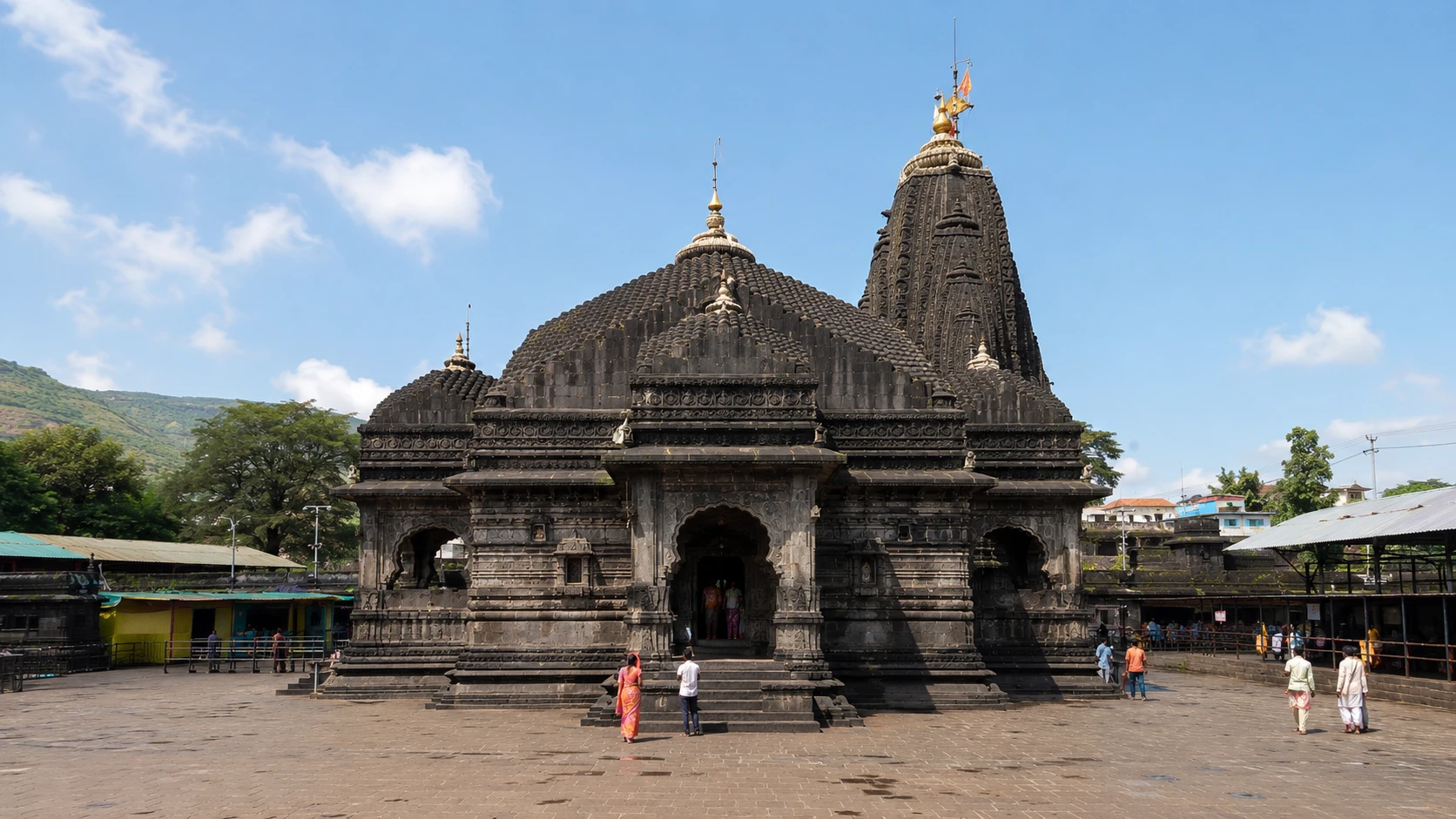
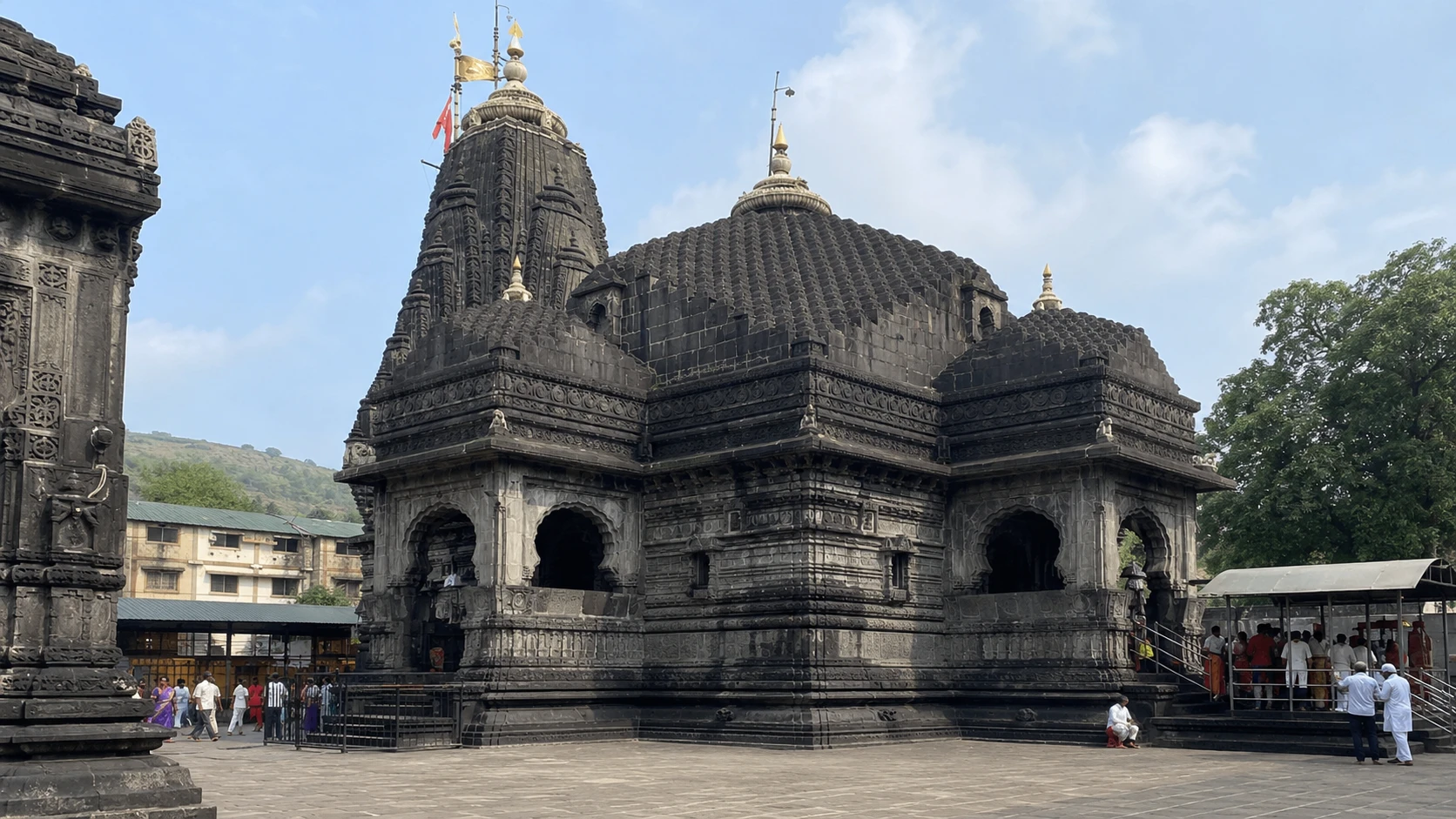
Maratha-period Nagara (North Indian shikhara form) in black basalt, with elaborate Peshwa-era stone carving on a Hemadpanti substrate
खुला
05:30 – 21:00
आरती
05:30 · 07:00 · 12:00 · 16:30 · 19:30 · 21:00
विशेष
Kakad Aarti at 05:30 with the silver crown placed over the three lingas, the temple's signature daily ritual; specialized seva counters for Kalsarpa Shanti, Narayan Nagbali, and Tripindi Shraddha pujas operate within the temple complex
पवित्र कथा · पवित्र कथा
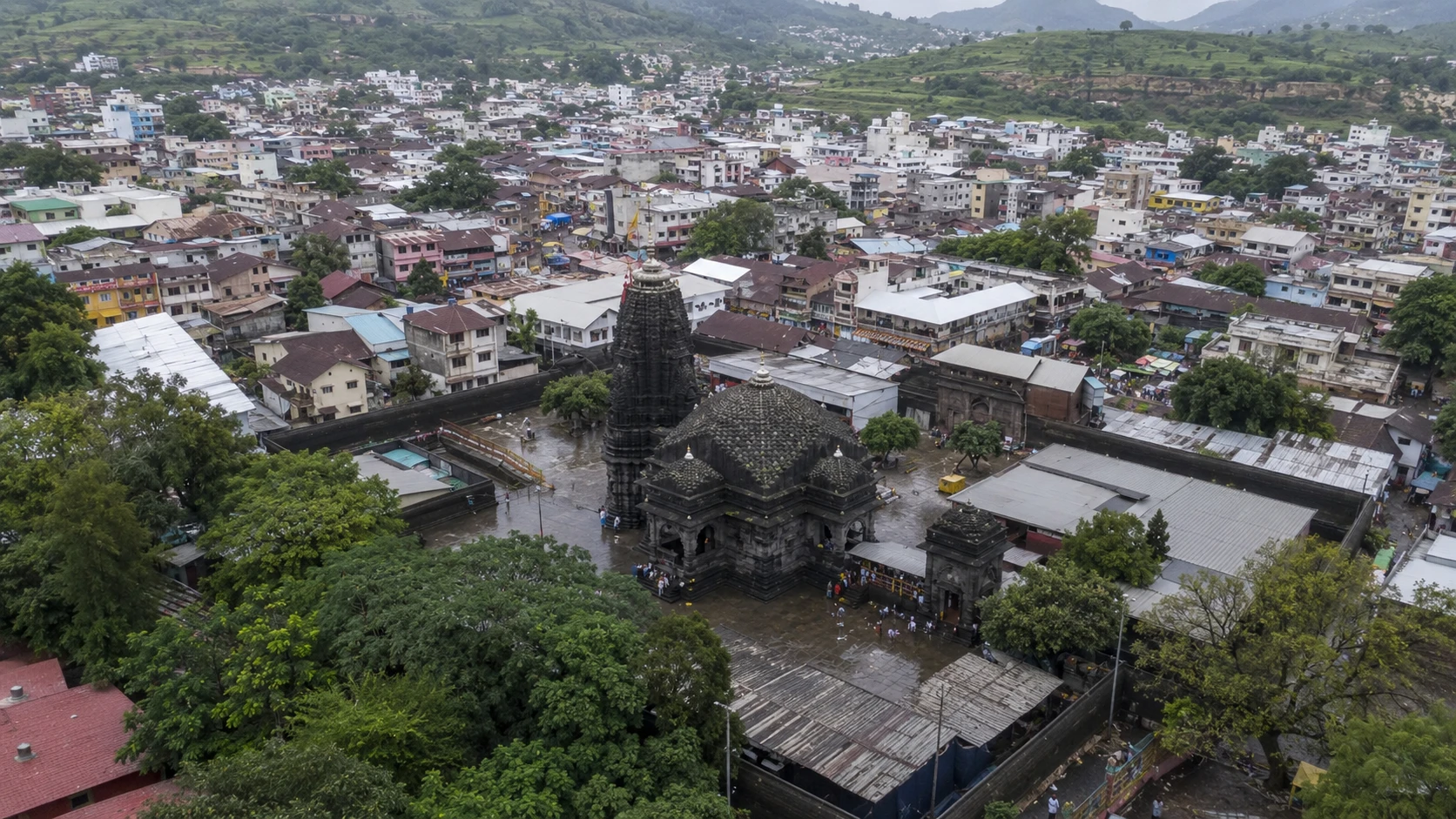
Trimbakeshwar is the eighth Jyotirlinga, set at the foot of Brahmagiri hill in the northern Sahyadri at the source of the Godavari, the river that pilgrims have called the Ganga of the Deccan since the time of the Skanda Purana. The Jyotirlinga marks the place where, by Puranic tradition, Lord Shiva summoned the Ganga to descend to earth as the Godavari at the prayer of the rishi Gautama, washing away a great sin laid upon him by jealous fellow ascetics. Unlike any other Jyotirlinga in India, the lingam here is not a single stone but three small linga-bindus together, Brahma, Vishnu, and Shiva, held in a low silver crown that gives the temple its name (Tryambakeshwar means 'lord of the three eyes'). The present structure was built between 1755 and 1786 by Peshwa Nanasaheb (Balaji Bajirao) and his successor Madhavrao I in elaborate Nagara style of black basalt; once every twelve years, when Jupiter enters Leo, the Sinhastha Kumbh Mela transforms the kshetra into one of the four greatest pilgrimage gatherings in the Hindu world. Trimbakeshwar is also India's most important site for Kalsarpa Shanti, Narayan Nagbali, and Tripindi Shraddha, anti-curse and ancestor rituals for which devotees travel from every part of the country, often as the central reason for the journey rather than darshan alone.
Sacred Designationपवित्र पदनाम
बारह ज्योतिर्लिंगों में 8वें
बारह ज्योतिर्लिंगों में 8th
Sacred Origin Storyपवित्र उत्पत्ति कथा
Source: Skanda Purana (Sahyadri Khanda) and Padma Purana, widely-attested
Long ago, on the slopes of Brahmagiri in the northern Sahyadri, the rishi Gautama lived with his wife Ahalya, both renowned for their austerity and their generosity. Gautama's tapas was so great that, when a twelve-year drought spread across the country and the springs and rivers themselves began to fail, Varuna the lord of waters appeared to him with a boon: a sacred basin (kund) on the hermitage grounds in which water would never fail, and a granary in which rice would never empty, no matter how many came to be fed.
For twelve years Gautama and Ahalya hosted every rishi family within reach. The hermitage filled with the children, the elderly, the widows of those still doing tapas elsewhere; Ahalya cooked without rest; the kund and the granary, by Varuna's boon, never emptied.
When the long drought at last ended and the other rishis prepared to return to their own forest hermitages, several of them could not bear that Gautama would be remembered as the one who had saved the country while they had simply been guests. They conspired together.
By their combined tapasic powers they created a maya-cow, an illusory cow with the appearance of life, and sent her into Gautama's grain-store to graze.
When Gautama saw the cow eating his stored rice, he reached for a blade of darbha grass to gently shoo her away, for the cow is sacred, and a rishi may not strike one. But the cow, by the conspirators' contrivance, fell dead at the touch of the grass.
The other rishis came running and accused Gautama of go-hatya, the killing of a cow, the gravest sin in Brahmanic tradition. They demanded he be exiled from the rishi community. They refused his food, his water, the sharing of his rituals. Even the Vedas, they said, would no longer accept his recitation while the stain of the cow's blood remained.
Gautama, knowing the cow's death had not been by his hand and yet bound by the appearance of the act, accepted the burden. He climbed Brahmagiri to its summit and performed tapas to Lord Shiva, a tapas more severe than any he had done before. For year after year he stood with arms raised, surviving on air and on the dew that gathered on his eyelashes at dawn.
At last Shiva appeared and offered him a boon.
'Lord,' said Gautama, 'I have committed no sin in spirit, but the world calls me a sinner. Wash me clean. Bring the Ganga down from your matted locks to this hill, that I may bathe in her waters here on earth and be purified.'
Shiva agreed. He shook a single lock of his hair, and the Ganga, who had been at peace in his locks, began to descend. But the Ganga, knowing that to flow on earth was to descend from heaven into a lesser realm, hesitated and tried to retreat.
Shiva, unwilling to coerce her, made a gentle declaration: this Ganga that had come down at Gautama's request would not be the same Ganga as the great northern river. She would be a younger Ganga, a southern Ganga, the Ganga of the Deccan, and she would carry two names: Gautami, after the rishi at whose word she had come, and Godavari, 'cow-saver,' after the cow whose innocent death had brought her down.
She would flow from this hill across the Deccan plain to the eastern sea.
Gautama bathed in the Godavari and was purified. The other rishis, witnessing the descent and recognising the magnitude of what their jealousy had set in motion, came forward in shame and asked his forgiveness, which he gave freely. The conspirators were exposed by their own works.
Then Gautama, Ahalya, and the assembled rishis asked Shiva to remain at the hill where he had brought the Ganga down, for the kshetra had become sanctified beyond the limit of any ordinary site. Shiva agreed. But because he had heard the entire case as a witness, because he had seen Gautama's innocence, the conspirators' guilt, and the cow's true nature all at once, holding the eye of the past, the eye of the present, and the eye of the future open simultaneously, he chose to remain in his three-eyed form: Tryambaka, the lord of the three eyes.
The Jyotirlinga at Trimbakeshwar is consequently not a single stone, like the lingams at the other eleven sites, but three small linga-bindus together, Brahma, Vishnu, and Shiva, the three powers that together had witnessed and adjudicated the case, held now in the inner sanctum as a single object of worship beneath a low silver crown.
The Brahmagiri hill above remains the source of the Godavari, who flows from this place to this day. And the rite that Gautama performed on the summit, extreme tapas to lift a curse falsely laid, is enacted in altered form by every pilgrim who comes to Trimbakeshwar today for Kalsarpa Shanti, Narayan Nagbali, and Tripindi Shraddha: rituals to lift sins one did not commit, to satisfy ancestors one did not know, to wash away the inheritance of curses one did not earn.
उद्धृत स्रोत:
- Skanda Purana, Sahyadri Khanda (Trimbakeshwar Mahatmya section)
- Padma Purana, Uttara Khanda
- Linga Purana, Section on the Twelve Jyotirlingas
- Brahma Purana (Gautami-mahatmya, Chapters 71, 175, the most extensive Puranic treatment of the Godavari source narrative)
विद्वत संदर्भ
Modern scholarship (Diana Eck, 'India: A Sacred Geography', 2012; Anne Feldhaus, 'Connected Places: Region, Pilgrimage, and Geographical Imagination in India', 2003) treats the Trimbakeshwar, Godavari source tradition as among the most architecturally complete examples of the Puranic 'sacred-geographical' imagination, a single site that encodes a river-origin myth, a Jyotirlinga manifestation, a rishi's redemption, and a continuous pilgrimage tradition into one inseparable kshetra. Anne Feldhaus's research on Maharashtra pilgrimage in particular treats Trimbakeshwar as the southern anchor of a Brahmagiri-Pravara-Godavari pilgrimage circuit that mirrors, on a regional Maratha scale, the Ganga-Yamuna-Saraswati confluence at Prayagraj. The temple's distinctive concentration of Kalsarpa Shanti, Narayan Nagbali, and Tripindi Shraddha rituals, drawing pilgrims from across India for these specific rites rather than for general darshan, reflects a continuous priestly transmission whose codified form is preserved in 18th- and 19th-century Marathi paddhati texts, and which finds its mythological warrant in the Gautama-rite of redemption from a sin one did not commit.
Historyइतिहास
Trimbakeshwar's documented history follows the long Maharashtra pattern of an ancient Puranic kshetra whose stable architectural superstructure dates to the Maratha period. The earliest references to the site as a Jyotirlinga and as the source of the Godavari appear in the Skanda Purana's Sahyadri Khanda and in the Brahma Purana's Gautami-mahatmya, both compiled across the early to mid-medieval period.
Hemadpanti-style structural elements visible in the older fabric of the temple complex suggest that a substantial stone shrine existed by the Yadava period (13th, 14th century), in keeping with the regional pattern at Bhimashankar, Aundha Nagnath, and other Maharashtra Shaiva sites of the same era.
The temple's stable modern form, however, dates entirely to the high Maratha period. Between 1755 and 1786, the present structure was commissioned and built under the patronage of two successive Peshwas: Balaji Bajirao (Nanasaheb), who initiated the reconstruction in 1755, and his son Madhavrao I, who completed the work in 1786.
The temple was constructed almost entirely in black basalt, quarried from the surrounding Sahyadri ridges, and was deliberately built to a scale and finish that would establish Trimbakeshwar as a Maratha-era counterweight to the older Mughal-period Maratha temples to the east.
Funding for the reconstruction is widely attributed to the wealth flowing into the Peshwa treasury after the Maratha conquest of Vasai (1739) and subsequent campaigns; this is the same campaign that brought the famous Portuguese bell to Bhimashankar.
The temple's role as the principal Indian site for Kalsarpa Shanti, Narayan Nagbali, and Tripindi Shraddha rituals is preserved in 18th- and 19th-century Marathi paddhati texts (priestly manuals codifying the procedure of each rite).
The continuous transmission of these rites by hereditary priestly lineages at Trimbak, many of whom trace their families back through the Peshwa-era reconstruction, gives the temple a particular institutional density that distinguishes it from most other Jyotirlingas, where general darshan rather than specialized seva is the dominant mode of pilgrimage.
The Sinhastha Kumbh Mela tradition at Nashik, Trimbakeshwar, held once every twelve years when Jupiter enters Leo, is documented in continuous administrative records from the mid-19th century onward, with broad historical antecedents in the regional Sahyadri pilgrimage tradition. The most recent major Sinhastha at Nashik, Trimbak was held in 2015, 2016.
The temple is administered today by the Shri Trimbakeshwar Devasthan Trust under the supervision of the Government of Maharashtra. In April 2016, in a ruling that applied to all Maharashtra temples including the inner sanctum at Trimbakeshwar, the Bombay High Court held that women have an equal right of entry to garbha-griha shrines on grounds of constitutional gender equality; the ruling has been implemented at Trimbakeshwar since then, and the temple now permits both men and women into the inner sanctum subject to identical dress-code and ritual conditions.
Historical Timelineऐतिहासिक कालक्रम
Compilation horizon of the Skanda Purana's Sahyadri Khanda and the Brahma Purana's Gautami-mahatmya, the principal classical texts establishing Trimbakeshwar as both the eighth Jyotirlinga and the source of the Godavari. The Gautama-rishi narrative, the descent of the Ganga as Godavari, and the three-eyed (Tryambaka) form of Shiva are codified together in this period, drawing on still-older oral and ritual traditions of the Sahyadri-Godavari geography.
Puranic compilation horizons are subject to ongoing philological debate; the 7th, 10th century range reflects mainstream scholarly consensus on the relevant textual layers. The Brahma Purana's Gautami-mahatmya in particular (105 chapters) is the most extensive single Puranic treatment of any river-source tradition in Hindu sacred geography.
Hemadpanti-style structural elements visible in the older fabric of the temple complex indicate a substantial stone shrine at Trimbakeshwar by the Yadava period of the Deccan, in keeping with the same architectural tradition that produced the older fabric of Bhimashankar, Aundha Nagnath, and other Maharashtra Shaiva sites of the era. The pre-Maratha shrine pattern is partially recoverable from foundation alignments below the present 18th-century structure.
Peshwa Balaji Bajirao (Nanasaheb), the third Peshwa of the Maratha Empire, commissioned the reconstruction of the Trimbakeshwar temple, replacing the older Hemadpanti structure with a new Nagara-style shrine in black basalt. The reconstruction was undertaken on a substantial scale, with funding drawn from the Peshwa treasury enriched by the Maratha conquest of Vasai (1739) and subsequent campaigns.
Reconstruction of the Trimbakeshwar temple was completed under Peshwa Madhavrao I (the son and successor of Nanasaheb), bringing the present black-basalt Nagara-style structure to its definitive form. The completed temple, with its three shikharas, finely-carved exterior friezes, and surrounding stone halls, represents one of the highest accomplishments of Peshwa-era temple architecture and remains essentially unaltered to the present day.
The Sinhastha Kumbh Mela tradition at Nashik, Trimbakeshwar, held once every twelve years when Jupiter enters Leo (Sinha rashi), is documented in continuous administrative records from this period. While the broader pilgrimage tradition has older Sahyadri antecedents, the codified Kumbh Mela format with formal akhada processions, scheduled royal baths, and state-coordinated pilgrim infrastructure crystallizes in the 19th century. Major Sinhastha gatherings have been recorded approximately every twelve years since.
The Bombay High Court, in a judgment applying to all Maharashtra temples including the inner sanctum at Trimbakeshwar, held that women have an equal constitutional right of entry to garbha-griha shrines that had previously been male-only. The ruling was delivered against the background of a multi-year campaign by women's-rights groups (notably the Bhumata Brigade led by Trupti Desai) and prior administrative resistance. The ruling has been implemented at Trimbakeshwar since 2016, and the temple now permits both men and women into the inner sanctum subject to identical dress-code and ritual conditions.
The 2016 ruling was the conclusion of a multi-year administrative and judicial process; the implementation at Trimbakeshwar specifically followed both the High Court ruling and a temple trust administrative decision. Eternal Raga records the legal outcome and its implementation at the temple without taking a position on the broader devotional and gendered debates that continue around temple entry policies elsewhere in India.
The most recent major Sinhastha Kumbh Mela was held at Nashik, Trimbakeshwar from 14 July 2015 to 11 August 2016. Estimated cumulative attendance across the thirteen-month festival exceeded several tens of millions; the principal royal bath dates (shahi snan) drew the largest single-day pilgrim numbers. The Kumbh transformed the Trimbakeshwar kshetra and the Kushavarta tirtha (the kund where the Godavari is said to first appear above ground) into the focal point of one of the four greatest pilgrimage gatherings in Hindu sacred geography. The next Sinhastha at Nashik, Trimbakeshwar is anticipated approximately twelve years hence, when Jupiter again enters Leo.
What You'll Seeदर्शन में
The Jyotirlinga at Trimbakeshwar is unlike any other in India. Where the eleven other Jyotirlingas are each a single lingam, tall or low, smooth or weathered, but always one, the Trimbakeshwar lingam is three small linga-bindus together: three thumb-sized depressions in a single black basalt base, representing Brahma, Vishnu, and Shiva.
The sanctum is small and set noticeably below the level of the surrounding mandap; pilgrims descend a short flight of stone steps to come into its presence. The three bindus are kept covered for most of the day by a low silver crown (mukut), and the central act of the morning Kakad Aarti at 05:30 is the brief lifting of this crown, when the three lingas are revealed for darshan beneath their continuous water-drip.
That water-drip is itself one of the temple's quiet wonders. From a natural spring high in Brahmagiri above the temple, a narrow channel brings water down through the rock and over the lingam in a slow, unbroken thread.
The water that has touched the three lingas falls into a small kund below the platform, and that kund, by tradition, is the very first emergence of the Godavari above ground. Pilgrims who bathe at the larger Kushavarta tirtha just outside the temple are bathing in the same flow, surfaced two hundred metres on.
The surrounding sanctum walls are carved black basalt, with floral bands and scenes from the Ramayana and Mahabharata picked out in fine relief. The doorway to the garbha-griha is intricately framed, the Peshwa-era stonemasons working in 1755, 1786 took the kshetra's status seriously, treating the sanctum's entry as a threshold deserving of the temple's most concentrated craft.
Above the sanctum rise the temple's three primary shikharas in Maratha-Nagara style, clustered together rather than strung along a single axis, their curvilinear profiles distinct against the basalt mass below. The exterior of the temple bears extensive bas-relief friezes: rows of ganas, mythological narratives, dancing figures, animal motifs, and floral bands worked into the basalt with the precision the Peshwa period demanded of its temple architecture.
The whole structure is dark and substantial, black against the green of the Sahyadri ridge above, and catches the morning sun first along its uppermost stone.
Just outside the main temple complex stands the Kushavarta tirtha, the stepped tank where the Godavari is held to first emerge above ground. The kund is paved in basalt, surrounded by smaller shrines, and is the principal site of pilgrim bathing, both for everyday darshan and, once every twelve years, for the principal royal-bath days of the Sinhastha Kumbh Mela.
Distinctive Practicesविशिष्ट परंपराएँ
Kalsarpa Shanti Puja
कालसर्प शान्ति पूजा
Year-round, by advance booking with authorized temple priests; particularly auspicious on Nag Panchami and Amavasya days
Kalsarpa Yoga is an astrological condition in which all seven main planets in a person's natal chart fall between the lunar nodes Rahu and Ketu, a configuration traditionally held to bring obstacles in marriage, livelihood, and progeny. Trimbakeshwar is the principal site in India for the Kalsarpa Shanti puja, the ritual remediation of this condition. The puja is a single-day ceremony performed by authorized temple priests at designated puja-mandaps within the temple complex; it includes Rudrabhishek of the Trimbakeshwar Jyotirlinga, recitation of the Mahamrityunjaya mantra, abhishekam with Godavari water from the Kushavarta kund, the offering of a silver Naga (snake) figurine, and a final aarti. The ritual typically begins around 09:00 and concludes by mid-afternoon. Devotees travel to Trimbakeshwar from every part of India for this puja, often as the central reason for the journey.
The Kalsarpa Shanti is grounded in the same theological principle as the Gautama-rite that founds the temple: that a burden falsely or unjustly carried, whether laid by jealous rishis, by inherited karma, or by an astrological configuration one did not choose, can be lifted at the kshetra where the Ganga descended specifically to lift such a burden. The ritual reads itself as a present-day enactment of the Skanda Purana's founding promise: that Trimbakeshwar is the place where unjust inheritances are washed away.
Narayan Nagbali
नारायण नागबलि
Year-round; the ritual must be completed across three consecutive days, scheduled by authorized temple priests in advance
Narayan Nagbali is a three-day composite ritual performed only at Trimbakeshwar (and a small number of allied sites) under the supervision of hereditary priestly lineages whose codified procedure is preserved in 18th- and 19th-century Marathi paddhati texts. The first day (Nagbali) addresses any harm, intentional or unintentional, in this life or in past lives, done to snakes, who in Hindu tradition carry both protective and ancestral associations. The second day (Pitrubali) addresses unsatisfied ancestors who may not have received proper post-death rituals. The third day (Narayanbali) addresses the broader karmic burdens carried by the devotee into this life. Together the three days are held to clear the path for life progress that has been blocked by inherited or unrecognized burdens. The ritual is performed at designated kunds and mandaps within the kshetra, and concludes with abhishekam of the Trimbakeshwar Jyotirlinga.
Narayan Nagbali addresses a class of suffering that the standard Hindu metaphysical framework recognises but does not always provide ritual access to: the burdens that come not from one's own actions but from the past lives one cannot remember, or from the actions of ancestors one never knew. Trimbakeshwar's institutional density of priestly lineages who have transmitted the codified procedure across generations makes the temple uniquely able to offer this rite. The pilgrim who completes Narayan Nagbali leaves having ritually settled accounts with portions of the karmic ledger that no other site in India provides equivalent access to.
Kushavarta Snan and Brahmagiri Pradakshina
कुशावर्त स्नान और ब्रह्मगिरि प्रदक्षिणा
Year-round; particularly auspicious on Sinhastha Kumbh days, Maha Shivratri, and Tripurari Pournima
Pilgrims to Trimbakeshwar traditionally bathe at the Kushavarta tirtha, the stepped basalt kund just outside the main temple where the Godavari is held to first emerge above ground, before darshan. Many pilgrims also undertake the Brahmagiri Pradakshina, a circumambulation of the Brahmagiri hill above the temple. The full pradakshina runs approximately 7 kilometres on a marked stone path that climbs partway up the ridge, passes the spring at the actual mountain-top source of the Godavari (the Gangadwar), and circles back through the surrounding shola forest. The walk takes most pilgrims 3, 4 hours; many begin before dawn to complete the circuit by the morning Kakad Aarti at the temple.
The Kushavarta and the Brahmagiri are not separate from the temple but extensions of its theology in geography. The kund is the body of the Godavari at her first emergence; the hill above is the site of Gautama's tapas and Shiva's descent of the Ganga. To bathe at Kushavarta is to bathe in the river at her newest moment; to circumambulate Brahmagiri is to retrace, in the body, the path along which the river was brought down. Together the two practices are the geographical liturgy of the temple, what the lingam encodes in the sanctum, the kund and the hill enact in the landscape.
Kakad Aarti and the Lifting of the Silver Crown
काकड़ आरती और रजत मुकुट का अनावरण
Daily, 05:30 (the first of six daily aartis)
The day's first aarti at Trimbakeshwar takes place at 05:30, performed in the small sanctum by lamplight while it is still dark outside. The defining moment of the ritual is the brief lifting of the silver mukut (crown) that covers the three lingas through most of the day; for a few minutes during the Kakad Aarti, the three bindus are visible to those gathered in the mandap, washed by the continuous water-drip from above and offered first water, bilva, and the kakad (cotton-wick) flame. Then the crown is restored and the lingas are returned to their ordinary covered state for the remainder of the day. Pilgrims who attend the Kakad Aarti often describe the moment of the crown's lifting as the most concentrated darshan of the temple's daily rhythm.
The covered-and-revealed rhythm of the silver crown enacts a theology specific to Trimbakeshwar: the lingam is not simply present, but is held in concealment for most of the day and given to sight only at the dawn ritual. The lifting of the crown at the Kakad Aarti is the daily small re-enactment of the Skanda Purana's founding moment, when Shiva, having heard the case, agreed to remain at the kshetra in his three-eyed form. Each dawn, briefly, that revelation is renewed.
Did You Know?क्या आप जानते हैं?
Trimbakeshwar is the only Jyotirlinga in India where the lingam is not a single stone but three small linga-bindus together, Brahma, Vishnu, and Shiva, held beneath a low silver crown. The three-fold form is the source of the temple's name (Tryambakeshwar means 'lord of the three eyes') and reflects the Skanda Purana's founding narrative, in which Shiva agreed to remain at the kshetra in his three-eyed form after witnessing and judging the case of Gautama rishi.
Skanda Purana, Sahyadri Khanda; Brahma Purana, Gautami-mahatmya; Shri Trimbakeshwar Devasthan Trust ritual records
Trimbakeshwar is the source of the Godavari, the largest river of the Deccan and the second-longest river in India after the Ganga. The Godavari rises from a spring high on Brahmagiri hill above the temple, surfaces above ground at the Kushavarta tirtha just outside the main shrine, and flows for approximately 1,465 km eastward across Maharashtra, Telangana, and Andhra Pradesh before reaching the Bay of Bengal. Of the twelve Jyotirlingas, Bhimashankar (source of the Bhima) and Trimbakeshwar (source of the Godavari) are the only two that are river-source temples, both in Maharashtra's Sahyadri ridges.
Central Water Commission, Godavari Basin reports; Maharashtra State Gazetteer, Nashik District
Trimbakeshwar is India's principal pilgrimage destination for three specific anti-curse and ancestor rituals: Kalsarpa Shanti (for Kalsarpa Yoga in the natal chart), Narayan Nagbali (a three-day ritual addressing inherited karmic burdens), and Tripindi Shraddha (for satisfying three generations of unsatisfied ancestors). Devotees travel to Trimbakeshwar from every part of India for these specific rites, often as the central reason for their journey rather than for general darshan, making the temple unique among Jyotirlingas in being primarily a destination for ritual remediation rather than for darshan-tourism.
Shri Trimbakeshwar Devasthan Trust ritual records; 18th- and 19th-century Marathi paddhati texts
Nashik, Trimbakeshwar is one of four sites that host the Sinhastha Kumbh Mela, held once every twelve years when Jupiter enters Leo (Sinha rashi). The other three Kumbh sites are Haridwar, Prayagraj, and Ujjain. Of the four, Nashik, Trimbakeshwar shares its astrological timing with Ujjain (both held when Jupiter is in Leo), distinguishing them from the Haridwar Kumbh (Jupiter in Aquarius) and the Prayagraj Kumbh (Jupiter in Taurus). The most recent Sinhastha at Trimbakeshwar was 2015, 2016.
Government of Maharashtra Sinhastha Mela Authority records; James M. Lochtefeld, God's Gateway (2010)
The Brahmagiri Pradakshina, a 7-kilometre circumambulation of the Brahmagiri hill above the temple, is one of the temple's most physically demanding pilgrim practices. The marked stone path passes the Gangadwar spring (the actual mountain-top source of the Godavari, distinct from the Kushavarta emergence-point below) and circles back through the surrounding shola forest. The full circuit takes 3, 4 hours and is undertaken both as devotional act and as pilgrim austerity (kayaklesh), particularly common during Maha Shivratri and Tripurari Pournima.
Maharashtra State Tourism documentation; Trimbakeshwar Devasthan Trust pilgrim guidance materials
In April 2016, the Bombay High Court ruled that women have an equal constitutional right of entry into the inner sanctums (garbha-griha) of all Maharashtra temples, including Trimbakeshwar, overturning a previous male-only entry tradition. The ruling was the conclusion of a multi-year campaign led primarily by the Bhumata Brigade under Trupti Desai. The temple has implemented gender-equal sanctum access since 2016.
Bombay High Court judgment, April 2016; Maharashtra Hindu Places of Worship (Entry Authorisation) Act, 1956
The reconstruction of Trimbakeshwar (1755, 1786) was funded substantially from the wealth flowing into the Peshwa treasury after the Maratha conquest of Vasai in 1739, the same campaign whose spoils brought the famous Portuguese bell to Bhimashankar. Both Jyotirlingas in Maharashtra thus carry, in their physical fabric, traces of the same 18th-century Maratha campaign: Bhimashankar in its bell from a Vasai church, Trimbakeshwar in its black-basalt Nagara superstructure built with Vasai-derived revenues.
Peshwa Daftar correspondence (Pune Archives); G.S. Sardesai, A New History of the Marathas, Vol. II
Visitor Accessप्रवेश जानकारी
Trimbakeshwar welcomes devotees of all backgrounds for darshan. Following the April 2016 Bombay High Court ruling on gender-equal temple entry in Maharashtra, both men and women have equal access to the inner sanctum (garbha-griha) subject to identical dress-code and ritual conditions. Photography is not permitted within the inner sanctum; the outer mandap and exterior may be photographed. Mobile phones must be on silent mode within the temple complex. Pilgrims undertaking specialized rituals (Kalsarpa Shanti, Narayan Nagbali, Tripindi Shraddha) should engage authorized temple priests in advance, the rituals require multi-day commitment and specific scheduling.
Allow at least 1, 2 hours for general darshan during off-peak hours; up to 4, 6 hours during festival days and Shravan Mondays. For Kalsarpa Shanti (single-day ritual): book at least 2, 3 weeks in advance through authorized temple priests. For Narayan Nagbali (three-day ritual) and Tripindi Shraddha: book at least a month in advance and plan accommodation for the full ritual duration. Be cautious of unauthorized priests soliciting outside the temple complex; engage only priests authorized by the Devasthan Trust. Photo ID is recommended for all pilgrim activities. The Brahmagiri Pradakshina trail is best undertaken in dry weather (October, February); monsoon and post-monsoon ascents can be slippery on the basalt path.
Festivalsत्योहार
Maha Shivratri
महाशिवरात्रि
Feb-Mar (Phalgun Krishna Chaturdashi)
The most important festival at any Shiva temple, observed at Trimbakeshwar with all-night vigil (jagaran), continuous abhishekam through the day and night, four prahar pujas at each watch of the night, and special access to the inner sanctum for the central nishitha kala puja at midnight. Many devotees combine Maha Shivratri at Trimbakeshwar with the Brahmagiri Pradakshina, undertaking the 7-km circumambulation in the cooler pre-dawn hours and returning to the temple for the late-night vigil. The temple opens earlier and stays open later than usual; pilgrim infrastructure outside the village is significantly expanded for the festival.
Tripurari Pournima
त्रिपुरारी पूर्णिमा
Nov (Kartik Shukla Purnima)
Tripurari Pournima at Trimbakeshwar is observed with deepamala (lamp-lighting) on every step of the temple's stone approach, on the kund-walls of the Kushavarta tirtha, and along the Brahmagiri Pradakshina path. The lit-up temple seen from across the surrounding ridge is among the most distinctive devotional images of the Sahyadri Jyotirlinga calendar, an effect Trimbakeshwar shares with Bhimashankar, the other Maharashtra Jyotirlinga. The full moon also draws additional pilgrims for the Brahmagiri Pradakshina through the night.
Shravan Month and Shravan Somvars
श्रावण मास और श्रावण सोमवार
Jul-Aug (Shravan)
The entire month of Shravan brings substantial pilgrim flow to Trimbakeshwar, with each Monday (Shravan Somvar) drawing the largest crowds. Continuous abhishekam runs through the day on Shravan Mondays; the temple opens earlier and stays open later. Many devotees combine Shravan Bhimashankar yatra with Trimbakeshwar, the two Maharashtra Jyotirlingas often visited together as a 'twin source' pilgrimage during this month, since both temples are river-source sites.
Sinhastha Kumbh Mela
सिंहस्थ कुम्भ मेला
Once every twelve years (when Jupiter enters Leo / Sinha rashi); typically spans 13 months
Once every twelve years, when Jupiter enters Leo, Nashik, Trimbakeshwar hosts the Sinhastha Kumbh Mela, one of the four Kumbh sites that together constitute the largest pilgrimage tradition in the Hindu world. The Kushavarta tirtha at Trimbakeshwar is one of the principal bathing sites of the Mela; akhada processions, scheduled royal-bath days (shahi snan), and pilgrim infrastructure transform the entire kshetra for thirteen months. The most recent Sinhastha at Trimbakeshwar was 2015, 2016; the next is anticipated approximately twelve years thereafter, when Jupiter again enters Leo. Pilgrims should consult the Maharashtra Sinhastha Mela Authority for current dates and arrangements when the next cycle approaches.
Traditional Offeringsपारंपरिक अर्पण
प्राथमिक अर्पण
Bel Patra (Bilva leaves)
बेल पत्र
बिल्व पत्र
The three leaflets of the bilva represent the three eyes of Shiva, the prongs of his trident, and the cosmic functions of creation, preservation, and dissolution. The Shiva Purana states that even a single bilva leaf, offered with devotion, surpasses elaborate rituals. At Trimbakeshwar, the three leaflets carry an additional symbolic resonance: they mirror the temple's three lingas (Brahma, Vishnu, Shiva), so that a single bilva offering encodes the same triadic theology that defines the kshetra itself.
Ganga Jal (Sacred river water)
गंगा जल
गङ्गा जल
Ganges water, or, at Trimbakeshwar, the equivalent water of the Godavari (called the Gautami-Ganga, the Ganga of the Deccan, in the Brahma Purana), is offered for abhishekam at every Shiva temple. The water carries the principle that Shiva himself holds the river in his matted locks. At Trimbakeshwar the practice carries a particular geographical completeness: the water poured onto the lingam is the same water that descends, drop by drop, from the spring above the temple onto the three lingas, and emerges below as the Godavari at her source.
Panchamrit (Five sacred substances)
पंचामृत
पञ्चामृत
The ritual bathing of the lingam with five sacred substances, milk, curd, honey, ghee, and sugar, is performed at all major Shiva temples. Each substance carries symbolic meaning: milk for purity, curd for prosperity, honey for sweet speech, ghee for victory, and sugar for happiness. The five together represent the five elements (panchabhuta) returning to their cosmic source.
Vibhuti (Sacred ash)
विभूति
विभूति
Sacred ash applied to the lingam and to the devotee's forehead. Vibhuti embodies the truth that all material existence eventually returns to ash, a constant reminder of impermanence. The three horizontal lines (tripundra) drawn across the forehead with vibhuti represent the three realms Shiva governs and the three gunas (qualities) of nature; at Trimbakeshwar, the same triad is read as the three powers (Brahma, Vishnu, Shiva) whose witness is held in the temple's three-lingam form.
Dhatura flowers and fruit
धतूरा के फूल और फल
धत्तूर
The trumpet-shaped dhatura flower, despite its toxic nature, is sacred to Shiva. The plant is said to have emerged when Shiva consumed the halahala poison during the churning of the cosmic ocean, the flower represents Shiva's capacity to absorb what is poisonous and transform it into an offering returned to him in worship. The plant grows wild in the Sahyadri ridges around Trimbakeshwar; offerings are typically brought from cultivated gardens rather than the surrounding ridges.
Camphor (Karpur)
कर्पूर
कर्पूर
Camphor is offered during aarti, particularly at the Kakad Aarti of 05:30, when the silver crown is briefly lifted to reveal the three lingas. Camphor is held to be a perfect offering because, when burned, it leaves no residue, embodying the ideal of devotion that surrenders entirely without trace. The clear blue camphor flame held before the briefly-revealed three lingas at Trimbakeshwar is one of the most concentrated images of the temple's daily liturgy.
इस मंदिर की विशेषता
Godavari Jal from the Kushavarta Tirtha
कुशावर्त तीर्थ से गोदावरी जल
Pilgrims to Trimbakeshwar traditionally bathe at the Kushavarta tirtha, the stepped basalt kund just outside the temple where the Godavari first emerges above ground, and carry water from the kund in a small kalash directly to the temple, offering it during darshan as part of the abhishekam. The water is sacred at the moment of its newest manifestation: it has just emerged from Brahmagiri, just become a river, and is offered immediately back to the lord at whose word it descended. The practice is the geographical completion of a single act, and is among the most devotionally weighted offerings any pilgrim can make at this kshetra.
Silver Naga (snake) Figurine for Kalsarpa Shanti
कालसर्प शान्ति हेतु रजत नाग प्रतिमा
Pilgrims undertaking the Kalsarpa Shanti puja, the principal anti-curse ritual for which Trimbakeshwar is famous, traditionally offer a small silver figurine of a Naga (snake) during the ritual. The figurine is held to embody the Rahu-Ketu axis (the lunar nodes that are mythologically the head and tail of a great cosmic serpent), and offering it at the lingam is held to release the constraints of Kalsarpa Yoga in the natal chart. Silver Naga figurines are made by traditional craftsmen in the Trimbak village and are obtained through authorized temple priests as part of the puja arrangement, not from outside vendors.
The Devasthan Trust maintains official offering counters within the temple precinct selling pre-packaged bundles (bilva, flowers, panchamrit, agarbatti, camphor) and prasad. For Kalsarpa Shanti, Narayan Nagbali, and Tripindi Shraddha pujas, all ritual materials including the silver Naga figurines are arranged through the authorized temple priests as part of the puja booking, devotees should not purchase these items separately from outside vendors, as the materials must be ritually prepared as part of the ceremony itself. Devotees are welcome to bring offerings from outside; pilgrims approaching from Nashik commonly carry small kalashes for collecting Kushavarta water.
How to Reachकैसे पहुँचें
Trimbakeshwar lies in the Trimbak taluka of Nashik district, about 28 km west of Nashik city in the northern Sahyadri. The temple is well-connected to Nashik by road; from Nashik, virtually all onward travel is by bus or taxi.
By rail, the principal stations are Nashik Road Junction (39 km from the temple, on the Mumbai, Bhusawal main line, with direct trains from Mumbai, Delhi, Pune, Hyderabad, Bhopal, and most major north and west Indian cities) and Nashik Devlali (38 km, slightly closer for some approaches).
From either station, MSRTC buses, private taxis, and shared cabs run regularly to Trimbak; the journey takes 60, 90 minutes depending on traffic. Pre-paid taxi counters operate at both stations.
By air, the nearest options are Ozar Airport at Nashik (62 km, approximately 2 hours by road) which has limited domestic flights primarily to Mumbai and Delhi; Chhatrapati Shivaji Maharaj International Airport at Mumbai (180 km, 4, 5 hours by road) which is the main international gateway; and Pune International Airport (210 km, 5 hours by road).
Mumbai is the more reliable option for international travelers.
By road, Trimbakeshwar is reached from Nashik via NH-848, a 28-km route that climbs gently into the Sahyadri ridges over the last 10 km. MSRTC buses operate frequent services from Nashik's Mahamarg bus stand to Trimbak (35, 45 minutes); shared and private taxis are the common choice for pilgrims with luggage. From Mumbai, the drive via NH-160 (formerly NH-3) takes 4, 5 hours.
From Pune, NH-60 leads via Nashik in approximately 5 hours.
Many pilgrims combine Trimbakeshwar with Bhimashankar (Maharashtra's other Jyotirlinga, approximately 230 km south, 5, 6 hours by road) to complete the 'twin source' Maharashtra Jyotirlinga circuit. Trimbakeshwar is also frequently combined with Shirdi (the Sai Baba shrine, 90 km east) and the broader Nashik temple circuit including Panchavati and the Sundarnarayan Temple in Nashik city.
Plan Your Visitयात्रा की योजना
🌤 सर्वोत्तम मौसम
October to February is the most rewarding period, temperatures range 12, 28°C, the post-monsoon Sahyadri is at its greenest, and the Brahmagiri Pradakshina path is at its safest. March to May brings warmer weather (25, 35°C) but the temple's elevation keeps conditions bearable. The monsoon (June to September) transforms the surrounding ridges into one of Maharashtra's most dramatic landscapes, but the Brahmagiri trail becomes slippery on basalt, leeches are common, and ghat-road approaches can be fog-bound. For festival visits, Maha Shivratri (Feb-Mar) and Tripurari Pournima (November) are most spiritually charged. For specialized rituals, any month is appropriate but Shravan Mondays should be avoided due to extreme crowding.
👘 पहनावे का नियम
Modest dress is expected. For men, full-length trousers or dhotis with a shirt or kurta; many male devotees enter the sanctum bare-chested with a dhoti, particularly for abhishekam and specialized rituals. For women, sarees, salwar suits, or long skirts with covered shoulders are appropriate; for entry into the inner sanctum (now permitted post-2016), some traditional priests prefer that women wear a saree or traditional Maharashtrian Nauvari sari rather than salwar, confirm dress requirements with the priest before commencing a specialized ritual. A head covering is optional but appreciated. Footwear must be removed well before entering the temple precinct.
📱 फोन और फोटोग्राफी
Mobile phones must be on silent mode within the temple complex. Photography with phones or cameras is not permitted in the inner sanctum; the outer mandap, the temple exterior, and the surrounding precinct (including the Kushavarta tirtha) may be photographed. During Kalsarpa Shanti, Narayan Nagbali, and Tripindi Shraddha rituals, phones should remain in silent or aeroplane mode for the duration of the puja, the rituals require sustained attention and any disruption is considered inauspicious for the rite.
🏨 आवास
Trimbak village offers a range of accommodation suited to the temple's pilgrim base. The Devasthan Trust operates a Bhakt Niwas guesthouse for pilgrims, with priority for those undertaking multi-day rituals (Narayan Nagbali, Tripindi Shraddha), booking is recommended through the trust office in advance. Several mid-range hotels and lodges operate in Trimbak village itself, catering primarily to pilgrim families. The MTDC (Maharashtra Tourism Development Corporation) Holiday Resort at Trimbak offers a small number of rooms. Many pilgrims base themselves in Nashik (28 km, full hotel range from luxury to budget) and undertake Trimbakeshwar as a day or overnight trip. Pilgrims undertaking the three-day Narayan Nagbali ritual should plan accommodation for at least 4 nights to accommodate the full ritual schedule plus arrival and departure days.
Sacred Soundsपवित्र ध्वनि
क्या आप जानते हैं? · Did You Know?
वही अनुवाद त्रुटि जिसने हिन्दू धर्म में '33 कोटि' को '33 करोड़' बनाया, बौद्ध धर्म में भी हुई। बौद्ध ग्रन्थों के चीनी अनुवाद ने 'सप्त कोटि बुद्ध' (7 श्रेष्ठ बुद्ध) का अनुवाद '7 करोड़ बुद्ध' कर दिया। तिब्बती अनुवाद ने सही किया: 7 प्रकार, 7 करोड़ नहीं। एक संस्कृत शब्द, दो प्रमुख विश्व धर्मों में गलत पढ़ा गया, ने दो एकसमान भ्रम स्वतन्त्र रूप से उत्पन्न किए।
Related Contentसंबंधित सामग्री
Related Scriptures
Community Reflections
🕉️
Be the first to share your reflection.