Mallikarjuna
मल्लिकार्जुन
Where Shiva and Parvati came as parents to find their estranged son
Srisailam, Andhra Pradesh, India
MallikārjunaAlso known as: Srisailam Mallikarjuna, Bhramaramba Mallikarjuna, Sri Mallikarjuna Swamy, Srisaila
युग
Origin pre-historic per Puranic tradition; documented temple from the 2nd century BCE onward; Vijayanagara-era expansion (15th century)
वास्तुकला
Vijayanagara with Dravidian influences
खुला
04:30 – 22:00
आरती
05:30 · 06:30 · 12:30 · 18:30 · 21:00
विशेष
Maha Mangala Aarti at 04:30 AM; Kalyanam (divine wedding ritual) at 12:00 noon daily, unique among Jyotirlingas; Pradosha Kala Pooja at 18:30
पवित्र कथा · पवित्र कथा
Mallikarjuna is the only Jyotirlinga where Shiva is worshipped together with Parvati on the same shrine, and the only one of the twelve also counted among the 51 Shakti Peeths. The mountain of Srisailam, rising 1500 feet above the Krishna river gorge in Andhra Pradesh, is where, according to the Skanda Purana, Shiva and Parvati came as worried parents seeking their son Kartikeya after he left Mount Kailash in anger. Today the temple stands as the rare Hindu site where the masculine and feminine principles are not just paired but fused, Mallikarjuna (Shiva) and Bhramaramba (Devi) sharing one consecrated mountain.
Sacred Designationपवित्र पदनाम
बारह ज्योतिर्लिंगों में 2वें
बारह ज्योतिर्लिंगों में 2nd
Shakti Peeth
शरीर का अंग: Upper lip / neck
शक्ति: Bhramaramba
भैरव: Mallikarjuna
Sacred Origin Storyपवित्र उत्पत्ति कथा
Source: Skanda Purana (Srisaila Khanda), the temple has its own dedicated khanda (section) within the Skanda Purana, an honor accorded to few sites
After Ganesha was wed before him, Kartikeya, the elder warrior son of Shiva and Parvati, left Mount Kailash in anger. The Skanda Purana tells that Kartikeya had been promised that whoever circled the universe first would be married first. Ganesha, in his cleverness, had circumambulated his parents instead, declaring them his universe, and won the contest.
Kartikeya, feeling slighted, departed Kailash and travelled south, finally settling on a mountain in the Deccan called Krauncha (now Srisailam).
Shiva and Parvati, distraught at their son's absence, descended from Kailash to find him. They came to the mountain where Kartikeya had taken residence. But Kartikeya, still in his sulk, would not face them directly, he moved further away each time they approached.
So Shiva and Parvati installed themselves on the mountain, in a Jyotirlinga form, so they could remain near their son even when he refused to come close. They have been there ever since.
This is the unique theological premise of Srisailam: Shiva manifested here not as the cosmic destroyer or the meditating ascetic, but as a parent, a parent who positioned himself at his estranged child's doorstep and waited. Devotees who circumambulate the Mallikarjuna lingam are said to receive the love of Shiva-as-parent rather than Shiva-as-deity.
A second tradition layered onto this: at the same site, a princess named Chandravati was meditating on Shiva. She offered him jasmine flowers (mallika) every day. Pleased by her devotion, Shiva manifested in the lingam form she had been worshipping, and the lingam was named 'Mallikarjuna', Arjuna (white, brilliant) of the Mallika (jasmine) flowers.
The two narratives, the parental visit and the jasmine devotion, coexist in the temple's mythology.
The Bhramaramba Shakti Peeth shares the mountain. According to the Devi Bhagavata, Parvati took the form of Bhramari ('she who is bees') to defeat the demon Arunasura. After the demon's death, the form remained at this site as Bhramaramba.
The body part of Sati that fell here, by the Shakti Peeth tradition, is said to be the upper lip or neck (sources vary), with Devi installed as Bhramaramba and her companion Bhairava installed as Mallikarjuna himself, fusing the Jyotirlinga and Shakti Peeth into a single consecrated mountain.
उद्धृत स्रोत:
- Skanda Purana, Srisaila Khanda (the entire khanda is dedicated to this temple, over 70 chapters)
- Shiva Purana, Koti Rudra Samhita (general Jyotirlinga origin)
- Devi Bhagavata Purana (Bhramaramba narrative and Shakti Peeth lineage)
- Lalita Sahasranama and Soundarya Lahari (Devi traditions at Srisailam)
विद्वत संदर्भ
Modern scholarship (Diana Eck, 'India: A Sacred Geography', 2012; Sanjukta Gupta and Richard Gombrich on Tantric Hinduism) emphasizes Srisailam's distinctive theological position: it is among the very few Hindu sites where Shaiva (Mallikarjuna) and Shakta (Bhramaramba) traditions are not merely co-located but ritually integrated. Adi Shankaracharya is said to have composed his 'Sivananda Lahari' here, and the temple was a major Shakta-Shaiva tantric center from the 7th century onward. The 'Mallikarjuna' name appears in inscriptions as early as the 2nd century BCE.
Historyइतिहास
Mallikarjuna's documented history extends further back than perhaps any other Jyotirlinga. Inscriptions from the 2nd century BCE, during the Satavahana dynasty, already reference the temple as an established religious site, suggesting active worship for at least 2,200 years.
The temple was patronized by successive dynasties of southern India: the Ikshvakus, the Pallavas, the Chalukyas of Badami, the Rashtrakutas, the Kakatiyas, and most prominently the Vijayanagara emperors.
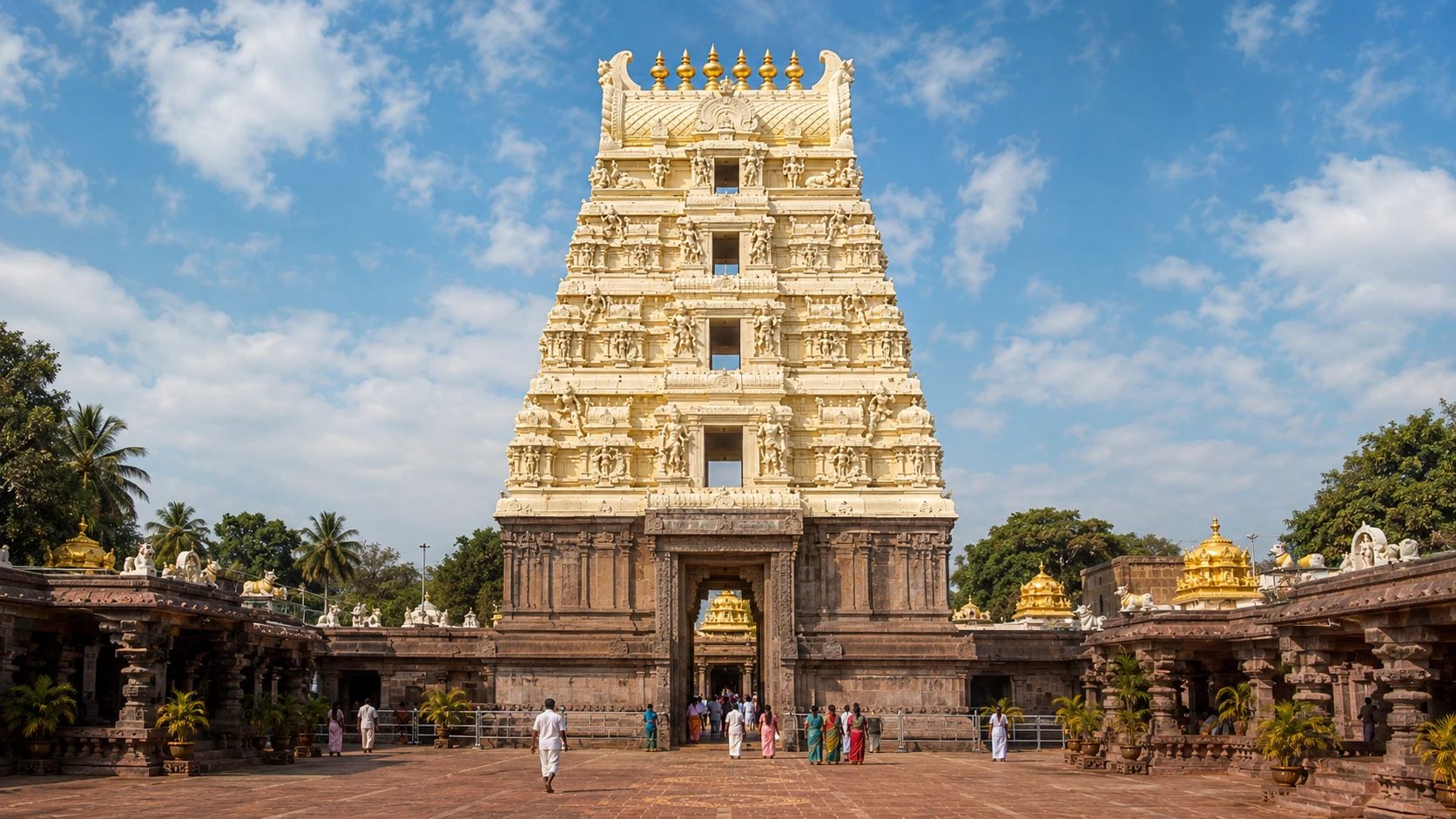
The Vijayanagara period (14th-16th centuries) was Mallikarjuna's golden age. Emperor Krishnadevaraya (r. 1509-1529) made multiple pilgrimages here and personally funded the temple's massive eastern gopuram, the spectacular Mukhamantapa (front pavilion), and the temple's outer walls. His inscription survives at the temple.
The kalyanam (divine wedding) ritual that is performed daily at noon was institutionalized in this period, formalizing the unique parental-Shiva theme of the temple's worship.
Srisailam's relative remoteness, deep in the Nallamala forest, accessible only by difficult mountain paths until the 20th century, protected it from many of the destructions that other Jyotirlingas suffered. Unlike Somnath, Kashi, or Mahakaleshwar, Mallikarjuna was never demolished by an invader's army; the steep gorge of the Krishna river and the dense forest provided natural protection.
The modern history of Srisailam was transformed by the 1980s construction of the Srisailam Dam on the Krishna river, which submerged the original village of Srisailam at the foot of the mountain. The temple itself, atop the mountain, was unaffected, but the surrounding pilgrim infrastructure was rebuilt at higher elevations.
The current Srisailam Devasthanam (temple administration) was constituted under the Andhra Pradesh Charitable and Hindu Religious Institutions and Endowments Act, and manages the temple, the Bhramaramba shrine, the surrounding forest pilgrim trails, and the temple's substantial agricultural lands.
Historical Timelineऐतिहासिक कालक्रम
Earliest documented inscription referencing the temple, from the Satavahana dynasty period. The temple is already described as an established religious site, indicating significantly older origins.
Adi Shankaracharya is said to have visited Srisailam and composed the 'Sivananda Lahari' here, a 100-verse hymn to Shiva that remains one of the most-recited devotional texts in Shaiva tradition.
The dating of Adi Shankaracharya's life is itself contested in scholarship (traditional dates 788-820 CE; some modern dates earlier). The composition of 'Sivananda Lahari' at Srisailam is hagiographic tradition rather than independently verified historical fact, but the text is undisputed and the Srisailam association is consistent across all Shankara biographies.
Major expansion under the Western Chalukyas. The temple's main mandapa structure dates from this period.
Vijayanagara empire patronage transforms Mallikarjuna into one of the most magnificent temple complexes in southern India. Multiple Vijayanagara emperors visit and fund construction.
Emperor Krishnadevaraya of Vijayanagara visits Srisailam, undertakes major construction including the eastern gopuram and the Mukhamantapa. His extensive inscription documenting the visit and donations survives at the temple.
After the Battle of Talikota and the fall of Vijayanagara, the temple's patronage continued under the successor Nayaka and Reddy dynasties. The temple's remoteness shielded it from the post-Vijayanagara political collapse.
Construction of the Srisailam Dam on the Krishna river. The original Srisailam village at the foot of the mountain was submerged; pilgrim accommodation and access infrastructure was rebuilt at higher elevations. The temple itself, atop the mountain, was unaffected.
The Srisailam temple complex underwent its most significant modern renovation since the Vijayanagara era. The Andhra Pradesh government allocated substantial funds for infrastructure modernization, queue management systems, and accommodation upgrades.
What You'll Seeदर्शन में
The Mallikarjuna lingam in the inner sanctum is a self-manifested (swayambhu) Shivling. Unlike Somnath's installed lingam or Kedarnath's bull-hump shape, Mallikarjuna's is described as a smooth, naturally-formed cylindrical stone, believed by the tradition to have emerged from the mountain itself.
The lingam is bathed daily in milk, water, and honey, and adorned with abundant jasmine flowers (mallika), the flower from which the deity takes his name.
The Bhramaramba shrine is on a separate hillock connected to the main temple by a covered walkway. The Bhramaramba murti is a fierce form of Devi, portrayed as crowned with bees, the literal meaning of her name (Bhramara = bee, Amba = mother). The bees commemorate Devi's defeat of the demon Arunasura by taking the form of a swarm.
Devotees often complete darshan at both shrines as a single integrated pilgrimage.
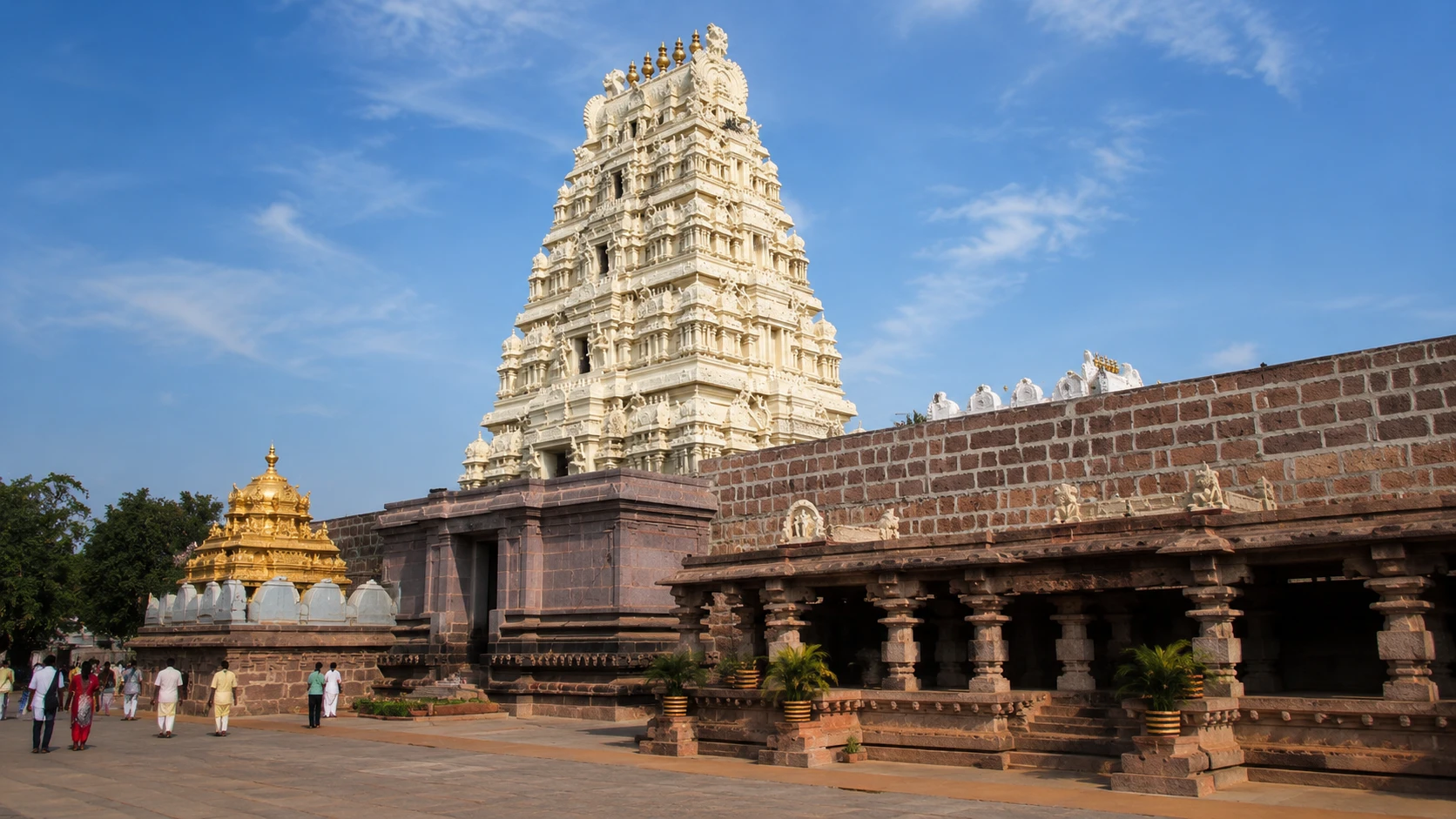
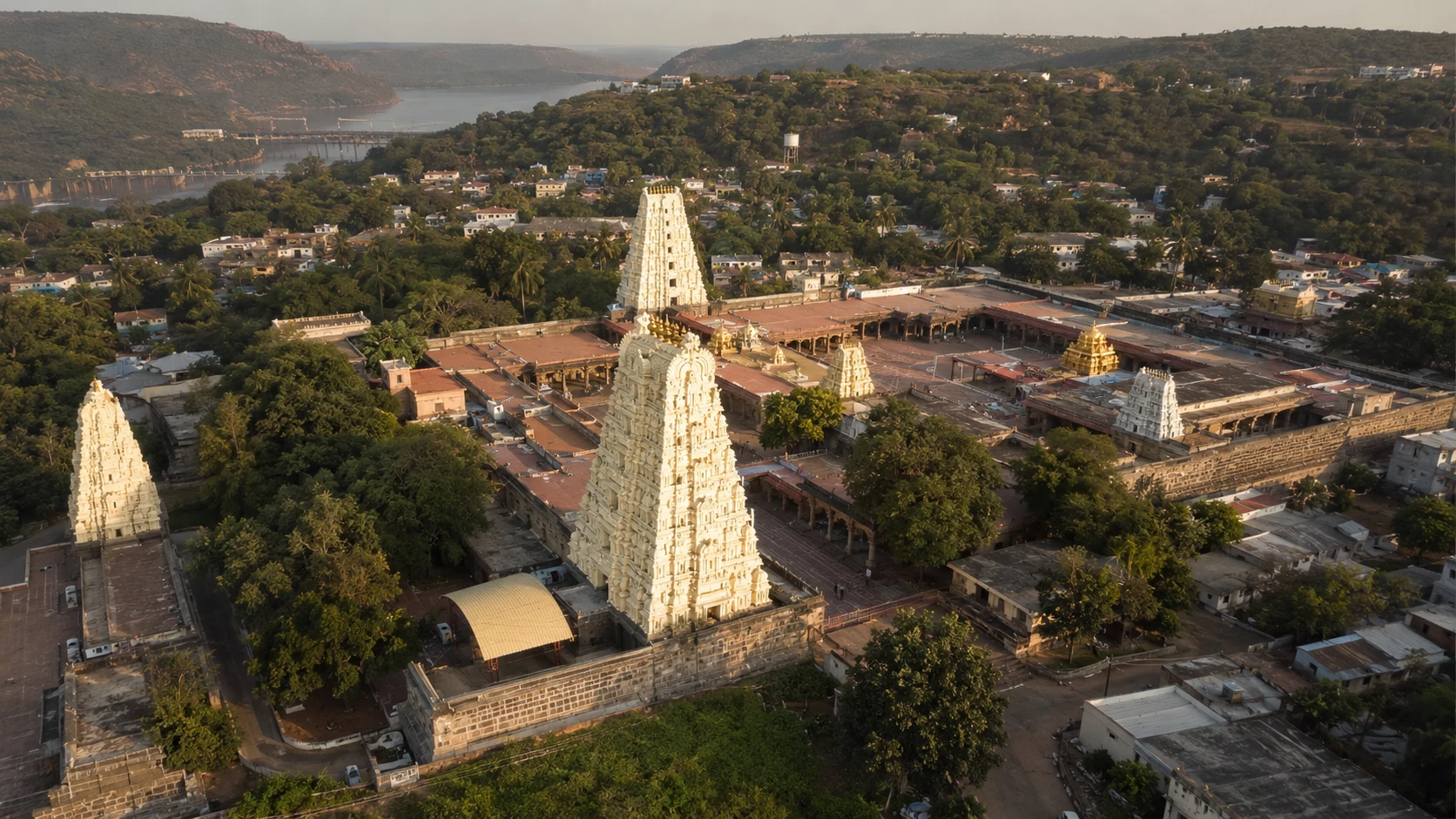
The temple complex is one of the largest in southern India. The eastern gopuram, built by Krishnadevaraya, rises in five tiers and is intricately sculpted. The outer walls of the temple bear thousands of detailed sculptures, depictions from the Ramayana, the Mahabharata, the Bhagavata Purana, and scenes of court life from the Vijayanagara period.
The Mukhamantapa (front pavilion) features the famous 'thousand-pillar' style that Vijayanagara architects favored, though the actual count is closer to 100 large pillars.
The Sahasralinga (thousand-lingam stone), located within the complex, contains a thousand small lingams carved on a single rock face, each representing a different aspect of Shiva. Pilgrims circumambulate this rock as part of the extended darshan.
Distinctive Practicesविशिष्ट परंपराएँ
Daily Kalyanam (Divine Wedding Ritual)
दैनिक कल्याणम् (दिव्य विवाह अनुष्ठान)
Daily, 12:00 noon
Mallikarjuna is the only Jyotirlinga where a daily kalyanam, the ritual marriage of Shiva and Parvati, is performed. The ceremony is conducted in the Kalyana Mandapa, with priests reciting the wedding mantras as if the divine couple were marrying for the first time. Devotees, especially newlyweds and those seeking spouses, attend in large numbers. The ritual is a daily renewal of the cosmic union of Shiva and Shakti.
The kalyanam embodies the unique theological premise of Srisailam: that Shiva manifested here not as the solitary ascetic but as a householder, a parent, a married deity. The daily reenactment is a continuous affirmation that the householder path, grihastha, is itself a path to liberation, not a barrier to it. For couples, attending the kalyanam is said to bless the marriage; for unmarried devotees, it is said to remove obstacles to finding a partner.
Pradakshina Through the Srisailam Forest
श्रीशैलम वन में प्रदक्षिणा
Year-round; especially during Maha Shivratri
Beyond the temple's inner pradakshina (circumambulation), serious pilgrims undertake the Srisailam Pradakshina, a 60-kilometer circumambulation of the entire mountain through the Nallamala forest, taking 5-7 days on foot. The route passes through eight sacred sites including the Hatakeshwaram lingam, the Sakshi Ganapati shrine, and several caves where saints have meditated. The trek is physically demanding and traverses tiger-reserve territory; pilgrims register with forest rangers and travel in groups.
The Srisailam Pradakshina is one of the most demanding pilgrimage circumambulations in Hindu tradition. The forest setting, wild, dense, populated with predators, recalls the original conditions in which Kartikeya is said to have retreated. Pilgrims walking the route are symbolically following the path Shiva and Parvati took to find their estranged son. The physical austerity is the offering.
Joint Darshan of Mallikarjuna and Bhramaramba
मल्लिकार्जुन और भ्रमरांबा का संयुक्त दर्शन
Always, completing both shrines is the standard pilgrimage at Srisailam
The accepted pilgrimage practice at Srisailam is to complete darshan at both the Mallikarjuna lingam and the Bhramaramba shrine in a single visit. The two shrines are connected by a covered walkway approximately 200 meters long. Some pilgrims begin at Mallikarjuna and end at Bhramaramba; others reverse the order. The integrated darshan is what makes Srisailam unique, at no other Jyotirlinga does the pilgrim also complete a Shakti Peeth darshan as part of the same temple visit.
The integrated Shaiva-Shakta darshan embodies the theological union of Shiva and Shakti, the recognition that masculine and feminine principles are not separate cosmic forces but two aspects of a single ultimate reality. Tantric tradition holds that worship of Shiva alone, without Shakti, is incomplete; Srisailam is the rare site where this teaching is institutionalized in the temple structure itself.
Did You Know?क्या आप जानते हैं?
Mallikarjuna is the only Hindu temple where both a Jyotirlinga (one of the 12 most sacred Shiva sites) and a Shakti Peeth (one of the 51 most sacred Devi sites) coexist on the same consecrated mountain. No other site in India, or anywhere else, holds this dual canonical status.
Skanda Purana Srisaila Khanda; Devi Bhagavata Shakti Peeth tradition; Diana Eck, 'India: A Sacred Geography' (2012)
Srisailam has the longest documented history of any Jyotirlinga. Inscriptions from the 2nd century BCE, over 2,200 years ago, already reference an established temple here, predating Somnath's documented record by approximately 800 years.
Archaeological Survey of India inscription catalogues; Epigraphia Indica
Adi Shankaracharya is said to have composed the 'Sivananda Lahari', a 100-verse devotional masterwork, at Srisailam in the 7th century. The text remains one of the most-recited Shaiva devotional compositions in India today.
Sivananda Lahari Sanskrit text; Sankara-Digvijaya by Madhava-Vidyaranya
Mallikarjuna is one of the very few major Hindu temples that was never destroyed by an invader. Its location deep within the Nallamala forest, accessible only by mountain paths until the 20th century, provided natural protection that other Jyotirlingas like Somnath, Kashi, and Mahakaleshwar did not have.
Comparative analysis of Jyotirlinga destruction records; Romila Thapar, 'Somanatha' (2004) for comparative context
Krishnadevaraya, the Vijayanagara emperor (r. 1509-1529), visited Srisailam multiple times, an unusual frequency for an emperor whose realm extended from Goa to Tirupati. His personal devotion is preserved in inscriptions at the temple, including verses he is said to have composed in praise of Mallikarjuna.
Krishnadevaraya's Srisailam inscription; Burton Stein, 'Vijayanagara' (1989)
The temple is located within an active tiger reserve. The Srisailam Tiger Reserve, established in 1983, surrounds the temple complex. Pilgrims undertaking the 60-kilometer mountain pradakshina occasionally encounter tigers, leopards, and Indian sloth bears; forest department escorts are mandatory for the deeper sections of the route.
Andhra Pradesh Forest Department records; Wildlife Institute of India tiger reserve documentation
The Mallikarjuna lingam is one of the few Jyotirlingas worshipped not in the orthodox North Indian style but with strong Tantric and Vama-marga (left-hand path) traditions. The Bhramaramba shrine specifically is one of the most important Tantric Devi sites in India, alongside Kamakhya.
Sanjukta Gupta, 'Tantric Hinduism'; Devi Bhagavata Purana
Visitor Accessप्रवेश जानकारी
Mallikarjuna welcomes devotees of all backgrounds for darshan at both the Jyotirlinga and the Bhramaramba shrine. There are no entry restrictions based on gender, age, or origin. Photography is permitted in the outer halls and grounds but not in the inner sanctum of either shrine. The temple complex is large; allow 3-4 hours minimum for a complete darshan including both shrines and the Sahasralinga.
Sheegra Darshan (priority queue) is available for INR 100-300 depending on the day. Special abhishekam tickets must be booked through the Srisailam Devasthanam at least one day in advance. Photo ID is mandatory for all bookings. The temple complex includes the main Mallikarjuna shrine, the Bhramaramba shrine, the Sahasralinga, the Hatakeshwaram lingam, and the Sakshi Ganapati shrine, pilgrims often need a full day for a thorough darshan.
Festivalsत्योहार
Maha Shivratri
महाशिवरात्रि
Feb-Mar (Phalgun Krishna Chaturdashi)
Maha Shivratri at Srisailam is among the largest Shivratri observances in India. The Brahmotsavams, a 10-day festival surrounding Shivratri, features daily processions of Mallikarjuna and Bhramaramba in elaborate ceremonial vehicles. The kalyanam ritual is performed with extra elaboration on Shivratri day. Pilgrim numbers exceed 500,000 over the festival period; the Devasthanam opens additional accommodation and increases temple operating hours to 03:00, 01:00.
Ugadi (Telugu New Year)
उगादी
Mar-Apr (Chaitra Shukla Pratipada)
As Srisailam is in Andhra Pradesh and is a major Telugu pilgrimage center, Ugadi is celebrated with particular significance. The Panchanga Sravanam, recitation of the new year's astrological calendar, is held in the Mukhamantapa, traditionally drawing large crowds.
Kumbhabhishekam (Periodic Re-consecration)
कुम्भाभिषेकम्
Held every 12 years
The temple's periodic re-consecration ritual, performed every 12 years, is one of the largest Hindu ceremonial events in southern India. Sacred waters from numerous rivers (Ganga, Yamuna, Saraswati, Krishna, Godavari, Kaveri) are brought to Srisailam in golden kalashas and used to re-consecrate the lingam. The most recent kumbhabhishekam was held in 2014.
Karthika Masam
कार्तिक मास
Oct-Nov (Kartik)
The entire month of Karthika is considered exceptionally auspicious at Srisailam. The lingam receives daily abhishekam with sacred substances throughout the month, and the temple grounds are illuminated with thousands of oil lamps each evening. Many devotees undertake the 60-kilometer Srisailam Pradakshina specifically during this month.
Traditional Offeringsपारंपरिक अर्पण
प्राथमिक अर्पण
Mallika (Jasmine flowers)
चमेली के फूल
मल्लिका
Jasmine is the signature offering at Mallikarjuna, the deity literally takes his name from this flower. Tradition holds that Princess Chandravati's jasmine offerings were what first drew Shiva to manifest in the lingam form. The white jasmine represents purity of devotion; the fragrance is said to be Shiva's favorite. Devotees often bring large garlands of jasmine to drape over the lingam.
Bel Patra (Bilva leaves)
बेल पत्र
बिल्व पत्र
The three leaflets of the bilva tree represent the three eyes of Shiva, the trident he wields, and the cosmic functions of creation, preservation, and dissolution. At Mallikarjuna, bilva leaves are offered in pairs with jasmine flowers, the dual offering symbolizes the integration of male and female devotional principles that defines this temple.
Panchamrit (Five sacred substances)
पंचामृत
पञ्चामृत
The ritual bathing of the lingam with five sacred substances, milk, curd, honey, ghee, and sugar. At Srisailam, the panchamrit abhishekam is particularly elaborate and can be sponsored by pilgrims as a special seva. The five substances each have symbolic meaning: milk for purity, curd for prosperity, honey for sweet speech, ghee for victory, and sugar for happiness.
Vibhuti (Sacred ash) and Kumkum
विभूति और कुमकुम
विभूति, कुङ्कुम
Sacred ash is offered to Mallikarjuna; kumkum (vermilion) is offered to Bhramaramba. The pairing reflects the Shaiva-Shakta integration: ash represents Shiva's renunciate aspect (the cremation ash of the universe), while kumkum represents Shakti's vital, creative power. Devotees often apply both, vibhuti to the forehead in three horizontal lines, and kumkum at the center between the eyebrows.
Coconut
नारियल
नारिकेल
Coconut is a standard offering at all major southern Indian Shiva temples, including Mallikarjuna. The coconut symbolizes the human ego, which must be broken before Shiva for spiritual progress. At the Srisailam complex, coconuts are typically broken at the Sakshi Ganapati shrine before the main darshan, ensuring obstacle-free worship.
Honey (special at Bhramaramba shrine)
शहद (भ्रमरांबा मंदिर पर विशेष)
मधु
Honey holds special significance at the Bhramaramba shrine because the goddess took the form of a swarm of bees (bhramara) to defeat the demon Arunasura. Devotees offer honey at her shrine in remembrance of this victory. The honey is consecrated and returned to devotees as prasad, one of the few temples where honey forms the principal prasad.
इस मंदिर की विशेषता
Naga Pratima (Serpent figure offering)
नाग प्रतिमा
Specific to Srisailam, devotees seeking relief from sarpa dosha (serpent-related astrological afflictions, including delays in marriage, childbirth difficulties, and inherited family issues) offer small silver or stone serpent figures at the Mallikarjuna shrine. The naga is associated with Shiva, he wears Vasuki around his neck, and these offerings are believed to invoke his protection from naga-related karmic burdens.
Wedding Trousseau Items at the Kalyanam
कल्याणम् पर विवाह के सामान
Couples seeking blessings for marriage (their own or a family member's) often bring wedding-related offerings to the daily kalyanam ritual: bangles, kumkum boxes, mangalsutra, sarees, or small gifts that would be exchanged in a traditional wedding. The priests include these in the kalyanam ceremony as if the items were being given to the divine bride and groom themselves. The items are then returned to the devotee as blessed prasad.
Devotees may bring offerings from outside, though the Srisailam Devasthanam maintains official counters within the complex selling pre-packaged offering bundles, naga pratimas of various metals, jasmine garlands prepared each morning, and ritual prasad. The Devasthanam strongly prefers natural flowers (especially jasmine) over synthetic offerings. Live bees are not offered (despite the Bhramara connection); only honey representing them.
How to Reachकैसे पहुँचें
Srisailam is in the Nallamala hills of Andhra Pradesh, deep within the Srisailam Tiger Reserve. Reaching it requires more planning than most Jyotirlingas due to its remote location.
The nearest airport is Hyderabad Rajiv Gandhi International (213 km, ~5 hour drive), followed by Vijayawada (270 km, ~6 hour drive) and Tirupati (340 km, ~8 hour drive). Hyderabad is the standard entry point, both for international flights and for the most direct road approach via NH-765.
There is no direct railway station at Srisailam. The closest stations are Markapur Road (85 km) and Cumbum (75 km), both with limited train connectivity. Most pilgrims combine train travel to Hyderabad or Kurnool with road travel for the final leg.
The road from Hyderabad to Srisailam (NH-765) is well-paved but climbs steadily through the Nallamala hills. The final 30 km approach passes through the Srisailam Tiger Reserve forest area, a scenic but slow drive, with several speed checkpoints.
Andhra Pradesh State Road Transport Corporation (APSRTC) operates regular buses from Hyderabad, Kurnool, Vijayawada, and other major cities. Express APSRTC buses make the Hyderabad-Srisailam journey in about 6 hours.
Many pilgrims combine Srisailam with a visit to Tirupati (340 km southeast) or with Mantralayam (the Datta Sampradaya temple, 200 km away). The Krishna river cruise from the Srisailam Dam, while not religiously required, offers a memorable approach to the region.
Plan Your Visitयात्रा की योजना
🌤 सर्वोत्तम मौसम
October to March is most comfortable, temperatures range from 15-30°C and the Nallamala forest is at its most scenic. Avoid April-June (35-42°C, dry heat) and July-September (heavy monsoon makes the mountain roads challenging). Maha Shivratri (Feb-Mar) is the most spiritually charged time but expect crowds exceeding 500,000 over the 10-day Brahmotsavams. Karthika Masam (Oct-Nov) offers a balance of pleasant weather and devotional intensity without the Shivratri crowd density.
👘 पहनावे का नियम
Modest dress is required for entry to both shrines. For men, full-length trousers or dhotis with sleeved shirts. For women, sarees, salwar suits, or long skirts with covered shoulders. Male devotees are typically asked to remove their upper garment when approaching the inner sanctum for abhishekam, this is traditional in many southern Indian temples and not unique to Srisailam. Footwear must be left at designated stands; the temple complex is extensive, so socks are recommended.
📱 फोन और फोटोग्राफी
Mobile phones must be on silent inside the temple complex. Photography is prohibited in the inner sanctums of both Mallikarjuna and Bhramaramba shrines. Photography is allowed in the outer halls, gopurams, and grounds. Lockers are available near the temple entrance for valuables; the security checkpoint at the main gate does not require phone deposit but does scan all bags.
🏨 आवास
The Srisailam Devasthanam operates several guest houses (atithi gruhas) of varying comfort levels, from basic dormitories at INR 200/night to deluxe AC rooms at INR 2500/night. Booking via the Devasthanam website is essential, especially during festivals. Beyond Devasthanam accommodation, Srisailam town has approximately 30-40 hotels ranging from budget lodges (INR 800-1500/night) to mid-range hotels (INR 2500-4500/night). For a luxury stay, pilgrims often base themselves in Hyderabad and undertake Srisailam as a 2-day round trip. The town has limited dining options, most accommodations include Telugu vegetarian meals.
Book a Pujaपूजा बुक करें
Booking links and phone numbers are verified periodically but may change without notice. Always confirm the destination URL belongs to the official Srisailam Devasthanam (srisailadevasthanam.org) before payment. Phone numbers and email addresses listed here are provided by the official temple authority where available. Several fraudulent websites with similar URLs exist, book only through the verified srisailadevasthanam.org domain. The Devasthanam does not work through any third-party booking agents.
Managed by: Srisailam Devasthanam
Sheegra Darshan (Priority Queue)
शीघ्र दर्शन
Mallikarjuna Abhishekam
मल्लिकार्जुन अभिषेकम्
Bhramaramba Kumkumarchana
भ्रमरांबा कुमकुमार्चना
Kalyanam Sponsorship
कल्याणम् प्रायोजन
Maha Mrityunjaya Homam
महामृत्युंजय होमम्
Annadanam Sponsorship
अन्नदानम् प्रायोजन
Booking information verified: 2026-05-02
Sacred Soundsपवित्र ध्वनि
क्या आप जानते हैं? · Did You Know?
वही अनुवाद त्रुटि जिसने हिन्दू धर्म में '33 कोटि' को '33 करोड़' बनाया, बौद्ध धर्म में भी हुई। बौद्ध ग्रन्थों के चीनी अनुवाद ने 'सप्त कोटि बुद्ध' (7 श्रेष्ठ बुद्ध) का अनुवाद '7 करोड़ बुद्ध' कर दिया। तिब्बती अनुवाद ने सही किया: 7 प्रकार, 7 करोड़ नहीं। एक संस्कृत शब्द, दो प्रमुख विश्व धर्मों में गलत पढ़ा गया, ने दो एकसमान भ्रम स्वतन्त्र रूप से उत्पन्न किए।
Related Contentसंबंधित सामग्री
Related Scriptures
Community Reflections
🕉️
Be the first to share your reflection.