Tirupati Balaji
तिरुपति बालाजी
The god who took a loan and is still repaying it
Tirumala, Andhra Pradesh, India
Tirumala VeṅkaṭeśvaraAlso known as: Balaji, Srinivasa, Govinda, Venkatachalapathy, Ezhumalaiyan, Tiruvengadam Udaiyan

युग
Attested in Tamil Sangam-era and early Alvar literature as Tiruvengadam; continuous documented patronage from the Pallavas, Cholas, Pandyas and Vijayanagara rulers, with the Ananda Nilayam vimana gilded under Vijayanagara patronage
वास्तुकला
Dravidian, with the gilded Ananda Nilayam vimana over the sanctum
विशेष
Darshan runs on a near-continuous cycle across free (Sarva Darshan) and paid-seva queues, with the Suprabhatam service opening the deity's day. Exact timings, seva quotas and queue categories are set by TTD and change frequently, including during Brahmotsavam.
पवित्र कथा · पवित्र कथा
Every temple asks for offerings. Tirumala is the only one that frames them as repayment. The tradition holds that when Srinivasa came to marry Padmavati, he had no wealth of his own, and so he borrowed from Kubera, treasurer of the gods, against a debt to be repaid with interest until the end of the Kali Yuga. The hundi, the great donation vessel into which devotees drop cash, gold and hair, is not framed as charity to a god who needs nothing. It is framed as devotees helping him settle an account. It is a remarkable piece of theology. It converts giving from a transaction into a shared obligation, and it makes the richest temple in the world explicable as a god still in debt.
Sacred Designationपवित्र पदनाम
Sacred Origin Storyपवित्र उत्पत्ति कथा
Source: Venkatachala Mahatmya of the Varaha Purana and Bhavishyottara Purana, with the Padmavati marriage cycle widely attested in Telugu and Tamil devotional literature
The account most often told begins with a slight, and the slight is not to Vishnu.
The sages of Naimisharanya, disputing which of the Trimurti was greatest, sent Bhrigu to determine it. He found Brahma absorbed and inattentive, and cursed him. He found Shiva unwelcoming, and cursed him too. Then he came to Vaikuntha and found Vishnu asleep, and struck him on the chest to wake him.
Vishnu did not retaliate. He rose, took the sage's foot, and pressed it, apologising for whatever hardness in his chest had bruised it. Bhrigu declared him the greatest, and the sages had their answer.
But the chest is where Lakshmi dwells. She had been struck, and her husband had apologised to the man who struck her. She left Vaikuntha without a word.
Vishnu came down to search for her and did not find her. He settled on the Venkata hill as Srinivasa, living in an anthill, and was sustained for a time by a cow that came each day and let her milk fall on the anthill. When the cowherd struck the cow in anger for yielding nothing, Srinivasa took the blow himself.
In time he met Padmavati, daughter of the local king Akasha Raja, and wanted to marry her. He had nothing. So he went to Kubera, treasurer of the gods, and borrowed against a debt to be repaid with interest until the end of the Kali Yuga.
He never returned to Vaikuntha. He remains on the hill, married, in debt, and receiving payments.
उद्धृत स्रोत:
- Varaha Purana, Venkatachala Mahatmya
- Bhavishyottara Purana, sections on Venkatachala
- Telugu and Tamil devotional literature on the Padmavati marriage cycle
विद्वत संदर्भ
The Bhrigu episode and the Padmavati marriage cycle are widely attested but are not of uniform antiquity. The identification of the Tirumala hill as a major Vaishnava centre is securely established by Alvar poetry of the first millennium, where it appears as Tiruvengadam. The elaborated Srinivasa-Padmavati narrative, and the Kubera loan in particular, are developed most fully in later Puranic and regional devotional material. Scholars note that the loan motif does substantial institutional work: it provides a theological account of why a temple should accumulate wealth, and it recasts donation as participation in an obligation rather than as purchase of favour. Whatever its date, it is the element that most distinguishes Tirumala from other Vaishnava centres.
Historyइतिहास
Tirumala's documented history is unusually long and unusually continuous. The hill appears in Tamil literature as Tiruvengadam well before the medieval period, and the Alvar poet-saints sing of it in the Nalayira Divya Prabandham, which fixes it among the 108 Divya Desams. The Alvars' verses matter historically as well as devotionally: they establish that the site was already a major Vaishnava centre in the first millennium.
Patronage then passes through the great southern dynasties in sequence. The Pallavas, Cholas and Pandyas endowed the temple; the Vijayanagara emperors made it a state concern, and Krishnadevaraya's visits and donations are recorded in inscriptions on the temple walls. The temple is, in fact, one of the most densely inscribed in India, with thousands of stone records documenting gifts, endowments and administrative arrangements across centuries. These inscriptions are a primary source for South Indian economic history, not merely religious history: they record grain prices, land grants, irrigation works and the terms on which temple servants were employed.
Ritual practice follows the Vaikhanasa Agama, an ancient Vaishnava system distinct from the more widespread Pancharatra. Sri Ramanujacharya's association with the temple in the eleventh to twelfth centuries shaped its Sri Vaishnava character and, by tradition, regularised aspects of its ritual and administration.
After the fall of Vijayanagara the temple passed through a succession of overlordships, and in the colonial period administration came under the East India Company before being transferred in the nineteenth century to the mahants of the Hathiramji Mutt. Modern administration dates from the constitution of the Tirumala Tirupati Devasthanams under Madras Presidency legislation in 1933, later governed under Andhra Pradesh endowments law.
TTD's scale is without real parallel. It administers the temple, runs the queue and accommodation systems that move enormous daily crowds, operates the kitchens that produce the laddu prasadam at industrial volume, and funds educational and medical institutions from temple revenue.
Historical Timelineऐतिहासिक कालक्रम
The Alvar poet-saints sing of Tiruvengadam in the Nalayira Divya Prabandham, establishing the hill among the 108 Divya Desams and attesting to its standing as a major Vaishnava centre in the first millennium.
The Alvar corpus provides the earliest secure dating anchor for the site's importance, independent of later Puranic elaboration.
Pallava-period endowments to the temple are recorded, beginning the long sequence of dynastic patronage documented in the temple's inscriptions.
Sri Ramanujacharya's association with Tirumala shapes the temple's Sri Vaishnava character and, by tradition, regularises aspects of its ritual and administrative order.
The extent of Ramanuja's personal role is debated; the institutional outcome, a firmly Sri Vaishnava temple following Vaikhanasa ritual, is not.
Chola and Pandya endowments accumulate, and the volume of inscriptions on the temple walls increases sharply, recording land grants, irrigation works and the terms of temple service.
These records are used as primary evidence in South Indian economic history, independent of their religious content.
Vijayanagara rule brings the temple into the ambit of state patronage, and its endowments expand substantially under successive emperors.
Krishnadevaraya of Vijayanagara visits Tirumala repeatedly, and his donations of gold, jewellery and villages are recorded in inscriptions on the temple walls. Statues of the emperor and his consorts stand in the complex.
The Ananda Nilayam vimana over the sanctum is gilded under Vijayanagara patronage, giving the temple its most recognisable feature.
After the decline of Vijayanagara the temple passes through a succession of regional overlordships, with administration and revenue arrangements changing hands several times.
The East India Company assumes oversight of the temple's administration as part of its wider assumption of revenue and religious-endowment functions in the region.
Company administration of Hindu endowments was contested at the time and was progressively withdrawn during the nineteenth century.
Administration of the temple is transferred from Company oversight to the mahants of the Hathiramji Mutt, who manage it for roughly the next ninety years.
The Tirumala Tirupati Devasthanams is constituted under Madras Presidency legislation, consolidating administration of the temple and its endowments under a single statutory body.
Later governed under successive Andhra Pradesh charitable and religious endowments legislation.
The Tirupati laddu is granted a Geographical Indication tag, legally restricting the name to the laddu prepared at Tirumala.
What You'll Seeदर्शन में
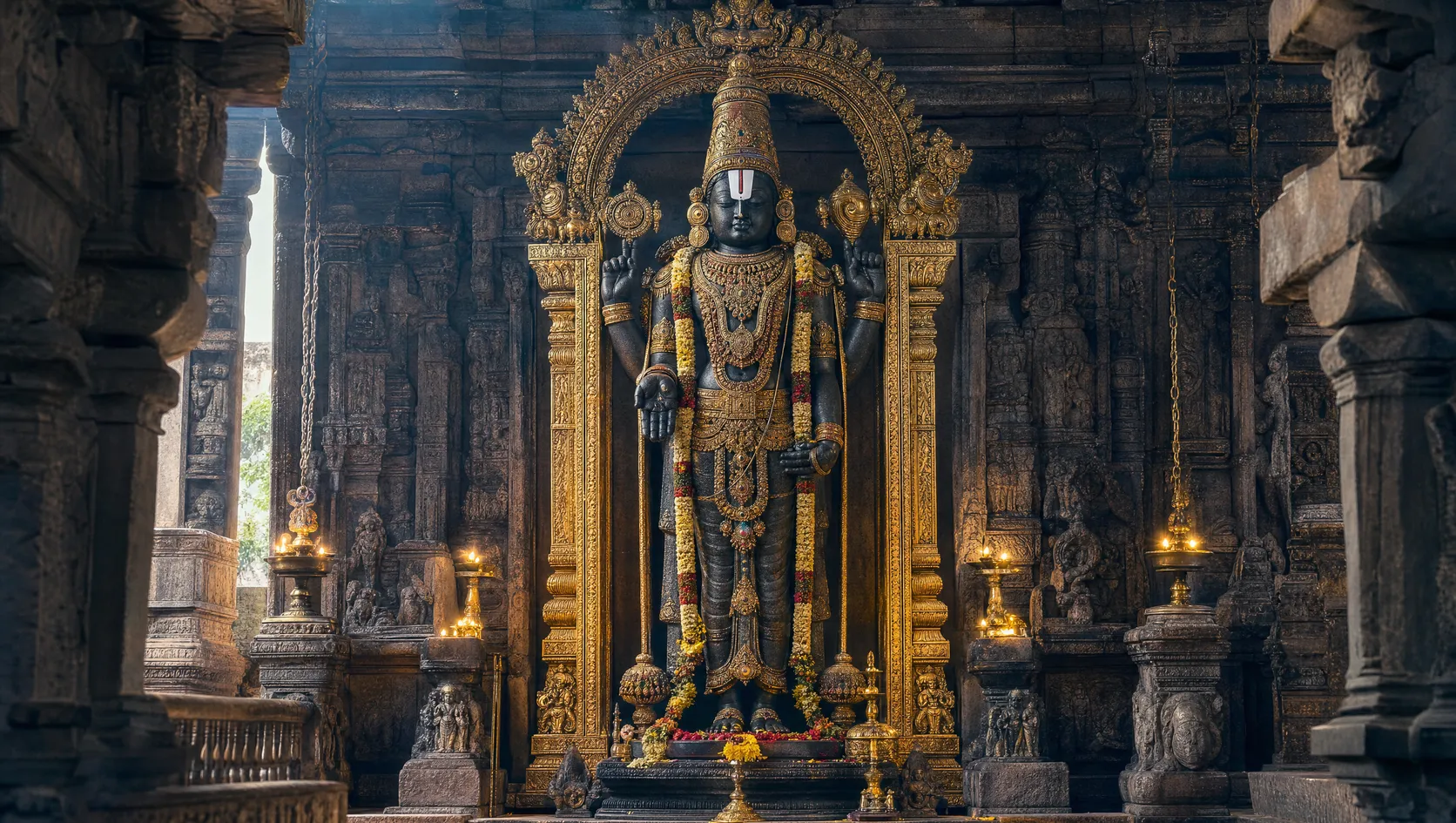
The mula virat stands roughly eight feet tall, dark stone, upright, in a posture called samabhanga, both feet planted evenly and the weight distributed without the hip-shift of the more common tribhanga. The upper hands hold the shankha and chakra; the lower right hand is in varada, the boon-giving gesture, and the lower left rests at the thigh in katyavalambita, a posture read as indicating the depth of the ocean of samsara from which the devotee is to be lifted.
Several features are distinctive. The deity is almost entirely covered in ornament and cloth, so what the devotee sees in the few seconds of darshan is a form heavy with gold rather than bare stone. A broad namam of refined camphor and musk covers the forehead and, by tradition, the eyes, so that the full gaze is not directly met; tradition holds the gaze too powerful to be received without mediation, and the eyes are briefly visible only when the namam is renewed. Lakshmi is present on the chest as Vyuha Lakshmi.
The hair on the image is real, offered by devotees at the tonsure halls and understood to grow rather than to be replaced, which is among the most persistent of the temple's traditions.
The image is fixed and immovable. The utsava murti, Malayappa Swami, is the processional form taken out during festivals, accompanied by Sridevi and Bhudevi. The vimana above the sanctum, the Ananda Nilayam, is gold-plated, and its finial is visible from the approach to the temple.
Distinctive Practicesविशिष्ट परंपराएँ
The Hundi and Kubera's Loan
हुंडी और कुबेर का ऋण
Continuous
Devotees drop cash, gold, jewellery and other valuables into the hundi, a large vessel within the temple. The offering is understood not as charity to a self-sufficient god but as a contribution toward repaying the loan Srinivasa took from Kubera to fund his marriage to Padmavati. The vessel is emptied and counted regularly by teams of temple staff and volunteers.
Framing the offering as repayment changes its character. The devotee is not buying favour; they are standing surety for a debt the god took on in order to marry. It makes giving an act of participation in his household rather than a transaction with a distant power, and it removes the awkwardness of enriching a deity who by definition lacks nothing.
Mottai (Tonsure)
मुंडन
Before darshan, at the designated tonsure halls
Enormous numbers of pilgrims, women and men alike, shave their heads before darshan and offer the hair at the temple. Dedicated halls, the kalyanakatta, handle the volume with barbers working in shifts around the clock. The collected hair is processed and auctioned by TTD, forming a significant revenue stream, with much of it entering the international hair trade.
Hair is the most visible marker of personal vanity and identity, and offering it is a surrender of appearance before the deity. Many pilgrims tonsure in fulfilment of a specific vow taken in a moment of difficulty, so the shaved head is also a public record that a promise was kept.
Srivari Mettu and Alipiri Footpaths
श्रीवारी मेट्टु और अलिपिरि पदमार्ग
Undertaken by pilgrims who choose to ascend on foot
Two stepped footpaths climb from the plains to Tirumala. Many pilgrims walk up rather than take the ghat road, some applying turmeric and kumkum to each step as they ascend, others carrying children making the journey for the first time.
The ascent is treated as part of the darshan rather than as travel toward it. Walking makes the effort itself an offering, and the steps are venerated as the approach to the deity's own hill. The tradition holds that the hill is Adishesha, so climbing it is understood as walking on the serpent who serves Vishnu.
Did You Know?क्या आप जानते हैं?
Ritual at Tirumala follows the Vaikhanasa Agama rather than the more widespread Pancharatra system. The Vaikhanasa tradition traces itself to the sage Vikhanasa and is followed at comparatively few temples, which makes Tirumala its most prominent living centre.
Vaikhanasa Agama literature; standard surveys of South Indian temple ritual
The temple walls carry thousands of stone inscriptions recording donations, endowments and administrative arrangements across many centuries. They are a primary source for South Indian economic and social history, documenting grain prices, land grants and terms of employment as well as religious gifts.
Tirumala Tirupati Devasthanams epigraphical series; South Indian Inscriptions volumes
The Tirupati laddu, distributed as prasadam, holds a Geographical Indication tag granted in 2009, meaning the name is legally protected and can be applied only to the laddu made at Tirumala.
Geographical Indications Registry, Government of India
The deity's eyes are kept covered by the camphor namam, and tradition holds that the full gaze is too powerful to be met directly. On the day the namam is renewed, the eyes are briefly visible.
Temple ritual tradition as described in Vaikhanasa practice
The hill itself is identified with Adishesha, the serpent on whom Vishnu reclines, and the seven peaks of the Seshachalam range are read as his hoods. Pilgrims climbing on foot understand themselves to be walking on the serpent.
Venkatachala Mahatmya tradition; regional devotional literature
Statues of Krishnadevaraya of Vijayanagara and his consorts stand within the temple complex, an unusual survival of royal portraiture inside a working Hindu shrine.
Vijayanagara-period temple records and surviving sculpture
TTD funds and operates educational and medical institutions from temple revenue, including hospitals and universities, making it one of the largest charitable operations run by a religious body in India.
Tirumala Tirupati Devasthanams published activities
Visitor Accessप्रवेश जानकारी
A traditional dress code applies for darshan. Photography and mobile phones are prohibited inside the temple, and there are cloakroom and security arrangements at the entry points. TTD operates several distinct darshan streams, including free Sarva Darshan and various paid and seva-linked queues, along with pilgrim accommodation on the hill. Entry procedures, queue categories and identity requirements are set by TTD and change with crowd conditions and festival calendars. Verify current requirements with TTD before travelling.
आध्यात्मिक आधार
The restrictions follow from how darshan is understood here. Seeing the deity is not looking at an object; it is being seen in return, and the tradition treats the encounter as brief, intense and requiring preparation. The dress code, the removal of footwear and the prohibition on photography all serve to strip away the ordinary apparatus a person carries into a room. The brevity of darshan is itself doctrinal rather than merely logistical. A devotee may wait many hours and pass the sanctum in seconds, and the tradition holds this to be sufficient, because what is received is not proportional to time spent.
समकालीन संदर्भ
Tirumala moves crowds on a scale few places on earth attempt. The queue system, the Vaikuntam complexes, the token arrangements and the accommodation network exist because tens of thousands of people arrive daily, and the numbers rise sharply during festivals. This produces genuine tension between devotional and administrative logic. Paid seva queues move faster than free ones, which has drawn criticism, and TTD periodically revises quotas and categories in response. Visitors should expect a managed, processed experience rather than an unstructured one, and should treat published arrangements as provisional.
व्यावहारिक मार्गदर्शन
Assume long waits and dress for them. The hill is cooler than the plains, and queue halls can be cold at night and hot by afternoon, so layers help. Carry minimal belongings, since phones and cameras must be deposited. If tonsure is intended, allow time for it before joining the darshan queue. Children and elderly travellers should be planned for separately, as standing time is substantial. Book accommodation and any seva well in advance, particularly around Brahmotsavam and Vaikunta Ekadasi.
Festivalsत्योहार
Salakatla Brahmotsavam
सालकट्ल ब्रह्मोत्सवम्
Sep-Oct (Kanya masam, around Purattasi)
The temple's principal annual festival, run over nine days, during which the utsava murti Malayappa Swami is taken in procession on a different vahana each day: Sesha, Hamsa, Simha, Muthyapu Pandiri, Kalpavriksha, Sarva Bhupala, Mohini, Garuda, Hanumantha, and others in sequence. Garuda Seva draws the largest crowds of the year, with the streets around the temple filled through the night. In years with an extra lunar month, a second Brahmotsavam, the Navaratri Brahmotsavam, is observed.
Vaikunta Ekadasi
वैकुंठ एकादशी
Dec-Jan (Dhanurmasa)
The Vaikunta Dwaram, the gateway associated with passage to Vaikuntha, is opened for devotees. It is among the most heavily attended observances of the year, and queue arrangements are altered substantially for it, with the darshan route passing through the opened gateway. Tradition holds that those who pass through on this day are released from the cycle of rebirth, which accounts for the scale of the crowds.
Rathasapthami
रथसप्तमी
Jan-Feb (Magha Shukla Saptami)
A single day on which the utsava murti is taken out on multiple vahanas from dawn to night, compressing into one day what Brahmotsavam spreads over nine. For devotees who cannot attend the nine-day festival, this is the day that offers the whole sequence at once.
Teppotsavam (Float Festival)
तेप्पोत्सवम्
Mar-Apr (Phalguna)
The processional deities are taken onto a decorated float on the Swami Pushkarini tank over several evenings, circling the water by lamplight. It is among the quieter and more visually striking observances of the temple year.
Traditional Offeringsपारंपरिक अर्पण
प्राथमिक अर्पण
Tulsi leaves
तुलसी
तुलसी
Tulsi is the offering most closely associated with Vishnu, and no worship of him is considered complete without it. The plant is treated as a devotee in her own right rather than as mere material: tradition holds that Tulsi was a woman whose devotion earned her a permanent place at Vishnu's feet. At Tirumala, tulsi garlands are prepared in the temple's own gardens and used in the daily ritual sequence. Tulsi that has been offered is returned to devotees and is often kept at home rather than discarded.
Hair (Mottai)
केश (मुंडन)
The offering of hair is unusual in being a part of the devotee's own body rather than an external substance. It is given at the kalyanakatta halls before darshan, most often in fulfilment of a vow. The tradition connects it to the Srinivasa narrative: when a shepherd struck the deity and drew blood, a princess is said to have offered her own hair to cover the wound, and Srinivasa promised that those who offered hair at his hill would be received. Whatever the account, the practical result is that appearance, the most public marker of self, is surrendered at the door.
Money and gold in the hundi
हुंडी में धन और स्वर्ण
Cash, gold and jewellery are dropped into the hundi within the temple. Uniquely among major Indian temples, the offering is theologically framed as repayment of Kubera's loan rather than as donation. The framing matters to how devotees describe what they are doing. They are not purchasing intercession; they are contributing to an obligation the deity assumed in order to marry, which makes the act closer to helping a relative settle a debt than to making a payment.
Panchamrit and abhishekam substances
पंचामृत और अभिषेक सामग्री
पञ्चामृत
Milk, curd, honey, ghee and sugar are used in abhishekam within the Vaikhanasa ritual sequence, along with sandal paste, camphor and saffron. Each substance carries symbolic weight: milk for purity, curd for prosperity, honey for sweetness of speech, ghee for strength, sugar for happiness. At Tirumala the abhishekam sequence is performed within specific sevas rather than being open to general participation, so most devotees encounter these substances as prasadam afterwards rather than as an offering they make themselves.
इस मंदिर की विशेषता
Tirupati Laddu
तिरुपति लड्डू
The laddu prepared in the temple kitchens, the Potu, is the single most recognisable prasadam in India and is carried home by pilgrims across the country. It holds a Geographical Indication tag granted in 2009, so the name is legally reserved to the laddu made at Tirumala. Its significance is partly that it travels. A pilgrim returns with something physical from the hill, and the laddu is distributed within families and neighbourhoods, so the darshan of one person extends to many who did not make the journey.
Most offerings at Tirumala are made through TTD's own counters and seva arrangements rather than brought from outside, given the scale of crowd management. Devotees intending a specific offering should check what is accepted and where, since arrangements differ between the free and paid darshan streams. Prasadam counters operate separately from the darshan queue, and laddu allocation is governed by its own token system.
How to Reachकैसे पहुँचें
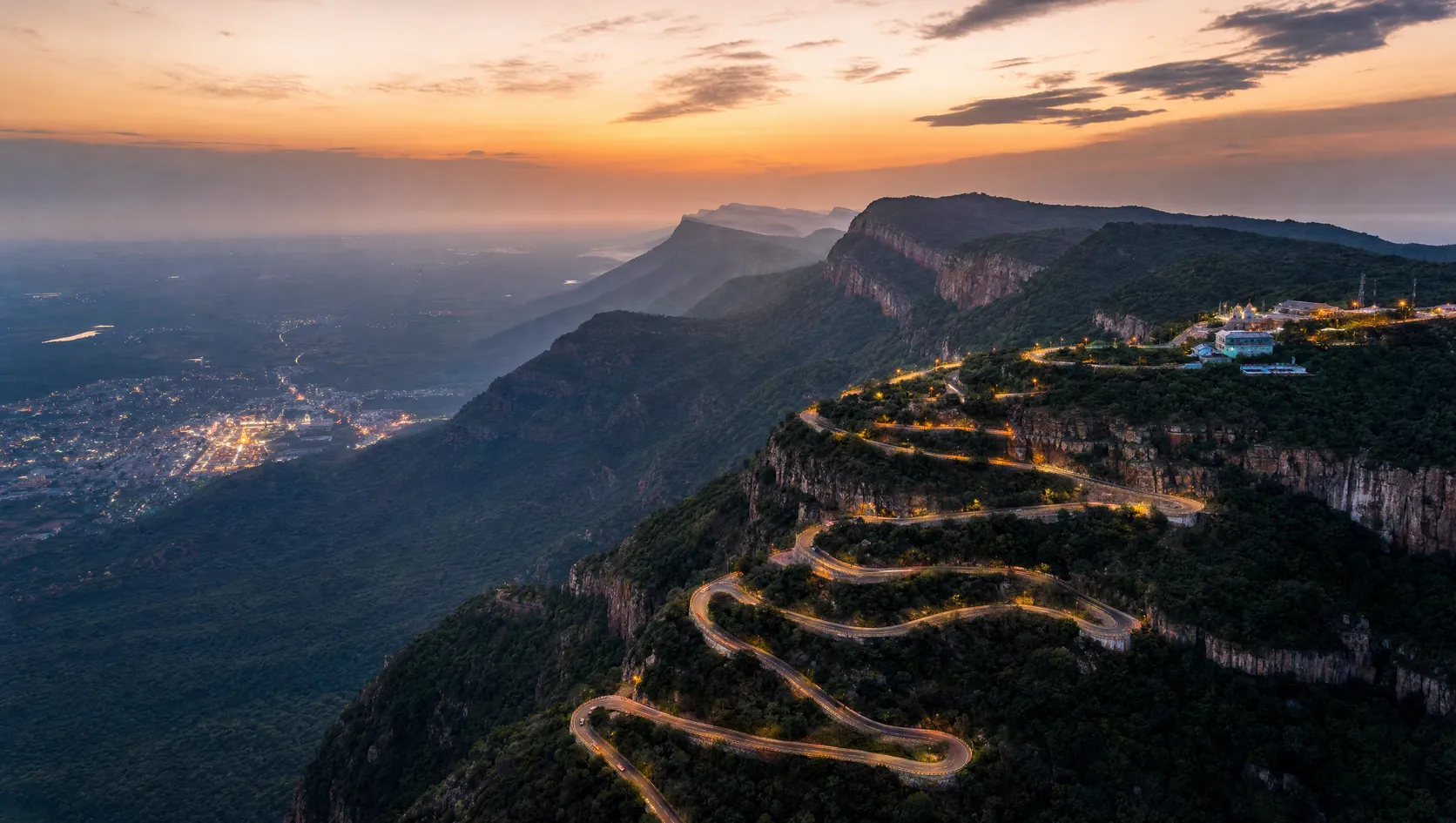
Tirumala sits on a hill above the town of Tirupati, and the temple is reached from there.
By air: Tirupati (Renigunta) Airport is roughly 40 km from Tirumala, with connections to major Indian cities. Chennai airport is the larger alternative at around 140 km from Tirupati town, and many international travellers route through it.
By rail: Tirupati Railway Station is well connected across South India and to major cities beyond it, and is one of the busiest stations in Andhra Pradesh. Tirumala is about 25 km further, up the ghat road.
By road: A ghat road connects Tirupati town to Tirumala, served by frequent APSRTC buses and taxis, with separate up and down routes to manage traffic. The climb takes roughly an hour depending on conditions.
On foot: pilgrims who prefer to walk use the Alipiri or Srivari Mettu stepped footpaths. Alipiri is the longer and more used of the two, with shelter and refreshment points along the way; Srivari Mettu is shorter but steeper. Both take several hours and should be started early.
Accommodation on the hill is administered by TTD. Because both transport and accommodation are affected by festival crowds, confirm arrangements before travelling.
Plan Your Visitयात्रा की योजना
🌤 सर्वोत्तम मौसम
The hill is cooler than the plains and can be visited year-round. Roughly October to February is the most comfortable stretch, with daytime temperatures generally pleasant and nights cool enough to want a layer in the queue halls. March to June is hot in the plains below, though Tirumala itself remains more temperate than Tirupati town. The southwest and northeast monsoons bring rain between roughly June and December, which can make the footpaths slippery and the ghat road slower. Brahmotsavam (Sep-Oct) and Vaikunta Ekadasi (Dec-Jan) are the most spiritually charged periods and also by far the most crowded, with waiting times that can extend dramatically. If the aim is an unhurried visit rather than a festival, avoid those windows and weekends.
👘 पहनावे का नियम
Traditional dress is required for darshan. Men commonly wear dhoti or pyjama with an upper cloth, or trousers with a shirt; women wear saree, half-saree or salwar kameez. Western casual wear such as shorts, sleeveless tops and short skirts is not permitted in the darshan queue. Footwear is removed before entering the temple area, and the stone underfoot can be hot in the afternoon. Socks are commonly worn for this reason.
📱 फोन और फोटोग्राफी
Mobile phones, cameras and electronic devices are not permitted inside the temple and must be deposited at the cloakroom facilities before joining the queue. Photography of the sanctum and the deity is prohibited entirely. Because deposit and retrieval add time at both ends, carrying as little as possible is the practical approach.
🏨 आवास
TTD administers extensive pilgrim accommodation on the hill, ranging from free dormitories and cottages to paid guest houses, allocated through its own systems. Private hotels are concentrated in Tirupati town below rather than at Tirumala. Demand far exceeds supply during Brahmotsavam, Vaikunta Ekadasi and public holidays, and allocation at short notice during those periods should not be assumed. Confirm current booking arrangements with TTD directly.
Sacred Soundsपवित्र ध्वनि
क्या आप जानते हैं? · Did You Know?
वही अनुवाद त्रुटि जिसने हिन्दू धर्म में '33 कोटि' को '33 करोड़' बनाया, बौद्ध धर्म में भी हुई। बौद्ध ग्रन्थों के चीनी अनुवाद ने 'सप्त कोटि बुद्ध' (7 श्रेष्ठ बुद्ध) का अनुवाद '7 करोड़ बुद्ध' कर दिया। तिब्बती अनुवाद ने सही किया: 7 प्रकार, 7 करोड़ नहीं। एक संस्कृत शब्द, दो प्रमुख विश्व धर्मों में गलत पढ़ा गया, ने दो एकसमान भ्रम स्वतन्त्र रूप से उत्पन्न किए।
Related Contentसंबंधित सामग्री
Related Scriptures
Community Reflections
🕉️
Be the first to share your reflection.