Mantralayam Pancha Mukhi Anjaneya
मंत्रालयम पंच मुखी आंजनेय
The five-faced Hanuman at the vrindavan of Raghavendra Swami — where the first Vayu-avatar is worshipped at the samadhi of the Madhva lineage
Mantralayam, Andhra Pradesh, India
Pañcamukha Āñjaneya, MantrālayamAlso known as: Mantralayam Pancha Mukhi Anjaneya, Pancha Mukha Anjaneya Swamy Mantralayam, Mantralayam Hanuman temple, Sri Raghavendra Swami Matha Pancha Mukha Anjaneya
युग
The broader Mantralayam pilgrimage site dates from Sri Raghavendra Swami's jeeva-samadhi in 1671 CE; the Pancha Mukhi Anjaneya shrine within the pilgrimage complex is associated with the Raghavendra Swami Matha's subsequent institutional development of the site
वास्तुकला
Madhva-Vaishnava matha temple architecture — modest shrine within the broader Sri Raghavendra Swami Brindavana complex, typical of Tungabhadra-region Madhva institutional temple construction
खुला
06:00 – 21:00
आरती
06:30 · 12:00 · 18:30 · 20:30
विशेष
The Pancha Mukhi Anjaneya shrine is typically visited as part of the broader Mantralayam pilgrimage circuit centred on the Sri Raghavendra Swami Brindavana; most pilgrims combine both darshans in a single visit
पवित्र कथा · पवित्र कथा
Mantralayam is, before anything else, the town of Sri Raghavendra Swami — the seventeenth-century Madhva-Vaishnava saint who entered jeeva-samadhi on the banks of the Tungabhadra in 1671, and who is believed by the tradition to remain alive in meditation within his vrindavan, still chanting the mantras from which the town takes its name. Within this spiritual geography, the Pancha Mukhi Anjaneya temple carries a particular theological weight. In the Dvaita philosophy of Madhvacharya — the doctrinal foundation of the tradition to which Raghavendra Swami belongs — Hanuman, Bhima, and Madhvacharya himself are three incarnations of Vayu, the wind-god. To worship the Pancha Mukha form of Hanuman at the samadhi-site of a saint within the lineage founded by the third Vayu-incarnation is, in the Madhva reading, to worship the first and greatest Vayu-avatar at the place where the third Vayu-avatar's spiritual succession continues. The five faces watch over the vrindavan of the saint who belongs to the same cosmic soul-lineage as the deity. For pilgrims visiting Mantralayam — and the town draws several million visitors a year for the Raghavendra Swami darshan — the Pancha Mukhi Anjaneya shrine is part of the standard pilgrim circuit: vrindavan first, then Hanuman, with the theological logic binding the two darshans into a single devotional unit.
Sacred Origin Storyपवित्र उत्पत्ति कथा
Source: Pancha Mukha Anjaneya tradition (Adbhuta Ramayana / Krittivasi Ramayana Mahiravana episode) interpreted through the Madhva-Vaishnava Vayu-triad doctrine (Sarvamoola Grantha of Madhvacharya); supplemented by the Sri Raghavendra Swami hagiographic tradition
The Pancha Mukha form of Hanuman — five faces in a single body, Hanuman himself eastward at the centre, Narasimha southward, Garuda westward, Varaha northward, Hayagriva upward — originates in the Mahiravana episode of the Adbhuta Ramayana. During the war with Ravana, the sorcerer Mahiravana abducted Rama and Lakshmana to Patala, the underworld. Hanuman descended to rescue them and found Mahiravana's life protected by a spell requiring the simultaneous extinguishing of five lamps in five directions. He assumed the Pancha Mukha form and extinguished all five in a single breath, killing Mahiravana and rescuing Rama and Lakshmana. The form entered Hanuman's iconographic canon as the configuration in which his protective powers reach their most concentrated expression.
At Mantralayam, this origin story is read through the lens of Madhva-Vaishnava theology, which gives Hanuman a cosmic identity beyond the Ramayana narrative. In the Dvaita philosophy of Madhvacharya (1238–1317 CE), the foundational thinker of the tradition to which the entire Mantralayam pilgrimage site belongs, Hanuman is not merely a devotee of Rama but the first incarnation of Vayu — the cosmic wind-god, the prana of the universe — who manifests in three successive incarnations across the cosmic ages: as Hanuman in the Treta Yuga, as Bhima in the Dvapara Yuga, and as Madhvacharya himself in the Kali Yuga. This Vayu-triad doctrine (Vayu-jeeva-uttama) is not a peripheral theological claim but a central pillar of Dvaita metaphysics. To worship Hanuman in the Madhva tradition is to worship the first and greatest incarnation of Vayu, who is himself the highest among all jeevas — the individual souls who exist in eternal distinction from the supreme Brahman in Madhva's metaphysical framework.
Sri Raghavendra Swami (1595–1671 CE), the saint whose jeeva-samadhi is the principal pilgrimage object at Mantralayam, is a direct spiritual successor within this Madhva lineage. He served as the head of the Kumbakonam Madhva Matha, later establishing his final seat at Mantralayam on the Tungabhadra, where he entered jeeva-samadhi — alive in meditation within his vrindavan (tomb-shrine), believed by the tradition to be still chanting mantras within until the end of the present cosmic cycle. The Pancha Mukhi Anjaneya shrine at Mantralayam therefore sits within a specific theological architecture: the first Vayu-avatar in his most powerful form, protecting the samadhi-site of a saint who belongs to the spiritual lineage of the third Vayu-avatar. The five faces of Hanuman watching over the vrindavan of Raghavendra Swami is the Madhva tradition's own geometry — the cosmic soul-family of Vayu gathered, across incarnations, at a single place on the banks of the Tungabhadra.
उद्धृत स्रोत:
- Adbhuta Ramayana — Pancha Mukha Anjaneya episode (Mahiravana / Patala-rescue narrative)
- Krittivasi Ramayana (Bengali, c. 15th century) — Mahiravana episode elaboration
- Pancha Mukha Anjaneya Kavacham (Sanskrit devotional stotra)
- Madhvacharya, Sarvamoola Grantha — Vayu-triad (Vayu-jeeva-uttama) doctrine
- Sri Raghavendra Swami hagiographic tradition — compiled in works including 'Sri Raghavendra Vijaya' (Pandit Appanacharya, 17th century)
- B. N. K. Sharma, 'History of the Dvaita School of Vedanta and its Literature' (Motilal Banarsidass, 1981)
What You'll Seeदर्शन में
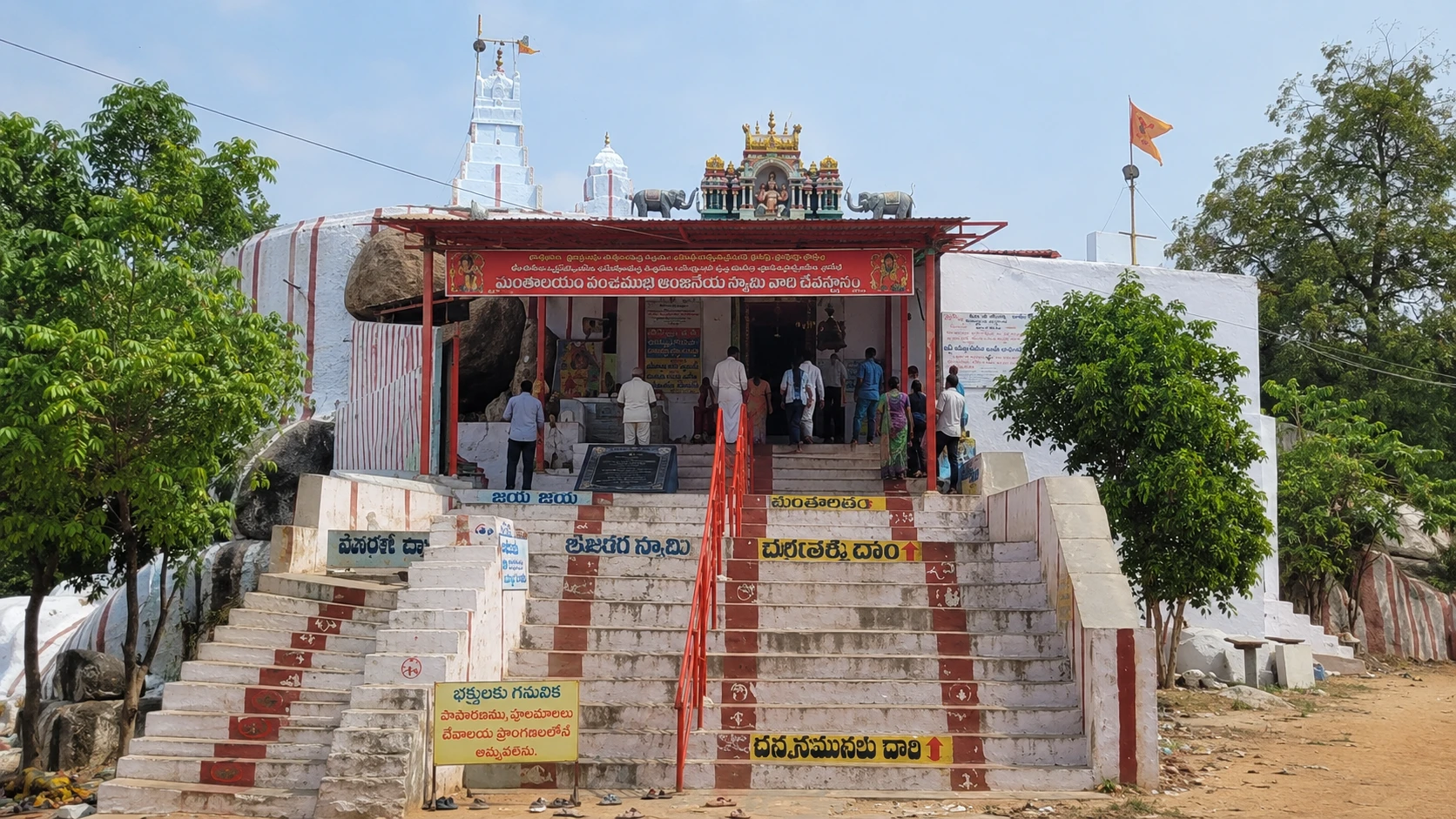
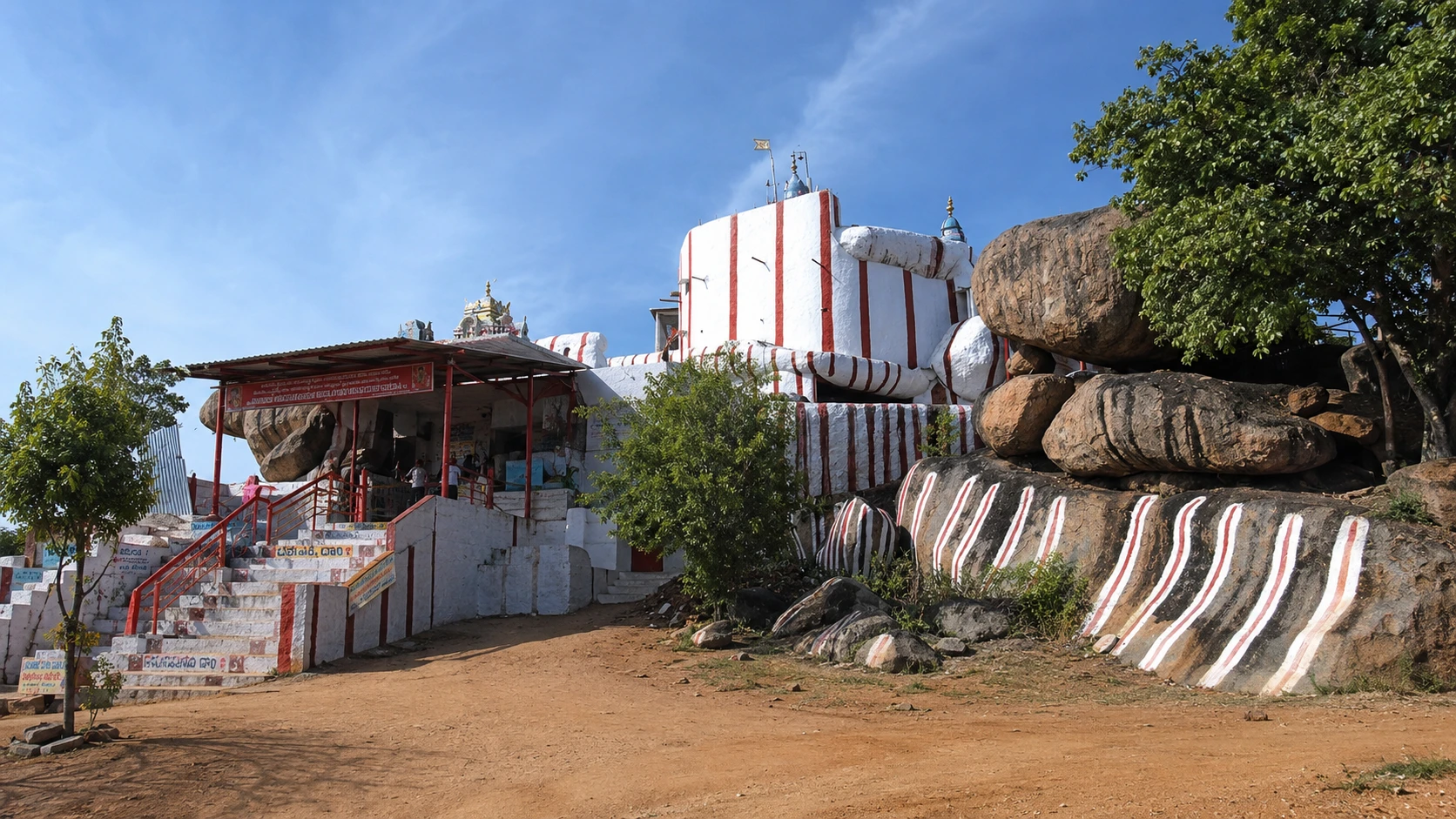
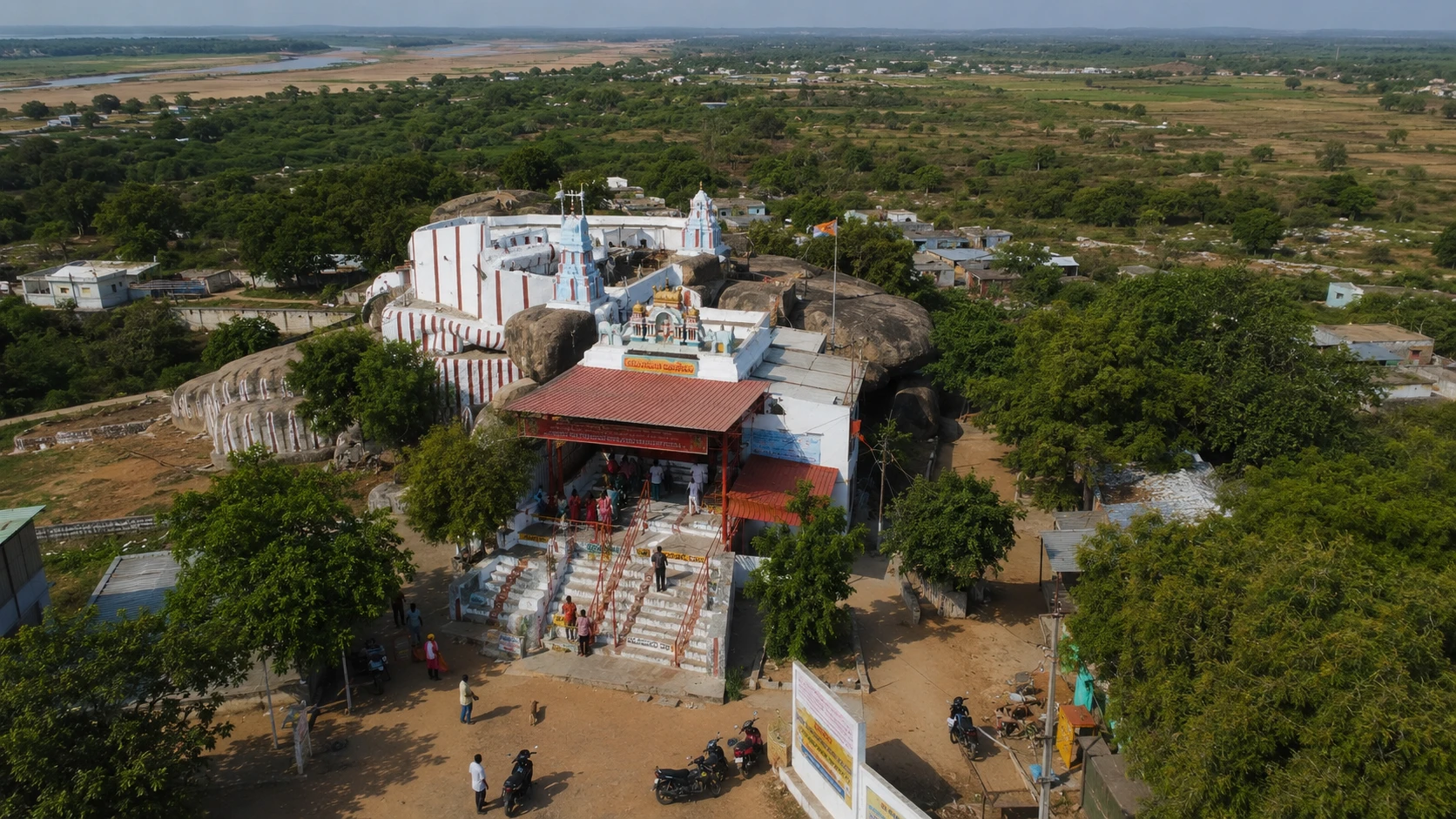
The Pancha Mukha Anjaneya murti at Mantralayam follows the canonical five-face configuration: Hanuman eastward at the centre, Narasimha southward, Garuda westward, Varaha northward, Hayagriva upward. The murti carries the standard Hanuman vermilion and is depicted with multiple arms bearing weapons and devotional attributes. The shrine sits within the broader Raghavendra Swami Brindavana pilgrim complex, and its visual character is shaped by the Madhva-Vaishnava institutional aesthetic — well-maintained, freshly-decorated during festival periods, with the Madhva vertical tilak (urdhva-pundra) visible on the murti and on the priests. Devotees offer vada-mala, sindoor-oil, tulsi, and betel leaves in the standard puja sequence, with the sindoor-oil application renewed daily by the attending priests. The shrine's position within the broader complex means that the typical pilgrim encounters the Pancha Mukha Anjaneya as part of a sequential darshan experience — vrindavan first, then the Hanuman shrine — rather than as an isolated temple. The proximity to the vrindavan gives the shrine a distinctive acoustic character during the morning and evening puja hours: the sounds of the Raghavendra Swami aarti and the Pancha Mukha Anjaneya puja overlap, and for pilgrims standing between the two, the experience is of simultaneous worship of the saint and the deity who protects his samadhi.
Did You Know?क्या आप जानते हैं?
The Mantralayam Pancha Mukhi Anjaneya temple sits within the broader pilgrimage complex of Sri Raghavendra Swami (1595–1671 CE), the Madhva-Vaishnava saint who entered jeeva-samadhi on the banks of the Tungabhadra and is believed by the tradition to remain alive in meditation within his vrindavan. The Hanuman shrine is part of the standard pilgrim circuit: devotees visiting the vrindavan typically include the Pancha Mukhi Anjaneya darshan as a theologically integrated second stop rather than a separate excursion.
Sri Raghavendra Swami Matha tradition; 'Sri Raghavendra Vijaya' (Pandit Appanacharya, 17th century)
In Madhva-Vaishnava (Dvaita) theology, Hanuman, Bhima, and Madhvacharya are three successive incarnations of Vayu — the cosmic wind-god, the prana of the universe. This Vayu-triad doctrine (Vayu-jeeva-uttama) means that worshipping the Pancha Mukha Hanuman at the samadhi-site of a saint within Madhvacharya's lineage is, in the tradition's reading, the first Vayu-incarnation being worshipped at the spiritual seat of the third. The Tungabhadra river, on whose banks both Mantralayam and Hampi (Anjaneyadri, Hanuman's birthplace) stand, connects the two Vayu-linked sites in a single riverine geography.
Madhvacharya, Sarvamoola Grantha; B. N. K. Sharma, 'History of the Dvaita School of Vedanta' (1981)
The Sri Raghavendra Swami Aradhana — the annual commemoration of the saint's entry into jeeva-samadhi, held during the month of Shravan (July–August) — draws several hundred thousand pilgrims to Mantralayam over its two-to-three day window, making it one of the largest annual religious gatherings in Andhra Pradesh. During the Aradhana period, the Pancha Mukhi Anjaneya temple receives intensified pilgrim traffic as part of the broader complex-wide observances.
Sri Raghavendra Swami Matha — Aradhana coordination documentation; Andhra Pradesh State Tourism
Festivalsत्योहार
Sri Raghavendra Swami Aradhana
श्री राघवेन्द्र स्वामी आराधना
July–August (Shravan month — the precise date is the anniversary of Raghavendra Swami's entry into jeeva-samadhi in 1671 CE)
The Aradhana is the principal annual event at Mantralayam — the commemoration of Sri Raghavendra Swami's entry into jeeva-samadhi. It is the broader complex's festival rather than a Hanuman-specific observance, but it is the single largest pilgrim-traffic window for the Pancha Mukhi Anjaneya temple because all pilgrim-circuit temples within the complex receive intensified darshan during the two-to-three day Aradhana period. For the temple specifically, the Aradhana is an occasion for enhanced Pancha Mukha Anjaneya Kavacham recitation and extended puja sequences, with the theological bond between Hanuman and Raghavendra Swami — both within the Vayu-lineage — explicitly invoked in the Aradhana-period liturgy.
Hanuman Jayanti
हनुमान जयन्ती
Observed in alignment with the Madhva-Vaishnava calendar (typically Margashirsha Shukla Trayodashi, December–January, consistent with the Karnataka-AP Madhva tradition)
Hanuman Jayanti at Mantralayam follows the Madhva-Vaishnava calendar — Margashirsha Shukla Trayodashi — which differs from the north Indian Chaitra Purnima convention. The festival sees special abhishekam, archana, and vada-mala arpana at the Pancha Mukhi Anjaneya shrine, with the Vayu-triad doctrine (Hanuman as the first Vayu-incarnation) explicitly invoked in the Jayanti puja. Pilgrim flow during Hanuman Jayanti at Mantralayam is significant but typically smaller than the Aradhana, because the Aradhana draws the broad Raghavendra Swami devotee base while the Hanuman Jayanti draws specifically those who are visiting the Pancha Mukha shrine.
Traditional Offeringsपारंपरिक अर्पण
प्राथमिक अर्पण
Vada-mala (garland of fried lentil rounds)
वड-माला
वट-माला
The vada-mala is the standard Hanuman offering, here offered within the institutional context of the Raghavendra Swami Matha's broader pilgrim-service ecology. Garlands are available from vendors within and near the complex.
Sindoor and oil (sindur-tail)
सिन्दूर एवं तेल
सिन्दूर, तैल
Sindoor-oil is applied to the Pancha Mukha murti during the standard puja. The institutional setting of the Matha complex means that the daily sindoor-oil application is maintained by the Matha's attending priests with consistency characteristic of Madhva-Vaishnava institutional temple management.
Tulsi (sacred basil) and betel leaves
तुलसी एवं पान-पत्र
तुलसी, ताम्बूल
Tulsi is the sacred Vaishnava plant; its offering at the Mantralayam Pancha Mukha shrine is particularly resonant given the Madhva-Vaishnava institutional framing. Together with vada-mala and sindoor-oil, this constitutes the standard Mantralayam Pancha Mukha Anjaneya offering set.
Offerings are available from vendors within and near the Sri Raghavendra Swami Brindavana complex. The Matha's institutional pilgrim-service infrastructure is more formalised than at independently-managed Pancha Mukha temples; general pilgrim services (prasad, accommodation, food) are coordinated through the Matha's administration.
How to Reachकैसे पहुँचें
Mantralayam is on the south bank of the Tungabhadra river in Kurnool district, Andhra Pradesh, near the AP–Karnataka border.
By air: Rajiv Gandhi International Airport, Hyderabad (HYD) at approximately 310 km is the principal full-service air gateway, with road transfer of approximately 5–6 hours. Kurnool Airport (limited domestic services) is closer at approximately 75 km but has restricted connectivity. Bengaluru International Airport (BLR) at approximately 370 km is an alternative for visitors arriving from the south.
By rail: Mantralayam Road Railway Station (MYAL) is approximately 12 km from the town, on the Guntakal–Hubli broad-gauge line with direct connections to Hyderabad, Bengaluru, Chennai, and Mumbai. Auto-rickshaws and shared transport from MYAL to Mantralayam town are readily available. Guntakal Junction (~70 km) is the nearest major junction for connections not directly serving MYAL.
By road: APSRTC and Karnataka KSRTC both operate bus services to Mantralayam from Hyderabad (~310 km), Bengaluru (~370 km), Kurnool (~75 km), and other regional cities. The town is accessible year-round by road; the AP–Karnataka border-zone road network is well-maintained.
Within Mantralayam, the Pancha Mukhi Anjaneya temple and the Sri Raghavendra Swami Brindavana are within walking distance of each other and of the town's accommodation and transport hub. The town is compact and pedestrian-navigable during non-Aradhana periods; during the Aradhana window, crowd management and traffic diversion arrangements are coordinated by the district administration.
Plan Your Visitयात्रा की योजना
🌤 सर्वोत्तम मौसम
October through March is the recommended season for general visits — cooler weather in the Rayalaseema region. The Raghavendra Swami Aradhana (July–August, Shravan) is the principal annual pilgrim event and is the most rewarding time for a devotional visit despite summer heat; advance accommodation booking is essential during the Aradhana window. The town is accessible year-round.
👘 पहनावे का नियम
Traditional Indian attire is preferred. The broader Raghavendra Swami complex observes Madhva-Vaishnava conventions; the urdhva-pundra tilak (the vertical Vaishnava forehead marking) is commonly worn by devotees within the complex. Footwear is removed before entering any shrine within the complex.
📱 फोन और फोटोग्राफी
Photography policies within the Raghavendra Swami Brindavana complex are generally conservative; sanctum photography of the vrindavan and of the Pancha Mukhi Anjaneya murti is typically not permitted. Outer-precinct photography is at the discretion of the matha administration. Visitors should ask before photographing within the complex.
🏨 आवास
The Sri Raghavendra Swami Matha operates pilgrim accommodation (choultries and guest rooms) within or adjacent to the complex; advance booking is possible through the Matha's administrative office. Mantralayam town also has a small number of private lodges and guesthouses serving pilgrims. During the Aradhana period, accommodation is at extreme premium; booking well in advance is essential. For higher-comfort requirements, Kurnool (~75 km) offers a broader hotel range.
Sacred Soundsपवित्र ध्वनि
क्या आप जानते हैं? · Did You Know?
वही अनुवाद त्रुटि जिसने हिन्दू धर्म में '33 कोटि' को '33 करोड़' बनाया, बौद्ध धर्म में भी हुई। बौद्ध ग्रन्थों के चीनी अनुवाद ने 'सप्त कोटि बुद्ध' (7 श्रेष्ठ बुद्ध) का अनुवाद '7 करोड़ बुद्ध' कर दिया। तिब्बती अनुवाद ने सही किया: 7 प्रकार, 7 करोड़ नहीं। एक संस्कृत शब्द, दो प्रमुख विश्व धर्मों में गलत पढ़ा गया, ने दो एकसमान भ्रम स्वतन्त्र रूप से उत्पन्न किए।
Related Contentसंबंधित सामग्री
Related Scriptures
Related Temples
Tirumala Pancha Mukhi Hanuman
तिरुमला पंच मुखी हनुमान
Tirumala, Andhra Pradesh
Anjaneyadri (Hampi)
अंजनेयाद्रि हम्पी
Hampi, Karnataka
Pancha Mukhi Hanuman (Kumbakonam)
पंच मुखी हनुमान कुम्भकोणम्
Kumbakonam, Tamil Nadu
Pancha Mukha Anjaneya Swamy (Tiruvallur)
पंच मुख आंजनेय स्वामी
Tiruvallur, Tamil Nadu
Namakkal Anjaneyar
नमक्कल आंजनेयर
Namakkal, Tamil Nadu
Yantrodharaka Anjaneya (Hampi)
यंत्रोद्धारक आंजनेय
Hampi, Karnataka
Community Reflections
🕉️
Be the first to share your reflection.