Yantrodharaka Anjaneya (Hampi)
यंत्रोद्धारक आंजनेय
Hanuman at the heart of his own homeland — the ruins of Kishkindha
Hampi, Karnataka, India
Yantroddhāraka ĀñjanēyaAlso known as: Yantrodharaka Anjaneya Hampi, Yantroddharaka Anjaneya, Hampi Anjaneya, Kishkindha Anjaneya
युग
Vijayanagara period (14th–16th century); some elements may predate the empire
वास्तुकला
Vijayanagara temple architecture; Dravidian-influenced with Deccan regional features
खुला
06:00 – 20:30
आरती
06:30 · 12:00 · 18:00
विशेष
Located within the Hampi UNESCO World Heritage Site — the entire landscape of ruined temples, boulder fields, and river corridors constitutes the sacred geography; Saturdays and Tuesdays draw peak devotional crowds
पवित्र कथा · पवित्र कथा
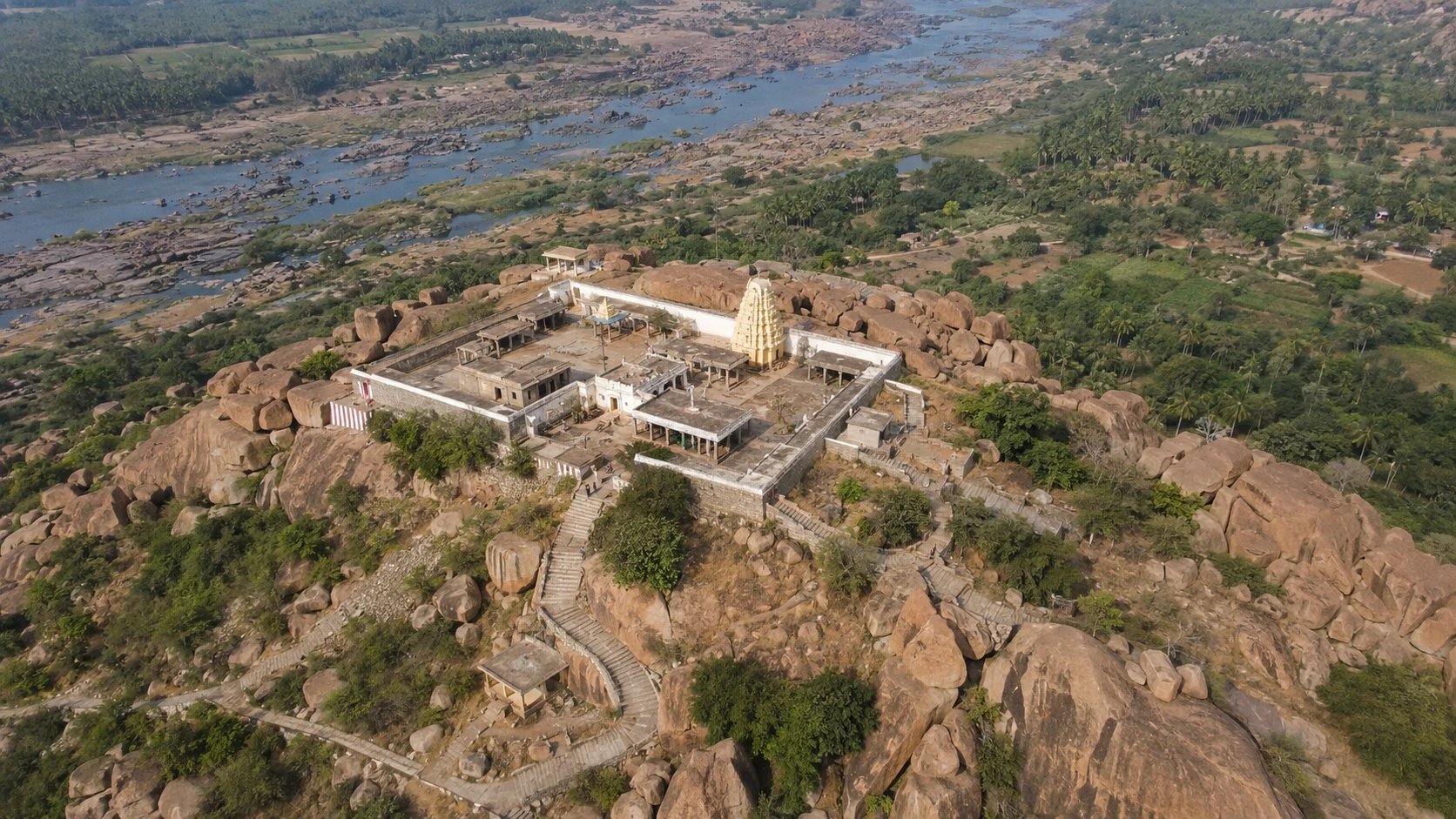
Among the boulder-strewn, river-cut ruins of Hampi — the once-magnificent capital of the Vijayanagara Empire and the landscape the Ramayana calls Kishkindha, the monkey kingdom — stands a Hanuman temple of unusual theological depth. The Yantrodharaka Anjaneya is named for a specific, dramatic moment in the extended Ramayana tradition: the episode in which Ahiravana, the demon king of the underworld, kidnapped Rama and Lakshmana using magical devices, and Hanuman took his Panchamukha (five-faced) form to defeat him. To worship Hanuman here is not merely to visit a temple — it is to stand in the ruins of Kishkindha itself, the kingdom where Hanuman was born, where Sugriva held court, where the monkey army assembled before the war for Sita.
Sacred Origin Storyपवित्र उत्पत्ति कथा
Source: Extended Ramayana tradition (Kamba Ramayana, Adbhuta Ramayana, regional Telugu-Kannada Ramayana narratives) / Kishkindha-Hampi local tradition
The name Yantrodharaka encodes one of the most dramatic episodes in the extended Ramayana tradition — a story not in the Valmiki Ramayana but preserved in the Tamil Kamba Ramayana, the Telugu Ranganatha Ramayana, regional Kannada narratives, and the North Indian Adbhuta Ramayana tradition.
In this account, Ahiravana — the demon king of Patala (the underworld), a relative of Ravana — devised a scheme to help Ravana by kidnapping Rama and Lakshmana from their tent during the Lanka war using magical devices (yantras). By the power of these yantras, both Rama and Lakshmana were rendered unconscious and transported to Patala.
Hanuman followed. In the underworld, he discovered that Ahiravana could only be killed if five lamps burning in five directions were extinguished simultaneously — it was physically impossible for a single being to be in five places at once. Hanuman responded by taking the Panchamukha form — five faces pointing in the five sacred directions: Anjaneya (east), Narasimha (south), Garuda (west), Varaha (north), and Hayagriva (the sky). With five faces, five sets of breath, he simultaneously extinguished all five lamps. Ahiravana was killed. Rama and Lakshmana were rescued.
The 'Yantrodharaka' name — literally 'the one who lifts/destroys the yantra' — commemorates the precise moment when Hanuman, by taking multiple divine forms, broke the magical constraint that would have been unsolvable in any single form.
Beyond the Ahiravana episode, the deeper mythological significance of Hampi for Hanuman worship is Kishkindha. The Valmiki Ramayana describes Kishkindha as the monkey kingdom in the Deccan, ruled by Vali and then Sugriva, where Hanuman served as minister and prime devotee. The hills, boulders, and river curves of the Hampi landscape are identified by tradition as the physical remains of Kishkindha — the Matanga hill, the Rishyamuka mountain, the Tungabhadra river (identified with the Pampa Sarovar), the Anjanadri hill (Hanuman's birthplace) across the river in Anegundi. To worship at Hampi is thus to worship in Hanuman's homeland — not a place where he visited or intervened, but the place where he was born and where he grew.
उद्धृत स्रोत:
- Kamba Ramayana (Tamil) — Ahiravana episode
- Ranganatha Ramayana (Telugu)
- Adbhuta Ramayana (Sanskrit) — Panchamukha Hanuman episode
- Valmiki Ramayana, Kishkindha Kanda — for the Kishkindha geography
- Local Hampi-Vijayanagara pilgrimage tradition
विद्वत संदर्भ
The Ahiravana-Panchamukha episode is absent from the Valmiki Ramayana but well-established in regional Ramayana traditions. Philip Lutgendorf ('Hanuman's Tale', 2007) analyses the Panchamukha form's theological significance as an expression of Hanuman's capacity to embody multiple divine energies simultaneously — Narasimha's wrath, Garuda's speed, Varaha's persistence, Hayagriva's wisdom, and his own devotion. The Hampi-Kishkindha identification is accepted by the Archaeological Survey of India as a tradition of significant antiquity, and the Vijayanagara kings actively promoted it as part of their political theology — claiming descent from the monkey kingdom and thus divine sanction for their rule.
Historyइतिहास
The Vijayanagara Empire (1336–1646 CE), which had its capital at Hampi on the south bank of the Tungabhadra river, was one of the most extensive and culturally productive polities in pre-modern South India. The empire's founding mythology explicitly tied its origins to Kishkindha — the Ramayana's monkey kingdom — and the Vijayanagara kings drew political legitimacy from this claimed continuity with the sacred geography.
Hanuman was among the most important deities of the Vijayanagara tradition. The empire's greatest monarch, Krishnadevaraya (r. 1509–1529), was a devoted Vaishnavite and composed the Telugu epic Amuktamalyada, which contains substantial reflection on devotion to Vishnu and his servants. Inscriptions and literary sources from the Vijayanagara period attest to extensive Hanuman temple construction, patronage of Vaishnava acharyas, and the political use of the Hanuman-Kishkindha mythology to anchor the empire's sacred legitimacy.
The Yantrodharaka Anjaneya temple in the Hampi bazaar area was part of this broader Vijayanagara religious landscape. Multiple Hanuman temples existed within the empire's capital city — the temple complex at Hampi includes Hanuman shrines, Anjaneya temples, and references to the vanara king Sugriva across the landscape. The Anjaneyadri hill (Anjanadri or Anjana Parvata) across the Tungabhadra in Anegundi is identified in tradition as Hanuman's actual birthplace — a claim endorsed by local tradition and treated as historically significant pilgrimage geography.
The fall of Vijayanagara in 1565 CE, following the Battle of Talikota, was catastrophic. The city was systematically looted and burned by the Deccan Sultanate coalition for months. Most of the major temples were damaged or destroyed; the population fled. The Hampi landscape was largely abandoned, the magnificent city becoming the boulder-strewn, ruined landscape that visitors encounter today.
The religious sites that survived — including the Yantrodharaka Anjaneya temple — did so primarily because they were built into or of the granite landscape itself, or because pilgrimage tradition maintained enough presence to prevent total abandonment. The Virupaksha temple, adjacent to Hampi bazaar, maintained continuous worship through the post-Vijayanagara period and into the present, and the Hanuman temple complex benefited from this continuity.
Hampi was designated a UNESCO World Heritage Site in 1986. The Archaeological Survey of India manages the monumental zone, while the temple trusts and local religious communities continue active worship. The intersection of active pilgrimage with archaeological heritage management creates a distinctive administrative context that pilgrims should be aware of.
Historical Timelineऐतिहासिक कालक्रम
Founding of the Vijayanagara Empire by Harihara I and Bukka Raya at Hampi, on the Tungabhadra river. The empire's political mythology explicitly tied its legitimacy to the sacred geography of Kishkindha, with the founders claiming descent from the territory of the Ramayana monkey kingdom.
Reign of Krishnadevaraya, the most celebrated Vijayanagara emperor. His extensive patronage of temples, Vaishnava scholarship, and Telugu literature (including the Amuktamalyada) represented the peak of Vijayanagara's religious and cultural expression. Hanuman temple patronage at Hampi reached its height during this period.
Fall of Vijayanagara following the Battle of Talikota. The Deccan Sultanate coalition defeated the empire and systematically sacked and burned the city of Hampi over several months. Most major structures were damaged or destroyed. The city was largely abandoned, leaving the ruined landscape that defines Hampi today.
The duration and extent of the Hampi destruction are attested by multiple independent sources including Portuguese travelers, Deccan chronicle accounts, and later archaeology. The Virupaksha temple and several other sites maintained some continuity of worship even after the destruction, which explains their survival relative to more thoroughlly destroyed structures.
Hampi designated a UNESCO World Heritage Site. The designation recognized the exceptional universal value of the Vijayanagara ruins as one of the largest medieval cities in Asia. The Archaeological Survey of India's formal management of the heritage zone began intersecting with the active pilgrimage traditions at surviving temple sites.
What You'll Seeदर्शन में
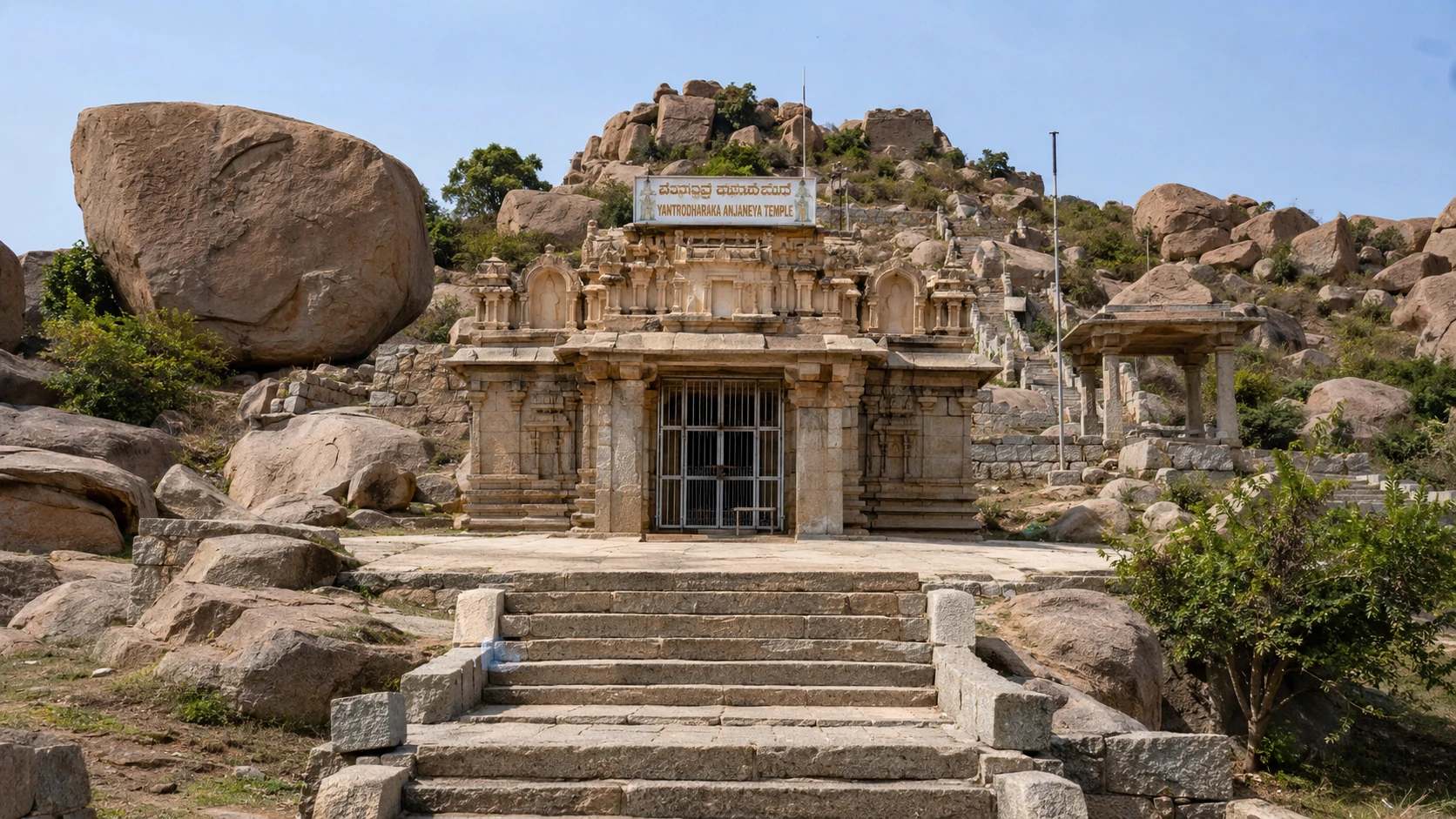
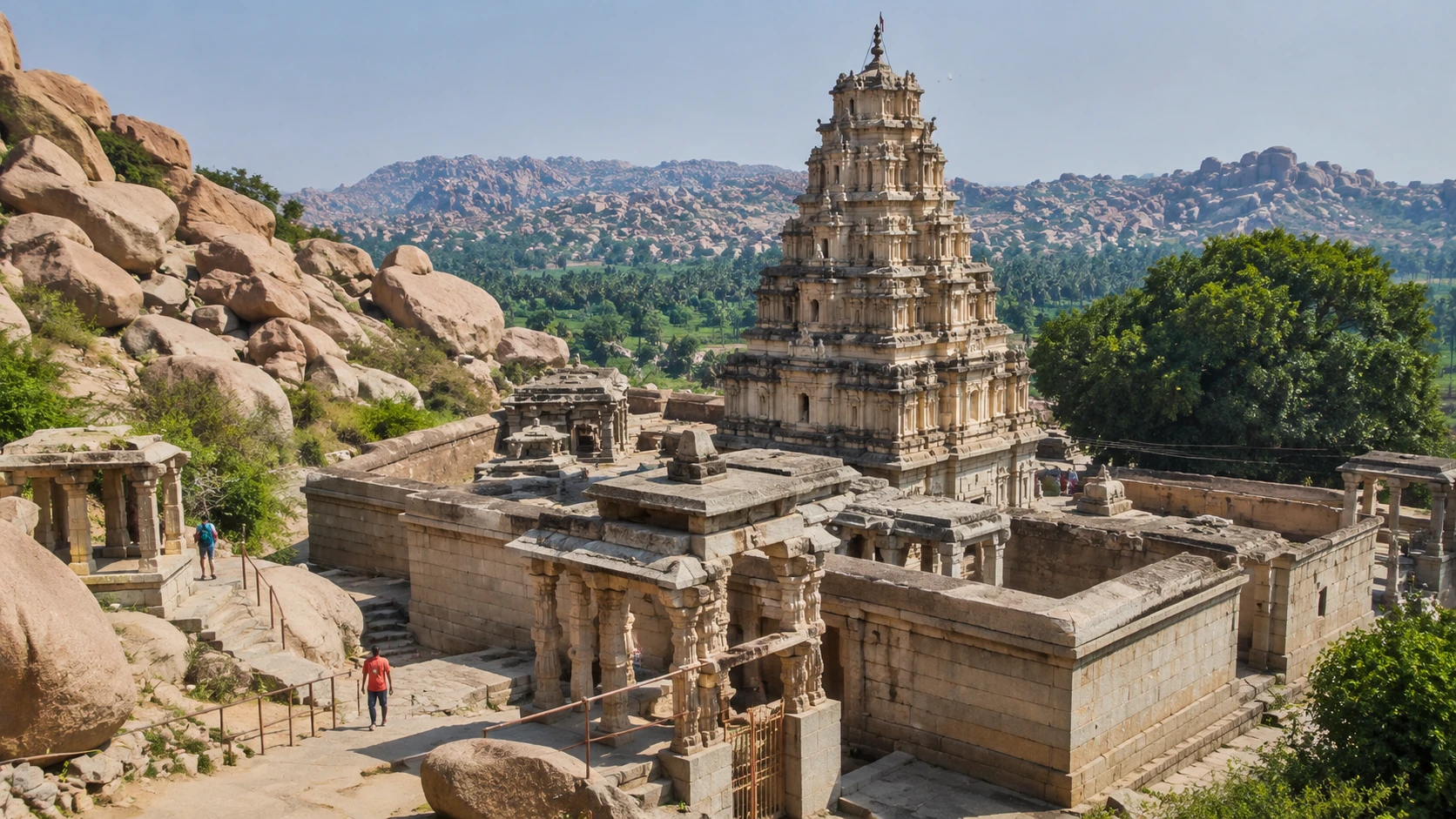
The Yantrodharaka Anjaneya murti is a standing Hanuman figure in the Vijayanagara sculptural style — large, powerful, with the characteristic decorative elaboration of the 14th–16th century Deccan tradition. The right hand is raised in abhaya mudra or holds a weapon; the left holds a gada. The murti carries the sindoor coating of continuous worship but the underlying stone shows the refined quality of Vijayanagara-period carving. The temple's architectural setting is characteristic of Vijayanagara sacred architecture — a gopuram entrance, a mandapa (pillared hall), and a garbhagriha — but the stone used and the surrounding landscape of boulders, ruins, and the Tungabhadra river give it a visual context unlike any other Hanuman temple in India. The ruins of the Vijayanagara bazaar extend around the temple; the Virupaksha temple's towering gopuram is nearby. To stand at the murti is to see simultaneously a living temple and the ruins of the civilization that built it.
Distinctive Practicesविशिष्ट परंपराएँ
Heritage Pilgrimage Circuit (Kishkindha Parikrama)
विरासत तीर्थयात्रा सर्किट (किष्किंधा परिक्रमा)
Year-round; most pilgrims undertake the full circuit over 1–2 days
Pilgrims visiting the Yantrodharaka Anjaneya typically undertake a broader Kishkindha circuit through the Hampi heritage landscape. The circuit includes: Yantrodharaka Anjaneya temple (Hampi bazaar), the Matanga hill (where Vali's body was carried in the Ramayana), the Rishyamuka Parvata (where Sugriva and Hanuman hid from Vali), the Tungabhadra river crossing to Anegundi, and the Anjaneyadri hill (believed to be Hanuman's birthplace). The circuit transforms the pilgrimage into a journey through the physical landscape of the Ramayana rather than a visit to a single temple.
The Hampi landscape is not merely the backdrop to a temple — it is the surviving physical form of Kishkindha itself. Walking from site to site through the Vijayanagara ruins is walking through the terrain where Hanuman grew up, where the alliance between Rama and Sugriva was made, where the vanara army assembled. The heritage pilgrimage circuit makes the entire landscape the object of devotion — rock, river, hill, and ruin alike.
Did You Know?क्या आप जानते हैं?
Hampi is identified in Hindu tradition with Kishkindha — the monkey kingdom of the Ramayana — making it the only major Indian heritage site that is simultaneously a UNESCO World Heritage Site and a landscape believed to be Hanuman's literal homeland. The Vijayanagara kings explicitly used this identification as political theology, claiming descent from the Ramayana monkey kingdom.
Valmiki Ramayana, Kishkindha Kanda; ASI heritage documentation; Burton Stein (1989)
The Panchamukha (five-faced) form of Hanuman — which the 'Yantrodharaka' name invokes — depicts Hanuman simultaneously embodying five divine energies: his own face (Anjaneya, east), Narasimha (south), Garuda (west), Varaha (north), and Hayagriva (sky/zenith). This form is particularly revered in South Indian Hanuman worship and is associated with total protection in all five directions.
Adbhuta Ramayana; Kamba Ramayana; Philip Lutgendorf (2007)
The Vijayanagara Empire's greatest monarch Krishnadevaraya (r. 1509–1529) composed the Telugu literary masterpiece Amuktamalyada, which includes extensive meditation on Vishnu devotion. His patronage of Hanuman temples at Hampi was part of a deliberate theological program in which the monkey-kingdom mythology anchored the empire's spiritual legitimacy.
Amuktamalyada by Krishnadevaraya; Vijayanagara historical scholarship
The Anjaneyadri hill in Anegundi, across the Tungabhadra river from Hampi, is held in tradition to be the birthplace of Hanuman. The hill is reached by climbing approximately 575 steps; a small temple at the summit marks the birth site. Pilgrims visiting the Yantrodharaka Anjaneya temple commonly make the river crossing and hill climb as part of the same Kishkindha pilgrimage circuit.
Local tradition; ASI heritage documentation on Anegundi
Visitor Accessप्रवेश जानकारी
The Yantrodharaka Anjaneya temple is open to all devotees. The temple is located within the Hampi UNESCO World Heritage Site — the Archaeological Survey of India's zone regulations apply to the surrounding ruins, though active temples within the zone maintain their own worship protocols. Photography of the ruins is permitted throughout; photography inside the sanctum should be confirmed on-site. Footwear removed before the temple. The heritage landscape requires sturdy footwear for walking the boulder-strewn terrain between sites.
Hire a local guide or auto-guide service for the full Kishkindha circuit — navigating the ruined landscape efficiently requires local knowledge. The circuit covering Yantrodharaka Anjaneya, Matanga hill, Rishyamuka, Tungabhadra crossing, Anjaneyadri, and return takes a full day. Carry water and sun protection — the boulder landscape is exposed and can be brutally hot in summer. Coracle boat rides across the Tungabhadra to Anegundi and Anjaneyadri are part of the pilgrimage experience.
Festivalsत्योहार
Hanuman Jayanti
हनुमान जयंती
Mar-Apr (Chaitra Purnima)
The principal festival at Yantrodharaka Anjaneya, celebrated across the Hampi heritage landscape. Special abhishekam, extended darshan, and pilgrimage by devotees from across Karnataka, Andhra Pradesh, and Telangana. The Anjaneyadri hill temple and the Yantrodharaka Anjaneya are both focal points. The Kishkindha geography gives this celebration a significance unique to Hampi — Hanuman's birthday observed in his homeland.
Vijayadasami (Vijaya Dashami)
विजयदशमी
Sep-Oct (Ashwin Shukla Dashami)
Vijaya Dashami — the day of Rama's victory over Ravana — carries special meaning at Hampi, where the Vijayanagara Empire claimed its authority from the Ramayana tradition. The festival is observed with particular devotion at the surviving Ramayana-associated temples in the Hampi area. The day was historically celebrated as a major state festival by the Vijayanagara kings with processions and temple worship at the royal scale.
Traditional Offeringsपारंपरिक अर्पण
प्राथमिक अर्पण
Sindoor (Vermilion)
सिंदूर
सिन्दूर
Sindoor offered to Anjaneya in the Vijayanagara tradition carries the standard theological meaning — Hanuman's body covered in vermilion as an act of total devotion to Rama — but at Hampi it carries a historical resonance: the Vijayanagara kings and their courts, the greatest Hanuman devotees of their age, offered sindoor at this very site. The offering connects the present devotee to a line of worship centuries deep.
Coconut
नारियल
नारिकेल
Coconut offering before Anjaneya symbolizes the breaking of obstacles. In the Karnataka-Andhra devotional tradition, the coconut offering is among the most common and is always fresh — the coconut is broken at the temple rather than offered whole. The coconut water and kernel are typically distributed as prasad, including to the pilgrims present.
Laddoo and Karnataka sweets
लड्डू और कर्नाटक मिठाइयाँ
Sweet offerings to Anjaneya at Hampi include standard boondi laddoos but also regional Kannada and Telugu sweets — holige (sweet flatbread), obbattu, and chakli. Temple prasad in Karnataka often reflects the local culinary tradition, distinguishing South Indian Hanuman temple offerings from the laddoo-centric North Indian norm.
Chameli Tel (Jasmine Oil)
चमेली तेल
Jasmine oil offered to anoint the murti, standard practice at Hanuman temples across both North and South India. At Hampi, where the landscape carries the fragrance of wild jasmine during certain seasons, the offering connects the devotee to the natural environment of the sacred site.
Offering materials are available from vendors near the temple and throughout the Hampi bazaar area. For the Kishkindha circuit pilgrimage (including Anjaneyadri hill), carry offerings to last the day. Local vendors near the Tungabhadra coracle crossing also sell offerings for the Anjaneyadri temple.
How to Reachकैसे पहुँचें
Hampi is in the Vijayanagara district of northern Karnataka, on the south bank of the Tungabhadra river.
By rail, Hospet Junction (13 km from Hampi) is the nearest railway station, with trains from Bengaluru (Hubli route), Hubballi, Hyderabad, Guntakal, and other regional hubs. From Hospet, autos and buses reach Hampi bazaar in about 30 minutes.
By road, Hampi is 350 km from Bengaluru (5–6 hours), 160 km from Hubballi (3 hours), and 72 km from Hubli Airport. Karnataka State Road Transport Corporation (KSRTC) buses run from Bengaluru to Hospet; local buses connect Hospet to Hampi.
By air, Hubli Airport (72 km) has flights from Bengaluru, Mumbai, and Hyderabad. Bengaluru Kempegowda International Airport (350 km) has the broadest domestic and international connectivity.
Within Hampi, auto-rickshaws, bicycles, and walking are the primary transport modes for navigating the heritage site. For the Kishkindha circuit including Anegundi and Anjaneyadri, coracle boats cross the Tungabhadra river from the north bank of Hampi.
Plan Your Visitयात्रा की योजना
🌤 सर्वोत्तम मौसम
October to February is ideal — temperatures of 18–30°C and manageable sun exposure for walking the boulder landscape. March–May brings intense heat (35–44°C) that makes outdoor walking between sites very challenging. The monsoon (June–September) greens the landscape dramatically but roads can become difficult. The Hampi festival calendar aligns well with October–March visits.
👘 पहनावे का नियम
Modest traditional dress appropriate. Sturdy closed-toe footwear essential for the boulder terrain — sandals are inadequate. Sun hat and sunscreen mandatory in all but winter months. Remove footwear before temples.
📱 फोन और फोटोग्राफी
Photography of the ruins, boulder landscape, and temple exteriors is freely permitted. Confirm sanctum photography rules at the temple itself. The ASI prohibits certain photography at protected monuments within the heritage zone.
🏨 आवास
Hampi and nearby Hospet (13 km) offer accommodation at all price points. Hampi bazaar area has numerous guesthouses and small hotels — book well in advance for peak season (November–February) and festival periods. Hospet has better mid-range hotels. Several heritage stays and resort properties have developed in the Hampi-Kamalapuram area for higher-end travelers. The Karnataka Tourism Development Corporation (KSTDC) operates facilities near the site.
Sacred Soundsपवित्र ध्वनि
क्या आप जानते हैं? · Did You Know?
वही अनुवाद त्रुटि जिसने हिन्दू धर्म में '33 कोटि' को '33 करोड़' बनाया, बौद्ध धर्म में भी हुई। बौद्ध ग्रन्थों के चीनी अनुवाद ने 'सप्त कोटि बुद्ध' (7 श्रेष्ठ बुद्ध) का अनुवाद '7 करोड़ बुद्ध' कर दिया। तिब्बती अनुवाद ने सही किया: 7 प्रकार, 7 करोड़ नहीं। एक संस्कृत शब्द, दो प्रमुख विश्व धर्मों में गलत पढ़ा गया, ने दो एकसमान भ्रम स्वतन्त्र रूप से उत्पन्न किए।
Related Contentसंबंधित सामग्री
Related Scriptures
Community Reflections
🕉️
Be the first to share your reflection.