Hanuman Garhi
हनुमान गढ़ी
The fortress where Hanuman guards Rama's city
Ayodhya, Uttar Pradesh, India
HanumānagarḥīAlso known as: Hanuman Garhi Mandir, Hanuman Garhi Ayodhya, Hanumangarhi
युग
Antiquity uncertain; current structure attributed to Nawab of Awadh's era (~18th century), with older shrine on site
वास्तुकला
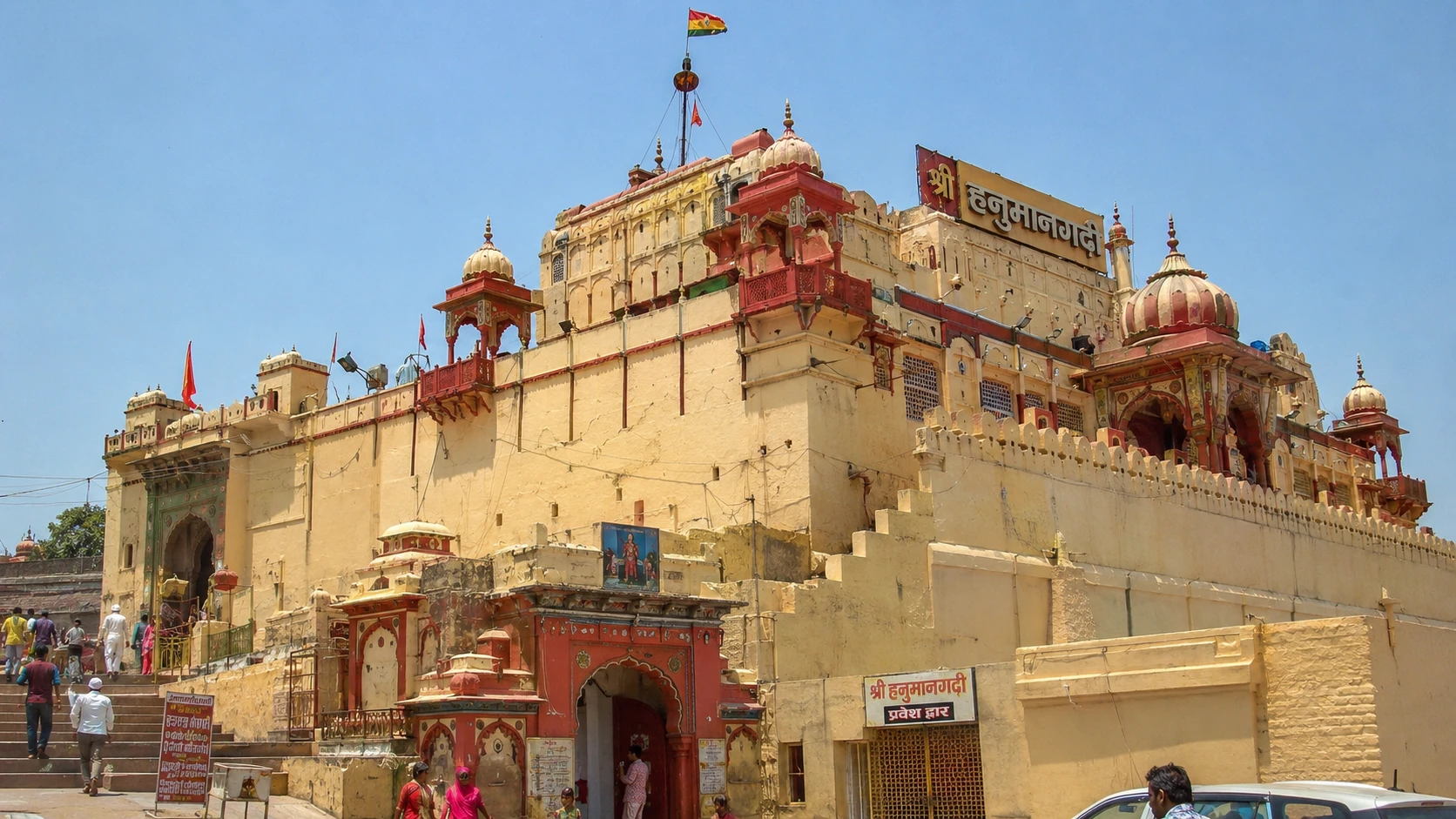
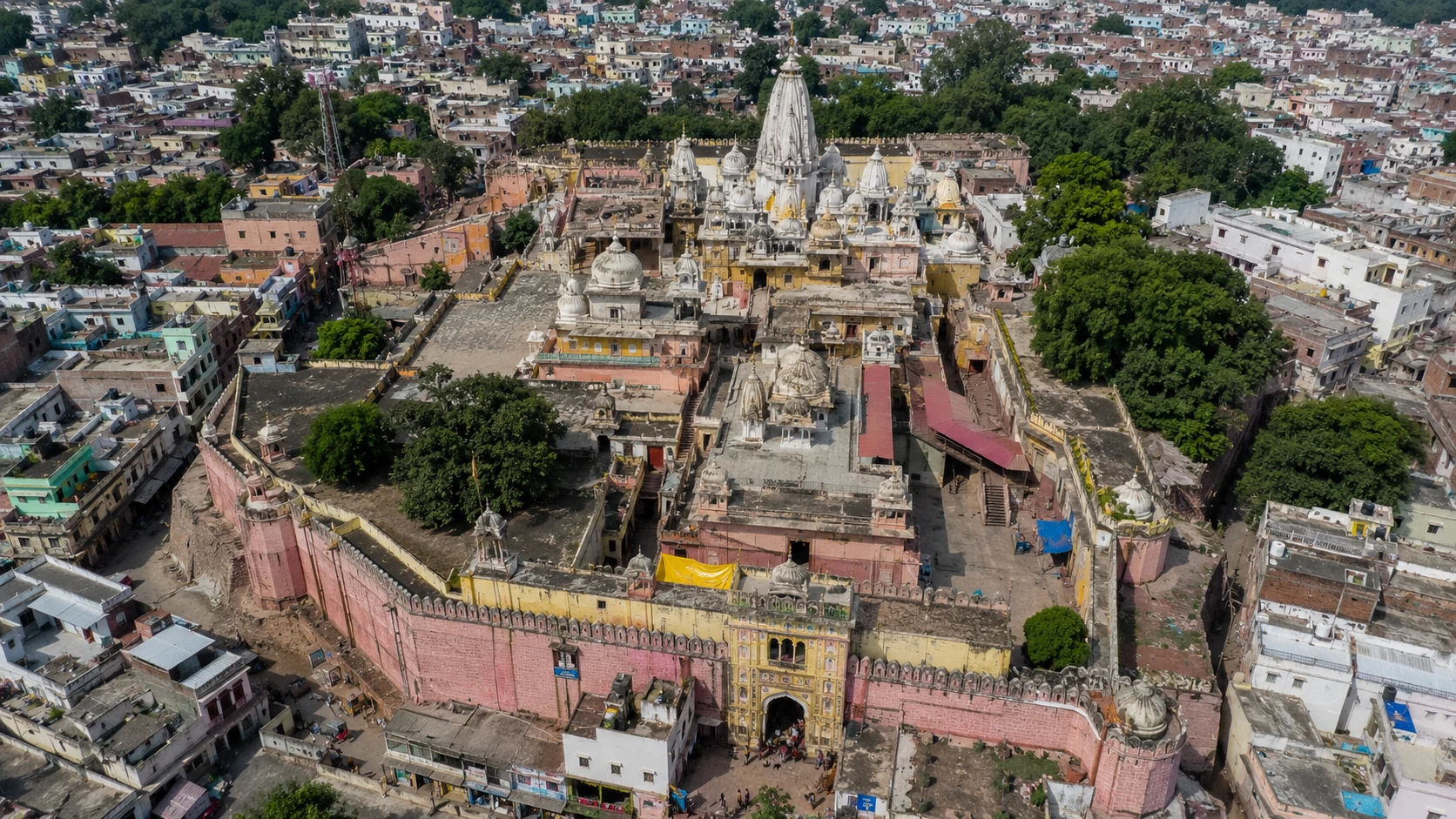
Fortress-style temple (garhi) on elevated mound; North Indian temple architecture
खुला
05:00 – 22:00
आरती
06:00 · 12:00 · 19:30
विशेष
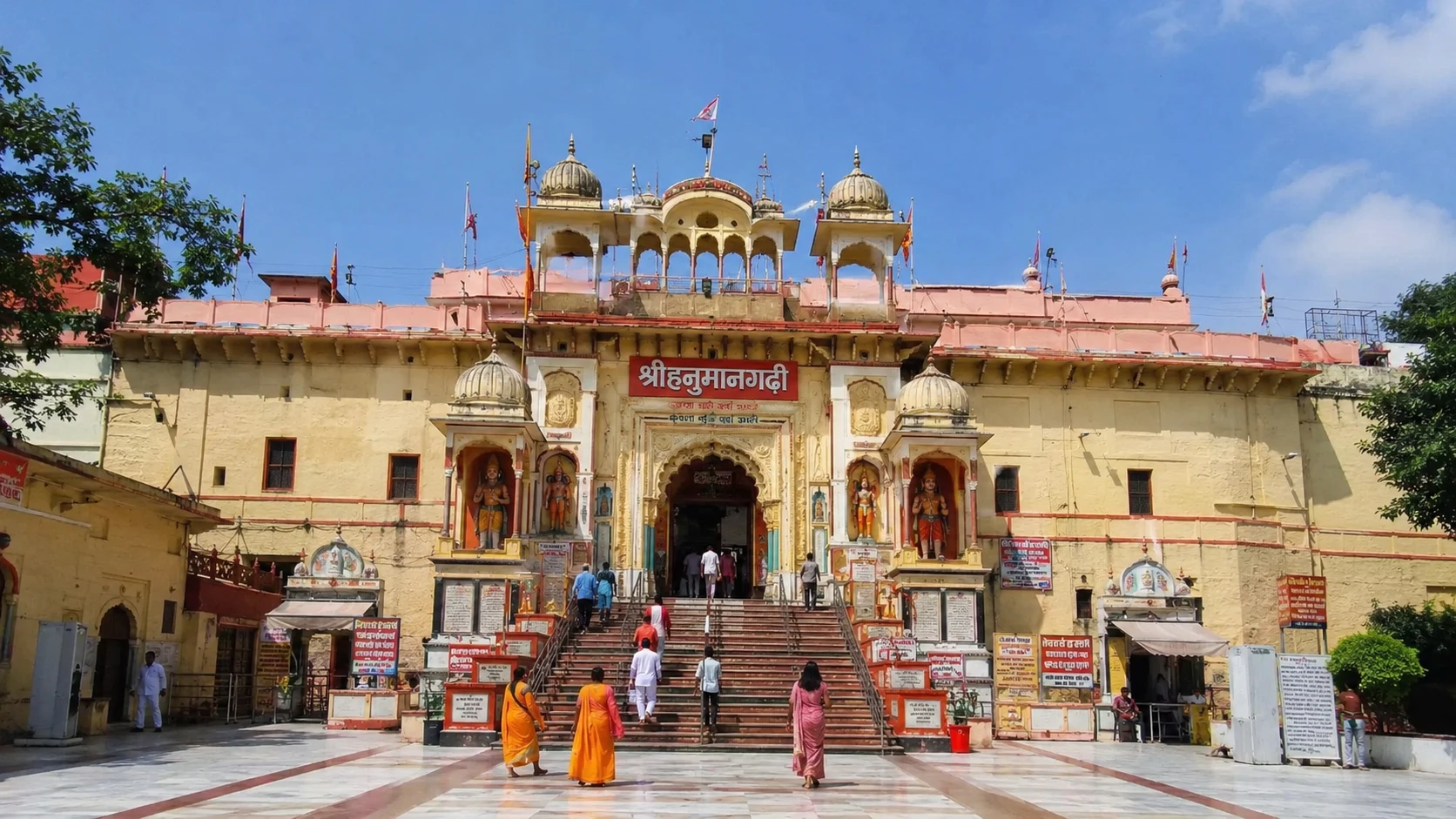
Seventy-six steps lead to the main sanctum on the hillock; Tuesdays and Saturdays are primary congregation days
पवित्र कथा · पवित्र कथा
In Ayodhya, the city that belongs to Rama, the most visited temple is not Rama's — it is Hanuman's. Hanuman Garhi rises like a fortress on a hillock in the heart of the old city, reached by a steep climb of seventy-six steps. The tradition holds that Hanuman chose this spot as his permanent guard post, a cave on the hill from which he has watched over Rama's capital since the Treta Yuga. What makes this temple unique among Hanuman shrines is the form of the deity: not the muscular warrior carrying a mountain, but a tender image of the infant Hanuman cradled in the lap of his mother Anjani — the protector revealed first as a child, reminding devotees that even the mightiest power begins in a mother's arms.
Sacred Origin Storyपवित्र उत्पत्ति कथा
Source: Local Ayodhya tradition / Awadhi oral narrative — widely attested
The mythology of Hanuman Garhi is inseparable from the mythology of Ayodhya itself — the city of Lord Rama.
The foundational belief is that after the events of the Ramayana — after Rama's victory at Lanka, his return to Ayodhya, and the commencement of Rama Rajya (the ideal reign) — Hanuman refused to leave his lord's city. While others returned to their homes and kingdoms, Hanuman remained in Ayodhya as the eternal guardian. He chose a hillock in the heart of the city and established himself in a cave there, watching over Rama's capital with the same vigilance he had shown during the war.
The tradition holds that Hanuman lives in this cave to this day — not as a memory or a symbol but as a living presence. Devotees believe that the hill on which Hanuman Garhi stands is the very hillock where Hanuman took his post, and that the cave shrine within the temple marks the exact spot of his eternal vigil.
What makes the Hanuman Garhi tradition distinctive, however, is not the guardian narrative — which is common to many Hanuman temples — but the form in which the deity is worshipped here. The principal murti depicts not the adult warrior Hanuman but the infant Hanuman (Bal Hanuman) seated in the lap of his mother Anjani Devi. This mother-child iconography is extremely rare in Hanuman worship across India.
The theological significance is layered. On one level, the image of Anjani with the infant Hanuman recalls the Puranic narrative of Hanuman's birth — Anjani's tapas, the boon from Vayu (the Wind God), and the birth of the divine child who would become Rama's greatest devotee. On another level, it teaches that even Hanuman — the being capable of lifting mountains, crossing oceans, and burning Lanka — was first a child in a mother's lap. His power did not diminish his tenderness; his tenderness did not diminish his power.
Pilgrims to Ayodhya traditionally visit Hanuman Garhi before visiting any other temple, including the Ram Mandir. This is not mere custom but theological sequence: one first seeks the blessing and protection of the guardian before approaching the king. Just as Hanuman preceded Rama to Lanka to assess the situation, devotees visit Hanuman first to seek his grace before presenting themselves before Rama.
उद्धृत स्रोत:
- Local Ayodhya pilgrimage tradition (oral)
- Awadhi folk narrative tradition
- Valmiki Ramayana and Tulsidas's Ramcharitmanas — for the broader Hanuman-guardian-of-Ayodhya narrative
- Philip Lutgendorf, 'Hanuman's Tale: The Messages of a Divine Monkey' (2007)
विद्वत संदर्भ
Lutgendorf (2007) discusses Hanuman Garhi as an example of Hanuman's evolving role in North Indian devotion — from Rama's servant in the Valmiki Ramayana to a powerful independent deity in his own right. The tradition of visiting Hanuman Garhi before the Ram temple reflects what Lutgendorf calls the 'gatekeeper theology' — Hanuman as the one who mediates access to Rama. The Anjani-Bal Hanuman iconography is unusual and may reflect the temple's function as the first stop for families and women pilgrims, for whom the maternal aspect offers a different entry point into Hanuman devotion than the martial form.
Historyइतिहास
The documented history of Hanuman Garhi is complicated by the absence of a dated foundation inscription. The hillock on which the temple stands likely hosted a shrine for centuries before the current structure was built. Local tradition attributes the earliest worship at the site to the ancient period, but the architectural evidence points to the current fortress-style structure being built or substantially renovated in the 18th century, during the Nawabi period of Awadh.
The Nawabs of Awadh, who ruled the region from Lucknow and Faizabad, are documented as having patronized both Hindu and Islamic religious sites. The fortress-like architecture of Hanuman Garhi — the elevated mound, the thick walls, the imposing stairway — may reflect this period's building conventions, though the exact patron and date are not established through inscriptions.
In 1855, Hanuman Garhi was the site of a violent sectarian incident when a group of Sunni Muslims, led by Maulvi Amir Ali of Amethi, attempted to seize the temple. The resulting confrontation led to significant casualties on both sides. The British colonial administration intervened, and the temple remained under Hindu custodianship. This event is documented in British colonial records and is sometimes cited as an early episode in the communal tensions that would come to define Ayodhya's modern history.
The temple is managed by the Nirmohi Akhara, one of the most prominent Vaishnavite monastic orders in North India. The Akhara's custodianship of Hanuman Garhi has been continuous through the modern period.
In the 21st century, Hanuman Garhi's significance has been amplified by the transformation of Ayodhya into a major national pilgrimage destination. The consecration of the Ram Mandir at the Ram Janmabhoomi site in January 2024 brought an unprecedented surge in pilgrim traffic to Ayodhya. Hanuman Garhi, as the traditional first stop on the Ayodhya pilgrimage circuit, has benefited directly — footfall has increased dramatically, and the Uttar Pradesh government and the temple trust have invested in infrastructure improvements including widened approach roads, crowd management systems, and pilgrim amenities.
The Maharishi Valmiki International Airport, inaugurated in Ayodhya in 2024, has further transformed access to the city, making the pilgrimage circuit accessible to devotees from across India who previously relied on rail connections via Faizabad or Lucknow.
Historical Timelineऐतिहासिक कालक्रम
Construction or substantial renovation of the current fortress-style temple structure on the hillock, attributed to the Nawabi period of Awadh. The elevated mound, thick walls, and imposing seventy-six-step stairway date to this period.
No dated foundation inscription survives for Hanuman Garhi. The attribution to the Nawabi period is based on architectural analysis and the general pattern of Awadh-era temple construction. An older shrine likely existed on the site before the current structure.
Sectarian attack on Hanuman Garhi by a group of Sunni Muslims led by Maulvi Amir Ali of Amethi. The confrontation resulted in significant casualties. British colonial authorities intervened and upheld Hindu custodianship of the temple.
The 1855 Hanuman Garhi incident is documented in British colonial records and has been analyzed by scholars including Peter van der Veer (1988) and Hans Bakker (1986). It is sometimes cited as an early episode in the communal tensions over sacred space in Ayodhya that would intensify in the 20th century.
Consecration (Pran Pratishtha) of the Ram Mandir at the Ram Janmabhoomi site in Ayodhya, transforming the city into a major national pilgrimage destination. As the traditional first stop on the Ayodhya circuit, Hanuman Garhi experienced a dramatic increase in visitor traffic.
Inauguration of Maharishi Valmiki International Airport in Ayodhya, providing direct air connectivity to the pilgrimage city for the first time. The airport transformed access patterns for the Ayodhya pilgrimage circuit, including Hanuman Garhi.
What You'll Seeदर्शन में
The principal murti at Hanuman Garhi depicts the infant Hanuman (Bal Hanuman) seated in the lap of his mother Anjani Devi. This mother-child iconographic form is extremely rare among Hanuman temples in India, where the deity is almost universally depicted as a powerful adult — standing with mace, carrying the Dronagiri mountain, or tearing open his chest to reveal Rama and Sita. The Anjani-Bal Hanuman form at Hanuman Garhi shows a tender, intimate scene: the mother goddess cradling the divine child, her expression serene, his posture at once playful and potent. The murti is adorned with sindoor, flower garlands, and ornamental clothing, with elaborate decoration during festivals. The sanctum is located at the top of the seventy-six-step stairway, inside the fortress-like walls, creating a sense of ascending to a protected inner court.
Distinctive Practicesविशिष्ट परंपराएँ
First Stop Pilgrimage Tradition
प्रथम पड़ाव तीर्थ परंपरा
Always — applies to every Ayodhya pilgrimage
Pilgrims to Ayodhya traditionally visit Hanuman Garhi first, before visiting the Ram Mandir or any other temple in the city. The practice is deeply embedded in the Ayodhya pilgrimage circuit — local guides, temple authorities, and pilgrim tradition all reinforce this sequence. Devotees climb the seventy-six steps, take darshan of Anjani-Bal Hanuman, receive prasad, and only then proceed to the other temples.
The theological logic is that of the gatekeeper: one seeks the protection and blessing of the guardian before approaching the king. Hanuman is Rama's foremost devotee and the one who mediates access to divine grace. Just as Hanuman went to Lanka before Rama to prepare the way, devotees visit Hanuman first to seek his intercession before presenting themselves before Rama. This sequence also reflects the teaching that humility precedes access — the climb up seventy-six steps to Hanuman's fortress is itself an act of effort and devotion before the ease of approaching Rama.
Did You Know?क्या आप जानते हैं?
The principal murti at Hanuman Garhi depicts the infant Hanuman (Bal Hanuman) in the lap of his mother Anjani — an extremely rare iconographic form. While Hanuman is worshipped at thousands of temples across India, almost all depict him as an adult warrior. The mother-child form at Hanuman Garhi is virtually unique among major Hanuman temples.
Temple tradition; Philip Lutgendorf, 'Hanuman's Tale' (2007)
Hanuman Garhi is reached by climbing exactly seventy-six steps — a steep ascent that is itself considered a devotional act. The fortress-like architecture with thick walls and an imposing stairway is unusual for a temple and may reflect the building conventions of the Nawabi period of Awadh (18th century).
On-site observation; architectural analysis
In Ayodhya's pilgrimage tradition, devotees are expected to visit Hanuman Garhi before visiting any other temple, including the Ram Mandir. This 'gatekeeper' protocol — seeking Hanuman's blessing before approaching Rama — reflects the theological principle that Hanuman mediates access to divine grace.
Ayodhya pilgrimage tradition; Philip Lutgendorf (2007)
The temple is managed by the Nirmohi Akhara, one of the most prominent Vaishnavite monastic orders in North India. The Akhara, which traces its lineage to Ramananda (14th–15th century), has maintained custodianship of Hanuman Garhi through centuries of political change in Ayodhya.
Nirmohi Akhara records; Peter van der Veer (1988)
Visitor Accessप्रवेश जानकारी
Hanuman Garhi welcomes all devotees without restriction. The temple is reached by climbing seventy-six steps — elderly visitors and those with mobility difficulties should plan accordingly (no elevator or ramp exists). Photography is permitted on the steps and outer courtyard but not inside the inner sanctum. Mobile phones should be on silent mode inside the temple. Security screening is in place at the base of the steps.
The seventy-six steps can be challenging in summer heat — carry water and pace yourself. Early morning visits (before 8 AM) offer the shortest queues. Since the Ram Mandir consecration in 2024, Ayodhya pilgrimage traffic has increased dramatically; Tuesdays and Saturdays are particularly crowded. Combine with visits to the Ram Mandir, Kanak Bhawan, and Nageshwarnath temple for the standard Ayodhya circuit. Shoes must be deposited at the base of the steps — lockers are available.
Festivalsत्योहार
Hanuman Jayanti
हनुमान जयंती
Mar-Apr (Chaitra Purnima)
The most important festival at Hanuman Garhi, drawing enormous crowds to Ayodhya. The murti receives special abhishekam, the temple is elaborately decorated, and darshan hours extend through the night. Since the Ram Mandir consecration, Hanuman Jayanti in Ayodhya has become a national-scale event.
Ram Navami
राम नवमी
Mar-Apr (Chaitra Shukla Navami)
Lord Rama's birthday draws massive pilgrimage to Ayodhya, and Hanuman Garhi — as the traditional first stop — sees peak traffic. Devotees visit Hanuman Garhi first to seek Hanuman's blessing before proceeding to the Ram Mandir for the principal Ram Navami celebrations.
Tuesday and Saturday Congregations
मंगलवार और शनिवार समागम
Every Tuesday and Saturday, year-round
Both days draw large weekly crowds, with Tuesday being the primary Hanuman worship day and Saturday associated with Shani-related Hanuman devotion. The steep steps are continuously busy with ascending and descending devotees, and the temple operates at extended capacity.
Traditional Offeringsपारंपरिक अर्पण
प्राथमिक अर्पण
Sindoor (Vermilion)
सिंदूर
सिन्दूर
Sindoor is the primary offering to Hanuman, recalling his legendary act of covering his entire body in vermilion for Lord Rama's wellbeing. At Hanuman Garhi, sindoor offered to the Anjani-Bal Hanuman murti carries a dual significance — it honors both Hanuman's devotion to Rama and the mother-child bond between Anjani and her divine son.
Laddoo (Sweet offering)
लड्डू
Boondi laddoos are the standard sweet offering to Hanuman. At Hanuman Garhi, laddoo shops line the approach lanes at the base of the seventy-six steps. Devotees purchase laddoos, offer them at the sanctum, and receive a portion back as prasad. The sweetness is symbolically associated with Hanuman's nature — powerful but gentle, fierce but sweet.
Chameli Tel (Jasmine Oil)
चमेली तेल
Jasmine oil is offered to anoint the murti, a standard practice at North Indian Hanuman temples. The fragrance is believed to please Hanuman, who as a brahmachari deity is offered fragrant oils as a mark of veneration.
Coconut
नारियल
नारिकेल
Coconut breaking before Hanuman symbolizes the shattering of ego and obstacles. At Hanuman Garhi, devotees break coconuts at the base of the steps or at the sanctum as part of their petition to the guardian deity before proceeding to the Ram Mandir.
Offering shops line the base of the seventy-six steps and the approach lanes. Sindoor, chameli oil, laddoos, coconut, and flower garlands are all readily available. The temple does not operate its own prasad kitchen — neighborhood shops serve this function. Purchase offerings before climbing the steps, as options are limited at the top.
How to Reachकैसे पहुँचें
Hanuman Garhi is in the heart of Ayodhya's old city, on a hillock near the main market area.
Within Ayodhya, the temple is accessible by auto-rickshaw, e-rickshaw, or cycle-rickshaw from Ayodhya Junction station (2 km) or Ayodhya Cantt station (3 km). The approach roads have been widened since 2024, but the final stretch to the temple base involves walking through narrow lanes.
By rail, Ayodhya Junction is the closest station, well-connected to Lucknow, Varanasi, Delhi, and Mumbai. Express and superfast trains stop at Ayodhya Junction regularly.
By air, Maharishi Valmiki International Airport in Ayodhya (inaugurated 2024) is approximately 10 km from the temple and offers flights from Delhi, Mumbai, Ahmedabad, and other major cities. This has transformed access to Ayodhya for pilgrims flying in from across India. Lucknow Airport (135 km, ~3 hours by road) remains an alternative with broader flight connectivity.
Pilgrims typically combine Hanuman Garhi with the full Ayodhya circuit: Ram Mandir (Ram Janmabhoomi), Kanak Bhawan, Nageshwarnath Temple, Dashrath Mahal, and the Saryu Ghat for evening aarti. Hanuman Garhi is traditionally the first stop.
Plan Your Visitयात्रा की योजना
🌤 सर्वोत्तम मौसम
October to March is most comfortable (12–28°C). The Ram Navami period (March-April) is the most spiritually charged but also the most intensely crowded. Avoid May–June when temperatures exceed 45°C and the open-air seventy-six-step climb becomes extremely challenging. The monsoon (July–September) brings heavy rain but the temple remains accessible. Since 2024, all seasons see heavy pilgrim traffic due to the Ram Mandir effect.
👘 पहनावे का नियम
Modest dress expected. Traditional Indian attire is appropriate. Remove footwear at the base of the seventy-six steps — lockers available.
📱 फोन और फोटोग्राफी
Mobile phones on silent mode inside the temple. Photography permitted on steps and outer courtyard but not inside the inner sanctum.
🏨 आवास
Ayodhya's accommodation infrastructure has expanded rapidly since 2024. Options range from dharamshalas and trust-operated guest houses near the ghats to new mid-range and budget hotels along the approach roads. The Uttar Pradesh government has also developed pilgrim facilities near the Ram Mandir area. For budget travelers, multiple dharamshalas operate near Hanuman Garhi. For more comfortable stays, hotels in the newer parts of Ayodhya or in Faizabad (10 km) offer good options.
Sacred Soundsपवित्र ध्वनि
क्या आप जानते हैं? · Did You Know?
वही अनुवाद त्रुटि जिसने हिन्दू धर्म में '33 कोटि' को '33 करोड़' बनाया, बौद्ध धर्म में भी हुई। बौद्ध ग्रन्थों के चीनी अनुवाद ने 'सप्त कोटि बुद्ध' (7 श्रेष्ठ बुद्ध) का अनुवाद '7 करोड़ बुद्ध' कर दिया। तिब्बती अनुवाद ने सही किया: 7 प्रकार, 7 करोड़ नहीं। एक संस्कृत शब्द, दो प्रमुख विश्व धर्मों में गलत पढ़ा गया, ने दो एकसमान भ्रम स्वतन्त्र रूप से उत्पन्न किए।
Related Contentसंबंधित सामग्री
Related Scriptures
Community Reflections
🕉️
Be the first to share your reflection.