Salasar Balaji
सालासर बालाजी
Where the bearded Hanuman answers every cry for help
Salasar, Rajasthan, India
Sālāsar BālājīAlso known as: Salasar Dham, Salasar Hanuman, Daadhi Wale Balaji, Salasar Balaji Dham, Balaji Salasar
युग
Mid-18th century (c. 1754)
वास्तुकला
Rajasthani temple architecture with later modern expansion
खुला
05:00 – 21:30
आरती
05:30 · 07:30 · 12:00 · 18:00 · 20:30
विशेष
Saturdays draw the heaviest pilgrim traffic; Hanuman Jayanti and Navratri periods see extended darshan hours and special abhishekam
पवित्र कथा · पवित्र कथा
In the heart of Rajasthan's Shekhawati desert, a farmer's plough struck something buried in the earth — and what emerged was a murti of Hanuman unlike any other in India. The face bore a full beard, an iconographic rarity so striking that devotees call him Daadhi Wale Balaji, the Bearded One. Installed at Salasar in the mid-18th century by the ascetic Mohandasji, this temple has grown from a desert village shrine into one of the most visited Hanuman temples in the country, drawing millions each year who believe that no sincere prayer offered here goes unanswered.
Sacred Origin Storyपवित्र उत्पत्ति कथा
Source: Local Sthala Purana / oral tradition of the Shekhawati region — widely attested
The origin of Salasar Balaji is not traced to a Mahapurana but to a local miracle story that has become one of the most beloved Hanuman narratives in Rajasthan.
In the village of Asota, some distance from Salasar, a Jat farmer was ploughing his field one day in the mid-18th century when his plough struck something hard beneath the soil. He dug carefully and unearthed a stone murti of Hanuman — but this was no ordinary image. The face bore a full beard and mustache, a feature almost never seen in Hanuman iconography anywhere in India. The farmer, astonished, reported his discovery to the Thakur of Asota.
That same night, the Thakur dreamed that this murti was meant not for Asota but for Salasar, a small desert settlement where a devout Hanuman bhakt named Mohandasji lived. Mohandasji was a Brahmin ascetic who had spent years in intense devotion to Hanuman, performing daily worship with such sincerity that the villagers of Salasar regarded him as a saint. He had been praying ceaselessly for Hanuman to manifest in Salasar — for the deity himself to come and dwell among the people of this arid land.
The Thakur, moved by the dream, arranged for the murti to be transported to Salasar. When Mohandasji saw the bearded image of Hanuman, he wept with recognition. This was the form he had seen in his meditations — the Sankatahara, the Remover of Obstacles, come at last to dwell in the desert. Mohandasji consecrated the murti with Vedic rites, and from that day, the temple at Salasar was established.
Devotees believe the beard on the murti is not an artistic choice but a sign of Hanuman in his most powerful form — the mature, battle-ready protector who stood beside Rama at Lanka, not the youthful Hanuman of childhood stories. The bearded form is said to represent Hanuman as he appeared when he carried the Dronagiri mountain to save Lakshmana — fully grown, fully potent, fully present. Pilgrims who come to Salasar seek this form of protection: not gentle comfort, but fierce, active intervention in their troubles.
The tradition holds that Mohandasji's devotion was so intense that Hanuman promised him that anyone who prayed at this site with a true heart would be heard. This promise, passed down through oral tradition, is the reason millions journey across the desert to this day.
उद्धृत स्रोत:
- Sthala Purana of Salasar Balaji (oral tradition, compiled by temple trust)
- Local Shekhawati folk narratives — documented in regional Hindi literature
- Shree Salasar Balaji Temple Trust historical records
विद्वत संदर्भ
The bearded Hanuman iconography at Salasar is an iconographic anomaly that has attracted scholarly interest. Standard Hanuman iconography across both North and South Indian traditions depicts a clean-shaven, often youthful deity. The Salasar murti's facial hair may reflect a regional folk tradition of depicting powerful protector deities with mature, martial features — a pattern seen in some Rajasthani and Marwari devotional art. No Puranic text prescribes a bearded form for Hanuman; the tradition is entirely local and devotional. The temple's 18th-century founding places it in the period of post-Mughal regional consolidation in Rajputana, when local shrines often emerged as centers of community identity.
Historyइतिहास
The documented history of Salasar Balaji begins in the mid-18th century, during a period when the Shekhawati region of Rajasthan was a patchwork of Rajput thikanas and Jat agricultural settlements under the broader suzerainty of the Jaipur and Bikaner kingdoms. The discovery of the Hanuman murti at Asota village and its subsequent installation at Salasar by the ascetic Mohandasji around 1754 marks the founding event. The temple initially was a modest desert shrine — a small structure housing the consecrated murti, served by Mohandasji and his successors.
Through the late 18th and 19th centuries, the temple's reputation grew primarily through oral testimony — pilgrims who visited and reported miraculous resolutions to their troubles. The Shekhawati region, being a major trade corridor for Marwari merchants traveling between Rajputana and the ports of Gujarat and the Gangetic plain, ensured that word of the temple spread far beyond its immediate geography. Marwari trading families, who carried deep Hanuman devotion as part of their commercial and spiritual culture, became early and enduring patrons.
The 20th century transformed Salasar from a regional pilgrimage site into a nationally significant temple. Improved road connectivity after Indian independence, the growth of bus and rail networks linking Churu district to Jaipur and Delhi, and the Marwari diaspora's continuing patronage from Mumbai, Kolkata, and other commercial centers all contributed to exponential growth in footfall. The Shree Salasar Balaji Temple Trust was established to manage the growing infrastructure needs.
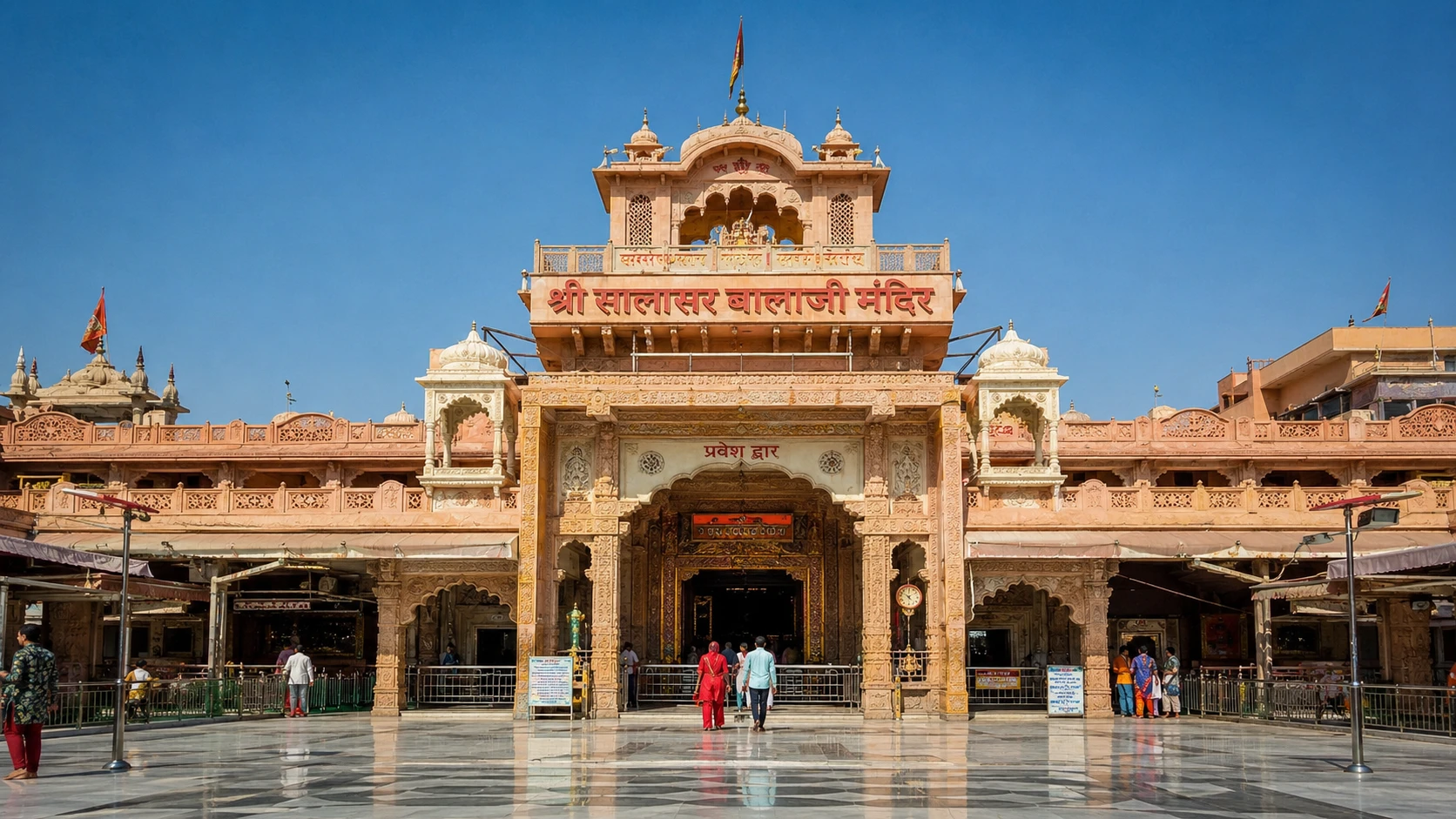
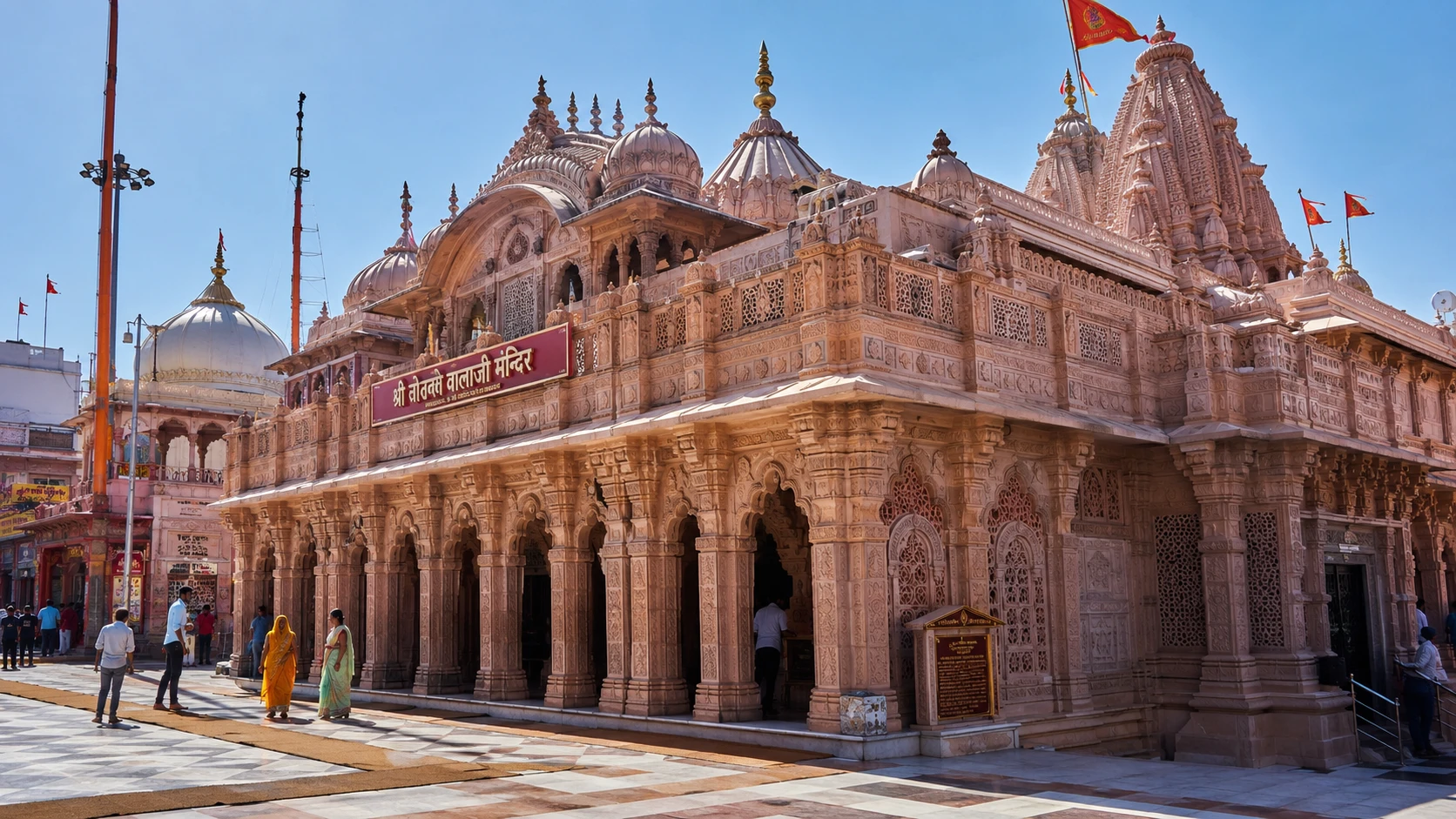
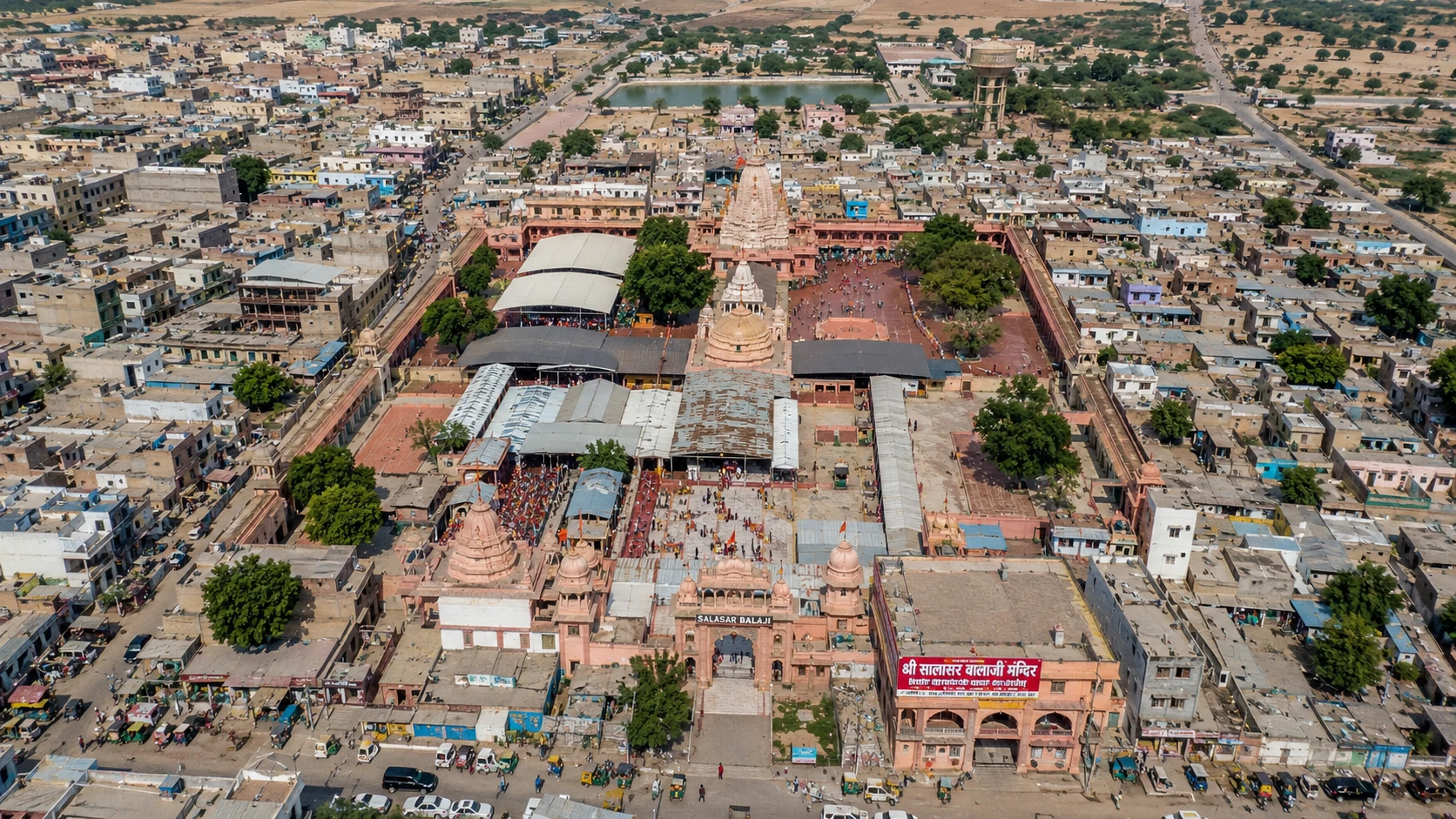
In recent decades, the temple has undergone significant expansion — new mandapas, pilgrim facilities, dharamshalas, and a large courtyard to accommodate the crowds, especially during Hanuman Jayanti and Navratri. The annual visitor count now runs into the millions. Despite this scale, the temple retains the character of a desert devotional center — the murti remains the original 18th-century image discovered at Asota, and the core ritual practice has not changed.
Historical Timelineऐतिहासिक कालक्रम
Discovery of the bearded Hanuman murti by a Jat farmer while ploughing his field in Asota village, Churu district. The Thakur of Asota, reportedly guided by a dream, arranged for the murti to be sent to Salasar.
The exact date of the murti's discovery is not recorded in any dated inscription or chronicle. The mid-18th century dating (c. 1754) is based on oral tradition maintained by the temple trust and the genealogical records of Mohandasji's lineage. No independent archaeological or epigraphic corroboration exists for the founding event.
Consecration of the Hanuman murti at Salasar by the ascetic Mohandasji, establishing the temple. Mohandasji performed Vedic installation rites and became the first chief priest of the shrine.
Growth of Salasar as a regional pilgrimage center, driven by Marwari merchant patronage and the Shekhawati trade corridor. Multiple small dharamshalas and pilgrim shelters were constructed around the temple by merchant families.
Establishment of the Shree Salasar Balaji Temple Trust and major expansion of the temple complex. New mandapas, a larger courtyard, improved pilgrim facilities, and road connectivity projects transformed the temple into a nationally significant pilgrimage destination.
What You'll Seeदर्शन में
The presiding murti at Salasar Balaji is a self-manifested (swayambhu) stone image of Hanuman, distinguished by its most striking feature — a full beard and mustache. This is an extreme rarity in Hanuman iconography across India, where the deity is almost universally depicted clean-shaven and youthful. The murti depicts Hanuman in a standing posture, right hand raised in the abhaya mudra (gesture of fearlessness and protection), with a gada (mace) held in the left hand. The eyes are large and prominent, the chest broad. The image is adorned daily with sindoor (vermilion), which over generations has given the murti a deep orange-red surface. Fresh flower garlands, particularly jasmine and marigold, are draped around the murti during each aarti. A silver crown (mukut) and ornamental clothing are placed on the deity during festivals. The overall iconographic impression is of Hanuman in his most mature, powerful form — the warrior-protector, not the devotional child.
Distinctive Practicesविशिष्ट परंपराएँ
Sindoor Offering
सिंदूर अर्पण
Daily, throughout the day
Devotees offer sindoor (vermilion paste) directly to the murti, applying it to the image and then taking a portion back as prasad to apply on their own foreheads. The murti is thickly coated in sindoor, renewed continuously by the stream of devotees. The air in the sanctum carries the distinctive earthy fragrance of fresh sindoor mixed with jasmine oil.
Sindoor offered to Hanuman recalls the story from the Ramayana where Hanuman, seeing Sita apply sindoor to her hair parting, asked its purpose. When told it was for Lord Rama's long life and wellbeing, Hanuman covered his entire body in sindoor, reasoning that if a small application could benefit Rama, full-body application would protect him infinitely more. The practice at Salasar thus becomes an act of emulating Hanuman's boundless devotion to Rama.
Saturday Pilgrimage
शनिवार तीर्थयात्रा
Every Saturday
Saturdays at Salasar Balaji are the weekly peak — the temple draws its largest crowds on this day. Pilgrim buses from Jaipur, Delhi, Sikar, and Bikaner arrive through the night and early morning. The darshan queue often stretches several hundred meters, and the temple extends its operational hours to accommodate the flow. Special food distribution (bhandara) is organized by devotee groups.
Saturday is traditionally associated with Hanuman worship across North India. The connection derives from Hanuman's role as the deity who can mitigate the malefic effects of Shani (Saturn), whose day is Saturday. Devotees believe that worshipping Hanuman on Saturday protects them from Shani's unfavorable astrological influence — a belief rooted in the Puranic narrative where Hanuman rescued Shani from captivity under Ravana.
Did You Know?क्या आप जानते हैं?
The Salasar Balaji murti is one of only a handful of Hanuman images in India that depict the deity with a full beard and mustache — a feature so distinctive that the temple is popularly known as 'Daadhi Wale Balaji' (the Bearded Hanuman). No canonical Puranic text prescribes this form; it is unique to this temple's tradition.
Temple trust records; iconographic analysis in regional art history literature
Salasar Balaji and Rani Sati Temple in Jhunjhunu (approximately 90 km apart) form one of the most popular twin-pilgrimage circuits in Rajasthan. Devotees, particularly from the Marwari community, traditionally visit both temples in a single trip — Balaji for protection from obstacles and Rani Sati for courage and fidelity. Bus operators and tour agencies market this as a standard combined pilgrimage route.
Rajasthan Tourism Department; pilgrim circuit documentation
The murti is classified as swayambhu (self-manifested) — discovered buried in agricultural land rather than carved by a sculptor. This classification gives it heightened devotional status in Hindu temple theology, where naturally occurring divine images are considered more potent than human-made ones.
Temple trust theological documentation; Hindu temple iconography traditions
During Hanuman Jayanti, the temple complex becomes the site of one of the largest single-day religious gatherings in the Shekhawati region. Temporary tent cities spring up around the temple, free food distribution (bhandara) is organized by dozens of devotee groups simultaneously, and the darshan queue can take 4–6 hours to traverse.
Rajasthan police and district administration crowd management reports; temple trust annual records
Visitor Accessप्रवेश जानकारी
Salasar Balaji welcomes all devotees regardless of gender, caste, or origin. There are no entry restrictions. Photography is permitted in the outer courtyard and temple grounds but not in the inner sanctum during darshan. Mobile phones should be on silent mode inside the temple. Footwear must be removed before entering the temple complex.
On Saturdays, Hanuman Jayanti, and Navratri, expect very long darshan queues (2–6 hours). Plan to arrive early morning or late evening for shorter waits. During peak periods, the temple administration manages crowd flow with barrier systems. Keep belongings minimal — lockers are available outside the temple complex. Carry water, especially in summer months when temperatures can exceed 45°C.
Festivalsत्योहार
Hanuman Jayanti
हनुमान जयंती
Mar-Apr (Chaitra Purnima)
The most important festival at Salasar Balaji, celebrating the birth of Hanuman. The temple sees its highest annual footfall on this day. Special abhishekam with panchamrit, extended aarti schedules, and 24-hour darshan are the norm. Massive bhandaras (community feasts) are organized by devotee groups from across Rajasthan and beyond. The murti is specially adorned with new garments, a silver crown, and elaborate floral decoration.
Chaitra Navratri
चैत्र नवरात्रि
Mar-Apr (Chaitra Shukla Pratipada to Navami)
Though Navratri is primarily a Devi festival, at Salasar Balaji the nine-day observance draws massive crowds. Hanuman, as the supreme devotee (param bhakt) of Rama and a brahmachari deity, is worshipped alongside the Devi in Rajasthani folk tradition. Special evening aartis and bhajan sessions run through all nine nights.
Ashwin Navratri (Sharad Navratri)
आश्विन नवरात्रि (शारद नवरात्रि)
Sep-Oct (Ashwin Shukla Pratipada to Navami)
The autumn Navratri draws the second-largest annual crowds after Hanuman Jayanti. The festival combines Devi worship and Hanuman veneration in the Shekhawati tradition. Many devotees undertake a nine-day walking pilgrimage from their home villages to Salasar, timing their arrival for the culmination of Navratri.
Saturday Congregations (Shanivar)
शनिवार समागम
Every Saturday, year-round
While not a formal festival, every Saturday functions as a mini-pilgrimage day at Salasar Balaji. The weekly congregation is so large and consistent that it shapes the temple's operational rhythm — extended hours, additional food distribution, and supplementary crowd management are permanent Saturday features.
Traditional Offeringsपारंपरिक अर्पण
प्राथमिक अर्पण
Sindoor (Vermilion)
सिंदूर
सिन्दूर
Sindoor is the most important offering to Hanuman, rooted in the Ramayana narrative where Hanuman saw Sita applying sindoor for Rama's wellbeing and covered his entire body in it to magnify the blessing. Offering sindoor to the murti and receiving a portion back as prasad is the central devotional act at Salasar. The vermilion is believed to carry Hanuman's protective energy.
Chameli Tel (Jasmine Oil)
चमेली तेल
Jasmine oil is offered to anoint the murti, a practice specific to Hanuman temples in the Rajasthani and North Indian tradition. The oil is believed to please Hanuman, who as a brahmachari deity is offered fragrant oils rather than the flowers and sweets typical of married deities. The application of oil mixed with sindoor creates the characteristic deep-orange coating seen on Hanuman murtis across North India.
Laddoo (Sweet offering)
लड्डू
Laddoos, particularly boondi laddoos, are the standard sweet offering to Hanuman. The practice recalls Hanuman's fondness for sweet foods mentioned in folk Ramayana traditions. At Salasar, devotees bring boxes of laddoos as offerings; a portion is placed before the murti and the rest distributed as prasad. The temple trust also prepares and distributes its own laddoo prasad.
Paan (Betel Leaf)
पान
ताम्बूल
Betel leaf offered to Hanuman is a tradition rooted in the hospitality rituals of Hindu worship — paan symbolizes respect and completion of a devotional offering cycle. In the Rajasthani tradition, paan is offered along with supari (betel nut) and elaichi (cardamom) as part of the concluding offering after darshan.
Coconut
नारियल
नारिकेल
Coconut breaking before the deity is a universal Hindu offering practice, symbolizing the destruction of ego before the divine. At Hanuman temples specifically, the hard shell represents the obstacles in the devotee's life, and breaking it represents Hanuman's intervention to shatter those obstacles — reflecting his name Sankatahara, the Remover of Difficulties.
इस मंदिर की विशेषता
Salasar Balaji Prasad (Temple Trust Laddoo)
सालासर बालाजी प्रसाद (मंदिर ट्रस्ट लड्डू)
The temple trust prepares its own consecrated laddoo prasad, distributed to devotees after darshan. This prasad is considered particularly blessed — devotees carry it home and share it with family members who could not make the pilgrimage. During peak festival days, the trust's kitchen produces thousands of laddoos daily to meet demand.
Devotees may bring their own offerings including sindoor, chameli oil, laddoos, coconut, and paan. The temple trust also sells pre-packaged offering sets (puja samagri) at counters near the entrance. Sindoor and oil are the most commonly brought offerings. During peak seasons, the temple manages offering flow to avoid congestion in the sanctum.
How to Reachकैसे पहुँचें
Salasar is in Churu district, in the Shekhawati region of northeastern Rajasthan. It is well-connected by road but somewhat remote from major railway and air hubs.
By road is the most common approach. Salasar lies on NH-65 (Jaipur–Bikaner highway), making it accessible by bus and car from both cities. From Jaipur, the drive takes approximately 4 hours (185 km) via Sikar. From Delhi, the drive is about 7–8 hours (430 km) via NH-48 and NH-65. Rajasthan State Road Transport Corporation (RSRTC) operates regular bus services to Salasar from Jaipur, Bikaner, Sikar, Jhunjhunu, and Delhi. Private Volvo and sleeper buses run nightly from Delhi and Jaipur, timed for early morning arrival. On Saturdays and festival days, additional services are deployed.
By rail, the nearest stations are Sujangarh Junction (57 km, about 1 hour by taxi) and Ladnun Junction (60 km). Sujangarh has trains from Jaipur, Delhi, Bikaner, Jodhpur, and Ahmedabad. From the station, shared taxis and private cabs run to Salasar regularly. Dedicated Salasar pilgrim buses meet incoming trains on Saturdays.
By air, the nearest airports are Jaipur (185 km, ~4 hours drive) and Bikaner (160 km, ~3 hours). Jaipur is the more practical choice with national and limited international connectivity.
Pilgrims frequently combine Salasar with a visit to the Rani Sati Temple in Jhunjhunu (90 km away), Khatu Shyamji (130 km), or the Shakambhari Mata Temple in Sikar district — forming a popular Shekhawati devotional circuit.
Plan Your Visitयात्रा की योजना
🌤 सर्वोत्तम मौसम
October to March is the most comfortable period — the Shekhawati desert region has mild, pleasant winters (10–25°C). Avoid April–June when temperatures regularly exceed 45°C and the desert heat makes queuing extremely challenging. The monsoon (July–September) brings some relief but roads can become temporarily waterlogged in low-lying areas near the temple. Hanuman Jayanti (March-April) and both Navratri periods are the most spiritually charged times but also the most intensely crowded.
👘 पहनावे का नियम
Modest dress is expected. There is no formal dress code enforced, but devotees typically wear traditional Indian attire. Carry head covering if visiting in summer for sun protection. Remove footwear before entering the temple complex — the temple courtyard floor can be extremely hot in summer months; proceed quickly or carry socks.
📱 फोन और फोटोग्राफी
Mobile phones should be on silent mode inside the temple. Photography is permitted in the outer courtyard and temple grounds but not inside the inner sanctum during darshan.
🏨 आवास
The Shree Salasar Balaji Temple Trust operates dharamshalas offering clean, basic rooms at subsidized rates — book in advance during festival seasons. Salasar town has a growing number of budget and mid-range hotels catering to pilgrims. For more comfortable stays, Sikar (85 km) and Churu (70 km) offer better hotel options. Pilgrims traveling from Jaipur or Delhi often prefer overnight buses that arrive early morning, complete darshan, and return the same day.
Sacred Soundsपवित्र ध्वनि
क्या आप जानते हैं? · Did You Know?
वही अनुवाद त्रुटि जिसने हिन्दू धर्म में '33 कोटि' को '33 करोड़' बनाया, बौद्ध धर्म में भी हुई। बौद्ध ग्रन्थों के चीनी अनुवाद ने 'सप्त कोटि बुद्ध' (7 श्रेष्ठ बुद्ध) का अनुवाद '7 करोड़ बुद्ध' कर दिया। तिब्बती अनुवाद ने सही किया: 7 प्रकार, 7 करोड़ नहीं। एक संस्कृत शब्द, दो प्रमुख विश्व धर्मों में गलत पढ़ा गया, ने दो एकसमान भ्रम स्वतन्त्र रूप से उत्पन्न किए।
Related Contentसंबंधित सामग्री
Related Scriptures
Community Reflections
🕉️
Be the first to share your reflection.