Bade Hanuman Ji (Prayagraj)
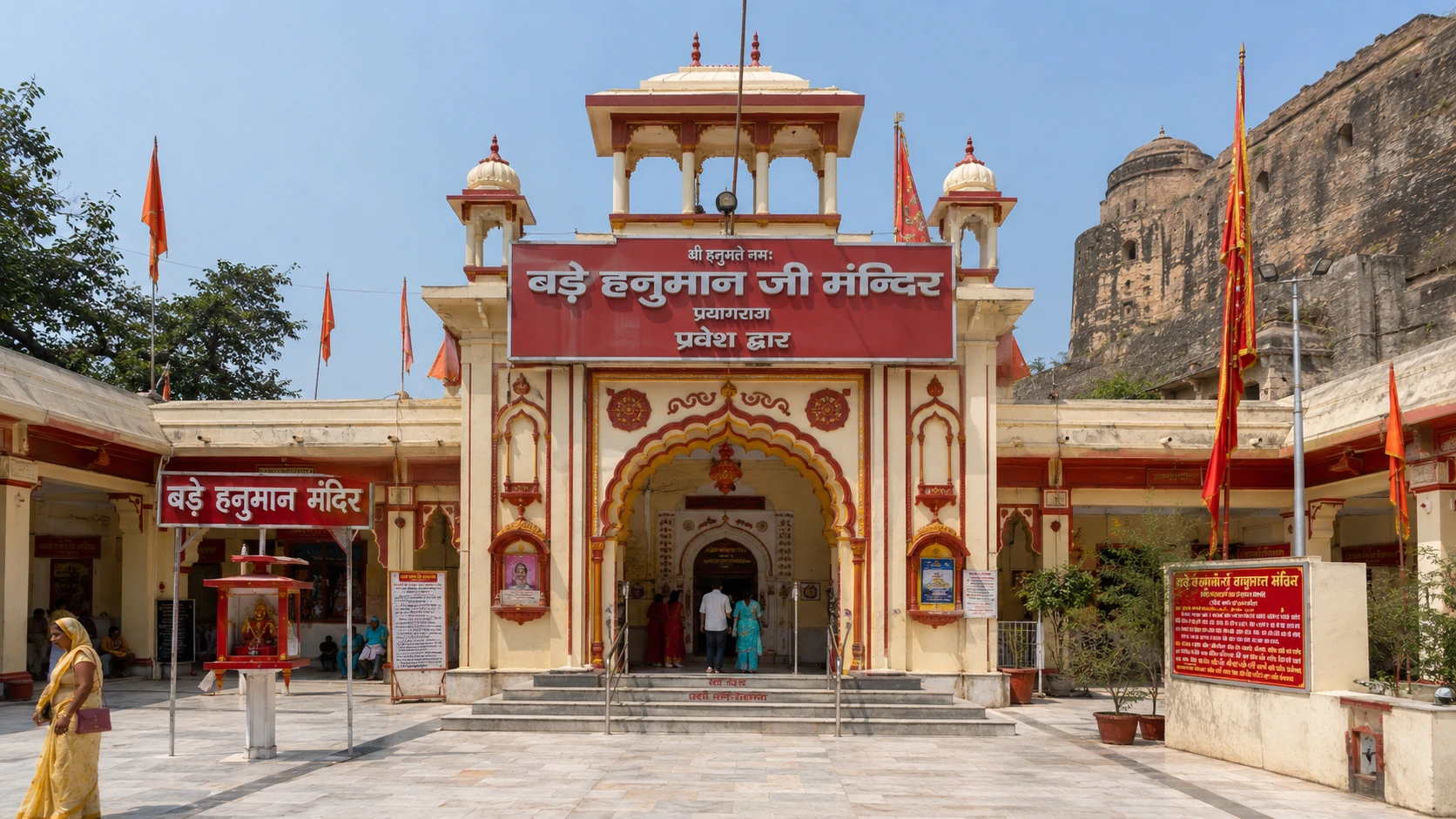
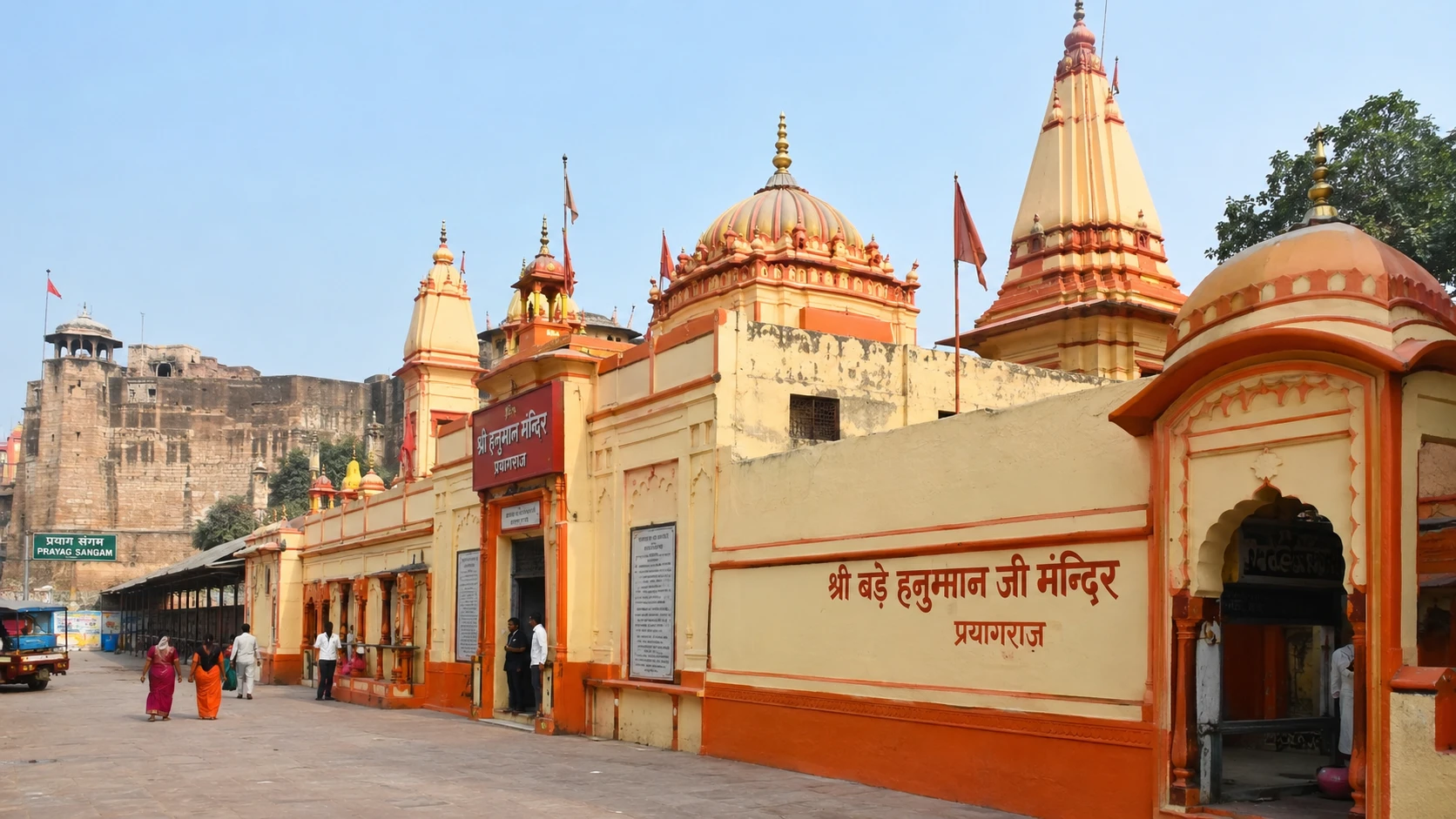
बड़े हनुमान जी मंदिर
Reclining at the Sangam, bathed by the Ganga itself
Prayagraj, Uttar Pradesh, India
Baṛe Hanumāna Jī MandiraAlso known as: Bade Hanuman Ji Mandir Prayagraj, Lete Hue Hanuman, Sayan Hanuman Mandir, Sangam Hanuman, Bajrang Mandir Prayagraj
युग
Antiquity uncertain; swayambhu murti of unknown date; current temple structure of the modern era
वास्तुकला
Semi-subterranean shrine; temple built around a naturally occurring low-lying murti near the Sangam
खुला
05:00 – 22:00
आरती
06:00 · 12:00 · 19:00
विशेष
Temple floods annually during monsoon Ganga rise — this period is treated as sacred; Kumbh Mela years draw millions to the Sangam and the temple
पवित्र कथा · पवित्र कथा
At the holiest confluence in Hinduism — the Triveni Sangam at Prayagraj, where the Ganga, the Yamuna, and the invisible Saraswati meet — lies a Hanuman unlike any other in India. Bade Hanuman Ji is not standing, not seated, not carrying a mountain. He is reclining, semi-prone, in a posture so rare that pilgrims travel from across the country just to see it. Each year, when the monsoon swells the Ganga, the temple floods and the sacred river bathes the murti directly — an abhishekam performed by the river itself, without any human hand. This annual submersion is not treated as a calamity but as a blessing: Hanuman, guardian of the most sacred waters in India, receives the embrace of the Ganga as his annual consecration.
Sacred Origin Storyपवित्र उत्पत्ति कथा
Source: Prayagraj local tradition / Sangam oral narrative — widely attested
The mythology of Bade Hanuman Ji at Prayagraj is rooted in the supreme sacred geography of the Triveni Sangam — the place where, according to Hindu cosmology, three of the holiest rivers converge: the Ganga, the Yamuna, and the subterranean Saraswati.
Prayagraj (Allahabad) holds a unique position in Hindu sacred geography. The Puranas describe it as the Tirtharaja — the King of All Pilgrimage Sites — because the merit (punya) earned by bathing at the Triveni Sangam is said to surpass the merit earned at all other tirthas. The Kumbh Mela, held here every twelve years, is the largest human gathering on earth, an expression of the site's unparalleled sacred power.
The local tradition holds that Hanuman, who had vowed to guard Rama's devotees throughout the Kali Yuga, chose the Triveni Sangam as his post precisely because it was the most sacred ground on earth. Where the greatest pilgrimage would concentrate the most devotees, Hanuman would position himself — not standing guard but reclining, watching, present at the confluence of the holiest waters.
The reclining posture (sayan or lete hue) is explained in different ways within the tradition. One account holds that Hanuman, after the events of the Ramayana, was exhausted from his labors and chose to rest at the Sangam — his body oriented so that his feet point toward the holy water, receiving the continual blessing of the tirtharaja's energies. Another account holds that the posture expresses Hanuman's disposition at the end of an age: not the martial alertness of the warrior in battle, but the watchful rest of a protector whose primary battle is over and who now keeps a gentle, eternal vigil.
What the tradition unanimously agrees upon is this: the flooding of the temple each monsoon, when the Ganga rises and covers the murti, is not a disruption but a consecration. The river that Shiva wears in his matted locks, the river born from Vishnu's feet, the river that carries the sins of all who touch it — this river comes to Hanuman. The greatest purifier is purified; the Tirtha-raja blesses the eternal guardian. When the floodwaters recede, devotees find the murti undamaged, still reclining, as though the Ganga merely paid a visit.
उद्धृत स्रोत:
- Local Prayagraj pilgrimage tradition (oral)
- Matsya Purana and Padma Purana — on Prayagraj as Tirtharaja
- Skanda Purana, Prayaga Mahatmya section
- Diana Eck, 'Banaras: City of Light' (1982) — for broader Ganga-Prayag sacred geography context
विद्वत संदर्भ
Diana Eck's 'India: A Sacred Geography' (2012) discusses Prayagraj's unique position in the Hindu sacred landscape as the Tirtharaja — the confluence that supersedes all other confluences. The reclining Hanuman murti at the Sangam fits within a pattern of deities positioned at places of extraordinary sacred potency in North Indian tradition: the deity is drawn to the place of maximum spiritual concentration, not placed there by human decision. The annual monsoon flooding, which submerges the murti, has a theological parallel in the submersion of Shivalingas in Varanasi during floods — a sacred inversion where the pilgrimage site becomes the pilgrim, receiving the blessing of the divine river.
Historyइतिहास
The historical record for Bade Hanuman Ji is thin, as the temple's significance derives from sacred geography rather than from a documented founding event or royal patronage. The murti is classified as swayambhu — self-manifested — and no dated inscription or textual source establishes when worship at this specific site began.
What is clear is that the Triveni Sangam at Prayagraj has been a site of continuous Hindu pilgrimage for at least two thousand years. The Prayaga Mahatmya sections of the Matsya Purana and Skanda Purana establish the site's theological status as Tirtharaja — King of Pilgrimage Sites — and the Kumbh Mela tradition at Prayagraj is among the oldest documented mass gatherings in human history.
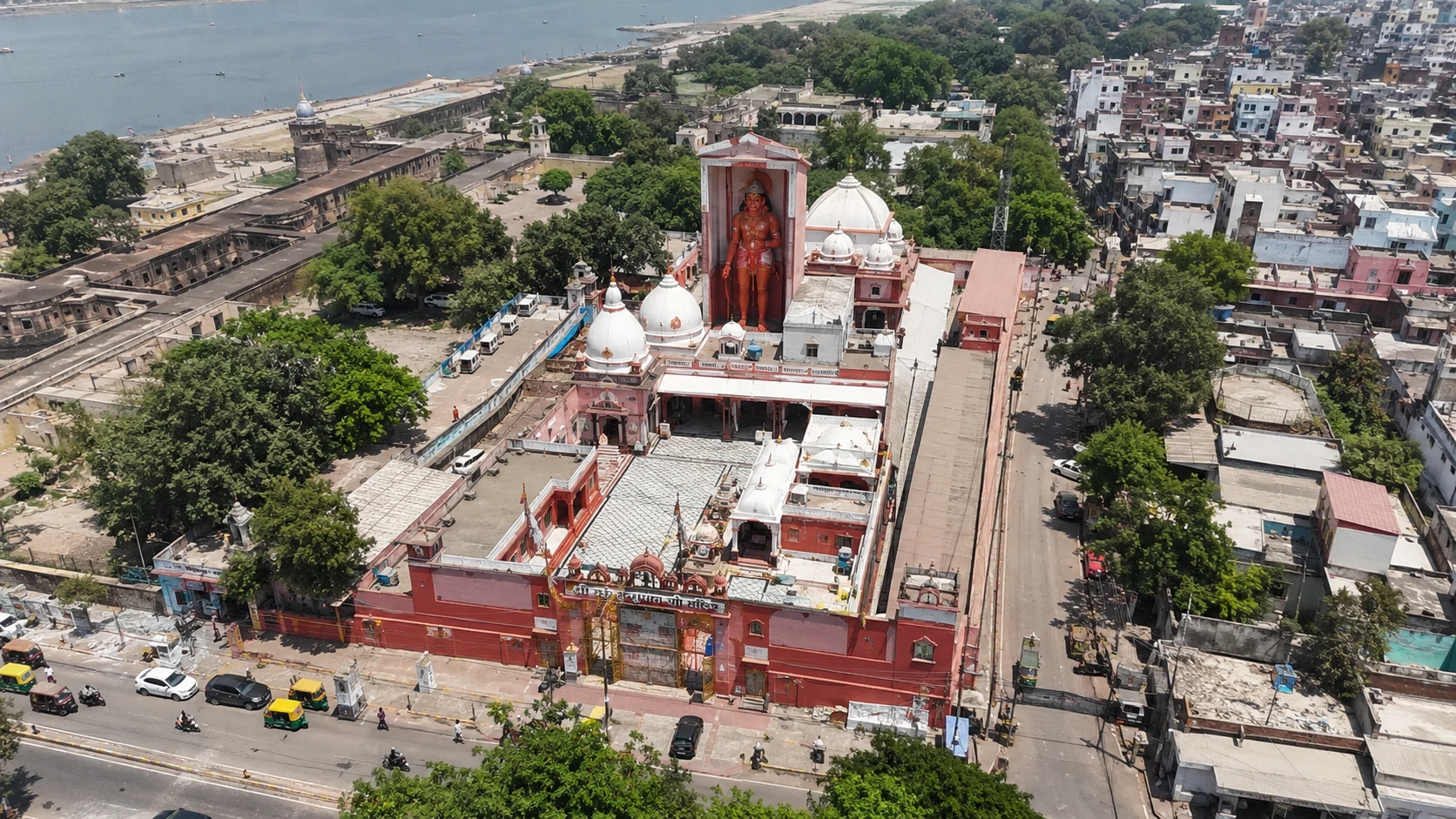
The temple in its current form is a modest structure built close to the Sangam bank, semi-subterranean in character — the murti lies in a depression that causes it to flood with the monsoon Ganga rise. This geographic relationship — the sacred murti at the water's edge, flooded annually — is the defining environmental feature of the site, and it has attracted pilgrims for as long as the confluence has been venerated.
In the colonial period, Allahabad (the British name for Prayagraj) became an administrative capital of the United Provinces. The British presence did not suppress pilgrimage at the Sangam but did restructure the physical landscape around it, constructing the Allahabad Fort on the Sangam promontory in the 16th century (under Akbar) in ways that affected access to some Sangam-adjacent sites.
The modern era has seen extraordinary growth in the temple's visibility, primarily through the Kumbh and Maha Kumbh Mela cycles. The 2013 Maha Kumbh drew an estimated 120 million pilgrims to Prayagraj over 55 days — the largest peaceful gathering in recorded human history. The 2019 Kumbh (Ardh Kumbh) and the 2025 Maha Kumbh similarly brought tens of millions. Bade Hanuman Ji, located on the approach to the Sangam, became one of the most visited temples in India during these events.
The Uttar Pradesh government designated Prayagraj as a major pilgrimage infrastructure development priority in the lead-up to the 2019 and 2025 Kumbh Melas, investing substantially in ghats, roads, crowd management, and temple access. The temple has benefited from these investments.
Historical Timelineऐतिहासिक कालक्रम
Establishment of the swayambhu reclining Hanuman murti at the Triveni Sangam site. No dated founding inscription survives. The murti is classified as self-manifested, and pilgrimage to this site is documented through the broader Prayaga Mahatmya tradition.
No historically dated founding record exists for the Bade Hanuman Ji temple. The swayambhu classification and the Sangam's documented importance as a pilgrimage site are the primary evidence for the site's antiquity.
Maha Kumbh Mela at Prayagraj draws an estimated 120 million pilgrims over 55 days — the largest peaceful gathering in recorded human history. Bade Hanuman Ji, on the approach to the Sangam, receives unprecedented visitor traffic.
Crowd estimates for Kumbh Mela vary between official government figures and independent assessments. The 120 million figure over 55 days is the Uttar Pradesh government's official estimate for the 2013 Maha Kumbh and has been widely cited. Individual single-day estimates (Mauni Amavasya bathing day) have reached 30–40 million.
Kumbh Mela (Ardh Kumbh) and major infrastructure investment by the Uttar Pradesh government — new ghats, crowd management systems, approach road widening, and pilgrim facilities constructed near the Sangam. The temple area benefited from improved access infrastructure.
Maha Kumbh Mela at Prayagraj, drawing tens of millions of pilgrims. Among the largest religious gatherings in history. Bade Hanuman Ji and the Triveni Sangam area saw extraordinary footfall.
What You'll Seeदर्शन में
The presiding murti at Bade Hanuman Ji is a large reclining (sayan or lete hue) form of Hanuman — a posture so rare in Hanuman iconography that it is virtually unique among major temples in India. The murti is approximately eight feet long and lies at a slight incline, with the feet oriented toward the Triveni Sangam. The body posture is neither fully prone nor fully supine but a relaxed, watchful reclining — Hanuman at rest, not in action. The face bears an expression of calm, benevolent awareness rather than the martial intensity of combat-mode Hanuman icons. The murti is coated in sindoor and adorned with garlands. The sanctum is semi-subterranean — the floor level of the inner shrine sits below the surrounding ground level, which creates the flooding dynamic during monsoon Ganga rise. The Ganga waters, when they rise, enter the shrine naturally from the river-facing side, filling the sanctum and covering the murti.
Distinctive Practicesविशिष्ट परंपराएँ
Gangajal Swayam Abhishekam (The Ganga's self-performed ritual bathing)
गंगाजल स्वयं अभिषेकम (गंगा द्वारा स्वयं-किया गया अनुष्ठानिक स्नान)
Annual, monsoon season (July–September), when the Ganga rises above the temple floor level
Each monsoon, when the Ganga rises with the rains, the river water enters the semi-subterranean temple and covers the reclining murti. The submersion typically lasts several weeks. During this period, the temple is not evacuated or the murti relocated — instead, priests and devotees continue worship at the water's edge, with boats sometimes used to approach the sanctum. The floodwaters are treated as holy — as Ganga directly performing the abhishekam that no human priest can replicate. When the waters recede, the murti emerges intact, its sindoor coating renewed by the river's action.
This practice embodies a radical theological inversion: rather than devotees carrying Ganga water to pour over a deity, the Ganga herself comes to the deity. Hanuman, the guardian of the sacred confluence, receives the blessing of the tirtharaja itself. The tradition teaches that the highest forms of devotion are those in which the devotee is embraced by the divine rather than merely approaching it — and here, the divine river embraces the divine guardian.
Did You Know?क्या आप जानते हैं?
The murti at Bade Hanuman Ji is one of the only major reclining (sayan) Hanuman images in India. Across thousands of Hanuman temples, the deity is almost universally depicted standing or seated; the reclining form is extraordinary and is the defining visual identity of this temple.
Temple tradition; comparative Hanuman iconography surveys
The temple floods every monsoon when the Ganga rises, submerging the reclining murti for several weeks. Rather than a disaster, this is regarded by devotees as an annual sacred event — the Ganga performing Hanuman's abhishekam. The murti has survived centuries of such floods without structural damage.
Temple tradition; local observation
Bade Hanuman Ji is located steps from the Triveni Sangam — the confluence of the Ganga, Yamuna, and the mythical subterranean Saraswati. The Sangam is described in the Puranas as the Tirtharaja (King of Pilgrimage Sites) and is the site of the Kumbh Mela, the largest human gathering on earth.
Matsya Purana; Skanda Purana, Prayaga Mahatmya; Diana Eck (2012)
During the 2013 Maha Kumbh Mela, an estimated 120 million pilgrims visited Prayagraj — the largest peaceful gathering in recorded human history. Bade Hanuman Ji, on the primary approach to the Sangam, was among the most visited religious sites in the world during that 55-day period.
Uttar Pradesh government Kumbh Mela Authority records; international media
Visitor Accessप्रवेश जानकारी
Bade Hanuman Ji welcomes all devotees without restriction. During monsoon flooding, access to the inner sanctum may be restricted when the water level is high — worship continues at the water's edge and by boat in such cases. Photography is permitted in the outer area but not inside the sanctum. Security screening is in place at the temple entrance.
The temple is in the Sangam area, best reached by cycle-rickshaw or on foot from the Prayagraj Rambag area. During Kumbh and Maha Kumbh years, the entire Sangam approach is extremely crowded — arrive very early (before dawn on major bathing dates) for manageable crowds. During monsoon flooding, check with the temple authorities before visiting as access to the sanctum may be restricted. The Sangam boat ride (to the confluence point) is typically combined with a Bade Hanuman Ji visit.
Festivalsत्योहार
Kumbh and Maha Kumbh Mela
कुंभ और महाकुंभ मेला
Jan-Mar (every 6 years Ardh Kumbh, every 12 years Maha Kumbh)
The largest religious gathering on earth, held at the Triveni Sangam at Prayagraj. The Kumbh cycle is determined by the position of Jupiter, the Sun, and the Moon. Bade Hanuman Ji is on the primary approach to the Sangam and receives tens of millions of pilgrims during each Kumbh cycle. The 2025 Maha Kumbh was a historic event drawing unprecedented crowds.
Hanuman Jayanti
हनुमान जयंती
Mar-Apr (Chaitra Purnima)
The birthday of Hanuman draws large crowds to Bade Hanuman Ji. Special abhishekam, continuous Hanuman Chalisa recitation, and extended darshan characterize the celebration. At the Sangam, Hanuman Jayanti is observed both at the temple and on the river — with flowers and lamps floated on the confluence waters.
Magh Mela (Annual Sangam Fair)
माघ मेला
Jan-Feb (Magh)
The annual Magh Mela at the Sangam is the 'small Kumbh' — held every year, drawing hundreds of thousands for ritual bathing at the confluence. Bade Hanuman Ji sees elevated traffic throughout the Magh month, with the Mauni Amavasya (silent new moon) bathing day as the peak.
Traditional Offeringsपारंपरिक अर्पण
प्राथमिक अर्पण
Sindoor (Vermilion)
सिंदूर
सिन्दूर
Sindoor is the primary offering to Hanuman at Bade Hanuman Ji, recalling his legendary act of covering his body in vermilion for Lord Rama's wellbeing. Here, the sindoor offering carries additional resonance — the murti at the Sangam, covered in vermilion by generations of devotees and annually washed and renewed by the Ganga, embodies the cycle of human devotion and divine purification.
Gangajal (Sacred Ganges water)
गंगाजल
गङ्गा जल
At Bade Hanuman Ji, Gangajal offering carries unique significance — the temple sits at the Triveni Sangam, where the Ganga is just steps away. Devotees fill Gangajal from the confluence and offer it to the reclining murti, mirroring on a small scale the grand annual event when the Ganga herself floods the temple. Offering Gangajal here completes a theological circle: what the Ganga does to the murti annually, the devotee enacts daily.
Laddoo (Sweet offering)
लड्डू
Boondi laddoos are the standard sweet offering to Hanuman, available from shops near the temple entrance. The sweetness symbolizes the fulfilled devotee — one who has been blessed, whose bitterness and obstacles have been dissolved by Hanuman's grace.
Coconut
नारियल
नारिकेल
Coconut offered and broken before the deity symbolizes the shattering of ego and obstacles. At the Triveni Sangam, the coconut offering takes on additional meaning — the coconut's three marks (the 'eyes') are associated in tradition with Brahma, Vishnu, and Shiva, making the offering a tribute to the entire divine triad at the site where their energies converge.
Gangajal is uniquely available fresh from the Triveni Sangam itself — a few steps from the temple. Devotees traditionally fill their own copper vessels (lota) with Sangam water and offer it directly to the murti, making this the only major Hanuman temple where the temple-specific offering is the river that stands beside it. All other offerings (sindoor, laddoo, coconut) are available from vendors at the temple entrance.
How to Reachकैसे पहुँचें
Bade Hanuman Ji is in the Sangam area of Prayagraj, near the confluence of the Ganga and Yamuna.
Within Prayagraj, the Sangam area is reached by cycle-rickshaw or e-rickshaw from Prayagraj Junction (7 km) or Prayagraj Rambag station (3 km). Autos and taxis drop at the Civil Lines or Sangam approach, from where cycle-rickshaws are the most practical mode. During Kumbh periods, large sections of the Sangam approach are pedestrian-only — all vehicles are parked at designated lots and devotees walk.
By rail, Prayagraj Junction is the principal station, with trains from Delhi, Mumbai, Lucknow, Varanasi, Kolkata, and all major cities. Prayagraj Rambag (3 km) is a shorter option for Sangam-bound travelers. A new Prayagraj Cheoki station also serves as a major terminus.
By air, Prayagraj Airport at Bamrauli (13 km) has domestic flights from Delhi, Mumbai, and Lucknow. Connectivity has improved since the 2019 Kumbh infrastructure upgrades.
The Sangam boat ride — hiring a boat to reach the actual confluence point where all three rivers meet — is a central part of any Prayagraj pilgrimage and is typically combined with the Bade Hanuman Ji visit. The boat ghats are a short walk from the temple.
Plan Your Visitयात्रा की योजना
🌤 सर्वोत्तम मौसम
October to March is the most comfortable period. January–February during the Magh Mela season is particularly auspicious. Kumbh and Maha Kumbh years transform the city into one of the world's largest pilgrim destinations — spiritually unparalleled but logistically demanding. Avoid the monsoon inner sanctum visit (July–September) unless comfortable with flooding conditions. Summer (April–June) is intensely hot at 40–47°C.
👘 पहनावे का नियम
Modest traditional dress expected. Remove footwear before entering the temple. During the Sangam visit, carry a change of clothes if taking a holy dip at the confluence.
📱 फोन और फोटोग्राफी
Mobile phones on silent mode inside the temple. Photography permitted in the outer area; prohibited in the inner sanctum.
🏨 आवास
Prayagraj offers accommodation at all price points. Civil Lines area has the best mid-range and upscale hotels. The Sangam area has dharamshalas and budget lodges. During Kumbh and Maha Kumbh periods, the tent city (temporary accommodation set up by the government and private operators on the Sangam floodplain) provides distinctive, purpose-built pilgrim accommodation — book well in advance as it fills months ahead.
Sacred Soundsपवित्र ध्वनि
क्या आप जानते हैं? · Did You Know?
वही अनुवाद त्रुटि जिसने हिन्दू धर्म में '33 कोटि' को '33 करोड़' बनाया, बौद्ध धर्म में भी हुई। बौद्ध ग्रन्थों के चीनी अनुवाद ने 'सप्त कोटि बुद्ध' (7 श्रेष्ठ बुद्ध) का अनुवाद '7 करोड़ बुद्ध' कर दिया। तिब्बती अनुवाद ने सही किया: 7 प्रकार, 7 करोड़ नहीं। एक संस्कृत शब्द, दो प्रमुख विश्व धर्मों में गलत पढ़ा गया, ने दो एकसमान भ्रम स्वतन्त्र रूप से उत्पन्न किए।
Related Contentसंबंधित सामग्री
Related Scriptures
Community Reflections
🕉️
Be the first to share your reflection.