Meenakshi Temple
मीनाक्षी मंदिर
The Mīnākṣī Devī of Madurai, the canonical Tamil Devī shrine integrated with her consort Sundareśvara (Śiva) at the canonical Mīnākṣī-Sundareśvara dual-sanctum temple-complex, one of the largest and most architecturally elaborated Hindu temple-complexes of South India; corpus-distinctive in operating outside the canonical 51-Pīṭha and canonical Aṣṭādaśa Stotram frameworks while attesting in regional Tamil-tradition extended Shakta-network frameworks; the canonical Velli Ambalam / Rajata Sabhā (Silver Hall) of the Pancha Sabhai (Pañca Sabhā) Tamil Śaiva canonical dance-hall framework through her consort Sundareśvara; the closing entry of the Eternal Raga Shakti Peeth Phase 4 sweep
Madurai, Tamil Nadu, India
Mīnākṣī DevīAlso known as: Meenakshi, Meenakshi Amman, Madurai Meenakshi, Tāḍātakai (the canonical pre-Devī-wedding name per the Tiruviḷaiyāḍal Purāṇam), Aṅgayarkaṇṇī (Tamil 'the Fish-Eyed Goddess'), Mīnākṣī-Sundareśvara (the canonical Devī-Śiva dual-sanctum designation), Madurai Veedhi Veedhiyamman
युग
Pre-canonical Tamil Sangam-era (approximately 3rd century BCE, 3rd century CE) Madurai cultural-religious attestation; medieval Pāṇḍya dynasty patronage period; 14th-century invasion-disruption period through the Madurai Sultanate (1335-1378) and the documented Malik Kafur invasion (1311 CE); Vijayanagara empire-era reconstruction beginning in the late 14th century; substantial Nayak dynasty patronage period (16th, 17th centuries) under Tirumalai Nayak (1623, 1659) operating as the principal modern temple-complex reconstruction-and-architectural-elaboration phase; modern administrative arrangements under the Tamil Nadu Hindu Religious and Charitable Endowments Department continue temple operations
वास्तुकला
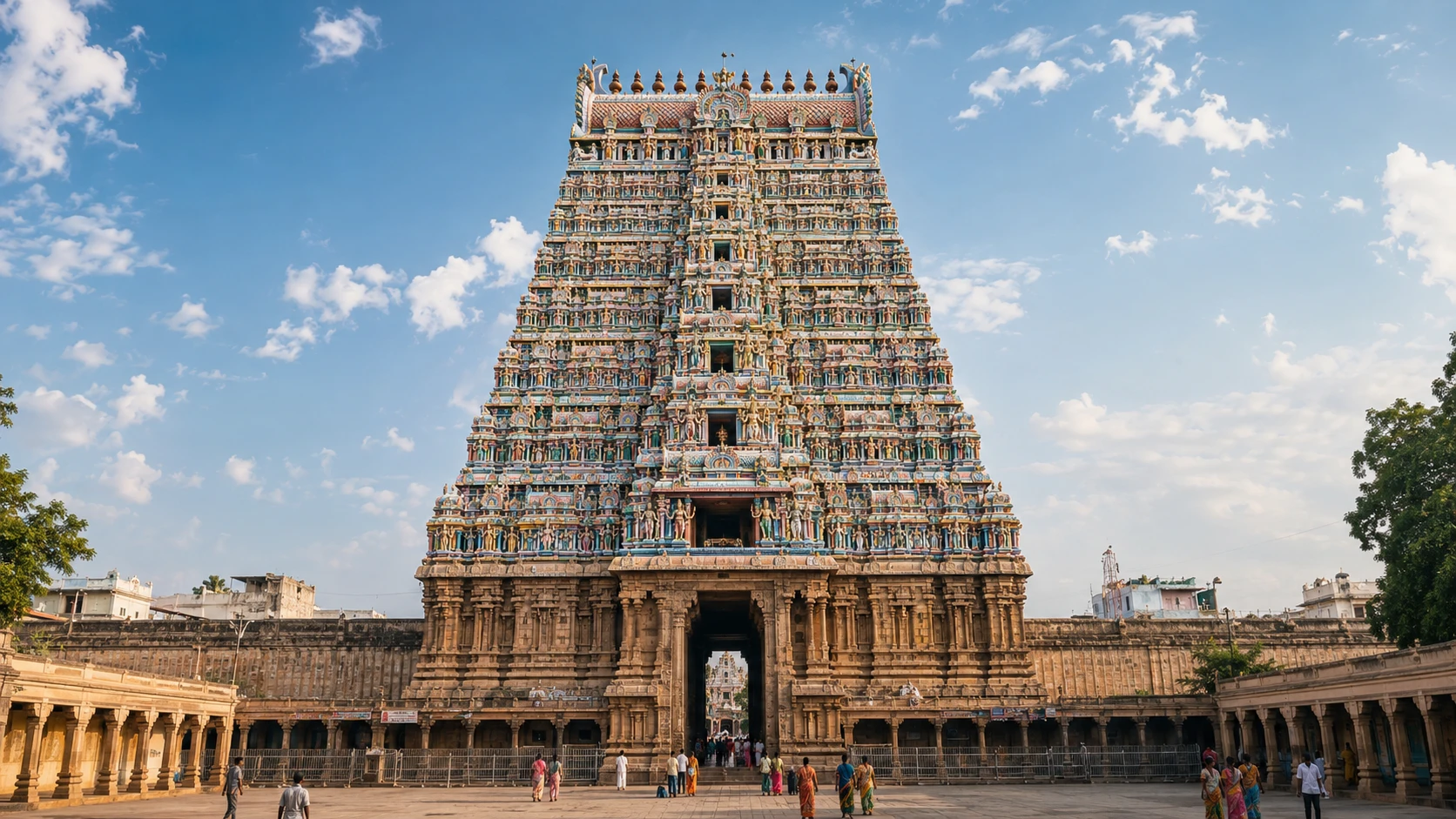
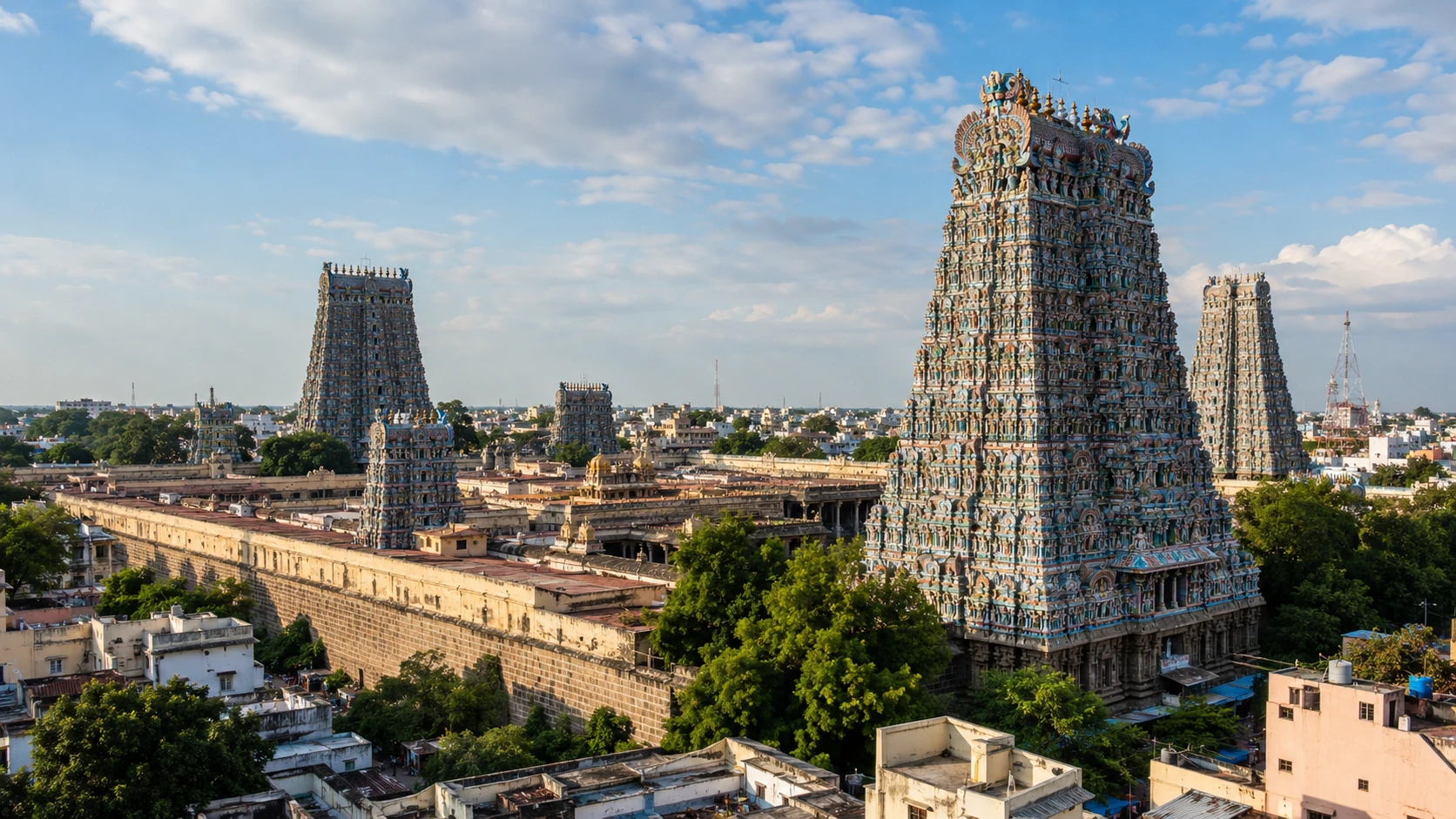
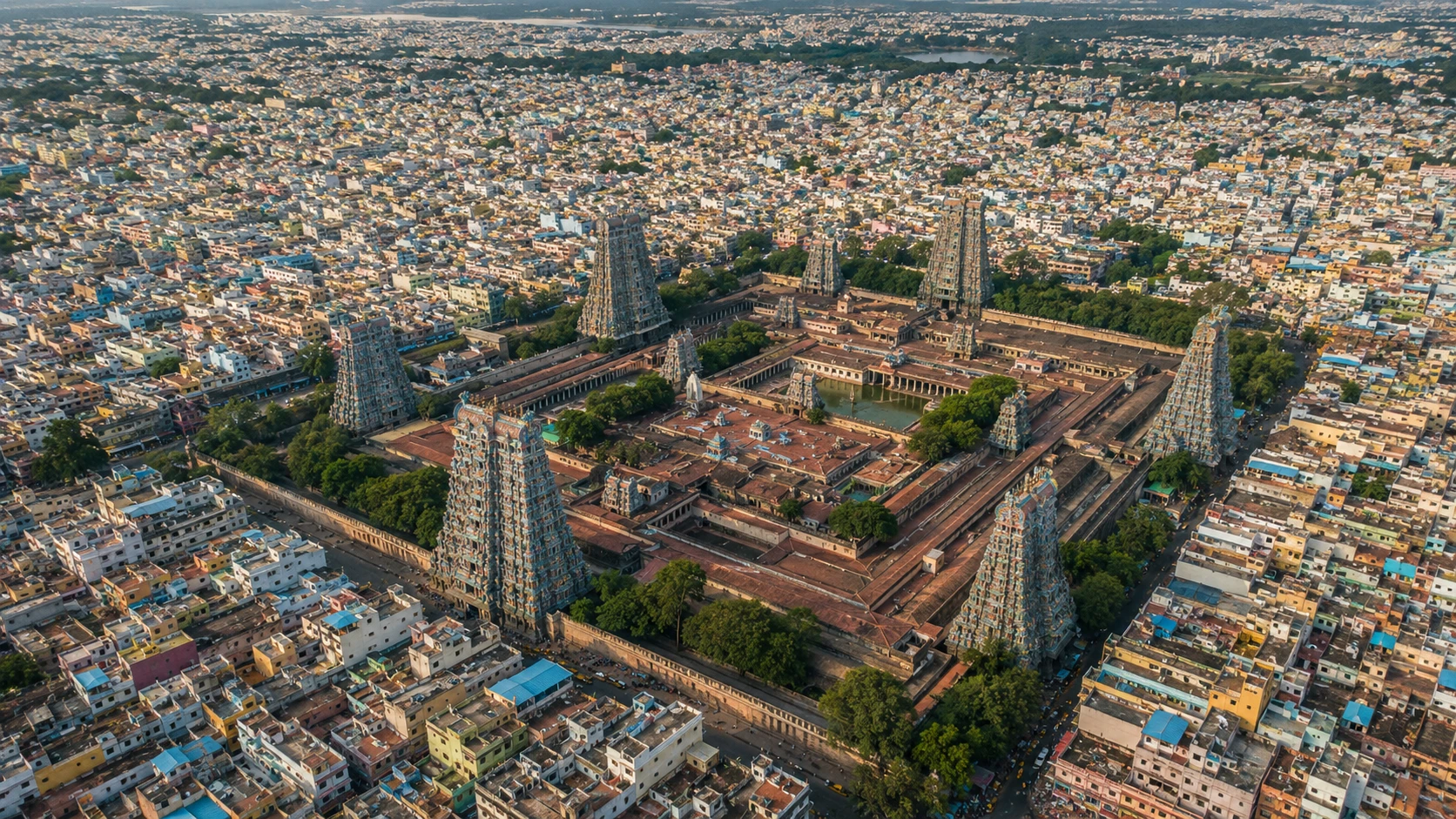
Tamil Drāviḍa (Dravidian) temple-construction style with substantial Nayak-period (16th, 17th centuries) architectural elaboration. The canonical temple-complex (approximately 14 acres) is one of the largest Hindu temple-complexes of South India, with the canonical Mīnākṣī-Sundareśvara dual-sanctum at the integrated complex core. The fourteen gopurams (towers) include four outer gopurams reaching approximately 50 meters in height, the canonical East, West, North, and South gopurams operating as the canonical compass-oriented architectural anchors of the temple-complex envelope. Distinctive architectural elements include the canonical Thousand-Pillared Hall (Āyiram Kāl Maṇḍapam) comprising 985 distinctively-sculpted pillars; the canonical Golden Lotus Pond (Pōrtāmarai Kuḷam, the canonical sacred tank); the canonical Pudu Maṇḍapam (the 'New Hall' commissioned by Tirumalai Nayak as the canonical bridal-procession hall); the canonical ornately-carved Vaikāsi Maṇḍapam; and the canonical Aṣṭa-Śakti Maṇḍapam (the canonical Eight-Śakti hall integrated into the canonical temple-complex's broader devotional architecture). The Mīnākṣī sanctum and the Sundareśvara sanctum operate as the canonical dual-sanctum at the integrated complex core, with the broader canonical sub-shrine infrastructure operating across the canonical temple-precinct envelope
खुला
05:00 – 22:00
आरती
05:30 · 06:30 · 11:00 · 17:00 · 19:30 · 21:30
विशेष
Chithirai Tiruvizha (April-May) is the canonical principal annual festival programming, the canonical Mīnākṣī-Sundareśvara wedding festival (Tirukkalyāṇam) operating as the canonical Tirukalyana Utsavam, the 12-day festival sequence drawing substantial pan-South-Indian pilgrim flow and the canonical Tamil Devī-festival's principal annual observance; Avani Mūla Utsavam (August-September) is the canonical secondary annual festival with significant regional pilgrim engagement; the canonical Theppotsavam (Float Festival) on the Mariamman Teppakulam tank brings the canonical winter festival programming; Navarātri (Sep-Oct) brings the canonical pan-Hindu Devī-festival cycle's regional observance; the canonical daily liturgical cycle includes the canonical six daily aarti times reflecting the temple's substantial daily liturgical scale
पवित्र कथा · पवित्र कथा
Mīnākṣī Devī sits at the canonical Mīnākṣī-Sundareśvara Temple in Madurai, Tamil Nadu, one of South India's oldest continuously inhabited cities, with documented Tamil Sangam-era (c. 3rd c. BCE, 3rd c. CE) attestation as the canonical Pāṇḍya-kingdom capital. The canonical temple-complex (approximately 14 acres at the heart of old Madurai city) is one of the largest and most architecturally elaborated Hindu temple-complexes of South India, featuring fourteen gopurams (towers) with the four outer gopurams reaching approximately 50 meters in height, the canonical Thousand-Pillared Hall (Āyiram Kāl Maṇḍapam, comprising 985 pillars of which each is distinctively sculpted), the canonical Golden Lotus Pond (Pōrtāmarai Kuḷam) operating as the temple's sacred tank, and the integrated Mīnākṣī-Sundareśvara dual-sanctum architectural envelope. The site is structurally distinctive within the corpus, and within the broader Phase 4 sweep, through its corpus-distinctive recension-variable Pīṭha-network canonical attestation: Meenakshi does NOT appear in the canonical 51-Pīṭha enumeration per the dominant Pīṭhanirṇaya tradition or in the canonical Aṣṭādaśa Shakti Pīṭha Stotram (either the dominant pan-Indian Adi Shankara recension or the Karnataka regional recension), distinguishing the site from the corpus's other Phase 4 sweep entries that operate within the canonical 51-Pīṭha network and/or the canonical Aṣṭādaśa framework. However, Meenakshi is regionally attested in extended regional Tamil-tradition Shakta-network frameworks, including extended canonical Devī-Peetha enumerations operating within the broader Tamil Śaiva-Shakta canonical theological literature and the canonical Hālāsya Māhātmya regional Sanskrit Sthala Purāṇa of Madurai. The site's canonical theological framework operates through the corpus-distinctive Mīnākṣī-Sundareśvara dual-sanctum Devī-Śiva integrated framework, the canonical Devī Mīnākṣī ('the Fish-Eyed One,' from Sanskrit mīna = fish + akṣī = eyes, reflecting the canonical Devī's distinctive fish-eyed iconographic register) and her canonical consort Sundareśvara (the canonical 'Beautiful Lord,' a regional Tamil form of Śiva) operate as the canonical integrated cosmic-feminine-and-cosmic-masculine framework at the dual-sanctum temple-complex. This structurally distinct framework operates outside the canonical Pīṭha-Bhairava intra-site pairing pattern that operates at the canonical 51-Pīṭha and Aṣṭādaśa Pīṭha sites, the canonical Mīnākṣī-Sundareśvara framework is a Devī-Śiva integrated theological framework rather than a canonical Pīṭha-Bhairava framework, with the canonical Sundareśvara operating as the canonical Devī's husband and theological consort rather than as a canonical Pīṭha-Bhairava intra-site pair. The site's canonical Tamil-tradition theological framework integrates the canonical Mīnākṣī-Sundareśvara dual-sanctum framework with the canonical Pancha Sabhai (Pañca Sabhā) Tamil Śaiva canonical dance-hall framework, Madurai operates as the canonical Velli Ambalam (Tamil 'Silver Hall') / Rajata Sabhā (Sanskrit 'Silver Court'), one of the five canonical Pancha Sabhai sites where the canonical Śiva-Naṭarāja's cosmic dance is canonically held to be performed (alongside Chidambaram as the Kanaka Sabhā / Golden Hall, Tirunelveli-Kutralam as the Tāmra Sabhā / Copper Hall, Tiruvalankadu as the Ratna Sabhā / Ruby Hall, and Tiruvannamalai as the Citra Sabhā / Painting Hall). The canonical Mīnākṣī-Sundareśvara dual-sanctum framework integrates the canonical Mīnākṣī Devī devotional infrastructure with the canonical Sundareśvara-Pancha-Sabhai-Velli-Ambalam Tamil Śaiva canonical infrastructure within the integrated temple-complex's theological envelope. The site is the canonical capstone of the Eternal Raga Shakti Peeth Phase 4 sweep, operating as the major Tamil Devī temple whose canonical attestation framework distinguishes it from the broader canonical 51-Pīṭha network while integrating the canonical Tamil-Shakta-Śaiva canonical theological framework at substantial scale.
Sacred Designationपवित्र पदनाम
Shakti Peeth
शक्ति: Mīnākṣī ('the Fish-Eyed One,' from Sanskrit mīna = fish + akṣī = eyes; the canonical Tamil Devī of Madurai whose distinctive fish-eyed iconographic register operates as the canonical Devī-attestation. Mīnākṣī is canonically held as the integrated cosmic-feminine power within the canonical Tamil-Shakta-Śaiva theological framework, integrated with her canonical consort Sundareśvara at the canonical Mīnākṣī-Sundareśvara dual-sanctum temple-complex)
Sacred Origin Storyपवित्र उत्पत्ति कथा
Source: Tiruviḷaiyāḍal Purāṇam (the canonical Tamil Sthala Purāṇa of Madurai, attributed to Paranjyoti Munivar, c. 16th century) preserving the canonical Mīnākṣī-Sundareśvara theological narrative; Hālāsya Māhātmya (the canonical Sanskrit Sthala Purāṇa of Madurai) preserving the canonical Mīnākṣī devotional-theological framework in Sanskrit canonical register; Sangam-era Tamil literature (Maturaikkāñci within the canonical Pattuppāṭṭu corpus) preserving the canonical Sangam-era Madurai attestation; Pāṇḍya dynasty inscriptional and historical record; Nayak dynasty inscriptional and architectural record; regional Tamil Śaiva-Shakta canonical scholarly framework
The canonical Mīnākṣī-Sundareśvara theological narrative operates through the canonical Tiruviḷaiyāḍal Purāṇam and the canonical Hālāsya Māhātmya as the canonical theological framework of the Mīnākṣī-Sundareśvara Temple at Madurai.
The canonical narrative records that Mīnākṣī was born of the canonical King Malayadhwaja (the Pāṇḍya-king of Madurai) and Queen Kāncanamālā through canonical Devī-intervention, with the canonical infant born with three breasts, a canonical iconographic distinction prophesied as follows: the third breast would canonically vanish when the canonical infant met her canonical destined husband.
The canonical narrative further records that Mīnākṣī grew into a canonical warrior-queen and ruled the canonical Pāṇḍya kingdom of Madurai as the canonical Devī-monarch, conducting canonical conquest-campaigns across the broader regional canonical zone.
Upon reaching the canonical Mount Kailasa during one canonical campaign, Mīnākṣī encountered the canonical Sundareśvara (the canonical 'Beautiful Lord,' a regional Tamil form of Śiva); the canonical third breast vanished upon canonical recognition, fulfilling the canonical prophecy and confirming Sundareśvara as the canonical destined husband.
The canonical Mīnākṣī-Sundareśvara wedding (Tirukkalyāṇam) was canonically performed at Madurai with canonical divine attendance, the canonical Tirukkalyāṇam narrative operates as the canonical theological centerpiece of the Mīnākṣī-Sundareśvara Temple's annual festival programming, with the canonical Chithirai Tiruvizha festival (12 days, April-May) annually reenacting the canonical Tirukkalyāṇam.
The canonical narrative integrates the canonical Mīnākṣī-Sundareśvara dual-sanctum theological framework with the canonical Pancha Sabhai (Pañca Sabhā) Tamil Śaiva canonical dance-hall framework, Madurai operates as the canonical Velli Ambalam (Tamil 'Silver Hall') / Rajata Sabhā (Sanskrit 'Silver Court'), the canonical second of the five Pancha Sabhai dance-halls where the canonical Śiva-Naṭarāja's cosmic dance is canonically performed (the canonical Chidambaram Kanaka Sabhā / Golden Hall operates as the principal Pancha Sabhai anchor; Madurai's Velli Ambalam / Rajata Sabhā operates as the canonical regional Pancha Sabhai integration).
The canonical Sundareśvara's canonical Pancha Sabhai role integrates the canonical Mīnākṣī-Sundareśvara dual-sanctum framework with the broader Tamil Śaiva canonical theological infrastructure. The canonical Mīnākṣī Devī's distinctive theological identity, the canonical fish-eyed (mīna-akṣī) iconographic distinction reflecting the canonical Devī's pan-cosmic vigilance, the canonical warrior-queen royal-tutelary tradition reflecting the canonical Pāṇḍya-kingdom canonical-devotional connection, and the canonical Devī-Śiva consort-integration through Sundareśvara, operates as the canonical Tamil-tradition Devī-theological framework that distinguishes Mīnākṣī from the broader canonical 51-Pīṭha network's standard canonical body-part-fall Pīṭha-formation framework.
The corpus documents the canonical Mīnākṣī-Sundareśvara framework as a Tier A Tamil Devī shrine within the Phase 4 sweep with honest treatment of the recension-variable Pīṭha-network canonical attestation.
उद्धृत स्रोत:
- Tiruviḷaiyāḍal Purāṇam (canonical Tamil Sthala Purāṇa of Madurai, attributed to Paranjyoti Munivar, c. 16th century)
- Hālāsya Māhātmya (canonical Sanskrit Sthala Purāṇa of Madurai)
- Maturaikkāñci (canonical Sangam-era Tamil text within the canonical Pattuppāṭṭu corpus preserving Sangam-era Madurai attestation)
- Pāṇḍya dynasty inscriptional record and historical chronicles
- Nayak dynasty inscriptional and architectural record (16th, 17th c.)
- Regional Tamil Śaiva-Shakta canonical scholarly framework
- Sircar, D. C., 'The Śākta Pīṭhas' (Motilal Banarsidass, 1948; revised 1973)
- Bhattacharya, N. N., 'History of the Sakta Religion' (Manohar, 1974)
- Harman, William P., 'The Sacred Marriage of a Hindu Goddess' (Indiana University Press, 1989)
- Fuller, C. J., 'Servants of the Goddess: The Priests of a South Indian Temple' (Cambridge University Press, 1984)
- Hudson, D. Dennis, 'The Body of God' (Oxford University Press, 2008)
- Stein, Burton, 'Peasant State and Society in Medieval South India' (Oxford University Press, 1980)
- Stein, Burton, 'Vijayanagara' (Cambridge University Press, 1989)
- Nilakanta Sastri, K. A., 'A History of South India' (Oxford University Press, 1955)
अन्य परंपराएँ · अन्य परंपराएँ
Recension-variable Pīṭha-network canonical attestation at Meenakshi
The canonical Pīṭha-network attestation framework at the Mīnākṣī-Sundareśvara Temple shows documented recension variability across the canonical Sanskrit Pīṭha-textual corpus and the regional Tamil-tradition extended Shakta-network frameworks.
The dominant Pīṭhanirṇaya tradition and Sircar 1948's authoritative attestation framework do NOT include Meenakshi in the canonical 51-Pīṭha enumeration; the canonical Aṣṭādaśa Shakti Pīṭha Stotram (both the dominant pan-Indian Adi Shankara recension and the Karnataka regional recension) does NOT include Meenakshi in the canonical eighteen-shrine enumeration.
However, Meenakshi is regionally attested in extended regional Tamil-tradition Shakta-network frameworks, including extended canonical Devī-Peetha enumerations within the broader Tamil Śaiva-Shakta canonical theological literature, the canonical Hālāsya Māhātmya regional Sanskrit Sthala Purāṇa, and the canonical Tiruviḷaiyāḍal Purāṇam regional Tamil Sthala Purāṇa.
Some regional Tamil traditions extend the canonical Aṣṭādaśa framework to include Meenakshi in extended Tamil-recension readings, though these extended readings operate outside the corpus's standard canonical Pīṭha-network list framework.
The corpus documents Meenakshi's canonical attestation status honestly within this recension-variability framework, the site is presented as a Tier A Tamil Devī shrine whose canonical attestation operates outside the corpus's standard canonical Pīṭha-network lists while integrating the canonical regional Tamil-Shakta-Śaiva canonical theological framework at substantial scale.
This recension-variability handling parallels the corpus-FIRST recension-parallel-position handling documented at Mookambika (Karnataka-recension Aṣṭādaśa #2) but operates within a different recension-variability framework (Meenakshi is recension-variable across the canonical Pīṭha-network frameworks, while Mookambika is canonical within the Karnataka regional recension of the Aṣṭādaśa Stotram).
Pancha Sabhai integration via Sundareśvara, canonical Tamil Śaiva dance-hall framework
The canonical Pancha Sabhai (Pañca Sabhā) integration at the Mīnākṣī-Sundareśvara Temple operates through the canonical Sundareśvara theological identity and the canonical Madurai Velli Ambalam (Tamil 'Silver Hall') / Rajata Sabhā (Sanskrit 'Silver Court') canonical designation.
The canonical Pancha Sabhai framework comprises five canonical Tamil Śaiva sites where the canonical Śiva-Naṭarāja's cosmic dance is canonically performed: (1) Chidambaram (Kanaka Sabhā / Golden Hall), the canonical principal Pancha Sabhai anchor, the canonical Naṭarāja shrine that operates as the central Pancha Sabhai canonical site within the broader Tamil Śaiva tradition; (2) Madurai (Velli Ambalam / Rajata Sabhā / Silver Hall), the canonical Mīnākṣī-Sundareśvara Temple's Pancha Sabhai integration through the canonical Sundareśvara identity; (3) Tirunelveli-Kutralam (Tāmra Sabhā / Copper Hall); (4) Tiruvalankadu (Ratna Sabhā / Ruby Hall); (5) Tiruvannamalai (Citra Sabhā / Painting Hall).
The canonical Pancha Sabhai framework operates within the canonical Tamil Śaiva tradition's distinctive theological-architectural framework where each canonical site's canonical dance-hall designation reflects the canonical materials (gold, silver, copper, ruby, painting) and the canonical cosmic-dance-aspect framework.
The canonical Mīnākṣī-Sundareśvara Temple's Pancha Sabhai integration via Sundareśvara gives the canonical temple-complex its substantive Tamil Śaiva canonical theological integration alongside the canonical Mīnākṣī Devī devotional framework.
The integrated canonical framework operates as the canonical Tamil-Shakta-Śaiva integrated theological framework at the site, the canonical Mīnākṣī Devī's distinctive theological identity and the canonical Sundareśvara's Pancha Sabhai theological identity operate as the canonical integrated framework rather than as separate theological poles, reflecting the canonical Tamil tradition's distinctive Devī-Śiva integrated canonical theology.
विद्वत संदर्भ
The Mīnākṣī-Sundareśvara Temple at Madurai occupies a structurally distinctive position in the corpus and is the canonical capstone of the Eternal Raga Shakti Peeth Phase 4 sweep. The canonical attestation framework operates outside the corpus's standard canonical Pīṭha-network lists, Meenakshi does NOT appear in the canonical 51-Pīṭha enumeration per the dominant Pīṭhanirṇaya tradition, does NOT appear in the canonical Aṣṭādaśa Shakti Pīṭha Stotram (either the dominant pan-Indian Adi Shankara recension or the Karnataka regional recension), and does NOT appear in the canonical 52-Kālikā-Purāṇa-list tradition. However, Meenakshi is regionally attested in extended regional Tamil-tradition Shakta-network frameworks, including extended canonical Devī-Peetha enumerations within the broader Tamil Śaiva-Shakta canonical theological literature, the canonical Hālāsya Māhātmya regional Sanskrit Sthala Purāṇa, and the canonical Tiruviḷaiyāḍal Purāṇam regional Tamil Sthala Purāṇa. The corpus documents this recension-variability honestly, with the list_membership field empty ([]) and the canonical_convergence_count 0 reflecting the site's absence from the corpus's standard canonical Pīṭha-network lists. The site's canonical theological framework operates through the corpus-distinctive Mīnākṣī-Sundareśvara dual-sanctum Devī-Śiva integrated framework, the canonical Devī Mīnākṣī ('the Fish-Eyed One') and her canonical consort Sundareśvara (a regional Tamil form of Śiva) operate as the canonical integrated cosmic-feminine-and-cosmic-masculine framework. This Devī-Śiva integrated framework is structurally distinct from the canonical Pīṭha-Bhairava intra-site pairing framework that operates at the canonical 51-Pīṭha and Aṣṭādaśa Pīṭha sites, the canonical Sundareśvara operates as Mīnākṣī's canonical husband and theological consort rather than as a canonical Pīṭha-Bhairava intra-site pair. The canonical Pancha Sabhai (Pañca Sabhā) integration via Sundareśvara, Madurai operating as the Velli Ambalam / Rajata Sabhā within the canonical Tamil Śaiva canonical dance-hall framework, gives the canonical temple-complex its substantive Tamil Śaiva canonical theological integration alongside the canonical Mīnākṣī Devī devotional framework. The canonical Mīnākṣī-Sundareśvara theological narrative (preserved through the canonical Tiruviḷaiyāḍal Purāṇam and the canonical Hālāsya Māhātmya) operates as the canonical theological framework, Mīnākṣī's canonical warrior-queen royal-tutelary tradition (the canonical Devī-monarch of the Pāṇḍya kingdom of Madurai) integrating with the canonical Sundareśvara consort-recognition narrative and the canonical Tirukkalyāṇam wedding-festival annual reenactment through the Chithirai Tiruvizha festival. Harman 1989 ('The Sacred Marriage of a Hindu Goddess') provides the principal modern academic treatment of the canonical Mīnākṣī-Sundareśvara theological narrative; Fuller 1984 provides the principal modern academic ethnographic-canonical study of the Mīnākṣī Temple priesthood; Smith 1996 and Younger 1995 provide the broader canonical Pancha Sabhai scholarly framework. The site's historical depth, pre-canonical Tamil Sangam-era attestation, medieval Pāṇḍya patronage, 14th-century invasion-disruption, Vijayanagara-Nayak reconstruction period, operates within the broader Tamil regional historical framework documented through Stein 1980/1989, Nilakanta Sastri 1955, and the broader Tamil regional historical scholarship. The corpus documents the site as a Tier A canonical Tamil Devī shrine within the Phase 4 sweep, with the recension-variable Pīṭha-network canonical attestation framework documented honestly within the corpus's editorial framework.
Historyइतिहास
Meenakshi's historical depth as a sacred site is integrated with Madurai's broader Tamil Sangam-era historical framework. The pre-canonical layer (Tamil Sangam-era attestation from approximately 3rd century BCE through 3rd century CE) preserves the canonical Sangam-era Madurai attestation through the canonical Maturaikkāñci (within the canonical Pattuppāṭṭu corpus), the canonical Tamil literary attestation documents Madurai as the canonical Pāṇḍya-kingdom capital with substantial regional cultural-religious prominence.
The medieval Pāṇḍya dynasty period (~6th, 13th centuries) operated Madurai as the canonical Pāṇḍya capital, with the canonical Mīnākṣī-Sundareśvara Temple operating as the canonical kingdom's principal canonical Devī-shrine. The Pāṇḍya patronage period brought substantial canonical architectural-devotional infrastructure development at the temple-complex.
The 14th-century invasion-disruption period brought substantial canonical infrastructure disruption: the canonical Malik Kafur invasion (1311 CE, the canonical Delhi Sultanate's southern campaign under Alauddin Khilji) substantially desecrated the canonical Mīnākṣī-Sundareśvara Temple; the Madurai Sultanate (1335, 1378 CE, the canonical regional Delhi Sultanate offshoot) administered Madurai during this period with continued canonical Hindu Shakta-tradition infrastructure operating under restricted-and-disrupted conditions.
The Vijayanagara empire's southern campaigns (mid-14th century) reconquered Madurai by the late 14th century, with the canonical Mīnākṣī-Sundareśvara Temple beginning its substantive canonical reconstruction period under Vijayanagara empire patronage.
The Nayak dynasty period (16th, 17th centuries) brought the most substantive canonical reconstruction-and-architectural-elaboration phase, particularly under Tirumalai Nayak (1623, 1659 CE), who oversaw the canonical principal architectural-elaboration program that produced the canonical contemporary temple-complex's distinctive architectural envelope (the canonical fourteen gopurams, the canonical Thousand-Pillared Hall, the canonical Pudu Maṇḍapam, and the broader canonical architectural infrastructure).
The British colonial period (1801 cession of Madurai to the East India Company, continuing through 1947 direct administration as part of the Madras Presidency) brought the canonical temple-complex into the colonial administrative arrangements, with continued canonical Hindu Shakta-Śaiva tradition operations across the colonial period.
The post-Independence period (1947, present) placed the canonical Mīnākṣī-Sundareśvara Temple within the Tamil Nadu state administrative framework (state renamed Tamil Nadu in 1969, previously Madras state from 1956). The contemporary administrative arrangements under the Tamil Nadu Hindu Religious and Charitable Endowments Department continue canonical temple operations.
The 21st century has brought substantial canonical infrastructure improvements including coordinated pilgrim management during the canonical Chithirai Tiruvizha festival and the broader canonical Tamil Devī-festival cycle, with the temple drawing approximately 15,000, 25,000 daily pilgrim flow on average and substantially higher festival-period crowds, making it one of the most-visited canonical Hindu temple sites in India.
Historical Timelineऐतिहासिक कालक्रम
Tamil Sangam-era attestation of Madurai as the canonical Pāṇḍya-kingdom capital with substantial regional cultural-religious prominence. The canonical Maturaikkāñci (within the canonical Pattuppāṭṭu corpus) preserves the canonical Sangam-era Madurai literary attestation, documenting the city as one of the principal canonical Tamil capitals of the canonical Sangam-era classical Tamil literary framework. The canonical Mīnākṣī devotional tradition's pre-canonical origins are situated within this broader canonical Sangam-era Tamil cultural-religious framework.
Substantive medieval Pāṇḍya dynasty patronage period of the canonical Mīnākṣī-Sundareśvara Temple. The Pāṇḍya dynasty operated Madurai as the canonical Pāṇḍya capital, with the canonical Mīnākṣī-Sundareśvara Temple operating as the canonical kingdom's principal canonical Devī-shrine. The Pāṇḍya patronage period brought substantial canonical architectural-devotional infrastructure development at the temple-complex, with the canonical Mīnākṣī devotional tradition operating as the canonical Pāṇḍya-kingdom canonical tutelary-deity tradition. Pāṇḍya-period inscriptional record at the canonical temple-complex documents the dynasty's sustained patronage across this period.
14th-century invasion-disruption period at the canonical Mīnākṣī-Sundareśvara Temple. The canonical Malik Kafur invasion (1311 CE, the canonical Delhi Sultanate's southern campaign under Alauddin Khilji) substantially desecrated the canonical Mīnākṣī-Sundareśvara Temple, with substantial canonical infrastructure damage documented in the canonical regional historical chronicles. The Madurai Sultanate (1335, 1378 CE, the canonical regional Delhi Sultanate offshoot) administered Madurai during this period; canonical Hindu Shakta-Śaiva tradition operations at the temple-complex continued under restricted-and-disrupted conditions, with the canonical core devotional infrastructure preserved through canonical Hindu institutional resilience. The 14th-century invasion-disruption period constitutes one of the most substantively-documented disruption phases at a major South Indian canonical temple-complex within the broader canonical Hindu regional historical framework.
Vijayanagara empire-era reconstruction of the canonical Mīnākṣī-Sundareśvara Temple. The Vijayanagara empire's southern campaigns (mid-14th century) reconquered Madurai by the late 14th century, with the canonical Mīnākṣī-Sundareśvara Temple beginning its substantive canonical reconstruction period under Vijayanagara empire patronage. The Vijayanagara-period reconstruction restored canonical infrastructure damaged during the 14th-century invasion-disruption period and established the foundational architectural-devotional framework that would receive further substantive elaboration during the subsequent Nayak dynasty period. Vijayanagara-period inscriptional record at the canonical temple-complex documents the empire's sustained reconstruction patronage.
Substantive Nayak dynasty patronage period of the canonical Mīnākṣī-Sundareśvara Temple. The Nayak dynasty (16th, 17th centuries, the regional Vijayanagara feudatory dynasty that emerged as the canonical regional administrative authority across the southern Tamil Nadu region following the Vijayanagara empire's gradual decline) operated as the canonical principal modern reconstruction-and-elaboration patrons of the canonical Mīnākṣī-Sundareśvara Temple. The canonical principal architectural-elaboration program operated under Tirumalai Nayak (1623, 1659 CE), whose substantive patronage program produced the canonical contemporary temple-complex's distinctive architectural envelope, the canonical fourteen gopurams reaching approximately 50 meters in height (the four outer gopurams operating as the canonical compass-oriented architectural anchors), the canonical Thousand-Pillared Hall (Āyiram Kāl Maṇḍapam, comprising 985 distinctively-sculpted pillars), the canonical Pudu Maṇḍapam (the 'New Hall,' the canonical bridal-procession hall), the canonical Aṣṭa-Śakti Maṇḍapam (the canonical Eight-Śakti hall), the canonical Vaikāsi Maṇḍapam, and the broader canonical architectural infrastructure that operates as the canonical Nayak-period architectural register of the canonical temple-complex.
British colonial period (1801 cession of Madurai to the East India Company, continuing through 1858, 1947 direct administration as part of the Madras Presidency under the British Raj) brought the canonical Mīnākṣī-Sundareśvara Temple into the colonial administrative arrangements, with continued canonical Hindu Shakta-Śaiva tradition operations across the colonial period and continued Pāṇḍya-Nayak architectural-devotional infrastructure preservation. The post-Independence period (1947, present) placed the canonical Mīnākṣī-Sundareśvara Temple within the post-Independence Indian administrative framework, initially under Madras state (1947, 1969) and subsequently under Tamil Nadu state (renamed in 1969). The contemporary administrative arrangements under the Tamil Nadu Hindu Religious and Charitable Endowments Department continue canonical temple operations. The 21st century has brought substantial canonical infrastructure improvements including coordinated pilgrim management during the canonical Chithirai Tiruvizha festival (the canonical Mīnākṣī-Sundareśvara wedding-festival annual reenactment, the principal annual festival programming), the canonical Avani Mūla Utsavam, the canonical Theppotsavam Float Festival, the canonical pan-Hindu Navarātri observance, and the broader canonical Tamil Devī-festival cycle. The temple draws approximately 15,000, 25,000 daily pilgrim flow on average and substantially higher festival-period crowds (the canonical Chithirai Tiruvizha festival peak crowds substantially exceed the daily-average pilgrim flow), making the Mīnākṣī-Sundareśvara Temple one of the most-visited canonical Hindu temple sites in India and a substantively-significant canonical cultural-religious destination within the broader pan-Indian Hindu temple-tradition framework.
What You'll Seeदर्शन में
The Mīnākṣī-Sundareśvara Temple at Madurai preserves the canonical Mīnākṣī-Sundareśvara dual-sanctum integrated iconographic register, corpus-distinctive within the Phase 4 sweep through its canonical Devī-Śiva dual-sanctum integrated architectural-iconographic envelope.
The principal Mīnākṣī sanctum houses the canonical Mīnākṣī murti in the canonical Tamil Drāviḍa sculptural tradition, depicting the canonical Devī in the canonical anthropomorphic standing form bearing the canonical Devī-iconographic attributes: a green parrot perched on the canonical Devī's right hand (the canonical parrot-iconographic distinction reflecting the canonical Devī's auspicious-cosmic-feminine register), a canonical garland or flower-cluster in the canonical Devī's left hand, the canonical fish-eyed (mīna-akṣī) iconographic distinction operating as the canonical Devī's signature theological-iconographic feature, the canonical regional Tamil Devī-ornamental infrastructure (the canonical Devī-kireeta, the canonical Devī-mukuta, the canonical Devī-nāgābharaṇa-and-kanaka ornamental register), and the canonical regional Tamil Devī-iconographic decorum.
The Mīnākṣī murti is daily draped in canonical green silk vestments (the canonical Tamil-tradition green color reflecting the canonical Devī's auspicious-cosmic-feminine register; this canonical green-silk convention is corpus-distinctive at Meenakshi within the broader Devī-shrine register where red silk is the canonical pan-Hindu Devī-vestment standard), with substantial gold and diamond ornamentation operating at festival-period elaborated scale.
The Sundareśvara sanctum (architecturally integrated within the canonical Mīnākṣī-Sundareśvara dual-sanctum envelope) houses the canonical Sundareśvara liṅga (the canonical Śiva-liṅga aniconic register that operates as the canonical regional Tamil Śaiva canonical Śiva-iconographic anchor at the site, distinct from the canonical anthropomorphic Sundareśvara framework).
The integrated dual-sanctum architectural envelope places the canonical Mīnākṣī sanctum and the canonical Sundareśvara sanctum within the canonical temple-complex's coordinated architectural-devotional framework, with the canonical inter-sanctum coordination operating through canonical liturgical infrastructure that integrates the canonical Mīnākṣī Devī devotional engagement with the canonical Sundareśvara Śaiva devotional engagement.
The broader canonical temple-complex's architectural-iconographic register includes: the canonical fourteen gopurams reaching approximately 50 meters in height (the canonical East, West, North, and South outer gopurams operating as the canonical compass-oriented anchors, with the broader inner gopurams operating as the canonical sub-shrine and Mīnākṣī-Sundareśvara dual-sanctum anchor towers); the canonical Thousand-Pillared Hall (Āyiram Kāl Maṇḍapam, 985 distinctively-sculpted pillars each operating as a canonical sculptural-iconographic register featuring canonical Devī, Śiva, Viṣṇu, regional Tamil canonical deities, canonical mythological narrative episodes, and the canonical Tamil Drāviḍa sculptural ornamental infrastructure); the canonical Golden Lotus Pond (Pōrtāmarai Kuḷam, the canonical sacred tank that functions as the canonical principal sacred-water infrastructure of the temple-complex and the canonical bathing observance anchor); the canonical Pudu Maṇḍapam (the 'New Hall' commissioned by Tirumalai Nayak as the canonical bridal-procession hall, featuring canonical massive-scale pillar-sculpture infrastructure depicting the canonical Tirumalai Nayak portraits and the canonical Mīnākṣī-Sundareśvara wedding narrative); the canonical Aṣṭa-Śakti Maṇḍapam (the canonical Eight-Śakti hall featuring eight canonical Devī-aspects integrated into the broader Mīnākṣī Devī devotional infrastructure); and the canonical Vaikāsi Maṇḍapam (the canonical ornately-carved pillared hall operating within the broader canonical temple-complex's architectural-iconographic envelope).
The integrated dual-sanctum + 14-gopuram + Thousand-Pillared-Hall + Golden-Lotus-Pond + Pudu-Maṇḍapam + Aṣṭa-Śakti-Maṇḍapam + Vaikāsi-Maṇḍapam architectural register is one of the most architecturally elaborated canonical Hindu temple-complex envelopes in South India.
Distinctive Practicesविशिष्ट परंपराएँ
Canonical Chithirai Tiruvizha Tirukkalyāṇam (Mīnākṣī-Sundareśvara Wedding-Festival) Annual Reenactment, Corpus-Distinctive Pancha Sabhai-Integrated Devī-Śiva Wedding Festival
प्रामाणिक चित्तिरै तिरुविळा तिरुक्कल्याणम् (मीनाक्षी-सुन्दरेश्वर विवाह-उत्सव) वार्षिक पुनः-प्रदर्शन, संग्रह-विशिष्ट पंच सभाई-एकीकृत देवी-शिव विवाह उत्सव
Annually during the canonical Chithirai month (Chittirai, mid-April to mid-May per the canonical Tamil calendar). The canonical festival's 12-day sequence operates as the canonical principal annual festival programming at the Mīnākṣī-Sundareśvara Temple, with the canonical Tirukkalyāṇam wedding-reenactment ceremony operating as the canonical festival's principal canonical liturgical event (typically falling on the canonical eighth or ninth day of the canonical festival sequence)
The corpus-distinctive Chithirai Tiruvizha Tirukkalyāṇam annual reenactment at the Mīnākṣī-Sundareśvara Temple operates as the canonical principal annual festival programming integrating the canonical Mīnākṣī-Sundareśvara wedding narrative with the canonical regional Tamil Devī-festival framework. The canonical festival operates through coordinated devotional practices: (a) canonical Tirukkalyāṇam wedding-reenactment ceremony, the canonical wedding-ritual sequence canonically performed at the principal dual-sanctum, with the canonical Mīnākṣī murti and the canonical Sundareśvara liṅga participating in the canonical wedding-procession infrastructure; (b) canonical 12-day festival sequence, the canonical festival cycle covers the canonical Mīnākṣī coronation (canonically operating as the canonical Pāṇḍya-kingdom Devī-monarch coronation reenactment), the canonical Mīnākṣī conquest-campaign reenactment, the canonical Mount-Kailasa encounter and canonical third-breast-vanishing reenactment, the canonical wedding-procession infrastructure across the broader Madurai city framework (the canonical wedding-procession route through the canonical four canonical Madurai streets surrounding the temple-complex), and the canonical Tirukkalyāṇam wedding ceremony culmination; (c) canonical regional Tamil cultural-festival infrastructure operating alongside the canonical liturgical sequence, the canonical festival draws substantial pan-South-Indian pilgrim flow, with festival-period crowd flows substantially exceeding the daily-average pilgrim flow; (d) canonical Pancha Sabhai integration, the canonical Sundareśvara's canonical Velli Ambalam / Rajata Sabhā Pancha Sabhai identity operates within the canonical festival's broader theological framework, integrating the canonical Mīnākṣī-Sundareśvara wedding-narrative with the canonical Tamil Śaiva Pancha Sabhai canonical framework. The corpus-distinctive Tirukkalyāṇam annual reenactment is the principal documented Devī-Śiva wedding-festival pattern within the broader corpus.
The canonical Tirukkalyāṇam annual reenactment operates as the canonical principal annual festival programming that integrates the canonical Mīnākṣī-Sundareśvara wedding narrative with the canonical Devī-Śiva consort-integration theological framework. The canonical festival's substantive scale reflects the canonical Mīnākṣī-Sundareśvara theological framework's centrality to the site's canonical theological identity.
Pancha Sabhai Integrated Sundareśvara Velli Ambalam / Rajata Sabhā Devotional Engagement, Canonical Tamil Śaiva Dance-Hall Framework Integration
पंच सभाई एकीकृत सुन्दरेश्वर वेल्ली अम्बलम / रजत सभा भक्ति संलग्नता, प्रामाणिक तमिल शैव नृत्य-मंडप ढाँचा एकीकरण
Year-round; particularly weighted during the canonical Tamil Śaiva festival programming including the canonical Mahā Śivarātri, the canonical Naṭarāja Abhiṣeka observances, and the canonical Tamil Śaiva canonical liturgical calendar's coordinated programming
The corpus-distinctive Pancha Sabhai integrated Sundareśvara devotional engagement at the Mīnākṣī-Sundareśvara Temple operates through the canonical Velli Ambalam / Rajata Sabhā canonical designation that integrates the canonical Sundareśvara theological identity with the broader canonical Pancha Sabhai (Pañca Sabhā) Tamil Śaiva canonical dance-hall framework. The canonical engagement operates through coordinated devotional practices: (a) canonical Sundareśvara sanctum darshan operating within the canonical Mīnākṣī-Sundareśvara dual-sanctum coordinated darshan framework; (b) canonical Pancha Sabhai liturgical integration, the canonical Sundareśvara's canonical Velli Ambalam / Rajata Sabhā Pancha Sabhai identity operates alongside the canonical Chidambaram Kanaka Sabhā / Golden Hall principal Pancha Sabhai anchor and the broader canonical Pancha Sabhai network (Tirunelveli-Kutralam Tāmra Sabhā, Tiruvalankadu Ratna Sabhā, Tiruvannamalai Citra Sabhā); (c) canonical Tamil Śaiva canonical Naṭarāja devotional infrastructure integration, the canonical regional Tamil Śaiva tradition's canonical Naṭarāja-iconographic-and-theological framework operates as the broader regional canonical theological context within which the Mīnākṣī-Sundareśvara dual-sanctum theological framework is embedded; (d) canonical Pancha Sabhai pilgrim-circuit integration, pilgrims undertaking the canonical Pancha Sabhai pilgrim circuit canonically engage all five canonical Pancha Sabhai sites in coordinated multi-site darshan, with Madurai operating as the canonical second canonical Pancha Sabhai site within the broader canonical pilgrim infrastructure. The Pancha Sabhai integration via Sundareśvara is corpus-distinctive at Meenakshi as the first formal documentation of canonical Pancha Sabhai theological framework integration with a Tier A Devī shrine within the broader corpus.
The canonical Pancha Sabhai integration via Sundareśvara operates as the canonical theological framework that integrates the canonical Mīnākṣī-Sundareśvara dual-sanctum framework with the broader canonical Tamil Śaiva canonical theological infrastructure. The canonical Pancha Sabhai framework's coordinated regional Tamil Śaiva-tradition framework gives the canonical temple-complex its substantive Tamil Śaiva canonical theological integration.
Fish-Eyed Mīnākṣī Canonical Iconographic Devotional Engagement, Corpus-Distinctive Tamil Devī-Iconographic Framework
मीन-नेत्र मीनाक्षी प्रामाणिक प्रतिमा-शास्त्रीय भक्ति संलग्नता, संग्रह-विशिष्ट तमिल देवी-प्रतिमा-शास्त्रीय ढाँचा
Year-round; integrated into the canonical daily liturgical cycle at the principal Mīnākṣī sanctum with festival-period elaborated engagement during the canonical Chithirai Tiruvizha and the broader canonical Tamil Devī-festival programming
The corpus-distinctive fish-eyed Mīnākṣī canonical iconographic devotional engagement at the Mīnākṣī-Sundareśvara Temple operates through the canonical Mīnākṣī Devī's signature theological-iconographic feature, the canonical mīna-akṣī (fish-eyed) iconographic distinction that reflects the canonical Devī's pan-cosmic vigilance and the canonical regional Tamil Devī-iconographic distinctive register. The canonical engagement operates through coordinated devotional practices: (a) canonical Mīnākṣī sanctum darshan engaging the canonical fish-eyed iconographic register at the principal sanctum, with the canonical fish-eyed iconographic distinction operating as the canonical Devī-attestation's principal theological-iconographic anchor; (b) canonical green-silk vestment-offering practice, pilgrims engaging the canonical green-silk-vestment offering tradition (corpus-distinctive at Meenakshi as the canonical regional Tamil-tradition green-color Devī-vestment register, distinct from the canonical pan-Hindu red-color Devī-vestment standard); (c) canonical regional Tamil Devī-stotra recitation engaging the canonical Mīnākṣī Pañcaratnam stotra, the canonical Mīnākṣī Stotram, and the broader canonical regional Tamil Devī-stotra corpus; (d) canonical fish-eyed iconographic motif engagement across the broader temple-complex's canonical sub-shrine and devotional infrastructure, with the canonical Mīnākṣī fish-iconographic motif operating across the broader canonical temple-complex's architectural-iconographic register. The corpus-distinctive Mīnākṣī fish-eyed iconographic devotional engagement is the principal documented fish-eyed Devī-iconographic framework within the broader corpus.
The canonical fish-eyed Mīnākṣī iconographic distinction operates as the canonical Devī's signature theological-iconographic feature reflecting the canonical Devī's pan-cosmic vigilance and the canonical regional Tamil Devī-iconographic distinctive register. The canonical green-silk vestment-offering practice operates as the canonical regional Tamil-tradition Devī-vestment register that integrates the canonical iconographic engagement with the broader canonical Devī-offering framework.
Did You Know?क्या आप जानते हैं?
Meenakshi is corpus-distinctive within the Phase 4 sweep, and the broader corpus, as the only Phase 4 sweep entry whose Pīṭha-network canonical attestation operates outside the corpus's standard canonical Pīṭha-network lists. Meenakshi does NOT appear in the canonical 51-Pīṭha enumeration per the dominant Pīṭhanirṇaya tradition, does NOT appear in the canonical Aṣṭādaśa Shakti Pīṭha Stotram (either the dominant pan-Indian Adi Shankara recension or the Karnataka regional recension), and does NOT appear in the canonical 52-Kālikā-Purāṇa-list tradition. However, Meenakshi is regionally attested in extended regional Tamil-tradition Shakta-network frameworks, including extended canonical Devī-Peetha enumerations within the broader Tamil Śaiva-Shakta canonical theological literature, the canonical Hālāsya Māhātmya regional Sanskrit Sthala Purāṇa, and the canonical Tiruviḷaiyāḍal Purāṇam regional Tamil Sthala Purāṇa. The site's canonical theological framework operates through the corpus-distinctive Mīnākṣī-Sundareśvara dual-sanctum Devī-Śiva integrated framework, a canonical Devī-Śiva integrated theological framework rather than a canonical Pīṭha-Bhairava intra-site pairing framework, with the canonical Sundareśvara operating as Mīnākṣī's canonical husband and theological consort rather than as a canonical Pīṭha-Bhairava intra-site pair.
Sircar, 'The Śākta Pīṭhas' (1948); Pīṭhanirṇaya manuscript tradition; Hālāsya Māhātmya; Tiruviḷaiyāḍal Purāṇam
Madurai operates as the canonical Velli Ambalam (Tamil 'Silver Hall') / Rajata Sabhā (Sanskrit 'Silver Court') of the canonical Pancha Sabhai (Pañca Sabhā) Tamil Śaiva canonical dance-hall framework through the canonical Sundareśvara theological identity. The canonical Pancha Sabhai framework comprises five canonical Tamil Śaiva sites where the canonical Śiva-Naṭarāja's cosmic dance is canonically performed: Chidambaram (Kanaka Sabhā / Golden Hall, the principal anchor), Madurai (Velli Ambalam / Rajata Sabhā), Tirunelveli-Kutralam (Tāmra Sabhā / Copper Hall), Tiruvalankadu (Ratna Sabhā / Ruby Hall), and Tiruvannamalai (Citra Sabhā / Painting Hall). The Pancha Sabhai integration via Sundareśvara is corpus-distinctive at Meenakshi as the first formal documentation of canonical Pancha Sabhai theological framework integration with a Tier A Devī shrine within the broader corpus.
Smith, 'The Dance of Siva' (1996); Younger, 'The Home of Dancing Sivan' (1995); Tiruviḷaiyāḍal Purāṇam
The canonical Tirumalai Nayak (1623, 1659 CE) architectural-elaboration program produced the canonical contemporary temple-complex's distinctive architectural envelope, the canonical fourteen gopurams reaching approximately 50 meters in height, the canonical Thousand-Pillared Hall (Āyiram Kāl Maṇḍapam, 985 distinctively-sculpted pillars), the canonical Pudu Maṇḍapam (the 'New Hall,' the canonical bridal-procession hall featuring Tirumalai Nayak portraits), the canonical Aṣṭa-Śakti Maṇḍapam (the canonical Eight-Śakti hall), and the canonical Vaikāsi Maṇḍapam. The canonical temple-complex (approximately 14 acres) is one of the largest Hindu temple-complexes of South India and represents one of the most substantively-elaborated canonical Nayak-period architectural programs within the broader South Indian Hindu temple-tradition framework.
Nayak dynasty inscriptional and architectural record; Stein, 'Vijayanagara' (1989); Nilakanta Sastri, 'A History of South India' (1955)
The canonical Malik Kafur invasion of 1311 CE (the canonical Delhi Sultanate's southern campaign under Alauddin Khilji) substantially desecrated the canonical Mīnākṣī-Sundareśvara Temple, with substantial canonical infrastructure damage documented in the canonical regional historical chronicles. The subsequent Madurai Sultanate (1335, 1378 CE, the canonical regional Delhi Sultanate offshoot) administered Madurai during a 43-year disruption period, with canonical Hindu Shakta-Śaiva tradition operations at the temple-complex continuing under restricted-and-disrupted conditions. The 14th-century invasion-disruption period constitutes one of the most substantively-documented disruption phases at a major South Indian canonical temple-complex within the broader canonical Hindu regional historical framework. The Vijayanagara empire's southern campaigns reconquered Madurai by the late 14th century, with the canonical reconstruction period commencing under Vijayanagara empire patronage and continuing through the substantive Nayak-period reconstruction-and-elaboration phase.
Delhi Sultanate administrative chronicles; regional Tamil historical chronicles; Habib, 'Medieval India' (2007); Stein, 'Vijayanagara' (1989)
The canonical Mīnākṣī-Sundareśvara Temple draws approximately 15,000, 25,000 daily pilgrim flow on average and substantially higher festival-period crowds (the canonical Chithirai Tiruvizha festival peak crowds substantially exceed the daily-average pilgrim flow), making the temple one of the most-visited canonical Hindu temple sites in India and a substantively-significant canonical cultural-religious destination within the broader pan-Indian Hindu temple-tradition framework. The temple's substantial daily pilgrim flow operates within the broader Tamil Nadu Hindu Religious and Charitable Endowments Department administrative framework, with coordinated pilgrim management infrastructure operating across the daily liturgical cycle.
Government of Tamil Nadu, Tamil Nadu Hindu Religious and Charitable Endowments Department documentation; Fuller, 'Servants of the Goddess' (1984)
Visitor Accessप्रवेश जानकारी
The temple-complex is open to all pilgrims regardless of background. Photography and videography are restricted inside the principal Mīnākṣī Devī sanctum and the principal Sundareśvara sanctum particularly during aarti; mobile phones should be carried switched off or deposited at the designated counter when entering the inner sanctum infrastructure. Footwear is removed at the entrance to the temple precinct. The temple operates from approximately 05:00 to 22:00 with six canonical aarti times, reflecting the substantial daily liturgical scale of one of the most-visited canonical Hindu temple sites in India.
आध्यात्मिक आधार
The photography prohibition reflects the standard major canonical Hindu temple-complex sanctum-photography policy, with particular sanctum-specific photography sensitivity at the dual-sanctum infrastructure.
समकालीन संदर्भ
The Mīnākṣī-Sundareśvara Temple operates under the Tamil Nadu Hindu Religious and Charitable Endowments Department administrative framework. The 21st century has brought substantial infrastructure improvements including coordinated pilgrim management during the canonical Chithirai Tiruvizha festival, the canonical Avani Mūla Utsavam, the canonical Theppotsavam Float Festival, the canonical pan-Hindu Navarātri observance, and the broader canonical Tamil Devī-festival cycle. There are no caste, gender, or sectarian access restrictions in modern practice. The temple's substantial daily pilgrim flow (15,000, 25,000 average, substantially higher festival-period crowds) requires coordinated pilgrim management infrastructure operating across the daily liturgical cycle.
व्यावहारिक मार्गदर्शन
Allow approximately 2, 4 hours at the Mīnākṣī-Sundareśvara Temple for the integrated dual-sanctum darshan + broader canonical temple-complex engagement during off-peak periods (substantially longer during major festival peaks, particularly the canonical Chithirai Tiruvizha festival). Pilgrims undertaking the canonical Pancha Sabhai pilgrim circuit typically allocate 5, 7 days for the canonical extended circuit covering Chidambaram (Kanaka Sabhā), Madurai (Velli Ambalam), Tirunelveli-Kutralam (Tāmra Sabhā), Tiruvalankadu (Ratna Sabhā), and Tiruvannamalai (Citra Sabhā). Modest, traditional dress is expected; the canonical Tamil temple convention preserves traditional dress (saree/sari for women, dhoti/veshti for men) for the canonical ceremonial darshan participation. Southern Tamil Nadu's tropical climate brings warm-and-humid summers (April-June, with 32-38°C highs and high humidity), moderate monsoon (October-December, with the canonical north-east monsoon bringing substantial rainfall to the broader Tamil Nadu coastal-and-interior zone), and mild winters (December-February, with comfortable 20-28°C range).
Festivalsत्योहार
Chithirai Tiruvizha (Canonical Mīnākṣī-Sundareśvara Wedding-Festival Annual Reenactment)
चित्तिरै तिरुविळा (प्रामाणिक मीनाक्षी-सुन्दरेश्वर विवाह-उत्सव वार्षिक पुनः-प्रदर्शन)
Chittirai (mid-April to mid-May per the canonical Tamil calendar)
Chithirai Tiruvizha is the canonical principal annual festival programming at the Mīnākṣī-Sundareśvara Temple, the 12-day canonical Mīnākṣī-Sundareśvara wedding-festival annual reenactment operating as the canonical Tirukkalyāṇam wedding ceremony culmination. The canonical festival sequence covers the canonical Mīnākṣī coronation, the canonical Mīnākṣī conquest-campaign reenactment, the canonical Mount-Kailasa encounter, the canonical third-breast-vanishing reenactment, the canonical wedding-procession infrastructure through the canonical four canonical Madurai streets surrounding the temple-complex, and the canonical Tirukkalyāṇam wedding ceremony culmination. The festival draws substantial pan-South-Indian pilgrim flow with festival-period crowds substantially exceeding the daily-average pilgrim flow.
Avani Mūla Utsavam (Canonical Secondary Annual Festival)
अवनि मूल उत्सवम (प्रामाणिक द्वितीयक वार्षिक उत्सव)
Āvaṇi (August-September per the canonical Tamil calendar)
Avani Mūla Utsavam is the canonical secondary annual festival at the Mīnākṣī-Sundareśvara Temple, drawing significant regional pilgrim engagement. The canonical festival operates within the canonical regional Tamil Devī-festival calendar's coordinated programming, with the canonical Mīnākṣī-Sundareśvara dual-sanctum participating in the canonical festival's coordinated liturgical infrastructure.
Theppotsavam (Canonical Float Festival on the Mariamman Teppakulam tank)
तेप्पोत्सवम (मरीअम्मन तेप्पकुळम सरोवर पर प्रामाणिक तैरता उत्सव)
Thai (January-February per the canonical Tamil calendar)
Theppotsavam is the canonical Float Festival at the Mariamman Teppakulam tank (a substantial sacred-water tank located in Madurai approximately 5 km from the Mīnākṣī-Sundareśvara Temple, commissioned by Tirumalai Nayak in the canonical 17th-century construction program). The canonical festival operates through the canonical Mīnākṣī and Sundareśvara processional murti infrastructure embarking on canonical decorated floats across the tank during the canonical festival sequence, drawing substantial regional pilgrim flow during the canonical winter festival programming.
Navarātri (Pan-Hindu Devī-Festival Cycle's Regional Tamil Observance)
नवरात्र (पैन-हिंदू देवी-उत्सव चक्र का क्षेत्रीय तमिल आचरण)
Sep-Oct (Āśvina month)
Navarātri at the Mīnākṣī-Sundareśvara Temple follows the canonical pan-Hindu Devī-festival cycle with full nine-night observance at the principal Mīnākṣī sanctum, with the canonical regional Tamil Devī-festival programming integrating the broader pan-Hindu Devī-tradition with the canonical regional Tamil Devī-iconographic framework. The canonical regional Tamil Navarātri observance includes the canonical Bommai Kolu tradition (the canonical Tamil regional doll-display devotional practice) operating alongside the canonical temple-precinct festival programming.
Regional Tamil Festival Cycle's Coordinated Programming (Mahā Śivarātri, Karthikai Deepam, and the broader regional Tamil canonical calendar's coordinated programming)
क्षेत्रीय तमिल उत्सव चक्र का समन्वित कार्यक्रम (महा शिवरात्रि, कार्तिकै दीपम्, और व्यापक क्षेत्रीय तमिल प्रामाणिक कैलेंडर का समन्वित कार्यक्रम)
Various dates per the canonical Tamil calendar
The broader regional Tamil festival cycle's coordinated programming at the Mīnākṣī-Sundareśvara Temple integrates the canonical pan-Hindu festival framework with the canonical regional Tamil canonical calendar's coordinated programming. The canonical Mahā Śivarātri (February-March, the canonical pan-Hindu Śaiva observance) brings substantial canonical Sundareśvara sanctum-specific liturgical engagement. The canonical Karthikai Deepam (November-December, the canonical regional Tamil festival-of-lights observance) brings the canonical regional Tamil cultural-religious framework's coordinated festival programming. The broader regional Tamil canonical calendar's coordinated programming operates throughout the year alongside the canonical principal Chithirai Tiruvizha and the canonical secondary festival cycle.
Traditional Offeringsपारंपरिक अर्पण
प्राथमिक अर्पण
Green silk vestment (Pattu Saree, canonical green color), the canonical Mīnākṣī Devī's signature canonical vestment register
हरा रेशम वस्त्र (पट्टु साड़ी, प्रामाणिक हरा रंग), प्रामाणिक मीनाक्षी देवी का हस्ताक्षर प्रामाणिक वस्त्र स्तर
हरित-क्षौम
The canonical green-silk vestment offering at the Mīnākṣī Devī sanctum is corpus-distinctive within the broader Devī-shrine register, the canonical Tamil-tradition green color reflects the canonical Mīnākṣī Devī's auspicious-cosmic-feminine register, distinct from the canonical pan-Hindu red-color Devī-vestment standard documented across most canonical Devī-shrines in the broader corpus. The regional Tamil silk-weaving traditions (Kanchipuram silk, Madurai silk) provide regional pilgrims with locally-significant offering options; green Kanchipuram silk in particular carries particular canonical ritual weight at the Mīnākṣī sanctum.
Red flowers, hibiscus (japā-kusum), marigold, red roses, jasmine
लाल पुष्प, गुड़हल (जपा-कुसुम), गेंदा, लाल गुलाब, चमेली
पुष्प-माल्य
Red flowers are the canonical floral offering across the Shākta tradition. At the Mīnākṣī Devī sanctum the offering is placed at the parapet of the principal sanctum, integrated into the canonical daily Devī-adornment cycle. The regional Tamil Shakta floral convention emphasizes hibiscus, marigold, and the canonical Tamil jasmine (the canonical Madurai mallikai jasmine, regionally famous), with the canonical regional Tamil floral combinations operating at festival-period elaborated scale.
Coconut
नारियल
नारिकेल
Coconut, offered whole or broken at the sanctum, represents the egoic self surrendered to the Devī. At the Mīnākṣī Temple the coconut offering follows the standard Tamil canonical Hindu temple convention, with the broken coconut's interior fluid offered as part of the canonical abhiṣeka sequence at both the Mīnākṣī and Sundareśvara sanctums.
Sindoor and Kumkum (vermilion offerings)
सिंदूर और कुंकुम
सिन्दूर; कुङ्कुम-तिलक
Sindoor and kumkum are applied at the canonical Mīnākṣī murti's consecrated application points, on the vestment, and as tilak on the pilgrim's forehead. The consecrated kumkum returned as prasad carries the canonical Devī-presence consecration. The canonical Tamil Shakta convention preserves the canonical sindoor-and-vibhuti (canonical sacred ash) application tradition at the canonical dual-sanctum.
Akhand-Jyot ghee and wicks
अखंड-ज्योत हेतु घी और बत्तियाँ
अखण्ड-ज्योतिः घृत-वर्तिका
The canonical temple-complex maintains continuously-burning lamps at the principal Mīnākṣī sanctum, the principal Sundareśvara sanctum, and across the broader canonical temple-complex's canonical sub-shrine infrastructure. Pilgrims offer ghee and wicks to be added to these lamps per the regional Tamil canonical Hindu temple convention.
इस मंदिर की विशेषता
Tirukkalyāṇam Wedding-Festival Coordinated Offering (Corpus-Distinctive Devī-Śiva Wedding-Festival Liturgical Offering)
तिरुक्कल्याणम् विवाह-उत्सव समन्वित अर्पण (संग्रह-विशिष्ट देवी-शिव विवाह-उत्सव धार्मिक अर्पण)
The corpus-distinctive Tirukkalyāṇam wedding-festival coordinated offering at the Mīnākṣī-Sundareśvara Temple operates through the canonical 12-day Chithirai Tiruvizha festival's canonical Devī-Śiva wedding-narrative liturgical infrastructure. The offering operates through coordinated devotional practices: (a) canonical wedding-procession offering material, pilgrims engaging the canonical 12-day festival cycle bring offerings calibrated to the canonical wedding-narrative sequence (the canonical Mīnākṣī coronation offerings, the canonical conquest-campaign offerings, the canonical Mount-Kailasa encounter offerings, the canonical Tirukkalyāṇam wedding ceremony offerings); (b) canonical wedding-procession participation, pilgrims participate in the canonical four-streets wedding-procession route surrounding the temple-complex during the canonical festival sequence; (c) canonical Tirukkalyāṇam-specific offering tradition operating at the canonical eighth or ninth day of the canonical festival sequence (typically falling on the canonical full-moon or near-full-moon day of the Chittirai month), with the canonical wedding-ceremony offerings operating as the canonical festival's principal canonical liturgical offering anchor; (d) canonical pan-South-Indian pilgrim flow participation reflecting the canonical festival's substantive scale and canonical theological significance. The corpus-distinctive Tirukkalyāṇam wedding-festival offering is the principal documented Devī-Śiva wedding-festival offering pattern within the broader corpus.
Pancha Sabhai Integrated Sundareśvara Offering (Velli Ambalam / Rajata Sabhā Coordinated Devotional Offering)
पंच सभाई एकीकृत सुन्दरेश्वर अर्पण (वेल्ली अम्बलम / रजत सभा समन्वित भक्ति अर्पण)
The corpus-distinctive Pancha Sabhai integrated Sundareśvara offering at the Mīnākṣī-Sundareśvara Temple operates through the canonical Velli Ambalam / Rajata Sabhā Pancha Sabhai integration framework. The offering operates through coordinated devotional practices: (a) canonical Sundareśvara liṅga-specific offering material (canonical bilva-leaf offering, canonical Śaiva-specific abhiṣeka materials including canonical pañcāmṛta, the canonical milk-yogurt-ghee-honey-sugar mixture, canonical sandalwood paste, canonical sacred-ash / vibhuti offering); (b) canonical Pancha Sabhai pilgrim-circuit coordinated offering, pilgrims undertaking the canonical Pancha Sabhai pilgrim circuit (Chidambaram Kanaka Sabhā + Madurai Velli Ambalam + Tirunelveli-Kutralam Tāmra Sabhā + Tiruvalankadu Ratna Sabhā + Tiruvannamalai Citra Sabhā) bring coordinated offerings across the canonical multi-site network; (c) canonical Tamil Śaiva canonical Naṭarāja-tradition coordinated offering operating at the broader canonical regional Tamil Śaiva canonical theological infrastructure level. The Pancha Sabhai integrated offering is corpus-distinctive at Meenakshi as the first formal documentation of canonical Pancha Sabhai integrated offering pattern within the broader corpus.
Mīnākṣī-Sundareśvara Dual-Sanctum Coordinated Darshan Integrated Offering, Canonical Tamil Shakta-Śaiva Integrated Theological Framework Offering
मीनाक्षी-सुन्दरेश्वर द्वि-गर्भगृह समन्वित दर्शन एकीकृत अर्पण, प्रामाणिक तमिल शाक्त-शैव एकीकृत सैद्धान्तिक ढाँचा अर्पण
The corpus-distinctive Mīnākṣī-Sundareśvara dual-sanctum coordinated darshan integrated offering at the Mīnākṣī-Sundareśvara Temple operates through the canonical integrated Devī-Śiva dual-sanctum darshan framework. The offering operates through coordinated devotional practices: (a) canonical Mīnākṣī sanctum darshan engaging the canonical fish-eyed iconographic register with the canonical green-silk vestment offering and canonical Devī-offerings; (b) canonical Sundareśvara sanctum darshan engaging the canonical Sundareśvara liṅga with canonical bilva-leaf and canonical Śaiva-specific offerings; (c) integrated dual-sanctum coordinated darshan sequence operating through the canonical Mīnākṣī sanctum → Sundareśvara sanctum sequence (the canonical Tamil convention preserves Devī-darshan-first as the canonical sequence at the integrated Mīnākṣī-Sundareśvara dual-sanctum); (d) canonical Mīnākṣī Pañcaratnam recitation operating alongside the integrated dual-sanctum darshan sequence; (e) canonical Tiruviḷaiyāḍal Purāṇam recitation engaging the canonical Tamil-tradition liturgical anchor. The integrated dual-sanctum coordinated offering is corpus-distinctive at Meenakshi as the principal documented canonical Tamil Shakta-Śaiva integrated dual-sanctum offering pattern within the broader corpus.
Offerings may be brought from outside or purchased at vendor counters near the canonical temple-complex precinct. The integrated Tirukkalyāṇam wedding-festival coordinated offering + Pancha Sabhai integrated Sundareśvara offering + Mīnākṣī-Sundareśvara dual-sanctum coordinated darshan integrated offering frameworks are corpus-distinctive at the Mīnākṣī-Sundareśvara Temple. The Tamil Nadu Hindu Religious and Charitable Endowments Department through the Arulmigu Meenakshi Sundareshwarar Thirukkoil administration coordinates the canonical offering ecology including the canonical multi-component ritual materials and the festival-period coordinated offering arrangements.
How to Reachकैसे पहुँचें
The Mīnākṣī-Sundareśvara Temple at Madurai is well-accessible from the broader pan-Indian transport network. By air, Madurai International Airport (IXM), approximately 12 km from the temple, provides full domestic and limited international connectivity (with direct flights to Colombo, Dubai, and Singapore alongside comprehensive Indian domestic connectivity); Tiruchirappalli International Airport (TRZ), 130 km, provides full domestic and international connectivity; Chennai International Airport (MAA), 460 km, provides comprehensive domestic and international connectivity as India's principal regional South Indian hub.
By rail, Madurai Junction Railway Station (MDU), approximately 1.5 km from the Mīnākṣī Temple, is the principal regional railhead on the Southern Railway's broader network with comprehensive connectivity from Chennai, Bengaluru, Trivandrum, Tirunelveli, Coimbatore, Mumbai, Delhi, Kolkata, and the broader pan-Indian rail network.
From the railway station, the Mīnākṣī Temple is reached by local taxi, auto-rickshaw, or cycle-rickshaw services in approximately 10, 15 minutes. By road, Madurai is connected via the canonical National Highway 38 (the canonical Madurai-Theni-Munnar highway), National Highway 44 (the canonical pan-Indian North-South corridor extending to Kanyakumari), and the regional Tamil Nadu state highway network, Tamil Nadu State Transport Corporation (TNSTC) and the broader regional bus services operate from Chennai (450 km), Bengaluru (450 km), Coimbatore (215 km), Tirunelveli (165 km), Trivandrum (300 km), and the broader regional South Indian transport network.
Pilgrims undertaking the canonical Pancha Sabhai pilgrim circuit typically arrange hired multi-day road transport linking Madurai (Velli Ambalam) with the broader Pancha Sabhai network sites, Chidambaram (Kanaka Sabhā, approximately 400 km north of Madurai), Tirunelveli-Kutralam (Tāmra Sabhā, approximately 165 km south of Madurai), Tiruvalankadu (Ratna Sabhā, approximately 400 km north-east of Madurai near Chennai), and Tiruvannamalai (Citra Sabhā, approximately 320 km north of Madurai).
Plan Your Visitयात्रा की योजना
🌤 सर्वोत्तम मौसम
October through March offers the most agreeable weather in southern Tamil Nadu for the Mīnākṣī-Sundareśvara Temple darshan and the broader regional pilgrim engagement, moderate temperatures with the canonical north-east monsoon's gradual recession through December, February, and mild winter weather through March. The canonical principal festival period, Chithirai Tiruvizha during the canonical Tamil month of Chittirai (mid-April to mid-May), brings substantial pan-South-Indian pilgrim flow despite the warm-and-humid pre-monsoon weather; the canonical festival's substantial scale and canonical theological significance attract pilgrims regardless of the broader regional weather framework. The canonical Theppotsavam Float Festival during the canonical Thai month (January-February) operates during the canonical winter festival programming period with agreeable weather. The hot dry summer months (April-June, with 35-40°C highs) and the active monsoon period (October-December, with the canonical north-east monsoon bringing substantial rainfall) require pilgrims' planning consideration.
👘 पहनावे का नियम
Modest, traditional attire is expected at the Mīnākṣī-Sundareśvara Temple. The canonical Tamil temple convention preserves traditional dress (saree/sari for women, dhoti/veshti for men) for the canonical ceremonial darshan participation, with modern modest dress also accepted; head covering is customary at the sanctum during aarti for women in some canonical traditions. For the canonical Chithirai Tiruvizha festival and the broader canonical Tamil festival observances, traditional Tamil regional attire is the canonical pilgrim festival convention. The canonical green-silk vestment is the canonical Mīnākṣī Devī's signature canonical vestment register; pilgrims offering canonical green-silk vestments engage the canonical regional Tamil-tradition Devī-vestment offering convention.
📱 फोन और फोटोग्राफी
Mobile phones must be deposited at the cloak counter before entering the principal Mīnākṣī Devī sanctum or the principal Sundareśvara sanctum, or carried in switched-off state during aarti. Photography and videography are restricted within the inner sanctum infrastructure particularly during aarti and the canonical festival-period observances. Photography is generally permitted at the outer prākāra, on the temple-complex's open-air precincts (the canonical 14 gopuram outer infrastructure, the canonical Pudu Maṇḍapam infrastructure, the canonical Aṣṭa-Śakti Maṇḍapam infrastructure), and across the broader Madurai city framework.
🏨 आवास
Madurai has extensive accommodation infrastructure operating as one of southern Tamil Nadu's principal urban centers, including substantial private hotel infrastructure across all budget categories (luxury, business, mid-range, budget), Devasthanam-coordinated guesthouse facilities near the Mīnākṣī Temple, and the broader regional Madurai pilgrim-accommodation network. The city operates as a major regional accommodation hub for pilgrims undertaking the canonical Pancha Sabhai pilgrim circuit (Madurai operating as the canonical Velli Ambalam base) and for broader pan-Tamil-Nadu Hindu temple-tradition circuits. During the canonical Chithirai Tiruvizha festival, accommodation demand at Madurai substantially exceeds standard supply; advance booking is strongly recommended (often months ahead for premium accommodation). The Tamil Nadu Tourism Development Corporation (TTDC) operates regional pilgrim-services infrastructure across Madurai and the broader regional pilgrim-services framework.
Book a Pujaपूजा बुक करें
The Mīnākṣī-Sundareśvara Temple at Madurai draws substantial pan-South-Indian pilgrim flow at one of the largest scales in India, approximately 15,000, 25,000 daily pilgrim flow on average, with festival-period crowds substantially exceeding the daily-average pilgrim flow. The canonical Chithirai Tiruvizha festival (April-May) brings the canonical principal annual peak crowd, with Tirukkalyāṇam wedding-ceremony day crowds in the hundreds of thousands. The substantial pilgrim concentration creates corresponding substantial vulnerability to third-party fraud across the integrated dual-sanctum devotional infrastructure. Third-party activity to navigate with care includes: informal-pandit intermediaries at the canonical temple-complex entrance soliciting 'authenticated Mīnākṣī Devī VIP darshan' or 'priority Tirukkalyāṇam VIP coordination' at high cost outside the canonical official temple administration priest-roster, pilgrims should engage ONLY the official temple administration priest roster (operating under the Tamil Nadu HR&CE framework) for canonical ritual coordination; travel-agency operators offering 'South-Indian temple yatra packages' combining the Mīnākṣī-Sundareśvara Temple with the broader South Indian canonical Hindu temple network, verify all multi-site circuit operators against each site's respective administrative office recognition before payment; online booking aggregators selling 'guaranteed Chithirai Tiruvizha VIP darshan' or 'guaranteed Tirukkalyāṇam VIP wedding-ceremony access' outside official temple channels, these are particularly common around major festival periods; informal-vendor intermediaries near the canonical temple-complex selling 'authenticated Mīnākṣī-blessed prasad' or 'pre-prepared dual-sanctum coordinated puja-thali ready-prepared sets', pilgrims seeking these items should source through reputable Madurai vendors or official temple-recognized retail counters rather than informal sellers. Any third-party website or service claiming to offer 'guaranteed Mīnākṣī-Sundareśvara VIP darshan,' 'authenticated Pancha Sabhai VIP integrated coordination,' or 'priority Chithirai Tiruvizha VIP integrated coordination' should be verified through the Arulmigu Meenakshi Sundareshwarar Thirukkoil official channels (www.maduraimeenakshi.org) before any payment.
Managed by: Arulmigu Meenakshi Sundareshwarar Thirukkoil (the canonical official temple administrative designation), operating under the Tamil Nadu Hindu Religious and Charitable Endowments Department (Tamil Nadu HR&CE) administrative oversight. The temple's substantial scale and substantial daily pilgrim flow (15,000, 25,000 average, substantially higher festival-period crowds) operates within the Tamil Nadu HR&CE coordinated administrative framework. The administration coordinates festival programming during the canonical Chithirai Tiruvizha, the canonical Avani Mūla Utsavam, the canonical Theppotsavam Float Festival, the canonical Navarātri, the canonical Mahā Śivarātri, the canonical Karthikai Deepam, and the broader regional Tamil canonical festival cycle, alongside the standard daily integrated dual-sanctum darshan operations
Booking information verified: 2026-05-17
Sacred Soundsपवित्र ध्वनि
Durgā Saptaśatī / Devī Māhātmya Pāṭha (the 700-verse Shākta liturgy from the Mārkaṇḍeya Purāṇa), recited at the principal Mīnākṣī Devī sanctum during the canonical Navarātri cycle and the broader canonical Tamil Devī-festival programming
path
Tiruviḷaiyāḍal Purāṇam recitation, the canonical Tamil Sthala Purāṇa of Madurai (attributed to Paranjyoti Munivar, c. 16th century) preserving the canonical Mīnākṣī-Sundareśvara theological narrative including the canonical 64 līlā (sacred play) episodes of the canonical Sundareśvara at Madurai. The canonical recitation operates as the canonical site-specific Tamil-tradition liturgical anchor at the Mīnākṣī-Sundareśvara Temple
purana
Hālāsya Māhātmya recitation, the canonical Sanskrit Sthala Purāṇa of Madurai preserving the canonical Mīnākṣī devotional-theological framework in Sanskrit canonical register, operating alongside the canonical Tiruviḷaiyāḍal Purāṇam as the canonical Sanskrit textual anchor of the site
purana
Mīnākṣī Pañcaratnam, the canonical five-verse Devī-stotra invoking Mīnākṣī in her canonical Tamil Devī register (attributed to Ādi Śaṅkarācārya in the canonical Sanskrit Devī-stotra corpus, with the canonical stotra operating as the canonical Mīnākṣī-specific devotional liturgical anchor at the Mīnākṣī-Sundareśvara Temple)
stotram
Pancha Sabhai canonical Tamil Śaiva canonical dance-hall framework corpus, the canonical regional Tamil Śaiva textual-theological corpus preserving the canonical Pancha Sabhai framework (the five canonical dance-halls of Śiva-Naṭarāja: Chidambaram Kanaka Sabhā, Madurai Velli Ambalam / Rajata Sabhā, Tirunelveli-Kutralam Tāmra Sabhā, Tiruvalankadu Ratna Sabhā, Tiruvannamalai Citra Sabhā). The canonical corpus operates as the broader regional canonical theological context within which the Mīnākṣī-Sundareśvara dual-sanctum theological framework is embedded via the canonical Sundareśvara identity
philosophical
Śrī Vidyā Tri-Bīja (Om Aim Hrīṁ Śrīm), the three-seed Devī mantra suitable for non-initiated recitation; the Pañcadaśākṣarī and longer Śrī Vidyā mantras require initiation and are not published
mantra
क्या आप जानते हैं? · Did You Know?
वही अनुवाद त्रुटि जिसने हिन्दू धर्म में '33 कोटि' को '33 करोड़' बनाया, बौद्ध धर्म में भी हुई। बौद्ध ग्रन्थों के चीनी अनुवाद ने 'सप्त कोटि बुद्ध' (7 श्रेष्ठ बुद्ध) का अनुवाद '7 करोड़ बुद्ध' कर दिया। तिब्बती अनुवाद ने सही किया: 7 प्रकार, 7 करोड़ नहीं। एक संस्कृत शब्द, दो प्रमुख विश्व धर्मों में गलत पढ़ा गया, ने दो एकसमान भ्रम स्वतन्त्र रूप से उत्पन्न किए।
Related Contentसंबंधित सामग्री
Related Scriptures
Related Temples
Kamakshi Amman Temple
कामाक्षी अम्मन मंदिर
Kanchipuram, Tamil Nadu
Kanyakumari Bhagavathy
कन्याकुमारी भगवती
Kanyakumari, Tamil Nadu
Mookambika (Kollur)
मूकाम्बिका मंदिर
Kollur, Karnataka
Bhairavi Mata (Jalandhar)
भैरवी माता
Jalandhar, Punjab
Bhramari Devi (Trisrota)
भ्रामरी देवी
Jalpaiguri, West Bengal
Jayanti Shakti Peeth
जयंती शक्तिपीठ
Nartiang, Meghalaya
Kalighat
कालीघाट
Kolkata, West Bengal
Dakshineswar Kali
दक्षिणेश्वर काली
Kolkata, West Bengal
Tarapith
तारापीठ
Tarapith, West Bengal
Kamakhya Temple
कामाख्या मंदिर
Guwahati, Assam
Community Reflections
🕉️
Be the first to share your reflection.