Kanyakumari Bhagavathy
कन्याकुमारी भगवती
The eternal virgin Goddess at the meeting of three seas
Kanyakumari, Tamil Nadu, India
Kanyākumārī BhagavatīAlso known as: Kanya Kumari, Bhagavathy Amman, Devi Kanya Kumari, Sarvani, Kumari Amman, Kumari Bhagavathy, கன்னியாகுமரி பகவதி, கன்னியாகுமரி அம்மன், தேவி கன்னியாகுமரி, கன்னியாகுமரி கோயில்
युग
Pre-historic per Puranic tradition; classical references from the 1st century CE onward (Periplus of the Erythraean Sea, Ptolemy's Geographia); Adi Shankara's late 8th-century pilgrimage; Pandya, Chola, Chera, Vijayanagara, and Travancore patronage in the present structure (9th, 18th centuries); current administration under the Tamil Nadu Hindu Religious & Charitable Endowments (HR&CE) Department
वास्तुकला
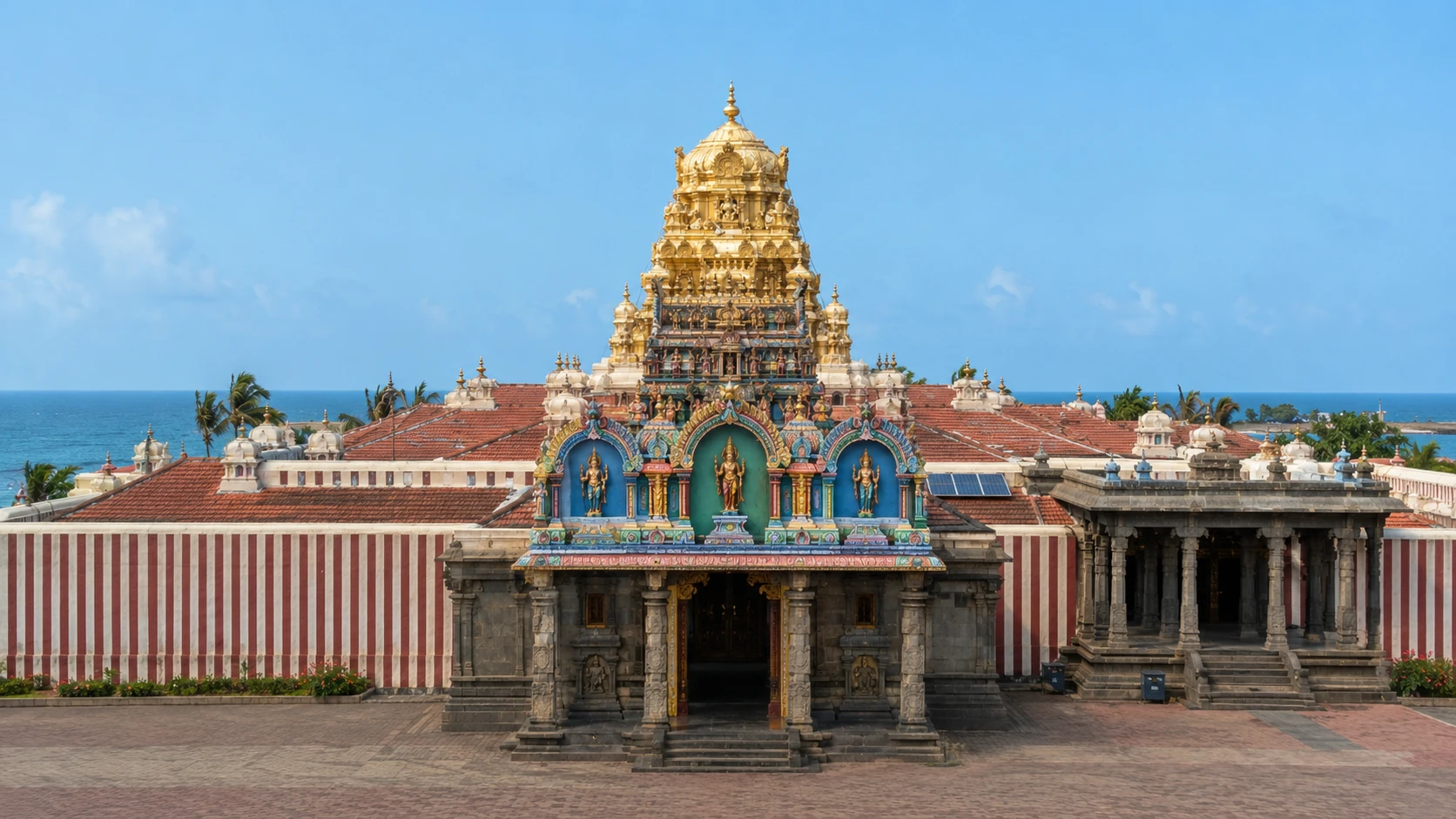
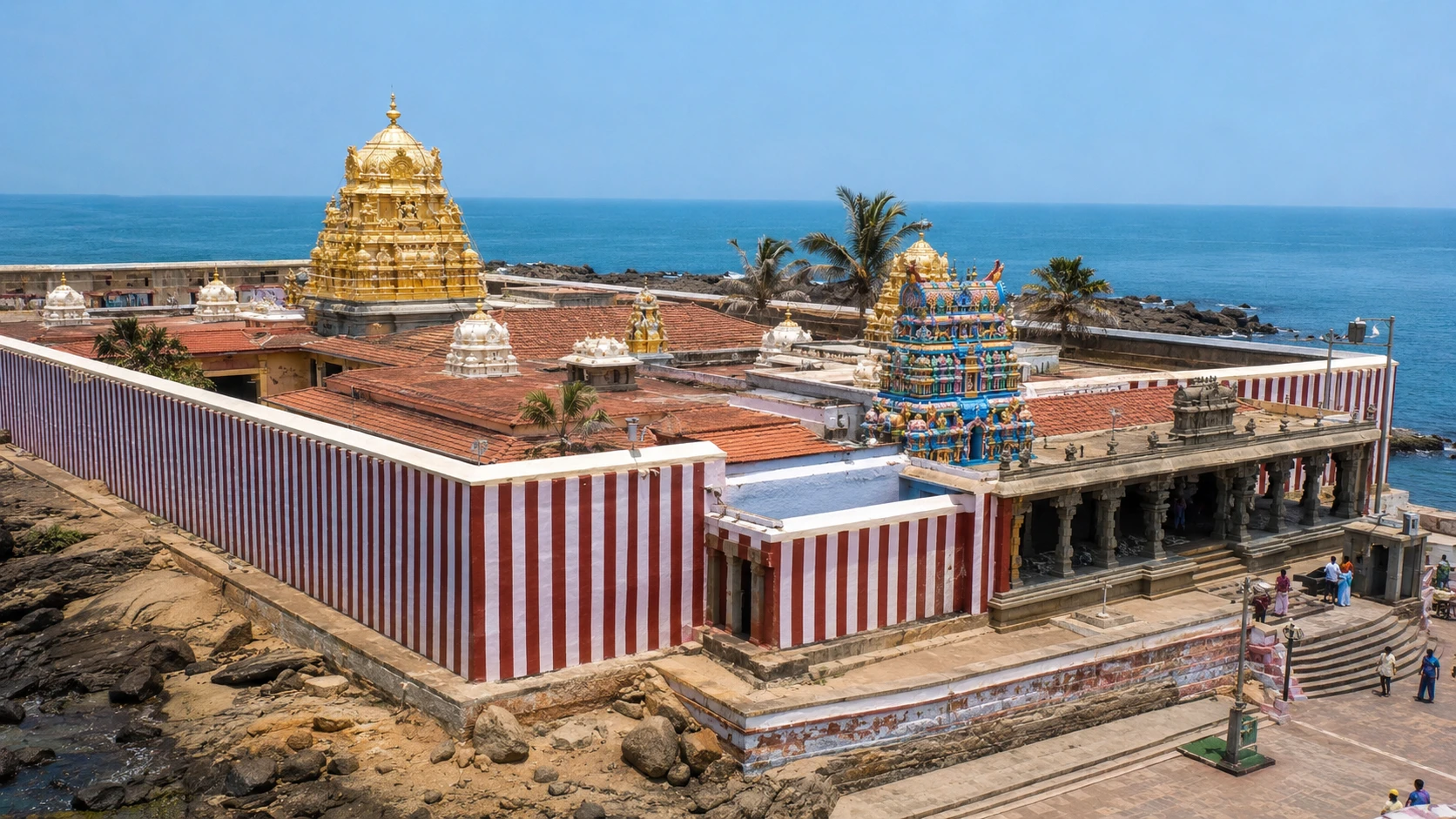
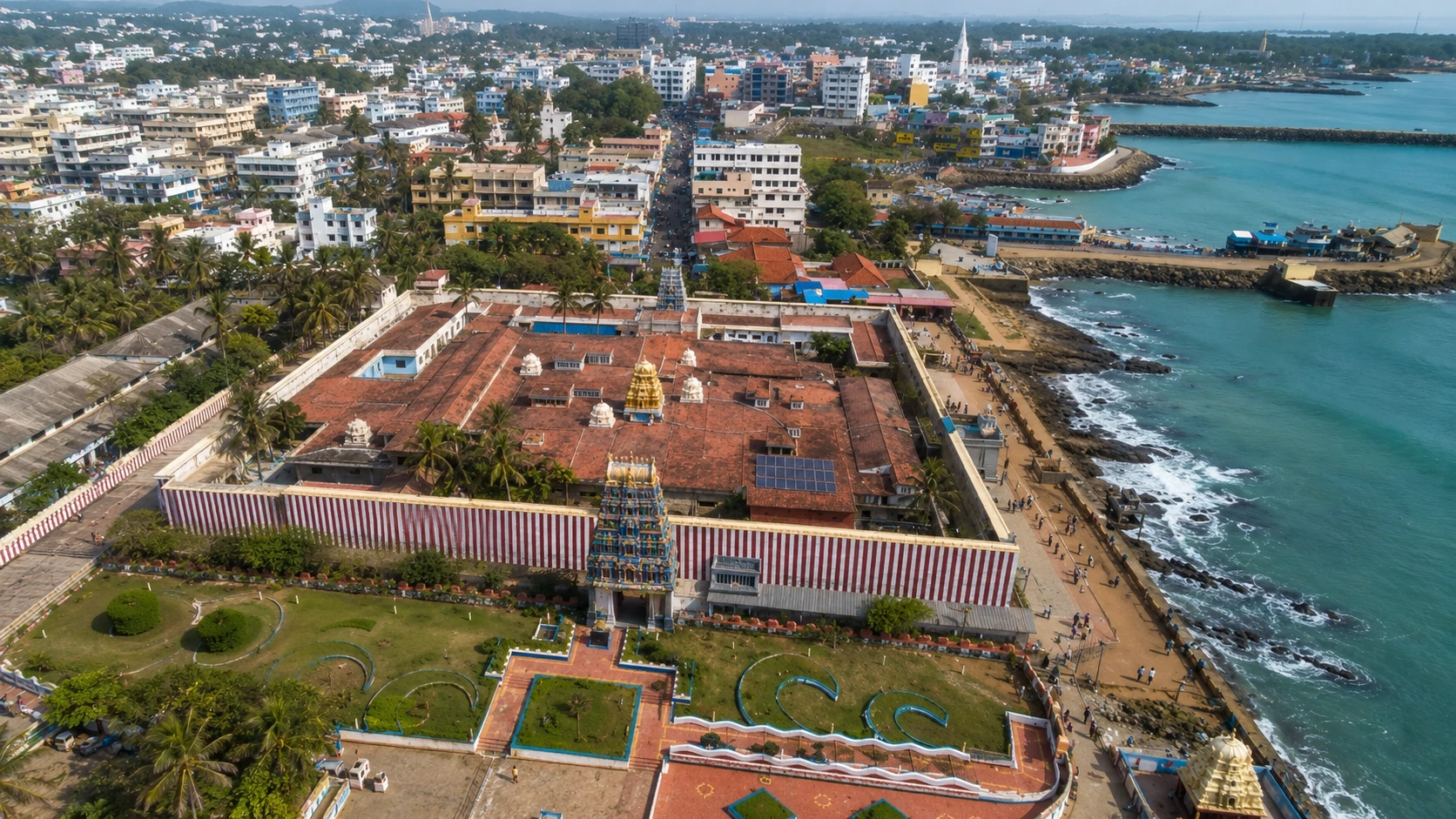
Dravidian (Pandya, Chera lineage) with Vijayanagara and Travancore-period additions; granite garbhagriha with surrounding mandapas and a compact compound oriented toward the eastern sea
खुला
04:30 – 20:15
आरती
04:45 · 07:30 · 11:45 · 17:30 · 19:45
विशेष
Vaisakha Pournami (full moon of Vaikasi, April, May), peak pilgrimage day; Navarathri Mandapam Pooja sequence (September, October), where the Devi is presented in nine successive alankaras across nine nights; Aippasi Aaraattu (October, November), the ceremonial sea-bath procession in which the utsava murti is carried to the shore; Chittirai Pournami draws large crowds; the rare-glimpse darshan of the Devi's diamond nose-ring (mookuthi) at certain aarti slots
पवित्र कथा · पवित्र कथा
At the southernmost tip of the Indian subcontinent, where the Indian Ocean, Bay of Bengal, and Arabian Sea braid into a single horizon, the Goddess waits for a bridegroom who will never arrive. Devi Kanya Kumari was to wed Shiva, the muhurta was set, the wedding procession assembled at Suchindram a few miles inland, but Narada, knowing that her cosmic task was to slay the demon Banasura and that this task required her to remain virgin, prevailed on the cocks of the temple precinct to crow before dawn. The auspicious hour passed. The bridegroom turned back. The bride remained, and remains. Her diamond nose-ring is said to flash so brightly across the sea that ancient sailors once steered ships by it. The temple stands today on the rocky promontory of Cape Comorin, Ashtadasa Shakti Peetha, the seat where Sati's back is said to have fallen in the canonical 51-Peetha enumeration, and one of the oldest continuously-worshipped Devi shrines on the subcontinent.
Sacred Designationपवित्र पदनाम
Shakti Peeth
शरीर का अंग: back / spine (pṛṣṭha)
शक्ति: Sarvani, the eternally-virgin Bhagavati, locally invoked as Devi Kanya Kumari and Bhagavathy Amman
भैरव: Nimisha, the Bhairava who, in a single nimisha (instant), wards off all that would intrude upon the virgin Goddess
Sacred Origin Storyपवित्र उत्पत्ति कथा
Source: Composite of the Devi Bhagavata Purana (Banasura-vadha cycle), the Skanda Purana, the Bhagavata Purana, and the regional Kanyakumari Sthala Mahatmya transmitted through the temple's priestly lineage and the linked Suchindram tradition; the canonical Shakti Peetha framing draws on Adi Shankara's Ashtadasa Shakti Peetha Stotram and the Pithanirnaya section of the Tantra-cuḍāmaṇi.
The Puranic frame begins with the asura Banasura, who through long penance had won from Brahma a boon that he could be slain by no being other than a virgin maiden. Drunk on this immunity, he overran the gods, displaced Indra from Amaravati, and turned his attention to the southern peninsula, where he demanded the worship that belonged to the Devi herself.
The gods, in distress, appealed to Adi Parashakti. She agreed to descend in a form that could fulfill the boon's exact terms, a kanya, a virgin maiden, and was born on the southernmost shore of the subcontinent as a princess of luminous beauty. She undertook penance there for Shiva, who, moved by her devotion, agreed to marry her.
The wedding muhurta was fixed in the depth of night. The bridegroom Shiva, accompanied by his ganas, set out from Suchindram a few miles inland and began the journey toward the shore. Narada, knowing that if the marriage were completed the Devi would cease to be virgin and Banasura would become unslayable, intervened.
By one telling he caused the cocks of the temple precinct to crow before their hour; by another he himself took the form of a rooster. The crowing announced the false arrival of dawn. Shiva, taking the signal that the auspicious time had passed, turned back to Suchindram. The Devi waited through the true dawn; the bridegroom did not come.
The wedding feast that had been prepared, rice, lentils, spices, was scattered along the shore in her grief. To this day the multi-coloured sand of Kanyakumari beach is shown to pilgrims as the remains of that abandoned wedding feast: the white, yellow, red, and black grains held to be the rice, turmeric, kumkum, and burnt offerings turned by her tears to stone.
Knowing now that the marriage was not to be, the Devi accepted the form that would fulfill her cosmic task. When Banasura at last came to claim her as his bride, she met him as the virgin warrior; in the battle that followed, she slew him on the shore where the three seas meet.
The gods restored Indra to his throne, and the Devi remained at the spot of the battle in penance for her bridegroom, taking eternal vow as Kanya, virgin, undescending, undeparting. The temple stands on the location of that vow.
The Shakti Peetha layer is laid onto this story through the canonical body-part enumeration. When Vishnu cut Sati's body apart with the Sudarshana chakra to release Shiva from his grief, fifty-one fragments fell to earth at fifty-one consecrated sites.
The Pithanirnaya assigns to Kanyakumari the falling of the back (pṛṣṭha), the spine that bears all weight, the seat from which the cosmic Devi straightens to fight. Adi Shankara's Stotram names the Devi at this seat Sarvāṇī and pairs her with the Bhairava Nimisha, the watchman who in a single instant wards off all that would intrude upon the virgin form.
उद्धृत स्रोत:
- Devi Bhagavata Purana, Skanda VII (Banasura-vadha narrative and the descent of Adi Parashakti as the virgin maiden)
- Skanda Purana, references to the southern peninsula and the Kumari shrine
- Bhagavata Purana, passing references to the Kumari at the southern tip in pilgrimage enumerations
- Kanyakumari Sthala Mahatmya (regional Sanskrit-Tamil temple text transmitted through the priestly lineage)
- Suchindram Sthanu Mahatmya (linked tradition explaining the bridegroom's path and return)
- Adi Shankaracharya, Ashtadasa Shakti Peetha Stotram (canonical placement as Sarvani at position 17, paired with Bhairava Nimisha)
- Tantra-cuḍāmaṇi, Pithanirnaya section (51-Peetha body-part attribution: back / pṛṣṭha at Kanyakumari)
अन्य परंपराएँ · अन्य परंपराएँ
Devi Bhagavata emphasis, the Banasura-vadha as primary narrative, marriage subordinated
A strong strand of the Devi Bhagavata reading subordinates the marriage-vow narrative to the Banasura-vadha. In this telling, the Devi was never genuinely intended to wed; the marriage proposal was itself a strategic frame within the divine plan, designed to anchor the Devi in a virgin form at the precise location where the asura would seek her.
Narada's intervention, by this reading, is not a thwarting but a fulfillment, the cosmic plan working through its appointed instrument. The grief at the shore and the scattered wedding feast are understood as the Devi's expressive lila rather than genuine sorrow, since the outcome was foreknown from before the proposal was made.
This reading is favoured in Shakta lineages that emphasize the Devi's sovereignty and discourage interpretations in which she could be acted upon by a male deity's choice.
Shakti Peetha tradition, Sati's back / spine fell here
Separately and earlier in the cosmic chronology, the Shakti Peetha tradition holds that Sati, the first wife of Shiva, immolated herself at her father Daksha's yagna after Shiva was deliberately insulted. When the inconsolable Shiva carried her body across the cosmos in his grief, Vishnu cut the body apart with the Sudarshana chakra to release him.
Fifty-one fragments fell to earth at fifty-one sites, each becoming a Shakti Peetha. The Pithanirnaya assigns to Kanyakumari the falling of the back / spine (pṛṣṭha). The Devi installed at this site is Sarvāṇī, the all-pervading one, and the Bhairava is Nimisha, the watchman of the instant.
By this reading the present temple's marriage-vow narrative and the Sati-back narrative are two distinct theological layers that the same physical site honours: the Banasura-vadha account explains the form (eternally virgin), and the Shakti Peetha account explains the seat (back of the cosmic Devi).
विद्वत संदर्भ
Kanyakumari is among the very few Hindu sites whose existence as a place of pilgrimage is independently attested in non-Indian classical sources dating to the 1st century CE. The Periplus of the Erythraean Sea (c. 60 CE), an anonymous Greek navigational handbook, refers to 'Komari' as a southern cape where pilgrims gathered for ritual bathing in the sea; Ptolemy's Geographia (c. 150 CE) similarly identifies the cape as a place sacred to a virgin goddess. The European traveller accounts of Marco Polo (13th century) and Niccolò de' Conti (15th century) preserve later references to the shrine. The Adi Shankara connection is theologically central: Shankara, traditionally dated c. 788, 820 CE and born at Kaladi in Kerala about 200 km north, is held to have visited Kanyakumari during his digvijaya and to have included Sarvāṇī at Kanyakumari at position 17 of his Ashtadasa Shakti Peetha Stotram. Modern scholarship (Diana Eck, India: A Sacred Geography, 2012; Susan Bayly, Saints, Goddesses and Kings, 1989) reads Kanyakumari as a node where pan-Indian Shakta cosmology, Tamil regional Devi worship, and southern peninsular sailor and trade traditions converge, the diamond nose-ring marker, the multi-coloured beach sand, and the rooster-narrative are all distinctively Tamil layers grafted onto the Sanskritic frame. The 1956 States Reorganisation Act transferred the Kanyakumari district from the Travancore-Cochin state to the Madras State (later Tamil Nadu), bringing the temple under Tamil HR&CE administration; this is the operationally significant modern transition.
Historyइतिहास
Kanyakumari's documented history extends with unusual depth for a southern Indian temple. The cape was a known navigational landmark for Indo-Roman trade in the 1st century CE, referenced in the Greek Periplus of the Erythraean Sea (c. 60 CE) and Ptolemy's Geographia (c. 150 CE), both of which describe ritual bathing and the worship of a virgin goddess at this southern promontory, establishing that an active shrine existed here at least 2,000 years ago.
The present granite-and-stone temple structure layers continuous patronage from at least the Pandya period onward: Pandya additions in the 9th, 11th centuries, Chola and Chera contributions, substantial Vijayanagara-era expansion in the 14th, 16th centuries, and Travancore princely-state additions through the 17th, 19th centuries.
The Travancore Maharajas exercised effective patronage of the temple for several centuries; the linked temple at Suchindram (which figures in the wedding-procession narrative) was similarly patronized.
Adi Shankara, traditionally dated c. 788, 820 CE and born at Kaladi roughly 200 km north in Kerala, is held by tradition to have visited Kanyakumari during his digvijaya, the cross-subcontinental pilgrimage in which he is said to have visited and re-consecrated the principal Shakti Peethas of India.
His Ashtadasa Shakti Peetha Stotram places Sarvāṇī at Kanyakumari at position 17 of the eighteen, alongside the Bhairava Nimisha. The temple's contemporary Shaiva-Shakta theological framing draws directly on this Shankaran canonization.
The modern transformation of Kanyakumari is associated above all with two events. In late December 1892, the young wandering monk Swami Vivekananda, then thirty years old and three years before his speech at the Parliament of Religions in Chicago, swam from the shore to a small rock about 500 metres offshore and meditated there for three days.
He is said to have been crystallizing the resolve that would carry him to the West. The rock has since been known as the Vivekananda Rock. In 1970, after a decade-long fundraising campaign led by Eknath Ranade and the newly founded Vivekananda Kendra, a memorial structure was completed on the rock, inaugurated on 2 September 1970 by V.V. Giri, the President of India.
The memorial reshaped Kanyakumari from a temple town into a national pilgrimage site combining Devi worship with the modern remembrance of Vivekananda.
The 1956 States Reorganisation Act transferred the Kanyakumari district from the Travancore-Cochin state to the Madras State (renamed Tamil Nadu in 1969), bringing the temple under the Tamil Nadu Hindu Religious & Charitable Endowments (HR&CE) Department, which administers it today.
Photography is prohibited in the inner sanctum, and male devotees are required to remove their upper garments before entering the inner enclosure, a Travancore-period devotional protocol retained by the present administration.
Historical Timelineऐतिहासिक कालक्रम
Earliest non-Indian classical reference. The anonymous Greek navigational handbook Periplus of the Erythraean Sea identifies 'Komari' (Cape Comorin) as a southern promontory where pilgrims gather for ritual bathing, and references the worship of a virgin goddess at the cape, independent attestation that an active Devi shrine existed here at least 2,000 years ago.
The Periplus reference is widely accepted as one of the earliest external attestations of any Hindu pilgrimage site. Lionel Casson's authoritative 1989 edition reads the relevant passage as referring unambiguously to Cape Comorin and a virgin-goddess cult, though the precise ritual details described (bathing, vows) are sparse. Scholars debate whether the cult described in the 1st century CE is theologically continuous with the present Kanya Kumari tradition or represents an earlier Tamil or Dravidian Devi cult onto which the Sanskritic frame was later laid; the physical and devotional continuity of the site is not in dispute, the theological continuity is.
Adi Shankaracharya's pilgrimage and the Ashtadasa Shakti Peetha Stotram. During his digvijaya, the cross-subcontinental philosophical and pilgrimage tour, Adi Shankara is held by tradition to have visited Kanyakumari and to have composed (or transmitted) the Ashtadasa Shakti Peetha Stotram, in which Sarvāṇī at Kanyakumari is named at position 17, alongside the Bhairava Nimisha. This canonization placed Kanyakumari permanently in the pan-Indian Shakti Peetha enumeration.
Direct authorship of the Stotram by Adi Shankara is traditional but contested by some modern scholars who place its composition in the post-Shankara Advaita tradition (10th, 12th c.). The Stotram's canonization function is not in doubt regardless of strict authorship: it is the text by which the Ashtadasa enumeration became canonical in pan-Indian devotional life. Shankara's traditional dates (c. 788, 820 CE) are themselves the subject of scholarly debate, with some Indologists proposing earlier dates (c. 500, 600 CE) and others retaining the traditional dating.
Vijayanagara-era expansion and Travancore princely patronage. The present temple's gopuram, mandapas, and outer compound reflect substantial Vijayanagara-period building campaigns in the 14th, 16th centuries, layered with subsequent Travancore princely-state patronage through the 17th and later centuries. Travancore Maharajas, particularly during the reigns of Marthanda Varma (r. 1729, 1758) and Dharma Raja (r. 1758, 1798), endowed lands, ritual specifications, and the daily puja calendar that continues to govern the temple's contemporary worship cycle.
The temple's continuous architectural layering across Pandya, Vijayanagara, and Travancore periods makes precise dating of individual structural elements difficult; many features are conventionally attributed to broad period bands rather than specific reigns. The Travancore patronage record is significantly better documented than the Vijayanagara, owing to the survival of the Travancore state archives.
Swami Vivekananda's three-day meditation on the offshore rock. The thirty-year-old wandering monk, having walked across India during his parivrajaka years, reached Kanyakumari, swam from the shore to a small rock about 500 metres offshore, and meditated there continuously for three days. He is held to have arrived at the resolve to carry the message of Vedanta to the West; he would speak at the Parliament of the World's Religions in Chicago less than nine months later. The rock has since been known as the Vivekananda Rock.
Vivekananda Rock Memorial inaugurated. After a decade-long all-India fundraising campaign led by Eknath Ranade and the newly founded Vivekananda Kendra, a campaign that famously gathered contributions from millions of Indians at one rupee each, a memorial complex was completed on the offshore rock. The structure houses the Sri Pada Mandapam (commemorating the footprint of the Devi believed to be inscribed on the rock) and the Vivekananda Mandapam with a statue of the monk in meditation. The memorial was inaugurated on 2 September 1970 by V.V. Giri, the President of India. The 133-foot Thiruvalluvar Statue, commemorating the Tamil poet-philosopher, was added on an adjacent rock in 2000.
What You'll Seeदर्शन में
The Devi at Kanyakumari is enshrined as a svayambhu (self-manifest) stone image, dark in colour and polished smooth by centuries of daily abhisheka. She stands facing east, toward the Bay of Bengal, in the posture of a maiden in penance, feet together, body upright, gaze level and outward.
Her right hand holds a rudraksha rosary (akshamala), the visible mark of her undeparting tapas; her left hand rests free. The image is small and intimate, consistent with southern garbhagriha design where the deepest seat is most contained.
The iconographic feature for which Kanyakumari is famous across the subcontinent is the diamond nose-ring (mookuthi). The stone of the nose-ring is held by temple tradition to flash with a brilliance visible far out at sea, bright enough that historically, before modern navigational aids, sailors are said to have steered ships by its reflection across the Bay of Bengal.
The eastern door of the sanctum is for this reason kept closed for most of the year, opening only on five specific festival occasions; the temple's protective protocol holds that an open eastern door at night would draw vessels onto the cape's rocks by mistaking the nose-ring's flash for harbor lights.
Devotees take darshan through the western and northern doors on ordinary days; the rare eastern-door darshan is among the most coveted ritual moments in the Tamil pilgrimage calendar.
The Devi is dressed daily in silk in colours appropriate to the lunar tithi and the festival cycle, with garlands of mallika (jasmine), tulsi, and seasonal southern flowers. Her ornaments include the historic diamond nose-ring, a heavy gold chain, ear ornaments, and bracelets.
The sanctum is small, lit by oil lamps, and conserves the inward concentration characteristic of Pandya-period Devi shrines.
Distinctive Practicesविशिष्ट परंपराएँ
The Five Eastern-Door Openings
पाँच पूर्वी-द्वार उद्घाटन
Five specific occasions in the temple year, most consistently the Vaisakha Festival (May), Navarathri Vijayadashami (October), the Aippasi Aaraattu (October, November), the Margazhi Karthigai (December), and Edavappathi (June)
On most days the sanctum's eastern door, facing directly toward the Bay of Bengal, remains closed, and devotees take darshan of the Devi through the western and northern entrances. The eastern door opens only on five specific occasions in the temple year, granting darshan in the orientation toward which the Devi herself faces in her endless watch. These openings are among the most sought-after moments in the southern devotional calendar; many pilgrims plan their entire Kanyakumari yatra around one of them.
Temple tradition holds that the diamond nose-ring (mookuthi) of the Devi is so brilliant that an open eastern door at night would draw vessels onto the cape's rocks, the sailors mistaking the gem's flash for harbor lights. The restraint is therefore both protective and revelatory: the closed door guards seafarers, and the rare opening grants the devotee the orientation in which the Devi most fully sees outward.
Aippasi Aaraattu, Sea-Bath of the Utsava Murti
ऐप्पसी आराट्टु, उत्सव मूर्ति का सागर-स्नान
Aippasi month (October, November), at the new-moon (Amavasya) culmination of the temple's annual Aippasi observance
On the concluding day of the Aippasi observance, the temple's utsava murti, the processional bronze of the Devi, is carried out of the sanctum in a palanquin and taken in solemn procession to the cape itself, the rocky promontory where the three seas meet. There the murti is given the aaraattu, a full ceremonial bath in the sea-water of the confluence. Temple priests offer milk, turmeric, sandal paste, and flowers into the sea around the bathing image; pilgrims along the shore add their own offerings to the same waters. After the bath the murti is dried, re-adorned, and carried back to the sanctum.
Among Devi temples of India, only a handful are positioned on a coast where the deity can be given a sea aaraattu, and only one, Kanyakumari, at the confluence of three open seas. The ritual enacts the Devi's vow at the spot of her cosmic battle: the ocean that witnessed Banasura's death becomes, on this one day each year, the abhisheka jala (bathing water) of the goddess who fought him. The pilgrim who joins offerings to the sea on this day is held to participate in the same continuity.
Triveni Snan, Pre-Darshan Bath at the Three-Sea Confluence
त्रिवेणी स्नान, दर्शन-पूर्व त्रिसागर-संगम स्नान
Ideally before the morning darshan; particularly observed at sunrise on Vaisakha Pournami, Navarathri, and during the annual Aippasi observance
The standard pilgrim sequence at Kanyakumari prescribes a bath in the sea at the cape before the temple darshan, at the spot where the Indian Ocean, Bay of Bengal, and Arabian Sea braid together. Pilgrims wade in to chest depth, take three immersions (one for each sea), and offer water through cupped palms to the rising sun if the bath is taken at dawn. They then walk the short distance to the temple in still-wet clothes for the morning darshan. The temple itself supplies no bathing infrastructure; the practice belongs to the cape, not to the temple precinct, and is part of why the seafront immediately east of the temple is treated as sacred ground.
The three-sea confluence is held in tradition to be a Triveni, analogous to the Ganga, Yamuna, Saraswati confluence at Prayag, but composed of three oceans rather than three rivers. The pilgrim purifies through the same logic that governs Prayag snan: confluence-water carries the cleansing power of three streams at once. For the Kanyakumari pilgrim, the cleansing is also preparation for facing a Devi who has herself stood on this shore in eternal penance.
Did You Know?क्या आप जानते हैं?
The famously multi-coloured sand of Kanyakumari beach, bands of white, yellow, red, and black grains, distinct enough that pilgrims often collect a small vial as a memento, is held in temple tradition to be the petrified remains of the abandoned wedding feast: the rice (white), turmeric (yellow), kumkum (red), and burnt offerings (black) scattered along the shore in the Devi's grief and turned to stone by her tears. Modern geology identifies the colours as natural mineral content, with Kanyakumari beach in fact constituting one of India's richest concentrations of placer minerals (ilmenite, garnet, monazite, zircon, rutile). Tradition and geology read the same sand twice; neither reading replaces the other in pilgrim experience.
Temple Sthala Mahatmya tradition; Geological Survey of India reports on Tamil Nadu coastal mineral deposits; Indian Rare Earths Limited operations at Manavalakurichi (40 km from Kanyakumari) work the same mineral sand belt
The diamond nose-ring (mookuthi) is said in temple tradition to have been visible at sea, bright enough that, before modern lighthouses and navigational beacons, ships running close to the cape are reported to have mistaken its flash for a harbor light. For this reason the eastern door of the sanctum, which faces directly onto the Bay of Bengal, is kept closed for most of the year and opens only on five specific festival occasions.
Temple Sthala Mahatmya; Travancore State Manual (V. Nagam Aiya, 1906) on the Devi shrines of southern Travancore
Kanyakumari is one of the very few coastal points in India from which a person standing on the beach can observe both sunrise over open ocean (the Bay of Bengal to the east) and sunset over open ocean (the Arabian Sea to the west) in the same day. Through certain weeks of the year, the geometry permits both observations from the same approximate vantage; through other weeks the sun's seasonal position offsets one or the other. The pilgrim guidebook tradition treats the dual horizon as a visible enactment of the Devi's location at the meeting point of the diurnal cycle.
Tamil Nadu Tourism guides; standard astronomical reference for Cape Comorin latitude (8.08°N)
The wedding-procession narrative of the Devi connects Kanyakumari directly to the Suchindram Thanumalayan Temple, approximately 13 km inland, the site where Shiva, with his ganas, is held to have set out toward the wedding and to which he returned when Narada's pre-dawn cock-crow signalled the missed muhurta. The two temples are linked in the regional Yatra circuit; the linked Devi-Shiva festival linkages span the Vaisakha and Aippasi observances. Suchindram itself enshrines Shiva, Vishnu, and Brahma in a single linga (the Sthanumalaya, meaning sthanu+mal+aya, the seat of Shiva+Vishnu+Brahma).
Suchindram Sthanu Mahatmya; standard Tamil Nadu temple-circuit pilgrim guides
Kanyakumari Railway Station (station code CAPE) is the southern terminus of the Indian Railways network and the starting point of the Himsagar Express to Jammu Tawi, India's longest single train route, covering approximately 3,750 km in roughly 71 hours of running time, transiting twelve states from the cape to the Kashmir foothills. For many pilgrims the train journey to Kanyakumari is itself part of the yatra, undertaken in the spirit of crossing the subcontinent to face the Devi who stands at its southern edge.
Indian Railways official route documentation; Himsagar Express timetable (Train Nos. 16317/16318)
Visitor Accessप्रवेश जानकारी
The Kanyakumari Bhagavathy Temple is open to devotees of all backgrounds, faiths, and nationalities for darshan, but observes several specific protocols. Photography is strictly prohibited inside the inner sanctum and within demarcated zones of the temple complex; mobile phones must be silenced. Male devotees are required to remove their upper garments (shirts, banyans, t-shirts) before entering the inner enclosure, this is a Travancore-period devotional protocol retained by the present Tamil Nadu HR&CE administration. The sanctum's eastern door is kept closed for most of the year and opens only on five specific festival occasions in the temple year. There are no restrictions of caste, gender, or marital status on entry.
आध्यात्मिक आधार
The male upper-garment removal is rooted in the Travancore-Cochin devotional grammar of approaching the Devi as a kanya in tapas, entering her presence without the social armour of formal dress. The photography prohibition reflects the temple's understanding of darshan as a non-reciprocal seeing: the Devi sees the devotee, and the devotee is asked to be present in that seeing rather than to capture it. The eastern-door restriction is woven into the very iconography of the Devi (see iconography and distinctivePractices).
समकालीन संदर्भ
The temple is administered by the Tamil Nadu Hindu Religious & Charitable Endowments (HR&CE) Department since the 1956 transfer of Kanyakumari district from Travancore-Cochin to Madras State. The protocols above are administered by HR&CE in consultation with the hereditary priestly lineage. Cameras and phones are held at a deposit counter at the entry; pilgrims should arrive expecting to leave electronics outside.
व्यावहारिक मार्गदर्शन
Plan to arrive at least 90 minutes before your intended darshan slot. Leave bags, cameras, and phones at the cloak-room counter at the main entrance. Men should be prepared to remove upper garments at the inner enclosure entry; carry a small towel for comfort. Allow time afterward for the cape's beach, the Vivekananda Rock Memorial (reached by short ferry, separate timings), and the Thiruvalluvar Statue. Sunrise darshan combined with the Triveni snan at the cape is the most fully realized devotional sequence the site offers.
Festivalsत्योहार
Vaisakha Festival (Vaikasi Visakha Brahmotsavam)
वैशाख उत्सव (वैकासि विशाखा ब्रह्मोत्सवम्)
May, June (Vaikasi, Tamil)
The temple's principal annual brahmotsavam, observed across ten days in the Tamil month of Vaikasi and culminating on the Vaisakha Pournami (full moon). Daily processions of the utsava murti, elaborate alankaras, and one of the year's five eastern-door openings make this the festival around which the Kanyakumari ritual year is organized. Pilgrim numbers peak; bookings should be made well in advance.
Navarathri Mandapam Pooja
नवरात्रि मंडपम् पूजा
September, October (Purattasi, Tamil)
The nine-night Sharadiya Navarathri observance, in which the Devi is presented in nine successive alankaras across nine evenings, each evoking a different facet of the goddess, from the warrior Durga of the early nights through Lakshmi in the middle to Saraswati and the final Vijayadashami procession. The temple's Navarathri Mandapam is decorated nightly, kolam (rangoli) art is laid afresh, and the cape draws pilgrims from across Tamil Nadu, Kerala, and Karnataka. Vijayadashami is one of the year's five eastern-door openings.
Aippasi Aaraattu, Sea-Bath Festival
ऐप्पसी आराट्टु, सागर-स्नान उत्सव
October, November (Aippasi, Tamil)
The annual observance culminating in the sea-bath of the utsava murti at the three-sea confluence (see distinctivePractices). The Aippasi observance spans approximately ten days, with the aaraattu itself falling on the new-moon day. The temple's eastern door opens at this culmination, and the procession from the sanctum to the shore is among the most photographed ceremonial movements in Tamil temple life (photography permitted along the procession route, not inside the sanctum).
Thai Pongal & Pongal Pooja
थाई पोंगल और पोंगल पूजा
Mid-January (Thai, Tamil)
Tamil Nadu's signature harvest festival is observed at the temple with special pre-dawn pujas, the offering of freshly cooked Pongal (sweet rice with jaggery and ghee) to the Devi, and a community feast in the temple precinct. Though not specifically a Devi festival in pan-Indian terms, Pongal at Kanyakumari is observed with the full grammar of Tamil temple ritual and draws large local participation alongside the steady pilgrim flow from across India.
How to Reachकैसे पहुँचें
By air: Trivandrum International Airport (TRV, ~88 km in neighbouring Kerala) is the nearest, with direct flights from major Indian cities and several Gulf destinations; the road transit from Trivandrum to Kanyakumari is approximately 2.5, 3 hours on NH-66.
Tuticorin Airport (TCR, ~155 km) and Madurai Airport (IXM, ~245 km) are secondary options with lighter direct connectivity.
By rail: Kanyakumari Railway Station (station code CAPE), the southern terminus of the Indian Railways network, lies approximately 1 km from the temple. Direct trains operate from across the subcontinent: the Himsagar Express from Jammu Tawi (the longest single train route in India, ~71 hours), the Kanyakumari, Bangalore Island Express, the Kanyakumari, Mumbai LTT Express, services from Delhi, Howrah, Trivandrum, Chennai, Coimbatore, Bangalore, and dense regional connectivity from across Tamil Nadu and Kerala.
By road: NH-44 (Srinagar, Kanyakumari, India's longest national highway, terminates here) and NH-66 (coastal Kerala, Tamil Nadu corridor) both enter Kanyakumari. Tamil Nadu State Transport Corporation (TNSTC) buses run frequently from Trivandrum (3 hrs), Nagercoil (22 km, 30 min), Tirunelveli (85 km, 2 hrs), Madurai (5 hrs), and Chennai (overnight).
Private operators and tourist coaches connect from across South India. Within Kanyakumari town, the temple, the ferry jetty for the Vivekananda Rock, and the main pilgrim accommodation are all within easy walking distance.
Plan Your Visitयात्रा की योजना
🌤 सर्वोत्तम मौसम
October through February is the best period to visit: the southwest and northeast monsoons have passed, temperatures are pleasant (24, 32°C), the sea is calm, and sunrise and sunset are most reliably visible. March through May is hot and humid (often 32, 37°C with high humidity from the surrounding seas) but festival energy is high during the Vaikasi Visakha Brahmotsavam. June through September is the southwest monsoon period: rains are heavy, the sea is rough, ferry services to the Vivekananda Rock are often suspended, and the cape's signature sunrise/sunset visibility is frequently obscured.
👘 पहनावे का नियम
Traditional modest dress is expected. Men: dhoti or trousers with a shirt; the upper garment (shirt, t-shirt, banyan) must be removed before entering the inner enclosure, a Travancore-period devotional protocol retained by the HR&CE administration. Carry a small towel or angavastram for comfort. Women: saree, salwar-kameez, or long skirt and modest top; head covering not required but appreciated. Avoid shorts, sleeveless tops, and beachwear at the temple itself, even though the cape's beach is just outside.
📱 फोन और फोटोग्राफी
Mobile phones and cameras are strictly not permitted inside the inner sanctum or in demarcated zones of the temple complex. A deposit counter at the main entrance accepts phones, cameras, and bags for the duration of darshan. Tokens are returned on exit. Phones must be silenced if carried into the outer prakara areas.
🏨 आवास
Kanyakumari town offers accommodation across the price range. Government options include Tamil Nadu Tourism's Hotel Tamil Nadu (sea-facing rooms; advance booking via TTDC). Vivekananda Kendra Vivekanandapuram, about 1 km from the temple, offers ashram-style accommodation oriented around morning meditation programs and the Kendra's spiritual schedule, appropriate for pilgrims seeking a contemplative stay. Private hotels span budget guesthouses to mid-range business hotels along the main road and the seafront. Booking is essential during Vaikasi Visakha (May, June), Navarathri (Sept, Oct), Aippasi Aaraattu (Oct, Nov), and the winter peak (Dec, Jan). Many pilgrims also stay at Nagercoil (22 km) or Trivandrum (88 km) and make day visits.
Book a Pujaपूजा बुक करें
Booking links and phone numbers are verified periodically but may change without notice. Always confirm the destination URL belongs to the official temple trust before payment. Phone numbers and email addresses listed here are provided by the official temple authority where available; verify on the trust's official website before contacting. Several operational fields for the Kanyakumari Bhagavathy Temple are intentionally null in this record pending a dedicated verification pass against Tamil Nadu HR&CE listings; the on-ground sponsorship route through the temple administrative office remains the most reliable channel.
Managed by: Tamil Nadu Hindu Religious & Charitable Endowments (HR&CE) Department, Government of Tamil Nadu, Arulmigu Bhagavathy Amman Devasthanam, Kanyakumari
Archana (general)
अर्चना (सामान्य)
Abhishekam (special)
अभिषेकम् (विशेष)
Sahasranama Archana (full thousand-name recitation)
सहस्रनाम अर्चना (पूर्ण सहस्र-नाम पाठ)
Sacred Soundsपवित्र ध्वनि
Ashtadasa Shakti Peetha Stotram, the canonical text in which Adi Shankara enumerates the eighteen seats of the Devi and names Sarvāṇī at Kanyakumari at position 17, paired with Bhairava Nimisha
stotram · 312
Bhavani Ashtakam, Adi Shankara's eight-verse plea to the Devi as the sole refuge ('na tāto na mātā na bandhur na dātā... tvameva tvameva tvameva tvameva'), recited daily across Shakta traditions
stotram · 285
Lalita Sahasranama, the thousand names of Lalita Tripura Sundari from the Brahmanda Purana, the canonical Sri Vidya text that names many of the same epithets under which the Kanyakumari Devi is worshipped
stotram · 2820
Soundarya Lahari, Adi Shankara's hundred-verse hymn to the Devi, the foundational Sri Vidya poetic text, in which the Devi is approached both as cosmic Shakti and as the most beautifully imagined form
stotram · 2640
Devi Mahatmya, Chapter 11 (Narayani Stuti), the gods' praise of the Devi after the slaying of the asuras, from the Markandeya Purana; the central canonical text for the warrior-Devi who, in the Kanyakumari narrative, slays Banasura on the cape's shore
stotram · 540
क्या आप जानते हैं? · Did You Know?
वही अनुवाद त्रुटि जिसने हिन्दू धर्म में '33 कोटि' को '33 करोड़' बनाया, बौद्ध धर्म में भी हुई। बौद्ध ग्रन्थों के चीनी अनुवाद ने 'सप्त कोटि बुद्ध' (7 श्रेष्ठ बुद्ध) का अनुवाद '7 करोड़ बुद्ध' कर दिया। तिब्बती अनुवाद ने सही किया: 7 प्रकार, 7 करोड़ नहीं। एक संस्कृत शब्द, दो प्रमुख विश्व धर्मों में गलत पढ़ा गया, ने दो एकसमान भ्रम स्वतन्त्र रूप से उत्पन्न किए।
Related Contentसंबंधित सामग्री
Related Scriptures
Related Temples
Mahalakshmi Kolhapur
महालक्ष्मी कोल्हापुर
Kolhapur, Maharashtra
Vaishno Devi
वैष्णो देवी
Katra, Jammu and Kashmir
Kamakhya Temple
कामाख्या मंदिर
Guwahati, Assam
Meenakshi Temple
मीनाक्षी मंदिर
Madurai, Tamil Nadu
Chamundeshwari
चामुण्डेश्वरी
Mysore, Karnataka
Jwala Devi
ज्वाला देवी
Jwalamukhi, Himachal Pradesh
Naina Devi
नैना देवी
Bilaspur, Himachal Pradesh
Community Reflections
🕉️
Be the first to share your reflection.