Chamundeshwari
चामुण्डेश्वरी
The hill where Chamundi slew Mahishasura and where Mysuru takes its name
Mysore, Karnataka, India
CāmuṇḍeśvarīAlso known as: Chamundi Devi, Sri Chamundeshwari, ಚಾಮುಂಡೇಶ್ವರಿ ದೇವಿ, ಚಾಮುಂಡಿ, चामुंडेश्वरी देवी, चामुंडी, Krouncha Pithesvari (Ashtadasa designation; Krouncha-peetha at Mysuru), Mahishasura Mardini of Mysuru, The Goddess of Chamundi Hill
युग
Worship at Chamundi Hill is referenced in classical Karnataka tradition from at least the 8th century CE through Adi Shankara's Ashtadasa Stotram; Hoysala and Vijayanagara patronage from the 12th, 15th centuries; the temple's institutional consolidation as the Wodeyar kuladevata from 1610 onwards; major 1827 reconstruction under Maharaja Krishnaraja Wodeyar III; current administrative framework under the Karnataka Hindu Religious and Charitable Endowments (Muzrai) Department from the post-Independence era
वास्तुकला
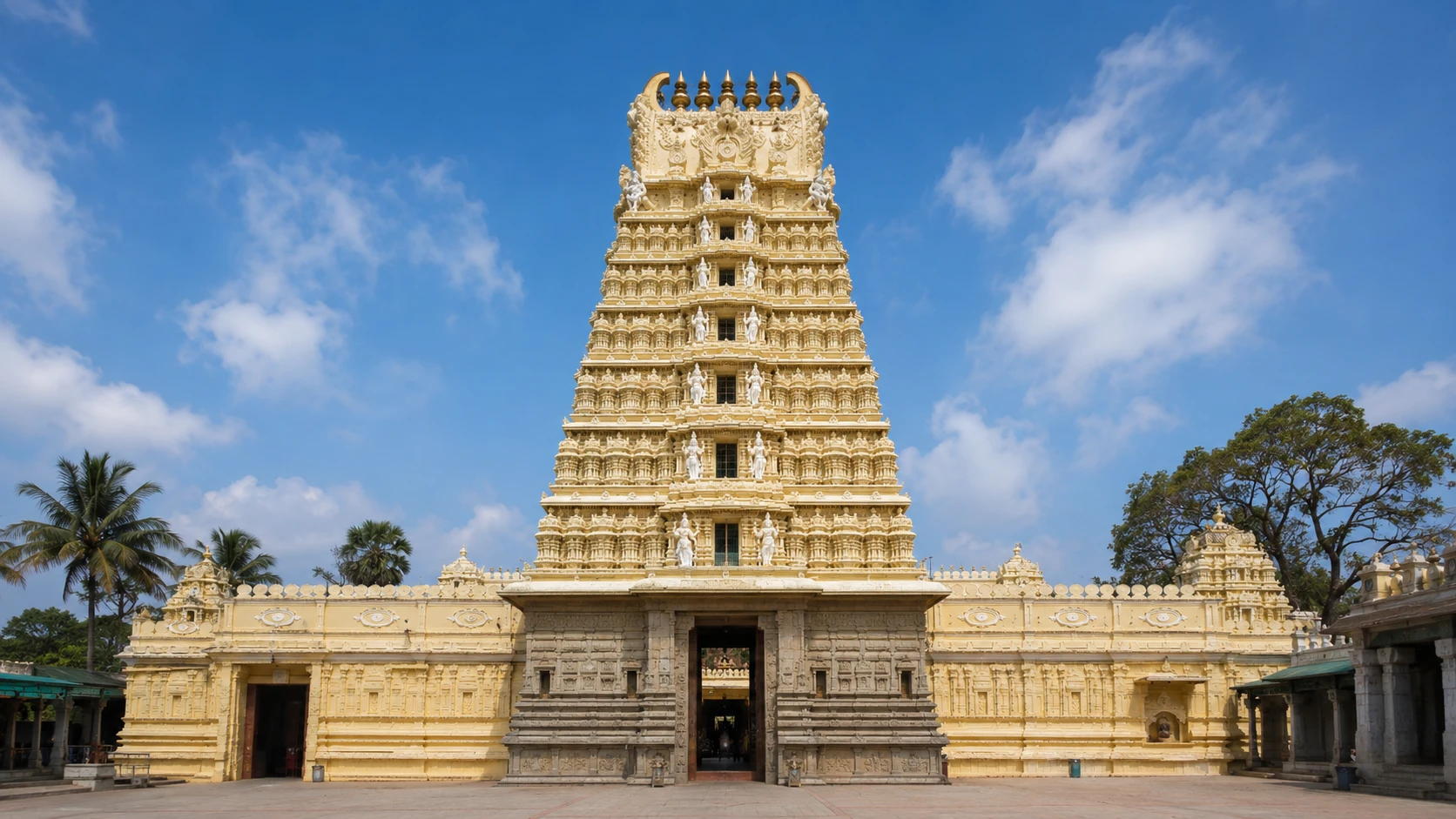
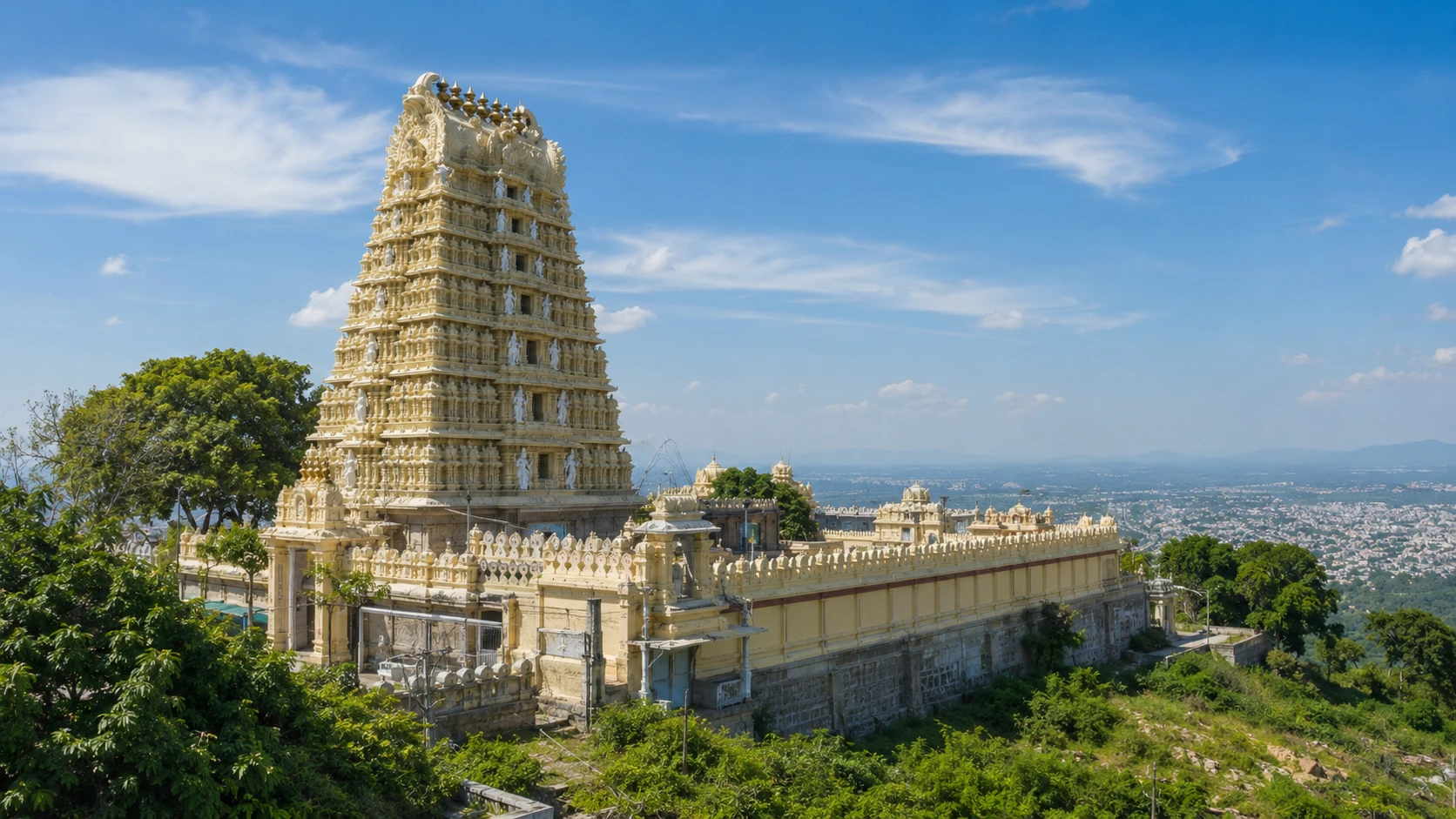
Dravidian temple architecture in the regional Mysuru-Vijayanagara style, characteristic pyramidal gopuram entrance towers, pillared mandapas with Dravidian column work, and a vimana over the central sanctum; the temple's present structural form derives substantially from the 1827 Krishnaraja Wodeyar III reconstruction, with additional 19th- and 20th-century expansions; the surrounding hilltop complex includes secondary shrines, the famous Mahishasura statue at the entrance, and the monolithic Nandi statue on the climb up
खुला
07:30 – 21:00
आरती
07:30 · 12:00 · 18:00 · 19:30
विशेष
The principal daily aartis are conducted at morning opening, midday, evening, and night-close; the Maha Mangala Aarti during Dasara is the year's most elaborate ritual moment, with Wodeyar-family ceremonial participation and Karnataka state government attendance. Sponsored sevas (abhishekam, archana, kunkumarchana, pushparchana) can be arranged through the Karnataka Muzrai department's seva channels; advance booking is required for the major festival windows. The Vajra-Mukuta (diamond crown) donated by Maharaja Krishnaraja Wodeyar III is occasionally placed on the goddess during major festivals, drawing exceptional pilgrim flow.
पवित्र कथा · पवित्र कथा
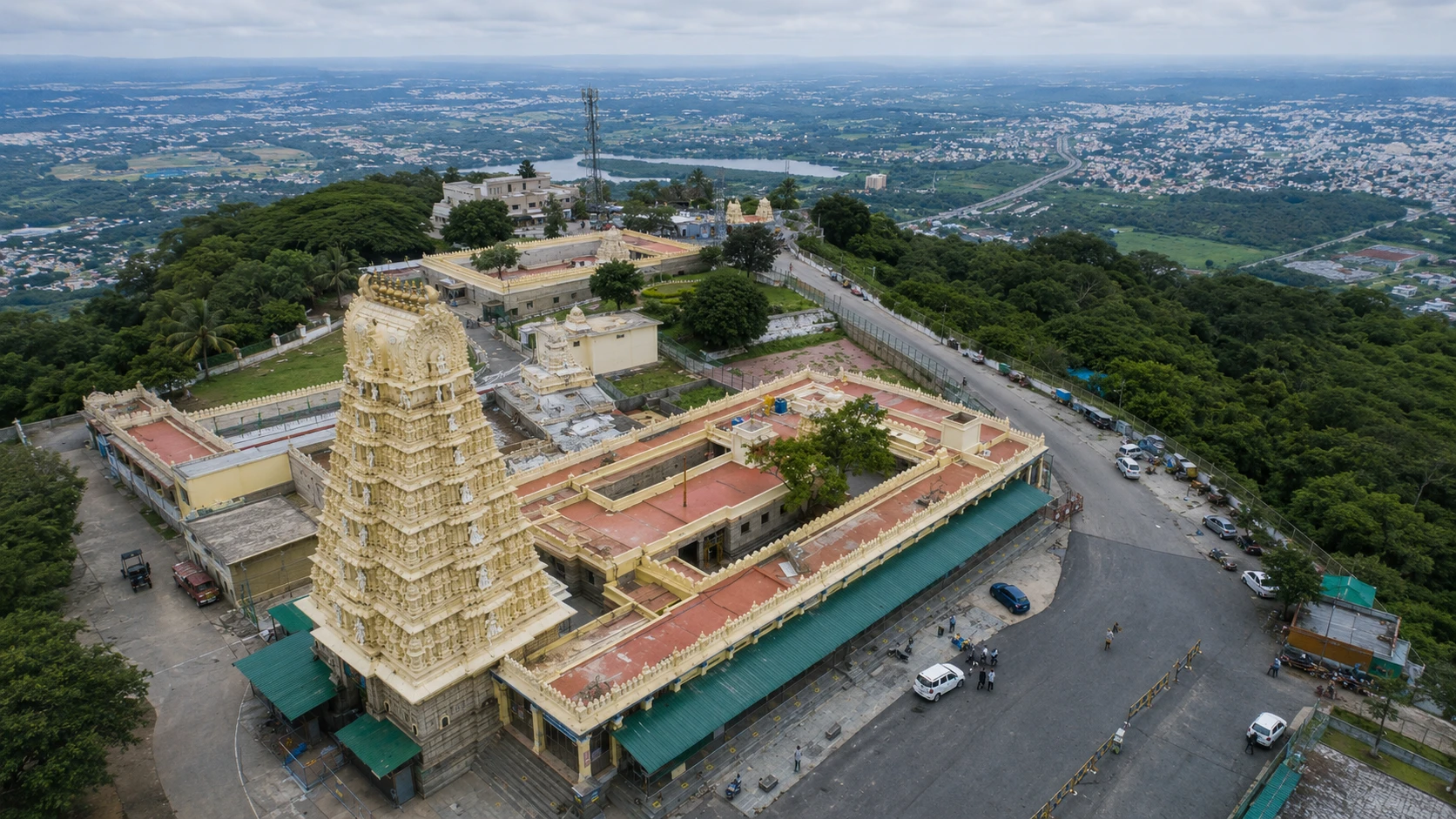
On the summit of Chamundi Hill, Chamundi Betta in Kannada, rising approximately 1,000 metres above the southern Karnataka plains, sits one of the most institutionally consequential Shakti Peethas in southern India. The temple's name is the goddess's name: Sri Chamundeshwari, the form of Devi who, according to the foundational regional narrative, slew the buffalo-demon Mahishasura at this very hilltop. The narrative is woven directly into the surrounding geography: the city below, Mysuru, the Kannada-language form of which the British rendered as 'Mysore', takes its name from the demon she killed (Mahishasura's place becomes Mahishuru becomes Mysuru), and at the entrance to the hilltop a colossal monolithic statue of Mahishasura himself stands in the goddess's commemoration of her own defeated adversary. Few major Hindu shrines display the slain demon as prominently as this; here the statue stands not as an object of worship but as a visual record of the moment the cosmic order was restored. The goddess walks through the world named for the one she defeated. Chamundeshwari is one of the eighteen Maha Shakti Peethas catalogued in Adi Shankara's 8th-century Ashtadasa Shakti Peetha Stotram, listed at the fourth position among the great seats of the Devi (between Sri Sailam Bhramaramba and Jogulamba at Alampur in the canonical ordering). For at least the past four centuries the temple has functioned as the kuladevata (clan goddess) of the Wodeyar dynasty of Mysore, the royal house that established its capital here in 1610 under Raja Wodeyar I and continued through the maharajas who ruled the princely state of Mysore until the merger with the Indian Union in 1947, and whose descendants remain ceremonially associated with the temple's principal festivals today. The Mysuru Dasara, the ten-night autumnal festival concluding on Vijayadashami, is one of India's most institutionally elaborate Devi observances, with the goddess at the centre of an entire municipal-and-state festival ecosystem that culminates in the famous Jamboo Savari elephant procession through the streets of Mysuru. To climb the 1,008 stone steps from the base of Chamundi Hill to the temple summit, past the giant monolithic Nandi statue installed by Dodda Devaraja Wodeyar in 1659, and to stand before the fierce, jewelled, weapon-bearing goddess in her inner sanctum is to enter a sacred geography that has been continuously elaborated by royal patronage, classical Sanskrit hymnology, and regional Kannada devotional life for over a thousand years.
Sacred Designationपवित्र पदनाम
Shakti Peeth
शरीर का अंग: Hair/locks (kesh/kuntala) per regional Karnataka tradition; the specific canonical Sati body-part attribution at this site varies across sources and is less standardized than at the body-part-named peethas. Some traditions identify the site by reference to 'Krouncha-peetha' (the peak/hill peetha) rather than by a specific body part, treating Chamundeshwari's Ashtadasa status as a designation of the goddess form rather than a strict Sati-dismemberment site
शक्ति: Chamundi / Chamundeshwari, the fierce-protective form of Devi who slew the buffalo-demon Mahishasura at this hilltop; iconographically eight-armed, weapon-bearing, seated on the lion vehicle
भैरव: Less canonically standardized at this site; some regional Tantric sources name variants but no single attribution holds across the major textual enumerations
Sacred Origin Storyपवित्र उत्पत्ति कथा
Source: Devi Mahatmya (Durga Saptashati) chapters 7, 8 for the Chanda-Munda and Mahishasura killing narratives; Adi Shankara's Ashtadasa Shakti Peetha Stotram (8th century CE); regional Karnataka Mahatmya tradition; Wodeyar-era Mysore royal devotional literature.
Chamundeshwari's foundational narrative reaches deep into the Devi Mahatmya, the 5th-7th century Sanskrit text that codifies the goddess's principal cosmic interventions. Two episodes from the Mahatmya converge on this hilltop: the killing of the buffalo-demon Mahishasura (Durga Saptashati chapter 3), and the killing of the demon-twins Chanda and Munda (chapter 7) from which Chamundi takes her name.
In the Mahishasura narrative, the demon-king Mahishasura has obtained a boon that no male, neither god nor human, can defeat him; he conquers the three worlds, ousts the gods from Indra's heaven, and reduces the cosmic order to chaos.
The combined energies of the gods coalesce into the form of the goddess Durga, who confronts Mahishasura in a nine-day battle that ends with the goddess piercing the buffalo-demon's heart with her trident. The Mysuru regional tradition specifically locates this cosmic battle at Chamundi Hill: this hilltop is where Mahishasura made his stand, where the goddess pursued him through his shape-shifting transformations, and where she finally killed him.
The hill's name (Chamundi) and the city's name (Mysuru, derived from Mahishuru, derived from Mahishasura) both encode this foundational event into the surrounding geography.
The Chanda-Munda narrative provides Chamundeshwari's specific name. In Durga Saptashati chapter 7, the demon-king Shumbha sends two of his generals, Chanda and Munda, to capture or kill the goddess. The goddess emanates from her own forehead a fierce dark form named Kali, who proceeds to behead both demon-generals in single combat.
When Kali presents the severed heads to the goddess, the goddess names her Chamundi, 'she who slew Chanda and Munda', and from this naming the goddess at the hilltop takes her epithet Chamundeshwari, 'the lord of (or being identical with) Chamundi'.
The naming connects the local Mysuru tradition to the pan-Indian Devi Mahatmya in a single etymological move: Chamundi at Chamundi Hill is the demon-slayer named after demons she killed in cosmic time, and the hilltop is where her work was completed in cosmic time at this geographic location.
The two narratives interweave in regional theology: Chamundi-as-name comes from Chanda-Munda's killing; Chamundi-as-place is where Mahishasura was killed; the goddess in her central murti at the inner sanctum holds the weapons used in both engagements (sword, trident, discus, conch, bow, arrow, mace, shield) in her eight arms, seated upon her lion vehicle in the moment of triumphant after-battle calm.
The Mahishasura statue at the hill's entrance, a colossal monolithic figure installed in 1659 under Wodeyar patronage, is the regional tradition's commemorative anchor: the slain demon stands at the threshold of the goddess's hilltop, where the act of killing took place, as a visible record of the cosmic restoration that gives the entire surrounding region its sacred geography.
To climb Chamundi Hill is to ascend through the memory of Mahishasura's defeat into the presence of the goddess who accomplished it.
उद्धृत स्रोत:
- Devi Mahatmya (Durga Saptashati), chapters 3 (Mahishasura killing) and 7 (Chanda-Munda killing)
- Adi Shankara, 'Ashtadasa Shakti Peetha Stotram' (8th century CE; Chamundeshwari at position 4)
- Markandeya Purana (the broader Purana within which the Devi Mahatmya is embedded)
- Regional Karnataka Mahatmya literature on Mysuru sacred geography
- Wodeyar-era Mysore royal devotional literature (Kannada and Sanskrit)
- Mysuru Palace archives, Wodeyar dynastic patronage records
अन्य परंपराएँ · अन्य परंपराएँ
The body-part attribution variability, Chamundeshwari as Ashtadasa Peetha without a single canonical Sati body-part
Among the major Maha Shakti Peethas, Chamundeshwari's relationship to the canonical Sati-dismemberment framework is more layered than at most other sites. The strict 51-Peetha enumerations (Pithanirnaya, Tantra Chudamani, Devi Bhagavata) do not uniformly attribute a single specific Sati body-part to Chamundi Hill; sources variously identify the site with the hair/locks (kesh/kuntala), with the broader head, with a peak/hill designation (Krouncha-peetha), or treat the goddess's Ashtadasa status as a designation of her form (Chamundi) rather than as a strict Sati-body-part site.
The Ashtadasa Stotram itself, which lists Chamundeshwari at position 4, names the goddess by form (Chamundi at Mysuru) without specifying the body-part attribution. This makes Chamundeshwari similar in pattern to certain other Ashtadasa peethas where the goddess-form naming is canonical and the body-part attribution is regional and layered.
The honest scholarly account is that Chamundeshwari's Maha Shakti Peetha status is grounded in the goddess's classical demon-slaying identity (Chamundi from Devi Mahatmya, slayer of Chanda-Munda, slayer of Mahishasura) rather than in a single uncontested Sati body-part location, and this is no less canonical for being structurally different from the body-part-named peethas like Kamakhya (yoni) or Kalighat (toes).
Mysuru tribal-origin and Mahishasura ancestry traditions, a regional reading of Mahishasura as a local ruler
A second tradition, prominent in certain regional Karnataka discourse and developed substantially in late 19th- and 20th-century cultural scholarship, reframes the Mahishasura narrative by attending to its possible underlying historical layers.
In this reading, the Mahishasura of Mysuru regional memory may represent a local tribal or Dravidian-region ruler who was integrated into the Sanskritic Mahishasura framework through the goddess-cult expansion of the early medieval period, the historical figure becoming the cosmic demon as the goddess-cult expanded into regions that had pre-existing royal-and-religious traditions.
Karnataka tribal communities, particularly some Dravidian-region groups, have historical traditions in which Mahishasura is remembered as a culture-hero or local ruler rather than as a cosmic adversary; some modern scholars and tribal-rights advocates have argued for reclaiming this alternative reading.
The traditional Shakta devotional tradition does not accept this reframing, the cosmic Mahishasura narrative as preserved in Devi Mahatmya is regarded as canonical, but the layered reading exists in academic discourse and in some Karnataka regional discussions.
Eternal Raga presents the cosmic Mahishasura narrative as the temple's primary tradition while noting that academic-scholarly readings of the underlying historical layers exist and are part of contemporary Karnataka cultural discussion.
विद्वत संदर्भ
Modern scholarship on Chamundeshwari engages with several intersecting questions: (1) the temple's classical Ashtadasa Shakti Peetha status (uncontested) and the layered body-part attribution discussed in alternateAccounts above; (2) the temple's medieval architectural and ritual consolidation under Hoysala, Vijayanagara, and Wodeyar patronage, which provides much of its current institutional form; (3) the Wodeyar dynasty's continuous engagement with the temple as kuladevata from 1610 onwards, including the Maharajas' Vajra-Mukuta donation, the Mahishasura statue commissioning, and the Mysuru Dasara festival institutionalization; (4) the modern Karnataka state administrative framework under the Muzrai (Hindu Religious and Charitable Endowments) Department; and (5) the temple's place in contemporary Karnataka cultural-political discourse, where the Mahishasura narrative has been the subject of layered academic and regional readings (also discussed in alternateAccounts above). The temple's pan-Indian profile is significant, Chamundeshwari's Ashtadasa status, the Mysuru Dasara's national-level visibility, and the temple's place in Karnataka's heritage tourism economy combine to give the shrine wider visibility than most Karnataka regional temples. Annual pilgrim numbers exceed several million; the Dasara festival window alone draws hundreds of thousands of additional visitors from across India and abroad.
Historyइतिहास
Chamundeshwari's documented history is structured across multiple layers reflecting Karnataka's complex political and religious history: ancient regional sacred-geography references, medieval Hoysala and Vijayanagara patronage, the foundational Wodeyar dynasty consolidation from 1610, the 1827 Krishnaraja Wodeyar III reconstruction that produced the temple's current architectural form, the modern post-Independence state-administration transition, and the temple's ongoing role as the spiritual centre of the Mysuru Dasara festival.
References to Chamundeshwari at this hilltop appear in Adi Shankara's Ashtadasa Shakti Peetha Stotram (8th century CE), which lists the temple at the fourth position among the eighteen Maha Shakti Peethas. The Stotram is the canonical reference establishing Chamundeshwari's pan-Indian Maha Shakti Peetha status; pre-Shankara references to organized worship at Chamundi Hill are more loosely attested in regional Karnataka tradition.
Through the medieval period, the temple operated under successive Karnataka dynasties, the Hoysalas (10th, 14th centuries), the Vijayanagara Empire (14th, 16th centuries), and various intermediary regional powers. The Vijayanagara period in particular provided substantial temple-building and ritual codification across southern Karnataka, with the Chamundeshwari shrine receiving sustained royal attention.
Specific Vijayanagara-era inscriptions referencing the temple's patronage and the ritual cycles maintained there have been documented in epigraphic surveys.
The foundational transformation came with the Wodeyar dynasty's adoption of Mysuru as their capital in 1610 under Raja Wodeyar I. From that point forward Chamundeshwari became the Wodeyar kuladevata, clan goddess, and the dynasty's royal religious life centred substantially on her temple.
The Mysuru Dasara festival, in its modern institutionalized form, was established by Raja Wodeyar I in 1610 and has been continuously celebrated since, making it among the oldest continuously-observed royal festivals in India.
Successive Wodeyar Maharajas funded temple expansions, gilding work, jewelry donations, ritual elaborations, and the construction of supporting infrastructure. Dodda Devaraja Wodeyar (r. 1659, 1673) commissioned the famous monolithic Nandi statue on the Chamundi Hill climbing path in 1659.
The temple's most consequential single act of patronage came under Maharaja Krishnaraja Wodeyar III (r. 1799, 1868), who in 1827 funded a major reconstruction and expansion that produced much of the temple's current architectural form.
The Maharaja also donated the famous Vajra-Mukuta, a diamond crown of exceptional value, which remains in the temple's treasury and is placed on the goddess during major festivals. The Mahishasura statue at the hill's entrance was installed during the Wodeyar period (some sources give 1659 under Dodda Devaraja Wodeyar's commission), establishing the unique commemorative tradition of representing the slain demon at the threshold of the goddess's temple.
Through the late 19th and 20th centuries the temple continued under Wodeyar patronage as the Princely State of Mysore developed under British paramountcy. The state was a recognized model of progressive princely-state administration; Chamundeshwari and the Dasara festival were among its principal cultural-religious institutions.
With Indian Independence in 1947 and the merger of Mysore state into the Indian Union, the Wodeyar royal family's formal political role ended, but the family's ceremonial association with the temple has continued. The Karnataka Hindu Religious and Charitable Endowments (Muzrai) Department, established under Karnataka state government from the post-Independence period onwards, took administrative responsibility for the temple's day-to-day operations while preserving the royal ceremonial role during major festivals.
The Mysuru Dasara festival in its modern form is officially the Karnataka State Festival (Nada Habba), the state-level festival of Karnataka, with the Chamundeshwari temple as its spiritual centre. The festival has been celebrated continuously since 1610 with brief interruptions only during the most acute political transitions (notably the Tipu Sultan era 1761, 1799 when the Wodeyars were displaced from royal authority).
The festival's 10-day cycle culminates in the Jamboo Savari elephant procession through Mysuru on Vijayadashami, the iconic image of which has become one of Karnataka's most recognizable cultural symbols.
Historical Timelineऐतिहासिक कालक्रम
Adi Shankara (788, 820 CE traditional dating) composes the Ashtadasa Shakti Peetha Stotram, which lists Chamundeshwari at Mysuru as the fourth Maha Shakti Peetha among the eighteen catalogued. The Stotram is the canonical reference establishing Chamundeshwari's pan-Indian Maha Shakti Peetha status and remains the most consequential single textual placement of the temple in classical Sanskrit literature. Pre-Shankara references to organized worship at Chamundi Hill are loosely attested in regional Karnataka tradition without firm epigraphic anchoring.
Successive Karnataka dynasties, the Hoysalas (10th, 14th centuries) and the Vijayanagara Empire (14th, 16th centuries), extend royal patronage to the Chamundi Hill temple. The Vijayanagara period in particular provides substantial temple-building and ritual codification across southern Karnataka; the Chamundeshwari shrine receives sustained royal attention with specific epigraphic references documented in regional inscriptions. The medieval architectural form of the temple substantially derives from this period, with subsequent Wodeyar-era additions building on the Vijayanagara foundation.
Raja Wodeyar I establishes Mysuru as the capital of the Wodeyar dynasty and adopts Chamundeshwari as the kuladevata (clan goddess) of the royal house. The Mysuru Dasara festival in its modern institutionalized form is established this year by royal decree, making it among the oldest continuously-observed royal festivals in India. From this point forward the Wodeyars systematically fund temple expansions, gilding work, jewelry donations, ritual elaborations, and supporting infrastructure across successive reigns. The institutional partnership between the Wodeyar dynasty and the Chamundeshwari temple, established in 1610, has continued through to the present day in modified form despite the 1947 political transition.
Dodda Devaraja Wodeyar (r. 1659, 1673) commissions the monolithic Nandi statue installed on the Chamundi Hill climbing path, a colossal seated bull figure carved from a single block of stone, regarded as one of the largest monolithic Nandi statues in India. The Mahishasura statue at the hill's entrance is also installed during the Wodeyar period (various sources place this during Dodda Devaraja's reign or slightly later), establishing the distinctive Mysuru tradition of commemorating the slain demon at the threshold of the goddess's temple complex.
Maharaja Krishnaraja Wodeyar III (r. 1799, 1868) funds a major reconstruction and expansion of the Chamundeshwari temple that produces much of its current architectural form. The Maharaja also donates the famous Vajra-Mukuta, a diamond crown of exceptional value, which remains in the temple's treasury and is ceremonially placed on the goddess during major festivals. The 1827 reconstruction represents the Wodeyar dynasty's most consequential single act of temple patronage and establishes the temple's modern visual identity. Krishnaraja Wodeyar III is also remembered for the broader Mysore-state cultural patronage that flourished during his reign, including support for Sanskrit and Kannada literature, classical music, and Yakshagana performance.
What You'll Seeदर्शन में
The inner sanctum at Chamundeshwari Temple houses the central murti of the goddess in her eight-armed warrior form. Carved from black stone with gold and jewelry overlay, the goddess is depicted seated on her lion vehicle, bearing in her eight arms the weapons used to slay both Mahishasura and the demon-twins Chanda and Munda: sword (khadga), trident (trishula), discus (chakra), conch (shankha), bow (dhanush), arrow (bana), mace (gada), and shield (kheta).
The iconographic configuration condenses the entire Devi Mahatmya combat narrative into a single image; to stand before her is to see all the weapons of the cosmic battles laid before the worshipper at once. The goddess's face bears the characteristic Karnataka regional Devi style, full, serene-fierce in expression, with eyes outlined in black, decorated daily in red and gold cloths, fresh flower garlands, and gold ornaments.
During the Mysuru Dasara festival the Vajra-Mukuta, the diamond crown donated by Maharaja Krishnaraja Wodeyar III in 1827, is placed on the goddess for ceremonial darshan, drawing the year's exceptional pilgrim flow.
The temple's exterior is Dravidian temple architecture in the regional Mysuru-Vijayanagara style: a pyramidal gopuram entrance tower rising over the main gateway, sculpted with Devi-iconography figures including Mahishasura Mardini scenes; an outer mandapa with pillared columns in classical Dravidian style; and the vimana over the central sanctum bearing the gold-plated kalasha (finial).
The 1827 Krishnaraja Wodeyar III reconstruction substantially produced this present form, with subsequent 19th- and 20th-century elaborations building on the same architectural language.
Outside the temple complex but central to its devotional geography stand two iconographic features unique in Indian Devi temple landscape. First, at the hilltop entrance, stands the colossal Mahishasura statue, a monolithic figure of the buffalo-demon, weapons in hand, depicted in the moment before his cosmic defeat.
The statue's position is theologically pointed: the slain demon stands at the threshold of the goddess's temple, where the act of killing took place, as a permanent visual record of the cosmic restoration that gives the region its sacred geography.
Few major Hindu temples display the slain adversary as prominently as Chamundeshwari does; the Mahishasura statue is among the most photographed and most visited features on the hilltop. Second, on the climbing path between the hill base and the summit, sits the famous monolithic Nandi statue commissioned by Dodda Devaraja Wodeyar in 1659, a colossal seated bull figure carved from a single block of black granite, measuring approximately 4.9 metres in height, regarded as one of the largest monolithic Nandi statues in India.
Pilgrims climbing the 1,008 stone steps to the summit pause at the Nandi statue for darshan; the seated bull's position en route to the goddess's temple is theologically apt, Nandi as Shiva's vehicle, here standing in patient devotional vigil beside the path to his consort.
The broader hilltop complex includes secondary shrines, a sacred tank, queue-management infrastructure, and accommodations for the Wodeyar-family ceremonial role during major festivals. The architectural register across the complex is consistently Dravidian-Mysuru: stone construction, pillared mandapas, and the layered visual elaboration characteristic of southern Karnataka temple building under Vijayanagara and Wodeyar influence.
Distinctive Practicesविशिष्ट परंपराएँ
Mysuru Dasara Royal Procession (Jamboo Savari), the world-famous elephant procession on Vijayadashami
मैसूरु दशहरा राजकीय जुलूस (जंबू सवारी), विजयदशमी पर विश्व-प्रसिद्ध हाथी जुलूस
Vijayadashami day, the tenth day of Sharad Navratri (September-October); the day of the goddess's victory over Mahishasura in the cosmic battle
The Jamboo Savari is the culminating ritual of the Mysuru Dasara, a procession through the streets of Mysuru that has been celebrated continuously since the festival's institutionalization by Raja Wodeyar I in 1610, with only brief interruptions during the most acute political transitions. On Vijayadashami the goddess's golden idol is placed in a ceremonial golden howdah on the back of a specially-decorated lead elephant, and the procession winds through Mysuru's historic streets accompanied by additional decorated elephants, royal cavalry contingents, traditional musicians, classical and folk performance troupes, military regiments, and tens of thousands of devotees and spectators. The procession route, from the Mysuru Palace through the historic streets to the Bannimantap parade grounds, passes major civic and royal-heritage sites that themselves have been continuously preserved by the Mysuru ceremonial system since the Wodeyar era. The Karnataka Chief Minister and senior state government officials participate in the modern procession alongside members of the Wodeyar royal family, who retain a ceremonial role despite the political transitions of 1947 and after. The Jamboo Savari is officially designated as the Karnataka State Festival (Nada Habba) and is among India's most institutionally elaborate Devi observances; its annual celebration draws hundreds of thousands of additional visitors to Mysuru beyond the city's standard population.
The Jamboo Savari enacts the goddess's victory procession after the cosmic battle: the goddess, having slain Mahishasura at Chamundi Hill on the tenth day of Navratri, descends from the hilltop into the human world to receive the celebration of her victory. The procession's path through Mysuru's streets retraces, in ritual time, the goddess's movement from the place of cosmic combat into the city that takes its name from her victory. The Vijayadashami timing, the tenth day, the day of Durga's victory in the canonical Devi Mahatmya account, anchors the procession to the pan-Indian Navratri framework while expressing it through the specifically Karnataka regional tradition of royal-civic-religious convergence. To witness the procession is to be present at the goddess's victorious return, in the city named for the demon she defeated, on the cosmically-charged day of her triumph. The continuity of the procession since 1610 makes it among the longest-running royal-religious ceremonies on record anywhere in India.
Chamundi Hill 1,008-Step Climb, the traditional foot pilgrimage
चामुंडी पर्वत 1,008-सीढ़ी चढ़ाई, पारंपरिक पैदल तीर्थयात्रा
Year-round daily access; especially observed during Sharad Navratri, Chaitra Navratri, and on individual Tuesdays and Fridays (the traditionally Devi-auspicious weekdays in Karnataka tradition)
The traditional access to Chamundeshwari Temple is the 1,008-step stone climb from the hill base to the summit, a foot-pilgrimage of approximately 3.5 km that traditional devotees regard as the theologically complete way to approach the goddess. The path is ancient (with the stone steps maintained and renovated across centuries of Wodeyar and post-Wodeyar patronage), broad enough for two-way traffic, and lined with small subsidiary shrines including the famous monolithic Nandi statue installed by Dodda Devaraja Wodeyar in 1659. Pilgrims climb in 30, 90 minutes depending on pace, age, and stopping pattern; many pause at the Nandi for darshan and at the smaller shrines along the route. The number 1,008 is auspicious in Hindu tradition, the number of names in the goddess's Sahasranama, the number of malas typically used in Devi meditation cycles, and a number that carries cosmological significance. To complete the climb is to perform a numerical-meditational ascent toward the goddess at the summit. Pilgrims who arrive by the modern road and the bus or taxi service still typically descend on foot via the steps to receive at least partial credit for the traditional Yatra; for many Karnataka devotional families the climb is a multi-generational tradition undertaken on specific life occasions.
The 1,008-step climb is theologically structured: the number is the canonical count of the goddess's names in Devi Sahasranamas, of the malas used in Devi-meditation cycles, and of the cosmic units recurring across Hindu numerology. To climb 1,008 steps is to physically embody the recitation of the goddess's full name-cycle while ascending toward her physical presence at the summit. The climb is also a graduated approach: each step is a small act of devotion, the cumulative effect of 1,008 such acts being a substantive Yatra rather than a casual visit. The road and taxi access introduced in the 20th century has not displaced the foot-climb tradition; both modes coexist with the foot-climb continuing to be regarded as the theologically more complete form of approach, while road access is accommodated as appropriate for the elderly, the unwell, those with severe time constraints, and pilgrims for whom the climb is genuinely not feasible.
Mahishasura Vadha Commemoration, the unique slain-demon visibility tradition
महिषासुर वध स्मरण, अनूठी वध-असुर दृश्यता परंपरा
Year-round at the hill entrance; performed liturgically during Mysuru Dasara and Vijayadashami
Among Chamundeshwari's most distinctive devotional features is the explicit commemoration of the slain demon at the entrance to her sacred geography. The colossal monolithic Mahishasura statue at the hilltop's entrance, depicting the buffalo-demon with weapons in hand, in the moment before the goddess's killing strike, is unusual in Indian temple practice, where the slain adversary is more commonly shown beneath the goddess's feet within the central iconography rather than as a standalone statue at the threshold. The Mahishasura statue at Chamundi Hill is among the most photographed iconographic features at any Indian Devi shrine; pilgrims pause before it, often touching the statue's base in acknowledgement of the demon's role in the cosmic restoration that gives the temple its purpose. The pattern reflects a theologically sophisticated regional Karnataka tradition: the demon's defeat is not a cause for triumphalism but for sustained acknowledgement; the goddess's victory required an adversary worthy of the victory, and the slain adversary remains visible at the threshold of her temple as a permanent record of the cosmic transaction. During the Mysuru Dasara, devotional songs and dramatic enactments perform the Mahishasura narrative explicitly, integrating the statue into a sustained festival commemoration that re-affirms the goddess's victory annually.
The Mahishasura statue's prominence at Chamundi Hill reflects a sophisticated theological position: the cosmic order is restored not by erasing the adversary but by remembering the act of restoration in full. Mahishasura was a serious threat, he conquered the three worlds, ousted the gods, reduced the cosmic order to chaos, and his defeat required the combined energies of all the gods coalescing into the form of the goddess. To remember the goddess's victory accurately requires remembering the gravity of the threat she defeated; the slain demon at the threshold maintains the seriousness of the cosmic transaction. The pattern also reflects a regional Karnataka theological generosity: the demon's defeat does not require his erasure; he can stand at the threshold of the goddess's temple in his moment before defeat, recognized for the role he played in the cosmic structure. Some modern theological commentary draws on this generosity to argue for a Shakta understanding of cosmic restoration that includes rather than excludes the adversarial element, an understanding consonant with the goddess's own grace, which extends even to the moment of cosmic combat itself.
Did You Know?क्या आप जानते हैं?
The city of Mysuru takes its name from the buffalo-demon Mahishasura, whom the goddess Chamundi killed at the hilltop above the city. The etymological chain is direct: Mahishasura → Mahishuru → Mysuru (the British rendered it as 'Mysore', and the modern Kannada spelling has returned to Mysuru). At the entrance to Chamundi Hill stands the colossal monolithic Mahishasura statue, installed during the Wodeyar period in the 17th century, depicting the demon with weapons in hand in the moment before his cosmic defeat. Few major Hindu temples display the slain adversary as prominently as Chamundeshwari does; the Mahishasura statue is among the most photographed iconographic features at any Indian Devi shrine. The combination, a city named for the demon, a colossal statue of the demon at the threshold of the goddess's temple, gives Chamundeshwari its unique sacred-geographic identity.
Adi Shankara's Ashtadasa Stotram; Devi Mahatmya chapter 3; regional Karnataka etymological tradition; standard Kannada linguistic references
Chamundeshwari is the fourth Maha Shakti Peetha among the eighteen catalogued in Adi Shankara's 8th-century Ashtadasa Shakti Peetha Stotram, listed in the canonical sequence between Sri Sailam Bhramaramba (third) and Jogulamba at Alampur (fifth). The Stotram is the most consequential single textual placement of the temple in classical Sanskrit literature and establishes Chamundeshwari's pan-Indian Maha Shakti Peetha status. The naming convention in the Stotram emphasizes the goddess form (Chamundi, the slayer of Chanda-Munda and Mahishasura) rather than a specific Sati body-part attribution, placing Chamundeshwari among Ashtadasa peethas where the form-naming is canonical and the body-part attribution is regionally layered.
Adi Shankara, 'Ashtadasa Shakti Peetha Stotram' (8th century CE); comparative Shakti Peetha scholarship
The Wodeyar dynasty of Mysore adopted Chamundeshwari as its kuladevata (clan goddess) in 1610 under Raja Wodeyar I, establishing an institutional partnership that has continued in modified form for over four centuries. The Mysuru Dasara festival, in its modern institutionalized form, was established the same year and has been celebrated continuously since, making it among the oldest continuously-observed royal festivals in India, with brief interruptions only during the most acute political transitions (notably during the Tipu Sultan era 1761, 1799 when the Wodeyars were displaced from royal authority). Despite the 1947 merger of Mysore state into the Indian Union ending the Wodeyars' formal political role, the family's ceremonial association with the temple has continued; senior Wodeyar family members participate in the Dasara festival's ceremonial functions alongside the Karnataka state government.
Wodeyar dynastic records; Mysuru Palace archives; Vikram Sampath, 'Splendours of Royal Mysore: The Untold Story of the Wodeyars' (2008); Suryanath U. Kamath, 'A Concise History of Karnataka'
The colossal monolithic Nandi statue installed on the Chamundi Hill climbing path in 1659, commissioned by Dodda Devaraja Wodeyar, is regarded as one of the largest monolithic Nandi statues in India. Carved from a single block of black granite, the seated bull figure measures approximately 4.9 metres in height (16 feet) and is in continuous worship as Shiva's vehicle stationed en route to his consort's hilltop temple. Pilgrims climbing the 1,008 stone steps pause at the Nandi for darshan; the statue is among the climbing path's defining iconographic features and contributes substantially to the Yatra's devotional structure.
Mysuru Department of Archaeology; Wodeyar dynastic records of 1659 commissioning; Karnataka heritage documentation
The Vajra-Mukuta, a diamond crown of exceptional value, was donated to the Chamundeshwari temple by Maharaja Krishnaraja Wodeyar III during the major 1827 reconstruction. The crown remains in the temple's treasury and is ceremonially placed on the goddess during major festivals, drawing the year's most exceptional pilgrim flow. The Vajra-Mukuta is among the most precious individual donations recorded at any Indian Hindu temple and represents the high point of Wodeyar-era royal patronage of Chamundeshwari; its annual ceremonial use connects the contemporary worship cycle directly to the 1827 royal donation that produced much of the temple's current institutional form.
Mysuru Palace archives; Karnataka Department of Archaeology; Vikram Sampath, 'Splendours of Royal Mysore' (2008)
Visitor Accessप्रवेश जानकारी
Chamundeshwari Temple is open to all visitors regardless of gender, caste, religious background, or age. There is no menstrual restriction on women entering the shrine. The Karnataka regional Shakta tradition has historically been open-access. Photography is generally prohibited inside the inner sanctum; phones and cameras must be deposited at designated counters before approaching the main murti, or pocketed and not used inside. Footwear is removed at the prescribed outer boundary. The hilltop's elevation means temperatures are slightly cooler than at Mysuru city below; light layers are advisable. Children, the elderly, and pregnant women are all welcomed, with the road access providing an alternative to the 1,008-step climb for those who cannot make the foot ascent.
Pilgrims approaching Chamundeshwari Temple: choose between the 1,008-step foot climb (traditional Yatra route, 30, 90 minutes depending on pace) or the road access via Mysuru city bus, taxi, or private vehicle (the road winds through serpentine bends to the hilltop parking area). During Mysuru Dasara (September-October), Sharad Navratri, and Chaitra Navratri, both routes can be crowded; expect 1, 3 hour total round-trip including darshan during peak periods. Photography is prohibited inside the inner sanctum; deposit phones and cameras at the locker counter before entering. Light layers and comfortable footwear are recommended year-round. The Mahishasura statue at the entrance and the Nandi statue on the climbing path are not to be missed; both are significant darshan stops along the Yatra route. Sponsored sevas can be arranged through the Karnataka Muzrai department channels; advance booking is required for the major festival windows.
Festivalsत्योहार
Mysuru Dasara / Sharad Navratri
मैसूरु दशहरा / शरद नवरात्रि
Sep-Oct (Ashwin Shukla Pratipada to Dashami)
The autumn nine-night festival and the tenth-day Vijayadashami procession is Chamundeshwari's principal annual festival and Karnataka's most significant state-level cultural-religious observance. Officially designated as the Karnataka State Festival (Nada Habba), Mysuru Dasara has been celebrated continuously since its institutionalization by Raja Wodeyar I in 1610. The ten-day cycle includes intensified daily aartis at the temple, sponsored seva sequences, classical music and dance programmes across Mysuru city, the famous Mysuru Palace illumination, and culminates in the Jamboo Savari elephant procession from Mysuru Palace through the historic streets to the Bannimantap parade grounds on Vijayadashami. Hundreds of thousands of additional visitors attend Mysuru during the festival window. The Wodeyar royal family retains a ceremonial role in the principal Dasara functions alongside the Karnataka state government; the festival's continuous institutional history makes it among the oldest royal-religious ceremonies on record in India.
Chaitra Navratri
चैत्र नवरात्रि
Mar-Apr (Chaitra Shukla Pratipada to Navami)
The spring nine-night festival is Chamundeshwari's second major annual Devi observance. Like Sharad Navratri, the festival dedicates each of the nine nights to a Navadurga aspect. Chaitra Navratri overlaps the spring agricultural cycle in Karnataka and is auspicious for new beginnings; many Karnataka families schedule the Chamundeshwari Yatra during Chaitra to coincide with new business ventures, examination periods, or wedding-season planning. The festival concludes on Rama Navami, tying back into the broader pan-Indian Devi-Vishnu theological framework. Chaitra Navratri at Chamundeshwari is considerably less crowded than Mysuru Dasara, making it the preferred window for devotional pilgrimage without festival-tourism overlay.
Ashada Festival
आषाढ़ उत्सव
Jun-Jul (Ashada month)
The Ashada month (June-July) holds particular regional significance for Devi worship in Karnataka. Chamundeshwari's Ashada festival includes intensified worship across the month, additional aartis, and specific ritual sequences focused on the goddess's protective-maternal aspect during the monsoon transition. The Ashada Aarti is among the most regionally distinctive temple observances and is particularly attended by Karnataka devotional families. The festival is significantly less crowded than the Navratris or Dasara, providing a quieter devotional window with deep regional theological resonance.
Chamundeshwari Jayanti (Annual Founding Observance)
चामुंडेश्वरी जयंती (वार्षिक स्थापना पालन)
Variable (regional calendar; commonly observed on a specific Ashada or Shravan day)
An annual observance commemorating the temple's institutional founding and the goddess's appearance at this hilltop. The festival is regionally specific to Chamundeshwari and includes special abhishekam sequences, intensified bhog offerings, and ceremonial recitation of the Devi Mahatmya at the temple. The Jayanti date varies in regional calendars but is commonly observed during Ashada or Shravan as a smaller, devotionally focused observance distinct from the major pan-Indian Devi festivals. The observance reflects the temple's specific regional identity within the broader Karnataka Devi-circuit and provides families an opportunity to make sponsored offerings on a date specifically tied to Chamundeshwari rather than to the wider Navratri calendar.
Traditional Offeringsपारंपरिक अर्पण
प्राथमिक अर्पण
Kumkuma (Vermillion), Karnataka regional Devi essential
कुमकुम, कर्नाटक क्षेत्रीय देवी आवश्यक
कुङ्कुम
Kumkuma is the principal individual offering at Chamundeshwari and across most major Karnataka Devi shrines. The bright red powder is applied to the goddess's forehead at every aarti cycle and is returned to devotees as the most commonly distributed prasad. At Chamundeshwari the kumkuma offering connects directly to the goddess's iconography, the central murti's forehead bears prominent kumkuma application that is refreshed daily, and to the Kumkumarchana ritual (described in templeSpecific offerings below) that is the temple's signature ritual sequence. Women devotees apply the kumkuma in the central parting of their hair as a Karnataka Shakta blessing for marital harmony, household protection, and the goddess's continuing presence.
Red Flowers, hibiscus, roses, marigolds
लाल पुष्प, गुड़हल, गुलाब, गेंदा
जपाकुसुम
Red flowers, particularly hibiscus (japa-kusuma, traditionally associated with fierce Devi forms) and roses, are offered at the inner shrine and garland the central murti throughout the day. Garlands are refreshed during each aarti cycle; pilgrims purchase flower garlands from vendor stalls outside the temple or at official Trust counters. The combination of red flowers, red chunari, and red kumkuma produces the distinctive crimson-and-gold visual register of Chamundeshwari darshan. Hibiscus specifically is the most theologically charged flower for Chamundi worship, the flower's bright redness aligns with the fierce-protective aspect of the goddess.
Coconut (Narikela)
नारियल
नारिकेल
Whole coconut with husk and water intact is offered at the inner shrine and ritually broken by the Sebait. The broken coconut is partly retained for temple bhog preparation, partly returned to the devotee as prasad. At Chamundeshwari the coconut offering carries the standard South Indian devotional significance, the ego cracked open through devotion, and is universally presented across all major sevas and pilgrim visits.
Red Chunari / Silk Cloth
लाल चुनरी / रेशम वस्त्र
रक्ताम्बर
Red chunaris and silk cloths are offered at the inner shrine, bright red and gold-bordered pieces presented to the priests, blessed at the goddess's murti, and either retained for the temple wardrobe or returned to the devotee as Devi-prasad. The Chamundeshwari murti receives daily cloth changes during the morning aarti cycle; the cloth offerings function within this rotation. For families undertaking the Yatra during major life events, weddings, examinations, business launches, the chunari offering carries particular significance, as in other major Devi temples.
South Indian Sweets, Mysore Pak, Holige, Payasam
दक्षिण भारतीय मिठाइयाँ, मैसूरु पाक, होलिगे, पायसम
मिष्टान्न
South Indian and specifically Karnataka regional sweets, Mysore Pak (the iconic Karnataka chickpea-flour and ghee fudge created during the Wodeyar period), Holige (a stuffed flatbread sweet), Payasam (rice-and-milk pudding), are offered at the inner shrine and form part of the temple's daily bhog distribution. Mysore Pak in particular has a direct Wodeyar dynastic connection: the sweet was reportedly created in the Mysuru Palace kitchens during the Wodeyar era, and its association with Mysuru's royal-cultural identity makes it a natural offering at the city's principal Devi temple. The sweets are prepared without onion or garlic (maintaining sattvic standard) and use ghee, milk, sugar, and traditional ingredients.
Sandalwood Paste (Chandana)
चंदन (चंदन-लेप)
चन्दन
Sandalwood paste, chandana, is applied to the goddess's murti during specific aarti sequences and is returned to devotees as a fragrant prasad, often applied to the forehead. The chandana offering connects Chamundeshwari to broader South Indian temple traditions where sandalwood is among the most sacred substances; the fragrance is regarded as carrying the goddess's presence in olfactory form, and the cooling property of the paste is theologically associated with the goddess's tranquil-protective aspect even as her iconography emphasizes her warrior form.
इस मंदिर की विशेषता
Royal Dasara Seva Sponsorship, sponsored participation in Mysuru Dasara festival rituals
राजकीय दशहरा सेवा प्रायोजन, मैसूरु दशहरा उत्सव अनुष्ठानों में प्रायोजित भागीदारी
The Mysuru Dasara is the year's most institutionally elaborate festival window at Chamundeshwari, and the Trust accommodates a structured seva-sponsorship program for devotees and families wishing to participate in the festival's principal ritual moments. Sponsorship categories include sponsored aartis at the temple during the 10-day Navratri cycle, sponsored bhog preparation for the festival's culminating Vijayadashami day, contributions to the festival's traditional charitable distributions, and (for very senior sponsorships at the highest tiers) ceremonial recognition during the Jamboo Savari procession itself. The Royal Dasara Seva Sponsorship is unique in Indian Devi temple practice for its scale and continuity, a direct contemporary inheritance of the Wodeyar-era royal patronage tradition, now restructured under Karnataka state government coordination for general public access. Booking is conducted through the Karnataka Muzrai Department or directly through the Trust office well in advance of the festival window, with the most sought-after sponsorship tiers typically requiring booking 6, 12 months ahead.
Kumkumarchana, the kumkum offering with name-recitation
कुमकुमार्चना, नाम-जप के साथ कुमकुम अर्पण
The Kumkumarchana is Chamundeshwari's signature ritual offering, a sponsored archana sequence in which the Trust priests offer kumkuma (vermillion) to the goddess while reciting either the 108 or 1,008 names of the goddess from the Devi Sahasranama or Lalita Sahasranama. The devotee or family sponsoring the Kumkumarchana provides the kumkuma along with a small additional offering (flowers, coconut, modest dakshina), and the priests perform the recitation in the family's name with the kumkuma applied to the murti at each name. The full 1,008-name Kumkumarchana takes approximately 75, 90 minutes and is regarded as among the most theologically complete sponsored offerings available at the temple. The 108-name version is more commonly sponsored for routine devotional commitments. The Kumkumarchana is particularly meaningful as a Wodeyar-era family tradition that has been opened to general public sponsorship through the Karnataka Muzrai administrative framework; the practice connects contemporary devotees to the Wodeyar dynasty's centuries-long ritual relationship with the goddess.
Standard offerings (kumkuma, flowers, coconut, chunari, sweets, sandalwood) can be purchased from vendor stalls outside the temple or at official Karnataka Muzrai Trust counters inside the compound. Trust counter prices are fixed and recommended; outside-vendor pricing is unregulated and can spike during Dasara and other festival peaks. The Royal Dasara Seva and Kumkumarchana sponsorships require advance booking through the Karnataka Muzrai Department; pilgrims should not attempt to arrange these through unaffiliated middlemen at Mysuru railway station or bus stand. Animal sacrifice is not part of Chamundeshwari's contemporary ritual tradition, the temple is strictly vegetarian, with no bali tradition in modern practice. Historical sources reference earlier (pre-Wodeyar) periods when blood offerings may have been part of regional Shakta practice at this site; the contemporary tradition is uniformly vegetarian.
How to Reachकैसे पहुँचें
Chamundeshwari Temple sits on Chamundi Hill, approximately 13 km from Mysuru city centre and 145 km from Bengaluru. By air, the principal airport for international and most domestic travelers is Kempegowda International Airport, Bengaluru (BLR, 170 km from the temple); pre-paid taxis and app-based cabs cover the Bengaluru-to-Mysuru route in 3, 4 hours via the well-maintained Bengaluru-Mysuru Expressway.
Mysuru Airport (MYQ, 22 km) provides limited domestic flights and is an option for pilgrims connecting through Bengaluru. By rail, Mysuru Junction (Mysore Junction, 13 km from the temple) is well-connected to Bengaluru, Chennai, and other major Indian cities via express and regional services including the Shatabdi and Vande Bharat trains; Bengaluru's KSR Bengaluru Junction (Bangalore City) is the larger hub for broader train coverage with onward road or rail transfer to Mysuru.
By road, Chamundi Hill is accessed from Mysuru city via the dedicated hill road, which winds through serpentine bends to the hilltop temple parking area; Karnataka state buses, private buses, and taxi services run regularly between Mysuru city and the hilltop.
For the traditional Yatra, the 1,008-step climbing path begins at the hill base and ascends to the summit in approximately 3.5 km; pilgrims can also ascend by road and descend on foot to receive at least partial credit for the traditional pilgrimage.
Plan Your Visitयात्रा की योजना
🌤 सर्वोत्तम मौसम
October to March is the most comfortable period, Mysuru temperatures range 15, 28°C with crisp clear weather, the temple area is pleasant for the climb or road approach, and the major festival cycle (Mysuru Dasara in September-October, Chaitra Navratri in March-April) provides spiritually charged windows. Dasara specifically is the year's most institutionally elaborate festival window but also the most crowded; first-time pilgrims prioritizing unhurried darshan should consider visiting in late October-November (post-Dasara) or in February-March (pre-Chaitra Navratri). Avoid summer (April-June) when Mysuru temperatures can exceed 35°C, particularly during the climb. The monsoon (June-September) brings heavy rainfall in stretches and can make the foot climb slippery; the road route remains accessible. Karnataka winter is mild (December-February), and the hilltop's slight elevation keeps temperatures pleasant.
👘 पहनावे का नियम
Modest, traditional attire is expected, particularly inside the inner sanctum. Karnataka temple etiquette is more formal than some North Indian regional traditions; pilgrims should avoid shorts, sleeveless garments, and revealing clothing. Traditional South Indian attire, sarees, salwar-kameez, dhoti-shirt, or kurta-pyjama, is most appropriate. Footwear is removed at the prescribed outer boundary. The 1,008-step climb requires comfortable walking footwear; the road access can be undertaken in regular attire. Light layers are useful year-round given the hilltop's slight elevation; even on warm Mysuru days the hilltop can be 3, 5°C cooler than the city below.
📱 फोन और फोटोग्राफी
Photography and videography are prohibited inside the inner sanctum where the central Chamundeshwari murti is enshrined. Phones, cameras, and recording devices must be deposited at designated counters before approaching the main shrine, or pocketed and not used inside. Photography is permitted in the outer mandapa, at the Mahishasura statue at the entrance, at the Nandi statue on the climbing path, and at the outer hilltop courtyards, except where signage indicates otherwise. The Mahishasura statue and the Nandi statue are among the most photographed iconographic features at any Indian Devi shrine; pilgrims are encouraged to photograph these but to refrain from photography inside the temple's inner spaces.
🏨 आवास
Mysuru city (13 km from Chamundi Hill) has extensive accommodation infrastructure tailored to its position as one of Karnataka's principal tourism cities: luxury heritage hotels (notably the Lalit Mahal Palace Hotel, a converted Wodeyar-era palace), mid-range business hotels, traditional dharamshalas, and budget guesthouses. Mysuru also offers homestays in heritage Wodeyar-era buildings. During the Dasara festival window all Mysuru accommodation reaches saturation; book through verified channels at least 8, 10 weeks in advance for this period. The Karnataka Tourism Department maintains accommodation listings and a centralized booking platform for state-sector hotels. Bengaluru (145 km) provides international-class accommodation and is feasible as a day-trip base for the Chamundeshwari visit via the Bengaluru-Mysuru Expressway, though most pilgrims prefer to stay in Mysuru to access the broader Wodeyar-era cultural heritage.
Sacred Soundsपवित्र ध्वनि
Devi Suktam (Vāk Sūkta, Rig Veda 10.125)
stotram · 420
Mahishasura Mardini Stotram (Ayi Giri Nandini, attributed to Adi Shankara), the canonical hymn to Chamundi's principal cosmic victory
stotram · 540
Chamundeshwari Ashtakam / Chamundi Stotram (regional Karnataka Sanskrit-Kannada tradition)
stotram · 360
Ashtadasa Shakti Peetha Stotram (Adi Shankara, names Chamundeshwari at Mysuru as the 4th Peetha)
stotram · 480
Devi Kavacham (from Durga Saptashati)
kavacham · 600
क्या आप जानते हैं? · Did You Know?
वही अनुवाद त्रुटि जिसने हिन्दू धर्म में '33 कोटि' को '33 करोड़' बनाया, बौद्ध धर्म में भी हुई। बौद्ध ग्रन्थों के चीनी अनुवाद ने 'सप्त कोटि बुद्ध' (7 श्रेष्ठ बुद्ध) का अनुवाद '7 करोड़ बुद्ध' कर दिया। तिब्बती अनुवाद ने सही किया: 7 प्रकार, 7 करोड़ नहीं। एक संस्कृत शब्द, दो प्रमुख विश्व धर्मों में गलत पढ़ा गया, ने दो एकसमान भ्रम स्वतन्त्र रूप से उत्पन्न किए।
Related Contentसंबंधित सामग्री
Related Scriptures
Community Reflections
🕉️
Be the first to share your reflection.