Vaishno Devi
वैष्णो देवी
Where the Adi Shakti dwells as three Mothers in a single cave
Katra, Jammu and Kashmir, India
Vaiṣṇavī DevīAlso known as: Mata Vaishno Devi, Vaishnavi Devi, वैष्णो देवी, ਵੈਸ਼ਨੋ ਦੇਵੀ, Mata Rani, Trikuta Bhagavati, Sheranwali Mata, The Goddess of Trikuta, Mata of the Three Pindis
युग
Pilgrimage at Trikuta is attested in regional sacred-geography tradition from at least the medieval period; the Sridhar Pandit foundational narrative is traditionally dated between the 11th and 16th centuries CE (variable across sources); the current administrative framework dates from the Shri Mata Vaishno Devi Shrine Act, 1988
वास्तुकला
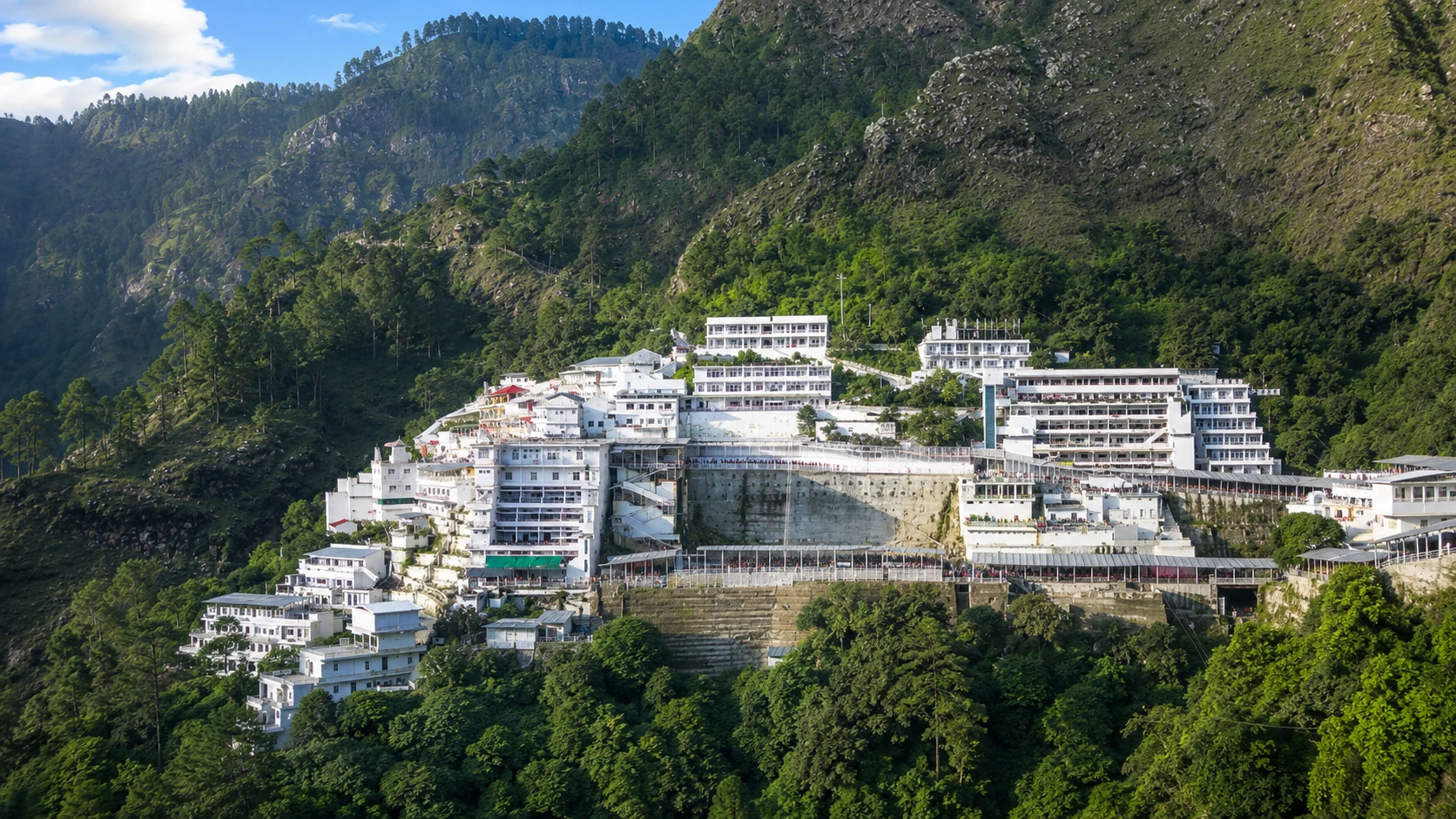
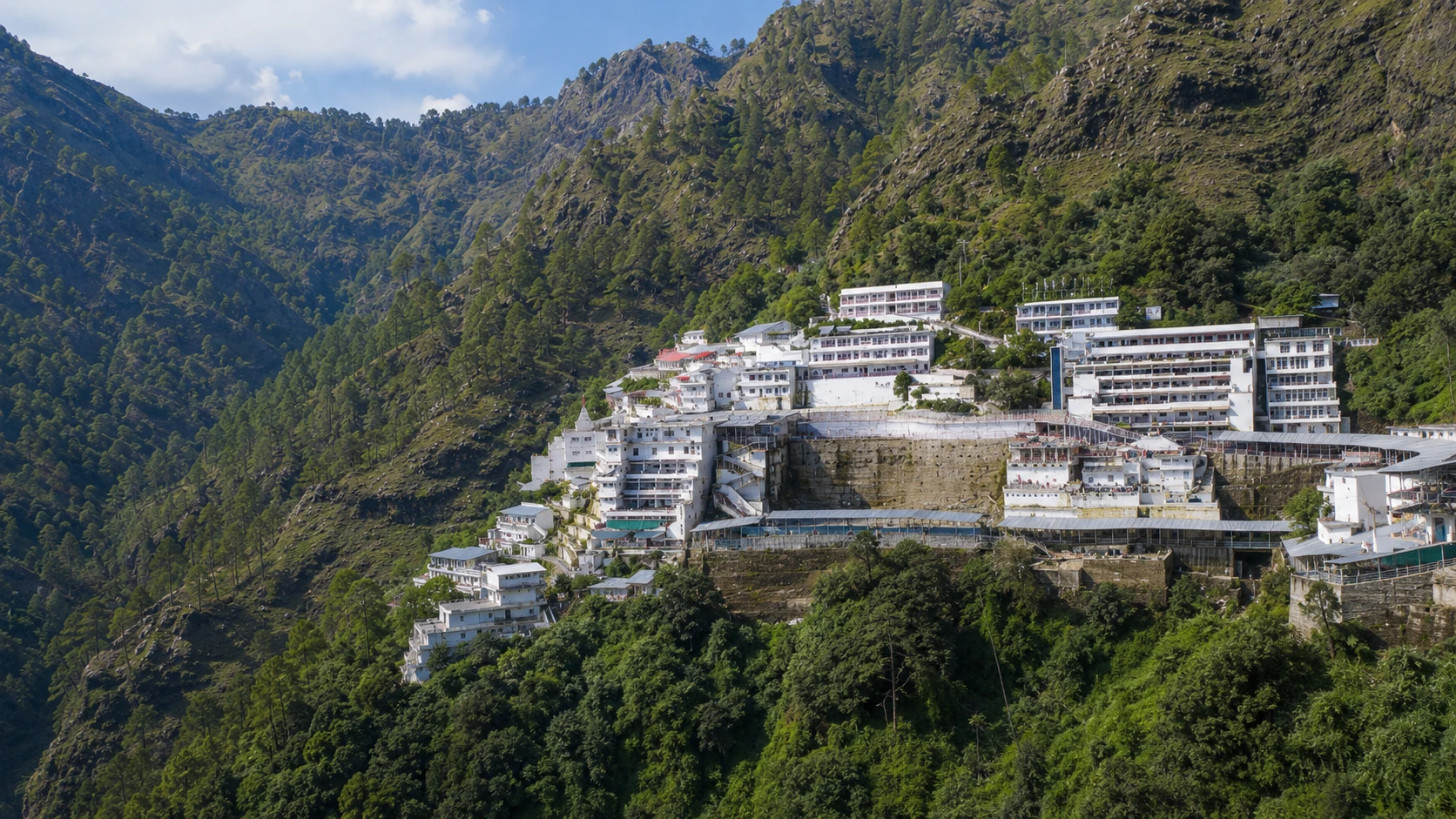
Natural cave shrine, the principal sanctum is a geological feature rather than an architectural one; the surrounding Bhawan complex, Yatra route facilities, and modern Atka platform are 20th- and 21st-century constructions in functional pilgrim-infrastructure rather than classical temple-style architecture
खुला
00:00 – 24:00
आरती
05:00 · 19:30
विशेष
The cave shrine remains accessible essentially around the clock during normal periods, with the Atka aarti at dawn (~05:00) and evening (~19:30) marking the day's two principal ritual peaks. The Bhairon Baba shrine, 2.5 km uphill from Bhawan via the Bhairon path, is theologically inseparable from the Vaishno Devi darshan, Bhairon's blessing is regarded as completing the pilgrimage. Ardhkuwari, midway up the route, holds the second-most-important Yatra ritual moment with its narrow Garbh Joon cave passage.
पवित्र कथा · पवित्र कथा
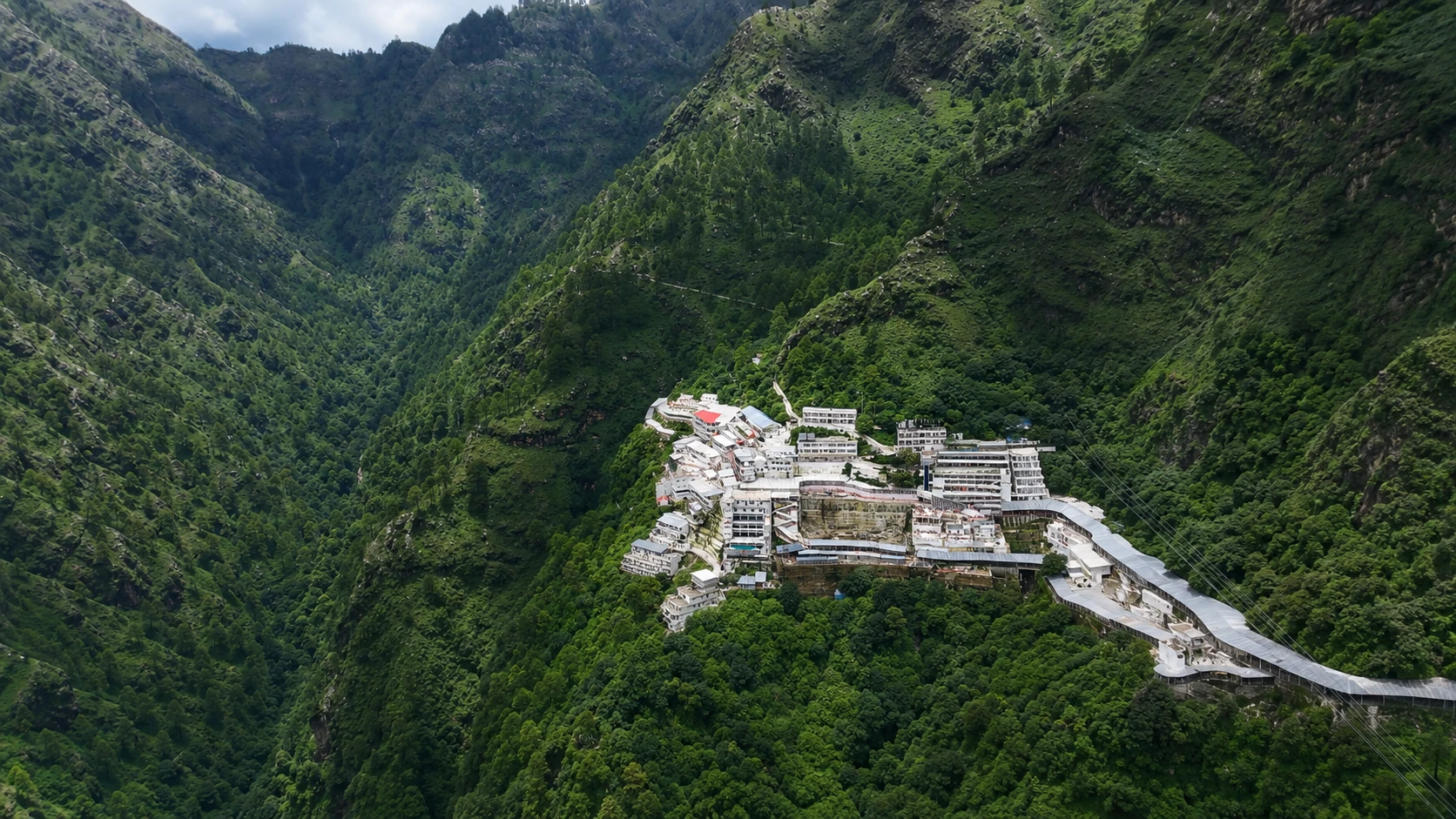
Five thousand feet up in the Trikuta range of the Jammu hills, behind a low arched opening in the mountain's southern face, sits a cave shrine like no other in Hindu sacred geography. The cave contains no carved murti. No sculpted goddess presides at the inner end of the passage. Instead, three natural rock pindis, three weathered stone forms emerging from the cave wall, are venerated as the unified manifestation of the Adi Shakti in her three principal aspects: Mahakali on the right, Mahalakshmi in the centre, Mahasaraswati on the left. The three pindis are the goddess. Mata Vaishno Devi, the protective Mother of the Trikuta hills, is not three separate goddesses sharing a cave but a single Adi Shakti who has divided her radiance into three so that none of her aspects, the fierce, the gracious, the wise, is missing from any devotee's darshan. To stand before the pindis at Bhawan, in the cold cave air, with the line of pilgrims pressing forward behind, is to receive in a single moment the blessing of all three Mothers at once. The journey to reach them is itself the pilgrimage. Eight to thirteen kilometres of climbing path winds up from Katra, the base town at the foot of Trikuta, through Banganga, Charanpaduka, Ardhkuwari, and Sanjichhat, gaining 4,000 feet of elevation across hairpin bends and stone-paved stretches. Pilgrims walk it on foot in four to six hours, ride ponies, take palanquins, or for the elderly and unwell, climb in battery-powered vehicles or descend by helicopter. The Yatra is one of the largest annual Hindu pilgrimage flows in the world, eight to ten million devotees a year, second only to Tirupati among Hindu shrines, and the Shrine Board has built infrastructure to match: queue-managed darshan, on-route accommodation, helicopter and battery-car services, and a fully formalized yatra-registration system that begins at Katra. Yet despite the scale, the cave at the journey's end remains small, dim, cold, and intimate. Three pindis, no light beyond the temple lamps, and the goddess as she has manifested here since beyond the reach of recorded history.
Sacred Designationपवित्र पदनाम
Shakti Peeth
शरीर का अंग: Not classically attributed; no Sati body-part is identified at Vaishno Devi in the canonical Pithanirnaya, Tantra Chudamani, or Devi Bhagavata enumerations. Her Maha Shakti Peetha status derives from popular Hindu devotional tradition and modern pilgrimage discourse rather than the strict classical lists; some popular list-variants associate Trikuta with the head of Sati, but this is not grounded in the primary textual enumerations
शक्ति: Mata Vaishno Devi, Tridevi manifestation: Mahakali (right pindi), Mahalakshmi (centre pindi), Mahasaraswati (left pindi), unified as Vaishnavi Shakti
भैरव: Bhairon Baba (Bhairon Nath)
Sacred Origin Storyपवित्र उत्पत्ति कथा
Source: Regional Dogra-Punjabi devotional tradition; Vaishno Devi Mahatmya (regional Hindi/Dogri text); Mata Vaishno Devi Shrine Board canonical narrative.
The story of Mata Vaishno Devi as told in regional devotional tradition begins not with Sati's dismemberment but with a different cosmic episode entirely. In the Treta Yuga, when Rama had taken his earthly birth and the goddess Lakshmi had incarnated as Sita, the three principal aspects of the Adi Shakti, Mahakali, Mahalakshmi, and Mahasaraswati, combined their energies and entered the womb of Sumeru Pandit's wife.
The child born of this combined incarnation was called Vaishnavi, the Vaishnava-aligned daughter of the Adi Shakti, dedicated from birth to the worship of Vishnu in his Rama avatar.
Vaishnavi grew up in the South Indian forests where her father lived as a brahmin sage. She made the early vow of celibacy and lifelong devotion to Rama; when she sought Rama himself, she encountered him during his wanderings of the dandakaranya forest.
Rama recognized her devotion and told her that he was bound by his vows to Sita and would not take a second consort, but that she would, at the appropriate moment in her cosmic timeline, find him as Kalki, Vishnu's tenth and final avatar, and would unite with him at that point.
Until then, he instructed her, she should ascend to the Trikuta mountains in the Himalayan northwest and there meditate, accepting devotees and granting blessings.
Vaishnavi traveled the length of the subcontinent to reach Trikuta, and at the cave that would later become her Bhawan she settled into meditation. Devotees came to her from across northern India. Among them came Bhairon Nath, a Tantric practitioner of the time whose worship had drifted from the goddess's chosen path into pursuit of personal power.
Bhairon Nath was struck by Vaishnavi's beauty and began pursuing her, treating her not as the deity she was but as a woman whose hand he might take by force.
Vaishnavi fled. The Yatra route that pilgrims walk today retraces her flight: Banganga, where she struck the rock with her arrow and produced a spring to slake her thirst; Charanpaduka, where her footprints are preserved on a stone; Ardhkuwari, where she meditated for nine months in a narrow cave (Garbh Joon, 'the cave of the womb') in penance and preparation.
After nine months at Ardhkuwari she emerged and continued upward to her present cave at the top of Trikuta, with Bhairon still pursuing. At the cave entrance she turned and fought him; with the assistance of Hanuman, she beheaded Bhairon Nath with a single blow.
The severed head flew through the air a distance of two and a half kilometres uphill from her cave, landing on the slope that today bears Bhairon's own shrine.
In his dying moment Bhairon Nath recognized who Vaishnavi truly was, the Adi Shakti in her Vaishnavi aspect, and asked her forgiveness. The goddess granted it. More: she granted him moksha, the release from rebirth, and ordained that no Vaishno Devi pilgrimage would be considered complete without a subsequent visit to Bhairon's shrine.
The Yatra structure as pilgrims walk it today, Vaishno Devi at Bhawan, then the climb uphill to Bhairon Baba, was inscribed in this granting. Vaishnavi then withdrew permanently into the cave and assumed her Tridevi form: the three pindis that mark the three aspects she had carried with her since birth. Mahakali to the right, Mahalakshmi at the centre, Mahasaraswati to the left.
The three pindis are her, in the form she chose to take when she withdrew from the visible world into the cave where she had completed her cosmic task.
The traditional founding of organized worship at the cave is associated with the discovery narrative of Pandit Sridhar, a pious Brahmin of the Trikuta foothills who, in some regional accounts dated to the medieval period (sources give estimates between the 11th and 16th centuries), was led by Mata Vaishno Devi herself, appearing to him in dream or vision, up the mountain to her cave.
The Pandit Sridhar narrative provides the bridge between the cosmic episode of Vaishnavi's withdrawal and the documented modern pilgrimage tradition.
उद्धृत स्रोत:
- Vaishno Devi Mahatmya (regional Hindi/Dogri devotional tradition)
- Shri Mata Vaishno Devi Shrine Board canonical narrative
- Devi Bhagavata Purana, Skandha 7 (for the Tridevi framework context)
- Regional Dogra hagiographic tradition recorded in 19th- and 20th-century devotional compilations
- Oral pilgrim tradition preserved by hereditary Sebait families at Bhawan and along the Yatra route
अन्य परंपराएँ · अन्य परंपराएँ
The Tridevi reading, Vaishno Devi as the unified Mahakali-Mahalakshmi-Mahasaraswati rather than specifically as the Vaishnavi avatar
A second devotional tradition, prominent in modern Devi-bhakti discourse and in some regional commentary, places less emphasis on the Vaishnavi-as-Rama-devotee narrative and more on the Tridevi framework itself. In this reading, the three pindis at Bhawan are not three aspects that Vaishnavi 'carried with her since birth' but are the Adi Shakti's three primary forms manifesting at this site in their original co-equal status, Mahakali as the goddess of dissolution and protection, Mahalakshmi as the goddess of sustenance and abundance, Mahasaraswati as the goddess of wisdom and consciousness, with 'Vaishno Devi' serving as the unified name under which all three are simultaneously addressed.
This reading does not contradict the Vaishnavi-Rama narrative but treats it as a secondary layer atop the underlying Tridevi theology. Devotees emphasizing the Tridevi reading point to the iconographic fact that the three pindis are essentially equal in size, arrangement, and ritual treatment, Mahalakshmi at centre because central, not because chief.
Trikuta as Maha Shakti Peetha, popular Hindu enumeration tradition that includes Vaishno Devi among the Shakti Peethas despite her absence from the classical canonical lists
A second tradition, important for understanding why Vaishno Devi appears on modern Shakti Peetha enumerations, addresses the relationship between Vaishno Devi and the classical Sati framework. The strict canonical enumerations, Pithanirnaya, Tantra Chudamani, Devi Bhagavata Skandha 7, do not include Trikuta among the fifty-one Shakti Peethas; no Sati body-part is identified at this site in the primary textual sources.
However, popular Hindu devotional tradition, modern Shrine Board publications, and a wide range of pilgrim guidebooks consistently include Vaishno Devi among the Maha Shakti Peethas. Some variant popular lists associate Trikuta with the head of Sati (this is not textually grounded but appears in modern Devi-circuit literature).
The honest scholarly account is that Vaishno Devi's Maha Shakti Peetha status is a modern devotional consensus rather than a classical textual identification, and this status is no less real for being modern. Vaishno Devi is treated as a Shakti Peetha because Hindu devotional tradition treats her as one; the classical lists do not exhaust what the goddess's Peethas can be.
विद्वत संदर्भ
Modern scholarship on Vaishno Devi engages with three intersecting questions: the historical age of organized worship at Trikuta cave (where archaeological and epigraphic evidence is sparse and the dating of the Sridhar Pandit foundational narrative is loose, with estimates ranging from the 11th to the 16th century CE); the theological framing of the Tridevi configuration (drawing on Devi Bhagavata and Devi Mahatmya scholarship); and the modern pilgrimage flow as a phenomenon of post-1986 administrative consolidation and 21st-century mass devotional Hinduism. The shrine's scale is itself a topic of study: Vaishno Devi receives between 8 and 10 million pilgrims annually, making it among the most-visited Hindu shrines globally; the Shri Mata Vaishno Devi Shrine Board's management of this flow has been treated in studies of Indian temple administration as a leading example of statutory religious-trust governance. The Maha Shakti Peetha designation, as noted in alternateAccounts above, is a popular modern attribution rather than a classical textual identification, this is uncontested in scholarly literature even where it remains uncontroversial in devotional practice. Among major recent works: Daniela Berti, 'The Goddess of the Mountains: Trance and Possession in the Himalayan Western Himalayas' (CNRS); Mark Juergensmeyer (ed.), 'The Oxford Handbook of Global Religions' chapters on Vaishno Devi pilgrim flow; and the Shrine Board's own annual Yatra reports for current pilgrim statistics.
Historyइतिहास
Vaishno Devi's documented history is structured around three layers: ancient sacred geography, medieval foundational narrative, and modern institutional consolidation.
The ancient layer is the harder to date. The Trikuta range appears in regional sacred-geography references in various Puranic and Mahatmya texts; the Mahabharata references mountains in the J&K region without specifically naming Trikuta as a goddess-site.
The cave shrine itself shows no archaeological evidence of organized worship predating the medieval period, though the geological feature is far older and the cave's identification as a goddess-site may have local pre-Sanskrit origins among the hill communities of the western Himalayas.
As with many remote-mountain shrines, the difficulty is that organized worship may have ancient origins that left no architectural or epigraphic record.
The medieval foundational narrative, the Sridhar Pandit story, is variably dated across sources, with estimates ranging from the 11th to the 16th century CE. The narrative describes Sridhar, a devout brahmin of the Trikuta foothills, being led by Mata Vaishno Devi herself (appearing in dream or direct vision) up the mountain to her cave; Sridhar then established the first sustained organized worship at the site, including the practice of feeding pilgrims.
The exact date is unrecoverable from primary sources but the narrative's persistence in regional Dogra tradition is well-attested.
The documented modern history begins with the consolidation of the Dogra Rajput dynasty in Jammu and Kashmir under Maharaja Gulab Singh (r. 1846, 1857). The Treaty of Amritsar in 1846, between the British East India Company and Gulab Singh, established the Princely State of Jammu and Kashmir with Gulab Singh as Maharaja; the Vaishno Devi shrine fell within Dogra jurisdiction from this point.
Through the 19th and 20th centuries the shrine operated under hereditary Sebait families (Baridars) with varying levels of Dogra royal patronage. British gazetteers, Drew's 'Jummoo and Kashmir Territories' (1875), Lawrence's 'The Valley of Kashmir' (1895), provide colonial-era documentation of the pilgrim flow.
The critical modern transformation came with the Shri Mata Vaishno Devi Shrine Act, 1988, which established the Shri Mata Vaishno Devi Shrine Board as a statutory body to administer the shrine, the Yatra route, and pilgrim infrastructure.
The Shrine Board's mandate displaced the Baridar (hereditary Sebait) administration that had previously controlled the shrine; the transition was contested at the time but is now consolidated. Under the Shrine Board, pilgrim infrastructure expanded dramatically: the Atka platform was reorganized, multiple Bhawan and route facilities were built, the Yatra Registration Counter (YRC) system was formalized at Katra, helicopter service to Sanjichhat was introduced, battery-vehicle services for the disabled and elderly were added, and the route was paved and lit for night travel.
Annual pilgrim numbers rose from approximately one million in 1986 to between eight and ten million in the 2010s and 2020s.
The shrine's modern history also includes a serious safety event: on the night of 31 December 2021 to 1 January 2022, a stampede at the Bhawan complex during the New Year's Eve rush resulted in twelve pilgrim deaths and several injuries.
The Shrine Board's subsequent response included expanded crowd-management protocols, additional CCTV surveillance, restructuring of the queue corridors, and improved emergency response coordination with the J&K administration. The event remains a cautionary reference point in pilgrim safety planning at the shrine.
Administratively, Jammu and Kashmir's reorganization into a Union Territory in October 2019 (under the J&K Reorganisation Act, 2019) brought the Shri Mata Vaishno Devi Shrine Board under the new Union Territory framework; the Shrine Board's statutory functions and Yatra administration continued without operational disruption through this transition.
Historical Timelineऐतिहासिक कालक्रम
The Trikuta range appears in regional sacred-geography tradition across Puranic and Mahatmya sources, establishing the broader Jammu hills as a recognized devotional landscape in Hindu textual culture. The cave shrine itself shows no archaeological evidence of organized worship predating the medieval period, but the geological feature is ancient and the cave's identification as a goddess-site may have pre-Sanskrit origins among the hill communities of the western Himalayas, with later absorption into the Sanskritic Tridevi framework.
The ancient layer of Vaishno Devi's history is the most difficult to date confidently. The 'discovery' type marks the emergence of the site in regional sacred geography rather than a singular event. Hindu textual culture's references to the broader Trikuta range are well-attested; specific references to the cave-as-goddess-site that pre-date the medieval period are limited.
The Sridhar Pandit foundational narrative places organized worship at the Trikuta cave with the discovery story of Pandit Sridhar, a devout brahmin of the Trikuta foothills who is led to the cave by Mata Vaishno Devi herself in dream or vision. Sridhar establishes the first sustained pilgrim-feeding tradition at the site. The exact date is unrecoverable; regional Dogra sources give estimates ranging from the 11th to the 16th century CE, with no firm chronological anchoring.
The Sridhar Pandit narrative is a foundational devotional tradition rather than a historiographic record; its dating is loose and varies across sources. The narrative's persistence and centrality in regional Dogra devotional discourse is well-attested. Eternal Raga presents the date range honestly without choosing a specific century.
The Treaty of Amritsar, signed between the British East India Company and Maharaja Gulab Singh of the Dogra dynasty, establishes the Princely State of Jammu and Kashmir under British paramountcy, with Gulab Singh as the founding Maharaja. The Vaishno Devi shrine falls within Dogra jurisdiction from this point. Through the 19th century the shrine operates under hereditary Sebait (Baridar) families with varying levels of Dogra royal patronage; British colonial-era gazetteers, Drew's 'Jummoo and Kashmir Territories' (1875), Lawrence's 'The Valley of Kashmir' (1895), provide the earliest formal documentation of the shrine's pilgrim flow and administrative arrangements.
The Shri Mata Vaishno Devi Shrine Act, 1988 (Act No. 16 of 1988), passed by the Jammu and Kashmir state legislature, establishes the Shri Mata Vaishno Devi Shrine Board as the statutory body administering the shrine, the Yatra route, and pilgrim infrastructure. The Board's mandate displaces the previously dominant Baridar (hereditary Sebait) administration; the transition was contested at the time but is now consolidated. The Shrine Board era brings rapid infrastructure expansion: the Atka platform is reorganized, multiple Bhawan and route facilities are constructed, the Yatra Registration Counter (YRC) system is formalized at Katra, helicopter services to Sanjichhat are introduced, and the Yatra route is paved and lit for night travel. Annual pilgrim numbers grow from approximately one million in 1986 to between eight and ten million in the 2010s and 2020s.
Stampede at the Bhawan complex on the night of 31 December 2021 to 1 January 2022, during New Year's Eve rush, results in twelve pilgrim deaths and several injuries. The Shri Mata Vaishno Devi Shrine Board's response includes expanded crowd-management protocols, additional CCTV surveillance across the queue corridors, restructuring of the inner sanctum approach paths, and improved emergency coordination with the J&K Union Territory administration. The event remains a cautionary reference point in shrine safety planning; subsequent years have seen tightened crowd controls during peak periods including New Year, Navratri, and the summer Yatra season. The shrine continues to operate without restriction, with safety protocols updated rather than restrictive.
Casualty figures are drawn from official government statements; some early media reports gave slightly varying numbers in the immediate aftermath. The twelve-death figure is the officially recorded count. The event is included not to deter pilgrims but for editorial transparency regarding documented safety considerations at this exceptionally high-volume shrine.
What You'll Seeदर्शन में
What distinguishes Vaishno Devi from nearly every other major Hindu shrine is what is not there. No carved murti presides at Bhawan. No sculpted goddess sits at the end of the cave passage. The inner sanctum contains only three natural rock pindis, three weathered stone forms emerging from the cave wall, and the goddess is the rock.
Mahakali to the right, fierce and dark; Mahalakshmi at the centre, gracious and golden; Mahasaraswati to the left, white and luminous. The colour associations are devotional rather than visual (the pindis themselves are stone-colored), but they correspond to the three goddesses' canonical iconographic registers from the Devi Mahatmya.
The pindis are dressed daily, red cloths, gold ornaments, sindoor, and garlanded with flowers, but the underlying form remains the natural rock as it has emerged from the cave wall over geological time. There is no anthropomorphic intervention. The Adi Shakti is approached at her place of self-manifestation rather than through artistic representation of her.
The cave itself sits inside Trikuta Mountain at approximately 5,200 feet elevation. The historic original entrance, Garbh Joon, 'the cave of the womb', is preserved as a narrow stone passage roughly ten metres long and one metre wide at its tightest point, where pilgrims who choose this devotional option crawl through on hands and knees in symbolic re-enactment of Vaishnavi's nine-month meditation at Ardhkuwari.
The modern wider entrance, opened by the Shrine Board to handle pilgrim volume, runs parallel to the historic passage and is the route most devotees take; the historic Garbh Joon remains accessible to those who want it, though weight and size restrictions apply. Both passages converge at the Bhawan complex around the inner shrine.
Surrounding the cave is the larger Bhawan complex: a marble-floored darshan corridor, the Atka platform where the morning and evening aartis are conducted, queue management infrastructure, devotee waiting halls, and the Shrine Board's administrative offices.
The complex is functional 21st-century pilgrimage architecture rather than classical temple architecture; the shrine's age and sanctity reside in the cave itself, not in the buildings around it. The pilgrim route from Katra to Bhawan passes through four principal stopping points, Banganga (where Vaishnavi struck the rock for water), Charanpaduka (where her footprints are preserved on stone), Ardhkuwari (where she meditated for nine months in the Garbh Joon womb-cave), and Sanjichhat (the high pass before the final descent to Bhawan).
Each station has its own small shrine and devotional observance. The 2.5 km path uphill from Bhawan to the Bhairon Baba shrine completes the Yatra per Vaishnavi's grant; many pilgrims now use ponies, palkis, or the battery-car service for this final leg.
Distinctive Practicesविशिष्ट परंपराएँ
Yatra Registration (YRC) and the structured pilgrimage route
यात्रा पंजीकरण (YRC) और संरचित तीर्थयात्रा मार्ग
Year-round; Yatra Registration Counter at Katra operates 24/7; the trek itself takes 4, 10 hours depending on mode and stops
Unlike most Hindu shrines where pilgrims simply arrive and queue for darshan, Vaishno Devi operates a structured pilgrimage system unique among Indian temples. All pilgrims must obtain a Yatra Registration Card (YRC slip) at the official counter in Katra before beginning the climb, this is free, takes a few minutes, and records the pilgrim's identity and intended start time. The YRC is mandatory at the Banganga checkpoint; pilgrims without it are turned back. From Katra, the route ascends through the four traditional stations, Banganga, Charanpaduka, Ardhkuwari, Sanjichhat, each with its own small shrine where pilgrims pause for darshan and rest. Multiple transport options run in parallel: pony and palki services operated by registered porters, battery-vehicle service (limited to specific stretches), and helicopter service between Katra and Sanjichhat (booking required). At Sanjichhat the path drops down to Bhawan. Modern Bhawan-approach corridors are queue-managed with electronic display boards showing approximate waiting times; sevas and special darshans can be pre-arranged through the Shrine Board.
The structured Yatra reflects the underlying theology of pilgrimage at Vaishno Devi: the climb is not transport to the shrine but part of the shrine itself. Each station along the route is a place where Vaishnavi paused, struck a rock, left a footprint, or meditated, to walk the route is to retrace her flight from Bhairon Nath and her ascent into divine seclusion. The Yatra is, in this sense, an embodied participation in the goddess's own movement: the pilgrim does not arrive at Vaishno Devi from outside her story but enters her story by walking through it. The Shrine Board's formalization of this route, the YRC, the registered stops, the queue management, is a modern administrative overlay on what remains a fundamentally narrative pilgrimage rather than a destination pilgrimage.
Garbh Joon, the womb-cave crawl through the historic narrow passage
गर्भ जून, ऐतिहासिक संकीर्ण मार्ग के माध्यम से गर्भ-गुफा की क्रॉल
Available daily as an optional alternative to the modern wider entrance; suspended only when crowd flow or safety conditions require it
The historic original entrance to the cave shrine, Garbh Joon, literally 'the womb-cave', is preserved as a narrow stone passage roughly ten metres long, with its tightest point at about one metre wide and one metre tall. Pilgrims who choose this devotional option enter the passage on hands and knees, crawl through the constricted middle section, and emerge into the inner shrine. The constriction is a physical re-enactment of Vaishnavi's nine-month meditation at Ardhkuwari (whose Garbh Joon cave the Bhawan passage mirrors), and theologically of birth itself, the devotee is born again, in symbolic terms, from the goddess's womb-cave into the renewed life that emerges at darshan. The Garbh Joon is voluntary; pilgrims who are claustrophobic, mobility-limited, larger-bodied, or simply not so inclined use the modern wider entrance running parallel. Devotees who complete the Garbh Joon crawl often regard it as the spiritual climax of their entire Yatra, even more than the darshan itself.
Hindu Tantric and Devi-bhakti traditions across the subcontinent recognize the cave-as-womb metaphor, the female body's reproductive structure mapped onto sacred geography, with the pilgrim's passage through narrow openings as ritual rebirth. Vaishno Devi's Garbh Joon is the most physically explicit version of this in major Hindu pilgrimage: the devotee literally crawls through a tight space into the goddess's interior, emerging changed. The narrowness is not incidental but doctrinal, the constriction forces the pilgrim into a posture of humility (hands and knees), removes adult dignity (the pilgrim is briefly helpless inside the rock), and recreates the universal human experience of birth. The body's struggle is the practice. Devotees often emerge moved beyond verbal articulation.
Bhairon Baba Darshan, completing the Yatra at the severed-head shrine
भैरों बाबा दर्शन, कटे-शीश देवालय पर यात्रा पूर्ण करना
After completing Bhawan darshan; the Bhairon shrine sits 2.5 km uphill from Bhawan via a paved path
The Yatra at Vaishno Devi is theologically incomplete without a subsequent visit to the Bhairon Baba shrine, the location 2.5 km uphill from Bhawan where, according to the foundational narrative, the severed head of Bhairon Nath landed after Vaishnavi beheaded him with Hanuman's assistance. In his dying moment Bhairon recognized Vaishnavi's true nature and asked her forgiveness; the goddess granted him moksha and ordained that no Vaishno Devi darshan would be considered complete without his subsequent darshan. The Bhairon shrine itself is small, a stone platform with the symbolic head-relic enshrined, surrounded by a simple compound, but the pilgrim flow through it nearly matches the Bhawan flow. Most pilgrims complete the climb on foot (45, 90 minutes); pony, palki, and battery-vehicle services run the route for those who prefer not to walk. The double pilgrimage, Bhawan, then Bhairon, has been a constitutive feature of the Yatra for centuries.
Bhairon's role in the Vaishno Devi narrative is theologically significant because of what it tells about the goddess. Bhairon pursued her, threatened her, sought to violate her autonomy; she fled, she meditated, she fought, she killed him. But she did not stop there. She listened when, dying, he recognized her and asked forgiveness. She gave him not just pardon but moksha, the highest spiritual release. And she made his subsequent darshan a precondition of her own. The teaching is uncompromising: the goddess's nature is not to abandon even those who have most wronged her, once they have recognized her. The Yatra structure inscribes this teaching into pilgrim practice, you cannot have a complete Vaishno Devi darshan without paying respects to the one she granted moksha. The doctrine of grace extending even to former enemies, embedded in the spatial geography of the pilgrimage.
Did You Know?क्या आप जानते हैं?
Vaishno Devi's inner sanctum contains no carved deity, only three natural rock pindis emerging from the cave wall. Mahakali to the right, Mahalakshmi at the centre, Mahasaraswati to the left. The Adi Shakti is worshipped at her place of geological self-manifestation rather than through artistic representation. Among major Hindu shrines this absence of an anthropomorphic murti is rare; what makes Vaishno Devi unique is the triadic form, the goddess as not one rock but three, each corresponding to one of the three principal aspects of the Devi Mahatmya. Most pilgrims, walking past in the queue, see all three pindis in a single sweep of their gaze and receive Tridevi darshan in one moment.
Field documentation; Mata Vaishno Devi Shrine Board canonical narrative; Devi Mahatmya / Durga Saptashati for the Tridevi framework
The Yatra route from Katra to Bhawan is itself a narrative re-enactment. Each station marks a moment in Vaishnavi's flight from Bhairon Nath: Banganga, where she struck the rock with her arrow and produced a spring to slake her thirst; Charanpaduka, where her footprints are preserved on a stone; Ardhkuwari, where she meditated for nine months in the Garbh Joon womb-cave; Sanjichhat, the high pass before the final descent to Bhawan. The pilgrim does not walk to the shrine but walks through the shrine's mythology, the geography is the story, and to climb the path is to embody the story in one's own body across four to ten hours.
Vaishno Devi Mahatmya (regional tradition); SMVDSB Yatra route documentation; pilgrim ethnography
Vaishno Devi receives between eight and ten million pilgrims annually, placing it among the most-visited Hindu shrines globally, second among Indian temples only to Tirupati's Venkateswara shrine. On peak days during Navratri the daily pilgrim count can exceed 50,000. The infrastructure required to manage this flow, the Yatra Registration Counter system, the parallel transport modes (foot, pony, palki, battery vehicle, helicopter), the queue corridors at Bhawan, the on-route accommodation and food services, operates at a scale comparable to a major airport's passenger processing, sustained year-round by the Shri Mata Vaishno Devi Shrine Board.
Shri Mata Vaishno Devi Shrine Board annual reports; comparative pilgrim statistics across major Hindu shrines
The helicopter Yatra service from Katra to Sanjichhat was operationalized progressively from the late 1990s onwards under the Shrine Board's modernization mandate. The service today flies pilgrims from the Katra helipad to the Sanjichhat helipad (approximately 8 km of trek distance compressed into a 6, 8 minute flight), with onward foot or battery-vehicle access to Bhawan. Helicopter slots are limited, weather-dependent, and require advance booking; the service is particularly important for elderly pilgrims and those with mobility limitations who could not undertake the climb. The infrastructure has been a model for other major Hindu shrine boards considering aerial-access options for elderly devotees.
Shri Mata Vaishno Devi Shrine Board public communications and annual reports; operator publications for the helicopter service contractors
The 1988 Shri Mata Vaishno Devi Shrine Act represented a structural transformation of Hindu temple administration. Before 1988, the shrine operated under hereditary Sebait families (the Baridars), the standard temple-management model across Indian temples. The Shrine Board Act displaced this hereditary administration with a statutory body appointed by the state government, while preserving certain ritual functions for traditional Sebait lineages. The transition was contested at the time, Baridar families and their associates challenged the Act in court, but is now consolidated. The Vaishno Devi Shrine Board has subsequently become a reference model studied by other Indian states considering similar reforms of major temple administration.
Shri Mata Vaishno Devi Shrine Act, 1988; J&K High Court and Supreme Court judgments on the Act's constitutional challenges; Indian temple administration scholarship
Visitor Accessप्रवेश जानकारी
Vaishno Devi is open to all visitors regardless of gender, caste, religious background, or age; there is no menstrual restriction on women entering the shrine. The Shri Mata Vaishno Devi Shrine Board has consistently maintained open-access policy. Practical access carries its own constraints: the cave shrine sits at 5,200 ft elevation requiring a 12, 13 km mountain climb (or alternative transport), the Garbh Joon historic narrow passage has weight and size limits making it unsuitable for larger-bodied pilgrims, and peak-period crowd-management protocols may temporarily restrict access (particularly during New Year's Eve peak following the 2022 stampede event). Photography is prohibited inside the cave shrine and at the inner Bhawan corridors; phones and cameras must be deposited at the locker counter at Bhawan before approaching the inner sanctum. Footwear is removed at the Atka platform outer boundary. Children, the elderly, and pregnant women are all welcomed.
Pilgrims planning a Vaishno Devi visit should: (1) book Katra accommodation in advance, particularly for Navratri or summer-peak periods; (2) obtain the free YRC slip at Katra immediately on arrival (the slip is valid for a 6-hour climb window); (3) choose a transport mode honestly based on physical condition, the 13 km foot climb takes 4, 6 hours for an average healthy adult, longer for the elderly; pony, palki, and helicopter alternatives exist but require booking; (4) carry adequate water and snacks; (5) wear comfortable walking footwear and layered clothing (Bhawan temperatures are 8, 12°C cooler than Katra); (6) plan for the Bhairon Baba shrine 2.5 km uphill from Bhawan to complete the Yatra. Cell phone signal is variable on the route; download Shrine Board apps and offline maps before starting.
Festivalsत्योहार
Sharad Navratri
शरद नवरात्रि
Sep-Oct (Ashwin Shukla Pratipada to Dashami)
The autumn nine-night festival is Vaishno Devi's largest annual pilgrim peak. Each of the nine nights is dedicated to one of the Navadurga aspects with parallel worship at all three pindis. Daily pilgrim counts during peak Sharad Navratri exceed 50,000; the Shrine Board operates expanded queue management, additional helicopter slots, and continuous Atka-aarti recitation across the festival window. The festival concludes on Vijayadashami, when the goddess is celebrated in her victory aspect, themes consonant with Vaishnavi's defeat of Bhairon Nath in the foundational narrative.
Chaitra Navratri
चैत्र नवरात्रि
Mar-Apr (Chaitra Shukla Pratipada to Navami)
The spring nine-night festival is Vaishno Devi's second annual pilgrim peak. Like Sharad Navratri, the festival dedicates each of the nine nights to a Navadurga aspect with parallel worship at all three pindis. Chaitra Navratri overlaps the spring agricultural cycle in northern India and is regarded as auspicious for new beginnings, many pilgrim families schedule the Yatra during Chaitra to coincide with new business ventures, harvest celebrations, or wedding-season planning. The festival concludes on Rama Navami, celebrating Rama's birth, tying back into the Vaishnavi-Rama narrative that grounds the temple's foundational mythology.
Diwali (Lakshmi Puja)
दीवाली (लक्ष्मी पूजा)
Oct-Nov (Kartik Amavasya)
On the new-moon night of Kartik, Vaishno Devi observes Diwali with intensified worship of the Mahalakshmi pindi specifically, the central pindi at the inner sanctum represents Lakshmi, the goddess most directly celebrated at Diwali across North India. The Bhawan complex is illuminated with thousands of lamps and modern electric decorations; the Atka platform hosts extended evening aarti through the night; pilgrims arrive in significant numbers despite Diwali typically being a home-festival rather than a pilgrimage-festival. The shrine's Diwali observance integrates the broader Hindu festival's themes (light over darkness, prosperity, family blessings) into the Vaishno Devi devotional framework.
Krishna Janmashtami
कृष्ण जन्माष्टमी
Aug-Sep (Bhadrapada Krishna Ashtami)
Although Janmashtami is a Krishna-avatar festival, Vaishno Devi observes it because of the Vaishnavi-Vishnu theological link that grounds the temple's primary narrative. Vaishnavi is, by tradition, an emanation of Vaishnavi Shakti, Vishnu's feminine energy, dedicated to the worship of Rama and Krishna; her cosmic timeline anticipates uniting with Vishnu in his Kalki avatar. Janmashtami at Bhawan therefore observes the goddess's Vaishnava character explicitly, with Krishna devotional songs, special bhog offerings, and night-long worship at the Bhawan complex. The festival is less dramatically attended than the Navratris but is theologically significant within the temple's Vaishnavi-Vishnu framework.
Traditional Offeringsपारंपरिक अर्पण
प्राथमिक अर्पण
Red Chunari, the iconic Vaishno Devi cloth offering
लाल चुनरी, वैष्णो देवी का प्रतीकात्मक वस्त्र अर्पण
रक्ताम्बर
The red chunari is Vaishno Devi's signature offering, a length of bright red cloth, often gold-bordered, brought by virtually every pilgrim and bound at the shrine in fulfillment of a vow or in petition for one. Chunari vendors line the Katra approach and the route stations, and the chunari is among the visual signatures of the Yatra: pilgrims climb the path with red bundles tucked into their belts, and at Bhawan the bound chunaris adorn every available surface near the inner sanctum. The Sebaits rotate the chunaris through the shrine ritual and return portions to devotees as Devi-prasad, completing the offering-blessing circulation. For many North Indian families, the Vaishno Devi chunari is among the most prized objects in the household shrine.
Red Flowers, hibiscus, roses, marigolds
लाल पुष्प, गुड़हल, गुलाब, गेंदा
जपाकुसुम
Red flowers, hibiscus, roses, marigolds, are offered to all three pindis with particular emphasis on the Mahakali pindi (the fierce-protective aspect responds most directly to red flower offerings in Shakta tradition). Garlands are laid across the pindis daily and refreshed throughout the day during peak periods. The combination of red flowers, red chunaris, and red sindoor produces the distinctive visual register of Vaishno Devi darshan, the inner cave glowing red against the dark stone of the pindis and the silver framework around them.
Sindoor (Vermilion)
सिंदूर
सिन्दूर
Sindoor is applied to all three pindis daily and a portion is returned to women devotees who apply it in the central parting of their hair, a Shakta blessing for marital harmony and household protection. At Vaishno Devi the sindoor offering carries a particular Punjabi-Dogra register: women pilgrims of these regional traditions consider the Vaishno Devi sindoor application a definitive marital blessing distinct from sindoor received at other shrines.
Coconut (Narikela)
नारियल
नारिकेल
Whole coconut with husk and water intact is offered at the inner shrine and ritually broken by the Sebait. Within the Tridevi framework, the coconut offering is considered to address all three goddesses simultaneously, a single coconut, single act, three-fold blessing. The broken coconut is partly retained for use in temple bhog preparation, partly returned to the devotee as prasad.
Dry Fruits, raisins, almonds, walnuts
सूखे फल, किशमिश, बादाम, अखरोट
शुष्क-फल
Dry fruits, raisins, almonds, walnuts, are a regionally distinctive Vaishno Devi offering, drawing on the Jammu hills' historical role as a producer and trade route for Himalayan-region dry fruits. Pilgrims bring small packets to the shrine; the offering connects the Bhawan ritual to the regional agricultural and trade economy. The offered dry fruits, like sweets, are partly returned to devotees as prasad and partly distributed in temple bhog services for incoming pilgrims.
North Indian Sweets, peda, ladoo, mishri
उत्तर भारतीय मिठाइयाँ, पेड़ा, लड्डू, मिश्री
मिष्टान्न
North Indian traditional sweets, peda (milk-fudge), ladoo (besan or motichoor), and mishri (rock sugar), are offered at the inner shrine and form part of the temple's daily bhog distribution. The sweets are typically prepared without onion or garlic (preserving the sattvic standard) and use milk, ghee, sugar, and dry fruits. Mishri specifically, sugar crystallized as small rocks, has a particular Vaishno Devi association: small mishri pieces are common returned-prasad given to children at the Yatra's conclusion.
इस मंदिर की विशेषता
Atka Aarti Sponsorship, participating in the dawn or evening worship at Bhawan
अटका आरती प्रायोजन, भवन पर प्रातः अथवा सायं पूजा में भागीदारी
Devotees who wish to participate in the temple's most distinctive ritual moment can sponsor and join the Atka Aarti, the formal dawn or evening worship conducted by the Shrine Board's priests at the Atka platform just outside the cave's inner sanctum. Sponsorship is arranged through the Shri Mata Vaishno Devi Shrine Board's seva portal and requires advance booking, particularly during Navratri and other peak periods. The sponsoring devotee or family is given a designated position at the Atka platform during the aarti, with the priests performing the worship in their name. The Atka Aarti is the temple's most concentrated daily ritual moment, the bell-ringing, the conch-blowing, the synchronized lamp-waving across all three pindis simultaneously, and to participate as a sponsor is among the most meaningful sevas available at the shrine.
Manat Chunari Bandhan, the vow-fulfillment cloth binding
मनौती चुनरी बंधन, मनौती-पूर्ति वस्त्र बंधन
The most theologically charged variant of the standard chunari offering is the Manat Chunari Bandhan, the cloth bound at Bhawan as ritual completion of a vow (manat) the devotee made to the goddess. The pattern is universal across Vaishno Devi devotional culture: a devotee facing a serious challenge, childlessness, a serious illness in the family, a major business or career crisis, a child's safe return from abroad, an examination, promises Vaishno Devi a chunari at her shrine if the prayer is fulfilled. When the prayer is fulfilled, the devotee returns to Bhawan and ties the promised chunari in the inner shrine area, completing the vow. The bound chunaris that adorn the inner shrine corridors are visible records of fulfilled vows across generations of pilgrims; the practice is particularly central to Punjabi, Dogra, and broader North Indian devotional culture, where saying 'I will go to Vaishno Devi' is shorthand for 'I have made a vow at her shrine'.
Standard offerings (chunari, flowers, coconut, sindoor, dry fruits, sweets) can be purchased at vendor stalls in Katra and at intermediate stations along the Yatra route; the Shrine Board operates a vendor regulation system that publishes recommended prices to combat overcharging. For the inner shrine area, official offering thalis pre-arranged through the Shrine Board are preferred over loose offerings, the thalis are vetted and the offering structure conforms to Bhawan ritual protocols. Atka Aarti sponsorship and Manat Chunari Bandhan arrangements require advance booking via the official Shrine Board channels. Animal sacrifice is not part of Vaishno Devi's ritual tradition, the Tridevi framework here is strictly vegetarian, with no bali tradition at any point in the Yatra including the Bhairon Baba shrine.
How to Reachकैसे पहुँचें
Vaishno Devi is accessed from Katra, the base town at the foot of Trikuta Mountain, with the cave shrine sitting 12, 13 km uphill. By air, the principal airport is Jammu Airport (IXJ, 50 km from Katra); pre-paid taxis cover the airport-to-Katra route in 75, 90 minutes via the Jammu-Srinagar highway.
Srinagar International Airport (260 km) is an alternative but rarely used due to the much greater distance. By rail, Shri Mata Vaishno Devi Katra Railway Station (SVDK) sits at Katra and is well-connected to Delhi, Mumbai, Chennai, Kolkata, and other major Indian cities via Sampark Kranti, Vande Bharat, and other long-distance services; Jammu Tawi Junction (50 km from Katra) handles broader train coverage with onward road transfer.
By road, Katra connects via the Jammu-Srinagar National Highway (NH-44) with regular bus services from Jammu, Pathankot, Delhi, and major northern cities. Once at Katra, pilgrims must register at the Yatra Registration Counter (YRC) before beginning the climb, mandatory and free, near the Tarakote and Banganga route entry points.
From Katra to Bhawan, choose: foot trek (12, 13 km, 4, 10 hours); pony or palki (5, 8 hours); battery-vehicle service on permitted stretches; helicopter to Sanjichhat (6, 8 minute flight, then ~2 km onward to Bhawan).
Plan Your Visitयात्रा की योजना
🌤 सर्वोत्तम मौसम
March to June and September to November are the most comfortable periods, Katra temperatures 15, 28°C with cooler Bhawan conditions (8, 18°C), dry well-walked route, and the major festival cycles (Chaitra Navratri in March-April, Sharad Navratri in September-October) providing the year's most spiritually charged windows. Avoid peak monsoon (July-August): heavy rain, occasional landslide risk, and slippery stone-paved stretches reduce experience and add safety risk. Winter (December-February) brings snow on the upper Yatra route, particularly around Sanjichhat and Bhawan; the route remains accessible but requires warm clothing, careful footwear, and acceptance that helicopter flights may be cancelled on weather. New Year's Eve and 1 January carry historic peak-crowd association and the 2022 stampede precedent, pilgrims wishing to avoid extreme crowding should choose other peak periods.
👘 पहनावे का नियम
Practical pilgrimage attire is expected, for the climb (warm, layered, comfortable walking clothing and shoes suitable for paved-stone surfaces) and for darshan at the inner shrine (modest, covered). Bright colours, particularly red and yellow, are devotionally preferred but not mandatory. Leather items (belts, wallets, watches with leather straps) should be removed before entering the inner cave area. Footwear is removed at the prescribed outer boundary at the Atka platform. Critical practical note: Bhawan temperatures can be 8, 12°C cooler than at Katra, with sharper drops in winter; carry warm layers even if Katra is warm at start of climb. For the Garbh Joon historic narrow passage, loose clothing and pocketed valuables should be secured, the constricted space can catch loose fabric.
📱 फोन और फोटोग्राफी
Photography and videography are completely prohibited inside the cave shrine and at the inner Bhawan corridors. Phones, cameras, and recording devices must be deposited at the official locker counter at Bhawan before approaching the inner sanctum; lockers are provided free of charge with retrieval token. Photography is permitted on the Yatra route, at the outer station shrines (Banganga, Charanpaduka, Ardhkuwari, Sanjichhat), at the helicopter helipads, and at the Atka platform's outer areas, except where signage indicates otherwise. The Bhairon Baba shrine maintains its own photography restrictions at the inner area. The Shrine Board's policy reflects both ritual decorum (the goddess's interior space should not be mediated through images) and security/crowd-management concerns at this high-volume site.
🏨 आवास
Most pilgrims base themselves at Katra and complete the entire pilgrimage in one or two days. Katra has the most extensive accommodation infrastructure: Shrine Board Sarais (subsidized pilgrim guest houses), private hotels across all price points from luxury (Country Inn, Asia Vaishno Devi) to mid-range to budget guesthouses near the YRC entrance. The Shri Mata Vaishno Devi Shrine Board operates a centralized booking portal for its Sarais. Mid-route accommodation at Ardhkuwari and Sanjichhat is available through Shrine Board facilities and a small number of private operators, useful for two-day Yatras where pilgrims overnight midway. Bhawan itself has limited accommodation (Shrine Board dormitories with very short stays permitted); most descend after darshan. During Navratris and peak seasons all Katra accommodation reaches saturation; book through verified channels at least 4, 6 weeks in advance. After 2019's UT reorganization, J&K state tourism websites have been replaced by UT-level portals, verify booking site authenticity before paying.
Sacred Soundsपवित्र ध्वनि
Devi Suktam (Vāk Sūkta, Rig Veda 10.125)
stotram · 420
Mahishasura Mardini Stotram (Ayi Giri Nandini, attributed to Adi Shankara)
stotram · 540
Vaishno Devi Stuti / Aarti (regional Dogra-Hindi tradition)
stotram · 480
Tridevi Stotram, hymn to Mahakali, Mahalakshmi, Mahasaraswati
stotram · 420
Devi Kavacham (from Durga Saptashati)
kavacham · 600
क्या आप जानते हैं? · Did You Know?
वही अनुवाद त्रुटि जिसने हिन्दू धर्म में '33 कोटि' को '33 करोड़' बनाया, बौद्ध धर्म में भी हुई। बौद्ध ग्रन्थों के चीनी अनुवाद ने 'सप्त कोटि बुद्ध' (7 श्रेष्ठ बुद्ध) का अनुवाद '7 करोड़ बुद्ध' कर दिया। तिब्बती अनुवाद ने सही किया: 7 प्रकार, 7 करोड़ नहीं। एक संस्कृत शब्द, दो प्रमुख विश्व धर्मों में गलत पढ़ा गया, ने दो एकसमान भ्रम स्वतन्त्र रूप से उत्पन्न किए।
Related Contentसंबंधित सामग्री
Related Scriptures
Community Reflections
🕉️
Be the first to share your reflection.