Bimala Temple
बिमला मंदिर
Where Sati's feet fell, and Jagannatha himself stands as her Bhairava
Puri, Odisha, India
VimalāAlso known as: Bimala Devi, Vimala Devi, ବିମଳା ଦେବୀ, विमला देवी, বিমলা দেবী, Adi Shakti Peetha, Purushottama-kshetra, Bimala Mandir within Shree Jagannatha Temple, The Pure One
युग
Worship at Purushottama-kshetra textually attested from at least the 6th, 8th century (Brahma Purana references); main Jagannatha temple complex constructed 1135, 1147 under Anantavarman Chodaganga Deva; the Vimala shrine within the complex is generally regarded as predating the main temple
वास्तुकला
Kalinga style, characteristic Odia temple architecture with a curvilinear rekha-deula tower; Vimala's shrine is a smaller-scale Kalinga structure inside the larger Jagannatha complex
खुला
05:00 – 22:00
आरती
05:00 · 08:00 · 13:00 · 19:30
विशेष
Access to the Vimala shrine is via the main Jagannatha temple complex; non-Hindus are not permitted entry to the Jagannatha complex, which therefore also restricts non-Hindu access to Vimala. During the annual Durga Puja (Shodasha Dinatmaka Puja, sixteen-day worship), Vimala receives special intensified worship distinct from any other period of the year. Goat sacrifice continues in the small outer courtyard of the Vimala shrine during Durga Puja, one of the few Shakta animal-offering rituals continuing inside a Char Dham temple compound.
पवित्र कथा · पवित्र कथा
Inside the most famous Vaishnava temple in eastern India, the Shree Jagannatha Temple of Puri, one of the four Char Dham, sits a small southwest-corner shrine that the Shakta tradition holds older, holier, and theologically prior to the great Jagannatha himself. This is the Bimala shrine. Where Sati's feet fell during Vishnu's cosmic dismemberment of her corpse, the Mother Goddess took her seat as Vimala, 'the pure one'. Her paired Bhairava is no separate Shiva form but Jagannatha himself: the Vaishnava Lord of Puri, dark-faced and large-eyed, is also, in his Tantric aspect, the Bhairava of Vimala-Devi. This unique theological knot, that Vishnu's most beloved avatar is simultaneously the Bhairava of an Adi Shakti Peetha, makes Puri the most consequential Vaishnava-Shakta synthesis in Indian religion. And it is Vimala, not Jagannatha, who controls the famous Mahaprasad: every grain of rice cooked in the largest temple kitchen on earth must first be offered to Jagannatha, then carried to Vimala's shrine for her acceptance, and only after her acceptance does the food become Mahaprasad, the cooked grace that thirty thousand pilgrims share daily. Without Vimala, the Puri kitchen produces only bhog. With her, it produces the most sacred meal in Hinduism.
Sacred Designationपवित्र पदनाम
Shakti Peeth
शरीर का अंग: Feet (the soles of Sati's feet, or in some traditions both feet)
शक्ति: Vimala (Bimala), 'the pure one'
भैरव: Jagannatha (uniquely, the Vaishnava Lord of Puri serves as Bhairava in his Tantric aspect)
Sacred Origin Storyपवित्र उत्पत्ति कथा
Source: Pithanirnaya, Tantra Chudamani, Devi Bhagavata Purana, Kalika Purana, and the regional Odia tradition recorded in the Madala Panji (the Puri temple chronicle).
When Daksha Prajapati's great yajna ended in Sati's self-immolation and Shiva's grief-mad tandava, the gods sent Vishnu to halt the dance before it unmade the cosmos. Vishnu followed Shiva through the sky and from his Sudarshana chakra loosed precise cuts that severed Sati's body, piece by piece, while she still rested upon her lord's shoulder.
As each part fell to the earth below, Shiva's grief lightened, until at last he carried nothing, and the dance ended. The fifty-one places where Sati's body fell became Shakti Peethas, pillars of the goddess's presence on earth.
To Purushottama-kshetra, the holy ground that rises between the Mahodadhi (the Bay of Bengal) and the inland forests of what is now Odisha, fell Sati's feet. Where her soles touched the earth, the Mother Goddess took her seat in her most luminous, gracious aspect, the form that Tantric tradition calls Vimala, 'the pure one'.
She is unlike the fierce-faced Kalika of Bengal, unlike the rock-cleft yoni of Kamarupa: Vimala is the goddess as serene purification, the radiance that scours away accumulated impurity simply through proximity.
The theological twist that makes Vimala's site unique among all fifty-one Shakti Peethas concerns her Bhairava. Every Shakti Peetha has a paired Bhairava, a form of Shiva who stands as the goddess's companion and protector at that specific site. At Kamakhya the Bhairava is Umananda; at Kalighat, Nakuleshwara.
But at Purushottama-kshetra, the paired Bhairava is Jagannatha himself, the very same dark-faced, large-eyed Lord whose Vaishnava form draws millions of devotees to Puri annually as one of the four Char Dham. The Tantra Chudamani is unambiguous: Vimala's Bhairava is Jagannatha.
In his Vaishnava aspect he is Vishnu-Krishna; in his Shakta-Tantric aspect, he is the Bhairava who keeps watch beside the goddess of feet, of purity, of the kshetra itself.
This is the most consequential synthesis of Vaishnava and Shakta traditions in Indian religion. And it works itself out, daily, in the most quotidian way imaginable: through cooking. The food prepared in the Jagannatha temple kitchen, a kitchen so vast it serves up to 100,000 pilgrims on festival days, is first offered to Jagannatha at the main shrine.
Then a portion is carried in a covered vessel by senior priests to the small Vimala shrine in the southwest corner of the complex, where it is presented to the goddess. Only after Vimala's acceptance does the cooked food become Mahaprasad, the consecrated meal that may then be sold from the Ananda Bazar and distributed to devotees.
Until Vimala has eaten, the kitchen has produced only bhog. After she has eaten, it has produced Mahaprasad. The doctrinal logic is precise: the male deity offers, the female deity receives, and her receiving is what consecrates. At Puri, Vaishnava centrality on the surface is structurally underwritten by Shakta primacy at the deepest ritual layer.
Vimala's image in the shrine is a four-armed murti, unlike the rock at Kamakhya or the face at Kalighat, she is fully anthropomorphic, seated in dhyana pose with the goddess's weapons in her hands. She is luminous, not terrible; protective, not fierce. The shrine is small. The queue is short.
But every Mahaprasad that has been eaten in Puri for at least eight hundred years has passed through her.
उद्धृत स्रोत:
- Pithanirnaya (anonymous medieval Sanskrit text enumerating 51 Shakti Peethas)
- Tantra Chudamani (medieval Sanskrit Tantric text)
- Devi Bhagavata Purana, Skandha 7
- Kalika Purana, chapters 18
- Brahma Purana (Purushottama-kshetra mahatmya sections)
- Madala Panji (the temple chronicle of Puri, Odia)
- Skanda Purana, Utkala Khanda
अन्य परंपराएँ · अन्य परंपराएँ
Modern academic scholarship, the Eschmann-Kulke-Tripathi syncretism thesis, drawn from German Indology and confirmed by subsequent fieldwork in Odisha
A major modern scholarly framework, articulated most fully in the landmark 1978 volume 'The Cult of Jagannath and the Regional Tradition of Orissa' edited by Anncharlott Eschmann, Hermann Kulke, and Gaya Charan Tripathi, argues that Vimala was the original deity of Purushottama-kshetra, and that the Jagannatha cult, in its current Vaishnava form, was a later development that absorbed an earlier Shakta-tribal goddess complex.
In this reading, the Sabara tribal peoples of the eastern Indian forests worshipped a local goddess (whose name may have been Vimala or a related form) on or near the site of present-day Puri; the goddess's role in this earlier cult was likely consonant with what Vimala does today, purifying, accepting offerings, governing the local sacred ground.
As the Eastern Ganga dynasty consolidated political control over Odisha in the 11th, 12th centuries and built the great Jagannatha temple, the older goddess complex was preserved within the new framework rather than displaced.
The Mahaprasad cycle, in which Vimala must accept Jagannatha's offering for the food to become consecrated, preserves, in this view, the older ritual order: the local goddess remains the gatekeeper, even after the new Vaishnava deity has taken the architectural center.
Tantric-Shakta interpretive primacy, a reading internal to Shakta theology that finds Vimala's ritual centrality controlling, with Jagannatha's surface primacy as ornamental
A second alternate reading is theological rather than historical: it grants the Vaishnava Puranic narratives their full standing but argues that the temple's actual ritual logic, traced through the Mahaprasad cycle, places Vimala, not Jagannatha, at the structural center. This is a Tantric-Shakta interpretive position.
The reasoning runs: in any ritual order, the consecrating act is theologically more fundamental than the offering act. At Puri, Jagannatha offers (the kitchen produces food in his name) and Vimala consecrates (her acceptance turns bhog into Mahaprasad). Therefore, in pure ritual logic, Vimala is the temple's controlling theological principle.
Shakta exegetes argue that the Vaishnava architectural framing, Jagannatha's enormous shrine at the compound's center, Vimala's small shrine tucked away in the southwest corner, masks rather than displaces this ritual reality. Most Vaishnava devotees of Puri would politely disagree; the question of whose worship 'comes first' at Puri is genuinely contested rather than settled.
विद्वत संदर्भ
Modern scholarship on Vimala draws on three converging streams: the textual study of Shakta enumerations of Shakti Peethas (Pithanirnaya, Tantra Chudamani, Kalika Purana, Devi Bhagavata) which uniformly identify Purushottama-kshetra as the foot-Peetha; the archaeological and ritual study of the Jagannatha complex itself (Eschmann, Kulke, Tripathi 1978; Apffel-Marglin 1985; Mishra 1996); and the Madala Panji, the Puri temple's own chronicle (in Odia), which documents the Mahaprasad cycle and Vimala's role in it. The Eschmann-Kulke-Tripathi syncretism thesis, that Vimala is the older, locally-rooted goddess subsequently absorbed into the Jagannatha cult, is widely accepted in academic Indology and well-supported by ritual evidence, though it remains one historical reading among others within devotional discourse. The body-part attribution ('feet' for Vimala) is uncontested across the major textual enumerations. Some traditions identify the body part at Purushottama as the navel rather than feet; this is a minority reading and is generally treated as a confusion with the Nabhi (navel) attribution that some lists give to Maya/Haridwar or Naimisharanya.
Historyइतिहास
The textual history of Vimala worship at Purushottama-kshetra reaches back further than the documented history of the Jagannatha cult itself. References to a goddess of the kshetra appear in the Brahma Purana (in its Purushottama-kshetra mahatmya sections, generally dated 6th, 9th century CE) and in the Skanda Purana's Utkala Khanda, both of which describe sacred ground at the coast of what is now Odisha governed by feminine sacred power before any explicit Jagannatha narrative.
The Eastern Ganga dynasty, consolidating political control over Odisha (then Kalinga and Utkala) through the 11th and 12th centuries, undertook the construction of the great Jagannatha temple under Anantavarman Chodaganga Deva between approximately 1135 and 1147 CE.
The Vimala shrine, regarded by tradition as predating the Jagannatha temple, was preserved within the expanding compound; this preservation rather than displacement is the architectural signature of the Vaishnava-Shakta synthesis at Puri.
The Madala Panji, the Puri temple's chronicle, kept in Odia by successive generations of temple chroniclers, documents the codification of the Mahaprasad cycle, in which Vimala's ritual gatekeeping role over the temple's cooked-food consecration is set down in formal terms. By the 14th century the Mahaprasad cycle was operative in essentially its present form.
The 16th-century arrival of Sri Chaitanya Mahaprabhu (c. 1510, with subsequent residence at Puri until 1533) brought renewed Vaishnava devotional intensity to the kshetra; Chaitanya is recorded as having worshipped both Jagannatha and Vimala, and his Gaudiya Vaishnava lineage preserved this dual-worship orientation.
Under successive Maratha (mid-18th century) and post-Maratha governance, the temple complex including the Vimala shrine continued under hereditary Sebait management.
The modern administrative framework dates from the Shri Jagannatha Temple Act of 1954, under which the Shree Jagannatha Temple Administration (SJTA) was constituted to govern the entire complex, Jagannatha's main shrine, Vimala's shrine, the Mahaprasad kitchen, and all subsidiary shrines as a unified institution.
Hereditary Sebait families continue to perform specific ritual functions; non-Hindu access to the complex is restricted per long-standing temple convention, a restriction unchanged in the post-Independence period. Major modern conservation interventions, the Archaeological Survey of India and the Government of Odisha's joint restoration projects, have periodically addressed structural concerns; in recent years (2019, present) a comprehensive heritage corridor project has expanded pilgrim infrastructure around but not inside the main complex.
Vimala's relationship to the Jagannatha temple's Ratha Yatra, the world-famous chariot procession during which Jagannatha, his brother Balabhadra, and sister Subhadra leave the main shrine for the Gundicha temple, is theologically distinctive: Vimala does not travel. She remains in her shrine throughout the festival.
Her static position is itself ritually significant: the goddess of the kshetra is the kshetra's permanent ground, the still point around which the Vaishnava deities' annual journey turns.
Historical Timelineऐतिहासिक कालक्रम
Textual references to a goddess of Purushottama-kshetra appear in the Brahma Purana's mahatmya sections and in the Skanda Purana's Utkala Khanda. These pre-date any clear textual emergence of the Jagannatha cult in its current Vaishnava form, indicating that the kshetra was understood as governed by feminine sacred power before the great temple was conceived. Whether these references identify the goddess by the name Vimala specifically or by a related epithet is not always clear; the references nonetheless establish female cultic primacy at the site.
Dating of Purana strata is notoriously difficult; the 6th, 9th century range reflects mainstream scholarly consensus on the Brahma Purana's relevant mahatmya layer. Earlier oral tradition almost certainly predates the textual codification. The 'discovery' type here marks the earliest dated textual attestation rather than a singular discovery event.
Construction of the main Shree Jagannatha Temple by Anantavarman Chodaganga Deva of the Eastern Ganga dynasty. The current Kalinga-style architectural form of the Jagannatha complex dates from this construction. The Vimala shrine, considered by tradition to predate the new temple, is preserved within the expanding compound rather than displaced, establishing the architectural template for the Vaishnava-Shakta synthesis that continues at Puri today.
Codification of the Mahaprasad cycle in its current form, in which food cooked at the Jagannatha temple kitchen is first offered to Jagannatha at the main shrine and then carried to Vimala's shrine for her acceptance, only after which the food becomes consecrated Mahaprasad and may be distributed. This ritual order is formally documented in the Madala Panji and stabilizes the Vimala-Jagannatha theological relationship as a daily institutional practice rather than an occasional ceremony.
The Madala Panji is the temple's continuously maintained chronicle in Odia. Dating specific entries to precise centuries is difficult because the document was kept over many generations; the 14th-century date here refers to scholarly consensus on when the Mahaprasad cycle reached its current ritual form, supported by textual references in 14th-century Odia and Sanskrit sources.
Sri Chaitanya Mahaprabhu arrives at Puri and takes up residence at the kshetra, where he remains (with periodic travel) until his death in 1533. Chaitanya's devotional practice at Puri includes worship of Vimala alongside the worship of Jagannatha; the Gaudiya Vaishnava tradition that emerges from his movement preserves this dual orientation, with Vimala recognized as inseparable from Jagannatha worship even within strict Vaishnava devotional discipline. The Chaitanya period intensifies pilgrim flow to Puri across all of eastern and northern India.
Chaitanya's date of arrival at Puri is given as c. 1510 in the Caitanya Caritamrita and subsequent Gaudiya hagiography; the year is reasonably well-established. His death in 1533, also at Puri, is uncontested though the circumstances are theologically interpreted in multiple ways within Gaudiya tradition.
Under the Shri Jagannath Temple Act of 1954, the Shree Jagannatha Temple Administration (SJTA) is constituted to govern the entire Puri temple complex, including the main Jagannatha shrine, the Vimala shrine, the Mahaprasad kitchen, and all subsidiary shrines, as a unified institution under the Government of Odisha. Hereditary Sebait families continue to perform specific ritual functions; the long-standing convention restricting non-Hindu entry to the complex is preserved. The 1955 formation marks the transition from feudal-era Sebait-only governance to a modern administrative framework that nevertheless preserves traditional ritual and Sebait roles.
What You'll Seeदर्शन में
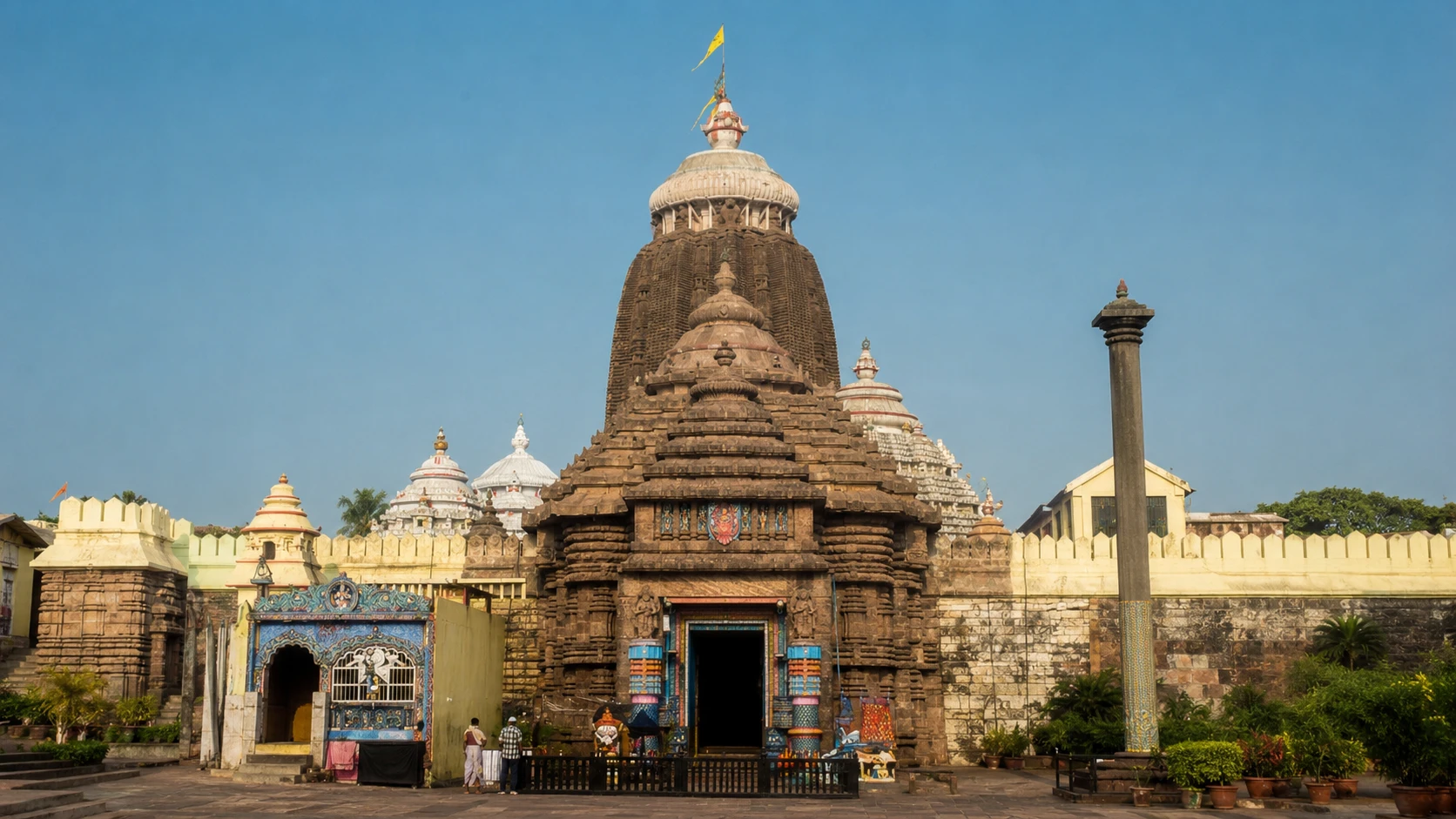
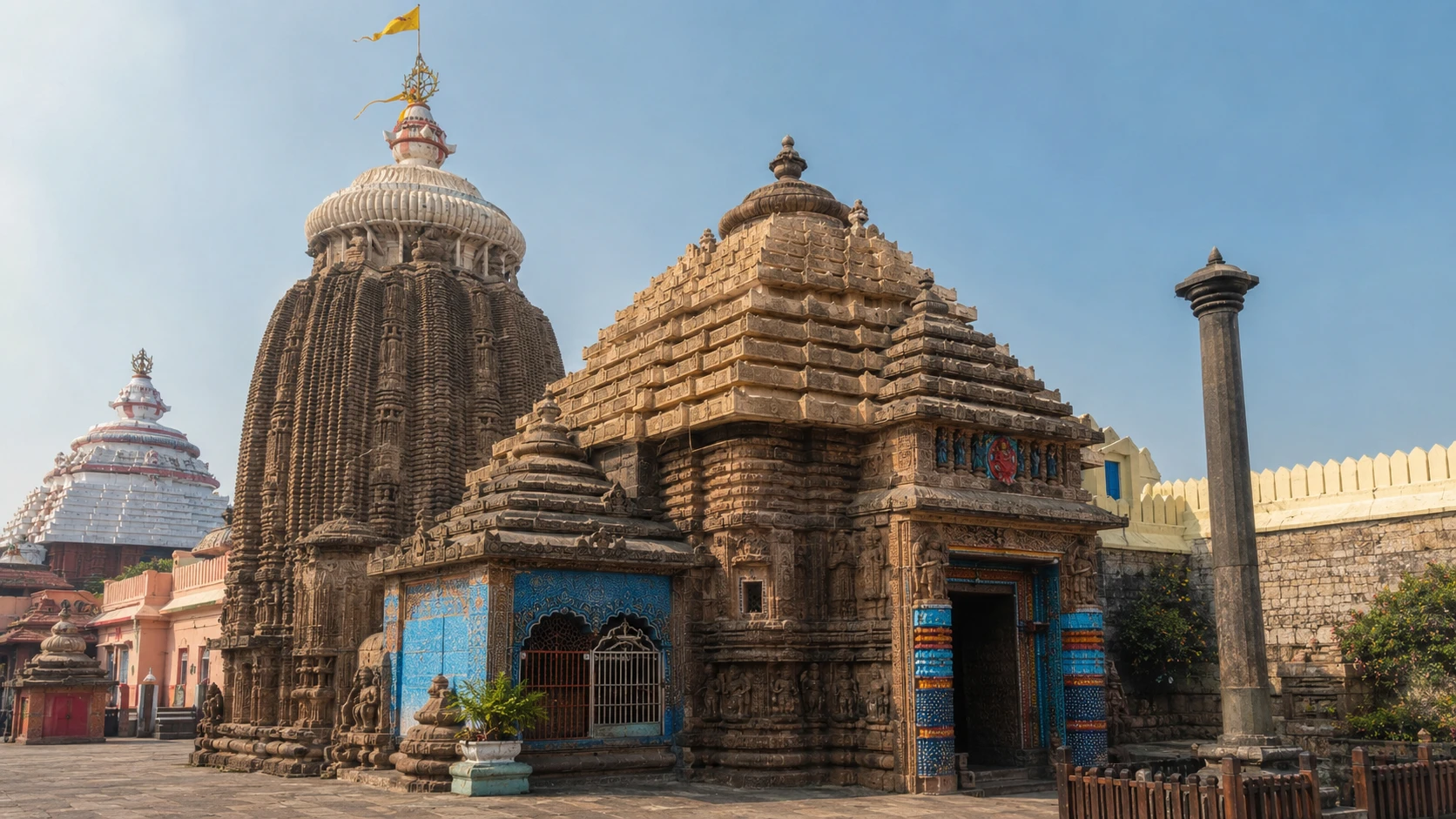
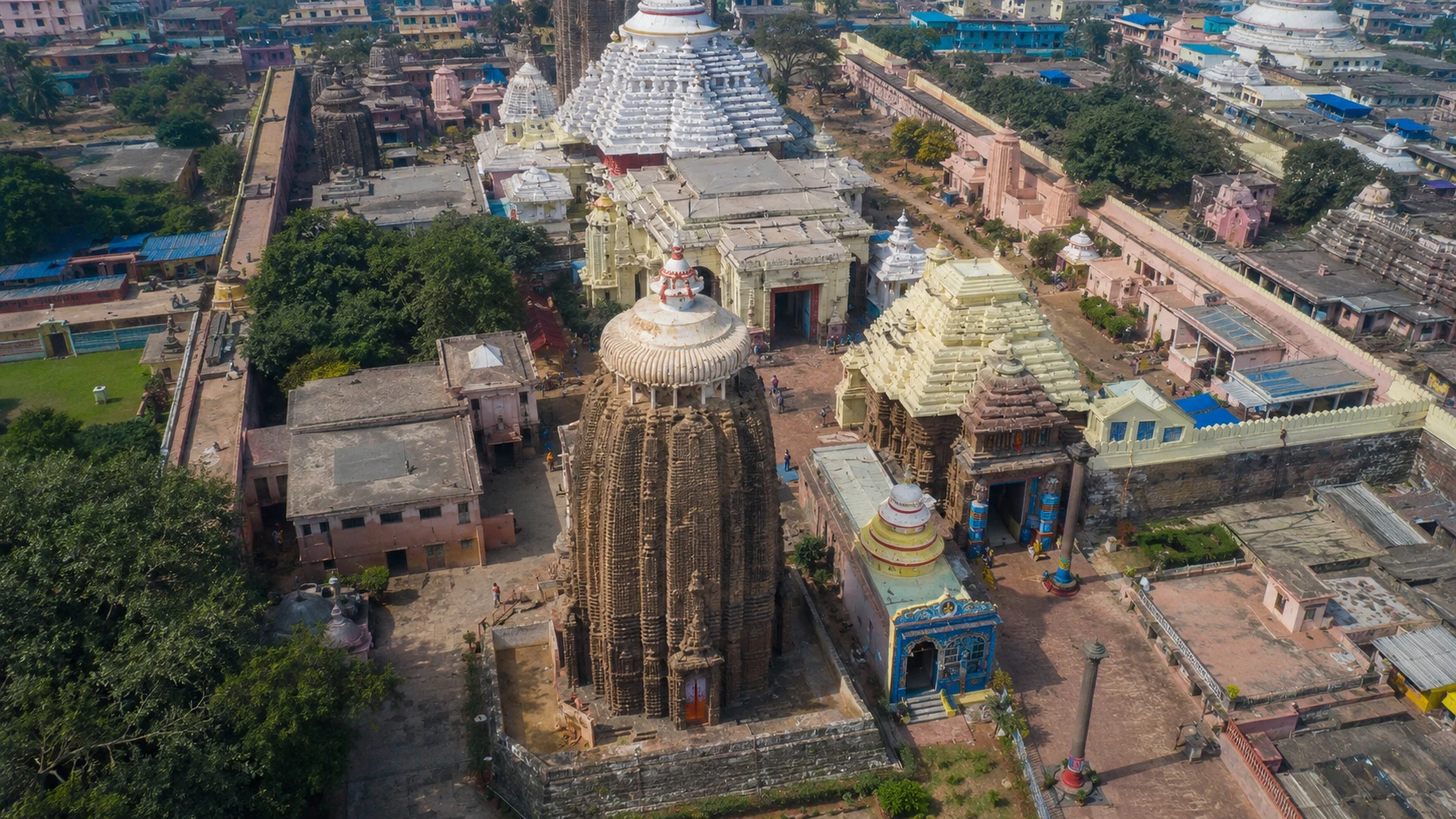
Vimala is enshrined in her own small Kalinga-style temple in the southwest corner of the Shree Jagannatha Temple compound, set against the inner compound wall and accessed by a short walk from the main shrine. The image is a four-armed goddess sculpted in dark stone, fully anthropomorphic, unlike the rock-cleft yoni of Kamakhya or the face-only image at Kalighat.
She stands or sits in a serene, protective posture (different historical descriptions and current ritual practice vary in detail), her four hands holding the typical Tantric attributes of the goddess: pasha (noose) and ankusha (goad) in the upper hands, an akshamala (rosary) or vessel and a varada-mudra gesture below.
Her face is composed and luminous, not fierce, the name 'Vimala' (the pure one) is reflected in her expression. The murti is dressed in red and gold silks, garlanded with hibiscus and other red flowers, and crowned in silver and gold ornaments.
The shrine itself is a compact rekha-deula in Kalinga style, a curvilinear-towered structure proportioned much smaller than the great Jagannatha temple beside it. Outside the shrine sits a small open courtyard used for daily ritual and, during Durga Puja, for the Shakta bali.
The Vimala shrine's location within the Jagannatha complex is architecturally significant: it stands precisely where, by tradition, the goddess's feet fell, and the entire layout of the Jagannatha temple complex is theologically described as built around her.
The compound's other subsidiary shrines, Lakshmi, Saraswati, Mahalakshmi, and various Bhairavas, orient themselves with reference to both the central Jagannatha shrine and the southwest Vimala shrine.
Distinctive Practicesविशिष्ट परंपराएँ
Mahaprasad Acceptance, Vimala's gatekeeping of the consecrated meal
महाप्रसाद स्वीकृति, पवित्रीकृत भोजन पर विमला की द्वारपालिका
Daily, conducted by senior priests as part of the standard Jagannatha temple cooking-and-offering cycle (Bhoga Mandapa rituals)
The single most distinctive ritual at the Vimala shrine, and arguably one of the most theologically remarkable in all Hindu temple practice, is the daily Mahaprasad acceptance. Food prepared in the Jagannatha temple kitchen (Rosaghara), the largest religious kitchen in the world, is first offered to Jagannatha at the main shrine. A portion is then carried in a covered vessel by senior priests, walking quietly through the compound to the southwest corner, where it is presented to Vimala in her shrine. Only after Vimala has accepted the offering does the cooked food become Mahaprasad, the consecrated meal that may be released to the Ananda Bazar within the temple compound and distributed to devotees. Without this acceptance, the kitchen has produced bhog. With it, Mahaprasad. The ritual is not occasional but daily, and it is the structural mechanism by which the Vaishnava-Shakta synthesis at Puri is enacted in practice rather than merely in theology.
The doctrinal logic is precise. In Hindu temple ritual, the act of consecration is theologically more fundamental than the act of offering, anyone can offer; only the right deity can consecrate. At Puri, Jagannatha is the offerer (the kitchen runs in his name, the offering is presented in his shrine) but Vimala is the consecrator (her acceptance turns bhog into Mahaprasad). The mythological grounding is the Sati narrative: the body part that fell at Purushottama-kshetra was the foot, and feet in Tantric symbolism are what touches the consecrated ground, what carries the goddess's presence into the world. Vimala therefore stands at the threshold between the temple's interior offering and the outside world's reception of grace, and grace flows only when she opens the threshold.
Sodasha Dinatmaka Puja, sixteen-day Durga Puja at the kshetra
षोडश दिनात्मक पूजा, क्षेत्र पर सोलह-दिवसीय दुर्गा पूजा
Annually beginning on Mulasthami (Bhadrapada Krishna Ashtami) and running for sixteen days through Vijayadashami; mid-September to early October by the Gregorian calendar
Where most Indian Devi temples observe Durga Puja or Navaratri for nine nights, Vimala's shrine at Puri runs an extended sixteen-day Durga Puja called the Sodasha Dinatmaka Puja. The extended duration is itself theologically meaningful: each day is dedicated to a specific aspect of the Devi, with progressive Tantric and Vedic worship layered through the ritual sequence. The puja begins on Mulasthami (the dark eighth of Bhadrapada), earlier than the standard Navaratri opening, and concludes on Vijayadashami in keeping with the broader Hindu calendar. The shrine is intensely active throughout, with continuous ritual cycles, the only period of the year when Vimala's shrine receives this concentrated focus distinct from the steadier daily Mahaprasad cycle. This is the most active Shakta worship sequence inside any Char Dham temple compound in India.
The sixteen-day count corresponds to the sixteen kalas (digits, phases) of the goddess in Tantric reckoning, a Sri Vidya enumeration that maps the goddess's complete cycle from manifestation through dissolution. By running the puja across all sixteen kalas rather than the standard nine nights, the Vimala shrine performs the most complete annual Devi worship of any Shakti Peetha. The choice of Mulasthami as starting day (Bhadrapada Krishna Ashtami) folds the puja into both the Vaishnava and the Shakta calendars simultaneously, Krishna Janmashtami of the dark fortnight aligns with Mulasthami, allowing Jagannatha-Krishna and Vimala-Devi observances to begin together.
Bali Prathā, Shakta animal offering within a Char Dham compound
बलि प्रथा, चार धाम परिसर के भीतर शाक्त पशु-अर्पण
Specifically during the Sodasha Dinatmaka Puja (Durga Puja), particularly on Mahashtami and Mahanavami nights
Among the most theologically remarkable continuities at Vimala's shrine is the practice of bali, Shakta animal sacrifice, within the compound of a Char Dham temple. Most major Vaishnava temples in India practice strict vegetarianism; the Jagannatha temple's own ritual cuisine is famously vegetarian-only. Yet at Vimala's shrine, during Durga Puja, goat sacrifice continues in a small outer courtyard, performed by traditional officiants, in keeping with Shakta-Tantric ritual specifications laid out in the Kalika Purana. This is the only Char Dham temple compound where Shakta bali persists. The practice is preserved because, in the temple's internal theology, Vimala is structurally a Shakti Peetha goddess first and a temple-of-Jagannatha subsidiary deity second; her own ritual demands take precedence over the Vaishnava conventions of the larger compound at this specific shrine, on these specific festival days.
The persistence of bali at Vimala's shrine encapsulates the temple's most subtle theological position: the Vaishnava and Shakta layers at Puri are not in conflict, but their internal demands sometimes differ. Vaishnava ritual centers on darshan and vegetarian bhog; Shakta ritual centers on Shakti's acceptance, which in Tantric tradition includes blood-offering. By preserving bali at Vimala's shrine only, and only on specific Durga Puja days, in a discrete outer courtyard, the temple's ritual order honors both traditions' demands without subordinating one to the other. Modern Hindu reformist traditions have criticized this practice; the SJTA and the hereditary Sebait families have maintained the ritual on grounds of tradition continuity. Eternal Raga documents the practice without endorsement or condemnation, in keeping with respectful pluralism.
Did You Know?क्या आप जानते हैं?
Mahaprasad isn't Mahaprasad without Vimala. The famously sacred meal of the Jagannatha temple, fed to up to 100,000 pilgrims on festival days, prepared in the largest religious kitchen on earth, with a reputation that draws devotees from across India, owes its consecrated status entirely to a small four-armed goddess in the southwest corner of the compound. Food offered only to Jagannatha and not subsequently presented to Vimala remains bhog: nourishing, devotional, but ritually incomplete. Only Vimala's acceptance transforms it into Mahaprasad. This single ritual fact establishes that, regardless of who appears central from the temple's architectural outside, Shakta primacy controls the temple's most consequential daily output.
Madala Panji (Puri temple chronicle); Frédérique Apffel-Marglin, 'Wives of the God-King' (Oxford, 1985); Gaya Charan Tripathi, 'Communication with God' (IGNCA, 2004); SJTA daily ritual records
Vimala's paired Bhairava, the form of Shiva who, in standard Shakti Peetha grammar, accompanies the goddess at each site, is uniquely identified at Puri as Jagannatha himself. The most beloved Vaishnava avatar of eastern India, the Lord of one of the four Char Dham, is simultaneously, in his Tantric aspect, the Bhairava of an Adi Shakti Peetha. This is unique across all fifty-one Shakti Peethas, at no other site does a Char Dham deity serve double-duty as Bhairava. The theological knot is the foundational stitch of the Vaishnava-Shakta synthesis at Puri.
Tantra Chudamani; Pithanirnaya; Eschmann et al., 'The Cult of Jagannath' (1978); P.K. Mishra, 'Jagannath in Indian Religious Life and Mind' (1996)
When Jagannatha leaves on his world-famous Ratha Yatra chariot procession, taken from the main shrine to the Gundicha temple two kilometers away each Ashadh Shukla Dwitiya, his sister Subhadra and brother Balabhadra accompany him, but Vimala does not. She remains in her shrine throughout the festival. Her static position is itself ritually significant: the goddess of the kshetra is the kshetra's permanent ground, the still point around which the Vaishnava deities' annual journey turns. When Jagannatha returns at the festival's end, he returns to her.
SJTA Ratha Yatra ritual documentation; Madala Panji; Apffel-Marglin, 'Wives of the God-King' (1985)
Vimala's shrine is the only Char Dham temple compound in India where Shakta bali, animal sacrifice, continues as an established ritual. During the Sodasha Dinatmaka (sixteen-day) Durga Puja, particularly on Mahashtami and Mahanavami, goats are offered in the outer courtyard of the Vimala shrine according to Tantric specifications laid out in the Kalika Purana. The Jagannatha temple's own ritual cuisine is famously vegetarian-only; the bali at Vimala's shrine operates as a precise theological exception that honors her Shakta-Tantric identity within the broader Vaishnava compound. No other Char Dham (Badrinath, Dwarka, Rameshwaram) carries a comparable Shakta exception.
SJTA Sodasha Dinatmaka Puja documentation; Kalika Purana, Rudhiradhyaya; Eschmann et al., 'The Cult of Jagannath' (1978)
The name Vimala means 'the pure one', strikingly different in register from the names of her fellow Adi Shakti Peethas. Kamakhya is 'she who is known through desire'; Kali at Kalighat is the goddess of time and death; Tara Tarini are the saviour-twins. Only at Puri does the Adi Shakti carry a name emphasizing serenity and purification rather than power, transformation, or rescue. The naming itself is theological commentary: Vimala is the goddess of the consecrated ground, the still purifying presence that turns ordinary food into Mahaprasad and ordinary pilgrim earth into kshetra.
Monier-Williams Sanskrit Dictionary (entry: vimala); Brahma Purana, Purushottama-kshetra mahatmya; Skanda Purana, Utkala Khanda
Visitor Accessप्रवेश जानकारी
Access to Vimala's shrine is via the main Shree Jagannatha Temple complex, and is therefore governed by the temple's long-standing convention restricting entry to followers of the Hindu religion only. This restriction applies to the entire compound, main Jagannatha shrine, Vimala shrine, all subsidiary shrines, and the Mahaprasad kitchen and Ananda Bazar areas. Non-Hindus may not enter the temple compound. The restriction is strictly enforced; foreign tourists and Indian non-Hindus alike are routinely denied entry, regardless of denominational background, government office, or marriage to Hindu family. Notable past denials include the late Indira Gandhi (denied entry on grounds of her marriage to Feroze Gandhi, a Parsi, despite being raised Hindu). Inside the compound, photography is strictly prohibited at every shrine, including Vimala's. Footwear is removed at the outer boundary. The Vimala shrine itself is small; queues are typically short relative to the main Jagannatha darshan.
आध्यात्मिक आधार
The Shree Jagannatha Temple's Hindu-only convention is among the oldest continuously enforced access traditions at any major Indian temple, with roots in medieval Kalinga political-religious culture. The temple's interpretation is that the sacred ground of Purushottama-kshetra demands ritual observance consonant with the Hindu Dharmashastra; the restriction is therefore framed as protecting ritual integrity rather than excluding individuals. Vimala's specific theology, as the goddess who consecrates Mahaprasad through Hindu Tantric ritual, is bound to this broader ritual framework. The restriction is not unique to Puri (some other major Indian temples observe similar conventions) but is among the most strictly enforced.
समकालीन संदर्भ
The Hindu-only access convention at Puri has been subject to periodic public discussion in independent India, particularly when high-profile individuals (foreign dignitaries, Indian public figures) have been denied entry. Indian courts have generally affirmed the temple's prerogative to maintain its own ritual conventions; the restriction has not been overturned. The temple's position is consistent and the SJTA does not make case-by-case exceptions. Non-Hindus visiting Puri can view the temple's exterior from outside (the temple's exterior architecture is itself impressive, and the surrounding bazaars are open to all), and the nearby Raghunandan Library rooftop offers a panoramic view into the compound, popular with foreign visitors.
व्यावहारिक मार्गदर्शन
Hindu pilgrims approaching Vimala's shrine: enter the main Jagannatha temple through the standard pilgrim entrance, complete the main Jagannatha darshan first per traditional ritual order, then walk to the southwest corner of the compound to reach Vimala's smaller shrine. Most pilgrim groups complete both darshans in a single visit. The Vimala shrine has shorter queues than the main shrine; expect 15, 45 minutes during normal periods, longer during Sodasha Dinatmaka Puja or Ratha Yatra week. Photography is completely prohibited inside the compound, leave all cameras, phones, and recording devices at the locker counters outside the main gate. Wallets and valuables: thefts within the dense crowd around the main shrine are not uncommon; carry minimal valuables. Footwear must be deposited at the prescribed outer boundary; bring socks if the stone floor is uncomfortably hot in summer.
Festivalsत्योहार
Sodasha Dinatmaka Puja (Sixteen-Day Durga Puja)
षोडश दिनात्मक पूजा (सोलह-दिवसीय दुर्गा पूजा)
Sep-Oct (Bhadrapada Krishna Ashtami to Ashwin Shukla Dashami)
Vimala's principal festival and the most extended annual Shakta worship sequence inside any Char Dham temple compound. Beginning on Mulasthami (Bhadrapada Krishna Ashtami, earlier than the standard Navaratri opening) and concluding on Vijayadashami, the sixteen-day puja corresponds to the sixteen kalas of the goddess in Tantric Sri Vidya reckoning. Each day is dedicated to a specific Devi aspect, with progressive Tantric and Vedic worship layered through the ritual sequence. Goat sacrifice (bali) is performed in the outer courtyard on Mahashtami and Mahanavami. The shrine receives intensified ritual focus throughout, the only period when Vimala's worship is decoupled from the steady daily Mahaprasad cycle and given dedicated festival weight.
Ratha Yatra (Vimala's Static Witness)
रथ यात्रा (विमला की स्थिर साक्षी)
Jun-Jul (Ashadh Shukla Dwitiya)
While the world-famous Ratha Yatra is celebrated for Jagannatha, Balabhadra, and Subhadra leaving the main shrine on chariots for the Gundicha temple, Vimala's festival role is precisely the opposite: she does not travel, and her staying is itself ritually significant. The Vaishnava deities' annual journey requires a still ground to journey from and return to, and Vimala holds that ground. During Ratha Yatra week, Vimala's shrine remains open and active, and devotees making the pilgrimage to Puri to see the chariots traditionally include her darshan as the journey's bookend, her presence is the kshetra's permanent anchor against which the chariot procession's annual motion makes sense.
Snan Yatra (Bathing of the Deities)
स्नान यात्रा (देवताओं का स्नान)
Jun (Jyestha Purnima)
On the full-moon day of Jyestha, two weeks before Ratha Yatra, the principal deities of the Jagannatha complex receive a ritual bath called Snan Yatra. Vimala is included in the bathing observance, though the centerpiece of the festival is the bathing of Jagannatha, Balabhadra, and Subhadra on the Snan Bedi platform. The festival establishes the ritual transition from the dry summer to the monsoon-and-Ratha-Yatra season, and is one of the few moments when Vimala's worship is publicly visible alongside the main shrine's Vaishnava observances rather than running quietly in parallel.
Magha Saptami
माघ सप्तमी
Jan-Feb (Magha Shukla Saptami)
The seventh day of the bright fortnight of Magha is a specifically Vimala-centric festival within the Jagannatha temple calendar. The shrine receives special abhishekam (ritual bathing of the image), full pushpanjali (flower offering), and intensified Tantric mantra recitation throughout the day. Magha Saptami is observed across many regional Hindu traditions as auspicious for goddess worship; at Puri the festival is woven specifically into Vimala's ritual cycle, providing a mid-winter complement to the autumn Sodasha Dinatmaka Puja and the early-summer Snan Yatra.
Traditional Offeringsपारंपरिक अर्पण
प्राथमिक अर्पण
Red Hibiscus (Japa / Joba)
लाल जपा (गुड़हल)
जपाकुसुम
The red hibiscus is among Vimala's most-offered flowers, drawn from the wider eastern-Indian Shakta tradition and integrated into Puri's specific ritual cycle. Garlands of fresh joba are laid on the goddess's image during morning and evening puja; the flower's bright crimson against Vimala's dark-stone murti is one of the visual signatures of the shrine. Offering hibiscus at Vimala carries a particular theological resonance: as the flower most associated with the Devi's blood-and-fertility iconography, it acknowledges the goddess's Shakta nature even within the Vaishnava compound that surrounds her.
Red Cloth / Saree
लाल वस्त्र / साड़ी
रक्ताम्बर
Devotees bring lengths of red silk, cotton, or a full saree as offerings to Vimala. The Sebaits accept the cloths and rotate them through the shrine's ritual cycle; cloths that have been draped over the goddess are later returned to devotees as Devi-prasad. Bengali, Odia, and Assamese pilgrims in particular include a red-saree offering at Vimala as part of important family observances, for daughter's weddings, for safe pregnancy, for recovery from major illness. The cloth participates in the shrine's small-but-continuous gift economy of the goddess's grace returned to devotees in tangible form.
Sindoor (Vermilion)
सिंदूर
सिन्दूर
Sindoor offered to Vimala is applied to her forehead, and a small portion is returned to women devotees who apply it in the central parting of their hair, a Shakta blessing for marital harmony and household protection. The simplicity of the offering reflects Vimala's serene rather than fierce iconography: where Kalighat's sindoor links the goddess's terrible aspect to her maternal one, Vimala's sindoor is more directly maternal, the radiant blessing returned from the goddess to her devotee with no intervening fierce mediation.
Coconut (Narikela)
नारियल
नारिकेल
Whole coconut with husk and water intact is offered to Vimala and ritually broken by the Sebait. Within the Mahaprasad cycle the coconut takes on particular significance: it is among the first offerings prepared in the Jagannatha kitchen each morning, and a portion of every coconut prepared at the main shrine is brought to Vimala's shrine as part of the daily ritual rhythm. Coconuts offered by devotees specifically at Vimala's shrine are distributed back as prasad to the offering family, completing the offering-receiving circulation.
Ghee Diya (Clarified Butter Lamp)
घी का दीया
घृत-दीप
Lamps lit with ghee are offered at every aarti and by individual devotees seeking specific blessings or fulfilling vows. The amber flame of a ghee diya in Vimala's small, dim shrine establishes the visual register of the goddess's encounter: she is the still illumination at the southwest corner of the kshetra, and the lamps her devotees light participate in that quality of light. Devotees often light a diya specifically before requesting Mahaprasad sponsorship or making a major manat.
Pan-Supari (Betel Leaf and Areca Nut)
पान-सुपारी
ताम्बूल
In Odia, Bengali, and other eastern Indian Devi traditions, pan-supari is offered as a mark of welcome and hospitality to the goddess, treating her as an honored guest at her shrine. At Vimala, the betel-leaf-and-areca-nut offering is incorporated into both daily ritual and special pujas; for special darshans, devotees may bring elaborate decorated pan-supari arrangements to be presented at the shrine. The offering belongs to the layer of practice that connects Puri's temple ritual to the broader eastern Indian regional culture of goddess hospitality.
इस मंदिर की विशेषता
Sponsored Bhog for the Mahaprasad Consecration Cycle
महाप्रसाद पवित्रीकरण चक्र के लिए प्रायोजित भोग
Devotees who wish to participate in the temple's most distinctive ritual cycle can sponsor a portion of a day's bhog dedication, the cooked food prepared in the Jagannatha kitchen, offered first to Jagannatha at the main shrine, then brought to Vimala for her acceptance, then released as Mahaprasad. The sponsorship is arranged through SJTA channels and the hereditary Sebait families. The devotee's sponsorship does not place them at the ritual itself (the daily Mahaprasad cycle is conducted by senior priests; lay devotees receive Mahaprasad in distribution rather than performing the rite), but it inscribes the sponsoring family's name into the temple's ritual record for that day's consecration cycle. Among the most spiritually meaningful sponsorships available at any Indian temple, given the underlying theology of female consecration.
Sodasha Upachara Puja Sponsorship (during Sodasha Dinatmaka Puja)
षोडश उपचार पूजा प्रायोजन (षोडश दिनात्मक पूजा के दौरान)
During the annual sixteen-day Sodasha Dinatmaka Durga Puja (Sept-Oct), devotees can sponsor the Sodasha Upachara, the full sixteen-fold Tantric offering sequence, for a specific day of the festival. The Sodasha Upachara encompasses ritual welcoming (avahana), seat (asana), foot-washing (padya), water (arghya), drinking-water (achamana), bath (snana), garment (vastra), sacred thread (yajnopavita), perfume (gandha), flowers (pushpa), incense (dhupa), light (dipa), food (naivedya), betel (tambula), prayer (pranama), and farewell (visarjana). Sponsoring a full Sodasha Upachara is among the most elaborate ritual sponsorships available at Vimala's shrine, requiring advance booking through the SJTA and the hereditary Sebait families. The sequence is foundational to Tantric Shakta worship and is performed only at major Shakti Peethas during festival peaks.
Standard offerings (hibiscus, red cloth, coconut, sindoor, ghee diya, pan-supari) can be brought from outside or purchased at vendor stalls outside the temple's main gates. Inside the compound, the SJTA operates an official offering counter where devotees can purchase ritually-prepared offerings for direct presentation through the Sebaits. Note that the Jagannatha temple complex restricts all photography and most personal possessions inside the compound, bring offerings rather than carrying through cameras or large bags. Sponsored bhog and Sodasha Upachara arrangements require advance booking through SJTA channels; lay devotees cannot perform these rituals themselves (they are conducted by initiated priests) but can sponsor and witness them within ritual permissions. The non-Hindu access restriction applies to the entire compound and therefore to Vimala's shrine offerings.
How to Reachकैसे पहुँचें
Access to Vimala's shrine is via the Shree Jagannatha Temple complex, which is the principal landmark of Puri's old town near the Bay of Bengal coast. By air, the nearest airport is Biju Patnaik International Airport at Bhubaneswar (BBI), 60 km north; pre-paid taxis and app-based cabs cover the Bhubaneswar, Puri route in 60, 90 minutes via the well-maintained Bhubaneswar, Puri highway, with frequent inter-city buses also available.
By rail, Puri Railway Station sits 3 km from the temple and is well-connected to Bhubaneswar, Kolkata, Howrah, Delhi, Chennai, and other major Indian cities via long-distance express services; auto-rickshaws and cycle-rickshaws cover the station-to-temple stretch in 10, 15 minutes.
Bhubaneswar Railway Station (65 km) handles a broader range of express trains; transfers to Puri by road or local rail are routine. Within Puri itself, the temple area is pedestrian-oriented; vehicular access stops a few hundred meters from the temple gates, and the final approach is on foot through narrow lanes lined with vendor stalls.
The Lions Gate (Singha Dwara) is the principal entry for pilgrims.
Plan Your Visitयात्रा की योजना
🌤 सर्वोत्तम मौसम
October to March is the most comfortable period, temperatures range from 16, 28°C, humidity is moderate by Odia coastal standards, and the autumn-winter festival calendar (Sodasha Dinatmaka Puja in Sept-Oct, Magha Saptami in Jan-Feb) makes the temple atmospherically rich. Avoid the peak monsoon (June-September) unless visiting specifically for Ratha Yatra: heavy rain, occasional cyclone risk, and Puri's coastal humidity reduce the experience. April-May is hot and humid; coastal temperatures regularly cross 35°C. Ratha Yatra week (June-July) and Sodasha Dinatmaka Puja (Sept-Oct) are the most spiritually charged times but also the most crowded, first-time visitors prioritizing unhurried darshan should choose November-February.
👘 पहनावे का नियम
Modest, traditional attire is expected, and reinforced by the temple's general access conventions. For men: dhoti and shirt, or full-length trousers with a shirt or kurta; sleeveless garments are discouraged; bare-chested men following the South Indian convention are not allowed at this temple. For women: saree, salwar-kameez, or long skirt with covered shoulders; head covering is not strictly required but considered respectful. Leather items (belts, wallets, watches with leather straps) should be removed before entering the compound, they are typically deposited at the lockers outside the main gate. Footwear is removed at the prescribed outer boundary of the temple complex.
📱 फोन और फोटोग्राफी
Photography and videography are completely prohibited inside the entire Shree Jagannatha Temple compound, including at the Vimala shrine, the main Jagannatha shrine, the Mahaprasad kitchen area, the Ananda Bazar, and all subsidiary shrines. Phones, cameras, and recording devices must be deposited at the locker counters outside the main temple gates before entry; they are not permitted in pockets within the compound. The restriction is rigorously enforced by temple security and SJTA staff. Photography is permitted in the surrounding bazaars and from the Raghunandan Library rooftop, which offers panoramic exterior views of the temple but no view into ritual interiors.
🏨 आवास
Puri is a long-established pilgrimage and beach town with an extensive accommodation ecosystem at every price point, from heritage properties such as Mayfair Heritage and Hans Coco Palms to mid-range hotels in the temple's vicinity and along Marine Drive, to dharamshalas (pilgrim guest houses) attached to various maths and sebait families, to budget options near the railway station. The Odisha Tourism Development Corporation operates Panthanivas Puri, a recognized government-sector option. Booking through verified channels (hotel websites or established online travel platforms) avoids the unaffiliated agents who congregate around the bus and railway stations. During Ratha Yatra week (June-July), Sodasha Dinatmaka Puja (Sept-Oct), and the year-end holiday season (Dec-Jan), Puri reaches saturation; book at least 4, 6 weeks in advance for these windows. For Vimala-specific pilgrims who want to be close to the temple, accommodations in the streets between the temple and the beach (Swargadwar area) offer walking-distance access.
Sacred Soundsपवित्र ध्वनि
Devi Suktam (Vāk Sūkta, Rig Veda 10.125)
stotram · 420
Mahishasura Mardini Stotram (Ayi Giri Nandini, attributed to Adi Shankara)
stotram · 540
Vimala Stotram (from the Brahma Purana, Purushottama-kshetra mahatmya)
stotram · 360
Jagannathashtakam (Adi Shankara, Hymn to Jagannatha, Vimala's paired Bhairava)
stotram · 480
Devi Kavacham (from Durga Saptashati)
kavacham · 600
क्या आप जानते हैं? · Did You Know?
वही अनुवाद त्रुटि जिसने हिन्दू धर्म में '33 कोटि' को '33 करोड़' बनाया, बौद्ध धर्म में भी हुई। बौद्ध ग्रन्थों के चीनी अनुवाद ने 'सप्त कोटि बुद्ध' (7 श्रेष्ठ बुद्ध) का अनुवाद '7 करोड़ बुद्ध' कर दिया। तिब्बती अनुवाद ने सही किया: 7 प्रकार, 7 करोड़ नहीं। एक संस्कृत शब्द, दो प्रमुख विश्व धर्मों में गलत पढ़ा गया, ने दो एकसमान भ्रम स्वतन्त्र रूप से उत्पन्न किए।
Related Contentसंबंधित सामग्री
Related Scriptures
Community Reflections
🕉️
Be the first to share your reflection.