Kalighat
कालीघाट
Where Sati's right toes fell and Kali made her seat
Kolkata, West Bengal, India
KālīghāṭaAlso known as: Kalighat Kali Temple, Kalighat Mandir, কালীঘাট মন্দির, कालीघाट मंदिर, Kalikshetra, Dakshina Kali at Kalighat, Adi Shakti Peetha, Kalighat
युग
Earliest dated textual reference 1495 (Manasa-Mangal Kavya); current Atchala-style temple consecrated 1809; site continuously active as a Shakta pilgrimage center since at least the 15th century
वास्तुकला
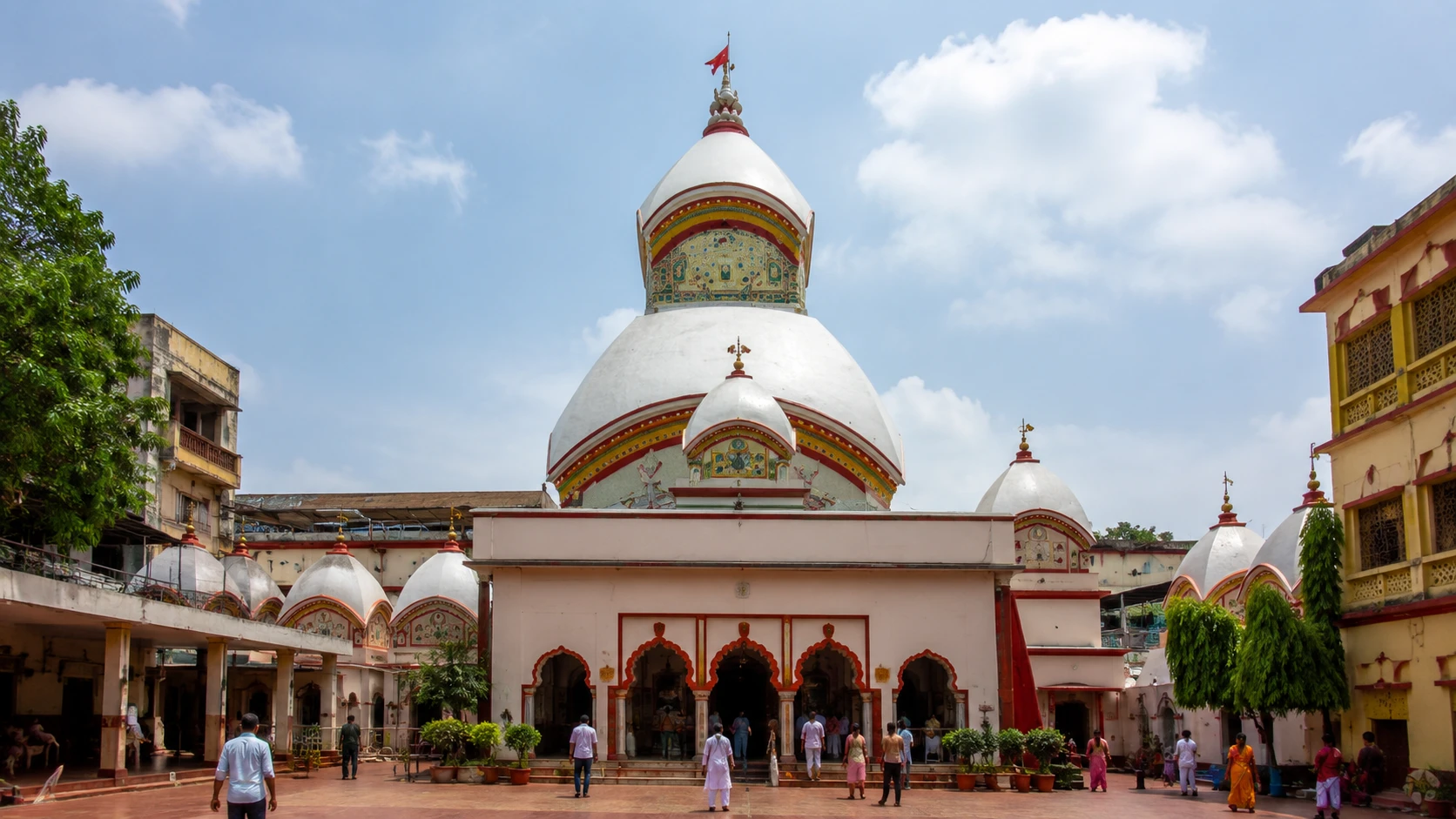
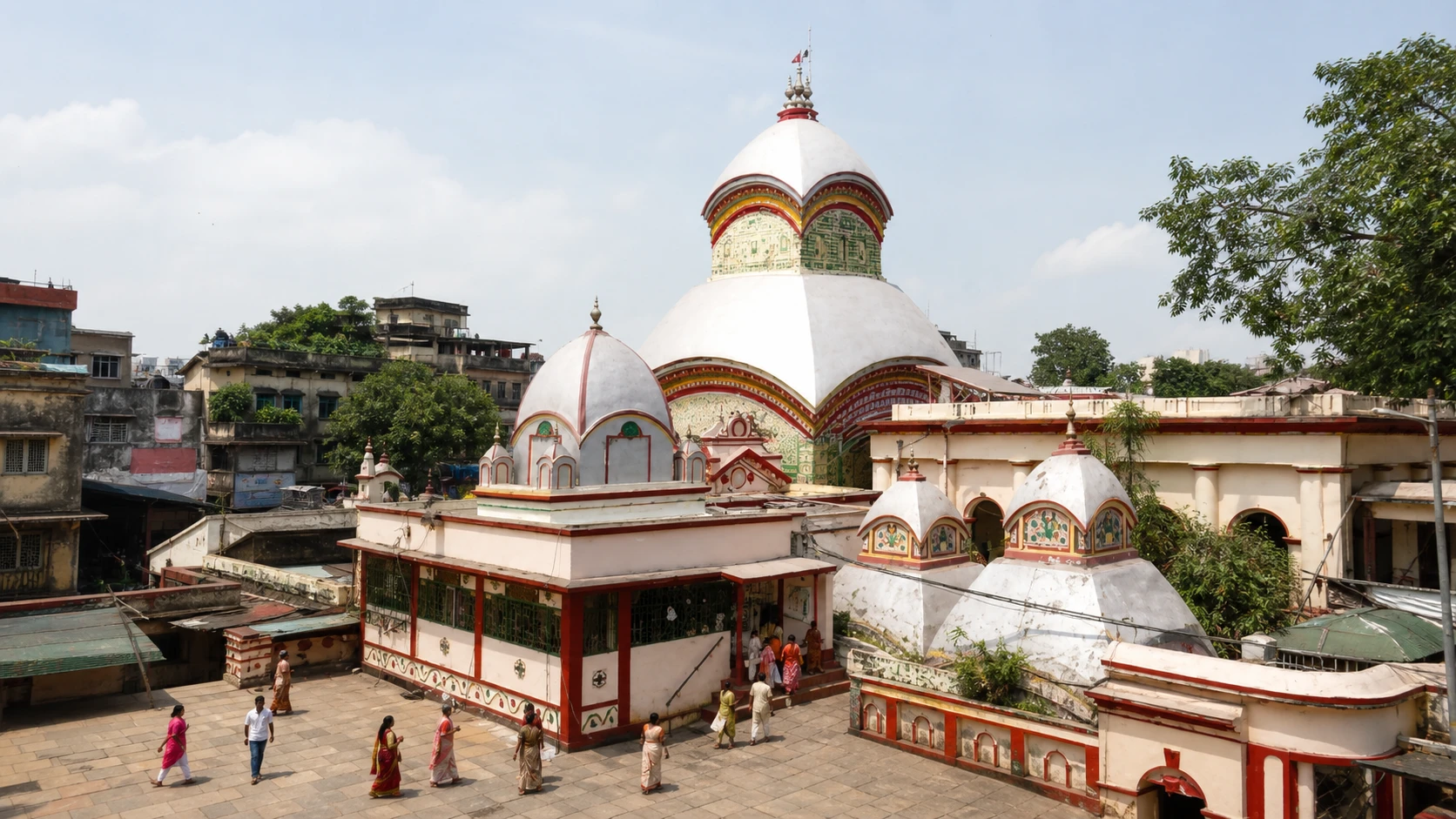
Bengal Atchala (eight-roofed) style, a layered, curvilinear roof typology native to medieval Bengal, with terracotta detailing and a central garbhagriha enclosed by an outer mandapa
खुला
05:00 – 22:30
आरती
05:00 · 07:00 · 18:30 · 21:00
विशेष
Sparsha (touch) darshan available for an additional fee; the temple complex includes the Kundupukur tank used for ritual bathing, the Nat-Mandir for assembly and bhajan, the Sosthi Tala for child-blessing rituals, and the Hari-Sabha hall; during Kali Puja the temple stays open through the night
पवित्र कथा · पवित्र कथा
Kalighat is where Bengal goes to meet its goddess. Where Sati's right toes fell during the cosmic dismemberment of her corpse, the Mother Goddess took her seat as Dakshina Kali, and for five centuries the religious life of Bengal has organized itself around her gates. The image enshrined here is unlike any other Kali murti in the subcontinent: not a sculpted body but a face alone, carved in black touchstone, smeared with vermilion, set with three almond-shaped eyes and a long protruding gold tongue, framed in silver, with separate gold arms appended to hold the sword and the severed head of her terrible iconography. Built in its current Atchala form in 1809 on the bank of the now-silted Adi Ganga, the temple sits two kilometers south of Kolkata's bustling heart, and on any given day its queue carries Bengali grandmothers, taxi drivers, students before exams, brides on their wedding morning, and pilgrims from far beyond Bengal, each arriving at the threshold of the Mother who hides nothing, devours fear, and meets every devotee on the level ground of her open courtyard.
Sacred Designationपवित्र पदनाम
Shakti Peeth
शरीर का अंग: Right toes, specifically the four smaller toes of Sati's right foot
शक्ति: Kalika (Dakshina Kali)
भैरव: Nakuleshwara
Sacred Origin Storyपवित्र उत्पत्ति कथा
Source: Pithanirnaya, Tantra Chudamani, and Devi Bhagavata Purana, widely-attested. The Bengali Mangal Kavya tradition (Manasa-Mangal, Chandi-Mangal) supplies the regional narrative.
When Daksha Prajapati's great yajna ended in Sati's self-immolation and Shiva's grief-mad tandava, the gods sent Vishnu to halt the dance before it unmade the cosmos. Vishnu followed Shiva through the sky and from his Sudarshana chakra loosed precise cuts that severed Sati's body, piece by piece, while she still rested upon her lord's shoulder.
As each part fell to the earth below, Shiva's grief lightened, until at last he carried nothing, and the dance ended. The places where Sati's body fell became Shakti Peethas, pillars of the goddess's presence on earth.
To a marshy stretch of land in the Gangetic delta, the place that would become Bengal, fell the toes of her right foot. Four small toes. The earth where they touched was claimed by the Mother Goddess in her dark, fierce, formless aspect: not Durga the warrior, not Lakshmi the gracious one, not Saraswati the muse, but Kali, the goddess of time, of death, of dissolution, who alone is unbound by the cycles she presides over.
She took the name Kalika at this place, and the name of the place itself became Kali-ghat: the ghat of Kali, the riverbank steps where the dark Mother had made her seat.
The Tantra Chudamani specifies the iconography of the goddess at Kalighat: Dakshina Kali, the southward-facing Kali, in her benevolent-protective aspect. Where the Mahakali of cremation grounds is fierce-only, Dakshina Kali turns her face toward the devotee.
She still holds the sword and the severed head, for the goddess of time does not lay these down, but her other hands form the abhaya mudra ('do not fear') and the varada mudra ('I grant boons'). Her long protruding tongue, often misread as grotesque, is in Shakta interpretation an arrested mudra of shame: the Mother, having stepped on the prone body of Shiva (her own consort) in the heat of her cosmic dance, has bitten her tongue and stopped, the most maternal moment in all of Hindu iconography, the goddess of death realizing she has placed her foot on her beloved.
The paired Bhairava at Kalighat is Nakuleshwara, who has his own small shrine within the temple complex. As Kalika cannot be worshipped without acknowledging her Shiva-counterpart, devotees who complete a Kalighat darshan also visit the Nakuleshwara shrine, even if briefly.
उद्धृत स्रोत:
- Pithanirnaya (anonymous medieval Sanskrit, enumerates 51 Shakti Peethas with body-part attributions)
- Tantra Chudamani (medieval Sanskrit Tantric text)
- Devi Bhagavata Purana, Skandha 7, chapter 30
- Kalika Purana, chapters 18 (Sati's dismemberment narrative)
- Brihat Nila Tantra (Bengali Shakta-Tantric text)
अन्य परंपराएँ · अन्य परंपराएँ
Bengali Mangal Kavya tradition, particularly Bipradas Pipilai's Manasa-Mangal (1495) and Mukundaram Chakraborty's Chandi-Mangal (c. 1582). Folk-narrative attestation embedded in regional verse.
A regional Bengali tradition, layered onto the pan-Indian Sati narrative and attested in the Mangal Kavya literature from the late 15th century, holds that the Kalighat toe-relic was rediscovered, not first discovered, by a wandering yogi named Bhubaneswar Brahmachari (some sources call him Atmaram Brahmachari).
The narrative places him in the marshy delta where the Adi Ganga met cleared land, sometime in the medieval period before reliable dating. He saw a strange amber light rising from the riverbed at low tide, dove in, and recovered a stone shaped like four small toes. He built a small shrine on the bank to enshrine the relic.
The shrine grew through pilgrimage; the village became Kalikshetra, then Kalighat. The current Atchala temple of 1809 stands atop centuries of layered prior structures, each rebuilding on the same sacred footprint that Bhubaneswar Brahmachari is said to have first marked.
Modern academic scholarship, Kalighat as a layered Shakta-Tantric site predating its 1809 architectural form
A second framing, articulated by scholars including Sukumar Sen, David Kinsley, and Rachel Fell McDermott, treats Kalighat not as a single shrine but as a Shakta-Tantric center whose history predates the current 1809 Atchala temple by at least four centuries, and quite possibly far longer.
The 15th-century Manasa-Mangal reference is the earliest dated mention but already speaks of Kalighat as an established sacred site, implying prior continuity. Multiple smaller shrines along the Adi Ganga's banks (now mostly silted into archaeological invisibility) likely converged into the current temple's architectural footprint between the 16th and early 19th centuries.
The Sabarna Roy Choudhury family's hereditary patronage from the early 17th century formalized a pre-existing pilgrimage tradition rather than founding one.
विद्वत संदर्भ
Modern scholarship (David Kinsley, 'Tantric Visions of the Divine Feminine', 1997; Rachel Fell McDermott, 'Mother of My Heart, Daughter of My Dreams', 2001) places Kalighat in the wider context of Bengali Shakta devotionalism, alongside the 18th-19th century efflorescence of poet-saints (Ramprasad Sen, Kamalakanta Bhattacharya) who reshaped Kali devotion into a distinctly Bengali maternal-emotional register. The temple is frequently conflated by visitors with Dakshineswar (8 km northeast), the 19th-century Kali temple associated with Ramakrishna Paramahamsa; the two are entirely separate institutions, with separate priesthoods, separate Sebait families, and substantially different cultic histories. The right-toes body-part attribution at Kalighat is uncontested across the Sanskrit Pithanirnaya, Tantra Chudamani, Devi Bhagavata, and Kalika Purana enumerations, though minor variations exist on whether all four small toes or only the four (excluding the great toe) are said to have fallen. The Bhairava attribution, Nakuleshwara, is similarly uncontested in the primary textual tradition.
Historyइतिहास
Kalighat's dated history begins in the late 15th century, when Bipradas Pipilai's 'Manasa-Mangal Kavya' (1495) names the temple as an established site of pilgrimage on the Adi Ganga. This places the temple, in some form, before the founding of the Mughal Empire in India, and at a time when the Bengal delta was under the Husain Shahi sultanate.
The 16th-century reference in Mukundaram Chakraborty's 'Chandi-Mangal Kavya' (c. 1582) confirms the temple's status as a regionally significant Shakta center by the late Mughal era.
The temple's institutional history enters clearer focus in the early 17th century. Around 1608, Lakshmikanta Gangopadhyay, founder of the lineage later known as the Sabarna Roy Choudhury family, received a sanad (royal grant) from the Mughal emperor Jahangir making him zamindar of a vast tract in the Gangetic delta, including the villages of Kalikata, Sutanuti, Govindapur, and the surrounding Kalighat region.
The Sabarna Roy Choudhuries became hereditary Sebaits (worshipper-trustees) of the Kalighat temple from this point, and the family has continued in this role for over four centuries, an unbroken Sebait succession unusual among major Indian temples.
The village of Kalikata, site of the temple, was one of three villages purchased by the British East India Company from the Sabarna Roy Choudhuries in 1698, becoming the nucleus of British Calcutta. The temple itself remained under Sabarna family Sebait management; only the surrounding land changed hands.
As Calcutta grew into the East India Company's principal city through the 18th century, Kalighat (a few kilometers south of the colonial center) became a major pilgrimage destination, drawing devotees from across Bengal and increasingly from northern India.
The current Atchala-style temple structure was constructed under the patronage of Santosh Roy Choudhury of the Sabarna family. Foundation work began in the 1790s; the main shrine was consecrated in 1809. Successive generations of the family completed the surrounding mandapas, the Sosthi Tala (for child-blessing rituals), the Hari-Sabha hall, and the Kundupukur tank.
Through the 19th and early 20th centuries the temple emerged as the spiritual center of urban Bengali Hinduism, drawing devotees through every phase of the Bengal Renaissance, Ramakrishna Paramahamsa visited Kalighat repeatedly, as did Swami Vivekananda, the poet-saint Ramprasad Sen, and countless lesser-known seekers.
In the modern era the Kalighat Temple Committee, with hereditary Sabarna Roy Choudhury Sebaits and government-nominated representatives, administers the temple. Animal sacrifice, primarily of male goats, continues in the designated outer courtyard during Kali Puja and select other festivals; buffalo sacrifice was discontinued in stages through the late 20th century.
Beginning in 2019, a major heritage conservation initiative funded by the Reliance Foundation in partnership with the Government of West Bengal undertook restoration of the temple structure, renovation of pilgrim infrastructure, and improved crowd management, a multi-year project that drew both appreciation and contention over heritage-modification questions, and that continues in stages.
Historical Timelineऐतिहासिक कालक्रम
Bipradas Pipilai's 'Manasa-Mangal Kavya', composed during the reign of Bengal's Husain Shahi sultanate, names Kalighat as an established temple on the Adi Ganga. This is the earliest precisely-datable textual reference to the temple, placing its existence as a sacred site at least to the late 15th century, and by implication, given the Kavya's description of an established pilgrimage tradition, somewhat earlier.
The 'discovery' type here marks the earliest dated textual attestation of the temple rather than a single discovery event. The Manasa-Mangal Kavya's reference treats Kalighat as already established, which implies prior continuity that cannot be precisely dated from surviving sources.
Mukundaram Chakraborty (known by the title Kavikankan), composing his 'Chandi-Mangal Kavya' under the patronage of zamindar Bankura Roy of Arrah, names Kalighat among the major Shakta sites of Bengal. This second textual reference, separated from the Manasa-Mangal by nearly a century, confirms the temple's continuous status as a regional pilgrimage center through the late Mughal era.
Lakshmikanta Gangopadhyay, founder of the lineage known thereafter as the Sabarna Roy Choudhury family, receives a sanad (royal grant) from Mughal emperor Jahangir making him zamindar of a vast Gangetic-delta tract including the villages of Kalikata, Sutanuti, Govindapur, and the surrounding Kalighat region. The Sabarna Roy Choudhuries become hereditary Sebaits of Kalighat, a Sebait succession that continues unbroken to the present day, exceeding four centuries.
The exact date of the sanad is given as 1608 in family records; some general histories give c. 1610. The first Mughal recognition of the lineage's zamindari rights over the Kalighat-Kalikata region is uncontested across sources, though the precise document date varies by a year or two.
The current Atchala-style main temple structure is consecrated under the patronage of Santosh Roy Choudhury of the Sabarna Roy Choudhury family. Foundation work had begun in the 1790s; the consecrated 1809 structure replaced and consolidated earlier smaller shrines on the same site. The Atchala style, with its eight-faceted curvilinear roof, is characteristically Bengali, and Kalighat became among the most architecturally significant Atchala temples surviving in Kolkata.
A major heritage conservation and pilgrim-infrastructure initiative is launched at Kalighat under joint funding from the Reliance Foundation and the Government of West Bengal, with technical input from the Department of Archaeology. The project covers structural restoration of the 1809 Atchala temple, renovation of approach roads, queue-management infrastructure, the Nat-Mandir and Hari-Sabha halls, the Kundupukur tank, and signage. The multi-year project is conducted in coordination with the Kalighat Temple Committee and the hereditary Sabarna Roy Choudhury Sebaits; it has drawn both appreciation for improved pilgrim experience and contention over specific heritage-modification choices.
The renovation project has been the subject of public debate, particularly around the balance between heritage authenticity and modernization of pilgrim infrastructure. Eternal Raga documents the project as a significant modern event without endorsement of any specific design choice; pilgrims interested in the temple's pre-renovation architectural state should consult pre-2019 photographic records at the Sabarna Sangrahalaya and the Asiatic Society of Bengal.
What You'll Seeदर्शन में
The deity image at Kalighat is unique among major Kali temples in India: not a sculpted body but a face alone. Carved in black touchstone (kasti pathar), the face presents three large almond-shaped eyes set with fierce concentration, a long protruding gold tongue (gold leaf, refurbished periodically), and a sindoor-smeared forehead bearing the great Shakta bindi.
The face is set within a silver frame; four separate arms, fashioned of gold and attached to the framework rather than carved from the same stone, extend outward holding the sword (kharga) and the severed head (mundamala) in the lower hands, and forming the abhaya mudra ('do not fear') and varada mudra ('I grant boons') in the upper hands.
The image is draped in red silk, garlanded with red hibiscus and gold ornaments, and crowned in silver. Devotees who approach see, at the heart of the dim garbhagriha, only this face and these four golden arms emerging from the darkness, an iconography that emphasizes the goddess's terrible-yet-maternal presence over any anatomical completeness.
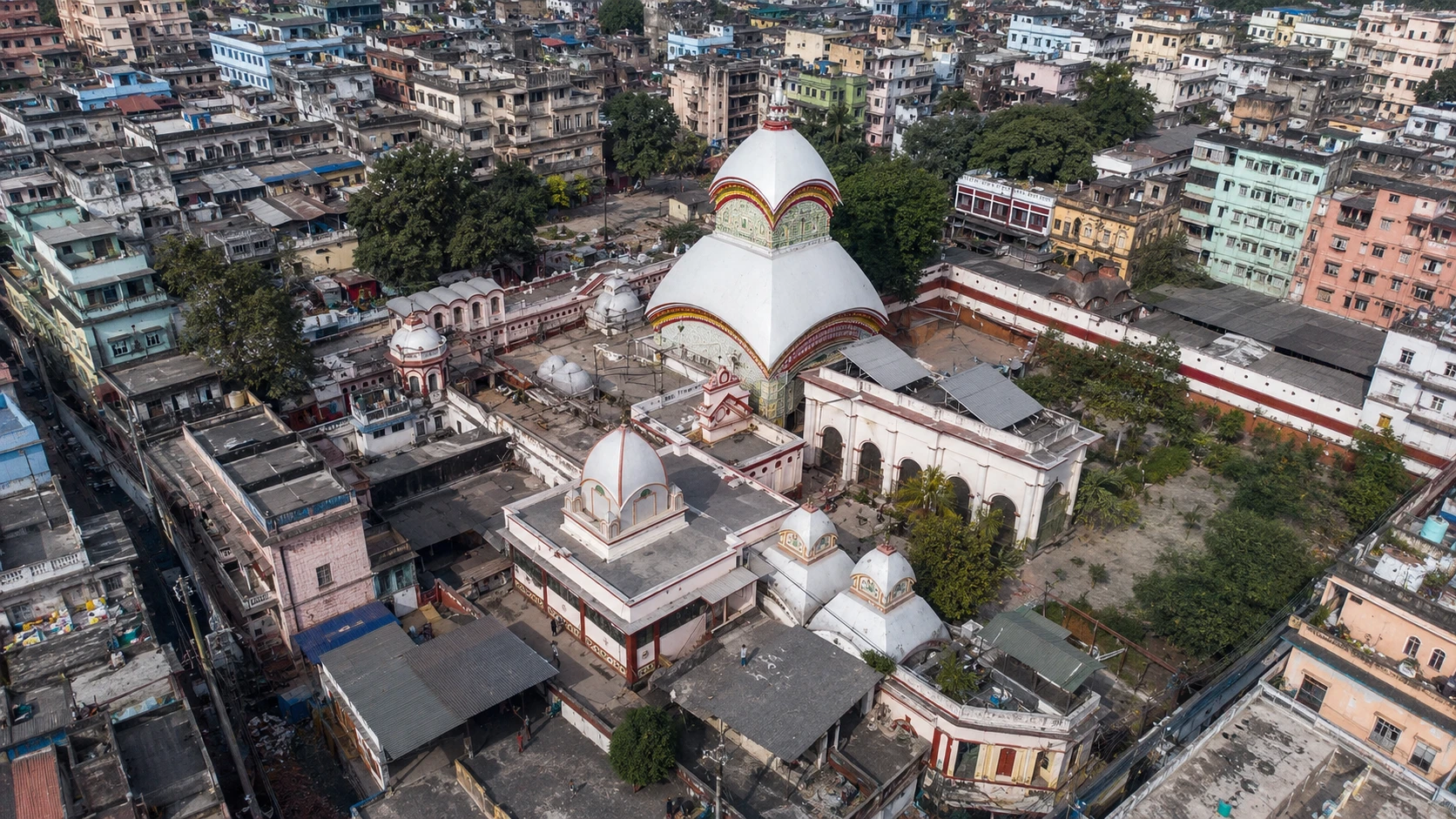
The temple structure itself is a leading surviving example of Bengal's Atchala (eight-roofed) architecture. The shrine sits beneath an eight-faceted curvilinear roof typical of medieval Bengali temple-building, executed in brick and lime mortar with terracotta detailing on the outer walls.
The central garbhagriha is enclosed by an outer mandapa; surrounding the main shrine within the temple complex are the Nat-Mandir (assembly hall for bhajan and kirtan), the Hari-Sabha (devotional hall), the Sosthi Tala (a separate shrine area for child-blessing rituals), the Kundupukur (a ritual bathing tank that today preserves a symbolic reference to the historic Adi Ganga riverbank), and the small Nakuleshwara shrine where Kali's paired Bhairava is worshipped.
Distinctive Practicesविशिष्ट परंपराएँ
Bali Prathā, Shakta animal offering
बलि प्रथा, शाक्त पशु-अर्पण
Daily on a small scale; large-scale during Kali Puja (Kartik Amavasya), Durga Puja (Mahashtami and Mahanavami nights), Phalaharini Kali Puja, and on Saturdays and Tuesdays in some traditions
Kalighat is one of a small number of major Hindu temples in India where animal sacrifice continues openly as an established Shakta-Tantric ritual. The principal offering today is the male goat; buffalo sacrifice was discontinued in stages through the late 20th century, and birds (pigeons, ducks) are no longer common. The bali is performed in a designated outer courtyard by traditional officiants, never inside the inner sanctum. Devotees offering bali typically do so in fulfillment of a manat (vow), for a child, a cure, success in an endeavor, or release from a chronic affliction. The meat is subsequently consumed; portions are distributed and the remainder taken home by the devotee's family.
Shakta theology, as articulated in the Kalika Purana, Yogini Tantra, and the Bengali tantric tradition, holds that Kali is also the goddess of blood, of dissolution, of the return of life to its source. The Kalika Purana's 'Rudhiradhyaya' chapter codifies which animals may be offered, in what manner, and with which mantras. Modern Hindu reformist traditions oppose bali on ethical grounds and the practice has narrowed considerably since the early 20th century; nineteenth-century reformers including Rammohun Roy were among the earliest critics. Eternal Raga documents the tradition without endorsement or condemnation. Lay devotees observe; the rite is performed by initiated officiants only.
Sosthi Tala, the child-blessing tradition
सोष्ठी ताला, बाल-आशीर्वाद परंपरा
Year-round; particularly active on Saturdays and during festival seasons; the day after Sosthi-vrat (sixth of every lunar fortnight) draws specific devotees
Within the Kalighat complex, a few minutes' walk from the main shrine, sits the Sosthi Tala, a separate shrine area dedicated to Sosthi-Mata, the regional folk goddess of children, fertility, and maternal protection. Mothers and grandmothers bring infants and young children here for blessings; expecting mothers come for safe delivery vows; women without children come to make manats (vows) for conception. The shrine is identifiable by its small, ancient banyan tree, around which red threads are tied, one thread per fulfilled or pending vow. The Sosthi tradition is older than Kalighat's Sanskritic formalization and reflects the temple's deep roots in Bengali folk Shakta practice; Sosthi-Mata is widely understood as a regional manifestation of the same Adi Shakti whose primary form is the Kalika of the inner sanctum.
The Sosthi Tala folds Kalighat's terrible-mother iconography back into its underlying maternal essence. Where the Kalika of the inner sanctum holds sword and severed head, the Sosthi of the outer shrine holds infants and grants fertility. Bengali Shakta tradition does not treat these as separate deities but as a single goddess turning her two faces, the fierce face that destroys what must die, and the gentle face that grants what must live. A pilgrimage to Kalighat is, in its full form, a darshan of both faces.
Bhog Prasad, including fish, the Shakta non-vegetarian offering
भोग प्रसाद, मछली सहित, शाक्त मांसाहारी अर्पण
Daily cooked offerings; primary mahaprasad distribution during major festivals (Kali Puja, Durga Puja); fish-bhog particularly on Saturdays
Kalighat is among the few major Hindu temples where the daily bhog offered to the deity and distributed to pilgrims as prasad includes fish, alongside the more universal cooked rice (annabhog), pulao or khichuri, dal, vegetables, and Bengali sweets (mishti). The fish, typically rohu or hilsa, is prepared according to traditional Shakta culinary specification: cooked simply with mustard oil and turmeric, never with onion or garlic (which are tamasic exclusions), and offered to the goddess before being distributed. This is unusual among temple bhog traditions in India, most of which are strictly vegetarian, and reflects the distinctive Bengali Shakta theological position that fish, drawn from Ganga waters, is among the goddess's natural foods rather than a polluting substance.
Bengali Shakta tradition rejects the pan-Indian temple convention that all prasad must be strictly vegetarian. The reasoning is theological: Kali in her cremation-ground aspect transcends categories of pure and impure that govern ordinary worldly food. What sustains the body of the goddess's devotee can be offered to her; what she receives in offering she returns as blessing. Fish, fundamental to Bengali life and the Hooghly delta, therefore belongs at her altar. The exclusion of onion and garlic preserves the sattvic standard within this expanded category; the broader principle is that the goddess accepts the regional honest food of her people. The non-vegetarian bhog tradition at Kalighat is documented in Kavikankan's 'Chandi-Mangal' and other 16th-century Bengali sources.
Did You Know?क्या आप जानते हैं?
Kalighat's deity image is the only major Kali murti in India that is a face alone, no carved body, no sculpted torso. Cut from black touchstone, the face presents three almond-shaped eyes and a long protruding gold tongue; four separate gold arms are appended to the surrounding silver frame to hold her terrible attributes. Every other major Kali temple in India, Dakshineswar, Tarapith, Kamakhya's Kali subsidiary, uses an anthropomorphic figure of some kind. Kalighat alone reduces the goddess to face, glance, and four reaching arms emerging from the dark.
Field documentation; David Kinsley, 'Tantric Visions of the Divine Feminine' (1997); Rachel Fell McDermott, 'Mother of My Heart, Daughter of My Dreams' (2001)
Kalighat gave its name to Kolkata. The village whose name was anglicized to 'Calcutta' (and later restored as 'Kolkata' in 2001) was originally called Kalikata, a name derived from 'Kalikshetra' (the field of Kali) or 'Kalighat' (the ghat of Kali). The entire city, in its colonial and post-colonial forms, takes its name from the temple. Few major world cities are so directly named after a single religious site.
S.W. Goode, 'Municipal Calcutta' (1916); H.E.A. Cotton, 'Calcutta Old and New' (1907); Government of West Bengal notifications on city renaming (2001)
The Kalighat school of painting, among the most internationally recognized South Asian folk art traditions, was born around the temple. From the early 19th century, itinerant Patua painters set up around Kalighat's approach roads to sell quick devotional images to pilgrims: Kali, Durga, Lakshmi, and increasingly satirical scenes of colonial Calcutta. The bold, fluid Kalighat Pat style went on to be collected by the Victoria and Albert Museum in London, the Museum of Modern Art in New York, and major Indian museums; some scholars argue it was a direct influence on early modernist Indian art. The temple's vendor stalls today still preserve descendants of the tradition.
Victoria and Albert Museum collection records; Jyotindra Jain, 'Kalighat Painting: Images from a Changing World' (Mapin, 1999); B.N. Mukherjee, 'Kalighat Paintings' (Lalit Kala Akademi, 1989)
The Adi Ganga, the river on whose bank Kalighat originally stood, has substantially silted over the past two centuries. Once a major distributary of the Hooghly carrying river traffic into Bengal's interior, the Adi Ganga is today reduced to a narrow, polluted canal running past the temple. The Kundupukur tank within the temple complex preserves a ritual symbolic reference to the goddess's riverbank seat; it is still used for ritual bathing by devotees who once would have bathed in the river itself. The silting of the Adi Ganga is one of the most documented examples of colonial-era hydrological change in the Gangetic delta.
Kalyan Rudra, 'The Encroaching Ganga and Social Conflicts: The Case of West Bengal, India' (Indian Statistical Institute, multiple editions); Indian National Trust for Art and Cultural Heritage (INTACH), Adi Ganga restoration reports
The Sabarna Roy Choudhury family has held hereditary Sebait (worshipper-trustee) rights at Kalighat in unbroken succession since c. 1608, when the family's founding ancestor Lakshmikanta Gangopadhyay received Mughal-era zamindari over the region from Emperor Jahangir. This continuous Sebait succession across more than sixteen generations and over four centuries, through Mughal, British, and Indian-republican periods, is among the longest unbroken religious-administrative successions at any major Indian temple. The family's archives at the Sabarna Sangrahalaya in Barisha preserve documentary records of this lineage.
Pranatosh Chowdhury, 'Sabarna Roy Choudhury Paribarer Itihas' (Bengali, family history); Sabarna Sangrahalaya archival records, Barisha; family lineage charts published by Sabarna Roy Choudhury Paribar Parishad
Visitor Accessप्रवेश जानकारी
Kalighat is open to all visitors regardless of gender, caste, or background. There is no menstrual restriction on women entering the temple. Photography is prohibited inside the inner sanctum (garbhagriha) and at certain inner mandapa points; phones and cameras must be deposited or pocketed before entering. Footwear is removed at the temple's prescribed outer boundary. The bali (animal sacrifice) courtyard is in a designated outer area; visitors uncomfortable with this tradition can route their visit away from this section, especially on major festival days. Hawkers and unofficial guides ('pandas' and ticket-touts) operate aggressively around the temple's approach roads and have a long-standing reputation for overcharging tourists and unfamiliar pilgrims, visitors should engage only with the official temple counter and recognized Sabarna Roy Choudhury Sebaits for ritual arrangements.
Sparsha darshan involves a short stay inside a small, dim, crowded chamber; pilgrims with claustrophobia or sensitivity to crowds and incense smoke should pace themselves. The temple permits a separate priority queue (Sheegra Darshan) for an additional fee, payable at the official temple counter, never to roadside touts. Photography is permitted in the outer courtyards but strictly prohibited at the inner sanctum, the Sosthi Tala, and certain other shrine points marked by signage. The approach roads to the temple are densely lined with vendor stalls and aggressive touts; first-time visitors are strongly advised to read the temple's official guidance posted at the entrance and to refuse any 'special darshan' offer made outside the temple grounds.
Festivalsत्योहार
Kali Puja / Deepavali
काली पूजा / दीपावली
Oct-Nov (Kartik Amavasya)
Kali Puja is Kalighat's most important festival and the temple's spiritual high-tide. On the new-moon night of Kartik, when much of western and northern India celebrates Lakshmi at Deepavali, Bengal honors Kali, and Kalighat becomes the city's spiritual center for a 36-hour window. The image is bathed, anointed, freshly garlanded with thousands of red hibiscus, dressed in new red silks, and offered grand bhog (including fish prepared in the Shakta culinary specification). Animal sacrifice (goats only since the late 20th century) is performed in the outer courtyard. The temple remains open through the night, with continuous chanting and music in the Nat-Mandir. Pilgrim numbers exceed half a million across the festival window.
Durga Puja
दुर्गा पूजा
Sep-Oct (Ashwin Shukla Saptami to Dashami)
Durga Puja, Bengal's signature festival, sees Kalighat at the heart of the city's celebrations. While the great Durga pandals erected across Kolkata are the festival's public face, devotees consistently begin and end Durga Puja journeys at Kalighat, for Mahalaya pre-dawn darshan, for Saptami morning's formal opening, for Bali rituals on Mahashtami and Mahanavami, and for Vijayadashami farewell. The temple itself does not host a Durga pandal (it is the Kali temple), but the goddess of the inner sanctum is understood as the same Adi Shakti whose Durga form is celebrated in the pandals.
Snan Yatra
स्नान यात्रा
Jun (Jyestha Purnima)
On the full-moon day of Jyestha, when the goddess is given a ritual bath, Kalighat observes Snan Yatra. The image is bathed with 108 pots of water drawn from the Kundupukur tank (historically, from the Adi Ganga), anointed with sandalwood, and adorned afresh. The ritual mirrors the better-known Snan Yatra observed at the Jagannath Puri temple a fortnight earlier and reflects a shared eastern Indian devotional grammar around bathing the deity during the heat of pre-monsoon summer. Devotees attending Snan Yatra at Kalighat traditionally consume only fruits (phalahar) that day.
Phalaharini Kali Puja
फलहारिणी काली पूजा
May-Jun (Jyestha Krishna Amavasya)
On the new-moon night of the dark fortnight of Jyestha, devotees observe Phalaharini Kali Puja, 'the Kali who consumes the fruits of karma'. The festival emphasizes the goddess's role in dissolving accumulated negative karma; devotees offer fruits, particularly seasonal mangoes and jackfruit, alongside the standard hibiscus and red cloth. Phalaharini Kali Puja carries particular weight in modern Bengali Shakta memory through Ramakrishna Paramahamsa's worship of his consort Sarada Devi as the embodied Shodashi-Kali at Dakshineswar on this day in 1872; the date is observed at Kalighat with parallel reverence.
Traditional Offeringsपारंपरिक अर्पण
प्राथमिक अर्पण
Red Hibiscus (Joba)
लाल जबा (गुड़हल)
जपाकुसुम
The red hibiscus, joba in Bengali, is Kali's most iconic flower and the single most important offering at Kalighat. The flower's crimson matches the red cloth, the sindoor, and the cremation-ground theology that situates Kali among the colors of blood and fire. The Brihat Nila Tantra and the Karpuradi Stotra both specifically name japa (hibiscus) as the goddess's preferred flower; the Tantric texts go further and call any Kali worship without hibiscus 'incomplete'. At Kalighat, every devotee carries a small string of hibiscus at minimum, and the temple's flower vendors at the gates measure their day in hibiscus garlands.
Red Saree / Lal Cloth
लाल साड़ी / लाल वस्त्र
रक्ताम्बर
Red cloth offered to the goddess is among the most powerful Shakta votive gestures. Devotees bring a new saree, a length of red silk, or a bolt of red cotton, to be draped over the deity image as part of her daily adornment. The Kalighat Sebaits accept these cloths, rotate them through the sanctum across multiple devotees, and the cloths that have touched the goddess are later returned as Devi-prasad. Bengali brides traditionally offer a saree at Kalighat in the morning of their wedding day, a custom that remains widespread in 21st-century Kolkata.
Sindoor (Vermilion)
सिंदूर
सिन्दूर
Sindoor offered to Kali is applied to her forehead, then a portion is returned to devotees, for women devotees, applying Kalighat's sindoor in the central parting of the hair is a particularly important Bengali blessing for marital harmony and household protection. The red of sindoor links the goddess's terrible aspect to her maternal-protective one; what looks like blood on the lips of the dark mother is also what blesses the head of her married devotee. Bengali married women include a Kalighat sindoor visit as part of important household rituals.
Coconut (Narikela)
नारियल
नारिकेल
Whole coconut with husk and water intact is offered to the goddess and ritually broken by the Sebait. In Shakta symbolism the coconut is the ego (ahamkara), hard outer shell of the false self that must be broken open through devotion, releasing the inner sweetness and purified water as offering to the goddess. Coconut offered at Kalighat is partly retained by the temple kitchen for use in bhog preparation, partly returned to the devotee as prasad.
Ghee Diya (Lamp)
घी का दीया
घृत-दीप
Lamps lit with clarified butter are offered at every aarti and by individual devotees seeking specific blessings. The deep amber flame of a ghee diya in the dim garbhagriha is one of the defining sensory memories of Kalighat darshan, the goddess's face and four golden arms are most often seen by the unsteady light of these flames rather than electric lighting. Devotees often light a diya before requesting a specific manat or making a particular prayer.
Bengali Mishti (Sweets)
बंगाली मिष्टि (मिठाइयाँ)
मिष्टान्न
Bengali traditional sweets, sandesh (cottage-cheese fudge), rasogolla, kalo-jam, pantua, mihidana, are offered to the goddess by devotees and used in the temple's daily bhog. The sweets are typically prepared without onion or garlic (preserving the sattvic standard) and use chhana (fresh cheese), milk, sugar, and seasonal fruits. Mishti at Kalighat connects the temple's spiritual life to the broader Bengali culinary tradition; the sweets reflecting the goddess's regional palate.
इस मंदिर की विशेषता
Macher Bhog, Fish Prasad
माछेर भोग, मछली प्रसाद
Among the most distinctive of Kalighat's offerings is the fish bhog, cooked rohu or hilsa prepared in Shakta culinary specification (mustard oil, turmeric, no onion or garlic), offered to the goddess, then distributed to assembled devotees as mahaprasad. This is uncommon among major Hindu temples in India, most of which keep prasad strictly vegetarian. At Kalighat, the fish bhog reflects the deep theological position of Bengali Shakta tradition: Kali in her cremation-ground transcendence accepts the regional, honest food of her people, and what she has received in offering she returns as blessing. The fish prasad is particularly central to Saturday darshans and to Kali Puja distribution.
Devi-prasad Joba, Hibiscus Returned from the Goddess
देवी-प्रसाद जबा, देवी से लौटाया गुड़हल
Hibiscus garlands that have rested on the deity image, that have touched her forehead, her tongue, the gold of her arms, are removed after a brief offering period and returned to devotees as Devi-prasad joba. This is among the most prized prasad at Kalighat, particularly for Bengali Shakta households who keep a piece of the goddess's hibiscus in the home shrine. The flower retains its color and fragrance for a few days, after which it is composted with reverence rather than discarded. Devotees making manats often promise to return with hibiscus offerings if their prayers are fulfilled, completing a circulation of flower-as-vow.
Hibiscus, red cloth, sindoor, coconut, and mishti can be brought from outside or purchased at vendor stalls along the temple's approach roads. The Kalighat Temple Committee operates an official offering counter inside the complex; offerings purchased there are pre-arranged in traditional thalis for direct presentation to the Sebait. Outside vendors near the temple gates have a long-standing reputation for aggressive pricing, visitors should know typical rates before purchase. Animal offerings (bali) are organized only on specific festival days and require advance arrangement through the official temple committee or recognized Sabarna Roy Choudhury Sebaits; this is a Shakta-Tantric ritual and is not undertaken casually.
How to Reachकैसे पहुँचें
Kalighat is one of the most accessible major temples in India, direct metro access places it within a 30-minute reach of any point in central Kolkata. By metro, Kalighat Station (Kolkata Metro Blue Line) sits 300 m from the temple gates and offers the fastest, simplest, and most reliable route from across the city.
By air, Netaji Subhas Chandra Bose International Airport (CCU) is 18 km north; a pre-paid taxi or app-based cab takes 45, 75 minutes depending on traffic, or one can take the metro from Dum Dum station after a short connecting cab ride.
By rail, Sealdah Station is 7 km away and Howrah Junction is 11 km across the Hooghly; either is well-connected to the temple by metro (via interchange) or by direct cab. Local Kolkata transport, yellow taxis, app-based cabs, auto-rickshaws, and city buses, connects the temple area to every part of the city.
The approach roads to the temple gates are pedestrian-heavy and narrow; visitors should expect to walk the final 200, 300 m on foot from any drop-off point.
Plan Your Visitयात्रा की योजना
🌤 सर्वोत्तम मौसम
October to March is the most comfortable period, temperatures range from 12, 27°C, humidity is low for Kolkata, and the autumn-winter festival calendar (Durga Puja, Kali Puja, Phalaharini) makes the temple atmospherically rich. Avoid the peak monsoon (June, September): Kolkata receives heavy rain, temple approach roads flood, and the pilgrim experience suffers. April, May is humid and uncomfortable. Sundays, festival days, and the Navaratri-Kali Puja period bring extreme crowding; first-time visitors prioritizing unhurried darshan should choose a weekday in November, February.
👘 पहनावे का नियम
Modest, traditional attire is expected. For men: dhoti and shirt, or full-length trousers with a shirt or kurta; sleeveless garments are discouraged. For women: saree, salwar-kameez, or long skirt with covered shoulders; Bengali women traditionally wear saree for Kalighat darshan, with red and white the canonical Shakta colors. Leather items (belts, wallets, watches with leather straps) should be removed before approaching the inner sanctum. Footwear is removed at the prescribed outer boundary of the temple.
📱 फोन और फोटोग्राफी
Photography and videography are strictly prohibited inside the inner sanctum (garbhagriha), at the Sosthi Tala, at the Nakuleshwara shrine's inner area, and on the staircase approaches to the main image. Phones, cameras, and recording devices must either be deposited at the official temple counter or pocketed and silent before entering. Photography is permitted in the outer courtyards, the Nat-Mandir, the Hari-Sabha hall, and at the Kundupukur tank, except where signage indicates otherwise. During Kali Puja and Durga Puja, additional restrictions may be enforced; follow on-site guidance from the temple staff and West Bengal Police personnel.
🏨 आवास
The Kalighat Temple Committee does not operate a dedicated pilgrim guest house; given the temple's central Kolkata location, devotees almost universally lodge in Kolkata's broader hotel ecosystem rather than at the temple itself. Hotels across all budget ranges, from heritage properties in Park Street and Esplanade to mid-range business hotels in Ballygunge and Gariahat to budget options near Sealdah, are within 15, 45 minutes of Kalighat. The Maharaja Chowdhury family-run heritage hotels and the West Bengal Tourism Development Corporation properties offer recognizable, well-rated options. Booking through verified channels (hotel websites or established online travel platforms) avoids the touts who congregate around the temple area. During Kali Puja and Durga Puja, Kolkata hotels approach saturation; book at least one month in advance for these festival windows.
Sacred Soundsपवित्र ध्वनि
Mahishasura Mardini Stotram (Ayi Giri Nandini, attributed to Adi Shankara)
stotram · 540
Karpuradi Stotra, Hymn to Dakshina Kalika (Mahakala-Samhita)
stotram · 660
Adyastotra (Adyakali Hymn, Brihat Nila Tantra)
stotram · 420
Shyama Sangeet, selected Ramprasadi padavali (Ramprasad Sen, 18th c.)
bhajan · 1500
Devi Kavacham (from Durga Saptashati)
kavacham · 600
क्या आप जानते हैं? · Did You Know?
वही अनुवाद त्रुटि जिसने हिन्दू धर्म में '33 कोटि' को '33 करोड़' बनाया, बौद्ध धर्म में भी हुई। बौद्ध ग्रन्थों के चीनी अनुवाद ने 'सप्त कोटि बुद्ध' (7 श्रेष्ठ बुद्ध) का अनुवाद '7 करोड़ बुद्ध' कर दिया। तिब्बती अनुवाद ने सही किया: 7 प्रकार, 7 करोड़ नहीं। एक संस्कृत शब्द, दो प्रमुख विश्व धर्मों में गलत पढ़ा गया, ने दो एकसमान भ्रम स्वतन्त्र रूप से उत्पन्न किए।
Related Contentसंबंधित सामग्री
Related Scriptures
Community Reflections
🕉️
Be the first to share your reflection.