Jwala Devi
ज्वाला देवी
The Devī who appears as flame
Jwalamukhi, Himachal Pradesh, India
JvālāmukhīAlso known as: Jwala Ji, Jwalamukhi Devi, Jvālā-jihvā, Siddhidā, Jota Wali Mata, Flaming Mouth Goddess
युग
Pre-medieval flame-shrine; canonical Pīṭha attestation by 9th, 12th c.; current structure largely 19th c. with later renovations
वास्तुकला
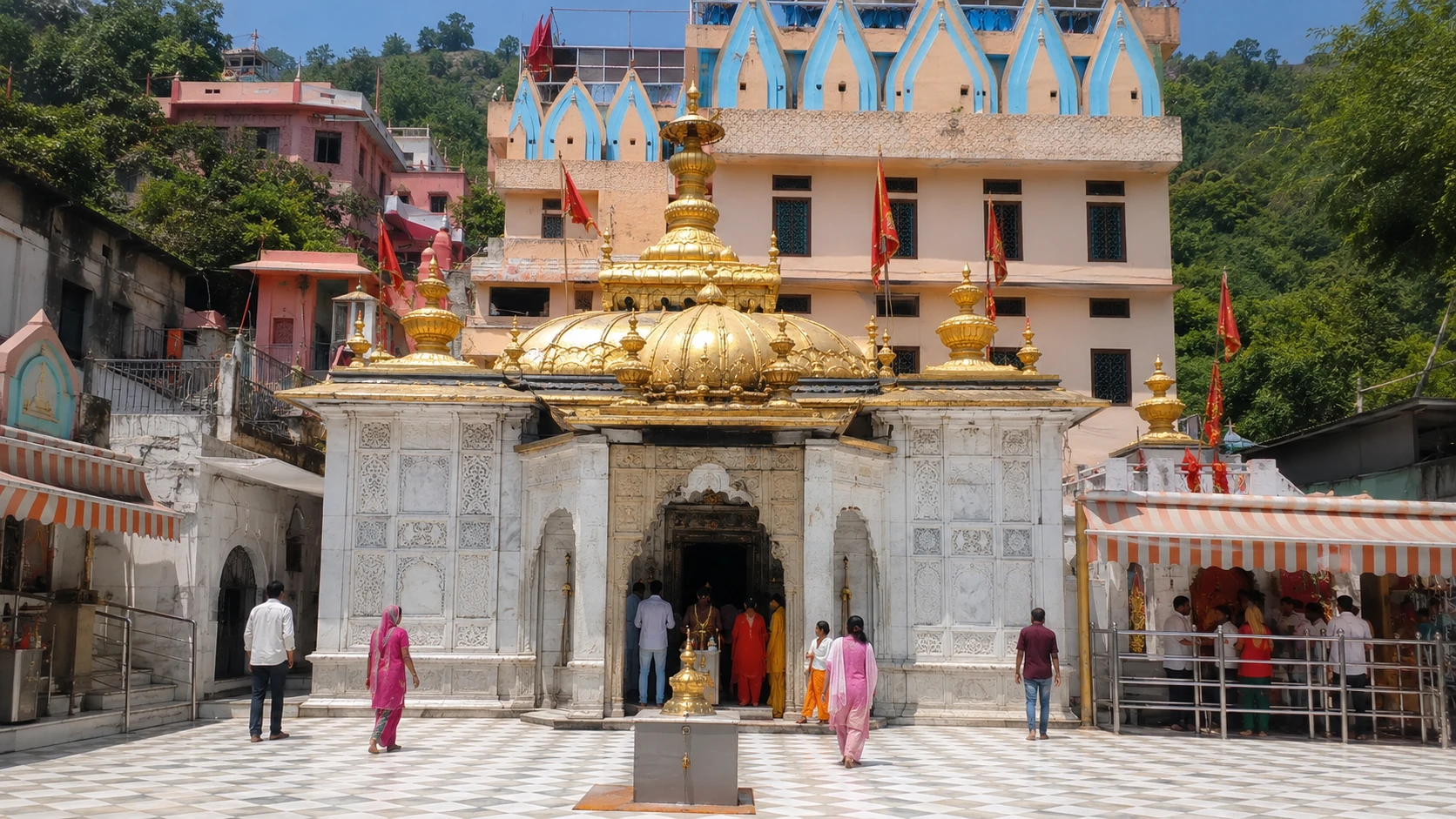
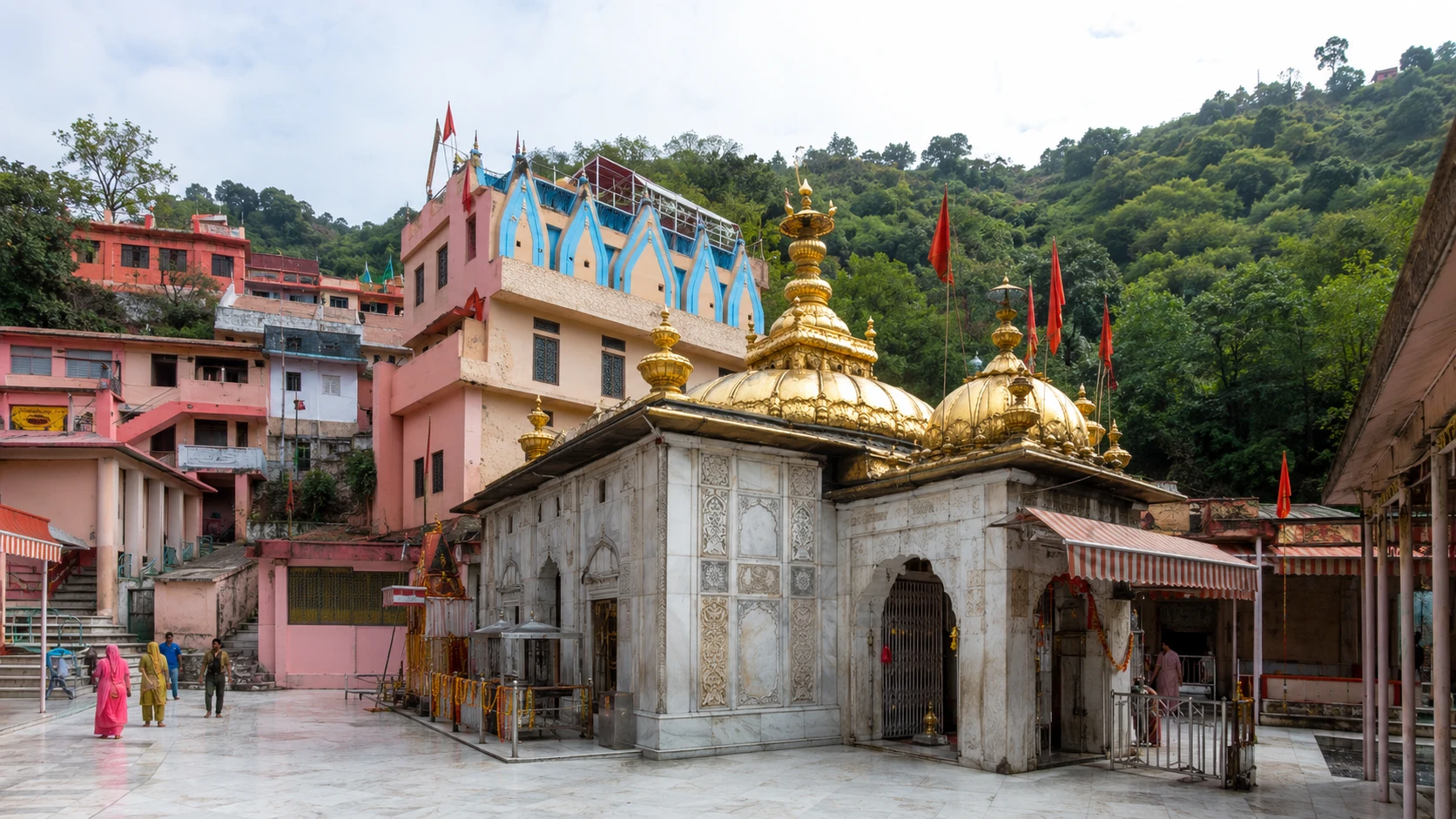
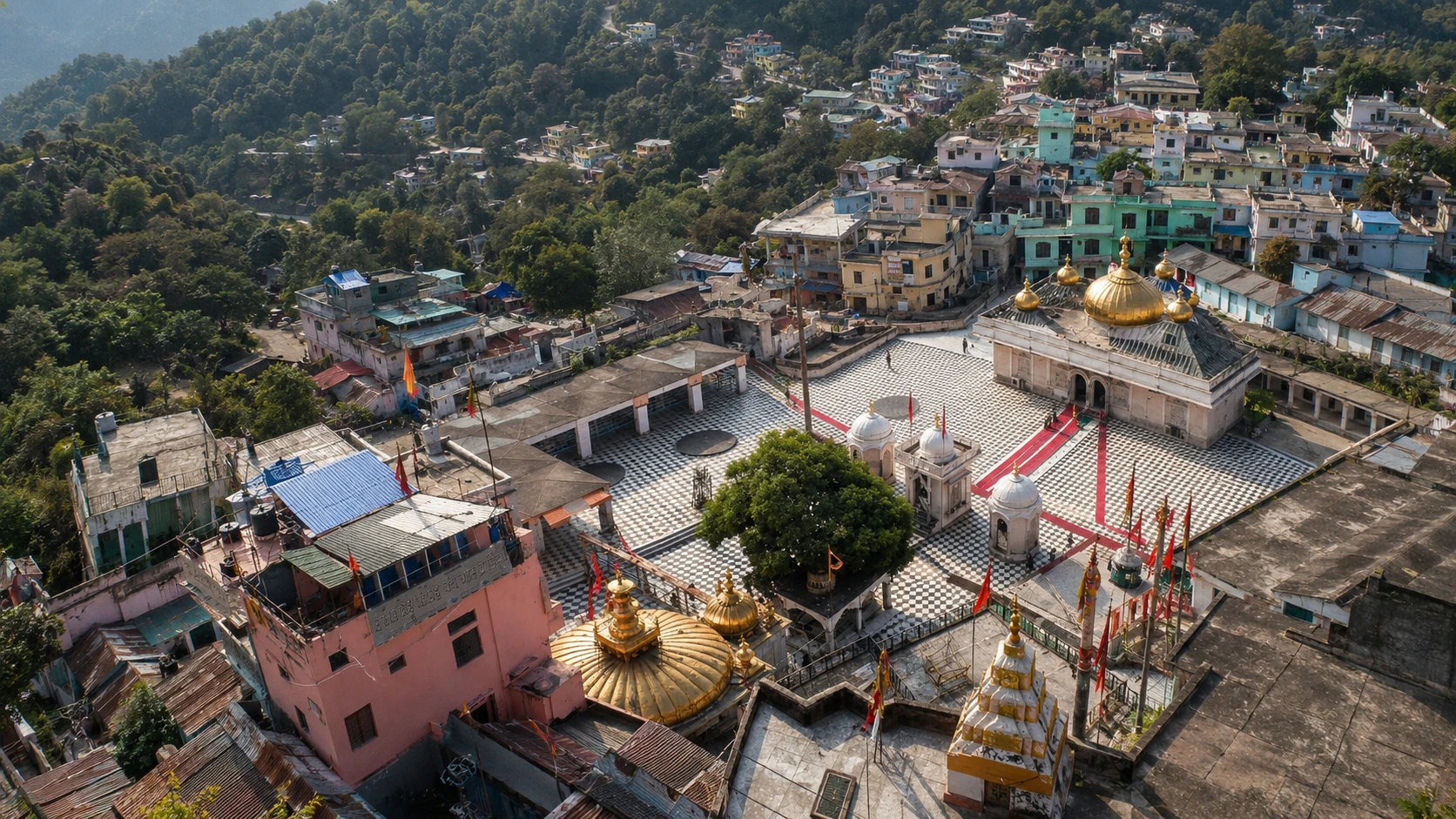
Pahari-Sikh composite; gilded shikhara (Ranjit Singh patronage, c. 1815) over a flame-sanctum without a murti
खुला
05:00 – 21:30
आरती
05:00 · 11:30 · 12:30 · 19:00 · 21:00
विशेष
Five daily aartis are performed around the flame-fissures rather than around a murti; the Shayan (final) aarti is conducted before the sanctum is closed for the night, with the flames left burning
पवित्र कथा · पवित्र कथा
At Jwalamukhi the Devī is not a murti. She is fire, nine perpetual blue flames rising directly from fissures in the rock, sustained by no fuel that any pilgrim or geologist has ever placed there. When Satī's body was carried by Shiva in his grief-walk across the world, and Vishnu's discus cut it apart to release him, her tongue is said to have fallen here in the Kangra hills. The flame is what remained. For more than a thousand years the shrine has stayed lit. Akbar tried to extinguish it and could not; he sent a golden parasol in apology, and tradition says the gold turned to baser metal in the Devī's presence. Ranjit Singh gilded the dome. The earth shook in 1905 and the flames burned on. Jwalamukhī is the rarest of the Shakti Pīṭhas, a temple where the deity is not depicted, only encountered.
Sacred Designationपवित्र पदनाम
Shakti Peeth
शरीर का अंग: Tongue
शक्ति: Jvālāmukhī (also enumerated as Siddhidā in some recensions)
भैरव: Unmatta Bhairava
Sacred Origin Storyपवित्र उत्पत्ति कथा
Source: Devī Bhāgavata Purāṇa, Skandha VII (51-Pīṭha enumeration); Kālikā Purāṇa, Chapters 18 and 60, 62 (52-list tradition); Ashtadasha Shakti Pīṭha Stotram attributed to Ādi Śaṅkara
Dakṣa Prajāpati, father of Satī and patriarch of the gods, performed a great yajña and to it invited all the divine beings, except Śiva, whom he despised for his ash-smeared austerity and his refusal of decorum. Satī, hearing of the yajña, went to her father's house uninvited. There Dakṣa heaped insult upon her husband in her presence.
Satī, unable to bear the desecration of her lord, walked into the sacrificial fire and gave up her body. When Śiva learned what had happened, his grief broke open the world. He took up Satī's burnt body upon his shoulder and walked across the earth in a tāṇḍava of mourning, and wherever his foot fell the ground shook. The cosmos itself began to come undone.
To release Śiva from this grief and restore the order of the worlds, Viṣṇu followed and, with his Sudarśana Cakra, cut the body of Satī piece by piece. Where each piece touched the earth, a Pīṭha rose, a place forever consecrated by the Devī's presence in her own physical form. At this place in the lower Dhauladhar foothills, Satī's tongue is said to have fallen.
The earth opened, and from the rock came forth nine flames that have never been extinguished. They are not symbolic of the Devī. They are the Devī. The Pīṭhanirṇaya names the goddess here as Jvālāmukhī, She whose mouth is flame, and her consort-form of Śiva as Unmatta Bhairava.
The Ashtadasha Shakti Pīṭha Stotram of Śaṅkarācārya, which enumerates the eighteen great Shakti shrines, names Her in the canonical sequence: Jvālāyāṁ tu Jvālāmukhī, at Jvālā, Jvālāmukhī.
उद्धृत स्रोत:
- Devī Bhāgavata Purāṇa, Skandha VII (canonical 51-Pīṭha enumeration tradition)
- Kālikā Purāṇa, Chapters 18 and 60, 62 (52-list tradition; tongue body-part attribution at this site)
- Pīṭhanirṇaya (Tantric pīṭha-enumeration treatise; Devī-Bhairava pairing)
- Ashtadasha Shakti Pīṭha Stotram attributed to Ādi Śaṅkarācārya (8th c. CE; Jvālāyāṁ tu Jvālāmukhī)
- Bṛhannīla Tantra (Shākta cosmography of the Pīṭha network)
अन्य परंपराएँ · अन्य परंपराएँ
Pahari folk tradition (Pre-Sanskritic local Devī worship layer)
A widely-told regional account holds that the flame predates the Satī narrative entirely, that the natural gas-seepage at this site was venerated as a manifestation of the Devī by hill peoples long before the Pīṭha tradition arrived from the plains.
The Sanskritic Sati story was subsequently overlaid upon a far older flame-cult, integrating an indigenous Himachal Devī shrine into the pan-Indian Shakti network. This view is not in tension with the Pīṭha account devotionally, both traditions hold that the flame is the Devī, but it locates the shrine's origin in deep local antiquity rather than in a single Puranic event.
Pahari oral / Mahābhārata-Pandava attribution legend
A regional oral tradition, widely circulated in pilgrimage pamphlets and local guidebooks, holds that the flame was discovered by a cowherd who noticed that one of his cows always yielded its milk at a particular spot in the forest. The villagers dug at the place and found the flame burning beneath the rock.
The Pāṇḍavas, during their exile, are said to have come to this spot and established the original shrine. While the cowherd-discovery motif is a recurring local narrative pattern across many Himachal Devī sites, and the Pāṇḍava-attribution is not textually attested in the Mahābhārata itself, this account is significant as the dominant folk-narrative carried orally and in vernacular Pahari devotional literature.
विद्वत संदर्भ
Modern scholarship treats Jwalamukhi as a paradigm case of Sanskritic-vernacular convergence in Himachal Devī tradition. Kathleen Erndl ('Victory to the Mother', 1993) argues that the Kangra Devī cluster, Jwalamukhi, Brajeshwari, Chamunda, Naina Devi, Chintpurni, represents a regional Devī network with deep pre-Sanskritic roots, subsequently integrated into the pan-Indian Shakti Pīṭha framework through the 51/52-list traditions and the Ashtadasha Stotram. William Sax ('Mountain Goddess', 1991) places the broader Himalayan Devī tradition in a longue durée framework where local mountain goddesses are continuously re-narrated within Puranic categories without losing their indigenous character. Diana Eck ('India: A Sacred Geography', 2012) treats Jwalamukhi specifically as evidence that Indian sacred geography integrates natural phenomena, perpetual flames, hot springs, river-sources, mountain peaks, directly into the divine, rather than treating them as metaphors for the divine. The Jwalamukhi flame is, in this framework, not a symbol of the Devī's presence; it is her presence.
Historyइतिहास
The flame at Jwalamukhi is older than its documentation. Geologically, the perpetual flames issue from natural gas seepage along a fault-line fissure in the Siwalik foothills, a phenomenon that almost certainly predates any historical record.
Canonical attestation in the Devī Bhāgavata, Kālikā Purāṇa and Ashtadasha Stotram traditions formalizes the site within the pan-Indian Pīṭha network by the 9th, 12th centuries CE, though the local cult is almost certainly older.
The shrine's medieval institutional life was sustained under the Katoch Rajput dynasty of Kangra, whose patronage of the Pahari Devī shrines is well attested in regional chronicles. The Mughal-era encounter is the most documented chapter: Akbar visited the shrine in 1581 during his Kabul campaign (the Ain-i-Akbari mentions the visit and his veneration of the goddess), and tradition holds that he attempted to extinguish the flame and, having failed, offered a golden chhatra (parasol) which is said to have turned to a baser metal upon being placed before the Devī, a story devotionally meaningful and chronicled in local tradition though not in the Ain-i-Akbari itself.
The Sikh patronage under Maharaja Ranjit Singh in the early 19th century is the most architecturally consequential: around 1815 he donated the gold for the gilded shikhara that gives the temple its distinctive appearance, and silver-plated folding doors are also attributed to Sikh-period donation.
The Kangra earthquake of 1905, one of the most destructive seismic events in Himachal history, with documented widespread damage to temples and forts throughout the region, caused structural damage at Jwalamukhi but, devotionally significantly, the flames continued to burn.
Post-Independence, the shrine has been administered by the Mata Jwala Ji Temple Trust under Himachal Pradesh state government oversight, with substantial pilgrim infrastructure development in the late 20th and early 21st centuries. The shrine today receives a steady stream of pilgrims year-round and is the most-visited stop on the canonical Himachal Devī yatra circuit.
Historical Timelineऐतिहासिक कालक्रम
Canonical formalization of Jwalamukhi within the pan-Indian Shakti Pīṭha network through textualization in the Devī Bhāgavata Purāṇa (Skandha VII) and Kālikā Purāṇa (Chapters 18, 60, 62), and through the Ashtadasha Shakti Pīṭha Stotram tradition attributed to Ādi Śaṅkara (8th c. CE, with later textual recensions). The Stotram names the site explicitly in its eighteen-shrine sequence: Jvālāyāṁ tu Jvālāmukhī. The local flame-cult is almost certainly far older than this textual horizon.
Date range reflects the textualization horizon of the relevant Puranic strata as established in modern scholarship; the underlying flame-cult is widely held by scholars (Erndl 1993; Sax 1991) to predate this attestation by an undetermined period.
Sustained institutional patronage under the Katoch Rajput dynasty of Kangra, the long-ruling Rajput house that controlled the Kangra valley and its Devī-shrine network through the medieval period. The Katoch rulers' patronage of Jwalamukhi, Brajeshwari and the wider Pahari Devī network is documented in regional Rajput chronicles and reflected in vernacular Pahari devotional literature of the period.
Visit of the Mughal Emperor Akbar to the shrine during his Kabul campaign. The Ain-i-Akbari (Abu'l-Fazl) records the Emperor's veneration of the goddess at Jvālāmukhī. Local tradition holds that Akbar attempted to extinguish the flames by various means including diverting a stream over them, that all such attempts failed, and that he subsequently offered a golden parasol (chhatra) to the Devī in apology, which is said to have turned to a baser metal upon being placed before her, demonstrating the futility of imperial offering before divine presence.
The Ain-i-Akbari attests Akbar's visit and his veneration of the goddess; the golden parasol legend (the gold turning to baser metal) is a local devotional tradition not found in the Mughal chronicles themselves. Eternal Raga reports both, the chronicled visit and the locally-told legend, as distinct strata of the same event. The legend is devotionally significant and an integral part of the shrine's living oral history; it is not presented here as documented imperial fact.
Patronage of Maharaja Ranjit Singh, founder of the Sikh Empire, who donated the gold leaf for the gilding of the shrine's shikhara (sanctum spire) after his consolidation of Kangra into Sikh territory. The gilded dome that gives Jwalamukhi its distinctive visual identity dates substantially from this patronage. Silver-plated folding doors at the sanctum entrance are also attributed to Sikh-period donation. Ranjit Singh's gilding of Jwalamukhi parallels his more famous gilding of the Harmandir Sahib (Golden Temple) at Amritsar, and reflects the Sikh sovereign's pattern of Devī-shrine patronage in the Pahari hill states.
The Kangra earthquake of 4 April 1905, one of the most destructive seismic events in the recorded history of the Indian Himalayan region, with a moment magnitude estimated at approximately 7.8 and an official death toll exceeding 20,000, caused widespread devastation across the Kangra valley including significant damage to temples, forts and habitations. Structural damage at Jwalamukhi was documented, and substantial portions of the shrine complex required subsequent restoration. Devotionally, however, the perpetual flames continued to burn throughout the seismic event and the rebuilding period, a fact that is integral to the shrine's modern devotional self-understanding.
The official death toll of approximately 20,000 reflects contemporary colonial-administrative counting; later seismological reassessments (Ambraseys and Bilham, 2000) accept this order of magnitude. The structural damage to Jwalamukhi is documented in the ASI Punjab Circle reports of the period.
Post-Independence administrative reorganization of the shrine under the Mata Jwala Ji Temple Trust with oversight from the Himachal Pradesh state government following the integration of the former Punjab hill states into independent India. Major pilgrim-infrastructure development through the late 20th and early 21st centuries, improved road access from the Pathankot, Mandi National Highway, expansion of the parikrama path around the sanctum, addition of pilgrim rest-house and prasad-distribution facilities, and installation of crowd-management systems for the Navratri peak-season pilgrim surge. Jwalamukhi today is integrated into the canonical Himachal Devī yatra circuit and receives a year-round flow of pilgrims with the heaviest concentrations during the Chaitra and Ashwin Navratris.
What You'll Seeदर्शन में
There is no murti. The sanctum of Jvālāmukhī is a small, low rock-chamber set into the hillside, and from fissures in the living rock issue nine natural flames, pale blue, near-translucent, of a particular cold-burning quality that distinguishes them visually from any tended fire.
The flames are not constant in size: they rise and fall through the day in patterns the priesthood reads attentively. The chamber is railed off; the pilgrim approaches a low parapet from which the fissures and the flames are visible.
The nine flames are individually named, and each is identified with a major form of the Devī across the pan-Indian Shakti tradition: Mahākālī, Annapūrṇā, Chaṇḍī, Hiṅglāj, Vindhyavāsinī, Mahālakṣmī, Sarasvatī, Ambikā, and Añjanā Devī.
The naming is significant, Jwalamukhi gathers within its sanctum a visible compendium of the wider Devī network, with each flame standing as the local manifestation of a Pīṭha or major form elsewhere in the geography. The shrine's outer architecture is composite Pahari-Sikh: a gilded copper-plated shikhara (the Ranjit Singh donation, c. 1815) surmounting a low sandstone superstructure, with silver-plated folding doors at the sanctum entrance.
The interior walls of the mandapa bear painted devotional images and inscriptions; the immediate flame-sanctum is intentionally undecorated, the rock and the flames are the iconography. Pilgrims do not bring lamps to the Devī; she is the lamp.
Distinctive Practicesविशिष्ट परंपराएँ
Pañca Ārati at the Flame-Sanctum
ज्वाला-गर्भगृह की पञ्च आरती
Daily, 05:00 (Mangala Ārati), 11:30 (Bhog Ārati), 12:30 (Bhog Ārati conclusion), 19:00 (Sandhya Ārati), 21:00 (Shayan Ārati)
Five daily aartis are conducted at Jwalamukhi, and uniquely in the Pīṭha network, all five are performed before the flames themselves rather than before a murti. The priest carries the aarti lamp around the perimeter of the flame-chamber while reciting Devī stutis appropriate to the time of day. Devotees gather along the parapet. The Mangala Ārati at dawn welcomes the Devī; the two midday aartis are coupled with the bhog (food offering); the Sandhya Ārati at dusk honours her in the day-night transition; the Shayan Ārati closes the sanctum for the night with the flames left burning in their natural state. The sanctum is never dark.
The Pañca Ārati structure at Jwalamukhi is theologically distinct from aarti at murti-shrines. Where a murti receives the offered light, here the flame is the Devī receiving offered light from itself, the aarti becomes a recognition that the source of all worshipful light is identical with the deity. The five-fold daily cycle marks the Devī's continuous presence; the priest's circumambulation of the parapet enacts the parikrama that a pilgrim performs around any sanctum, scaled to the Pīṭha's particular geography.
Vāk-Vrata, the Speech-Vow at the Pīṭha of the Tongue
जिह्वा-पीठ पर वाक्-व्रत
Personal vow; commonly initiated during Navratri but undertaken year-round
Because Jwalamukhi is the Pīṭha of Satī's tongue (jihvā), the shrine has a long association with vows concerning speech, taking up a vow at this site to refrain from harmful speech (parā-nindā, the censure of others), gossip, false speech, or, in more rigorous undertakings, a vow of silence (mauna-vrata) for a specified period. Pilgrims undertake these vows in the sanctum chamber, sometimes formally registered with a priest, sometimes privately. The vow is held to be witnessed by the Devī of speech-fire herself.
The Pīṭha tradition holds that each Shakti site carries a thematic register corresponding to the body-part fallen there: tongue-Pīṭhas to speech, womb-Pīṭhas to fertility and creation, feet-Pīṭhas to pilgrimage and journey. At Jwalamukhi, where the tongue is also figured as the flame, the doubled symbolism of speech and fire, both of which Sanskrit philosophy treats as Agni's domain, gives the speech-vow particular spiritual weight. To master the tongue is, in the shrine's idiom, to bring one's vāk under the Devī's flame.
Jvālā-darśana with offering of Misri and Milk
मिश्री और दूध के अर्पण के साथ ज्वाला-दर्शन
Year-round; commonly observed in concluding sequence after main darshan
Pilgrims offer crystallized sugar (misri or rock candy) and a small portion of milk before the flames as the closing gesture of darshan. The priest places the offering before the sanctum; the misri is returned to the pilgrim as prasad. The milk is poured into a small receptacle near the flames; tradition holds that water and milk poured at this site evaporate before the flames without quenching them, which devotees treat as visible demonstration of the Devī's nature. The misri-prasad is carried home and shared in small portions.
Sweetness offered before fire is a recurrent motif in Devī worship, the Devī receives mādhurya (sweetness) and returns it as prasad, a circulation of grace through the most ordinary substance. The visible evaporation of liquids before the flames serves a teaching function: liquids that would extinguish any ordinary fire here yield to the flame instead, a small daily proof that what burns at Jwalamukhi is not subject to ordinary physics.
Did You Know?क्या आप जानते हैं?
Jwalamukhi is the only Shakti Pīṭha in the canonical 51-list where the Devī is encountered not as a murti but as a natural phenomenon. The sanctum contains nine perpetual blue flames issuing directly from fissures in the rock, each individually named and identified with a major form of the Devī elsewhere in the geography, Mahākālī, Annapūrṇā, Chaṇḍī, Hiṅglāj, Vindhyavāsinī, Mahālakṣmī, Sarasvatī, Ambikā, and Añjanā Devī. The shrine thus condenses within a single sanctum a visible compendium of the pan-Indian Devī network.
Pīṭhanirṇaya; Mata Jwala Ji Temple Trust traditional enumeration of the nine flames; Erndl, 'Victory to the Mother' (1993)
The Mughal Emperor Akbar visited Jwalamukhi in 1581 during his Kabul campaign, a visit attested in the Ain-i-Akbari of Abu'l-Fazl. Local tradition holds that the Emperor attempted to extinguish the flames by diverting a stream over them, that all such attempts failed, and that he subsequently offered a golden parasol (chhatra) in apology to the Devī, which is said to have turned to a baser metal upon being placed before the sanctum. The chronicled visit and the local parasol-legend are distinct strata: the visit is documented; the transmutation is devotional tradition.
Abu'l-Fazl, Ain-i-Akbari (c. 1590); Pahari local devotional tradition
Geologically, the perpetual flames at Jwalamukhi are sustained by natural gas seeping along a fault-line fissure in the Siwalik foothills of the lower Himalaya. The phenomenon belongs to the small category of eternal-flame sites known to geology worldwide (Chimaera in Turkey, Yanartaş, Baba Gurgur in Iraq), but Jwalamukhi is unique in having sustained an unbroken devotional history for more than a thousand years around such a flame. The flames are blue rather than orange, a colour characteristic of natural methane combustion under specific atmospheric conditions.
Geological Survey of India, Punjab and Himachal regional reports; Ambraseys and Bilham, 'Current Science' (2000), seismotectonic context
The 1905 Kangra earthquake of approximately moment magnitude 7.8, one of the most destructive seismic events in recorded Indian Himalayan history with an official death toll exceeding 20,000, caused widespread devastation across the Kangra valley including significant damage to forts, temples and habitations. Structural portions of Jwalamukhi required restoration, but devotionally significantly, the perpetual flames continued to burn throughout the seismic event, a fact that has become integral to the shrine's modern self-understanding as a place where the Devī's manifestation is anchored beyond ordinary structural existence.
Middlemiss, C. S., Memoirs of the Geological Survey of India, Vol. 38 (1910); Ambraseys and Bilham, Current Science Vol. 79 (2000)
The Sanskrit name Jvālāmukhī is itself a description of the Devī's manifest form: jvālā (flame) + mukha (mouth or face), literally 'She whose mouth is flame' or 'the flaming-faced one'. The name does not metaphorize the deity; it names what the pilgrim encounters. The Ashtadasha Shakti Pīṭha Stotram attributed to Ādi Śaṅkara names the site with the same literalness, Jvālāyāṁ tu Jvālāmukhī, at Jvālā, Jvālāmukhī, placing the goddess's name and her location into a single phonetic loop.
Ashtadasha Shakti Pīṭha Stotram (Sanskrit, traditional attribution to Ādi Śaṅkarācārya); Sanskrit lexicons (Amarakośa; Monier-Williams Sanskrit-English Dictionary)
Visitor Accessप्रवेश जानकारी
The shrine is open to all pilgrims regardless of background. Photography and videography are strictly prohibited inside the flame-sanctum and in the inner mandapa; mobile phones must be deposited at the cloak counter or carried switched off. Footwear is removed at a designated counter outside the temple complex. Devotees with leather goods are requested to leave them outside the inner zone.
आध्यात्मिक आधार
The photography prohibition in the flame-sanctum reflects the shrine's central theological principle: the Devī is not an image to be captured but a presence to be encountered. The sanctum is treated as a meeting-place rather than a viewing-place. The prohibition is centuries-old in spirit, formalized in modern signage and enforced by the temple administration.
समकालीन संदर्भ
The Mata Jwala Ji Temple Trust, under Himachal Pradesh state government oversight, manages access, queue discipline and the seasonal pilgrim surge. During Navratri peak periods queue durations can extend significantly; the trust periodically introduces token-system reforms for crowd-management. There are no caste, gender or sectarian access restrictions in modern practice.
व्यावहारिक मार्गदर्शन
Arrive early, pre-dawn Mangala Ārati (05:00) and early Bhog Ārati (11:30) are less crowded than midday and evening windows. Avoid Navratri peak unless prepared for substantial queues. Modest dress; head covering optional but customary. Refer to the official Mata Jwala Ji Temple Trust signage and online portal for the current visit schedule before travel.
Festivalsत्योहार
Chaitra Navratri
चैत्र नवरात्र
Mar-Apr
The nine nights of Chaitra Navratri are observed at Jwalamukhi with continuous abhisheka of the parapet area, extended aarti schedules, special bhog offerings on each tithi corresponding to the nine forms of the Devī enshrined in the nine flames, and a substantial pilgrim influx from the Kangra-Pathankot-Una corridor and from Punjab. The festival is regarded at the shrine as the springtime appearance of the Devī in fullness, paired thematically with the Ashwin Navratri later in the year.
Ashwin (Sharad) Navratri
आश्विन (शरद) नवरात्र
Sep-Oct
The autumn Navratri is the larger of the two annual peaks at Jwalamukhi, drawing pilgrims from across North India. The shrine observes the complete nine-night liturgy with augmented aarti, continuous Devī-pāṭha recitation, paths reserved for kanya-pūjā observances on Ashtami and Navami, and the closing Vijayadashami procession to the outer-courtyard shrines. Crowd management during this period extends into the surrounding bazaar; advance planning is essential.
Shravan Ashtami Mela
श्रावण अष्टमी मेला
Jul-Aug (Shravan)
The Shravan-month Ashtami draws a particular Pahari-region pilgrimage flow to Jwalamukhi and the wider Kangra Devī circuit. The festival is regarded locally as the monsoon-month manifestation of the Devī; the unique sight of the rain-veiled hillsides framing the temple's gilded shikhara is itself part of the devotional experience. Many pilgrims undertake a multi-shrine Pahari Devī parikrama during the Shravan month encompassing Jwalamukhi, Brajeshwari Devi at Kangra, Chamunda Devi, Chintpurni and Naina Devi.
Makar Sankranti
मकर संक्रांति
Jan
Makar Sankranti is observed at Jwalamukhi with a special pre-dawn abhisheka and the offering of til-and-gur (sesame-and-jaggery) prasad. The festival's astronomical significance, the sun's transit into Capricorn marking the lengthening of days, is paired at this shrine with the symbolism of the perpetual flame as a counterpart to the returning solar light. Pilgrim numbers are substantial but typically manageable.
Traditional Offeringsपारंपरिक अर्पण
प्राथमिक अर्पण
Misri (crystallized rock sugar)
मिश्री
शर्करा
Crystallized sugar is the central offering at Jwalamukhi. Pilgrims present misri before the flame-sanctum; the priest receives it, places it before the fissures, and returns a portion as prasad. The Devī's acceptance of mādhurya (sweetness) at a shrine of flame holds a particular theological resonance, fire that does not consume sweetness but returns it sanctified. The misri-prasad is carried home in small portions and shared, treated as a tangible blessing from one of the eighteen great Shakti Pīṭhas.
Coconut and red chunari
नारियल और लाल चुनरी
नारिकेल; उत्तरीय
Coconut and the red chunari are paired offerings at Devī shrines across North India. The coconut, broken at the sanctum or offered whole, represents the egoic self surrendered to the Devī; the red chunari, draped over the parapet or sanctum railing, represents the Devī's mantle and is offered with a prayer for her covering protection. At Jwalamukhi specifically, the red colour resonates with the warmth-imagery of the flame-Devī. Many pilgrims tie a small thread to the chunari-bundle as a vow-marker (mannat-dhāgā) to be untied upon fulfilment.
Sindoor and Roli (vermilion offerings)
सिंदूर और रोली
सिन्दूर; गोरोचना-तिलक
Sindoor and roli are applied at the parapet area and to the chunari, and a tilak is taken on the forehead by the pilgrim. Sindoor at a Devī shrine carries the suhāg-blessing, the goddess's protection of marital and household wellbeing, and pilgrims (particularly women) carry sindoor home for the household altar. At Jwalamukhi the sindoor is sometimes warmed by proximity to the sanctum and is treated as carrying a portion of the Devī's heat.
Akhand-Jyot ghee and wicks (for the eternal lamp)
अखंड-ज्योत हेतु घी और बत्तियाँ
अखण्ड-ज्योतिः घृत-वर्तिका
Outside the natural flame-sanctum proper, the shrine maintains a number of akhand jyots, eternal lamps burning ghee and oil, at subsidiary Devī installations within the complex. Pilgrims offer pure ghee and prepared wicks (vatti) to be added to these lamps; the donation supports the continuous burning of the akhand jyots and the gesture symbolically associates the pilgrim's offering with the maintenance of light. The akhand jyots are distinct from the natural flames; the latter require no fuel.
Floral garlands, red roses, hibiscus, marigold
पुष्प-मालाएँ, लाल गुलाब, गुड़हल, गेंदा
पुष्प-माल्य; जपा-कुसुम
Red flowers are offered before the parapet, hibiscus (japā-kusum) being particularly sacred to all forms of the Devī across Shākta tradition, marigold and red roses commonly offered alongside. The colour-correspondence with the flame is held to be intentional. The Devī Bhāgavata and other Śākta texts repeatedly specify red flowers, particularly hibiscus, as the preferred floral offering to the Mother. At Jwalamukhi the flowers are typically left at the parapet rather than placed on the sanctum itself.
इस मंदिर की विशेषता
Milk-pour at the flame-fissure
ज्वाला-दरार पर दूध-अर्पण
Unique to Jwalamukhi: a small quantity of milk is poured at the rim of one of the flame-fissures as part of the closing darshan-sequence. Tradition holds, and pilgrims observe, that the milk evaporates before the flame without quenching it, a daily phenomenological demonstration that the flame is not an ordinary fire subject to liquids. The offering is supervised by the priest; the pilgrim does not pour directly into the sanctum but into a small receptacle at its edge.
Misri-Prasad (returned offering)
मिश्री-प्रसाद (लौटाया गया अर्पण)
The misri offered before the flames is consecrated by proximity to the sanctum and returned to the pilgrim by the priest as prasad. This specific misri-prasad, distinct from other temples' laddu-style or pedha-style prasad, is the canonical Jwalamukhi take-home blessing. Many pilgrims carry small packets to share with family members unable to travel; the prasad's sweetness is held to carry the Devī's grace into the household. The Mata Jwala Ji Temple Trust manages prasad-distribution counters within the complex; pilgrims may purchase pre-blessed misri packets at trust-operated counters in addition to receiving returned-offering prasad.
Offerings may be brought from outside the temple complex or purchased at trust-operated counters within. The trust prefers traditional materials (real flowers, pure ghee, natural fibres) over synthetic substitutes. Note that the photography prohibition extends to the offering process within the sanctum-zone, pilgrims should not attempt to photograph their own offerings or aarti.
How to Reachकैसे पहुँचें
Jwalamukhi sits in the lower Kangra valley, accessible from three principal directions. By air, the closest airport is Gaggal (Kangra Airport, IATA: DHM) at approximately 46 km, with limited daily connections to Delhi; Amritsar's Sri Guru Ram Dass Jee International Airport (200 km) offers wider connectivity and is the standard option for international pilgrims.
By rail, the narrow-gauge Pathankot, Jogindernagar line has a Jwalamukhi Road station approximately 20 km from the shrine, though the broad-gauge railhead at Pathankot (123 km) or Una Himachal (120 km) is more commonly used for substantive journeys from Delhi and Punjab; the train ride is followed by road transfer.
By road, Jwalamukhi is well connected on the Pathankot, Mandi National Highway and via the Kangra valley corridor; HRTC (Himachal Road Transport Corporation) and private bus operators run regular services from Pathankot, Dharamshala, Una, Hoshiarpur and Chandigarh.
Pre-arranged taxi from Kangra-Gaggal airport is the most common arrangement for first-time pilgrims arriving by air. The final approach to the temple is up a short gradient with a bazaar street leading to the shrine entrance; the immediate temple parking area accommodates only a modest number of vehicles and overflow parking sits down-slope.
Plan Your Visitयात्रा की योजना
🌤 सर्वोत्तम मौसम
October through March offers the most agreeable weather, cool, clear, and the surrounding Kangra hills at their most visually striking. Avoid the peak Navratri windows (March-April and September-October) unless you specifically seek the festival atmosphere and are prepared for substantial queues. The monsoon months (July-September) bring the Shravan pilgrimage atmosphere and dramatic rain-veiled hillside views but also slower road conditions and unpredictable closures along the Pathankot, Mandi corridor.
👘 पहनावे का नियम
Modest, traditional attire is expected, for women, sarees, salwar-kameez or full-length skirts with covered shoulders; for men, kurta-pyjama, dhoti or full-length trousers with a shirt. Footwear is removed at a designated counter outside the temple complex. A head covering is customary at the sanctum entrance, particularly for the morning aartis; chunnis are commonly carried by pilgrims and stoles are sometimes provided at the temple counter.
📱 फोन और फोटोग्राफी
Mobile phones must be deposited at the cloak counter before entering the inner mandapa, or carried in switched-off state. Photography and videography are strictly prohibited within the flame-sanctum and the inner mandapa; signage to this effect is posted at the sanctum entrance and enforcement is active. Photography is permitted in the outer courtyard and bazaar areas.
🏨 आवास
The Mata Jwala Ji Temple Trust operates a yatri-niwas (pilgrim rest-house) with modest rooms in the immediate temple vicinity; advance booking is advisable particularly around Navratri. The HPTDC (Himachal Pradesh Tourism Development Corporation) operates a guest-house in the town. A wider range of private hotels at varying tariff levels is available along the bazaar street and on the Pathankot road; mid-range hotels are also accessible in Kangra town (~30 km) and Dharamshala (~50 km), the latter offering a substantially broader hotel inventory if combining Jwalamukhi with a wider Kangra-valley itinerary.
Sacred Soundsपवित्र ध्वनि
Ashtadasha Shakti Pīṭha Stotram (the canonical hymn naming Jvālāmukhī among the eighteen great Shakti shrines)
stotram
Jwalamukhi Devi Aarti (the temple's traditional five-time daily aarti hymn)
aarti
Devī Atharva Śīrṣa (Upanishadic hymn from the Atharva Veda, foundational to Shākta theology)
vedic_chant
Durgā Saptaśatī / Devī Māhātmya Pāṭha (the 700-verse devotional recitation central to all Shākta liturgy)
path
Śrī Vidyā Tri-Bīja (Om Aim Hrīṁ Śrīm), the three-seed Devī mantra suitable for non-initiated recitation; the Pañcadaśākṣarī and longer Śrī Vidyā mantras require initiation and are not published
mantra
क्या आप जानते हैं? · Did You Know?
वही अनुवाद त्रुटि जिसने हिन्दू धर्म में '33 कोटि' को '33 करोड़' बनाया, बौद्ध धर्म में भी हुई। बौद्ध ग्रन्थों के चीनी अनुवाद ने 'सप्त कोटि बुद्ध' (7 श्रेष्ठ बुद्ध) का अनुवाद '7 करोड़ बुद्ध' कर दिया। तिब्बती अनुवाद ने सही किया: 7 प्रकार, 7 करोड़ नहीं। एक संस्कृत शब्द, दो प्रमुख विश्व धर्मों में गलत पढ़ा गया, ने दो एकसमान भ्रम स्वतन्त्र रूप से उत्पन्न किए।
Related Contentसंबंधित सामग्री
Related Scriptures
Related Temples
Brajeshwari Devi
बज्रेश्वरी देवी
Kangra, Himachal Pradesh
Chamunda Devi (Pahari)
चामुंडा देवी (पहाड़ी)
Dadh / Chamunda Nandikeshwar Dham, Himachal Pradesh
Chhinnamastika (Chintpurni)
छिन्नमस्तिका (चिंतपूर्णी)
Chintpurni, Himachal Pradesh
Naina Devi
नैना देवी
Bilaspur, Himachal Pradesh
Vindhyavasini
विंध्यवासिनी
Vindhyachal, Uttar Pradesh
Bhairavi Mata (Jalandhar)
भैरवी माता
Jalandhar, Punjab
Ambaji
अंबाजी
Ambaji, Gujarat
Avanti (Harasiddhi Mata)
अवंती शक्तिपीठ
Ujjain, Madhya Pradesh
Vaishno Devi
वैष्णो देवी
Katra, Jammu and Kashmir
Tarapith
तारापीठ
Tarapith, West Bengal
Mookambika (Kollur)
मूकाम्बिका मंदिर
Kollur, Karnataka
Community Reflections
🕉️
Be the first to share your reflection.