Chamunda Devi (Pahari)
चामुंडा देवी (पहाड़ी)
The riverside Devi-temple of the Dhauladhar foothills, second anchor of the Himachal Devi circuit, paired with Shiva as Nandikeshwar
Dadh / Chamunda Nandikeshwar Dham, Himachal Pradesh, India
Cāmuṇḍā Devī Mandir (Cāmuṇḍā Nandikeśvar Dhām), Dharmaśālā / PālampurAlso known as: Chamunda Devi Mandir, Dharamshala, Chamunda Nandikeshwar Dham, Chamunda Devi, Palampur, श्री चामुण्डा देवी मन्दिर, चामुण्डा नन्दिकेश्वर धाम
खुला
06:00 (summer 06:00; winter 06:30; opens earlier on festival days) – 21:00 (closes 12:00–14:00 for the midday break; reopens 14:00–21:00; extended hours on festival days)
पवित्र कथा · पवित्र कथा
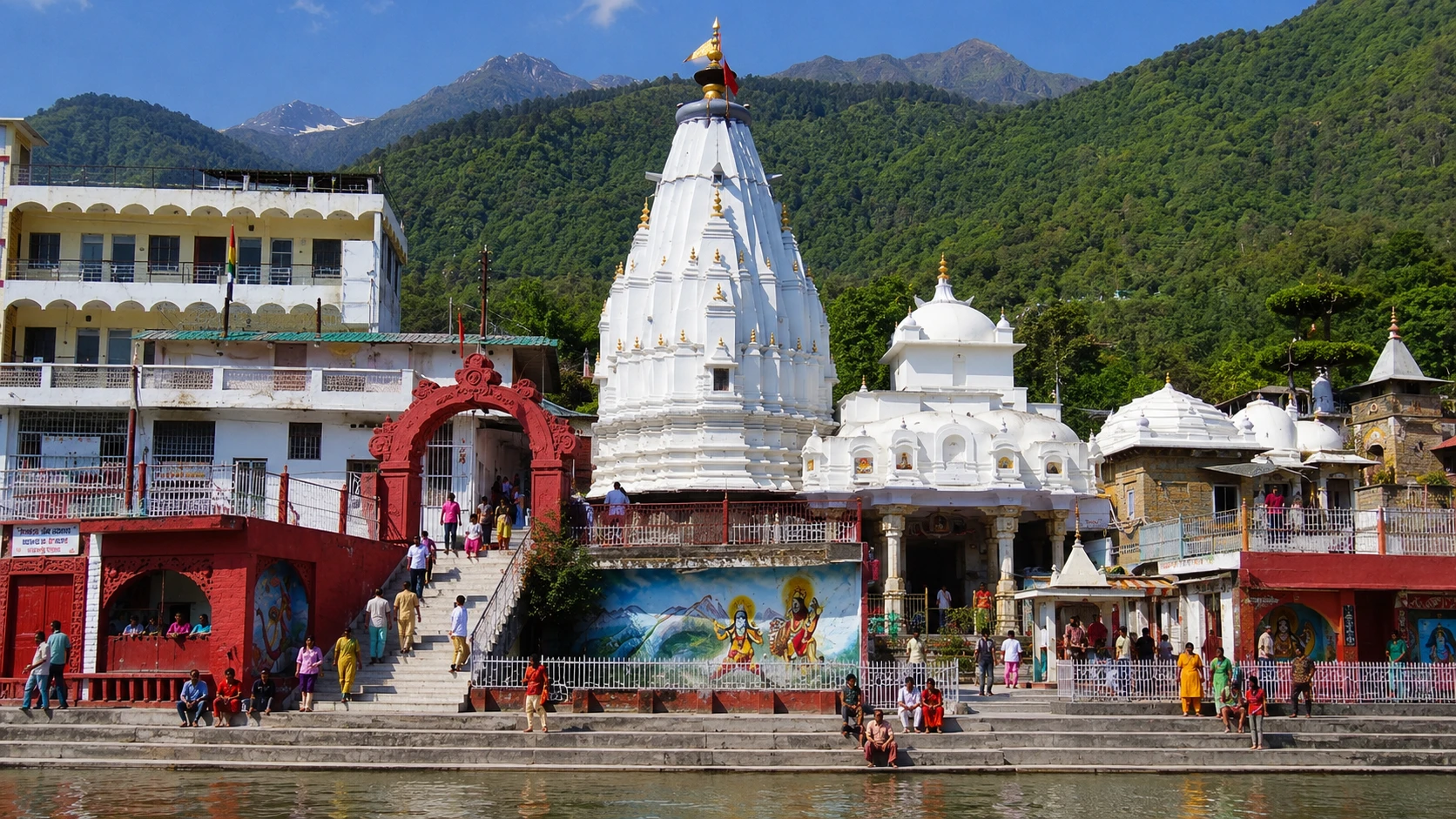
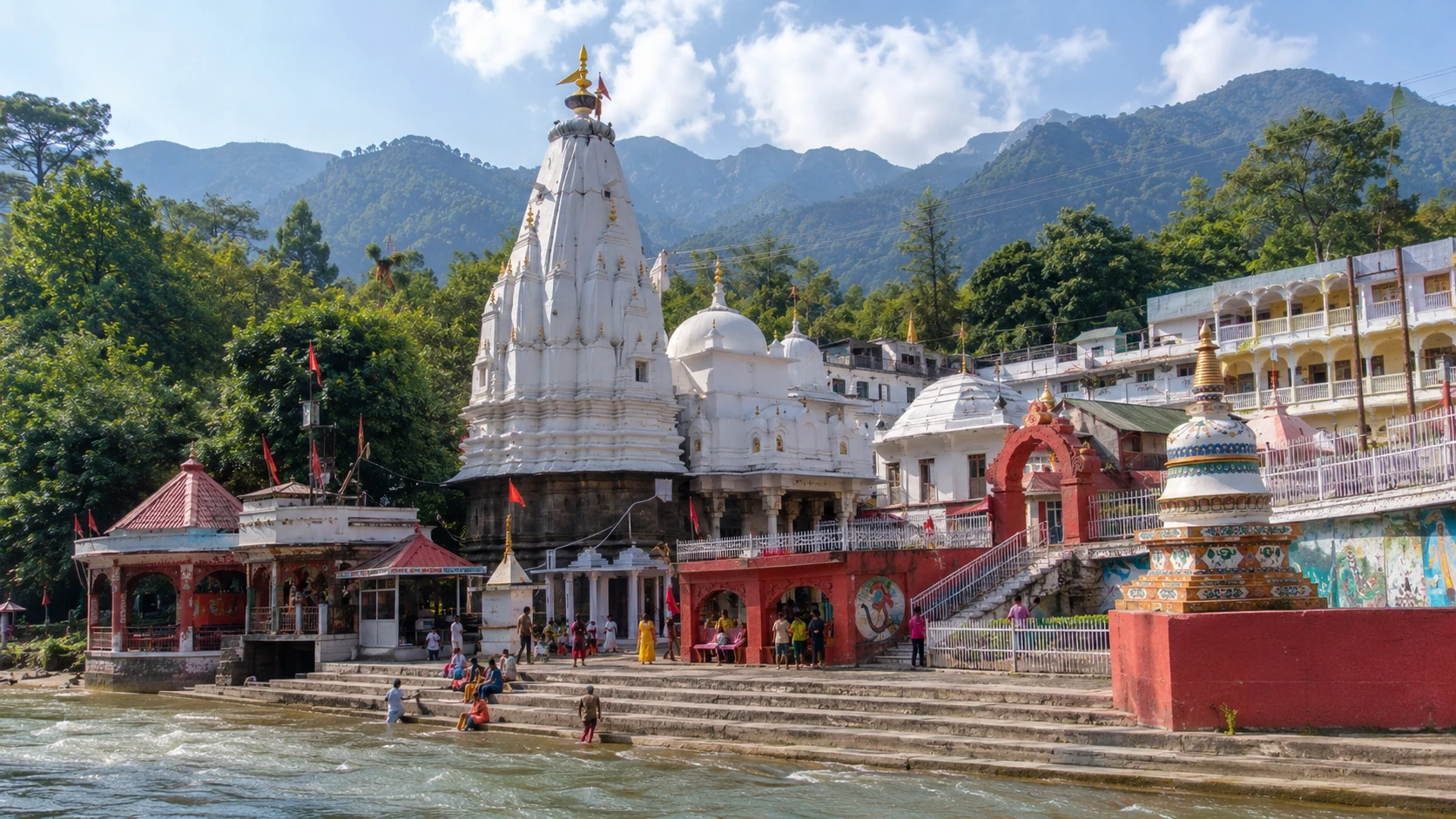
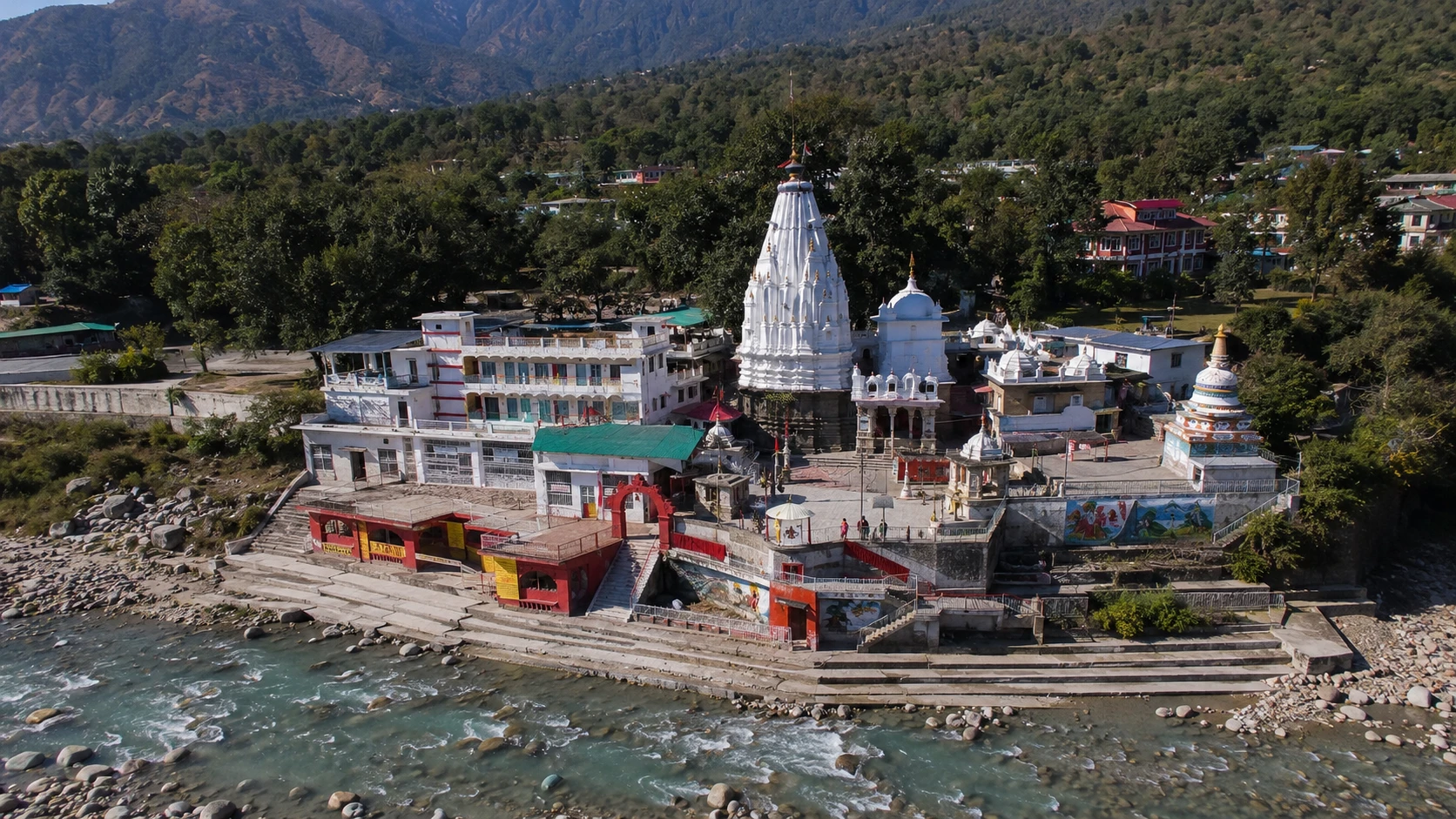
The Chamunda Devi temple sits on the banks of the Baner River, a tributary of the Beas, in the lower Dhauladhar foothills of Himachal Pradesh — approximately 15 km west of Palampur, 19 km south-east of Dharamshala, and 25 km north-east of the Brajeshwari Devi temple at Kangra (the principal anchor of the Himachal Devi circuit). The full traditional name of the complex is Chamunda Nandikeshwar Dham — emphasising the canonical pairing of the goddess Chamunda with Shiva in his Nandikeshwar form, present at the temple in a small but theologically central Shiva sub-shrine adjacent to the principal Devi sanctum. The principal deity is Chamunda Devi — the Devi-form whose name derives from the Devi Mahatmya's Chanda-Munda combat narrative (chapters 6–8 of the Saptashati), in which the goddess slays the asura generals Chanda and Munda and receives the epithet Chamunda from this victory. The Chamunda at Dharamshala is iconographically continuous with the broader Chamunda-tradition across the Indian subcontinent and is one of the principal Chamunda-shrines of north India. The temple is widely included in the Shakti Peeth lists preserved across the broader Tantric and Puranic devotional literature, though its canonical status is held with somewhat less doctrinal certainty than the firmly-settled Brajeshwari/Nagarkot attribution — the body-part attribution at Chamunda Devi varies across sources, with the principal traditions giving it as the skull or head (the goddess as Sati's skull-presence) and minority traditions placing it as the feet. The Eternal Raga treatment presents the canonical-status framing faithfully while noting the variant attributions with appropriate scholarly care. Within the broader regional devotional geography, Chamunda Devi is the second anchor of the Himachal Devi circuit — the five-temple unit comprising Brajeshwari (Kangra), Chamunda (Dharamshala), Jwalamukhi, Chintpurni, and Naina Devi. Pilgrims completing the Himachal Devi-circuit yatra typically take Brajeshwari darshan first (Kangra being the most-accessible by rail and air) and then Chamunda Devi as the second leg, taking advantage of the temple's proximity to Dharamshala and the broader McLeod Ganj tourist infrastructure. The Baner River setting gives Chamunda its distinctive geographical character: the temple's lower courtyard opens directly onto the river ghats, where ritual bathing and the immersion of offerings into the river are integrated into the broader temple visit. A cremation ground (shmashana) historically operated alongside the river near the temple, giving Chamunda a Tantric-ritual context that is largely absent from the corpus's other Devi-temple entries. The temple is administered under Himachal Pradesh state religious oversight — broadly within the third administrative-architecture mode of the Devi Marquee corpus (managed trust with state oversight), parallel to the Brajeshwari and the Haridwar Mansa-Chandi pattern. As of 2026, Chamunda Devi operates as a steadily-trafficked component of the Himachal Devi circuit, with attendance peaking during Sharadiya and Chaitra Navaratri and during the broader Himachal pilgrimage-and-tourism windows.
Sacred Designationपवित्र पदनाम
Sacred Origin Storyपवित्र उत्पत्ति कथा
Source: The Devi Mahatmya (Durga Saptashati) Chanda-Munda combat narrative from which the goddess's name derives; the Daksha Yajna and Sati-dismemberment cycle as preserved in the Devi Bhagavata Purana, the Kalika Purana, and the broader Shakti Peetha enumerations; regional Himachal devotional and sthala-purana literature for the temple's local foundational tradition; the Pithanirnaya and other Tantric Shakti Peeth enumerations for the canonical-status references.
The Chamunda narrative unfolds across three interlocking layers, each of which contributes to the temple's identity at Dharamshala.
The first is the Devi Mahatmya Chamunda-narrative — shared with the Chandi Devi temple at Haridwar (the corpus's prior Chamunda-tradition entry) and with the broader Chamunda-shrine network across India. In the seventh chapter of the Devi Mahatmya, the asuras Shumbha and Nishumbha send their general-asuras Chanda and Munda to capture the radiantly-beautiful Devi-as-Kaushiki who has emerged from Parvati's body. As they approach with their armies, the Devi's wrathful form Kali springs from her forehead — black-complexioned, gaunt, armed, the embodiment of the goddess's destroying-aspect. Kali advances on the asura armies, sweeping them aside, and seizes Chanda and Munda themselves. With one stroke she severs the head of each. The Devi, observing Kali's victory, bestows upon her the epithet Chamunda — 'she who has slain Chanda and Munda' — and the name is preserved across the subsequent Shakta tradition as one of the seven Matrikas and as one of the principal Devi-victory-names. The Chamunda enshrined at Dharamshala is iconographically and theologically continuous with this foundational narrative; the temple is one of the principal Chamunda-shrines at which the narrative is liturgically performed.
The second is the Shakti Peeth foundational layer — connecting Chamunda Devi to the broader Daksha Yajna and Sati-dismemberment cycle. The temple is widely-included in the Shakti Peeth lists preserved across the broader Tantric and Puranic devotional literature, though the body-part attribution varies across sources. The principal tradition gives the attribution as the skull or head — connecting etymologically to the broader Chamunda-iconography in which the goddess is the bestower of the kapala-mala (skull-garland) and is associated with the head-form of the destructive aspect of the Devi. Minority traditions place the body-part attribution at the feet. Some strict-scholarly enumerations of the 51/52 Shakti Peethas include Chamunda Devi at Dharamshala on the canonical list; others place the canonical 'kapala' attribution at Hinglaj (also a kapala/forehead Shakti Peeth in the principal Tantric enumeration) and treat Chamunda Devi as a major non-canonical Devi-shrine. The Eternal Raga treatment preserves the canonical-Shakti-Peeth framing as it is widely-preserved in the devotional tradition while noting the variant scholarly positions with appropriate care.
The third is the regional Himachal devotional layer — the temple's identity within the broader Himachal Devi circuit and its operational pairing with Shiva as Nandikeshwar. The full traditional name Chamunda Nandikeshwar Dham preserves the canonical Shaiva-Shakta pairing that is theologically required for every Shakti Peeth across the broader network: every Shakti Peeth has a paired Bhairava/Shiva-form as its canonical guardian, and at Chamunda Devi the paired form is Nandikeshwar — the Shiva-as-master-of-the-bull form, present in a small but theologically central sub-shrine adjacent to the principal Devi sanctum. The Nandikeshwar pairing is operationalised in pilgrim practice through the standard Devi-Shiva paired darshan; serious Shakti-Peeth-tradition pilgrims understand the Chamunda visit to include both the principal sanctum and the Nandikeshwar sub-shrine as theologically complementary halves of a single ritual unit.
The Baner River setting and the historical cremation-ground context near the temple integrate Chamunda into the broader Tantric-Shakta tradition more directly than most other Devi Marquee entries. In Tantric theology, the proximity of cremation-and-river to the Devi shrine is theologically significant: the cremation ground represents the dissolution of egoic attachment (a precondition for genuine Devi-darshan) and the river represents the flowing-water principle of purification. The Baner riverside ghats are integrated into the temple's ritual architecture in a way that connects Chamunda to the broader Tantric-Shakta sites (Kalighat, Kamakhya, and others) at which similar cremation-and-river configurations are theologically operationalised.
Devotees thus engage with Chamunda Devi on multiple registers simultaneously: the Devi Mahatmya theological layer (Chamunda as the Chanda-Munda-slaying warrior-Devi), the widely-attested Shakti Peeth layer (with the kapala/head body-part attribution per the principal traditions), the Shaiva-Shakta paired-Nandikeshwar layer (theologically required for every Shakti Peeth), and the Tantric-context layer (the Baner riverside and the historical cremation-ground proximity). Each layer contributes to the temple's lived identity.
उद्धृत स्रोत:
- Devi Mahatmya (Durga Saptashati), chapters 6–8 — the Chanda-Munda combat narrative from which Chamunda derives her name and identity
- Markandeya Purana — within which the Devi Mahatmya is preserved
- Devi Bhagavata Purana — broader Shakta theological framework and Shakti Peetha enumerations
- Kalika Purana — broader Shakta-Tantric framework within which the Shakti Peetha enumerations are preserved
- Pithanirnaya — Tantric enumeration of the 51/52 Shakti Peethas with variant body-part attributions
- Regional Himachal devotional and sthala-purana literature for the local foundational tradition
- Chamunda Nandikeshwar Dham administrative-and-devotional records
- Tantric-Shakta liturgical tradition for the riverside-and-cremation-ground theological framework
अन्य परंपराएँ · अन्य परंपराएँ
विद्वत संदर्भ
The Chamunda Devi narrative requires editorial care on three registers. First, the Devi Mahatmya Chamunda-narrative: presented as foundational scriptural narrative (the goddess's name and identity derive from this combat) rather than as historical event; this is theological-narrative content. Second, the Shakti Peeth canonical-status framing: the canonical-status claim is widely-preserved in devotional tradition but is held with somewhat less doctrinal certainty than the firmly-settled Brajeshwari attribution. The body-part attribution varies across sources (skull/head per the principal traditions, feet per minority traditions); some strict-scholarly enumerations include Chamunda Devi on the canonical 51/52 list, others place the canonical 'kapala' attribution at Hinglaj and treat Chamunda Devi as a major non-canonical Devi-shrine. The Eternal Raga treatment presents the canonical-status framing as it is widely-preserved in devotional tradition while noting these variations with appropriate scholarly care. Third, the Nandikeshwar pairing: the Shaiva-Shakta paired-Bhairava/Shiva tradition that every canonical Shakti Peeth requires is operationalised here as the Nandikeshwar pairing — the corpus's distinctive instance of the canonical pairing, theologically continuous with the Vajra Bhairava pairing at Brajeshwari and the Bhairava-pairings at Kalighat, Kamakhya, and other canonical Shakti Peethas. The pairing's etymological coherence at Brajeshwari (Vajra Bhairava ↔ Vajreshwari) is not paralleled at Chamunda (Nandikeshwar is the Shiva-master-of-the-bull form, not a Chamunda-cognate); the pairing here is theological-canonical rather than etymological-cognate, and the Eternal Raga treatment notes this distinction.
Historyइतिहास
The history of Chamunda Devi at the present Dharamshala-area site is documented less extensively than the parallel Brajeshwari/Nagarkot history that the corpus has just covered — partly because Chamunda Devi was not a target of the spectacular medieval looting events that gave Brajeshwari its dense Persian-chronicle documentary record, and partly because the Chamunda site's pre-modern infrastructure was more modest. References to a major Devi shrine on the banks of the Baner River, however, appear in regional Devi-mahatmya sources from the pre-Islamic-conquest period, and the temple has continued in worship across the broader Kangra-valley Hindu sacred-geography network without major destructive interruptions.
The medieval period saw the temple operate within the broader Kangra-region pilgrimage network alongside Brajeshwari at Nagarkot, Jwalamukhi, and the broader Devi-temple cluster. The 1009 Mahmud of Ghazni campaign that devastated Brajeshwari was directed primarily at the Nagarkot fortified town and the wealth concentrated there; Chamunda Devi, being more remote and less wealth-accumulated, escaped the direct destruction. Similarly, the 1360 Firuz Shah Tughlaq Kangra campaign appears to have been focused on Nagarkot rather than on the broader Devi-temple network of the region. The temple's continuity through the medieval period is preserved in regional devotional sources and in continuous worship-tradition.
The Mughal period (sixteenth through eighteenth centuries) saw the temple continue under varying levels of regional patronage. The Sikh Empire period of the early nineteenth century brought significant patronage from Maharaja Ranjit Singh — whose territory included the Kangra valley from approximately 1809 to his death in 1839 — and from the broader Sikh-Empire administrative-and-economic framework. The 1849 British annexation of Punjab following the Second Anglo-Sikh War brought the Kangra region within the broader British Indian administrative framework; the temple continued throughout, with various princely-state and zamindari families contributing to its maintenance.
The 4 April 1905 Kangra earthquake — the major destructive event in the broader Kangra-valley sacred-geography corpus — affected Chamunda Devi but less severely than it affected Brajeshwari. The temple's structure was damaged in the 1905 event but the principal sanctum survived in essentially its pre-earthquake form; reconstruction work in the subsequent decades restored the surrounding compound and ancillary structures. The present visible temple structure is substantially the post-1905 reconstruction with subsequent post-independence and twenty-first-century modernization additions.
The post-1947 administrative phase brought the temple within the Indian Union framework, initially under Punjab state administration (Kangra was then part of Punjab) and from 25 January 1971 under Himachal Pradesh state administration. The 1971 separation of Himachal Pradesh from Punjab brought Chamunda Devi and the broader Kangra district within the new state; the temple has since operated under Himachal Pradesh state religious oversight. The post-1971 period has seen progressive modernization — improved approach roads from Dharamshala and Palampur, expanded riverside ghats infrastructure, the introduction of online seva-booking, and the integration of Chamunda Devi into the broader Himachal Devi-circuit tourism-and-pilgrimage management framework.
The broader Dharamshala-region transformation following the establishment of the Tibetan exile community in McLeod Ganj from 1959 onwards (with the Dalai Lama's arrival and the subsequent establishment of the Central Tibetan Administration) gave Chamunda Devi a new tourist context: international visitors to Dharamshala for Tibetan-Buddhist purposes frequently extend their visits to include Chamunda Devi, integrating the temple into a multi-religious regional tourism flow that is operationally distinctive within the Devi Marquee corpus.
As of 2026, Chamunda Devi operates as a steadily-trafficked component of both the Himachal Devi circuit and the broader Dharamshala–McLeod Ganj tourist flow.
Historical Timelineऐतिहासिक कालक्रम
References to a major Devi shrine on the banks of the Baner River appear in regional Devi-mahatmya sources from the pre-Islamic-conquest period. The temple operates within the broader Kangra-valley Hindu sacred-geography network alongside Nagarkot, Jwalamukhi, and the broader Devi-temple cluster.
Mahmud of Ghazni's campaign devastates Brajeshwari Devi at Nagarkot but does not directly affect Chamunda Devi, which is more remote from the principal Nagarkot fortified town. The temple's continuity through this period is preserved.
The temple continues through the medieval and early-modern Indian period under varying levels of regional patronage. The continuity is preserved in regional devotional sources and in continuous worship-tradition; the temple does not see the spectacular destructive events that affected Brajeshwari but maintains its presence within the broader Kangra-valley Devi-temple cluster.
The Kangra valley falls within the Sikh Empire of Maharaja Ranjit Singh. Significant patronage from the Sikh-Empire administration supports the temple's maintenance, alongside the broader Kangra-Devi-temple network.
The British annexation of Punjab brings the Kangra region within the British Indian administrative framework. The temple continues under British administration.
The Kangra earthquake (~magnitude 7.8, centred near Kangra) strikes the broader region. Chamunda Devi is damaged but less severely than Brajeshwari; the principal sanctum survives in essentially pre-earthquake form. Reconstruction of the surrounding compound and ancillary structures follows over subsequent decades.
Indian Independence. The temple continues under the Indian Union, initially within Punjab state.
The establishment of the Tibetan exile community in McLeod Ganj following the Dalai Lama's arrival from Tibet brings a substantial international tourist flow to the broader Dharamshala region. The new tourist context gives Chamunda Devi a multi-religious tourism integration that is operationally distinctive within the Devi Marquee corpus.
Himachal Pradesh is created as a separate Indian state from Punjab. Chamunda Devi and the broader Kangra district come within the new state's administrative jurisdiction.
Progressive modernization — improved approach roads from Dharamshala and Palampur, expanded riverside ghats infrastructure, the introduction of online seva-booking through state-affiliated channels, and integration of Chamunda Devi into the broader Himachal Devi-circuit tourism-and-pilgrimage management framework.
What You'll Seeदर्शन में
The principal sanctum holds the Chamunda Devi murti — an anthropomorphic form in the canonical Chamunda iconographic register. The depiction shows the goddess as a multi-armed warrior-Devi: typically bearing weapons (sword, trishul, kapala or skull-bowl, drum, and other Devi-armaments in alternating hands), with at least one hand in varada-mudra (the boon-granting gesture) or abhaya-mudra (the fear-not gesture). The Chamunda iconography characteristically includes the kapala (skull-cup) and the muṇḍa-mālā (garland of severed heads) — emblems of the Chanda-Munda combat narrative from which the goddess's name derives. She is depicted on a lion or similar Devi-vahana, with a crown, heavy gold ornamentation, and a richly-coloured sari that is changed daily and ritually. The Chamunda configuration is iconographically continuous with the Chamunda at Chandi Devi Haridwar (the corpus's prior Chamunda-tradition entry) and with the broader Chamunda-shrine network across India.
The Nandikeshwar Shiva sub-shrine — adjacent to the principal Devi sanctum and integrated into the full traditional name Chamunda Nandikeshwar Dham — houses a small Shiva-lingam representing the Nandikeshwar form (Shiva-as-master-of-the-bull). The Nandikeshwar sub-shrine is the canonical Shaiva-Shakta paired counterpart to the principal Devi sanctum; the paired-darshan tradition treats the two halves as theologically complementary. The sub-shrine is more modest in scale than the principal sanctum but is central to the canonical Chamunda Devi observance.
Additional sub-shrines within the broader temple complex include a Hanuman sub-shrine, smaller Bhairava sub-shrines (the canonical guardian-Bhairava form for Shakti Peeth sites), and Ganesha sub-shrines. The riverside ghats opening onto the Baner River are integrated into the temple's ritual architecture — devotees descend the ghats for ritual bathing and the immersion of offerings into the river as part of the standard pilgrim observance. The historical cremation-ground proximity to the temple is theologically significant in the Tantric-Shakta framework, though the cremation-ground itself is operationally separate from the principal pilgrim-flow paths.
Photography of the Chamunda Devi sanctum during darshan is restricted. Devotees may photograph the temple's external structure, the Nandikeshwar sub-shrine (outer aspects), the courtyard, the riverside ghats, and the broader compound architecture; photography is not permitted within the inner sanctum during Chamunda Devi darshan or in the inner-shrine moments of the Nandikeshwar Shiva sub-shrine. The trust's protocols are enforced by temple-employed darshan staff.
Distinctive Practicesविशिष्ट परंपराएँ
Devi Mahatmya Chamunda-narrative observance and Sharadiya Saptami emphasis
देवी माहात्म्य चामुण्डा-कथा अनुष्ठान और शारदीय सप्तमी बल
The temple's principal narrative observance is the recitation of the Devi Mahatmya's seventh chapter — containing the Chanda-Munda combat narrative from which Chamunda Devi derives her name and identity. The Sharadiya Navaratri Saptami is the temple's symbolic peak-narrative day; many devotees recite the sixth and seventh chapters at the sanctum on this day. The corpus's two Chamunda-tradition temples — Chandi Devi at Haridwar and Chamunda Devi at Dharamshala — both observe the Saptami narrative-day, integrating them theologically across the broader Chamunda-shrine network.
Paired Chamunda-Nandikeshwar darshan (canonical Shakti Peeth Shiva-Shakti pairing)
युग्मित चामुण्डा-नन्दिकेश्वर दर्शन (प्रामाणिक शक्तिपीठ शिव-शक्ति युग्म)
The distinctive Chamunda Devi devotional practice — and the practice that gives the full traditional name Chamunda Nandikeshwar Dham its operational significance — is the paired darshan of Chamunda Devi at the principal sanctum and Nandikeshwar Shiva at the adjacent sub-shrine. Devotees completing the canonical Shakti Peeth observance take both halves of the pair as theologically complementary; serious Shakti-Peeth-tradition pilgrims do not consider the visit complete without both. The Nandikeshwar pairing here is the canonical Shaiva-Shakta tradition that every Shakti Peeth requires, here operationalised as the Shiva-master-of-the-bull form rather than the Vajra Bhairava form found at Brajeshwari.
Baner River ritual bathing and offering-immersion
बनेर नदी अनुष्ठानिक स्नान और अर्पण-विसर्जन
The temple's riverside ghats opening onto the Baner River are integrated into the standard pilgrim observance. Devotees descend the ghats for ritual bathing before darshan and for the immersion of post-darshan offerings (flower garlands, used puja-materials) into the river. The ritual-bathing-then-darshan sequence connects Chamunda Devi to the broader Devi-temple network in which riverside-and-bathing infrastructure is central (Har-ki-Pauri at Haridwar, Kalighat at the Adi Ganga, Kamakhya at the Brahmaputra). The Baner River setting gives Chamunda its distinctive operational character.
Himachal Devi-circuit second-leg position (Brajeshwari → Chamunda → onward)
हिमाचल देवी-परिक्रमा द्वितीय-चरण स्थिति (ब्रजेश्वरी → चामुण्डा → आगे)
Within the Himachal Devi-circuit standard yatra-sequence, Chamunda Devi is the second leg after Brajeshwari Kangra. The 25 km Brajeshwari-to-Chamunda distance is the longest single inter-temple leg of the circuit (versus the shorter ~30 km Chamunda-to-Jwalamukhi and ~75 km Jwalamukhi-to-Chintpurni legs). The operational practice has pilgrims base themselves in Kangra or Dharamshala and undertake the Chamunda visit as a half-day excursion, before continuing to the southern temples (Jwalamukhi, Chintpurni, Naina Devi). The Chamunda leg is thus operationally connected both to the Brajeshwari anchor and to the broader Dharamshala–McLeod Ganj tourist-flow context.
Dharamshala–McLeod Ganj multi-religious tourism integration
धर्मशाला–मैक्लियोडगंज बहु-धार्मिक पर्यटन एकीकरण
A distinctive Chamunda Devi practice — operationally distinctive within the Devi Marquee corpus — is the multi-religious tourism integration with the Dharamshala–McLeod Ganj Tibetan-Buddhist sites. International and domestic tourists visiting McLeod Ganj for the Dalai Lama's residence, the Tsuglagkhang temple complex, the Norbulingka Institute, and the broader Tibetan-cultural sites frequently extend their visits to include Chamunda Devi. The temple integrates into this multi-religious flow without compromising its primary devotional identity; the trust accommodates international visitors with brief explanatory signage in English and standard photography-protocol enforcement.
Tantric-context Baner-riverside-and-cremation-proximity observance
तान्त्रिक-सन्दर्भ बनेर-नदी-तटीय-व-श्मशान-निकटता अनुष्ठान
For pilgrims with a particular Tantric-Shakta orientation, the Chamunda Devi visit includes engagement with the historical cremation-ground proximity and the Baner riverside as theologically-significant elements of the broader Tantric Devi-tradition. The cremation ground itself is operationally separate from the principal pilgrim-flow but is theologically integrated into the temple's broader Tantric framework. The practice is more pronounced at Chamunda than at most other Devi Marquee entries because of the explicit theological alignment between the Chamunda-iconography (skull-bowl, severed-head-garland) and the cremation-ground symbolism.
Did You Know?क्या आप जानते हैं?
Chamunda Devi at Dharamshala is widely included in the Shakti Peeth lists preserved across the broader Tantric and Puranic devotional literature, with the principal traditions giving the body-part attribution as the skull or head — etymologically aligned with the Chamunda-iconography in which the goddess is the bestower of the kapala-mala (skull-garland). The canonical-status framing is held with somewhat less doctrinal certainty than the firmly-settled Brajeshwari/Nagarkot attribution; some strict-scholarly enumerations place the canonical 'kapala' attribution at Hinglaj instead.
The temple's full traditional name is Chamunda Nandikeshwar Dham — emphasising the canonical Shaiva-Shakta pairing with Shiva in his Nandikeshwar (master-of-the-bull) form, present in a small but theologically central sub-shrine adjacent to the principal Devi sanctum. The pairing is operationalised through the standard Devi-Shiva paired darshan that serious Shakti-Peeth-tradition pilgrims complete as theologically complementary halves of a single ritual unit.
The deity's name 'Chamunda' derives from the Devi Mahatmya's seventh chapter, in which the goddess slays the asura generals Chanda and Munda and receives the epithet 'she who has slain Chanda and Munda'. The Chamunda at Dharamshala shares this name and identity with the Chamunda at Chandi Devi Haridwar (the corpus's prior Chamunda-tradition entry); both temples observe the Sharadiya Navaratri Saptami as the principal narrative-day on which the Chanda-Munda combat is described.
The temple sits on the banks of the Baner River, a tributary of the Beas — giving Chamunda Devi a distinctive riverside setting that is integrated into the temple's ritual architecture. The riverside ghats are used for ritual bathing before darshan and for the immersion of post-darshan offerings into the river. The Dhauladhar mountain backdrop visible from the temple is among the most scenically distinctive in the Himachal Devi-circuit network.
The Tantric-context dimension is more pronounced at Chamunda Devi than at most other Devi Marquee entries. The historical cremation-ground proximity to the temple, combined with the Baner riverside setting, integrates Chamunda into the broader Tantric-Shakta tradition in which the proximity of cremation-and-river to the Devi shrine is theologically significant — the cremation ground representing the dissolution of egoic attachment and the river the flowing-water principle of purification.
Chamunda Devi is the second anchor of the Himachal Devi circuit — the five-temple unit comprising Brajeshwari (Kangra), Chamunda (Dharamshala), Jwalamukhi, Chintpurni, and Naina Devi. The standard circuit yatra-sequence places Chamunda Devi second after Brajeshwari (the most-accessible by rail and air), with the 25 km Brajeshwari-to-Chamunda distance being the longest single inter-temple leg of the circuit.
Chamunda Devi is operationally distinctive within the Devi Marquee corpus for its integration with the Dharamshala–McLeod Ganj multi-religious tourism flow. Following the 1959 arrival of the Dalai Lama and the establishment of the Tibetan exile community in McLeod Ganj, the broader Dharamshala region became a major international tourist destination; Chamunda Devi receives substantial multi-religious tourist visits alongside its primary Hindu pilgrim flow.
Chamunda Devi was less severely affected by the 1905 Kangra earthquake than Brajeshwari was. While the surrounding compound and ancillary structures were damaged, the principal sanctum survived in essentially pre-earthquake form, and the reconstruction phase was less extensive than the multi-decade Brajeshwari rebuilding. This relative survival makes Chamunda one of the few Kangra-valley temples whose principal sanctum has substantial pre-1905 structural continuity.
The Chamunda iconography preserved at the temple includes the kapala (skull-cup) and the muṇḍa-mālā (garland of severed heads) — emblems of the Chanda-Munda combat narrative that connect the deity-form to the broader Tantric-Shakta tradition. These emblems are theologically distinct from the more-pacific Devi iconographies at Mahalakshmi Mumbai, Annapurna Varanasi, or Saraswati Basar — placing Chamunda within the fierce-aspect register of the Devi-tradition alongside Kali and the broader Mahavidya forms.
Festivalsत्योहार
Sharadiya Navaratri (with Saptami Chanda-Munda observance)
शारदीय नवरात्रि (सप्तमी चण्ड-मुण्ड अनुष्ठान के साथ)
Sharadiya Navaratri is the temple's principal annual flagship. The Saptami observance is theologically central: the day on which the Chanda-Munda combat is described in the foundational scripture is the day on which the temple's narrative-and-name come into focus. Many devotional groups organise Saptashati-path (recitation of the full Devi Mahatmya) over the nine nights, with chapters 6–8 (containing the Chanda-Munda combat) receiving particular emphasis on Saptami. The broader Himachal Devi-circuit yatra-flow intensifies during the Sharadiya nine nights.
Chaitra Navaratri (Vasanta Navaratri)
चैत्र नवरात्रि (वसन्त नवरात्रि)
The vernal counterpart to Sharadiya Navaratri. The spring weather in the Kangra valley is particularly favourable; cumulative attendance is substantial though less than during the autumn Sharadiya nine nights. The Saptami observance is again emphasised. The closing Ramnavami brings Vaishnava-tradition observance into the temple calendar.
Mahashivratri (with Nandikeshwar emphasis)
महाशिवरात्रि (नन्दिकेश्वर बल के साथ)
Mahashivratri at Chamunda Devi is observed with particular emphasis on the Nandikeshwar Shiva sub-shrine — the canonical Shaiva-Shakta paired-Shiva form. The day's all-night observance integrates the Devi-Shiva paired tradition that gives the full Chamunda Nandikeshwar Dham its theological coherence. Attendance is moderate at the principal sanctum but substantial at the Nandikeshwar sub-shrine.
Diwali (Deepawali)
दीपावली
Diwali at Chamunda Devi is observed with the Devi-centric character common to the broader Himachal Devi-temple network. The riverside ghats are illuminated with floating diyas; the courtyard sees compound-wide diya illumination through the night. The night-long observance integrates with the broader Himachal Devi-temple Diwali tradition.
Hanuman Jayanti
हनुमान जयन्ती
The Hanuman sub-shrine within the temple complex receives expanded attendance on Hanuman Jayanti. The day connects Chamunda Devi to the broader Ramayana-devotional landscape and is observed as a sub-shrine-focused day rather than a principal-deity-focused observance.
Makar Sankranti / Lohri-Maghi cycle
मकर संक्रान्ति / लोहड़ी-माघी चक्र
The broader Punjab-Himachal Lohri-Maghi observance window brings expanded regional pilgrim attendance to Chamunda Devi alongside the broader Himachal Devi-temple network. Regional sweets, traditional Lohri-bonfire observances, and the Maghi-snan tradition are integrated into the temple's broader calendar.
Traditional Offeringsपारंपरिक अर्पण
प्राथमिक अर्पण
Red and yellow flowers (hibiscus, marigold, rose)
लाल और पीले पुष्प (गुड़हल, गेंदा, गुलाब)
Red and yellow flowers are the standard Devi-offering at canonical Shakti Peethas in the north Indian tradition. Hibiscus (jaba), marigold (genda), and rose petals are offered at the goddess's feet during darshan. The red colour invokes the Shakti-aspect of the goddess; the flowers are typically purchased at small stalls along the temple approach.
Kumkum, sindoor, and turmeric
कुंकुम, सिन्दूर, और हल्दी
The triad of red kumkum, vermilion sindoor, and turmeric is offered at the goddess's feet and applied to her forehead. The triad is the standard Devi-temple offering vocabulary across north India and is distributed back to devotees as part of the prasad-blessing; married women receive the sindoor-blessing as a saubhagya-aashirvad.
Coconut (nariyal) — with paired Nandikeshwar offering
नारियल — युग्मित नन्दिकेश्वर अर्पण के साथ
Coconut is brought by devotees and broken in the courtyard area at the entrance to the sanctum precinct. A distinctive Chamunda Devi pattern: a small secondary coconut is taken to the Nandikeshwar Shiva sub-shrine as part of the canonical paired-shrine observance, complementing the principal Devi-darshan with the canonical Shaiva-Shakta paired offering. The flesh is returned to the devotee as prasad.
Ghee diya (clarified-butter lamp)
घी का दीपक
Lamps of pure ghee are lit at the goddess's feet by devotees. The light symbolises both the devotional warmth and the dispelling of ignorance through Mother-grace. Akhand-jyot (continuous ghee-lamp) sponsorship is available through the trust's seva-booking system, particularly for Sharadiya Navaratri Saptami observances.
Mishri, fruits, and seasonal offerings
मिश्री, फल, और मौसमी अर्पण
Mishri (rock sugar), seasonal fruits, and other small offerings complete the standard Devi-offering set at Chamunda Devi. Mishri is the principal sweet offering at the sanctum and is distributed back as prasad; fruits are placed at the goddess's feet during darshan and returned to the devotee in part as prasad. The seasonal-availability principle is maintained.
इस मंदिर की विशेषता
Paired Chamunda-Nandikeshwar darshan-prasad
युग्मित चामुण्डा-नन्दिकेश्वर दर्शन-प्रसाद
The distinctive Chamunda Devi practice is the paired darshan-prasad — pilgrims completing the canonical Shakti Peeth observance take both the principal Chamunda Devi darshan-prasad (Devi prasad) and a separately-distributed Nandikeshwar Shiva sub-shrine prasad (Shiva prasad). The two prasad-items together constitute the complete Shakti Peeth canonical offering-cycle. The Nandikeshwar prasad is typically a smaller portion than the principal Devi prasad and is distributed at the sub-shrine itself.
Baner-riverside ritual-bathing-and-immersion package
बनेर-नदी-तटीय अनुष्ठानिक-स्नान-व-विसर्जन पैकेज
The temple's riverside ghats opening onto the Baner River are integrated into the standard pilgrim observance. Devotees take ritual bathing at the ghats before darshan, and post-darshan offerings (flower garlands, used puja-materials) are immersed in the river. The ritual-bathing-then-darshan sequence is operationally distinctive within the Devi Marquee corpus and is theologically continuous with the broader Devi-temple network in which riverside-and-bathing infrastructure is central.
Devi-Mahatmya-Saptami Saptashati sponsorship
देवी-माहात्म्य-सप्तमी सप्तशती प्रायोजन
The temple's signature seva is the Sharadiya Navaratri Saptami Saptashati-path sponsorship — the recitation of the full Devi Mahatmya at the sanctum on the day on which the Chanda-Munda combat is described in the scripture. The recitation is conducted by trust priests with the sponsor in attendance and is heavily oversubscribed during Sharadiya Navaratri; advance booking is essential. The seva is theologically the most-aligned vow-completion offering for the temple.
Devotees may bring offerings from outside the temple grounds or purchase them at the stalls along the temple approach. Flowers, kumkum, coconuts, and incense are most commonly purchased at the approach stalls; trust-operated counters at the temple entrance offer the paired Chamunda-Nandikeshwar darshan-sponsorship, the Saptashati-path sponsorship, and other formal-seva registrations. Coconut-breaking is done at the entrance area; flowers and kumkum are taken into the sanctum. Monetary offerings to the temple go through the trust counters for receipt; for larger sponsorship-amount offerings (Saptashati-path, Akhand Jyot, Navaratri Saptami special-day sponsorship), advance booking through the trust office is recommended, particularly during Sharadiya and Chaitra Navaratri.
How to Reachकैसे पहुँचें
Chamunda Devi is reached by road from the broader Dharamshala-Palampur-Kangra region. From Dharamshala (the principal tourist gateway, ~19 km north-west of the temple via NH 154A), regular Himachal Pradesh Roadways buses, shared tempo travellers, and private taxis (Ola, Uber, and local operators) make the connection. From Palampur (~15 km east), similar transport options operate. From Kangra (~25 km south-west), the Brajeshwari-to-Chamunda leg of the Himachal Devi circuit is most efficiently done by private taxi or by a combined-package Devi-circuit tour operator. By rail, Maranda railway station on the Kangra Valley narrow-gauge Railway is approximately 6 km from the temple, with auto-rickshaw transfer; the Kangra Valley Railway is one of India's principal heritage narrow-gauge lines and the journey itself is a heritage-tourism experience. For broad-gauge connectivity, Pathankot Junction (PTK) is approximately 105 km, with onward narrow-gauge or road transfer. By air, Kangra Airport (DHM, Gaggal Airport) is approximately 22 km from the temple — limited domestic connectivity, principally to Delhi. For broader international connectivity, Indira Gandhi International Airport (DEL), Delhi, at approximately 500 km is the practical international gateway, with road or rail transfer to Dharamshala/Kangra. Within the broader Kangra valley, the standard Himachal Devi-circuit itinerary places Brajeshwari first, Chamunda second, then Jwalamukhi, Chintpurni, and Naina Devi in sequence.
Plan Your Visitयात्रा की योजना
🌤 सर्वोत्तम मौसम
October to March is the most comfortable period to visit — Kangra valley temperatures range from 5–22°C with clear views of the Dhauladhar range rising above the temple. Sharadiya Navaratri (September–October) and Chaitra Navaratri (March–April) are the most spiritually charged windows; the Saptami of Sharadiya Navaratri is the temple's symbolic peak-narrative day. Avoid the heart of the monsoon (July–August) when the Kangra valley sees heavy rainfall and the Baner River can be in spate; landslide risk on the broader Himachal road network can disrupt transport. The April-through-June pre-monsoon period is warmer but generally pleasant. Early-morning windows (06:00–09:00) are the least crowded year-round; the Dhauladhar mountain views are particularly distinct in the clear post-monsoon and winter months.
👘 पहनावे का नियम
Modest traditional dress is expected. For men, full-length trousers or dhotis with sleeved shirts or kurtas are appropriate; for women, sarees, salwar suits, or long skirts with covered shoulders are appropriate. The cooler Kangra valley climate means layered clothing including a warm shawl or sweater is comfortable in the autumn-through-spring months. Devotees planning to use the Baner riverside ghats for ritual bathing should bring a change of clothes and modest river-bathing attire. Shorts, sleeveless tops, and very short dresses are not appropriate for sanctum darshan.
📱 फोन और फोटोग्राफी
Mobile phones must be on silent within the temple precinct. Photography with phones is permitted in the outer courtyard, at the Nandikeshwar Shiva sub-shrine (outer aspects), at the riverside ghats, and at the broader compound architecture. Photography is not permitted in the inner sanctum during Chamunda Devi darshan or in the inner-shrine moments of the Nandikeshwar sub-shrine. Flash photography is discouraged throughout. There is no phone-deposit requirement at the temple entrance.
🏨 आवास
Dharamshala (~19 km north-west) offers extensive accommodation across all categories — from budget guesthouses and Tibetan-exile-community-operated lodgings in McLeod Ganj to mid-range hotels in lower Dharamshala and the higher-end properties throughout the broader region. Palampur (~15 km east) also offers a range of accommodation. Kangra town (~25 km south-west) offers accommodation closer to Brajeshwari Devi, making it convenient for combined Brajeshwari-Chamunda pair-temple itineraries. For Himachal Devi-circuit yatra-season visits, pre-booking 3–6 weeks in advance is strongly recommended; the broader Dharamshala-McLeod Ganj tourist flow fills accommodation rapidly during peak periods, particularly the autumn months and Tibetan-Buddhist event windows.
Book a Pujaपूजा बुक करें
The Chamunda Devi temple operates as a Devi-and-Shiva paired complex (Chamunda Nandikeshwar Dham). Devotees should plan their visit around the following: (a) the temple has a midday closure period (typically 12:00–14:00) — plan to either complete darshan in the morning window or arrive after 14:00 reopening; (b) photography is not permitted in the inner sanctum during Chamunda Devi darshan or in the inner-shrine moments of the Nandikeshwar sub-shrine, with trust enforcement; (c) the Baner riverside ghats can be slippery, particularly during monsoon — pilgrims using the ghats for ritual bathing should bring appropriate clothing and exercise care; (d) the monsoon season (July–August) brings landslide risk on the broader Himachal road network and potential Baner River spate, which can disrupt riverside ghat access — plan transport and ghat-use accordingly; (e) Sharadiya Navaratri (particularly Saptami through Navami) and the broader Himachal Devi-circuit yatra-flow weeks see extreme crowds — pre-plan accordingly with Saptashati-path sponsorship advance enquiry and accommodation booking in Dharamshala or Kangra; (f) the temple does not authorise third-party agents or booking-aggregator services to provide paid darshan-skip services outside the trust's official channels; (g) the broader Dharamshala-McLeod Ganj region has tourist-fraud risks (overcharging taxis, fake guides) — use Himachal Pradesh Tourism-affiliated or pre-booked transport; (h) several fraudulent websites and social-media pages impersonate the Chamunda Devi temple administration, particularly during Navaratri periods. Carry photo ID for ticketed-seva attendance.
Managed by: Shri Chamunda Nandikeshwar Devi Trust (managed under Himachal Pradesh state religious oversight)
Mangala Aarti participation (pre-dawn opening of the goddess)
मंगला आरती में भागीदारी (देवी का प्रातः-पूर्व उद्घाटन)
Chamunda Devi Abhishekam
चामुण्डा देवी अभिषेकम
Nandikeshwar paired darshan-sponsorship (canonical Shakti Peeth paired observance)
नन्दिकेश्वर युग्मित दर्शन-प्रायोजन (प्रामाणिक शक्तिपीठ युग्मित अनुष्ठान)
Saptashati-path sponsorship (Devi Mahatmya recitation)
सप्तशती-पाठ प्रायोजन (देवी माहात्म्य पाठ)
Akhand Jyot (continuous oil/ghee lamp)
अखण्ड ज्योत (निरन्तर तेल/घी दीप)
Annadan (community meal sponsorship)
अन्नदान (सामुदायिक भोजन प्रायोजन)
Navaratri Saptami special-day sponsorship
नवरात्रि सप्तमी विशेष-दिवस प्रायोजन
Booking information verified: 2026-05-21
Sacred Soundsपवित्र ध्वनि
Devi Mahatmya (Durga Saptashati), chapters 6–8 — the Chanda-Munda combat narrative from which Chamunda derives her name and identity
stotram
Chandi Path (the full Saptashati recitation) — the principal liturgical text recited at the temple during Sharadiya and Chaitra Navaratri
stotram
Durga Kavach — the protective hymn from the Devi Mahatmya tradition
stotram
Mahishasura Mardini Stotram (Aigiri Nandini) — the principal Devi-victory hymn
stotram
Chamunda Devi Chalisa — the forty-verse devotional invocation in the north Indian Devi Chalisa tradition
stotram
Chamunda Aarti — the temple's daily morning and evening aarti hymn
aarti
Regional Kangra-Pahari Devi bhajans — folk-devotional songs in the Pahari tradition
bhajan
क्या आप जानते हैं? · Did You Know?
वही अनुवाद त्रुटि जिसने हिन्दू धर्म में '33 कोटि' को '33 करोड़' बनाया, बौद्ध धर्म में भी हुई। बौद्ध ग्रन्थों के चीनी अनुवाद ने 'सप्त कोटि बुद्ध' (7 श्रेष्ठ बुद्ध) का अनुवाद '7 करोड़ बुद्ध' कर दिया। तिब्बती अनुवाद ने सही किया: 7 प्रकार, 7 करोड़ नहीं। एक संस्कृत शब्द, दो प्रमुख विश्व धर्मों में गलत पढ़ा गया, ने दो एकसमान भ्रम स्वतन्त्र रूप से उत्पन्न किए।
Related Contentसंबंधित सामग्री
Related Scriptures
Related Temples
Brajeshwari Devi
बज्रेश्वरी देवी
Kangra, Himachal Pradesh
Chhinnamastika (Chintpurni)
छिन्नमस्तिका (चिंतपूर्णी)
Chintpurni, Himachal Pradesh
Naina Devi
नैना देवी
Bilaspur, Himachal Pradesh
Vaishno Devi
वैष्णो देवी
Katra, Jammu and Kashmir
Chandi Devi (Haridwar)
चंडी देवी मंदिर
Haridwar, Uttarakhand
Mansa Devi (Haridwar)
मनसा देवी मंदिर
Haridwar, Uttarakhand
Kalighat
कालीघाट
Kolkata, West Bengal
Kamakhya Temple
कामाख्या मंदिर
Guwahati, Assam
Community Reflections
🕉️
Be the first to share your reflection.