Mansa Devi (Haridwar)
मनसा देवी मंदिर
The wish-fulfilling goddess of Haridwar, whose Bilwa Parvat shrine and thread-tying tradition draw devotees across the Char Dham pilgrimage season
Haridwar, Uttarakhand, India
Mansā Devī Mandir, HaridvārAlso known as: Mansa Devi Temple, Haridwar, Bilwa Tirtha Mansa Devi, Shri Mansa Devi Mandir, मनसा देवी मन्दिर, हरिद्वार, बिल्व तीर्थ मनसा देवी
खुला
05:00 (summer; winter opens 06:30); ropeway operations typically begin 08:00 – 21:00 (summer; winter closes 19:00); ropeway operations typically end 18:00 (summer) or 17:00 (winter); extended hours during Navaratri and festival days
पवित्र कथा · पवित्र कथा
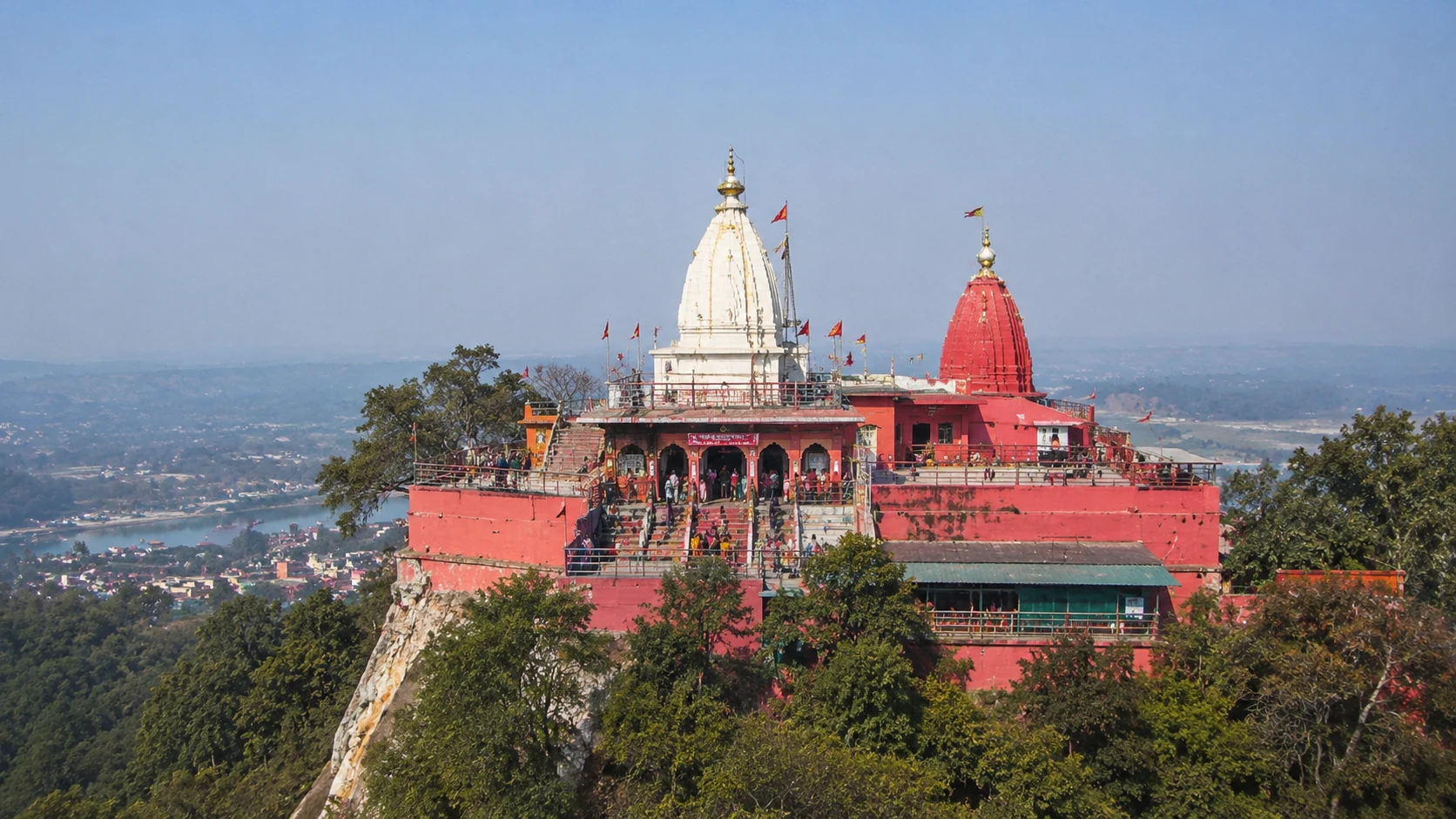
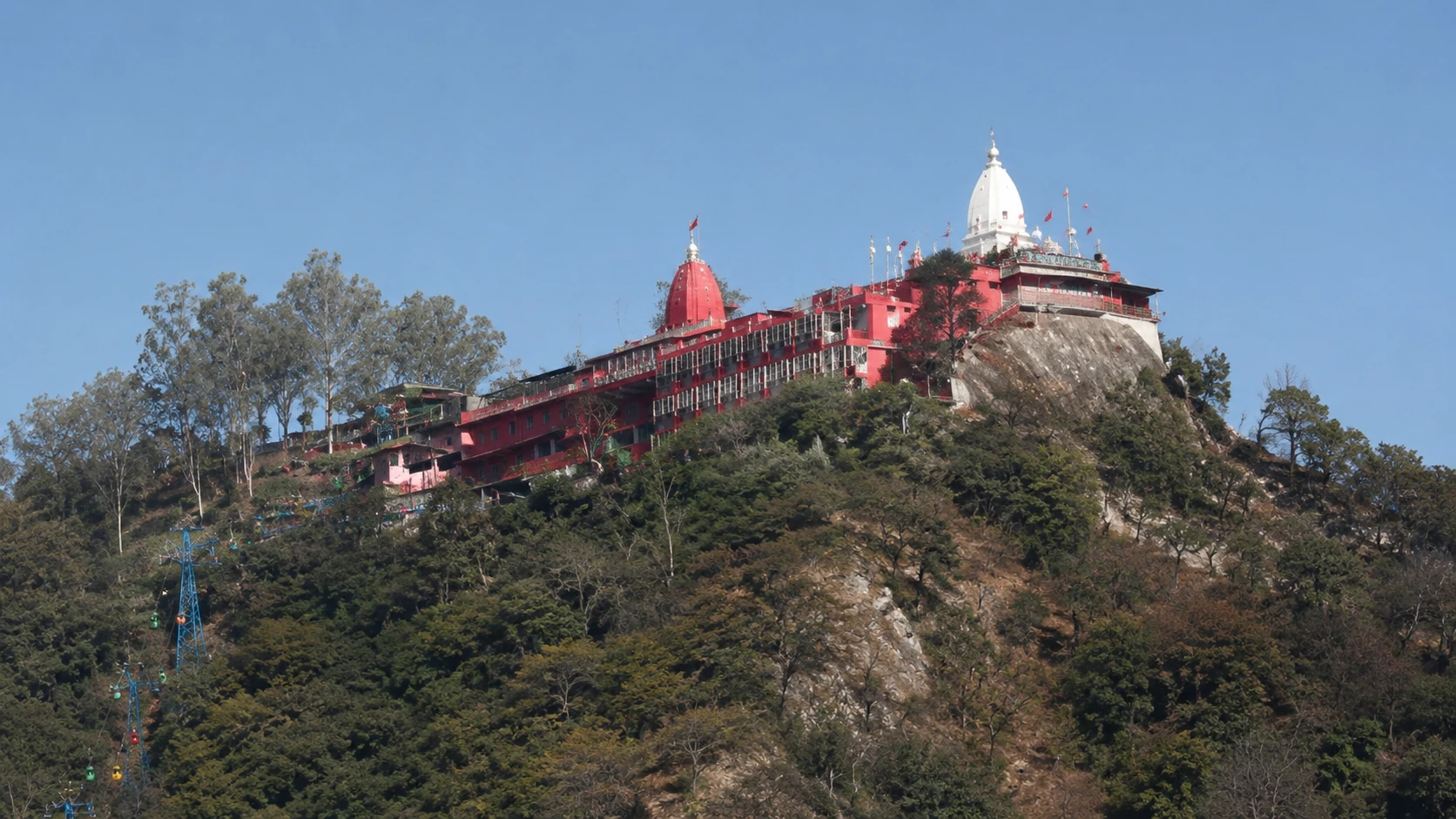
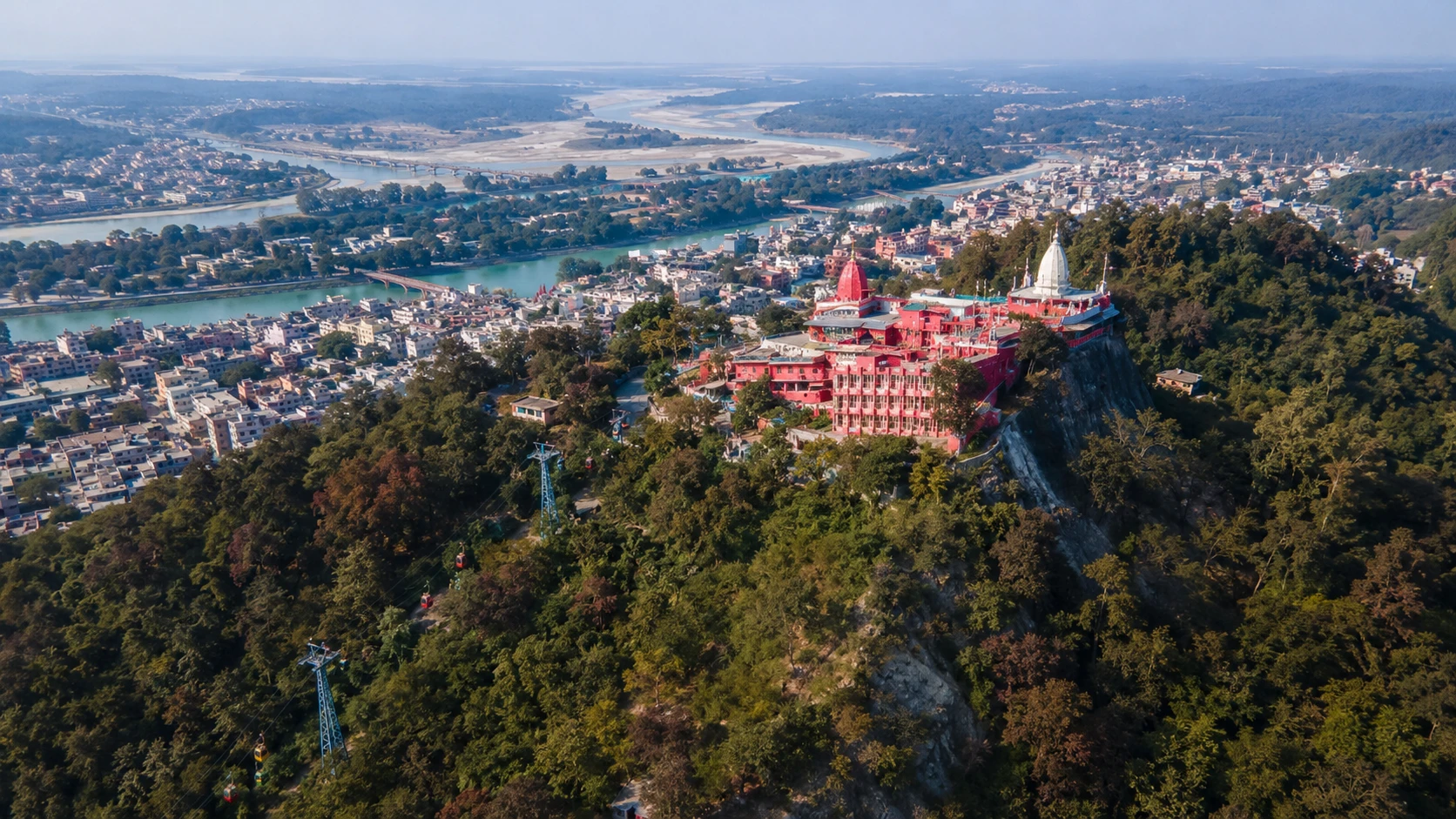
The Mansa Devi temple stands on the summit of Bilwa Parvat — one of the three principal hills of the Shivalik foothills that overlook Haridwar from the south-east — at approximately 167 metres above the Ganga valley floor. The principal deity is Mansa Devi, 'the goddess of the mind / wish' (mansa: mind, intention, desire), and the temple's defining devotional identity is unambiguously the wish-fulfilling practice: devotees come to Mansa Devi with a personal wish, formally tie a thread or piece of cloth on the sacred tree within the temple precinct (the Mannat-tree), and return — months or years later, by tradition — to untie the thread once the wish has been fulfilled and to offer thanks. The continuous cycle of thread-tying and thread-untying gives the temple its operational character; the Bilwa Parvat hilltop is, at any given moment, hung with tens of thousands of devotee threads in varying states of vow and fulfilment. Mansa Devi is a Shakti-form of the Goddess, theologically associated with the mind-aspect of Devi-energy — distinct from the more well-known Mansa Devi of Bengal (the snake-goddess of the Manasamangal poetic tradition), though some folk-tradition strands draw loose connections between the two. The Haridwar Mansa Devi is iconographically and ritually a North Indian Shakti shrine within the broader Devi-of-the-mountains tradition that runs from Vaishno Devi in Jammu through the Shivalik and Himachal foothills to Kamakhya in Assam — a tradition that places the Goddess on hilltops accessible by ascent, with the climb itself part of the devotional offering. The present temple structure dates to 1811–1815 and is attributed to Maharaja Bhup Singh of Manimajra, a Sikh principality of the Punjab plains south of the Shivaliks, whose patronage consolidated an older shrine into the present sanctum-and-courtyard form. Earlier Devi-worship at Bilwa Parvat is attested in pre-modern Haridwar mahatmya literature, though the pre-Bhup-Singh phase is archaeologically thin. The temple's twentieth- and twenty-first-century history has been shaped most distinctively by the 1981 opening of the Mansa Devi ropeway — a 540-metre aerial cable car connecting the Haridwar valley floor to the hilltop temple — which transformed access from a steep one-and-a-half-kilometre climb to a five-minute aerial journey, and which made the temple one of the most-visited hill-shrines in northern India. Mansa Devi sits within a broader Haridwar Devi geography that includes the Chandi Devi temple on Neel Parvat across the Ganga (theologically paired with Mansa Devi — mind-wish-goddess and fierce-demon-slayer-goddess) and the Maya Devi temple in the Haridwar town below; the combined Mansa-Chandi-Maya darshan circuit is the standard pilgrim practice. The temple's annual rhythm is shaped by the Char Dham Yatra season (April–November), when Haridwar serves as the principal gateway for pilgrims travelling onwards to Yamunotri, Gangotri, Kedarnath, and Badrinath, and by the once-in-twelve-years Kumbh Mela (and the six-yearly Ardh-Kumbh) for which Haridwar is one of the four sacred sites.
Sacred Designationपवित्र पदनाम
Sacred Origin Storyपवित्र उत्पत्ति कथा
Source: Pre-modern Haridwar mahatmya literature for the Bilwa Parvat Devi tradition; broader Shakta sources (Devi Bhagavata Purana, Markandeya Purana / Devi Mahatmya) for the theological framework of Mansa-as-Shakti; regional Garhwal devotional literature and the Maharaja Bhup Singh family-history tradition for the early-nineteenth-century consolidation narrative.
The Mansa Devi narrative operates on three registers that need to be distinguished to avoid confusion across overlapping Devi-traditions.
The theological register places Mansa Devi as a Shakti-form of the Goddess associated with the mind-aspect (manas) of Devi-energy. In the broader Shakta tradition, the various forms of Devi correspond to different aspects of conscious-and-energetic principle: Mahakali corresponds to the time-dissolution aspect, Mahalakshmi to the prosperity-sustenance aspect, Mahasaraswati to the knowledge-illumination aspect, and Mansa to the mind-intention-wish aspect. The mind, in this framework, is not the lower discursive thinking but the deeper formative principle through which intention shapes reality — and Mansa Devi as the goddess of this principle is approached for wishes that the devotee wishes the universe to actualise. The thread-tying practice is the operational expression of this theology: the devotee formally externalises an intention by tying it on the sacred tree, placing it in the Goddess's care, and waiting for actualisation.
The regional-geographic register places Mansa Devi on Bilwa Parvat as one of the principal Devi sites of the Haridwar gateway-zone — the boundary between the Indo-Gangetic plain and the Garhwal-Himalayan high country. The pre-modern Haridwar mahatmya literature describes Bilwa Parvat as one of the city's sacred hills (alongside Neel Parvat, which holds Chandi Devi), with Devi-presence attested for many centuries before the present temple structure was built. The geographic positioning is theologically meaningful: the Goddess sits at the threshold between the worldly plain and the Himalayan abode of the great Shaiva and Vaishnava shrines, and the pilgrim who completes Mansa Devi darshan before setting out for the Char Dham is, by tradition, securing the Goddess's blessing for the longer journey ahead.
The foundational register places Maharaja Bhup Singh of Manimajra — the early-nineteenth-century Sikh ruler of a small Punjab plains principality south of the Shivaliks — as the patron who consolidated the older Bilwa Parvat Devi shrine into the present temple structure between 1811 and 1815. The Maharaja's devotion to Mansa Devi is preserved in regional family-history tradition and in the temple's own oral history; he is said to have built the present sanctum and the principal courtyard structures, with subsequent additions through the nineteenth and twentieth centuries. The Bhup Singh dating is the conventionally-given date in temple and regional literature but is more historically settled through nineteenth-century records than through pre-1811 documentation of the older shrine.
A point of theological disambiguation worth noting: the Haridwar Mansa Devi is distinct from the Mansa Devi of the Bengal tradition. The Bengal Mansa Devi is the snake-goddess of the Manasamangal poetic-devotional tradition — a folk-Shakta figure associated with snake-protection, fertility, and forest ecology, with a substantial regional literary corpus including the medieval Manasamangal kavyas. The Haridwar Mansa Devi is a Shakti-form in the broader North Indian Devi tradition with no specific snake-association; the shared name is coincidental rather than denoting a shared deity. The two Mansa Devis should not be conflated, and the Haridwar tradition does not draw on Manasamangal sources or iconographic conventions. Some folk-tradition strands attempt loose syncretic linking between the two, but mainstream temple practice at Haridwar does not engage with the Bengal Mansa Devi material.
उद्धृत स्रोत:
- Pre-modern Haridwar mahatmya literature for Bilwa Parvat Devi-tradition references
- Devi Bhagavata Purana and Markandeya Purana (Devi Mahatmya) — broader Shakta theological framework
- Regional Garhwal devotional literature on the Haridwar Devi triad (Mansa-Chandi-Maya)
- Maharaja Bhup Singh of Manimajra family-history tradition (early nineteenth-century Punjab principalities)
- Shri Mansa Devi Mandir Sanchalini Samiti operational and historical documentation
अन्य परंपराएँ · अन्य परंपराएँ
विद्वत संदर्भ
The Mansa Devi narrative requires editorial care on two registers. First, the Mansa Devi disambiguation: the popular conflation of the Haridwar Shakti-form Mansa Devi with the Bengal Manasamangal snake-goddess Mansa Devi is widespread in popular devotional literature and even in some pilgrim-tour-operator material, and it requires explicit correction in any serious treatment. The two are theologically and ritually distinct goddesses sharing only a name; the Haridwar tradition is rooted in the broader North Indian Devi-of-the-mountains corpus and the Bengal tradition is rooted in the regional folk-Shakta and forest-ecological devotional literature. Eternal Raga's treatment of either temple should explicitly state the disambiguation rather than allow the conflation to stand. Second, the foundational dating: the 1811–1815 Maharaja Bhup Singh attribution is the conventionally-given temple-founding date and is well-attested in regional family-history and temple-tradition sources, but the pre-Bhup-Singh history of Bilwa Parvat as a Devi site is archaeologically thin and rests primarily on textual attestation from pre-modern Haridwar mahatmya literature. The continuity between the pre-modern Devi-presence and the post-1815 temple structure is documented in tradition but not in independent material evidence; the present narrative therefore reasonably treats the present temple as an early-nineteenth-century consolidation of an older sacred geography rather than as a continuous pre-modern temple structure. A third, more recent register: the 1981 ropeway opening transformed the temple's operational character without changing its theological centre. The wish-tying practice predates the ropeway, but the practice's scale — tens of thousands of threads tied annually — became possible only with the volume-of-pilgrims that the ropeway access enabled. The modern Mansa Devi is in this specific sense a post-1981 phenomenon; the prior shrine was the same goddess on the same hill, but the operational character has shifted with the access transformation.
Historyइतिहास
The history of Devi-worship at Bilwa Parvat is older than the present temple structure, but is archaeologically thinly documented in its pre-modern phase. Pre-modern Haridwar mahatmya literature attests Devi-presence on Bilwa Parvat alongside the parallel Devi-presence on Neel Parvat (Chandi Devi); the literature does not specify the form or scale of the earlier shrine. Continuous Devi-worship at the site across the medieval and early-modern periods is preserved in tradition rather than in independent documentation.
The principal historically-attested inflection is the early-nineteenth-century consolidation under Maharaja Bhup Singh of Manimajra, a Sikh principality of the Punjab plains south of the Shivaliks. Bhup Singh's devotion to Mansa Devi is preserved in his family-history records and in the temple's own tradition; he is credited with constructing the present sanctum and the principal courtyard structures between 1811 and 1815. The dating is conventional and well-attested in regional sources, though the precise construction-versus-renovation breakdown is not finally resolved (some accounts describe the work as a substantial rebuild on an existing foundation rather than a fresh construction).
Through the nineteenth and twentieth centuries the temple operated continuously under successive trust administrations linked to the Manimajra family-line and subsequently to local Haridwar religious-administrative structures. Pilgrim attendance grew steadily through the colonial period and into the post-independence decades, supported by Haridwar's expanding role as the principal North-Indian Devi-pilgrimage and Char-Dham-gateway city. The temple's ritual cycle, festival observances, and the wish-tying tradition continued without significant interruption.
The most consequential modern transformation of the temple is the 1981 opening of the Mansa Devi Ropeway — a 540-metre aerial cable car connecting the Haridwar valley floor (at the base of Bilwa Parvat) to the temple compound at the hilltop. The ropeway transformed a steep one-and-a-half-kilometre pedestrian climb (which had historically restricted attendance from elderly, infirm, and time-constrained pilgrims) into a five-minute aerial journey. The volume effect was substantial: daily attendance grew from a few thousand pre-ropeway to tens of thousands post-ropeway, with festival-period attendance crossing 100,000 on peak days. The Mansa Devi Ropeway is among the earliest temple-access ropeways in India and was operationally innovative for its time; it remains a significant infrastructure asset and is operated by the Usha Breco company under contract with the temple trust.
The temple has continued through the late twentieth and twenty-first centuries under the Shri Mansa Devi Mandir Sanchalini Samiti — a managed-trust body operating under broad Uttarakhand state oversight. The trust administers the temple's ritual cycle, seva-booking, prasad-distribution, and ropeway co-management. Significant twenty-first century events include the temple's role in successive Kumbh Mela observances at Haridwar (most recently the curtailed 2021 Kumbh held during the COVID-19 pandemic), the 2013 Uttarakhand floods (which devastated the broader Garhwal-Himalayan pilgrimage infrastructure but spared the hilltop Mansa Devi temple itself), and the continuing scale-up of Char Dham Yatra pilgrim traffic through Haridwar.
Historical Timelineऐतिहासिक कालक्रम
Devi-worship attested at Bilwa Parvat in pre-modern Haridwar mahatmya literature, alongside the parallel Devi-presence on Neel Parvat (Chandi Devi). The form, scale, and continuity of the pre-modern shrine are not archaeologically established but the textual attestation establishes Bilwa Parvat as a Devi-sacred geography long before the present temple structure was built.
Maharaja Bhup Singh of Manimajra, a Sikh ruler of a small Punjab plains principality south of the Shivaliks, sponsors the construction or substantial renovation of the present Mansa Devi temple structure at the summit of Bilwa Parvat. The principal Mansa Devi sanctum, the courtyard structures, and the early sub-shrines are completed during this period. The Bhup Singh attribution is the conventionally-given dating in temple and regional family-history sources.
The temple operates continuously under successive trust administrations through the British colonial period; pilgrim attendance grows steadily as Haridwar consolidates its role as the principal North-Indian Devi-pilgrimage and Char-Dham-gateway city. The wish-tying tradition is documented in pilgrim-tradition and devotional literature from this period.
Indian independence; the temple continues operations through the political transition with no immediate administrative change. Haridwar's growing role as a Char Dham gateway accelerates through the post-independence decades.
The Mansa Devi Ropeway — a 540-metre aerial cable car connecting the Haridwar valley floor to the Bilwa Parvat hilltop temple compound — opens for public operation. The ropeway transforms a steep one-and-a-half-kilometre pedestrian climb into a five-minute aerial journey and dramatically expands the temple's accessibility for elderly, infirm, and time-constrained pilgrims. Daily attendance grows from a few thousand pre-ropeway to tens of thousands post-ropeway. The ropeway is operated by the Usha Breco company under contract.
The State of Uttarakhand is formed by separation from Uttar Pradesh. The temple — previously administered under the UP religious-trust framework — transitions to the new Uttarakhand state administrative oversight. The transition does not change the temple's day-to-day operations but affects the broader administrative-architecture context for religious sites in the region.
The Uttarakhand floods (the Kedarnath-area cloudburst and broader Garhwal-Himalayan flash flooding) devastate the Char Dham Yatra infrastructure and significantly affect pilgrim movement through Haridwar. The Mansa Devi temple, sitting on the Bilwa Parvat hilltop above the flood-affected valley, is itself unaffected; the Haridwar pilgrim economy is substantially disrupted for the remainder of the 2013 season and into 2014. The post-flood reconstruction of the Char Dham routes returns Haridwar's gateway role to normal pilgrim volumes by 2015–2016.
The Haridwar Kumbh Mela is held in curtailed form during the second wave of the COVID-19 pandemic. The Mansa Devi temple sees substantially reduced pilgrim attendance during the curtailed Kumbh window, with health protocols restricting ropeway capacity and queue density. Normal pilgrim volumes resume from late 2021 onwards.
Post-pandemic operations stabilise. Char Dham Yatra pilgrim volumes through Haridwar return to and exceed pre-pandemic levels. Mansa Devi temple attendance returns to the typical 50,000+ daily on busy days and crosses 100,000 on Navaratri peaks and the Char Dham opening dates. The trust expands digital infrastructure for online seva-booking and ropeway-ticket pre-booking.
What You'll Seeदर्शन में
The sanctum of the principal Mansa Devi temple holds two iconographic forms of the goddess on a single platform behind a stone-and-metal railing. The principal murti is the three-faced (trimukhi) five-armed Mansa Devi, carved in stone and ornamented with cloth, gold, and silver according to the daily ritual cycle. The three faces are not separate goddesses (as they are in some Trimurti-style configurations elsewhere) but three aspects of Mansa Devi herself — most commonly interpreted as the saumya (peaceful), rajasik (active), and ugra (fierce) aspects of the Goddess, though regional interpretive traditions also offer the Saraswati-Lakshmi-Kali triadic reading and the past-present-future temporal reading. The five arms hold the canonical Devi attributes (varada-mudra, abhaya-mudra, akshamala, a small lotus, and a small khadga in the most-attested configuration) with slight variations across the temple's daily shringar choices.
The secondary murti on the same platform is an eight-armed Mansa Devi in standard Shakti iconography. She is shown in seated or lalitasana posture, holding the canonical Devi weapons — trishul, khadga, akshamala, pustaka, and varada-mudra among others — and is iconographically continuous with the broader Devi-Durga-Mahishasura-Mardini tradition. The eight-armed form is worshipped alongside the three-faced principal form rather than as a separate sub-shrine; the two together constitute the Mansa Devi enshrinement.
Both murtis are dressed daily in a sari (most commonly red, with gold and silver embellishments) and ornamented with gold and silver jewellery — crown, neck-ornaments, ear-pieces, and bangle-courses. The shringar pattern changes through the ritual week and is significantly elaborated during Navaratri and major festival days. Garlands of flowers — particularly red hibiscus and marigold — are placed before the murtis and changed at each major aarti.
The Mannat tree — the sacred wish-tying tree within the temple compound — is iconographically and ritually as central to the temple as the principal sanctum itself. The tree is enclosed by a small stone enclosure with railings; devotees approach it after their sanctum darshan, tie a thread or piece of cloth onto the tree's branches while making a personal wish, and depart with the wish formally externalised in the goddess's care. At any given time tens of thousands of threads are tied to the tree in various stages of vow and fulfilment. Devotees who return after wish-fulfilment untie their threads (or, where the thread can no longer be identified, perform a thanks-ritual at the tree) and offer additional thanksgiving to the goddess. The continuous cycle of thread-tying and thread-untying is the temple's most distinctive operational practice.
Subsidiary structures in the broader compound include a small Shiva sub-shrine (the standard Shaiva-Shakta pair), shrines to Hanuman and Ganesha, viewing platforms with panoramic views of Haridwar town and the Ganga valley, and operational structures including the ropeway terminal at the western edge, prasad-counters, the trust office, and visitor facilities. The Bilwa Parvat ridge stretches beyond the temple compound on both sides; the temple does not occupy the full ridge.
Photography of the sanctum and the two Mansa Devi murtis during darshan is restricted. Devotees may photograph the temple's exterior, the courtyard, the Mannat tree, and the viewing platforms; photography is not permitted within the inner sanctum or directly facing the murtis during darshan. The trust's protocols are enforced by temple-employed darshan staff.
Distinctive Practicesविशिष्ट परंपराएँ
Mannat thread-tying (the wish-fulfilment vow)
मन्नत धागा-बाँधना (कामना-पूर्णक व्रत)
The temple's single most distinctive practice and the operational identity that draws most pilgrims to Mansa Devi. After taking sanctum darshan, the devotee approaches the Mannat tree, formulates a specific wish — typically for marriage, childbirth, health, academic success, employment, or relief from a specific problem — and ties a coloured thread or small piece of cloth onto one of the tree's branches while mentally articulating the wish to the goddess. The thread externalises the wish and places it formally in the goddess's care. The devotee then returns, by tradition, only after the wish has been fulfilled, to untie the original thread or (where impractical) to perform a thanksgiving-ritual at the tree. Tens of thousands of threads are tied at any given time, and the practice's volume is the principal source of the Bilwa Parvat compound's distinctive visual signature.
Combined Mansa-Chandi-Maya darshan circuit
संयुक्त मनसा-चण्डी-माया दर्शन परिक्रमा
The conventional pilgrim circuit at Haridwar combines darshan at Mansa Devi (Bilwa Parvat), Chandi Devi (Neel Parvat across the Ganga), and Maya Devi (Haridwar town below) into a single Devi-pilgrimage observance. The three temples are theologically integrated as the Haridwar Devi triad: mind-wish-goddess (Mansa), fierce-demon-slayer-goddess (Chandi), and the older shrine attesting Haridwar's pre-modern Devi-presence (Maya). Pilgrims commonly take Mansa Devi darshan first (via the ropeway from the Haridwar side), descend to the city for Maya Devi, and cross to Chandi Devi (via the Chandi Devi ropeway from the Neel Parvat side); the full combined circuit takes most of a day.
Pre-Char Dham Yatra Devi observance
चार धाम यात्रा-पूर्व देवी अनुष्ठान
Pilgrims setting out for the Char Dham of Uttarakhand (Yamunotri, Gangotri, Kedarnath, Badrinath) commonly complete Mansa Devi darshan as a pre-yatra Devi-observance — securing the goddess's blessing for the longer Himalayan journey ahead. The practice is rooted in Haridwar's geographic role as the gateway between the Indo-Gangetic plain and the Himalayan high country, and is particularly observed at the Char Dham opening (typically late April / early May, when the four shrines reopen for the season) and the closing (typically late October / early November, before they close for the winter). The Mansa Devi temple sees a substantial pre-yatra and post-yatra footfall component on top of its regular pilgrim base.
Ropeway ascent as devotional practice
भक्ति-प्रथा के रूप में रोपवे आरोहण
The Mansa Devi Ropeway — the 540-metre aerial cable car opened in 1981 — has become integrated into the temple's devotional practice rather than merely serving as transportation infrastructure. Many devotees treat the five-minute ropeway journey as part of the darshan experience: the gradual elevation away from the worldly plain, the panoramic view of Haridwar and the Ganga unfolding below, and the approach to the goddess's hilltop residence are framed devotionally rather than merely operationally. Some pilgrims prefer the older pedestrian-path ascent (the 1.5-kilometre stepped climb) as a more rigorous devotional offering; the temple accommodates both modes. The ropeway terminal at the temple compound is treated as the formal arrival-point.
Navaratri nine-night Devi observance
नवरात्रि नौ-रात्रि देवी अनुष्ठान
Both Sharadiya Navaratri (September–October) and Chaitra Navaratri (March–April) bring substantially expanded ritual programmes to the Mansa Devi temple. The nine-night progression through the Navadurga forms is observed with daily shringar rotations on the principal Mansa Devi murti, expanded abhishekam, evening aarti with augmented musical participation, and continuous bhajan sessions. Mannat thread-tying volume rises significantly during the nine nights as devotees consider Navaratri an auspicious window for new vow-formulation. Daily attendance on the seventh, eighth, and ninth nights routinely crosses 50,000 each.
Tuesday and Saturday weekly Devi observance
मंगलवार और शनिवार साप्ताहिक देवी अनुष्ठान
Tuesdays and Saturdays are the principal weekly Devi-observance days in the North Indian Shakta tradition, and at Mansa Devi these days see substantially elevated attendance compared to other weekdays. Devotees with weekly vrats to Mansa Devi complete their observances on these days; trust priests conduct expanded abhishekam and aarti. The two days together account for the majority of mid-week footfall at the temple outside of festival periods. Mannat thread-tying volume is highest on these days within the regular weekly cycle.
Did You Know?क्या आप जानते हैं?
The Haridwar Mansa Devi is distinct from the Bengal Mansa Devi (the snake-goddess of the Manasamangal poetic tradition); the two share a name but are theologically and ritually distinct goddesses. The Haridwar Mansa Devi is a Shakti-form in the broader North Indian Devi tradition associated with the mind-aspect (manas) of Devi-energy, while the Bengal Mansa Devi is a folk-Shakta snake-goddess of regional forest-ecological devotional literature.
The temple's defining devotional practice is the Mannat thread-tying tradition — devotees tie coloured threads or pieces of cloth on the sacred Mannat tree within the compound while making a personal wish, and return after fulfilment to untie the thread. At any given moment tens of thousands of threads are tied to the tree in various stages of vow and fulfilment, giving the temple compound its distinctive visual signature.
The temple holds two principal Mansa Devi murtis on a single sanctum platform: a three-faced (trimukhi) five-armed principal murti, and a smaller eight-armed secondary murti. The three faces of the principal murti are not separate goddesses but three aspects of Mansa Devi herself — most commonly interpreted as the saumya (peaceful), rajasik (active), and ugra (fierce) aspects, with regional interpretive variations.
The Mansa Devi Ropeway, opened in 1981, is among the earliest temple-access ropeways in India. The 540-metre aerial cable car transformed a steep one-and-a-half-kilometre pedestrian climb into a five-minute aerial journey and is operated by the Usha Breco company under contract with the temple trust. The ropeway opening was the principal modern-era transformation of the temple's accessibility and consequently of its pilgrim-volume profile.
Mansa Devi forms one part of the Haridwar Devi triad — Mansa Devi (Bilwa Parvat), Chandi Devi (Neel Parvat across the Ganga), and Maya Devi (Haridwar town). The combined Mansa-Chandi-Maya darshan circuit is the standard pilgrim practice and is theologically integrated as three aspects of Devi-presence in the Haridwar gateway-zone: mind-wish-goddess, fierce-demon-slayer-goddess, and the older shrine attesting Haridwar's pre-modern Devi-presence.
The present temple structure is attributed to Maharaja Bhup Singh of Manimajra, a Sikh ruler of a small Punjab plains principality south of the Shivaliks, and is conventionally dated to 1811–1815. Earlier Devi-worship at Bilwa Parvat is attested in pre-modern Haridwar mahatmya literature but the pre-Bhup-Singh phase is archaeologically thin; the temple is best understood as an early-nineteenth-century consolidation of an older sacred geography.
The temple serves as the principal pre-Char Dham Devi observance for pilgrims setting out for Yamunotri, Gangotri, Kedarnath, and Badrinath. Haridwar's role as the gateway between the Indo-Gangetic plain and the Garhwal-Himalayan high country gives Mansa Devi a distinctive position in the broader Uttarakhand pilgrimage geography — pilgrims complete the Devi-darshan as a blessing-securing observance before the longer Himalayan journey ahead.
Haridwar is one of the four sites of the Kumbh Mela (alongside Allahabad/Prayagraj, Nashik, and Ujjain), held once every twelve years, with the Ardh-Kumbh held at the six-year midpoint. The Mansa Devi temple receives exceptional pilgrim surge during these observances; the most recent Kumbh at Haridwar (April 2021) was held in curtailed form during the second COVID-19 wave, with the next full Kumbh expected in 2033 and the next Ardh-Kumbh in 2027.
The 2013 Uttarakhand floods — the devastating Kedarnath-area cloudburst and broader Garhwal-Himalayan flash flooding — affected the wider Char Dham pilgrimage infrastructure and Haridwar's pilgrim economy substantially, but the Mansa Devi temple on Bilwa Parvat's hilltop was itself unaffected by the floodwaters and continued to function. The temple's elevated geographic position protected it from a disaster that significantly damaged lower-elevation pilgrim infrastructure.
Unlike the private-trust administrative architecture of Mahalakshmi Mumbai and Dakshineswar, and unlike the fully-public-statutory model of Annapurna Varanasi and Saraswati Basar, Mansa Devi operates under a semi-public managed-trust model — the Shri Mansa Devi Mandir Sanchalini Samiti operates with significant administrative autonomy but under broad Uttarakhand state oversight. The ropeway is operated by a private company (Usha Breco) under contract. This hybrid administrative architecture is itself a distinctive feature of how the temple has scaled in the modern era.
The temple is not in the canonical 51/52 Shakti Peeth list. Mansa Devi's significance is established through (a) the wish-fulfilment practice and Mannat-tree tradition, (b) the Bilwa Parvat hilltop setting within Haridwar's pre-modern sacred geography, and (c) the Char Dham Yatra gateway role — rather than through canonical-list membership. The Haridwar region's canonical Shakti-association is more closely tied to the Daksha Yajna narrative at Kankhal (Daksha Mahadev temple) than to any specific body-part-of-Sati identification.
Daily pilgrim attendance at Mansa Devi typically ranges from 5,000 on quiet weekdays to over 50,000 on weekends and during Char Dham Yatra season. Navaratri peak nights routinely cross 100,000; Kumbh Mela attendance peaks have crossed 500,000 on principal bathing days. The Mansa Devi Ropeway capacity is a primary bottleneck during peak periods; pre-booking ropeway tickets is essential for Navaratri and Char Dham opening days.
Festivalsत्योहार
Sharadiya Navaratri
शारदीय नवरात्रि
The temple's principal annual flagship period. The nine-night progression through the Navadurga forms is observed with daily shringar rotations on the principal three-faced Mansa Devi murti, expanded abhishekam, evening aarti with augmented musical participation, and continuous bhajan sessions. Daily attendance on the seventh, eighth, and ninth nights routinely crosses 50,000 each, with peak Sharadiya days seeing 100,000+. Mannat thread-tying volume rises significantly as devotees consider Navaratri an auspicious window for new vow-formulation. Vijayadashami marks the formal observance close.
Chaitra Navaratri (Vasant Navaratri)
चैत्र नवरात्रि (वसन्त नवरात्रि)
The vernal counterpart to Sharadiya Navaratri and the temple's second-peak annual observance. At Mansa Devi, Chaitra Navaratri coincides closely with the Char Dham Yatra opening (typically late April / early May) and is operationally combined with the pre-yatra pilgrim surge. The closing Ramnavami day connects Devi observance to the Vaishnava Rama narrative.
Char Dham Yatra opening
चार धाम यात्रा प्रारम्भ
The Char Dham Yatra opening week brings substantially expanded pre-yatra pilgrim traffic to Haridwar, with Mansa Devi receiving the principal share. Pilgrims setting out for the Himalayan shrines complete Mansa Devi darshan as a blessing-securing observance before the longer journey. The temple's ritual programme during this week emphasises the goddess's role as the gateway-Devi who protects pilgrims on their onward journey.
Kumbh Mela / Ardh-Kumbh Mela
कुम्भ मेला / अर्ध-कुम्भ मेला
The Kumbh Mela is the largest religious congregation in the world; Haridwar's once-in-twelve-years Kumbh draws tens of millions of pilgrims over the multi-month observance, with peak bathing days seeing several million bathers at Har-ki-Pauri. The Mansa Devi temple receives exceptional pilgrim surge during the principal bathing days — peak attendance has crossed 500,000 on some Kumbh bathing days. The ropeway operates at maximum capacity with extended hours; the temple trust coordinates extensively with the Uttarakhand Kumbh Mela administration.
Magh Mela (annual)
माघ मेला (वार्षिक)
The annual Magh Mela is a smaller, traditional observance at Haridwar that draws regional pilgrims for a winter bathing-and-Devi-darshan observance. Mansa Devi sees a moderate expansion of pilgrim attendance during the month — substantially less than Navaratri or Kumbh but noticeably above the regular winter daily volume. Principal bathing days of the Magh Mela (Makar Sankranti, Mauni Amavasya, Basant Panchami, Maghi Purnima) are the peak Mansa Devi attendance days within the mela window.
Vasant Panchami
वसन्त पंचमी
While Vasant Panchami is principally a Saraswati observance in the broader Hindu calendar, Mansa Devi participates in the day's observance through its position within the Magh Mela's first half (Vasant Panchami is one of the principal Magh Mela bathing days at Haridwar). The temple sees expanded attendance during the Vasant Panchami bathing-and-darshan window, with pilgrims combining a Har-ki-Pauri snan with a Mansa Devi darshan.
Hanuman Jayanti
हनुमान जयन्ती
The Hanuman sub-shrine within the Mansa Devi compound receives expanded attendance on Hanuman Jayanti. The day's principal observance is at dedicated Hanuman temples elsewhere in Haridwar and the broader region, but Mansa Devi's Hanuman sub-shrine participates in the broader observance through coordinated abhishekam and aarti.
Char Dham Yatra closing
चार धाम यात्रा समापन
Pilgrims returning from completed Char Dham yatras commonly complete a return-thanksgiving Mansa Devi darshan on their way back through Haridwar — closing the gateway-loop that they opened with the pre-yatra darshan. The post-yatra return-window in late October and November sees a secondary expansion of pilgrim traffic, smaller than the pre-yatra opening surge but operationally significant.
Traditional Offeringsपारंपरिक अर्पण
प्राथमिक अर्पण
Red and yellow threads (mauli / kalava) for mannat-tying
मन्नत-बाँधने के लिए लाल और पीले धागे (मौली / कलावा)
The single most distinctive offering at Mansa Devi — the red-and-yellow twisted thread (mauli in Hindi, kalava in some traditions) that devotees tie to the sacred tree within the temple precinct as the physical mark of a wish placed before the goddess. The threads are typically purchased at small stalls on the pedestrian-path approach or at the base-station shops; many families bring their own. The thread-tying is the wish-placement; the return visit to untie the thread after the wish is fulfilled is the thanksgiving. The bilateral cycle (tie / untie) is theologically a contract with the goddess that begins and ends at her sanctum.
Red flowers (hibiscus, marigold, rose)
लाल पुष्प (गुड़हल, गेंदा, गुलाब)
Red flowers are the standard Devi-offering across the north Indian tradition. Hibiscus (jaba), marigold (genda), and rose petals are offered at the goddess's feet during darshan; the flowers are typically purchased from the stalls along the pedestrian-path approach to the temple or at the base-station market. The red colour invokes the Shakti-aspect of the goddess and is iconographically continuous with the red of the mannat thread.
Kumkum, sindoor, and turmeric
कुंकुम, सिन्दूर, और हल्दी
The triad of red kumkum, vermilion sindoor, and turmeric is offered at the goddess's feet and applied to her forehead. The triad is offered as part of the formal puja arrangement and distributed back to devotees as part of the prasad-blessing; married women receive the sindoor-blessing as a saubhagya-aashirvad. The triad is part of the standard Devi-temple offering vocabulary across north India and is not distinctive to Mansa Devi specifically.
Coconut (nariyal)
नारियल
Coconut is brought by devotees and broken in the courtyard area at the entrance to the sanctum precinct; the broken-coconut offering is theologically associated with the breaking of the ego before the deity and is a standard north Indian Devi-temple offering. The flesh of the coconut is returned to the devotee as prasad; the broken-and-blessed coconut is sometimes carried home for household puja inclusion.
Mishri, fruits, and ghee diya
मिश्री, फल, और घी का दीपक
Mishri (rock sugar), seasonal fruits, and ghee lamps complete the standard Devi-offering set at Mansa Devi. Mishri is the principal sweet offering and is distributed back as prasad; fruits are placed at the goddess's feet during darshan; ghee diyas are lit at the platform corners as part of the devotional act. Akhand-jyot (continuous ghee-lamp) sponsorship is available through the trust's seva system, particularly for Navaratri observances.
इस मंदिर की विशेषता
Mannat-thread sponsorship and blessing (signed and blessed at the sanctum)
मन्नत-धागा प्रायोजन और आशीर्वाद (गर्भगृह पर हस्ताक्षरित और आशीर्वादित)
The temple operates a specific sponsorship service in which devotees can have their mannat-thread formally registered, signed by the priestly staff, and blessed at the sanctum before being tied to the sacred tree. The formal-registration variant is a more elaborate version of the standard self-tied mannat-thread practice and is taken by devotees who wish to mark a particularly significant wish (the birth of a child, a major health concern, a critical exam outcome, or a Char Dham Yatra). The formal-registration thread is theologically the same as the self-tied thread but operationally elaborated.
Boondi laddu prasad (the temple's signature prasad-sweet)
बूँदी लड्डू प्रसाद (मन्दिर का हस्ताक्षर प्रसाद-मिष्ठान्न)
Boondi laddu — the small-bead besan-and-sugar laddu — is the temple's signature prasad-sweet, distributed at counters near the sanctum exit and prepared in larger quantities for Navaratri days. The laddu is sattvika (no onion-garlic) and is sold in small and larger take-home packets; many Char Dham pilgrims carry the laddu-prasad with them on the yatra as a portable blessing.
Blessed red-and-yellow threads for take-home
घर ले जाने के लिए आशीर्वादित लाल-व-पीले धागे
In addition to the mannat-tying threads tied at the temple itself, the trust distributes shorter, pre-blessed red-and-yellow threads that devotees can wear as a wristband (kalava) or carry home for household puja inclusion. The take-home thread is theologically a continuation of the temple-tied mannat — a small portable mark of the goddess's grace that the devotee carries with them between visits.
Char Dham yatra-mangal blessing (pre-yatra protective offering)
चार धाम यात्रा-मंगल आशीर्वाद (यात्रा-पूर्व रक्षा-अर्पण)
For Char Dham Yatra-bound pilgrims, the trust offers a pre-yatra blessing service — a dedicated short puja in which the pilgrim's yatra-mangal is invoked at the Mansa Devi sanctum, with thread-blessing, akshat-application, and a small protective amulet (taveez) provided. The service is particularly popular during the Char Dham opening period (late April through early May). The blessing is theologically a pre-yatra invocation of the goddess's protection across the long Himalayan journey ahead.
Devotees may bring offerings from outside the temple grounds or purchase them at the stalls along the pedestrian-path approach and at the ropeway base-station market. Mannat threads, flowers, kumkum, and coconuts are most commonly purchased at the base-station market or the lower stretches of the pedestrian path; the in-temple counters operated by the trust offer the formal-registration mannat service and the Char Dham yatra-mangal blessing. Coconut-breaking is done at the entrance area; flowers and kumkum are taken into the sanctum. Monetary offerings to the temple go through the trust counters for receipt; for larger sponsorship-amount offerings (Akhand Jyot, Char Dham yatra-mangal, Navaratri special-day sponsorship), advance booking through the trust office or its online channels is recommended, particularly during peak periods.
How to Reachकैसे पहुँचें
Mansa Devi is reached principally by ropeway or by stepped pedestrian path from the ropeway base station near Har-ki-Pauri in Haridwar. The base station and the temple are connected by the Mansa Devi Udankhatola — an aerial cable car operated by Usha Breco Limited since 1981 — covering approximately 540 metres of cable length and rising approximately 178 metres from base to summit; the ride takes 5–8 minutes. The stepped pedestrian path covers approximately 1.5 km of ascending stone steps from the base to the summit and takes 30–45 minutes on foot; it remains the traditional approach for pilgrims who prefer the slower contemplative ascent. Ropeway tickets can be booked at the base station or online through Usha Breco's portal; combined Mansa-Chandi ropeway tickets are available for pilgrims visiting both Bilwa Parvat (Mansa Devi) and Neel Parvat (Chandi Devi) in the same day, with the combined ticket representing a modest discount on individual purchases. Reaching the base station: Haridwar Junction railway station (HW) is approximately 4 km from the base station, served by frequent trains from Delhi (~225 km, 4–5 hours by express train), Lucknow, Kolkata, Mumbai, and most major Indian rail nodes. Jolly Grant Airport (DED) in Dehradun is approximately 35 km away with limited domestic connectivity (principally to Delhi); for broader international connectivity, Indira Gandhi International Airport (DEL) in Delhi at approximately 225 km is the practical gateway, with road or rail transfer to Haridwar. By road, Haridwar lies on National Highway 334 and is connected to Delhi via the Delhi-Meerut Expressway / NH334 corridor (5–6 hours by car or bus); regular UTC (Uttarakhand Transport Corporation) and Delhi Transport Corporation buses operate the route. Within Haridwar, auto-rickshaws, e-rickshaws, and shared tempo travellers cover the short distance from the railway station, the bus stand, or Har-ki-Pauri to the Mansa Devi ropeway base station; private cabs (Ola, Uber) are also available for booking from the railway station or hotel.
Plan Your Visitयात्रा की योजना
🌤 सर्वोत्तम मौसम
October to March is the most comfortable period to visit — Haridwar temperatures range from 8–25°C with low humidity and clear views of the Shivalik foothills from Bilwa Parvat. Sharadiya Navaratri (September–October) and Chaitra Navaratri (March–April) are the most spiritually charged windows; the Char Dham Yatra opening period (late April through early May) brings additional pre-yatra pilgrim attendance. Avoid the heart of the monsoon (mid-July through August) when Haridwar sees heavy rainfall, the Ganga rises substantially, and landslides on the surrounding hill-roads can disrupt regional travel; while Mansa Devi itself on the hilltop remains accessible, ropeway operations may be suspended during heavy rain or high wind. Avoid late-April through May-onset (peak summer pre-monsoon, 35–40°C, though Haridwar is moderated by the Ganga's cooling effect) when the pedestrian path becomes uncomfortable in midday hours. The 2013 Uttarakhand floods (the 'Himalayan tsunami', mid-June 2013) — while it did not directly affect Mansa Devi on the hilltop — remains a reference for the broader regional flood-risk profile during peak monsoon. Early-morning windows (06:00–09:00) are the least crowded year-round.
👘 पहनावे का नियम
Modest traditional dress is expected. For men, full-length trousers or dhotis with sleeved shirts or kurtas are appropriate; for women, sarees, salwar suits, or long skirts with covered shoulders are appropriate. Char Dham-bound pilgrims often visit Mansa Devi already in traditional yatra-dress (saffron or white). Comfortable footwear is important for the pedestrian-path approach (though footwear is removed at the temple gate); rubber-soled shoes are preferable to leather sandals on the stepped path. The ropeway is also more comfortable in modest dress. Shorts, sleeveless tops, and very short dresses are not appropriate for sanctum darshan.
📱 फोन और फोटोग्राफी
Mobile phones must be on silent within the temple precinct. Photography with phones is permitted in the outer courtyard, on the viewing platforms looking out over Haridwar and the Ganga, and at the ropeway base and summit stations. Photography is not permitted in the inner sanctum during Mansa Devi darshan; flash photography is discouraged everywhere. There is no phone-deposit requirement at the temple entrance, but devotees should ensure phones are on silent and not used during darshan or aarti.
🏨 आवास
Haridwar has extensive accommodation across all categories — from dharmashalas operated by community trusts and budget guesthouses near Har-ki-Pauri to mid-range hotels in the broader town and the Hari Ki Pauri area to higher-end properties in the Bhupatwala and Jwalapur areas. Rishikesh (~25 km north) offers additional accommodation options including ashrams and luxury wellness retreats. For Char Dham Yatra-season visits (April through November), pre-booking accommodation 4–8 weeks in advance is strongly recommended; Haridwar's hotels fill up rapidly during the yatra-opening and closing weeks. Pre-booking is also essential for Navaratri and any Kumbh-Mela year (the most recent Haridwar Kumbh was 2021).
Book a Pujaपूजा बुक करें
The Mansa Devi temple operates two access routes (ropeway via Usha Breco Limited and stepped pedestrian path) with distinct operational realities. Devotees should plan their visit around the following: (a) the ropeway operates approximately 08:00–18:00 typical hours, with extended operation during Navaratri and the Char Dham yatra-opening period — book tickets in advance during peak windows; (b) ropeway operations may be suspended during heavy rain or high wind, particularly during the monsoon (mid-July through August); pedestrian-path access remains available year-round but is also affected by monsoon conditions; (c) the temple has a midday closure period (typically 12:00–14:00) — plan to either complete darshan in the morning window or arrive after 14:00 reopening; (d) photography is not permitted in the inner sanctum during Mansa Devi darshan, with trust enforcement; (e) Sharadiya Navaratri, Chaitra Navaratri, and the Char Dham yatra-opening week see extreme crowds — pre-plan accordingly with combined Mansa-Chandi ropeway tickets and seva-booking advance enquiry; (f) the temple does not authorise third-party agents or booking-aggregator services to provide paid darshan-skip or ropeway-priority services outside the trust's and Usha Breco's official channels — any such offer should be refused; (g) several fraudulent websites and social-media pages impersonate the temple trust, particularly during Char Dham yatra-opening and Navaratri periods. Carry photo ID for ticketed-seva attendance and ropeway booking.
Managed by: Shri Mansa Devi Mandir Sanchalini Samiti (Shri Mansa Devi Temple Management Committee; managed trust with some Uttarakhand state oversight)
Mangala Aarti participation (pre-dawn opening of the goddess)
मंगला आरती में भागीदारी (देवी का प्रातः-पूर्व उद्घाटन)
Mansa Devi Abhishekam
मनसा देवी अभिषेकम
Mannat-thread formal registration and blessing
मन्नत-धागा औपचारिक पंजीकरण और आशीर्वाद
Char Dham yatra-mangal blessing (pre-yatra protective puja)
चार धाम यात्रा-मंगल आशीर्वाद (यात्रा-पूर्व रक्षा पूजा)
Akhand Jyot (continuous oil/ghee lamp)
अखण्ड ज्योत (निरन्तर तेल/घी दीप)
Annadan (community meal sponsorship)
अन्नदान (सामुदायिक भोजन प्रायोजन)
Navaratri special-day sponsorship
नवरात्रि विशेष-दिवस प्रायोजन
Booking information verified: 2026-05-21
Sacred Soundsपवित्र ध्वनि
Mansa Devi Chalisa — the forty-verse devotional invocation of Mansa Devi in the north Indian Devi Chalisa tradition
stotram
Mansa Devi Ashtottara Shatanamavali (108 names of Mansa Devi)
stotram
Durga Saptashati (Devi Mahatmya) — recited during Sharadiya and Chaitra Navaratri
stotram
Mahishasura Mardini Stotram (Aigiri Nandini) — the principal Devi-victory hymn
stotram
Durga Kavach — the protective hymn recited before the start of a journey or undertaking; particularly sung by Char Dham pilgrims at Mansa Devi as pre-yatra protection
stotram
Mansa Devi Aarti (Jai Mansa Maa) — the temple's daily morning and evening aarti hymn
aarti
Regional Garhwal Devi bhajans — folk-devotional songs in the Garhwali tradition addressing Mansa Devi and other Shivalik-foothill goddesses
bhajan
क्या आप जानते हैं? · Did You Know?
वही अनुवाद त्रुटि जिसने हिन्दू धर्म में '33 कोटि' को '33 करोड़' बनाया, बौद्ध धर्म में भी हुई। बौद्ध ग्रन्थों के चीनी अनुवाद ने 'सप्त कोटि बुद्ध' (7 श्रेष्ठ बुद्ध) का अनुवाद '7 करोड़ बुद्ध' कर दिया। तिब्बती अनुवाद ने सही किया: 7 प्रकार, 7 करोड़ नहीं। एक संस्कृत शब्द, दो प्रमुख विश्व धर्मों में गलत पढ़ा गया, ने दो एकसमान भ्रम स्वतन्त्र रूप से उत्पन्न किए।
Related Contentसंबंधित सामग्री
Related Scriptures
Related Temples
Chandi Devi (Haridwar)
चंडी देवी मंदिर
Haridwar, Uttarakhand
Vaishno Devi
वैष्णो देवी
Katra, Jammu and Kashmir
Chamunda Devi (Pahari)
चामुंडा देवी (पहाड़ी)
Dadh / Chamunda Nandikeshwar Dham, Himachal Pradesh
Brajeshwari Devi
बज्रेश्वरी देवी
Kangra, Himachal Pradesh
Chhinnamastika (Chintpurni)
छिन्नमस्तिका (चिंतपूर्णी)
Chintpurni, Himachal Pradesh
Mahalakshmi Temple (Mumbai)
महालक्ष्मी मंदिर
Mumbai, Maharashtra
Annapurna Mandir (Varanasi)
अन्नपूर्णा मंदिर
Varanasi, Uttar Pradesh
Gnana Saraswati (Basar)
ज्ञान सरस्वती मंदिर
Basar, Telangana
Dakshineswar Kali
दक्षिणेश्वर काली
Kolkata, West Bengal
Community Reflections
🕉️
Be the first to share your reflection.