Gnana Saraswati (Basar)
ज्ञान सरस्वती मंदिर
India's principal Saraswati temple, where Vyasa shaped the Tridevi from Godavari sand and where children begin their learning
Basar, Telangana, India
Śrī Jñāna Sarasvatī Devī Mandir, BāsaraAlso known as: Sri Gnana Saraswati Devi Temple, Basar, Basar Saraswati Temple, Basara Saraswati Temple, Vyasara, Sri Vidya Saraswati Temple, శ్రీ జ్ఞాన సరస్వతీ దేవీ ఆలయం, బాసర, श्री ज्ञान सरस्वती देवी मन्दिर, बासर
खुला
04:00 – 20:30
पवित्र कथा · पवित्र कथा
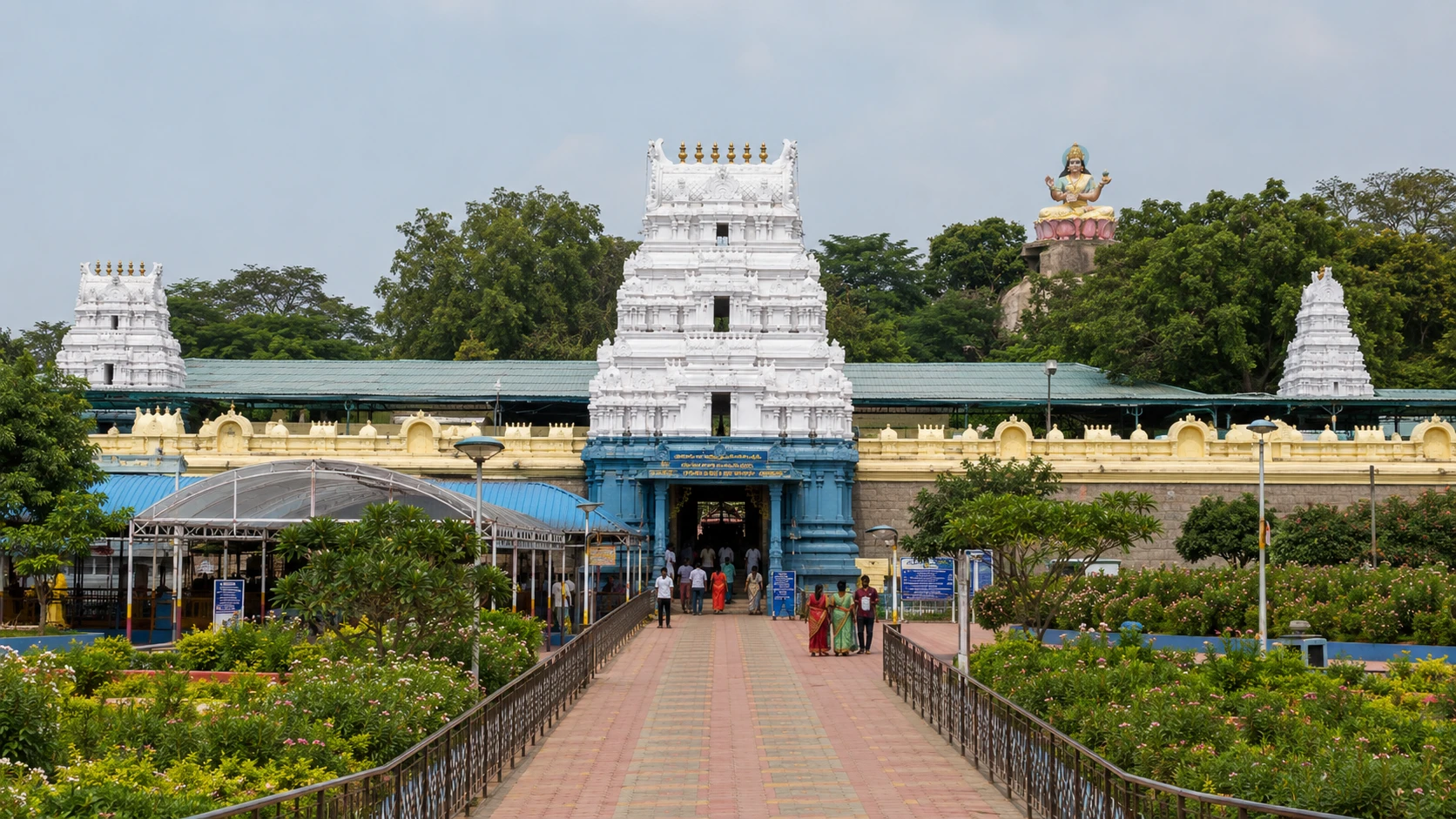
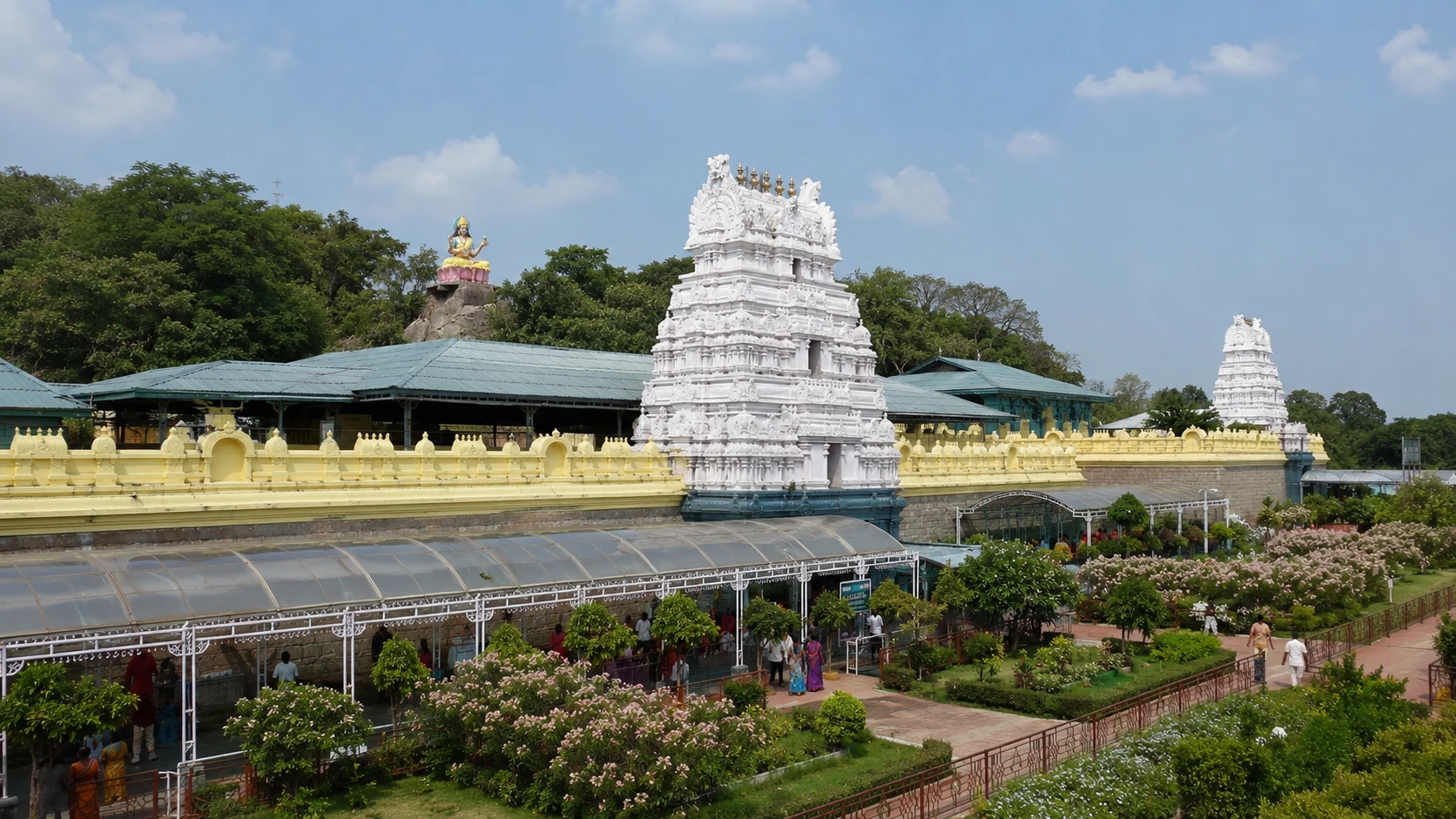
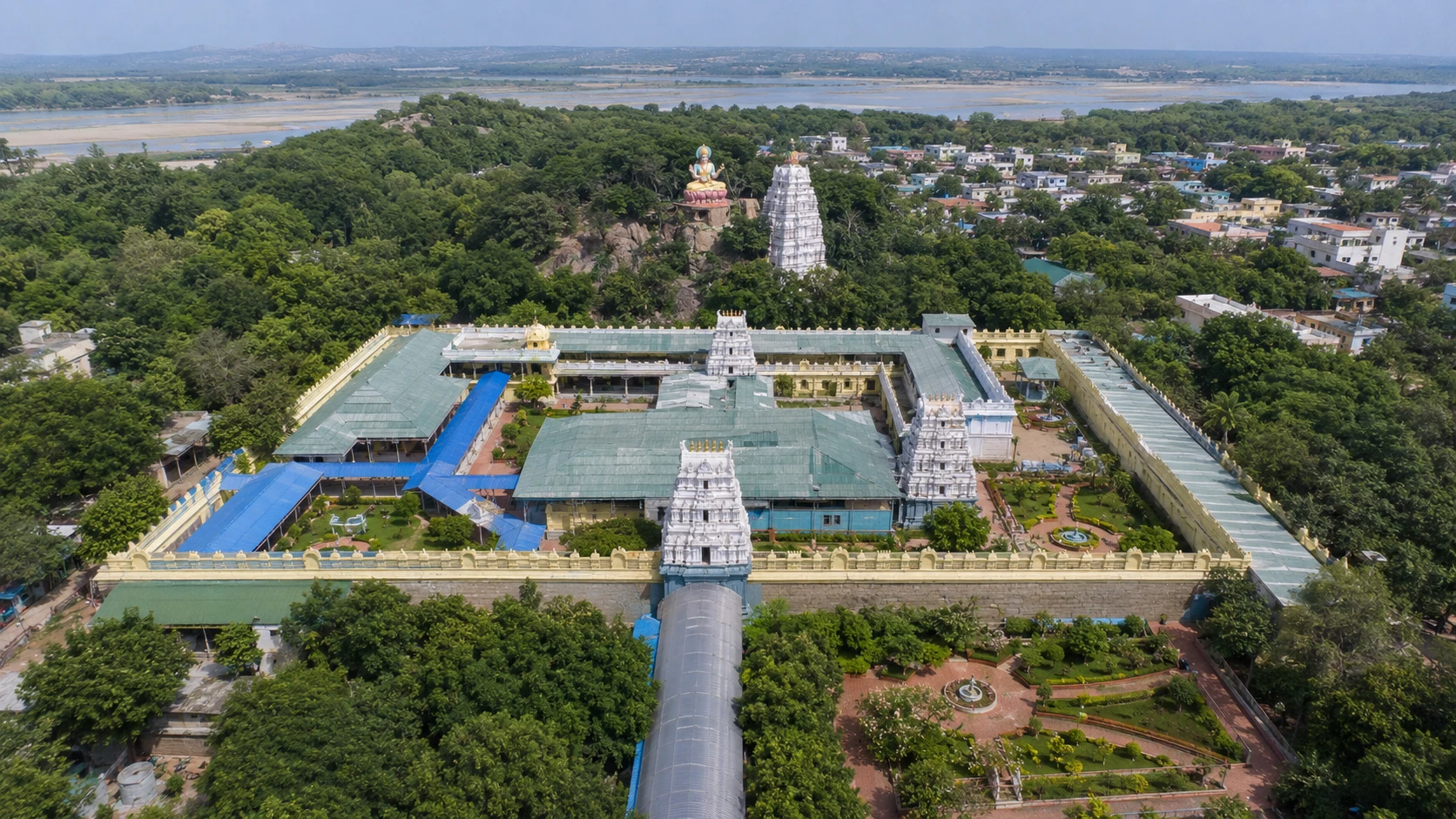
The Sri Gnana Saraswati Devi Temple at Basar is, alongside the Sharadamba Temple at Sringeri, one of India's two principal temples dedicated to Saraswati — the goddess of speech, learning, music, and the cultivated arts. A third major Saraswati shrine, Sharda Mata at Maihar, is sometimes added to make a triad, but Basar and Sringeri are the universally-acknowledged anchors of the Saraswati devotional tradition. What makes Basar distinctive within this small group is the temple's foundational narrative — Sage Vyasa is said to have shaped the goddess's idol himself from the sands of the Godavari — and its operational identity as the principal site in India for Aksharabhyasam, the ritual initiation of a child into the formal world of letters and learning. The temple sits on the south bank of the Godavari in the Nirmal district of Telangana, about 200 kilometres from Hyderabad. The sanctum holds three idols, all attributed by tradition to Vyasa's own shaping: Saraswati at the centre, Mahalakshmi to her devotional left, and Mahakali to her devotional right — making Basar, like Mahalakshmi Mumbai but with the deity of focus reversed, one of the rare temples in which all three Mahadevis are enshrined together on a single platform as the Tridevi. The Saraswati murti is shown four-armed, holding her classical attributes — the veena (the South Indian stick-zither), the pustaka (a palm-leaf manuscript), the akshamala (rosary), and the kamandalu (water-pot) — and is dressed in the white-and-gold combination traditional to the goddess. The Aksharabhyasam ritual is what draws most devotees here. Hindu parents from across Telangana, Andhra Pradesh, Maharashtra, Karnataka, and increasingly from across India bring their young children (typically aged three to five) to the temple to begin formal learning. The child sits before the goddess; a temple priest guides the child's hand to write the first letters of the Telugu, Devanagari, or Tamil alphabet — depending on the family's tradition — on a plate of rice, or directly onto the temple's specially prepared surface. The first letter inscribed is typically the syllable 'Om' or the opening letter 'Aa', followed by the Saraswati-vandana invocation. Many tens of thousands of Aksharabhyasams are performed at the temple each year, with peak concentrations on Vasanta Panchami (the goddess's principal festival), Vijayadashami, Akshaya Tritiya, and other auspicious days. The ceremony is one of the most quietly significant rites of passage in the South Indian Hindu tradition, marking the formal entry of a child into the world of learning under the goddess's direct blessing.
Sacred Designationपवित्र पदनाम
Sacred Origin Storyपवित्र उत्पत्ति कथा
Source: Sthala Purana of Basar (regional Telugu and Marathi devotional sources) for the Vyasa narrative; Brahmanda Purana and Skanda Purana for the broader Saraswati theological framework; the Aksharabhyasam tradition is attested in classical South Indian household-rite literature (grihya-sutra and post-grihya regional samskara-paddhati texts) and is not specific to this temple but is operationally most-associated with it.
The Basar foundational narrative is set in the period immediately following Sage Vyasa's composition of the Mahabharata. By tradition, Vyasa — the rishi who organised the Vedas into four samhitas, who composed the Brahma Sutras, who transmitted the Bhagavata and the principal Puranas, and who composed the world's longest epic — finished the labour of the Mahabharata in a state of profound spiritual exhaustion. The work he had completed was vast; the moral burden it carried was vaster. Having narrated the destruction of two royal families, the loss of an entire warrior generation, and the slow ethical disintegration that precedes that loss, Vyasa needed silence, repair, and the recovery of the goddess of speech without whom further composition was impossible.
He came to a quiet spot on the south bank of the Godavari — a forested stretch near the river's confluence with the Manjira, well-watered, removed from the political turmoil of the post-war kingdoms. He chose this place specifically for its silence, and resolved to do penance to Saraswati. The Sthala Purana describes his daily routine over the course of his stay: he would rise before dawn, bathe in the Godavari, and on his return from the river he would gather a handful of fine sand from the riverbank. With this sand he shaped, over the course of three successive days, three small idols on the platform he had chosen as his place of worship. On the first day he shaped Saraswati. On the second day he shaped Mahalakshmi. On the third day he shaped Mahakali. The three idols, formed of Godavari sand, became the focus of his daily worship through the period of his penance.
The place came to be called Vyasara — 'the place of Vyasa's worship' — and over the centuries the name shortened first to Basara (which remains the dominant regional spelling in Telugu and Marathi sources) and then in modern usage to Basar. The three sand-idols that Vyasa shaped are, by tradition, the idols enshrined in the present temple — preserved across millennia in the inner sanctum, periodically re-strengthened with consecrated materials but in their core form continuous with what Vyasa is said to have made. The temple's distinctive operational ritual — Aksharabhyasam, the initiation of children into formal learning — connects to this founding narrative through the figure of Vyasa himself, the world-architect of the written-and-recited tradition: a child at Basar is brought into the same lineage of letters that Vyasa undertook to organise.
The broader Saraswati theological framework — drawn from the Brahmanda Purana, the Skanda Purana, and the Vedic Sri Suktam and Sarasvati Suktam — places the goddess as the consort of Brahma, the principle of vak (speech and articulate utterance) without which Brahma's creative act is impossible. The Devi-tradition's later integration makes her one of the three primary Mahadevis (with Mahalakshmi and Mahakali); the Tridevi enshrinement at Basar reflects this integration, with Saraswati restored to her position as the deity of focus rather than (as at Mahalakshmi Mumbai) being the right-hand companion. The Aksharabhyasam ritual itself is not specific to Basar — household-rite literature attests it widely as a samskara performed at home or at any Saraswati shrine — but its operational concentration at Basar makes the temple the principal national site for the rite.
उद्धृत स्रोत:
- Sthala Purana of Basar (regional Telugu and Marathi devotional traditions)
- Brahmanda Purana — Saraswati theological framework
- Skanda Purana — Saraswati references in the Devi sections
- Rigveda khila Sri Suktam and Sarasvati Suktam (Vedic foundational hymns for the goddess)
- Devi Bhagavata Purana — broader Tridevi theological integration
- Endowments Department, Government of Telangana — temple historical record
- Andhra Pradesh / Telangana State Gazetteers — Nirmal district entries
अन्य परंपराएँ · अन्य परंपराएँ
विद्वत संदर्भ
The Basar narrative is editorially distinctive in three registers. First, in its textual basis: the Vyasa-founding narrative is principally preserved in regional Sthala Purana literature in Telugu and Marathi devotional traditions, with parallels in some Brahmanda-Purana-derived material. The narrative is not securely attested in the canonical pan-Indian Sanskrit Purana corpus in the way that, for example, the Annapurna Kashi-narrative is attested in the Skanda Purana Kashi Khanda. This is not unusual for South Indian Devi-shrine origin narratives, many of which have stronger regional textual bases than pan-Indian Sanskrit-corpus attestations, but it does mean that the Vyasa-founding narrative should be treated as a tradition transmitted within South Indian Shakta devotionalism rather than a pan-Indian canonical narrative. Second, in its historical reconstruction: the temple's pre-modern history is layered. Various regional sources attribute construction or renovation phases to the Badami Chalukyas (c. 6th–8th centuries CE), the Kakatiyas of Warangal (c. 12th–14th centuries CE), and the Marathas of the eighteenth century. The relative weight of these attributions is debated, and the precise extent of new construction versus restoration in each phase is not finally settled. The temple's present visible fabric is the cumulative result of these layered commissions plus twentieth-century renovations. Third, in its operational distinctiveness: the Aksharabhyasam tradition itself is not unique to Basar. The samskara of formal letter-initiation is widely attested in grihya-sutra-derived household-rite literature and is performed at Saraswati shrines across India (including Sringeri and at many smaller local Devi-shrines) and also in household settings without temple involvement. What Basar has achieved through the twentieth and early twenty-first centuries is operational concentration: the temple has become the principal organised national site for the rite, with formalised seva-booking, dedicated mandapa-spaces, and an organisational infrastructure capable of conducting hundreds or thousands of ceremonies per day during peak periods. This operational scale is itself a modern-era development; pre-twentieth-century Basar conducted Aksharabhyasam ceremonies but at much smaller scale. The temple's identity as 'the' Aksharabhyasam destination is therefore a twentieth-century devotional-tradition development rather than a continuous ancient claim. A point of editorial care: the temple is administered by the Endowments Department of the Government of Telangana State (since the 2014 formation of Telangana state from the bifurcation of Andhra Pradesh, the temple's administrative governance shifted from the Andhra Pradesh Endowments Department to the Telangana counterpart). It is therefore a public-trust administered shrine in administrative architecture similar to Annapurna Varanasi (Shri Kashi Vishwanath Temple Trust) rather than the private-trust model of Mahalakshmi Mumbai. Operational realities — pricing, queue-management, seva-booking — operate under public-law oversight.
Historyइतिहास
The history of Devi-worship at Basar is, like much pre-modern Indian sacred-site history, a story told in layers, with different traditions attesting different early phases. The Vyasa-founding narrative (see Mythology) places the site's sacred identity in the post-Mahabharata-composition period; archaeologically that places no specific date, but it does establish the cultural framework within which all subsequent commissions operated. Basar's geographic position — on the south bank of the Godavari near its confluence with the Manjira, in a region that has been at the intersection of Deccan-Plateau and northern political-cultural currents for two millennia — meant that the site was patronised by successive ruling dynasties as they extended their sphere of religious patronage into the Telangana-Andhra plateau.
The Badami Chalukyas (c. 6th–8th centuries CE), whose patronage extended across substantial portions of the western and central Deccan, are credited by some regional sources with the temple's earliest constructed phase. The Kakatiya dynasty of Warangal (c. 12th–14th centuries CE), the principal Telugu-speaking medieval political power, are credited with significant patronage and possibly with substantial renovation. The Vijayanagara empire (14th–17th centuries CE) extended its religious patronage into this region during its periods of northward expansion. The eighteenth-century Maratha confederacy, particularly during the Peshwa-era expansion into the Telangana plateau, contributed further patronage and renovation; the Maratha-era contribution accounts for the presence of the Dattatreya sub-shrine within the precinct (Datta-sampradaya being a strong Maratha-era devotional movement) and for the substantial Maharashtrian devotee component that the temple draws to this day.
Through the eighteenth and nineteenth centuries the temple operated under the patronage of the Nizam's Hyderabad State, into which Basar fell after the eighteenth-century settlement of Deccan political boundaries. The Nizam-era Hyderabad State, while a Muslim-ruled polity, maintained an integrated administrative-and-religious framework that included temple endowments; Basar continued operating under this framework. Following Indian independence (1947) and the integration of Hyderabad State into the Indian Union (1948), the temple came under the administrative framework of Andhra Pradesh (formed in 1956 from the linguistic reorganisation of states). Following the 2014 bifurcation of Andhra Pradesh into Andhra Pradesh and Telangana, the temple came under the administrative jurisdiction of the Telangana State Endowments Department.
The twentieth century is the period of the temple's emergence as the principal national Aksharabhyasam site. Pre-twentieth-century Basar conducted Aksharabhyasam ceremonies but at much smaller scale; the operational concentration of the rite at this temple is a development of the post-independence period, accelerating particularly from the 1960s and 1970s onward as South Indian Hindu households increasingly identified Basar as 'the' destination for the rite. The temple's Aksharabhyasam-ceremony infrastructure — dedicated mandapa-spaces, formalised seva-booking, multi-line parallel ceremony operation on peak days — was built out across the 1970s, 1980s, and 1990s, and continues to expand. The 2014 transition to Telangana State Endowments Department oversight brought renewed investment in temple infrastructure and accessibility.
Historical Timelineऐतिहासिक कालक्रम
Sage Vyasa, having completed the composition of the Mahabharata, comes to the Basar site on the Godavari's south bank for spiritual restoration. By tradition, he shapes three sand-idols from the Godavari's banks over three successive days — Saraswati, Mahalakshmi, and Mahakali — and conducts his penance to the goddess of speech here. The site comes to be called Vyasara ('the place of Vyasa's worship'), later shortened to Basara/Basar.
The Badami Chalukya dynasty, whose patronage extends across substantial portions of the western and central Deccan, is credited by some regional sources with the temple's earliest constructed phase. The architectural and inscriptional record for this attribution is limited; the more secure historical attestation comes with later dynasties.
The Kakatiya dynasty of Warangal, the principal Telugu-speaking medieval political power, is credited with significant patronage of the temple and possibly with substantial renovation or expansion of the structure. The Kakatiya-period architectural elements visible within the temple's present fabric (particularly in stone-work and mandapa-columns) support this attribution.
The Vijayanagara empire extends its religious patronage into the region during its periods of northward expansion. The empire's general policy of supporting major Hindu pilgrimage centres extends to Basar, though the specific scale of Vijayanagara-period intervention here is debated.
The Maratha confederacy, particularly during the Peshwa-era expansion into the Telangana plateau, contributes further patronage and renovation. The Dattatreya sub-shrine within the Basar precinct is attributable to this period, and the temple's enduring strong devotee constituency among Maharashtrian families is a direct legacy of the Maratha-era integration of Basar into the Datta-sampradaya pilgrimage geography.
The temple operates under the patronage and administrative framework of the Nizam's Hyderabad State, which maintained integrated temple-endowment infrastructure across the state's substantial Hindu pilgrimage geography. The Nizam-era policy supported continued temple operations without interrupting devotional practice.
Hyderabad State integrates into the Indian Union following Operation Polo. The temple, like all Hyderabad-State religious endowments, comes under the new administrative framework of the Indian Union — initially under the Hyderabad State successor administration, and from 1956 under the newly-formed Andhra Pradesh state.
The temple emerges as the principal national Aksharabhyasam destination across this period, with operational infrastructure progressively developed to support the growing scale of the ceremony. Dedicated mandapa-spaces for Aksharabhyasam, formalised seva-booking, multi-line parallel ceremony operation on peak days, and prasad-distribution infrastructure are all built out during this period. Annual ceremony volume grows from hundreds in the early 1960s to many tens of thousands by the 1990s.
The bifurcation of Andhra Pradesh into the residual Andhra Pradesh state and the new Telangana state brings the temple under the administrative jurisdiction of the Telangana State Endowments Department. The transition involves no immediate operational change but does shift administrative oversight, budgeting, and policy coordination from Hyderabad-as-Andhra-Pradesh-capital to Hyderabad-as-Telangana-capital.
The temple closes during the strictest phases of the COVID-19 lockdowns from late March 2020. Reopening proceeds in stages from late 2020 with attendance caps, mandatory masking, and ceremony-distancing protocols affecting Aksharabhyasam operations particularly significantly. Full-capacity Aksharabhyasam operations resume through 2021–2022, with several digitised booking and queue-management protocols retained from the period.
Post-pandemic operations stabilise with hybrid online-and-offline Aksharabhyasam booking, expanded digital seva-pricing transparency, and renewed infrastructure investment under Telangana State Endowments Department oversight. Annual Aksharabhyasam volume returns to and exceeds pre-pandemic levels.
What You'll Seeदर्शन में
The principal sanctum holds three Devi murtis arranged on a single platform behind a stone-and-metal railing, with the central position held by Saraswati. The Saraswati murti — Sri Gnana Saraswati, the goddess of knowledge in its fullest realisation — is shown four-armed and seated in lalitasana. In her right hands she holds the akshamala (rosary, signifying meditation and the disciplined repetition of mantras) and the pustaka (a palm-leaf manuscript or book, signifying the textual corpus of learning); in her left hands she holds the veena (the South Indian stick-zither which is the goddess's signature instrument, signifying music and the cultivated arts) and the kamandalu (water-pot, signifying purification and the sustaining of life). The veena is the iconographic element that most-distinctively identifies Saraswati and is rendered here at relatively large scale across her lap, with the fingerboard rising and the resonator-gourd visible below. Her vahana — the swan (hamsa) or peacock (mayura), depending on the tradition — is rendered as a small flanking figure rather than as a mount carrying her.
Saraswati's attire is the white-and-gold combination traditional to the goddess of speech and learning: white symbolising the purity of knowledge, the un-coloured-state from which all colours arise; gold symbolising the value of cultivated wisdom. Her crown (mukuta) is high but restrained; her jewellery is full but not heavy; her expression is serene, attentive rather than smiling. The face of the murti is characteristically Telugu-Telangana in its visual conventions — round, full-cheeked, with large eyes lined with collyrium.
Mahalakshmi on the central figure's left (devotee's right) and Mahakali on the central figure's right (devotee's left) complete the Tridevi platform. Both are smaller in scale than Saraswati and are dressed in their characteristic colours — Mahalakshmi in red-and-gold, Mahakali in deep red-or-black. Mahalakshmi holds her standard attributes (lotus, kalasha, akshamala, varada-mudra) and Mahakali holds hers (sword, trident, severed head in stylised form, kapala). Note that the disposition reverses Mahalakshmi Mumbai's arrangement: at Basar, Saraswati is centre, Mahalakshmi is to the side; at Mahalakshmi Mumbai, Mahalakshmi is centre, Mahasaraswati is to the side. The two temples can be read as mirror-images of each other within the same Tridevi tradition.
The Vyasa sub-shrine houses an iconographic image of the sage seated in meditation, holding a palm-leaf manuscript and the rosary — the iconographic conventions for a rishi-as-textual-author. The sub-shrine is positioned within the broader temple precinct and is part of the standard devotional circuit; many devotees take darshan of Vyasa first (as the founding sage) before proceeding to the Tridevi sanctum.
The Lakshmi Narasimha and Dattatreya sub-shrines within the precinct are iconographically standard for their respective traditions: Lakshmi Narasimha in the seated-with-Lakshmi-on-lap configuration characteristic of South Indian Narasimha worship; Dattatreya in the standard three-headed (Brahma-Vishnu-Shiva) standing form with attendant cows and dogs.
Photography within the inner sanctum is restricted, though the policy is less stringent than at the Kashi Vishwanath Corridor: devotees are asked not to photograph during darshan and not to use flash, but mobile phones do not need to be deposited at electronics-locker counters as at Kashi. Photography is permitted in the outer prasad-distribution and Aksharabhyasam-ceremony areas, in the courtyards, and at the Vyasa sub-shrine. The Telangana State Endowments Department releases official photography of the central murti for festival documentation.
Distinctive Practicesविशिष्ट परंपराएँ
Aksharabhyasam (formal initiation into learning)
अक्षराभ्यासम (औपचारिक विद्यारम्भ)
The temple's principal distinctive practice and the operational identity that draws most pilgrims to Basar. Hindu families bring their children (typically aged three to five) to be initiated into the formal world of letters and learning. The ceremony unfolds in a dedicated mandapa-space adjacent to the main sanctum: the child sits before the goddess on a small platform; a temple priest invokes Saraswati through the Saraswati-vandana (a brief Sanskrit invocation); the child is given a small handful of rice grains on a plate or tray; the priest guides the child's right index finger to inscribe the first letters — typically the syllable 'Om' followed by the opening letter 'Aa' or 'Sri' — onto the rice surface. The script used is the family's traditional script (Telugu, Devanagari, Tamil, Kannada, or Marathi being the most common at Basar). The ceremony closes with the priest blessing the child, the family offering a small dakshina (priestly honorarium), and the child receiving prasad. Many tens of thousands of these ceremonies are conducted at Basar each year.
Godavari snanam (river-bath) prior to darshan
दर्शन से पूर्व गोदावरी स्नानम
The Godavari flows immediately north of the temple, and the tradition of bathing in the river before entering the sanctum is unbroken at Basar. Devotees commonly perform a Godavari-snan at one of the small bathing-steps cut into the south bank near the temple, change into clean clothes, and then approach the temple for darshan. The Godavari-snan is theologically appropriate to the Vyasa-founding narrative — Vyasa himself, by tradition, bathed in the Godavari each day before commencing his daily worship — and is observed by most regular pilgrims.
Vasanta Panchami special seva and shringar
वसन्त पञ्चमी विशेष सेवा और शृङ्गार
Vasanta Panchami — the fifth day of the bright fortnight of Magha (January–February) — is Saraswati's principal pan-Indian festival and the temple's largest single-day observance. The central murti is dressed in a specially-prepared yellow-and-white shringar (yellow is Vasanta Panchami's signature colour, associated with the mustard-flower fields that bloom at this season); a special abhishekam is conducted at dawn; Aksharabhyasam ceremonies operate at maximum capacity through the day; and the temple hosts musical and literary performances in the evening — vocalists, veena-players, and Sanskrit-and-Telugu reciters offering their art to the goddess. Cumulative attendance on Vasanta Panchami routinely crosses 100,000.
Saraswati-vandana recitation at the commencement of formal study
औपचारिक अध्ययन के आरम्भ पर सरस्वती-वन्दना पाठ
The Saraswati-vandana — particularly the verse 'Yaa kundendu tushaara haara dhavalaa, yaa shubhra vastraavrita; yaa veena vara danda mandita karaa, yaa shweta padmaasanaa' — is recited at the temple by Aksharabhyasam-ceremony families, by students about to begin a formal course of study, and by individual devotees who have come specifically to ask the goddess's blessing for a learning project. The verse, of uncertain authorship but pan-Indian in distribution, is the most commonly-known Saraswati-invocation in modern Indian Hindu practice and is the verse most-frequently chanted at the temple.
Examination-result and academic-success offerings
परीक्षा-परिणाम और शैक्षणिक-सफलता अर्पण
A distinctive operational pattern at Basar is the visible spike in attendance around major examination result-announcements and academic admission-seasons. Telangana, Andhra Pradesh, and Karnataka state-board results, central CBSE/ICSE results, IIT-JEE / NEET / EAMCET entrance-examination results, and university examination cycles all generate identifiable spikes in temple attendance from successful students and their families, who come to complete vow-offerings (vows typically made when the student commenced the course of study) and to thank the goddess. The temple's Aksharabhyasam mandapa-spaces are sometimes repurposed during these spikes to accommodate vow-completion ceremonies.
Combined Tridevi darshan with Vyasa sub-shrine visit
व्यास उप-मन्दिर भेंट के साथ संयुक्त त्रिदेवी दर्शन
The standard devotional circuit at Basar includes darshan of the Vyasa sub-shrine in addition to the Tridevi sanctum. Many devotees take darshan of Vyasa first — acknowledging the founding sage and the lineage of letters he organised — before proceeding to the Tridevi platform. Some devotees, particularly those of Maharashtrian background, also include the Dattatreya sub-shrine in their darshan circuit. The full combined-circuit darshan takes 45–90 minutes depending on Aksharabhyasam-ceremony-day concentrations.
Did You Know?क्या आप जानते हैं?
Basar is one of the three principal Saraswati temples of India in the most-widely-cited tradition — alongside Sringeri Sharadamba (Karnataka, the Adi Shankaracharya Sarada Peetham) and Maihar Sharda Devi (Madhya Pradesh). Variant lists exist (some traditions substitute Pushkar Saraswati in Rajasthan or Koothanur Saraswati in Tamil Nadu) and there is no single authoritative enumeration.
The temple is operationally the most learning-initiation-centric Saraswati shrine in southern India: many tens of thousands of Aksharabhyasam ceremonies are conducted each year, with hundreds performed on a single Vasant Panchami day. The ceremony involves the child tracing the first letters of the alphabet on a bed of rice grains under the priest's guidance, with the goddess's image before them.
The temple's founding tradition holds that Maharshi Veda Vyasa shaped the three murtis (Saraswati, Lakshmi, Kali) from the sand of the Godavari river, and that the goddess's blessing transformed the sand into permanent form. The narrative places the temple's sacred identity in the post-Mahabharata-composition period, with Vyasa choosing this Godavari-bank for his post-war tapas.
The village name 'Basar' is derived through linguistic contraction from 'Vyasa Vasara' ('Vyasa's residence'), which was itself a contraction of 'Vyasapuri' ('Vyasa's town'). The etymological chain Vyasapuri → Vyasa Vasara → Basara → Basar is one of the clearer instances of a temple's founding-narrative being preserved in the place-name.
Like Mumbai Mahalakshmi, Basar enshrines the Tridevi (Saraswati, Lakshmi, Kali) on a single platform — but with Saraswati at the centre rather than Lakshmi, reflecting the temple's primary dedication. The two temples taken together illustrate how the same Tridevi configuration can be re-centred around different principal deities according to the founding tradition.
The temple precinct includes a subsidiary shrine to Vyasa Maharshi himself — the founding-tradition seer — which is unusual: most Hindu temples do not enshrine the rishi associated with their founding narrative as a separate sanctum within the same precinct. The Vyasa shrine is included in the standard darshan circuit at Basar.
A subsidiary shrine to Datta (Dattatreya) is also present in the precinct, reflecting the strong presence of the Datta Sampradaya across the Telangana-Maharashtra cultural belt that Basar sits within. Pilgrims from Maharashtrian backgrounds frequently include the Datta sub-shrine in their darshan circuit.
The temple was part of the Hyderabad State (Nizam's dominion) until the police action of September 1948 brought it into the Indian Union; after the linguistic reorganisation it became part of Andhra Pradesh, and after the 2014 creation of Telangana state it transitioned to the Telangana State Endowments Department. The administrative trajectory parallels much of the temple architecture of this Marathi-Telugu frontier zone.
Like Annapurna Varanasi, Basar is administered as a public-trust shrine under a state Endowments Department (the Telangana State Endowments Department, post the 2014 reorganisation from Andhra Pradesh), not as a private religious trust. This administrative architecture contrasts with Mahalakshmi Mumbai's private-trust model and means operational protocols — pricing, queue management, seva booking, Aksharabhyasam scheduling — operate under public-law oversight.
The temple's Aksharabhyasam draws families from across the southern Indian linguistic landscape — children commonly write their first letters in Telugu, Devanagari (for Hindi/Marathi), Tamil, or Kannada at Basar. The choice of script is the family's, not the temple's; the priest guides the inscription regardless of script. This multi-script reality is rare among Indian temples and reflects Basar's position as a pan-southern-India Saraswati destination.
Devotees frequently complete a Godavari snanam (river-bath) at the temple's adjacent ghats before darshan. The Godavari is considered the principal sacred river of the Deccan — sometimes called the 'Ganga of the South' — and a snanam before Aksharabhyasam adds a layer of purificatory observance to the initiation ceremony.
Festivalsत्योहार
Vasant Panchami (Sri Panchami / Saraswati Jayanti)
वसन्त पंचमी (श्री पंचमी / सरस्वती जयन्ती)
The temple's principal festival and the day on which the largest single concentration of Aksharabhyasam ceremonies is conducted each year. Many tens of thousands of families bring their children to Basar on this day; the queues for Aksharabhyasam form before dawn and the dedicated mandapas remain in continuous use through the day, with priest-teams rotating to maintain the ceremonial throughput. The goddess is decorated in white-and-gold shringar appropriate to her day; special abhishekam, Saraswati-stotram recitation, and elaborate floral offerings mark the morning ritual.
Sharadiya Navaratri
शारदीय नवरात्रि
Across the southern Indian Devi tradition, the seventh, eighth, and ninth nights of Sharadiya Navaratri are particularly associated with Saraswati — the seventh night being Saraswati Avahan (the goddess's formal invocation), the eighth Saraswati Puja, and the ninth being the day on which books, instruments, and tools of learning are placed before the goddess for blessing. Basar sees substantial Aksharabhyasam attendance through these nine nights, second only to Vasant Panchami in volume.
Chaitra Navaratri (Vasanta Navaratri)
चैत्र नवरात्रि (वसन्त नवरात्रि)
The vernal counterpart to Sharadiya Navaratri. At Basar, the Chaitra observance sees moderate Aksharabhyasam attendance — substantially less than the Sharadiya nine nights — and is more focused on the temple's regular ritual cycle. The closing Ramnavami day connects the Devi observance to Vaishnava devotion through the Rama narrative.
Guru Purnima (Vyasa Purnima)
गुरु पूर्णिमा (व्यास पूर्णिमा)
Particularly significant at Basar because of the temple's founding tradition tying it to Maharshi Veda Vyasa. The Vyasa sub-shrine within the precinct sees its highest annual attendance on Guru Purnima; teachers, students, and lineage-holders from across the southern Indian academic and devotional landscape bring offerings to the Vyasa shrine alongside their darshan of Saraswati.
Maha Shivratri
महाशिवरात्रि
Although primarily a Shaiva observance, the Mahadeva sub-shrine within the Basar precinct draws expanded attendance on Maha Shivratri. The day's observances draw families completing Saraswati-Mahadeva combined darshan, particularly those local to the Telangana-Maharashtra cultural belt where Datta-Shiva-Saraswati syncretic devotion is well-established.
Datta Jayanti
दत्त जयन्ती
The Datta sub-shrine within the Basar precinct draws particular attendance from Maharashtrian devotees on Datta Jayanti. The day commemorates the appearance-anniversary of Dattatreya and is observed across the Telangana-Maharashtra Datta Sampradaya belt. At Basar the Datta observance is added to a regular Saraswati darshan rather than being the day's primary observance, but the sub-shrine's special darshan window and Maharashtrian-tradition aarti are conducted.
Devi Bhagavata Saptaha
देवी भागवत सप्ताह
An annual seven-day continuous recitation of the Devi Bhagavata Purana is conducted by the temple at the river-facing mandapa, drawing scholars, Vaidikas, and devotees. The recitation reinforces the temple's textual foundations and is a significant academic-devotional event in the regional Sanskrit study circuit.
Traditional Offeringsपारंपरिक अर्पण
प्राथमिक अर्पण
White flowers (jasmine, white lotus, white champaka)
श्वेत पुष्प (चमेली, श्वेत कमल, श्वेत चम्पा)
White is Saraswati's signature colour, invoking the purity of knowledge and the clarity of thought she bestows. White flowers — particularly jasmine, white lotus, and white champaka — are offered at her feet during darshan; jasmine is the most readily available regional flower for the offering. Classical Saraswati invocations describe her as 'shukla varnam' (of white complexion) and 'shubhravarnam', and the white-flower offering aligns with this iconographic emphasis.
Rice grains (akshat)
अक्षत (चावल के दाने)
Rice grains are offered at the goddess's feet during darshan and are also the principal medium for the Aksharabhyasam ceremony — the child writes the first letters on a tray of rice grains. The double function of rice as both offering and learning-medium gives the grain a special place in Basar's devotional vocabulary; many devotees take home a small packet of sanctum-blessed rice grains for use in household Saraswati pujas, particularly to bless the start of school years or new academic ventures.
Books, pens, and instruments of learning
पुस्तकें, लेखनी, और शिक्षा के साधन
On Maha Navami (the ninth day of Sharadiya Navaratri) and on Vijayadashami, devotees bring books, pens, musical instruments, and other tools of their learning or profession to the temple to be placed before the goddess for blessing. The practice — sometimes called 'Ayudha Puja' in the broader southern Indian tradition — is particularly associated with academic and artistic vocations at Basar. After the blessing, the tools are taken back home and used in the year ahead with the goddess's grace.
Kumkum, turmeric, and sandal-paste (chandanam)
कुंकुम, हल्दी, और चन्दन-लेप
The triad of kumkum (vermilion), turmeric, and sandal-paste is offered at the goddess's feet and applied to her forehead. Sandal-paste (chandanam) is particularly significant in the southern Indian Saraswati tradition; the goddess is often depicted with chandanam-tilakam, and the paste is offered both for its cooling quality (associated with the calming of the mind that knowledge brings) and for its fragrance. The triad is also distributed to devotees as a prasad-mark.
Panchamrit (five sacred substances)
पंचामृत
The ritual bathing of the goddess with milk, curd, honey, ghee, and sugar is performed at major abhishekams. For Saraswati specifically, the panchamrit invokes the goddess's role as the principle of nourishing speech and clear thought — milk for purity, curd for the prosperity of knowledge, honey for the sweetness of refined speech, ghee for the lamp of learning, sugar for the joy that wisdom brings.
इस मंदिर की विशेषता
Aksharabhyasam rice-tray (the child's first-letter-inscription tray)
अक्षराभ्यासम् चावल-थाली (बच्चे की प्रथम-अक्षर-अंकन थाली)
Unique to Basar and a few other Aksharabhyasam-centric temples: the rice-tray on which the child inscribes the first letters of the alphabet is itself an offering — a small handful of rice is brought by the family, used in the ceremony, and afterwards returned to the family along with the priest's blessing. The rice is then preserved at home (often kept in a small pouch in the family's puja room) or used in the household's annual Saraswati puja.
Saraswati Sahasranama Archana (1,008-name continuous puja)
सरस्वती सहस्रनाम अर्चना (1,008-नाम निरन्तर पूजा)
Devotees sponsor the temple's Saraswati Sahasranama Archana — the chanting of the 1,008 names of Saraswati while floral offerings are made for each name — typically as a vow-completion for academic or artistic success. The full archana takes approximately 90 minutes and is conducted by trust priests with the sponsor in attendance. It is among the temple's most-booked seva offerings outside of Aksharabhyasam.
Sweet pongali and kesari prasad
मीठा पोङ्गलि और केसरी प्रसाद
The temple's signature sweet prasads — pongali (sweet rice with jaggery and ghee) and kesari (a saffron-and-sugar semolina sweet) — are distributed at counters near the exit. The choice is regional-South-Indian and reflects the temple's cultural setting; the prasads can be carried home or consumed on the temple grounds. Both are vegetarian and onion-and-garlic-free.
Devotees may bring offerings from outside the temple grounds or purchase them at the trust-operated counters near the entrance. Aksharabhyasam-participating families typically bring their own rice grains (the regional preference is small white rice, untreated) along with the prescribed priestly dakshina; the trust does not require these to be purchased on the premises. Coconut-breaking is done at the entrance area; flowers and chandanam are taken into the sanctum. Monetary offerings to the temple go through the trust counters for receipt; for larger sponsorship-amount offerings (Sahasranama Archana, Aksharabhyasam, full mahapuja), booking through the trust office or online portal is required.
How to Reachकैसे पहुँचें
Basar is well-connected by rail and road, and reasonably connected by air via Hyderabad or Nanded. By air, Rajiv Gandhi International Airport (HYD) at Hyderabad is the principal gateway at approximately 210 km — a 4-to-5-hour drive via NH44 and NH63 through Nizamabad. Nanded Airport (NDC) in Maharashtra is closer at approximately 100 km but has limited domestic connectivity; some devotees from western and central India prefer Nanded for its proximity. From either airport, pre-paid taxis or app-based cabs (Ola, Uber service Hyderabad but coverage thins toward Basar) are the principal options. By rail, Basar railway station (BSX) is approximately 1 km from the temple and is the closest railhead — it lies on the Secunderabad-Manmad corridor of the South Central Railway, with regular trains from Hyderabad/Secunderabad, Nanded, Aurangabad, Mumbai, and several other Maharashtra-Telangana junctions. Nizamabad Junction (NZB) at approximately 35 km is the larger nearby junction with broader connectivity including direct services from Delhi, Tirupati, and Bengaluru. From Basar railway station, auto-rickshaws and cycle-rickshaws cover the short distance to the temple. By road, NH44 (Hyderabad–Nagpur) connects to Basar via Nizamabad; state highways from Nanded, Adilabad, and Karimnagar also serve the route. Telangana State Road Transport Corporation (TSRTC) buses operate regular services between Hyderabad's Mahatma Gandhi Bus Station and Basar, with stops at Nizamabad, Bodhan, and Bhainsa; the journey takes approximately 5–6 hours by bus. Private taxi services from Hyderabad to Basar are widely available for day-trip and overnight bookings. Within Basar town, the temple precinct is approached on foot or by cycle-rickshaw from the bus stand and railway station; private parking is available at designated lots near the temple entrance.
Plan Your Visitयात्रा की योजना
🌤 सर्वोत्तम मौसम
October to February is the most comfortable period — temperatures range from 15–30°C with low humidity. Vasant Panchami (January–February) is the temple's most spiritually charged window but also the most crowded; pre-book accommodation and Aksharabhyasam slots well in advance. Sharadiya Navaratri (September–October) is the second-peak period. Avoid May–June (peak summer, 35–45°C, the temperature can make the riverside ghats uncomfortable) and the heart of the monsoon (mid-July through August) when the Godavari rises and ghat access can be disrupted. Weekday early-morning windows (06:30–09:00) are the least crowded throughout the year.
👘 पहनावे का नियम
Modest traditional dress is expected. For men, full-length trousers or dhotis with sleeved shirts or kurtas are appropriate; for women, sarees, salwar suits, or long skirts with covered shoulders are appropriate. For children attending Aksharabhyasam, traditional dress is strongly preferred — boys in dhoti or pyjama-kurta, girls in pavada-chunni or langa-voni — though not strictly enforced. Shorts, sleeveless tops, and very short dresses are not appropriate for sanctum darshan.
📱 फोन और फोटोग्राफी
Mobile phones must be on silent within the temple precinct. Photography with phones is permitted in the outer mandapa, courtyard, and river-facing platform but not in the inner sanctum or during darshan of the Tridevi murtis. Flash photography is discouraged everywhere. There is no phone-deposit requirement at the entrance, though devotees who wish to focus without distraction may use the cloakroom-locker facilities for valuables.
🏨 आवास
Basar town has limited accommodation — primarily a small number of dharmashalas operated by community trusts and a few budget lodges near the railway station and temple precinct. The Telangana State Endowments Department operates a modest pilgrim guesthouse near the temple; bookings should be made through the temple administration office or the state's tourism portal in advance. For better-equipped accommodation, devotees commonly stay in Nizamabad (~35 km, full range of hotels), Nirmal (~50 km, regional hotels), or Adilabad (~70 km). For families travelling for Aksharabhyasam during Vasant Panchami, pre-booking accommodation at least 30–45 days in advance is strongly recommended.
Book a Pujaपूजा बुक करें
The Basar temple operates under the Telangana State Endowments Department's protocols. Devotees should plan their visit around the following operational realities: (a) Aksharabhyasam ceremony slots are heavily oversubscribed during Vasant Panchami and the Sharadiya Navaratri nine nights — pre-book at least 30–45 days in advance for peak periods; (b) the temple administration does not authorise third-party agents or 'expediters' offering paid Aksharabhyasam-slot or darshan-skip services outside the trust's official channels; any such offer should be refused; (c) phone numbers and email addresses published on the trust's portal may change with administrative cycles — verify on the Telangana Endowments Department's official website before contacting; (d) several fraudulent websites and social-media pages impersonate the Basar temple administration around peak festival periods. Carry photo ID for ticketed-seva attendance.
Managed by: Telangana State Endowments Department — Sri Gnana Saraswati Devi Devasthanam, Basar
Aksharabhyasam ceremony (child's initiation into letters)
अक्षराभ्यासम् संस्कार (बच्चे की विद्यारम्भ-दीक्षा)
Saraswati Abhishekam (morning ritual bath)
सरस्वती अभिषेकम (प्रातः अनुष्ठानिक स्नान)
Saraswati Sahasranama Archana (1,008-name puja)
सरस्वती सहस्रनाम अर्चना (1,008-नाम पूजा)
Akhand Jyot (continuous oil/ghee lamp)
अखण्ड ज्योत (निरन्तर तेल/घी दीप)
Annadan (community meal sponsorship)
अन्नदान (सामुदायिक भोजन प्रायोजन)
Vasant Panchami special sponsorship
वसन्त पंचमी विशेष प्रायोजन
Booking information verified: 2026-05-21
Sacred Soundsपवित्र ध्वनि
Saraswati Vandana (Ya Kundendu Tushara Hara Dhavala)
stotram
Saraswati Stotram (Brahma's hymn from the Brahmanda Purana)
stotram
Saraswati Ashtottara Shatanamavali (108 names of Saraswati)
stotram
Saraswati Dvadasanama Stotram (the twelve names of Saraswati)
stotram
Devi Mahatmya (Durga Saptashati — recited at Navaratri)
stotram
Devi Bhagavata Purana — Saraswati-related excerpts (recited during the annual Saptaha)
stotram
Saraswati Aarti (Jai Saraswati Mata)
aarti
क्या आप जानते हैं? · Did You Know?
वही अनुवाद त्रुटि जिसने हिन्दू धर्म में '33 कोटि' को '33 करोड़' बनाया, बौद्ध धर्म में भी हुई। बौद्ध ग्रन्थों के चीनी अनुवाद ने 'सप्त कोटि बुद्ध' (7 श्रेष्ठ बुद्ध) का अनुवाद '7 करोड़ बुद्ध' कर दिया। तिब्बती अनुवाद ने सही किया: 7 प्रकार, 7 करोड़ नहीं। एक संस्कृत शब्द, दो प्रमुख विश्व धर्मों में गलत पढ़ा गया, ने दो एकसमान भ्रम स्वतन्त्र रूप से उत्पन्न किए।
Related Contentसंबंधित सामग्री
Related Scriptures
Community Reflections
🕉️
Be the first to share your reflection.