Annapurna Mandir (Varanasi)
अन्नपूर्णा मंदिर
Kashi's goddess of food, who fed Shiva himself when he came begging
Varanasi, Uttar Pradesh, India
Annapūrṇā Devī Mandir, VārāṇasīAlso known as: Annapurna Mata Mandir, Maa Annapurna Mandir, Annapoorna Devi Temple, Kashi Annapurna, अन्नपूर्णा देवी मंदिर, वाराणसी, माँ अन्नपूर्णा मंदिर
खुला
04:00 – 23:30
पवित्र कथा · पवित्र कथा
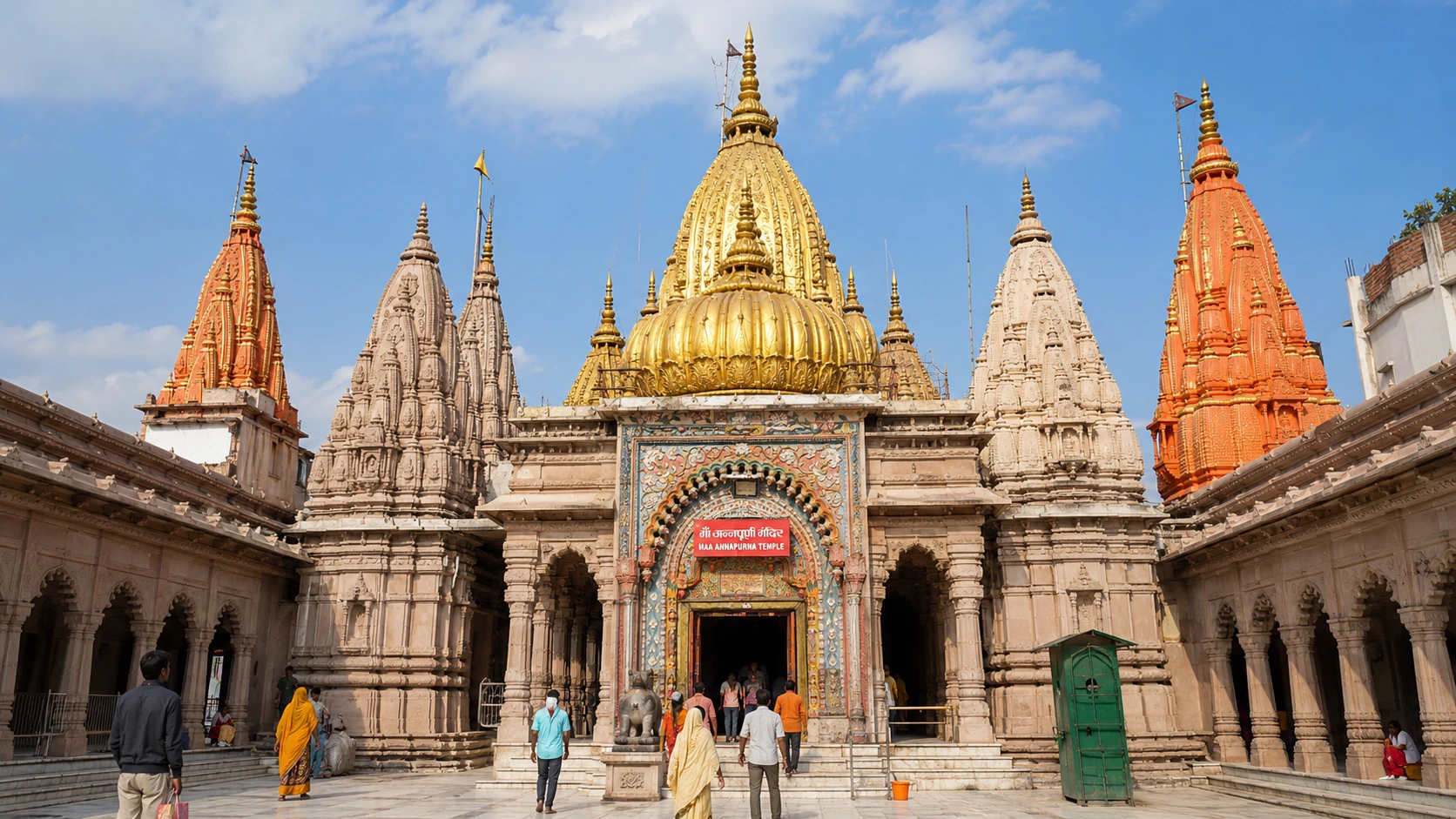
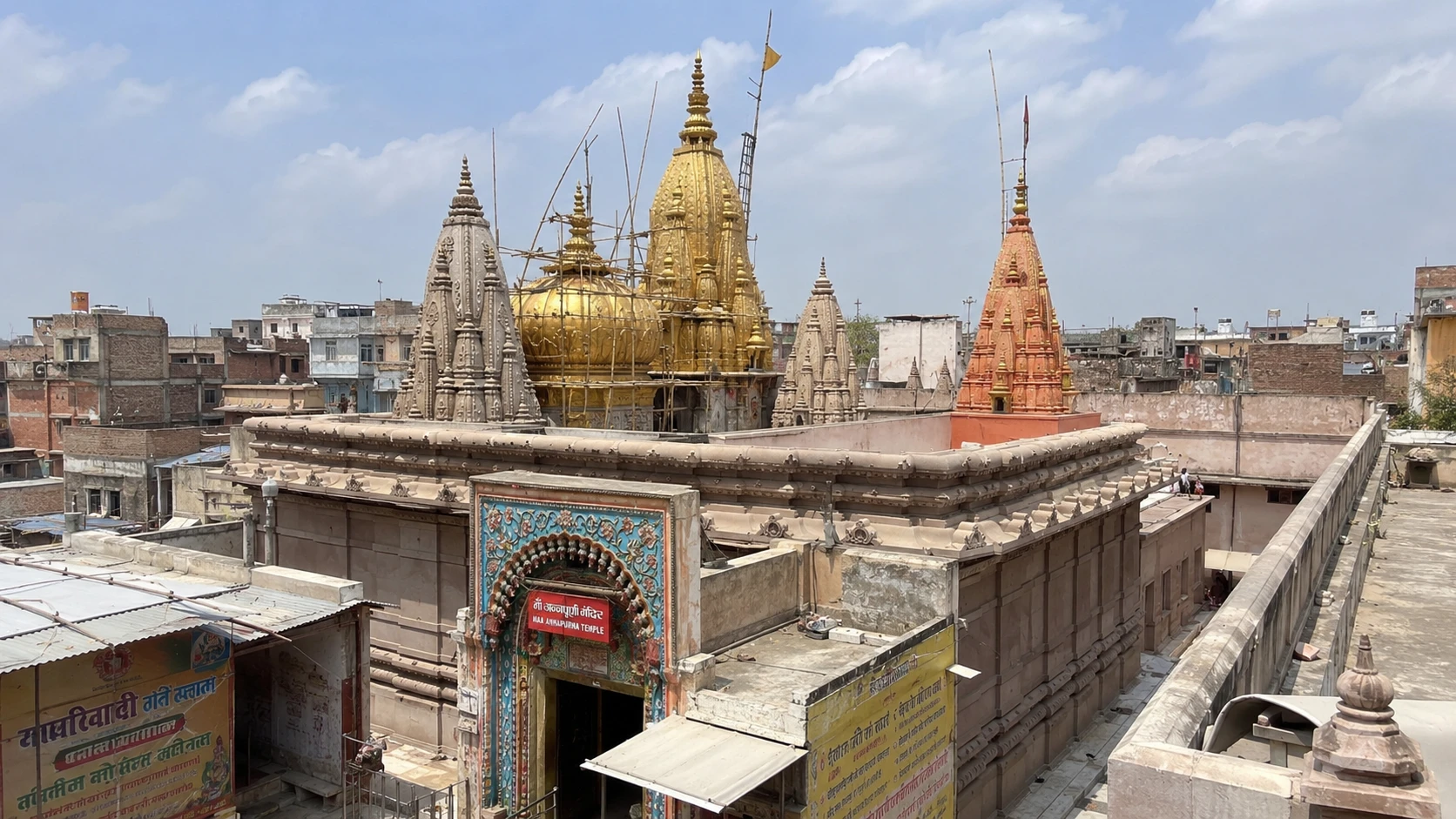
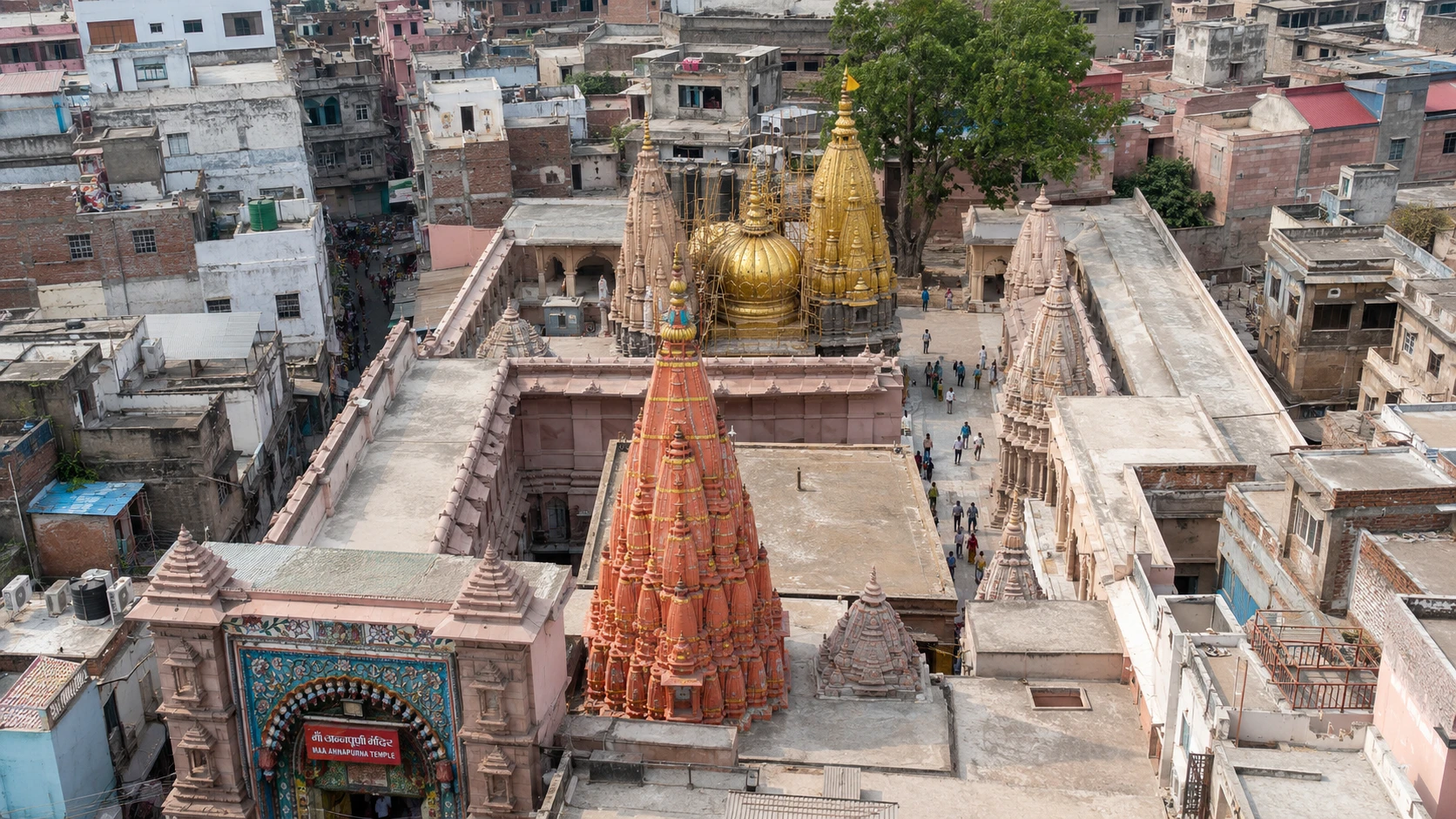
The Annapurna Devi temple stands at the very heart of Kashi, immediately adjacent to the Kashi Vishwanath Jyotirlinga within the temple's reconstituted corridor precinct. Annapurna — 'she who is full of food' (anna + purna) — is the form of the goddess as the principle of nourishment itself, the giver of food without which even the lord of yoga grows hungry. The temple's foundational story is one of the most quietly radical theological reversals in the Hindu tradition: Shiva, in a moment of philosophical excess, declared the material world to be illusion, including food itself; Parvati, who is the principle of nourishment, withdrew from creation in distress; plants stopped fruiting, mothers' milk dried, and Shiva himself grew hungry; she set up her kitchen in Kashi and began to feed the hungry of the world; and Shiva, the renunciate lord, came to her at last with his begging bowl extended and accepted food from her hand — a public acknowledgement that matter is not illusion but Shakti in tangible form. The iconic tableau of the temple is precisely this exchange: Annapurna with her serving ladle (darvi) ready, Shiva approaching as bhikshu with bowl extended. The present temple structure was built during the Maratha period, attributed to Peshwa Baji Rao I and dedicated around 1729, on a site of older Devi-worship in the area. The sanctum holds two principal Annapurna images: a daily-worship copper-and-bronze murti, and a smaller golden image known as the Swarna Annapurna, whose darshan is open to the public only on Annakut — the day immediately after Diwali — when queues form before dawn and remain through the night for the single day's viewing. The temple sees year-round prasad-distribution of rice and lentils (khichdi), the goddess's own offering returned daily to her devotees in tangible form, and an annual community-feeding observance on Annakut that draws devotees from across India. Adi Shankaracharya's eight-verse Annapurna Stotram — 'Annapurne sadapurne shankara prana vallabhe' — composed in this city, is the temple's defining liturgical text and remains the most-chanted Annapurna hymn in the Indian tradition.
Sacred Designationपवित्र पदनाम
Sacred Origin Storyपवित्र उत्पत्ति कथा
Source: Skanda Purana (Kashi Khanda) and Devi Bhagavata Purana for the textual narrative of Annapurna's appearance in Kashi; Adi Shankaracharya's Annapurna Stotram (eighth–ninth century CE) as the canonical liturgical text; the founding-of-the-present-temple narrative is preserved in Maratha-period Kashi records of the early eighteenth century.
The Annapurna narrative is one of the quiet hinge-stories of the Shaiva-Shakta integrated tradition — a story in which the renunciate lord is brought, through his own teaching, to acknowledge that the manifest world he has called illusion is in fact his consort in tangible form. In its received version, drawn principally from the Kashi Khanda of the Skanda Purana and the Devi Bhagavata Purana, the story unfolds in three movements.
In the first movement, Shiva, in conversation with Parvati on Mount Kailash, takes the philosophical position to its limit: all of this — the world, the body, food, the very business of eating — is maya, illusion, transient, unreal. Parvati, who is herself the principle of manifestation, the Shakti without whom Shiva's pure consciousness has no object to know, is grieved by the dismissal. The dismissal is not merely theoretical; it is also a denial of her own ontological standing, because what is being called illusion is precisely the realm in which she operates. In some versions she replies in disputation; in all versions she withdraws from creation in protest, and the protest is not symbolic but cosmological.
In the second movement, the consequences of her withdrawal unfold across the worlds. Plants stop fruiting; rivers grow thin; the cycles by which food is produced and consumed begin to fail; mothers' milk dries; the gods themselves grow hungry; and Shiva, who had declared food to be illusion, finds that the body he wears in his cosmic functions is itself subject to the conditions he has dismissed — he grows hungry. The narrative is careful here: it is not Shiva's transcendental being that hungers, but the lord-in-form, the Shiva who acts in the world.
In the third movement, Parvati takes the form of Annapurna — 'she who is full of food' — and appears in Kashi, the city she and Shiva share as their earthly home. She sets up her kitchen in the city's centre and begins to feed the hungry. Word of the goddess who feeds the world spreads across the worlds; Shiva himself, hungry and humbled, takes the form of a bhikshu — a wandering beggar — comes to Kashi with his begging bowl extended, and approaches the goddess. She recognises him at once, lifts her serving ladle, and fills his bowl. The exchange is the temple's defining theological tableau: the lord of yoga, who had called food illusion, accepts food from his own consort, who is the food itself. The acknowledgment is not stated in argument but enacted in the giving and the receiving. Matter is not illusion; matter is Shakti.
At the textual register, this narrative is canonised in Adi Shankaracharya's Annapurna Stotram, the eight-verse Sanskrit hymn that has been the most-recited Annapurna liturgy for over a thousand years. Composed, by the tradition, by Shankaracharya during his Kashi residency, the stotram opens 'Nityanandakari varabhayakari saundaryaratnakari' and culminates in 'Annapurne sadapurne shankara prana vallabhe, jnana vairagya siddhyartham bhiksham dehi cha parvati' — 'O Annapurna, ever-full one, beloved of Shankara, for the attainment of knowledge and dispassion, give me food and grace, O Parvati'. The stotram is significant for its theological move: even Shankaracharya, the most uncompromising of the non-dualist philosophers, asks the goddess for food before he asks her for knowledge — implicitly acknowledging that the realm of matter is not subordinate to the realm of consciousness but is its precondition.
The Kashi connection is essential. The narrative places Annapurna's kitchen specifically in this city — not in any city, but in Kashi — and in doing so confirms Kashi's identity as the city where the goddess's nourishing aspect is permanently established. The Maratha-period founding of the present temple in 1729 by Peshwa Baji Rao I is, in this sense, not the introduction of Annapurna to Kashi but the architectural consolidation of a Devi-presence the city had long acknowledged.
उद्धृत स्रोत:
- Skanda Purana, Kashi Khanda — chapters on the goddesses of Kashi and the Annapurna narrative
- Devi Bhagavata Purana — the broader Shakta theological framework
- Adi Shankaracharya, Annapurna Stotram (eight verses; some traditions add four phala-shruti verses for a twelve-verse total) — composed by tradition during the philosopher's Kashi residency
- Diana L. Eck, 'Banaras: City of Light' (1982) — chapters on Annapurna, Vishweshwari, and the Devi tradition in Kashi
- Kuber Nath Sukul, 'Varanasi Down the Ages' (1974) — historical accounts of Kashi temples including Annapurna
- Government of India, Ministry of Culture archives on Kashi Vishwanath Corridor (2019–2021)
अन्य परंपराएँ · अन्य परंपराएँ
विद्वत संदर्भ
The Annapurna narrative is editorially distinctive in two registers. First, in its theological structure: the story is one of the very few in the Hindu corpus in which Shiva — the lord of consciousness and renunciation — is brought to acknowledge, through his own hunger, that matter is not subordinate to spirit but is its tangible form. This is not a simple Shakta-supremacy story (in which the Goddess is declared superior to the gods), but a more textured account of the integration of Shaiva and Shakta principles — the begging-bowl tableau is theologically more interesting than the slaying-of-demon tableau because the resolution is not victory but exchange. Adi Shankaracharya's Annapurna Stotram canonises this exchange in the most uncompromising of philosophical traditions: the non-dualist who has spent a lifetime arguing that the world is non-different from Brahman still asks the goddess for food first and knowledge second. Second, in its historical complexity: the present temple structure dates to 1729, but Devi-worship at the site is older — exactly how much older is not settled. The Vishwanath-Annapurna integrated devotional unit is documented in pre-modern Kashi sources, and the area immediately around the Vishwanath shrine has been a continuous Hindu sacred precinct through the documented period, including the Aurangzeb-era destruction of the principal Vishwanath structure in 1669 and the Maratha-period reconstructions that followed. The Annapurna shrine appears to have survived the 1669 demolitions in some form (the exact form is not archaeologically established) and was either renewed or substantially rebuilt under Peshwa Baji Rao I in 1729. The recent 2019–2021 Kashi Vishwanath Corridor redevelopment significantly expanded the surrounding precinct (from approximately 3,000 square metres to over 50,000 square metres) without altering the Annapurna sanctum itself; the corridor brought a different visual context — sandstone-and-marble pathways, expanded service infrastructure, sharply-formalised security and queue management — while preserving the eighteenth-century sanctum at its core. The 2021 repatriation of an early-twentieth-century-stolen Annapurna idol from Canada added a modern-era chapter to the temple's history. A point of editorial care: the Shri Kashi Vishwanath Mandir Act 1983 brought the Vishwanath temple (and the integrated Annapurna shrine) under Government of Uttar Pradesh administration through the Shri Kashi Vishwanath Temple Trust, which now handles operational aspects including seva-booking, security, prasad-distribution, and the annual Annakut Swarna Annapurna darshan. The trust is a public body; the temple is not under any independent religious trust, which distinguishes it from privately-administered shrines like Mahalakshmi Mumbai. This administrative architecture should be understood as the operational reality of the temple's present-day functioning.
Historyइतिहास
The history of Devi-worship at the present Annapurna site is older than the temple structure itself; Kashi has been a continuous Hindu sacred city for the entire documented historical period, and the area immediately surrounding the Vishwanath shrine has held Devi-presence in some form across the city's pre-modern, medieval, and early-modern phases. Pre-modern Kashi mahatmya literature attests to Annapurna-worship in the city; the integrated Vishwanath-Annapurna devotional pair predates any of the surviving structures.
The principal historical inflection point is the Aurangzeb-era destruction of 1669, when the Mughal emperor ordered the demolition of the principal Vishwanath structure as part of a broader temple-destruction campaign in northern India. The Annapurna shrine appears to have survived in some form — the exact form is not archaeologically settled, and accounts vary as to whether the shrine was structurally destroyed, partially preserved, or relocated within the precinct — but the integrated Vishwanath-Annapurna devotional unit did not cease, and Devi-worship in the area continued through the eighteenth-century Maratha period.
The present Annapurna temple structure was built or rebuilt during the early eighteenth century under Peshwa Baji Rao I (1700–1740) of the Maratha confederacy, and is conventionally dated to 1729. This date is well-attested in nineteenth- and twentieth-century Kashi-history literature, though the precise extent of new construction versus restoration of an earlier structure is not finally resolved. The Maratha-period Kashi rebuilding programme — culminating in the 1780 reconstruction of the principal Vishwanath structure by Ahilyabai Holkar of Indore — restored the integrated Vishwanath-Annapurna precinct as a continuous functioning Hindu pilgrimage site.
Through the nineteenth and twentieth centuries the temple operated continuously, drawing devotees through the colonial period, the independence transition (1947), and the gradual modernisation of pilgrimage logistics. The most significant administrative inflection came in 1983, when the Government of Uttar Pradesh enacted the Shri Kashi Vishwanath Mandir Act, bringing the Vishwanath temple — and the integrated Annapurna shrine — under public administration through the Shri Kashi Vishwanath Temple Trust. The trust took over operational responsibilities including seva-booking, prasad-distribution, security, and the regulation of the Annakut Swarna Annapurna darshan.
The most dramatic transformation in the temple's modern history is the 2019–2021 Kashi Vishwanath Corridor redevelopment, formally inaugurated by Prime Minister Narendra Modi on 13 December 2021. The corridor project expanded the precinct surrounding the Vishwanath-Annapurna shrines from approximately 3,000 square metres to over 50,000 square metres, demolishing and acquiring densely-built structures in the historic Vishwanath Galli area, creating sandstone-and-marble pathways, expanded service infrastructure, formalised security checkpoints, and direct ghat-side access. The Annapurna sanctum itself was not structurally altered; the surrounding context, however, was transformed. The corridor brought significantly increased footfall — the Vishwanath-Annapurna precinct now sees a daily average exceeding 50,000 visits, with peak-festival-day figures crossing 200,000 — and concomitant changes in queue management, visitor flow, and operational scale.
A notable modern-era event: in November 2021, an early-twentieth-century-stolen Annapurna idol was repatriated from Canada and was publicly received by Prime Minister Modi before being installed in a procession through Kashi. The idol, dated to approximately the eighteenth century and stolen from a Varanasi ghat around 1913, had been held in Canadian museum collections; its repatriation under the Government of India's antiquities-recovery framework added a contemporary chapter to the temple's history of theft, loss, and restoration that traces back to the Aurangzeb-era period.
Historical Timelineऐतिहासिक कालक्रम
Annapurna-worship attested in Kashi sources as part of the broader pre-modern Vishwanath-Annapurna devotional pair; pre-modern Kashi mahatmya literature establishes the goddess as a continuous Devi-presence in the city, predating any of the surviving structures by an indeterminate margin.
The Mughal emperor Aurangzeb orders the demolition of the principal Kashi Vishwanath structure as part of a broader temple-destruction campaign in northern India. The Annapurna shrine in the integrated precinct survives in some form, though the exact extent of preservation versus loss is not archaeologically settled.
The present Annapurna temple structure is built or rebuilt under Peshwa Baji Rao I of the Maratha confederacy. The 1729 date is conventionally given for the temple's consecration; the precise extent of new construction versus restoration of an earlier surviving structure is not finally resolved in the documentary record.
Maharani Ahilyabai Holkar of Indore commissions the reconstruction of the principal Kashi Vishwanath structure, restoring the integrated Vishwanath-Annapurna precinct as a continuous functioning Hindu pilgrimage site. This contextual event consolidates the early-eighteenth-century Maratha-period rebuilding of the broader sacred precinct in which Annapurna is housed.
An eighteenth-century Annapurna idol is stolen from a Varanasi ghat. The idol is later acquired by Canadian museum collections, where it remains until its 2021 repatriation. The early-twentieth-century theft is part of the broader colonial-and-early-modern-period trafficking of Indian temple antiquities to Western collections.
Indian independence; the temple, like all Kashi shrines, continues operations through the political transition with no immediate administrative change. Pilgrimage volume grows steadily through the post-independence decades.
The Government of Uttar Pradesh enacts the Shri Kashi Vishwanath Mandir Act, bringing the Kashi Vishwanath temple — and the integrated Annapurna shrine — under public administration through the newly-constituted Shri Kashi Vishwanath Temple Trust. The trust takes over operational responsibilities including seva-booking, prasad-distribution, security, and management of the Annakut Swarna Annapurna darshan.
Prime Minister Narendra Modi inaugurates the foundation of the Kashi Vishwanath Corridor redevelopment project. Demolition and acquisition of densely-built structures in the historic Vishwanath Galli area begins to clear the way for an expanded sandstone-and-marble precinct connecting the Vishwanath-Annapurna sanctums directly to the Ganga ghats. The project is controversial in some Banaras old-city quarters owing to the scale of historic-property acquisition, but proceeds.
An early-twentieth-century-stolen Annapurna idol is repatriated to India from Canadian museum collections (MacKenzie Art Gallery, Regina). The idol is publicly received by Prime Minister Modi and installed in a procession through Kashi before being placed in the temple's precinct. The repatriation operates under the Government of India's antiquities-recovery framework and is among several high-profile sacred-object returns of the period.
Prime Minister Modi formally inaugurates the completed Kashi Vishwanath Corridor. The redevelopment expands the precinct from approximately 3,000 square metres to over 50,000 square metres, creates direct ghat-side access for the first time in centuries, and substantially scales up the operational footprint of the integrated Vishwanath-Annapurna devotional unit. Annapurna sanctum remains structurally unchanged; surrounding context is transformed.
Post-corridor operations stabilise. Daily average footfall in the Vishwanath-Annapurna precinct exceeds 50,000; peak-festival-day attendance crosses 200,000. The Annakut Swarna Annapurna darshan is now managed under corridor-era queue protocols with extensive overnight crowd management. The trust expands online seva-booking and digital prasad-distribution.
What You'll Seeदर्शन में
The Annapurna sanctum holds three principal iconographic elements arranged on a single platform behind a stone-and-metal railing: the daily-worship Annapurna murti at the centre, the smaller Swarna Annapurna (golden image) typically kept covered to the side, and the figure of Shiva as bhikshu (the begging seeker) positioned to the goddess's devotional left.
The daily-worship Annapurna murti is cast in copper-and-bronze alloy and is shown seated. She is most commonly depicted four-armed, although some renderings present her two-armed in the simpler 'kitchen-goddess' form. Her primary attributes are the darvi — the long-handled serving ladle, which she holds in one of her right hands ready to fill a devotee's vessel — and the anna patra, the food bowl or pot brimming with cooked rice, which she holds in the corresponding left hand. The two attributes together identify her unambiguously: no other Hindu goddess holds this particular pair. Where four-armed, her upper hands typically carry an akshamala (rosary) and either a small lotus or a varada-mudra gesture of granting boons. Her ornamentation is full but restrained: a tall crown (mukuta), gold neck-ornaments, ear-pieces, and bangle-courses; her sari is changed daily and is most often in a warm Kashi-traditional combination of red, gold, and green; she sits in a posture of receiving and giving, neither warrior-stance nor pure-meditation-stance, but the posture of a goddess at her kitchen-throne.
The Swarna Annapurna — the golden image — is smaller in scale, perhaps one-third to one-half the size of the daily murti. She is cast in gold and follows the same iconographic configuration: serving ladle, food bowl, seated posture. She is kept covered throughout the year, displayed publicly only on Annakut, the day after Diwali, when her covering is removed and devotees take darshan in a continuous queue through the night and the following day. The Swarna Annapurna's once-a-year visibility is part of the temple's distinctive operational ritual; many Kashi devotees plan their pilgrimage year around this single day.
The Shiva-as-bhikshu figure is iconographically essential to the temple's defining tableau. Shiva is shown standing, comparatively smaller than the seated goddess (an iconographic reversal of the usual Shiva-Parvati scale-relationship), holding a kapala (the skull-bowl used by ascetic Shaiva practitioners as a begging vessel), with his other arm extended in the gesture of receiving. The pair Annapurna-with-ladle / Shiva-with-bowl is the temple's iconographic signature — it appears on the temple's prasad-wrappers, on devotional posters distributed by the trust, and on the temple's official insignia. The figure of Shiva here is not the ferocious or the tantric Shiva but the bhikshatana form — the lord-as-mendicant — drawn from the broader Shaiva tradition that places renunciation at the centre of the cosmic order.
A repatriated eighteenth-century Annapurna idol — returned from Canada in November 2021 — is housed within the precinct under trust custody. The repatriated idol is iconographically consistent with the temple's established Annapurna configuration and was identified for repatriation based on its provenance documentation matching the early-twentieth-century theft from a Varanasi ghat.
Photography of the sanctum is restricted under both the temple trust's protocols and the broader Kashi Vishwanath Corridor security regime. Devotees are not permitted to photograph the goddesses or the Shiva-bhikshu figure during darshan. Mobile phones must be deposited at the corridor's electronics-locker counters before entering the sanctum precinct. The trust occasionally releases official photography of the Swarna Annapurna for festival documentation and devotional publications.
Distinctive Practicesविशिष्ट परंपराएँ
Annakut Swarna Annapurna darshan (once-a-year golden image viewing)
अन्नकूट स्वर्ण अन्नपूर्णा दर्शन (वर्ष-में-एक-बार स्वर्ण-प्रतिमा दर्शन)
The single most distinctive devotional practice at the temple. The Swarna Annapurna — the smaller golden image kept covered throughout the year — has her covering removed on Annakut, the day immediately after Diwali (Kartik Shukla Pratipada), and remains publicly visible for approximately 24 hours. Devotees from across India queue from midnight of Diwali night onward; the line typically wraps through the Kashi Vishwanath Corridor precinct and extends into the old city. Many Kashi devotees plan their entire pilgrimage year around this single window; the goddess's golden form is considered to confer particular grace upon those who manage to take darshan despite the queue.
Daily khichdi prasad-distribution
दैनिक खिचड़ी प्रसाद-वितरण
The temple's continuous prasad-distribution of khichdi — a one-pot dish of rice, lentils, and ghee — is the operational embodiment of the temple's theology. The goddess of food cannot, theologically, withhold food; the temple's daily preparation and distribution of khichdi to all comers, regardless of social standing or economic capacity, is the most direct continuation of the founding-story image of Annapurna feeding the hungry of the world from her Kashi kitchen. The practice is unbroken across the temple's known history and is one of the principal mechanisms by which the Kashi blessing 'koi kashi mein bhukha nahi sote' ('no one sleeps hungry in Kashi') is operationally fulfilled.
Annapurna Stotram recitation
अन्नपूर्णा स्तोत्र पाठ
Adi Shankaracharya's eight-verse Annapurna Stotram is recited at the temple by trust priests during morning and evening aartis, and by devotees individually or in family groups throughout the day. The stotram's closing verse — 'Annapurne sadapurne shankara prana vallabhe, jnana vairagya siddhyartham bhiksham dehi cha parvati' — is the most-recited Annapurna verse in the Indian devotional tradition and is the verse most-commonly chanted at vow-completion and food-blessing ceremonies. The recitation often precedes meal-blessings in observant Hindu households across north India.
Anna-daan (food-donation) vow-completion
अन्न-दान व्रत-पूर्णाहुति
Devotees with food-related vows — typically vows made during times of hunger, food-scarcity, or for the well-being of family members — complete their observances at the Annapurna temple through anna-daan, the sponsored distribution of food to a specified number of devotees or to the temple's continuous khichdi-distribution operation. The vow is theologically appropriate to the goddess: those who receive grace in the form of food return that grace in the form of food. The trust formalises anna-daan-sponsorship through its seva-booking system; sponsorship tiers range from small daily-sponsor amounts to large festival-day-sponsor commitments.
Combined Vishwanath-Annapurna darshan
विश्वनाथ-अन्नपूर्णा संयुक्त दर्शन
Devotees visiting the Kashi Vishwanath corridor characteristically take darshan of both Vishwanath (the Jyotirlinga) and Annapurna in the same visit, treating the two shrines as theologically integrated. The two darshans are typically taken in sequence — Vishwanath first, then Annapurna, or in reverse — and the order is theologically meaningful: the Shaiva tradition takes Vishwanath first (the lord-of-the-city before the goddess-who-feeds-him), while the Shakta tradition reverses this. The Kashi Vishwanath Corridor's pathway design now formalises both sequences. Most devotees complete the combined darshan in a single 30–90 minute visit.
Sankashti Chaturthi household-vow completion
संकष्टी चतुर्थी गृह-व्रत-पूर्णाहुति
While Sankashti Chaturthi (the fourth day after each full moon) is primarily a Ganesha observance, in north Indian household practice it is common for the day's fast to be broken with a meal blessed at Annapurna's shrine or with Annapurna-temple prasad. The temple sees a small but regular increase in vow-completion-prasad-collection traffic on Sankashti days, particularly among women observing the fast on behalf of family members.
Did You Know?क्या आप जानते हैं?
The temple holds two principal Annapurna images: a daily-worship copper-and-bronze murti viewable year-round, and a smaller golden image — the Swarna Annapurna — whose public darshan is open for approximately 24 hours once a year, on Annakut, the day immediately after Diwali. This makes Annapurna Varanasi one of the very few Hindu temples in India with a single-day-per-year flagship darshan window.
The Annapurna iconography — goddess with serving ladle (darvi) and food bowl (anna patra), facing Shiva-as-bhikshu with begging bowl — is theologically distinctive in the Hindu corpus. It is one of the very few iconographic configurations in which Shiva is shown in a posture of receiving from Parvati rather than the reverse, and it embeds a sophisticated theological argument about the integration of matter and consciousness in a single visual tableau.
Adi Shankaracharya's eight-verse Annapurna Stotram — 'Annapurne sadapurne shankara prana vallabhe' — is, by tradition, the philosopher's own composition during his Kashi residency in the eighth or ninth century. It is the most-recited Annapurna hymn in the Indian tradition and is significant for its theological move: Shankaracharya, the most uncompromising of non-dualist philosophers, asks the goddess for food (bhiksham dehi) first and for knowledge-and-dispassion (jnana-vairagya-siddhi) second.
The Kashi blessing 'koi kashi mein bhukha nahi sote' — 'no one in Kashi goes to sleep hungry' — is traditionally attributed to Annapurna's grace, and the temple's continuous khichdi-prasad-distribution to all comers is the operational embodiment of this blessing. The practice has been unbroken across the temple's recorded history.
An eighteenth-century Annapurna idol stolen from a Varanasi ghat around 1913 was repatriated to India from the MacKenzie Art Gallery (Regina, Canada) in November 2021 and publicly received by Prime Minister Modi. The repatriation operates under the Government of India's antiquities-recovery framework, which has secured returns of dozens of looted sacred objects from Western collections through the 2010s and 2020s.
The present Annapurna temple structure is conventionally dated to 1729 and attributed to Peshwa Baji Rao I of the Maratha confederacy. The temple is part of the broader Maratha-period rebuilding of the Kashi sacred precinct that culminated in the 1780 reconstruction of the principal Vishwanath structure by Maharani Ahilyabai Holkar of Indore.
The 2019–2021 Kashi Vishwanath Corridor redevelopment expanded the Vishwanath-Annapurna precinct from approximately 3,000 square metres to over 50,000 square metres — one of the largest pilgrimage-precinct redevelopments in independent India. The Annapurna sanctum was preserved structurally; the surrounding precinct, however, was transformed, with sandstone-and-marble pathways, expanded service infrastructure, and direct Ganga-ghat connectivity for the first time in centuries.
Annapurna is one of the principal Devis of Kashi but is notably not part of the canonical 51/52 Shakti Peeth list — Kashi's Shakti Peeth in the 51-list traditions is Vishalakshi (at Mir Ghat, about 600 metres away), associated with the falling of Sati's earrings or eyes. Annapurna's significance in Kashi rests instead on the integrated Vishwanath-Annapurna devotional pair and the Kashi-Vishweshwari tradition.
The Vishwanath-Annapurna precinct now records a daily average exceeding 50,000 darshan visits post-corridor; peak-festival-day figures (Mahashivratri, Annakut, Kartik Purnima) routinely cross 200,000. By visitor volume, it is among the most-visited Hindu pilgrimage destinations in India, alongside Tirupati, Vaishno Devi, and Sabarimala.
Theologically, Annapurna is integrated with the Lakshmi tradition in some North Indian devotional schools, where she is treated as the 'daily-living' aspect of the goddess of prosperity — Lakshmi grants wealth, but Annapurna grants the food that converts wealth into nourishment. Margashirsha Guruvar observances (Thursdays of the Margashirsha month) often address both goddesses together in household pujas.
Unlike Mahalakshmi Mumbai which operates under a private religious trust, the Annapurna temple is administered by the Shri Kashi Vishwanath Temple Trust — a public body constituted under the Shri Kashi Vishwanath Mandir Act 1983 — which is a Government of Uttar Pradesh statutory authority. This administrative architecture means that operational protocols, seva pricing, and security regimes are subject to public-law oversight rather than independent trust decisions.
The temple's prasad — khichdi prepared with rice, moong dal, ghee, salt, and a minimal seasoning — is theologically calibrated as universal-access food: it is cheap to prepare at scale, can be consumed by virtually all dietary traditions within Hindu observance (no onion-garlic, no complex spice profile that excludes regional palates), and is nourishing as a single-meal substitute. The choice of khichdi over the more elaborate prasads at other major temples is itself a theological statement about Annapurna's mission.
Festivalsत्योहार
Annakut (Swarna Annapurna darshan)
अन्नकूट (स्वर्ण अन्नपूर्णा दर्शन)
The temple's principal festival and one of the most distinctive single-day observances in north Indian Hindu practice. The Swarna Annapurna — the smaller golden image kept covered throughout the year — has her covering removed on this day and is publicly visible for approximately 24 hours. Devotees from across India travel to Kashi for this single window, treating the day's darshan as the year's principal devotional event. The name 'Annakut' (literally 'mountain of food') refers also to the broader north Indian Diwali-day-after observance in which mountains of food are offered to the deity, but for Annapurna Varanasi the day is iconically associated with the golden image's annual visibility.
Annapurna Jayanti / Margashirsha Purnima
अन्नपूर्णा जयन्ती / मार्गशीर्ष पूर्णिमा
While Annakut is the flagship public-darshan event, Annapurna Jayanti is the goddess's birth-anniversary observance per several regional traditions. The Margashirsha Purnima date is well-attested in north Indian devotional literature and is the day on which household Annapurna-vrats are typically completed.
Sharadiya Navaratri
शारदीय नवरात्रि
While Sharadiya Navaratri is principally associated with the Devi Mahatmya's Mahishasura-mardini narrative (which is not Annapurna's story), the temple participates in the city-wide Navaratri observance. Annapurna is treated during these nine days as one of the principal Devi-forms of Kashi, with daily abhishekam, expanded aarti participation, and increased seva-bookings.
Mahashivratri (with Vishwanath)
महाशिवरात्रि (विश्वनाथ के साथ)
Although primarily a Shaiva observance centred on the Vishwanath Jyotirlinga, the integrated Vishwanath-Annapurna devotional pair means that Mahashivratri sees substantial spillover attendance at the Annapurna sanctum. Many devotees taking the Vishwanath abhishekam darshan also complete a parallel Annapurna darshan on the same day. The temple's role on Mahashivratri is secondary to Vishwanath but theologically continuous: the goddess who feeds Shiva attends the lord's own great night of vigil.
Kartik Purnima
कार्तिक पूर्णिमा
One of the holiest days of the Kashi calendar — when the lighting of lamps on the ghats and on the Ganga merges into the Dev Deepawali observance, which has become one of Varanasi's signature festivals. Annapurna sees high attendance as devotees complete their Ganga snan with a darshan at the integrated Vishwanath-Annapurna precinct.
Margashirsha Guruvar Vrats
मार्गशीर्ष गुरुवार व्रत
The Thursday observances of Margashirsha month are typically Lakshmi-vrats in Maharashtrian and broader north Indian practice, but at Annapurna Varanasi the Thursdays are also observed as Annapurna-vrats, reflecting the Lakshmi-Annapurna integration discussed in interestingFacts. Households conduct Annapurna-katha and vrat-pooja at home and complete the vrat with a darshan and khichdi-prasad at the temple.
Akshaya Tritiya
अक्षय तृतीया
The day of inexhaustible bounty in the Hindu calendar — particularly auspicious for grain-and-food blessings and for vow-completion offerings. Annapurna receives substantial vow-completion attendance on Akshaya Tritiya, particularly from devotees beginning new household kitchens, opening new restaurants or food businesses, or completing anna-daan vows for family well-being.
Traditional Offeringsपारंपरिक अर्पण
प्राथमिक अर्पण
Rice grains (akshat) and raw rice
अक्षत (चावल के दाने) और कच्चा चावल
अक्षत तण्डुल
Rice is Annapurna's principal grain — the staple anna of the eastern and central Indian devotional tradition, and the base of the temple's khichdi prasad. Rice-grain offerings (akshat) are placed at the goddess's feet during darshan and incorporated into ritual abhishekam; raw rice in larger quantity is donated for the temple's continuous prasad-distribution operation. The offering is theologically appropriate to Annapurna in a way that few other offerings are: the goddess of food receives food, and returns it to the world as prasad.
Red flowers (hibiscus, marigold, rose)
लाल पुष्प (गुड़हल, गेंदा, गुलाब)
रक्त पुष्प
Red flowers are the standard Devi-offering across the Indian tradition, and at Annapurna they are offered alongside the goddess's red-and-gold daily sari. Hibiscus (japa) and marigold are the most common; rose petals are offered on festival days. The red colour invokes the Shakti-aspect of the goddess and is paired with turmeric and kumkum at her feet.
Kumkum and turmeric
कुंकुम और हल्दी
कुंकुमं हरिद्रा च
Kumkum (vermilion) is offered at the goddess's feet and applied to her forehead; turmeric is offered alongside as the auspicious yellow. The pair is inseparable in Devi worship across the subcontinent. At Annapurna they are also distributed as part of the saubhagya-blessing for married women devotees, who often complete vrat-observances at the temple.
Ghee diya (clarified-butter lamp)
घी का दीपक
घृत दीप
Lamps of pure ghee are lit at the goddess's feet by devotees, who carry small earthen-or-metal dipikas as part of their offering. The light symbolises both the warmth of the kitchen-goddess's hearth and the dispelling of ignorance through devotion. Akhand-jyot (continuous ghee-lamp) sponsorship is available through the trust's seva-booking system.
Panchamrit (five sacred substances)
पंचामृत
पञ्चामृत
The ritual bathing of the goddess with milk, curd, honey, ghee, and sugar is performed at major abhishekams. For Annapurna specifically, the panchamrit invokes the abundance of the kitchen — milk for purity, curd for prosperity, honey for the sweetness of speech, ghee for the cooking-fire's warmth, sugar for the goddess's own sweetness as she gives.
Fruits (seasonal, especially bananas and apples)
फल (मौसमी, विशेष रूप से केले और सेब)
फल
Seasonal fruit offerings are placed at the goddess's feet during darshan; bananas and apples are the most-frequently-offered varieties in Kashi practice. A portion of the offered fruit is returned to the devotee as prasad. During festivals, more elaborate fruit-platters are sponsored as seva.
इस मंदिर की विशेषता
Khichdi prasad (the temple's signature daily offering and prasad)
खिचड़ी प्रसाद (मंदिर का हस्ताक्षर दैनिक अर्पण और प्रसाद)
Khichdi — rice, moong dal, ghee, salt, minimal seasoning — is the temple's signature offering and the prasad distributed to all comers continuously through the day. The choice of khichdi over more elaborate prasads is theologically deliberate: it is universal-access food, cheap to prepare at scale, consumable by virtually all Hindu dietary traditions, and nourishing as a complete single-meal. The temple's khichdi-pot is the operational embodiment of the founding-story image of Annapurna's kitchen in Kashi.
Anna-daan (food-distribution sponsorship)
अन्न-दान (भोजन-वितरण प्रायोजन)
Devotees may sponsor anna-daan — the distribution of food to a specified number of devotees, or a contribution to the temple's continuous khichdi-prasad-distribution operation. The sponsorship is theologically the most-aligned vow-completion offering for the goddess: those who receive grace return it in the form she has given. The trust's seva-booking system formalises anna-daan sponsorship at various scales, from small daily-prasad-amount donations to large festival-day or annual sponsor commitments.
Raw rice donations for the prasad-operation
प्रसाद-संचालन के लिए कच्चे चावल का दान
Specifically for Annapurna, raw rice in larger quantity is donated by devotees who wish to support the temple's continuous prasad-distribution. Donations are accepted at the trust office. The grain is incorporated into the khichdi-preparation cycle and ultimately distributed back to devotees as prasad — a closed devotional loop in which the act of giving is also the act of receiving.
Devotees may bring offerings from outside the corridor or purchase them at the trust-operated counters near the corridor entry. The trust does not require offerings to be purchased on the premises, though the proximity of the corridor's electronics-locker-and-cloakroom checkpoints to the prasad-and-offering counters means most devotees use the trust's own offering channels. The most-aligned offering for Annapurna is rice (in any form) or its sponsorship via anna-daan. Coconut-breaking is done at the entrance area; flowers and turmeric-kumkum are taken into the sanctum. Ornament-and-monetary offerings go through the trust office for inventory and receipt; the temple does not maintain a private ornament-corpus comparable to Mahalakshmi Mumbai's, as it is administered as a public-trust shrine.
How to Reachकैसे पहुँचें
Varanasi is well-connected by air, rail, and road, and the Annapurna temple sits at the centre of the city's old quarter — accessible through the Kashi Vishwanath Corridor whose multiple entry gates serve different arrival directions. By air, Lal Bahadur Shastri International Airport (VNS), at Babatpur approximately 25 km from the temple, has direct connections to most major Indian cities (Delhi, Mumbai, Bengaluru, Kolkata, Hyderabad, Chennai, Ahmedabad, and others) and limited international connections via Sharjah, Bangkok, and Kathmandu. Pre-paid taxis, app-based cabs (Ola, Uber), and the airport's shuttle services to the city take approximately 50–90 minutes depending on traffic; the old city's narrow lanes mean that vehicles cannot reach the corridor gates directly — the final 500–800 metres are by foot, cycle-rickshaw, or auto-rickshaw from the Godowlia–Dashashwamedh junction. By rail, Varanasi Junction (Varanasi Cantt, VNS) is the principal terminus, approximately 5 km from the temple; Banaras railway station (formerly Manduadih) is approximately 6 km. Both stations have prepaid taxi counters and connect to almost all major Indian rail corridors — Delhi, Mumbai, Howrah, Chennai, Mughalsarai-Pt. Deen Dayal Upadhyay Jn (a major junction 15 km away offering additional connections), and a wide range of regional services. Auto-rickshaws and cycle-rickshaws from the stations to Godowlia (the gateway to the corridor) are inexpensive and frequent. By road, Varanasi is on National Highway 19 (the historic Grand Trunk Road, now NH19/NH2) connecting Delhi to Kolkata; arrivals from Lucknow, Allahabad (Prayagraj), Patna, and other northern and eastern cities reach the city by road. Within Varanasi, the corridor gates are reached on foot from Godowlia chowk or from the Ganga ghats (particularly Dashashwamedh, Manikarnika, and Lalita ghats); private vehicles cannot enter the corridor zone, and parking is available at designated lots near Godowlia and at the western edge of the corridor footprint. Cycle-rickshaws and e-rickshaws operate the short-distance traffic from major nearby roads to the corridor entry gates.
Plan Your Visitयात्रा की योजना
🌤 सर्वोत्तम मौसम
October to March is the most comfortable period to visit Varanasi — temperatures range from 10–28°C with low-to-moderate humidity. November (Dev Deepawali, Annakut) and February–March (Mahashivratri) are the most spiritually charged and most crowded periods. Avoid May–June (peak summer, 35–45°C, the corridor's sandstone pathways become uncomfortably hot underfoot during midday) and July–September (monsoon — Varanasi sees heavy rainfall and the Ganga rises significantly, sometimes flooding the lower ghats and affecting access to ghat-side gates; the temple itself sits on high ground and remains accessible, but the broader city experience can be disrupted). Early-morning darshan (04:00–07:00) is the least crowded and most contemplative window throughout the year.
👘 पहनावे का नियम
Modest traditional dress is expected and is the local norm in Kashi. For men, full-length trousers or dhotis with sleeved shirts or kurtas are appropriate; for women, sarees, salwar suits, or long skirts with covered shoulders are appropriate. Shorts, sleeveless tops, very short dresses, and overtly western beach attire are not appropriate for darshan; the corridor's security may turn away inappropriately-dressed visitors at peak times. Footwear must be removed at the corridor entry. Head-covering is not required for the Annapurna darshan (it is required at some other Kashi shrines).
📱 फोन और फोटोग्राफी
Mobile phones must be deposited at the corridor's electronics-locker counters before entering the sanctum precinct. The temple trust and Uttar Pradesh Police enforce a strict no-photography, no-video, no-phone-recording policy in the sanctum and immediate approach. Lockers are free and the deposit-tag should be retained for retrieval after darshan. Devotees who wish to focus on darshan without distraction may also deposit other valuables.
🏨 आवास
Varanasi offers the full range of accommodation from backpacker hostels and budget guesthouses (heavily concentrated around Assi Ghat and Dashashwamedh) to mid-range hotels (in the Cantonment area and along the river) to luxury heritage properties (the Taj Ganges, Brijrama Palace, Suryauday Haveli, and others). For Annapurna devotees who wish to be within walking distance, properties in the Godowlia–Dashashwamedh corridor and along the upper ghats (Munshi Ghat, Pandey Ghat, Darbhanga Ghat) are most convenient. The temple trust does not run a dedicated dharmashala, but several traditional dharmashalas in the old city (particularly those run by various community trusts) serve pilgrim accommodation at modest cost. For peak festival periods (Annakut, Mahashivratri, Dev Deepawali) book accommodation 2–3 months in advance.
Book a Pujaपूजा बुक करें
The Kashi Vishwanath Corridor operates strict security and access protocols established after the 2019–2021 redevelopment and tightened during major festival days. Devotees should plan their visit around the following corridor-specific realities: (a) mobile phones, cameras, and other electronics must be deposited at electronics-locker counters before entering the sanctum precinct — there are no exceptions; (b) bags larger than small handbags must be deposited at the cloakroom — knives, scissors, lighters, e-cigarettes, and packaged food are not permitted in the sanctum precinct; (c) the corridor's pathways and queue routes change on festival days — verify current routing at the corridor information desk on arrival; (d) the trust does not authorise third-party agents or 'expediters' offering paid darshan-skip services outside the trust's official channels — any such offer should be refused and reported to the corridor security staff. The trust's published phone numbers and email addresses may change without notice; verify on the trust's official website before contacting. Several fraudulent websites and social-media pages impersonate the trust, particularly during peak festival periods.
Managed by: Shri Kashi Vishwanath Temple Trust (a Government of Uttar Pradesh statutory body under the Shri Kashi Vishwanath Mandir Act 1983)
Mangala Aarti participation (pre-dawn)
मंगला आरती में भागीदारी (प्रातः-पूर्व)
Annapurna Abhishekam
अन्नपूर्णा अभिषेकम
Bhog Seva (prasad sponsorship)
भोग सेवा (प्रसाद प्रायोजन)
Akhand Jyot (continuous oil/ghee lamp)
अखण्ड ज्योत (निरंतर तेल/घी दीप)
Anna-daan (food-distribution sponsorship)
अन्न-दान (भोजन-वितरण प्रायोजन)
Annakut Swarna Annapurna sponsorship
अन्नकूट स्वर्ण अन्नपूर्णा प्रायोजन
Booking information verified: 2026-05-21
Sacred Soundsपवित्र ध्वनि
Annapurna Stotram (Adi Shankaracharya, 8 verses)
stotram
Annapurna Ashtakam
stotram
Annapurna Ashtottara Shatanamavali (108 names of Annapurna)
stotram
Sri Suktam (Rigveda khila — Annapurna's integration with the Lakshmi tradition)
stotram
Devi Mahatmya (Durga Saptashati — recited at Navaratri)
stotram
Mahishasura Mardini Stotram (Aigiri Nandini)
stotram
Annapurna Aarti (Jai Annapurne, Hindi/Bhojpuri)
aarti
क्या आप जानते हैं? · Did You Know?
वही अनुवाद त्रुटि जिसने हिन्दू धर्म में '33 कोटि' को '33 करोड़' बनाया, बौद्ध धर्म में भी हुई। बौद्ध ग्रन्थों के चीनी अनुवाद ने 'सप्त कोटि बुद्ध' (7 श्रेष्ठ बुद्ध) का अनुवाद '7 करोड़ बुद्ध' कर दिया। तिब्बती अनुवाद ने सही किया: 7 प्रकार, 7 करोड़ नहीं। एक संस्कृत शब्द, दो प्रमुख विश्व धर्मों में गलत पढ़ा गया, ने दो एकसमान भ्रम स्वतन्त्र रूप से उत्पन्न किए।
Related Contentसंबंधित सामग्री
Related Scriptures
Related Temples
Kashi Vishwanath
काशी विश्वनाथ
Varanasi, Uttar Pradesh
Sankat Mochan
संकट मोचन
Varanasi, Uttar Pradesh
Mahalakshmi Temple (Mumbai)
महालक्ष्मी मंदिर
Mumbai, Maharashtra
Gnana Saraswati (Basar)
ज्ञान सरस्वती मंदिर
Basar, Telangana
Dakshineswar Kali
दक्षिणेश्वर काली
Kolkata, West Bengal
Ambaji
अंबाजी
Ambaji, Gujarat
Kamakhya Temple
कामाख्या मंदिर
Guwahati, Assam
Community Reflections
🕉️
Be the first to share your reflection.