Ambaji
अंबाजी
The Devī worshipped as yantra, not as image
Ambaji, Gujarat, India
Ārāsurī AmbājīAlso known as: Arasuri Ambaji, Ambaji Mata, Ambika, Aravalli Devi, Ambamata
युग
Pre-medieval Devī shrine; canonical Pīṭha attestation by 9th, 12th c.; current marble structure substantially 19th, 20th c. with continuing trust-led renovation
वास्तुकला
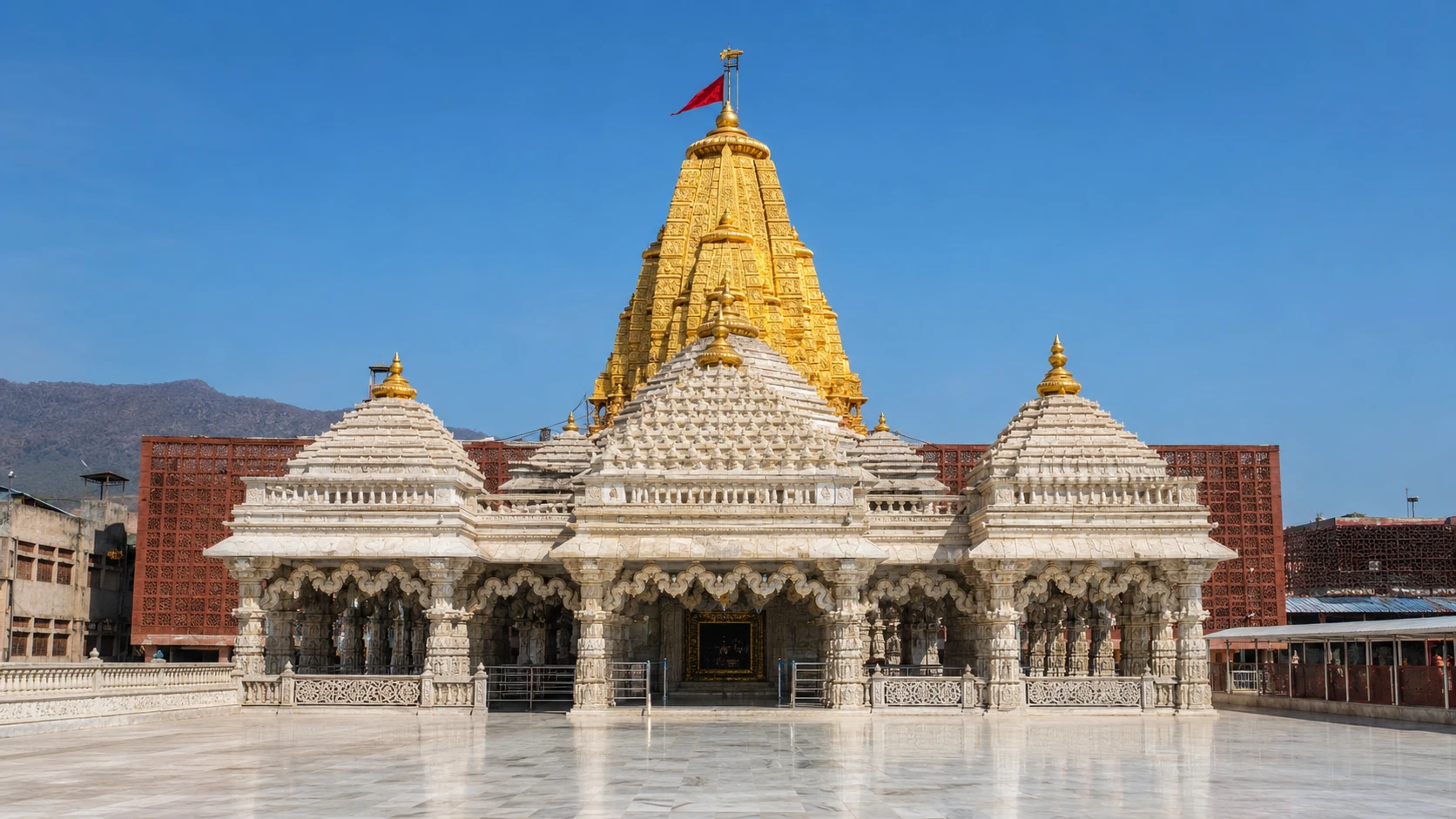
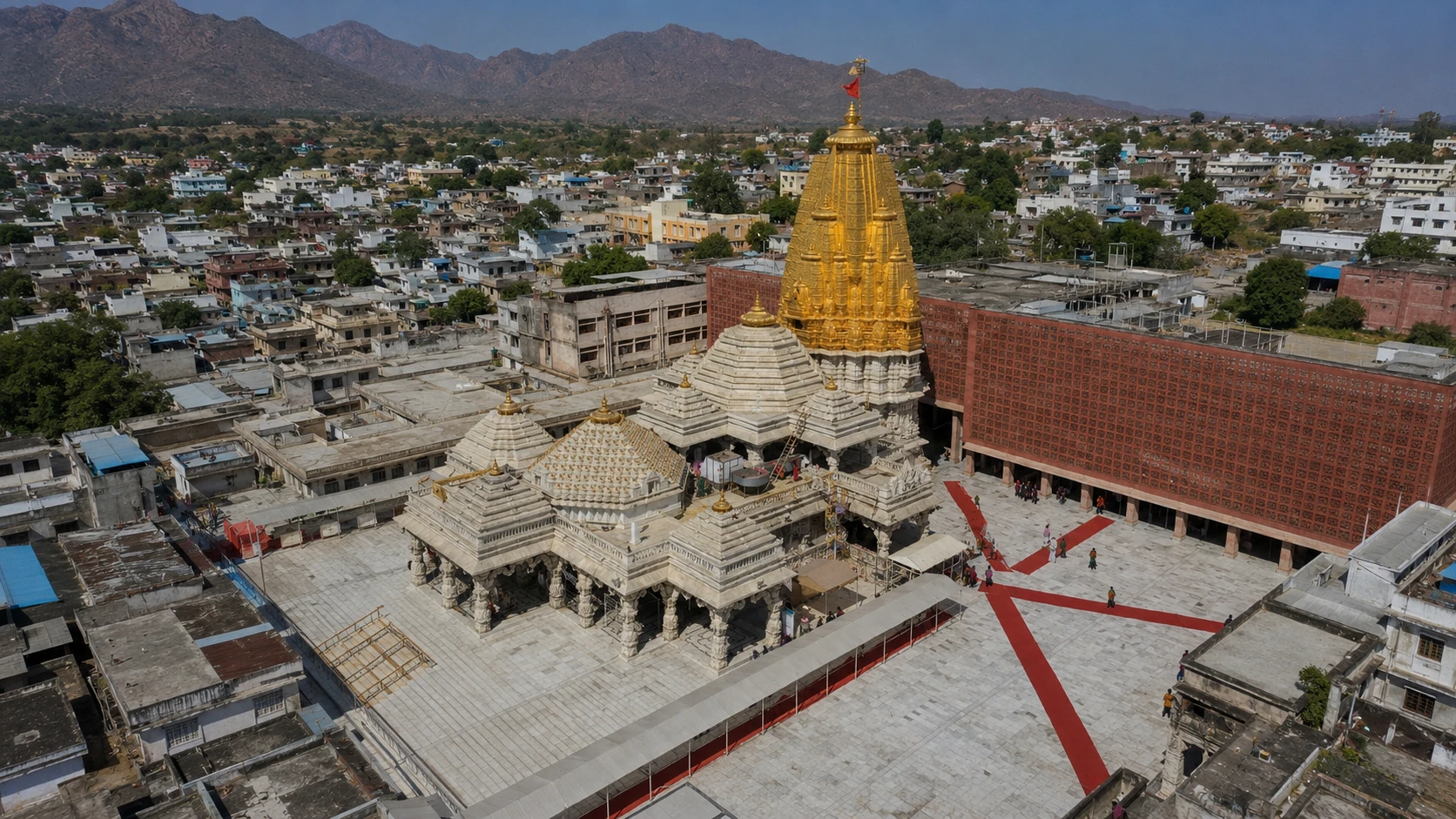
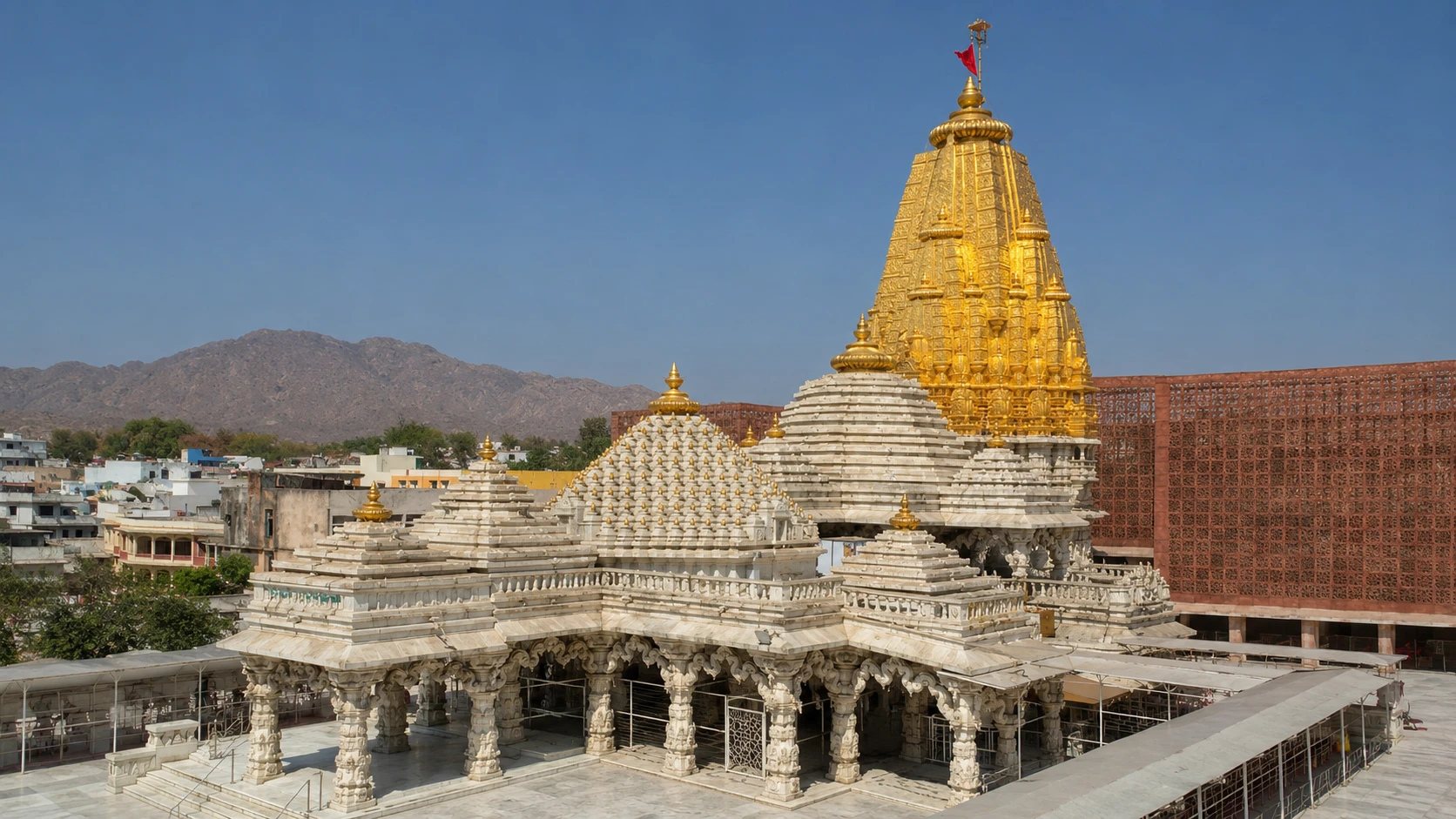
Maru-Gurjara (Solanki tradition) with extensive modern marble overlay; central white-marble shikhara surmounted by gold-plated kalashas
खुला
07:00 – 21:30
आरती
07:00 · 09:00 · 12:00 · 16:30 · 18:30 · 20:30
विशेष
The Yantra is briefly visible during the morning shringar (adornment-change ceremony, typically pre-09:00 aarti); the Gabbar Hill shrine ~5 km away marks the site where Satī's heart is traditionally said to have fallen and is accessed by ropeway or stepped trail
पवित्र कथा · पवित्र कथा
At Ambaji there is no murti. What the pilgrim takes for the Devī, the crowned form draped in red and gold visible through the sanctum doorway, is in fact an adornment placed against the back wall of the garbhagriha to give devotees a focal point. Behind the chunari and the silver-and-gold mukut, the iconographic centre of the shrine is the Bīsā Yantra, the geometric diagram of the Devī carved into the wall itself. The Yantra is not a representation of the Mother; in the theology of Shrī Vidyā, it is the Mother. Pilgrims who come for darshan do not see the Yantra directly, the adornment is part of the temple's accommodation to the human need for an anthropomorphic encounter. But the priests serve the Yantra. The aartis are offered to the Yantra. And on certain mornings, when the chunari is changed, the geometry that is the goddess is briefly visible. Ambaji is one of the eighteen Mahā Shakti Pīṭhas, the place where Satī's heart fell, and uniquely in this network, the heart of the Mother is offered to the world not as form, but as the silent geometry from which form arises.
Sacred Designationपवित्र पदनाम
Shakti Peeth
शरीर का अंग: Heart
शक्ति: Ārāsurī Ambā (also enumerated as Ambikā)
भैरव: Baṭuk Bhairava
Sacred Origin Storyपवित्र उत्पत्ति कथा
Source: Devī Bhāgavata Purāṇa, Skandha VII (51-Pīṭha enumeration); Kālikā Purāṇa, Chapters 18 and 60, 62 (52-list, heart body-part attribution); Ashtadasha Shakti Pīṭha Stotram attributed to Ādi Śaṅkarācārya (Ārāsuryāṁ tu Ambikā)
The Pīṭha narrative is the same that anchors every site in the network, and at Ambaji it concludes with a particular gravity. When Dakṣa's slight against Śiva drove Satī into the sacrificial fire, and Śiva took up her body in grief and walked the world in tāṇḍava, Viṣṇu followed and with his Sudarśana Cakra cut the body piece by piece to release Śiva from his sorrow.
At each place a piece touched the earth, a Pīṭha arose. In the Aravalli foothills, on a low ridge above the plains of what is now North Gujarat, Satī's heart fell. The place was named Gabbar, the ridge itself bearing the impress of where the Mother's heart came to rest, and from there the spiritual gravity of the site spread to the village in the valley below, which became Ambaji proper.
The Devī Bhāgavata, the Kālikā Purāṇa and the Pīṭhanirṇaya all name this site within the canonical sequence. The Ashtadasha Shakti Pīṭha Stotram attributed to Ādi Śaṅkara names her in the eighteen-shrine sequence: Ārāsuryāṁ tu Ambikā, at Ārāsurī (the older name for the Ambaji ridge), Ambikā.
And uniquely among the heart-Pīṭhas of the canonical lists, the Devī here is not worshipped through a sculpted form. The garbhagriha contains, on its back wall, the Bīsā Yantra, a geometric diagram of nine interlocking triangles surrounded by lotus petals and protective enclosures, in the Śrī Vidyā tradition the very form of the Goddess.
The Yantra is the heart, and the heart is the Yantra. The ornaments and the chunari placed before it through the day make a meeting-place for the devotee who seeks an embodied encounter; the priests, behind the adornment, serve the geometry.
उद्धृत स्रोत:
- Devī Bhāgavata Purāṇa, Skandha VII (canonical 51-Pīṭha enumeration)
- Kālikā Purāṇa, Chapters 18 and 60, 62 (52-list tradition; heart body-part attribution)
- Pīṭhanirṇaya (Tantric pīṭha-enumeration treatise; Devī-Bhairava pairing)
- Ashtadasha Shakti Pīṭha Stotram attributed to Ādi Śaṅkarācārya (8th c. CE; Ārāsuryāṁ tu Ambikā)
- Skanda Purāṇa, Aravalli Khaṇḍa (regional Sthala Purāṇa of the Ārāsurī Devī)
- Brooks, Douglas Renfrew, 'The Secret of the Three Cities: An Introduction to Hindu Śākta Tantrism' (University of Chicago Press, 1990), Śrī Vidyā Bīsā Yantra theology
- Khanna, Madhu, 'Yantra: The Tantric Symbol of Cosmic Unity' (Thames and Hudson, 1979), Yantra-as-Devī iconography
अन्य परंपराएँ · अन्य परंपराएँ
Krishna's mundan (tonsure) tradition (Vaiṣṇava devotional layer)
A widely-told regional tradition holds that Ambaji is the site where Krishna's mundan (the ritual first hair-cutting of an infant) was performed by Nanda and Yashoda, that Devī Ambā, as the Mother of the gods, presided over this rite for the child Vaiṣṇava avatāra.
The account is preserved in regional Vaiṣṇava devotional literature and in local oral tradition; it is not in the canonical Krishna lifecycle of the Bhāgavata Purāṇa, but is significant as the layer through which Vaiṣṇavas integrate Ambaji into their devotional geography.
The tradition is celebrated at Ambaji each year through specific seasonal observances and informs the shrine's wide pilgrim base from Vaiṣṇava as well as Shākta communities.
Pre-Sanskritic local Devī tradition (scholarly view)
Modern scholarship treats Ambaji as a paradigm case of regional Mother-Goddess worship subsequently integrated into the pan-Indian Pīṭha framework. The toponym Ārāsurī, the older name for the Ambaji ridge, predates the textual horizon of the 51-Pīṭha tradition by an undetermined period, and the surrounding Aravalli geography contains multiple pre-Sanskritic Mother-shrine sites whose worship continuities are documented in archaeological survey work and in scholarly Devī-studies literature.
Within this scholarly frame, the Sanskritic Pīṭha narrative did not arrive at an empty site; it integrated an already-flourishing regional Mother-cult into the canonical network. This account is not in tension with the primary Pīṭha narrative devotionally, both hold that the site is the Mother's, but locates its origin in deep local antiquity rather than in a single Puranic event.
विद्वत संदर्भ
Ambaji sits at the convergence of three distinct sacred-geographical frames that scholars treat as illuminating in combination. First, the canonical Shakti Pīṭha network: Ambaji is one of the eighteen Mahā Pīṭhas named in the Ashtadasha Stotram and one of the fifty-one (or fifty-two) sites in the Devī Bhāgavata and Kālikā Purāṇa enumerations, a four-way embedding that places her among the most heavily-attested Pīṭhas in the entire corpus. Second, the Aravalli sacred geography: the Mt Abu cluster (Dilwara Jain temples, the Adhar Devi shrine, the Achaleshwar Mahadev complex) constitutes a Jain-Hindu cross-tradition pilgrimage zone of which Ambaji is the principal Hindu Devī node. The two traditions have coexisted in active proximity for at least a thousand years, the Dilwara temples of Vimal Vasahi (c. 1031 CE) and Luna Vasahi (c. 1230 CE) sit within forty kilometres of the Ambaji shrine, and pilgrims and patrons have moved between the sites without religious friction across the medieval period. Third, the Bīsā Yantra and Śrī Vidyā tradition: Ambaji is one of the very few major public temples in the subcontinent where the central icon is unambiguously a yantra rather than a murti, and the shrine's Tantric theological standing, particularly in Śrī Vidyā lineages of western India, gives it a doctrinal weight beyond its raw pilgrim numbers. Douglas Brooks ('The Secret of the Three Cities', 1990) and Madhu Khanna ('Yantra', 1979) both treat Ambaji within the context of Śrī Vidyā theology and the doctrine of the goddess-as-geometry.
Historyइतिहास
The historical depth of Ambaji is older than its documentation. The toponym Ārāsurī, the older Sanskritic name for the ridge on which the shrine sits, appears in regional Puranic literature and is referenced in early medieval inscriptions in the wider Aravalli zone.
Canonical attestation of the site within the pan-Indian Pīṭha network occurs through the Devī Bhāgavata, Kālikā Purāṇa and Ashtadasha Stotram traditions by the 9th, 12th centuries CE. The institutional life of the shrine through the medieval period sat under successive Rajput patronage, first the Chavda and Solanki dynasties (9th, 13th c.), then the Vaghela (13th c.), and after the consolidation of the region into the Mughal Suba of Gujarat, under the patronage of local Rajput jagirdars and merchant networks rather than direct imperial sponsorship.
The shrine survived the 17th-century Mughal disruptions of Gujarat Hindu institutions during the Aurangzeb era, documented for several Gujarat temples and recorded in chronicles of the period, without the structural destruction inflicted on more politically visible shrines such as Somnath.
The reconstruction of the shrine in its present configuration was substantially accomplished under the Maratha-period revival of regional Hindu institutional life (early-to-mid 18th c.) and consolidated through the 19th century under princely-state patronage, particularly that of the Idar State (a Rathore Rajput princely state that controlled the immediate Ambaji territory in the colonial period).
The Shri Arasuri Ambaji Mata Devasthan Trust was constituted under post-Independence administrative reform and operates the temple today under the State of Gujarat's oversight. The modern era has seen the formalisation of the Bhādravī Pūrṇimā pilgrimage as one of the largest annual religious gatherings in western India, a development that drew on an older base of regional pilgrimage but was substantially expanded through state infrastructure investment and pilgrim-coordination beginning in the 1970s and continuing through the 2010s.
The Gabbar Hill site, the original sanctified spot some five kilometres from the main temple, was made accessible through staircase improvements and a ropeway inaugurated in the late 1990s, bringing the dual-site pilgrimage that had historically required a substantial climb within reach of the broader pilgrim population.
Historical Timelineऐतिहासिक कालक्रम
Canonical formalization of Ārāsurī Ambājī within the pan-Indian Shakti Pīṭha network through textualization in the Devī Bhāgavata Purāṇa (Skandha VII), Kālikā Purāṇa (Chapters 18, 60, 62), and the Ashtadasha Shakti Pīṭha Stotram tradition attributed to Ādi Śaṅkarācārya. The Stotram names the site in its eighteen-shrine sequence: Ārāsuryāṁ tu Ambikā. The local Mother-cult at Ārāsurī almost certainly predates this textual horizon by an undetermined period and is supported by regional toponymic continuity from pre-Sanskritic strata.
Date range reflects the textualization horizon of the relevant Puranic strata in modern scholarship. The underlying Devī cult at Ārāsurī is supported by archaeological and toponymic evidence (Burgess and Cousens, 1903) to be substantially older than this textual horizon. Specifically regarding the Ashtadasha Stotram attestation: the line 'Ārāsuryāṁ tu Ambikā' appears in the regional Gujarati recension of the Stotram widely cited in western Indian devotional literature, but is not present in the most-circulated Adi Shankara recension which names 18 different Pithas in a fixed sequence. Eternal Raga records the 18_ashtadasa_maha membership in honour of the Gujarati recension while flagging the recension-dependency in the categoryAttributes.shakti_peeth.recensionNote field. The 51-Pīṭha and 52-Pīṭha embeddings (Devī Bhāgavata Skandha VII and Kālikā Purāṇa Chapters 18, 60, 62 respectively) are uncontested across recensions and constitute the firmest canonical attestation.
Sustained institutional patronage under the Chavda, Solanki and Vaghela Rajput dynasties of Gujarat. The Solanki period (c. 940, 1244 CE), under whose rule Patan was the seat of one of the great medieval Hindu polities of western India, saw substantial temple-building across the Aravalli zone, including the Dilwara Jain temples at Mt Abu and the Modhera Sun Temple. Ambaji's institutional consolidation occurred within this broader patronage ecosystem, though direct epigraphic attestation of Solanki-period Ambaji grants is more fragmentary than for the Jain Dilwara temples of the same era.
Survival of the shrine through the Mughal disruptions of Gujarat Hindu institutional life during the late Aurangzeb period. The era saw documented disruption to several Gujarat shrines including Somnath (raided and partially destroyed in this period) and other prominent sites; Ambaji's relative inaccessibility on the Aravalli edge and its dispersed worship pattern (the Yantra-aniconic register meaning there was no anthropomorphic icon to be defiled as the central act of desecration) appear to have spared it the structural destruction inflicted on more politically prominent shrines. Pilgrimage to Ambaji continued through this period under reduced patronage, supported by local Rajput jagirdars and merchant networks rather than imperial sponsorship.
The Aurangzeb-era disruption of Gujarat Hindu institutions is well-attested in modern scholarship (Eaton 2000, 2019) for shrines such as Somnath; the documentary record for Ambaji specifically during this period is thin, and the relative preservation of the shrine reflects a combination of geographic and iconographic factors rather than any specific imperial protection. Eternal Raga reports the broader regional pattern alongside the specific Ambaji continuity without claiming documentary detail not in the sources.
Reconstruction and consolidation of the shrine under the Maratha-period regional revival of Hindu institutional life in Gujarat, followed by colonial-period princely-state patronage. The shrine's present-day architectural configuration, the white-marble shikhara with golden kalashas, the elaborated mandapa, the formalized parikrama path, was substantially established in this period. Patronage came primarily from the Idar State (a Rathore Rajput princely state that controlled the immediate territory) and from regional merchant networks of Marwari and Gujarati communities who treated Ambaji as their kuldevi (clan goddess) and channeled significant philanthropic resources to the shrine.
Constitution of the Shri Arasuri Ambaji Mata Devasthan Trust under post-Independence administrative reform of major Hindu shrines in Gujarat, bringing the temple under formal trust governance with State of Gujarat oversight. The trust took over from earlier mixed-administration arrangements (princely-state patronage + hereditary priestly families + merchant-philanthropic management) and consolidated the shrine's operational, ritual and financial administration under a unified institutional framework. Substantial pilgrim-infrastructure investment followed through the 1970s, 2010s, including the formalization of the Bhādravī Pūrṇimā Mela as a major state-coordinated pilgrimage event and (in the late 1990s) the construction of the ropeway connecting the main temple to the Gabbar Hill shrine.
Formalisation and substantial expansion of the Bhādravī Pūrṇimā Mela as one of the largest annual religious gatherings in western India. The pilgrimage, undertaken by walking padayātrās from across Gujarat, Rajasthan, Maharashtra and beyond, converging on Ambaji during the full-moon night of the lunar month of Bhādra (Aug-Sep), drew on a long-established regional pilgrimage tradition but was substantially expanded in scale, logistics and state coordination in this period. Pilgrim flow during peak Mela period regularly crosses two to three million across the festival's main days, with the State of Gujarat coordinating road infrastructure, sanitation, medical aid, security and pilgrim-shelter networks along the major padayātrā routes.
The two-to-three-million pilgrim figure reflects the order of magnitude commonly reported in state and trust documentation and in Indian press coverage for peak Mela days; exact year-on-year figures vary with monsoon conditions, the day-of-week alignment of the Pūrṇimā, and security-related factors. The figure is provided as scale-indicator rather than precise count.
What You'll Seeदर्शन में
The iconographic centre of the shrine is the Bīsā Yantra, known in the local Ārāsurī tradition as the Viśva Yantra or simply the Yantra, carved into the back wall of the garbhagriha and not visible to the lay pilgrim during ordinary darshan.
The Yantra in its full form comprises nine interlocking triangles, four pointing upward (the Śiva triangles) and five pointing downward (the Śakti triangles), generating forty-three subsidiary triangles around a central bindu.
The interlocked geometry is enclosed by sixteen-petalled and eight-petalled lotus arrangements, themselves enclosed within three concentric protective lines (bhūpura) representing the squared cosmic enclosure of the divine.
In the Śrī Vidyā theological tradition, this geometry is not a representation of the Devī but is the Devī, the Yantra is treated as her body, her form and her presence, with the bindu at the centre identified with her supreme consciousness.
Before the Yantra, the priests place a continuously-renewed adornment: a chunari (sacred cloth) draped across the wall, a silver-and-gold mukut (crown) above, jewellery and ornaments arranged to suggest a feminine form. To the lay darshan-pilgrim, looking through the sanctum doorway, the adornment appears as the Devī herself.
The accommodation is intentional and theologically transparent: the shrine offers an embodied focal point to those who need one, while the Yantra behind remains the iconographic core for the priests and the Tantric tradition.
The garbhagriha is surmounted by a white-marble shikhara crowned with gold-plated kalashas; the mandapa is constructed in Maru-Gurjara style with elaborate pillar-work and ceiling-rosettes, refurbished and extended through successive generations of trust-led renovation.
At Gabbar Hill, five kilometres distant, the smaller original shrine marks the spot where Satī's heart is traditionally said to have fallen, a simpler structure on a rocky ridge, accessible by stepped pathway or by ropeway, with its own iconographic register: a tiny chamber containing a stone considered to be sanctified by direct heart-contact.
Distinctive Practicesविशिष्ट परंपराएँ
Yantra-Darshan at Shringar Change
श्रृंगार-परिवर्तन के समय यंत्र-दर्शन
Daily, during the morning shringar-change ritual (typically before the 09:00 aarti); fully observed on Pūrṇimā mornings
Once each day, the chunari, mukut and ornaments are removed from before the Bīsā Yantra so that fresh adornment may be placed. During the moments of changeover, a window of perhaps a few minutes, the Yantra itself is briefly visible to those present in the sanctum mandapa. Devotees who attend the shringar timings specifically for this glimpse stand in the mandapa with hands folded, waiting for the chunari to be lifted away. The priests perform the change with the speed and quietness appropriate to the moment. The Yantra is then re-adorned for the day's onward darshan. The practice is open to all pilgrims who arrive at the appropriate hour, no special access is required, though knowledge of the timing tends to come from regular pilgrims, family tradition, or local guidance.
The brief Yantra-darshan is the central theological event of the day at Ambaji. It is the moment in which the shrine's accommodating image-form gives way to its iconographic core; the Devī who has been encountered as an embodied form is briefly encountered as the geometry from which all forms arise. In Śrī Vidyā theology this is treated as the more direct of the two encounters, the form-encounter is graceful concession to embodied awareness, the Yantra-encounter is the Devī in her own terms. Pilgrims who hold the moment of changeover in awareness are held to receive a more direct transmission than ordinary darshan offers.
Bhādravī Pūrṇimā Padayātrā
भादरवी पूर्णिमा पदयात्रा
Annual; converges on Ambaji on the full-moon night of the lunar month of Bhādra (typically late August to mid-September)
In the weeks leading up to Bhādravī Pūrṇimā, walking pilgrim groups (padayātrīs) set out from villages, towns and city neighbourhoods across Gujarat, Rajasthan, parts of Maharashtra and beyond, on foot toward Ambaji. The pilgrims walk in groups large and small, often carrying a chunari to be offered at the shrine, sometimes accompanied by community kitchens (annakṣetras) and shelter networks established along major routes by trusts, sangathans and the State of Gujarat. Padayātrās from Ahmedabad and Vadodara typically take ten to fifteen days; those from more distant origins (Mumbai, Jaipur, Indore) may take three weeks or more. The walk itself is the offering, the foot-pilgrimage as discipline, austerity, and embodied prayer. On the night of the Pūrṇimā the pilgrims converge on Ambaji town and Gabbar Hill in a flow that for several days transforms the scale and texture of the town.
The Bhādravī Pūrṇimā gathering at a heart-Pīṭha during the full-moon night carries triple symbolic resonance: the full moon traditionally associated with the Devī's maximum manifestation, the lunar month of Bhādra a sensitive period in the Hindu liturgical calendar, and the heart-Pīṭha as the seat of the Mother's compassion. The padayātrā tradition treats the journey as a kind of inverted yajña, the offering is not poured into the fire but walked toward the Devī. The discipline of the walk transforms the body into the offering; arriving at the heart-shrine on the night of fullness is taken to be the meeting of the pilgrim's offered heart with the Mother's enshrined one.
Dual-Site Darshan, Main Temple and Gabbar Hill
द्वि-स्थल दर्शन, मुख्य मंदिर और गब्बर पहाड़ी
Year-round; both sites visited in sequence by pilgrims completing the full Pīṭha-darshan
The complete Ambaji darshan involves two sites in sequence: the main temple in Ambaji village (containing the Bīsā Yantra in its garbhagriha) and the Gabbar Hill shrine some five kilometres away (marking the original sanctified spot where Satī's heart is traditionally said to have fallen). Most pilgrims darshan at the main temple first, then proceed to Gabbar, by road, by stepped pathway up the hillside (around 300 steps to the summit shrine), or by the ropeway operational from the late 1990s. The Gabbar shrine itself is a modest structure on a rocky ridge with sweeping views back across the plains; the iconographic register at Gabbar is yet simpler than at the main temple, a stone considered to be the direct heart-fall site, marked but not elaborately adorned. The dual-site pattern is integral to the Ambaji pilgrimage; pilgrims who darshan only at the main temple are widely understood to have completed only half the darshan.
The dual-site pattern reflects a layered theology: Gabbar is the place where the heart actually came to rest, and the main temple is the place where the heart's spiritual gravity expanded outward into accessible worship. Visiting only one site receives only one half of the Pīṭha's nature, the wild original sanctification at Gabbar without the developed worship-centre, or the developed worship-centre without the original ground-touch. To complete the darshan is to honour both the sanctifying event and the worshipping community that has grown up around it across the centuries.
Did You Know?क्या आप जानते हैं?
Ambaji is one of the very few major public temples in the subcontinent where the iconographic centre is unambiguously a yantra rather than a murti. The Bīsā Yantra carved into the back wall of the garbhagriha, nine interlocking triangles around a central bindu, enclosed by lotus petals and protective lines, is treated in the Śrī Vidyā theological tradition not as a representation of the Devī but as her actual form. The murti-like adornment that pilgrims see during ordinary darshan is a chunari, mukut and jewellery arrangement placed before the Yantra to give devotees a focal point; the priests serve the Yantra behind the adornment.
Brooks, 'The Secret of the Three Cities' (1990); Khanna, 'Yantra' (1979); Shri Arasuri Ambaji Mata Devasthan Trust documentation
The Bhādravī Pūrṇimā Mela at Ambaji is one of the largest annual religious gatherings in western India, with pilgrim flow during peak Mela days regularly crossing two to three million. The pilgrimage is distinctive for its walking-pilgrimage (padayātrā) tradition, pilgrims walk to Ambaji from across Gujarat, Rajasthan and beyond, with journeys typically taking ten to twenty-one days depending on origin point. Community kitchens, shelter networks and state-coordinated infrastructure support the pilgrim flow along major routes.
Government of Gujarat, Department of Pilgrimage Development; Indian press reports 2010s, 2020s
A regional Vaiṣṇava tradition holds that Krishna's mundan (the ritual first hair-cutting of an infant) was performed at Ambaji by Nanda and Yashoda, with Devī Ambā presiding over the rite for the child Vaiṣṇava avatāra. This account is not in the canonical Krishna lifecycle of the Bhāgavata Purāṇa, which locates Krishna's infancy in Vraj (Mathura-Vrindavan), but is significant as the devotional layer through which Vaiṣṇavas integrate Ambaji into their geography. The tradition is celebrated at the shrine through specific seasonal observances and contributes to the temple's wide cross-tradition pilgrim base.
Regional Vaiṣṇava devotional tradition; Shri Arasuri Ambaji Mata Devasthan Trust documentation
Ambaji is a dual-site Shakti Pīṭha: the main temple in Ambaji village contains the Bīsā Yantra, while Gabbar Hill some five kilometres away marks the original spot where Satī's heart is traditionally said to have fallen. The Gabbar shrine sits on a rocky ridge and is accessible by stepped pathway (around 300 steps to the summit) or by a ropeway constructed in the late 1990s. The dual-site pattern is corpus-rare among major Shakti Pīṭhas and reflects the layered theology of the original sanctification event and the developed worship-community that grew up around it.
Shri Arasuri Ambaji Mata Devasthan Trust documentation; pilgrim guidance literature
Ambaji sits at the heart of an Aravalli sacred geography that includes the Dilwara Jain temples at Mt Abu, the Vimal Vasahi (c. 1031 CE) and Luna Vasahi (c. 1230 CE), within forty kilometres of the shrine. Hindu and Jain pilgrims and patrons have moved between the sites across the medieval period without religious friction, and the Solanki-period (940, 1244 CE) saw simultaneous patronage of both traditions by the Anhilwad Patan court. The cross-tradition pilgrimage zone of Aravalli is one of the longest-running examples of Hindu-Jain co-veneration in Indian sacred geography.
Burgess and Cousens, 'The Architectural Antiquities of Northern Gujarat' (1903); Dhaky, 'The Temple Architecture of Gujarat' (1961); Eck, 'India: A Sacred Geography' (2012)
Visitor Accessप्रवेश जानकारी
The shrine is open to all pilgrims regardless of background. Photography and videography are strictly prohibited inside the sanctum (garbhagriha) and the inner mandapa; phones must be carried switched off or deposited at the cloak counter. Direct viewing of the Bīsā Yantra is available only during the brief shringar-change window once daily, typically before the 09:00 aarti; the rest of the day the Yantra remains behind its adornment. Footwear is removed at designated counters outside the temple complex. The Gabbar Hill shrine is accessible by stepped pathway or ropeway; the ropeway has its own ticket charge separate from the temple.
आध्यात्मिक आधार
The photography prohibition reflects the standard sanctum-photography policy of major Shakti Pīṭhas and the Śrī Vidyā tradition's particular treatment of the Yantra as a presence rather than an image to be captured. The intentional veiling of the Yantra behind the chunari-mukut adornment is theologically transparent: the Devī is offered to lay darshan through a form she has consented to wear, and her unmediated form is reserved for the priests who serve her and the brief moments of public glimpse during the shringar change.
समकालीन संदर्भ
The Shri Arasuri Ambaji Mata Devasthan Trust, under State of Gujarat oversight, manages access, queue discipline and the seasonal pilgrim surge. There are no caste, gender or sectarian access restrictions in modern practice. During Bhādravī Pūrṇimā Mela peak days, queue durations can extend substantially and crowd-management measures are implemented across the temple precinct, the Gabbar approach, the ropeway and the major bazaar streets.
व्यावहारिक मार्गदर्शन
Plan the visit around the morning shringar-change window if Yantra-darshan is the priority, confirm precise timing at the temple office on the day of visit, as the schedule can vary with seasonal aarti reorganization. Avoid Bhādravī Pūrṇimā peak unless prepared for substantial crowds and walking-pilgrim flow on all approach roads. Modest dress; head covering customary at the sanctum. Allow sufficient time to complete the dual-site darshan (main temple + Gabbar), the full sequence typically takes four to six hours including ropeway transit.
Festivalsत्योहार
Bhādravī Pūrṇimā Mela
भादरवी पूर्णिमा मेला
Aug-Sep (Bhādra Pūrṇimā)
The annual full-moon gathering at Ambaji during the lunar month of Bhādra is the corpus-distinctive festival of this Pīṭha, one of the largest annual religious gatherings in western India, with peak pilgrim flow regularly crossing two to three million. The festival is anchored by the walking-pilgrim (padayātrā) tradition: groups walk to Ambaji over ten to twenty-one days from across Gujarat, Rajasthan, Maharashtra and beyond, converging on the night of the Pūrṇimā. Community kitchens, shelter networks and state-coordinated infrastructure support the pilgrim flow along major routes. The Mela transforms the scale of Ambaji town for nearly a week and is widely understood as the central spiritual event of the western Indian Devī calendar.
Chaitra Navratri
चैत्र नवरात्र
Mar-Apr
The nine nights of Chaitra Navratri are observed at Ambaji with extended aarti schedules, special bhog offerings on each tithi, and pilgrim flow from across Gujarat. The festival is regarded as the springtime appearance of the Devī in fullness, paired thematically with the Sharad Navratri later in the year. Specific evenings during Chaitra Navratri see traditional garbā performances in the temple precinct and surrounding squares, Gujarati garbā being the canonical communal dance-prayer addressed to the Devī.
Sharad Navratri
शरद नवरात्र
Sep-Oct
The autumn Navratri at Ambaji follows immediately after Bhādravī Pūrṇimā in the liturgical calendar and continues the period of heightened pilgrim activity. The nine nights are observed with full aarti liturgy, kanya-pūjā observances on Ashtamī and Navamī, and extensive evening garbā in Ambaji town and across Gujarati communities worldwide who hold Ambaji as their kuldevi. The closing Vijayadashami marks the formal conclusion of the autumn Devī cycle.
Diwali and Annakut
दीवाली और अन्नकूट
Oct-Nov
Ambaji observes Diwali with full illumination of the temple and the surrounding bazaar, and the Annakut (mountain of food) the day following, a grand collective offering of cooked dishes arranged before the Devī, prepared by trust kitchens and by devotee families. The Devī is presented with a feast of dozens of preparations on this day, and the consecrated food is subsequently distributed as prasad. Diwali-Annakut at Ambaji draws a substantial regional pilgrim flow distinct from the Mela and Navratri patterns, families completing the festival cycle of the year by darshan at their kuldevi shrine.
Traditional Offeringsपारंपरिक अर्पण
प्राथमिक अर्पण
Chunari (the red sacred cloth)
चुनरी
उत्तरीय
Chunari is the central offering at Ambaji, more so than at most other Shakti Pīṭhas, because the Devī here is literally clothed in chunari as the visible adornment over the Yantra. Pilgrims bring a chunari from outside, hand it to the priests for placement, and on subsequent shringar-changes the chunari may be cycled into the daily adornment rotation. The colour red is foundational: the Devī's mantle, the colour of life, the colour traditionally identified with the rajas-guṇa quality of the Mother as activity and manifestation. Many pilgrims tie a small mannat-thread to the chunari-bundle as a vow-marker.
Coconut
नारियल
नारिकेल
Coconut, offered whole or broken before the sanctum, represents the egoic self surrendered to the Devī. The hard outer shell is the worldly persona; the meat and water within are the inner being; breaking the coconut at the shrine is the symbolic offering of the self in its layers. At Ambaji the coconut is also a substantial cash-offering equivalent, its presence in the offering carries the weight that a more substantial donation might in another context.
Sindoor and Roli (vermilion offerings)
सिंदूर और रोली
सिन्दूर; गोरोचना-तिलक
Sindoor and roli are applied at the parapet area, on the chunari, and as tilak on the pilgrim's forehead. Sindoor at a Devī shrine carries the suhāg-blessing, the goddess's protection of marital and household wellbeing, and pilgrims (particularly women) carry sindoor home for the household altar. At Ambaji, where the Devī is enshrined as Mother (Ambā), the sindoor is held to carry a particular maternal blessing-quality, and is widely used by Gujarati and Rajasthani Marwari families who hold Ambaji as their kuldevi.
Floral garlands, red roses, hibiscus, marigold
पुष्प-मालाएँ, लाल गुलाब, गुड़हल, गेंदा
पुष्प-माल्य; जपा-कुसुम
Red flowers are the canonical floral offering, hibiscus (japā-kusum) being particularly sacred to all forms of the Devī across Shākta tradition, marigold and red roses commonly offered alongside. The Devī Bhāgavata and other Śākta texts specify red flowers, and especially hibiscus, as the preferred floral offering. At Ambaji the flowers are placed at the parapet or on the chunari rather than on the Yantra itself.
Akhand-Jyot ghee and wicks
अखंड-ज्योत हेतु घी और बत्तियाँ
अखण्ड-ज्योतिः घृत-वर्तिका
The shrine maintains a continuously-burning lamp (akhand jyot) in the mandapa, pure ghee with prepared cotton wicks, refilled in cycle by the priests. Pilgrims offer ghee and wicks to be added to this lamp; the donation supports the continuous burning of the akhand jyot, and the act symbolically associates the pilgrim's offering with the maintenance of light at the heart-shrine of the Mother. The akhand-jyot prasad, small portions of the consecrated lamp-soot mixed with ghee, is sometimes given as blessing to devotees with specific household or marital observances.
इस मंदिर की विशेषता
Mohanthal (the canonical Ambaji prasad)
मोहनथाल
Mohanthal, a Gujarati sweet of besan (gram flour), ghee and sugar slow-cooked to a granular fudge-like consistency, often flavored with cardamom and saffron and topped with chopped almonds and pistachios, is the canonical prasad of Ambaji. It is prepared by the trust kitchens in significant quantities daily and offered to the Devī before being distributed to pilgrims. The mohanthal-prasad is one of the most recognizable Pīṭha-prasads in the Indian Devī tradition and is widely carried home by pilgrims in small or large quantities; the prasad's particular texture and flavour mean that Mohanthal in Gujarati households is often associated specifically with the Ambaji yātrā. The Shri Arasuri Ambaji Mata Devasthan Trust manages prasad-distribution counters within the complex; the prasad is also available pre-packaged at trust counters for take-home.
Chundadi, the dedicated patterned shringar-chunari
चुनड़ी
A chundadi at Ambaji is a chunari produced in the dedicated Gujarati bandhani (tie-dye) tradition with auspicious patterns and red-and-yellow colour combinations, prepared specifically for the Devī's shringar. Pilgrims commission or purchase chundadis from temple-area workshops as a more substantial offering than ordinary chunari; the chundadi may be inscribed with the family or donor name and dedicated for a specific shringar occasion. The bandhani tradition of Kutch and Saurashtra is a recognized Gujarati craft, and chundadi-offering at Ambaji links the textile artisan tradition to the Pīṭha network. Many Gujarati families who hold Ambaji as their kuldevi commission a chundadi for major life-cycle observances (childbirth, marriage, milestone anniversaries).
Offerings may be brought from outside or purchased at trust-operated counters within the complex. The trust prefers traditional materials over synthetic substitutes. Mohanthal-prasad is the most widely carried home of all offering returns from Ambaji; pilgrims should be aware that prasad bought from non-trust outlets in the bazaar may not be temple-consecrated even when sold as 'Ambaji prasad', verify trust-counter sourcing if the consecration matters. Photography prohibition extends to the offering process within the sanctum-zone.
How to Reachकैसे पहुँचें
Ambaji sits on the Gujarat-Rajasthan border in the Aravalli foothills, well-connected to the western Indian rail and road network. By air, the closest options are Udaipur Maharana Pratap Airport (140 km, with regular connections to Delhi and Mumbai) and Sardar Vallabhbhai Patel International Airport at Ahmedabad (188 km, the major airport with the widest connectivity including international flights); both involve a road transfer of three to four hours.
By rail, Abu Road railway station (20 km) is the closest station on the Western Railway main line and is well-served by Delhi-Mumbai mainline trains; Palanpur Junction (65 km) is a secondary option. Pre-arranged or shared taxis from Abu Road station to Ambaji are the standard arrangement and run frequently throughout the day.
By road, Ambaji is well-connected on State Highways from Palanpur, Mt Abu, Udaipur and Ahmedabad; GSRTC (Gujarat State Road Transport Corporation) and private operators run regular bus services. During Bhādravī Pūrṇimā Mela, road traffic on all approach corridors increases dramatically and walking-pilgrim flow occupies significant portions of the highway shoulders; pilgrims arriving by vehicle during peak Mela period should plan for extended transit times.
The Gabbar Hill ropeway is operated separately from the temple and has its own ticket counter at the lower station.
Plan Your Visitयात्रा की योजना
🌤 सर्वोत्तम मौसम
October through March offers the most agreeable weather, cool, clear, and the Aravalli foothills at their visually striking best. April through June bring hot, dry conditions inappropriate for sustained outdoor pilgrimage (and impossible for padayātrā). The monsoon months (July-September) coincide with the Bhādravī Pūrṇimā cycle, these months bring the Mela atmosphere and the pilgrimage-pilgrim flow at maximum intensity, with attendant heat, humidity and crowd-density that make this either the peak season for festival immersion or a period to avoid depending on the visitor's purpose.
👘 पहनावे का नियम
Modest, traditional attire is expected, for women, sarees, salwar-kameez or full-length skirts with covered shoulders; for men, kurta-pyjama or full-length trousers with a shirt. Footwear is removed at designated counters outside the temple complex. Head covering is customary at the sanctum, particularly during the morning aartis and the shringar-darshan window; chunnis are commonly carried by women pilgrims and stoles are sometimes provided at the temple counter.
📱 फोन और फोटोग्राफी
Mobile phones must be deposited at the cloak counter before entering the inner mandapa, or carried in switched-off state. Photography and videography are strictly prohibited within the sanctum and the inner mandapa; this includes any attempt to photograph the brief Yantra-darshan during the shringar change. Signage is posted at the sanctum entrance and enforcement is active. Photography is permitted in the outer courtyard, the bazaar areas and at the Gabbar Hill exterior viewpoints (but not at the Gabbar sanctum itself).
🏨 आवास
The Shri Arasuri Ambaji Mata Devasthan Trust operates a substantial network of dharamshalas and yatri-niwas accommodations in Ambaji town with rooms at modest tariffs; advance booking is essential during Bhādravī Pūrṇimā and Navratri windows. Private hotels at varying tariff levels are available along the main bazaar street and on the approach roads. Mid-range and higher-end hotels are accessible in Mt Abu (~50 km, a substantially larger hill-station inventory if combining Ambaji with Aravalli sightseeing) and at Abu Road (20 km, more transit-convenient). During the Mela peak, all accommodation in Ambaji town and the surrounding villages tends to be fully occupied and overflow tent-cities are established by the state administration along the principal padayātrā routes.
Sacred Soundsपवित्र ध्वनि
Ashtadasha Shakti Pīṭha Stotram (the canonical hymn naming Ārāsuryāṁ tu Ambikā in the eighteen-shrine sequence)
stotram
Jai Ādya Shakti Mā, the canonical Ambaji aarti, sung at all five daily aartis in Gujarati and Sanskrit
aarti
Durgā Saptaśatī / Devī Māhātmya Pāṭha (the 700-verse Shākta liturgy)
path
Śrī Sūkta (Rigveda Khila V.87, the Vedic hymn to the Goddess of fortune; foundational to Śrī Vidyā liturgy)
vedic_chant
Śrī Vidyā Tri-Bīja (Om Aim Hrīṁ Śrīm), the three-seed Devī mantra suitable for non-initiated recitation; the Pañcadaśākṣarī and longer Śrī Vidyā mantras require initiation and are not published
mantra
क्या आप जानते हैं? · Did You Know?
वही अनुवाद त्रुटि जिसने हिन्दू धर्म में '33 कोटि' को '33 करोड़' बनाया, बौद्ध धर्म में भी हुई। बौद्ध ग्रन्थों के चीनी अनुवाद ने 'सप्त कोटि बुद्ध' (7 श्रेष्ठ बुद्ध) का अनुवाद '7 करोड़ बुद्ध' कर दिया। तिब्बती अनुवाद ने सही किया: 7 प्रकार, 7 करोड़ नहीं। एक संस्कृत शब्द, दो प्रमुख विश्व धर्मों में गलत पढ़ा गया, ने दो एकसमान भ्रम स्वतन्त्र रूप से उत्पन्न किए।
Related Contentसंबंधित सामग्री
Related Scriptures
Related Temples
Jwala Devi
ज्वाला देवी
Jwalamukhi, Himachal Pradesh
Avanti (Harasiddhi Mata)
अवंती शक्तिपीठ
Ujjain, Madhya Pradesh
Manibandh (Gayatri Mata)
मणिबंध शक्तिपीठ
Pushkar, Rajasthan
Mahalakshmi Kolhapur
महालक्ष्मी कोल्हापुर
Kolhapur, Maharashtra
Mookambika (Kollur)
मूकाम्बिका मंदिर
Kollur, Karnataka
Vindhyavasini
विंध्यवासिनी
Vindhyachal, Uttar Pradesh
Meenakshi Temple
मीनाक्षी मंदिर
Madurai, Tamil Nadu
Bhairavi Mata (Jalandhar)
भैरवी माता
Jalandhar, Punjab
Somnath
सोमनाथ
Prabhas Patan, Gujarat
Dwarkadhish
द्वारकाधीश
Dwarka, Gujarat
Tarapith
तारापीठ
Tarapith, West Bengal
Vaishno Devi
वैष्णो देवी
Katra, Jammu and Kashmir
Community Reflections
🕉️
Be the first to share your reflection.