Manibandh (Gayatri Mata)
मणिबंध शक्तिपीठ
Where Satī's wrist fell, above Brahma's tīrtha, Pīṭha at the seat of the Vedic mantra-goddess
Pushkar, Rajasthan, India
Gāyatrī (Maṇibandh Pīṭha, Puṣkara)Also known as: Manibandh Gayatri, Pushkar Gayatri Devi, Maṇidvīpa Gāyatrī, Gāyatrī Mātā Mandir, Pushkar, Gayatri Pith
युग
Pīṭhanirṇaya canonical inclusion in the medieval period; documented Vedic-tradition association with Pushkar from the Mahābhārata and the early Purāṇas; the Padma Purāṇa's Puṣkara Khaṇḍa provides extensive treatment of the wider sacred geography; current temple structure substantively dates to the 19th-century Marwar Rajput restoration period with later renovations
वास्तुकला
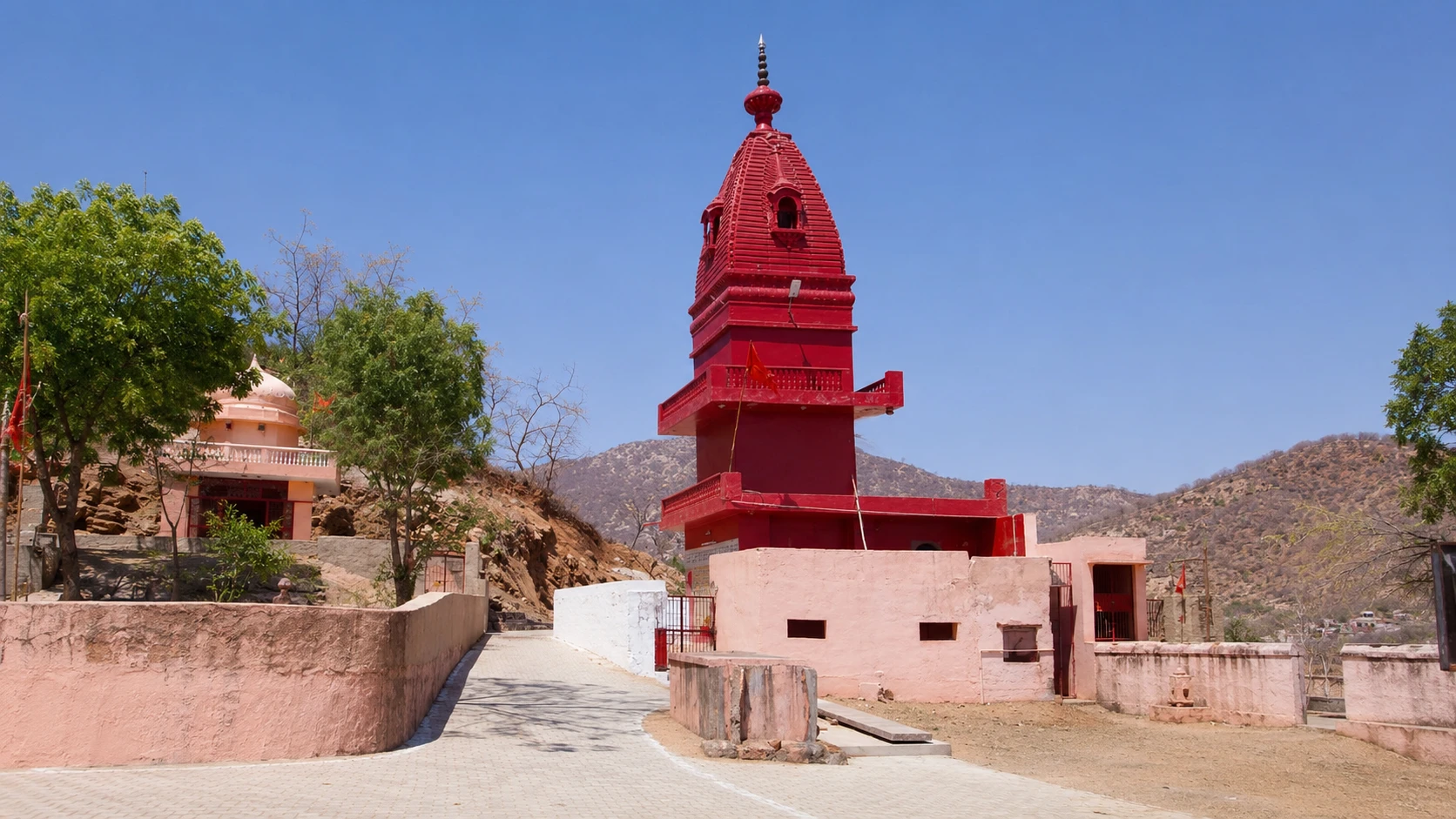
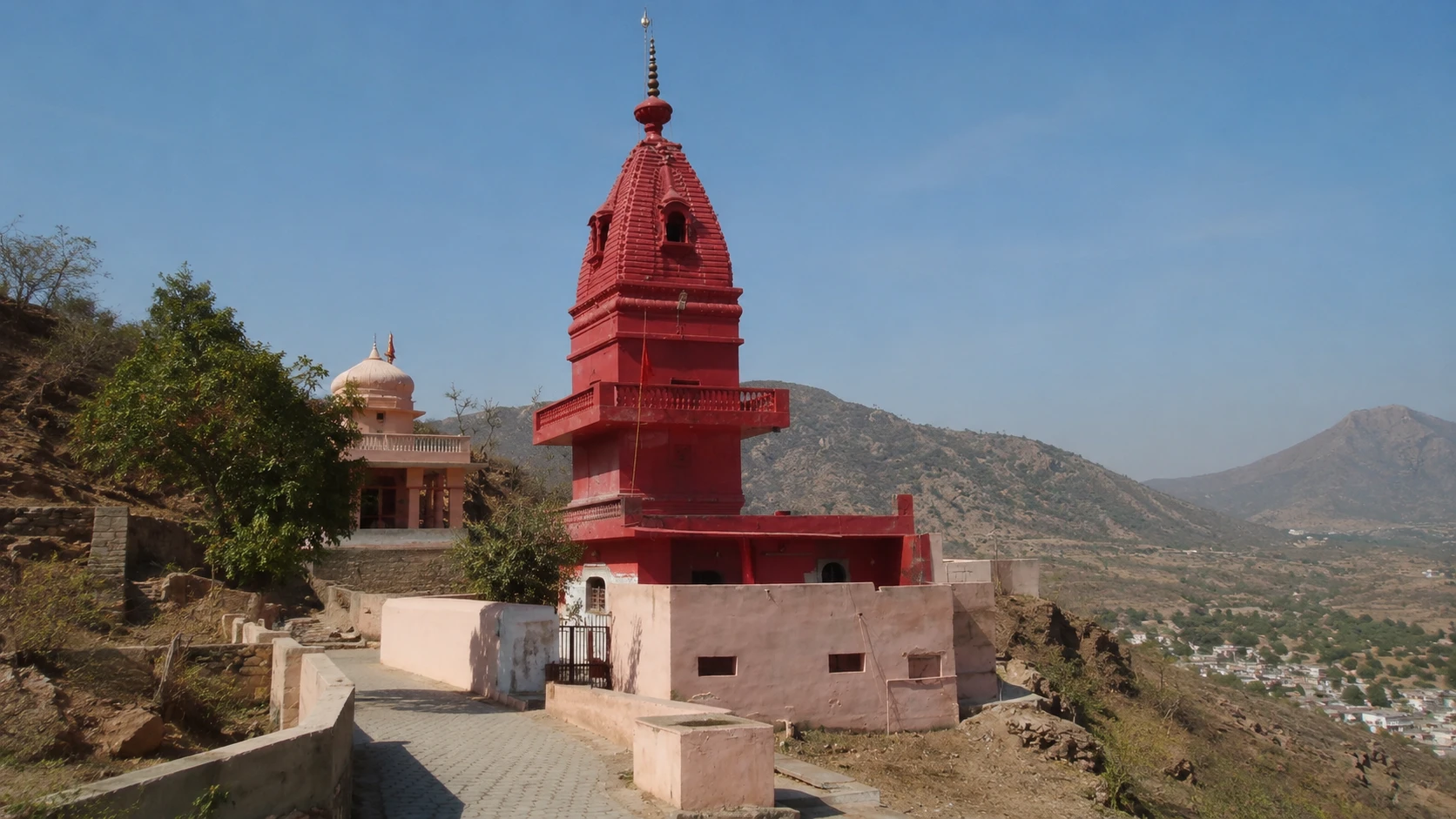
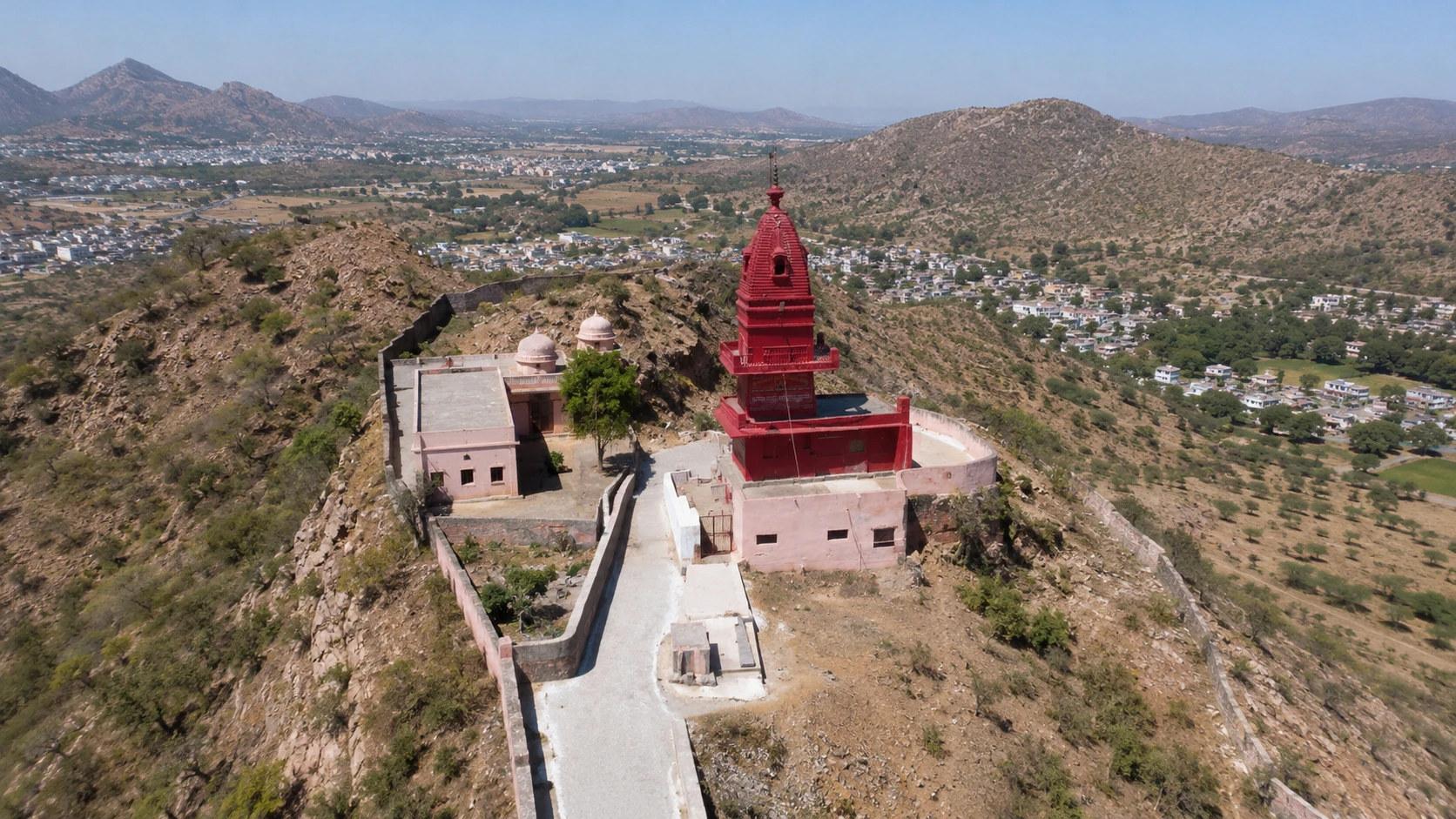
Hilltop Rajasthani temple architecture with shikhara superstructure, sandstone construction characteristic of central-Rajasthani 19th-century temple revival; small to mid-scale shrine in keeping with the Pīṭha's character as a Devī seat above the larger Pushkar sacred-geographic complex; approached by stone steps climbing the western hill from the lake's edge
खुला
05:00 – 21:00
आरती
05:30 · 12:00 · 19:00
विशेष
Pushkar Mela (annual; Kārtika śuklapakṣa, October, November), the principal annual gathering, drawing pilgrims from across North India and substantial international tourist traffic; Navarātri (Aswin) cycles; Caitra Navarātri in spring; daily pilgrimage flow from the wider Pushkar lake-pilgrimage circuit
पवित्र कथा · पवित्र कथा
Manibandh Gāyatrī at Pushkar is the Shakti Pīṭha where Satī's wrist (maṇibandha, literally 'the bracelet-place') is said to have fallen as Viṣṇu's Sudarśana cakra cut her body apart upon the back of the grieving Śiva. The canonical Pīṭhanirṇaya enumeration places the presiding Devī as Gāyatrī, uniquely among the Shakti Pīṭhas, the Devī here is identified not with a Kālī, Durgā, or Pārvatī register but with the Vedic mantra-goddess of the Ṛgveda 3.62.10 sūkta, the syllabic embodiment of the Gāyatrī-mantra itself. Among the eighteen Ashtadasa Mahā-Shakti Pīṭhas listed in Ādi Śaṅkara's foundational stotram (8th c. CE), Manibandh Gāyatrī occupies a position of singular theological distinctiveness: she is the only Shakti Pīṭha Devī whose primary canonical identity is as the personification of a specific Vedic mantra rather than as a Tantric or Puranic Devī-aspect. Set on a hilltop overlooking the Pushkar Sarovar, the sacred lake that Brahma is said to have created when he dropped a lotus to earth, and the site of the only major Brahma temple in India, the Pīṭha stands at the intersection of two devotional registers that ordinarily do not converge: the Shākta tradition's body-fall pīṭha system, and the Vedic tradition's reverence for the Gāyatrī-mantra as the most sacred utterance in the entire Sanskrit canonical corpus. To approach Gāyatrī at Pushkar is to encounter the Devī at a threshold where Vedic and Tantric traditions meet at a single shrine.
Sacred Designationपवित्र पदनाम
Shakti Peeth
शरीर का अंग: Wrist (maṇibandha, 'the bracelet-place')
शक्ति: Gāyatrī ('the singer / mantra-personification of the Ṛgveda 3.62.10 sūkta')
भैरव: Sarvānanda Bhairava (per Devī-Bhāgavata-aligned recensions; alternate traditions and some 51-list enumerations are silent on the Bhairava attribution)
Sacred Origin Storyपवित्र उत्पत्ति कथा
Source: Pīṭhanirṇaya (canonical Tantric pīṭha-enumeration text) and the Ashtadasa Shakti Pīṭha Stotram attributed to Ādi Śaṅkara (8th c. CE), paired with the Devī Bhāgavata Purāṇa Skandha VII 51-list tradition and the Padma Purāṇa's Puṣkara Khaṇḍa which provides extensive treatment of the wider sacred geography of Pushkar
When Dakṣa Prajāpati performed his great sacrifice and refused to invite his daughter Satī's husband, the ascetic Śiva, whom Dakṣa had never accepted as a son-in-law, Satī went to her father's court uninvited, intending to confront him.
Dakṣa met her not with welcome but with public condemnation: he spoke of Śiva as one fit only for cremation grounds, as the consort of ghosts, as no proper husband for the daughter of a Prajāpati. Satī, hearing her husband mocked in the assembly of the gods, would not return to him bearing such humiliation.
She invoked her own yogic fire at her father's hearth and consumed her body in it.
When Śiva learned of his wife's self-immolation, his grief broke the cosmos. He destroyed Dakṣa's yajña, sending Vīrabhadra to scatter the gods and behead Dakṣa himself, and then, taking up Satī's burned body across his shoulders, he began the wandering called the Tāṇḍava of grief.
He walked across the earth without rest, the dead weight of his wife borne on his back, and as he walked, all creation began to shudder.
Viṣṇu, who alone of the gods could intervene, took up his Sudarśana cakra and, walking behind Śiva on his unending journey, he reached his discus forward and began to cut. Piece by piece, almost surgically, the cakra severed Satī's body from Śiva's shoulders.
Each part fell to earth at the place where the cakra's stroke had cut, and each place where a piece of the goddess fell became sanctified, a Pīṭha, a seat of the goddess's power, where she could thereafter be worshipped in fragmentary but inexhaustible presence.
At one such cut, Satī's wrist, the maṇibandha, the bracelet-place, fell to the Aravalli hills of central Rajasthan, on the western slope of the valley that held the sacred lake of Pushkar. The canonical Pīṭhanirṇaya enumeration registers this place's presiding Devī as Gāyatrī, and here lies a theological distinctiveness that no other Shakti Pīṭha shares.
Where every other entry in the 51-list and the 18-Ashtadasa list names the presiding Devī as a Tantric or Puranic Devī-aspect (Mahākālī, Bhuvaneśvarī, Tāriṇī, Vimalā, Kātyāyanī, Yogādyā), Manibandh Gāyatrī alone names her presiding Devī as the personification of a Vedic mantra.
The Gāyatrī mantra of Ṛgveda 3.62.10, 'tat savitur vareṇyaṃ bhargo devasya dhīmahi dhiyo yo naḥ pracodayāt', is, in the Vedic tradition, the most sacred single utterance of the entire Sanskrit canonical corpus, the mantra recited by every twice-born Vedic householder at sandhyā (the morning and evening junctures) for the past three millennia.
To name the Pīṭha-Devī after this mantra is to make the Devī herself the syllabic embodiment of the Vedic tradition's most central utterance.
The placement of this Devī at Pushkar is theologically apt. Pushkar is, in the Padma Purāṇa's Puṣkara Khaṇḍa, the site where Brahmā, the cosmic creator, is said to have dropped a lotus to earth and where the resulting sarovar became sacred; Brahmā is recorded to have performed his great yajña here, and the only major Brahmā temple in India sits on the Pushkar lakeshore.
Gāyatrī is, in the canonical Vedic-Puranic tradition, Brahmā's consort, and the mantra she embodies is the one through which Brahmā creates and renews the cosmos at every dawn. The Devī of the Vedic creation-mantra inhabits the Pīṭha at the city where Brahmā the cosmic creator is uniquely housed.
The convergence of the Shākta body-fall narrative with the Vedic-Puranic Brahma-Gāyatrī theology gives Manibandh Gāyatrī a registration that no other Pīṭha shares: she is the Devī of the Vedic dawn, holding the threshold at the seat of the cosmic creator.
उद्धृत स्रोत:
- Pīṭhanirṇaya (canonical Tantric pīṭha-enumeration), entry for the maṇibandha-fall locus
- Ashtadasa Shakti Pīṭha Stotram attributed to Ādi Śaṅkara (8th c. CE)
- Devī Bhāgavata Purāṇa, Skandha VII
- Kālīkā Purāṇa, Chapters 18 and 60, 62
- Padma Purāṇa, Puṣkara Khaṇḍa (extensive treatment of the Pushkar sacred geography)
- Ṛgveda 3.62.10 (the Gāyatrī mantra itself)
- Mahābhārata, Vana Parva (early references to Puṣkara as a major tīrtha)
- Sircar, D. C., 'The Śākta Pīṭhas' (Journal of the Royal Asiatic Society of Bengal, 1948; revised monograph 1973)
- Eck, Diana L., 'India: A Sacred Geography' (Harmony Books, 2012), for the Pushkar sacred geography
- Bhardwaj, Surinder Mohan, 'Hindu Places of Pilgrimage in India' (University of California Press, 1973)
अन्य परंपराएँ · अन्य परंपराएँ
Brahmā-Sāvitrī-Gāyatrī triadic reading, the Pīṭha within the Pushkar Brahmā-tradition sacred geography, integrating the body-fall narrative with the Puranic account of Brahmā's two consorts at Pushkar
A primary alternative reading approaches Manibandh Gāyatrī not first through the Pīṭhanirṇaya body-fall narrative but through the Padma Purāṇa's Puṣkara Khaṇḍa account of Brahmā's two consorts at Pushkar. In this Puranic narrative, Brahmā arrived at Pushkar to perform his great yajña; his canonical consort Sāvitrī was delayed in arriving, and Brahmā, needing a consort to complete the ritual, took Gāyatrī (described variously as a Gūjar cowherd-woman or as the Devī herself) as a second consort to perform the yajña alongside him.
When Sāvitrī finally arrived and found Brahmā with Gāyatrī, she withdrew in anger to a hilltop on the eastern side of the valley, while Gāyatrī took her place on the western hilltop. The Sāvitrī temple and the Gāyatrī temple at Pushkar today occupy these two opposing hills, looking at each other across the sacred lake; both are Devī shrines, and both are pilgrim destinations, but Gāyatrī is the one canonically identified as the Maṇibandh Shakti Pīṭha.
In this Puranic reading, the body-fall narrative and the Brahmā-yajña narrative are complementary: the Pīṭha is the Shākta layer of a Devī-identity that is also held by the Vedic-Puranic tradition's Brahmā-consort narrative. Both layers operate simultaneously, and the temple's hilltop location is theologically explained by both at once.
Vedic mantra-goddess reading, Gāyatrī as the syllabic personification of the Ṛgveda 3.62.10 mantra, the Pīṭha-Devī encountered through Vedic chanting rather than through the body-fall narrative
A second alternative reading approaches Manibandh Gāyatrī through the Vedic tradition's own theology of the Gāyatrī mantra. In the Vedic-Brāhmaṇic register, Gāyatrī is not a Tantric Devī-aspect but the syllabic embodiment of the Ṛgveda 3.62.10 sūkta, the most sacred single utterance of the Sanskrit canon, recited at sandhyā by every twice-born Vedic householder for the past three millennia.
The mantra itself: 'tat savitur vareṇyaṃ bhargo devasya dhīmahi dhiyo yo naḥ pracodayāt', 'May we meditate upon the supreme effulgence of the divine Savitṛ, that he may inspire our intellects.' The Gāyatrī of this Vedic register is not anthropomorphic; she is sound itself, the metrical pattern (gāyatrī chandas, twenty-four syllables in three octosyllabic feet) personified as the goddess who utters herself in every Vedic recitation.
The Pīṭha at Pushkar, in this reading, is the seat of the mantra-power that the Vedic tradition holds central; pilgrims who approach the temple through Vedic chanting, particularly through the sandhyā recitation cycle, encounter the Devī not as a fragment of Satī's body but as the sounding mantra itself, manifested in form at the location where her body's wrist canonically fell.
The two readings, Vedic mantra-personification and Shākta body-fall, converge at the temple's actual ritual practice, where Vedic chanting of the Gāyatrī mantra is performed alongside the standard Shākta Devī-pūjā registers.
विद्वत संदर्भ
Modern scholarship treats Manibandh Gāyatrī at Pushkar as a Pīṭha of singular theological distinctiveness within the Shakti Pīṭha tradition. The Pīṭha is included in all three major Shakti Pīṭha enumeration traditions, Ādi Śaṅkara's 18 Ashtadasa Mahā-Pīṭhas (typically as the tenth position), the Kālīkā Purāṇa's 52-list, and the Devī Bhāgavata Purāṇa's 51-list. Among the 18 Ashtadasa entries, Gāyatrī at Pushkar is the only Pīṭha whose presiding Devī is canonically identified as the personification of a specific Vedic mantra rather than as a Tantric or Puranic Devī-aspect; this Vedic-Shākta convergence is unique among the Shakti Pīṭhas. The Pīṭha's location within the Pushkar sacred-geographic complex, the only site in India housing a major Brahmā temple, and one of the five most important Hindu tīrthas (Pañca-Sarovara), adds a second layer of canonical distinctiveness: this is the only Shakti Pīṭha whose adjacent site holds a major Brahmā temple. D. C. Sircar's foundational compilation ('The Śākta Pīṭhas', 1948/1973) treats Pushkar as a well-attested Pīṭha across the major 51-list traditions, with the wrist (maṇibandha) body-part attribution consistent across the lists. The Bhairava attribution as Sarvānanda appears in some Devī-Bhāgavata-aligned recensions but is silent or variant in some 51-list enumerations; this variability is noted in the entry's categoryAttributes block. Surinder Mohan Bhardwaj's 'Hindu Places of Pilgrimage in India' (1973) provides the foundational modern geographic-anthropological treatment of Pushkar's pilgrimage ecosystem. Diana Eck's 'India: A Sacred Geography' (2012) treats Pushkar's Brahmā-tradition adjacency as among the most distinctive in the subcontinent.
Historyइतिहास
Manibandh Gāyatrī at Pushkar's documented history is anchored in the long civilizational continuity of Pushkar itself, one of the oldest documented tīrtha-sites in the subcontinent. The earliest documentary horizons place Pushkar's sacred-geographic status from the Mahābhārata's Vana Parva (which lists Puṣkara as a major tīrtha) and the early Padma Purāṇa Puṣkara Khaṇḍa, both attesting to a sacred-pilgrimage tradition at Pushkar by at least the early centuries of the common era.
The specific Pīṭha attestation, the maṇibandha-fall identification with Gāyatrī as the presiding Devī, emerges in the canonical Pīṭhanirṇaya tradition of the medieval period and is formalised in Ādi Śaṅkara's Ashtadasa Shakti Pīṭha Stotram (8th c. CE), which lists Pushkar Gāyatrī as one of the eighteen.
Through the medieval and early-modern periods, Pushkar was sustained as a major pilgrimage centre under the patronage of the Chauhan dynasty of Ajmer (8th, 12th c.) and subsequently the Rathore Rajputs of Marwar (from the 14th c. onward).
Pushkar's geographic position, at the junction of the Marwar (Jodhpur), Mewar (Udaipur), and Dhundhar (Jaipur) Rajput territories, meant that the site received patronage from successive Rajput houses across the medieval and early-modern period.
The Mughal period brought a period of significant disruption to Pushkar's temple complex. The Mughal-era policies of Aurangzeb in the late seventeenth century included documented temple destruction across Rajasthan, and the Pushkar temple-complex is recorded as having been substantially affected during this period; the extent of damage to the Gāyatrī Pīṭha specifically is less directly documented than the impact on the Brahmā temple at the lake, but the wider sacred-geographic disruption was substantial.
The 19th-century Marwar Rajput restoration represents the substantive period of the current temple structure. Under the Marwar Maharajas (particularly during the reigns of Mān Singh, Takhat Singh, and Jaswant Singh II of Jodhpur in the nineteenth century), the Pushkar temple-complex was systematically rebuilt and re-consecrated, with the present Gāyatrī temple structure substantively dating from this Marwar-revival period.
The construction of stone steps up the western hill, the reinforcement of the hilltop temple structure, and the formalisation of the daily aarti cycle all unfold in this nineteenth-century horizon.
Through the British colonial period, Pushkar's annual Pushkar Mela (held during Kārtika śuklapakṣa, October, November) grew into one of the largest organised pilgrimage and trade fairs of North India. The post-Independence period has seen further formalisation of the Mela alongside the development of Pushkar as a major international tourist destination, the temple complex now operates within an ecosystem that combines traditional pilgrimage flows with substantial international tourist traffic, particularly during the Mela period and the cooler October-to-March visiting window.
The Manibandh Gāyatrī temple has continued through this transformation as a principal Devī-darshan node within the wider Pushkar pilgrimage circuit, with regular pilgrim flows and a continuing presence of Vedic-traditional sandhyā observance alongside the standard Shākta Devī-pūjā cycles.
Historical Timelineऐतिहासिक कालक्रम
Pīṭhanirṇaya canonical inclusion of Pushkar as the maṇibandha-fall locus, with Gāyatrī as the presiding Devī. The canonical-Tantric layer establishes Pushkar Gāyatrī as a Pīṭha within the medieval Tantric enumeration tradition; the earliest documentary horizon for the Pīṭha specifically pre-dates the major Mahābhārata and Padma Purāṇa references to Pushkar as a tīrtha but is built on the longer civilizational continuity of the site.
Composition of the Ashtadasa Shakti Pīṭha Stotram attributed to Ādi Śaṅkara, which lists Gāyatrī at Pushkar as one of the eighteen Ashtadasa Mahā-Pīṭhas (typically as the tenth position in standard recensions). The 18-list attestation positions Pushkar Gāyatrī within the most theologically privileged Shakti Pīṭha enumeration in the tradition, and its inclusion in this list, alongside the broader 51-list and 52-list traditions, establishes the multi-canonical convergence that defines the Pīṭha's standing.
The attribution of the Ashtadasa Shakti Pīṭha Stotram to Ādi Śaṅkara is the traditional attribution; modern scholarship varies on whether the stotram is his direct composition or a later work attributed to him. The 8th-century horizon for the formalisation of the 18-list is consistent across modern critical accounts regardless of the attribution question.
Chauhan dynasty patronage from Ajmer (8th, 12th c., centred at Ajmer's Taragarh fort) and subsequent transition to Rathore Rajput patronage of Marwar (14th c. onward) sustained Pushkar as a major Hindu pilgrimage centre. The Chauhans, with their capital at Ajmer (15 km from Pushkar), extended particular patronage to the Pushkar sacred geography; the wider Rajput patronage network of central Rajasthan integrated Pushkar's temples into the regional ritual economy across this long medieval horizon.
Aurangzeb-era temple disruption across Rajasthan. The Mughal emperor Aurangzeb's late-17th-century policies of temple destruction across Rajasthan affected Pushkar's temple complex; the famous Brahmā temple at Pushkar is documented as having been substantially affected, and the wider sacred geography of Pushkar, including the Manibandh Gāyatrī Pīṭha, saw significant disruption during this period. The damage to the Gāyatrī Pīṭha specifically is less directly documented than the Brahmā temple's destruction, but the overall disruption of Pushkar's temple infrastructure was substantial, necessitating the comprehensive 19th-century Marwar restoration.
The Aurangzeb-era temple-destruction policies and their specific application at Pushkar are documented in Mughal-era Persian chronicles and have been treated extensively in modern scholarship. The interpretive frame around the period (whether religious-ideological, political-pragmatic, or some combination) remains contested among historians; Eternal Raga reports the documented disruption without adjudicating these contested interpretive frames.
Marwar Rajput restoration period, the substantive rebuilding of the Pushkar temple complex including the present Gāyatrī temple structure. Under the Marwar Maharajas (particularly Mān Singh r. 1803, 1843, Takhat Singh r. 1843, 1873, and Jaswant Singh II r. 1873, 1895 of Jodhpur), the Pushkar temple complex was systematically restored and re-consecrated; the construction of stone steps up the western hill to the Gāyatrī temple, the reinforcement of the hilltop temple structure, and the formalisation of the temple's daily ritual cycle all unfold in this 19th-century horizon. The Marwar revival forms the substantive period of the current temple structure as it stands today.
Post-Independence continuity and the formalisation of the Pushkar Mela as one of India's major annual pilgrimage and cultural events. The Kārtika śuklapakṣa Pushkar Mela (October, November) has grown through the post-1947 period into one of the largest annual gatherings in Rajasthan, drawing pilgrims, camel-traders, cultural-tourism visitors, and substantial international tourist traffic. Estimates place annual Mela attendance at approximately 200,000, 400,000 pilgrims and visitors during the peak Mela period, with the Manibandh Gāyatrī Pīṭha receiving substantial pilgrim flows as a principal Devī-darshan node within the wider Pushkar circuit. The temple has continued operations through this transformation as a continuously-active Devī shrine within Pushkar's combined traditional-pilgrimage and modern-tourism ecosystem.
What You'll Seeदर्शन में
The Gāyatrī mūrti at Manibandh Pushkar is enshrined in a hilltop Rajasthani temple structure on the western slope of the Pushkar valley, accessed by stone steps climbing approximately 200 metres above the lake's edge. The presiding image is a sandstone Devī form in the Gāyatrī register, five-headed in the canonical iconographic convention (representing the five elements or the five Vedas, depending on the textual register), each face carrying a meditative expression appropriate to the mantra-goddess; ten arms hold the customary Devī attributes (lotus, varada-mudrā, abhaya-mudrā, scriptural pothī, japa-mālā, conch, discus, and others, with iconographic variation across recensions).
The five-headed Gāyatrī iconography is distinctive among the Shakti Pīṭhas, most Pīṭha-Devīs are depicted in single-headed forms reflecting their Tantric or Puranic Devī-aspect, but Gāyatrī's Vedic mantra-goddess identity is iconographically expressed through the multi-headed form that the Vedic-Puranic tradition gives her.
The mūrti is robed in red and gold textile in keeping with the Marwar-Rajasthani temple aesthetic in which the contemporary structure was rebuilt. Subsidiary shrines within the temple compound include the Bhairava Sarvānanda companion shrine and small ancillary Devī images.
The hilltop location provides a commanding view across the Pushkar valley, the sacred Sarovar below, the Brahmā temple on the lake's eastern shore, and the Sāvitrī temple on the opposite hilltop visible across the valley.
The architectural configuration is modest in scale compared to the major Brahmā temple at the lakeshore, but the elevation and the panoramic-pilgrim approach make the Gāyatrī temple one of Pushkar's most atmospheric darshan experiences.
Distinctive Practicesविशिष्ट परंपराएँ
Sandhyā Gāyatrī-mantra recitation at the Pīṭha (Vedic-register practice)
पीठ पर सन्ध्या गायत्री-मन्त्र पाठ (वैदिक-रजिस्टर प्रथा)
Year-round daily at sandhyā junctures (pre-dawn and dusk); intensified during Gāyatrī Jayantī and the Vedic-tradition observance periods
The most distinctive practice at Manibandh Gāyatrī, sustained by the temple's Vedic-mantra-goddess identity: devotees recite the Gāyatrī mantra (Ṛgveda 3.62.10) at the temple during sandhyā, the canonical morning and evening junctures of the Vedic ritual day. The practice integrates the standard Vedic sandhyā observance (recited daily by every twice-born Vedic householder at dawn and dusk) with Shakti Pīṭha darshan at the same location: the Devī of the mantra and the seat of her Pīṭha are encountered through the chanting of her own canonical Vedic verse. This practice is corpus-unique among the 51-list Shakti Pīṭhas, nowhere else does Vedic mantra-recitation form the principal distinctive practice of a Shakti Pīṭha, because nowhere else is the presiding Devī herself a Vedic mantra. Local Brahmin priestly lineages at the temple maintain the sandhyā recitation tradition continuously, and Vedic-traditional devotees (particularly Ārya Samājī householders and Vedic-pāṭhaśālā students) make focused pilgrim visits to perform sandhyā at the hilltop temple.
The sandhyā recitation makes the relationship between the Devī and her devotee linguistically immediate: the devotee is not addressing the Devī through stotra or pūjā but speaking the very mantra she embodies. To recite the Gāyatrī at her Pīṭha is to bring the mantra back to the place where its goddess holds form, the syllabic Devī returning to her body-fall locus through the very utterance that constitutes her. The sandhyā timing, dawn and dusk, the threshold moments of the daily cosmic cycle, aligns the Vedic ritual register with the Devī's body-fall locus at a meditative crossing-point.
Pushkar Mela integration (annual Kārtika observance)
पुष्कर मेला समाकलन (वार्षिक कार्तिक अनुष्ठान)
Annual; Kārtika śuklapakṣa (October, November), peaking on Kārtika Pūrṇimā
The Pushkar Mela, held annually during the Kārtika śuklapakṣa fortnight and peaking on Kārtika Pūrṇimā (the full moon of October, November), is the largest annual event in the temple's calendar and one of the most internationally-visible Hindu pilgrimage gatherings. Estimated annual attendance ranges from 200,000 to 400,000 pilgrims and visitors during the peak Mela period, drawn from across Rajasthan, the wider North Indian Hindu pilgrim network, and a substantial international tourist contingent for whom the Mela's combination of religious pilgrimage and traditional camel-fair has become a major draw. The Manibandh Gāyatrī Pīṭha is integrated into the Mela's religious circuit alongside the Brahmā temple, the Sāvitrī temple, and the 52 sacred ghāts that ring the Pushkar Sarovar. Pilgrim ritual practice during the Mela includes bathing in the Sarovar (particularly on Kārtika Pūrṇimā), circumambulation of the lake's ghāts, and ascent to both hilltop Devī temples. Among the major Shakti Pīṭhas, only Manibandh Gāyatrī sits within a Mela of this scale and international visibility.
The Kārtika śuklapakṣa timing has multiple theological registers operating at once. Kārtika is traditionally the month of Viṣṇu's awakening from Cāturmāsya cosmic slumber, the month of Tulsī-vivāha and other major Vaiṣṇava observances, and, at Pushkar specifically, the month of Brahmā's annual yajña commemoration. The Devī of the Vedic mantra of cosmic dawn receives darshan at the moment when the entire Hindu liturgical year is itself at a major waking-threshold. The Mela's pilgrim density carries the doctrinal weight of this moment.
Brahmā, Sāvitrī, Gāyatrī triadic darshan circuit
ब्रह्मा-सावित्री-गायत्री त्रिक दर्शन परिक्रमा
Year-round; intensified during the Pushkar Mela and major festival periods
A practice distinctive to Pushkar's particular three-temple sacred geography: pilgrims undertake a sequenced darshan of the Brahmā temple at the lakeshore (the only major Brahmā temple in India), then ascend the eastern hill to the Sāvitrī temple, and finally cross the valley to ascend the western hill to the Manibandh Gāyatrī temple. The circuit reflects the Puranic narrative of Brahmā's yajña and his two consorts at Pushkar: the pilgrim physically traces the geographic relationships that the Padma Purāṇa's Puṣkara Khaṇḍa narrates. The triadic circuit is unique to Pushkar; no other Hindu pilgrimage site in the subcontinent offers a Brahmā-Sāvitrī-Gāyatrī integrated darshan in this geographically-specific way. Most pilgrims complete the circuit in a single day, often beginning with pre-dawn bathing at the Sarovar before the Brahmā temple darshan.
The triadic circuit performs the Puranic theology of Pushkar physically: the pilgrim moves through the geographic registration of a cosmic narrative, the body tracing the doctrinal pattern that the Padma Purāṇa establishes. Brahmā at the lake is the cosmic creator at the place of creation; Sāvitrī on her hill is the canonical first consort; Gāyatrī on her hill is the mantra-power that completes the yajña. To traverse the three temples is to receive the Pushkar narrative in its full geographic-theological completeness.
Did You Know?क्या आप जानते हैं?
Manibandh Gāyatrī at Pushkar is the only Shakti Pīṭha in the entire 51-list and 18-Ashtadasa traditions where the presiding Devī is canonically identified as the personification of a specific Vedic mantra rather than as a Tantric or Puranic Devī-aspect. The Gāyatrī mantra of Ṛgveda 3.62.10, 'tat savitur vareṇyaṃ bhargo devasya dhīmahi dhiyo yo naḥ pracodayāt', is the most sacred single utterance in the entire Sanskrit canonical corpus, recited at sandhyā by every twice-born Vedic householder for the past three millennia. To name the Pīṭha-Devī after this mantra is to make the Devī herself the syllabic embodiment of the Vedic tradition's most central utterance. This Vedic-Shākta convergence is corpus-unique and is the temple's most theologically distinctive feature.
Pīṭhanirṇaya; Ashtadasa Shakti Pīṭha Stotram (Adi Shankara); Ṛgveda 3.62.10; comparative observation across the 51-list and 18-list traditions
Manibandh Gāyatrī is the only Shakti Pīṭha in the subcontinent whose adjacent site holds a major Brahmā temple. Brahmā, the cosmic creator god, has only one major temple in all of India, the Brahmā Mandir at Pushkar on the eastern shore of the Sarovar (approximately 1 km from the Gāyatrī temple's hilltop location across the valley). The Puranic tradition explains this rarity through the curse of Sarasvatī or Sāvitrī: Brahmā, having angered his consort, was decreed to receive worship only at Pushkar. The Gāyatrī temple's adjacency to this unique Brahmā site makes the Pīṭha part of a sacred-geographic ensemble that no other Shakti Pīṭha replicates.
Padma Purāṇa, Puṣkara Khaṇḍa; Bhardwaj (1973); Eck (2012); comparative observation across the Indian temple corpus
The five-headed iconography of Gāyatrī Devī at Pushkar is distinctive among the Shakti Pīṭhas, where most Devīs are depicted in single-headed forms reflecting their Tantric or Puranic Devī-aspect. Gāyatrī's five faces are variously interpreted: as the five elements (earth, water, fire, air, ether), as the five Vedas (counted as Rg, Yajur, Sāma, Atharva, and a fifth itihāsa-purāṇa register), or as the five aspects of cosmic time. The Vedic mantra-goddess's multi-headed form gives her iconography a complexity that the standard single-headed Devī images do not carry; the temple's mūrti represents one of the most theologically dense iconographic forms in the Pīṭha tradition.
Padma Purāṇa Puṣkara Khaṇḍa; living temple iconographic tradition; Bühler and other Indological commentary on multi-headed Devī iconography
Pushkar's Sarovar is one of the five Pañca-Sarovara, the five most important sacred lakes of Hindu pilgrimage tradition (Mānasarovara in Tibet, Bindu-Sarovara in Gujarat, Nārāyaṇa-Sarovara in Gujarat's Kutch, Pampā-Sarovara in Karnataka, and Puṣkara-Sarovara in Rajasthan). The Manibandh Gāyatrī temple's location overlooking this Pañca-Sarovara lake gives the Pīṭha a doubled sacred-geographic embedding: a Shakti Pīṭha within a Pañca-Sarovara tīrtha. No other Shakti Pīṭha sits at a Pañca-Sarovara location.
Padma Purāṇa; Skanda Purāṇa; Bhardwaj (1973); Eck (2012)
Gāyatrī Jayantī, the annual celebration of the Gāyatrī mantra-goddess's 'birth' (or canonical revelation), is observed at Manibandh Gāyatrī during Jyeṣṭha śuklapakṣa Ekādaśī (late May or June). The festival is distinctive because it is the only Shakti Pīṭha annual cycle anchored on the canonical commemoration of a Vedic mantra rather than on the standard Devī-aspect liturgical calendar. Vedic-traditional households and Ārya Samājī devotees make focused Gāyatrī Jayantī pilgrimages to the temple; the observance includes mantra-recitation, scripture-study, and Vedic-tradition rituals that integrate with the standard Pīṭha-Devī liturgy.
Vedic-traditional liturgical calendars; Ārya Samāja observance records; modern Gāyatrī Parivār documentation
Visitor Accessप्रवेश जानकारी
Manibandh Gāyatrī welcomes devotees of all backgrounds for darshan throughout the temple's open hours. There are no caste-based, sectarian, or gender-based entry restrictions. The temple's hilltop location requires climbing approximately 200 metres of stone steps from the lake level; the climb is moderately strenuous and visitors with mobility limitations should plan accordingly (some pilgrim assistance is informally available during peak periods). The temple operates within Pushkar's combined traditional-pilgrimage and international-tourism ecosystem; international visitors are accustomed to and welcomed at the temple, with basic English alongside Hindi spoken at the temple gate. Photography of the inner sanctum and the Gāyatrī mūrti is not permitted; outer-compound photography (the hilltop courtyard, the panoramic views) is generally accepted and is one of Pushkar's most-photographed sites. During the Pushkar Mela period (Kārtika), pilgrim density is very high and the hilltop climb may experience queue-style staging.
Festivalsत्योहार
Pushkar Mela (Kārtika śuklapakṣa)
पुष्कर मेला (कार्तिक शुक्लपक्ष)
Oct, Nov (Kārtika śuklapakṣa fortnight, peaking on Kārtika Pūrṇimā)
The temple's principal annual gathering and one of the most internationally-visible Hindu pilgrimage events. Estimated 200,000, 400,000 pilgrims and visitors during peak Mela days; the Manibandh Gāyatrī Pīṭha receives substantial flows as part of the wider Brahmā-Sāvitrī-Gāyatrī triadic circuit. Kārtika Pūrṇimā is the festival's culminating day, with predawn bathing at the Sarovar followed by darshan at the major temples.
Navarātri (Aswin)
नवरात्रि (आश्विन)
Sep, Oct (Aswin śuklapakṣa)
The standard Aswin Navarātri Devī cycle observed at Manibandh Gāyatrī with the wider North Indian Navarātri convention. Gāyatrī receives darshan in her Pīṭha-Devī register alongside the Vedic-mantra register that defines the temple's distinctive theology. The nine nights bring substantial Devī-devotee pilgrim flows alongside the regular Pushkar pilgrim ecosystem.
Gāyatrī Jayantī (Vedic-tradition observance)
गायत्री जयन्ती (वैदिक-परम्परा अनुष्ठान)
May, Jun (Jyeṣṭha śuklapakṣa Ekādaśī)
Distinctive to Manibandh Gāyatrī among the Shakti Pīṭhas: the annual celebration of the Gāyatrī mantra-goddess's canonical revelation. The observance is centred on Vedic-traditional households and Ārya Samājī devotees, with mantra-recitation, scripture-study, and integrated Vedic-Shākta liturgy. No other Shakti Pīṭha in the corpus observes a Vedic-mantra-specific Jayantī as a temple-level festival.
Caitra Navarātri
चैत्र नवरात्रि
Mar, Apr (Caitra śuklapakṣa)
The spring Devī cycle, observed at Manibandh Gāyatrī alongside the Aswin Navarātri in the standard nine-night Devī liturgical pattern. The Caitra cycle attracts smaller pilgrim attendance than the Aswin and the Pushkar Mela but is preserved as a continuous part of the temple's annual liturgy.
Traditional Offeringsपारंपरिक अर्पण
प्राथमिक अर्पण
Red Japā (Hibiscus) flowers
लाल जपा (गुड़हल) के पुष्प
जपा-पुष्प
The canonical red floral offering to the Devī. At Manibandh Gāyatrī, the offering carries its standard Shākta significance alongside the additional Vedic-register layer: the red of the offering corresponds to the dawn-light register of the Gāyatrī mantra (the mantra invokes the supreme effulgence of Savitṛ, the sun at dawn). Red japā at this Pīṭha is simultaneously a Shākta and a Vedic-tradition offering.
Kumkum and Sindūr (Vermilion)
कुमकुम और सिन्दूर
कुङ्कुम / सिन्दूर
Vermilion is offered at the Devī's feet, carrying the standard Shākta register of life-force and sovereignty. At Manibandh Gāyatrī, the sindūr offering connects to the Devī's married status, Gāyatrī is, in the Puranic tradition, Brahmā's second consort, and the sindūr at her feet marks the marital theological register that the Padma Purāṇa Puṣkara Khaṇḍa establishes.
Red bangles and red-bordered cloth
लाल चूड़ियाँ और लाल-किनारी वस्त्र
Devotees offer red bangles and lengths of red-and-gold cloth to the Devī. At Manibandh Gāyatrī, the textile-offering register reflects the Marwar-Rajasthani temple aesthetic in which the contemporary structure was rebuilt and is particularly substantial during the Pushkar Mela period.
Coconut
नारियल
नारिकेल
The coconut is broken before the Devī as a symbolic offering of the ego, the hard outer shell, white interior, and sweet water within corresponding to body, mind, and consciousness offered to the goddess. Observed at Manibandh Gāyatrī in continuity with standard Hindu temple practice.
Pān-supāri (Betel leaf and areca)
पान-सुपारी
ताम्बूल-पूगफल
Betel leaf with areca and lime is offered before the Devī as a traditional auspicious offering signifying hospitality, honour, and welcome. Distributed at the close of major aartis as a token of the Devī's reciprocal welcome to the devotee.
इस मंदिर की विशेषता
Vedic-register sandhyā materials (sandalwood-paste, kuśa grass, ghee for dīpa-arghya)
वैदिक-रजिस्टर सन्ध्या सामग्री (चन्दन-लेप, कुश घास, दीप-अर्घ्य के लिए घी)
Distinctive to Manibandh Gāyatrī among the Shakti Pīṭhas: offerings appropriate to the Vedic-tradition sandhyā register that the temple's Vedic-mantra-goddess identity invites. Devotees performing sandhyā at the hilltop bring sandalwood-paste (used for tilaka application and for the Devī's iconographic anointing), kuśa grass (the sacred grass canonical to Vedic ritual, used as a seat or for ritual purification), and ghee (clarified butter, the canonical Vedic ritual substance, used for the hilltop dīpa-arghya offering). These materials are characteristic of Vedic-tradition ritual rather than the standard Tantric Devī-pūjā offering register; their presence here reflects the temple's unique convergence of Vedic and Shākta liturgical traditions.
Brahmā, Gāyatrī, Sāvitrī triadic-circuit paired offerings
ब्रह्मा-गायत्री-सावित्री त्रिक-परिक्रमा युग्म अर्पण
Pilgrims undertaking the three-temple circuit at Pushkar often carry paired offering bundles, yajña-tradition offerings (akṣata, dūrvā, samidha) for Brahmā at the lake, plus standard Devī offerings for Gāyatrī on the western hilltop and Sāvitrī on the eastern hilltop. The offering pattern reflects the canonical reading of Pushkar as a single sacred-geographic ground holding Vedic-tradition Brahmā-worship and Shākta Devī-Pīṭha worship as complementary registers. The vendor ecosystem around the Pushkar lakeshore, operating continuously across generations, has organised offering supply around this triadic practice.
Most devotees bring offerings from the vendor ecosystem near the Pushkar lake market or from shops along the route to the hilltop temple. Vendors typically offer pre-organised bundles tailored to the Brahmā-Gāyatrī-Sāvitrī triadic circuit; Vedic-tradition devotees performing sandhyā often bring their own ritual materials. The temple itself does not maintain a formal offerings counter; offering arrangements are organised through the wider Pushkar ecosystem with informal coordination at the temple gate.
How to Reachकैसे पहुँचें
Manibandh Gāyatrī at Pushkar is reached from Ajmer Junction (15 km), the principal long-distance rail hub for the Pushkar region, with direct daily services to Delhi, Mumbai, Jaipur, Jodhpur, Ahmedabad, and most other major Indian cities. The road journey from Ajmer to Pushkar takes approximately 30 minutes via Nag Parbat (the Naga hill range that separates the two towns).
From Delhi, the road journey via NH-48 takes approximately 6, 7 hours; from Jaipur via the Ajmer corridor approximately 3 hours. The nearest functional airport is Jaipur International Airport (145 km, full domestic and international connectivity); Kishangarh Airport (50 km) provides limited domestic connectivity.
Within Pushkar, the temple is reached on foot, the town's central area is largely pedestrian-only with cycle-rickshaws and shared autos serving longer movement. From Pushkar's central bazaar, the climb to the Gāyatrī temple on the western hilltop takes approximately 30, 45 minutes including the stone-step ascent.
During the Pushkar Mela (Kārtika), the Rajasthan State Road Transport Corporation operates additional buses to Pushkar from Delhi, Jaipur, Jodhpur, and other regional centres.
Plan Your Visitयात्रा की योजना
🌤 सर्वोत्तम मौसम
October to March is the most comfortable visiting window, cool to mild Rajasthani winter weather, dry conditions, and the Pushkar Mela at the heart of the season. The Mela period (Kārtika Pūrṇimā, October, November) brings extraordinary pilgrim density and substantial international tourist traffic, with accommodation and movement pressure across Pushkar; visitors who want a quieter darshan should consider late November through February. The April, June pre-monsoon period brings extreme heat to the Rajasthani plateau; daytime temperatures often exceed 42°C and the hilltop climb to the temple is particularly demanding during these months. The July, September monsoon brings moderate rainfall and somewhat cooler temperatures but the hilltop stone steps can become slippery in heavy rain. Gāyatrī Jayantī (Jyeṣṭha śuklapakṣa, May, June) occurs during the extreme-heat window; Vedic-traditional pilgrims who attend should plan accordingly.
👘 पहनावे का नियम
Modest full-coverage attire is appropriate. For women: saree, salwar-kameez, or other modest full-coverage clothing. For men: dhoti-kurta, kurta-pyjama, or modest trousers and shirt. Pushkar's combined pilgrim-tourist ecosystem means a wide range of clothing is seen in the town and around the lake, but visitors should adjust to modest temple-appropriate attire when approaching the Gāyatrī temple proper. The hilltop climb makes comfortable footwear important; footwear is removed at the temple entrance and covered shoe-storage is available. Vedic-traditional and Ārya Samājī devotees performing sandhyā often wear specific ritual attire (yajñopavīta, sacred thread, visible) appropriate to the Vedic register of their practice.
📱 फोन और फोटोग्राफी
Mobile phones are permitted on the temple grounds. Photography is not permitted in the inner sanctum (garbhagriha); outer-courtyard photography is generally accepted and the hilltop's panoramic views are among Pushkar's most-photographed sites. Flash photography near the mūrti is not appropriate. During sandhyā recitation periods (pre-dawn and dusk), pilgrims engaged in Vedic chanting should not be disturbed by photography. The Pushkar Mela period sees substantial international photography traffic; courtesy expectations remain in force during pilgrim ritual moments regardless of the broader tourism context.
🏨 आवास
Pushkar offers an exceptionally wide accommodation range serving its combined pilgrim and international-tourism flows. Options include the Rajasthan Tourism Development Corporation's hotels, hundreds of mid-range hotels and guesthouses in central Pushkar, traditional dharamshalas for pilgrims, large premium-segment heritage hotels (including Rajput-era haveli conversions), and budget options for international backpackers. The Pushkar Mela period (Kārtika) brings substantial accommodation pressure; advance booking 2, 3 months in advance is recommended for the Mela window. Outside the Mela, October, March is the peak tourism season but availability is generally good. Pushkar's accommodation is small-town in scale; for larger or premium-segment options, Ajmer (15 km) provides a metropolitan alternative.
Sacred Soundsपवित्र ध्वनि
Gāyatrī Mantra Recitation (Ṛgveda 3.62.10), the mantra the Devī embodies
mantra · 248
Brahmā, Gāyatrī, Sāvitrī Yugma Stotram (Pushkar triadic invocation)
stotram · 612
Ashtadasa Shakti Pīṭha Stotram (Ādi Śaṅkara, 18 Mahā-Pīṭha enumeration listing Gāyatrī at Pushkar)
stotram · 612
Caṇḍī Pāṭh, Devī Māhātmya Chapter 1
path · 1247
Vedic Sandhyā Recitation (full canonical morning sandhyā cycle including the Gāyatrī mantra)
vedic_chant · 842
108 Japa Practice
Gāyatrī Mantra (Ṛgveda 3.62.10), Oṁ bhūr bhuvaḥ svaḥ, tat savitur vareṇyaṃ, bhargo devasya dhīmahi, dhiyo yo naḥ pracodayāt
Chant 108 times in the spirit of this temple
क्या आप जानते हैं? · Did You Know?
वही अनुवाद त्रुटि जिसने हिन्दू धर्म में '33 कोटि' को '33 करोड़' बनाया, बौद्ध धर्म में भी हुई। बौद्ध ग्रन्थों के चीनी अनुवाद ने 'सप्त कोटि बुद्ध' (7 श्रेष्ठ बुद्ध) का अनुवाद '7 करोड़ बुद्ध' कर दिया। तिब्बती अनुवाद ने सही किया: 7 प्रकार, 7 करोड़ नहीं। एक संस्कृत शब्द, दो प्रमुख विश्व धर्मों में गलत पढ़ा गया, ने दो एकसमान भ्रम स्वतन्त्र रूप से उत्पन्न किए।
Related Contentसंबंधित सामग्री
Related Scriptures
Related Temples
Avanti (Harasiddhi Mata)
अवंती शक्तिपीठ
Ujjain, Madhya Pradesh
Ambaji
अंबाजी
Ambaji, Gujarat
Mahakaleshwar
महाकालेश्वर
Ujjain, Madhya Pradesh
Kireet Shakti Peeth
किरीट शक्तिपीठ
Lalbagh (Murshidabad), West Bengal
Yogadya (Kshirgram)
योगाद्या शक्तिपीठ
Kshirgram, West Bengal
Vrindavan (Uma Devi)
वृंदावन शक्तिपीठ
Vrindavan, Uttar Pradesh
Tarapith
तारापीठ
Tarapith, West Bengal
Bakreshwar Mahishmardini
बक्रेश्वर शक्तिपीठ
Bakreshwar, West Bengal
Bahula Shakti Peeth
बहुला शक्तिपीठ
Ketugram, West Bengal
Kankalitala Shakti Peeth
कंकालीतला शक्तिपीठ
Bolpur, West Bengal
Attahas Shakti Peeth
अट्टहास शक्तिपीठ
Labpur, West Bengal
Community Reflections
🕉️
Be the first to share your reflection.