Bahula Shakti Peeth
बहुला शक्तिपीठ
Where Satī's left arm fell on the Ajay's bank
Ketugram, West Bengal, India
BahulāAlso known as: Bahula at Ketugram, Bāhulā, Ketugram Bahula, বহুলা, মা বহুলা মন্দির, কেতুগ্রাম বহুলা
युग
Medieval Bengali Shākta site; present temple structure 18th, 19th c., with later additions
वास्तुकला
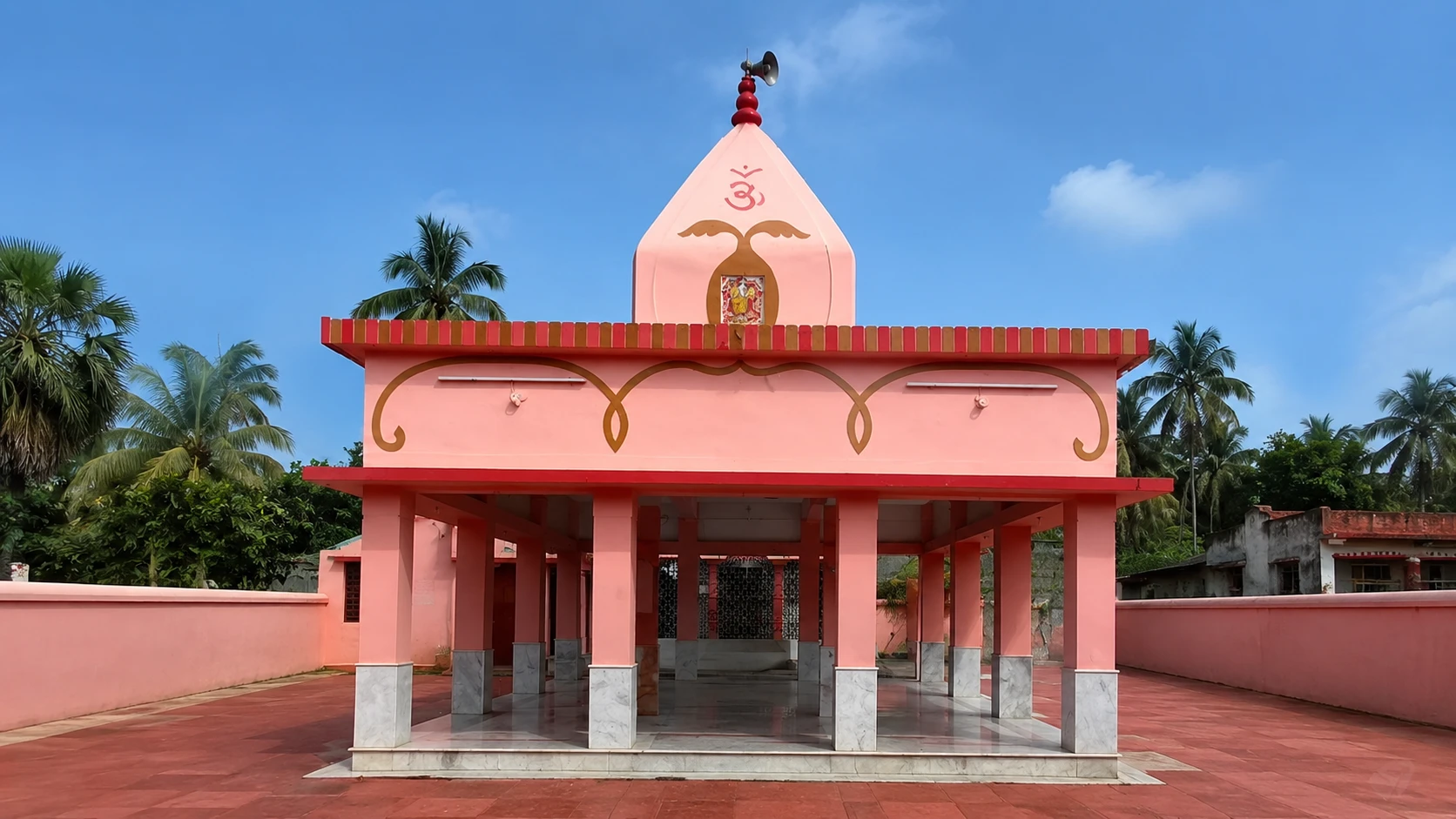
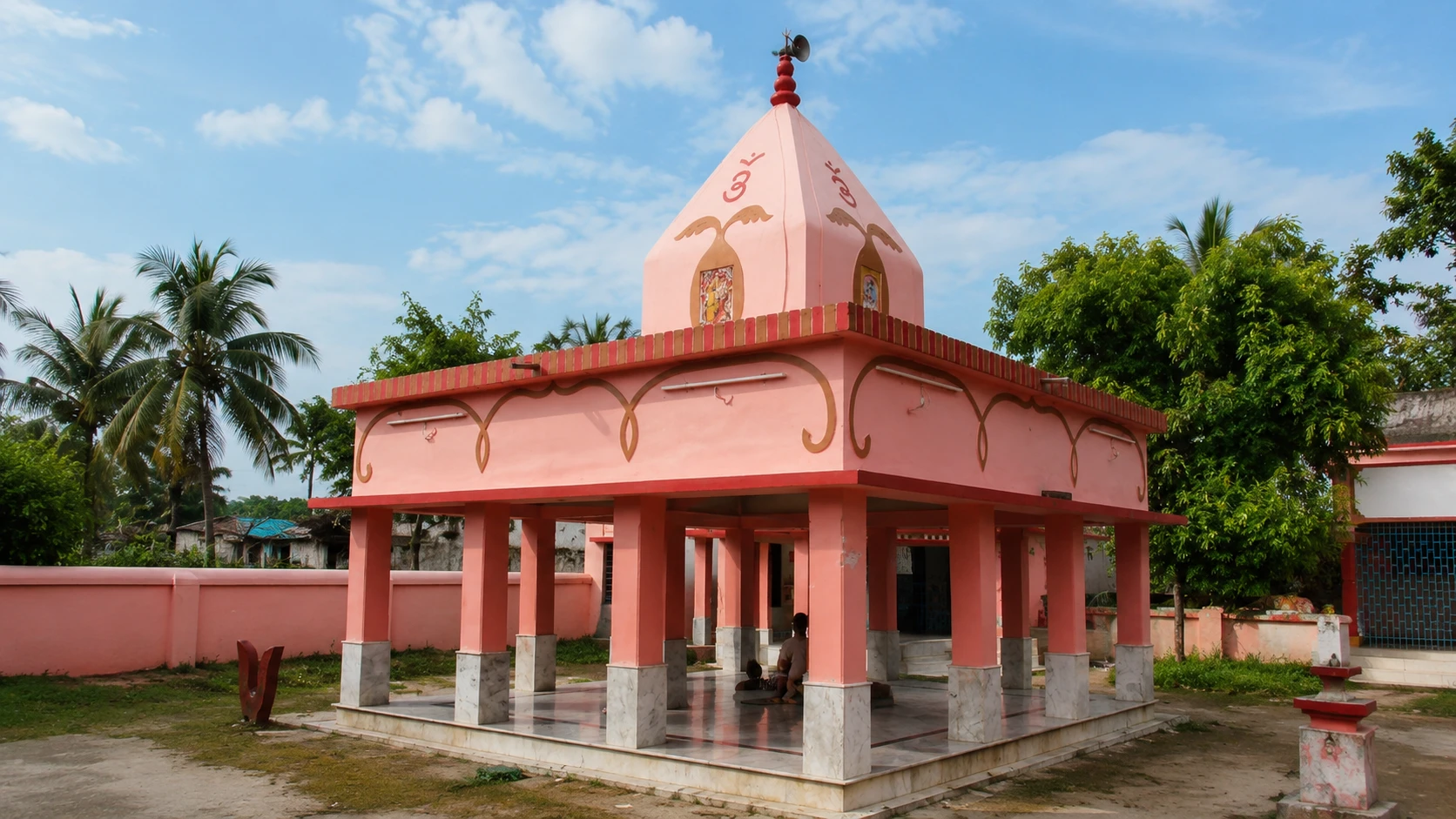
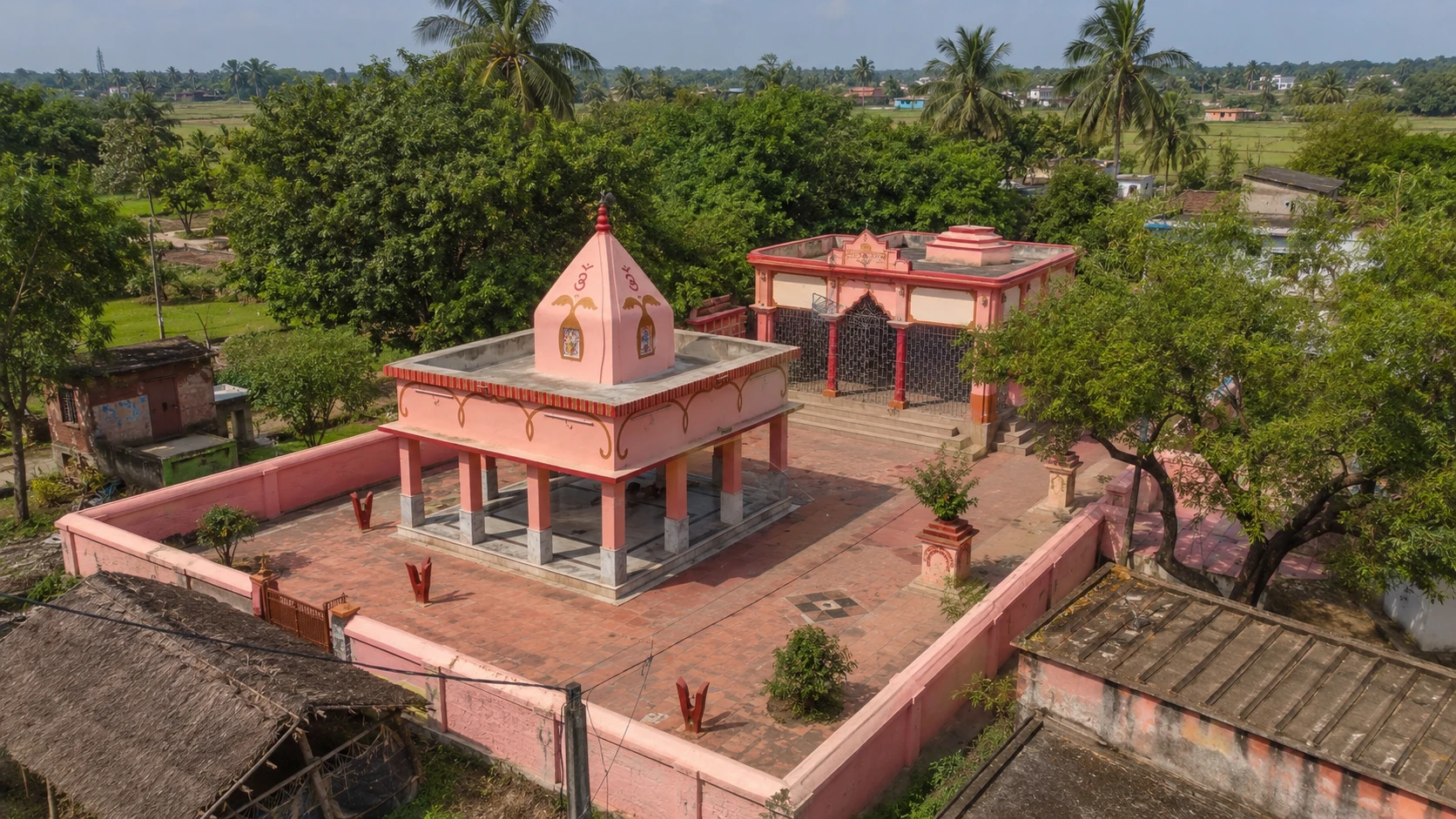
Bengali āṭcālā temple on the high bank of the Ajay river, modest in scale
खुला
06:00 – 20:30
आरती
06:30 · 12:00 · 19:30
विशेष
Annual Bahulā Caturthī observance (Bhādrapada Kṛṣṇa Caturthī, August, September); seasonal Magha and Caitra ritual bathing in the Ajay
पवित्र कथा · पवित्र कथा
At Ketugram on the bank of the Ajay river, the goddess sits with her arm. When Viṣṇu's Sudarśana chakra divided Satī's body to release Shiva from his madness of grief, the parts of her body fell at fifty-one places across the eastern Indian earth, and the part that fell at Ketugram was her left arm, the vāma-bāhu. The Devī enshrined here is named Bahulā, and the name preserves the relation: bāhu, the arm, is the body-part by which she is identified at this place; Bahulā, 'she of the arm,' is the form of the Devī this Peetha holds. The Bhairava paired with Bahulā in the Pīṭhanirṇaya is Bhīruka, the one who is feared, the protective fearfulness that stands beside the goddess at the site of her own arm's falling. The temple sits on the high bank of the Ajay where the river curves through Purba Bardhaman, in country that has belonged to the Rāḍh Bengal Shākta circuit for as long as the Bengali Shākta tradition has held a circuit at all. What distinguishes Bahulā among the Bengali Shakti Peethas is the philological integration: the body-part has named the Devī. At Bakreshwar the body-part (manas) is internally philosophical and the Devī is named for her work (Mahiṣamardinī); at Tarapith the body-part attribution is regional-popular rather than strictly canonical. At Bahulā the body-part is the name. There is a directness to this site that the larger Bengali Shakta seats sometimes elaborate past, Bahulā holds her arm, simply, and the pilgrim who comes to the Ajay's bank comes for the simplicity of that holding.
Sacred Designationपवित्र पदनाम
Shakti Peeth
शरीर का अंग: Left arm (vāma-bāhu), per the canonical 51-Peetha attribution preserved in the Pīṭhanirṇaya and the Devī Bhāgavata Purāṇa Saptama Skandha. The name 'Bahulā' relates philologically to 'bāhu' (arm), making this one of the few Shakti Peethas where the Devī's name itself encodes the body-part attribution that defines the site. The attribution is uncontested across major Bengali Shākta and Sanskrit Tāntric recensions; Bahulā is one of the cleaner canonical attributions in the 51-Peetha enumeration.
शक्ति: Bahulā, a Durgā-register form of the Devī, depicted in the Ketugram sanctum as a multi-armed warrior-mother figure. The form integrates closely with the body-part attribution: the Devī here is understood as both the goddess to whom the arm belonged and the goddess whose presence consecrates the site through that arm's fall. In Bengali Shākta iconographic tradition Bahulā is treated as one of the more accessible Durgā-register Devī forms, less elaborate than the great Mahāvidyā or Mahālakṣmī seats and more direct in its body-part-and-Devī unity.
भैरव: Bhīruka, the canonical Bhairava paired with Bahulā in the Pīṭhanirṇaya enumeration. The Bhīruka linga is enshrined at Ketugram within or adjacent to the Bahulā temple complex. The name Bhīruka derives from the Sanskrit root bhī (fear), and the Bhairava is understood as the protective-fearfulness pole of the Peetha, the fierce guardian whose dread keeps the goddess's site inviolable. In some Bengali Shākta traditions Bhīruka is also referenced as the wider protector-Bhairava of the Ajay-river Shākta circuit.
Sacred Origin Storyपवित्र उत्पत्ति कथा
Source: Pīṭhanirṇaya / Devī Bhāgavata Purāṇa Saptama Skandha / Bengali Shākta sthala-purāṇa
The story of Bahulā is the foundational story of the 51 Shakti Peethas, told for this particular site.
In the days of Dakṣa's yajña, Satī, the daughter of Dakṣa and the wife of Shiva, undertook the journey to her father's sacrifice against Shiva's wishes. At the sacrifice she was insulted: her father refused to give Shiva his portion, and the assembled devas tacitly accepted the insult.
Satī, unable to bear the dishonour of her husband, walked into the sacrificial fire and consumed herself in the flames of her own yogic concentration. Shiva, learning what had been done, was overcome with grief beyond consolation. He took up Satī's body and began the tāṇḍava, the cosmic dance of grief that, unchecked, would have unmade the worlds.
The devas turned to Viṣṇu, who released his Sudarśana cakra: the chakra moved through Satī's body as Shiva carried it across the eastern Indian earth, dividing the body part by part. Wherever a part fell, a Peetha came into being, a sacred geography of fifty-one places, each consecrated by what had fallen there.
At Ketugram on the bank of the Ajay river, Satī's left arm fell. The Devī of the site became Bahulā, 'she of the arm,' her form taking the Durgā-register multi-armed iconography that the Pīṭhanirṇaya prescribes. The Bhairava paired with her at this Peetha is Bhīruka, the fearful one, the guardian whose dread protects the site of the limb's falling.
The Pīṭhanirṇaya and the Devī Bhāgavata Purāṇa preserve this attribution; subsequent Bengali Shākta sthala-purāṇas elaborate the site's identity in regional voice but do not depart from the canonical body-part-and-Bhairava pair.
The directness of Bahulā among the Shakti Peethas lies in this, that there is no further layer. The body-part is the name; the Devī is the form named for the body-part; the Bhairava is the canonical pair. Tarapith has its Mahāvidyā Tara and its cremation-ground integration; Bakreshwar has its Aṣṭāvakra-Shiva and its kuṇḍas; Bahulā has the falling of the arm, the Devī named for it, and the Ajay river that has held the site for centuries.
The pilgrim who comes to Ketugram comes for the cleanness of that holding, for the Shakti-Peetha narrative in its simplest and most directly canonical form.
उद्धृत स्रोत:
- Pīṭhanirṇaya / Mahāpīṭhanirūpaṇa (canonical 51-Peetha enumeration including Bahulā at Ketugram, body part vāma-bāhu, Bhairava Bhīruka)
- Devī Bhāgavata Purāṇa, Saptama Skandha (canonical Shakti Peetha enumeration)
- Ketugram local sthala-purāṇa (Bengali, preserved in temple administration)
- Bengali Shākta literature on the Rāḍh Bengal Devī circuit
अन्य परंपराएँ · अन्य परंपराएँ
Bahulā Caturthī / Bahulā-cow tradition from the Bhāgavata Purāṇa
A second tradition, less canonically central but regionally significant in eastern India, identifies the name Bahulā with a different referent: the devoted cow Bahulā of the Bhāgavata Purāṇa. In that older narrative, Bahulā the cow had a calf whose protection became the occasion for a famous demonstration of Krishna's grace; the festival of Bahulā Caturthī (observed on the fourth day of the dark fortnight of Bhādrapada) honours this cow-narrative and is associated with the welfare of children and cattle in regional Bengali Hindu practice.
Some local Ketugram traditions integrate this Bahulā-cow narrative with the Bahulā-Devī of the Shakti Peetha, treating the name as carrying a double resonance, the Pīṭhanirṇaya Devī and the Bhāgavata cow held as complementary aspects of the same Bahulā-presence.
The corpus presents this integration as a meaningful regional reading without treating it as canonically equivalent to the body-part-attribution primary account; the philological origin of Bahulā's name remains bāhu (arm) per the Pīṭhanirṇaya, while the Bahulā-cow resonance is a parallel and culturally meaningful association.
Tantric reading of Bahulā as a Mahāvidyā-adjacent form in certain Bengali Shākta lineages
A second alternate tradition, narrower in circulation but documented in some Bengali Tāntric sources, reads Bahulā not solely as a Durgā-register form but as a Mahāvidyā-adjacent Devī, particularly in connection with the broader Daśa-Mahāvidyā framework that the Bengali Shākta Tāntric tradition organises across the entire Devī-circuit of eastern India.
In this reading, the body-part attribution (vāma-bāhu) is not merely descriptive but iconographically generative: the arm is the limb of action, of grasping, of holding-fast, and the Devī whose arm fell at Ketugram is theologically the Devī of resolute holding, a quality that some Tāntric lineages associate with the Mahāvidyā Bhuvaneśvarī or with specific Daśa-Mahāvidyā sub-forms.
The reading is rare in formal published Bengali Shākta literature but persists in living Tāntric oral tradition.
विद्वत संदर्भ
Modern scholarship on Bahulā at Ketugram is more modest than at Tarapith or Bakreshwar, reflecting the site's smaller pilgrim-economy footprint and lesser international scholarly attention. June McDaniel's 'Offering Flowers, Feeding Skulls' (2004) treats Bahulā within the broader survey of West Bengal Devī sites without extended monographic focus on the site specifically. Regional Bengali scholarship in journals such as those published by the Bengali Asiatic Society and various Birbhum-Bardhaman district pilgrimage gazetteers preserves more detailed local-historical material on Ketugram, the Ajay-river Shākta circuit, and the temple's relation to surrounding Bahulā Caturthī observance. The canonical inclusion of Bahulā in the Pīṭhanirṇaya 51-list is uncontested across major recensions; the body-part (vāma-bāhu) and Bhairava (Bhīruka) attributions are stable. Among Bengali Shākta Peethas, Bahulā represents the relatively-uncomplicated canonical type, a site whose theology rests cleanly on the Devī Bhāgavata Purāṇa Saptama Skandha account without the layered Mahāvidyā, geological, or Tāntric-lineage overlays that complicate the larger sites of the cluster.
Historyइतिहास
Bahulā at Ketugram's documented history begins with mention in late-medieval Bengali Shākta literature, which references the site as an established Shakti Peetha, body part vāma-bāhu, Bhairava Bhīruka, by at least the fifteenth, sixteenth centuries.
The site's antiquity certainly precedes this textual horizon, as the body-part attribution is preserved in older Sanskrit Pīṭhanirṇaya strata, but Bengali documentary attestation of Ketugram specifically as a living pilgrimage destination consolidates around the late medieval period.
The present temple complex dates substantially from the eighteenth and nineteenth centuries, with patronage drawn from the Bardhaman zamindari and from various pilgrim-patrons of the Ajay-river region over the colonial and post-Independence decades.
Ketugram lies within historic Vaishnava-Shakta cross-traffic country, the Bardhaman-Birbhum-Murshidabad region was a corridor for Chaitanya-tradition Vaishnava pilgrim circuits as well as the Shākta circuit, and Ketugram's local devotional literature preserves a layered ecumenical character that distinguishes it from purely Shākta sites such as Tarapith.
In the nineteenth century, the broader Birbhum-Bardhaman Shākta circuit was activated by figures including Bāmākhyāpā of Tarapith and other Bengali Shākta saints whose pilgrimage routes occasionally included Ketugram. After 1947, the Partition's effect on Bengali Shākta pilgrim networks elevated Ketugram's role within the now-bounded West Bengal Devī-circuit, though Bahulā's smaller scale meant the post-Partition expansion was correspondingly modest.
The twentieth and twenty-first centuries have brought continued local devotional activity, gradual heritage recognition by West Bengal authorities, and renewed scholarly and pilgrim attention to Bahulā as one of the cleaner canonical Shakti Peethas in the Rāḍh Bengal Devī geography.
Historical Timelineऐतिहासिक कालक्रम
Earliest documented references to Bahulā at Ketugram in Bengali Shākta literature, attesting the site as an established Shakti Peetha with the canonical attributions: body part vāma-bāhu, Devī Bahulā, Bhairava Bhīruka. The site's antiquity certainly precedes this textual horizon, the body-part attribution is preserved in older Sanskrit Pīṭhanirṇaya strata, but Bengali documentary attestation of Ketugram specifically as a living pilgrimage destination consolidates around the late medieval period.
The 1500 date marks the approximate horizon at which Bengali documentary attestation of Ketugram becomes consistent, not the founding date of the Peetha. The Pīṭhanirṇaya body-part attribution is significantly older in its Sanskrit substrate; the consolidation of Ketugram specifically as the living-pilgrimage location for the vāma-bāhu Peetha is the development that the late medieval Bengali sources document.
Substantial reconstruction of the present Bahulā temple at Ketugram under Bardhaman zamindari patronage during the mid-eighteenth century. The current āṭcālā structure on the high bank of the Ajay river, the adjacent Bhīruka shrine, and the principal outer enclosure take their substantial present form from this period. The exact date and patron names are variably attested in Bengali zamindari records; the mid-eighteenth-century period is the most commonly cited consolidation window rather than a single attested year.
The mid-eighteenth-century date is approximate; Bahulā at Ketugram, like many smaller Bengali Shakti Peethas, lacks specific founding-inscription documentation. The c. 1750 date is the most commonly cited consolidation window in Bengali zamindari records; some local sources place the reconstruction within the broader c. 1700, 1800 period.
Bahulā at Ketugram's inclusion within the broader nineteenth-century Birbhum-Bardhaman Shākta pilgrim circuit activated by Bāmākhyāpā of Tarapith and other contemporaneous Bengali Shākta saints. The Ajay-river corridor functioned as a connector between Tarapith and Ketugram for Tāntric and Shākta pilgrim movement during this period; Ketugram's modest scale relative to Tarapith meant its role was supportive rather than primary within the circuit. Bengali Shākta hagiographic literature of this period references Bahulā as one of the canonical Peethas within the Birbhum-Bardhaman circle.
After the Partition of Bengal in August 1947, the unified pre-Partition Bengali Shākta pilgrimage circuit, which had moved between Tarapith, Kālīghāṭ, Bakreshwar, Bahulā at Ketugram, Sugandhā (in East Bengal, now Bangladesh), Chattal (Chittagong), Kāmākhyā in Assam, and other Devī seats, was disrupted at the new international border. Bahulā's role within the now-bounded West Bengal Shākta circuit was correspondingly recontextualised: while smaller in scale than Tarapith or Kālīghāṭ, the canonical inclusion of Bahulā in the 51-Peetha enumeration meant the site retained pilgrim attention from West Bengali Shaktas seeking to complete a canonical Peetha-circuit within independent India. The post-1947 expansion of pilgrim infrastructure at Bahulā was modest, in keeping with the site's smaller scale, but consistent.
Gradual heritage recognition by West Bengal authorities of Bahulā at Ketugram as one of the canonical Shakti Peethas located within the state, contributing to modest infrastructure improvements (access roads, pilgrim amenities, basic conservation) during the mid-to-late 2010s and 2020s. The site has not received the major state-tourism promotion that Tarapith and certain other West Bengal Devī sites have received but has been documented within the state's broader Shakti-Peetha heritage frameworks.
What You'll Seeदर्शन में
The Bahulā sanctum at Ketugram holds a stone mūrti of the Devī in classical Durgā-register iconography, multi-armed, weapons drawn, in the standing or seated posture that the Pīṭhanirṇaya prescribes for Bahulā. The image is modest in scale relative to the great Tarapith or Kālīghāṭ mūrtis but executed in the same Bengali Shākta murti idiom: dark stone (kashti-pāthar tradition), daubed with sindoor and ghee from continuous worship, draped in red and gold cloth that the temple's sevāyats renew through the day.
The body-part attribution is encoded directly into the iconography: the Devī's left arm carries iconographic emphasis in the temple's worship, with vāma-bāhu offerings of red bangles and arm-cloth made by devotees as part of the standard darśana protocol.
The Bhīruka linga sits in an adjacent shrine within the temple complex, a simple stone liṅga of the kind characteristic of Bengali Shākta Bhairava enshrinement, paired-canonically with the Devī by the Pīṭhanirṇaya rather than elaborated separately in regional theology.
The temple architecture is austere Bengali āṭcālā on the high bank of the Ajay river, with the river itself visible from the temple precincts. The architectural scale is modest, Bahulā is one of the smaller Bengali Shakti Peethas in built form, but the riverbank siting gives the temple its distinctive landscape character.
The Ajay flows below the precincts during ordinary water levels and floods to the temple's elevation during the monsoon; the relation between the Devī, the body-part-relic, and the moving river is a foundational fact of Bahulā's spatial theology.
Distinctive Practicesविशिष्ट परंपराएँ
Vāma-bāhu offering, red bangles and arm-cloth at the sanctum
वाम-बाहु नैवेद्य, गर्भगृह पर लाल चूड़ियाँ तथा बाहु-वस्त्र
Year-round, as part of standard darśana protocol; intensified during major festivals and at Bahulā Caturthī
Devotees at Bahulā commonly bring offerings that explicitly invoke the body-part attribution: red glass or lac bangles (which adorn the arm in Bengali Hindu women's tradition), arm-cloth (folded fabric symbolic of cover for the limb), and occasional arm-shaped or hand-shaped clay or silver tokens for the temple's votive collection. The offering protocol differs from many other Bengali Shakti Peethas in this body-part-thematic specificity. Pilgrim mothers and grandmothers, in particular, frequently bring bangles for the goddess's left arm with prayers for the wellbeing of family members, children, daughters-in-law, expectant women, whose own arms (and the protection they offer) are theologically linked through the Bahulā offering to the Devī's vāma-bāhu.
The body-part-thematic offering enacts the Pīṭhanirṇaya theology bodily: the Devī's left arm fell at Ketugram and consecrated the site, and the pilgrim's offering of bangles and arm-cloth participates in honouring that specific limb. Where most Devī worship offers generic flowers, prasāda, and cloth, Bahulā's worship asks the pilgrim to bring something that the limb itself would wear, and through that specificity, to remember what the Peetha is, in terms more literal than the abstracted darśana-protocol of larger temples. The offering is theologically pointed and culturally maternal: it is most often made by women whose own bangle-bearing arms register, in the daily idiom of Bengali Hindu life, the same care the Devī's vāma-bāhu now receives at Ketugram.
Ajay-river snāna integrated with darśana
अजय-नदी स्नान दर्शन से एकीकृत
Year-round; intensified during Magha (January, February) and Caitra (March, April) bathing months
The Ajay river is theologically integrated into the Bahulā pilgrimage in the manner characteristic of Bengali Devī sites situated on sacred rivers. Pilgrims commonly bathe in the Ajay below the temple before approaching the sanctum for darśana, the river is treated as the Devī's own river in local theology, the water that flows past the site of her arm-fall. The Magha and Caitra months see the strongest pilgrim engagement with the river-bathing aspect of the Bahulā circuit; during monsoon high water the riverbank approach is restricted and pilgrims approach the sanctum directly from the temple precincts.
The integration of river-bathing with Devī darśana follows the broader Bengali Shākta-tīrtha pattern in which the water that flows past the site is theologically continuous with the goddess's presence, not a preparatory cleansing space external to the temple but an extension of the temple's sacred geography. At Bahulā the Ajay carries this register particularly clearly because the temple's elevation on the high bank brings the river directly into the visual field of the sanctum; the pilgrim does not have to leave the temple's sight to bathe.
Bahulā Caturthī observance, annual festival with local distinctive character
बहुला चतुर्थी पालन, स्थानीय विशिष्ट चरित्र वाला वार्षिक उत्सव
Annual, Bhādrapada Kṛṣṇa Caturthī (August, September); date set by lunar calendar
Bahulā Caturthī is observed at Ketugram with a distinctive double character: the regional Bengali Bahulā-cow / Bhāgavata festival is observed (with special offerings for the welfare of children and cattle in pilgrim families), and simultaneously the Shakti-Peetha Devī Bahulā is honoured with extended darśana hours, special sevā at the sanctum, and a small annual fair in the temple precincts. The temple administration treats the day as the annual signature event of Ketugram; pilgrim numbers exceed normal-day attendance significantly though they remain modest compared to Tarapith or Bakreshwar festival peaks. The double observance preserves the regional integration of the Vaishnava-Bhāgavata Bahulā tradition with the canonical Shakti-Peetha Bahulā without conflating the two theologies.
Bahulā Caturthī's double observance is a distinctively Ketugram resolution of the Vaishnava-Shakta cross-traffic that characterises the Bardhaman-Birbhum-Murshidabad corridor. Where elsewhere in Bengal the Vaishnava Bahulā-cow narrative and the Shakta Bahulā-Devī tradition are observed in separate locations and registers, Ketugram's particular geographic and devotional history brings them into the same festival day without theological collapse. The pilgrim who comes for either tradition finds the other respected and integrated, and the resulting festival is one of the more ecumenical Bengali Shākta annual observances.
Did You Know?क्या आप जानते हैं?
Bahulā is one of the few Shakti Peethas in the canonical 51-list where the Devī's name itself encodes the body-part attribution: 'Bahulā' is philologically related to 'bāhu' (arm), so that the body-part that fell at Ketugram, the left arm (vāma-bāhu), also names the goddess enshrined there. Most Peetha names take from the Devī's quality or work (Mahiṣamardinī, Kāmākhyā, Tripura Sundarī); Bahulā's name is the body-part itself, made into a feminine form. The directness of the encoding is one of the cleaner symbolic facts in the 51-Peetha geography.
Pīṭhanirṇaya / Mahāpīṭhanirūpaṇa; Sanskrit etymological tradition
The Ajay riverbank siting integrates Bahulā into the wider sacred-river geography of Bengal: the Ajay flows from the Chotanagpur plateau through Birbhum and Purba Bardhaman before joining the Bhāgirathī (Hooghly), and several smaller Shākta sites and Vaishnava temples line its course. Ketugram is one of the more important ritual stops on this sacred-river itinerary.
Bengali Shākta tīrtha-geography literature; Survey of India regional river-system documentation
Bahulā Caturthī at Ketugram is one of the relatively rare Bengali festivals where a Vaishnava (Bhāgavata Bahulā-cow) and Shākta (Shakti-Peetha Bahulā-Devī) tradition share a festival day in a single location, with both observances integrated into the temple's annual calendar without theological collapse. The integration reflects the Vaishnava-Shakta cross-traffic that historically characterised the Bardhaman-Birbhum-Murshidabad pilgrimage corridor.
Local Ketugram pilgrim oral tradition; Bengali Shākta-Vaishnava cross-cultural literature
Among the Bengali Shakti Peethas, Bahulā represents what scholars sometimes call the 'clean canonical type', a site whose theology rests directly on the Pīṭhanirṇaya / Devī Bhāgavata body-part-and-Bhairava pair without the layered Mahāvidyā framework (as at Tarapith), the geological-theological integration (as at Bakreshwar), or the contested attributions (as at certain other regional sites). The simplicity is structurally meaningful: Bahulā shows what a Shakti Peetha looks like at its theological baseline.
Bengali Shākta comparative literature; June McDaniel, 'Offering Flowers, Feeding Skulls' (2004)
The Bhairava paired with Bahulā in the Pīṭhanirṇaya is Bhīruka (Sanskrit bhīru, 'fearful'), one of the few Bhairavas in the 51-Peetha enumeration whose name explicitly invokes the protective-fearfulness register. Most Bhairavas are named for divine or local qualities (Vakranāth at Bakreshwar, Krodhīśa at certain other Peethas); Bhīruka's name is the quality itself, fear, as the guardian's mode of presence at the site of the limb's falling.
Pīṭhanirṇaya / Mahāpīṭhanirūpaṇa; Sanskrit lexical tradition
Visitor Accessप्रवेश जानकारी
Bahulā at Ketugram welcomes pilgrims of all backgrounds for darśana. Photography is generally permitted in the outer temple precincts; the inner Devī sanctum follows standard Bengali Shākta photography norms, verify locally before photographing the mūrti. The Ajay riverbank is open access for the customary pre-darśana bath. No caste-based or religion-based exclusions apply.
Most pilgrims complete the Bahulā circuit in this order: (1) Ajay-river snāna where seasonally accessible, (2) Devī sanctum darśana with vāma-bāhu offering, (3) Bhīruka linga darśana in the adjacent shrine, (4) brief perambulation of the temple precincts and the riverbank if not already approached. Allow 1.5, 2 hours for an unhurried visit; on Bahulā Caturthī plan for a full half-day. Bring red bangles or arm-cloth for the vāma-bāhu offering if undertaking the customary protocol.
Festivalsत्योहार
Bahulā Caturthī
बहुला चतुर्थी
Bhādrapada Kṛṣṇa Caturthī (August, September)
The annual signature festival at Ketugram, observed with the distinctive double character described under distinctivePractices. Both the Bhāgavata Bahulā-cow tradition and the Shakti-Peetha Bahulā-Devī tradition are honoured on the same day; the temple administration extends darśana hours and a small annual fair takes place in the temple precincts. Pilgrim numbers exceed normal-day attendance significantly but remain modest in absolute terms.
Durgā Pūjā
दुर्गा पूजा
Āśvina Śukla Saptamī, Daśamī (September, October)
Durga Puja at Bahulā is observed with full Bengali Shākta protocol within the temple precincts, in keeping with the Devī's Durgā-register form. Saptamī through Vijayā Daśamī are marked by special abhiṣeka, sandhi pūjā on the Aṣṭamī, Navamī boundary, and the Vijayā Daśamī procession. The festival draws significantly larger pilgrim numbers than ordinary days, though it remains a regional rather than pan-Bengali draw, pilgrims travelling specifically to a major Durga Puja destination more commonly go to Kālīghāṭ or to the Kolkata para-pandals.
Kālī Pūjā (Bengali Shākta Diwali Amāvasyā)
काली पूजा (बंगाली शाक्त दीपावली अमावस्या)
Kārttika Amāvasyā (October, November)
Kālī Pūjā is observed at Bahulā with full Bengali Shākta night-worship protocol, though as at other non-Kālī-primary Bengali Devī sites the festival sits secondary to the Devī's own primary identity. Night ārati, sandhi-time worship, and special offerings are observed; pilgrim numbers are moderate compared to the Tarapith or Kālīghāṭ peaks but consistent with Bahulā's regular festival rhythm.
Vāsanti Pūjā / Caitra Navarātri
वासन्ती पूजा / चैत्र नवरात्रि
Caitra Śukla Pratipadā, Navamī (March, April)
The spring festival of the Devī, observed at Bahulā as Vāsanti Pūjā, the springtime Durgā worship that the Bengali Shākta calendar holds as the older textually grounded Devī festival, distinct from the more famous Śarad (autumn) Durga Pūjā. The nine nights are observed within the temple precincts with daily abhiṣeka and special evening ārati. Pilgrim attendance is moderate; Vāsanti Pūjā at Bahulā is favoured by serious sādhakas seeking less crowded but theologically appropriate Devī observance.
How to Reachकैसे पहुँचें
Bahulā at Ketugram lies in the Ketugram-I or Ketugram-II block of Purba Bardhaman district, West Bengal, approximately 170 km north of Kolkata on the Ajay river. The nearest rail-head is Katwa Junction (17 km), which connects via the Howrah, Bandel, Katwa line to Howrah; journey time from Howrah is approximately 3.5, 4 hours.
Salar railway station (~5 km, on a smaller line) offers closer rail approach for trains routed via that connection. Local taxis, auto-rickshaws, and shared transport connect both stations to Ketugram village. By road, Ketugram is accessible via state highways from Katwa or via the longer NH-corridor from Bardhaman city.
The nearest commercial airports are Kazi Nazrul Islam Airport at Andal, Durgapur (95 km) and Netaji Subhas Chandra Bose International Airport at Kolkata (170 km). Pilgrims combining Bahulā with Tarapith and Bakreshwar in a Birbhum-Bardhaman Shākta circuit should plan for an additional travel day or use Rampurhat / Suri as a touring base, as direct cross-circuit connections between Ketugram and the Birbhum sites may require road travel rather than rail.
Plan Your Visitयात्रा की योजना
🌤 सर्वोत्तम मौसम
October to March is the most comfortable window for Bahulā, with cool-to-mild daytime conditions ideal for the river-bank temple and Ajay snāna. Bahulā Caturthī (August, September) falls within the monsoon and the river is at high water; the festival is still observed but riverbank approach is restricted during the festival day if water levels are seasonally elevated. Summer (April, June) is hot (up to 42 °C in Bardhaman) and the temple courtyard is exposed; pilgrim attendance is lower. Magha and Caitra (winter and spring) are the favoured months for the river-bathing aspect of the Bahulā circuit.
👘 पहनावे का नियम
Standard Bengali Shākta temple norms: modest clothing covering shoulders and knees; women in sari or salwar-kameez; men in dhoti-panjabi or kurta-pyjama, though standard ethnic or modest Western clothing is accepted. For Ajay-river snāna where undertaken, carry change of clothing and modest bathing-wear consistent with Bengali tīrtha-snāna norms. Footwear is removed at the temple-precinct entry.
📱 फोन और फोटोग्राफी
Phones and cameras are generally permitted in the outer temple precincts and at the Ajay riverbank. The inner Devī sanctum follows standard Bengali Shākta photography norms, verify the current policy with on-site sevāyats before photographing the mūrti. Discretion at the riverbank around fellow pilgrims who may be bathing is expected.
🏨 आवास
Ketugram offers modest local pilgrim infrastructure: small dharmaśālās and basic lodges. Katwa town (17 km) offers fuller hotel options and is a practical overnight base for pilgrims combining Bahulā with other regional sites. Many pilgrims complete Bahulā as a half-day visit from a Bardhaman, Katwa, or Rampurhat base and continue onward in the same trip.
Sacred Soundsपवित्र ध्वनि
Durgā Saptaśatī (Devī Māhātmya), Mārkaṇḍeya Purāṇa, opening Kavaca and Argala stotras
stotram · 720
Bahulā Caturthī Vrata Kathā, recitation of the fast-observance narrative
stotram · 540
Mahiṣāsuramardinī Stotram, 'Ayi Giri Nandini' (attributed to Ādi Śaṅkarācārya)
stotram · 540
Bhairavāṣṭakam, for the Bhīruka-Bhairava pole of the Peetha
stotram · 360
Nārāyaṇī Stuti, Devī Māhātmya, Chapter 11, from the Caṇḍī Pāṭha
stotram · 600
क्या आप जानते हैं? · Did You Know?
वही अनुवाद त्रुटि जिसने हिन्दू धर्म में '33 कोटि' को '33 करोड़' बनाया, बौद्ध धर्म में भी हुई। बौद्ध ग्रन्थों के चीनी अनुवाद ने 'सप्त कोटि बुद्ध' (7 श्रेष्ठ बुद्ध) का अनुवाद '7 करोड़ बुद्ध' कर दिया। तिब्बती अनुवाद ने सही किया: 7 प्रकार, 7 करोड़ नहीं। एक संस्कृत शब्द, दो प्रमुख विश्व धर्मों में गलत पढ़ा गया, ने दो एकसमान भ्रम स्वतन्त्र रूप से उत्पन्न किए।
Related Contentसंबंधित सामग्री
Related Scriptures
Related Temples
Community Reflections
🕉️
Be the first to share your reflection.