Bakreshwar Mahishmardini
बक्रेश्वर शक्तिपीठ
Where Satī's mind fell among Shiva's hot springs
Bakreshwar, West Bengal, India
BakreśvaraAlso known as: Vakreshwar, Bakreswar, Bakranath, Vakreshwar Mahishamardini, বক্রেশ্বর, বক্রেশ্বর মহিষমর্দিনী মন্দির
युग
Medieval Tāntric roots (pre-16th c.); current temple complex 18th, 19th c.
वास्तुकला
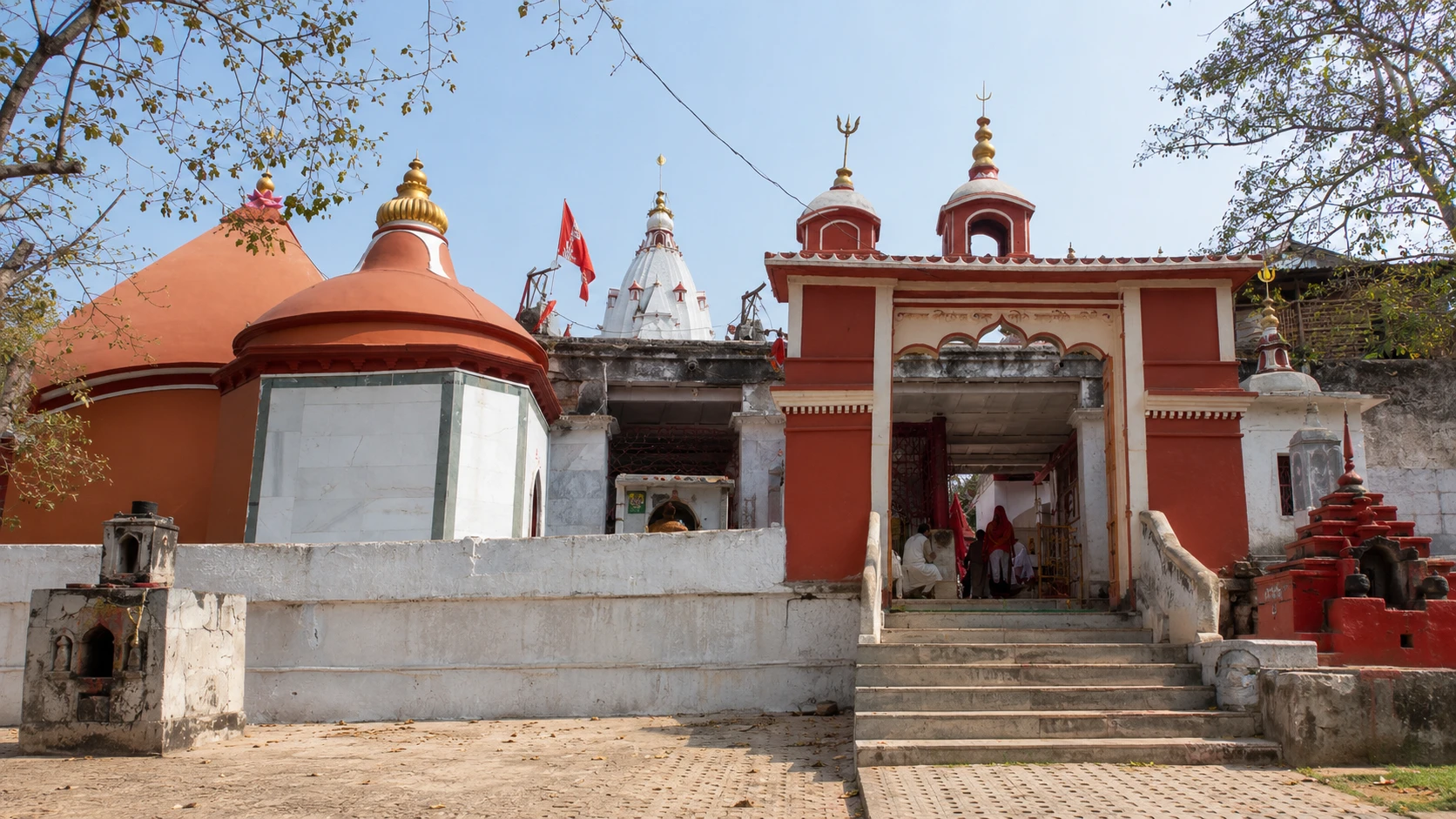
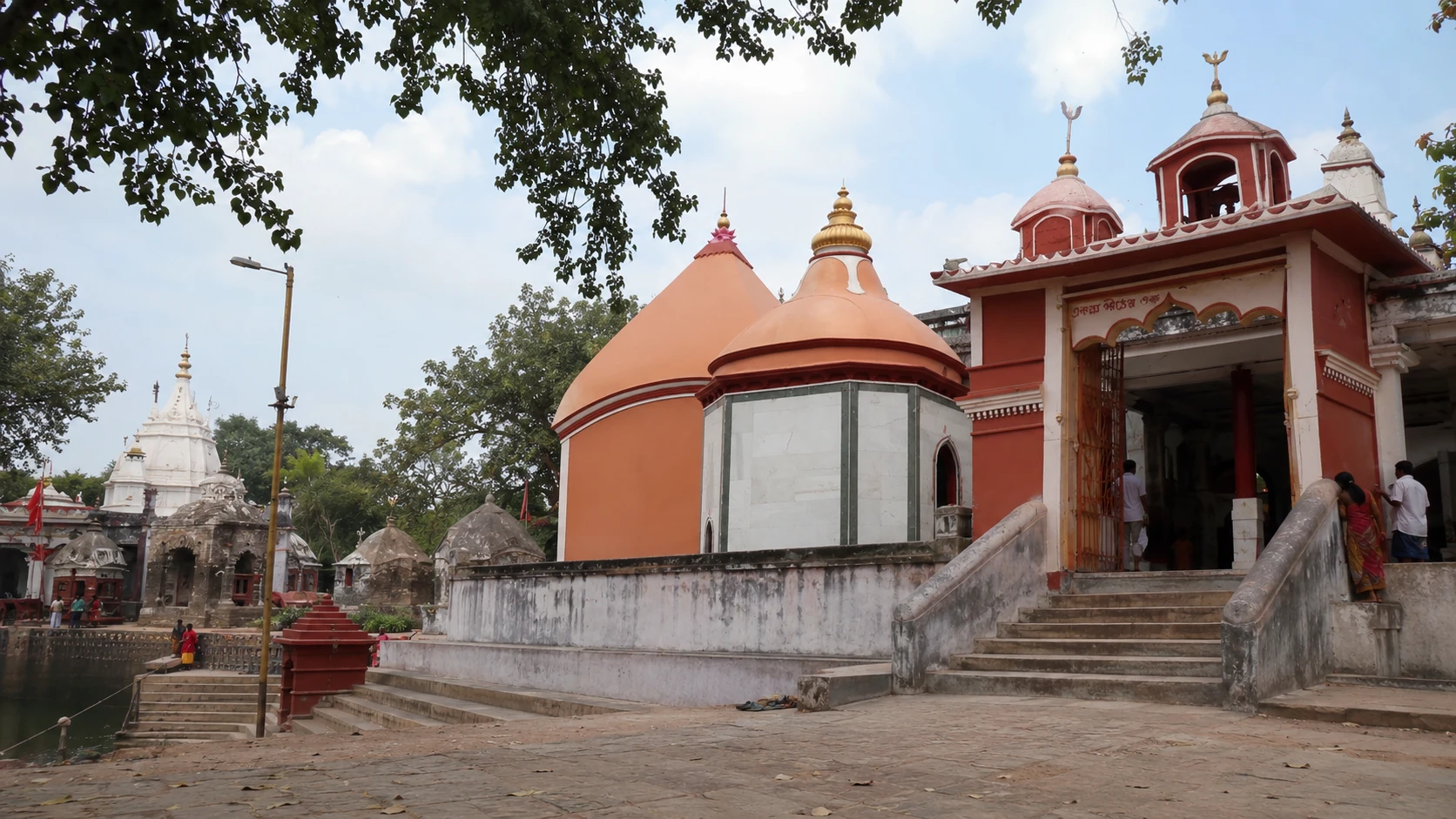
Bengali āṭcālā with adjoining hot-spring kuṇḍa enclosure complex
खुला
05:00 – 21:00
आरती
06:00 · 12:00 · 19:30
विशेष
Pilgrim immersion in the temple kuṇḍas (hot springs) is integral to the Bakreshwar circuit; bathing protocols vary by kuṇḍa temperature
पवित्र कथा · पवित्र कथा
At Bakreshwar in Birbhum, the canonical Shakti Peethas and the geology of hot springs meet. Here, where the manas, the mind, the inner organ of thought and will, of Satī is said to have fallen when her body was divided across the eastern Indo-Gangetic earth, the Devī sits enshrined as Mahiṣāsuramardinī, the goddess in her warrior form. Around her stretches a landscape unlike any other major Bengali Shākta site: seven natural mineral hot springs bubble through the temple precincts, each named for a sage or divine figure and each maintained at its own characteristic temperature, Agni Kuṇḍa at the highest, near-boiling heat; the cooler kuṇḍas amenable to pilgrim immersion. Local tradition identifies the springs as Shiva's own warmth, retained in the earth from the heat of his cosmic tapas; the temple's name comes from Vakranāth, the bent Lord, whose linga sits adjacent to the Devī sanctum and gives the site the name Bakreshwar, 'Lord of the bent one.' The Pīṭhanirṇaya counts Bakreshwar among the canonical Shakti Peethas; in the Bengali Birbhum Shākta circuit it is paired with Tarapith as the dual axis of the district's living Devī worship. Pilgrims who complete the Bakreshwar circuit do not only see the goddess, they bathe in the kuṇḍas, traverse the ground between manas (mind) and tapas (heat), and stand at the precise meeting-point of geology and theology that defines this Peetha.
Sacred Designationपवित्र पदनाम
Shakti Peeth
शरीर का अंग: Manas (mind / the inner faculty of thought and will), per the most widely cited Pīṭhanirṇaya attribution. Some Bengali Shākta recensions alternately give 'bhrumadhya' (the space between the eyebrows) for Bakreshwar; the corpus uses 'manas' as the dominant canonical attribution while noting the variation. The philosophical resonance of the attribution is meaningful, it is by manas that the inner Mahiṣa of distraction is recognised, and the goddess enshrined here is Mahiṣāsuramardinī, the slayer of the buffalo-demon.
शक्ति: Mahiṣāsuramardinī, the goddess in her warrior form, slayer of the buffalo-demon Mahiṣa. The Bakreshwar mūrti depicts her in the classical Mahiṣamardinī iconography: multi-armed, weapons drawn, mounted on her lion, with the buffalo-demon's body and head shown in the moment of severance.
भैरव: Vakranāth (Bakranāth, the Bent Lord), the local Shiva-Bhairava whose linga sits adjacent to the Devī sanctum and gives the site its name Bakreshwar. Local tradition links Vakranāth to the Aṣṭāvakra-Shiva narrative: when Sage Aṣṭāvakra ('eight-bent') attained liberation through his austerities here, Shiva himself manifested in a bent (vakra) form in his honour. Some Pīṭhanirṇaya recensions alternately name the Bhairava as Mahānanda; the corpus uses Vakranāth as the dominant on-ground living attribution.
Sacred Origin Storyपवित्र उत्पत्ति कथा
Source: Bakreshwar sthala-purāṇa / Pīṭhanirṇaya / Bengali Shākta tradition / Aṣṭāvakra narrative integration
Two streams meet at Bakreshwar, and the temple holds them both as one.
The first stream is the story of the sage Aṣṭāvakra, born twisted in eight places, despised by the wider world for his deformity, who came to this riverbed in Birbhum to undertake tapas of such fierce concentration that Shiva himself was drawn to him.
As Aṣṭāvakra's austerities mounted, the earth beneath him began to heat; springs of hot mineral water burst forth, one after another, until seven kuṇḍas had emerged around his seat. Shiva appeared, asked what boon Aṣṭāvakra desired, and the sage answered: not health, not wealth, not even straightening, but liberation.
Shiva granted it, and as he did, he himself took a bent form here, manifesting as Vakranāth, the Lord of the Bent One, whose linga remains beside the springs as the masculine pole of this Peetha. The hot springs that emerged in Aṣṭāvakra's tapas burn still, Agni Kuṇḍa at the highest, near-boiling heat; the others arranged by descending temperature down to the cool kuṇḍas where pilgrims now bathe.
The second stream is the older story, the one that connects Bakreshwar to all the Devī-seats across the eastern Indian earth. When Satī's body was divided by Vishnu's Sudarśana chakra to release Shiva from his madness of grief, the parts of her body fell at fifty-one places across the subcontinent, and the part that fell at Bakreshwar was her manas, her mind, the inner faculty that holds thought and will.
The Pīṭhanirṇaya and the canonical Shākta lists count Bakreshwar among the proper Peethas for this reason; the Devī here is Mahiṣāsuramardinī, the goddess in her warrior form, slayer of the buffalo-demon. The Mahāvidyā theology of Bengal reads this pairing carefully: manas, the falling part, and Mahiṣamardinī, the form of the Devī enshrined, are not arbitrary pairings.
It is by manas that the inner demon-Mahiṣa of distraction, ego, and confusion is recognised and struck down; and the goddess who fell here in her mind is the same goddess who, in the Devī Māhātmya, raised her sword against the buffalo-demon and severed his head.
These two streams, the Aṣṭāvakra-Shiva story of the heat that defines the place, and the Satī-Mahiṣamardinī story of the mind that consecrates it, are not held as separate texts at Bakreshwar. The standard pilgrim circuit moves from the Devī sanctum through the kuṇḍas to the Vakranāth linga and back; the bath at Saubhāgya Kuṇḍa is taken before darśana, the prasāda is shared at the springs themselves, and the integration of the geological and the mythological is the lived experience of this Peetha in a way distinctive even within the Bengali Shākta world.
उद्धृत स्रोत:
- Bakreshwar local sthala-purāṇa (Bengali, preserved in temple administration)
- Pīṭhanirṇaya / Mahāpīṭhanirūpaṇa (canonical 51-Peetha enumeration)
- Devī Bhāgavata Purāṇa, Saptama Skandha
- Aṣṭāvakra Gītā (philosophical context for the Aṣṭāvakra figure)
- Devī Māhātmya (Caṇḍī), Mārkaṇḍeya Purāṇa, chapters 81, 93, Mahiṣamardinī narrative
- June McDaniel, 'Offering Flowers, Feeding Skulls' (Oxford, 2004)
अन्य परंपराएँ · अन्य परंपराएँ
Aṣṭāvakra-primary Shaiva tradition, Bakreshwar as principally a Vakranāth-Bhairava seat
A first alternate tradition, locally held by Shaiva pilgrim communities and some Bengali Tāntric sources, treats Bakreshwar primarily as a Shiva-Bhairava seat, the temple of Vakranāth, the bent Lord, whose appearance honoured the sage Aṣṭāvakra's liberation.
In this reading, the hot springs are the central sacred fact: they emerged through Aṣṭāvakra's tapas, they manifest Shiva's own warmth, and they define the site's identity as one of the few major Bengali Shākta locations where the male principle (Shiva-Bhairava) and the geological substrate (the kuṇḍas) take precedence over the female principle in the narrative organization of the place.
The Shakti Peetha attribution, in this reading, is a later canonical overlay that integrated an older Shaiva pilgrimage into the Pīṭhanirṇaya framework. The corpus presents this reading as a meaningful alternative emphasis without adjudicating it against the integrated primary account.
Devī-centric reading of the hot springs as Satī's residual fire (Bengali Shākta tāntric interpretation)
A second alternate tradition, held within certain Bengali Shākta tāntric lineages, inverts the directionality of the heat. In this reading, the kuṇḍas at Bakreshwar are not Shiva's tapas-heat but the residual fire of Satī's own body, the burning that consumed her at Dakṣa's yajña, retained in the earth at the site where her manas fell, manifesting through the centuries as the steaming kuṇḍas that ring the temple precincts.
This reading aligns the geological fact of the hot springs with the foundational Devī narrative rather than with the Aṣṭāvakra-Shiva narrative; it reads the temperature gradient across the seven kuṇḍas as a map of Satī's interior fire from manas (mind) outward to the more dispersed and cooler aspects of her residual presence.
The interpretation is rare in formal Bengali Shākta literature but persists in regional oral tradition and informs certain Tāntric reading-frames of Bakreshwar.
विद्वत संदर्भ
Modern scholarship on Bakreshwar sits at an unusual disciplinary intersection, religious studies, regional Bengali Shākta history, and Indian geothermal geology. The Bakreshwar geothermal field has been studied by the Geological Survey of India and other research bodies as one of the most significant low-temperature geothermal sites in eastern India; the springs are mineral-rich, characteristically high in radon and sulphur, and emerge through fissures associated with the Eastern Ghat granitic basement. The temple complex sits directly over the principal vent area. Religious-studies treatment of Bakreshwar (June McDaniel; regional Bengali scholarship in Bangla journals) reads the site as exemplary of the integration of geological fact and theological framing characteristic of Bengali Shākta hot-springs sites, Bakreshwar, alongside Tattapani in Himachal and Manikaran in Kullu, occupies a sub-category of pilgrimage sites where mineral hot springs are sacralised within the temple's primary theology rather than treated as ancillary natural features. The Pīṭhanirṇaya canonical inclusion of Bakreshwar as a 51-Peetha site (body part: manas) is uncontested in major Shākta enumerations, though the specific positional number within the 51-list varies across recensions and the body-part attribution shifts between 'manas' and 'bhrumadhya' across textual witnesses.
Historyइतिहास
Bakreshwar's documented history begins with mention in late-medieval Bengali Tāntric and Shākta literature, which references the site as an established Mahiṣamardinī-Peetha and Vakranāth-Bhairava seat by at least the fifteenth, sixteenth centuries.
The Aṣṭāvakra-Shiva and Satī-Mahiṣamardinī narratives are both attested in older Sanskrit Purāṇic and Tāntric strata, but their integration as the single living theology of Bakreshwar is characteristically Bengali and consolidates in the medieval-to-early-modern period.
The present temple complex, including the Devī sanctum, the Vakranāth linga shrine, and the enclosure surrounding the seven principal kuṇḍas, dates substantially from the eighteenth, nineteenth centuries; major patronage came from the local zamindars of the Birbhum region, with later contributions from various pilgrim patrons over the colonial and post-Independence periods.
The hot springs themselves have always been integral to the pilgrimage; documentary references to their identifying names (Agni Kuṇḍa, Saubhāgya Kuṇḍa, and so forth) appear in Bengali Shākta literature consistently across centuries.
In the nineteenth century, Bakreshwar was visited by Bāmākhyāpā of Tarapith and by other Bengali Shākta figures within the broader Birbhum Shākta circuit. After 1947, the Partition's effect on Bengali Shākta pilgrim networks elevated Bakreshwar's role within the now-bounded West Bengal Devī-circuit; the temple administration consolidated under modern Trust governance in the post-Independence decades.
Twenty-first-century developments include scientific characterization of the Bakreshwar geothermal field by the Geological Survey of India, state geological heritage recognition, and growing scholarly and tourist attention to the site as one of the rare living confluences of geology and Shakta theology in India.
Historical Timelineऐतिहासिक कालक्रम
Earliest documented references to Bakreshwar in Bengali Tāntric and Shākta literature, attesting the site as an established Mahiṣamardinī-Peetha and Vakranāth-Bhairava seat. The site's antiquity certainly precedes this textual horizon, the Aṣṭāvakra and Satī-Mahiṣamardinī narratives are documented in older Sanskrit Purāṇic strata, but Bengali documentary attestation of Bakreshwar specifically as a living pilgrimage destination consolidates around the late medieval period.
The 1500 date marks the approximate horizon at which Bengali documentary attestation becomes consistent, not the founding date of the site. The Aṣṭāvakra-Vakranāth narrative is significantly older in its Sanskrit substrate; the integration of that narrative with the Satī-Mahiṣamardinī Shakti-Peetha attribution in Bengali Shākta theology is the development that the late medieval Bengali sources document.
Major reconstruction of the present Bakreshwar temple complex under the patronage of the Birbhum-region zamindars, approximately mid-eighteenth century. The Devī sanctum, the Vakranāth linga shrine, and the enclosure around the seven principal kuṇḍas take their substantial present form from this period of patronage; the exact date and patron names are variably attested across Bengali zamindari records and local oral tradition. The mid-eighteenth-century date is the most commonly cited consolidation period rather than a single attested year.
The mid-eighteenth-century date is approximate; Bengali zamindari record-keeping for temple patronage in this period is uneven, and Bakreshwar's reconstruction lacks the specific founding-inscription documentation available at some better-archived Bengali sites. The 1755 date is the most commonly cited; some sources place the reconstruction earlier or later within the period c. 1730, 1780.
Recorded visits of Bāmākhyāpā of Tarapith to Bakreshwar during the second half of the nineteenth century, as part of the broader Birbhum Shākta pilgrimage circuit. Bengali Shākta hagiographic tradition preserves accounts of Bāmākhyāpā's connection to the Vakranāth, Mahiṣamardinī seat, and several Tāntric lineages active in Birbhum continued to read Tarapith and Bakreshwar as paired Shākta sites through the late nineteenth and early twentieth centuries. The 1865 date is approximate, indicating the period of Bāmākhyāpā's active sādhanā years rather than a specifically dated visit.
After the Partition of Bengal in August 1947, the unified pre-Partition Bengali Shākta pilgrimage circuit, which had moved between Tarapith, Kālīghāṭ, Bakreshwar, Sugandhā (in East Bengal, now Bangladesh), Chattal (Chittagong), Kāmākhyā in Assam, and other Devī seats, was disrupted at the new international border. Bakreshwar's role within the now-bounded West Bengal Shākta circuit intensified correspondingly. The post-1947 expansion of pilgrim infrastructure, the addition of West Bengal Tourism Department recognition, and the consolidation of Bakreshwar's position alongside Tarapith as the dual Birbhum-district Shākta axis all date from the post-Partition decades.
Scientific characterization of the Bakreshwar geothermal field by the Geological Survey of India and subsequent research bodies, beginning in the late 1970s and continuing through the 1980s and beyond. The springs were identified as one of the most significant low-temperature geothermal sites in eastern India, mineral-rich (with characteristic radon and sulphur signatures), and structurally associated with the Eastern Ghat granitic basement. The temple complex sits directly over the principal vent area. State geological heritage recognition followed in the subsequent decades, and twenty-first-century geothermal pilot projects in the region have proceeded with explicit protection of the temple kuṇḍa area as a sacred zone.
What You'll Seeदर्शन में
The Bakreshwar Devī sanctum holds a stone mūrti of Mahiṣāsuramardinī in the classical iconographic posture, multi-armed (most accounts give eight or ten arms), each arm bearing the weapons of the gods that the Devī Māhātmya names: trident (triśūla), discus (cakra), conch (śaṅkha), sword (khaḍga), bow and arrows (dhanus-bāṇa), thunderbolt (vajra), and the inevitable goad (aṅkuśa) or lotus depending on the recension.
She is shown mounted on her lion, weapons drawn, with the buffalo-demon Mahiṣa shown in the moment of severance, his human form emerging from the buffalo body as the goddess's blade meets his neck. The image is dark and stout in characteristic Bengali Shākta murti style, daubed with sindoor and ghee from continuous worship, draped in red and gold cloth that the temple's sevāyats renew through the day.
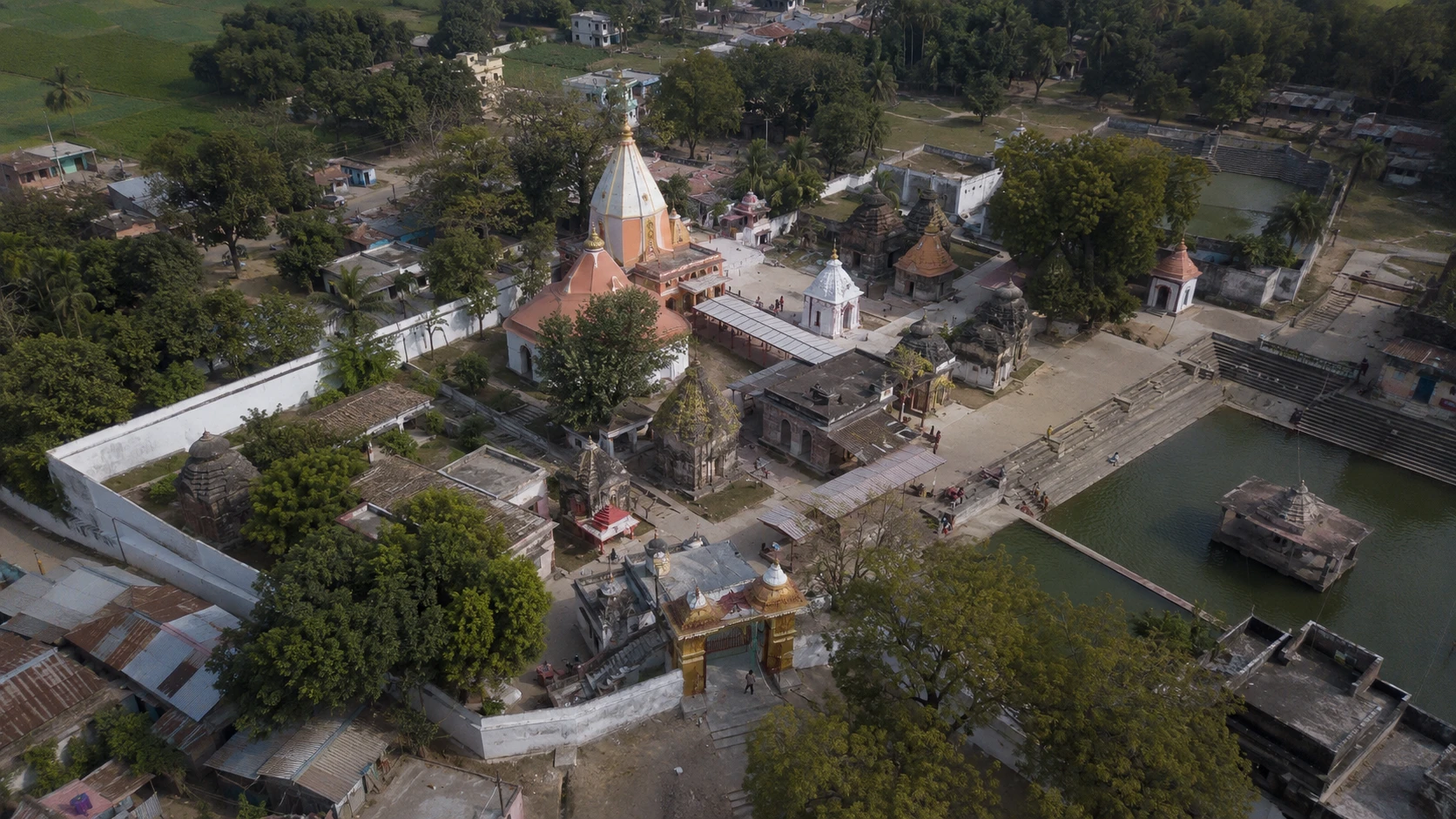
The Vakranāth linga sits in an adjoining shrine, characteristically bent in form, a natural deviation in the stone that the local tradition reads as Shiva's own honouring of the bent sage Aṣṭāvakra. The temple's architecture is austere Bengali āṭcālā with central shikhara over the Devī sanctum, a smaller shrine for Vakranāth, and a substantial enclosure surrounding the seven principal kuṇḍas.
The kuṇḍa enclosure is the distinguishing architectural fact of Bakreshwar: each spring sits within a small built pool of brick and stone, with named railings and steps for pilgrim access. The hottest, Agni Kuṇḍa, reaches near-boiling temperatures (approximately 67, 71 °C per Geological Survey of India measurements) and is approached only for darśana, not for immersion; the cooler kuṇḍas, Sūrya, Candra, Brahma, Saubhāgya, Vāyu, Bhairava, are graded by descending temperature and accommodate pilgrim bathing within ranges of cultural and physical safety.
Distinctive Practicesविशिष्ट परंपराएँ
Kuṇḍa snāna, pre-darśana bathing in the hot springs
कुण्ड स्नान, दर्शन-पूर्व तप्त-कुण्डों में स्नान
Year-round, before sanctum darśana; integral to the standard Bakreshwar pilgrim circuit
The standard Bakreshwar pilgrim does not approach the Devī sanctum directly from the entrance, the circuit begins at the kuṇḍas. After arrival, pilgrims proceed first to Saubhāgya Kuṇḍa or another temperature-appropriate spring, immerse for a ritual bath, and only then approach the sanctum for darśana with Mahiṣāsuramardinī. The hottest kuṇḍas (Agni, Sūrya) are visited for darśana of the springs themselves rather than immersion; the cooler kuṇḍas (Saubhāgya, Candra, Bhairava) are graded for bathing within physical safety. Devout pilgrims complete a full circuit of all seven principal kuṇḍas as part of the pradakṣiṇa.
The kuṇḍa snāna inverts the conventional sequence at most Shakta sites, where the pilgrim is internally purified before entering the precinct. At Bakreshwar the purification is part of the precinct itself: the kuṇḍas are not external preparation but interior arrival. The pilgrim does not approach the Devī cleansed by outside means; the pilgrim enters Bakreshwar's geological body, Shiva's tapas-heat by one reading, Satī's residual fire by another, and is shaped by it before standing before her image. The geology is liturgy.
Saptakuṇḍa pradakṣiṇa, circumambulation of the seven kuṇḍas
सप्तकुण्ड प्रदक्षिणा, सात कुण्डों की परिक्रमा
Year-round, integrated into the standard pilgrim circuit; emphasised during major festivals (Maghi Pūrṇimā, Mahā Śivarātri)
After kuṇḍa snāna and Devī darśana, devout pilgrims complete the saptakuṇḍa pradakṣiṇa, visiting each of the seven principal kuṇḍas in sequence, offering flowers or red sindoor at the rim of each spring, and reciting brief invocations to the divine or sage figure for whom each kuṇḍa is named. The circuit honours the geological-mythological integration of the site: each kuṇḍa is a discrete sacred presence with its own name, temperature, and identifying narrative, and the seven together compose the full presence of Bakreshwar's male principle (the Vakranāth-Shiva pole) just as the sanctum holds its female principle (the Mahiṣamardinī pole).
The saptakuṇḍa pradakṣiṇa enacts the Aṣṭāvakra-Shiva narrative bodily: as Aṣṭāvakra's tapas brought forth the seven springs one after another, the pilgrim retraces that emergence in reverse, completing in their own walking what the sage's tapas inaugurated. The pradakṣiṇa is therefore not auxiliary movement around a fixed sanctum but participatory re-enactment of the founding sacred event of the place. The integration with the Devī darśana ensures that the masculine pole (kuṇḍas, Vakranāth) and the feminine pole (Mahiṣamardinī sanctum) are held together in the single act of pilgrimage rather than experienced as separate observances.
Maghi Pūrṇimā kuṇḍa-snāna festival
माघी पूर्णिमा कुण्ड-स्नान पर्व
Annual, full moon of the month of Māgha (January, February); date varies by lunar calendar
Maghi Pūrṇimā at Bakreshwar is the festival when the cold-season pilgrimage peaks, the contrast between Birbhum's January chill and the warmth of the kuṇḍas draws large pilgrim numbers, and the bathing at this full moon is held to confer particular merit. The temple administration extends darśana hours and the kuṇḍa enclosure is busy through the night; many pilgrims arrive the day before to secure a place at one of the cooler kuṇḍas for the auspicious pre-dawn bath. The festival is celebrated across the Bengali Shākta hot-springs and tīrtha-snāna geography but takes a distinctive character at Bakreshwar because of the kuṇḍas' geothermal warmth in the cold-season setting.
Maghi Pūrṇimā is broadly observed across Hindu tīrtha-snāna geography as the auspicious full moon for pre-dawn ritual bathing, at the Saṅgam in Prayāgrāj, at Hardwar on the Gaṅgā, at Kumbh-cycle sites generally. At Bakreshwar the festival acquires the additional layer that the bathing waters are themselves divine, Shiva's tapas-warmth or Satī's residual fire, depending on the tradition the pilgrim holds. The cold-season setting concentrates the experience: the pilgrim leaves the chill of the Birbhum night to immerse in the heat that the goddess and the Bhairava together hold beneath the earth, and emerges marked by both the cold and the warmth in a single passage.
Did You Know?क्या आप जानते हैं?
Bakreshwar is one of very few major Shakti Peethas in India where mineral hot springs are integrated into the primary theology of the temple itself rather than treated as adjacent natural features. The kuṇḍas, the Aṣṭāvakra, Shiva narrative, and the Mahiṣamardinī sanctum form a single liturgical unit; pilgrims do not visit the temple and then optionally bathe in the springs, the springs are the temple as much as the sanctum is. Geology and Shākta theology meet here in a way unique within the Bengali Devī-circuit.
Diana Eck, 'India: A Sacred Geography' (2012); June McDaniel, 'Offering Flowers, Feeding Skulls' (2004)
The Agni Kuṇḍa at Bakreshwar reaches near-boiling temperatures, approximately 67, 71 °C per Geological Survey of India measurements, making it one of the hottest temple-integrated mineral springs in India. The kuṇḍa is approached for darśana of the geothermal phenomenon itself; immersion is not undertaken and clear safety advisories are posted. The other six principal kuṇḍas are graded by descending temperature down to ranges safe for pilgrim bathing.
Geological Survey of India research reports on the Bakreshwar geothermal field
The temple's name comes not from the Devī but from the Bhairava, Bakreshwar means 'Lord of the Bent One,' referring to Vakranāth-Shiva who appeared in a bent form here to honour the sage Aṣṭāvakra ('eight-bent'). Most Shakti Peethas take their identifying name from the Devī or from the body part that fell at the site; Bakreshwar is one of the few where the Bhairava-name dominates the popular nomenclature even though the Devī (Mahiṣāsuramardinī) is theologically primary.
Local Bakreshwar sthala-purāṇa; Bengali Tāntric literature on the Aṣṭāvakra-Vakranāth tradition
The body part attributed to Bakreshwar, manas (the inner faculty of mind), is one of the more philosophically distinctive attributions in the 51-Peetha enumeration. Most Peetha attributions name physical body parts (yoni, eye, breast, navel, fingers); manas is an antaḥkaraṇa-organ, an interior faculty rather than a physical part. The pairing of manas with Mahiṣāsuramardinī as the enshrined Devī is theologically pointed: the Devī Māhātmya's Mahiṣa is the embodiment of the unrefined inner self, and it is precisely manas that recognises and overcomes this inner Mahiṣa.
Pīṭhanirṇaya / Mahāpīṭhanirūpaṇa; Devī Māhātmya hermeneutic literature
The Bakreshwar geothermal field has been studied since the late 1970s as a potential site for low-temperature geothermal power generation in India. Pilot geothermal projects in the surrounding area (Bakreshwar, Tantloi geothermal province) have proceeded under explicit constraints to protect the kuṇḍa enclosure as a sacred zone, a rare instance of formal heritage-and-faith integration into Indian energy policy.
Geological Survey of India; Bhattacharya et al., research papers in Indian geoscientific journals; West Bengal energy policy documentation
Visitor Accessप्रवेश जानकारी
Bakreshwar welcomes pilgrims of all backgrounds for darśana and for use of the kuṇḍas. Photography is generally permitted in the outer temple precincts and around the kuṇḍas (with discretion at bathing areas); the inner Devī sanctum follows standard Bengali Shākta photography norms, verify locally before photographing the mūrti. The hot springs are open to all visitors; immersion is restricted only by the natural temperature gradient of each kuṇḍa, not by any caste-based or religion-based protocol. The Tarapith-Bakreshwar pair has historically been characterised by the open, Tāntric-inclusive ethos of Birbhum Shākta tradition.
Most pilgrims complete the Bakreshwar circuit in this order: (1) kuṇḍa snāna at Saubhāgya or another temperature-appropriate spring, (2) Devī sanctum darśana with Mahiṣāsuramardinī, (3) Vakranāth linga darśana, (4) saptakuṇḍa pradakṣiṇa visiting all seven principal kuṇḍas in sequence. Allow 3, 4 hours for an unhurried completion on a normal day; on Maghi Pūrṇimā, Mahā Śivarātri, or weekends plan for a full day or overnight. Carry change of clothes for the kuṇḍa snāna; modest bathing-wear standards apply. Approach Agni Kuṇḍa for darśana only, the temperature is genuinely unsafe for immersion.
Festivalsत्योहार
Mahā Śivarātri
महाशिवरात्रि
Phālguna Kṛṣṇa Caturdaśī (February, March)
Mahā Śivarātri at Bakreshwar honours the Vakranāth pole of the Peetha. The Vakranāth linga is the central focus for the night; the temple administration organises night-long ārati and bilva-patra abhiṣeka. Because Bakreshwar holds Shiva and Devī in single integration, Mahā Śivarātri here is observed as a pairing-festival rather than a Shaiva-only event, pilgrims approach the linga but also the Devī sanctum, and the kuṇḍas remain open through the night as part of the festival circuit.
Durgā Pūjā / Mahiṣāsuramardinī observances
दुर्गा पूजा / महिषासुरमर्दिनी पर्व
Āśvina Śukla Saptamī, Daśamī (September, October)
Durga Puja at Bakreshwar is theologically the most appropriate festival of the year, the Devī enshrined here is Mahiṣāsuramardinī herself, and the autumn festival is the canonical celebration of her victory over the buffalo-demon Mahiṣa. Saptamī through Vijayā Daśamī are observed with full Bengali Durga Puja protocol within the temple precincts: special abhiṣeka, kumārī pūjā where customary, sandhi pūjā on Aṣṭamī, Navamī boundary, and the Vijayā Daśamī procession that marks the goddess's victory. The Bakreshwar temple complex remains open throughout the festival days with extended hours.
Maghi Pūrṇimā
माघी पूर्णिमा
Māgha Pūrṇimā (January, February)
The supreme festival of kuṇḍa-snāna at Bakreshwar. The cold-season setting concentrates the contrast between Birbhum night chill and the kuṇḍas' geothermal warmth; the full-moon bathing is held to confer particular merit. Pilgrim numbers peak at this festival and the kuṇḍa enclosure stays busy through the night. The temple administration coordinates with West Bengal Tourism Department for crowd management. Maghi Pūrṇimā is the festival at which Bakreshwar's distinctive identity, pilgrim-bathing in living hot springs as part of Shakta darśana, is most fully on display.
Vāsanti Pūjā / Caitra Navarātri
वासन्ती पूजा / चैत्र नवरात्रि
Caitra Śukla Pratipadā, Navamī (March, April)
The spring festival of the Devī, observed at Bakreshwar as Vāsanti Pūjā, the springtime Durgā worship that the Bengali Shākta calendar holds as the older and more textually grounded Devī festival, distinct from the more famous Śarad (autumn) Durga Puja. The nine nights of Caitra Navarātri are observed within the temple precincts with daily abhiṣeka of the Mahiṣamardinī mūrti and special evening ārati. Pilgrim numbers at Vāsanti Pūjā are smaller than at Maghi Pūrṇimā or Durga Puja, which makes it a preferred festival for serious sādhakas seeking less crowded darśana with depth.
How to Reachकैसे पहुँचें
Bakreshwar lies in the Sahapur block of Birbhum district, West Bengal, approximately 205 km north-west of Kolkata and 24 km west of Suri (the Birbhum district headquarters). The most direct rail approach is via Sainthia Junction (28 km), which lies on the Howrah, Sahibganj main line and is served by frequent express and passenger trains from Howrah (3, 4 hours from Kolkata).
Suri Junction (24 km, on the Sainthia, Suri branch) and Dubrajpur (16 km) are alternative options closer to the temple by road. Local taxis, auto-rickshaws, and shared transport connect all three rail-heads to Bakreshwar village. By road, Bakreshwar is accessible via NH 14 (formerly NH 60) and connecting state highways; private taxi from Kolkata takes 5, 6 hours.
The nearest commercial airports are Kazi Nazrul Islam Airport at Andal, Durgapur (55 km, limited connectivity) and Netaji Subhas Chandra Bose International Airport at Kolkata (205 km, full domestic and international connectivity). Many pilgrims combine Bakreshwar with Tarapith (~75 km north) in a single Birbhum Shākta circuit trip.
Plan Your Visitयात्रा की योजना
🌤 सर्वोत्तम मौसम
October to March (Śarad, Vasanta, post-monsoon to pre-summer) is the most comfortable window for Bakreshwar, with cool-to-mild daytime conditions ideal for the kuṇḍa snāna experience. The cold-season window, December and January in particular, when night temperatures in Birbhum can drop to 8, 10 °C, produces the most theologically distinctive Bakreshwar experience, with the chill of the open air heightening the contrast of the geothermal kuṇḍas; this period also draws large pilgrim numbers around Maghi Pūrṇimā. Summer (April, June) is hot (up to 42 °C) and the kuṇḍa snāna becomes less pleasant; monsoon (July, September) is humid with regional flooding risks.
👘 पहनावे का नियम
Standard Bengali Shākta temple norms apply: modest clothing covering shoulders and knees; women traditionally wear sari or salwar-kameez; men commonly wear dhoti-panjabi or kurta-pyjama, though standard ethnic or modest Western clothing is accepted. For the kuṇḍa snāna, carry change of clothing, modest bathing-wear standards apply, similar to other Indian tīrtha-snāna sites; women often bathe in sari, men in dhoti or modest swimwear. Footwear is removed at the temple-precinct entry; lockers are available.
📱 फोन और फोटोग्राफी
Phones and cameras are generally permitted in the outer temple precincts and around the kuṇḍas (with discretion at bathing areas). The inner Devī sanctum follows standard Bengali Shākta photography norms, verify the current photography policy with the on-site sevāyats before photographing the mūrti. Video recording near the kuṇḍas should be undertaken with respect for fellow pilgrims who may be bathing.
🏨 आवास
Bakreshwar village offers pilgrim infrastructure on a smaller scale than Tarapith: dharmaśālās, modest private lodges, and a small selection of mid-range hotels. Suri (24 km) and Sainthia (28 km) offer broader hotel options for pilgrims preferring a town base. Advance booking is essential during Maghi Pūrṇimā, Mahā Śivarātri, and Durga Puja. Many pilgrims combine Bakreshwar with Tarapith and base their stay in Rampurhat or Suri for convenience to both circuits.
Sacred Soundsपवित्र ध्वनि
Mahiṣāsuramardinī Stotram, 'Ayi Giri Nandini' (attributed to Ādi Śaṅkarācārya)
stotram · 540
Devī Māhātmya, Chapter 3, Mahiṣāsura Vadha (the slaying of the buffalo-demon)
stotram · 660
Śiva Tāṇḍava Stotram, for the Vakranāth-Bhairava pole of the Peetha
stotram · 360
Aṣṭāvakra Gītā, opening dialogue between Aṣṭāvakra and Janaka
philosophical · 720
Nārāyaṇī Stuti, Devī Māhātmya, Chapter 11, from the Caṇḍī Pāṭha
stotram · 600
क्या आप जानते हैं? · Did You Know?
वही अनुवाद त्रुटि जिसने हिन्दू धर्म में '33 कोटि' को '33 करोड़' बनाया, बौद्ध धर्म में भी हुई। बौद्ध ग्रन्थों के चीनी अनुवाद ने 'सप्त कोटि बुद्ध' (7 श्रेष्ठ बुद्ध) का अनुवाद '7 करोड़ बुद्ध' कर दिया। तिब्बती अनुवाद ने सही किया: 7 प्रकार, 7 करोड़ नहीं। एक संस्कृत शब्द, दो प्रमुख विश्व धर्मों में गलत पढ़ा गया, ने दो एकसमान भ्रम स्वतन्त्र रूप से उत्पन्न किए।
Related Contentसंबंधित सामग्री
Related Scriptures
Community Reflections
🕉️
Be the first to share your reflection.