Mahalakshmi Kolhapur
महालक्ष्मी कोल्हापुर
The three-eyed goddess of Karavir, Mahalakshmi at Kolhapur, sixth of the eighteen great Peethas
Kolhapur, Maharashtra, India
Mahālakṣmī KolhāpuraAlso known as: Sri Mahalakshmi Mandir, Kolhapur, श्री महालक्ष्मी मंदिर, कोल्हापूर, Ambabai (regional Marathi name), अंबाबाई, Karavir Nivasini (the goddess of Karavir; Karavir / Karaveer being the ancient Sanskrit name for the Kolhapur region), करवीर निवासिनी, Mahalaxmi Karavir, Dakshin Kashi Mahalakshmi (regional designation as the Southern Kashi), महामाया
युग
Worship at Mahalakshmi Kolhapur is referenced in regional Maharashtra tradition from at least the 7th, 8th century CE through the Chalukya era; the Ashtadasa Shakti Peetha Stotram of Adi Shankara (8th century CE) lists Mahalakshmi at Kolhapur at canonical position 6; substantial Shilahara dynasty patronage from the 10th, 12th centuries; Yadava-era Hemadpanti additions in the 12th, 13th centuries; Maratha-era consolidation under the Bhonsle and Kolhapur Riyasat dynasty from the 17th century onwards; modern administrative framework under the Western Maharashtra Devasthan Samiti (Paschim Maharashtra Devasthan Vyavasthapan Samiti) from the post-Independence era
वास्तुकला
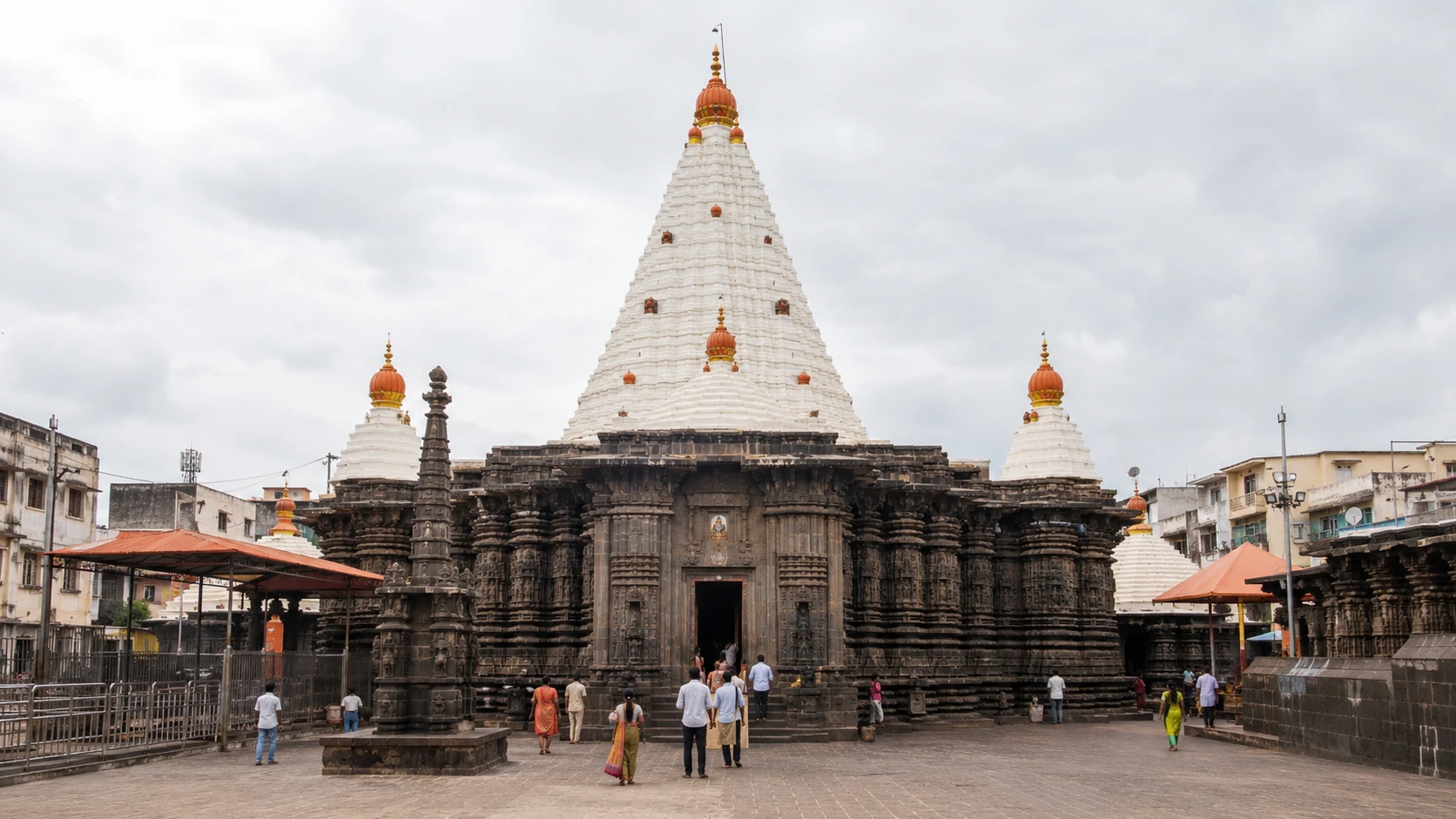
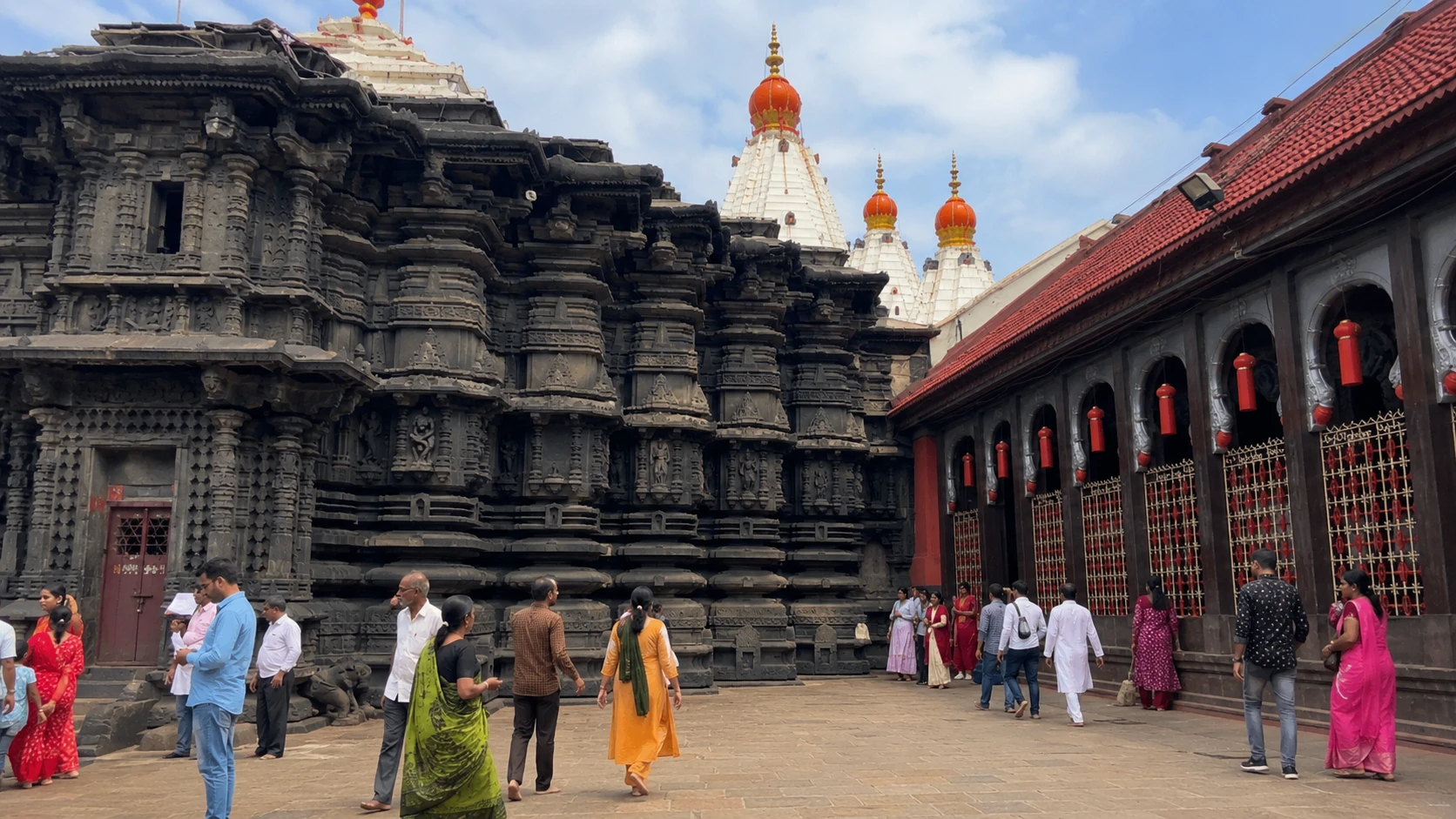
Mixed Chalukya-Hemadpanti Maharashtra temple architecture, original 7th, 8th century Chalukya construction, with substantial Hemadpanti (Yadava-era) additions in the 12th, 13th centuries; characterized by black stone construction, the distinctive shikhara towers, pillared mandapas, and the Saat Bhuvan (seven-courtyard) layout that structures pilgrim approach to the inner sanctum; the architectural alignment that produces the Kirnotsav (sunlight festival) phenomenon is a precise pre-modern engineering achievement
खुला
04:30 – 22:30
आरती
05:00 · 08:00 · 11:30 · 19:30 · 22:00
विशेष
The five daily aartis (Panchaaarti) at Mahalakshmi Kolhapur, Kakad Aarti at dawn, Bal Bhog at 8am, Madhyahn Aarti at midday, Sayan Aarti at evening, and Shejaarati at night-close, comprise one of the most elaborate daily aarti cycles among the Maha Shakti Peethas. The Kirnotsav (sunlight festival) is the temple's most extraordinary annual phenomenon: during specific dates in late January, early February and early-to-mid November, direct sunlight passes through architecturally-aligned windows to fall on the goddess's face, illuminating the central murti for approximately three minutes at sunset on each of three consecutive days. The phenomenon is treated as a darshan-event of exceptional significance, drawing tens of thousands of additional pilgrims to Kolhapur during the Kirnotsav window.
पवित्र कथा · पवित्र कथा
In the historic centre of Kolhapur, Karavir in classical Sanskrit, a name still used in liturgical contexts, sits one of the most institutionally significant Devi shrines in southern Maharashtra and one of the most theologically consequential Shakti Peethas in classical Sanskrit Shakta enumeration. Sri Mahalakshmi at Kolhapur, known regionally as Ambabai, 'mother of mothers' in Marathi affectionate form, is the sixth Maha Shakti Peetha catalogued in Adi Shankara's 8th-century Ashtadasa Shakti Peetha Stotram, listed in the canonical sequence between Jogulamba at Alampur (fifth) and Ekaveerika at Mahur (seventh). The temple holds rare distinction within the Maha Shakti Peetha system: a relatively clear canonical body-part attribution, the trinetra, the three eyes, that aligns directly with the temple's central iconography. The Mahalakshmi murti at the inner sanctum is famously carved with three eyes, including the vertical third eye on the forehead, and the iconographic feature is among the most theologically explicit in the entire Maha Shakti Peetha network: the body-part attribution stated in the canonical 51-Peetha enumeration is visible to every devotee who stands before the goddess. The goddess at Kolhapur is identified as Mahalakshmi but in her fierce, warrior, eight-armed-and-lion-vehicled form, distinct from the consort Lakshmi who appears alongside Vishnu at the great Vishnu temples of the southern Indian peninsula. This Mahalakshmi is Karavir Nivasini, 'she who dwells at Karavir', and her iconographic registers connect to the broader Devi Mahatmya warrior-goddess framework while preserving the specific Mahalakshmi prosperity-and-protection theological character. The black stone murti, approximately 4 feet tall, bears the trinetra and is decorated daily with red and gold cloths, gold ornaments, and fresh flower garlands. The Kolhapur Mahalakshmi tradition holds the goddess as one of the foremost Sri Vidya peethas of India, a centre where the Sri Vidya lineage of the Lalita Tripura Sundari tradition has been continuously preserved across centuries of Maratha and pre-Maratha patronage, and where the Mahalakshmi form is recognized within the Sri Vidya framework as a manifestation of Lalita in her protective-prosperity aspect. The temple's architectural form derives from Chalukya-era construction (7th, 8th century CE), with substantial subsequent additions across the Shilahara, Yadava, and Maratha periods. The Hemadpanti style influence (a Yadava-era Maharashtra temple architecture tradition) is visible in much of the present structure. Within the temple complex the Saat Bhuvan, the seven courtyards or chambers, provide the structured devotional space through which pilgrims approach the inner sanctum. Outside the temple, the surrounding Kolhapur historic district preserves layers of Maratha-Bhonsle royal patronage, including elements still maintained through the legacy of Chhatrapati Shahu Maharaj of Kolhapur (1894, 1922), the reformer-monarch whose social-justice and religious-philanthropic work redefined Kolhapur's modern identity. To stand before the three-eyed Mahalakshmi at the inner sanctum is to be present at one of Indian Shakta tradition's most theologically clear iconographic-textual alignments: the canonical attribution is visible, the goddess's form is unambiguous, and the centuries of royal patronage that brought the temple to its present form are layered in the surrounding city's stones.
Sacred Designationपवित्र पदनाम
Shakti Peeth
शरीर का अंग: Three eyes (trinetra), per the canonical 51-Peetha attribution that connects Mahalakshmi Kolhapur with Sati's three-eye body-part. The iconographic feature is preserved in the central murti, which famously depicts the goddess with three carved eyes including the vertical third eye on the forehead. Among the Maha Shakti Peethas Mahalakshmi Kolhapur is distinctive in this iconographic-textual alignment: the canonical body-part attribution is directly visible in the temple's central murti
शक्ति: Mahalakshmi / Karavir Nivasini / Ambabai, the fierce-protective form of the goddess, eight-armed and lion-vehicled, with prominent three-eye iconography; distinct from the consort Lakshmi form worshipped at Vishnu temples in the southern peninsula
भैरव: Less canonically standardized at this site in the major textual enumerations; some regional Tantric sources name attributions but no single canonical reference holds across the principal Sanskrit Shakta texts
Sacred Origin Storyपवित्र उत्पत्ति कथा
Source: Adi Shankara's Ashtadasa Shakti Peetha Stotram (8th century CE); Devi Bhagavata Purana, Skandha 7; Pithanirnaya canonical 51-Peetha enumeration with trinetra attribution at Kolhapur; regional Maharashtra Mahatmya tradition; Sri Vidya devotional tradition recognizing Mahalakshmi as a manifestation of Lalita Tripura Sundari.
When Daksha Prajapati's great yajna ended in Sati's self-immolation and Shiva's grief-mad tandava, the gods sent Vishnu to halt the dance before it unmade the cosmos. Vishnu followed Shiva through the sky and from his Sudarshana chakra loosed precise cuts that severed Sati's body, piece by piece, while she still rested upon her lord's shoulder.
As each part fell to the earth below, Shiva's grief lightened, until at last he carried nothing, and the dance ended. The fifty-one places where Sati's body fell became Shakti Peethas, with the canonical attributions preserved in the Pithanirnaya, Tantra Chudamani, and Devi Bhagavata enumerations.
To a hilltop in southern Maharashtra at the site of what would become Karavir, the ancient name for Kolhapur, fell Sati's three eyes (trinetra). The body part associated with divine vision, with the third eye of inner sight, with the goddess's all-seeing presence.
From the place where her three eyes touched the earth, the Mahalakshmi presence emerged, and the central murti at this site has carried the three-eye iconography ever since. The Pithanirnaya canonical enumeration places the trinetra Peetha specifically at this location; the Mahalakshmi murti at Kolhapur is among the very few in the Maha Shakti Peetha network where the canonical body-part attribution is directly preserved in the iconography that devotees can see.
The Adi Shankara Ashtadasa Shakti Peetha Stotram of the 8th century CE places Mahalakshmi at Kolhapur at the sixth position among the eighteen great seats of the goddess, in the canonical sequence between Jogulamba at Alampur and Ekaveerika at Mahur.
The Stotram identifies the goddess by form (Mahalakshmi at Kolhapur) and the body-part attribution (trinetra) preserved in regional tradition completes the canonical anchoring. Few Maha Shakti Peethas have this clarity of textual-iconographic alignment.
The Mahalakshmi at Kolhapur is, theologically, the fierce-protective form of the goddess associated with both abundance (Lakshmi-prosperity) and protective combat (the eight-armed warrior aspect). She is distinct from the consort Lakshmi form worshipped at the great Vishnu temples, there, Lakshmi appears alongside her consort, in a serene-prosperity register; here at Kolhapur she is Karavir Nivasini, the goddess of the place, in her own protective seat with her own iconographic register.
The Mahalakshmi tradition at Kolhapur further integrates with the broader Sri Vidya Devi tradition: Sri Vidya lineages have continuously preserved at Kolhapur the recognition of Mahalakshmi as a manifestation of Lalita Tripura Sundari, the principal Sri Vidya goddess, with the temple serving as one of the foremost Sri Vidya peethas of India.
The Sri Vidya integration adds a layer of esoteric theological depth to the temple's Maha Shakti Peetha identity, Kolhapur is both classical Maha Shakti Peetha and active Sri Vidya centre across uninterrupted lineage transmission spanning centuries.
उद्धृत स्रोत:
- Adi Shankara, 'Ashtadasa Shakti Peetha Stotram' (8th century CE; Mahalakshmi at Kolhapur at position 6)
- Pithanirnaya (anonymous medieval Sanskrit text enumerating 51 Shakti Peethas with trinetra attribution at Kolhapur)
- Tantra Chudamani (medieval Sanskrit Tantric text)
- Devi Bhagavata Purana, Skandha 7
- Kalika Purana, chapter 18 (Sati's dismemberment)
- Regional Maharashtra Mahatmya tradition (Marathi and Sanskrit sources)
- Sri Vidya lineage texts identifying Mahalakshmi as a manifestation of Lalita Tripura Sundari
- Lalita Sahasranama and Sri Vidya commentarial literature
अन्य परंपराएँ · अन्य परंपराएँ
Mahalakshmi-Lakshmi disambiguation, the Kolhapur Mahalakshmi as distinct from the Vishnu-consort Lakshmi
A persistent source of confusion in modern pilgrim discourse concerns the relationship between Mahalakshmi at Kolhapur and the consort Lakshmi worshipped alongside Vishnu at major Vishnu temples (notably at Tirupati, Sri Rangam, and other Sri Vaishnava centres).
The two are theologically distinct: the Kolhapur Mahalakshmi is Karavir Nivasini, the goddess of the place, in her own protective-prosperity seat, and is iconographically registered as a fierce eight-armed warrior form with the trinetra.
The Vishnu-consort Lakshmi is theologically the prosperity-giver who emerged from the cosmic ocean churning and accompanies Vishnu in his various avatars; she is iconographically registered as a serene seated or standing figure beside her consort.
The Sri Vidya theological framework that the Kolhapur tradition draws on understands Mahalakshmi at Kolhapur as a manifestation of Lalita Tripura Sundari, the principal Sri Vidya goddess, rather than as the Vishnu-consort.
Devotees approaching the Kolhapur shrine are addressing Karavir Nivasini, the Maha Shakti Peetha trinetra goddess; the disambiguation is preserved in the temple's regional tradition and is theologically meaningful but does not usually require explicit navigation by individual pilgrims, who experience the temple's distinctive character directly through the iconography and worship sequences.
Sri Vidya lineage tradition, Mahalakshmi as a manifestation of Lalita Tripura Sundari
Within the Sri Vidya tradition, one of the most theologically elaborate Hindu Shakta lineages, transmitted through guru-disciple succession across centuries, the Mahalakshmi at Kolhapur is recognized as a regional manifestation of Lalita Tripura Sundari, the principal Sri Vidya goddess.
The Sri Vidya integration adds an esoteric theological dimension to the Maha Shakti Peetha identity: the goddess at the Kolhapur trinetra Peetha is, in this reading, an emanation of the Sri Yantra-anchored Lalita herself, with the Mahalakshmi prosperity-protection aspects functioning as one specific manifestation of her broader cosmic role.
Sri Vidya practitioners regard Kolhapur as one of the foremost active Sri Vidya peethas in India, with continuous lineage transmission spanning centuries of pre-Maratha and Maratha-era patronage. The Sri Vidya tradition operates through initiation-required mantras and meditation practices that are not publicly transmitted; this account is descriptive of the tradition's existence and theological framework rather than instructional.
विद्वत संदर्भ
Modern scholarship on Mahalakshmi Kolhapur engages with several intersecting questions: (1) the temple's classical Ashtadasa Shakti Peetha status (uncontested, at position 6) and the distinctive iconographic-textual alignment of the trinetra body-part attribution with the central murti's three-eye iconography; (2) the temple's architectural history across Chalukya, Shilahara, Yadava, and Maratha periods, with the present structure substantially preserving multi-century construction layers; (3) the Mahalakshmi-Lalita identification within the Sri Vidya tradition, which gives the temple its specific esoteric theological character; (4) the Kirnotsav phenomenon, the precise pre-modern architectural alignment that produces direct sunlight on the goddess's face during specific dates in late January, early February and early-to-mid November, which is among the most remarkable surviving examples of Indian temple architecture incorporating astronomical alignment; and (5) the temple's continuing role as the institutional centre of regional Maharashtra Shakta devotion, with substantial pilgrim flows from Maharashtra, Karnataka, and broader South Indian Hindu families. Annual pilgrim numbers exceed several million; the Kirnotsav window draws exceptional additional pilgrim flows.
Historyइतिहास
Mahalakshmi Kolhapur's documented history extends across multiple layers reflecting Maharashtra's long political-religious complexity: ancient Chalukya-era origins, medieval Shilahara and Yadava patronage, the foundational Maratha consolidation under the Bhonsle royal house, the Kolhapur Riyasat under Chhatrapati Shahu Maharaj and his successors, and the modern post-Independence state-administration transition.
The temple's earliest documented form derives from Chalukya-era construction in the 7th, 8th centuries CE, with the central sanctum and the foundational architectural elements traceable to this period. Adi Shankara's 8th-century Ashtadasa Shakti Peetha Stotram lists Mahalakshmi at Kolhapur at canonical position 6, providing the pan-Indian Maha Shakti Peetha anchoring that has shaped scholarly discourse on the temple ever since.
The Shilahara dynasty (10th, 12th centuries) extended substantial patronage to the temple, expanding the structural form and the surrounding civic infrastructure. Shilahara inscriptions documenting temple grants and royal devotional engagement have been preserved across the Karavir region.
The Yadava period (12th, 13th centuries) brought the distinctive Hemadpanti architectural additions that are still visible in the temple's present form, pillared mandapas and stone-construction conventions characteristic of this Maharashtra regional school.
Through the medieval period the temple operated under successive regional powers, including periods of Bahmani and later Adil Shahi rule. Some sources reference damage during medieval Islamic invasions and subsequent restorations, though the temple's central structural form has been substantially preserved.
The foundational modern transformation came with the establishment of the Kolhapur Riyasat under the Bhonsle dynasty, descendants of Chhatrapati Shivaji Maharaj, from the late 17th century onwards. The Marathas regarded Mahalakshmi as the Kuldevi (clan goddess) of the Kolhapur royal house, paralleling the Wodeyars' relationship with Chamundeshwari at Mysuru.
Maratha-era patronage included structural elaborations, ritual cycle codification, and the institutional partnership between the royal house and the temple that has continued in modified form to the present.
The most consequential single figure in the temple's modern history is Chhatrapati Shahu Maharaj of Kolhapur (1874, 1922; ruled 1894, 1922), one of India's most significant social-reform monarchs of the late colonial period.
Shahu Maharaj's reign brought substantial temple patronage but also progressive reforms in the temple's administrative framework, including the opening of temple access to all castes (a major reform act with national-level significance in the Indian social-justice movement of the era).
Shahu Maharaj's broader social-justice legacy, opening educational institutions, supporting Dalit rights, and challenging Brahmanical orthodoxy in various ways, has made him among the most revered figures in modern Maharashtra political-cultural memory, and his association with Mahalakshmi Kolhapur is part of the temple's modern identity.
Kolhapur Riyasat merged into the Indian Union in 1947, 1948 following Indian Independence. The temple's administrative responsibility transitioned to the Western Maharashtra Devasthan Samiti (Paschim Maharashtra Devasthan Vyavasthapan Samiti), which administers Mahalakshmi Kolhapur along with other major Maharashtra Devi shrines.
The Devasthan Samiti maintains the temple's daily operations, ritual schedules, pilgrim infrastructure, and the precise architectural-astronomical features that enable the Kirnotsav phenomenon. Through the late 20th and into the 21st century the Samiti has overseen progressive infrastructure expansion, queue-management systems, digital booking platforms, restoration projects preserving the historical architectural elements, while maintaining the temple's essential structural and ritual character.
Historical Timelineऐतिहासिक कालक्रम
The earliest documented form of Mahalakshmi Kolhapur derives from Chalukya-era construction. Adi Shankara (788, 820 CE traditional dating) composes the Ashtadasa Shakti Peetha Stotram, listing Mahalakshmi at Kolhapur at canonical position 6 among the eighteen Maha Shakti Peethas. The Stotram is the most consequential single textual placement of the temple in classical Sanskrit literature and establishes Mahalakshmi Kolhapur's pan-Indian Maha Shakti Peetha status. The combination, Chalukya-era construction plus Ashtadasa canonical listing in the same broad century, anchors the temple firmly in pan-Indian sacred geography by the end of the 8th century CE.
The Shilahara dynasty extends substantial patronage to Mahalakshmi Kolhapur, expanding the temple's structural form and the surrounding civic-devotional infrastructure across several generations. Shilahara-era inscriptions documenting temple grants, royal devotional engagement, and ritual cycle support have been preserved across the Karavir region. The Shilahara patronage period establishes Mahalakshmi Kolhapur as a major regional Maharashtra pilgrimage centre with infrastructure adequate to substantial pilgrim flows.
The Yadava period brings the distinctive Hemadpanti architectural additions to Mahalakshmi Kolhapur, pillared mandapas, stone-construction conventions, and structural elaborations characteristic of this Maharashtra regional school. The Hemadpanti additions are still visible in the temple's present form and represent the second major architectural layer atop the original Chalukya construction. The Yadava-era ritual cycles and codification practices established conventions that have continued through subsequent periods.
Chhatrapati Shahu Maharaj of Kolhapur (1874, 1922; ruled 1894, 1922) extends his progressive social-reform program to the Mahalakshmi temple's administrative framework, including the opening of temple access to all castes, a major reform act with national-level significance in the Indian social-justice movement of the era. Shahu Maharaj's broader social-justice legacy, opening educational institutions for Dalit and underprivileged students, supporting Dalit rights through legal-administrative reforms, and challenging Brahmanical orthodoxy in various ways, has made him among the most revered figures in modern Maharashtra political-cultural memory. His association with Mahalakshmi Kolhapur is part of the temple's modern identity and is commemorated in regional devotional and historical memory.
Shahu Maharaj's temple-access reform is regarded as one of the earliest substantive state-level interventions on caste-based temple access in modern India, predating the more widely-known Travancore temple-entry proclamation of 1936 and several other regional reforms. The reform's specific scope and implementation at Mahalakshmi Kolhapur is well-documented in Kolhapur Riyasat administrative records.
Following Indian Independence, Kolhapur Riyasat merges into the Indian Union, ending the Bhonsle royal house's formal political role. The Mahalakshmi temple's administrative responsibility transitions to the Western Maharashtra Devasthan Samiti (Paschim Maharashtra Devasthan Vyavasthapan Samiti), which administers Mahalakshmi Kolhapur along with other major Maharashtra Devi shrines. The transition preserves the temple's essential structural and ritual character while reorganizing the administrative framework under the post-Independence Indian state. Through the late 20th and into the 21st century the Samiti has overseen progressive infrastructure expansion, queue-management systems, digital booking platforms, restoration projects preserving the historical architectural elements that enable the Kirnotsav phenomenon, while maintaining the temple's continuous worship cycle.
What You'll Seeदर्शन में
The central murti of Mahalakshmi at Kolhapur is among the most theologically and visually distinctive in the entire Maha Shakti Peetha network. Carved from black stone (approximately 4 feet tall, 40 kilograms in weight), the goddess is depicted in seated form bearing the iconographic features that anchor her canonical identity: three eyes, the trinetra body-part attribution of the Pithanirnaya canonical enumeration, with the vertical third eye carved prominently in the centre of the forehead, and eight arms holding weapons and symbols characteristic of the fierce-protective Devi form (sword, mace, shield, conch, and the lotus that marks her Lakshmi prosperity character).
The murti's distinctive black stone gives the iconographic surface a subdued depth that contrasts with the daily decorations of red silk cloth, gold and silver ornaments, and fresh flower garlands. The goddess sits in lotus-position lalita-asana, her lion vehicle implied at her base.
The decoration cycle changes through the day across the five aarti sequences, and the goddess is dressed in particularly elaborate festival attire during Navratri, Kirnotsav, and other major observances.
The temple's architectural form derives from multiple historical layers. The Chalukya-era 7th, 8th century construction provides the foundational structural form; the Shilahara dynasty (10th, 12th centuries) expanded the structural envelope; the Yadava-era Hemadpanti additions (12th, 13th centuries) provided much of the pillared mandapa architecture visible today; subsequent Maratha-era elaborations added the present elevated sanctum platforms, the courtyard structures, and the queue infrastructure that accommodates substantial modern pilgrim flows.
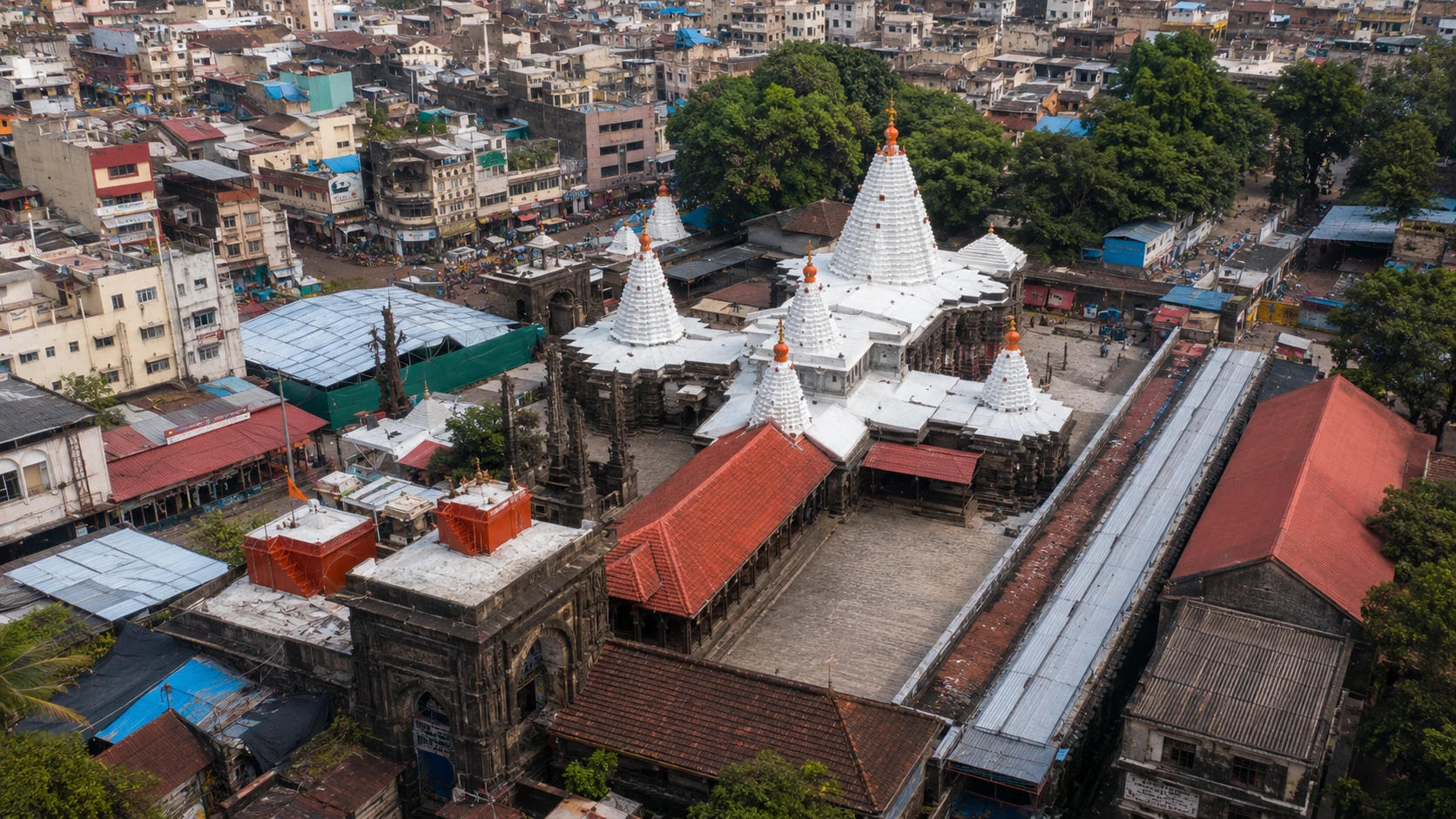
The temple complex includes the Saat Bhuvan, the seven courtyards or chambers, which provide a structured devotional approach through which pilgrims pass before reaching the inner sanctum.
The Kirnotsav architectural alignment is among the temple's most remarkable engineering features. The temple was constructed with specific window orientations on the western side of the sanctum such that, during particular dates in late January, early February and again in early-to-mid November, direct sunlight at sunset enters through these architecturally-aligned apertures and falls progressively across the goddess's body and face.
The phenomenon takes approximately three minutes to unfold each evening of the Kirnotsav cycle, with each consecutive day's sunbeam falling progressively higher on the murti, from the goddess's feet on the first day, through her body on the second, to her face on the third.
The precise alignment is preserved through careful architectural conservation; the Western Maharashtra Devasthan Samiti and the temple Trust treat the architectural elements producing the Kirnotsav as among the temple's most theologically irreplaceable features.
Modern astronomical analysis has confirmed that the alignment corresponds to the sun's solstitial position relative to the temple's longitude, a precise pre-modern engineering achievement that suggests the Chalukya or Hemadpanti builders incorporated specific astronomical calculations into the temple's foundational design.
The outer temple precinct preserves the surrounding Kolhapur historic district, Maratha-era civic structures, the Bhonsle royal palace complex (Old Palace and New Palace), the Town Hall, and various heritage buildings that frame the temple's urban context. The historic district's preservation is part of the temple's wider cultural footprint within Maharashtra heritage tourism.
Distinctive Practicesविशिष्ट परंपराएँ
Kirnotsav, the architectural-astronomical sunlight festival
किरणोत्सव, स्थापत्य-खगोलीय सूर्य प्रकाश उत्सव
Twice annually, once in late January, early February (typically January 31, February 2) and once in early-to-mid November (typically November 9, 11); exact dates shift slightly across years based on the sun's solstitial position
The Kirnotsav at Mahalakshmi Kolhapur is among the most remarkable surviving examples of Indian temple architecture incorporating astronomical alignment for ritual purposes. During specific three-day windows twice per year, direct sunlight at sunset enters through architecturally-aligned western-facing apertures and falls progressively across the goddess's body and face over approximately three minutes each evening. The phenomenon unfolds in graduated sequence across the three consecutive days: on the first day the sunbeam falls on the goddess's feet, on the second day across her body, and on the third day directly on her face, the moment of darshan-event peak that draws tens of thousands of additional pilgrims to Kolhapur. The sun's position at the specific dates corresponds to the temple's astronomical alignment, which is preserved through careful architectural conservation. The Kirnotsav has been documented in temple records for centuries, and modern astronomical analysis has confirmed the precision of the original architectural calculation. Devotees regard the sunlight's reaching the goddess as a moment of cosmic acknowledgement: the sun, the principal celestial body, completes its salutation to the goddess at her precise hilltop seat. The phenomenon is theologically Vedic in framing, the sun's worship of Devi is among the oldest Vedic-Shakta motifs, and architecturally extraordinary in execution. The Kirnotsav windows draw substantial additional pilgrim flow and are treated by the Devasthan Samiti as among the temple year's most institutionally important moments.
The Kirnotsav reflects a deep theological convergence: the goddess's place is so precisely seated in the cosmic order that even the sun's annual path acknowledges her, returning twice each year to salute her face directly. The phenomenon also reflects a precise pre-modern Indian theological-engineering tradition: temple architects who understood astronomical principles and incorporated them into temple design produced sacred spaces that participated in the broader cosmic order rather than standing apart from it. The Kirnotsav is not a stand-alone marvel but the visible expression of a sacred-geographical-astronomical alignment that the original temple builders engineered to participate in cosmic time itself. The pilgrim who attends the Kirnotsav is present at the goddess's salutation by the sun, a darshan that has been ritually structured into the temple's architecture for over a thousand years.
Panchaarati, the five daily aarti cycle
पंचारती, पाँच दैनिक आरती चक्र
Daily, Kakad Aarti at 5am, Bal Bhog at 8am, Madhyahn Aarti at 11:30am, Sayan Aarti at 7:30pm, Shejaarati at 10pm
The five-aarti daily cycle at Mahalakshmi Kolhapur is among the most elaborate among the Maha Shakti Peethas, far exceeding the typical 2, 4 aarti cycles at most major Indian Devi shrines. The five aartis follow a graduated daily rhythm: the Kakad Aarti at dawn awakens the goddess; the Bal Bhog at 8am presents the morning food offering; the Madhyahn Aarti at midday is the day's central worship moment; the Sayan Aarti at evening marks the evening offerings; and the Shejaarati at 10pm, literally 'bed aarti', formally puts the goddess to rest for the night. The structural pattern reflects a regional Maharashtra devotional tradition that treats the goddess as a continuously-present presence requiring sustained attendance across the full daily cycle rather than worship at scattered moments. The Panchaarati is conducted by hereditary priestly families with deep regional Brahminical training; specific mantras, ritual sequences, and accompanying music are preserved with care. Pilgrims who attend the full daily aarti cycle complete a theologically substantive devotional commitment; many Kolhapur-resident families organize their daily schedules around at least one of the five aartis.
The five-aarti cycle expresses the regional Marathi-Maharashtra theology of sustained devotional attention. The goddess at Kolhapur is understood not as a presence to be visited occasionally but as a continuous reality requiring continuous engagement; the five aartis structure the day in such a way that the goddess's devotees can be present at her side at every major transition of the day. The pattern parallels household devotional traditions in regional Maharashtra families, where elder women in particular maintain extended daily worship cycles centered on the household deity (often Mahalakshmi or Ambabai in Maharashtra Brahminical traditions). The temple's five-aarti cycle is, in effect, the institutionalized form of this household pattern, devotion structured across the full day rather than at scattered moments. The pattern's continuation across the centuries through Maratha-era patronage and post-Independence administration reflects the deep institutional importance of the daily ritual rhythm at Mahalakshmi Kolhapur.
Sri Vidya Lalita lineage tradition
श्री विद्या ललिता वंशावली परंपरा
Year-round, with intensified lineage observances during Sharad Navratri (the Sri Vidya tradition's most charged annual cycle) and on specific dates within the Sri Vidya lineage calendar
Mahalakshmi Kolhapur is recognized within the broader Sri Vidya tradition as one of the foremost active Sri Vidya peethas in India, a centre where the lineage of the Lalita Tripura Sundari devotional and meditational tradition has been continuously preserved across centuries of pre-Maratha and Maratha-era patronage. Within the Sri Vidya framework the Mahalakshmi at Kolhapur is understood as a manifestation of Lalita Tripura Sundari, the principal Sri Vidya goddess, with the Mahalakshmi prosperity-protection aspects functioning as one specific expression of her broader cosmic role. Sri Vidya practitioners visit Kolhapur for darshan within the lineage's understanding of the goddess; the temple's regional priestly families include Sri Vidya-initiated lineages whose practices integrate the temple's regular ritual cycles with deeper Sri Vidya meditational sequences. The Sri Vidya tradition operates through initiation-required mantras and meditation practices not publicly transmitted; the temple's association with the lineage is descriptive of its devotional character rather than instructional. Pilgrims interested in pursuing Sri Vidya practice should seek formal initiation through established lineage gurus; the temple itself serves as a site of pilgrimage for both general devotees and Sri Vidya practitioners.
The Sri Vidya lineage's continuous presence at Kolhapur reflects the temple's theological depth: Mahalakshmi here is not only a Maha Shakti Peetha trinetra goddess but also an actively transmitted Sri Vidya lineage seat, with the goddess understood across both the Pithanirnaya canonical framework and the Lalita Tripura Sundari Sri Vidya framework. The dual identity gives Kolhapur a theological richness that few other Maha Shakti Peethas have: classical Sanskrit Shakti Peetha status plus active esoteric lineage tradition. For Sri Vidya practitioners the temple is a major lineage pilgrimage destination; for general devotees the lineage's continued presence at the temple adds depth to the goddess's perceived availability and the priestly tradition's continuity. The Sri Vidya association is preserved with appropriate discretion, initiation-required practices are not publicly displayed, but the lineage's institutional history at Kolhapur is well-documented in regional devotional literature.
Did You Know?क्या आप जानते हैं?
Twice each year, in late January-early February and again in early-to-mid November, direct sunlight passes through architecturally-aligned western-facing apertures at Mahalakshmi Kolhapur and falls progressively on the goddess's body and face at sunset. The phenomenon, known as Kirnotsav (sunlight festival), unfolds in graduated sequence across three consecutive days: on the first day the sunbeam reaches the goddess's feet, on the second day her body, and on the third day directly her face. The precise alignment was engineered by the original Chalukya or Hemadpanti builders to correspond to the sun's solstitial position at the temple's specific longitude, and is preserved through careful architectural conservation. Modern astronomical analysis has confirmed the precision of the original calculation. The Kirnotsav is among the most remarkable surviving examples of Indian temple architecture incorporating astronomical alignment for ritual purposes; the phenomenon draws tens of thousands of additional pilgrims to Kolhapur during each annual window.
Western Maharashtra Devasthan Samiti documentation; Indian Heritage Sites architectural studies; modern astronomical analysis of the temple's solar alignment
Mahalakshmi Kolhapur is among the very few Maha Shakti Peethas where the canonical Sati body-part attribution is directly visible in the central murti's iconography. The Pithanirnaya canonical 51-Peetha enumeration attributes the trinetra (three eyes) Peetha specifically to Kolhapur, and the goddess's central murti at the inner sanctum is carved with three eyes, including the vertical third eye in the centre of the forehead, making the textual attribution and the iconographic feature directly aligned. The clarity of this iconographic-textual alignment is rare in the Maha Shakti Peetha network and gives Mahalakshmi Kolhapur a particularly explicit canonical character.
Pithanirnaya canonical enumeration; Adi Shankara's Ashtadasa Stotram; comparative Maha Shakti Peetha scholarship
Mahalakshmi Kolhapur holds a dual canonical-and-esoteric identity within Hindu Shakta tradition. As a Maha Shakti Peetha she is at canonical position 6 in Adi Shankara's 8th-century Ashtadasa Stotram. As a Sri Vidya peetha she is recognized within the Sri Vidya lineage tradition as a manifestation of Lalita Tripura Sundari, the principal Sri Vidya goddess. The dual identity gives Kolhapur a theological richness that few other Maha Shakti Peethas have: classical Sanskrit Shakti Peetha status plus active esoteric lineage tradition. Both identities are continuously maintained, the Maha Shakti Peetha status through the temple's public worship and Ashtadasa Stotram recitation, the Sri Vidya status through initiation-required lineage practices preserved by hereditary priestly families.
Adi Shankara's Ashtadasa Stotram; Sri Vidya lineage tradition; Lalita Sahasranama; Saundarya Lahari
Chhatrapati Shahu Maharaj of Kolhapur (1874, 1922; ruled 1894, 1922) extended his progressive social-reform program to the Mahalakshmi temple's administrative framework during his reign, opening temple access to all castes, a major reform act with national-level significance in the Indian social-justice movement of the era. The reform predates the more widely-known Travancore temple-entry proclamation of 1936 and several other regional reforms; it is regarded as one of the earliest substantive state-level interventions on caste-based temple access in modern India. Shahu Maharaj's broader social-justice legacy, opening educational institutions for Dalit and underprivileged students, supporting Dalit rights through legal-administrative reforms, and challenging Brahmanical orthodoxy in various ways, has made him among the most revered figures in modern Maharashtra political-cultural memory.
Dhananjay Keer, 'Shahu Chhatrapati: A Royal Revolutionary' (Popular Prakashan, 1976); Kolhapur Riyasat administrative records; modern Maharashtra social-reform scholarship
The Mahalakshmi at Kolhapur is theologically distinct from the consort Lakshmi worshipped alongside Vishnu at major Vishnu temples. The Kolhapur Mahalakshmi is Karavir Nivasini, the goddess of the place, in her fierce, eight-armed, lion-vehicled warrior form with prominent three-eye iconography, not the serene consort form. The Sri Vidya theological framework that the Kolhapur tradition draws on understands Mahalakshmi here as a manifestation of Lalita Tripura Sundari rather than as Vishnu's consort. The disambiguation matters theologically for understanding the Kolhapur shrine's specific identity within the broader Hindu Devi pantheon: not all Mahalakshmi forms are equivalent, and the Kolhapur Mahalakshmi belongs to the Shakta Maha Shakti Peetha framework rather than the Vaishnava consort framework.
Comparative South Indian Vaishnava-Shakta theological literature; Sri Vidya lineage texts; D.C. Sircar, 'The Śākta Pīṭhas' (1948; revised 1973)
Visitor Accessप्रवेश जानकारी
Mahalakshmi Kolhapur is open to all visitors regardless of gender, caste, religious background, or age. There is no menstrual restriction on women entering the shrine. The temple has been formally open to all castes since the 1900s Shahu Maharaj reforms, among the earliest substantive caste-access reforms at any major Indian temple. Photography is prohibited inside the inner sanctum; phones and cameras must be deposited at designated counters before approaching the central murti, or pocketed and not used inside. Footwear is removed at the prescribed outer boundary. Children, the elderly, and pregnant women are all welcomed. During Kirnotsav windows and Sharad Navratri the temple operates expanded queue-management protocols; expect substantially longer darshan times during these periods.
Pilgrims approaching Mahalakshmi Kolhapur: the temple sits in the historic centre of Kolhapur city, accessible on foot or by auto from any point in the central district. During non-festival periods darshan typically takes 30, 90 minutes total including queue and inner sanctum time. During Sharad Navratri and Kirnotsav windows queue times can extend to several hours; advance planning is essential, and pilgrims wishing to attend the Kirnotsav specifically should arrive at the temple no later than mid-afternoon to secure inner-sanctum positioning before the sunset phenomenon. Photography is prohibited inside the inner sanctum; deposit phones and cameras at the designated counter before entering. Modest, traditional attire is expected (saree, salwar-kameez, dhoti-shirt, or kurta-pyjama); leather items should be removed before approaching the inner sanctum. The temple is barrier-free accessible for the elderly and mobility-limited through designated entry routes. Sponsored sevas, abhishekam, and special pujas can be arranged through the Devasthan Samiti channels; advance booking is required for the major festival windows.
Festivalsत्योहार
Sharad Navratri
शरद नवरात्रि
Sep-Oct (Ashwin Shukla Pratipada to Dashami)
The autumn nine-night festival is Mahalakshmi Kolhapur's principal annual Devi observance and the year's largest pilgrim flow window. Each of the nine nights is dedicated to one of the Navadurga aspects with parallel intensified worship at the inner shrine. Within Sharad Navratri the Sri Vidya tradition observes Lalita Panchami (the fifth night, sacred to Lalita Tripura Sundari with whom Mahalakshmi is identified in the Sri Vidya framework) as a particularly charged ritual moment; the temple's Sri Vidya-initiated priestly lineages conduct specific lineage observances on this night. The festival concludes on Vijayadashami with the goddess celebrated in her victory aspect.
Kirnotsav (Sunlight Festival)
किरणोत्सव (सूर्य प्रकाश उत्सव)
Twice annually, late January-early February and early-to-mid November
The Kirnotsav is Mahalakshmi Kolhapur's most architecturally extraordinary annual phenomenon. During three-day windows in late January, early February and again in early-to-mid November, direct sunlight passes through architecturally-aligned western-facing apertures and falls progressively on the goddess's body and face at sunset. The phenomenon unfolds in graduated sequence, feet, body, face, across three consecutive days, with the face-darshan day drawing exceptional pilgrim flow. Tens of thousands of additional pilgrims arrive at Kolhapur during each Kirnotsav window. The festival is theologically Vedic in character: the sun, the principal celestial body, completes its salutation to the goddess at her precise hilltop seat. The Kirnotsav's continuation across centuries reflects the original temple builders' precise astronomical-architectural engineering, preserved through careful structural conservation by the Devasthan Samiti.
Chaitra Navratri
चैत्र नवरात्रि
Mar-Apr (Chaitra Shukla Pratipada to Navami)
The spring nine-night festival is Mahalakshmi Kolhapur's secondary major annual Devi observance. Like Sharad Navratri, each of the nine nights is dedicated to a Navadurga aspect. Chaitra Navratri overlaps the spring agricultural cycle in Maharashtra and is auspicious for new beginnings; many Maharashtra and Karnataka families schedule the Yatra during Chaitra to coincide with new business ventures, examinations, or wedding-season planning. The festival concludes on Rama Navami. Chaitra Navratri is considerably less crowded than Sharad Navratri or Kirnotsav, making it the preferred window for devotional pilgrimage without festival-tourism overlay.
Mangalwar (Tuesday) Weekly Observances
मंगलवार साप्ताहिक पालन
Weekly (every Tuesday throughout the year)
Tuesdays are traditionally sacred to Mahalakshmi in Maharashtra Shakta devotional tradition; Mahalakshmi Kolhapur observes weekly Mangalwar (Tuesday) observances with intensified worship throughout the day. Regular Tuesday pilgrim flow exceeds non-Tuesday weekday flow significantly; many regional Maharashtra families visit the temple specifically on Tuesdays as part of weekly devotional commitment. The weekly observance pattern integrates the temple into the broader rhythm of regional Hindu household devotional life, where Tuesdays at home or at the temple are reserved for Mahalakshmi-Lakshmi practice.
Traditional Offeringsपारंपरिक अर्पण
प्राथमिक अर्पण
Red Saree / Chunari / Silk Cloth
लाल साड़ी / चुनरी / रेशम वस्त्र
रक्ताम्बर
Red sarees and silk cloths are among the principal offerings at Mahalakshmi Kolhapur. The temple's central murti receives daily cloth changes during the morning aarti cycle, and devotees present sarees (particularly the regional Maharashtra Nauvari nine-yard style) and bright-red silk pieces to be blessed at the inner shrine. The cloth offerings function within the temple's daily rotation; some are retained for the temple wardrobe, others returned to devotees as Devi-prasad. For Maharashtra families undertaking the Yatra during major life events, weddings, daughter's first menstruation rituals, business launches, the saree offering carries particular cultural-devotional significance.
Red Flowers, hibiscus, roses, lotus
लाल पुष्प, गुड़हल, गुलाब, कमल
जपाकुसुम / पद्म
Red flowers, hibiscus, roses, and the regionally significant lotus, are offered at the inner shrine and garland the central murti throughout the day. Garlands are refreshed during each of the five aarti cycles; pilgrims purchase flower garlands from vendor stalls outside the temple or from official Devasthan Samiti counters. The lotus offering specifically connects Mahalakshmi to the broader Lakshmi-prosperity iconography (Lakshmi is canonically associated with lotus across pan-Indian tradition) while the hibiscus aligns with the fierce-protective aspect characteristic of the Kolhapur Mahalakshmi.
Kumkum (Vermillion)
कुमकुम
कुङ्कुम
Kumkum is applied to the goddess's forehead at every aarti cycle and is returned to devotees as the most commonly distributed prasad. At Mahalakshmi Kolhapur the kumkum offering connects directly to the goddess's three-eye iconography, the central forehead area where the third eye is carved is the primary site of kumkum application. Women devotees apply the kumkum in the central parting of their hair as a Maharashtra Shakta blessing for marital harmony, household protection, and the goddess's continuing presence.
Coconut (Narikela)
नारियल
नारिकेल
Whole coconut with husk and water intact is offered at the inner shrine and ritually broken by the Sebait. The broken coconut is partly retained for temple bhog preparation, partly returned to the devotee as prasad. At Mahalakshmi Kolhapur the coconut carries the standard Maharashtra-South Indian devotional significance, the ego cracked open through devotion, and is universally presented across all major sevas, family pilgrim visits, and routine darshan moments.
Maharashtra Sweets, Puran Poli, Modak, Karanji
महाराष्ट्र मिठाइयाँ, पूरण पोली, मोदक, करंजी
मिष्टान्न
Maharashtra regional sweets, Puran Poli (a flatbread stuffed with sweetened jaggery-and-chickpea filling), Modak (steamed sweet dumplings, traditionally offered to Ganesh and adopted into broader Maharashtra Devi-worship), Karanji (a deep-fried sweet pastry filled with sweet coconut), and Payasam, are offered at the inner shrine and form part of the temple's daily bhog distribution. The Maharashtra regional flavor profile distinguishes Mahalakshmi Kolhapur prasad from offerings at other Shakti Peethas; pilgrims visiting from outside Maharashtra often notice the distinctive Marathi sweet traditions. The sweets are prepared without onion or garlic (maintaining sattvic standard) and use ghee, milk, jaggery, sugar, and regional dry fruits.
Sandalwood Paste (Chandana)
चंदन (चंदन-लेप)
चन्दन
Sandalwood paste, chandana, is applied to the goddess's murti during specific aarti sequences and is returned to devotees as a fragrant prasad, often applied to the forehead. The chandana offering connects Mahalakshmi Kolhapur to broader South Indian and Maharashtra temple traditions where sandalwood is among the most sacred substances; the cooling fragrance is regarded as theologically associated with the goddess's tranquil-prosperity aspect even as her iconography emphasizes her warrior form.
इस मंदिर की विशेषता
Kirnotsav Darshan Seva, sponsored participation in the sunlight festival
किरणोत्सव दर्शन सेवा, सूर्य प्रकाश उत्सव में प्रायोजित भागीदारी
Devotees who wish to participate in the Kirnotsav phenomenon, the temple's most architecturally extraordinary annual moment, when direct sunlight falls on the goddess during specific three-day windows in late January-early February and early-to-mid November, can sponsor and reserve participation through the Devasthan Samiti's Kirnotsav seva system. Sponsorship includes reserved inner-sanctum positioning during the sunset darshan moment, included aarti participation, designated bhog offerings, and ceremonial acknowledgement in the festival's recitation. The Kirnotsav Darshan Seva is among the most distinctive offerings at any Indian Devi temple, a sponsored darshan tied to a precise astronomical phenomenon that occurs only six days per year. Booking is required well in advance through the Devasthan Samiti official channels; the highest sponsorship tiers (with closest sanctum positioning) typically sell out 4, 6 months ahead of each Kirnotsav window.
Mahalakshmi Sthanapati Seva, sponsored participation in the Panchaarati cycle
महालक्ष्मी स्थानपति सेवा, पंचारती चक्र में प्रायोजित भागीदारी
Devotees can sponsor participation in any of the five daily aartis (Kakad Aarti, Bal Bhog, Madhyahn Aarti, Sayan Aarti, Shejaarati) through the Mahalakshmi Sthanapati Seva offered by the Devasthan Samiti. The sponsoring devotee or family is given designated positioning at the relevant aarti, with the priests performing the worship in their name and including the family in the ritual recitation. The Madhyahn Aarti at midday is the most commonly sponsored, it is the day's central worship moment with the most institutional weight, but each of the five aartis can be sponsored independently. Sthanapati Seva sponsorship is particularly meaningful as part of multi-generational family devotional commitments; many regional Maharashtra families have continuous Sthanapati Seva traditions extending across multiple generations.
Standard offerings (saree/chunari, flowers, coconut, kumkum, sweets, sandalwood) can be purchased from vendor stalls outside the temple or from official Devasthan Samiti counters in the compound. Devasthan Samiti counter prices are fixed and recommended; outside-vendor pricing is unregulated and can spike during Kirnotsav and Sharad Navratri windows. Kirnotsav Darshan Seva and Mahalakshmi Sthanapati Seva require advance coordination through the Devasthan Samiti's official channels; pilgrims should not attempt to arrange these through unaffiliated middlemen at Kolhapur railway station or Pune transport hubs. Animal sacrifice is not part of Mahalakshmi Kolhapur's contemporary ritual tradition, the temple is strictly vegetarian, with no bali tradition.
How to Reachकैसे पहुँचें
Mahalakshmi Kolhapur sits in the historic centre of Kolhapur city, southern Maharashtra. By air, Kolhapur Airport (KLH, 9 km from the temple) provides limited domestic flights; the principal airports for international and most domestic travelers are Pune Airport (PNQ, 240 km north) and Chhatrapati Shivaji Maharaj International Airport, Mumbai (BOM, 380 km north-west).
Pre-paid taxis and app-based cabs cover the Pune-to-Kolhapur route in approximately 4, 5 hours and the Mumbai-to-Kolhapur route in 7, 8 hours via the Mumbai-Pune Expressway and onward Pune-Kolhapur National Highway. By rail, Chhatrapati Shahu Maharaj Terminus (Kolhapur Junction, 3 km from the temple) is well-connected to Mumbai, Pune, Bengaluru, and other major Indian cities via express and regional services; Miraj Junction (44 km) is a major South Central Railway hub for broader train coverage.
By road, Kolhapur connects via the Pune-Bengaluru National Highway (NH-48) to Pune (240 km), Mumbai (380 km), and Bengaluru (615 km); regular bus services operate from these cities and from Goa (250 km west). Once in Kolhapur city, the Mahalakshmi temple is in the central historic district, accessible by auto, taxi, or short walk from most central locations.
Plan Your Visitयात्रा की योजना
🌤 सर्वोत्तम मौसम
October to March is the most comfortable period, Kolhapur temperatures range 15, 28°C with crisp clear weather. The Kirnotsav windows in late January, early February and early-to-mid November are the year's most architecturally extraordinary dates but bring the most concentrated crowds; pilgrims with flexibility may prefer to visit shortly before or after the Kirnotsav for unhurried darshan within the cooler season. Avoid the peak monsoon (June-September): heavy rainfall in the Western Ghat region, occasional landslide risk on the approach routes, and the difficult Kolhapur summer transition that follows. April-May can be hot (occasionally exceeding 35°C). Kolhapur winter is mild and the most universally pleasant visiting window.
👘 पहनावे का नियम
Modest, traditional attire is expected, particularly inside the inner sanctum. Maharashtra Shakta temple etiquette is formal; pilgrims should avoid shorts, sleeveless garments, and revealing clothing. Traditional Maharashtra attire, sarees (particularly the regional Nauvari nine-yard style for women), kurta-pyjama, or dhoti-shirt for men, is most appropriate. Leather items should be removed before entering the inner sanctum. Footwear is removed at the prescribed outer boundary. Comfortable walking footwear is useful given the historic district's pedestrian-only zones around the temple. The temple's marble flooring stays cool year-round; warm socks are advisable in winter.
📱 फोन और फोटोग्राफी
Photography and videography are prohibited inside the inner sanctum where the central Mahalakshmi murti is enshrined. Phones, cameras, and recording devices must be deposited at designated counters before approaching the main shrine, or pocketed and not used inside. Photography is permitted in the outer courtyards, in the Saat Bhuvan ambulatory spaces, and at the outer temple precinct, except where signage indicates otherwise. During Kirnotsav the temple operates additional photography restrictions to prevent disruption of the brief darshan-event windows; pilgrims should attend the Kirnotsav darshan with full attention rather than recording attempts.
🏨 आवास
Kolhapur has extensive accommodation infrastructure tailored to its position as a major regional pilgrimage and heritage tourism centre: luxury heritage hotels (notably the Shalini Palace, a converted Bhonsle-era palace), mid-range business hotels, traditional dharamshalas operated by various community trusts, and budget guesthouses. The Western Maharashtra Devasthan Samiti maintains accommodation listings and partnership with several Trust-affiliated lodging options near the temple. During Kirnotsav windows and Sharad Navratri all Kolhapur accommodation reaches saturation; book through verified channels at least 8, 12 weeks in advance for these periods. Pune (240 km) and Mumbai (380 km) provide alternative accommodation bases for pilgrims combining the Kolhapur visit with broader Maharashtra heritage exploration, though most pilgrims prefer to stay in Kolhapur itself to access the historic district and the multiple cultural sites surrounding the temple.
Sacred Soundsपवित्र ध्वनि
Devi Suktam (Vāk Sūkta, Rig Veda 10.125)
stotram · 420
Lalita Sahasranama (Brahmanda Purana), the 1,008 names of Lalita Tripura Sundari with whom Mahalakshmi Kolhapur is identified in Sri Vidya tradition
sahasranama · 2400
Saundarya Lahari (attributed to Adi Shankara), the foundational Sri Vidya stotram
stotram · 1800
Mahalakshmi Ashtakam, the eight-verse hymn to Mahalakshmi from the Padma Purana
stotram · 480
Ashtadasa Shakti Peetha Stotram (Adi Shankara, names Mahalakshmi at Kolhapur as the 6th Peetha)
stotram · 480
क्या आप जानते हैं? · Did You Know?
वही अनुवाद त्रुटि जिसने हिन्दू धर्म में '33 कोटि' को '33 करोड़' बनाया, बौद्ध धर्म में भी हुई। बौद्ध ग्रन्थों के चीनी अनुवाद ने 'सप्त कोटि बुद्ध' (7 श्रेष्ठ बुद्ध) का अनुवाद '7 करोड़ बुद्ध' कर दिया। तिब्बती अनुवाद ने सही किया: 7 प्रकार, 7 करोड़ नहीं। एक संस्कृत शब्द, दो प्रमुख विश्व धर्मों में गलत पढ़ा गया, ने दो एकसमान भ्रम स्वतन्त्र रूप से उत्पन्न किए।
Related Contentसंबंधित सामग्री
Related Scriptures
Community Reflections
🕉️
Be the first to share your reflection.