Vindhyavasini
विंध्यवासिनी
The Devi who dwells in the Vindhyas, Yogamaya, who stood in for the newborn Krishna
Vindhyachal, Uttar Pradesh, India
VindhyavāsinīAlso known as: Vindhyavasini, Vindhyavasini Devi, Vindhyeshwari, Yogamaya, Maha Maya, Vindhyachal Wali, विंध्यवासिनी, विंध्येश्वरी, योगमाया, विंध्यवासिनी देवी, विंध्याचल वाली, महामाया
युग
Origin pre-historic per Puranic and Vedic-period regional tradition; literary attestation in the Harivamsha and early Puranas (c. 100 BCE, 500 CE); Banbhatta's Harshacharita (7th century CE) preserves an early specific reference; continuous patronage through the Gupta, Kalachuri, Sultanate, Mughal, and Maratha periods; current administration under the Government of Uttar Pradesh's Vindhyavasini Devi Mandir trust / temple committee within the recent Vindhya Corridor administrative framework
वास्तुकला
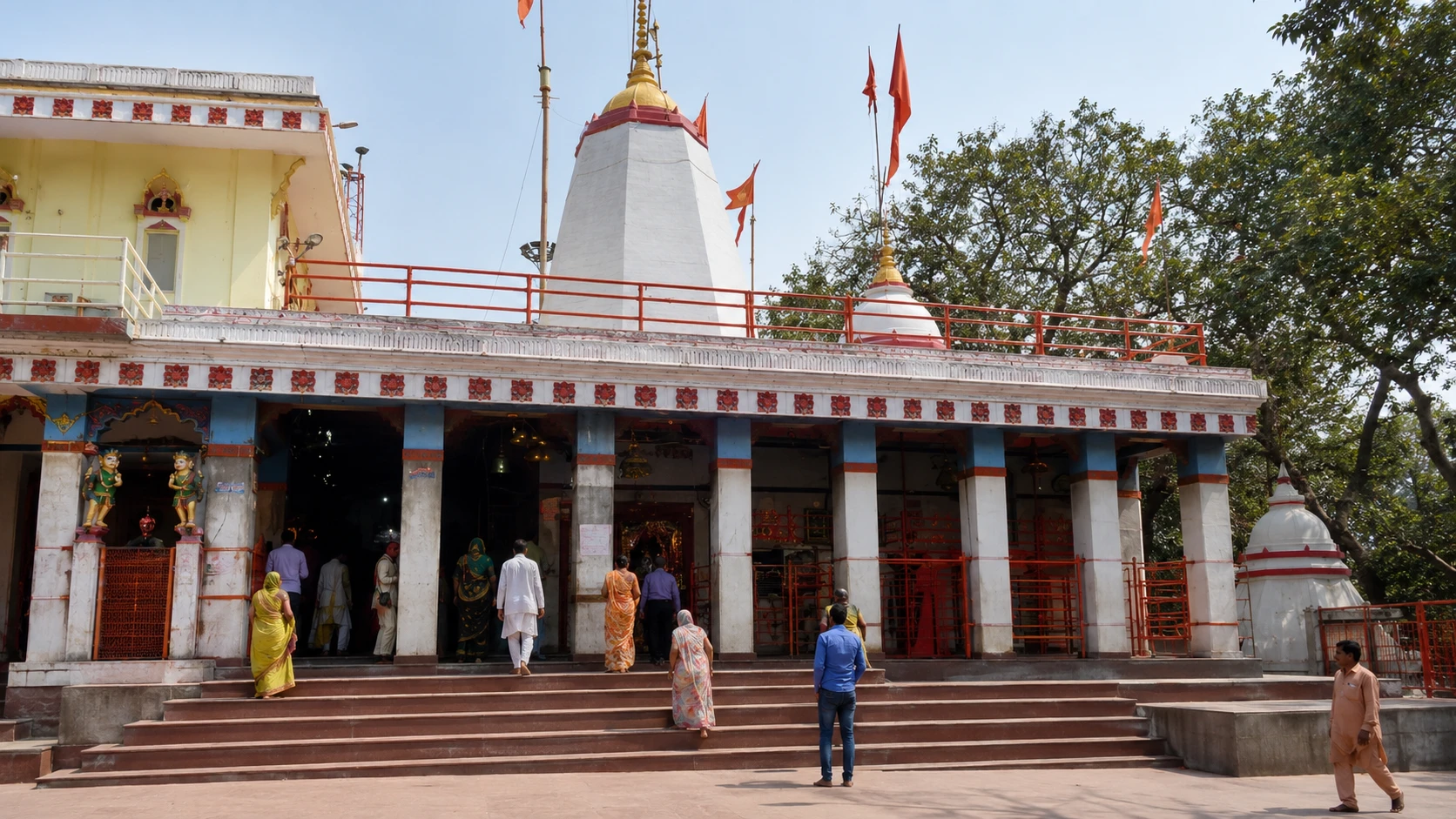
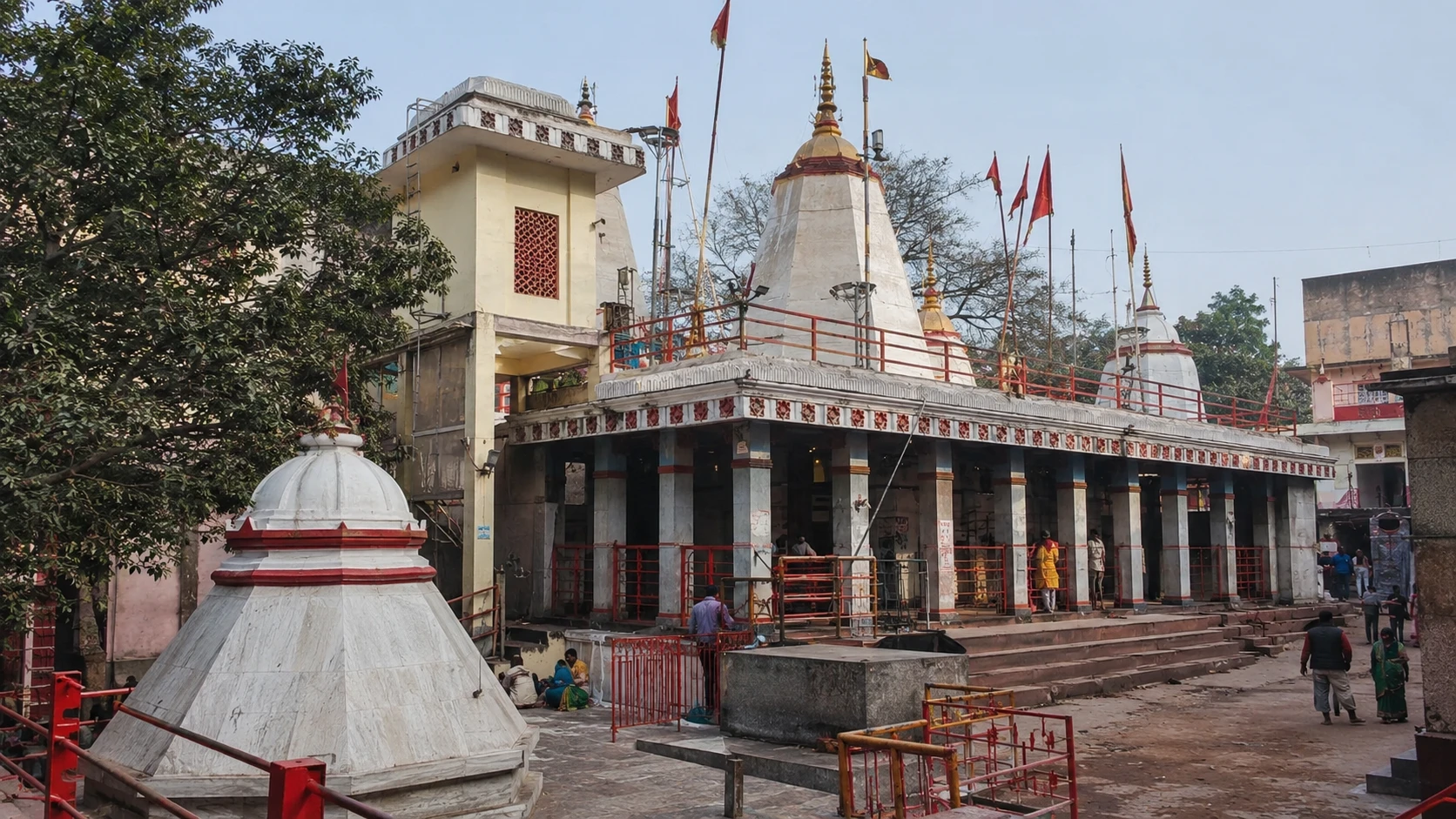
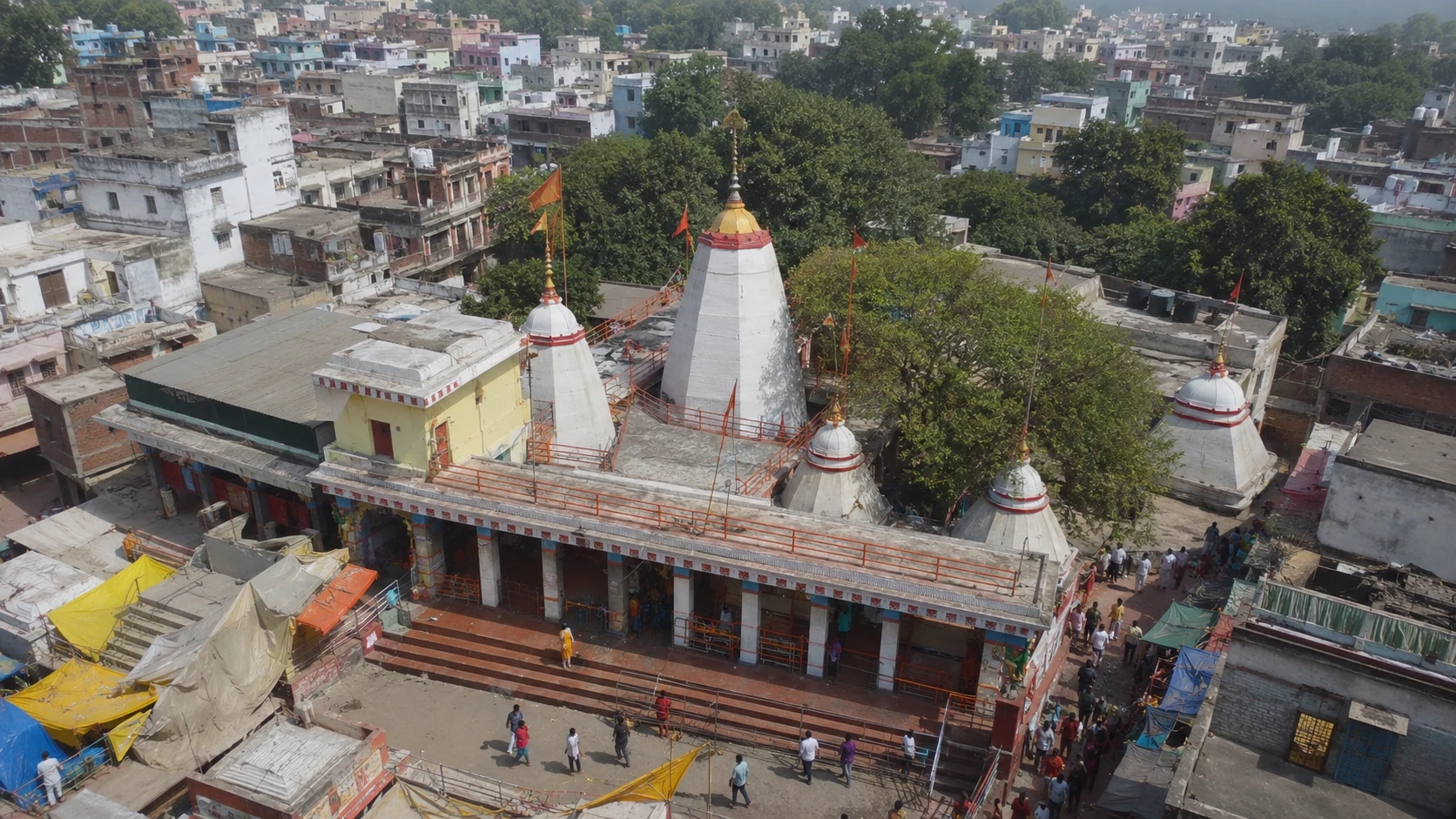
Composite Nagara temple with later-period mandapa and gopuram additions; the principal sanctum is small and architecturally modest in the manner of ancient Devi shrines where the murti's antiquity takes precedence over structural elaboration; surrounding compound substantially reshaped through the Vindhya Corridor development of the 2018, 2024 period
खुला
04:00 – 22:00
आरती
04:00 · 12:00 · 19:30 · 21:30
विशेष
Chaitra Navarathri (March, April) and Sharadiya Navarathri (September, October), both nine-night festival cycles draw the year's heaviest pilgrim flows; Krishna Janmashtami (the festival of Krishna's birth, August, September) carries unique theological weight at this site given the temple's Krishna-birth-substitute identification; Kumbh-season cross-pilgrimage from Prayagraj (during Magh Mela annually and the major Kumbh/Ardh Kumbh cycles every six years) makes Vindhyavasini one of the principal Kumbh-adjacent destinations; the Vindhya Trikona Parikrama linking three Devi shrines is a year-round defining practice but peaks during Navarathri
पवित्र कथा · पवित्र कथा
At Vindhyachal in the Mirzapur district of Uttar Pradesh, where the Ganges flows in a wide southerly curve and the Vindhya hills rise from the river's southern bank, sits one of the oldest continuously-worshipped Devi shrines in northern India. The goddess here is the Devi who appears in the Bhagavata Purana's Krishna birth narrative, the Yogamaya who was born to Yashoda in Gokul at the exact moment Krishna was born in Mathura prison, who was swapped for the infant Krishna by Vasudeva crossing the Yamuna in the storm, who slipped from Kamsa's murderous grip and rose into the sky as the eight-armed Maha Maya to declare that the destroyer of the tyrant was already born and to prophesy Kamsa's death. After her cosmic announcement she came to dwell in the Vindhya mountains, becoming Vindhyavāsinī, 'she who dwells in the Vindhyas', and her shrine at the foot of those hills is the seat of that dwelling. The Devi here is also identified with the warrior who slew Mahishasura and with the Adya Shakti of the Devi Bhagavata Purana; three theological strands, Yogamaya, Mahishasura-mardini, and Adya Shakti, converge at one shrine.
Sacred Designationपवित्र पदनाम
Shakti Peeth
शरीर का अंग: Body-part attribution at Vindhyavasini is not consistently established across major Shakti Peetha enumerations. The temple's place in the Shakti Peetha framework is grounded primarily in two distinct rationales: first, the temple is named in Adi Shankara's Ashtadasa Shakti Peetha Stotram (in those recensions that include it) as the seat of the Vindhya-dwelling Devi; second, the temple is held in regional tradition as a Siddha Peetha, a self-manifest seat of the Devi independent of the Sati-body fragmentation narrative, by virtue of the Bhagavata Purana, Harivamsha, and Devi Bhagavata Purana accounts that locate the cosmic Devi in the Vindhyas in her own primordial agency. Where body-part attribution does appear in marginal recensions of the 51-Peetha list, the right toe or right ankle is the most commonly cited fragment; this attribution should be treated as one regional reading rather than as a canonical fixture.
शक्ति: Vindhyavāsinī, 'she who dwells in the Vindhyas', identified across the tradition as Yogamaya (the cosmic Devi who substituted for the infant Krishna in the Bhagavata Purana's birth narrative), as the Mahiṣāsura-mardinī of the Devi Mahatmya, and as the Ādya Śakti of the Devi Bhagavata Purana; the three theological strands converge at the one shrine
भैरव: Bhairava attribution at Vindhyavasini is less consistently fixed than at the major south Indian Ashtadasa sites; some recensions identify the paired Bhairava as Kalabhairava (the universal cosmic-threshold Bhairava) rather than a site-specific form
Sacred Origin Storyपवित्र उत्पत्ति कथा
Source: Bhagavata Purana Skanda X (the Krishna birth narrative); Harivamsha (the supplement to the Mahabharata, with detailed Yogamaya material); Vishnu Purana, Skanda V; Devi Bhagavata Purana, Skanda VII (the primordial Vindhya-Devi narrative); Devi Mahatmya / Markandeya Purana (the Mahishasura-mardini narrative incorporated into the Vindhya identification); the local Vindhya Mahatmya transmitted through the temple's priestly lineage
The central Puranic narrative at Vindhyavasini is the Krishna birth-substitute story preserved most fully in the Bhagavata Purana's Skanda X and in the Harivamsha. King Kamsa of Mathura, who had imprisoned his sister Devaki and her husband Vasudeva on a prophecy that Devaki's eighth child would slay him, had systematically killed each of Devaki's children at birth.
As the eighth pregnancy approached its term, Vishnu and the cosmic Devi orchestrated the substitution that would preserve the prophesied liberator. At the same moment that Krishna was born in the Mathura prison cell to Devaki, Yogamaya, the cosmic Devi acting as the operative Maya through which the divine plan unfolds, was born to the cowherd Yashoda in Gokul, across the Yamuna.
The prison guards fell into a deep sleep; the chains and locks opened by themselves; Vasudeva took the newborn Krishna in a basket and walked to the Yamuna. The river, in flood from the storm, rose to touch the feet of the infant and then drew back to allow Vasudeva to cross.
Vasudeva reached Gokul, found Yashoda in postpartum sleep with the newborn Yogamaya beside her, and made the exchange, placing Krishna at Yashoda's side and taking Yogamaya back. By the time he returned to the Mathura prison, the locks had closed, the guards had not stirred, and Yogamaya was the child the morning would reveal to Kamsa.
Kamsa, alerted to the eighth birth, came to seize the child. As he raised the newborn to dash her against the stone, the infant slipped from his grasp and rose into the sky as the eight-armed Maha Maya, bearing weapons in every hand, blazing with cosmic light. She declared to Kamsa that the destroyer he sought was already born elsewhere and that his death was certain.
The Yogamaya-form then disappeared from his sight and came to dwell, by the Devi's own choice, in the Vindhya mountains, becoming Vindhyavāsinī, 'she who dwells in the Vindhyas'. The shrine at Vindhyachal is the seat of that dwelling.
The Devi Bhagavata Purana's Skanda VII independently establishes the Vindhyavasini identification, not as a derivative of the Krishna-birth narrative but as a primordial seat of the cosmic Devi: the Vindhya hills, marking the boundary between the northern Aryavarta and the southern Dakshinapatha, are read in the Devi Bhagavata as the cosmic Devi's own chosen seat in the geographical middle of the subcontinent, from which she presides over the cosmic order.
The Krishna-birth narrative is, in this reading, one episode within a longer cosmic agency that the Devi has continuously exercised from this seat.
A third theological strand connects Vindhyavasini to the Devi Mahatmya's Mahishasura-mardini, the warrior-Devi who, mounted on the lion, slew the buffalo-demon Mahishasura after his attempt to overthrow the gods. Several Mahatmya transmissions place the Mahishasura battle in the Vindhya region itself; the warrior-Devi of that battle is identified in local Vindhyachal tradition with the Vindhyavasini, and the principal murti's lion-mount (singhasana) is held to recall the Mahishasura-mardini iconography.
The three strands, Yogamaya, Adya Shakti, Mahishasura-mardini, are held simultaneously at one shrine without ranking or resolution. The pilgrim who comes to Vindhyavasini approaches the Devi who substituted for Krishna's body at his birth, who has dwelt in the Vindhyas since before the cosmic chronology, and who has been continuously the warrior-protector of the cosmic order, the same Devi, in three theological registers that the tradition has chosen not to collapse into one.
The shrine is further connected to two adjacent Devi temples through the Vindhya Trikona Parikrama. The Ashtabhuja Devi Mandir, approximately 3 km from the principal Vindhyavasini shrine on a hill, enshrines the eight-armed form (echoing the Yogamaya who manifested before Kamsa) and is identified in regional tradition with Mahasaraswati, the knowledge-Devi of the Devi Mahatmya trinity.
The Kali Khoh Devi Mandir, in a cave (khoh) some 1.5 km further, enshrines the dark Kali-form and is identified with Mahakali, the destroyer-Devi. The three shrines together compose the Vindhya Trikona, Mahalakshmi (Vindhyavasini, the central form), Mahasaraswati (Ashtabhuja), and Mahakali (Kali Khoh), and the parikrama linking the three has been the defining regional pilgrimage circuit for centuries, ranging from approximately 8 km on the standard footpath to as much as 15 km on the extended panchakroshi parikrama.
उद्धृत स्रोत:
- Bhagavata Purana, Skanda X, Krishna birth narrative and Yogamaya substitution
- Harivamsha (supplement to the Mahabharata), detailed Yogamaya material and the Vindhya-dwelling identification
- Vishnu Purana, Skanda V, parallel Krishna-birth narrative with Yogamaya
- Devi Bhagavata Purana, Skanda VII, the independent primordial Vindhya-Devi narrative
- Devi Mahatmya / Durga Saptashati (Markandeya Purana), the Mahishasura-mardini cycle incorporated into the Vindhya identification
- Banbhatta, Harshacharita (7th century CE), the earliest specific historical reference to the Vindhyavasini shrine
- Local Vindhya Mahatmya (Sanskrit-Hindi compilation transmitted through the temple's priestly lineage)
अन्य परंपराएँ · अन्य परंपराएँ
Shakta-Tantric account, Vindhyavasini as Adya Shakti prior to and independent of Krishna-birth narrative
A strong Shakta-Tantric reading, drawing on the Devi Bhagavata Purana's Skanda VII and on the broader Shakta-Tantric corpus, treats the Vindhyavasini identification as primordial and independent of the Krishna-birth episode.
By this reading, the cosmic Devi has dwelt in the Vindhya hills from before the manifestation of any of the avataras of Vishnu; the Krishna-birth substitution episode is one historical occasion on which the Devi who is always already in the Vindhyas extended her cosmic agency to participate in a specific cosmological need.
The Yogamaya who substituted for Krishna and the Devi who dwells in the Vindhyas are the same Devi, but the substitution is an episode within her timeless seat-presence at this site, not the founding moment of that presence. This reading is favoured in Shakta lineages that emphasize the Devi's sovereignty as prior to and not derivative from any Vaishnava cosmic event.
Mahishasura-mardini emphasis, the warrior-Devi reading via the Devi Mahatmya
A distinct theological emphasis, drawing on the Devi Mahatmya (Durga Saptashati) of the Markandeya Purana, foregrounds the Vindhyavasini's identity as the warrior-Devi who slew Mahishasura. Several Mahatmya transmissions, including local Vindhya regional readings, place the Mahishasura battle in the Vindhya region itself; the warrior-Devi mounted on the lion who, in the canonical Mahatmya cycle, slays the buffalo-demon after his attempt to overthrow the gods is identified in this tradition with the Vindhyavasini.
The principal murti's lion-mount (singhasana), in this reading, is not iconographic decoration but direct recapitulation of the Mahishasura-mardini iconography. The festival cycle at the temple, particularly the heavy emphasis on Sharadiya Navarathri culminating in Vijayadashami, reflects this Mahishasura-mardini identification more than the Yogamaya identification.
विद्वत संदर्भ
Vindhyavasini's documented history extends with unusual depth for a north Indian Devi shrine. Banbhatta's Harshacharita (7th century CE), the Sanskrit prose biography of Emperor Harsha by his court poet, includes a specific reference to the Vindhyavasini shrine, establishing that the temple was an active and well-known pilgrimage destination by the early medieval period. Earlier literary attestation (the Harivamsha, c. 100 BCE, 300 CE; the Bhagavata Purana, c. 800, 1000 CE in its present form but drawing on older traditions) places the Vindhyavasini identification at the heart of the pan-Indian Krishna-birth narrative. The Vindhya hills' larger civilizational significance as the boundary between Aryavarta and Dakshinapatha, a boundary that figures across the Mahabharata, the Puranas, and the dharmashastric literature, makes the Devi at this boundary a theologically charged figure: she dwells at the geographical centre of the subcontinent. Modern scholarship, Diana Eck's India: A Sacred Geography (2012), David Kinsley's Hindu Goddesses (1986), Cynthia Humes's research on the Vindhyavasini tradition specifically (her doctoral and published work in the 1990s on Vindhyavasini's textual and ritual history is the most thorough single source), reads Vindhyavasini as a particularly clear case of a Devi shrine that has integrated multiple theological strands without collapsing them. The Yogamaya / Adya Shakti / Mahishasura-mardini coexistence is not, in scholarly reading, a confusion to be resolved but a structural feature of how a major regional Devi tradition organizes its theological inheritance. Sri Ramakrishna Paramahamsa's documented visit to Vindhyavasini in April 1888, recorded in the Sri Sri Ramakrishna Kathamrita and in Mahendranath Gupta's M. Diary, places the temple in the modern Bengali Shakta revival's geography; Ramakrishna's deep experience at the shrine, reported in the Kathamrita with characteristic detail, became part of the foundational mythology of the Ramakrishna mission's Devi devotion. The temple's modern administration has been progressively reshaped by the Vindhya Corridor development project (announced 2018, with major construction and inauguration phases extending into the early 2020s), which has reconfigured the pilgrim flow infrastructure around the principal shrine and rebuilt the connectivity to the Ashtabhuja and Kali Khoh shrines on the Trikona Parikrama route.
Historyइतिहास
Vindhyavasini's documented history is one of unusual continuity for a north Indian Devi shrine, owing to early literary attestation, the temple's location at a civilizationally significant geographical boundary, and continuous patronage across multiple dynasties.
The earliest specific literary reference is Banbhatta's Harshacharita (7th century CE), the Sanskrit prose biography of Emperor Harsha of Kannauj composed by his court poet. The Harshacharita preserves a passage referencing the Vindhyavasini shrine as an active pilgrimage destination, establishing that the temple was a known and frequented site by the early medieval period.
Earlier still, the Harivamsha (c. 100 BCE, 300 CE) and the Bhagavata Purana (c. 800, 1000 CE in its present form, drawing on older oral traditions) place the Vindhyavasini identification at the heart of the Krishna-birth narrative, making the shrine theologically central to a pan-Indian tradition long before the medieval period.
Through the Gupta period (4th, 6th centuries) and the Kalachuri and Pratihara periods (8th, 11th centuries), the temple's continuous worship is attested in regional inscriptions and the Mahatmya literature, though specific dynastic patronage records are sparser than for major Shaiva-tradition sites in north India.
The Mughal period saw reduced direct royal patronage of Devi temples generally, but Vindhyavasini's continuous local patronage through the Banaras-Mirzapur regional zamindari structure preserved the shrine's worship through this period.
The 18th century brought a significant patronage revival under the Maratha confederation, particularly the Bhonsle-Maratha rulers of Nagpur and the Peshwa-period administrators in north India, who endowed lands and ritual specifications at Vindhyavasini as part of the broader Maratha religious patronage program that also reshaped Kashi (Varanasi), Gaya, and the Devi shrines of the Vindhya belt.
The temple's present-day priestly lineage chains and ritual cycle bear the imprint of this 18th-century reformulation.
The most-documented modern devotional event at the temple is the visit of Sri Ramakrishna Paramahamsa in April 1888. Ramakrishna, then in poor health (he had cancer of the throat and would die later that year), travelled to Vindhyavasini with a small group of disciples.
The Sri Sri Ramakrishna Kathamrita, Mahendranath Gupta's verbatim record of Ramakrishna's conversations, preserves the visit in characteristic detail. Ramakrishna is recorded as having entered ecstatic samadhi at the shrine, having spoken at length to disciples about the Devi's nature, and as having identified the Vindhyavasini's form with the form of the Devi he had worshipped at Dakshineswar (his home temple in Bengal).
The visit became part of the modern Bengali Shakta revival's geography; the temple is held in particular reverence in the Ramakrishna Mission tradition.
The 20th century brought integration into the United Provinces (and after 1950 the State of Uttar Pradesh) administrative framework. The temple was administered through various state-trust arrangements through the second half of the 20th century, with the priestly lineage continuing operationally under state oversight.
The most recent transformation is the Vindhya Corridor development project, announced by the Government of Uttar Pradesh in 2018 along the model of the Kashi Vishwanath Corridor in Varanasi (announced 2018, inaugurated 2021).
The Vindhya Corridor project encompassed expansion of the temple compound, redevelopment of the pilgrim flow infrastructure around the principal shrine, formal connectivity improvements between Vindhyavasini and the Ashtabhuja and Kali Khoh shrines on the Trikona Parikrama route, and significant land acquisition and reconstruction.
The project has been progressively inaugurated through the early 2020s; specific final-phase completion dates and post-completion administrative arrangements should be verified against current Government of Uttar Pradesh sources at time of pilgrim travel.
Historical Timelineऐतिहासिक कालक्रम
Banbhatta's Harshacharita, the Sanskrit prose biography of Emperor Harsha of Kannauj composed by his court poet Banabhatta, includes a specific reference to the Vindhyavasini shrine as an active pilgrimage destination. The Harshacharita is one of the earliest specific datable references to a major north Indian Devi temple by name, and establishes that Vindhyavasini was a known and frequented site by the early medieval period.
Maratha-period patronage revival at Vindhyavasini. The Bhonsle-Maratha rulers of Nagpur and the Peshwa-period administrators in north India endowed lands, ritual specifications, and infrastructure at Vindhyavasini as part of the broader Maratha religious patronage program of the late 18th and early 19th centuries, the same program that reshaped Kashi (Varanasi), Gaya, and the Devi shrines of the Vindhya belt. The temple's present-day priestly lineage chains and several elements of the daily ritual cycle bear the imprint of this Maratha-era reformulation.
Specific dating of individual Maratha endowments at Vindhyavasini is incomplete in the published scholarly record; the c. 1750, 1810 frame is conventional placement consistent with the broader Maratha patronage timeline rather than a verified specific endowment date. Targeted archival work in the Maharashtra State Archives Modi-script records would yield more precise dating.
Visit of Sri Ramakrishna Paramahamsa to Vindhyavasini, traditionally placed during his c. 1868 north Indian pilgrimage that took him through Vrindavan and Kashi with the Mathur Babu group; the exact year and route are debated in the primary-source record (see scholarlyNote). Ramakrishna travelled with a small group of disciples and patrons. The Sri Sri Ramakrishna Kathamrita, Mahendranath Gupta's verbatim record of Ramakrishna's conversations and behaviour with disciples in the 1880s, preserves material on Ramakrishna's engagement with the Vindhyavasini tradition: he is recorded as having entered ecstatic samadhi when discussing the shrine, having spoken at length to disciples about the Devi's nature, and as having identified the Vindhyavasini's form with the form of Kali whom he worshipped at Dakshineswar.
The date attribution of Ramakrishna's Vindhyavasini visit requires careful primary-source sourcing. Sri Ramakrishna died on 16 August 1886, so any visit must precede that date. The popular 'April 1888' attribution that circulates in some pilgrim sources is chronologically impossible and appears to be a transmission error. The most plausible historical placement is the c. 1868 north Indian pilgrimage during which Ramakrishna visited Vrindavan and Kashi with the Mathur Babu group, though whether Vindhyachal was specifically on that route varies across the Lilaprasanga and Kathamrita readings. The Kathamrita does preserve substantive material on Ramakrishna's engagement with the Vindhyavasini tradition; the specific dating of any pilgrimage visit should be reconciled against the primary Kathamrita and Swami Saradananda's Lilaprasanga records before final publication. Year-field set to 'c. 1868 (date contested)' to honestly surface the uncertainty rather than assert a specific impossible or unverified year. Flagged for verification in the operational knownGaps.
Post-Independence administrative integration. With the formation of the Republic of India and the 1950 reorganization of the United Provinces into the State of Uttar Pradesh, the temple was administered through various state-trust arrangements; the priestly lineage continued operationally under state oversight. Through the second half of the 20th century the pilgrim flow grew steadily, particularly during the Navarathri cycles and the Kumbh-season cross-pilgrimage from Prayagraj. The temple's national-pilgrimage profile rose markedly through the 1990s and 2000s as broader north Indian religious-tourism infrastructure improved.
Vindhya Corridor development project. Announced by the Government of Uttar Pradesh in 2018 along the model of the Kashi Vishwanath Corridor at Varanasi, the Vindhya Corridor project encompassed substantial expansion of the temple compound, redevelopment of the pilgrim flow infrastructure around the principal shrine, formal connectivity improvements between Vindhyavasini and the Ashtabhuja and Kali Khoh shrines on the Trikona Parikrama route, and significant land acquisition and reconstruction. The project has been progressively inaugurated through stages in the early 2020s; the temple's pilgrim-flow architecture and surrounding compound today are substantially reshaped from the pre-2018 configuration.
Specific final-phase completion dates and post-completion administrative arrangements (including any changes to temple committee composition or pilgrim flow protocols) should be verified against current Government of Uttar Pradesh sources at time of pilgrim travel; the corridor project has been progressively inaugurated with phased openings rather than a single completion date. Flagged in operational knownGaps.
What You'll Seeदर्शन में
The principal image of Vindhyavasini in the inner sanctum is, by the standards of major Devi shrines, modest in scale and ancient in form. It is a small, dark, near-black stone image, significantly smaller than the human-scale murtis at Kanyakumari or Tripura Sundari, embedded in the elevated stone platform of the garbhagriha and worshipped in continuous daily ritual that has, by literary attestation, been performed at this site for at least 1,500 years and quite possibly much longer.
The image's small scale and unpolished antique surface reflect the typical morphology of self-manifest (svayambhu) Devi shrines in north India, where the murti's textual and ritual antiquity takes precedence over architectural elaboration.
Iconographic descriptions of the Devi at this shrine vary somewhat across regional traditions and across ritual occasion. The dominant tradition shows the Devi seated on a lion (singhasana), an iconographic feature read as recalling both the Mahishasura-mardini imagery of the Devi Mahatmya and the lion-vahana of Durga in pan-Indian Devi iconography.
The Devi is most commonly depicted with four arms in regional ritual painting and image-trade representation: the upper-right hand holding a discus or trident, the upper-left holding a conch or lotus, the lower-right in abhaya mudra (the gesture of fearlessness), and the lower-left in varada mudra (the gesture of granting boons) or holding a sword.
Some traditions show eight arms, particularly in connection with the Ashtabhuja form at the linked Ashtabhuja Devi Mandir, but the principal Vindhyavasini sanctum image is conventionally four-armed.
The Devi is dressed daily in red silk (the auspicious red is the colour most consistently associated with this shrine across the year) with gold ornaments, garlands of mallika and mogra (jasmine), and ritual additions according to the tithi and the festival cycle.
The vermilion application (sindoor) to the Devi's forehead and the offering of sindoor by devotees is a particularly characteristic devotional gesture at this shrine; vermilion is among the most-purchased offerings at the temple's outer-compound shops.
The wider iconographic field of the Vindhyavasini Devi pilgrimage extends across the Trikona Parikrama: the eight-armed Ashtabhuja Devi at the hill shrine some 3 km away (recalling the Yogamaya who manifested before Kamsa with weapons in every hand), and the Kali at the Kali Khoh cave shrine some 1.5 km further (the dark cave-form, identified with Mahakali).
The three images together compose the full Vindhya Devi iconographic statement: a central seated singhasana Devi flanked by an eight-armed warrior expression and a cave-dwelling Kali, distributed across a geographic triangle that the pilgrim walks to encounter all three in sequence.
The sanctum compound has been substantially reshaped through the Vindhya Corridor development (2018, 2024), which expanded the outer flow infrastructure and improved sightline access to the principal shrine; the central sanctum and its murti, however, have been preserved through the reconstruction in their pre-corridor form, and the dark stone image visible to pilgrims today is the same image attested through the temple's continuous worship cycle.
Distinctive Practicesविशिष्ट परंपराएँ
Vindhya Trikona Parikrama, the Three-Temple Pilgrimage Circuit
विंध्य त्रिकोण परिक्रमा, त्रि-मंदिर तीर्थ परिपथ
Year-round; performed by individual pilgrims throughout the year, with peak observance during both Navarathri cycles (March, April and September, October)
The defining pilgrimage practice at Vindhyachal is the Trikona Parikrama, the three-temple circuit linking the principal Vindhyavasini shrine with the Ashtabhuja Devi Mandir (~3 km away on a hill) and the Kali Khoh Devi Mandir (~1.5 km further, in a cave). The three shrines are identified in regional theological tradition with the three Devis of the Devi Mahatmya: Mahalakshmi (Vindhyavasini, the central seated form), Mahasaraswati (Ashtabhuja, the eight-armed knowledge-Devi), and Mahakali (Kali Khoh, the dark cave-dwelling destroyer). The complete parikrama is approximately 8 km on the standard footpath, extending to as much as 15 km on the panchakroshi route. Pilgrims undertaking the full Trikona typically begin at Vindhyavasini before dawn, walk to Ashtabhuja for mid-morning darshan, descend to Kali Khoh for early afternoon darshan, and return to Vindhyavasini for sandhya darshan before sunset.
The Trikona Parikrama enacts in walked geography the theological structure of the Devi Mahatmya itself: the cosmic Devi as Mahalakshmi (the central beauty and abundance), Mahasaraswati (the cosmic knowledge), and Mahakali (the destroyer of ignorance). A pilgrimage to Vindhyavasini alone is held to be incomplete in the regional tradition; the full Devi-encounter at this site requires all three darshans in sequence. The hill-and-cave geography is itself theologically read: the Ashtabhuja on the hill represents the Devi's elevated knowledge-aspect, the Kali Khoh in the cave represents the Devi's hidden destroyer-aspect, and the central Vindhyavasini at the foot of the hills represents the Devi in her accessible Mahalakshmi form to which the cosmic powers return.
Mundan Sanskar, the First-Haircut Ceremony
मुंडन संस्कार, प्रथम केश-कर्तन समारोह
Year-round, with auspicious-tithi concentrations particularly during Chaitra (March, April) and the autumn months; pilgrim families typically travel for this rite with infants in the first or third year of life
Vindhyavasini is among the principal north Indian Devi shrines at which the Mundan Sanskar, the Hindu samskara of the first ritual cutting of an infant's hair, is traditionally performed. Families from across the Hindi-speaking belt (Uttar Pradesh, Bihar, Madhya Pradesh, eastern Rajasthan, and the broader Hindi diaspora) travel specifically for this rite, often combining it with the Trikona Parikrama. The ceremony takes place in the temple's designated mundan area in the outer compound: a barber performs the ritual cutting under priestly supervision, the cut hair is offered to the Devi (traditionally placed in the Ganga, which flows nearby, though specific disposition protocols have been updated through the Vindhya Corridor redevelopment), and a special puja is performed with the infant before the principal sanctum. The ceremony is typically performed in the child's first year (within twelve months of birth) or the third year, on a tithi prescribed by the family's traditional astrologer.
The Mundan Sanskar at a major Devi shrine specifically, rather than at a household-priest's officiation, places the infant's first samskara within the protection of the cosmic Mother. The Devi at Vindhyavasini, identified with Yogamaya who substituted her own body for the infant Krishna at his birth, is theologically resonant for the protection of infants and young children; families undertaking the Mundan Sanskar here are entrusting the child to the Devi who once protected the most theologically central infant in the tradition. The practice is intergenerational: pilgrim families often record the mundan at Vindhyavasini in family ritual memory across multiple generations.
Kumbh-Magh Mela Cross-Pilgrimage from Prayagraj
प्रयागराज से कुंभ-माघ मेला क्रॉस-तीर्थयात्रा
Annual Magh Mela at Prayagraj (mid-January through early March each year); Ardh Kumbh every six years; Maha Kumbh every twelve years
Vindhyavasini occupies a distinctive position in the broader Prayagraj pilgrimage geography: the temple is located approximately 80 km east of Prayagraj (Allahabad), and pilgrims undertaking the Magh Mela bath at the Triveni Sangam (the confluence of the Ganga, Yamuna, and Saraswati) traditionally extend their pilgrimage to include Vindhyavasini darshan within the same Magh-month pilgrimage trip. The pattern dates back at least to the early modern period and intensifies during the Ardh Kumbh (every six years) and the Maha Kumbh (every twelve years), when the Prayagraj pilgrim flow expands by an order of magnitude and the Vindhyavasini extension becomes a major secondary destination. Pilgrim flows during Maha Kumbh seasons routinely exceed several hundred thousand additional pilgrims at Vindhyavasini through the festival period, requiring substantial coordination between the Government of Uttar Pradesh, the District Magistrate of Mirzapur, and the Devasthan administration.
The traditional pilgrimage geography of north India organizes the major sacred sites of the Ganga belt, Prayagraj (Triveni Sangam), Kashi (Varanasi), Vindhyachal (Vindhyavasini), and Gaya, as a single interconnected pilgrimage circuit, with bathing at Prayagraj as the foundational cleansing, darshan at Kashi as the foundational liberation-encounter, darshan at Vindhyachal as the foundational Devi-encounter, and pinda daan at Gaya as the foundational ancestor-encounter. A pilgrim who has bathed at Prayagraj without then darshaning at Vindhyachal is held in the regional tradition to have undertaken only half of the cosmic round; the cross-pilgrimage practice is the embodied performance of this geographical theology.
Did You Know?क्या आप जानते हैं?
Vindhyavasini holds together three distinct theological identifications at one shrine, Yogamaya (the cosmic Devi who substituted for the infant Krishna at his birth, per the Bhagavata Purana and Harivamsha), Ādya Śakti (the primordial cosmic Devi who has dwelt in the Vindhyas from before the manifestation of any avatara, per the Devi Bhagavata Purana), and Mahiṣāsura-mardinī (the warrior-Devi who slew the buffalo-demon, per the Devi Mahatmya). The three readings coexist without ranking or resolution in the temple's living ritual life. This is theologically distinctive: most major Devi shrines integrate one or two such identifications, but the three-strand coexistence at Vindhyavasini is held in regional tradition as a sign of the shrine's seat at the cosmic centre, the place where the Devi's multiple agencies converge.
Bhagavata Purana, Skanda X; Devi Bhagavata Purana, Skanda VII; Devi Mahatmya / Markandeya Purana; Cynthia Humes's research on the Vindhyavasini textual tradition
The Vindhya Trikona Parikrama, linking Vindhyavasini, Ashtabhuja Devi, and Kali Khoh, is one of the very few major Devi pilgrimage circuits in India that the pilgrim is expected to walk on foot in a single day, encompassing all three Devi forms of the Devi Mahatmya trinity (Mahalakshmi at Vindhyavasini, Mahasaraswati at Ashtabhuja, Mahakali at Kali Khoh) within a single geographic triangle. The 8 km standard parikrama (or 15 km panchakroshi route) connects a seated singhasana Devi, an eight-armed hill Devi, and a cave-dwelling Kali, making the journey a walked theological statement.
Local Vindhya Mahatmya; Devasthan Trust pilgrim documentation; standard Hindi-belt pilgrim-circuit accounts
Vindhyavasini is among the very earliest Devi shrines in north India to be specifically named in a datable literary source: Banbhatta's Harshacharita, the 7th-century CE Sanskrit prose biography of Emperor Harsha of Kannauj, includes a specific reference to the shrine. Earlier still, the Harivamsha (c. 100 BCE, 300 CE), the supplement to the Mahabharata, places the Yogamaya-Vindhyavasini identification at the heart of the Krishna-birth narrative. The continuous documentation across nearly two thousand years makes Vindhyavasini one of a handful of north Indian Devi shrines whose textual record reaches all the way back to the late classical period.
Banbhatta, Harshacharita (7th c. CE); Harivamsha; Cynthia Humes's published scholarship on Vindhyavasini's textual history
The Vindhya hills, on which the temple sits, hold civilizational significance as the boundary between northern Aryavarta and southern Dakshinapatha in classical Indian geographical-cosmological thought. The Mahabharata, the Puranas, and the dharmashastric literature all read the Vindhya range as the demarcating line of the subcontinent's two great civilizational zones. Vindhyavasini at the foot of these hills is theologically read as the Devi who guards the boundary itself, making her seat geographically central to the classical Indian cosmographic imagination. The wider region around Vindhyachal is heavily archaeologically significant: the area has rock-shelter paintings dating to prehistoric periods and was an early-period crossroads of north-south trade routes.
Mahabharata, Bhishma Parva (geographical sections); Puranic geography; Diana Eck, India: A Sacred Geography (2012); archaeological surveys of the Vindhya region
The Mundan Sanskar, the Hindu samskara of the first ritual cutting of an infant's hair, is performed at Vindhyavasini in numbers that few other Devi shrines match. Pilgrim families from across the Hindi-speaking belt travel specifically for this rite, often combining it with the Trikona Parikrama. The theological resonance is direct: the Devi here is identified with Yogamaya who once substituted her own body for the infant Krishna at his birth, making her the cosmic Mother under whose protection the infant's first samskara is most appropriately placed. The practice creates intergenerational pilgrimage memory; families record successive children's mundan ceremonies at the same shrine across two and three generations.
Mirzapur District Gazetteer; pilgrim-circuit accounts; standard north Indian Hindu samskara literature
Visitor Accessप्रवेश जानकारी
The Vindhyavasini Temple is open to devotees of all backgrounds, faiths, and nationalities for darshan, with no restrictions of caste, gender, or marital status on entry. Photography is prohibited inside the inner sanctum and within demarcated zones of the temple complex; mobile phones must be silenced or surrendered at the entrance cloak-room. The Vindhya Corridor reconstruction has substantially improved the temple compound's accessibility for elderly and mobility-impaired pilgrims; the principal shrine and the connecting paths to the Ashtabhuja and Kali Khoh shrines on the Trikona route now have improved walkways and seating areas. Mundan Sanskar pilgrim families should approach the temple office on arrival to register the ceremony and identify the designated barber service area; the redevelopment has formalized this process. Pilgrim flow during Navarathri and Kumbh-season periods is heavy and queue-based; advance entry passes are not generally required outside the principal Navarathri days but may be subject to crowd-management protocols issued by the Devasthan administration in coordination with the Mirzapur District Magistrate.
आध्यात्मिक आधार
The temple's protocols around photography and electronics reflect the standard Devi-shrine grammar of treating darshan as a non-reciprocal seeing, the Devi sees the devotee, and the devotee is asked to be present in that seeing rather than to capture it. The Mundan Sanskar protocols reflect the samskara's character as a household-level Hindu rite that requires ritually qualified service rather than informal performance, hence the formalized barber-area system.
समकालीन संदर्भ
The temple is administered by the Government of Uttar Pradesh through the Vindhyavasini Devi Mandir trust / temple committee, with substantial administrative reorganization through the Vindhya Corridor development (2018, 2024). Specific current administrative arrangements (committee composition, fee structures for special pujas, contact channels) should be verified against current Government of Uttar Pradesh sources at time of pilgrim travel; the post-corridor administrative settlement is still being formalized in some respects.
व्यावहारिक मार्गदर्शन
Plan to arrive at the temple by mid-morning on regular days; allow 4, 6 hours for the full Trikona Parikrama including darshan at all three shrines. During Navarathri and Kumbh-season periods, arrive earlier, pre-dawn arrival is recommended, and expect several-hour queues for principal darshan. For Mundan Sanskar pilgrim families, contact the temple office on arrival to coordinate the ceremony scheduling; the rite typically requires 60, 90 minutes start to finish. Comfortable walking shoes are essential for the Trikona route, which combines paved paths and footpaths through forested hillside terrain.
Festivalsत्योहार
Sharadiya Navarathri
शारदीय नवरात्रि
September, October (Ashwin, Hindu calendar)
The nine-night autumn Navarathri is among the year's two heaviest pilgrim periods at Vindhyavasini, with the Devi presented in nine successive alankaras across nine evenings. The Mahishasura-mardini emphasis of the Devi Mahatmya's narrative cycle resonates particularly strongly during this festival, given the temple's identification with the warrior-Devi who slew the buffalo-demon. Vijayadashami, the tenth day culminating Navarathri, sees particularly large pilgrim flows, and the Devi is taken in processional alankara around the temple's outer compound. Pilgrim numbers during Sharadiya Navarathri routinely exceed several hundred thousand across the nine days.
Chaitra Navarathri
चैत्र नवरात्रि
March, April (Chaitra, Hindu calendar)
The nine-night spring Navarathri, less famous nationally than the autumn cycle but at Vindhyavasini observed with comparable intensity. Chaitra Navarathri culminates on Rama Navami (the ninth day, also Lord Rama's birth-day in pan-Indian observance), giving the festival an additional Vaishnava layer at Vindhyavasini, where the Devi's identification with Yogamaya (the Krishna-birth Devi) already carries Vaishnava theological weight. The Mundan Sanskar pilgrim flow is particularly heavy during Chaitra, when many families plan the rite for an infant within the year following birth.
Krishna Janmashtami
कृष्ण जन्माष्टमी
August, September (Bhadrapada krishna-paksha ashtami)
Krishna's birth festival carries unique theological weight at Vindhyavasini: this is the only major Devi shrine in India where Janmashtami is observed with explicit reference to the Devi's own participation in the Krishna-birth narrative as Yogamaya. The temple's Janmashtami observance includes a re-enactment of the cosmic moment of substitution: the night of the eighth tithi (the Janmashtami night), the temple holds an extended midnight observance during which the Yogamaya-aspect of the Devi is specifically invoked. The festival is distinctive among Devi temples but theologically natural at this site, given the Bhagavata Purana's Skanda X narrative.
Magh Mela Cross-Pilgrimage (annually) and Maha Kumbh (every 12 years)
माघ मेला क्रॉस-तीर्थयात्रा (वार्षिक) और महा कुंभ (प्रत्येक 12 वर्ष)
Mid-January through early March (annual Magh Mela); the Maha Kumbh and Ardh Kumbh cycles follow the standard Kumbh-mela calendar at Prayagraj
The annual Magh Mela at Prayagraj, observed each January, February with major bathing tithis on Makar Sankranti, Mauni Amavasya, Vasant Panchami, and Maghi Purnima, generates a sustained cross-pilgrimage flow to Vindhyavasini through the festival window, with pilgrims bathing at the Triveni Sangam and then making the 80 km journey to Vindhyavasini for Devi darshan. Pilgrim numbers expand by an order of magnitude during the Ardh Kumbh (every six years) and Maha Kumbh (every twelve years), with corresponding administrative coordination between Prayagraj and Vindhyavasini handled jointly by the Government of Uttar Pradesh and the district administrations. The 2025 Maha Kumbh season was the most recent major peak; the 2031 Ardh Kumbh and 2037 Maha Kumbh are the next anticipated peaks.
How to Reachकैसे पहुँचें
By air: Lal Bahadur Shastri International Airport at Varanasi (VNS, ~75 km from Vindhyachal) is the principal airport for the region, with daily direct flights from Delhi, Mumbai, Bengaluru, Hyderabad, Chennai, and Kolkata, plus select international services to the Gulf and Southeast Asia. Prayagraj Airport (IXD, ~85 km) is a secondary option with more limited connectivity.
From either airport, taxis and pre-arranged transport reach Vindhyachal in approximately 2, 2.5 hours.
By rail: Vindhyachal Railway Station is approximately 2 km from the temple, with several direct trains operating from across the north Indian rail network, including services on the Delhi, Howrah main line that connect Vindhyachal directly with Delhi, Lucknow, Kanpur, Allahabad (Prayagraj), Varanasi, Patna, and Kolkata.
Mirzapur Junction (~8 km from Vindhyachal) is the larger station with broader long-distance connectivity and is often the more practical option for pilgrims arriving from farther afield. Auto-rickshaws and local taxis cover the short distance from either station to the temple.
By road: NH-19 (the historic Grand Trunk Road, Delhi, Kolkata corridor) passes through the region; Vindhyachal is connected to Mirzapur city (~8 km), Varanasi (~75 km, ~2 hrs), Prayagraj (~80 km, ~2 hrs), and onward to the broader Uttar Pradesh state highway network.
Uttar Pradesh State Road Transport Corporation buses operate frequent services on the Varanasi, Prayagraj corridor, with stops at Mirzapur. Private taxis and pre-booked transport are widely available. Within Vindhyachal town, the principal Vindhyavasini shrine is centrally located; the Trikona Parikrama paths to the Ashtabhuja and Kali Khoh shrines are walkable or accessible by short auto-rickshaw rides.
Plan Your Visitयात्रा की योजना
🌤 सर्वोत्तम मौसम
October through March is the best period to visit: temperatures are pleasant (12, 28°C), humidity is low, and the post-monsoon clarity makes the Vindhya hills and the Ganges-bank setting most visually striking. October, November is the heaviest Sharadiya Navarathri period; January, February is the Magh Mela cross-pilgrimage window. March, April brings Chaitra Navarathri and rising temperatures. May, September is hot and humid (often 35, 42°C with high humidity) with the monsoon arriving in late June; pilgrim numbers are lower in this period, but the heat and rains make the Trikona Parikrama less comfortable.
👘 पहनावे का नियम
Traditional modest dress is expected. Men: dhoti or trousers with a shirt or kurta. Women: saree, salwar-kameez, or long skirt with modest top; head covering is appreciated though not required. The inner sanctum does not require upper-garment removal at this temple. For the Trikona Parikrama, comfortable walking attire and good footwear are essential, the route covers hillside terrain and combines paved paths with rougher footpaths. Footwear is removed at each of the three temple compounds.
📱 फोन और फोटोग्राफी
Mobile phones and cameras are not permitted inside the principal sanctum or in demarcated zones of the temple complex. A cloak-room counter at the main entrance accepts phones, cameras, and bags for the duration of darshan; tokens are returned on exit. Photography is permitted in the outer compound, along the Trikona Parikrama paths between the three shrines, and at the surrounding Ganges-bank ghats. The post-Vindhya Corridor compound has dedicated photography-permitted vantage points outside the principal sanctum zones.
🏨 आवास
Vindhyachal town offers limited accommodation directly; more substantial options are in Mirzapur city (8 km) and especially Varanasi (75 km). Within Vindhyachal, the Uttar Pradesh State Tourism Development Corporation (UPSTDC) operates a tourist lodge; private guesthouses and modest hotels cluster near the temple compound, and the Vindhya Corridor redevelopment has improved this segment of pilgrim infrastructure. The temple's Devasthan administration maintains some dharamshala accommodation, generally allocated on first-come-first-served basis. Booking from Varanasi accommodation is the more practical option for pilgrims travelling from outside the state, with day-visit trips to Vindhyachal as part of a Kashi-based itinerary. During Sharadiya Navarathri, Chaitra Navarathri, the annual Magh Mela window, and major Kumbh seasons, advance booking from Varanasi is essential, at-temple accommodation is typically fully committed weeks in advance.
Book a Pujaपूजा बुक करें
Booking links and phone numbers are verified periodically but may change without notice. Always confirm the destination URL belongs to the official temple trust before payment. Several operational fields for the Vindhyavasini Temple are intentionally null in this record pending a dedicated verification pass against post-Corridor Government of Uttar Pradesh listings; the on-ground sponsorship route through the temple administrative office remains the most reliable channel. Two additional contextual notices apply to this temple. First, the temple's administrative framework has been substantially reshaped through the Vindhya Corridor development project (2018, 2024), and post-corridor administrative arrangements, committee composition, fee structures, contact channels, online booking infrastructure, are still being formalized in some respects; pilgrims should verify current arrangements before travel. Second, pilgrim flow at this temple is significantly amplified by the Magh Mela cross-pilgrimage from Prayagraj (annual, January, March) and by the major Kumbh seasons; during Kumbh-season peaks (Ardh Kumbh every six years, Maha Kumbh every twelve years), pilgrim numbers at Vindhyavasini increase by orders of magnitude and the temple operates under coordinated crowd-management protocols issued jointly with the Mirzapur District Magistrate. Travel during these windows should be planned with awareness of the crowd-management framework.
Managed by: Vindhyavasini Devi Mandir trust / temple committee under the Government of Uttar Pradesh, with administrative oversight reorganized through the Vindhya Corridor development framework (2018, 2024)
Archana (general)
अर्चना (सामान्य)
Abhishekam (special anointing)
अभिषेकम् (विशेष अभिषेक)
Mundan Sanskar Puja
मुंडन संस्कार पूजा
Navarathri Sankalpa Puja (nine-day commitment)
नवरात्रि संकल्प पूजा (नौ-दिवसीय प्रतिबद्धता)
Sacred Soundsपवित्र ध्वनि
Devi Mahatmya (Durga Saptashati), the 700-verse Sanskrit text from the Markandeya Purana that narrates the three principal cosmic battles of the Devi, including the Mahiṣāsura-vadha episode foundational to the Vindhyavasini-as-Mahishasura-mardini identification; recited in full during Navarathri at the temple
stotram · 4800
Vindhyeshwari Stotra, the canonical Sanskrit stotram attributed to Adi Shankaracharya in which the Vindhyavasini Devi is invoked specifically as Vindhyeshwari, the lord/lady of the Vindhyas; recited daily at the temple as part of the standard worship cycle
stotram · 360
Vindhyeshwari Chalisa, the popular 40-verse Hindi devotional composition addressing the Devi at Vindhyachal, widely recited by pilgrims and across the Hindi-speaking devotional public; one of the most-recited Hindi Devi chalisas after the Durga Chalisa itself
chalisa · 480
Bhavani Ashtakam, Adi Shankara's eight-verse plea to the Devi as the sole refuge ('na tāto na mātā na bandhur na dātā... tvameva tvameva tvameva tvameva'); recited daily across Shakta traditions and particularly resonant at sites where the Devi is approached as cosmic Mother
stotram · 285
Ashtadasa Shakti Peetha Stotram, the canonical text on the eighteen seats of the Devi attributed to Adi Shankara; recited as part of the broader Shakti Peetha devotional grammar in which Vindhyavasini is held as a Maha Shakti Peetha (though body-part attribution at the site is not consistently fixed across recensions; see categoryAttributes for fuller treatment)
stotram · 312
क्या आप जानते हैं? · Did You Know?
वही अनुवाद त्रुटि जिसने हिन्दू धर्म में '33 कोटि' को '33 करोड़' बनाया, बौद्ध धर्म में भी हुई। बौद्ध ग्रन्थों के चीनी अनुवाद ने 'सप्त कोटि बुद्ध' (7 श्रेष्ठ बुद्ध) का अनुवाद '7 करोड़ बुद्ध' कर दिया। तिब्बती अनुवाद ने सही किया: 7 प्रकार, 7 करोड़ नहीं। एक संस्कृत शब्द, दो प्रमुख विश्व धर्मों में गलत पढ़ा गया, ने दो एकसमान भ्रम स्वतन्त्र रूप से उत्पन्न किए।
Related Contentसंबंधित सामग्री
Related Scriptures
Related Temples
Mahalakshmi Kolhapur
महालक्ष्मी कोल्हापुर
Kolhapur, Maharashtra
Vaishno Devi
वैष्णो देवी
Katra, Jammu and Kashmir
Kamakhya Temple
कामाख्या मंदिर
Guwahati, Assam
Jwala Devi
ज्वाला देवी
Jwalamukhi, Himachal Pradesh
Naina Devi
नैना देवी
Bilaspur, Himachal Pradesh
Chamundeshwari
चामुण्डेश्वरी
Mysore, Karnataka
Meenakshi Temple
मीनाक्षी मंदिर
Madurai, Tamil Nadu
Community Reflections
🕉️
Be the first to share your reflection.