Mookambika (Kollur)
मूकाम्बिका मंदिर
The Mūkāmbikā Devī of Kollur, Aṣṭādaśa Pīṭha position 2 in the Karnataka regional recension of the Adi Shankara Stotram, paralleling Kāmākṣī at Kanchipuram in the dominant pan-Indian Adi Shankara recension; the canonical Devī who slayed the demon Mūkāsura; one of the corpus's principal Adi Shankara-personally-consecrated shrines and the canonical anchor of the Sringeri Sharada Peeth institutional-theological relationship; corpus-first documented site with the Linga-Devī integrated iconographic register
Kollur, Karnataka, India
Mūkāmbikā DevīAlso known as: Mookambika, Mukambika, Kollur Mookambika, Mookambika Mata, Mookambika Bhagavathi, Maha Mookambika, Ādi Parāśakti Mūkāmbikā
युग
Pre-canonical Devī-worship attestation in the broader Kollur-Sauparnika region; canonical Adi Shankara consecration tradition canonically dated to approximately the 8th, 9th century CE per the dominant Hindu hagiographical attestation (with the broader multiple-Śaṅkara-tradition historiographical complexity qualifying the precise dating); substantive temple-construction phases through the Vijayanagara empire period (1336, 1646 CE) and the Keladi Nayaka dynasty period (1499, 1763 CE); modern administrative arrangements under the Government of Karnataka Hindu Religious and Charitable Endowments Department continue temple operations
वास्तुकला
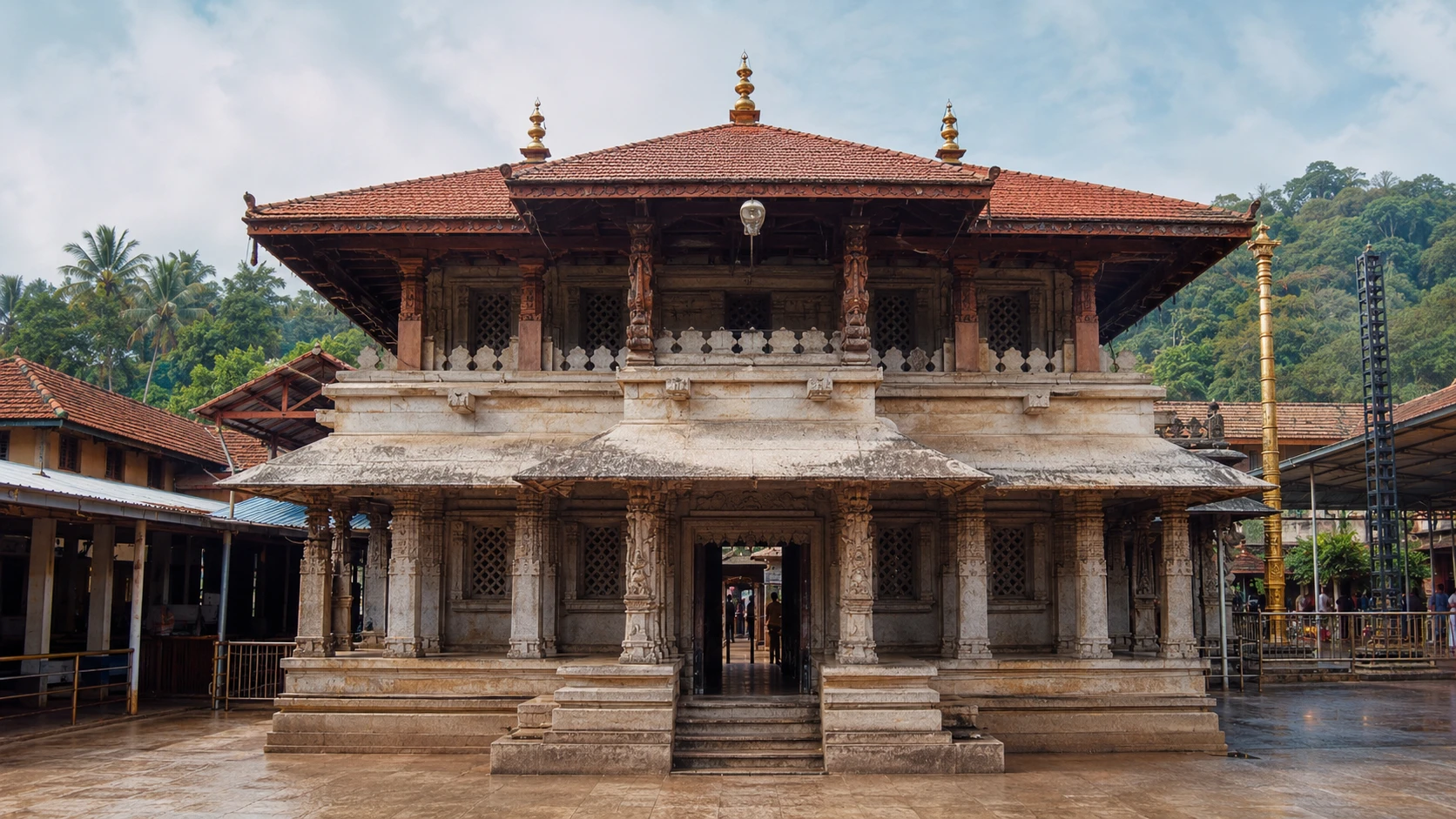
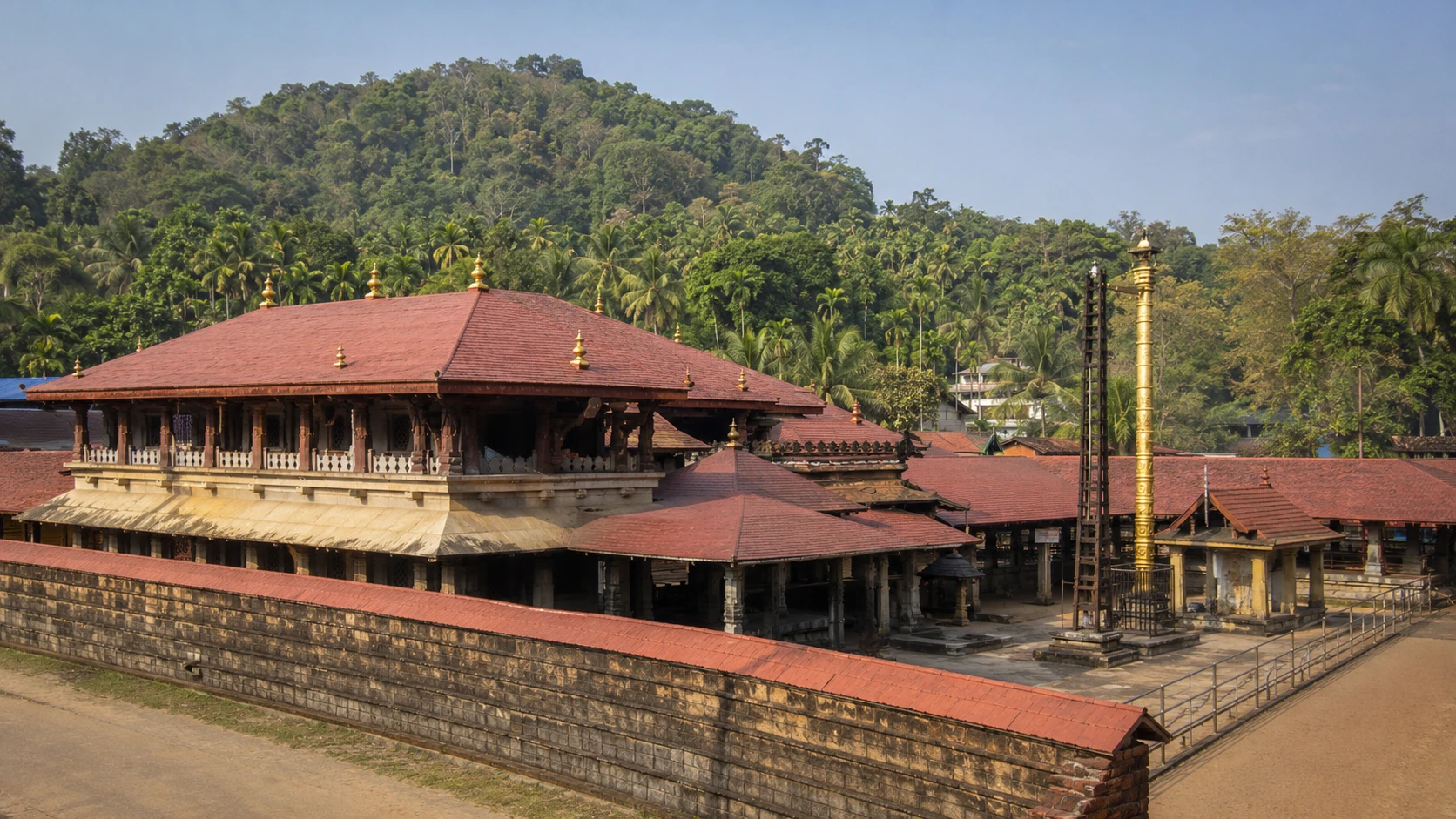
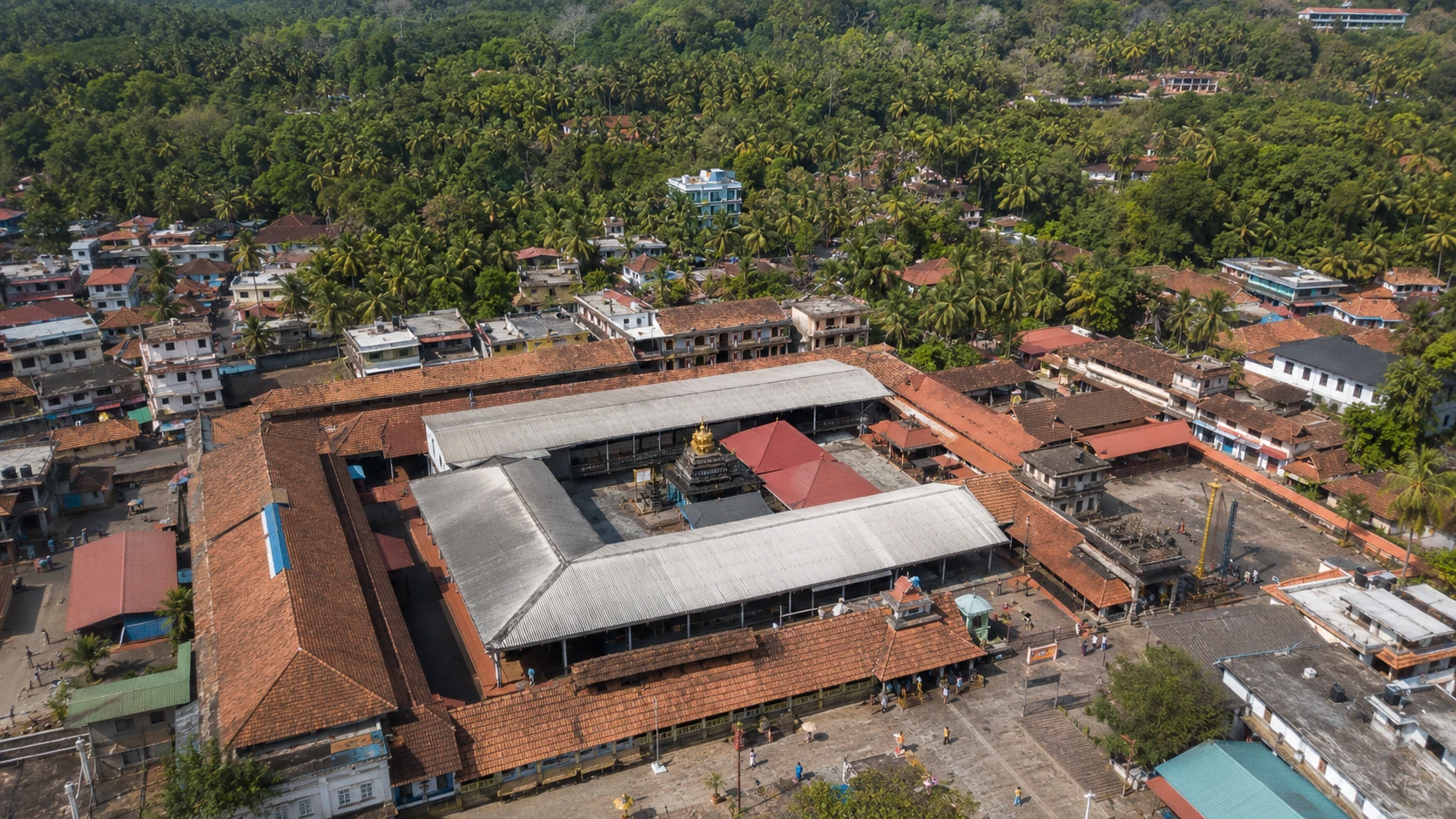
Regional Karnataka temple-construction style with substantial Vijayanagara-period and Keladi Nayaka-period architectural elaboration. The principal sanctum preserves the canonical regional Karnataka Shakta architectural register, with the broader temple-complex integrating the principal Mūkāmbikā Linga-Devī sanctum, the canonical sub-shrines (including the Saraswati Mandapa, the Subrahmanya shrine, and the Pancha-mukha Gaṇeśa shrine within the temple precinct), and the broader pilgrim-infrastructure within the coordinated architectural envelope. The Sauparnika river-side ghat operates as the canonical bathing and ritual-water-source associated with the temple. The Kodachadri hill-shrine infrastructure (with the canonical Sarvajna Peetha hill-top site canonically held as Adi Shankara's meditation location) operates as a complementary distant-shrine devotional infrastructure 21 km from the principal Kollur temple complex
खुला
05:00 – 21:00
आरती
05:30 · 11:30 · 18:00 · 20:30
विशेष
Śāradīya Navarātri (Sep-Oct) is the principal annual Devī-focused festival with full nine-night observance at the Mūkāmbikā sanctum, drawing substantial South Indian pilgrim flow from across Karnataka, Kerala, Tamil Nadu, and the broader pan-South-Asian Adi Shankara tradition network; Adi Shankara Jayanti (the canonical anniversary of Ādi Śaṅkarācārya's birth, observed on Vaiśākha Śukla Pañcamī, April-May) is the principal annual Adi-Shankara-tradition observance at Kollur given the site's canonical Adi-Shankara-personal-consecration heritage; Vasantī Navarātri (Mar-Apr) brings the spring Devī-festival cycle; the canonical Annual Brahmotsavam during the Mārgaśīrṣa month operates as the site's principal multi-day festival programming
पवित्र कथा · पवित्र कथा
Mūkāmbikā Devī sits at Kollur village in Udupi district of coastal Karnataka, approximately 80 km from Mangaluru and 135 km from Udupi, situated on the Sauparnika river at the foot of the Kodachadri hill range (the canonical hill that the regional tradition holds Adi Shankara meditated upon before personally consecrating the Devī murti at the Kollur site). The Pīṭha occupies a structurally distinctive position in the canonical Aṣṭādaśa enumeration through the Karnataka regional recension, position 2 in the Karnataka recension of the Adi Shankara-attributed Aṣṭādaśa Shakti Pīṭha Stotram, paralleling Kāmākṣī at Kanchipuram in the dominant pan-Indian Adi Shankara recension. The canonical Aṣṭādaśa Stotram exists in multiple regional recensions across the South Indian Hindu tradition, with the Karnataka-recension reading at position 2 ('Mūkāmbikāyāṁ Mūkāmbikā,' the Mūkāmbikā at the canonical Kollur seat) operating as the canonical theological framework within which the Kollur site's Aṣṭādaśa-attestation operates. The dominant pan-Indian Adi Shankara recension's position 2 (Kāmākṣī at Kanchipuram) and the Karnataka recension's position 2 (Mūkāmbikā at Kollur) operate as parallel canonical attestations rather than as competing claims, the broader Hindu Shakta tradition's recension-variability at this canonical position reflects the multiple South Indian traditions' canonical engagement with the Aṣṭādaśa framework. Mūkāmbikā's theological identity operates through the canonical narrative of the Devī as the slayer of Mūkāsura, the demon who received a boon from Brahmā that made him invincible to all weapons, but who was rendered 'mūka' (silent / mute / speechless) and ultimately slayed by the Devī's canonical cosmic-feminine power. The Devī's name Mūkāmbikā (literally 'the Mother who [made him] mute,' from Sanskrit mūka = silent/mute + ambikā = mother) reflects this canonical mythological foundation. The Kollur site is structurally distinctive within the corpus through several converging dimensions: (a) the Karnataka-recension Aṣṭādaśa #2 attestation, representing the corpus's first formally-documented recension-parallel canonical position alongside Kāmākṣī at Kanchipuram; (b) the canonical Adi Shankara personally-consecrated tradition, the regional canonical narrative holds that Ādi Śaṅkarācārya himself personally consecrated the Mūkāmbikā murti at the Kollur site during his pan-Indian dig-vijaya pilgrimage, with the canonical consecration tradition giving the site a corpus-distinctive Adi-Shankara-personal-consecration heritage that differs from the broader Adi Shankara visit tradition documented at Sharada Peeth; (c) the canonical Sringeri Sharada Peeth institutional-theological relationship, the Kollur site operates in canonical institutional-theological relationship with the Sringeri Math (one of the four canonical Adi Shankara Maths, with the Sringeri Sharada Peeth as the Math's principal Devī shrine and the broader South Indian Adi Shankara tradition's principal scholastic-institutional anchor), with the Kollur site operating as the Math's principal Devī-pilgrimage anchor within the canonical Adi Shankara hagiographical framework; (d) the corpus-first Linga-Devī integrated iconographic register, the principal Mūkāmbikā murti is canonically held as an integrated Linga-Devī form, a self-manifested (svayambhū) Linga bearing three vertical rekhas (lines) on its surface representing the canonical trinitarian Devī-energy (Mahākālī + Mahālakṣmī + Mahāsarasvatī, the integrated Ādi Parāśakti cosmic-feminine power), operating as the corpus's first formally-documented Linga-Devī integrated iconographic register distinct from the standard Devī-murti pattern, the Śaiva-Linga pattern documented at Pithapuram for the intra-site Bhairava, and the aniconic register documented at Alopī. Mookambika is corpus-distinctive as a non-body-part-fall Aṣṭādaśa Pīṭha, the canonical Devī-attestation operates through the Mūkāsura-slayer canonical narrative rather than through the body-part-fall Pīṭha-formation cycle that operates at the broader 51-Pīṭha network sites, and the site does not appear in the canonical 51-Pīṭha or 52-Kālikā Purāṇa enumerations. The Mookambika site's particular canonical-theological standing within the broader South Indian Hindu tradition operates through these convergent dimensions, the Karnataka-recension Aṣṭādaśa anchoring, the non-body-part-fall canonical attestation, the Adi Shankara-personal-consecration heritage, the Sringeri institutional-theological relationship, and the integrated Linga-Devī iconographic register.
Sacred Designationपवित्र पदनाम
Shakti Peeth
शक्ति: Mūkāmbikā (the Mother who [silenced and slayed] the demon Mūkāsura; the canonical Devī of the Kollur site whose theological identity operates through the Mūkāsura-slayer canonical narrative rather than through the body-part-fall Pīṭha-formation cycle. The Devī is canonically held as the integrated Ādi Parāśakti cosmic-feminine power, the unified trinitarian Devī-energy of Mahākālī + Mahālakṣmī + Mahāsarasvatī, operating through the canonical Linga-Devī integrated iconographic register)
Sacred Origin Storyपवित्र उत्पत्ति कथा
Source: Mookambika Mahatmya (the regional Karnataka Sthala Purāṇa preserving the canonical Mūkāmbikā theological narrative and the Adi-Shankara-personal-consecration tradition at Kollur); Skanda Purāṇa (some readings include the Mūkāmbikā-Mūkāsura canonical narrative); Karnataka regional recension of the Aṣṭādaśa Shakti Pīṭha Stotram attributed to Ādi Śaṅkarācārya (Mūkāmbikā at position 2); Mādhavīya Śaṅkaravijaya and the broader Adi Shankara hagiographical corpus preserving the canonical Kollur-consecration narrative; Sringeri Sharada Peeth tradition records and the canonical Sringeri Math institutional-theological relationship documentation; Vijayanagara-period and Keladi Nayaka-period inscriptional evidence at the Kollur temple complex
The canonical Pīṭha-narrative at Mookambika operates through the Devī's slayer-of-Mūkāsura canonical mythology rather than through the body-part-fall Pīṭha-formation cycle that operates at the broader 51-Pīṭha network sites.
The canonical Mookambika Mahatmya narrative records that the demon Mūkāsura received a boon from Brahmā that made him invincible to all weapons; the demon's resulting depredations across the cosmic-feminine devotional infrastructure produced the canonical need for the Devī's intervention.
The Devī appeared as Mūkāmbikā at the Kollur site and rendered the demon 'mūka' (silent / mute / speechless, preventing him from articulating his canonical boon's verbal-protective formula) before slaying him with her cosmic-feminine canonical weapons.
The Devī's canonical theological identity at Kollur operates as the integrated Ādi Parāśakti cosmic-feminine power, the unified trinitarian Devī-energy of Mahākālī (the cosmic-feminine power of dissolution and transformation) + Mahālakṣmī (the cosmic-feminine power of preservation and prosperity) + Mahāsarasvatī (the cosmic-feminine power of creation and learning), operating through the canonical Linga-Devī integrated iconographic register at the principal sanctum.
The site's canonical Aṣṭādaśa-attestation operates through the Karnataka regional recension of the Aṣṭādaśa Shakti Pīṭha Stotram, with the Karnataka-recension reading at position 2 'Mūkāmbikāyāṁ Mūkāmbikā' (Mūkāmbikā at the canonical Kollur seat) operating as the canonical theological framework.
The Karnataka recension parallels the dominant pan-Indian Adi Shankara recension's position 2 (Kāmākṣī at Kanchipuram); the two recensions document parallel canonical positions rather than competing claims, with the broader Hindu Shakta tradition's recension-variability at this canonical position reflecting the multiple South Indian traditions' canonical engagement with the Aṣṭādaśa framework.
The canonical Adi Shankara personal-consecration tradition at Kollur, the regional canonical narrative holds that Ādi Śaṅkarācārya himself meditated on the Kodachadri hill (the canonical hill 21 km from the Kollur principal site) before personally descending to the Kollur site and consecrating the Mūkāmbikā murti, is foundational to the site's canonical identity.
The canonical narrative further holds that during the consecration, Adi Shankara established the canonical worship protocol at the site, formalized the canonical institutional-theological relationship with the broader Sringeri Sharada Peeth (which Adi Shankara had established or was in the process of establishing on the parallel canonical narrative), and consecrated the canonical Linga-Devī integrated iconographic register through the canonical svayambhū-Linga that bears the three vertical rekhas (lines) representing the trinitarian Devī-energy.
The Sringeri Sharada Peeth institutional-theological relationship at Kollur operates through the canonical Adi Shankara Math network, the Sringeri Math is one of the four canonical Adi Shankara Maths (along with Dwaraka Sharada Math in Gujarat, Govardhan Math in Puri, and Jyotir Math in Uttarakhand, with Sringeri as the southern canonical Math anchoring the South Indian Advaita Vedānta tradition), and the Kollur site operates in canonical institutional-theological relationship with the Sringeri Math as the Math's principal Devī-pilgrimage anchor within the canonical Adi Shankara hagiographical framework.
उद्धृत स्रोत:
- Mookambika Mahatmya (regional Karnataka Sthala Purāṇa)
- Skanda Purāṇa (Mūkāmbikā-Mūkāsura canonical narrative)
- Karnataka regional recension of the Aṣṭādaśa Shakti Pīṭha Stotram attributed to Ādi Śaṅkarācārya (Mūkāmbikā at position 2)
- Mādhavīya Śaṅkaravijaya (16th c. canonical Adi Shankara biography)
- Anantanandagiri Śaṅkaravijaya (alternative Adi Shankara hagiographical tradition)
- Cidvilasa Śaṅkaravijaya (Karnataka regional Adi Shankara hagiographical tradition)
- Sringeri Sharada Peeth tradition records and Math institutional documentation
- Vijayanagara-period and Keladi Nayaka-period inscriptional evidence at the Kollur Mookambika temple complex
- Regional Karnataka Shakta Sthala Purāṇa tradition on Kollur
- Sircar, D. C., 'The Śākta Pīṭhas' (Motilal Banarsidass, 1948; revised 1973), discusses the Aṣṭādaśa recension variability at position 2
- Bhattacharya, N. N., 'History of the Sakta Religion' (Manohar, 1974)
- Pande, G. C., 'Life and Thought of Śaṅkarācārya' (Motilal Banarsidass, 1994), Adi Shankara historiographical framework
- Halbfass, Wilhelm, 'Tradition and Reflection: Explorations in Indian Thought' (SUNY Press, 1991), Advaita Vedanta and Sringeri-tradition scholarly framework
- Hacker, Paul, 'Śaṅkara, der Yogin und Śaṅkara, der Advaitin' (1968), multiple-Śaṅkara historiographical analysis
- Cenkner, William, 'A Tradition of Teachers: Śaṅkara and the Jagadgurus Today' (Motilal Banarsidass, 1983), Sringeri Math tradition framework
- Stein, Burton, 'Vijayanagara' (Cambridge University Press, 1989), Vijayanagara-period regional context
अन्य परंपराएँ · अन्य परंपराएँ
Aṣṭādaśa Stotram recension variability at position 2 (Kāmākṣī at Kanchipuram in the Adi Shankara recension vs Mūkāmbikā at Kollur in the Karnataka recension)
The canonical Aṣṭādaśa Shakti Pīṭha Stotram attributed to Ādi Śaṅkarācārya exists in multiple regional recensions across the South Indian Hindu tradition. The dominant pan-Indian Adi Shankara recension's position 2 reads 'Kāñcyāṁ Kāmākṣī' (Kāmākṣī at Kāñcī/Kanchipuram), while the Karnataka regional recension's position 2 reads 'Mūkāmbikāyāṁ Mūkāmbikā' (Mūkāmbikā at the canonical Kollur seat).
The recension-variability at this canonical position reflects the multiple South Indian traditions' canonical engagement with the Aṣṭādaśa framework, the Kanchipuram-anchored reading operates within the broader Tamil-tradition Aṣṭādaśa attestation, while the Kollur-anchored reading operates within the broader Karnataka-tradition Aṣṭādaśa attestation.
The Mādhavīya Śaṅkaravijaya, the Anantanandagiri Śaṅkaravijaya, and the Cidvilasa Śaṅkaravijaya (the canonical Adi Shankara hagiographical corpus, with the Cidvilasa Śaṅkaravijaya being the regional Karnataka Adi Shankara hagiographical tradition) all reference both the Kanchipuram canonical Devī engagement (during Adi Shankara's Tamil-tradition pilgrimage) and the Kollur canonical personal-consecration narrative (during the South-Karnataka phase of his dig-vijaya).
The two recensions therefore document parallel canonical positions rather than competing claims; the corpus records both attestations as devotionally compatible within the broader Aṣṭādaśa framework's recension-variability.
Some regional readings extend the recension framework to other Aṣṭādaśa positions as well, though the position-2 variability is the most prominently documented case across the canonical hagiographical and Stotram-textual corpora.
Adi Shankara hagiographical complexity and the Kollur personal-consecration tradition
The canonical Adi Shankara personal-consecration tradition at Kollur is preserved across multiple Sanskrit and regional Karnataka hagiographical sources, with the Mādhavīya Śaṅkaravijaya (16th c.), the Anantanandagiri Śaṅkaravijaya, the Cidvilasa Śaṅkaravijaya (the regional Karnataka tradition), and the broader Sringeri Sharada Peeth tradition records all preserving the canonical narrative of Adi Shankara's Kodachadri meditation and the personal-consecration of the Mūkāmbikā murti at the Kollur site.
A scholarly observation, preserved in modern academic literature (Hacker 1968, Pande 1994, Halbfass 1991), holds that the historical-biographical question of Ādi Śaṅkarācārya's actual pilgrimage routes is complicated by the multiple-Śaṅkara-tradition history (the medieval Hindu tradition records multiple Śaṅkarācāryas operating across different periods) and by the hagiographical-vs-historical-source separation.
The corpus records the canonical Kollur personal-consecration tradition as the dominant living-tradition attestation while acknowledging the broader scholarly historiographical observation. The canonical theological role of the Kollur personal-consecration tradition, as the principal anchor of the Sringeri Math's institutional-theological relationship with the Aṣṭādaśa framework, is preserved as the canonical institutional framework regardless of the historiographical complexity.
The Kollur personal-consecration tradition is theologically distinctive within the broader Adi Shankara hagiographical corpus: most canonical Adi Shankara sites operate through the broader visit / dig-vijaya tradition (as at Sharada Peeth), while Kollur operates through the more specific personal-consecration tradition that gives the site its corpus-distinctive Adi-Shankara-personal-consecration heritage.
विद्वत संदर्भ
Mookambika occupies a structurally distinctive position in the corpus through the convergence of multiple corpus-first canonical dimensions: (a) the Karnataka-recension Aṣṭādaśa #2 attestation, corpus-first formally-documented recension-parallel-position canonical attestation; (b) the canonical Adi Shankara personally-consecrated tradition; (c) the canonical Sringeri Sharada Peeth institutional-theological relationship, corpus-first formally-documented Sringeri Math institutional-canonical relationship integration with an Aṣṭādaśa Pīṭha; (d) the Linga-Devī integrated iconographic register, corpus-first formally-documented Linga-Devī iconographic register; (e) the non-body-part-fall canonical attestation pattern, corpus-first formally-documented Aṣṭādaśa Pīṭha whose canonical theological framework operates through a slayer-of-demon narrative rather than through the body-part-fall Pīṭha-formation cycle. The Aṣṭādaśa Stotram's recension-variability at position 2, Kāmākṣī at Kanchipuram (dominant pan-Indian Adi Shankara recension) vs Mūkāmbikā at Kollur (Karnataka regional recension), reflects the broader South Indian Hindu tradition's regional canonical engagement with the Aṣṭādaśa framework, with the Tamil-tradition reading and the Karnataka-tradition reading both operating as canonical recension-positions rather than competing claims. The corpus records both Kamakshi (under the Adi Shankara recension) and Mookambika (under the Karnataka recension) as devotionally compatible canonical Aṣṭādaśa #2 attestations. The canonical Adi Shankara personal-consecration tradition at Kollur is preserved across the Mādhavīya Śaṅkaravijaya, the Anantanandagiri Śaṅkaravijaya, the Cidvilasa Śaṅkaravijaya (the regional Karnataka tradition), and the broader Sringeri Sharada Peeth tradition records; the historical-biographical question of Ādi Śaṅkarācārya's pilgrimage routes is complicated by the broader multiple-Śaṅkara-tradition historiographical complexity (Hacker 1968, Pande 1994, Halbfass 1991), but the canonical living-tradition attestation operates regardless of the historiographical complexity. The Sringeri Sharada Peeth institutional-theological relationship at Kollur operates through the canonical Adi Shankara Math network, the Sringeri Math is one of the four canonical Adi Shankara Maths (alongside Dwaraka, Govardhan/Puri, and Jyotir Math), with Sringeri anchoring the South Indian Advaita Vedānta tradition and the Kollur site operating as the Math's principal Devī-pilgrimage anchor. Cenkner 1983 provides the principal modern academic treatment of the Sringeri Math tradition's institutional framework. Within the broader Karnataka regional Shakta sacred-geography, Mookambika operates alongside Chamundeshwari at Mysuru, Mahalakshmi at Kolhapur (geographically adjacent across the Karnataka-Maharashtra border), and the broader regional Karnataka Devī-pilgrimage network. The Linga-Devī integrated iconographic register at Mookambika operates as a theologically-distinctive iconographic form within the canonical Hindu sacred-geography network, neither pure Devī-murti nor pure Śaiva-Linga, but the integrated svayambhū-Linga form bearing the three vertical rekhas representing the canonical trinitarian Devī-energy.
Historyइतिहास
Mookambika's historical depth as a sacred site is integrated with the broader coastal Karnataka and Western Ghats Hindu sacred-geography. The pre-canonical layer (continuous Devī-worship in the broader Kollur-Sauparnika region from at least the late epic period through c. 4th c. CE) places Mookambika within the deep regional Devī-tradition.
The canonical Adi Shankara personal-consecration tradition is canonically dated to approximately the 8th, 9th century CE per the dominant Hindu hagiographical attestation (the Mādhavīya Śaṅkaravijaya tradition), though the historical-biographical complexity of the multiple-Śaṅkara-tradition history qualifies the precise dating.
The early medieval period saw the broader Karnataka Hindu temple network's institutional development including the Hoysala dynasty period (10th, 14th c. CE) which brought elaborated regional temple-construction across the broader Karnataka region (though Hoysala-period direct elaboration at Kollur is less prominently documented than at the major Hoysala sites).
The Vijayanagara empire period (1336, 1646 CE) brought substantial regional patronage for the broader coastal Karnataka and Western Ghats Hindu temple network, with documented Vijayanagara-period institutional recognition and renovation funding at Kollur, Vijayanagara-period inscriptional evidence at the Mookambika temple complex documents the dynasty's sustained patronage.
The Keladi Nayaka dynasty period (1499, 1763 CE), the regional dynasty that emerged as a Vijayanagara feudatory and operated across the Malenadu and coastal Karnataka region, provided substantial complementary patronage to the broader regional Hindu temple network including Kollur; the Keladi Nayakas were known for their canonical Shakta-devotional patronage and the dynasty's sustained engagement with the Mookambika site is preserved through inscriptional and institutional records.
The post-Keladi period brought the broader regional Karnataka Hindu temple network's continued operation through the colonial-era and post-Independence administrative frameworks. The Mysore Kingdom-era and the British colonial-era administrative arrangements integrated the broader Karnataka Hindu temple network within the colonial administrative framework, with the canonical Sringeri Sharada Peeth Math tradition's institutional continuity preserved across the colonial period.
Post-Independence (1947, present) administrative arrangements placed the site within the Government of Karnataka Hindu Religious and Charitable Endowments Department framework. The 21st century has brought substantial infrastructure improvements including coordinated pilgrim management during Śāradīya Navarātri, Adi Shankara Jayanti, and the canonical Annual Brahmotsavam festival periods, alongside the broader regional Udupi-Mangaluru pilgrim infrastructure development that integrates Mookambika with the broader regional coastal Karnataka pilgrimage circuit including Udupi's Krishna Math (one of the eight canonical Madhva-tradition Maths) and the broader regional Karnataka Hindu sacred-geography network.
Historical Timelineऐतिहासिक कालक्रम
Pre-canonical attestation of Devī-worship in the broader Kollur-Sauparnika region of coastal Karnataka. The Mookambika site is situated within the deep regional Devī-religious geography that would integrate the canonical Adi Shankara personal-consecration tradition through the canonical Adi Shankara dig-vijaya pilgrimage.
Canonical Adi Shankara personal-consecration tradition at Kollur per the dominant Hindu hagiographical attestation. The canonical narrative holds that Ādi Śaṅkarācārya himself meditated on the Kodachadri hill (21 km from the Kollur principal site) and then personally descended to the Kollur site and consecrated the Mūkāmbikā murti. The canonical narrative further holds that during the consecration, Adi Shankara established the canonical worship protocol at the site, formalized the canonical institutional-theological relationship with the broader Sringeri Sharada Peeth, and consecrated the canonical Linga-Devī integrated iconographic register through the canonical svayambhū-Linga. The canonical Adi Shankara personal-consecration narrative is preserved across the Mādhavīya Śaṅkaravijaya, the Anantanandagiri Śaṅkaravijaya, the Cidvilasa Śaṅkaravijaya (the regional Karnataka tradition), and the broader Sringeri Sharada Peeth tradition records. The historical-biographical question of Adi Shankara's actual pilgrimage routes is complicated by the broader multiple-Śaṅkara-tradition historiographical complexity (Hacker 1968, Pande 1994), but the canonical living-tradition attestation operates as the dominant theological framework.
Canonical Aṣṭādaśa attestation of Mookambika through the Karnataka regional recension of the Aṣṭādaśa Shakti Pīṭha Stotram attributed to Ādi Śaṅkarācārya (Mūkāmbikā at position 2, paralleling Kāmākṣī at Kanchipuram in the dominant pan-Indian Adi Shankara recension). The recension-variability at this canonical position reflects the broader Aṣṭādaśa framework's multiple South Indian regional traditions operating in coordinated theological-textual transmission. The Mookambika Mahatmya (the regional Karnataka Sthala Purāṇa preserving the canonical Mūkāmbikā theological narrative and the Adi-Shankara-personal-consecration tradition) was substantively developed and textualized during the broader medieval period.
Vijayanagara empire (1336, 1646 CE) patronage of the Mookambika temple complex. The Vijayanagara-era brought substantial regional patronage for the broader coastal Karnataka and Western Ghats Hindu temple network, with the Mookambika temple complex receiving documented Vijayanagara-period institutional recognition and renovation funding. Vijayanagara-period inscriptional evidence at the Kollur Mookambika temple complex documents the dynasty's sustained patronage of the temple infrastructure. The Vijayanagara patronage period institutionalized the temple-complex's pilgrim-management framework on the foundation that subsequent administrative phases inherited.
Keladi Nayaka dynasty (1499, 1763 CE) patronage of the Mookambika temple complex. The Keladi Nayakas, the regional dynasty that emerged as a Vijayanagara feudatory and operated across the Malenadu and coastal Karnataka region, provided substantial complementary patronage to the broader regional Hindu temple network including Kollur. The Keladi Nayakas were known for their canonical Shakta-devotional patronage and the dynasty's sustained engagement with the Mookambika site is preserved through inscriptional and institutional records. The Keladi-period patronage extended the Vijayanagara-period institutional framework and brought substantial architectural elaboration at the Kollur temple complex.
Post-Independence administration of the Mookambika temple complex under the Government of Karnataka Hindu Religious and Charitable Endowments Department framework. The post-1947 period saw the broader Karnataka Shakta tradition continue institutional operations through the state administrative framework, with the canonical Sringeri Sharada Peeth Math tradition's institutional continuity preserved across the post-Independence period. The 21st century has brought substantial infrastructure improvements including coordinated pilgrim management during Śāradīya Navarātri, Adi Shankara Jayanti, Vasantī Navarātri, and the canonical Annual Brahmotsavam festival periods, alongside the broader regional Udupi-Mangaluru pilgrim infrastructure development. The site continues to draw substantial pan-South-Indian pilgrim flow from across Karnataka, Kerala, Tamil Nadu, Andhra Pradesh, and the broader pan-South-Asian Adi Shankara tradition network, with the canonical institutional-theological relationship with the Sringeri Sharada Peeth Math operating as the principal canonical framework within which the site's contemporary pilgrim infrastructure operates.
What You'll Seeदर्शन में
The Mūkāmbikā Devī sanctum at Kollur preserves the corpus-first Linga-Devī integrated iconographic register, a theologically-distinctive iconographic form within the canonical Hindu sacred-geography network that operates as neither a pure Devī-murti nor a pure Śaiva-Linga, but as an integrated svayambhū-Linga that canonically embodies the Devī's cosmic-feminine theological identity.
The principal sanctum houses the canonical svayambhū-Linga form: a self-manifested Linga bearing three vertical rekhas (lines) on its surface representing the canonical trinitarian Devī-energy, Mahākālī (the cosmic-feminine power of dissolution and transformation), Mahālakṣmī (the cosmic-feminine power of preservation and prosperity), and Mahāsarasvatī (the cosmic-feminine power of creation and learning), operating together as the integrated Ādi Parāśakti cosmic-feminine power that Mūkāmbikā canonically embodies.
The canonical svayambhū-Linga is positioned at the precise canonical location that the regional tradition holds Adi Shankaracharya personally consecrated at the Kollur site after his canonical Kodachadri meditation. Behind the canonical svayambhū-Linga, the regional tradition holds that an anthropomorphic Devī-murti also operates as the canonical Mūkāmbikā devotional anchor, the anthropomorphic murti depicting the Devī in the canonical seated form bearing the canonical Devī-iconographic attributes (multiple arms with canonical weapons including the canonical conch, discus, sword, abhaya-mudrā, and varada-mudrā configurations), with the integrated Linga-Devī register operating through the canonical theological framework that holds the svayambhū-Linga and the anthropomorphic Devī-murti as theologically continuous canonical manifestations of the same integrated Ādi Parāśakti cosmic-feminine power rather than as separate canonical pillars.
The Devī is daily draped in the canonical red silk vestment per the regional Karnataka Shakta convention with substantial gold ornamentation including the canonical Devī-kireeta, and the sanctum's elaborate floral and lamp arrangements operate at canonical scale.
The broader temple-complex preserves the canonical sub-shrines that operate within the integrated devotional infrastructure: the canonical Saraswati Mandapa (where pilgrims engage in the canonical Vidyārambha, children's initiation into formal learning, observance during the canonical Vijayadaśamī day at the close of Śāradīya Navarātri), the canonical Subrahmanya shrine, and the canonical Pancha-mukha Gaṇeśa shrine within the temple precinct.
The Sauparnika river-side ghat operates as the canonical bathing and ritual-water-source associated with the temple, the river is held in the canonical regional tradition as one of the Devī-associated sacred waters of the broader Kollur sacred-geography.
The canonical Kodachadri hill-shrine infrastructure, situated 21 km from the Kollur principal site at the 1,343 m elevation of the Kodachadri peak, preserves the canonical Sarvajna Peetha hill-top site that the regional tradition holds as Adi Shankaracharya's canonical meditation location prior to his personal consecration of the Mūkāmbikā murti at Kollur.
The Sarvajna Peetha hill-top site operates as a complementary distant-shrine devotional infrastructure, with pilgrims undertaking the canonical extended Mookambika pilgrim circuit engaging the Kodachadri hill-shrine alongside the principal Kollur temple complex.
Distinctive Practicesविशिष्ट परंपराएँ
Adi Shankara Personal-Consecration Canonical-Attestation Devotional Tradition (Corpus-Distinctive Personal-Consecration Heritage)
आदि शंकर व्यक्तिगत-प्रतिष्ठा प्रामाणिक-प्रमाणन भक्ति परंपरा (संग्रह-विशिष्ट व्यक्तिगत-प्रतिष्ठा धरोहर)
Year-round; particularly weighted during Adi Shankara Jayanti (Vaiśākha Śukla Pañcamī, April-May), the canonical anniversary of Adi Shankara's birth, and during Śāradīya Navarātri when the canonical personal-consecration tradition's theological framework operates at festival-scale intensity at the principal sanctum
The corpus-distinctive Adi Shankara personal-consecration canonical-attestation devotional tradition at Mookambika operates through the canonical narrative that Ādi Śaṅkarācārya himself personally consecrated the Mūkāmbikā svayambhū-Linga at the Kollur site during his pan-Indian dig-vijaya pilgrimage. The practice operates through coordinated devotional engagement that distinguishes Mookambika from the broader Adi Shankara visit tradition documented at other canonical sites (such as Sharada Peeth, where the canonical narrative records Adi Shankara's visit but not a personal-consecration): (a) the canonical recitation of the Mādhavīya Śaṅkaravijaya and Cidvilasa Śaṅkaravijaya passages preserving the Kollur personal-consecration narrative at the principal sanctum during devotional engagement; (b) the canonical Adi Shankara-tradition Devī-stotra recitation (including the canonical Saundarya-Laharī attributed to Adi Shankara, which the broader Adi Shankara tradition holds as a canonical Devī-devotional text) at the Mookambika sanctum; (c) the integrated Kodachadri-Kollur pilgrim circuit that engages the Sarvajna Peetha hill-top site (Adi Shankara's canonical meditation location) alongside the Kollur principal sanctum (the canonical personal-consecration site), with the integrated circuit operating as the canonical re-enactment of Adi Shankara's pilgrimage from Kodachadri meditation to Kollur personal-consecration; (d) the canonical Sringeri Math institutional-theological relationship's devotional engagement, with pilgrims from the broader Sringeri Math tradition's institutional network engaging Mookambika as the canonical Devī-pilgrimage anchor within the Math's broader pilgrimage architecture. The practice is corpus-distinctive among the documented Adi Shankara-associated canonical sites in its specific personal-consecration framework, most Adi Shankara-associated sites operate through the broader visit / dig-vijaya tradition, while Mookambika operates through the more specific canonical personal-consecration heritage that gives the site its distinctive Adi-Shankara-canonical standing.
The canonical Adi Shankara personal-consecration tradition at Kollur gives the site a theologically-distinctive standing within the canonical Adi Shankara hagiographical framework, most Adi Shankara-associated sites operate through the broader visit / dig-vijaya tradition, while Kollur operates through the more specific personal-consecration tradition. The canonical theological role of the personal-consecration tradition operates as the principal anchor of the Sringeri Math's institutional-theological relationship with the Aṣṭādaśa framework and the broader canonical Adi Shankara Devī-pilgrimage architecture.
Kodachadri Hill-Shrine Integrated Pilgrim Circuit (Sarvajna Peetha Hill-Top + Kollur Principal Sanctum Coordinated Pilgrimage)
कोडचाद्री शैल-मंदिर एकीकृत तीर्थयात्री परिक्रमा (सर्वज्ञ पीठ शैल-शिखर + कोल्लूर प्रमुख गर्भगृह समन्वित तीर्थयात्रा)
Year-round; particularly weighted during Adi Shankara Jayanti, Śāradīya Navarātri, and during the canonical dry-season months (November-March) when the Kodachadri hill-trek is most accessible. The monsoon months (June-September) bring substantial accessibility challenges at the Kodachadri hill-trek route given the steep mountain terrain and the regional monsoon climate
The corpus-distinctive Kodachadri hill-shrine integrated pilgrim circuit at Mookambika operates through the coordinated pilgrimage that engages the canonical Sarvajna Peetha hill-top site at Kodachadri (the canonical Adi Shankara meditation location, 21 km from the Kollur principal site at 1,343 m elevation) alongside the principal Kollur temple complex (the canonical personal-consecration site). The canonical pilgrim circuit operates through coordinated devotional engagement: (a) the canonical Kodachadri hill-trek to the Sarvajna Peetha hill-top site (a substantial mountain-trek across the Western Ghats terrain), where pilgrims engage the canonical Adi Shankara meditation location; (b) descent to the Kollur principal sanctum and engagement of the canonical Mūkāmbikā svayambhū-Linga that Adi Shankara canonically consecrated; (c) the coordinated theological framework operating as the canonical re-enactment of Adi Shankara's pilgrimage from Kodachadri meditation to Kollur personal-consecration. The Kodachadri hill-shrine infrastructure includes the canonical Sarvajna Peetha hill-top shrine and a small canonical Mūkāmbikā sub-shrine at the Kodachadri peak (the canonical 'original Mūkāmbikā' site per some readings, with the Kollur principal sanctum operating as the canonical descended-position devotional pole). The practice is corpus-distinctive as the principal documented mountain-meditation + principal-consecration-site integrated pilgrim circuit, the broader Hindu sacred-geography contains other mountain-associated sites and other consecration-narrative sites, but the specific integrated circuit pattern at Mookambika (canonical mountain-meditation site + canonical descended-consecration site within a single coordinated pilgrim circuit) is corpus-distinctive among the documented Aṣṭādaśa Pīṭhas.
The canonical integrated Kodachadri-Kollur circuit operates as the canonical re-enactment of Adi Shankara's pilgrimage from Kodachadri meditation to Kollur personal-consecration. The integrated circuit's theological framework holds that engaging only the Kollur principal sanctum approaches the canonical Adi Shankara personal-consecration heritage from its descended endpoint without engaging the canonical meditation-foundation that the canonical narrative situates at Kodachadri. The integrated circuit's coordinated mountain-meditation + descended-consecration pilgrimage operates as the canonical comprehensive Mookambika pilgrim infrastructure within the broader Adi Shankara hagiographical framework.
Sringeri Math Institutional-Theological Coordinated Darshan (Canonical Adi Shankara Tradition Pilgrim Circuit Integration)
शृंगेरी मठ संस्थागत-सैद्धान्तिक समन्वित दर्शन (प्रामाणिक आदि शंकर परंपरा तीर्थयात्री परिक्रमा एकीकरण)
Year-round; particularly weighted during Adi Shankara Jayanti, Śāradīya Navarātri, and during the canonical Sringeri Math institutional festival cycle when the Math's broader pilgrim institutional infrastructure engages the canonical Devī-pilgrimage architecture
The corpus-first Sringeri Math institutional-theological coordinated darshan tradition at Mookambika operates through the canonical Adi Shankara Math network's institutional engagement with the Kollur site. The Sringeri Math, one of the four canonical Adi Shankara Maths (alongside Dwaraka Sharada Math, Govardhan Math at Puri, and Jyotir Math in the Himalayas), anchors the South Indian Advaita Vedānta tradition and operates Mookambika as the Math's principal Devī-pilgrimage anchor within the canonical Adi Shankara hagiographical framework. The coordinated darshan tradition operates through: (a) the canonical Sringeri Math tradition's institutional pilgrim infrastructure engaging Mookambika alongside the principal Sringeri Sharada Peeth Math site (Sringeri is approximately 90 km from Kollur, allowing the coordinated multi-site darshan to be operationalized within standard regional pilgrimage logistics); (b) the canonical Sringeri Jagadguru's institutional engagement with the Mookambika site, with the canonical Math's institutional records preserving the Math's sustained relationship with the Kollur Pīṭha across the canonical Math tradition's history; (c) the broader Karnataka regional Advaita Vedānta tradition's canonical engagement with Mookambika as the regional Aṣṭādaśa-anchor of the South Indian Adi Shankara tradition's broader pilgrimage architecture. The practice is corpus-first as the principal documented Sringeri Math institutional-canonical relationship integration with an Aṣṭādaśa Pīṭha, the corpus's first formal documentation of the canonical Adi Shankara Math network's institutional-theological relationship with a specific Aṣṭādaśa site.
The canonical Adi Shankara Math network operates as the foundational institutional framework of the canonical pan-South-Asian Advaita Vedānta tradition. The Sringeri Math's canonical institutional-theological relationship with the Mookambika site integrates the Math's broader institutional-pilgrimage architecture with the canonical Aṣṭādaśa Pīṭha framework, with Mookambika operating as the canonical Devī-pilgrimage anchor of the Math's broader pilgrimage infrastructure. The integrated Math-tradition pilgrim circuit operates as the canonical comprehensive South Indian Adi Shankara tradition pilgrim infrastructure.
Did You Know?क्या आप जानते हैं?
Mookambika occupies position 2 in the Karnataka regional recension of the canonical Aṣṭādaśa Shakti Pīṭha Stotram attributed to Ādi Śaṅkarācārya, paralleling Kāmākṣī at Kanchipuram (position 2 in the dominant pan-Indian Adi Shankara recension). The two recensions document parallel canonical attestations rather than competing claims, the broader Hindu Shakta tradition's recension-variability at this canonical position reflects the multiple South Indian traditions' canonical engagement with the Aṣṭādaśa framework. Eternal Raga records both Kamakshi (under the Adi Shankara recension) and Mookambika (under the Karnataka recension) as devotionally compatible canonical Aṣṭādaśa #2 attestations. The recension-parallel-position pattern is corpus-first formally-documented at Mookambika.
Karnataka regional recension of the Aṣṭādaśa Stotram; Mādhavīya Śaṅkaravijaya; Cidvilasa Śaṅkaravijaya; Sircar 1948; Sringeri Sharada Peeth tradition records
The principal Mūkāmbikā murti at Kollur preserves the corpus's first formally-documented Linga-Devī integrated iconographic register, a self-manifested (svayambhū) Linga bearing three vertical rekhas (lines) on its surface representing the canonical trinitarian Devī-energy (Mahākālī + Mahālakṣmī + Mahāsarasvatī = the integrated Ādi Parāśakti cosmic-feminine power). This iconographic register is theologically-distinctive within the canonical Hindu sacred-geography network, neither pure Devī-murti nor pure Śaiva-Linga, but an integrated svayambhū-Linga that canonically embodies the Devī's cosmic-feminine theological identity. The Linga-Devī integrated register is corpus-first at Mookambika and distinct from the standard Devī-murti pattern, the Śaiva-Linga pattern documented at Pithapuram for the intra-site Bhairava Kukkuṭeśvara, and the aniconic register documented at Alopī.
Mookambika Mahatmya; Karnataka regional Shakta Sthala Purāṇa tradition; Sringeri Sharada Peeth tradition records on the canonical iconographic register
Mookambika is canonically held in the regional Karnataka tradition to have been personally consecrated by Ādi Śaṅkarācārya himself, a corpus-distinctive Adi-Shankara-personal-consecration heritage that differs from the broader Adi Shankara visit tradition documented at other canonical sites (such as Sharada Peeth, where the canonical narrative records Adi Shankara's visit but not a personal-consecration). The canonical narrative further holds that Adi Shankara meditated on the Kodachadri hill (21 km from the Kollur principal site) before personally descending to consecrate the Mūkāmbikā svayambhū-Linga. The canonical personal-consecration tradition is preserved across the Mādhavīya Śaṅkaravijaya, the Anantanandagiri Śaṅkaravijaya, the Cidvilasa Śaṅkaravijaya (the regional Karnataka tradition), and the broader Sringeri Sharada Peeth tradition records.
Mādhavīya Śaṅkaravijaya (16th c.); Anantanandagiri Śaṅkaravijaya; Cidvilasa Śaṅkaravijaya; Sringeri Sharada Peeth tradition records
The Kollur site operates in canonical institutional-theological relationship with the Sringeri Sharada Peeth Math (one of the four canonical Adi Shankara Maths alongside Dwaraka, Govardhan/Puri, and Jyotir Math), the corpus's first formally-documented Sringeri Math institutional-canonical relationship integration with an Aṣṭādaśa Pīṭha. The Sringeri Math anchors the South Indian Advaita Vedānta tradition and operates Mookambika as the Math's principal Devī-pilgrimage anchor within the canonical Adi Shankara hagiographical framework. The Sringeri Math is approximately 90 km from Kollur, allowing the coordinated multi-site darshan to be operationalized within standard regional pilgrimage logistics.
Sringeri Sharada Peeth Math institutional records; Cenkner, 'A Tradition of Teachers' (1983); Halbfass, 'Tradition and Reflection' (1991)
Mookambika is corpus-first as a non-body-part-fall Aṣṭādaśa Pīṭha, the canonical Devī-attestation operates through the Mūkāsura-slayer canonical narrative rather than through the body-part-fall Pīṭha-formation cycle that operates at the broader 51-Pīṭha network sites. The site does not appear in the canonical 51-Pīṭha or 52-Kālikā Purāṇa enumerations, and the body-part attribution fields are correspondingly null in the corpus categorization. The canonical theological framework operates through the Mūkāsura-narrative + Adi-Shankara-personal-consecration tradition rather than through the standard body-part-fall framework, making Mookambika structurally-distinctive among the documented Aṣṭādaśa Pīṭhas.
Sircar, 'The Śākta Pīṭhas' (1948); Mookambika Mahatmya; Karnataka regional Shakta Sthala Purāṇa tradition
Visitor Accessप्रवेश जानकारी
The temple-complex is open to all pilgrims regardless of background. Photography and videography are restricted inside the principal Mūkāmbikā sanctum particularly during aarti and abhiṣeka; mobile phones should be carried switched off or deposited at the designated counter when entering the inner sanctum. Footwear is removed at the entrance to the temple precinct. The canonical sub-shrines (Saraswati Mandapa, Subrahmanya shrine, Pancha-mukha Gaṇeśa shrine) operate with their own access conventions. The Kodachadri hill-shrine infrastructure (21 km from the Kollur principal site) operates as a complementary distant-shrine pilgrim destination accessed via a substantial mountain-trek. The temple operates from approximately 05:00 to 21:00 with four canonical aarti times.
आध्यात्मिक आधार
The photography prohibition reflects the standard major Aṣṭādaśa Pīṭha shrine sanctum-photography policy. The Linga-Devī integrated iconographic register's particular canonical significance at Mookambika gives the photography restriction additional theological weight given the corpus-distinctive nature of the canonical svayambhū-Linga form.
समकालीन संदर्भ
The Government of Karnataka Hindu Religious and Charitable Endowments Department administers the Mookambika temple complex with continuing recognition of the site's canonical Aṣṭādaśa-Karnataka-recension standing, the Adi Shankara personal-consecration heritage, and the Sringeri Math institutional-theological relationship. The 21st century has brought substantial infrastructure improvements including coordinated pilgrim management during Śāradīya Navarātri, Adi Shankara Jayanti, Vasantī Navarātri, and the canonical Annual Brahmotsavam festival periods. There are no caste, gender, or sectarian access restrictions in modern practice.
व्यावहारिक मार्गदर्शन
Allow approximately 2, 3 hours at the principal Kollur temple complex for the standard darshan during off-peak periods (longer during major festival peaks); the integrated Kodachadri hill-shrine circuit requires an additional full day given the substantial mountain-trek to the Sarvajna Peetha hill-top site. Pilgrims undertaking the canonical integrated Sringeri-Mookambika circuit typically allocate 2, 3 days for the coordinated pilgrimage (Sringeri 90 km, with additional time for the Kodachadri integration). Pilgrims undertaking the broader regional South Indian Adi Shankara tradition pilgrimage may extend their itinerary to include the broader regional Karnataka-Kerala-Tamil Nadu canonical Devī-pilgrimage network. Modest, traditional dress is expected; head covering is customary at the sanctum during aarti. The coastal Karnataka climate's elevated humidity makes breathable cotton fabrics particularly practical.
Festivalsत्योहार
Śāradīya Navarātri (Autumn Devī-Festival; Includes Canonical Vidyārambha on Vijayadaśamī)
शारदीय नवरात्र (शरद देवी-उत्सव; विजयदशमी पर प्रामाणिक विद्यारंभ सहित)
Sep-Oct (Āśvina month)
Śāradīya Navarātri is the principal annual Devī-focused festival at Mookambika, with full nine-night observance at the principal sanctum and substantial festival-scale liturgical infrastructure across the broader temple-complex. The festival draws substantial pan-South-Indian pilgrim flow from across Karnataka, Kerala, Tamil Nadu, Andhra Pradesh, and the broader pan-South-Asian Adi Shankara tradition network. The festival's canonical Vijayadaśamī day at the close of the nine-night cycle brings the canonical Vidyārambha observance, the formal initiation of young children into formal learning, with the canonical Saraswati Mandapa within the temple-complex operating as the principal canonical Vidyārambha venue. The Vidyārambha tradition at Mookambika operates at substantial scale, with the canonical Saraswati component of the integrated Ādi Parāśakti cosmic-feminine power giving the site particular canonical-theological standing as the principal regional Vidyārambha destination. Durgāṣṭamī and Mahānavamī during the nine-night cycle bring the festival's peak crowd at the principal sanctum.
Adi Shankara Jayanti (Canonical Anniversary of Ādi Śaṅkarācārya's Birth)
आदि शंकर जयंती (आदि शंकराचार्य के जन्म की प्रामाणिक वर्षगाँठ)
April-May (Vaiśākha Śukla Pañcamī)
Adi Shankara Jayanti is the canonical anniversary of Ādi Śaṅkarācārya's birth, observed at Mookambika with the principal liturgical attention focused on the canonical Adi Shankara personal-consecration heritage at the site. The festival operates as the principal annual Adi-Shankara-tradition observance at Kollur given the site's corpus-distinctive Adi-Shankara-personal-consecration heritage. The festival draws substantial pilgrim flow from across the broader Adi Shankara tradition network including the Sringeri Math institutional network and the canonical four-Math pilgrim infrastructure. The canonical observance integrates the Kodachadri hill-shrine devotional engagement (the canonical Adi Shankara meditation location) with the principal Kollur sanctum darshan (the canonical personal-consecration site).
Vasantī Navarātri
वासंती नवरात्र
Mar-Apr (Caitra month)
The spring Navarātri at Mookambika follows the canonical Devī observance cycle with full nine-night observance at the principal sanctum. Vasant Pañcamī within the broader Caitra-month context, the canonical Sarasvatī-Pūjā day, brings particular theological weight given the canonical Saraswati component of the integrated Ādi Parāśakti cosmic-feminine power that Mūkāmbikā embodies through the canonical Linga-Devī integrated iconographic register. The festival's pilgrim flow operates at substantial regional scale though typically less than the autumn Śāradīya Navarātri peak.
Annual Brahmotsavam (Mārgaśīrṣa-Month Multi-Day Festival Programming)
वार्षिक ब्रह्मोत्सवम (मार्गशीर्ष-मास बहु-दिवसीय उत्सव कार्यक्रम)
Mārgaśīrṣa (Nov-Dec)
The Annual Brahmotsavam operates as the site's principal multi-day festival programming during the Mārgaśīrṣa month, with substantial festival-scale liturgical infrastructure operating across the broader temple-complex over the multi-day festival cycle. The festival integrates the canonical Mookambika devotional infrastructure with the broader regional Karnataka Brahmotsavam tradition, with the festival's multi-day cycle accommodating substantial regional pilgrim flow and coordinated festival programming. The Brahmotsavam operates within the broader Kollur temple-complex's annual liturgical calendar as the principal site-specific festival cycle distinct from the pan-Hindu Devī-festival cycles (Śāradīya Navarātri, Vasantī Navarātri).
Mookambika Jayanti (Canonical Annual Devī-Specific Observance)
मूकाम्बिका जयंती (प्रामाणिक वार्षिक देवी-विशिष्ट आचरण)
Regional Karnataka Shakta liturgical calendar (per the canonical Mookambika-tradition observance)
Mookambika Jayanti operates as the canonical annual Devī-specific observance at Kollur per the regional Karnataka Shakta liturgical tradition. The festival draws substantial regional pilgrim flow with the principal liturgical attention focused on the canonical Mūkāmbikā svayambhū-Linga and the broader temple-complex's canonical sub-shrine infrastructure. The festival's specific dating varies across regional Karnataka Shakta tradition; pilgrims should consult the Devasthanam's annual liturgical calendar for the specific observance dates.
Traditional Offeringsपारंपरिक अर्पण
प्राथमिक अर्पण
Red flowers, hibiscus (japā-kusum), marigold, red roses, jasmine
लाल पुष्प, गुड़हल (जपा-कुसुम), गेंदा, लाल गुलाब, चमेली
पुष्प-माल्य; जपा-कुसुम
Red flowers are the canonical floral offering across the Shākta tradition. At Mookambika the offering is placed at the parapet of the principal sanctum, integrated into the canonical daily Devī-adornment cycle. The regional Karnataka Devī-floral tradition emphasizes hibiscus (japā-kusum), marigold, and the canonical regional Shakta floral combinations; jasmine carries particular weight during the Adi Shankara-tradition observances given the canonical jasmine-association with the broader South Indian Adi Shankara devotional tradition.
Silk vestment (Pattu Saree) and Chunari
रेशम वस्त्र (पट्टु साड़ी) और चुनरी
क्षौम; उत्तरीय
Silk offerings at the principal sanctum are the canonical Devī-vestment offering. The regional Karnataka silk-weaving traditions (Mysore silk, Molakalmuru silk, Ilkal saree) provide regional pilgrims with locally-significant offering options. The canonical red Karnataka silk saree is the canonical Devī-festival vestment material at Mookambika.
Coconut
नारियल
नारिकेल
Coconut, offered whole or broken at the sanctum, represents the egoic self surrendered to the Devī. At Mookambika the coconut offering follows the standard Karnataka Devī temple convention, with the broken coconut's interior fluid offered as part of the canonical abhiṣeka sequence at the canonical svayambhū-Linga form. Coconut is the canonical staple offering across the broader regional coastal Karnataka Hindu temple tradition.
Sindoor and Kumkum (vermilion offerings)
सिंदूर और कुंकुम
सिन्दूर; कुङ्कुम-तिलक
Sindoor and kumkum are applied at the consecrated application points on the canonical svayambhū-Linga and the anthropomorphic Devī-murti, on the chunari, and as tilak on the pilgrim's forehead. The consecrated kumkum returned as prasad carries the canonical Devī-presence consecration. The Karnataka Shakta convention preserves the canonical sindoor-application tradition at the integrated Linga-Devī iconographic register.
Akhand-Jyot ghee and wicks
अखंड-ज्योत हेतु घी और बत्तियाँ
अखण्ड-ज्योतिः घृत-वर्तिका
The temple-complex maintains continuously-burning lamps at the principal Mūkāmbikā sanctum and across the broader temple-complex's canonical sub-shrines (the Saraswati Mandapa, the Subrahmanya shrine, the Pancha-mukha Gaṇeśa shrine). Pilgrims offer ghee and wicks to be added to these lamps. The integrated multi-shrine lamp-maintenance operates within the broader regional Karnataka Hindu temple convention.
इस मंदिर की विशेषता
Canonical Saundarya-Laharī Recitation Offering (Corpus-Distinctive Adi Shankara-Tradition Devotional Offering)
प्रामाणिक सौंदर्य-लहरी पाठ अर्पण (संग्रह-विशिष्ट आदि शंकर-परंपरा भक्ति अर्पण)
The corpus-distinctive Saundarya-Laharī recitation offering tradition at Mookambika operates through the canonical Adi Shankara-tradition Devī-devotional engagement at the canonically-personally-consecrated site. Pilgrims undertaking the canonical Adi Shankara-tradition devotional engagement at Mookambika recite the Saundarya-Laharī (the canonical 100-verse Devī-devotional Sanskrit poem attributed to Ādi Śaṅkarācārya) at the principal sanctum, with the canonical recitation operating through coordinated devotional engagement: (a) full Saundarya-Laharī recitation during Adi Shankara Jayanti and during Śāradīya Navarātri's culminating night; (b) selective verse-recitation during routine darshan, with pilgrims engaging the canonical verses appropriate to their devotional intent; (c) Saundarya-Laharī recitation alongside the broader canonical Adi Shankara-tradition Devī-stotra cycle (the Devī Stuti and related canonical Devī-devotional compositions attributed to the Adi Shankara tradition). The offering is corpus-distinctive at Mookambika among the documented Aṣṭādaśa Pīṭhas as the specific Saundarya-Laharī-anchored Adi Shankara-tradition devotional engagement, the canonical recitation operates within the broader Adi Shankara hagiographical framework as the site's specifically Adi-Shankara-tradition liturgical engagement.
Kodachadri-Kollur Integrated Circuit Offering (Sarvajna Peetha Hill-Top + Kollur Principal Sanctum Coordinated Offering)
कोडचाद्री-कोल्लूर एकीकृत परिक्रमा अर्पण (सर्वज्ञ पीठ शैल-शिखर + कोल्लूर प्रमुख गर्भगृह समन्वित अर्पण)
The corpus-distinctive Kodachadri-Kollur integrated circuit offering tradition at Mookambika operates through the coordinated offering set that pilgrims undertaking the canonical Kodachadri-Kollur integrated circuit bring through the canonical two-pole pilgrimage. The Kodachadri component includes: (a) canonical offerings at the Sarvajna Peetha hill-top site (the canonical Adi Shankara meditation location) including ghee for the canonical hill-shrine lamps, jasmine and other regional floral offerings, and the canonical meditative-engagement at the hill-top devotional infrastructure; (b) canonical offerings at the small Mūkāmbikā sub-shrine at the Kodachadri peak. The Kollur component includes the canonical offerings at the principal Mūkāmbikā svayambhū-Linga (red flowers, silk, sindoor/kumkum, ghee for the principal sanctum's continuously-burning lamps). Pilgrims preparing the integrated offering bring it through the canonical two-pole pilgrimage in the canonical sequence (Kodachadri meditation-engagement first, Kollur principal-consecration engagement second), reflecting the canonical Adi Shankara pilgrimage sequence (canonical meditation at Kodachadri preceding canonical personal-consecration at Kollur). The integrated offering tradition is corpus-distinctive as the principal documented mountain-meditation-site + principal-consecration-site coordinated offering tradition.
Sringeri-Math-Coordinated Integrated Puja-Thali (Canonical Adi Shankara Tradition Pilgrim Circuit Offering)
शृंगेरी-मठ-समन्वित एकीकृत पूजा-थाली (प्रामाणिक आदि शंकर परंपरा तीर्थयात्री परिक्रमा अर्पण)
The corpus-first Sringeri-Math-coordinated integrated puja-thali offering tradition at Mookambika operates through the coordinated offering set that pilgrims undertaking the canonical Sringeri-Mookambika pilgrim circuit bring through the canonical multi-site pilgrimage. The Sringeri component includes canonical offerings at the Sringeri Sharada Peeth Math's principal Sharada (Saraswati) sanctum, the canonical regional anchor of the South Indian Advaita Vedānta tradition. The Mookambika component includes the canonical offerings at the principal sanctum, with the canonical Linga-Devī integrated iconographic register receiving the canonical Adi Shankara-tradition liturgical attention through the Saundarya-Laharī recitation and the broader Adi Shankara-tradition Devī-devotional engagement. The integrated thali operates within the broader Sringeri Math institutional-pilgrim infrastructure, with the canonical Math's institutional records preserving the canonical multi-site pilgrim coordination across the canonical sites (Sringeri Sharada Peeth + Mookambika as the principal pair within the Math's broader pilgrim architecture). The offering is corpus-first as the principal documented Sringeri Math institutional-canonical multi-site offering coordination.
Offerings may be brought from outside or purchased at vendor counters near the temple precinct. The integrated Adi Shankara-tradition + Kodachadri-Kollur circuit + Sringeri-Mookambika circuit offering frameworks are corpus-distinctive at Mookambika, pilgrims should plan offerings appropriate to their canonical pilgrim-circuit engagement. The Government of Karnataka Hindu Religious and Charitable Endowments Department through the Devasthanam coordinates the offering ecology including the canonical multi-circuit ritual materials and the festival-period coordinated offering arrangements.
How to Reachकैसे पहुँचें
Mookambika at Kollur is accessible via the broader coastal Karnataka regional transport network. By air, Mangaluru International Airport (IXE, 90 km) provides full domestic and international connectivity; Kannur International Airport (CNN, Kerala, 200 km) provides full domestic and international connectivity; Bengaluru Kempegowda International Airport (BLR, 420 km) provides comprehensive domestic and international connectivity as India's principal regional hub.
By rail, Mookambika Road Byndoor Railway Station (BYNR, 28 km) is the nearest railhead on the Konkan Railway with direct connectivity from Mangaluru, Mumbai, Goa, and the broader Konkan corridor; Mangaluru Junction (MAQ, 80 km) is the principal regional rail hub with comprehensive South Western Railway connectivity to Bengaluru, Chennai, Mumbai, Goa, and the broader pan-Indian rail network.
From the railhead, Kollur is reached by local taxi, auto-rickshaw, or hired vehicle services. By road, Kollur is connected via National Highway 66 (the coastal Karnataka-Kerala arterial route) and the regional state highway network, Karnataka State Road Transport Corporation (KSRTC) operates regular bus services from Mangaluru (80 km), Udupi (135 km), Bengaluru (420 km), and the broader regional Karnataka transport network.
Pilgrims undertaking the canonical Sringeri-Mookambika circuit typically arrange hired multi-day transport given the inter-site distances (Sringeri 90 km from Kollur, with the broader regional pilgrimage architecture extending to Udupi 135 km, Mangaluru 80 km, and the broader regional coastal Karnataka Hindu sacred-geography network).
Plan Your Visitयात्रा की योजना
🌤 सर्वोत्तम मौसम
October through February offers the most agreeable weather in coastal Karnataka, cool, dry, and clear, ideal for both the Kollur principal-temple darshan and the integrated Kodachadri hill-trek. The Kodachadri hill-shrine circuit is best undertaken during these months given the dry mountain-trek conditions. March through May bring intense pre-monsoon heat in the coastal Karnataka region (38°C+ with elevated humidity); the monsoon months (June-September) bring substantial rainfall typical of the Western Ghats and coastal Karnataka monsoon climate, with substantial accessibility challenges at the Kodachadri hill-trek route. The major festival seasons, Śāradīya Navarātri (Sep-Oct), Adi Shankara Jayanti (Apr-May), Annual Brahmotsavam (Nov-Dec), and Vasantī Navarātri (Mar-Apr), bring substantial pilgrim flow.
👘 पहनावे का नियम
Modest, traditional attire is expected at the Mookambika temple-complex. Both traditional Karnataka convention (saree for women, dhoti or modern modest attire for men) and modern modest dress are accepted; head covering is customary at the sanctum during aarti. The regional Karnataka Shakta convention preserves traditional dress for major festival observances. For Adi Shankara Jayanti and Śāradīya Navarātri, traditional South Indian Shakta-tradition attire is the canonical festival pilgrim convention.
📱 फोन और फोटोग्राफी
Mobile phones must be deposited at the cloak counter before entering the principal Mūkāmbikā sanctum or carried in switched-off state during aarti. Photography and videography are restricted within the inner sanctum particularly during aarti and abhiṣeka. Photography is generally permitted in the outer prākāra, on the temple-complex's open-air precincts, and across the broader Kollur village and Sauparnika river landscape. The Kodachadri hill-shrine has its own photography conventions calibrated to the canonical hill-shrine devotional framework; pilgrims should respect any photography restrictions at the canonical Sarvajna Peetha hill-top site.
🏨 आवास
Kollur has substantial local accommodation infrastructure including Devasthanam-coordinated guesthouse facilities, private hotels of various budget categories, and the broader regional Udupi-district accommodation network. Many pilgrims base in Udupi (135 km, with elaborate accommodation infrastructure including business hotels, KSTDC facilities, and the broader regional pilgrim-services infrastructure as the major regional cultural-religious center) and undertake Mookambika as a day-trip or two-day visit; Mangaluru (80 km) provides additional accommodation options at international-standard scale. Pilgrims undertaking the canonical Sringeri-Mookambika circuit typically arrange coordinated multi-site accommodation between Sringeri (90 km, with substantial Math-coordinated and private accommodation) and Kollur. During Śāradīya Navarātri, Adi Shankara Jayanti, and Annual Brahmotsavam, accommodation demand at Kollur exceeds local supply; advance booking is strongly recommended. Pilgrims undertaking the integrated Kodachadri hill-trek should arrange basic accommodation arrangements at the Kodachadri base or in the broader hill-trek logistics framework.
Book a Pujaपूजा बुक करें
Mookambika draws substantial pan-South-Indian regional pilgrim flow alongside the corpus-distinctive multi-tradition pilgrim category, Aṣṭādaśa Pīṭha pilgrims (engaging the Karnataka recension's position 2), Adi Shankara-tradition pilgrims (engaging the canonical personal-consecration heritage), Sringeri Math institutional-pilgrim infrastructure, Kodachadri-Kollur integrated-circuit pilgrims, and broader regional Karnataka Devī-pilgrimage circuit pilgrims. The multi-tradition pilgrim concentration creates corresponding multi-domain vulnerability to third-party fraud across the integrated temple-complex devotional infrastructure. Third-party activity to navigate with care includes: informal-pandit intermediaries at the temple-precinct entrance soliciting 'authenticated Adi Shankara-personal-consecration VIP darshan' or 'authenticated Linga-Devī VIP abhiṣeka' or 'priority Saundarya-Laharī recitation VIP coordination' at high cost outside the Devasthanam-recognized priest-roster, pilgrims should engage ONLY the Devasthanam's official priest roster for canonical ritual coordination; travel-agency operators offering 'Sringeri-Mookambika combined yatra packages' or 'Kodachadri-Kollur integrated yatra packages' that may charge significantly above market and may include non-Devasthanam-recognized priest arrangements, verify all multi-site circuit package operators against each site's respective administrative office recognition before payment; online booking aggregators selling 'guaranteed Śāradīya Navarātri VIP darshan' or 'priority Adi Shankara Jayanti VIP coordination' or 'guaranteed Vidyārambha VIP ceremonial slots' outside official Devasthanam channels; and informal-vendor intermediaries near the temple selling 'authenticated Mūkāmbikā-blessed prasad' or 'pre-prepared integrated puja-thali ready-prepared sets' for the corpus-distinctive offering traditions, pilgrims seeking these items should source through reputable Kollur or Udupi town vendors or Devasthanam-recognized retail counters rather than informal sellers. Any third-party website or service claiming to offer 'guaranteed Mookambika VIP darshan,' 'authenticated Adi Shankara-tradition VIP coordination,' or 'priority Kodachadri hill-shrine VIP integrated coordination' should be verified through the Mookambika Devasthanam official channels before any payment.
Managed by: Sri Mookambika Devasthanam, the temple complex's official administrative trust framework operating under the Government of Karnataka Hindu Religious and Charitable Endowments Department. The Devasthanam coordinates major sevas across the integrated temple-complex (the principal Mūkāmbikā sanctum, the Saraswati Mandapa, the Subrahmanya shrine, the Pancha-mukha Gaṇeśa shrine), the canonical Śāradīya Navarātri and Adi Shankara Jayanti programming, the canonical Annual Brahmotsavam multi-day festival programming, and pilgrim-service arrangements for the integrated Kodachadri hill-shrine circuit. The Devasthanam operates in canonical institutional-theological coordination with the broader Sringeri Sharada Peeth Math network
Booking information verified: 2026-05-17
Sacred Soundsपवित्र ध्वनि
Ashtadasha Shakti Pīṭha Stotram (attributed to Ādi Śaṅkarācārya; Karnataka regional recension naming Mūkāmbikā at position 2, paralleling Kāmākṣī at Kanchipuram in the dominant pan-Indian Adi Shankara recension)
stotram
Durgā Saptaśatī / Devī Māhātmya Pāṭha (the 700-verse Shākta liturgy from the Mārkaṇḍeya Purāṇa), recited at the principal Mūkāmbikā sanctum during Śāradīya Navarātri and Vasantī Navarātri cycles in coordinated nine-night observance
path
Saundarya-Laharī ('Waves of Beauty'), the canonical 100-verse Devī-devotional Sanskrit poem attributed to Ādi Śaṅkarācārya. The Saundarya-Laharī is canonically held as one of Adi Shankara's foundational Devī-devotional compositions; at Mookambika the Saundarya-Laharī recitation operates as the canonical Adi Shankara-tradition Devī-stotra at the canonically-personally-consecrated site, with the broader Adi Shankara tradition's institutional infrastructure engaging the canonical recitation at the Kollur sanctum
stotram
Mādhavīya Śaṅkaravijaya (16th c. canonical Adi Shankara biography by Mādhava-Vidyāraṇya, the Sringeri Math tradition's principal hagiographical text), recited at Mookambika during Adi Shankara Jayanti and during the canonical personal-consecration tradition's devotional engagement, with the Kollur personal-consecration narrative passages operating as the canonical hagiographical anchor at the site
hagiography
Śrī Vidyā Tri-Bīja (Om Aim Hrīṁ Śrīm), the three-seed Devī mantra suitable for non-initiated recitation; the Pañcadaśākṣarī and longer Śrī Vidyā mantras require initiation and are not published
mantra
क्या आप जानते हैं? · Did You Know?
वही अनुवाद त्रुटि जिसने हिन्दू धर्म में '33 कोटि' को '33 करोड़' बनाया, बौद्ध धर्म में भी हुई। बौद्ध ग्रन्थों के चीनी अनुवाद ने 'सप्त कोटि बुद्ध' (7 श्रेष्ठ बुद्ध) का अनुवाद '7 करोड़ बुद्ध' कर दिया। तिब्बती अनुवाद ने सही किया: 7 प्रकार, 7 करोड़ नहीं। एक संस्कृत शब्द, दो प्रमुख विश्व धर्मों में गलत पढ़ा गया, ने दो एकसमान भ्रम स्वतन्त्र रूप से उत्पन्न किए।
Related Contentसंबंधित सामग्री
Related Scriptures
Related Temples
Kamakshi Amman Temple
कामाक्षी अम्मन मंदिर
Kanchipuram, Tamil Nadu
Chamundeshwari
चामुण्डेश्वरी
Mysore, Karnataka
Mahalakshmi Kolhapur
महालक्ष्मी कोल्हापुर
Kolhapur, Maharashtra
Sharada Peeth (Sarasvati)
शारदा पीठ (सरस्वती)
Sharda, Azad Kashmir (Pakistan-administered Kashmir)
Kanyakumari Bhagavathy
कन्याकुमारी भगवती
Kanyakumari, Tamil Nadu
Meenakshi Temple
मीनाक्षी मंदिर
Madurai, Tamil Nadu
Ekavira / Renuka Devi (Mahur)
एकवीरा / रेणुका देवी (माहूर)
Mahur, Maharashtra
Pithapuram Kukkuteswara Swamy
पीठापुरम
Pithapuram, Andhra Pradesh
Biraja Devi (Girija)
बिरजा देवी (गिरिजा)
Jajpur, Odisha
Bhramaramba Devi (Srisailam)
भ्रमरांबिका देवी (श्रीशैलम)
Srisailam, Andhra Pradesh
Jogulamba Temple
जोगुलाम्बा मंदिर
Alampur, Telangana
Manikyamba Devi
माणिक्यांबा देवी
Draksharamam, Andhra Pradesh
Tara Tarini Temple
तारा तारिणी मंदिर
Berhampur, Odisha
Vaishno Devi
वैष्णो देवी
Katra, Jammu and Kashmir
Community Reflections
🕉️
Be the first to share your reflection.