Sharada Peeth (Sarasvati)
शारदा पीठ (सरस्वती)
The Sharada Devī of Kashmir, Aṣṭādaśa #18, the closing Pīṭha in the Adi Shankara Stotram, situated in Sharda village of Neelum Valley in Pakistan-administered Azad Jammu and Kashmir; the canonical seat of the Sharada Peeth Sanskrit learning-center tradition, the namesake of the Sharada script, and the corpus's principal site of canonical-attestation continuity across the post-1947 cross-border access discontinuity
Sharda, Azad Kashmir (Pakistan-administered Kashmir), Pakistan
Śāradā DevīAlso known as: Sharada Devi, Sharda Devi, Kashmir Sharada, Saraswati Sharada, Maha Sharada, Sharada Bhagavati, The Goddess of Learning, Sharda Mata
युग
Pre-canonical Devī-worship attestation; canonical Pīṭha attestation by 8th, 12th c. textualization period; Sharada Peeth Sanskrit learning-center operating from approximately 6th, 12th c. CE; substantial 14th c. onward decline due to Sultanate-era and Mughal-era political shifts in Kashmir; partial Dogra-era restoration in the 19th, 20th c.; 1947 partition discontinuity with the site falling on the Pakistani side of the Line of Control; 2021, 2022 Government of Pakistan announced restoration and reconstruction work; the operational status as of 2026 combines partial restoration with continued cross-border access limitations
वास्तुकला
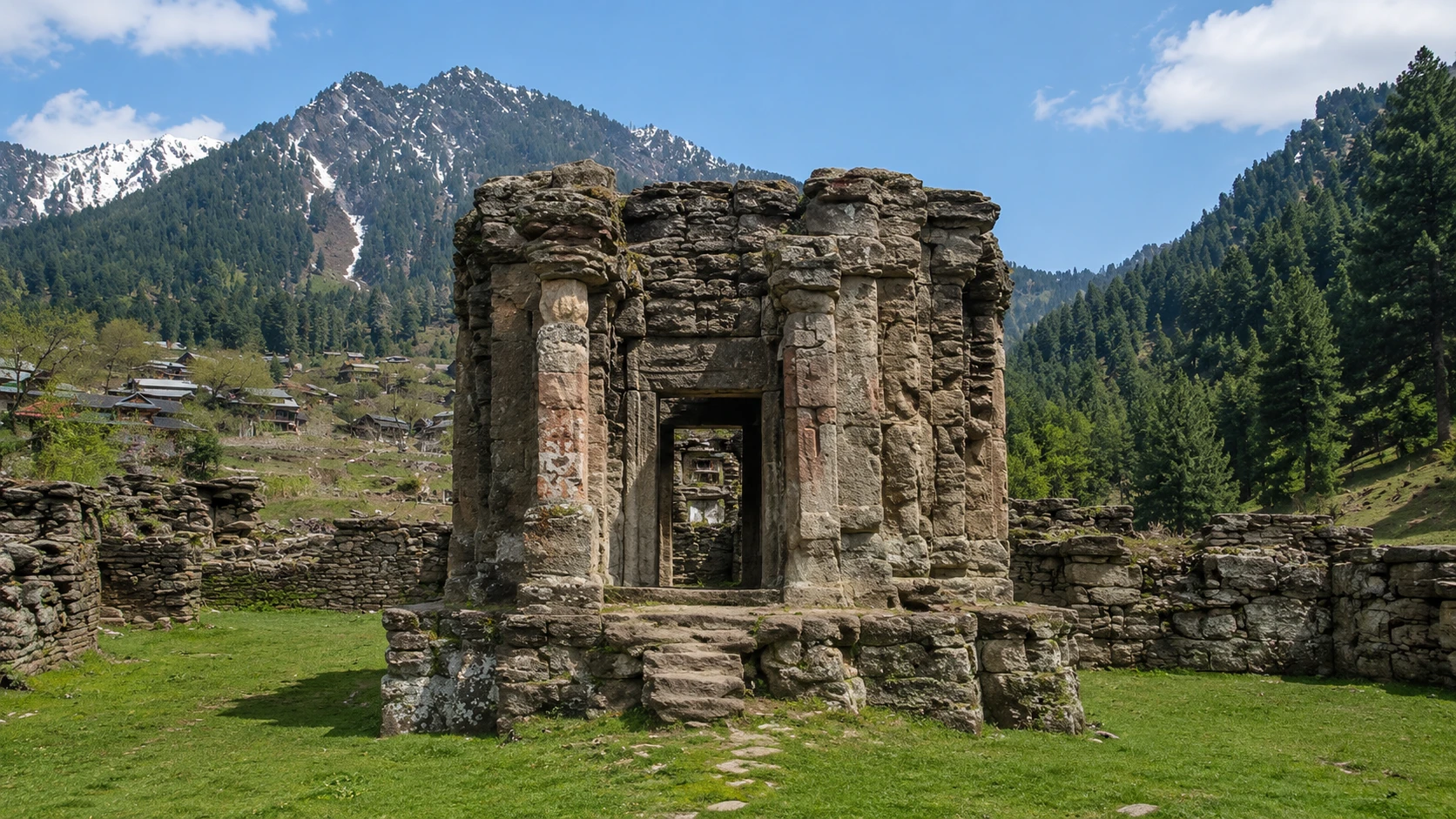
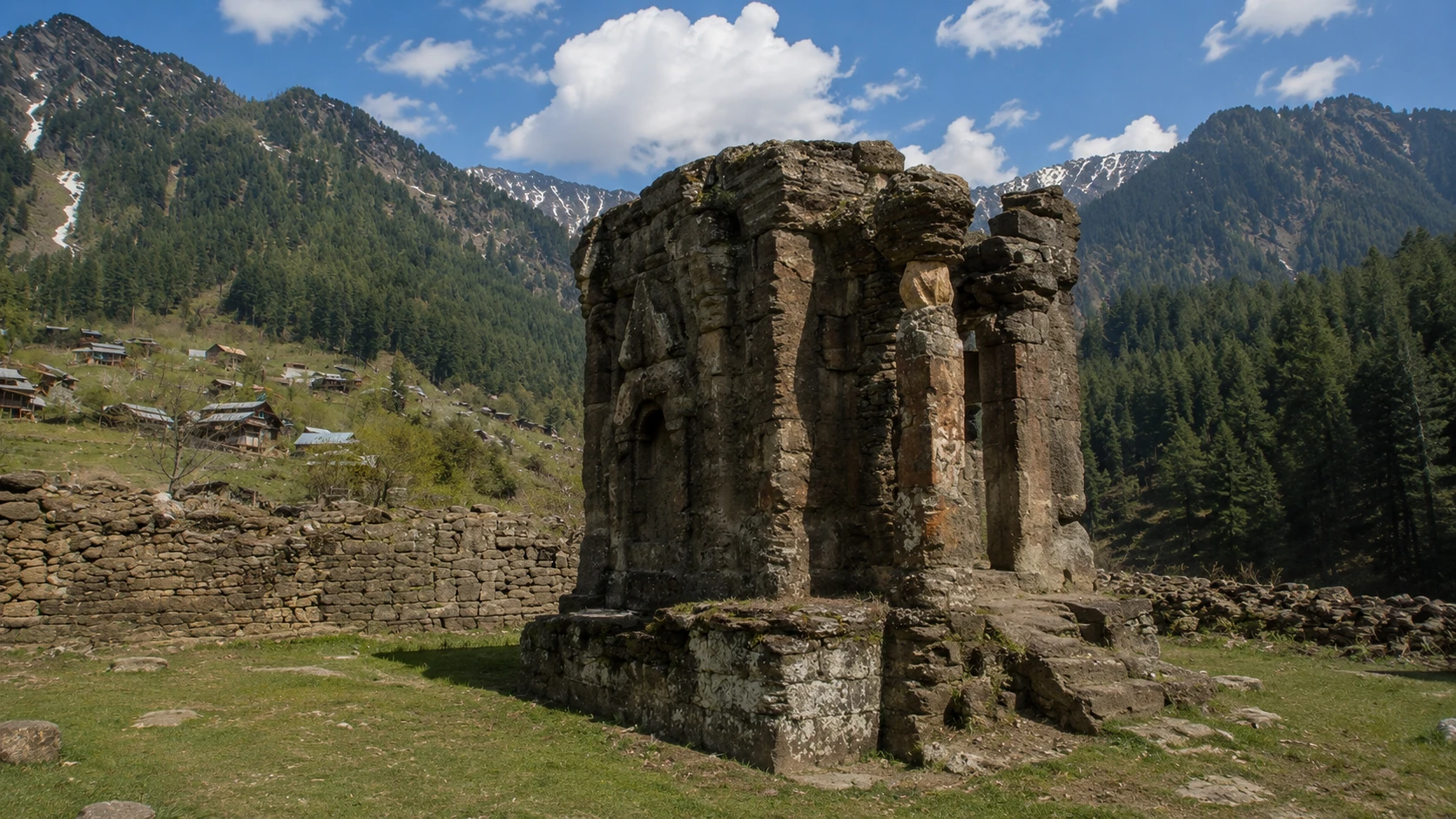
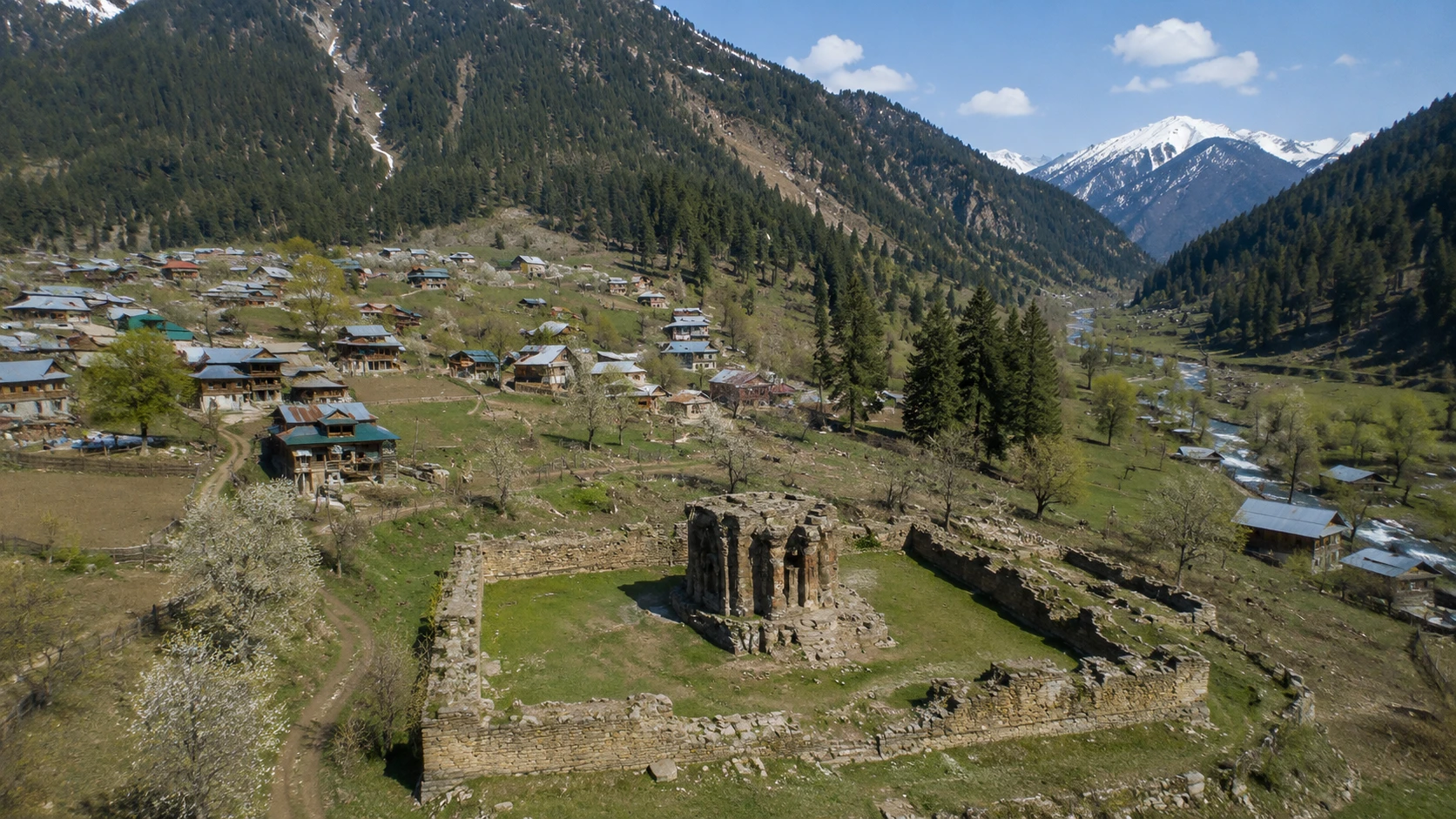
Surviving architectural elements from the canonical Sharada Peeth temple complex preserve aspects of the regional Kashmir Shaivite-Shakta architectural tradition, with substantial weather-damage and historical-disruption affecting the original architectural register. The temple's original elaborated architectural register, that the canonical Adi Shankara visit tradition holds was substantial enough to anchor a major regional learning-center, is preserved only partially in the surviving ruins and the 2021, 2022 reconstruction-era restoration work. The site's elevated mountain-valley setting in the Neelum Valley provides the distinctive geographical-architectural context
विशेष
The Sharada Peeth's operational status differs from typical Aṣṭādaśa Pīṭha sites due to the cross-border access discontinuity. Indian pilgrims cannot access the site via direct land routes due to the Line of Control closure between Pakistan-administered AJK and Indian-administered Jammu and Kashmir; the proposed Sharada Peeth Corridor diplomatic framework (analogous to the operating Kartarpur Corridor for Sikh pilgrims) has been discussed periodically since approximately 2007 but has not been operationalized as of the entry's compilation date. Pakistani-side local Hindu community access and broader Pakistani Hindu community access operates through the regional Pakistani administrative framework, with the site's 2021, 2022 restoration phase increasing the operational accessibility on the Pakistani side. Kashmir Pandit diaspora and broader Hindu diaspora engagement operates through diaspora-devotional practices including coordinated online observances, LoC-side accessible-point pilgrimages on the Indian side, and the canonical-attestation-maintenance through diaspora-tradition continuity
पवित्र कथा · पवित्र कथा
Śāradā Devī sits at Sharda village in the Neelum Valley of Pakistan-administered Azad Jammu and Kashmir, approximately 160 km north of Muzaffarabad on the Kishanganga (locally called Neelum) river, and the Pīṭha occupies the structurally final position in the canonical Aṣṭādaśa enumeration, position 18 in the Adi Shankara recension's Stotram, named simply as Śāradā in the closing verse. The body-part attribution at Sharada Peeth is canonically the right hand (dakṣiṇa-hasta) per the Pīṭhanirṇaya and Sircar 1948 attestations, with the Devī's name Śāradā (the Autumnal-Resplendent One, the Goddess of Learning, Wisdom, and Knowledge, etymologically connected to the autumn season and to the Sanskrit śaradā meaning lake or autumn) reflecting her canonical theological identity as the foundational goddess of learning across the Kashmir Shaivite-Shakta synthesis tradition. The Bhairava-pair at Sharada Peeth is Tribhuvaneśvara per the dominant Pīṭhanirṇaya attestation. The Sharada Peeth site is structurally distinctive within the corpus through multiple convergent dimensions: (a) it occupies the closing position of the canonical Adi Shankara-attributed Stotram and is canonically held in the Hindu tradition to have been visited by Ādi Śaṅkarācārya himself during his pan-Indian dig-vijaya pilgrimage; (b) it was the canonical seat of the Sharada Peeth Sanskrit learning-center, one of the pre-medieval South Asia's principal learning institutions alongside Nalanda, Vikramashila, and Taxila, that flourished from approximately the 6th, 12th centuries CE as an inter-religious (Hindu, Buddhist, broader Kashmir Shaivite) scholarly hub; (c) the Sharada script, the historical Brahmic writing system used for Sanskrit, Kashmiri, and other regional languages from approximately the 8th, 17th centuries, is named after this Pīṭha and reflects the temple's role as the canonical anchor of the regional textual-cultural tradition; (d) the site falls on the Pakistani side of the post-1947 Line of Control between India and Pakistan, making it inaccessible by direct land routes to Indian pilgrims since the partition-era access discontinuity. The Sharada Peeth's contemporary status combines its canonical Aṣṭādaśa standing with its physical inaccessibility to the principal Hindu pilgrim community, the site is theologically present in the Hindu sacred-geography network through textual attestation and diaspora-tradition continuity, while operationally inaccessible to the majority of canonical Hindu pilgrim flow. The post-1990 Kashmir Pandit migration created a global diaspora-pilgrim community for whom Sharada Peeth functions as the corpus-distinctive site of canonical-attestation maintained through diaspora-devotional practice despite physical inaccessibility. The Government of Pakistan announced restoration and reconstruction work on the temple compound during 2021, 2022; the site's operational status as of 2026 combines partial restoration with continued cross-border access limitations. The proposed Sharada Peeth Corridor, a diplomatic framework discussed between India and Pakistan periodically since approximately 2007, analogous to the operating Kartarpur Corridor for Sikh pilgrims, has not been operationalized as of the entry's compilation date, leaving the site without a formal Indian pilgrim access mechanism.
Sacred Designationपवित्र पदनाम
Shakti Peeth
शरीर का अंग: Right hand (Dakṣiṇa-hasta) per the dominant Pīṭhanirṇaya and Sircar 1948 attestations
शक्ति: Śāradā (the Autumnal-Resplendent One, the Goddess of Learning, Wisdom, and Knowledge; theologically integrated with Sarasvatī in the Kashmir Shaivite-Shakta synthesis tradition)
भैरव: Tribhuvaneśvara (canonical Pīṭhanirṇaya attestation; regional Kashmir Shaivite recensions give local Bhairava-forms as devotionally adjacent attestations)
Sacred Origin Storyपवित्र उत्पत्ति कथा
Source: Devī Bhāgavata Purāṇa, Skandha VII (canonical 51-Pīṭha enumeration); Kālikā Purāṇa, Chapters 18 and 60, 62 (52-list); Pīṭhanirṇaya (Śāradā at Sharada Peeth paired with Bhairava Tribhuvaneśvara); Ashtadasha Shakti Pīṭha Stotram attributed to Ādi Śaṅkarācārya (Śāradā at position 18, the closing verse of the canonical Stotram); Adi Shankara hagiographical tradition including the Mādhavīya Śaṅkaravijaya (16th c. canonical Śaṅkaravijaya biography); regional Kashmir Shaivite Sthala Purāṇa tradition on Sharada Peeth; Kashmir Pandit oral tradition preserving the site's pre-1947 institutional history
The Pīṭha-narrative at Sharada Peeth follows the canonical Pīṭha-formation cycle: Sati's body-fragment (canonically the right hand / dakṣiṇa-hasta per the dominant attestation) fell at the Sharda site in the Neelum Valley, giving rise to the Sharada Peeth.
The Devī's name Śāradā (the Autumnal-Resplendent One, the Goddess of Learning) reflects her canonical theological identity as the foundational goddess of learning across the Kashmir Shaivite-Shakta synthesis tradition, the regional Kashmir tradition identifies Śāradā as theologically continuous with Sarasvatī (the pan-Indian goddess of learning and the arts), with the Kashmir Shaivite synthesis integrating the canonical Sarasvatī-iconography with the regional Sharada-specific liturgical framework.
The Adi Shankara visit tradition, the canonical narrative that Ādi Śaṅkarācārya himself visited Sharada Peeth during his pan-Indian dig-vijaya pilgrimage (his canonical conquest-of-directions journey establishing Advaita Vedānta across the South Asian theological landscape), is foundational to the site's canonical identity.
The Adi Shankara visit canonically anchors the site's Aṣṭādaśa position 18 (the closing position of the Stotram) and provides the principal traditional attestation for the Stotram's attribution to Ādi Śaṅkarācārya, the Stotram concludes with Sharada Peeth precisely because Ādi Śaṅkarācārya canonically completed his northern dig-vijaya at this site, making the Stotram's geographical-textual structure terminate at the canonical pilgrimage's culmination.
The Sharada Peeth Sanskrit learning-center operated at the site from approximately the 6th, 12th centuries CE as one of pre-medieval South Asia's principal learning institutions; the canonical Kashmir Shaivite-Shakta synthesis was substantially developed at and transmitted through the Sharada Peeth scholarly community, with the Trika Shaivism tradition and the broader Kashmir Shaivite philosophical system anchoring at this institutional context.
The Sharada script, the historical Brahmic writing system that became the canonical writing system for Sanskrit, Kashmiri, and other regional languages from approximately the 8th, 17th centuries, was named after this Pīṭha and reflects the temple's canonical role as the anchor of the regional textual-cultural tradition.
The Bhairava-pair Tribhuvaneśvara at Sharada Peeth operates as the canonical Pīṭhanirṇaya-attested Bhairava-form. The site's post-1947 cross-border discontinuity (the Pakistani-side location making the site inaccessible to Indian pilgrims via direct land routes) is part of the canonical contemporary narrative the present temple-tradition carries: the canonical Pīṭha-attestation is preserved through the textual tradition (the Stotram, the Pīṭhanirṇaya, the Devī Bhāgavata), the diaspora-tradition continuity (the Kashmir Pandit and broader Hindu diaspora community maintaining devotional engagement despite physical inaccessibility), and the partial-restoration operational continuity (the Government of Pakistan's 2021, 2022 reconstruction phase at the site), which together constitute the Pīṭha's contemporary canonical standing across the cross-border access discontinuity layer.
उद्धृत स्रोत:
- Devī Bhāgavata Purāṇa, Skandha VII (canonical 51-Pīṭha enumeration)
- Kālikā Purāṇa, Chapters 18 and 60, 62 (52-list tradition)
- Pīṭhanirṇaya (Śāradā at Sharada Peeth paired with Bhairava Tribhuvaneśvara)
- Ashtadasha Shakti Pīṭha Stotram attributed to Ādi Śaṅkarācārya (Śāradā at position 18, the closing Stotram verse)
- Mādhavīya Śaṅkaravijaya (16th c. canonical Adi Shankara biography preserving the Sharada Peeth visit tradition)
- Anantanandagiri Śaṅkaravijaya (alternative Adi Shankara hagiographical tradition)
- Kashmir Shaivite Sthala Purāṇa tradition on Sharada Peeth
- Kashmir Pandit oral tradition preserving the site's pre-1947 institutional history
- Sircar, D. C., 'The Śākta Pīṭhas' (Motilal Banarsidass, 1948; revised 1973)
- Bhattacharya, N. N., 'History of the Sakta Religion' (Manohar, 1974)
- Sanderson, Alexis, 'The Śaiva Age' (in 'Genesis and Development of Tantrism', University of Tokyo, 2009), Kashmir Shaivite scholarly framework
- Slaje, Walter, 'Medieval Kashmir and the Science of History' (University of Texas, 2004), Kashmir Pandit institutional-historical tradition
- Rai, Mridu, 'Hindu Rulers, Muslim Subjects: Islam, Rights, and the History of Kashmir' (Princeton University Press, 2004)
- Stein, Mark Aurel, 'Kalhana's Rajatarangini: A Chronicle of the Kings of Kashmir' (Archibald Constable, 1900), historical Kashmir chronicle attesting Sharada Peeth
अन्य परंपराएँ · अन्य परंपराएँ
Adi Shankara visit recension and Sharada Peeth's canonical position-18 standing
The canonical Adi Shankara visit tradition holds that Ādi Śaṅkarācārya himself visited Sharada Peeth during his pan-Indian dig-vijaya pilgrimage, with the Sharada Peeth site canonically representing the northernmost canonical destination of his journey and the Stotram's geographical-textual closing position.
The tradition is preserved across the Mādhavīya Śaṅkaravijaya (the 16th c. canonical Śaṅkaravijaya biography) and the Anantanandagiri Śaṅkaravijaya (alternative hagiographical tradition), and is foundational to the canonical attribution of the Stotram to Ādi Śaṅkarācārya.
A scholarly observation, preserved in modern academic literature, holds that the historical-biographical question of Ādi Śaṅkarācārya's actual pilgrimage routes is complicated by the multiple-Śaṅkara-tradition history (the medieval Hindu tradition records multiple Śaṅkarācāryas operating across different periods, with the dating of the principal Ādi Śaṅkarācārya itself recension-variable) and by the hagiographical-vs-historical-source separation.
The corpus records the canonical Adi Shankara visit tradition as the dominant living-tradition attestation while acknowledging the broader scholarly historiographical observation. The Adi Shankara visit's canonical role as the principal anchor for the Stotram's geographical-textual structure (the Stotram concludes at Sharada Peeth because Adi Shankara's canonical journey culminated there) is preserved as the canonical theological framework regardless of the historiographical complexity.
Sharada Peeth as canonical learning-center and Sharada script anchor
The Sharada Peeth Sanskrit learning-center tradition is documented across multiple primary and secondary sources. The site operated as a principal learning institution from approximately the 6th, 12th centuries CE alongside Nalanda (Bihar), Vikramashila (Bihar), and Taxila (modern Pakistani Punjab), with the Sharada Peeth's distinctive contribution being the canonical Kashmir Shaivite-Shakta philosophical synthesis that became foundational to medieval Hindu theological development.
The Sharada script, the historical Brahmic writing system that became the canonical script for Sanskrit, Kashmiri, and other regional languages from approximately the 8th, 17th centuries, is named after this Pīṭha and remained the principal northern-Indian script for centuries before being progressively replaced by Devanagari (for Sanskrit) and Perso-Arabic (for Kashmiri) during the medieval-Sultanate-and-Mughal periods.
The Sharada Peeth's canonical role as the anchor of the regional textual-cultural tradition is preserved across the historical scholarly literature, with Kalhana's 12th-c. Rajatarangini (the canonical Kashmir historical chronicle) attesting the site's institutional standing at the height of its operational period.
विद्वत संदर्भ
Sharada Peeth occupies a structurally distinctive position in the Pīṭha network through the integration of multiple corpus-distinctive dimensions: (a) the closing position of the canonical Adi Shankara Stotram (position 18), making the site the principal canonical anchor for the Stotram's traditional attribution to Ādi Śaṅkarācārya; (b) the canonical seat of the Sharada Peeth Sanskrit learning-center, one of pre-medieval South Asia's principal learning institutions alongside Nalanda, Vikramashila, and Taxila; (c) the namesake of the Sharada script, the historical Brahmic writing system that anchored the regional textual-cultural tradition for centuries; (d) the post-1947 cross-border access discontinuity that places the site on the Pakistani side of the Line of Control. The Kashmir Shaivite-Shakta synthesis tradition that the Sharada Peeth learning-center developed and transmitted, including the Trika Shaivism school, the broader Kashmir Shaivite philosophical system, and the canonical Sharada-Sarasvatī theological integration, became foundational to medieval Hindu theological development across South Asia. The 1947 partition produced a corpus-distinctive operational situation: the canonical Pīṭha is preserved through the Hindu textual tradition (the Stotram, the Pīṭhanirṇaya, the Devī Bhāgavata), the diaspora-tradition continuity (the Kashmir Pandit community maintaining canonical attestation despite physical inaccessibility), and the partial-restoration operational continuity (Government of Pakistan 2021, 2022 reconstruction phase). Indian pilgrims cannot access the site via direct land routes due to the Line of Control closure; the proposed Sharada Peeth Corridor diplomatic framework (analogous to the operating Kartarpur Corridor for Sikh pilgrims) has been discussed periodically since approximately 2007 but has not been operationalized as of the entry's compilation date. The site's contemporary canonical standing is therefore documented through a layered framework that integrates the textual-canonical attestation with the diaspora-tradition continuity and the partial-restoration operational status. Eternal Raga's editorial position on the cross-border access situation is documented presentation of the operational reality as state-level operational context (not religious restriction) per the Phase 3 cross-border precedent established for Hinglaj (Pakistan), Lanka Shankari (Sri Lanka), Sugandha (Bangladesh), and Guhyeshwari (Nepal). The Government of Pakistan's stewardship of the site and the Government of Azad Jammu and Kashmir's administrative role are acknowledged as the operational framework within which the site's preservation and restoration operate. Alexis Sanderson's 'The Śaiva Age' (2009), Walter Slaje's 'Medieval Kashmir and the Science of History' (2004), and Mark Aurel Stein's translation of Kalhana's Rajatarangini (1900) provide the principal modern academic treatments of the Kashmir Shaivite-Shakta tradition's theological-historical framework within which Sharada Peeth operates.
Historyइतिहास
Sharada Peeth's historical depth as a sacred site is integrated with the broader Kashmir region's foundational role in the canonical Hindu Shaivite-Shakta synthesis tradition. The pre-canonical layer (continuous Devī-worship in the Kashmir region from at least the late epic period through c. 4th c.
CE) places the Sharada Peeth site within the deep Kashmir Shaivite-Shakta religious geography. The Karkota dynasty period (7th, 9th c. CE) and subsequent Utpala dynasty period (9th, 10th c. CE) provided the foundational dynastic-patronage context for the Sharada Peeth Sanskrit learning-center's substantial elaboration as one of pre-medieval South Asia's principal learning institutions.
The Lohara dynasty period (11th, 14th c. CE) saw the Sharada Peeth's institutional peak, with Kalhana's 12th c. Rajatarangini (the canonical Kashmir historical chronicle, written in the Sharada script) attesting the site's institutional standing at the height of its operational period. The Adi Shankara visit tradition is canonically dated to approximately the 8th, 9th c.
CE per the dominant Hindu hagiographical attestation (the Mādhavīya Śaṅkaravijaya tradition), though the historical-biographical complexity of the multiple-Śaṅkara-tradition history qualifies the precise dating. The 14th c. onward brought substantial decline due to the Kashmir Sultanate period (1339, 1586 CE, with periods of more rigorous and more accommodative Hindu-administration depending on the ruling Sultan); the Sharada Peeth's institutional-learning center capacity progressively diminished across this period.
The Mughal period (1586, 1751 CE, after Akbar's 1586 conquest of Kashmir) brought administrative integration into the broader Mughal Hindu-administrative framework, with the site's institutional standing operating at a substantially reduced scale compared to its pre-medieval learning-center peak.
The Afghan Durrani period (1751, 1819 CE) brought further institutional disruption to the broader Kashmir Hindu temple network. The Dogra dynasty period (1846, 1947 CE, after the Treaty of Amritsar transferred Kashmir to Dogra administration) brought partial restoration efforts and the integration of the broader Kashmir Hindu religious-institutional infrastructure within the Dogra-administered framework.
The 1947 partition placed the Sharada Peeth site on the Pakistani side of the Line of Control between Pakistan-administered Azad Jammu and Kashmir and Indian-administered Jammu and Kashmir, creating the post-1947 cross-border access discontinuity.
The 1990 onward Kashmir Pandit migration produced a global diaspora-community for whom Sharada Peeth functions as a canonical heritage anchor despite physical inaccessibility. The 2021, 2022 Government of Pakistan-administered reconstruction phase at the site brought partial restoration.
Proposed Sharada Peeth Corridor diplomatic discussions (analogous to the Kartarpur Corridor for Sikh pilgrims) have been periodically referenced since approximately 2007 but have not produced an operational corridor as of the entry's compilation date.
Historical Timelineऐतिहासिक कालक्रम
Pre-canonical attestation of Devī-worship in the broader Kashmir region, with the Sharada Peeth site situated within the deep Kashmir Shaivite-Shakta religious geography that integrated regional Devī-tradition with broader Hindu theological development. The pre-canonical layer establishes the geographical-religious foundation upon which the canonical Pīṭha-attestation and the Sharada Peeth Sanskrit learning-center later arrived through the textualization-and-institutional-development period.
Operating period of the Sharada Peeth Sanskrit learning-center as one of pre-medieval South Asia's principal learning institutions alongside Nalanda (Bihar), Vikramashila (Bihar), and Taxila (modern Pakistani Punjab). The Sharada Peeth's distinctive contribution to pre-medieval Indian learning was the canonical Kashmir Shaivite-Shakta philosophical synthesis, including the Trika Shaivism school, the broader Kashmir Shaivite philosophical system (Abhinavagupta's 10th, 11th c. Tantrāloka and the broader Kashmir Shaivite textual corpus), and the canonical Sharada-Sarasvatī theological integration. The Sharada script, named after this Pīṭha, became the principal Brahmic writing system for Sanskrit, Kashmiri, and other regional languages of the broader Kashmir cultural sphere across this period. The institutional patronage was provided successively by the Karkota dynasty (7th, 9th c. CE), the Utpala dynasty (9th, 10th c. CE), and the Lohara dynasty (11th, 14th c. CE), with the institutional peak being approximately the 9th, 12th centuries. The canonical Pīṭha attestation textualization (Devī Bhāgavata, Kālikā Purāṇa, Pīṭhanirṇaya, Aṣṭādaśa Stotram) overlapped with the Sharada Peeth learning-center's operational peak.
Canonical Pīṭha attestation of Sharada Peeth through textualization in the Devī Bhāgavata Purāṇa (Skandha VII), the Kālikā Purāṇa (Chapters 18 and 60, 62), the Pīṭhanirṇaya (Śāradā at Sharada Peeth paired with Bhairava Tribhuvaneśvara), and the Ashtadasha Shakti Pīṭha Stotram attributed to Ādi Śaṅkarācārya (Śāradā at position 18, the closing Stotram verse). The Pīṭha attestation arrived at the site during the broader 8th, 12th c. textualization period, overlapping with the Sharada Peeth Sanskrit learning-center's operational peak, the institutional and canonical attestations developed in coordinated mutual reinforcement. The Adi Shankara visit tradition (canonically dated to approximately the 8th, 9th c. CE per the dominant hagiographical attestation) provides the canonical anchor for the Stotram's traditional attribution to Ādi Śaṅkarācārya, with Sharada Peeth as the closing position of his pan-Indian dig-vijaya journey.
Successive Kashmir Sultanate (1339, 1586 CE), Mughal (1586, 1751 CE, after Akbar's 1586 conquest of Kashmir), and Afghan Durrani (1751, 1819 CE) periods brought substantial institutional disruption to the broader Kashmir Hindu temple network including the Sharada Peeth complex. The Sharada Peeth learning-center's institutional capacity progressively diminished across this period, the canonical scholarly literature documents the broader pattern of Kashmir Hindu institutional decline, with the Sharada Peeth's institutional-learning capacity substantially reduced from its pre-medieval peak. The precise sequence of disruption events at the Sharada Peeth site is documented unevenly across the regional historical record, but the broader pattern of institutional decline is documented through Kashmir medieval historiography. The Sharada script's progressive replacement by Devanagari (for Sanskrit) and Perso-Arabic (for Kashmiri) across this period reflects the broader institutional-cultural transformation; the Sharada script became functionally extinct as a routine writing system by approximately the 17th, 18th centuries.
The historical record of medieval Kashmir institutional-religious history is documented unevenly across primary sources, with the regional historiography working at the level of broader patterns rather than individual-temple chronicle. Eternal Raga records the documented broader pattern without making specific claims about individual destruction events that lack primary-source attestation. The scholarly literature varies in its framing of the medieval Kashmir period; Rai 2004 and Bamzai 1962 provide standard modern scholarly frameworks while reflecting the institutional-political complexity of the period.
Dogra dynasty administration of Kashmir (1846, 1947 CE, after the 1846 Treaty of Amritsar transferred Kashmir from the Sikh Empire to Dogra administration). The Dogra-era brought partial restoration efforts at the Sharada Peeth site and across the broader Kashmir Hindu religious-institutional infrastructure, with the canonical Pīṭha-attestation operating under the Dogra-administered Hindu religious framework. The Dogra period was the period during which the broader Kashmir Pandit community institutional infrastructure stabilized at its pre-1947 form, with the Sharada Peeth site preserved as a heritage anchor within the broader regional Kashmir Pandit religious-cultural framework. The Dogra-era Pandit institutional capacity at Sharada Peeth, however, operated at a substantially reduced scale compared to the pre-medieval learning-center peak.
Post-Partition operational discontinuity at Sharada Peeth. The 1947 partition placed the Sharada Peeth site on the Pakistani side of the Line of Control between Pakistan-administered Azad Jammu and Kashmir and Indian-administered Jammu and Kashmir, creating the cross-border access discontinuity that defines the site's contemporary operational status. Key post-1947 developments include: the immediate post-Partition discontinuity in Indian pilgrim access (no formal corridor established at partition for the Sharada Peeth pilgrim flow); the 1990 onward Kashmir Pandit migration from Indian-administered J&K, producing a global diaspora community for whom Sharada Peeth functions as a canonical heritage anchor despite physical inaccessibility; periodic diplomatic discussions of a proposed Sharada Peeth Corridor (analogous to the operating Kartarpur Corridor for Sikh pilgrims) since approximately 2007, with the proposal not operationalized as of the entry's compilation date; the 2021, 2022 Government of Pakistan-administered reconstruction and restoration phase at the Sharada Peeth temple compound, bringing partial restoration to the site's physical infrastructure. The Government of Pakistan's stewardship of the site (through the Government of Azad Jammu and Kashmir's administrative role and the broader Pakistani federal heritage-administration framework) is the present operational framework within which the site's preservation operates.
The Sharada Peeth Corridor diplomatic framework has been periodically discussed in India-Pakistan dialogues since approximately 2007, with the discussions analogous to the framework that produced the operating Kartarpur Corridor (opened 2019) for Sikh pilgrims accessing the Gurdwara Darbar Sahib at Kartarpur (Pakistan). As of the entry's compilation date (2026), the Sharada Peeth Corridor has not been operationalized; Indian pilgrims cannot access the site via formal land-corridor mechanisms. The 2021, 2022 Government of Pakistan restoration announcement reflects the Pakistani administration's heritage-preservation stewardship of the site within the Azad Jammu and Kashmir administrative framework. The contemporary operational status combines partial restoration with continued cross-border access limitations.
What You'll Seeदर्शन में
The Śāradā Devī iconographic register at the Sharada Peeth site preserves the canonical Kashmir Shaivite-Shakta sculptural tradition through the surviving devotional infrastructure that has been partially restored across the 2021, 2022 Government of Pakistan reconstruction phase.
The original temple's elaborated iconographic infrastructure, that the canonical pre-medieval institutional period operated through during the Sharada Peeth learning-center's peak, is preserved only partially in the surviving architectural ruins and the reconstruction-era restoration work; the canonical Devī murti's contemporary status combines surviving sculptural elements with the broader temple compound's partial reconstruction.
The canonical theological framework holds that the Devī Śāradā integrates the regional Kashmir Sharada-tradition with the pan-Indian Sarasvatī-iconographic register, the Devī is canonically depicted as the Goddess of Learning bearing the canonical Sarasvatī-attributes (the vīṇā instrument, the book/manuscript, the rosary, the lotus seat) within the regional Kashmir Shaivite-Shakta synthesis sculptural framework.
The canonical Sharada-iconographic identity preserves the Devī's distinctive autumnal-resplendent (śarat) theological attribute, the seasonal goddess of clear-knowledge whose iconographic register integrates the autumnal-clarity symbolism with the canonical Devī-attributes.
The Bhairava-pair Tribhuvaneśvara at Sharada Peeth operates as the canonical Pīṭhanirṇaya-attested Bhairava-form. The site's broader sacred-geographical infrastructure includes the canonical pre-medieval temple ruins (preserving the regional Kashmir Shaivite-Shakta architectural register at its pre-medieval peak through surviving stone elements), the Kishanganga river-side ghat (the canonical bathing and ritual-water-source associated with the temple complex), and the surrounding Neelum Valley mountain landscape (the canonical geographical setting that the regional Kashmir tradition holds as theologically integrated with the Devī's mountain-valley presence).
The 2021, 2022 reconstruction-era restoration has brought partial physical infrastructure rehabilitation; the canonical iconographic register operates in part through the surviving pre-medieval elements and in part through the reconstruction-era replacement elements.
Photography of the site is permitted within the broader Pakistani-administered heritage-site framework, with restrictions during any specific worship observances coordinated by the Pakistani-side administrative framework.
Distinctive Practicesविशिष्ट परंपराएँ
Diaspora-Pilgrimage Tradition, Canonical-Attestation Maintenance Through Diaspora Devotional Practice (Corpus-First Diaspora-Pilgrimage Register)
प्रवासी-तीर्थयात्रा परंपरा, प्रवासी भक्ति अभ्यास के माध्यम से प्रामाणिक-प्रमाणन रखरखाव (संग्रह-प्रथम प्रवासी-तीर्थयात्रा स्तर)
Year-round; particularly weighted during major Kashmir Pandit observance cycles including Sharada Jayanti, Sharad Pūrṇimā, the Kashmir Pandit New Year (Navreh) observance, and on the anniversary of the 1990 Kashmir Pandit migration commemorative observance
The corpus-first diaspora-pilgrimage tradition at Sharada Peeth is the canonical-attestation-maintenance practice developed by the global Kashmir Pandit diaspora community and the broader Hindu diaspora community for whom Sharada Peeth functions as a heritage anchor despite physical inaccessibility. The practice operates through multiple coordinated dimensions: (a) coordinated diaspora-organized online observances during major Sharada Devī festival cycles, with the canonical attestation maintained through synchronized devotional practice across the global diaspora community; (b) LoC-side accessible-point pilgrimages on the Indian-administered J&K side of the Line of Control, where Kashmir Pandit diaspora pilgrims travel to the closest physically-accessible Indian-side points to engage in canonical-attestation-maintenance worship while the Sharada Peeth site itself remains across the LoC; (c) the canonical-attestation-maintenance through the broader Kashmir Pandit Devī-worship tradition, the diaspora community's continuous engagement with the Sharada-Sarasvatī theological framework operates as the canonical preservation mechanism even without physical site access; (d) the proposed Sharada Peeth Corridor diplomatic advocacy as a community-level political-civil engagement that maintains the canonical-attestation-question in the broader political-diplomatic frame. The practice is corpus-first as the principal documented diaspora-pilgrimage register among the corpus Pīṭhas, no other Aṣṭādaśa Pīṭha has developed an equivalent diaspora-pilgrimage tradition driven by canonical-attestation-maintenance through community-level devotional and political-civil engagement despite physical inaccessibility. The diaspora-pilgrimage register operates structurally distinct from physical-pilgrimage Pīṭha-darshan: the canonical attestation is preserved through community-level continuity rather than through individual-pilgrim physical-darshan.
The diaspora-pilgrimage tradition operationalizes the theological principle that the Devī's canonical presence at a Pīṭha is theologically grounded in the cosmic-feminine canonical attestation rather than being dependent on the continuous physical-pilgrim access to the temple site. The Kashmir Pandit diaspora community's continuous engagement with the Sharada-Sarasvatī theological framework, through the canonical textual tradition (the Stotram, the Pīṭhanirṇaya), through the broader Kashmir Shaivite-Shakta scholarly heritage, and through the coordinated diaspora-devotional practice, operates as the canonical preservation mechanism that maintains the Pīṭha's contemporary canonical standing despite the post-1947 cross-border access discontinuity. The practice is theologically distinct from the standard physical-pilgrimage Pīṭha-darshan modes found at the other corpus Pīṭhas; the canonical attestation operates through community-level continuity rather than through individual-pilgrim physical-darshan.
Sharada-Sanskrit Learning-Tradition Observance, Scholarly-Devotional Integration
शारदा-संस्कृत शिक्षण-परंपरा आचरण, विद्वत्तापूर्ण-भक्ति एकीकरण
Year-round; particularly weighted during the canonical Hindu learning-tradition calendar (Vasant Pañcamī as the canonical Sarasvatī-worship day for learning, Sharada Jayanti as the canonical Sharada-specific learning observance, the academic year's canonical start and end)
The Sharada Peeth's canonical role as the historical seat of the Sharada Peeth Sanskrit learning-center makes the site corpus-distinctive in integrating the canonical Devī-Pīṭha tradition with the scholarly-learning tradition. The site is theologically a Pīṭha (the Devī-pilgrimage attestation) and an institutional anchor of the canonical Hindu learning-tradition (the pre-medieval learning-center heritage), with the two dimensions theologically integrated through the Sharada-Sarasvatī identity (Sarasvatī is the canonical goddess of learning across the broader Hindu tradition, and Sharada is the regional Kashmir-attested form of Sarasvatī). The Sharada-Sanskrit learning-tradition observance operates through coordinated devotional-scholarly practices: (a) the canonical Sarasvatī-Pūjā observance on Vasant Pañcamī (Māgha Śukla Pañcamī, Jan-Feb), with the Sharada Peeth Pīṭha as the canonical theological anchor; (b) Sharada-specific scholarly-devotional observances during the canonical Kashmir Pandit academic-calendar cycles; (c) the canonical pre-academic-year and end-of-academic-year scholarly-devotional engagement, with the Sharada-Sarasvatī attestation operating as the canonical Hindu learning-tradition's theological anchor; (d) the continuing scholarly engagement with the Kashmir Shaivite-Shakta textual corpus (Abhinavagupta's 10th, 11th c. Tantrāloka, the broader Trika Shaivism textual corpus, the Kashmir Sharada-philosophical heritage) as a canonical-attestation-maintenance dimension. The Sharada Peeth's canonical role as the Sarasvatī-learning-anchor is preserved across the broader Hindu tradition's scholarly-devotional infrastructure even in the contemporary cross-border access discontinuity context.
The integration of the Devī-Pīṭha tradition with the canonical Hindu learning-tradition through the Sharada-Sarasvatī identity is theologically distinctive in the canonical Hindu sacred-geography network. The pre-medieval Sharada Peeth learning-center operated as the institutional embodiment of this theological integration, the canonical Kashmir Shaivite-Shakta philosophical synthesis developed at the learning-center was simultaneously a scholarly tradition (the Trika Shaivism school, the broader Kashmir Shaivite philosophical system) and a devotional tradition (the canonical Sharada-Sarasvatī worship). The contemporary observance of the Sharada-Sanskrit learning-tradition preserves the canonical integration even without the operating learning-center institutional infrastructure.
Aṣṭādaśa Stotram Closing-Verse Recitation, Canonical Adi Shankara Pilgrimage-Completion Observance
अष्टादश स्तोत्रम् समापन-पद्यावली पाठ, प्रामाणिक आदि शंकर तीर्थयात्रा-सम्पन्न आचरण
Year-round wherever the Stotram is recited; particularly weighted during the canonical completion of an Aṣṭādaśa pilgrimage circuit (when the eighteenth and final Stotram verse is recited as the canonical completion-attestation), and during the Adi Shankara Jayanti observance (the canonical anniversary of Ādi Śaṅkarācārya's birth)
The Aṣṭādaśa Stotram closing-verse recitation tradition is corpus-distinctive at Sharada Peeth, the closing verse of the canonical Stotram, naming Śāradā at position 18, operates as the canonical pilgrimage-completion attestation across the broader Aṣṭādaśa tradition. Pilgrims undertaking the canonical pan-Indian eighteen-Pīṭha circuit recite the Stotram's verse for each position at the respective sanctum; the closing verse for Sharada Peeth is structurally the culminating recitation of the entire pilgrimage architecture. In the contemporary cross-border-access-discontinuity context, the closing-verse recitation operates as the canonical-attestation-maintenance vehicle even when physical pilgrimage to Sharada Peeth is not feasible, the verse is recited at the conclusion of the seventeen accessible Aṣṭādaśa positions or at the canonical-attestation-maintenance occasions, with the recitation operating as the canonical theological completion of the pilgrimage architecture even without physical Sharada Peeth darshan. The practice is corpus-distinctive in its structural-canonical centrality: the Stotram's textual structure terminates at Sharada Peeth, and the closing-verse recitation is therefore both the canonical pilgrimage-completion attestation and the canonical-attestation-maintenance vehicle for the inaccessible-but-canonical eighteenth position. The Adi Shankara visit tradition (the canonical narrative that Ādi Śaṅkarācārya himself completed his dig-vijaya at Sharada Peeth) gives the closing-verse recitation its particular liturgical weight as the canonical completion-attestation observance.
The Aṣṭādaśa Stotram's textual structure terminates at Sharada Peeth (position 18), and the closing-verse recitation is therefore structurally the canonical completion-attestation of the broader Aṣṭādaśa pilgrimage architecture. The canonical Adi Shankara visit tradition (the narrative that Ādi Śaṅkarācārya himself completed his pan-Indian dig-vijaya at Sharada Peeth) gives the closing position its theological-anchor role. In the contemporary cross-border-access-discontinuity context, the closing-verse recitation operates as the principal canonical-attestation-maintenance vehicle that preserves the pilgrimage architecture's textual-canonical completion even without the physical Sharada Peeth darshan.
Did You Know?क्या आप जानते हैं?
Sharada Peeth is position 18, the closing position, in the canonical Ādi Śaṅkarācārya-attributed Aṣṭādaśa Shakti Pīṭha Stotram. The Stotram's textual structure terminates at Sharada Peeth, and the canonical Adi Shankara visit tradition holds that Ādi Śaṅkarācārya himself completed his pan-Indian dig-vijaya at this site, making Sharada Peeth the principal canonical anchor for the Stotram's traditional attribution to Ādi Śaṅkarācārya and the structural culmination of the eighteen-Pīṭha pilgrimage architecture. The closing-verse status gives Sharada Peeth its corpus-distinctive standing as the canonical pilgrimage-completion site of the Aṣṭādaśa framework.
Ashtadasha Shakti Pīṭha Stotram attributed to Ādi Śaṅkarācārya; Mādhavīya Śaṅkaravijaya (16th c.); Sircar, 'The Śākta Pīṭhas' (1948)
The Sharada script, the historical Brahmic writing system used as the canonical script for Sanskrit, Kashmiri, and other regional languages from approximately the 8th, 17th centuries, is named after Sharada Peeth. The script became the principal northern-Indian writing system for several centuries and was the canonical script of the Kashmir Shaivite-Shakta textual tradition (including the Trika Shaivism school, Abhinavagupta's 10th, 11th c. Tantrāloka, and Kalhana's 12th c. Rajatarangini). The Sharada script's canonical anchoring at the Sharada Peeth makes the site corpus-distinctive, no other Aṣṭādaśa Pīṭha (or, indeed, no other Pīṭha in the broader documented corpus) is the canonical namesake of a historical writing system that anchored regional textual-cultural tradition for centuries.
Stein, 'Kalhana's Rajatarangini' (1900); Sanderson, 'The Śaiva Age' (2009); Slaje, 'Medieval Kashmir and the Science of History' (2004)
The Sharada Peeth Sanskrit learning-center operated at the site from approximately the 6th, 12th centuries CE as one of pre-medieval South Asia's principal learning institutions alongside Nalanda (Bihar), Vikramashila (Bihar), and Taxila (modern Pakistani Punjab). The Sharada Peeth's distinctive contribution to pre-medieval Indian learning was the canonical Kashmir Shaivite-Shakta philosophical synthesis, including the Trika Shaivism school, the broader Kashmir Shaivite philosophical system, and the canonical Sharada-Sarasvatī theological integration. The learning-center heritage is corpus-distinctive among Aṣṭādaśa Pīṭhas, no other Aṣṭādaśa site is the canonical seat of a major pan-South-Asian learning institution comparable to the Sharada Peeth's pre-medieval standing.
Stein, 'Kalhana's Rajatarangini' (1900); Sanderson, 'The Śaiva Age' (2009); Dyczkowski, 'The Stanzas on Vibration' (1992); Slaje, 'Medieval Kashmir and the Science of History' (2004)
The post-1947 cross-border access discontinuity at Sharada Peeth, the site falling on the Pakistani side of the Line of Control between Pakistan-administered Azad Jammu and Kashmir and Indian-administered Jammu and Kashmir, produced a corpus-first diaspora-pilgrimage tradition. The 1990 onward Kashmir Pandit migration created a global diaspora community for whom Sharada Peeth functions as a canonical heritage anchor despite physical inaccessibility. The proposed Sharada Peeth Corridor diplomatic framework (analogous to the operating Kartarpur Corridor for Sikh pilgrims, which opened in 2019) has been periodically discussed in India-Pakistan dialogues since approximately 2007 but has not been operationalized as of 2026. The 2021, 2022 Government of Pakistan-administered reconstruction phase brought partial restoration to the site, but Indian pilgrim access via direct land routes remains unavailable. The diaspora-pilgrimage tradition that has developed in response is corpus-distinctive among the documented Pīṭhas.
Schofield, 'Kashmir in Conflict' (2010); Public statements of Government of Pakistan Evacuee Trust Property Board 2021, 2022; Kashmir Pandit diaspora community records; periodic India-Pakistan diplomatic dialogues regarding the proposed Sharada Peeth Corridor
The canonical Adi Shankara visit tradition holds that Ādi Śaṅkarācārya himself visited Sharada Peeth during his pan-Indian dig-vijaya pilgrimage, his canonical conquest-of-directions journey establishing Advaita Vedānta across the South Asian theological landscape. The visit tradition is canonically dated to approximately the 8th, 9th c. CE per the dominant hagiographical attestation (the Mādhavīya Śaṅkaravijaya tradition). Sharada Peeth is the canonically attested northernmost destination of Adi Shankara's pilgrimage journey, and the Stotram's closing verse for Sharada Peeth at position 18 directly anchors the canonical attribution of the Stotram to Ādi Śaṅkarācārya. The Adi Shankara visit canonically completes both the geographical and the textual structure of the Aṣṭādaśa framework.
Mādhavīya Śaṅkaravijaya (16th c.); Anantanandagiri Śaṅkaravijaya; Hacker, 'Śaṅkara, der Yogin und Śaṅkara, der Advaitin' (1968)
Visitor Accessप्रवेश जानकारी
Sharada Peeth's access situation is structurally distinct from the typical operating-Pīṭha context due to the post-1947 cross-border discontinuity. Indian pilgrims cannot access the site via direct land routes; the Line of Control between Pakistan-administered Azad Jammu and Kashmir and Indian-administered Jammu and Kashmir is the operational boundary, and no formal land-corridor mechanism for Indian pilgrims has been established as of 2026. The proposed Sharada Peeth Corridor diplomatic framework has been periodically discussed but not operationalized. Pakistani-side access operates through the regional Government of Pakistan / Government of Azad Jammu and Kashmir administrative framework. The 2021, 2022 Government of Pakistan reconstruction phase brought partial restoration to the site. Indian-side LoC-accessible-point pilgrimages are undertaken by Kashmir Pandit diaspora community members at the closest physically-accessible Indian-side points to engage in canonical-attestation-maintenance worship.
आध्यात्मिक आधार
The cross-border access discontinuity is documented as a state-level operational reality rather than a religious restriction, the Devī's canonical attestation at the site is preserved through the textual tradition, the diaspora-tradition continuity, and the partial-restoration operational status. The canonical theological framework does not place restrictions on pilgrim access; the operational restrictions are political-administrative state-level matters between India and Pakistan that operate independently of the canonical theological framework.
समकालीन संदर्भ
The contemporary access framework operates within the broader India-Pakistan diplomatic-political relationship and the post-1947 Line of Control regulatory framework. Indian citizens require Pakistani visa and Pakistani-side administrative arrangements to access the site via Pakistani territory; the standard Pakistani visa framework for Indian citizens is restrictive and Sharada Peeth-specific tourist visa arrangements do not exist as of the entry's compilation date. The Government of Pakistan's stewardship of the site through the Azad Jammu and Kashmir administrative framework and the broader Pakistani federal heritage-administration system constitutes the present operational framework. The proposed Sharada Peeth Corridor diplomatic framework, analogous to the operating Kartarpur Corridor for Sikh pilgrims (opened 2019, allowing Indian Sikh pilgrims visa-free single-day access to the Gurdwara Darbar Sahib at Kartarpur, Pakistan), has been periodically discussed but not operationalized.
व्यावहारिक मार्गदर्शन
For Indian pilgrims: physical pilgrimage to Sharada Peeth is currently not feasible via direct land routes due to the Line of Control closure and the absence of a formal Sharada Peeth Corridor. Indian pilgrims wishing to engage the canonical Devī-attestation maintenance practice should engage the canonical Aṣṭādaśa Stotram closing-verse recitation tradition and the broader Kashmir Pandit diaspora canonical-attestation-maintenance framework. For Pakistani citizens and international pilgrims with Pakistani visa access: the site is accessible via the Pakistani-side road from Muzaffarabad through the Neelum Valley (approximately 5, 6 hours one-way subject to road conditions and seasonal accessibility). The Neelum Valley is moderate-to-difficult mountainous terrain with seasonal accessibility variations, the valley is best accessed May through October; winter months bring snow-and-landslide accessibility challenges. The 2021, 2022 reconstruction phase has brought partial physical infrastructure improvements at the site; pilgrims accessing the site from the Pakistani side should consult Government of Pakistan / Government of Azad Jammu and Kashmir current advisories for specific site-accessibility status.
Festivalsत्योहार
Sharada Jayanti (Annual Sharada Devī Observance per Kashmir Pandit Tradition)
शारदा जयंती (कश्मीर पंडित परंपरा के अनुसार वार्षिक शारदा देवी आचरण)
Regional Kashmir Pandit liturgical calendar (typically observed during the autumn season corresponding to the canonical Sharada-autumnal theological identity)
Sharada Jayanti is the canonical annual Sharada Devī observance per the Kashmir Pandit tradition, integrating the canonical Sharada-Sarasvatī theological framework with the specific Sharada-Devī liturgical identity. The festival operates primarily through the global Kashmir Pandit diaspora community given the cross-border access discontinuity at the Sharada Peeth site itself, coordinated diaspora-organized observances across the global community engage the canonical Sharada theological framework through synchronized devotional practice. The festival is canonically distinct from the broader Sarasvatī Pūjā observance (Vasant Pañcamī, Jan-Feb) in its Sharada-specific identity, though the two observances are theologically integrated in the canonical Sharada-Sarasvatī continuity framework.
Sharad Pūrṇimā
शरद पूर्णिमा
Sep-Oct (Āśvina Pūrṇimā)
Sharad Pūrṇimā, the full-moon night of the Āśvina month, traditionally the night of the autumnal moon's canonical clarity, has canonical theological resonance with the Sharada-tradition through the shared autumn-clarity (śarat) etymological-theological framework. The Devī Śāradā's name etymologically derives from the same śarat root, and Sharad Pūrṇimā's autumnal-clarity theological framework integrates directly with the Sharada-canonical theological identity. The festival is observed across the broader Hindu tradition with particular weight in the Kashmir Pandit community as a canonical Sharada-tradition observance.
Vasantī Navarātri
वासंती नवरात्र
Mar-Apr (Caitra month)
The spring Navarātri at Sharada Peeth follows the canonical Devī observance cycle, with the Kashmir Pandit diaspora community observing the canonical nine-night Devī-festival cycle in coordinated global observance. Vasant Pañcamī within the broader Caitra-month context, the canonical Sarasvatī-Pūjā day, brings particular Sharada-Sarasvatī theological weight given the canonical Sharada-Sarasvatī identity integration.
Śāradīya Navarātri
शारदीय नवरात्र
Sep-Oct
Śāradīya Navarātri is canonically the autumn Devī-festival cycle whose very name (Śāradīya = of Sharada / of autumn) references the Sharada theological framework. The canonical autumn Navarātri carries particular theological weight at Sharada Peeth given the Devī's etymological-theological identity with the Sharada/autumnal-clarity framework. The Kashmir Pandit diaspora community observes the canonical nine-night cycle with particular focus on the Sharada-canonical theological framework, with the festival's name itself referencing the Devī-canonical identity at the site.
Traditional Offeringsपारंपरिक अर्पण
प्राथमिक अर्पण
Red flowers (in diaspora-tradition observance contexts)
लाल पुष्प (प्रवासी-परंपरा आचरण संदर्भों में)
पुष्प-माल्य
Red flowers are the canonical floral offering across the Shākta tradition, observed in Kashmir Pandit diaspora canonical-attestation-maintenance practice during major Sharada-festival cycles. The diaspora-tradition observance integrates the canonical floral offering with the broader Kashmir Pandit liturgical framework. For Pakistani-side pilgrim access at the partially-restored site, the floral offering follows the broader regional convention.
Silk vestment (in diaspora-tradition observance contexts)
रेशम वस्त्र (प्रवासी-परंपरा आचरण संदर्भों में)
क्षौम
Silk offerings at the canonical Sharada-tradition observance follow the broader Shākta convention. In the Kashmir Pandit diaspora observance, silk-vestment offerings are integrated into the canonical-attestation-maintenance practice through coordinated community observances at diaspora ritual centers. For Pakistani-side pilgrim access, the silk offering follows the regional convention adapted to the partially-restored site infrastructure.
Coconut
नारियल
नारिकेल
Coconut, offered as the canonical Devī-surrender symbolic offering, follows the standard Shākta convention. In the Kashmir Pandit diaspora canonical-attestation-maintenance observance, coconut offerings are integrated into the community ritual framework.
Sindoor and Kumkum
सिंदूर और कुंकुम
सिन्दूर; कुङ्कुम-तिलक
Vermilion offerings follow the standard Devī-worship convention. In the Kashmir Pandit diaspora canonical-attestation-maintenance practice, sindoor and kumkum are integrated into the canonical community ritual framework with particular reference to the Sharada-Sarasvatī theological identity.
Akhand-Jyot ghee and wicks
अखंड-ज्योत हेतु घी और बत्तियाँ
अखण्ड-ज्योतिः घृत-वर्तिका
Lamp offerings are the canonical Devī-illumination symbolic offering. In the Kashmir Pandit diaspora canonical-attestation-maintenance practice, akhand-jyot ghee and wick offerings are integrated into the canonical community ritual framework with particular weight during the Śāradīya Navarātri and Sharad Pūrṇimā observances given the canonical Sharada-autumnal-clarity theological framework.
इस मंदिर की विशेषता
Sharada Stotram-Recitation Offering (Corpus-Distinctive Closing-Position Canonical-Attestation Practice)
शारदा स्तोत्रम्-पाठ अर्पण (संग्रह-विशिष्ट समापन-स्थान प्रामाणिक-प्रमाणन अभ्यास)
The corpus-distinctive offering practice at Sharada Peeth is the Stotram's closing-verse recitation offering, Aṣṭādaśa-completing pilgrims and Kashmir Pandit diaspora practitioners recite the canonical closing verse for Śāradā at position 18 as the canonical pilgrimage-completion attestation. The recitation operates as a verbal-textual offering that materially engages the Pīṭha's canonical closing-position standing, the closing verse is structurally the culminating recitation of the entire Aṣṭādaśa pilgrimage architecture, and its recitation is the canonical theological completion of the cosmic-feminine Devī-pilgrimage geography that the Stotram encodes. The practice is corpus-distinctive at Sharada Peeth in its particular structural-canonical centrality: in the contemporary cross-border-access-discontinuity context, the Stotram's closing-verse recitation operates as the principal canonical-attestation-maintenance vehicle for the inaccessible-but-canonical eighteenth position. Pilgrims undertaking the canonical pan-Indian Aṣṭādaśa circuit recite the closing verse at the conclusion of the seventeen accessible Pīṭha positions or at coordinated canonical-attestation-maintenance occasions. The Kashmir Pandit diaspora's coordinated recitation observances during major Sharada-festival cycles operate as the principal community-level canonical-attestation-maintenance ritual.
Diaspora-Coordinated Canonical-Attestation-Maintenance Offering
प्रवासी-समन्वित प्रामाणिक-प्रमाणन-रखरखाव अर्पण
The corpus-distinctive Kashmir Pandit diaspora-coordinated canonical-attestation-maintenance offering operates through synchronized community observances across the global diaspora during major Sharada-festival cycles. The practice integrates: (a) coordinated diaspora-organized ritual observances at community ritual centers (temples, community halls, and home altar arrangements across the global diaspora locations); (b) synchronized Stotram-recitation across the community during specific observance moments; (c) ritual-offering coordination (the canonical floral, silk, coconut, sindoor, and lamp offerings observed in synchronized community practice); (d) diaspora-tradition continuity-attestation through community-level documentation of the canonical observance. The practice is corpus-first as the principal documented diaspora-coordinated canonical-attestation-maintenance offering across the documented Pīṭhas, no other Aṣṭādaśa Pīṭha has developed an equivalent community-level coordinated offering tradition driven by canonical-attestation-maintenance despite physical site inaccessibility. The diaspora-coordinated offering operates structurally distinct from physical-pilgrimage Pīṭha-offering: the canonical offering attestation is preserved through community-level continuity rather than through individual-pilgrim physical-presence.
The offering ecology at Sharada Peeth is structurally distinct from the typical operating-Pīṭha context due to the cross-border-access-discontinuity. The corpus-distinctive Stotram-closing-verse recitation offering and the diaspora-coordinated canonical-attestation-maintenance offering operate as the principal canonical offering vehicles in the contemporary context, alongside the standard Shākta offerings observed at Pakistani-side pilgrim access at the partially-restored site. For Pakistani-side pilgrim access, the offerings follow the regional Pakistani-administered AJK heritage-site framework. For Kashmir Pandit diaspora canonical-attestation-maintenance, the offerings operate through community-level coordinated observance.
How to Reachकैसे पहुँचें
Sharada Peeth's access situation is structurally distinct from the typical Pīṭha context due to the post-1947 cross-border discontinuity. For Pakistani citizens and international pilgrims with Pakistani visa access: the site is approached via the Pakistani-side road from Muzaffarabad (the AJK capital, approximately 160 km via road) through the Neelum Valley.
Islamabad International Airport (ISB, approximately 280 km via road) is the principal international airport gateway. The Muzaffarabad-Sharda road traverses the Neelum Valley along the Kishanganga (Neelum) river corridor and is moderate-to-difficult mountainous terrain with seasonal accessibility variations, the road is best accessible May through October; winter months bring snow-and-landslide accessibility challenges that can disrupt vehicle access for periods of days to weeks.
For Indian pilgrims: direct land routes to Sharada Peeth are unavailable due to the Line of Control closure between Pakistan-administered AJK and Indian-administered Jammu and Kashmir. The proposed Sharada Peeth Corridor diplomatic framework (analogous to the operating Kartarpur Corridor for Sikh pilgrims) has been periodically discussed since approximately 2007 but has not been operationalized as of 2026.
Indian Kashmir Pandit diaspora pilgrims engage in LoC-side accessible-point pilgrimages on the Indian-administered J&K side at the closest physically-accessible Indian-side points (typically in the broader Bandipora-Gurez region of Indian-administered J&K, accessed via Srinagar Sheikh ul-Alam International Airport SXR).
The Sharada Peeth Corridor proposal, if operationalized, would provide a formal Indian pilgrim access framework analogous to the operating Kartarpur Corridor.
Plan Your Visitयात्रा की योजना
🌤 सर्वोत्तम मौसम
May through October offers the most accessible weather and road conditions for Pakistani-side approach via the Neelum Valley, clear skies, moderate temperatures, and reliable mountain-road accessibility. The peak season (June-August) brings the highest pilgrim flow from the Pakistani side and from international diaspora pilgrims with Pakistani visa arrangements. November through April brings winter conditions in the Neelum Valley with snow accumulation and landslide-risk that can disrupt road accessibility, pilgrims undertaking a Pakistani-side approach during these months should consult current Government of Pakistan / Government of Azad Jammu and Kashmir road-condition advisories. For Indian pilgrims engaging the LoC-side accessible-point canonical-attestation-maintenance pilgrimage on the Indian-administered J&K side, similar seasonal accessibility considerations apply for the broader Bandipora-Gurez region access.
👘 पहनावे का नियम
Pilgrims accessing the site from the Pakistani side should engage modest traditional attire appropriate to the Pakistani-administered AJK context, head covering is recommended particularly for women given the regional conservative cultural framework. Mountain-appropriate layered clothing is essential for the Neelum Valley terrain and the elevated valley conditions (Sharda village at approximately 1,981 m elevation produces moderately cool conditions even in summer months, with substantially cold conditions in shoulder seasons). For Indian-side LoC-accessible-point pilgrims, modest traditional Kashmir Pandit attire is the canonical convention, with mountain-appropriate layered clothing for the regional terrain.
📱 फोन और फोटोग्राफी
Mobile phone and photography policies operate within the Pakistani-administered AJK regulatory framework for Pakistani-side access; pilgrims should consult current Government of Pakistan / Government of Azad Jammu and Kashmir advisories for specific photography restrictions at the site. The Neelum Valley's broader context includes some sensitive border-area regulatory considerations given the Line of Control proximity (approximately 10 km from the site); pilgrims should respect any photography restrictions related to border-area sensitivity. For Indian-side LoC-accessible-point pilgrimages on the Indian-administered J&K side, similar border-area sensitivity considerations apply.
🏨 आवास
Pakistani-side accommodation for Sharada Peeth pilgrims is centered in Muzaffarabad (the AJK capital, approximately 160 km via road from Sharda) and in the Neelum Valley region (modest accommodation options in the broader valley including limited inventory in Sharda village itself). The Pakistani-side accommodation infrastructure for international pilgrims with Pakistani visa access operates at a substantially smaller scale than typical Hindu pilgrim destinations given the cross-border access pattern. For Indian Kashmir Pandit diaspora pilgrims engaging the Indian-administered J&K-side LoC-accessible-point pilgrimage, accommodation is centered in Srinagar (approximately 200 km from the Bandipora-Gurez region access points via the Indian-administered J&K road network), with the regional Bandipora-Gurez region offering modest local accommodation options.
Sacred Soundsपवित्र ध्वनि
Ashtadasha Shakti Pīṭha Stotram (attributed to Ādi Śaṅkarācārya; the canonical closing verse names Śāradā at position 18, with Sharada Peeth as the structural culmination of the eighteen-Pīṭha pilgrimage architecture and the canonical anchor for the Stotram's traditional attribution to Ādi Śaṅkarācārya)
stotram
Durgā Saptaśatī / Devī Māhātmya Pāṭha (the 700-verse Shākta liturgy from the Mārkaṇḍeya Purāṇa), recited in Kashmir Pandit diaspora canonical-attestation-maintenance observance during major Devī-festival cycles, integrating the canonical Sharada theological framework with the broader pan-Indian Shākta liturgical tradition
path
Mādhavīya Śaṅkaravijaya (16th c. canonical Adi Shankara biography by Mādhava-Vidyāraṇya), the principal Sanskrit hagiography preserving the Adi Shankara visit tradition at Sharada Peeth, with the visit canonically anchoring the Stotram's closing position and the broader Aṣṭādaśa pilgrimage architecture's geographical-textual completion
hagiography
Kashmir Shaivite textual corpus, including Abhinavagupta's 10th, 11th c. Tantrāloka (the canonical encyclopedic work of Trika Shaivism), the broader Spanda-Pratyabhijñā philosophical literature, and the Kashmir Shaivite scriptural corpus that the Sharada Peeth learning-center developed and transmitted. The corpus is corpus-distinctive at Sharada Peeth as the canonical scholarly-devotional textual tradition that the pre-medieval learning-center anchored
philosophical
Śrī Vidyā Tri-Bīja (Om Aim Hrīṁ Śrīm), the three-seed Devī mantra suitable for non-initiated recitation; the Pañcadaśākṣarī and longer Śrī Vidyā mantras require initiation and are not published
mantra
क्या आप जानते हैं? · Did You Know?
वही अनुवाद त्रुटि जिसने हिन्दू धर्म में '33 कोटि' को '33 करोड़' बनाया, बौद्ध धर्म में भी हुई। बौद्ध ग्रन्थों के चीनी अनुवाद ने 'सप्त कोटि बुद्ध' (7 श्रेष्ठ बुद्ध) का अनुवाद '7 करोड़ बुद्ध' कर दिया। तिब्बती अनुवाद ने सही किया: 7 प्रकार, 7 करोड़ नहीं। एक संस्कृत शब्द, दो प्रमुख विश्व धर्मों में गलत पढ़ा गया, ने दो एकसमान भ्रम स्वतन्त्र रूप से उत्पन्न किए।
Related Contentसंबंधित सामग्री
Related Scriptures
Related Temples
Vaishno Devi
वैष्णो देवी
Katra, Jammu and Kashmir
Biraja Devi (Girija)
बिरजा देवी (गिरिजा)
Jajpur, Odisha
Alopi Devi (Madhaveshwari)
अलोपी देवी (माधवेश्वरी)
Prayagraj, Uttar Pradesh
Shrinkhala Devi
शृंखला देवी
Pandua, West Bengal
Ekavira / Renuka Devi (Mahur)
एकवीरा / रेणुका देवी (माहूर)
Mahur, Maharashtra
Kamakhya Temple
कामाख्या मंदिर
Guwahati, Assam
Jogulamba Temple
जोगुलाम्बा मंदिर
Alampur, Telangana
Bhramaramba Devi (Srisailam)
भ्रमरांबिका देवी (श्रीशैलम)
Srisailam, Andhra Pradesh
Manikyamba Devi
माणिक्यांबा देवी
Draksharamam, Andhra Pradesh
Community Reflections
🕉️
Be the first to share your reflection.