Ekavira / Renuka Devi (Mahur)
एकवीरा / रेणुका देवी (माहूर)
The One-Heroine Devī of Mahur Hill, Aṣṭādaśa #8 paired with the Datta-sampradaya Mahur Kṣetra and the Paraśurāma-Reṇukā tradition in a corpus-distinctive triple-shrine hilltop architecture
Mahur, Maharashtra, India
Ekavīrā / ReṇukāAlso known as: Ekavira Devi, Renuka Devi, Mahur Renuka, Renuka Ekavira, Ekvira Mata, Mahurgarh Devi, Mahurchi Renuka, Yamai Devi
युग
Pre-canonical sacred geography of the Reṇukā-Paraśurāma tradition (continuous attestation from at least the late epic period through the Mahābhārata and the Bhāgavata Purāṇa narratives); canonical Pīṭha attestation by 8th, 12th c.; Datta-sampradaya formalization at Mahur through the 13th, 14th c. period of Śrīpāda Śrīvallabha and Narasimha Sarasvatī's broader Datta-sampradaya consolidation; substantial Yādava (12th, 14th c.) and Maratha-period (17th, 18th c.) renovation phases; modern administrative phases under the Government of Maharashtra continue temple operations
वास्तुकला
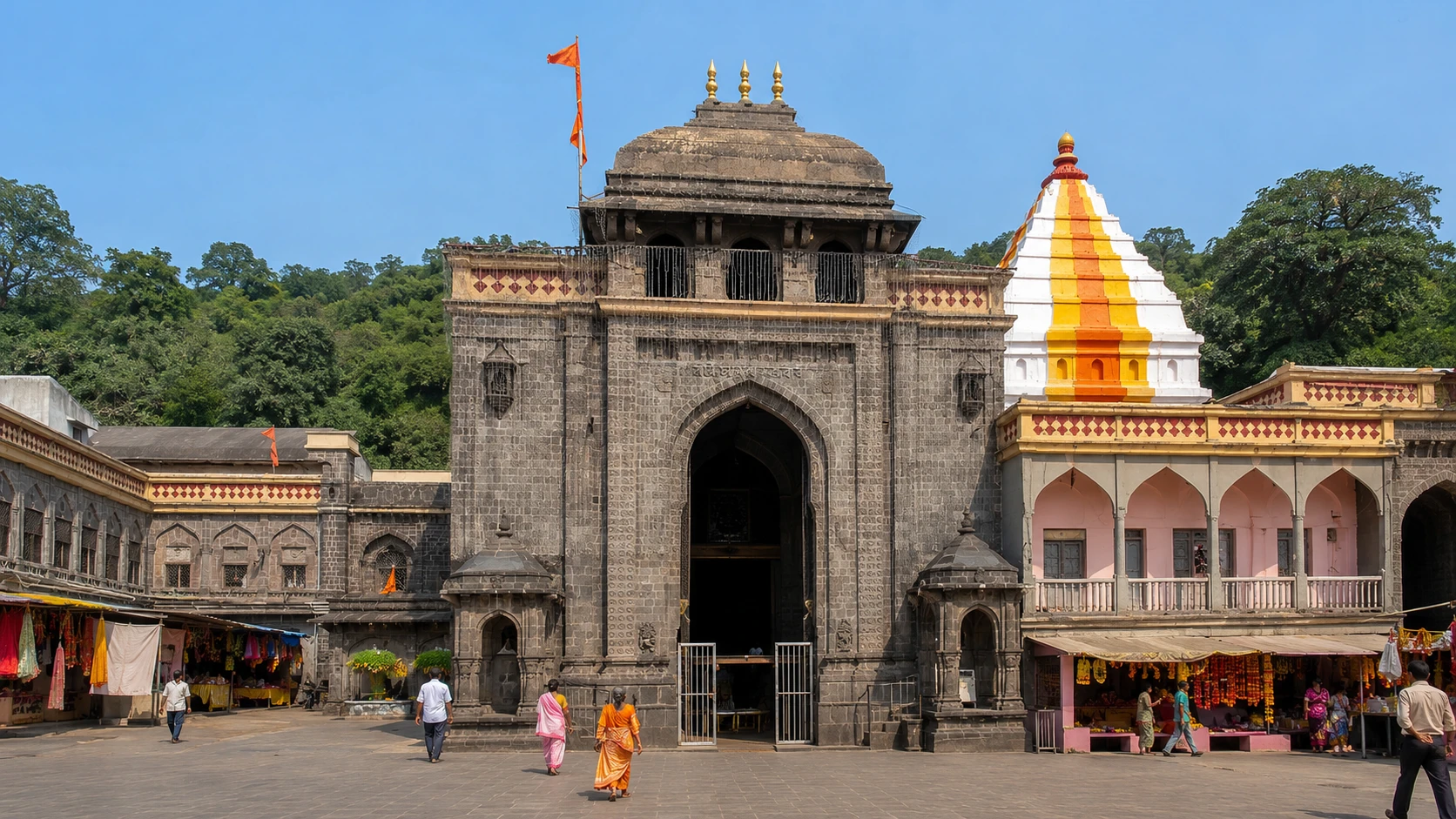
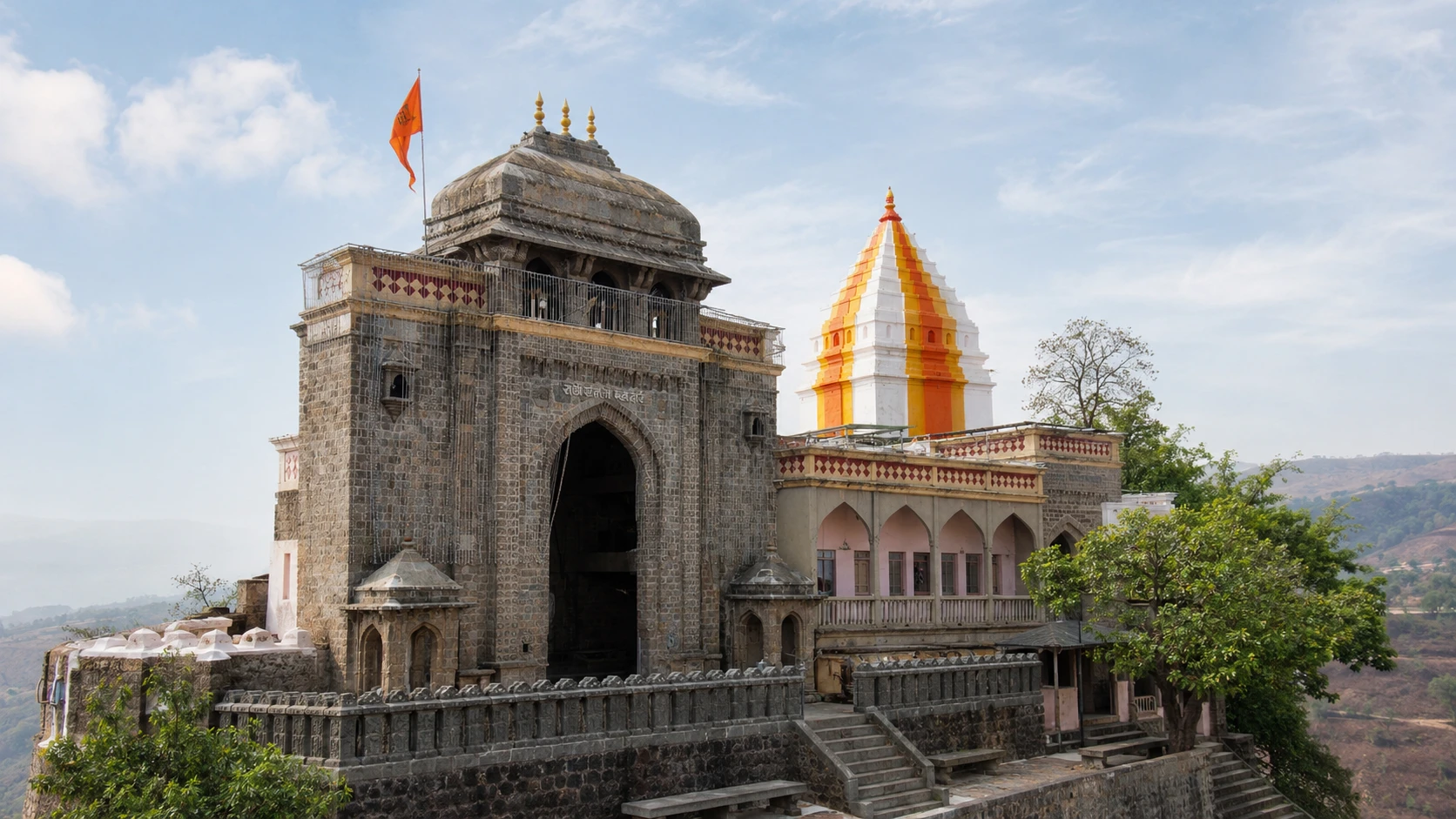
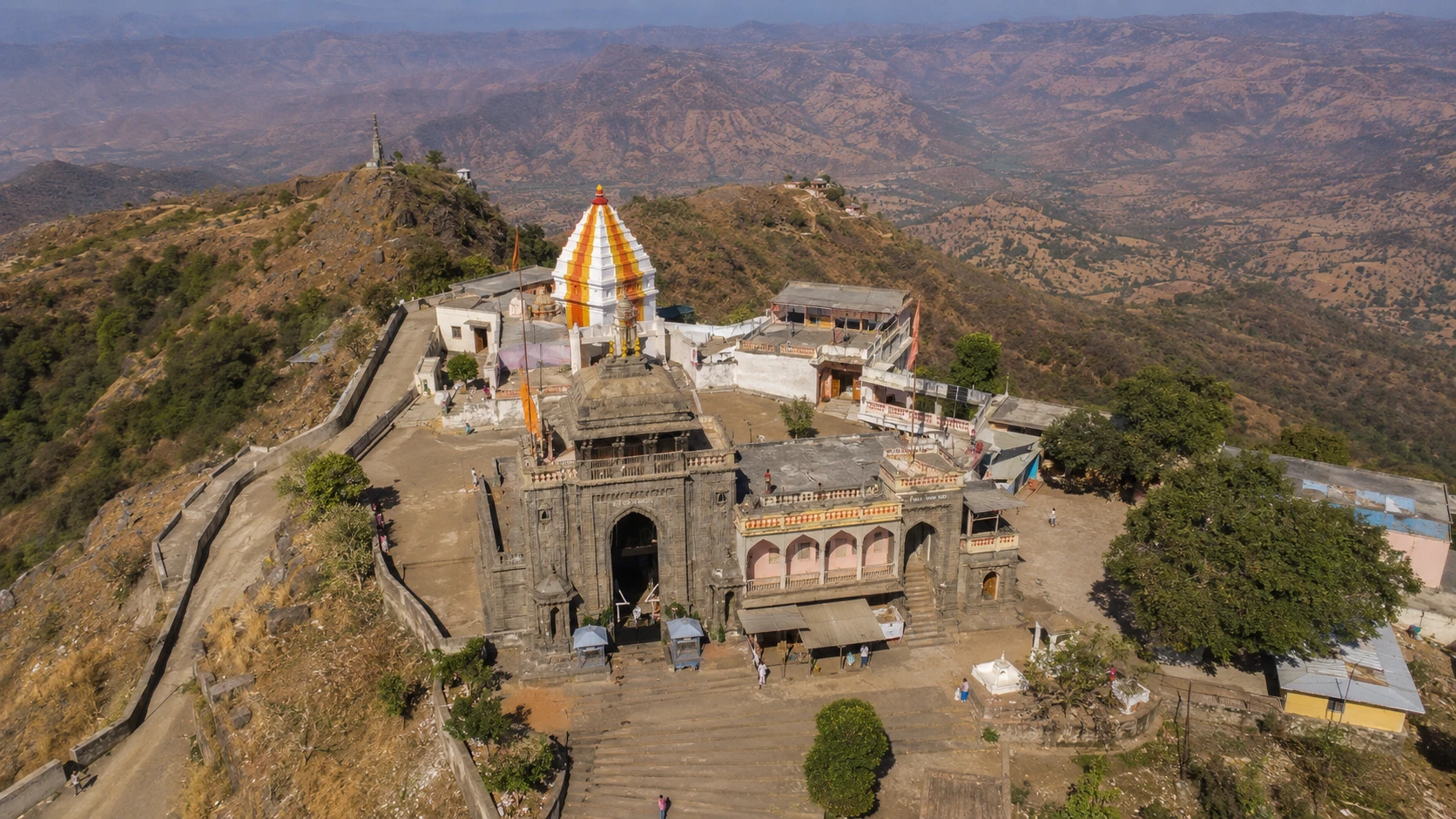
Hilltop temple complex in the regional Marathwada Hemādpanthī architectural register (the temple architectural style associated with Hemādri, the 13th-century Yādava-era polymath and architect-patron whose style characterized eastern Maharashtra temple-construction), with substantial subsequent Maratha-period renovation layering. The triple-shrine hilltop architecture spaces the Reṇukā / Ekavīrā temple (the principal Pīṭha shrine), the Dattātreya shrine (the Datta-sampradaya pole), and the Paraśurāma shrine across the hilltop precinct in a canonical three-pole arrangement. The principal Ekavīrā sanctum's iconographic register preserves the early-medieval Maharashtrian Devī sculpted form within the Hemādpanthī architectural frame
खुला
05:00 – 21:00
आरती
05:30 · 12:00 · 19:00 · 20:30
विशेष
The Reṇukā Devī Yātrā (the principal annual processional festival, typically in the regional Hindu festival calendar) brings substantial Marathwada pilgrim flow; Dattātreya Jayantī (Mārgaśīrṣa Pūrṇimā, Nov-Dec) brings the Datta-sampradaya peak observance at the hilltop's Dattātreya shrine with coordinated three-shrine darshan-flow; Śāradīya Navarātri (Sep-Oct) is the principal annual Devī-focused festival with full nine-night observance at the Ekavīrā sanctum; Vasantī Navarātri (Mar-Apr) brings the spring Devī-festival cycle; Akṣaya Tṛtīyā (Apr-May) brings the canonical day for temple renovation cycles and is observed at Mahur with particular weight
पवित्र कथा · पवित्र कथा
Ekavīrā at Mahur sits atop the Mahurgarh hilltop in Nanded district of eastern Maharashtra, and the Pīṭha occupies a structurally distinctive position in the canonical Aṣṭādaśa enumeration, position 8 in the Adi Shankara recension's Stotram, named as Ekavīrā Māhāyē. The body-part attribution at Ekavīrā is the right hand or right arm (dakṣiṇa-hasta / dakṣiṇa-bāhu), and the Devī's name Ekavīrā (the One Heroine, the Singular Heroine) reflects her iconographic and theological standing as the sole-acting Devī-warrior whose right-arm body-part attribution iconographically anchors the slaying-action register. In the Mahur tradition, the Devī Ekavīrā is theologically identified with Reṇukā, the mother of Paraśurāma in the canonical Mahābhārata and Bhāgavata Purāṇa narratives, and the Mahur hilltop is the site where, in the regional tradition, Reṇukā's body merged into the mountain after the canonical Reṇukā-restoration narrative (Paraśurāma slew Reṇukā at his father Jamadagni's command after a vow-violation, then restored her to life through a boon, with the merger of her body into the Mahur mountain framed as the consummation of her cosmic-feminine destiny). The Bhairava-pair at Ekavīrā is canonically Kapilāmbara per the Pīṭhanirṇaya attestation, with regional Maharashtrian recensions giving local Bhairava-forms as devotionally adjacent attestations. The Mahur hilltop preserves a corpus-distinctive triple-shrine integrated architecture: the Reṇukā / Ekavīrā temple (the Aṣṭādaśa Pīṭha), the Dattātreya shrine (one of the 3.5 / 4 canonical Datta-sampradaya pilgrimage sites of Maharashtra), and the Paraśurāma shrine (the canonical son of Reṇukā and Jamadagni), three theologically distinct shrines arranged on a single hilltop devotional complex. This makes Ekavīrā one of the corpus's two Aṣṭādaśa Pīṭhas with a Datta-sampradaya intra-site integration (alongside Pithapuram / Puruhūtikā at #10, which carries the Datta-sampradaya integration through a distinct architectural-theological pattern). The pilgrim approach to the hilltop is structured around the canonical climb, pilgrims traditionally undertake the approximately 400-step ascent on foot as part of the canonical pilgrim observance, with the motorable road (constructed in the mid-20th century) providing alternative access for elderly or mobility-limited pilgrims.
Sacred Designationपवित्र पदनाम
Shakti Peeth
शरीर का अंग: Right hand / Right arm (Dakṣiṇa-hasta / Dakṣiṇa-bāhu)
शक्ति: Ekavīrā (the One Heroine, theologically identified with Reṇukā in the Mahur tradition; the right-arm body-part attribution iconographically anchors the Devī's sole-acting warrior register)
भैरव: Kapilāmbara (canonical Pīṭhanirṇaya attestation), with regional Maharashtrian recensions giving local Bhairava-forms as devotionally adjacent attestations
Sacred Origin Storyपवित्र उत्पत्ति कथा
Source: Devī Bhāgavata Purāṇa, Skandha VII (canonical 51-Pīṭha enumeration); Kālikā Purāṇa, Chapters 18 and 60, 62 (52-list, dakṣiṇa-hasta body-part attribution at Mahur); Pīṭhanirṇaya (Ekavīrā at Mahur paired with Bhairava Kapilāmbara); Ashtadasha Shakti Pīṭha Stotram attributed to Ādi Śaṅkarācārya (Ekavīrā Māhāyē, position 8); Mahābhārata, Vana Parva and Anuśāsana Parva (the canonical Reṇukā-Paraśurāma narrative); Bhāgavata Purāṇa, Skandha IX (the Paraśurāma narrative); Reṇukā Māhātmya (regional Maharashtrian Sthala Purāṇa tradition on Mahur); Datta Māhātmya (the canonical Datta-sampradaya textual corpus including the Gurucharitra of Sarasvatī Gaṅgādhara, 16th c.); Yādava-period and Maratha-period inscriptional and chronicle evidence at the Mahur complex
The Pīṭha-narrative at Ekavīrā integrates two theologically distinct foundational cycles: the canonical Pīṭha-formation cycle (Sati's body-fragment fell at the Mahur hilltop, specifically the right hand or right arm, giving rise to the Ekavīrā Pīṭha) and the Reṇukā-Paraśurāma cycle from the Mahābhārata and Bhāgavata Purāṇa narrative tradition.
In the Reṇukā-Paraśurāma cycle, Reṇukā was the wife of the sage Jamadagni and mother of Paraśurāma (the sixth avatāra of Viṣṇu in the canonical avatāra-enumeration). When Reṇukā violated her vow of chaste-mindedness in a moment of weakness (the canonical narrative records her observing the Gandharva king Citraratha in amorous play and being momentarily transfixed), Jamadagni in his austerity-grounded wrath commanded his sons to slay her; the elder sons refused, but Paraśurāma, the canonical son of unwavering filial-piety, slew Reṇukā with his axe.
Paraśurāma's subsequent intercession with Jamadagni won him a boon, which he used to restore Reṇukā to life. In the Mahur regional tradition, the Reṇukā-restoration narrative is anchored at the Mahur hilltop: Reṇukā's restored body merged into the Mahur mountain after the restoration, framed as the consummation of her cosmic-feminine destiny and her transition from human-mother form to Devī-Pīṭha form.
The Devī Ekavīrā, theologically identified with the restored-and-merged Reṇukā, presides at the Mahur Pīṭha as the canonical Devī-form of this restoration-and-merger narrative. The Bhairava-pair Kapilāmbara at Ekavīrā reflects the canonical Pīṭhanirṇaya attestation; the local Maharashtrian Bhairava-forms at the hilltop's Śaiva sub-shrine are devotionally adjacent.
The Datta-sampradaya tradition's anchoring at Mahur, through the hilltop Dattātreya shrine, operates within a separate but theologically resonant cycle: the canonical Datta-narrative holds that Dattātreya, the trinitarian sage-incarnation of Brahmā-Viṣṇu-Maheśa, undertakes daily-cycle visits to specific Maharashtrian sites in a coordinated geographical pattern, with Mahur as the canonical resting-place where Datta returns at day's end.
The Paraśurāma shrine at the hilltop completes the triple-shrine architecture by anchoring the canonical son of Reṇukā as the third theological pole. The integrated three-pole hilltop devotional complex (Pīṭha + Datta-sampradaya + Paraśurāma) reflects the Maharashtrian Hindu tradition's distinctive capacity to integrate canonically-distinct theological domains within a single architectural-pilgrimage frame.
उद्धृत स्रोत:
- Devī Bhāgavata Purāṇa, Skandha VII (canonical 51-Pīṭha enumeration)
- Kālikā Purāṇa, Chapters 18 and 60, 62 (52-list tradition; dakṣiṇa-hasta body-part attribution at Mahur)
- Pīṭhanirṇaya (Ekavīrā at Mahur paired with Bhairava Kapilāmbara)
- Ashtadasha Shakti Pīṭha Stotram attributed to Ādi Śaṅkarācārya (Ekavīrā Māhāyē, position 8)
- Mahābhārata, Vana Parva and Anuśāsana Parva (the canonical Reṇukā-Paraśurāma narrative)
- Bhāgavata Purāṇa, Skandha IX (the Paraśurāma narrative)
- Reṇukā Māhātmya (regional Maharashtrian Sthala Purāṇa tradition on Mahur and the Reṇukā-restoration narrative)
- Datta Māhātmya, including the Gurucharitra of Sarasvatī Gaṅgādhara (16th c.) and the Avadhūta Gītā tradition
- Yādava-period inscriptional evidence at the Mahur hilltop complex
- Maratha-period chronicle evidence (Peshwa-period administrative records of the Mahur Pīṭha)
- Sircar, D. C., 'The Śākta Pīṭhas' (Motilal Banarsidass, 1948; revised 1973)
- Bhattacharya, N. N., 'History of the Sakta Religion' (Manohar, 1974)
- Feldhaus, Anne, 'Connected Places: Region, Pilgrimage, and Geographical Imagination in India' (Palgrave Macmillan, 2003), Maharashtrian sacred-geography context
- Glushkova, Irina; Feldhaus, Anne (eds.), 'House and Home in Maharashtra' (Oxford University Press, 1998), Maharashtrian Devī-tradition scholarly framework
अन्य परंपराएँ · अन्य परंपराएँ
Reṇukā ↔ Ekavīrā theological-identification recension
The theological identification of Ekavīrā at Mahur with Reṇukā (the canonical Mahābhārata-Bhāgavata mother of Paraśurāma) is the dominant Maharashtrian tradition reading and is canonical at the Mahur site. A separate scholarly thread observes that the theological-identification of Ekavīrā with Reṇukā emerged historically through the integration of the canonical Reṇukā-Paraśurāma narrative cycle (textually attested in the Mahābhārata and Bhāgavata Purāṇa) with the Pīṭha-attestation at Mahur (canonically attested in the 8th, 12th c. textualization period), and that earlier strata of the Mahur tradition may have operated with a separate Ekavīrā identity not yet integrated with the Reṇukā framework.
The scholarly observation does not contest the canonical Maharashtrian identification but documents the historical formation of the integrated Ekavīrā-Reṇukā theological framework. The corpus uses Ekavīrā-Reṇukā as the canonical Maharashtrian dual-identification while acknowledging the broader scholarly observation of the integration's historical formation.
Mahur as Khaṇḍobā / Reṇukā geographical complex (regional Maharashtrian Devī-tradition)
Within the broader regional Maharashtrian Devī-tradition, Ekavīrā / Reṇukā at Mahur is part of a multi-site Devī geographical complex that includes other regional Devī shrines (notably the Tuljā Bhavānī shrine at Tuljapur, the Mahālakṣmī shrine at Kolhapur, and the Sapt-Shringi shrine at Vani, the canonical Sāḍhe-Tīna-Śakti-Pīṭhas of Maharashtra) and the Khaṇḍobā network (the Maharashtrian Mhasoba-Khaṇḍobā Śaiva-warrior tradition).
The Mahur site operates within this regional network as the Aṣṭādaśa Pīṭha pole, with the regional Sāḍhe-Tīna and Khaṇḍobā contextualization providing devotional-architectural setting beyond the canonical Aṣṭādaśa enumeration.
Pilgrims undertaking the regional Maharashtrian Devī-circuit canonically integrate Mahur alongside the Sāḍhe-Tīna Pīṭhas, a regional pilgrimage architecture distinct from the canonical Aṣṭādaśa Stotram framework.
विद्वत संदर्भ
Ekavīrā at Mahur occupies a structurally distinctive position in the Pīṭha network through the integration of three theological-architectural dimensions at a single hilltop devotional complex: the Aṣṭādaśa Pīṭha (Ekavīrā / Reṇukā as the canonical Devī-Pīṭha with right-arm body-part attribution), the Datta-sampradaya pilgrimage-pole (Mahur as one of the 3.5 / 4 canonical Datta-sampradaya sites of Maharashtra), and the Paraśurāma narrative pole (the canonical son of Reṇukā and Jamadagni). The three-pole triple-shrine intra-site integrated architecture is corpus-distinctive, no other Aṣṭādaśa Pīṭha integrates three theologically distinct devotional poles at a single hilltop precinct in this configuration. Among the Aṣṭādaśa Pīṭhas, Ekavīrā at Mahur is one of two with Datta-sampradaya intra-site integration (the other being Pithapuram / Puruhūtikā at #10, awaiting corpus recategorization patch), with the architectural-theological pattern at Mahur being corpus-distinctive in its triple-shrine hilltop configuration. The Reṇukā ↔ Ekavīrā theological dual-identification reflects the historical integration of the canonical Reṇukā-Paraśurāma narrative cycle with the Pīṭha-attestation, producing a layered theological framework in which the body-part attribution (right hand/arm), the Devī-name (Ekavīrā, the One Heroine), and the canonical maternal-Devī narrative (Reṇukā as Paraśurāma's mother) operate in coordinated devotional coherence. The Datta-sampradaya integration through the hilltop Dattātreya shrine reflects the broader Maharashtrian Datta-tradition's distinctive Pīṭha-integration capacity, with the Mahur hilltop's Dattātreya pole operating in coordinated three-pole devotional architecture with the Pīṭha and the Paraśurāma shrine. Within the regional Maharashtrian Devī-tradition, Mahur additionally operates within the Sāḍhe-Tīna-Śakti-Pīṭhas framework (the canonical Maharashtrian half-and-three Devī-pilgrimage architecture including Tuljā Bhavānī at Tuljapur, Mahālakṣmī at Kolhapur, Sapt-Shringi at Vani, alongside Mahur), giving Mahur dual canonical-network membership (Aṣṭādaśa Pīṭha + regional Sāḍhe-Tīna-Pīṭha). Anne Feldhaus's 'Connected Places' (2003), Günther-Dietz Sontheimer's 'Pastoral Deities in Western India' (1989), and the Glushkova-Feldhaus 'House and Home in Maharashtra' (1998) provide the principal modern academic treatments of the Maharashtrian Devī-tradition's theological-pilgrimage framework.
Historyइतिहास
Ekavīrā at Mahur's historical depth as a sacred site is embedded within the broader Marathwada region's standing as one of the foundational Devī-tradition geographies of western India. The pre-canonical layer (late epic period through c. 4th c.
CE) places the Reṇukā-Paraśurāma narrative tradition at the textual foundation, with the Mahābhārata's Vana Parva and Anuśāsana Parva and the Bhāgavata Purāṇa's Skandha IX providing the canonical scriptural attestation of the Reṇukā-Paraśurāma narrative cycle. The Yādava dynasty period (12th, 14th c.
CE, capital at Devagiri/Daulatabad in the Marathwada region) provided the foundational dynastic-patronage period for the Mahur hilltop temple's substantive architectural development. The Hemādpanthī architectural style (associated with Hemādri, the 13th-century Yādava-era polymath and architect-patron) characterized the Mahur temple-construction phase, with eastern Maharashtra temples of this period preserving the Hemādpanthī register's distinctive features.
The Datta-sampradaya tradition's anchoring at Mahur formalized through the 13th, 14th c. period of Śrīpāda Śrīvallabha (the canonical first Datta-incarnation per the Gurucharitra tradition, c. early 14th c.) and Narasimha Sarasvatī (the canonical second Datta-incarnation, c. late 14th, early 15th c.), with the Datta-sampradaya's pan-Maharashtrian site network (including Mahur, Audumbar, Narsobawadi, Gangapur, and the Andhra-side Pithapuram extension) becoming institutionally consolidated through this period.
The Maratha period (17th, 19th c.) brought substantial Peshwa-administered patronage for the Mahur hilltop's three-pole devotional infrastructure, with the Peshwa-period administrative records documenting the integrated Pīṭha-Datta-Paraśurāma temple-complex's operational continuity.
The British colonial period (1818, 1947) saw the Mahur temple operate within the broader Marathwada region's princely-state and direct-colonial administrative arrangements. Post-Independence (1947 / 1956, Maharashtra state formation) brought administrative arrangements under the Government of Maharashtra state Hindu temple framework.
The motorable road to the Mahur hilltop was constructed in the mid-20th century, providing alternative access alongside the traditional canonical climb. The 21st century has brought infrastructure improvements including coordinated pilgrim management during Dattātreya Jayantī and Reṇukā Devī Yātrā festival periods.
Historical Timelineऐतिहासिक कालक्रम
Pre-canonical textual attestation of the Reṇukā-Paraśurāma narrative cycle through the Mahābhārata (Vana Parva and Anuśāsana Parva) and the Bhāgavata Purāṇa (Skandha IX). The narrative provides the canonical Hindu scriptural foundation for the Reṇukā-restoration story that the Mahur regional tradition later anchored at the Mahur hilltop. The pre-canonical layer establishes Reṇukā as a major Hindu sacred-narrative figure (the wife of Jamadagni, the mother of Paraśurāma, the sixth canonical Viṣṇu-avatāra) prior to the later canonical Pīṭha-attestation at Mahur in the 8th, 12th c. textualization period.
Canonical Pīṭha attestation of Ekavīrā at Mahur through textualization in the Devī Bhāgavata Purāṇa (Skandha VII), the Kālikā Purāṇa (Chapters 18 and 60, 62; dakṣiṇa-hasta body-part attribution at Mahur), the Pīṭhanirṇaya (Ekavīrā at Mahur paired with Bhairava Kapilāmbara), and the Ashtadasha Shakti Pīṭha Stotram attributed to Ādi Śaṅkarācārya (Ekavīrā Māhāyē, position 8). The Pīṭha attestation arrived at the site within the broader 8th, 12th c. textualization period during which the canonical Aṣṭādaśa Stotram framework and the broader Pīṭha-network textualization were consolidated. The historical integration of the Pīṭha attestation with the pre-existing Reṇukā-Paraśurāma narrative tradition at the Mahur regional site produced the layered Ekavīrā-Reṇukā theological framework that subsequent traditions inherited.
Yādava dynasty patronage of the Mahur hilltop temple's substantive architectural development. The Yādavas (12th, 14th c. CE, capital at Devagiri / Daulatabad in the Marathwada region) provided the foundational dynastic-patronage period for the Hemādpanthī architectural elaboration that gives the present Mahur temple its preserved historical-architectural register. Hemādri (the 13th-century Yādava-era polymath, prime minister, and architect-patron whose architectural style, Hemādpanthī, characterized eastern Maharashtra temple-construction during this period) is the canonical figure whose architectural tradition shaped the Mahur temple's medieval form. Yādava-period inscriptional and chronicle evidence at the Mahur hilltop documents the dynasty's sustained patronage of the integrated three-pole devotional complex.
Datta-sampradaya formalization at Mahur through the period of Śrīpāda Śrīvallabha (canonical first Datta-incarnation per the Gurucharitra tradition, c. early 14th c.) and Narasimha Sarasvatī (canonical second Datta-incarnation, c. late 14th, early 15th c.). The Datta-sampradaya's pan-Maharashtrian site network (including Mahur, Audumbar, Narsobawadi, Gangapur, with the Andhra-side Pithapuram extension) became institutionally consolidated through this period. The Mahur hilltop's Dattātreya shrine, the second pole of the corpus-distinctive triple-shrine integrated architecture, was canonically established within the broader Datta-sampradaya pilgrim-network during this period. The Gurucharitra of Sarasvatī Gaṅgādhara (16th c.) provides the principal textual attestation of the Datta-sampradaya site-network including Mahur.
Peshwa-administered patronage of the Mahur hilltop temple complex during the late Maratha period. The Peshwa administration (the Maratha confederacy's executive arm based at Pune, 1713, 1818) provided substantial regional patronage for the Marathwada temple-network including Mahur, with the Mahur hilltop's three-pole devotional complex receiving documented Peshwa-period administrative recognition and renovation funding. Peshwa-period inscriptional and administrative chronicle evidence documents the integrated Pīṭha-Datta-Paraśurāma temple-complex's operational continuity during this period. The Maratha confederacy's broader Hindu-revival administrative posture during the Peshwa period institutionalized the temple-complex's pilgrim-management framework on the foundation that subsequent administrative phases inherited.
Modern administration of the Mahur hilltop temple complex under the Government of Maharashtra state Hindu temple framework (Maharashtra state formed in 1956 from the Bombay Presidency reorganization), with continuing recognition of the integrated three-pole devotional complex's Aṣṭādaśa Pīṭha + Datta-sampradaya + Paraśurāma standing. Key modern-era developments include: the mid-20th century construction of the motorable road to the Mahur hilltop providing alternative pilgrim access alongside the canonical 400-step climb; the 21st century coordinated pilgrim management during Dattātreya Jayantī (the principal annual Datta-sampradaya festival at Mahur) and Reṇukā Devī Yātrā festival periods; the Government of Maharashtra Endowments framework's progressive formalization of the integrated three-shrine pilgrim infrastructure. The temple-complex continues to draw substantial Marathwada and broader Maharashtra pilgrim flow as a regional Devī-Pīṭha + Datta-pilgrimage destination.
What You'll Seeदर्शन में
The Ekavīrā / Reṇukā sanctum atop the Mahur hilltop preserves a corpus-distinctive mukha-pradhāna (face-prominent) iconographic register reflecting the Mahur tradition's Reṇukā-restoration narrative, the canonical regional tradition holds that the restored Reṇukā's body merged into the Mahur mountain after the canonical Reṇukā-restoration cycle, leaving only her face (mukha) visible above the rock surface as the principal devotional object.
The Devī's face is sculpted in dark chlorite/basalt stone characteristic of the regional Marathwada iconographic register, emerges from the rock-surface within the sanctum's interior framework, and is the principal focal point of the daily abhiṣeka and alaṅkāra cycles.
The face's iconographic features are corpus-distinctive: large prominent eyes that anchor the canonical Devī-darshan gaze (the eyes are the principal iconographic feature given the face-prominent configuration), a serene-but-resolute expression that reflects the Devī's One-Heroine (Ekavīrā) standing, and the face's emergence-from-rock register theologically encoding the body-merger narrative.
The face is daily draped in red silk cloth that frames the visible face-region (the cloth functioning as a saree-equivalent given the face-prominent configuration), ornamented with substantial gold and gem-set jewellery (including a prominent crown / kireeta positioned above the face, large gold earrings, nose-pendant, and forehead ornaments), and the broader sanctum's parapet receives the canonical Devī-attribute offerings (flower garlands, additional cloth, incense, lamps).
The right hand / right arm body-part attribution of the Pīṭha is iconographically referenced through the canonical Devī-attribute pattern at the face-region rather than through a full-body sculptural elaboration, the body-part is theologically present at the merged-into-mountain body even if not visually elaborated at the face-only sanctum.
The Mahur hilltop's two subsidiary shrines complete the canonical triple-shrine architecture: the Dattātreya shrine preserves the canonical Datta-sampradaya iconographic register through pādukā (the sacred sandals / footprints) rather than an anthropomorphic murti, a corpus-distinctive Datta-sampradaya devotional object structurally parallel to the Pīṭha's mukha-pradhāna register in its non-full-body iconographic configuration.
The Paraśurāma shrine houses the canonical Paraśurāma anthropomorphic murti, an axe-bearing seated form representing the canonical son of Reṇukā and Jamadagni. The three-shrine hilltop architecture preserves substantial Hemādpanthī architectural elements from the Yādava-period elaboration phase, with subsequent Maratha-period and modern administrative renovation layers visible across the complex.
Distinctive Practicesविशिष्ट परंपराएँ
Triple-Shrine Hilltop Integrated Darshan, Ekavīrā + Dattātreya + Paraśurāma in Coordinated Pilgrim Circuit
त्रि-मंदिर शैल-शिखर एकीकृत दर्शन, समन्वित तीर्थयात्री परिक्रमा में एकवीरा + दत्तात्रेय + परशुराम
Daily; particularly weighted during Dattātreya Jayantī (Mārgaśīrṣa Pūrṇimā, Nov-Dec), Reṇukā Devī Yātrā, Śāradīya Navarātri (Sep-Oct), and Vasantī Navarātri (Mar-Apr)
The corpus-distinctive devotional practice at the Mahur hilltop is the integrated triple-shrine darshan that engages the three theologically distinct devotional poles in a coordinated pilgrim circuit. The canonical darshan-sequence engages: (1) the Ekavīrā / Reṇukā sanctum, the Aṣṭādaśa Pīṭha #8 darshan engaging the corpus-distinctive mukha-pradhāna iconographic register and the right-arm body-part attribution; (2) the Dattātreya shrine, the Datta-sampradaya pādukā darshan engaging the canonical Datta-trinitarian iconographic register through the sacred sandals/footprints rather than an anthropomorphic murti; (3) the Paraśurāma shrine, the canonical Paraśurāma murti darshan engaging the third theological pole as the son of Reṇukā and Jamadagni. The three-pole sequence reflects the canonical theological architecture of the Mahur hilltop: Pīṭha (the Devī) + Datta-sampradaya (the trinitarian sage-avatāra) + Paraśurāma (the canonical son completing the Reṇukā-Paraśurāma narrative cycle). Pilgrims completing the canonical three-pole sequence have engaged the integrated Mahur complex in its full theological structure; pilgrims engaging only one pole have engaged a partial subset. The three-pole sequence is corpus-distinctive, no other Aṣṭādaśa Pīṭha integrates three theologically distinct devotional poles at a single hilltop precinct in this configuration.
The Mahur hilltop operates as an integrated three-pole devotional infrastructure rather than as separate shrines. The Reṇukā-Paraśurāma narrative cycle's mother-son relational architecture is materially preserved at the hilltop through the spatial proximity of the Reṇukā/Ekavīrā Pīṭha and the Paraśurāma shrine, while the Datta-sampradaya integration brings the trinitarian Datta presence into theological-architectural co-residence with the Reṇukā-Paraśurāma narrative. Engaging the Pīṭha without engaging the Datta-pādukā and the Paraśurāma murti approaches a partial subset of the canonical theological structure. The integrated three-pole pilgrimage is the canonical Mahur pilgrim experience.
Datta-Sampradaya Pilgrimage Integration, Mahur within the Maharashtrian 3.5 / 4 Datta-Sites Circuit
दत्त-संप्रदाय तीर्थयात्रा एकीकरण, महाराष्ट्रीय 3.5 / 4 दत्त-स्थल परिक्रमा के भीतर महूर
Year-round; particularly weighted during Dattātreya Jayantī (Mārgaśīrṣa Pūrṇimā, Nov-Dec), Guru Pūrṇimā (Āṣāḍha Pūrṇimā, Jul), and during individual Datta-sampradaya pilgrim observance cycles
Mahur is canonically one of the 3.5 / 4 principal Datta-sampradaya pilgrimage sites of Maharashtra, alongside Audumbar (in Sangli district), Narsobawadi (Narsimha-vāḍī, in Kolhapur district), and Gangapur (in Kalaburagi district, Karnataka), with Pithapuram as an Andhra-side fifth in some broader enumerations. The Datta-sampradaya pilgrim circuit canonically integrates these sites in a coordinated multi-day pilgrimage sequence, Mahur as the Datta-rest-place, Audumbar and Narsobawadi as the Datta-incarnation sites (Śrīpāda Śrīvallabha and Narasimha Sarasvatī respectively), and Gangapur as the Narasimha Sarasvatī samādhi-site. Datta-sampradaya pilgrims undertaking the canonical multi-site circuit engage the Mahur hilltop's Dattātreya shrine through the pādukā darshan (the sacred sandals/footprints), the canonical Datta-iconographic register that operates across all the Datta-sampradaya sites. The Datta-sampradaya integration at Mahur is corpus-distinctive in its co-residence with the Aṣṭādaśa Pīṭha, pilgrims undertaking the Datta-circuit may engage the Pīṭha as integrated extension of their canonical Datta-pilgrimage; pilgrims undertaking the Pīṭha may engage the Datta-pādukā as integrated extension of their canonical Pīṭha-pilgrimage. The bidirectional accessibility of the dual canonical-network membership is corpus-distinctive among the Aṣṭādaśa Pīṭhas.
The Datta-sampradaya tradition holds that Dattātreya, the trinitarian sage-incarnation of Brahmā-Viṣṇu-Maheśa, undertakes daily-cycle visits to specific Maharashtrian sites in a coordinated geographical pattern. Mahur as the canonical resting-place where Datta returns at day's end gives the Mahur site a distinctive theological standing within the Datta-sampradaya network. For the Pīṭha-pilgrim, engaging the Datta-pādukā at Mahur extends the canonical Aṣṭādaśa darshan with the Datta-trinitarian theological dimension; for the Datta-pilgrim, engaging the Pīṭha at Mahur extends the canonical Datta-circuit with the Aṣṭādaśa cosmic-feminine theological dimension. The bidirectional theological-extension capacity of the dual canonical-network membership is the corpus-distinctive theological feature of Mahur.
Hilltop Climb (400-Step Ascent) as Canonical Pilgrim Observance
प्रामाणिक तीर्थयात्री आचरण के रूप में शैल-शिखर चढ़ाई (400-सीढ़ी आरोहण)
Year-round; the climb's physical demand makes the canonical observance particularly weighted as a structured devotional discipline rather than as a routine access mode
The traditional pilgrim approach to the Mahur hilltop is the canonical 400-step ascent on foot, the climb is structured as a canonical devotional observance rather than merely an access mode, with the ascent's physical demand operating as a structured devotional discipline that prepares the pilgrim's contemplative attention for the hilltop's three-pole darshan. The climb begins from the base of the Mahurgarh hill, ascends through stepped pathways carved into the hillside (with regional resting-platforms and minor wayside shrines along the route), and concludes at the hilltop's principal temple complex. The motorable road (constructed in the mid-20th century) provides alternative access for elderly pilgrims, mobility-limited pilgrims, and pilgrims preferring vehicle access, but the canonical pilgrim convention preserves the on-foot climb as the structured devotional observance. Pilgrims undertaking the canonical climb typically: (a) maintain ritual silence or recite Devī mantras during the ascent; (b) pause at the wayside resting-platforms for brief contemplative engagement; (c) approach the hilltop's principal darshan-sequence in the prepared-attention state that the climb produces. The climb as canonical observance is corpus-distinctive among Aṣṭādaśa Pīṭhas, most Pīṭha shrines are accessible without a substantial climb-component, and Mahur's hilltop-elevation makes the climb a structured devotional element rather than a peripheral logistical detail.
The hilltop's elevation is theologically meaningful: in the Mahur tradition, Reṇukā's body merged into the mountain after the restoration, making the hill itself the Devī's body. The climb is therefore not merely physical ascent to the sanctum but a structured devotional movement across the Devī's body toward the mukha-pradhāna face, the face is at the hill's summit because that is the only portion of the merged body that remains visible. The climb's canonical observance reflects this embodied theology: the pilgrim's physical ascent across the body-mountain culminates at the face-only sanctum, materializing the body-merger narrative through the pilgrim's own bodily movement.
Did You Know?क्या आप जानते हैं?
Mahur is the corpus's first Aṣṭādaśa Pīṭha to integrate three theologically distinct devotional poles at a single hilltop precinct, the Reṇukā / Ekavīrā Pīṭha (Aṣṭādaśa #8), the Dattātreya shrine (one of the 3.5 / 4 canonical Datta-sampradaya pilgrimage sites of Maharashtra), and the Paraśurāma shrine (the canonical son of Reṇukā and Jamadagni). The triple-shrine hilltop integrated architecture is corpus-distinctive, no other Aṣṭādaśa Pīṭha integrates three theologically distinct devotional poles in this configuration. Among the corpus Aṣṭādaśa Pīṭhas, Ekavīrā at Mahur is one of two with Datta-sampradaya intra-site integration (alongside Pithapuram / Puruhūtikā at #10, with its distinct architectural-theological pattern), but the triple-shrine hilltop configuration at Mahur is structurally unique within the corpus.
Pīṭhanirṇaya; Gurucharitra of Sarasvatī Gaṅgādhara (16th c.); Reṇukā Māhātmya regional tradition; Feldhaus, 'Connected Places' (2003); Rigopoulos, 'Dattatreya: The Immortal Guru' (1998)
The Ekavīrā / Reṇukā sanctum preserves a corpus-distinctive mukha-pradhāna (face-prominent) iconographic register, the principal devotional object is the Devī's face (mukha) emerging from the mountain rock rather than a full-body anthropomorphic murti. The configuration reflects the Mahur tradition's Reṇukā-restoration narrative: Reṇukā's restored body merged into the Mahur mountain, leaving only her face visible above the rock surface. The face is sculpted in dark chlorite/basalt stone, daily draped in red silk and ornamented with substantial gold jewellery including a prominent crown / kireeta. The iconographic register is theologically integrated: the body-merger narrative produces the face-only iconographic configuration, the hilltop's elevation theologically encodes the merged body, and the canonical 400-step climb materializes the pilgrim's traversal across the Devī's body toward the visible face at the summit.
Reṇukā Māhātmya; Sircar, 'The Śākta Pīṭhas' (1948); Feldhaus, 'Connected Places' (2003)
Mahur holds dual canonical-network membership, it is canonically attested both in the pan-Indian Aṣṭādaśa Stotram framework (as position #8, Ekavīrā Māhāyē) and in the regional Maharashtrian Sāḍhe-Tīna-Śakti-Pīṭhas framework (the canonical Maharashtrian 'three-and-a-half Shakti Pīṭhas' regional pilgrimage architecture). The Sāḍhe-Tīna framework integrates Tuljā Bhavānī at Tuljapur, Mahālakṣmī at Kolhapur, Sapt-Shringi at Vani, and Reṇukā at Mahur as the four Maharashtrian Devī-pilgrimage poles, with Mahur traditionally counted as the 'half' Pīṭha in some versions of the enumeration and as a full Pīṭha in others. The dual canonical-network membership reflects the historical layering of pan-Indian and regional Devī-pilgrimage frameworks at the Mahur site, with both frameworks operating in devotionally compatible registers rather than competing attestations.
Ashtadasha Shakti Pīṭha Stotram; Sāḍhe-Tīna regional Maharashtrian tradition; Feldhaus, 'Connected Places' (2003); Sontheimer, 'Pastoral Deities in Western India' (1989)
The Dattātreya shrine at the Mahur hilltop preserves the canonical Datta-sampradaya iconographic register through pādukā (the sacred sandals / footprints) rather than an anthropomorphic murti, a corpus-distinctive devotional object that operates across all the canonical Datta-sampradaya sites of Maharashtra (Mahur, Audumbar, Narsobawadi, Gangapur). The pādukā register reflects the Datta-tradition's theological emphasis on Dattātreya as the ever-present trinitarian sage-incarnation whose continuing presence is iconographically marked by his footprints rather than by a fixed anthropomorphic form. The pādukā register is structurally parallel to the Pīṭha sanctum's mukha-pradhāna register at Mahur, both shrines use non-full-body iconographic configurations that reflect distinctive theological-narrative structures (face-only for the Devī's body-merger, footprints-only for the sage's continuing presence). The structural parallel between the Pīṭha and Datta iconographic registers at Mahur is corpus-distinctive integration of two non-standard iconographic configurations at a single hilltop precinct.
Gurucharitra; Datta Māhātmya tradition; Rigopoulos, 'Dattatreya: The Immortal Guru' (1998); Pain, 'The Dattātreya Cult' (1986)
The Reṇukā-Paraśurāma narrative cycle that underpins the Mahur tradition is one of the most theologically demanding episodes in the canonical Mahābhārata and Bhāgavata Purāṇa corpus, it presents the slaying of the mother by the son at the father's command, the subsequent restoration through the son's boon-power, and the mother's transition from human form to Devī-Pīṭha form through the body-merger into the Mahur mountain. The narrative integrates filial-piety (Paraśurāma's unwavering obedience to Jamadagni), maternal-restoration (the son's boon used to restore the slain mother), and cosmic-feminine elevation (the human mother becomes the Devī Pīṭha through the merger into the sacred mountain). The Mahur regional tradition's anchoring of this canonical narrative at a specific geographical site is corpus-distinctive in its narrative-density, no other Aṣṭādaśa Pīṭha is the anchor-site for a comparably theologically-dense scriptural narrative from the canonical itihāsa-purāṇa corpus.
Mahābhārata Vana Parva and Anuśāsana Parva; Bhāgavata Purāṇa Skandha IX; Reṇukā Māhātmya; Doniger, 'The Hindus' (2009); Hiltebeitel, 'Rethinking the Mahabharata' (2001)
Visitor Accessप्रवेश जानकारी
The shrine is open to all pilgrims regardless of background. Photography and videography are strictly prohibited inside the Ekavīrā / Reṇukā sanctum and at the Dattātreya pādukā shrine; phones should be carried switched off or deposited at the designated counter. Footwear is removed at the entrance to the temple precinct. The hilltop's three-pole darshan circuit is accessed in coordinated sequence, the principal Reṇukā / Ekavīrā sanctum, the Dattātreya pādukā shrine, and the Paraśurāma murti shrine, typically engaged in that canonical order or in the regional pilgrim-convention's preferred sequence. The 400-step climb is the canonical approach; the motorable road provides alternative access. The shrine operates from approximately 05:00 to 21:00 with four canonical aarti times.
आध्यात्मिक आधार
The photography prohibition reflects the standard sanctum-photography policy of major Aṣṭādaśa Pīṭha shrines, applied across the integrated three-shrine architecture. The canonical hilltop climb is operationally preserved through the on-foot stepped pathway alongside the motorable road's alternative access, neither path is exclusive, but the climb's canonical observance is preserved as the structured devotional discipline. The three-pole darshan-circuit's coordinated sequence reflects the integrated theological architecture of the Mahur hilltop.
समकालीन संदर्भ
The Government of Maharashtra Endowments Department administers the Mahur temple complex with continuing recognition of its integrated Aṣṭādaśa Pīṭha + Datta-sampradaya + Paraśurāma standing. The 21st century has brought infrastructure improvements including coordinated pilgrim management during Dattātreya Jayantī (the principal annual Datta-sampradaya festival at Mahur) and Reṇukā Devī Yātrā festival periods. There are no caste, gender, or sectarian access restrictions in modern practice.
व्यावहारिक मार्गदर्शन
Allow approximately 3, 4 hours at the Mahur hilltop for the integrated three-pole darshan during off-peak periods, plus additional time for the canonical 400-step climb (typically 30, 45 minutes one-way at moderate pace, with the climb's physical demand requiring suitable preparation for elderly pilgrims and those with cardio-vascular considerations). Pilgrims undertaking the canonical multi-day Datta-sampradaya circuit (Mahur + Audumbar + Narsobawadi + Gangapur) typically allocate 3, 5 days for the full circuit. Pilgrims undertaking the regional Maharashtrian Sāḍhe-Tīna-Pīṭhas circuit (Tuljapur + Kolhapur + Vani + Mahur) typically allocate 4, 6 days for the full circuit. Modest, traditional dress is expected; head covering is customary at the sanctum. The hilltop's elevation produces moderately cool conditions year-round; pilgrims should bring layered clothing for early-morning aarti attendance. Drinking water and basic prasad-distribution arrangements are available at the hilltop; pilgrims undertaking the climb should bring water for the ascent.
Festivalsत्योहार
Reṇukā Devī Yātrā (Annual Processional Festival)
रेणुका देवी यात्रा (वार्षिक यात्रा उत्सव)
Regional Hindu festival calendar timing (annual processional cycle traditionally celebrated in the Marathwada region's Devī-festival calendar)
The Reṇukā Devī Yātrā is the principal annual processional festival at Mahur, drawing substantial Marathwada and broader Maharashtra pilgrim flow. The Devī's utsava-mūrti is taken in procession around the Mahur Kṣetra in coordinated regional Maharashtrian Devī-festival format, with the canonical mukha-pradhāna sanctum's daily liturgy elevated to festival-scale ceremonial proportions during the Yātrā cycle. The Yātrā integrates regional pilgrim devotional flows with the canonical Aṣṭādaśa Pīṭha + Sāḍhe-Tīna-Pīṭhas dual-network membership, drawing pilgrims from across the Maharashtrian Devī-pilgrimage community to Mahur as a principal pilgrimage pole. The festival concludes with the Devī's return to the principal sanctum and the resumption of the standard daily liturgical cycle.
Dattātreya Jayantī (Mārgaśīrṣa Pūrṇimā)
दत्तात्रेय जयंती (मार्गशीर्ष पूर्णिमा)
Nov-Dec (Mārgaśīrṣa Pūrṇimā)
Dattātreya Jayantī is the principal annual Datta-sampradaya festival at Mahur, observed on Mārgaśīrṣa Pūrṇimā (the full-moon day of the Mārgaśīrṣa month) as the canonical birth-anniversary of Dattātreya. The festival draws substantial Datta-sampradaya pilgrim flow from across the canonical multi-site network (Mahur + Audumbar + Narsobawadi + Gangapur), with Mahur receiving particularly elevated flow given its Datta-resting-place standing within the Datta-tradition's daily-cycle theology. The canonical three-shrine darshan-circuit at the hilltop is observed with full festival-scale ceremonial proportions, integrating the Dattātreya pādukā shrine's elevated Jayantī observance with the Reṇukā / Ekavīrā sanctum's coordinated festival liturgy and the Paraśurāma shrine's coordinated darshan-flow. The Jayantī festival is corpus-distinctive at Mahur as the integration point where the Pīṭha-tradition and the Datta-sampradaya tradition come into peak coordinated celebration.
Śāradīya Navarātri
शारदीय नवरात्र
Sep-Oct
The autumn Navarātri is the principal annual Devī-focused festival at Mahur, with full nine-night aarti liturgy at the Reṇukā / Ekavīrā sanctum, kanyā-pūjā observances on Aṣṭamī and Navamī, and substantial Marathwada regional pilgrim flow. The festival-scale alaṅkāra of the mukha-pradhāna sanctum brings elaborated ceremonial-scale Devī adornment to the canonical face-prominent iconographic register, the festival's silk-and-jewellery cycle, the elevated lamp-rotation patterns, and the festival-specific floral elaborations engage the face-region with substantially expanded festival-scale ornamentation. Durgāṣṭamī typically brings the festival's peak crowd. The Navarātri observance at Mahur integrates the Aṣṭādaśa Pīṭha framework with the regional Maharashtrian Devī-festival cycle.
Vasantī Navarātri
वासंती नवरात्र
Mar-Apr (Caitra month)
The spring Navarātri at Mahur follows the canonical Devī observance cycle in parallel with the autumn Navarātri but with regionally lower pilgrim flow. The Caitra Navarātri weights the new-year and fertility-blessing dimensions of Devī worship, integrating with the corpus-distinctive mukha-pradhāna iconographic register and the broader integrated hilltop devotional architecture. Rāma Navamī (Caitra Śukla Navamī, the celebration of Rāma's birth) falls within the Vasantī Navarātri observance cycle, integrating the Devī-festival with the Rāma narrative within the canonical Caitra-month liturgical calendar.
Traditional Offeringsपारंपरिक अर्पण
प्राथमिक अर्पण
Red flowers, hibiscus, marigold, jasmine, red roses
लाल पुष्प, गुड़हल, गेंदा, चमेली, लाल गुलाब
पुष्प-माल्य; जपा-कुसुम
Red flowers are the canonical floral offering across the Shākta tradition. At Mahur the offering is placed at the parapet of the mukha-pradhāna Devī sanctum, integrated into the canonical Devī-face adornment cycle. The regional Maharashtrian Devī-floral tradition emphasizes hibiscus (japā-kusum) and marigold; jasmine carries particular weight at the adjacent Dattātreya pādukā shrine (jasmine is the canonical Datta-sampradaya flower across the Maharashtrian Datta-sites). Pilgrims undertaking the integrated three-shrine darshan typically bring coordinated floral offerings appropriate to each shrine's canonical tradition.
Silk vestment (Pattu Saree) and Chunari
रेशम वस्त्र (पट्टु साड़ी) और चुनरी
क्षौम; उत्तरीय
Silk offerings at Mahur are the canonical Devī-vestment offering. The regional Maharashtrian silk-weaving traditions (Paithani silk being particularly significant given its regional anchoring) provide regional pilgrims with locally-significant offering options. At the mukha-pradhāna sanctum the silk offering is incorporated into the daily silk-drapery cycle that frames the visible face-region, the cloth functioning as a saree-equivalent given the face-prominent configuration, with the visible portion of the cloth draped around the face-region as the principal element of the Devī's adornment.
Coconut
नारियल
नारिकेल
Coconut, offered whole or broken at the sanctum, represents the egoic self surrendered to the Devī. At Mahur the coconut offering follows the standard Maharashtrian Devī temple convention, with the broken coconut's interior fluid offered as part of the daily abhiṣeka sequence directed at the mukha-pradhāna face-region. Coconut is also a standard offering at the adjacent Dattātreya pādukā shrine and the Paraśurāma shrine.
Sindoor and Kumkum (vermilion offerings)
सिंदूर और कुंकुम
सिन्दूर; कुङ्कुम-तिलक
Sindoor and kumkum are applied at the Devī's mukha-pradhāna face's consecrated application points (the forehead, the parting-line of the silk drapery framing the face), on the chunari, and as tilak on the pilgrim's forehead. The consecrated kumkum returned as prasad carries the canonical Devī-presence consecration. The corpus-distinctive face-prominent configuration concentrates the kumkum application at the visible face-region, making the offering's iconographic engagement particularly direct.
Akhand-Jyot ghee and wicks
अखंड-ज्योत हेतु घी और बत्तियाँ
अखण्ड-ज्योतिः घृत-वर्तिका
The temple complex maintains continuously-burning lamps at all three hilltop shrines, the Ekavīrā / Reṇukā sanctum, the Dattātreya pādukā shrine, and the Paraśurāma shrine. Pilgrims offer ghee and wicks to be added to these lamps. The integrated three-shrine lamp-maintenance is a corpus-distinctive devotional infrastructure: pilgrims undertaking the canonical three-pole darshan typically offer coordinated ghee-and-wick offerings across all three shrines, with the cumulative offering supporting the integrated devotional architecture's continuing operation.
इस मंदिर की विशेषता
Cow-Ghee (Gomata-Ghṛta) for Integrated Three-Shrine Lamp Offering
एकीकृत त्रि-मंदिर दीप अर्पण हेतु गाय-घी (गोमाता-घृत)
Pure cow-ghee (gomata-ghṛta) carries particular ritual weight at Mahur given the Datta-sampradaya tradition's cosmological centering of the cow as the sacred animal companion of Dattātreya, the canonical Datta-iconographic register in pan-Maharashtrian Datta-sites includes the cow alongside the dogs (representing the four Vedas) as Datta's continuing companions, and the cow-ghee offering at Mahur's integrated three-shrine lamp-maintenance is theologically resonant beyond the standard Devī-lamp offering. Pilgrims undertaking the canonical three-pole darshan with the Datta-sampradaya theological integration typically bring cow-ghee specifically (rather than mixed ghee or commercial ghee preparations) for the integrated three-shrine lamp offering, with the offering's pure-cow-ghee specification carrying the canonical Datta-cosmological weight. The offering is corpus-distinctive at Mahur in its theological integration of the Devī-lamp tradition with the Datta-cow-cosmological tradition through the integrated three-shrine devotional architecture.
Integrated Three-Shrine Offering Pūjā-Thālī (Coordinated Devī + Datta-Pādukā + Paraśurāma Offering Set)
एकीकृत त्रि-मंदिर अर्पण पूजा-थाली (समन्वित देवी + दत्त-पादुका + परशुराम अर्पण समूह)
The corpus-distinctive offering tradition at Mahur is the integrated three-shrine pūjā-thālī, a coordinated offering set assembled by pilgrims undertaking the canonical three-pole darshan, with offerings calibrated to each shrine's distinctive devotional register. The Devī component of the thālī includes the canonical Devī-offerings (red flowers, silk, sindoor/kumkum for the mukha-pradhāna sanctum); the Datta-pādukā component includes the canonical Datta-offerings (jasmine flowers, sandalwood paste, silk pādukā-cloth for wrapping the sacred sandals, cow-ghee for the lamps); the Paraśurāma component includes the canonical Vaiṣṇava-avatāra offerings (tulsī leaves, sacred basil garlands, kheer-prasad). Pilgrims preparing the integrated thālī at home or at the Mahur base-town vendor counters bring it up the canonical 400-step climb (or via the motorable road) for coordinated offering at all three shrines in canonical darshan sequence. The integrated thālī is corpus-distinctive in its physical materialization of the three-pole hilltop architecture, the offering's coordinated structure mirrors the hilltop's coordinated theological structure, and the integrated offering act is the pilgrim's principal way of materially engaging the corpus-distinctive triple-shrine integration.
Offerings may be brought from outside or purchased at vendor counters near the temple precinct's base (at the foot of the climb) and at the hilltop's upper precinct. The integrated three-shrine offering coordination is the corpus-distinctive offering pattern at Mahur, pilgrims should plan offerings appropriate to each shrine's devotional register rather than bringing only Devī-offerings or only Datta-offerings. The Government of Maharashtra Endowments framework through the Mahur Devasthanam coordinates the offering ecology including the canonical multi-shrine ritual materials.
How to Reachकैसे पहुँचें
Mahur is accessible from major eastern Maharashtra transport hubs, with the hilltop's relatively remote location requiring multi-stage transport for most pilgrims. By air, Nanded Airport (NDC, 130 km) provides limited domestic connectivity; Aurangabad Airport (IXU, 270 km) and Nagpur Dr.
Babasaheb Ambedkar International Airport (NAG, 280 km) provide fuller domestic and international connectivity. By rail, Kinwat Railway Station (KNVT, 60 km) is on the Adilabad-Nanded line, the nearest railhead; Nanded Junction (NED, 130 km) is the principal regional rail junction with extensive connectivity to the Maharashtra and broader pan-Indian rail network including direct trains from Mumbai, Pune, Hyderabad, Tirupati, and the broader regional network; Yavatmal Railway Station (YTL, 90 km) offers alternative regional access.
From the railheads, pilgrims complete the journey to Mahur by road via local taxis, Maharashtra State Road Transport Corporation (MSRTC) bus services, or arranged hired transport. By road, Mahur is accessible via State Highway and District Road connectivity to the Marathwada regional road network, MSRTC operates regular bus services from Nanded, Yavatmal, and the broader Marathwada region.
Pilgrims undertaking the canonical multi-day Datta-sampradaya circuit (Mahur + Audumbar + Narsobawadi + Gangapur) or the Sāḍhe-Tīna-Pīṭhas circuit (Mahur + Tuljapur + Kolhapur + Vani) typically arrange hired multi-day road transport given the inter-site distances and the dispersed geographical distribution.
The Mahurgarh hilltop is accessed via the canonical 400-step climb (pedestrian access from the base) or the motorable road (vehicle access for the broader hilltop precinct).
Plan Your Visitयात्रा की योजना
🌤 सर्वोत्तम मौसम
October through February offers the most agreeable weather, cool, dry, and clear, ideal for the integrated three-shrine darshan at Mahur and the canonical 400-step climb. The hilltop's elevation produces moderately cool conditions year-round, with winter pre-dawn conditions during this season particularly suited for the canonical pilgrim climb. March through May bring intense pre-monsoon heat in the Marathwada region (40°C+) that makes the climb significantly more demanding; the monsoon months (June-September) bring substantial rainfall that can make the climb's stepped pathway slippery and the broader hilltop precinct's outdoor circulation challenging. The major festival seasons, Dattātreya Jayantī (Nov-Dec), the Reṇukā Devī Yātrā (annual regional calendar timing), Śāradīya Navarātri (Sep-Oct), and Vasantī Navarātri (Mar-Apr), bring substantial pilgrim flow.
👘 पहनावे का नियम
Modest, traditional attire is expected at all three shrines of the Mahur hilltop. Both traditional and modern modest dress are accepted; head covering is customary at the Ekavīrā / Reṇukā sanctum and at the Dattātreya pādukā shrine. Sturdy walking footwear is essential for the canonical 400-step climb (footwear is removed at the entrance to each individual shrine within the hilltop precinct, not at the base of the climb). For pilgrims undertaking the climb, comfortable layered clothing is recommended to accommodate the climb's exertion-warming and the hilltop's moderately cool conditions. The regional Maharashtrian convention preserves traditional dress for major festival observances; for Reṇukā Devī Yātrā and Dattātreya Jayantī, traditional Maharashtrian attire (saree / dhoti-kurta / Maharashtrian Devī-pilgrim conventional dress) is the canonical festival pilgrim convention.
📱 फोन और फोटोग्राफी
Mobile phones must be deposited at the cloak counter before entering the Ekavīrā / Reṇukā sanctum and the Dattātreya pādukā shrine, or carried in switched-off state. Photography and videography are strictly prohibited within both shrines. Photography is permitted in the outer prākāra, on the hilltop's open-air precincts, on the climb's stepped pathway, and across the broader Mahurgarh hilltop landscape (subject to discretion at the Paraśurāma shrine where local convention varies).
🏨 आवास
Mahur has a limited local accommodation inventory, basic Devasthanam-coordinated guesthouse facilities for pilgrims, a small number of private hotels in the Mahur town centre at the base of the hill, and basic dharamshala accommodations operated by various Maharashtrian Hindu religious-trust frameworks. The Mahur Devasthanam coordinates accommodation arrangements during major festival periods. Most pilgrims base in Nanded (130 km, with substantially more elaborated accommodation across budget categories) or Yavatmal (90 km) and undertake Mahur as an overnight or two-day visit. Pilgrims undertaking the canonical multi-day Datta-sampradaya circuit (Mahur + Audumbar + Narsobawadi + Gangapur) typically arrange accommodation at each circuit-site rather than basing centrally. Pilgrims undertaking the Sāḍhe-Tīna-Pīṭhas circuit (Mahur + Tuljapur + Kolhapur + Vani) similarly arrange site-specific accommodation. During Dattātreya Jayantī and Reṇukā Devī Yātrā the accommodation demand at Mahur exceeds local supply; advance booking at Nanded or Yavatmal is recommended for these periods.
Book a Pujaपूजा बुक करें
Mahur draws Marathwada-regional pilgrim flow that includes a corpus-distinctive multi-tradition pilgrim category, Aṣṭādaśa Pīṭha pilgrims, Datta-sampradaya circuit pilgrims (undertaking the canonical four-site Maharashtrian Datta-circuit), and Sāḍhe-Tīna-Pīṭhas circuit pilgrims (undertaking the canonical four-site regional Maharashtrian Devī-circuit). The multi-tradition pilgrim concentration creates corresponding multi-domain vulnerability to third-party fraud across the integrated hilltop devotional complex. Third-party activity to navigate with care includes: informal-pandit intermediaries at the base of the canonical 400-step climb soliciting 'integrated three-shrine VIP darshan' or 'authenticated Datta-pādukā coordinated abhiṣeka' coordination at high cost outside the Devasthanam-recognized priest-roster, pilgrims should engage ONLY the Devasthanam's official priest roster for integrated three-shrine ritual coordination; travel-agency operators offering 'Datta-sampradaya 4-site combined yatra packages' (Mahur + Audumbar + Narsobawadi + Gangapur) that may charge significantly above market and may include non-Devasthanam-recognized priest arrangements at each circuit-site, verify all multi-site circuit package operators against each site's respective Devasthanam recognition before payment; online booking aggregators selling 'guaranteed Reṇukā Devī Yātrā VIP processional access' or 'priority motorable-road VIP hilltop access' (since the motorable road's vehicle-permit framework can be a vector for fraud claims) outside official Devasthanam channels; and informal-vendor intermediaries near the temple selling 'authenticated Datta-pādukā gold offerings' or 'integrated three-shrine pūjā-thālī ready-prepared sets' for the corpus-distinctive offering tradition, pilgrims seeking these items should source through reputable Mahur-base-town vendors or Devasthanam-recognized retail counters rather than informal sellers. Any third-party website or service claiming to offer 'guaranteed Ekavīrā / Reṇukā VIP darshan,' 'authenticated Datta-sampradaya 4-site coordination,' or 'priority Sāḍhe-Tīna integrated pilgrimage booking' should be verified through the Mahur Devasthanam and the respective circuit-site Devasthanam official channels before any payment.
Managed by: Sri Reṇukā Devī Mahur Devasthanam, the temple complex's official administrative trust framework operating under the Government of Maharashtra Endowments Department. The Devasthanam coordinates major sevas across the integrated three-shrine hilltop architecture, the canonical Reṇukā Devī Yātrā festival, Dattātreya Jayantī coordinated three-shrine observance, Sharad and Vasantī Navarātri programming, and pilgrim-service arrangements for the canonical 400-step climb and the motorable road infrastructure
Booking information verified: 2026-05-17
Sacred Soundsपवित्र ध्वनि
Ashtadasha Shakti Pīṭha Stotram (attributed to Ādi Śaṅkarācārya; names Ekavīrā Māhāyē at position 8 in the eighteen-shrine canonical sequence)
stotram
Durgā Saptaśatī / Devī Māhātmya Pāṭha (the 700-verse Shākta liturgy from the Mārkaṇḍeya Purāṇa), recited at the Ekavīrā / Reṇukā sanctum during Śāradīya Navarātri and Vasantī Navarātri cycles in coordinated nine-night observance
path
Gurucharitra of Sarasvatī Gaṅgādhara (16th c. Marathi devotional text), the canonical Datta-sampradaya hagiographical corpus narrating the lives of Śrīpāda Śrīvallabha and Narasimha Sarasvatī, with the pan-Maharashtrian Datta-sampradaya site network including Mahur attested as foundational pilgrim infrastructure. The Gurucharitra is corpus-distinctive at Mahur as the principal Datta-sampradaya scripture engaged in coordinated reading at the hilltop's Dattātreya pādukā shrine
hagiography
Reṇukā Māhātmya (regional Maharashtrian Sthala Purāṇa tradition on Mahur, anchoring the Reṇukā-restoration narrative at the Mahur hilltop and providing the foundational regional scriptural attestation for the body-merger theological framework and the mukha-pradhāna iconographic register)
purana
Śrī Vidyā Tri-Bīja (Om Aim Hrīṁ Śrīm), the three-seed Devī mantra suitable for non-initiated recitation; the Pañcadaśākṣarī and longer Śrī Vidyā mantras require initiation and are not published
mantra
क्या आप जानते हैं? · Did You Know?
वही अनुवाद त्रुटि जिसने हिन्दू धर्म में '33 कोटि' को '33 करोड़' बनाया, बौद्ध धर्म में भी हुई। बौद्ध ग्रन्थों के चीनी अनुवाद ने 'सप्त कोटि बुद्ध' (7 श्रेष्ठ बुद्ध) का अनुवाद '7 करोड़ बुद्ध' कर दिया। तिब्बती अनुवाद ने सही किया: 7 प्रकार, 7 करोड़ नहीं। एक संस्कृत शब्द, दो प्रमुख विश्व धर्मों में गलत पढ़ा गया, ने दो एकसमान भ्रम स्वतन्त्र रूप से उत्पन्न किए।
Related Contentसंबंधित सामग्री
Related Scriptures
Related Temples
Mahalakshmi Kolhapur
महालक्ष्मी कोल्हापुर
Kolhapur, Maharashtra
Pithapuram Kukkuteswara Swamy
पीठापुरम
Pithapuram, Andhra Pradesh
Biraja Devi (Girija)
बिरजा देवी (गिरिजा)
Jajpur, Odisha
Alopi Devi (Madhaveshwari)
अलोपी देवी (माधवेश्वरी)
Prayagraj, Uttar Pradesh
Jogulamba Temple
जोगुलाम्बा मंदिर
Alampur, Telangana
Bhramaramba Devi (Srisailam)
भ्रमरांबिका देवी (श्रीशैलम)
Srisailam, Andhra Pradesh
Manikyamba Devi
माणिक्यांबा देवी
Draksharamam, Andhra Pradesh
Kamakhya Temple
कामाख्या मंदिर
Guwahati, Assam
Kalighat
कालीघाट
Kolkata, West Bengal
Ambaji
अंबाजी
Ambaji, Gujarat
Community Reflections
🕉️
Be the first to share your reflection.