Bhramaramba Devi (Srisailam)
भ्रमरांबिका देवी (श्रीशैलम)
The Bee-Mother whose Pīṭha shares its sanctum with the Jyotirliṅga
Srisailam, Andhra Pradesh, India
BhramarāmbāAlso known as: Bhramaramba Devi, Bhramari Devi, Sri Bhramaramba, Bhramaramba Amma, Bhramara Mata, Adi Shakti Bhramari
युग
Pre-canonical mountain-shrine standing with continuous worship from at least the Mauryan period (3rd c. BCE); canonical Pīṭha + Jyotirliṅga attestation by 8th, 12th c.; Adi Shankara establishment (8th c.) with composition of Bhramarāmbā Aṣṭakam and Śivānanda Laharī; current temple structure substantially Vijayanagara-era (14th, 16th c.) with continuing renovation under Andhra Pradesh State Endowments Department administration
वास्तुकला
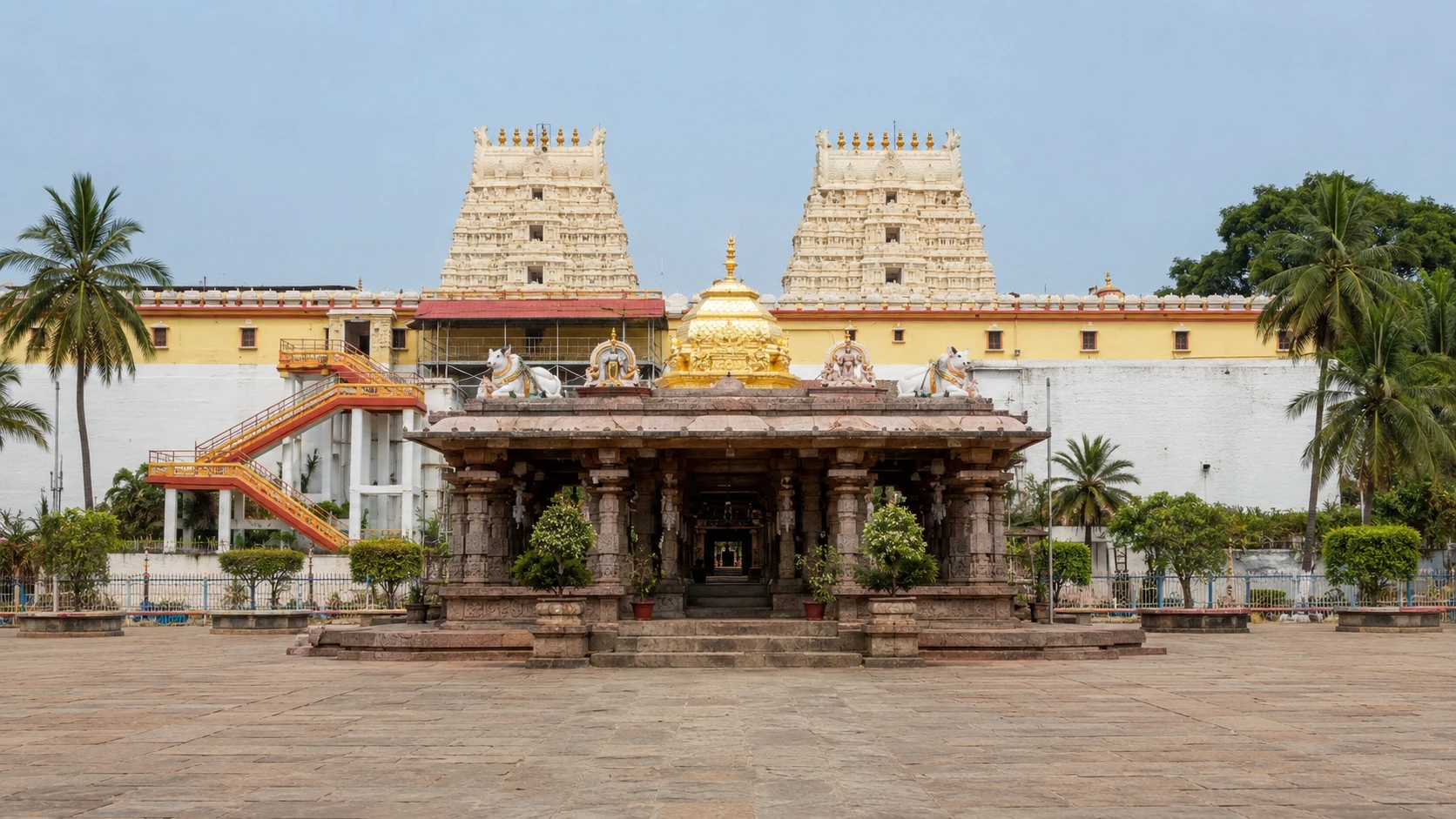
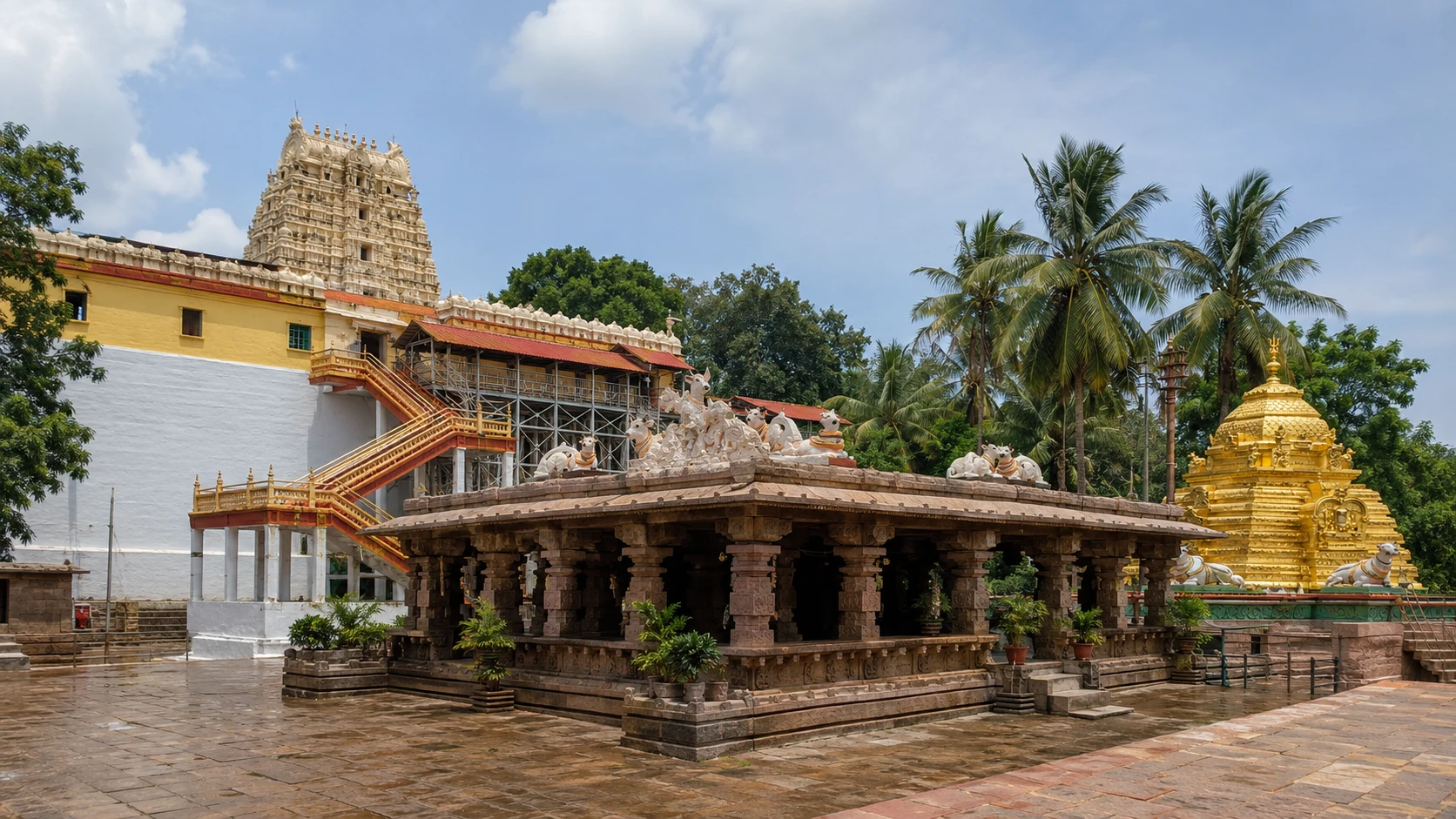
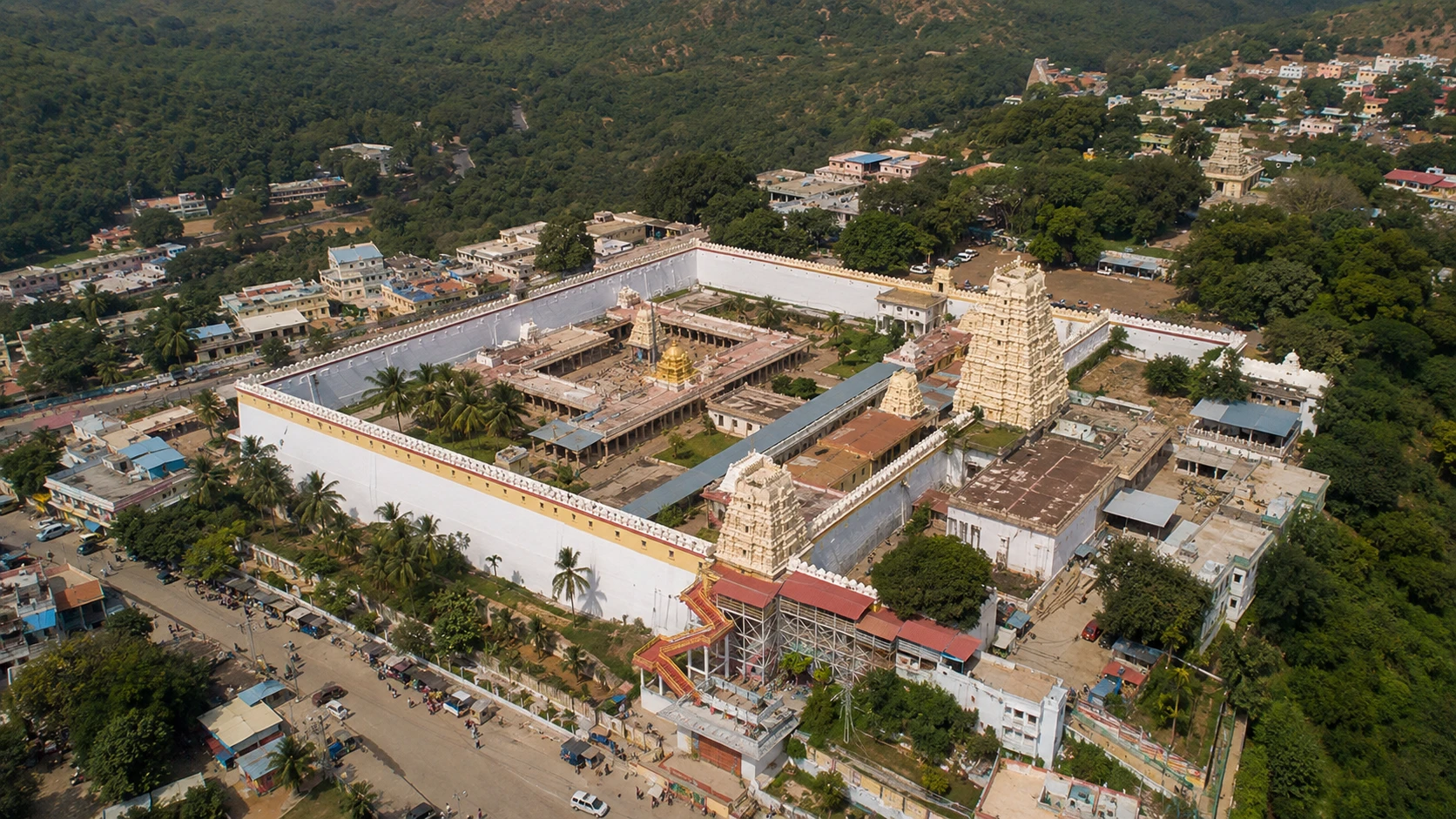
Dravidian (Drāviḍa) tradition with layered Pallava, Chola, Kakatiya, Vijayanagara and modern construction phases; the central Mallikārjuna Jyotirliṅga sanctum and the adjacent Bhramarāmbā Devī sanctum are within a single integrated temple complex with shared outer prākāra and shared mukhamaṇḍapa approach; substantial Vijayanagara-era gopuram expansions and the characteristic Nallamala hilltop temple-fortification walls give the complex its present visual profile
खुला
04:30 – 22:00
आरती
04:30 · 06:00 · 12:00 · 18:30 · 21:00
विशेष
The Mahā Śivarātri night (Phālguna Kṛṣṇa Caturdaśī, Feb, Mar) is the year's principal observance, with overnight darshan-flow at both the Bhramarāmbā and Mallikārjuna sanctums; the annual Bhramarāmbā Brahmotsavam (Caitra month, Mar, Apr) is the principal Devī-focused festival; the Sharad Navrātri cycle (Sept, Oct) brings substantial regional pilgrim flow; the Pradoṣa observances (each pakṣa's trayodaśī) are particularly weighted at this Pīṭha-Jyotirliṅga shrine because of the dual Śiva-Devī presence
पवित्र कथा · पवित्र कथा
No Pīṭha in the entire 51-Pīṭha network is paired with its Bhairava the way Bhramarāmbā is paired with Mallikārjuna at Śrīśailam. At other Pīṭhas the Bhairava is named in the Pīṭhanirṇaya enumeration and his shrine is often at some geographical remove from the Devī's, the two presences are theologically paired but spatially separated. At Śrīśailam the Bhairava is the Mallikārjuna Jyotirliṅga itself, one of the twelve great Jyotirliṅgas of Śiva, and the Pīṭha and the Jyotirliṅga are co-located in a single temple complex on the summit of Śrī Śaila mountain, with shared precinct, shared circumambulation path, and a darshan-flow that takes pilgrims through both shrines in a single integrated sequence. This is the closest Pīṭha-Jyotirliṅga geographical pairing in the entire 51+12 cross-reference, and the theological intensity that follows from it is correspondingly singular: where most Pīṭhas express the Devī presence and most Jyotirliṅgas express the Śiva presence, Śrīśailam expresses both at maximum proximity, making the Śiva-Śakti unity that the entire Shaiva-Shakta theological architecture rests on locally manifest at darshan distance. The Devī herself is Bhramarāmbā, the bee-mother, named for the Devī Māhātmya episode in which she takes the form of countless bees (bhramara) to slay the demon Aruṇa, who had obtained immunity from being killed by human, asura, man, or beast. The bees that emerge from her body to swarm and slay Aruṇa are the same bees that pilgrims can hear humming in the temple's sanctum on certain days, the local tradition holds that the Devī's bee-presence is audible to those whose hearing is sufficiently devotional. Adi Shankara, on his dig-vijaya cycle in the 8th century, established his own devotional presence at the site through the composition of the Bhramarāmbā Aṣṭakam (eight-verse hymn to the bee-mother) and the Śivānanda Laharī (the Wave of Śiva's Bliss, his great hymn to Mallikārjuna), two foundational devotional works composed at the same hilltop, in the same brief stay, addressed to the two co-located deities of Śrīśailam. The temple's identity is structured around this Śiva-Śakti unity at every level: the architecture, the liturgy, the daily darshan-flow, the festival cycle, and the very iconographic register of the Devī, who at Bhramarāmbā is not the standalone Devī of an isolated Pīṭha but the Devī whose presence anchors the Mahā Yantra of Śiva-Śakti unity at Śrīśailam.
Sacred Designationपवित्र पदनाम
Shakti Peeth
शरीर का अंग: Neck (Grīvā)
शक्ति: Bhramarāmbā (also enumerated as Bhrāmarī Devī, the bee-mother of the Devī Māhātmya Bhramari cycle)
भैरव: Mallikārjuna (the Mallikārjuna Jyotirliṅga; the second of the twelve Jyotirliṅgas of Śiva)
Sacred Origin Storyपवित्र उत्पत्ति कथा
Source: Devī Bhāgavata Purāṇa, Skandha VII (canonical 51-Pīṭha enumeration); Kālikā Purāṇa, Chapters 18 and 60, 62 (52-list, grīvā body-part attribution); Pīṭhanirṇaya; Ashtadasha Shakti Pīṭha Stotram attributed to Ādi Śaṅkarācārya (Śrīśaile Bhrāmarī, position 6); Devī Māhātmya / Mārkaṇḍeya Purāṇa (Bhramari Devi cycle slaying the demon Aruṇa); Skanda Purāṇa (Śrīśaila Khaṇḍa, regional Sthala Purāṇa); Mahābhārata (Vana Parva references to Śrī Śaila as a sacred mountain); Adi Shankara's Bhramarāmbā Aṣṭakam and Śivānanda Laharī (8th c.); Liṅga Purāṇa (Mallikārjuna Jyotirliṅga attestation)
The Pīṭha-narrative at Śrīśailam carries an exceptional theological intensity because of its convergence with two prior mythological cycles. First, the Bhramari Devī cycle from the Devī Māhātmya: the demon Aruṇa, through severe tapas, obtained from Brahmā the boon that no human, no asura, no man, no woman, and no beast could kill him.
With this near-total immunity, Aruṇa became invincible and threatened the cosmic order. The Devī, asked by the gods to intervene, considered the constraints of Aruṇa's boon and took a form that fell outside its enumeration, she manifested as countless bees (bhramara), emerging from her body in a vast swarm.
The bees descended on Aruṇa and slew him, the boon's enumeration not having anticipated this form. From this episode the Devī took the name Bhramarāmbā or Bhrāmarī Devī, the bee-mother, the mother of bees, the Devī whose embodiment as bees demonstrated the limit of taxonomic boons against the principle of feminine power.
Second, the Mallikārjuna Jyotirliṅga cycle from the Liṅga Purāṇa and the regional Skanda Purāṇa Śrīśaila Khaṇḍa: Śiva, in pursuit of his son Kārttikeya who had retreated to Krauñca mountain after a family dispute, manifested at Śrīśailam in the form of the Mallikārjuna Liṅga, the name compounded from mallikā (jasmine) and arjuna (the white Arjuna tree), referencing the Liṅga's appearance covered in white jasmine flowers and the surrounding Arjuna trees of the Nallamala forest.
Mallikārjuna became the second of the twelve Jyotirliṅgas of Śiva. Onto this dual mythological foundation, the Devī's Bhramari embodiment and the Śiva's Mallikārjuna manifestation, the Pīṭha narrative arrived: Satī's neck (grīvā) fell at Śrīśailam, and the Pīṭha that arose at the site was identified with Bhramarāmbā in iconographic continuity with the Devī Māhātmya Bhramari cycle, and was paired with Mallikārjuna in geographical and theological continuity with the Jyotirliṅga that had been at the site for longer.
The Pīṭha-Jyotirliṅga unity that Śrīśailam expresses is the most theologically intense Śiva-Śakti convergence in the entire pan-Indian sacred geography, anchored in shared sacred-mountain topography that predates either canonical narrative.
उद्धृत स्रोत:
- Devī Bhāgavata Purāṇa, Skandha VII (canonical 51-Pīṭha enumeration)
- Kālikā Purāṇa, Chapters 18 and 60, 62 (52-list tradition; grīvā body-part attribution)
- Pīṭhanirṇaya (Tantric pīṭha-enumeration treatise)
- Ashtadasha Shakti Pīṭha Stotram attributed to Ādi Śaṅkarācārya (Śrīśaile Bhrāmarī, position 6)
- Devī Māhātmya / Mārkaṇḍeya Purāṇa, Bhramari Devi cycle slaying the demon Aruṇa
- Skanda Purāṇa, Śrīśaila Khaṇḍa (regional Sthala Purāṇa of Srisailam)
- Liṅga Purāṇa, Mallikārjuna Jyotirliṅga canonical attestation
- Adi Shankara, Bhramarāmbā Aṣṭakam (8th c.)
- Adi Shankara, Śivānanda Laharī (8th c.; composed at Śrīśailam, addressed to Mallikārjuna)
- Mahābhārata, Vana Parva (references to Śrī Śaila as sacred mountain)
- Sircar, D. C., 'The Śākta Pīṭhas' (Motilal Banarsidass, 1948; revised 1973)
- Pintchman, Tracy, 'The Rise of the Goddess in the Hindu Tradition' (SUNY Press, 1994), Bhramari Devi cycle analysis
अन्य परंपराएँ · अन्य परंपराएँ
Pre-canonical Śrīśailam mountain-shrine continuity (scholarly view)
Modern scholarship treats the Bhramarāmbā Pīṭha and the Mallikārjuna Jyotirliṅga at Śrīśailam as the canonical formalization of a much older sacred-mountain tradition. Śrī Śaila is referenced as a sacred mountain in the Mahābhārata's Vana Parva and in early Buddhist and Jain literary references, placing the site's religious significance to at least the Mauryan period (3rd c.
BCE) and likely earlier. Archaeological evidence at the Srisailam plateau documents continuous human religious activity from the pre-Mauryan period through to the present. On this scholarly reading, the Bhramarāmbā Pīṭha narrative and the Mallikārjuna Jyotirliṅga narrative both arrived at a pre-existing sacred-mountain that already held deep religious significance in the Deccan religious geography.
The Pīṭha-Jyotirliṅga unity that the canonical texts elaborate is, on this view, the formalization in pan-Indian theological vocabulary of a sacred-geographical fact (the unity-mountain) that predates both narrative streams.
Body-part attribution recension variability
The body-part attribution at Bhramarāmbā shows minor recension variability across canonical sources. The dominant attestation across Pīṭhanirṇaya, Kālikā Purāṇa and modern scholarly compilations (including Sircar 1948) is grīvā (neck).
Some manuscript variants give ūrdhva-deha (upper body) as an essentially equivalent broader-regional reading; others give kaṇṭha (throat) which is anatomically adjacent to grīvā and may reflect manuscript-transmission variation rather than substantive theological difference.
The variability is minor in the sense that all attestations cluster around the neck/throat region; the corpus uses grīvā as the dominant primary attestation while acknowledging the regional manuscript variability in scholarlyNote.
विद्वत संदर्भ
Bhramarāmbā at Śrīśailam occupies a structurally singular position in the Hindu sacred-geographical architecture. First, the Pīṭha-Jyotirliṅga unity: Śrīśailam is the only site in the entire 51-Pīṭha network where the canonical Bhairava attribution refers to the same shrine as a canonical Jyotirliṅga attribution, with the two presences co-located in a single integrated temple complex rather than separated by even modest geographical distance. This makes Bhramarāmbā-Mallikārjuna the closest possible expression of Śiva-Śakti theological unity in the geographical sense, and the dual sacred-narrative (Pīṭha + Jyotirliṅga) at the same site is correspondingly singular in pan-Indian sacred geography. Second, the Devī Māhātmya integration: Bhramarāmbā is the Pīṭha-Devī whose identity is most explicitly grounded in the Devī Māhātmya's bee-form (Bhramari) episode, the Bhramari cycle has its theological completion at this Pīṭha, where the Devī who manifested as bees to slay Aruṇa now presides at the geographical site that bears her bee-mother name. Third, the Adi Shankara integration: Adi Shankara's 8th-century stay at Śrīśailam produced two foundational devotional works (the Bhramarāmbā Aṣṭakam and the Śivānanda Laharī) addressed to the two co-located deities, marking the foundational moment of the Vedānta-Tantric recognition of Śrīśailam as the principal Śiva-Śakti unity-site of southern Indian sacred geography. Fourth, the Nallamala mountain-pilgrimage tradition: Śrī Śaila is one of the four cardinal Śiva-pilgrimage mountains (with Kailāsa in the north, Mahendra in the east, and Sumeru in the west), positioning Śrīśailam as the southern pole of pan-Indian Śiva-pilgrimage geography. The convergence of these four frameworks, Pīṭha-Jyotirliṅga unity + Devī Māhātmya Bhramari completion + Adi Shankara Vedānta-Tantra integration + Nallamala cardinal Śiva-mountain, makes Bhramarāmbā theologically among the most layered single shrines in the Indian sacred landscape. Tracy Pintchman's work on the Bhramari Devi cycle in 'The Rise of the Goddess in the Hindu Tradition' (1994) and Frederick Asher's broader analytical work on early-medieval Deccan religious geography provide the principal modern scholarly treatments of the site's combined theological framework.
Historyइतिहास
Śrīśailam's historical depth as a sacred site is among the deepest in southern Indian sacred geography. The Mahābhārata's Vana Parva and early Buddhist and Jain literary references attest to Śrī Śaila as a sacred mountain by at least the late first millennium BCE; archaeological evidence at the plateau documents continuous religious activity from the pre-Mauryan period through to the present.
The Sātavāhana period (c. 2nd c. BCE, 2nd c. CE) brought substantial regional patronage to the broader Nallamala religious landscape, with Buddhist establishments at nearby Amaravati and Nagarjunakonda flourishing alongside the Hindu Śrī Śaila tradition; this multi-tradition substrate was the religious environment into which the canonical Mallikārjuna Jyotirliṅga and Bhramarāmbā Pīṭha narratives subsequently arrived.
The Pallava and Chalukya periods (4th, 8th c.) brought consolidation of Hindu institutional life at Śrīśailam; the Liṅga Purāṇa attestation of Mallikārjuna as one of the twelve Jyotirliṅgas is documented by the 8th, 10th c. and reflects the site's pan-Indian standing by that period.
Adi Shankara's 8th-century visit to Śrīśailam, during which he composed the Bhramarāmbā Aṣṭakam and the Śivānanda Laharī, is one of the foundational moments in the temple's historical-religious memory; the precise dating of Adi Shankara's life remains scholarly contested (traditional dating 788, 820 CE; academic dating proposals vary), but his establishment at Śrīśailam is universally affirmed across the Adi Shankara hagiographical tradition.
The Kakatiya period (12th, 14th c.) brought substantial royal patronage and temple-construction activity, particularly under the Kakatiya rulers Ganapati Deva and Prataparudra II; Kakatiya-era inscriptions at the Mallikārjuna and Bhramarāmbā temple complex document grants, ritual sponsorships and architectural expansions.
The Vijayanagara period (14th, 16th c.) was particularly consequential, the present-day temple structure is substantially Vijayanagara-era construction, with major patronage from successive Vijayanagara rulers including Krishnadevaraya (r. 1509, 1529) whose inscriptions at Śrīśailam document substantial construction works, ritual endowments and the regional pilgrim-infrastructure development.
The Qutb Shahi period (16th, 17th c.) brought a transition in regional political administration but Śrīśailam's Hindu institutional life was preserved through the period, the site's geographical remoteness in the Nallamala forest range made it less politically targeted than the more accessible Telugu-region temples.
The Asaf Jahi (Nizam) period (18th, 20th c.) and the British colonial period continued this pattern of relative continuity, with the temple administration evolving through successive frameworks. The 20th century brought the construction of the Srisailam Dam (Srisailam Hydroelectric Project) across the Krishna River, beginning in 1960 and operational by 1981, this major infrastructure project transformed the immediate landscape around Śrīśailam, creating the substantial Srisailam Reservoir and enabling the development of the Patala Ganga tirtha as a major pilgrim site, while simultaneously displacing several pre-existing settlements and altering the traditional access routes to the temple.
The Government of Andhra Pradesh has administered the temple through successive endowments-department frameworks; the 21st century has brought substantial pilgrim-infrastructure development (the Srisailam ropeway to Patala Ganga, improved approach roads, accommodation expansion) under the state's pilgrim-tourism coordination.
Historical Timelineऐतिहासिक कालक्रम
Pre-canonical establishment of Śrī Śaila as a recognized sacred mountain of the southern Deccan. The Mahābhārata's Vana Parva references Śrī Śaila as a tīrtha-mountain; early Buddhist and Jain literary sources document the broader Nallamala mountain religious landscape; archaeological evidence at the Srisailam plateau places continuous human religious activity to the pre-Mauryan period. The Sātavāhana dynasty (c. 2nd c. BCE, 2nd c. CE) provided sustained patronage to the broader Andhra-Telangana religious geography, with Buddhist establishments at Amaravati and Nagarjunakonda flourishing alongside the Hindu Śrī Śaila tradition, the multi-tradition Deccan religious substrate within which Śrīśailam's pan-Indian standing was subsequently consolidated.
Canonical formalization of both the Mallikārjuna Jyotirliṅga and the Bhramarāmbā Pīṭha through textualization in the Liṅga Purāṇa (Mallikārjuna Jyotirliṅga attestation), the Devī Bhāgavata Purāṇa (Skandha VII, 51-Pīṭha enumeration), the Kālikā Purāṇa (Chapters 18, 60, 62, 52-list, grīvā body-part attribution), the Pīṭhanirṇaya, the Ashtadasha Shakti Pīṭha Stotram attributed to Ādi Śaṅkarācārya (Śrīśaile Bhrāmarī, position 6), and the regional Skanda Purāṇa Śrīśaila Khaṇḍa. The Pīṭha-Jyotirliṅga unity at Śrīśailam is canonically attested across these textual traditions, making the site the only one in the entire pan-Indian sacred geography where canonical Jyotirliṅga and canonical Bhairava-of-Pīṭha attestations refer to the same shrine.
Śrīśailam's standing as both Pīṭha and Jyotirliṅga is uncontested across the canonical sources, the body-part attribution (grīvā / neck) is dominant per Pīṭhanirṇaya, Kālikā Purāṇa and Sircar 1948, with minor regional manuscript variation giving ūrdhva-deha (upper body) or kaṇṭha (throat) as essentially equivalent readings; the Mallikārjuna Jyotirliṅga attestation is canonically uncontested across the Jyotirliṅga enumeration traditions. The Bhairava attribution Mallikārjuna being identical to the canonical Jyotirliṅga is corpus-distinctive, at every other corpus Pīṭha the Bhairava is a separate manifestation of Śiva named in the Pīṭhanirṇaya.
Ādi Śaṅkarācārya's visit to Śrīśailam during his dig-vijaya cycle and the composition of the Bhramarāmbā Aṣṭakam (eight-verse hymn to the Devī) and the Śivānanda Laharī ('Wave of Śiva's Bliss', his great devotional hymn to Mallikārjuna) at the site. Both compositions are universally affirmed across the Adi Shankara hagiographical tradition, and their composition at the same hilltop during the same brief stay marks the foundational moment of the Vedānta tradition's recognition of Śrīśailam as the principal Śiva-Śakti unity-site of southern Indian sacred geography. The Śivānanda Laharī has become one of the most-recited Śiva-devotional hymns in pan-Indian liturgical use; the Bhramarāmbā Aṣṭakam is recited at the Bhramarāmbā shrine in daily and festival liturgy. The precise dating of Adi Shankara's life remains scholarly contested (traditional dating 788, 820 CE; some academic scholars argue for earlier or later periods), but his establishment at Śrīśailam is universally affirmed.
Adi Shankara's composition of two foundational devotional works at the same hilltop site during a single stay is one of the most-documented episodes in his hagiographical tradition. The Śivānanda Laharī's 100 verses (the title 'Wave of Śiva's Bliss' carries the same Laharī structure as the Saundarya Laharī addressed to the Devī, composed at Kanchi) and the Bhramarāmbā Aṣṭakam's 8 verses together constitute a complete devotional treatment of the Śiva-Śakti pair at Śrīśailam, paralleling and complementing the Kanchi pairing (Adi Shankara's Saundarya Laharī to Kāmākṣī + his Bhramarāmbā Aṣṭakam to the Devī here + his Śivānanda Laharī to Mallikārjuna here together constitute the foundational moments of his recognition of the major Devī Pīṭhas and major Śiva sites of southern India).
Kakatiya dynasty patronage of the Śrīśailam temple complex. The Kakatiyas (12th, 14th c., capital at Warangal) extended substantial royal patronage to Śrīśailam, with major rulers including Ganapati Deva (r. 1199, 1262) and Prataparudra II (r. 1289, 1323) providing grants for temple construction, ritual sponsorship and pilgrim-infrastructure development. Kakatiya-era inscriptions at the Mallikārjuna and Bhramarāmbā temple complex document the dynasty's sustained engagement with Śrīśailam, and the Kakatiya architectural elements visible in the temple's pre-Vijayanagara construction phases reflect this patronage layer. The Kakatiya period also saw the regional consolidation of Śrīśailam as the principal southern Andhra-Telangana Śiva pilgrimage destination, drawing pilgrim flow from across the Deccan plateau.
Sustained Vijayanagara empire patronage of Śrīśailam, with major construction phases that give the temple complex its present-day visual profile. The Vijayanagara rulers, particularly Harihara II (r. 1377, 1404), Devaraya II (r. 1422, 1446), and most significantly Krishnadevaraya (r. 1509, 1529), provided substantial royal patronage to the Mallikārjuna-Bhramarāmbā complex through inscriptions documenting construction works, ritual endowments, gopuram expansions, and pilgrim-infrastructure development. Krishnadevaraya's personal devotion to Mallikārjuna is documented in multiple inscriptions and in his own Telugu literary work Āmuktamālyada; his patronage funded the present gopuram structures, the outer prākāra construction, and substantial ritual-infrastructure expansion that established the temple's modern visual identity. The Vijayanagara period was also the high-water mark of pan-Deccan pilgrim flow to Śrīśailam, with documented pilgrim travel from across the Vijayanagara empire's territorial extent.
Construction of the Srisailam Dam (Srisailam Hydroelectric Project) across the Krishna River, a major modern infrastructure project that fundamentally transformed the immediate landscape around Śrīśailam. Construction began in 1960 and the dam became fully operational by 1981, creating the substantial Srisailam Reservoir (one of the largest hydroelectric reservoirs in India) and producing the underground spring tirtha (Patala Ganga) that has become a major pilgrim-coordinated site within the broader Śrīśailam pilgrimage geography. The dam construction displaced several pre-existing settlements along the Krishna valley and altered traditional access routes to the temple; the post-1981 access infrastructure includes the modern road approach via Markapur and the Srisailam ropeway connecting the temple plateau to the Patala Ganga site. The dam's reservoir significantly modified the Krishna's flow regime at Śrīśailam, affecting both the riverine ecology and the local devotional practices that traditionally engaged the river. The infrastructure transformation is one of the principal modern-era events in Śrīśailam's pilgrimage history.
What You'll Seeदर्शन में
The Bhramarāmbā Devī sanctum sits adjacent to the Mallikārjuna Jyotirliṅga sanctum within a single integrated temple complex on the summit of Śrī Śaila mountain, the two garbhagrihas share an outer prākāra and a coordinated mukhamaṇḍapa approach, with the dual-shrine architecture reflecting the Pīṭha-Jyotirliṅga unity that defines the site.
The Bhramarāmbā murti is a sculpted stone image of the Devī, typically depicted standing in an upright royal posture (rather than the seated Padmāsana of Kāmākṣī or the lalitāsana of most other Devī forms), eight-armed in the principal iconographic register, holding the standard Devī weapons (triśūla, ḍamaru, pāśa, aṅkuśa) along with additional attributes (a small bow, a wine-cup, the Devī Māhātmya-cycle implements).
The eight-armed iconography is corpus-distinctive among Pīṭha-Devīs and reflects the Bhramarāmbā Devī's identity as the warrior-mother of the Bhramari Devī cycle, the form that emerged from Devī's body to slay Aruṇa. The murti is darkened by centuries of ritual abhiṣeka and lamp-soot; on festival days the alaṅkāra elaboration is substantial, including the Devī's golden ornaments, silk vestments, and the corpus-distinctive bee-motif jewellery preserved at the shrine across hereditary patronage layers.
Subsidiary iconography in the garbhagriha includes small auxiliary murtis (a Gaṇeśa at the threshold, small forms of Kālī and Lakṣmī, and the regional Bhairava companion); the Bhairava-pair of the Pīṭha enumeration is Mallikārjuna himself in the adjacent sanctum rather than a subsidiary image.
The Mallikārjuna Jyotirliṅga sanctum contains the stone Liṅga in its characteristic Jyotirliṅga register, a self-manifested (svayambhū) form on the Śrīśailam plateau, traditionally held to have manifested in the lunar episode of Śiva pursuing Kārttikeya.
The shared outer prākāra includes the Sapta Mātṛkā shrines, a Pancaloha Naṭarāja, the Navagraha shrine, and subsidiary regional sthala-deities. The temple's outer architecture is layered Dravidian, Kakatiya 12th, 14th-c. construction layers visible in the inner sections, Vijayanagara 14th, 16th-c. gopurams (the eastern Mukhadvāra gopuram is the principal entrance), and the characteristic Nallamala hilltop-fortification walls that mark the temple complex as the summit of Śrī Śaila mountain.
From the temple plateau the view opens across the Krishna river valley (post-1981 substantially modified by the Srisailam Reservoir below) and across the dense Nallamala forest cover that extends in all directions, framing the temple as a high mountain-shrine in the Deccan religious geography rather than a temple in an urban setting.
Distinctive Practicesविशिष्ट परंपराएँ
Joint Mallikārjuna-Bhramarāmbā Dual-Darshan (the Mahā Yantra Circuit)
संयुक्त मल्लिकार्जुन-भ्रमरांबा द्वि-दर्शन (महा यंत्र परिक्रमा)
Daily; particularly weighted during Mahā Śivarātri night, Pradoṣa observances (each pakṣa's trayodaśī), and the Bhramarāmbā Brahmotsavam cycle
The corpus-distinctive practice of Bhramarāmbā is the dual-darshan that pairs the Mallikārjuna Jyotirliṅga and the Bhramarāmbā Devī Pīṭha as poles of a single integrated devotional experience. Pilgrims canonically darshan both shrines in coordinated sequence rather than treating them as separate temples, the standard pilgrim sequence is Mallikārjuna first (the Jyotirliṅga, the Śiva-pole), then Bhramarāmbā (the Pīṭha, the Devī-pole), though some traditions reverse the order with darshan completing at Mallikārjuna. The two shrines share a common pradakṣiṇā path within the inner prākāra, allowing the dual-darshan circumambulation to weave through both garbhagrihas in a single sustained motion. The pilgrim experience is theologically integral, neither shrine alone communicates the full Śrīśailam presence; the Mahā Yantra of Śiva-Śakti unity is constituted only by the joint darshan. The integrated darshan-flow makes Bhramarāmbā the only Pīṭha in the corpus where the canonical Bhairava-pair (Mallikārjuna) is accessed at the same precinct as the Pīṭha-Devī, with the corresponding dual-aarti schedule, dual-abhiṣeka coordination, and dual-festival programming all reflecting the integration at the institutional level.
The Śiva-Śakti theological unity that anchors the Shaiva-Shakta synthesis is, at Śrīśailam, not an abstract metaphysical claim but a geographically and ritually instantiated daily practice. Adi Shankara's recognition of the site in his 8th-century stay, composing the Bhramarāmbā Aṣṭakam for the Devī and the Śivānanda Laharī for Mallikārjuna in the same visit, articulated the foundational theological reading that the Mahā Yantra at Śrīśailam constitutes the southern Indian pole of the pan-Indian Śiva-Śakti unity tradition. Pilgrims completing the dual-darshan participate in this articulation each time they walk the integrated circumambulation: the masculine Liṅga-pole and the feminine Pīṭha-pole are theologically inseparable, and the dual-darshan is the lived form of that inseparability.
Pātāla Gaṅgā Tīrtha Ablution (the subterranean Krishna)
पाताल गंगा तीर्थ स्नान (भूमिगत कृष्णा)
Year-round, with peak observance before major festival darshans and during pilgrim arrival sequences; particularly weighted during Mahā Śivarātri
The Pātāla Gaṅgā tīrtha is the underground spring at the base of Śrī Śaila mountain, accessed from the temple plateau via approximately 850 steep stone steps (the traditional approach) or via the modern ropeway (the post-1990s alternative). The water emerging from the rock-spring is considered the underground Krishna river, the Krishna river enters a subterranean course beneath Śrīśailam and re-emerges through this spring, making the ablution-water cosmologically the same Krishna that flows in the open river below the mountain. Pilgrims canonically perform ritual ablution at the Pātāla Gaṅgā before ascending to the temple plateau for darshan, the sequence sanctifies the pilgrim through the underground Krishna's waters before the encounter with the dual deities at the summit. The traditional 850-step approach is itself a recognized austerity-observance; the ropeway access introduced in the 1990s after Srisailam Dam-era infrastructure changes provides accessibility for elderly and physically-limited pilgrims while preserving the steps-route for those undertaking the full traditional approach. The Pātāla Gaṅgā ablution is uniquely integrated with the Srisailam Dam infrastructure, the post-1981 reservoir's water-table modifications affected the spring's flow regime, and the modern Pātāla Gaṅgā pilgrim infrastructure includes coordinated water-flow management.
The Pātāla Gaṅgā integrates Śrīśailam's mountain-temple identity with the Krishna river's pan-Deccan flow, the water that emerges from beneath the mountain is the same Krishna that drains substantial portions of the southern Indian peninsula, making the spring a meeting point between local-mountain sanctity and trans-regional river-sanctity. Pilgrims who bathe at the Pātāla Gaṅgā before darshan are theologically prepared to enter the dual-sanctum experience: the underground Krishna purifies the pilgrim through the mountain's hidden water; the summit reveals the Śiva-Śakti unity that the mountain conceals at its base. The ablution-darshan sequence is thus a cosmographic descent-and-ascent: into the underground waters and up to the dual-deity summit.
Bhrāmarī Devī Cycle Commemoration
भ्रामरी देवी चक्र स्मरण
Particular lunar days associated with the Devī Māhātmya recitation cycle; especially during the Sharad Navrātri Aṣṭamī and during specific Bhramarāmbā Brahmotsavam observance days
The body-part-thematic distinctivePractice at Bhramarāmbā is the ritual commemoration of the Bhrāmarī Devī cycle from the Devī Māhātmya, the episode in which the Devī took the form of countless bees to slay the demon Aruṇa. On specific observance days, the Devī Māhātmya's Bhramari chapter (within the larger Caṇḍī Pāṭha liturgical recitation) is recited at the Bhramarāmbā shrine with particular elaboration, and the Devī's iconographic identification with bees is foregrounded in the day's worship. The local devotional tradition holds that on these days the Devī's bee-presence is audible to devotees whose hearing is sufficiently devotional, pilgrims report hearing the soft humming of bees in the sanctum during these observances, a phenomenon variously interpreted as the Devī's living presence, the audible echo of the slain Aruṇa's defeat, or simply the Devī's lila of revealing herself to her sincere devotees. The ritual remembrance is body-part-thematic in a distinctive way: most Pīṭhas link the body-part attribution (neck/grīvā here) to a practice directly engaging that body region, but at Bhramarāmbā the linkage runs through the Devī's name-meaning (the bee-mother) and the Devī Māhātmya episode that grounds the name. The neck-Pīṭha receives the swarm-mother, the body-part where speech, breath and the throat-chakra Viśuddha converge becomes the seat of the Devī whose embodiment is the swarming voice of vengeance.
The Bhramari Devī episode demonstrates the theological principle that feminine power is not constrained by the taxonomic categories that masculine boon-systems rely on. Aruṇa's boon enumerated the categories of beings that could not kill him, human, asura, man, woman, beast, and presumed that this exhaustive enumeration secured his invincibility. The Devī's response, manifesting as the bee-swarm, operated outside the enumeration's frame entirely: the bees are neither human nor asura, neither single beings nor a defined collective, neither male nor female in the boon's terms. The episode is a meditation on the structural limit of taxonomic thinking and the corresponding inexhaustibility of feminine śakti. At the neck-Pīṭha shrine, where the body's seat of voice and breath is enshrined, the ritual commemoration honours the Devī whose voice is the swarming bee-cloud and whose breath dissolves the categorical impositions of bounded reason.
Did You Know?क्या आप जानते हैं?
Śrīśailam is the only site in the entire 51-Pīṭha + 12-Jyotirliṅga network where the canonical Bhairava attribution and the canonical Jyotirliṅga attribution refer to the same shrine. At every other Pīṭha, the Bhairava is a separate manifestation of Śiva named in the Pīṭhanirṇaya enumeration; at Bhramarāmbā the Bhairava IS the Mallikārjuna Jyotirliṅga, and the two shrines are co-located in a single integrated temple complex on the summit of Śrī Śaila mountain. This makes Bhramarāmbā-Mallikārjuna the closest possible expression of Śiva-Śakti geographical-theological unity in the entire pan-Indian sacred geography, the local devotional tradition calls the combined presence the Mahā Yantra of Śiva-Śakti unity, and pilgrims canonically darshan both shrines in coordinated sequence as a single integrated devotional experience.
Sircar, 'The Śākta Pīṭhas' (1948); Pintchman, 'The Rise of the Goddess' (1994); Adi Shankara's combined Bhramarāmbā Aṣṭakam + Śivānanda Laharī composition
Bhramarāmbā is the only Pīṭha-Devī in the corpus whose name directly references a specific Devī Māhātmya episode, the Bhramari cycle in which the Devī took the form of countless bees (bhramara) to slay the demon Aruṇa. Aruṇa had obtained from Brahmā the boon that no human, no asura, no man, no woman, and no beast could kill him; the Devī's response, manifesting as a bee-swarm, neither in nor outside the boon's enumeration, exposed the structural limit of taxonomic boons against the inexhaustibility of feminine śakti. From this episode the Devī took her bee-mother name (Bhramarāmbā / Bhrāmarī), and the Śrīśailam Pīṭha is theologically the geographical completion of the mythological cycle. The local tradition holds that on certain observance days the Devī's bee-presence is audible to devotees in the sanctum, pilgrims report hearing the soft humming of bees during specific Bhramari-cycle ritual observances.
Devī Māhātmya / Mārkaṇḍeya Purāṇa; Pintchman, 'The Rise of the Goddess in the Hindu Tradition' (1994); Coburn, 'Encountering the Goddess' (1991)
Adi Shankara composed two foundational devotional works during a single brief 8th-century stay at Śrīśailam: the Bhramarāmbā Aṣṭakam (the eight-verse hymn to the Devī) and the Śivānanda Laharī ('Wave of Śiva's Bliss', the great 100-verse hymn to Mallikārjuna). The pairing is corpus-distinctive, Adi Shankara composed devotional works at multiple Hindu sites during his dig-vijaya cycles, but at Śrīśailam alone he composed paired works addressing both deities of a Pīṭha-Jyotirliṅga site in the same visit. The Śivānanda Laharī shares its 'Laharī' structure with the Saundarya Laharī composed at Kanchi (addressed to Kāmākṣī), making Adi Shankara's combined Saundarya Laharī + Bhramarāmbā Aṣṭakam + Śivānanda Laharī the foundational triad through which the Vedānta tradition recognized the two principal southern Indian Devī Pīṭhas and the principal southern Śiva site.
Adi Shankara, Bhramarāmbā Aṣṭakam; Adi Shankara, Śivānanda Laharī; Adi Shankara, Saundarya Laharī; Cenkner, 'A Tradition of Teachers' (1983)
Śrī Śaila is one of the four cardinal Śiva-pilgrimage mountains of pan-Indian sacred geography, positioned at the southern pole, Kailāsa in the far north (the principal Śiva-mountain of Tibet), Mahendra in the east, Sumeru in the cosmographic west, and Śrī Śaila in the south. The cardinal-mountain framework positions Śrīśailam as the southern anchor of the Śiva-pilgrimage geography, complementing its standing as the principal southern Pīṭha-Jyotirliṅga unity-site. Pilgrims who undertake the broader Śiva-mountain circuit traditionally include Śrīśailam as the southern observance; the temple's standing as a cardinal-mountain destination is reflected in its substantial pan-Indian pilgrim flow (rather than primarily Andhra-Telangana regional flow) and in the documented historical pilgrimage from across the subcontinent that the Vijayanagara-period inscriptions and Krishnadevaraya's literary references attest.
Skanda Purāṇa, Śrīśaila Khaṇḍa; Eck, 'India: A Sacred Geography' (Harmony Books, 2012); Sastri, 'A History of South India' (1955)
The Srisailam Dam (1960, 1981) is one of the largest hydroelectric infrastructure projects on the Krishna River, and its construction fundamentally transformed the Śrīśailam pilgrim ecology, the reservoir created the substantial water-body now visible from the temple plateau, the post-dam infrastructure produced the Pātāla Gaṅgā subterranean tirtha as a major coordinated pilgrim site, and the modern Srisailam ropeway (1990s) connecting the plateau to the Pātāla Gaṅgā represents the temple's adaptation to dam-era access changes. Krishnadevaraya, who patronized the temple in the early 16th century, recorded in his Telugu literary work Āmuktamālyada the experience of approaching Śrīśailam by traditional routes through the unmodified Krishna valley, those routes are now substantially submerged beneath the modern reservoir, making Krishnadevaraya's documented pilgrim experience an artifact of pre-dam Śrīśailam.
Government of Andhra Pradesh, Srisailam Hydroelectric Project documentation (1960, 1981); Krishnadevaraya, Āmuktamālyada (early 16th c.)
Visitor Accessप्रवेश जानकारी
The shrine is open to all pilgrims regardless of background. Photography and videography are strictly prohibited inside both the Mallikārjuna Jyotirliṅga sanctum and the Bhramarāmbā Devī sanctum; phones should be carried switched off or deposited at the designated counter. Footwear is removed at the entrance to the inner prākāra. The dual-shrine darshan-flow is integrated, pilgrims canonically darshan both sanctums in coordinated sequence rather than separately. The Pātāla Gaṅgā tīrtha is accessible from the temple plateau via approximately 850 stone steps (traditional approach) or the modern ropeway (post-1990s); pilgrims with limited mobility should use the ropeway. The shrine operates from approximately 04:30 to 22:00 with five canonical aarti times; Mahā Śivarātri night brings overnight darshan-flow.
आध्यात्मिक आधार
The photography prohibition reflects the standard sanctum-photography policy of major Jyotirliṅga and Śakti Pīṭha shrines. At Śrīśailam, the dual-sanctum arrangement means the photography restriction applies coherently across both shrines, pilgrims should not attempt to image-capture in either the Mallikārjuna or the Bhramarāmbā garbhagriha. The Mahā Yantra of Śiva-Śakti unity that the dual-shrine arrangement instantiates is held to be a direct devotional encounter rather than a documented one; image-capture would intermediate the encounter in ways traditional practice avoids.
समकालीन संदर्भ
The Government of Andhra Pradesh Endowments Department administers the Śrīśailam temple complex through the Śrī Bhramarāmbā Mallikārjuna Swamy Devasthanam, the temple's official trust. The Devasthanam coordinates temple operations, festival logistics, the ropeway and Pātāla Gaṅgā pilgrim infrastructure, and the seva-booking framework. The 21st century has brought substantial improvements in pilgrim infrastructure including the ropeway expansion, accommodation upgrades, and the Mahā Śivarātri-night crowd-management coordination. There are no caste, gender or sectarian access restrictions in modern practice. During Mahā Śivarātri, Bhramarāmbā Brahmotsavam, Sharad Navrātri and Ugadi peaks, queue durations can extend substantially and the Devasthanam coordinates advance booking and crowd-management.
व्यावहारिक मार्गदर्शन
For pilgrims completing the dual-shrine Śrīśailam darshan, plan at least one full day at the site, Pātāla Gaṅgā ablution first (via ropeway or steps), then ascent to the temple plateau, then coordinated darshan at Mallikārjuna and Bhramarāmbā in the canonical sequence (Mallikārjuna first, Bhramarāmbā second, integrated pradakṣiṇā). Allow 4, 6 hours for the full circuit during off-peak periods; festival periods substantially extend this. For Mahā Śivarātri, plan for an overnight stay and advance accommodation booking 8, 12 weeks ahead. The Nallamala forest-range location means evening temperatures can drop substantially even in summer; carry a light shawl. Modest, traditional dress is expected; head covering customary at both sanctums. The plateau-level walking distances are moderate; the temple complex is reasonably compact once on the plateau, but the Pātāla Gaṅgā descent-ascent (whether via steps or ropeway) requires planning.
Festivalsत्योहार
Mahā Śivarātri (Joint Mallikārjuna-Bhramarāmbā Observance)
महा शिवरात्रि (संयुक्त मल्लिकार्जुन-भ्रमरांबा आचरण)
Feb-Mar (Phālguna Kṛṣṇa Caturdaśī)
The principal annual observance at Śrīśailam, Mahā Śivarātri is the most-attended single observance at any Jyotirliṅga shrine, and at the Pīṭha-Jyotirliṅga unity-site of Śrīśailam the observance carries dual weight as both a Mallikārjuna Jyotirliṅga and a Bhramarāmbā Devī celebration. The all-night vigil (jāgaraṇa) with continuous abhiṣekas at both shrines, dual-sanctum darshan-flow extending through the night, special Bhramarāmbā-Mallikārjuna coordinated rituals, and the recitation of both the Śivānanda Laharī and the Bhramarāmbā Aṣṭakam through the night make this the year's most theologically charged observance at the site. Mahā Śivarātri pilgrim flow at Śrīśailam regularly crosses several hundred thousand to a million across the 24-hour observance, drawing devotees from across India for the joint Śiva-Śakti darshan. The Devasthanam coordinates substantial advance arrangements for the night-vigil including security, water, food-distribution, and overflow darshan-flow management.
Bhramarāmbā Brahmotsavam (Caitra)
भ्रमरांबा ब्रह्मोत्सवम (चैत्र)
Mar-Apr (Caitra month)
The principal Bhramarāmbā Devī-focused annual festival, a multi-day cycle in the Tamil-Telugu Caitra month featuring elaborate processional rituals at the Devī's sanctum, the Devī's vāhana cycle through different mounts on different days, special abhiṣekas, and the culminating Theertha-vāri observance. The festival is one of the principal regional Telugu Devī festivals and brings substantial Andhra-Telangana pilgrim flow. The Bhramarāmbā-specific elaborations include extended recitations of the Bhramarāmbā Aṣṭakam, special Bhramari Devī cycle ritual observances connecting to the bee-mother mythological identity, and coordinated Mallikārjuna-side rituals reflecting the integrated dual-shrine devotional architecture.
Sharad Navrātri
शरद नवरात्र
Sep-Oct
The autumn Navrātri at Bhramarāmbā is observed with full nine-night aarti liturgy, kanyā-pūjā observances on Aṣṭamī and Navamī, and the substantial Telugu regional pilgrim flow that characterizes the autumn Devī cycle in Andhra Pradesh and Telangana. The Bhramari Devī cycle commemoration is particularly weighted during the Sharad Navrātri Aṣṭamī observance, pilgrims who maintain regular Bhramarāmbā devotion treat Sharad Navrātri as the year's most-weighted Devī cycle alongside the Caitra Brahmotsavam. The Mallikārjuna-side observances continue in parallel reflecting the dual-shrine architecture; Vijayadaśamī (the closing day) brings coordinated procession-rituals across both sanctums.
Ugādi (Telugu New Year)
उगादि (तेलुगु नववर्ष)
Mar-Apr (Caitra Śukla Pratipadā)
Ugādi marks the Telugu (and Kannada) New Year on Caitra Śukla Pratipadā, the lunar new-moon day at the start of the bright fortnight of Caitra. At Bhramarāmbā the day is observed with special abhiṣekas, the traditional reading of the Telugu Pañcānga (annual almanac) by the temple priests, distribution of Ugādi pachadi (the six-taste festival preparation symbolizing life's full range), and substantial regional pilgrim flow from across Andhra Pradesh and Telangana. The observance immediately precedes the Bhramarāmbā Brahmotsavam in the Caitra month, making the Ugādi-Brahmotsavam cycle one of the most theologically charged spring periods at the shrine. The regional Telugu-Andhra-Telangana pilgrim identity of Śrīśailam is particularly visible during Ugādi, the temple is one of the principal Telugu-state shrines and the new-year observance at the joint Mallikārjuna-Bhramarāmbā shrine is one of the year's most-cited regional devotional moments.
Traditional Offeringsपारंपरिक अर्पण
प्राथमिक अर्पण
Red flowers, hibiscus, lotus, marigold, jasmine
लाल पुष्प, गुड़हल, कमल, गेंदा, चमेली
पुष्प-माल्य; जपा-कुसुम; मल्लिका
Red flowers are the canonical floral offering across the Shākta tradition. At Bhramarāmbā the hibiscus (japā-kusum) and marigold carry the standard Devī weight; jasmine (mallikā) carries additional resonance at this site because the paired Jyotirliṅga's name Mallikārjuna itself includes mallikā (jasmine), and jasmine flowers offered at the dual-shrine carry the integrated Śiva-Śakti weight of both deities. Lotus offerings reference the Devī's standing in lotus posture in the iconographic register. The flowers are offered at the parapet area, placed before the murti by the priests, and incorporated into the daily alaṅkāra.
Silk vestment (Pattu Sari) and Chunari
रेशम वस्त्र (पट्टु साड़ी) और चुनरी
क्षौम; उत्तरीय
Silk offerings at Bhramarāmbā are the canonical Devī-vestment offering, brought by pilgrims from outside and handed to the priests for placement at the Devī's feet or for incorporation into the daily shringar. The Andhra-Telangana silk-weaving tradition (Pochampally, Gadwal, Venkatagiri silk) provides regional pilgrims with locally-significant silk-offering options; pilgrims from across India bring silk offerings from their own regional traditions. On festival days the silk vestments are layered into the elaborated alaṅkāra, with corpus-distinctive bee-motif silk weaves preserved at the shrine appearing in major festival adornments.
Coconut
नारियल
नारिकेल
Coconut, offered whole or broken before the sanctum, represents the egoic self surrendered to the Devī. At Bhramarāmbā the coconut offering follows the standard Andhra-Telangana temple convention, with the coconut-breaking ritual integrated into the standard Devī offering grammar. The dual-shrine arrangement means coconut offerings are coordinated between the Bhramarāmbā and Mallikārjuna sanctums, pilgrims often offer coconut at both shrines as part of the integrated darshan-flow, with the dual offering reflecting the Mahā Yantra of Śiva-Śakti unity.
Sindoor and Kumkum (vermilion offerings)
सिंदूर और कुंकुम
सिन्दूर; कुङ्कुम-तिलक
Sindoor and kumkum are applied at the parapet, on the chunari, and as tilak on the pilgrim's forehead. At Bhramarāmbā the sindoor offering carries standard Devī suhāg-blessing weight; the consecrated kumkum returned as prasad is held to confer the Devī's protective gaze through the kumkum's continuing presence in the household altar. Married women carry consecrated Bhramarāmbā-kumkum home; the kumkum from this Pīṭha is regionally believed to carry particular potency because of the dual Pīṭha-Jyotirliṅga consecration the site instantiates.
Akhand-Jyot ghee and wicks
अखंड-ज्योत हेतु घी और बत्तियाँ
अखण्ड-ज्योतिः घृत-वर्तिका
The shrine maintains continuously-burning lamps in both the Bhramarāmbā and Mallikārjuna garbhagrihas, refilled in cycle by the priests. Pilgrims offer ghee and wicks to be added to these lamps. The dual-shrine lamp-maintenance is theologically significant: the joint burning at both sanctums symbolically maintains the Mahā Yantra of Śiva-Śakti unity, with the Devī's lamp and the Jyotirliṅga's lamp constituting the dual visible markers of the integrated divine presence. Pilgrim ghee-offerings to both lamps are common practice.
इस मंदिर की विशेषता
Bilvapatra (Bel-leaves; corpus-distinctive joint-Pīṭha-Jyotirliṅga acceptance)
बिल्वपत्र (बेल-पत्र; संग्रह-विशिष्ट संयुक्त पीठ-ज्योतिर्लिंग ग्रहण)
Bilvapatra is the canonical Śaiva offering, bilva (bel) leaves are offered to Śiva Liṅgas across the Hindu tradition, and at Jyotirliṅga shrines the bilvapatra offering is the principal devotional act. At Bhramarāmbā-Mallikārjuna the bilvapatra offering carries corpus-distinctive joint-acceptance weight: the leaves offered at the Mallikārjuna Jyotirliṅga are theologically held to be simultaneously received by the Bhramarāmbā Devī through the Mahā Yantra of Śiva-Śakti unity that the dual-shrine instantiates. Pilgrims completing the integrated dual-darshan offer bilvapatra primarily at the Jyotirliṅga sanctum, understanding that the Devī's reception is integral rather than separate. The three-lobed bilva leaf, symbolizing the three modes of Śiva (sattva, rajas, tamas), or alternatively the three aspects of consciousness (jāgrat, svapna, suṣupti), is theologically apt for the dual-shrine: each leaf embodies a triple-aspect that maps onto the Śiva-Śakti unity-form.
Madhu (Honey) Offering, Bhramari Devi Body-Part-Thematic
मधु अर्पण, भ्रामरी देवी शरीर-अंग-विषयक
Honey-offering at Bhramarāmbā is corpus-distinctive and body-part-thematic in a layered way unique among Pīṭha-Devīs. The Devī's name (Bhramarāmbā / Bhrāmarī, the bee-mother) directly references the Devī Māhātmya episode in which she took the form of countless bees (bhramara) to slay the demon Aruṇa; the bees that emerge from her body in the mythological cycle are the bees that produce honey, and honey-offering at the Devī's feet is the symbolic completion of the cycle, what the bees of the Devī's swarming form produce is returned to the Devī's presence. The neck-Pīṭha attribution (grīvā) adds a second layer: the throat-chakra Viśuddha at the neck region is associated with the channel through which sound and the sweet voice flow, and honey, the sweet substance that flows, carries iconographic resonance with this body-part attribution. The offering is most weighted during the Bhrāmarī Devī cycle commemoration days and during the Bhramarāmbā Brahmotsavam; pilgrims bring pure madhu (often forest-honey sourced from the surrounding Nallamala forest range), which is offered at the Devī's feet and partially returned to devotees as prasad-honey for use in domestic Devī worship.
Offerings may be brought from outside or purchased at vendor counters in the temple-precinct approach. The dual-shrine offering coordination is structurally important, pilgrims completing the integrated darshan-flow should understand the canonical offering sequence (bilvapatra primarily at Mallikārjuna with joint acceptance, red flowers and silk at Bhramarāmbā, coconut at both, honey at Bhramarāmbā during weighted observances). The Andhra Pradesh Endowments Department through the Śrī Bhramarāmbā Mallikārjuna Swamy Devasthanam coordinates the temple's offering ecology; major sponsored rituals and the substantial elaborations during the festival cycle pass through the Devasthanam's coordination with the hereditary priestly families. The forest-honey ecology around Śrīśailam is itself notable, the surrounding Nallamala range is one of India's most-substantial honey-producing forest ranges, and honey-offering practice is woven into the regional economic-religious fabric.
How to Reachकैसे पहुँचें
Śrīśailam is among the more remotely-located Tier A pilgrim sites in southern India, its hilltop position in the Nallamala forest range means access requires substantial road travel from any major transport hub. By air, Rajiv Gandhi International Airport at Hyderabad (HYD, 215 km) offers full domestic and international connectivity and is the standard arrival point; Vijayawada International Airport (VGA, 270 km) is the alternate hub for travelers from eastern routes.
Pre-arranged taxis from Hyderabad airport take approximately 5, 6 hours via the Hyderabad-Srisailam Highway; tour-coach packages from Hyderabad operate daily. By rail, no direct rail connectivity reaches Śrīśailam itself, pilgrims travel to Markapur Road (MRK, 90 km, the nearest railhead), Kurnool City Junction (KRNT, 180 km), or Hyderabad Deccan (HYB, 215 km) and complete the journey by road.
Andhra Pradesh State Road Transport Corporation (APSRTC) operates regular bus services from Hyderabad, Vijayawada, Kurnool, Bengaluru and Chennai to Śrīśailam; the temple Devasthanam-coordinated bus services (the Śrī Bhramarāmbā Mallikārjuna Swamy Devasthanam fleet) operate during festival peaks.
By road, Śrīśailam is accessed via NH 565 from Hyderabad (the principal approach) or via the eastern Andhra approach from Vijayawada/Guntur. The final approach climbs through the Nallamala forest range, the road is well-maintained but winding, and night travel is generally discouraged due to wildlife concerns (the surrounding Nagarjunasagar-Srisailam Tiger Reserve is one of India's largest tiger reserves).
Within Śrīśailam, the temple plateau is approachable by walking from the bus stand and accommodation areas; the Pātāla Gaṅgā tīrtha is accessed via the ropeway (most convenient for elderly pilgrims) or via the 850-step descent from the plateau.
Plan Your Visitयात्रा की योजना
🌤 सर्वोत्तम मौसम
October through February offers the most agreeable weather, cool, dry, and clear, with the Nallamala forest at its most accessible seasonal phase. March through June bring intense pre-monsoon heat (the forest cover provides some moderation but ambient temperatures rise substantially); the monsoon months (July-September) bring substantial rainfall with the Nallamala terrain becoming more challenging for road approach and the forest paths potentially impassable. The major festival seasons, Mahā Śivarātri (Feb-Mar), Bhramarāmbā Brahmotsavam (Mar-Apr), Ugādi (Mar-Apr), Sharad Navrātri (Sept-Oct), bring extraordinary pilgrim flow. Mahā Śivarātri particularly is the year's peak observance with the dual-shrine night-vigil and overnight pilgrim flow; advance accommodation booking is essential during this period.
👘 पहनावे का नियम
Modest, traditional attire is expected, Andhra Pradesh temple convention generally permits both traditional and modern modest dress: for women, sarees, salwar-kameez or full-length skirts with covered shoulders; for men, dhoti or full-length trousers with a shirt or kurta. Some pilgrims wear dhoti specifically for entering the Mallikārjuna Jyotirliṅga sanctum (the temple's convention permits trousers but dhoti is the more traditional approach). Comfortable walking footwear is essential for the temple plateau and especially for the Pātāla Gaṅgā 850-step descent-ascent if undertaking the traditional approach (footwear is then removed at the temple precinct entrance). Head covering is customary at both sanctums, particularly during the dual-darshan integrated circumambulation and during festival observances. Carry a light shawl, the hilltop temperatures drop substantially in the evenings even during summer.
📱 फोन और फोटोग्राफी
Mobile phones must be deposited at the cloak counter before entering either the Mallikārjuna or the Bhramarāmbā garbhagriha, or carried in switched-off state. Photography and videography are strictly prohibited within both sanctums; signage is posted at both entrances and enforcement is active. Photography is permitted in the outer prākāra, on the temple plateau, and at the Pātāla Gaṅgā outer area. The ropeway and the 850-step approach offer panoramic views of the Nallamala range and the Srisailam Reservoir that are photographically rewarding; the integrated dual-sanctum interior must be approached with restraint in image-capture.
🏨 आवास
Śrīśailam offers a moderate accommodation inventory operated through three main channels: the Śrī Bhramarāmbā Mallikārjuna Swamy Devasthanam's own guesthouse network (the Devasthanam Choultry system, with multiple tiers from basic dharamshala to mid-range guest rooms, bookable through the Devasthanam directly), the Andhra Pradesh Tourism Development Corporation (APTDC) Haritha Hotel Srisailam (a mid-range state-tourism guesthouse), and private hotels in the Śrīśailam town centre. During Mahā Śivarātri the entire accommodation inventory is fully booked weeks in advance, advance booking 8, 12 weeks ahead is essential for this peak. Bhramarāmbā Brahmotsavam (Caitra), Ugādi, and Sharad Navrātri also bring substantial accommodation demand; off-peak periods allow walk-in bookings. For pilgrims seeking the most-coordinated experience, the Devasthanam Choultry accommodations include integrated darshan-coordination, prasad-distribution access, and ritual-sponsorship facilitation, booking through the Devasthanam is the recommended approach for the full integrated pilgrim experience.
Book a Pujaपूजा बुक करें
Śrīśailam is a high-volume Andhra Pradesh pilgrim site with substantial pan-Indian pilgrim flow, particularly around Mahā Śivarātri, the dual Pīṭha-Jyotirliṅga unity-site standing makes the temple a destination for both Devī devotees and Jyotirliṅga pilgrims, with corresponding intermediary-ecosystem complexity. Third-party activity to navigate with care includes: travel-agency operators offering 'Srisailam-Mahanandi-Mantralaya combined Andhra pilgrimage packages' that may charge significantly above market for routine arrangements; online booking aggregators selling 'guaranteed Mahā Śivarātri VIP darshan' or 'integrated dual-shrine ritual coordination' outside official Devasthanam channels; Pātāla Gaṅgā ropeway intermediaries offering 'priority booking' that pilgrims should verify against the official Devasthanam ropeway counter; tout-Pandās at the temple plateau offering ritual coordination for inflated fees outside the hereditary priestly family network; and accommodation-broker intermediaries during festival peaks that may quote substantially above the published Devasthanam Choultry rates. Any third-party website or service claiming to offer 'guaranteed Bhramarāmbā-Mallikārjuna VIP darshan,' 'instant Mahā Śivarātri night-vigil access,' or 'authenticated Devasthanam-sanctioned ritual coordination' should be verified through the Devasthanam's posted signage at the temple before any payment. The forest-honey vendor ecosystem around Śrīśailam is legitimate but pilgrims sourcing honey for the Bhramarāmbā body-part-thematic offering should buy through Devasthanam-recognized vendors or verified forest cooperatives rather than informal roadside sellers to ensure quality.
Managed by: Śrī Bhramarāmbā Mallikārjuna Swamy Devasthanam, the temple's official trust under the Government of Andhra Pradesh Endowments Department. The Devasthanam coordinates all major sevas, sponsored rituals, festival programming, accommodation network, ropeway operations and pilgrim infrastructure
Booking information verified: 2026-05-17
Sacred Soundsपवित्र ध्वनि
Ashtadasha Shakti Pīṭha Stotram (attributed to Ādi Śaṅkarācārya; names Śrīśaile Bhrāmarī at position 6 in the eighteen-shrine canonical sequence)
stotram
Bhramarāmbā Aṣṭakam, Ādi Śaṅkarācārya's 8-verse hymn to the bee-mother Devī, composed during his 8th-century stay at Śrīśailam; recited in daily and festival liturgy at the Bhramarāmbā shrine and across Devī devotional practice that takes the bee-mother form as its iconographic anchor
stotram
Śivānanda Laharī ('Wave of Śiva's Bliss') attributed to Ādi Śaṅkarācārya, the 100-verse devotional hymn to Mallikārjuna, composed during the same 8th-century Śrīśailam stay as the Bhramarāmbā Aṣṭakam; one of the most-recited Śiva-devotional hymns in pan-Indian liturgical use, recited at the Mallikārjuna Jyotirliṅga sanctum and integrated into the joint Bhramarāmbā-Mallikārjuna dual-shrine devotional cycle at Śrīśailam
stotram
Durgā Saptaśatī / Devī Māhātmya Pāṭha, the 700-verse Shākta liturgy from the Mārkaṇḍeya Purāṇa, including the Bhramari Devī cycle (the episode in which the Devī takes the form of countless bees to slay the demon Aruṇa); the Bhramari chapter is particularly weighted in Bhramarāmbā liturgical use
path
Śrī Vidyā Tri-Bīja (Om Aim Hrīṁ Śrīm), the three-seed Devī mantra suitable for non-initiated recitation; the Pañcadaśākṣarī and longer Śrī Vidyā mantras require initiation and are not published
mantra
क्या आप जानते हैं? · Did You Know?
वही अनुवाद त्रुटि जिसने हिन्दू धर्म में '33 कोटि' को '33 करोड़' बनाया, बौद्ध धर्म में भी हुई। बौद्ध ग्रन्थों के चीनी अनुवाद ने 'सप्त कोटि बुद्ध' (7 श्रेष्ठ बुद्ध) का अनुवाद '7 करोड़ बुद्ध' कर दिया। तिब्बती अनुवाद ने सही किया: 7 प्रकार, 7 करोड़ नहीं। एक संस्कृत शब्द, दो प्रमुख विश्व धर्मों में गलत पढ़ा गया, ने दो एकसमान भ्रम स्वतन्त्र रूप से उत्पन्न किए।
Related Contentसंबंधित सामग्री
Related Scriptures
Related Temples
Mallikarjuna
मल्लिकार्जुन
Srisailam, Andhra Pradesh
Kamakshi Amman Temple
कामाक्षी अम्मन मंदिर
Kanchipuram, Tamil Nadu
Lanka Shankari Temple
लंका शंकरी मन्दिर
Trincomalee, Eastern Province
Mookambika (Kollur)
मूकाम्बिका मंदिर
Kollur, Karnataka
Chamundeshwari
चामुण्डेश्वरी
Mysore, Karnataka
Mahalakshmi Kolhapur
महालक्ष्मी कोल्हापुर
Kolhapur, Maharashtra
Avanti (Harasiddhi Mata)
अवंती शक्तिपीठ
Ujjain, Madhya Pradesh
Kamakhya Temple
कामाख्या मंदिर
Guwahati, Assam
Jwala Devi
ज्वाला देवी
Jwalamukhi, Himachal Pradesh
Vishalakshi Temple
विशालाक्षी मंदिर
Varanasi, Uttar Pradesh
Mangala Gauri Temple
मंगला गौरी मंदिर
Gaya, Bihar
Ambaji
अंबाजी
Ambaji, Gujarat
Somnath
सोमनाथ
Prabhas Patan, Gujarat
Community Reflections
🕉️
Be the first to share your reflection.