Vishalakshi Temple
विशालाक्षी मंदिर
The wide-eyed witness of the city of liberation
Varanasi, Uttar Pradesh, India
Viśālākṣī DevīAlso known as: Vishalakshi Mata, Vishalakshi Gauri, Manikarni, Vishalakshi Amma, Kashi Vishalakshi
युग
Sthala-shakti of pre-medieval Kashi; canonical Pīṭha attestation by 8th, 12th c.; current structure substantially post-1777 (Ahilyabai Holkar restoration) with subsequent renovation phases including the Kashi Vishwanath Corridor redevelopment of 2019, 2022
वास्तुकला
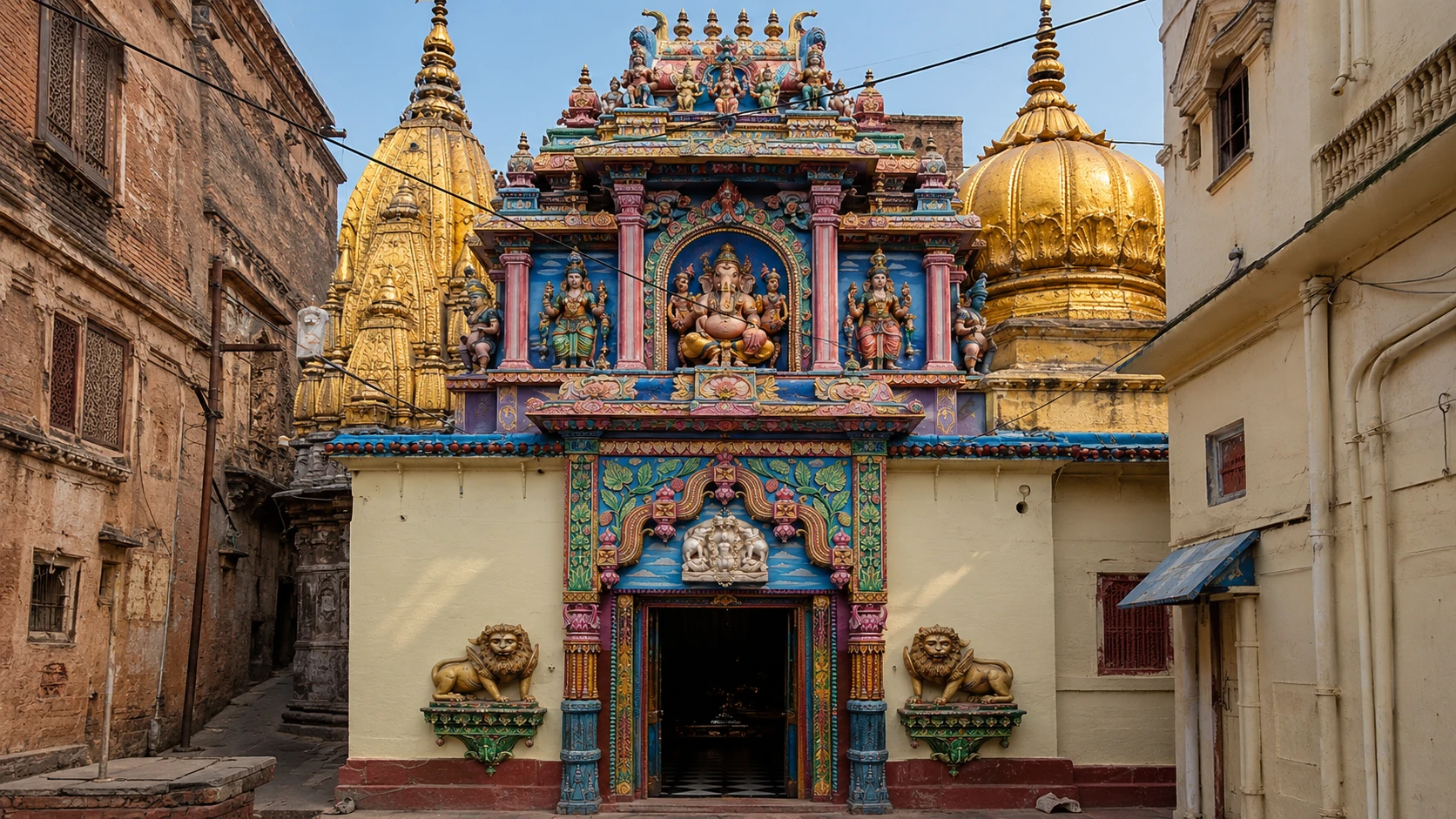
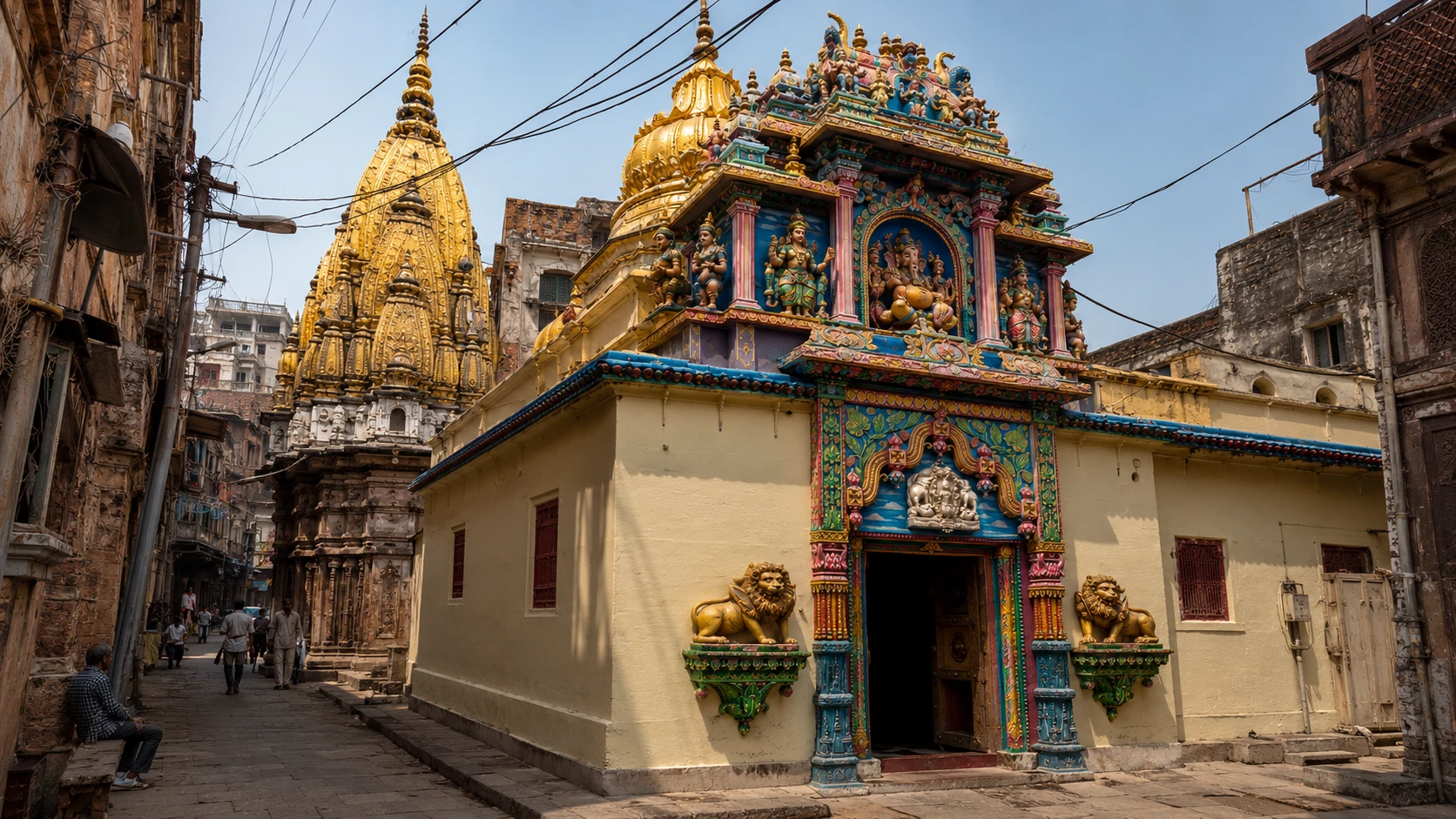
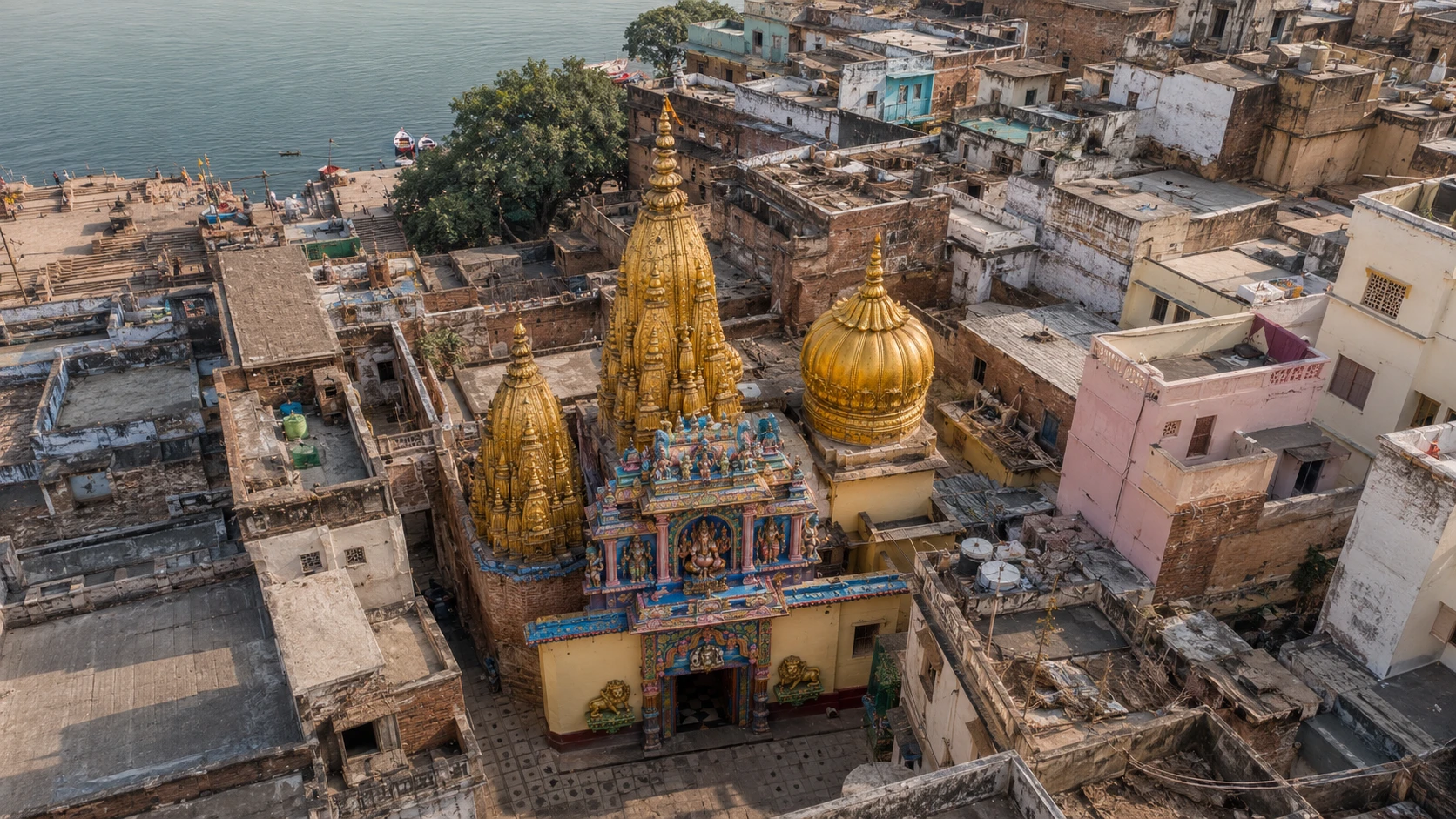
North Indian (Nāgara) tradition in compact ghat-side form; modest scale typical of the dense Kashi gali-temple architecture rather than the freestanding shikhara complexes of more open temple sites; recent renovations under the Corridor redevelopment have improved approach access without altering the core garbhagriha
खुला
04:00 – 22:30
आरती
04:30 · 07:00 · 12:00 · 19:00 · 21:00
विशेष
Coordinated darshan combining Vishalakshi, Kashi Vishwanath, Annapurna and Kal Bhairav constitutes the full Kashi Devī-Vishwanath cycle; many pilgrims complete this sequence in a single morning, with Vishalakshi typically darshan-ed after the pre-dawn Mangala aarti at Vishwanath
पवित्र कथा · पवित्र कथा
At Manikarnika Ghat, where ten thousand pyres a year reduce mortal bodies to ash and the Ganga carries the ash to the sea, a small temple stands a hundred paces inland from the cremation grounds. Inside is the Devī Vishālākṣī, the wide-eyed one, and the tradition holds that this is where Satī's earring fell when Viṣṇu cut her body to release Śiva from his grief. The earring, kuṇḍala, the jewel of the ear, also called manikarnikā, gave its name to the ghat. The ghat became the burning-ground. The burning-ground gave Kashi its standing as the Mokṣapurī, the city where dying grants liberation. So the chain of mythological causation runs: Satī's earring fell here, therefore this became the place of cremation, therefore this became the city where death is release. Vishalakshi watches over the entire architecture of that chain. She is the Pīṭha-Devī of the Mokṣapurī, the wide-eyed witness of the cremation grounds, the form the goddess takes at the threshold where the body is offered to fire and the soul is offered to the river. Her wide eyes are not metaphorical, they are the eyes of the goddess who sees every death that has happened on this riverbank and every soul that has crossed from here. To stand before her is to stand in the gaze that has held a hundred generations of the dying.
Sacred Designationपवित्र पदनाम
Shakti Peeth
शरीर का अंग: Earring (Kuṇḍala / Maṇikarṇikā, the jewel of the ear)
शक्ति: Viśālākṣī
भैरव: Kāla Bhairava
Sacred Origin Storyपवित्र उत्पत्ति कथा
Source: Devī Bhāgavata Purāṇa, Skandha VII (canonical 51-Pīṭha enumeration); Kālikā Purāṇa, Chapters 18 and 60, 62 (52-list, ear-jewel body-part attribution); Pīṭhanirṇaya; Ashtadasha Shakti Pīṭha Stotram attributed to Ādi Śaṅkarācārya (Vāraṇāsyāṁ Viśālākṣī, position 17 in the canonical sequence); Kāśī Khaṇḍa of the Skanda Purāṇa (regional Sthala Purāṇa of Varanasi)
The Sati narrative arrives at Varanasi with a particular elegance of geography and language. When Viṣṇu cut Satī's body with the Sudarśana Cakra to release Śiva from his tāṇḍava of grief, the kuṇḍala, Satī's earring, also named maṇikarṇikā, the jewel of the ear, fell on the bank of the Ganga at the place that has been called Maṇikarṇikā Ghāṭ ever since.
The Devī arose at the spot as Viśālākṣī, the wide-eyed one, and the earring's falling sanctified the bank for what was to come. Kashi was already old when Satī's earring fell, the city is among the oldest continuously inhabited places on the subcontinent, and the Kāśī Khaṇḍa describes it as the ridge that floats above the cosmic dissolution, never destroyed by the cycles of universal pralaya.
But it was the falling of the earring that gave the ghat its name, and the name that gave the ghat its destined role as the principal cremation-ground of the Hindu civilization. Bodies have been burned at Maṇikarṇikā for at least three thousand years, in a continuous fire that has not been allowed to fully extinguish across any verifiable period.
Souls of those cremated here are held to attain liberation directly, Kashi's standing as the Mokṣapurī, the city where dying releases the soul from rebirth, is etymologically and theologically built on the Pīṭha geography of Satī's earring. Viśālākṣī is therefore not one Pīṭha among the 51; she is the Pīṭha that grounds the soteriology of the entire Mokṣapurī tradition.
Her sister-Pīṭhas elsewhere sanctify particular places; Viśālākṣī sanctifies the very framework of release that organizes Hindu thinking about death. Her wide eyes hold the gaze of every death that has happened here, every soul that has crossed.
उद्धृत स्रोत:
- Devī Bhāgavata Purāṇa, Skandha VII (canonical 51-Pīṭha enumeration)
- Kālikā Purāṇa, Chapters 18 and 60, 62 (52-list tradition; ear-jewel body-part attribution)
- Pīṭhanirṇaya (Tantric pīṭha-enumeration treatise)
- Ashtadasha Shakti Pīṭha Stotram attributed to Ādi Śaṅkarācārya (Vāraṇāsyāṁ Viśālākṣī)
- Skanda Purāṇa, Kāśī Khaṇḍa (Sthala Purāṇa of Varanasi)
- Sircar, D. C., 'The Śākta Pīṭhas' (Motilal Banarsidass, 1948; revised 1973)
- Eck, Diana L., 'Banaras: City of Light' (Princeton University Press, 1982), foundational scholarly treatment of Kashi's sacred geography
- Parry, Jonathan P., 'Death in Banaras' (Cambridge University Press, 1994), ethnographic study of Manikarnika cremation tradition and its theological basis
अन्य परंपराएँ · अन्य परंपराएँ
Eye-attribution view (alternate Pīṭha recension; etymological reading)
A second tradition holds that what fell at Varanasi was not Satī's earring but her right eye, an attribution that resolves the apparent discrepancy between the body-part (kuṇḍala / earring per most canonical lists) and the Devī's name (Viśālākṣī, 'the wide-eyed one').
On this reading, the etymology of Maṇikarṇikā is explained by a separate legend, Śiva's own earring, dropped while consoling Viṣṇu after Satī's death, or alternatively the earring of Viṣṇu himself which fell while he was performing the body-cutting.
The eye-attribution makes the name Viśālākṣī directly etiological rather than metaphorical: the wide eyes of the Devī are the eye that became the Pīṭha. This view is found in some regional Kāśī Khaṇḍa manuscripts and in certain Tantric Pīṭha enumerations that diverge from the standard Devī Bhāgavata reading.
Pre-Sanskritic Pancha-tīrtha Devī tradition (scholarly view)
Modern Kashi scholarship treats Viśālākṣī as the integration of a pre-Sanskritic Mother-of-Kashi cult into the pan-Indian Pīṭha framework. The five ancient ghats of pre-medieval Kashi, Aśī Ghāṭ, Daśāśvamedha, Maṇikarṇikā, Pañcagaṅgā, and Ādi-Keśava, together constitute the Pañca-tīrtha, the five sacred fords, whose worship-continuity is documented archaeologically and through inscriptional evidence to at least the Gupta period (4th, 6th c.
CE) and almost certainly predates that. At each of the Pañca-tīrtha, a Devī-presence is documented either by surviving shrine or by toponymic continuity, suggesting that the Kashi Devī worship has roots in regional Mother-cult traditions older than the Pīṭha narrative's textual horizon.
The Pīṭha narrative did not arrive at an empty riverbank; it integrated an existing complex of Kashi-Devī shrines into a unified canonical framework that gave the city's sacred geography a single overarching theological grammar.
विद्वत संदर्भ
Viśālākṣī occupies a unique structural position in Indian sacred geography. Three frames converge on her shrine, each of which would independently make the site significant; in combination they make Kashi-Viśālākṣī one of the most theologically dense single shrines in the entire corpus. First, the canonical Shakti Pīṭha network: she is named uncontested across all three major Pīṭha enumerations (51-Pīṭha Devī Bhāgavata, 52-Pīṭha Kālikā Purāṇa, 18-Pīṭha Ashtadasha Stotram), with the strongest possible Bhairava pairing (Kāla Bhairava, who is independently a major shrine and the city-guardian of Kashi). Second, the Kashi Vishwanath Jyotirlinga complex: Viśālākṣī is the Devī-pole of the Kashi sacred quartet, Viśvanātha (Liṅga), Annapūrṇā (the food-giving consort), Kāla Bhairava (the protector), Viśālākṣī (the Pīṭha-Devī). This quartet is sometimes extended to a pentad by adding Saṅkaṭa-Mocan (the Hanumān shrine that guards against trouble); the Devī-pole in either framework is Viśālākṣī. Third, the Sapta Puri Mokṣapurī tradition: Kashi is one of the seven Hindu cities where death grants liberation, and the etymological-mythological grounding of that Mokṣapurī standing runs through the Pīṭha geography of the earring fallen at Maṇikarṇikā. This means Viśālākṣī is not just a Pīṭha within Kashi; she is the Pīṭha whose presence anchors Kashi's Mokṣapurī standing in the first place. The convergence of these three frames at a single ghat-side shrine is unparalleled in the Indian sacred geography. Diana Eck's 'Banaras: City of Light' (1982) and Jonathan Parry's 'Death in Banaras' (1994) both treat the Vishalakshi shrine within this dense convergence; Eck reads it as the Devī ground-tone of the entire Kashi soundscape, Parry reads it as the theological grounding of the cremation-ground tradition.
Historyइतिहास
The historical depth of Viśālākṣī's shrine is inseparable from the historical depth of Kashi itself. The city is among the oldest continuously inhabited urban centres on the subcontinent, archaeological evidence at the Rajghat plateau (the ancient civic core) places urban settlement at the Ganga-Varuna confluence to at least the 11th, 8th centuries BCE, and continuous occupation has been documented from then to the present.
The Buddha preached at nearby Sarnath in the 6th century BCE, and Pali Buddhist sources describe Kashi as already a major established religious centre at that time. By the early centuries CE, Kashi was a recognized pan-Indian pilgrimage destination with active Shaiva, Shakta, Buddhist and Jain traditions in living proximity.
The Kāśī Khaṇḍa of the Skanda Purāṇa, the principal regional Sthala Purāṇa of Varanasi, compiled in approximately the 13th, 14th centuries CE from older textual strata, names Viśālākṣī as one of the principal Devī shrines of the city and connects her unambiguously to the Maṇikarṇikā geography. Inscriptional evidence from the Gāhaḍavāla period (11th, 12th c.
CE) documents royal patronage of Kashi's major shrines including Vishwanath; while direct Gāhaḍavāla inscriptions naming Viśālākṣī are not extensively preserved, the shrine's institutional life through this period is inferrable from the broader patronage ecosystem.
The transformative disruption came in 1669 CE, when Aurangzeb's farman ordered the destruction of the Kashi Vishwanath temple (the principal Jyotirlinga); the surrounding Devī shrines including Viśālākṣī suffered partial damage in this wave, though the smaller scale and less politically visible nature of the Devī shrines meant they were not destroyed at the catastrophic scale inflicted on Vishwanath.
The 18th-century Maratha-era revival of Kashi's temple infrastructure was led decisively by Ahilyabai Holkar of the Holkar dynasty, who in 1777 oversaw the reconstruction of Kashi Vishwanath in its present location and funded substantial reconstruction across the surrounding shrines including Viśālākṣī.
The modern temple structure traces substantially to this Holkar-period rebuild, with subsequent renovation under successive trust arrangements through the 19th and 20th centuries. The most recent transformative event is the Kashi Vishwanath Corridor (Śrī Kāśī Viśvanātha Dhām), inaugurated in stages 2019, 2022, which substantially restructured the entire ghat-side temple precinct, clearing dense residential encroachment, creating direct pedestrian connections between Vishwanath, the principal ghats including Maṇikarṇikā, and the Devī shrines, and bringing the Viśālākṣī approach within an architectural framework that connects it visibly to the Jyotirlinga complex for the first time in many generations of Kashi's lived urban form.
Historical Timelineऐतिहासिक कालक्रम
Establishment and consolidation of Kashi as a major urban-religious centre at the Ganga-Varuna confluence. Archaeological evidence at the Rajghat plateau dates urban settlement at the site to at least the early first millennium BCE, with continuous occupation documented from then to the present. By the time of the Buddha's first sermon at Sarnath (c. 528 BCE per traditional dating), Kashi was already an established pan-Indian religious centre, mentioned in Pali Buddhist sources as a major civic and pilgrimage destination. The deep urban antiquity of Kashi is the foundational ground for the subsequent layering of Pīṭha, Jyotirlinga and Sapta Puri traditions onto the city's sacred geography, Viśālākṣī's shrine arose within an already-flourishing urban-religious context, not on an empty riverbank.
Canonical formalization of Vishālākṣī within the pan-Indian Shakti Pīṭha network through textualization in the Devī Bhāgavata Purāṇa (Skandha VII), Kālikā Purāṇa (Chapters 18, 60, 62), the Pīṭhanirṇaya, and the Ashtadasha Shakti Pīṭha Stotram attributed to Ādi Śaṅkarācārya (Vāraṇāsyāṁ Viśālākṣī, position 17). The Kāśī Khaṇḍa of the Skanda Purāṇa, compiled in approximately the 13th, 14th centuries CE from older textual strata, independently confirms Vishalakshi's status as a principal Devī shrine of Kashi and links her unambiguously to the Maṇikarṇikā geography. The body-part attribution (earring / kuṇḍala / maṇikarṇikā) is uncontested across these primary canonical sources, though the alternate eye-attribution view appears in some regional manuscripts.
Vāraṇāsī's position in the Ashtadasha Stotram (position 17, Vāraṇāsyāṁ Viśālākṣī) is one of the most stable attestations in the entire Ashtadasha tradition, unlike the more disputed positions (Śṛṅkhalā at Pradyumna, Sarasvatī at Śāradā), Vishalakshi's enumeration is consistent across all major recensions including Adi Shankara, Karnataka, and the Gujarati Stotram variants. The body-part attribution shows minor manuscript variability between kuṇḍala (earring) and netra (eye), but the kuṇḍala attribution is overwhelmingly the canonical reading and is etymologically grounded in the Maṇikarṇikā Ghāṭ naming.
Sustained Gāhaḍavāla dynasty patronage of Kashi's principal shrines. The Gāhaḍavāla period was the high water-mark of pre-Sultanate Kashi's institutional consolidation, Govindachandra (r. 1114, 1155) and his successors patronized the Vishwanath shrine and the surrounding temple-shrine network, with inscriptional evidence documenting major grants. While direct epigraphic attestation specifically naming Vishalakshi is more fragmentary than for Vishwanath, the shrine's institutional life through this period is well-supported by the broader Gāhaḍavāla patronage of Kashi's temple ecology. The dynasty's fall to the Ghurid invasions (1194 CE, sack of Varanasi by Qutb-ud-din Aibak) was the first major disruption to Kashi's continuous temple culture but did not extinguish it.
Aurangzeb's farman of 1669 CE ordering the destruction of the Kashi Vishwanath temple. The principal Jyotirlinga shrine at Kashi was demolished and the Gyanvapi mosque constructed at the site, an event documented unambiguously in the Maasir-i-Alamgiri (Saqi Mustaid Khan's contemporary court chronicle of Aurangzeb's reign) and corroborated by multiple independent sources. The Devī shrines in the surrounding ghat-side network including Viśālākṣī suffered partial damage in the wave of demolition that accompanied the Vishwanath destruction, though the smaller scale and less politically visible nature of the Devī shrines meant they were not destroyed at the catastrophic scale inflicted on the Jyotirlinga itself. The shrine survived in damaged form through the late 17th and early-to-mid 18th centuries under reduced patronage, with worship continuing in modest circumstances.
The 1669 destruction of the Kashi Vishwanath temple under Aurangzeb's farman is one of the most extensively documented temple-desecration events in Mughal-era India and is unambiguous in primary sources. The collateral damage to surrounding Devī shrines including Viśālākṣī is supported by 18th-century travel accounts (which note the Devī shrines existing in damaged or modest form pending Maratha-period restoration) and by the architectural-archaeological evidence that the present Viśālākṣī structure dates substantially to the post-1777 Holkar restoration rather than to any pre-1669 phase. Eternal Raga reports the historical event with the documentary care appropriate to its sensitivity, acknowledging both the well-attested specific events and the broader pattern of late-17th-century institutional disruption to Hindu Kashi.
Reconstruction of the Kashi Vishwanath temple in its present location by Ahilyabai Holkar, queen-regent of the Holkar dynasty of the Maratha confederacy. The Holkar-period reconstruction was the decisive event that re-established Kashi's institutional temple culture after the 17th, 18th century disruption, and Ahilyabai's patronage extended substantially beyond Vishwanath to the surrounding ghat-side shrines including the major Devī shrines (Viśālākṣī, Annapūrṇā), the major Bhairava shrine (Kāla Bhairava), and the principal cremation infrastructure (Maṇikarṇikā Ghāṭ). The present-day Viśālākṣī shrine traces its architectural foundation substantially to this Holkar-period rebuild, with continuing renovation through the 19th and 20th centuries under successive trust arrangements and the post-Independence administrative consolidation of Kashi's temple ecology.
Kashi Vishwanath Corridor (Śrī Kāśī Viśvanātha Dhām), phased redevelopment of the ghat-side temple precinct inaugurated by the Government of Uttar Pradesh in partnership with the Government of India. The project substantially restructured the dense urban fabric immediately surrounding the Vishwanath complex, clearing encroachment, restoring approach access to multiple suppressed shrines, and creating direct pedestrian connections between the Vishwanath complex, the principal ghats including Maṇikarṇikā and Lalitā, and the Devī shrines including Viśālākṣī and Annapūrṇā. For Viśālākṣī specifically, the Corridor work improved approach accessibility from both the Vishwanath complex side and the Manikarnika Ghat side, integrated the shrine into the formal pilgrim circuit, and provided infrastructure improvements to the temple's immediate precincts. The Corridor inauguration in phases between December 2021 and 2022 marked the largest single transformation of Kashi's ghat-side sacred geography in the modern era.
The Corridor redevelopment is contemporaneous and remains an evolving event; the urban-geographical and pilgrim-experiential consequences are still being absorbed by Kashi's temple ecology and are subject to ongoing scholarly and journalistic analysis. The pilgrim-flow implications for Viśālākṣī specifically, increased accessibility paired with substantially increased visitor numbers at the shrine, represent a modern transformation of the shrine's lived experience that older scholarly sources do not address. Field-checked operational details should be re-verified periodically as the post-Corridor pilgrim ecology stabilizes.
What You'll Seeदर्शन में
The garbhagriha of the Viśālākṣī Mandir is a modest stone chamber typical of the dense gali-temple architecture of old Kashi, a single small sanctum, low-ceilinged, the walls darkened by centuries of lamp-soot, the doorway framed in worn stone.
The Devī herself is enshrined in murti form: a sculpted stone image, blackened by ritual abhiśeka and offerings, depicting the goddess seated in lalitāsana with her characteristic wide eyes carved in the elongated lotus-petal shape that gives her name.
The murti is typically four-armed, holding the standard Devī attributes, a pāśa (noose) and aṅkuśa (goad) in the upper hands, blessing-mudrā and vara-mudrā in the lower; iconographic details vary slightly across the Devī's primary and uttara-shringar adornments.
The murti is draped through the day in a red sari and ornamented with gold and silver jewellery; on festival days the adornment is elaborated substantially. A subsidiary shrine adjacent contains the Annapūrṇā-aspect murti (the food-giving form), reflecting the theological pairing of Viśālākṣī and Annapūrṇā as the two principal Devī forms of Kashi.
The sanctum opens directly onto the small mandapa, which is itself compact, accommodating perhaps thirty to forty pilgrims at a time in normal flow. The outer parikrama path is tight, threading between the temple wall and the surrounding gali architecture.
Until the Corridor redevelopment of 2019, 2022, the shrine was accessible only through narrow lanes from the Manikarnika Ghat side; the Corridor improvements created additional approach routes from the Vishwanath complex side and improved the parikrama clearances.
The architectural register is intentionally modest, Kashi's sanctity is not architectural but topographic and ritual, and the Devī shrines of Kashi follow this register rather than competing with the monumental shikhara complexes of more open temple sites.
Distinctive Practicesविशिष्ट परंपराएँ
Kashi Devī-Quartet Sequential Darshan
काशी देवी-चतुष्क क्रमिक दर्शन
Year-round; many pilgrims complete the sequence within a single morning starting before the Vishwanath Mangala aarti at ~04:00
The complete Kashi darshan involves four shrines in canonical sequence: Kashi Viśvanātha (the Jyotirlinga), Annapūrṇā (the food-giving Devī, adjacent to Vishwanath), Kāla Bhairava (the protector, ~2 km north), and Viśālākṣī (the Pīṭha-Devī, ~150 m from Vishwanath via the Corridor approach). Pilgrims traditionally complete this sequence in a single visit, with the order following different conventions, the most-cited order begins with Vishwanath at the pre-dawn Mangala aarti, proceeds to Annapurna, then to Vishalakshi via the Manikarnika approach, and concludes at Kal Bhairava in the late morning. Some traditions extend the quartet to a pentad by adding Sankat Mochan (the Hanuman shrine at the city's southwestern edge); others extend to a complete Pancha-tirtha by including darshan at the five principal ghats. The sequential darshan integrates the four primary devotional poles of Kashi, Liṅga (Vishwanath), Anna (Annapurna's food-grace), Bhairava (Kala Bhairava's guardianship), and Pīṭha (Vishalakshi's wide-eyed witnessing), into a single coordinated pilgrim circuit.
The quartet structure encodes the complete cosmological grammar of Kashi: the masculine principle (Liṅga), the feminine-as-nourishment (Annapūrṇā), the protective intercessor (Kāla Bhairava), and the feminine-as-witness (Viśālākṣī, the Pīṭha). The sequence completes Kashi as a single cosmographic body. Pilgrims who darshan at only one of the four shrines are widely understood to have received only a quarter of Kashi's blessing; completing the quartet is the canonical pilgrim experience of the city. The Pīṭha-pole (Viśālākṣī) is theologically the most weighted in soteriological terms, she is the Pīṭha whose presence anchors Kashi's status as the Mokṣapurī, and her wide-eyed witnessing is held to register the pilgrim's intent in a way that the more institutional shrines do not.
Maṇikarṇikā Mortality-Witness Darshan
मणिकर्णिका मृत्यु-साक्षित्व दर्शन
Year-round; particularly associated with pilgrims accompanying funeral rites at Maṇikarṇikā Ghāṭ and with seasonal mortality-meditation observances (Pitṛ-pakṣa, Maghi Pūrṇimā)
Many pilgrims approach Viśālākṣī specifically in relation to death, either accompanying the body of a relative being cremated at Maṇikarṇikā (in which case darshan at Viśālākṣī is part of the rites for the soul's transit), or in mortality-meditation practice (contemplating the inevitability of one's own death within the gaze of the wide-eyed Devī who has witnessed every death the riverbank has held). The body-part-thematic practice is unique to the kuṇḍala-Pīṭha at this Mokṣapurī shrine: pilgrims pause before the sanctum, contemplate the chain of mythological causation that runs from the falling earring through the cremation-ground to the soteriology of release, and offer their own mortality to the Devī's gaze. The practice is intensely personal and varies in its detail across pilgrim traditions, but the structural form, Viśālākṣī darshan as a mortality-encounter rather than a worldly-blessing-petition, is corpus-distinctive among the Shakti Pīṭhas.
The kuṇḍala-Pīṭha is the only Pīṭha whose body-part attribution directly anchors a soteriological category, every other Pīṭha sanctifies a place, but Viśālākṣī's earring at Maṇikarṇikā sanctifies the theological category of Mokṣapurī death-as-liberation. Pilgrims who recognize this theological structure approach the shrine not for the kinds of petitions made at other Devī shrines (marital wellbeing, fertility, prosperity, victory over difficulty) but for the more direct work of contemplating one's own mortality within the gaze of the Devī whose presence makes Kashi's death-tradition coherent. The wide eyes of the Devī are the eyes that have already seen the pilgrim's death, the practice is an anticipation of being seen by her at the end.
Kajalī Tīj, Wide-Eyed Devī Observance
कजली तीज, विस्तृत-नेत्र देवी अनुष्ठान
Annually on the third lunar day of Bhādra-pada (Bhādrapada Krishna Tritīyā, typically August)
Kajalī Tīj is a Bhādrapada observance especially associated with Viśālākṣī because of the linguistic resonance between kajal (the black eye-cosmetic used to enlarge and accentuate the eyes) and the Devī's wide-eyed iconography. On the third lunar day of Bhādra Kṛṣṇa pakṣa, married Hindu women of Kashi traditionally visit the Devī to offer kajal, sometimes home-prepared lamp-soot kajal, sometimes commercial preparations, which is placed at the Devī's feet, applied to the Devī's image by the priest, and then carried home as prasad to be applied to the women's own eyes. The observance is associated with marital wellbeing, the husband's longevity, and protection from the evil eye (nazar), the Devī's wide eyes are held to absorb evil-eye and to bless the eyes of the devotee with similar protective vision. The Kashi Kajalī Tīj is corpus-distinctive among Devī observances; the offering of kajal as the central rite for a Pīṭha-Devī is found at very few other Shakti Pīṭhas.
Kajal is not merely a cosmetic in this context, it is an offering that thematically links the body-part-thematic distinctivePractice pattern to the daily ritual life of the shrine. The kuṇḍala-attribution of the Pīṭha (the earring fallen at Maṇikarṇikā) connects to the eye-iconography (Viśālākṣī = wide-eyed) through the kajal-offering at Kajalī Tīj: what was the earring becomes the eye becomes the kajal that frames the eye, and the chain links Sati's earring, the Maṇikarṇikā ghat, the wide-eyed witness, and the eye-protection blessing of the contemporary devotee. The cultural-ritual particularity of Kashi Kajalī Tīj is what makes Viśālākṣī's body-part-thematic distinctivePractice cluster especially rich.
Did You Know?क्या आप जानते हैं?
Viśālākṣī is the only Shakti Pīṭha in the entire 51-Pīṭha network whose body-part attribution directly anchors a soteriological category. Other Pīṭhas sanctify particular places; Viśālākṣī's earring at Maṇikarṇikā sanctifies the entire framework of Mokṣapurī, the doctrine that dying at Kashi grants liberation from rebirth. The chain of mythological causation runs: Satī's earring (kuṇḍala / maṇikarṇikā) fell at this riverbank, therefore the ghat was named Maṇikarṇikā, therefore the ghat became the principal cremation-ground, therefore Kashi became the city where dying grants mokṣa. This makes Viśālākṣī the Pīṭha whose presence theologically anchors Kashi's entire status as the city of release.
Eck, 'Banaras: City of Light' (1982); Parry, 'Death in Banaras' (1994); Sircar 'The Śākta Pīṭhas' (1948)
There is a long-running canonical-source variability between the body-part attribution (kuṇḍala / earring per most lists) and the Devī's name (Viśālākṣī, 'the wide-eyed one'). Some regional Kāśī Khaṇḍa manuscripts and certain Tantric Pīṭha enumerations resolve this by holding that Satī's right eye fell here (making the name etiologically direct). The earring-attribution remains canonically dominant because it grounds the Maṇikarṇikā ghat-naming, but the eye-attribution view appears in a non-trivial fraction of regional traditions and is preserved in modern Devī scholarship as a legitimate alternate reading.
Sircar 'The Śākta Pīṭhas' (1948; revised 1973); variant manuscripts of Kāśī Khaṇḍa; Bhattacharya 'History of the Sakta Religion' (1974)
Viśālākṣī is the Devī-pole of the Kashi sacred quartet, the four-shrine network that organizes pilgrim experience of the city. The other poles are Viśvanātha (the Liṅga / Jyotirlinga), Annapūrṇā (the food-giving consort, adjacent to Vishwanath), and Kāla Bhairava (the city-guardian, ~2 km north). Pilgrims who complete darshan at only one pole are widely understood to have received only a quarter of Kashi's blessing; the canonical pilgrim circuit completes all four. Sometimes the quartet is extended to a pentad by adding Saṅkaṭa-Mocan (the Hanuman shrine at the city's edge). In every variant of the structure, Viśālākṣī occupies the Devī-pole.
Eck, 'Banaras: City of Light' (1982); Singh & Rana, 'Banaras Region' (2002)
Cremation has been continuously practiced at Maṇikarṇikā Ghāṭ for at least three thousand years, in a fire that tradition holds has never been allowed to fully extinguish, embers from one pyre are used to light the next, and so on indefinitely. The mythological grounding of this continuous-fire tradition is the kuṇḍala-fall of Satī: Viśālākṣī's earring sanctified the riverbank for what was to come, and the fire that has burned at Maṇikarṇikā ever since is treated as the fire of release that Satī's death-and-renewal narrative initiated. The Doṁ Rājā, the traditional keeper of the cremation fire and a hereditary position with origins traceable to the pre-medieval period, presides over the lighting of pyres and the continuity of the sacred flame.
Parry, 'Death in Banaras' (1994); Eck, 'Banaras: City of Light' (1982); Justice, 'Dying the Good Death' (1997)
The 2019, 2022 Kashi Vishwanath Corridor redevelopment was the largest transformation of Kashi's ghat-side sacred geography in the modern era, restructuring the dense urban fabric immediately around the Vishwanath complex to create direct pedestrian connections between the Jyotirlinga, the principal ghats including Maṇikarṇikā, and the surrounding Devī shrines including Viśālākṣī. For pilgrims this was a substantial improvement in accessibility, the previously gali-restricted approach to Viśālākṣī from the Vishwanath side was opened up, but it also brought substantially increased visitor numbers and changed the lived experience of darshan at a shrine that for centuries was approached through narrow lanes and discovered rather than directly accessed.
Government of Uttar Pradesh, Shri Kashi Vishwanath Dham project documentation (2017, 2022); contemporary press coverage
Visitor Accessप्रवेश जानकारी
The shrine is open to all pilgrims regardless of background. Photography and videography are strictly prohibited inside the sanctum (garbhagriha) and the inner mandapa; phones should be carried switched off or deposited at the cloak counter at the temple entrance. Footwear is removed at the designated counter at the precinct entrance. The shrine is open from approximately 04:00 to 22:30 with five canonical aarti times; the busiest periods are the Vishwanath Mangala-aarti hour (04:00, 05:30), the evening aarti hour (19:00, 20:00), and the Bhādrapada Kajalī Tīj observance day, when queue durations can extend substantially.
आध्यात्मिक आधार
The photography prohibition reflects the standard sanctum-photography policy of Kashi's principal shrines and the broader Shakti Pīṭha tradition. The intimate scale of the garbhagriha, a single small chamber accommodating the priests and a few devotees at a time, also makes photography practically disruptive of the worship-rhythm at the shrine.
समकालीन संदर्भ
The Kashi Vishwanath Corridor redevelopment (2019, 2022) substantially improved approach access to Viśālākṣī from the Vishwanath complex side. Pilgrim flow at the shrine has increased substantially post-Corridor, the older quiet-gali approach gave way to a more formal pilgrim-circuit experience. The shrine administration coordinates with the Shri Kashi Vishwanath Temple Trust for crowd management during peak periods. There are no caste, gender or sectarian access restrictions in modern practice.
व्यावहारिक मार्गदर्शन
For pilgrims completing the Kashi quartet, plan the day starting with the Vishwanath Mangala-aarti at ~04:00 and structuring the remaining shrines through the morning. Viśālākṣī is most peacefully darshan-ed in the mid-morning window (08:00, 10:00) after the Mangala flow has cleared. Modest dress; head covering customary at the sanctum. The Manikarnika Ghat approach to the shrine takes pilgrims past the principal cremation grounds, be prepared for the sight of active cremations, particularly in late morning and early afternoon when most rites are conducted. The body of someone being cremated should never be photographed.
Festivalsत्योहार
Kajalī Tīj (Vishālākṣī Tīj)
कजली तीज (विशालाक्षी तीज)
Aug (Bhādra Kṛṣṇa Tritīyā)
The corpus-distinctive festival of this Pīṭha, the third lunar day of the dark half of Bhādra is observed at Viśālākṣī specifically through the offering of kajal (eye-cosmetic) at the Devī's feet, with the consecrated kajal returned to devotees as prasad to apply to their own eyes. The observance is associated with marital wellbeing, the husband's longevity, and protection from the evil eye (nazar). Married Hindu women of Kashi traditionally fast through the day and break the fast only after Viśālākṣī darshan. The Kashi-Kajalī-Tīj draws substantial regional pilgrim flow during the day, with queue durations extending substantially through the morning hours. The body-part-thematic resonance of kajal-as-offering at the wide-eyed-Devī's shrine makes this Tīj observance particularly characteristic.
Chaitra Navrātri
चैत्र नवरात्र
Mar-Apr
The nine nights of Chaitra Navrātri are observed at Viśālākṣī through extended aarti schedules, special bhog offerings on each tithi, and the substantial pilgrim flow that comes to Kashi for the wider Navrātri-Rāma Navamī celebration. The festival sits within the broader Kashi Navrātri programme that includes parallel observances at all major Devī shrines of the city; the coordinated Devī-circuit darshan during Navrātri (Vishalakshi + Annapurna + Durga Mandir + Kalbhairavi + the nine Gauris) is one of the city's most-completed seasonal pilgrim activities.
Sharad Navrātri
शरद नवरात्र
Sep-Oct
The autumn Navrātri at Viśālākṣī is observed with full nine-night aarti liturgy, kanyā-pūjā observances on Aṣṭamī and Navamī, and the major Kashi-wide Devī-circuit completion that characterizes the autumn season at the shrine. The closing Vijayadaśamī observance is celebrated alongside the broader Vijayadaśamī processions through the old city; Viśālākṣī receives concluding offerings as the Pīṭha-pole of the Kashi sacred geometry.
Dev Deepāwalī (Kārttika Pūrṇimā)
देव दीपावली (कार्तिक पूर्णिमा)
Nov (Kārttika Pūrṇimā)
The grand exterior festival of Kashi, Dev Deepāwalī celebrates the Kārttika full moon with hundreds of thousands of clay lamps illuminating the ghats and the river-front, the largest single visual transformation of Kashi's sacred landscape in the annual cycle. Viśālākṣī observes the festival with extended aarti and bhog and with coordination of the Devī-circuit illumination programme. The Dev Deepāwalī celebration is held to be the night on which the gods themselves descend to Kashi to celebrate, and pilgrims who darshan at the principal shrines on this night, including Viśālākṣī, are held to share in the divine descent. The festival attracts the largest single-night pilgrim flow of the year to Kashi.
Traditional Offeringsपारंपरिक अर्पण
प्राथमिक अर्पण
Red flowers, hibiscus, marigold, red roses
लाल पुष्प, गुड़हल, गेंदा, लाल गुलाब
पुष्प-माल्य; जपा-कुसुम
Red flowers are the canonical floral offering across the Shākta tradition. Hibiscus (japā-kusum) is particularly sacred to all Devī forms; the Devī Bhāgavata and other Shākta texts specify it as the preferred floral offering. At Viśālākṣī, the flowers are offered at the parapet area, placed before the murti by the priests, and sometimes incorporated into the day's adornment. The red colour resonates with the Devī's iconographic register and with the sindoor that married pilgrims also offer.
Chunari (the red sacred cloth)
चुनरी
उत्तरीय
Chunari is the standard Devī offering at Shakti Pīṭhas, brought by pilgrims from outside and handed to the priests for placement at the Devī's feet or for incorporation into the daily shringar. At Viśālākṣī, where the daily adornment includes red sari and substantial jewellery work, chunari offerings are cycled into the rotation of cloth used in the shringar. Many married women pilgrims tie a small mannat-thread to the chunari bundle as a vow-marker for marital wellbeing or family prosperity.
Coconut
नारियल
नारिकेल
Coconut, offered whole or broken before the sanctum, represents the egoic self surrendered to the Devī. The hard outer shell is the worldly persona; the meat and water within are the inner being; breaking the coconut at the shrine is the symbolic offering of the self in its layers. At Kashi shrines including Viśālākṣī, the coconut is also a substantial cash-offering equivalent, its presence in the offering carries the weight that a more substantial donation might in another context.
Sindoor and Kumkum (vermilion offerings)
सिंदूर और कुंकुम
सिन्दूर; गोरोचना-तिलक
Sindoor and kumkum are applied at the parapet, on the chunari, and as tilak on the pilgrim's forehead. Sindoor at a Devī shrine carries the suhāg-blessing, the goddess's protection of marital wellbeing, and pilgrims (particularly women) carry sindoor home for the household altar. At Viśālākṣī, the sindoor offering is associated specifically with the eye-themed protection of the wide-eyed Devī, the Devī who has seen all and who shields the devotee from the evil eye (nazar) carried in others' gazes.
Akhand-Jyot ghee and wicks
अखंड-ज्योत हेतु घी और बत्तियाँ
अखण्ड-ज्योतिः घृत-वर्तिका
The shrine maintains a continuously-burning lamp (akhand jyot) in the mandapa, refilled in cycle by the priests. Pilgrims offer ghee and wicks to be added to this lamp. The donation supports the continuous burning of the akhand jyot, and the act symbolically associates the pilgrim's offering with the maintenance of light at the heart of Kashi's Pīṭha-shrine. The Vishalakshi akhand-jyot is thematically linked to the broader Kashi fire-continuity tradition, the akhand jyot of the shrine and the continuous cremation-fire at Manikarnika are held to share in the larger flame of release that the Pīṭha-event initiated.
इस मंदिर की विशेषता
Kajal (eye-cosmetic, particularly during Kajalī Tīj)
कजल (नेत्र-अंजन, विशेषतः कजली तीज के समय)
Kajal-offering is the corpus-distinctive Viśālākṣī offering, particularly associated with the Kajalī Tīj observance in Bhādrapada but offered throughout the year by pilgrims seeking the Devī's eye-protection blessing. Pilgrims bring home-prepared lamp-soot kajal or commercial preparations; the kajal is placed at the Devī's feet, applied to the murti by the priest, and the consecrated kajal is returned as prasad to be applied to the devotee's own eyes. The body-part-thematic resonance, the kuṇḍala-Pīṭha receives kajal that frames the eye, linking earring-ornament-to-eye through the kajal medium, makes this offering particularly characteristic of Viśālākṣī among all Shakti Pīṭhas.
Banarasi Pedā / Khurmā (the Kashi prasad-sweet tradition)
बनारसी पेड़ा / खुर्मा
The Banarasi pedā, a milk-based sweet of khoa, sugar and cardamom, is the canonical Kashi prasad sweet, prepared at the city's heritage halwai shops (Madhur Milan, Kshir Sagar, Chetna Restaurant and others) and offered at the principal shrines. Pilgrims commonly bring pedā for offering at Viśālākṣī and the other Devī shrines, and take the consecrated pedā home as prasad. Khurmā, a fried wheat-flour sweet glazed in sugar syrup, is the parallel tradition particularly associated with the festival days. The Banarasi prasad-sweet tradition links Viśālākṣī to the city's broader prasad ecology rather than being unique to her shrine; the offering carries the resonance of Kashi's continuous halwai tradition that has supplied pilgrim prasad for at least the past four centuries.
Offerings may be brought from outside or purchased at vendor counters in the gali approach to the temple. The post-Corridor reorganization changed the vendor ecosystem substantially, older gali-based vendors were displaced in some areas, with new vendor counters established along the formal pilgrim circuit. Pilgrims should be aware that prasad-sweets sold by non-trust vendors in the bazaar may not be temple-consecrated even when sold as 'Vishalakshi prasad' or 'Vishwanath prasad', verify the source if the consecration matters. Photography prohibition extends to the offering process within the sanctum-zone.
How to Reachकैसे पहुँचें
Varanasi is one of India's most thoroughly-connected pilgrim cities, with extensive rail, road and air infrastructure. By air, Lal Bahadur Shastri International Airport (VNS) at Babatpur, 26 km from the city centre, has direct domestic connectivity to all major Indian cities (Delhi, Mumbai, Kolkata, Chennai, Bengaluru, Hyderabad, Ahmedabad and more) and limited international routes (notably Kathmandu, Bangkok, Sharjah).
Pre-arranged taxis and airport-shuttle services connect the airport to the city; expect 45, 75 minutes by road depending on traffic. By rail, Varanasi has three principal stations: Varanasi Junction (BSB) is the primary station with extensive long-distance connectivity (Rajdhani, Vande Bharat and major mainline trains); Banaras railway station (Manduadih, MUV) handles substantial north-south and east-west rail traffic; Varanasi City station (BCY) is the smaller central station.
From Varanasi Junction the shrine is approximately 5 km by road. By road, Varanasi is well-connected on National Highways 19 (Delhi-Kolkata axis) and 31 (north-south axis); UPSRTC and private operators run extensive bus services from cities across northern India.
Within the old city, the immediate approach to Viśālākṣī is on foot, the post-Corridor approach from the Vishwanath complex is the most accessible route; alternatively, pilgrims approaching from the Ganga can climb up from Manikarnika Ghat or Lalita Ghat through the gali network.
Cycle-rickshaws and auto-rickshaws can navigate the outer Godolia / Vishwanath approach roads but not the inner old-city lanes; the final 200, 500 metres to the shrine is always on foot.
Plan Your Visitयात्रा की योजना
🌤 सर्वोत्तम मौसम
October through March offers the most agreeable weather, cool, clear, and the Ganga at its winter aspect. April through June bring intense pre-monsoon heat that makes the dense old-city approach to the shrine physically taxing; the monsoon months (July-September) bring high humidity and intermittent heavy rainfall. The major festival seasons, Kajalī Tīj in Bhādrapada (Aug), Navrātri (Mar-Apr and Sep-Oct), Dev Deepāwalī (Nov), bring extraordinary pilgrim flow and a transformed ghat-side atmosphere that is either the peak experience or a period to avoid depending on the visitor's preference.
👘 पहनावे का नियम
Modest, traditional attire is expected, for women, sarees, salwar-kameez or full-length skirts with covered shoulders; for men, kurta-pyjama or full-length trousers with a shirt. The dense old-city environment means comfortable walking footwear is essential before reaching the temple precinct (footwear is then removed at the temple's designated counter). Head covering is customary at the sanctum, particularly during morning aartis and the Kajalī Tīj observance; chunnis are commonly carried by women pilgrims.
📱 फोन और फोटोग्राफी
Mobile phones must be deposited at the cloak counter before entering the inner mandapa, or carried in switched-off state. Photography and videography are strictly prohibited within the sanctum and the inner mandapa; signage is posted at the sanctum entrance and enforcement is active. Photography is permitted in the outer precinct, the gali approaches and at the ghat-side. The cremation grounds at Maṇikarṇikā should never be photographed, this is a strict cultural prohibition that pilgrims should respect even where it is not formally signposted.
🏨 आवास
Varanasi has an extraordinarily wide accommodation inventory, from heritage hotels along the ghats (Brij Rama Palace, Suryauday Haveli, BrijRama Heritage and others), to mid-range hotels in the Cantonment area (Taj Ganges, Radisson Hotel Varanasi, Madin Hotel and others), to dharamshala accommodation operated by various trusts for budget pilgrims (Gujarati Samaj, Rajasthani trusts, Marwari dharamshala networks). For Viśālākṣī-specific pilgrimage, accommodation in the old city or along the ghats minimizes the walking distance to the shrine. Advance booking is essential during Navrātri windows, Dev Deepāwalī (which often sees full city occupancy several weeks in advance), and the Kajalī Tīj period.
Sacred Soundsपवित्र ध्वनि
Ashtadasha Shakti Pīṭha Stotram (attributed to Ādi Śaṅkarācārya; names Vāraṇāsyāṁ Viśālākṣī at position 17 in the eighteen-shrine canonical sequence)
stotram
Viśālākṣī Stotra, the canonical devotional hymn to the Devī as the wide-eyed witness of Kashi; recited in the daily liturgy at the shrine and in family Devī-puja across Kashi households
stotram
Durgā Saptaśatī / Devī Māhātmya Pāṭha (the 700-verse Shākta liturgy from the Mārkaṇḍeya Purāṇa)
path
Annapūrṇā Stotram attributed to Ādi Śaṅkarācārya, the hymn to the food-giving Devī of Kashi; recited as part of the Kashi Devī-pair liturgy that pairs Viśālākṣī (the Pīṭha-Devī) with Annapūrṇā (the nourishment-Devī)
stotram
Śrī Vidyā Tri-Bīja (Om Aim Hrīṁ Śrīm), the three-seed Devī mantra suitable for non-initiated recitation; the Pañcadaśākṣarī and longer Śrī Vidyā mantras require initiation and are not published
mantra
क्या आप जानते हैं? · Did You Know?
वही अनुवाद त्रुटि जिसने हिन्दू धर्म में '33 कोटि' को '33 करोड़' बनाया, बौद्ध धर्म में भी हुई। बौद्ध ग्रन्थों के चीनी अनुवाद ने 'सप्त कोटि बुद्ध' (7 श्रेष्ठ बुद्ध) का अनुवाद '7 करोड़ बुद्ध' कर दिया। तिब्बती अनुवाद ने सही किया: 7 प्रकार, 7 करोड़ नहीं। एक संस्कृत शब्द, दो प्रमुख विश्व धर्मों में गलत पढ़ा गया, ने दो एकसमान भ्रम स्वतन्त्र रूप से उत्पन्न किए।
Related Contentसंबंधित सामग्री
Related Scriptures
Related Temples
Kashi Vishwanath
काशी विश्वनाथ
Varanasi, Uttar Pradesh
Lanka Shankari Temple
लंका शंकरी मन्दिर
Trincomalee, Eastern Province
Chamundeshwari
चामुण्डेश्वरी
Mysore, Karnataka
Mahalakshmi Kolhapur
महालक्ष्मी कोल्हापुर
Kolhapur, Maharashtra
Avanti (Harasiddhi Mata)
अवंती शक्तिपीठ
Ujjain, Madhya Pradesh
Kamakhya Temple
कामाख्या मंदिर
Guwahati, Assam
Jwala Devi
ज्वाला देवी
Jwalamukhi, Himachal Pradesh
Mookambika (Kollur)
मूकाम्बिका मंदिर
Kollur, Karnataka
Ambaji
अंबाजी
Ambaji, Gujarat
Tarapith
तारापीठ
Tarapith, West Bengal
Vaishno Devi
वैष्णो देवी
Katra, Jammu and Kashmir
Vindhyavasini
विंध्यवासिनी
Vindhyachal, Uttar Pradesh
Meenakshi Temple
मीनाक्षी मंदिर
Madurai, Tamil Nadu
Community Reflections
🕉️
Be the first to share your reflection.