Lanka Shankari Temple
लंका शंकरी मन्दिर
Position one of the Ashtadasa Maha Shakti Peethas, the Goddess of Lanka, named in Adi Shankara's stotram across the strait, her seat held across two contested traditions and rebuilt across five centuries of erasure
Trincomalee, Eastern Province, Sri Lanka
Laṅkā Śāṅkarī MandirAlso known as: Shankari Devi of Lanka, Indrakshi (in some 51-list recensions), Lankayam Shankari Devi (Adi Shankara's Ashtadasa Stotram phrasing), Trikoneswari Devi (paired-goddess name at Koneswaram, Trincomalee), Naga Pooshani Amman / Bhuvaneswari (alternative identification at Nainativu, near Jaffna), शंकरी देवी, इन्द्राक्षी, त्रिकोणेश्वरी, शाङ्करी, इन्द्राक्षी, சங்கரி தேவி, இந்திராக்ஷி, திருகோணேஸ்வரி (Trikoneswari), நாக பூஷணி அம்மன் (alternative identification), ශංකරී දේවී (Sinhala script)
पवित्र कथा · पवित्र कथा
When Adi Shankaracharya composed the Ashtadasa Maha Shakti Peetha Stotram in the eighth century, he opened with a single line that would name a place across the strait, in a foreign kingdom, as the first of the Goddess's eighteen great seats: 'Lankayam Shankari Devi', in Lanka, Shankari Devi. The temple Shankara was naming has been worshipped, destroyed, and rebuilt across the centuries that followed, and the question of exactly which temple on the island bears the name is itself one of the great open questions of South Asian sacred geography. The longer historical record points to Trincomalee, on the eastern coast of present-day Sri Lanka, where the great Shiva temple of Koneswaram stood on the dramatic three-cornered cliff above the Indian Ocean, and where, paired with him, the goddess Trikoneswari held her seat as the Shakti of the headland, identified with the Lanka Shankari of Shankara's stotram. In 1622, Portuguese forces under Constantino de Sa de Noronha demolished the Koneswaram temple complex stone by stone, hurling the temple's sacred objects from the cliff into the sea; the site lay in ruins for over three centuries, the goddess's seat dispossessed. Reconstruction at Koneswaram began only in 1952, and the modern temple complex that pilgrims visit today is the product of more than seventy years of patient rebuilding by the Tamil Hindu communities of Trincomalee. An alternative tradition, well-established within Sri Lankan Tamil and Indian Tamil devotional circles, holds that with the destruction of Koneswaram the seat of the goddess passed to Nainativu, a small island off the Jaffna peninsula in the Northern Province, where the ancient Naga Pooshani Amman temple has been continuously worshipped for at least a millennium. Other traditions, including some Sri Lankan Tamil scholarly readings, hold that Nainativu was always the Lanka Shankari seat and that the Trincomalee identification is the secondary one. Eternal Raga records both identifications honestly, treats neither as the final word, and notes that for many contemporary pilgrims the question is settled less by canonical exegesis than by which of the two temples they have personally received the goddess's darshan at. After three decades of Sri Lankan civil war that closed both regions to easy access, Trincomalee on the east, the Jaffna peninsula and Nainativu on the north, the post-2009 reopening of the country has brought both temples back within the practical reach of pilgrims from India and from the Sri Lankan Tamil diaspora. Today, at Koneswaram on the Swami Rock and at Nainativu's ancient sanctum, the lamp that Adi Shankara honoured continues to burn, in two places, perhaps, but as one goddess.
Sacred Designationपवित्र पदनाम
Shakti Peeth
शरीर का अंग: Body-part attribution is not consistently established in the canonical Pithanirnaya or Tantra Chudamani 51-Peetha catalogues, some traditions place Lanka Shankari outside the 51-list as a primordial Devi seat of independent character, given Lanka's special status in Ramayana cosmology and the site's documented antiquity. Adi Shankaracharya's eighth-century Ashtadasa Maha Shakti Peetha Stotram opens explicitly with 'Lankayam Shankari Devi' (in Lanka, Shankari Devi), placing this site at position one of the eighteen Maha Shakti Peethas, but the stotram does not specify a body-part attribution. Some later derivative traditions assign anklets or some lower-body element to the site by analogy with the broader Shakti Peetha framework; these attributions are not canonically attested and Eternal Raga records them as variants rather than canon. The site's standing rests not on body-part attribution but on Adi Shankara's foundational listing and on continuous documented worship.
शक्ति: Shankari, the auspicious one, the consort-form of Shankara (Shiva); also identified as Indrakshi ('she of the eye of Indra') in some recensions. The two principal site identifications carry different specific iconographic traditions: at Trincomalee (Koneswaram), the paired goddess is historically known as Trikoneswari ('she of the three-cornered headland'), her name reflecting the geography of the dramatic three-cornered cliff promontory; at Nainativu, the goddess is venerated as Naga Pooshani Amman / Bhuvaneswari ('she adorned with serpents' / 'lady of the worlds') in her own ancient identity, with the Lanka Shankari attribution being an additional layer of identification for some traditions.
भैरव: Rakshaseshwara per the tradition that pairs Lanka's Shakti seat with the Bhairava-form appropriate to Lanka's Ramayana cosmology, the Lord of the Rakshasas as Shiva's manifestation in this land. At Trincomalee specifically, Shiva is worshipped as Koneswarar / Konesar, the Lord of the Three Corners. The paired-Bhairava-name tradition is less rigidly canonical for Lanka Shankari than for the Pithanirnaya 51-list sites.
Sacred Origin Storyपवित्र उत्पत्ति कथा
The Ashtadasa Maha Shakti Peetha Stotram, attributed to Adi Shankaracharya in the eighth century CE, enumerates eighteen great seats of the Goddess across the South Asian sacred geography. The stotram opens with the line 'Lankayam Shankari Devi', 'in Lanka, Shankari Devi', placing the Lanka site at position one of the eighteen and naming the goddess as Shankari, the auspicious consort-form of Shankara (Shiva).
This Ashtadasa enumeration runs in parallel with the broader fifty-one or fifty-two Peetha tradition of the Pithanirnaya and Tantra Chudamani; it is a distinct, older listing of specifically Maha (great) Peethas. Unlike most of the fifty-one Peethas, the Lanka site is not consistently assigned a specific body-part attribution in the Ashtadasa tradition, Shankara's stotram names the place and the goddess but does not specify which fragment of Sati descended here.
Some derivative traditions ascribe an anklet (jhāñjana) or some lower-body element to the site, but these are post-Shankara interpolations and are not canonically established. The site's standing in the eighteen Maha Peethas rests on Adi Shankara's foundational listing and on the documented antiquity of Devi worship at the Lanka site.
The mythology of the site within the older Tamil and Sanskrit literary record connects to Ramayana cosmology, Lanka as Ravana's kingdom, the wider Sri Lankan landmass as a primordial sacred geography on the southern frontier of the subcontinent, and to the documented antiquity of paired Shiva-Shakti worship at the Koneswaram precinct in Trincomalee, where the goddess as Trikoneswari was worshipped alongside Shiva as Koneswarar (the Lord of the Three Corners, referring to the geographical formation of the headland).
अन्य परंपराएँ · अन्य परंपराएँ
Sri Lankan Tamil and Indian Tamil devotional tradition (post-1622 and parallel-continuous variants)
Critical scholarly reading (Sircar; cf. Pithanirnaya textual studies)
Historyइतिहास
The historical record of Hindu worship in northern and eastern Sri Lanka extends into deep antiquity. At Trincomalee, archaeological and inscriptional evidence places paired Shiva-Shakti worship at the Koneswaram precinct from at least the early medieval period (5th, 9th centuries CE) onward, with substantial Pallava and Chola Tamil patronage in the 10th, 13th centuries when northern Sri Lanka came under successive south Indian rule and influence.
The Koneswaram temple as a major regional Shaiva centre was substantially developed during this Chola and post-Chola Tamil-kingdom period; the goddess Trikoneswari was worshipped as Shiva Koneswarar's pair on the headland.
Adi Shankaracharya's eighth-century Ashtadasa Stotram listing of Lanka Shankari at position one of the eighteen Maha Shakti Peethas testifies to the site's pan-South-Asian recognition by that date. At Nainativu, the Naga Pooshani Amman temple's deep antiquity is reflected in continuous Tamil and Sanskrit devotional traditions; the small island has held a distinctive place in northern Sri Lankan sacred geography for at least a millennium, simultaneously hosting the Hindu Naga Pooshani sanctum and the Buddhist Nagadeepa Vihara (one of the sixteen sacred Buddhist sites of Sri Lanka).
The pivotal event in the early modern history of Lanka Shankari is the Portuguese destruction of the Koneswaram temple complex in 1622, carried out under the orders of Constantino de Sa de Noronha, the Portuguese captain-general of Ceylon.
The destruction was systematic: the temple structures were demolished stone by stone, the sacred objects were hurled from the cliff into the sea, and the temple's stones were repurposed to build Fort Frederick on the same headland.
The site lay in ruins for over three centuries; some sacred items recovered from the seabed in twentieth-century underwater archaeology suggest the scale and character of the original temple. During this long interregnum, Hindu devotional life in the region continued, at smaller shrines, at private household worship, and at the still-functioning temples of the wider region, including Nainativu, but the Koneswaram seat itself was dispossessed.
Dutch and subsequently British colonial periods (1656 onward; 1796 onward) maintained the fort but did not actively support Hindu reconstruction at the site, though the British colonial framework permitted continued Hindu worship at other locations.
Reconstruction at Koneswaram began in earnest only in 1952, driven by the Tamil Hindu community of Trincomalee under the leadership of local trustees and with support from the Sri Lankan Tamil diaspora; the modern temple complex that pilgrims encounter today is the product of more than seventy years of patient rebuilding.
The Sri Lankan civil war (1983, 2009) closed both Trincomalee and the Jaffna peninsula (including Nainativu) to easy pilgrim access for nearly three decades. The post-2009 end of hostilities and the post-2011 reopening of the Northern Province brought both temples back within practical reach.
The 2004 Indian Ocean tsunami affected the Trincomalee coast and damaged some peripheral structures of the Koneswaram precinct; restoration was completed in the years following. Today, both Koneswaram (Trincomalee) and Nainativu (Naga Pooshani Amman / Bhuvaneswari) are recognised by the Sri Lankan Department of Hindu Religious and Cultural Affairs and receive significant pilgrim flows; the question of which is the canonical Lanka Shankari remains an open one in the living tradition.
Historical Timelineऐतिहासिक कालक्रम
Specific manuscript dating of any Shankara work involves real uncertainty; the stotram's attribution to Adi Shankara is traditional and broadly accepted but is not provable with manuscript-archaeological precision. The eighth-century dating reflects the conventional placement of Shankara's life and works.
The basic facts of the 1622 destruction are well-documented in Portuguese chronicles and corroborated by twentieth-century underwater archaeological recoveries. Specific details of the demolition method, the disposition of individual sacred objects, and the precise role of de Sa de Noronha are reported variably across sources. The framing of the event has political resonance in contemporary Sri Lankan Tamil discourse; Eternal Raga reports the documented event neutrally and notes that historical interpretations of motive and context vary across modern scholarly readings.
The Sri Lankan civil war's effects on pilgrim flow and on Tamil Hindu communities are subject to varied scholarly and political framings; Eternal Raga reports the operational fact of pilgrim-access closure and post-war reopening neutrally without engaging the wider political debates.
What You'll Seeदर्शन में
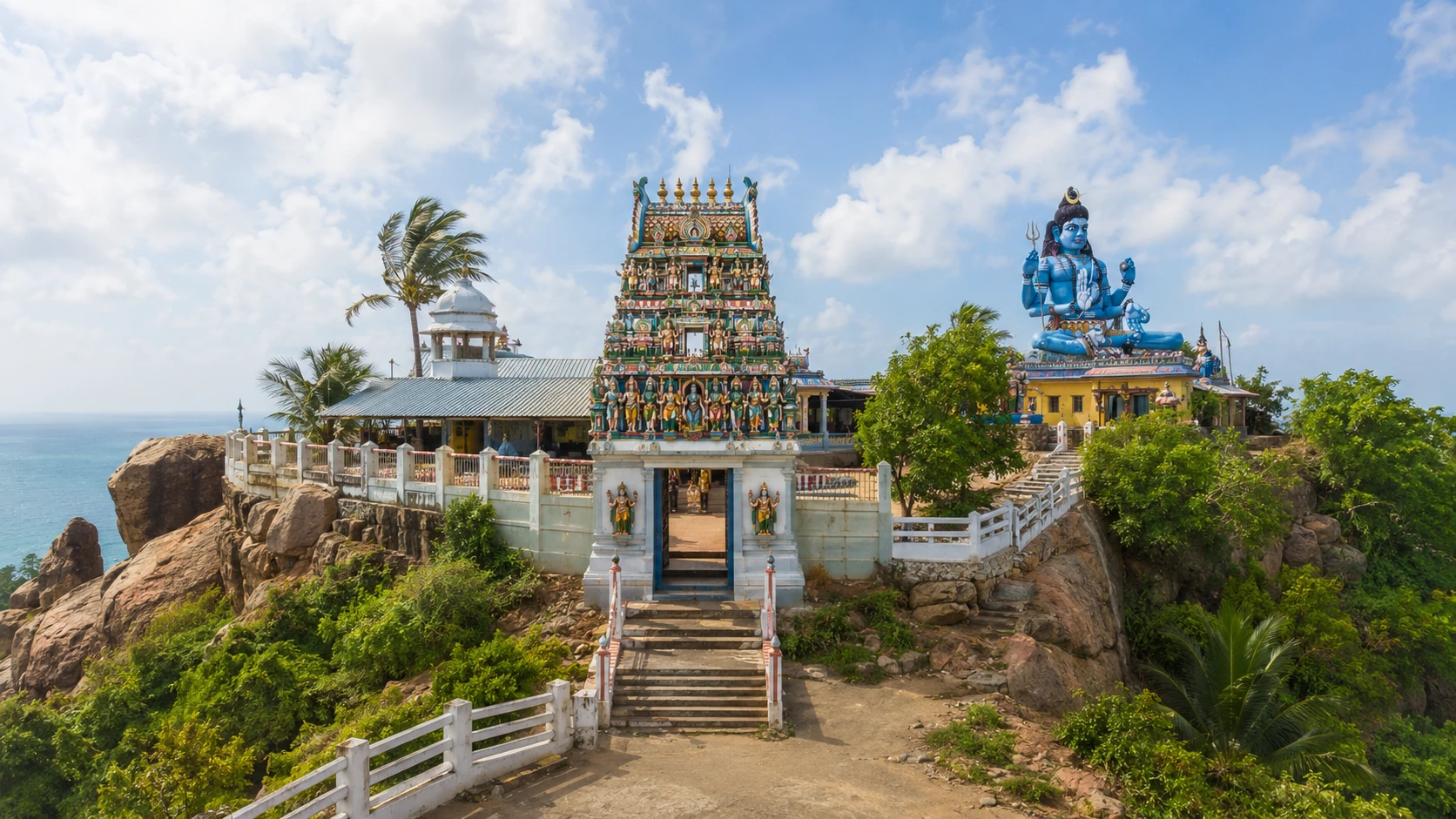
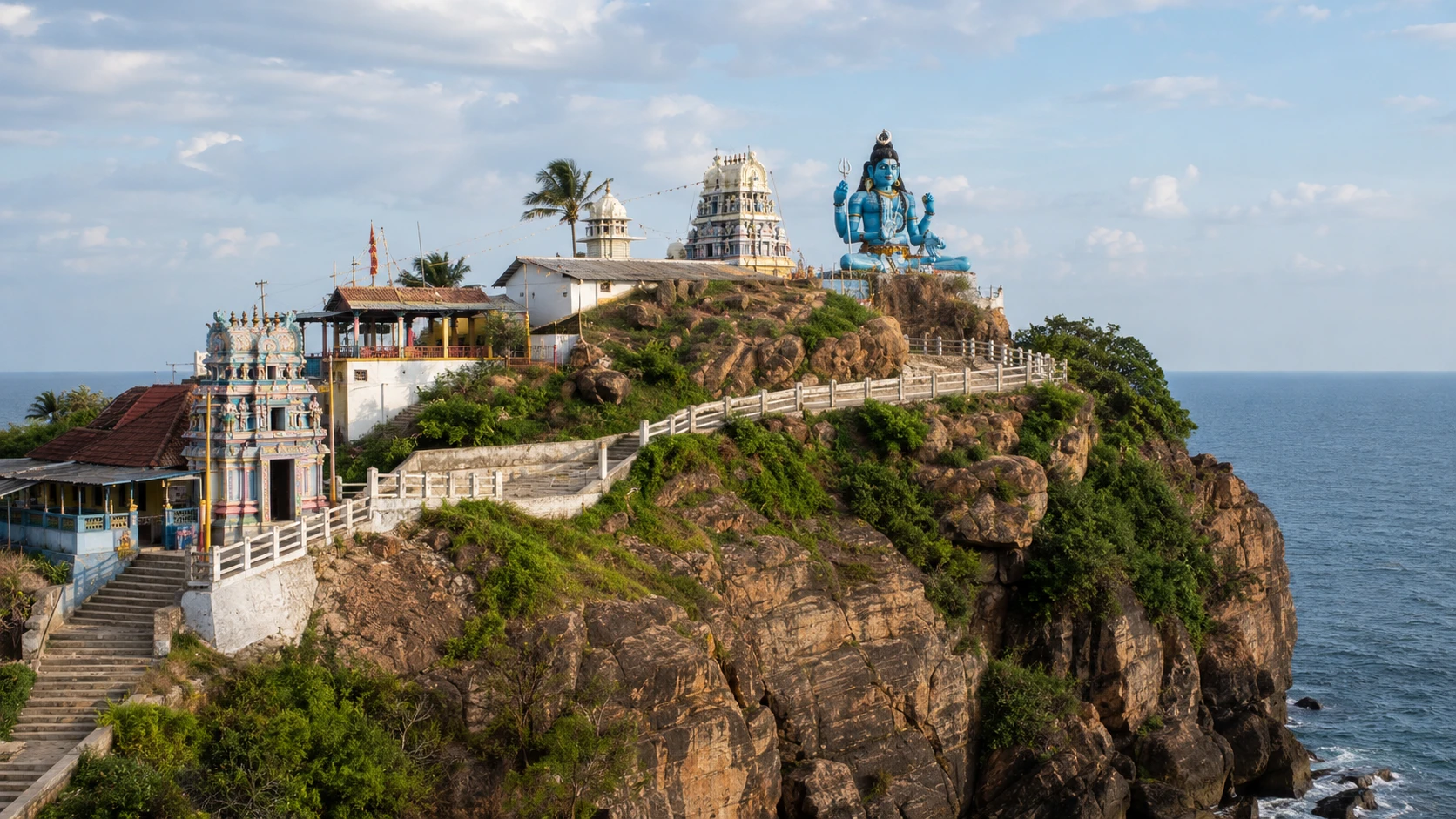
Lanka Shankari is the rare Shakti seat whose iconographic description must hold two genuinely different sanctums at once. At Koneswaram (Trincomalee), the modern temple, substantially rebuilt since 1952 on the surviving footprint of the headland after the 1622 Portuguese destruction, houses the reconstructed sanctum of Trikoneswari paired with Shiva Koneswarar.
The goddess is enshrined in her own sanctum within the wider Koneswaram precinct in standard anthropomorphic form, in keeping with classical Tamil Shaiva temple iconographic conventions; the imagery and ritual furnishings are the product of mid-twentieth-century and later reconstruction informed by Tamil temple tradition and by what could be recovered or recovered-from-memory of the pre-1622 temple.
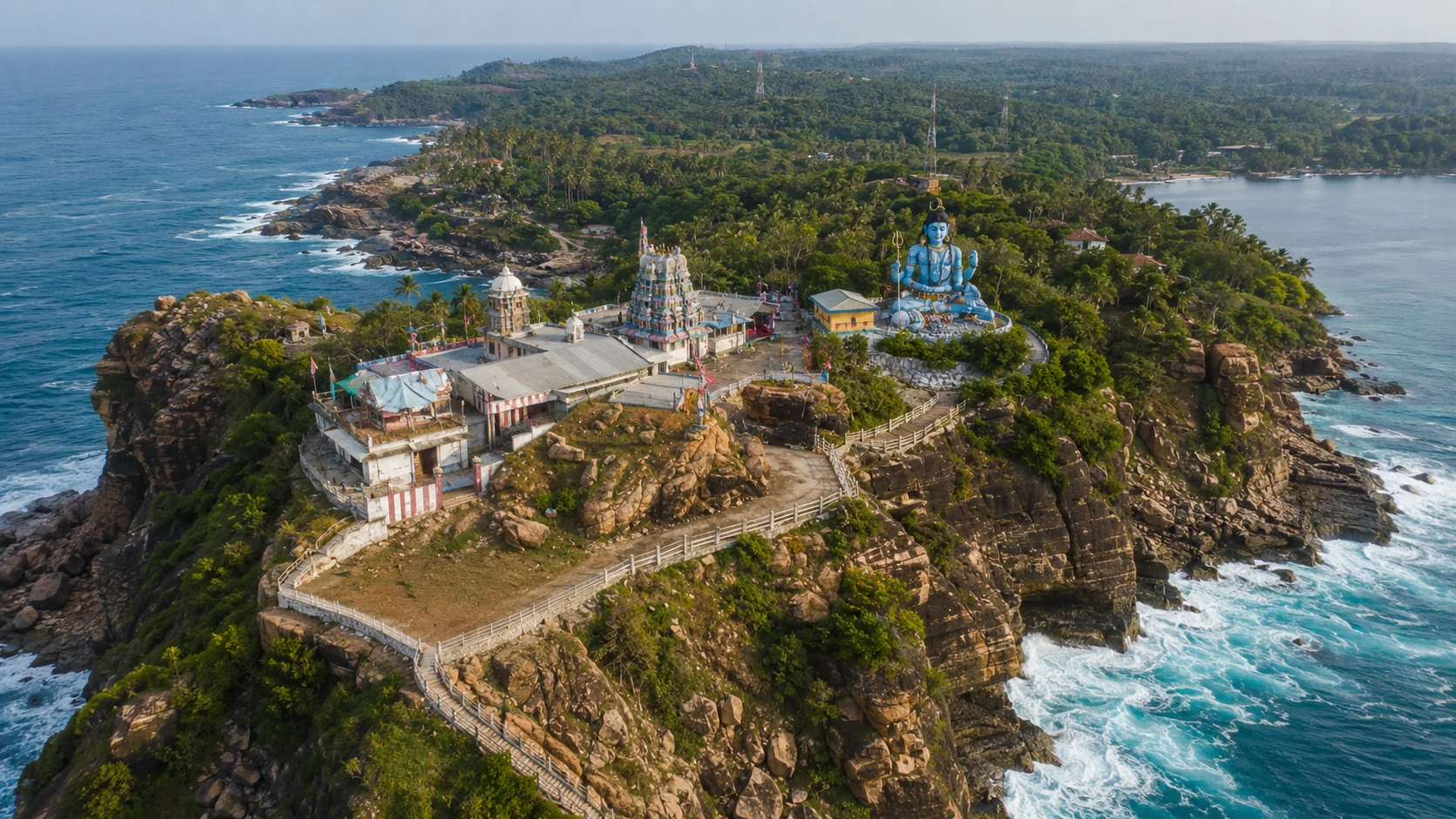
The Swami Rock setting, a dramatic three-cornered cliff rising sheer above the Indian Ocean, gives the temple precinct an exceptional geographical character; the views from the temple grounds out across the eastern ocean are themselves an integral part of the pilgrim experience.
The associated Shiva temple of Koneswarar occupies the adjacent space, the paired Shiva-Shakti worship structurally enacted as in any classical Tamil Shaiva precinct. At Nainativu, the goddess is enshrined in her ancient identity as Naga Pooshani Amman / Bhuvaneswari, 'she adorned with serpents' / 'lady of the worlds', in a continuously-worshipped sanctum whose iconographic tradition predates the dual identification with Lanka Shankari.
The Naga (serpent) iconography is central: the goddess is depicted with serpent adornments and the temple's symbolism throughout draws on the Naga theme, reflecting Nainativu's name (Naga-deepa, 'Serpent Island') in both Hindu and Buddhist tradition.
The temple is a classical Tamil Shakta shrine in its layout, with the goddess's sanctum at the centre and surrounding parikrama paths. Photography inside both sanctums is generally restricted; pilgrims should follow temple-staff direction at each site.
The cross-tradition shared geography of Nainativu, Hindu Naga Pooshani sanctum and Buddhist Nagadeepa Vihara on the same small island, less than a kilometre apart, is one of the most striking features of South Asian sacred geography.
Distinctive Practicesविशिष्ट परंपराएँ
The Swami Rock cliff-top darshan and the ocean parikrama view
स्वामी रॉक शीर्ष दर्शन और समुद्र-परिक्रमा दृश्य
Year-round, with the morning darshan (typically around 6, 8 AM) particularly favoured for the rising sun over the Indian Ocean visible from the temple precinct
At the Koneswaram identification, the temple's setting on the Swami Rock, a three-hundred-foot-tall cliff that drops sheer into the Indian Ocean, gives the pilgrim's darshan an exceptional geographical character. Morning pilgrims complete their darshan of Trikoneswari and Koneswarar and then walk to the cliff edge of the headland, where the temple precinct opens onto a view of the eastern ocean. The traditional pilgrim circuit includes a circumambulation of the headland that takes in this oceanic vista at multiple points. The lookout from the cliff edge, the same point from which the Portuguese threw the sacred objects of the original temple in 1622, is now a place where pilgrims gather to receive the goddess's blessing in the open view of the ocean. The visceral geographical drama of the location is integral to the experience: this is a Shakti seat where the goddess is approached at the very edge of the land.
The Goddess at the edge of the land is a recurring South Asian theme, Kanyakumari at the southern tip, Tara Tarini and Kalighat on the eastern coast, Hinglaj on the western edge, and Lanka Shankari extends this geography to the southernmost frontier of the canonical Hindu sacred map. The vertiginous setting forces the pilgrim into a posture of openness; one cannot approach the cliff-edge view without a measure of awe at the scale of what one faces. The 1622 destruction's specific physical character, sacred objects thrown into the ocean from this very point, gives the contemporary parikrama a layer of remembrance: the goddess is approached at the site of her dispossession and her return, and the very edge from which she was thrown is now where she gives darshan again.
The Kurikadduwan, Nainativu ferry pilgrimage and the Naga sanctum approach
कुरीकड्डुवान-नैनातीवू फेरी तीर्थयात्रा और नाग गर्भगृह दर्शन
Year-round, with ferries operating from early morning to late afternoon; the journey is particularly busy on Tuesdays and Fridays (auspicious for Devi worship) and during Adi Pooram and the temple's annual festivals
At the Nainativu identification, the pilgrim's approach to the goddess includes the short ferry crossing from Kurikadduwan (KKD) jetty on the Karainagar peninsula to the small island of Nainativu (Nayinathivu). The crossing takes approximately fifteen to twenty minutes and is itself part of the pilgrim experience, the small ferry boats carry pilgrims, monks, schoolchildren, and goods together, and the approach to the island gives the first view of the Naga Pooshani temple's white gopuram rising from the low island silhouette. On arrival, pilgrims walk a short distance from the jetty to the temple compound, which holds the goddess's sanctum at its centre. The Naga (serpent) iconography is encountered repeatedly along the approach and within the temple, serpent motifs in the temple's architecture, in the goddess's adornments, in the murals depicting her stories. Many pilgrims also visit the Buddhist Nagadeepa Purana Vihara, less than a kilometre away on the same island; the two shrines have coexisted on Nainativu for over a millennium and pilgrims of both traditions commonly visit both. The ferry pilgrimage to the island and back is, for many devotees, the part of the experience that marks the Nainativu visit as a true yatra rather than a routine darshan, the crossing dramatises the pilgrim's movement from the everyday to the sacred.
The ferry crossing is the operational form of the pilgrim's separation from the everyday, the Sanskrit word for pilgrimage, tirtha, originally means 'a crossing,' a ford, a place where one moves from one bank to another. At Nainativu, the pilgrim physically crosses water to reach the goddess. The Naga iconography places her within the older Indic theology in which serpents are the underground keepers of fertility, water, and the wisdom of the earth, a goddess venerated as 'adorned with serpents' is approached as a goddess of generative power. The shared geography with the Buddhist Nagadeepa Vihara reflects the older, less-policed Indic religious imagination in which Hindu and Buddhist sacred sites could legitimately share an island without either tradition feeling its claim diminished.
The dual-site pilgrim circuit, visiting both Koneswaram and Nainativu
द्वि-स्थल तीर्थयात्री-परिक्रमा, कोनेश्वरम और नैनातीवू दोनों का दर्शन
Across multi-day Sri Lanka pilgrimage itineraries, typically Nov, Mar; some pilgrims undertake the dual-site circuit during the Tamil New Year (mid-April) for the festival overlap
A growing number of contemporary pilgrims, particularly Indian Tamil pilgrims and Sri Lankan Tamil diaspora returning to the island, undertake a single pilgrimage that visits both Koneswaram (Trincomalee) and Nainativu (off Jaffna) explicitly because of the contested Lanka Shankari identification. The reasoning is straightforward: rather than adjudicating between the two traditions, the pilgrim receives darshan at both seats. The two sites are approximately 230 km apart by road (Trincomalee to Jaffna, with the Nainativu ferry adding a short additional leg); a multi-day Sri Lanka pilgrimage itinerary commonly includes both sites along with the wider Hindu temple landscape of northern Sri Lanka, Munneswaram, Naguleswaram, the Jaffna Nallur Kandaswamy temple, and others. Among pilgrims who frame the visit explicitly in Lanka Shankari terms, a small additional ritual is sometimes observed: pilgrims who have completed darshan at the first site formally acknowledge the second site's tradition before approaching, as a posture of respect to the unresolved canonical question. The dual-circuit practice is a contemporary innovation in some respects, older pilgrim traditions tended to follow one identification or the other, but it reflects the working contemporary settlement of the question: by visiting both, the pilgrim need not choose.
The dual-site circuit enacts the editorial posture this entry itself adopts: where the canonical tradition is unsettled, respect both readings and let the goddess receive worship at both seats. For pilgrims of deep Tamil heritage, the dual circuit also reflects the broader pattern of Tamil pilgrimage culture, in which a single goddess is often understood to hold seats across multiple geographical locations and the pilgrim's task is to honour her at the sites where she is venerated rather than to insist on a single locus. The Lanka Shankari question is resolved in practice, not in argument.
Did You Know?क्या आप जानते हैं?
Lanka Shankari occupies position one in Adi Shankaracharya's eighth-century Ashtadasa Maha Shakti Peetha Stotram, the opening line, 'Lankayam Shankari Devi,' names this site as the first of the eighteen great Goddess-seats that Shankara enumerates. This is the principal canonical reference for the site to the present day, and it places Lanka Shankari at the conceptual front of an entire enumeration of Shakti pilgrimage.
Adi Shankaracharya, Ashtadasa Maha Shakti Peetha Stotram, 8th c. CE
In 1622, after Portuguese forces under Constantino de Sa de Noronha demolished the Koneswaram temple complex, the temple's dressed stones were repurposed to construct Fort Frederick on the same Swami Rock headland, a fort that still stands today and which a pilgrim visiting Koneswaram walks past on the way to the temple precinct. The stones of the goddess's original shrine are, in this sense, still on the headland; they have simply been re-used for another purpose.
Queiroz, 'Conquista' (1687); Pieris, 'Ceylon: The Portuguese Era' (1913, 14)
Twentieth-century underwater archaeology at the foot of the Swami Rock cliff has recovered some of the sacred objects that were thrown into the ocean during the 1622 Portuguese destruction. These recovered items provide material evidence of the original temple's ritual furnishings and have informed the reconstruction work at the modern temple complex.
Pathmanathan, 'Hindu Temples and Shrines of Sri Lanka' (2006); various twentieth-century underwater archaeological reports
The small island of Nainativu, at the alternative Lanka Shankari identification, holds both the Hindu Naga Pooshani Amman temple and the Buddhist Nagadeepa Purana Vihara within less than a kilometre of each other; the Nagadeepa is one of the sixteen sacred Buddhist sites of Sri Lanka (Solosmasthana), traditionally said to have been visited by the Buddha. Pilgrims of both traditions commonly visit both shrines, and the dual-tradition shared geography on a small island is one of South Asia's most striking continuous examples of cross-tradition sacred coexistence.
Mahavamsa; Pathmanathan, 'The Kingdom of Jaffna' (1978)
The reconstruction of the Koneswaram temple at the Swami Rock began in 1952, more than 330 years after the Portuguese destruction, and has continued in stages across more than seventy years to the present day. The patience of the reconstruction is itself a part of the temple's modern character: this is not a single rebuild but a multi-generational sustained restoration carried by the Tamil Hindu community of Trincomalee and the wider Sri Lankan Tamil diaspora.
Pathmanathan (2006); Koneswaram Temple Trust records
Visitor Accessप्रवेश जानकारी
Both Lanka Shankari identifications, the Koneswaram precinct at Trincomalee and the Naga Pooshani Amman temple at Nainativu, are open to all worshippers regardless of caste, sect, or national origin. The principal practical restriction is the requirement of a valid Sri Lankan entry authorisation for non-Sri Lankan citizens; Indian citizens use the standard Sri Lankan ETA (Electronic Travel Authorisation) system or equivalent, applied online before travel. Sri Lankan Hindu citizens, including the Tamil communities of the Eastern and Northern Provinces, access both temples without restriction. Within each temple, photography inside the sanctums may be restricted by temple staff direction; pilgrims should follow local guidance at each site.
आध्यात्मिक आधार
Neither temple imposes caste, sect, or community restriction on darshan. Both sites maintain the traditional Tamil Shaiva-Shakta open-access posture characteristic of major Tamil temples. The visa restriction is a state-level operational reality rather than a religious or temple-administered rule.
समकालीन संदर्भ
Sri Lanka's ETA system permits Indian citizens and citizens of most countries to apply online for an entry authorisation prior to arrival, with processing typically completed within a few days. The ETA is generally valid for short-stay tourism (and pilgrimage is treated as tourism for visa purposes). The Sri Lankan visa regime is one of the more accessible in South Asia, and the Indian-Sri Lankan bilateral relationship has generally supported sustained pilgrim and tourist flow. Pilgrim groups travelling from India most commonly arrange through licensed Indian tour operators with Sri Lanka experience, who handle ETAs, transfers, and accommodation within a single package.
व्यावहारिक मार्गदर्शन
Indian and other foreign pilgrims should apply for the Sri Lankan ETA online well in advance of travel and bring printed confirmation. Pilgrim groups commonly book through licensed tour operators with experience of multi-temple Sri Lanka itineraries that include Koneswaram, Nainativu (and the Jaffna temple landscape), and other northern and eastern shrines. At both temples, modest dress is expected and footwear must be removed at the temple complex entrance. Within the sanctums, mobile phones must be silenced and photography may be prohibited as marked. Pilgrims visiting Nainativu should plan around the ferry schedule from Kurikadduwan, which operates regularly through the day but with reduced service in poor weather; the small island has minimal on-island infrastructure for extended stays, and most pilgrims visit as a day trip from Jaffna.
Festivalsत्योहार
Maha Shivaratri
महाशिवरात्रि
Feb, Mar (Phalguna Krishna Chaturdashi)
At Koneswaram, Maha Shivaratri is the principal festival of the paired Shiva-Shakti seat, with night-long vigil observances at Shiva Koneswarar's sanctum and parallel worship at the Trikoneswari shrine. The cliff-top setting gives the Shivaratri vigil at Koneswaram a particularly dramatic character, pilgrims who keep the night-watch can witness the dawn over the Indian Ocean from the temple precinct. At Nainativu, Maha Shivaratri is observed on a smaller scale alongside the temple's primary identification as a Devi shrine; the festival is locally observed by the Sri Lankan Tamil community of the area.
Sharad Navaratri
शरद नवरात्रि
Sep, Oct (Ashwin Shukla Pratipada to Navami)
The principal nine-day Devi festival in the autumn calendar, observed with intensified worship at both Koneswaram and Nainativu. At Nainativu in particular, the Navaratri period draws significant Tamil pilgrim flows from Jaffna and the wider Northern Province, with daily Devi Mahatmya recitations, special offerings, and the customary observance of the festival's day-by-day Devi-form progression. At Koneswaram, Navaratri observance has been re-established at the reconstructed Trikoneswari sanctum as part of the post-1952 ritual restoration.
Adi Pooram
आदि पूरम
Jul, Aug (Aadi month, Pooram nakshatram)
A distinctively Tamil Devi festival observed in the Aadi month, particularly significant at Tamil Shakta shrines. At Nainativu, Adi Pooram brings substantial pilgrim flows from Jaffna and the Sri Lankan Tamil diaspora; the festival is one of the principal annual occasions for women pilgrims to visit the goddess. At Koneswaram, Adi Pooram is observed in keeping with Tamil tradition. The festival is one of the clearer markers of Lanka Shankari's place within the Tamil temple tradition specifically, distinct from the pan-Indian Shakta calendar.
Koneswaram Thiruvilā / Nainativu Annual Mahotsavam
कोनेश्वरम तिरुविला / नैनातीवू वार्षिक महोत्सवम्
Varies by site, Koneswaram Thiruvilā typically in the post-monsoon period (March, April); Nainativu Mahotsavam in the Aani, Aadi window (Jun, Jul)
Each temple maintains its own annual mahotsavam, the great multi-day festival cycle with processions, chariot processions, special pujas, and community feeding. The Koneswaram Thiruvilā at Trincomalee draws regional Tamil Hindu pilgrim flows from the Eastern Province and beyond; the Nainativu annual festival is one of the principal religious occasions on the small island and draws ferry-borne pilgrim flows in significant numbers across the festival days. The exact dates vary year to year and are announced by the respective temple administrations; pilgrims planning visits around these festivals should confirm dates close to travel.
Traditional Offeringsपारंपरिक अर्पण
At both site identifications, traditional offerings follow Tamil Shakta temple convention: red flowers (especially hibiscus and red lotus), red sarees or chunaris, kumkum (red sindoor), sandal paste, coconut, fruits (banana especially), milk, jaggery, oil lamps (deepa), and traditional sweets including the Tamil temple staples of pongal, sarkkarai pongal, and modaka.
At Koneswaram, the Shiva-Shakti pair receives the traditional dual offering, bilva leaves to Shiva Koneswarar, kumkum and red flowers to Trikoneswari. At Nainativu, the Naga (serpent) iconography is reflected in some pilgrim offerings, small clay or metal serpent figurines are sometimes presented at the temple, particularly by pilgrims seeking blessings for fertility and family well-being.
Annaprasana / community feeding (annadhanam) is widely practised at both temples; pilgrim groups commonly sponsor a meal for fellow pilgrims as part of their darshan. Animal sacrifice is not part of either temple's worship. The Sri Lankan Department of Hindu Religious and Cultural Affairs maintains general guidance on appropriate offerings at heritage Hindu sites.
How to Reachकैसे पहुँचें
Lanka Shankari's two principal site identifications require distinct travel approaches. For Koneswaram (Trincomalee): from Colombo, the journey is approximately 260 km by road, 5, 6 hours by car or bus along the A6 highway via Habarana and Kantale. SriLankan Airlines operates domestic flights from Colombo to China Bay Airport (Trincomalee) on selected schedules.
Sri Lanka Railways operates a Northern, Trincomalee line passenger service from Colombo Fort, with the journey taking approximately 8 hours. Within Trincomalee, the temple precinct is on the Swami Rock headland and is reached by road from the town centre with a short walk through Fort Frederick to the temple complex.
For Nainativu (alternative identification): from Colombo, the journey to Jaffna is approximately 400 km by road, 8, 9 hours, or by domestic flight to Jaffna International Airport at Palaly (redeveloped and reopened for civilian flights in 2019). Sri Lanka Railways' Northern line via Anuradhapura serves Jaffna with a 6, 8 hour journey from Colombo Fort.
From Jaffna, the Nainativu pilgrim ferry departs from Kurikadduwan (KKD) jetty on the Karainagar peninsula, reached by road from Jaffna town in approximately 45 minutes to an hour; the ferry crossing to Nainativu takes 15, 20 minutes.
Pilgrims undertaking the dual-site circuit (visiting both Koneswaram and Nainativu) typically travel between Trincomalee and Jaffna by road (approximately 230 km, 5, 6 hours via the A29 / A9 corridor). Pilgrim groups from India and from the Sri Lankan Tamil diaspora most commonly arrange the full Sri Lanka pilgrimage through licensed tour operators experienced with multi-temple Northern and Eastern Province itineraries.
Plan Your Visitयात्रा की योजना
🌤 सर्वोत्तम मौसम
Sri Lanka's two principal regions of Lanka Shankari identification have distinct climatic patterns. For Trincomalee (Eastern Province), the dry season is May to September, with the northeast monsoon bringing rain from October to January; the best months for visiting are May through September, with March and April also generally good. For the Jaffna peninsula and Nainativu (Northern Province), the climate is somewhat drier overall, with the best months being December through March (cooler, drier) and acceptable conditions through April; the monsoon period (October to January) brings rain but is less intense than the eastern coast. Pilgrims planning the dual-site circuit will find March, April the best overlap window for both regions. The major festival windows (Maha Shivaratri Feb, Mar, Adi Pooram Jul, Aug, Sharad Navaratri Sep, Oct, the annual mahotsavams) can be planned around climate considerations; festival-period visits offer the most intense devotional atmosphere but also the largest crowds and the most strain on local accommodation.
👘 पहनावे का नियम
Modest dress is expected at both temples in keeping with Tamil temple convention. Women pilgrims commonly wear sari, salwar-kameez, or comparable traditional attire with shoulders, arms, and legs covered; many women pilgrims wear sari specifically for Devi-temple darshan as a traditional posture. Men should wear long trousers and full-sleeved shirts or traditional kurta; in classical Tamil temples a vesti (dhoti) and angavastram or shirt is the most traditional men's attire and is widely worn by pilgrims. Footwear must be removed at the temple complex entrance at both sites. Bright red, yellow, and orange are auspicious colours for Devi worship; many pilgrims wear specifically chosen attire for darshan.
📱 फोन और फोटोग्राफी
Photography inside the sanctums of both temples may be restricted by temple staff direction and pilgrims should follow local guidance. Photography in the outer compounds, courtyards, and at the Swami Rock cliff lookout at Koneswaram is generally permitted; the panoramic views of the Indian Ocean from the Koneswaram precinct are among the most photographed in eastern Sri Lanka. At Nainativu, photography during the ferry crossing and on the approach to the temple is generally permitted; pilgrims should confirm with on-site staff before photographing inside the temple complex. Mobile phones must be silenced inside both sanctums.
🏨 आवास
Trincomalee has substantial post-civil-war tourist infrastructure with hotels across every price category, particularly along the Uppuveli and Nilaveli beach strips north of the town centre; the temple precinct is approximately 5 km from these beach areas. Jaffna has expanding accommodation infrastructure, with Jetwing Jaffna, Tilko Jaffna City Hotel, and a range of smaller hotels and guesthouses serving the post-2011 pilgrim and tourist flow. Nainativu itself has minimal accommodation; pilgrims typically visit as a day trip from Jaffna. Pilgrim groups undertaking the dual-site Sri Lanka pilgrimage commonly use Trincomalee and Jaffna as their respective bases. For pilgrim-specific accommodation, the Sri Lankan Department of Hindu Religious and Cultural Affairs maintains some pilgrim facilities at major sites; advance enquiry through licensed pilgrim-tour operators is recommended.
Book a Pujaपूजा बुक करें
Photography inside the sanctums of both temples is restricted by temple-staff direction; pilgrims must follow on-site guidance. Modest dress is expected at both sites in keeping with Tamil temple convention. Footwear must be removed at the temple complex entrance at both sites. At Koneswaram, pilgrims walk through Fort Frederick to reach the temple precinct on the Swami Rock; this route passes a military zone and pilgrims should follow signage and on-site direction regarding photography of military installations. At Nainativu, the ferry from Kurikadduwan operates regularly through the day but with reduced service in poor weather; pilgrims should confirm ferry timings and plan their visit accordingly, with a buffer for return-crossing. Mobile network coverage in the Northern Province (including Nainativu) and at the Swami Rock precinct is generally adequate but can be intermittent at the temple sites themselves. Pilgrims undertaking the dual-site circuit should allow adequate time for travel between Trincomalee and Jaffna, approximately 5, 6 hours by road in good conditions.
Managed by: Koneswaram Temple Trust (Trincomalee identification); Nainativu Naga Pooshani Amman Temple administration (Nainativu identification); both under the overarching framework of the Sri Lankan Department of Hindu Religious and Cultural Affairs
Standard Darshan (both sites)
साधारण दर्शन (दोनों स्थल)
Archana / Sankalpa Puja
अर्चना / संकल्प पूजा
Festival-day Special Puja Sponsorship
उत्सव-दिवस विशेष पूजा प्रायोजन
Annadhanam Sponsorship (community feeding)
अन्नदानम् प्रायोजन (समुदायिक भोजन)
Sacred Soundsपवित्र ध्वनि
क्या आप जानते हैं? · Did You Know?
वही अनुवाद त्रुटि जिसने हिन्दू धर्म में '33 कोटि' को '33 करोड़' बनाया, बौद्ध धर्म में भी हुई। बौद्ध ग्रन्थों के चीनी अनुवाद ने 'सप्त कोटि बुद्ध' (7 श्रेष्ठ बुद्ध) का अनुवाद '7 करोड़ बुद्ध' कर दिया। तिब्बती अनुवाद ने सही किया: 7 प्रकार, 7 करोड़ नहीं। एक संस्कृत शब्द, दो प्रमुख विश्व धर्मों में गलत पढ़ा गया, ने दो एकसमान भ्रम स्वतन्त्र रूप से उत्पन्न किए।
Related Contentसंबंधित सामग्री
Related Scriptures
Community Reflections
🕉️
Be the first to share your reflection.