Hinglaj Mata
हिंगलाज माता
The Brahmarandhra of Sati, Shakti seated in a cave of the Kheerthar mountains, where Hindu yatra and Baloch reverence have kept the lamp burning across borders and centuries
Hinglaj, Balochistan, Pakistan
Hiṅgulājā Devī MandirAlso known as: Hingula Devi, Hingulaja Devi, Nani Mandir, Bibi Nani (Baloch usage), Nani Mata, हिंगुला देवी, हिंगलाज भवानी, नानी माता, हिङ्गुला, हिङ्गुलाजा, हिंगलाज (Sindhi, Devanagari script), هنگلاج (Sindhi, Perso-Arabic script)
पवित्र कथा · पवित्र कथा
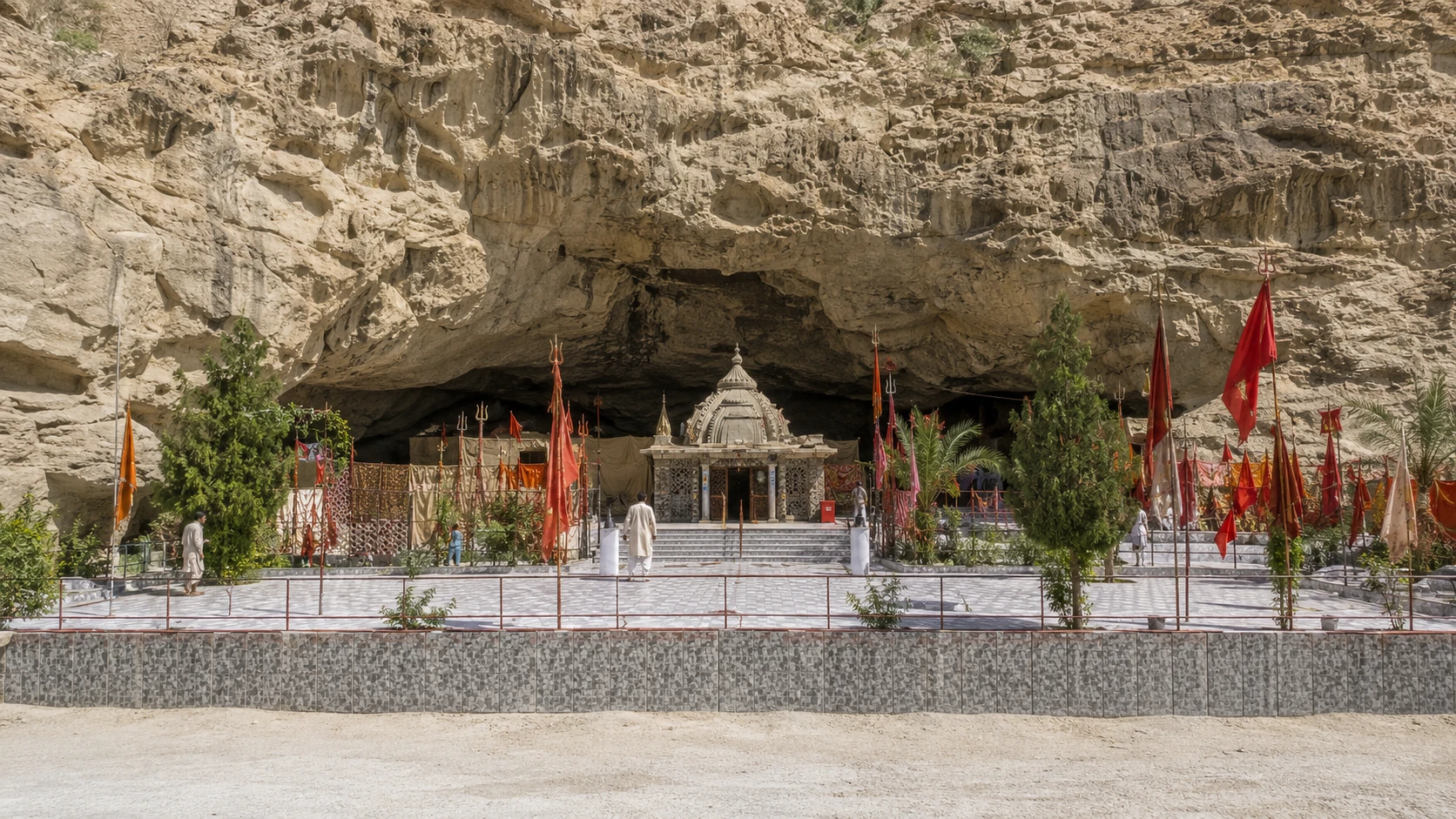
In a narrow cave at the foot of the Kheerthar mountains, where the Hingol river cuts through one of the wildest landscapes of the subcontinent, a small natural rock smeared with sindoor receives the worship of one of the oldest continuously-venerated Shakti seats in all of South Asia. When Vishnu's discus dismembered Sati's body to free Shiva from his Tandava of grief, the brahmarandhra, the aperture at the crown of her skull, the topmost gate of yogic anatomy, descended at this remote spot in what is now Pakistan's Balochistan province. The Pithanirnaya names the place Hingula-pitha and the goddess Hingula or Hingulaja; the cave-shrine has been worshipped under that name across what is known of recorded religious history. The yatra to Hinglaj is among the most arduous and most sacred journeys of Hindu pilgrimage. For centuries, Sindhi Hindu trading communities, Rajasthani and Kachchhi Charans (who hold Hinglaj as the originating source of their entire kuladevi lineage), and Bhatia and Lohana families travelled in protected caravans through hostile country to receive her darshan, and through all these centuries, the local Baloch communities, predominantly Muslim, have known her as Bibi Nani, Grandmother, and have offered the protection of their tribes to the passing pilgrims. After 1947, the yatra contracted to a trickle as the political border between India and Pakistan hardened. The completion of the Makran Coastal Highway in 2004 transformed the journey: what once took weeks of mountain trekking now takes hours by bus. Today, the annual Hinglaj Yatra each April, organised by the Pakistan Hindu Council and the local Sewa Mandali, draws tens of thousands of pilgrims from across Pakistan and from those who hold valid Indian-passport Pakistani visas; the cave's red rock is smeared anew each day with sindoor, and the lamp that has burned in this cave for as long as there have been pilgrims has, against all expectation, been kept burning.
Sacred Designationपवित्र पदनाम
Shakti Peeth
शरीर का अंग: Brahmarandhra (top of the skull, the crown aperture) per Pithanirnaya and most major Tantric recensions of the 51-Peetha list; some sources alternatively describe the falling part as the lalāṭa (forehead) or, less commonly, the bregma region of the skull. The brahmarandhra attribution is theologically the most charged in the entire Shakti Peetha catalogue, as it corresponds to the thousand-petalled sahasrara of yogic anatomy, the topmost chakra of liberation. The cave-shrine setting in a remote mountain gorge reinforces the attribution: the goddess of the crown aperture seated in the crown of a hidden mountain.
शक्ति: Hinglaj / Hingulaja / Hingula, the goddess of the Hingula stone; locally also Nani Mata in Sindhi-Balochi usage. Iconographically aniconic: the principal object of worship is a natural sindoor-smeared rock in the cave sanctum, not an anthropomorphic murti.
भैरव: Bhima Lochan per Pithanirnaya, 'he of the terrible eye'
Sacred Origin Storyपवित्र उत्पत्ति कथा
The Shakti Peethas were established when Vishnu's Sudarshana chakra, released to halt Shiva's world-ending Tandava of grief after Sati's self-immolation at her father Daksha's yajna, gradually dismembered her body as Shiva carried it across the cosmos. Each fragment fell to earth and consecrated that spot as a seat of Shakti.
The Pithanirnaya, the principal Tantric catalogue of the 51 Peethas, identifies Hingula-pitha as the place where Sati's brahmarandhra, the aperture at the crown of the skull, the highest gate of the yogic body, came to rest. The Devi Bhagavata Purana corroborates the attribution with minor variation.
The site is named, in the canonical lists, alongside Kamakhya (yoni), Kalighat (toes of the right foot), Vindhyavasini, and the other major seats. The Sanskrit name Hingula and its Prakrit-Sindhi descendant Hinglaj derive from hingula, a Sanskrit word for cinnabar or vermillion, the very substance with which the cave's red rock is daily anointed.
The goddess seated here is approached as Mahamaya in her crown-aperture aspect; in popular devotion she is simply Hinglaj Mata, the mother of the Hingula stone. Her paired Bhairava in the Pithanirnaya is named Bhima Lochan, 'he of the terrible eye'.
The local Baloch tradition, which has revered the same site across centuries of Muslim political dominance in Sindh and Balochistan, knows her as Bibi Nani, Lady Grandmother, and treats her as a tutelary spirit of the region whose protection extends to all who travel through her country in good faith.
The shared Hindu-Baloch reverence at the same site is one of the most remarkable features of South Asian sacred geography.
अन्य परंपराएँ · अन्य परंपराएँ
Charan kuladevi tradition (Rajasthani, Kachchhi, Sindhi)
Baloch folk-Islamic tradition
Historyइतिहास
Hinglaj's antiquity as a Shakti seat is canonically established in the medieval Tantric Peetha catalogues (Pithanirnaya, Tantra Chudamani) and corroborated by allusions in Sufi and Sindhi vernacular literature from at least the medieval period; the cave-shrine itself is older than any reliable historical record.
The pre-modern pilgrimage was organised through a network of Sindhi Hindu trading communities, Charan and Rajput protector-lineages, and ascetic sadhu groups; the journey was, in pre-mechanised eras, a six-to-eight-week round trip from the major Sindhi cities through largely uninhabited or sparsely-tribal mountain country.
Edward Backhouse Eastwick's 1849 'A Glance at Sind before Napier' offers one of the earliest English-language documentations of the yatra, describing pilgrim caravans that included merchants, ascetics, and protected families. Through the colonial period, the British Sind administration documented the pilgrimage and intermittently funded protective arrangements for the route.
The 1947 partition of British India placed Hinglaj inside Pakistan; the immediate post-Partition years saw the yatra contract sharply as Hindu migration from Sindh and Balochistan to India reduced the regional pilgrim base and as the new political border restricted cross-border movement.
For several decades after Partition, only small numbers of Pakistani Hindu pilgrims, plus a thin trickle of Indian visa-holders, reached the shrine. The Pakistan Hindu Council and local sewa mandalis maintained the temple through these years; the Sindhi Hindu communities of Karachi, Tharparkar, Umerkot, and Mithi remained the principal Pakistani pilgrim base.
The transformation of the yatra began in 2002 with the Government of Pakistan's establishment of Hingol National Park, and accelerated decisively with the 2004 completion of the Makran Coastal Highway (M-8 / N-10), which reduced the road journey from Karachi from a multi-day caravan to a four-to-five-hour bus ride.
From the mid-2000s onward, the annual April Tirath has grown into one of South Asia's most striking pilgrimages: a few thousand pilgrims in 2010, tens of thousands by the late 2010s, and a continuing year-on-year expansion. Improved access has also brought new pilgrim infrastructure under the coordination of the Pakistan Hindu Council and the Hinglaj Mata Mandir Sewa Mandali.
The shrine today is one of the most visible and best-publicised Hindu pilgrimage destinations in Pakistan, with substantial coverage in both Pakistani and Indian press, and with cross-community participation that includes local Baloch hospitality and protection at the yatra camps.
Historical Timelineऐतिहासिक कालक्रम
Establishing precise pre-medieval dates for any Shakti Peetha is methodologically difficult; the Peetha-catalogue tradition is itself an interpretive layer over older site veneration. Hinglaj's living folk and Charan traditions of antiquity are stronger evidence of continuous worship than any single textual reference.
Pilgrim numbers and migration figures for the immediate post-Partition decades vary across sources; the broad pattern of contraction and local-community continuity is well-attested but exact quantification is uncertain.
Pilgrim-flow estimates for the annual Hinglaj Yatra vary significantly across sources, Pakistan Hindu Council estimates, press reports, and academic ethnographies offer numbers that range from low tens of thousands to higher figures depending on year, method, and definition (cumulative attendance across the multi-day Tirath versus single-day peak). Pilgrims should treat published numbers as approximate orders of magnitude rather than precise counts.
What You'll Seeदर्शन में
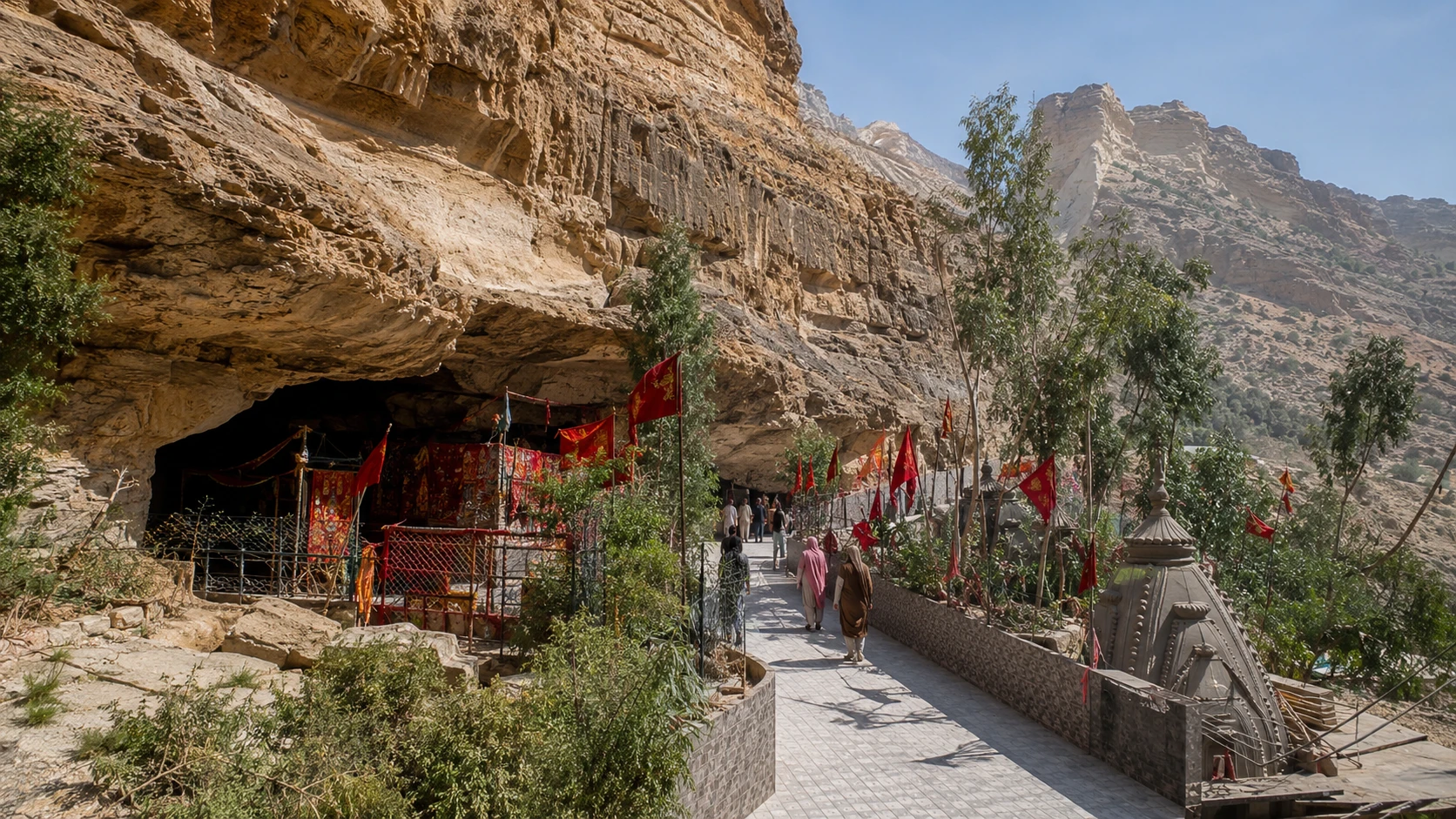
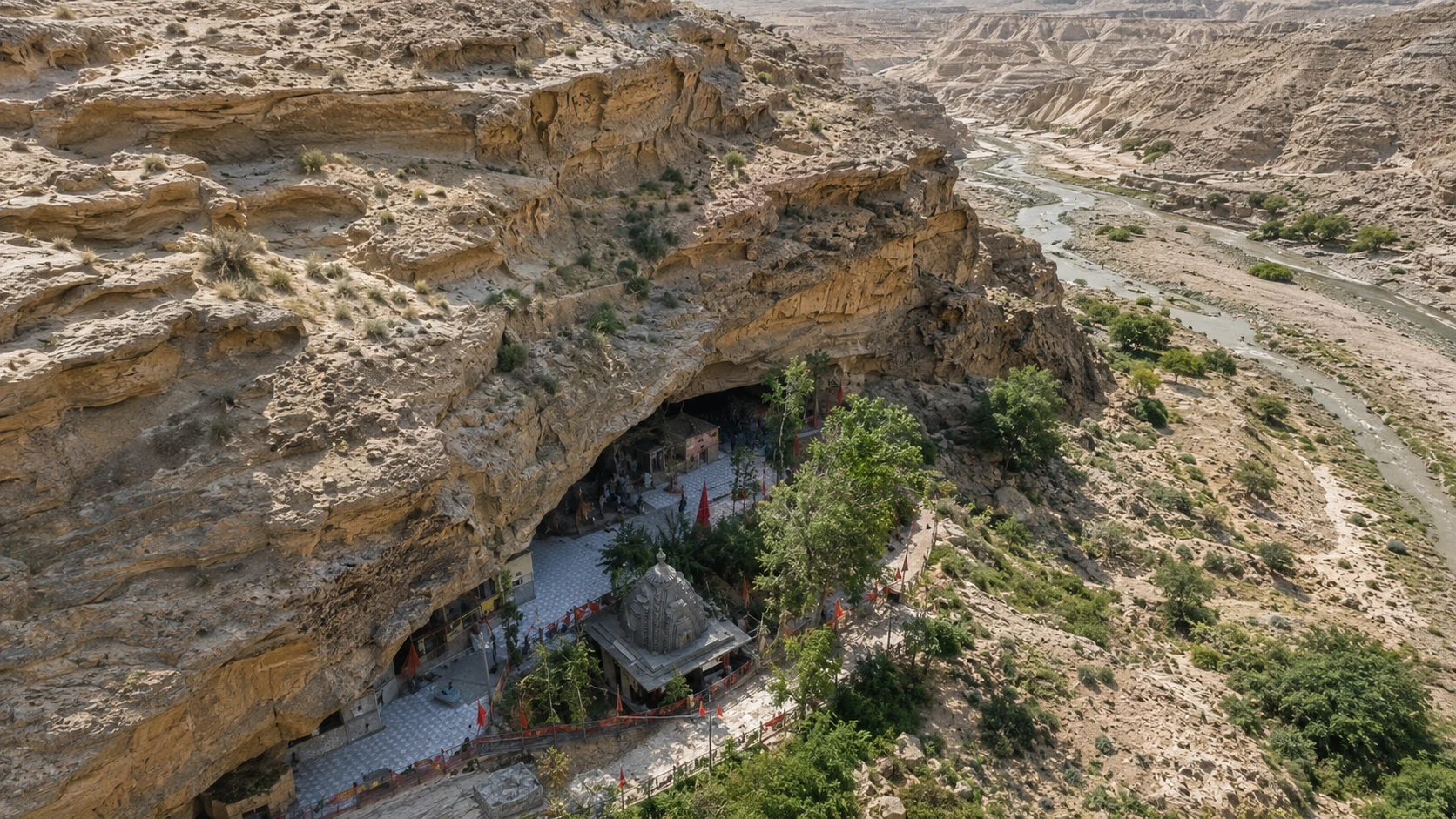
Hinglaj's sanctum is a natural rock cave at the foot of the Kheerthar mountains, beside the bank of the Hingol river. The principal object of worship is a small natural rock formation within the cave, anointed daily with thick layers of sindoor (vermillion) and other auspicious substances; the stone is interpreted as the brahmarandhra of Sati that fell at this spot, and as the seat of the goddess Hingula / Hinglaj.
There is no anthropomorphic murti. The cave is reached by a short flight of steps cut into the rock face and a low entrance through which pilgrims enter one by one or in small groups. The interior of the cave is intimate in scale, pilgrims approach the central sindoor-smeared rock, offer their worship, and exit through a separate opening.
The Sanskrit name Hingula and its derived form Hinglaj come from the same word as the substance daily applied to the stone: hingula is one of the older Sanskrit words for cinnabar / vermillion / red mercuric sulphide, and the etymological identity of the goddess's name with the colour of her worship is striking.
Around the cave entrance and along the approach path are smaller secondary shrines, including a Ganesha Deva shrine at the entrance, smaller shrines to Brahma and other deities, and shrine-spaces for offering and parikrama (circumambulation).
The entire precinct is set within a narrow gorge of dramatic geological character, red and ochre rock walls, scrub vegetation, and the seasonal Hingol river. The cave's aniconic character is theologically and historically deliberate: a Shakti seat at the western edge of the subcontinent, anointed daily in vermillion, where the goddess is the rock and the rock is the goddess.
Photography is permitted at the cave exterior and along the approach path but is not permitted inside the sanctum itself; pilgrims should follow on-site staff direction.
Distinctive Practicesविशिष्ट परंपराएँ
The Chandragup mud-volcano coconut offering, pre-darshan ritual stop
चन्द्रगुप कीचड़-ज्वालामुखी नारियल अर्पण, दर्शन-पूर्व अनुष्ठान-पड़ाव
Performed on the inbound journey before approaching the main Hinglaj cave, particularly during the annual Tirath but also on individual pilgrim visits throughout the year
Approximately a few kilometres before reaching the main Hinglaj cave, the pilgrim's route passes Chandragup, one of a cluster of active mud volcanoes that periodically vent bubbling mud, gas, and water through wide cone-shaped craters. Pilgrim tradition treats Chandragup as a sacred prerequisite stop: pilgrims climb the slope of the mud cone, offer prayer at the crater's rim, and drop or throw a coconut into the mud crater as an offering to the deities believed to preside there. The pattern of the crater's subsequent bubbling response is, in folk belief, interpreted as Hinglaj Mata's prior acceptance of the pilgrim and a sign of the success of the impending darshan. The Chandragup ritual functions as a ritual gateway: the pilgrim's approach to Hinglaj is not direct but mediated through this geological encounter, where the earth itself appears to respond to the offering.
The Chandragup ritual layers Hinglaj's worship with a chthonic, telluric dimension, the goddess of the cave is approached through the earth's own active geology. The mud volcano's vapours and bubbling response materialise the idea that the land itself participates in the pilgrim's address to Shakti. The ritual is also a test: a pilgrim whose offering produces no obvious response interprets the silence as a call to deeper sincerity rather than rejection.
Charan-led pilgrim leadership and bardic invocation
चारण-नेतृत्व तीर्थयात्री प्रमुखत्व एवं वन्दीजन आह्वान
Particularly during the annual Chaitra Navaratri Tirath, but reflected in routine pilgrimage flows year-round where Charan participants are present
The Charan community's historic role as the protector-bards of the Hinglaj pilgrimage continues in modified form in the contemporary yatra. Charan pilgrims from Rajasthan, Kachchh, Gujarat, and Sindh form a distinctive cohort within the Tirath; their elders are accorded recognition by the Sewa Mandali, and their bardic invocations, extempore Sanskrit and Rajasthani verses praising the goddess in the older Charan vernacular bhakti style, are performed at gathering points along the route and at the temple precinct itself. The Charan kuladevi linkage is articulated through these performances: the Charan visiting Hinglaj is, in their own tradition's terms, returning to the source from which their entire community-goddess lineage emerged. The performances are not staged 'cultural events' but living devotional practice continuous with centuries of Charan poetry. Pilgrims of all backgrounds gather to listen.
Within the Charan understanding, Shakti is not abstract, she takes form repeatedly across history through Charan women recognised as her living embodiments, and her primal seat is Hinglaj. The Charan visit therefore enacts a return that completes the lineage: the descendant comes back to where the lineage began. For non-Charan pilgrims who witness Charan bardic performance at the yatra, the practice offers a window into one of South Asia's oldest continuous Shakti devotional traditions.
Cross-community pilgrim hospitality, Baloch tribal protection and Bibi Nani offerings
अन्तर-समुदायीय तीर्थयात्री आतिथ्य, बलोच जनजातीय संरक्षण एवं बीबी नानी अर्पण
Year-round, with heightened visibility during the annual Tirath when pilgrim camps are organised along the yatra route through Lasbela district
The local Baloch communities of Lasbela district have, for generations, extended hospitality and protection to Hinglaj pilgrims regardless of religious community. During the annual Tirath, Baloch tribal leaders coordinate with the Pakistan Hindu Council and the Sewa Mandali to ensure pilgrim safety along the route; Baloch traders sell food, water, and supplies at the route camps; and local Baloch families make their own offerings to Bibi Nani at customary points along the route. The tradition is rooted in the Baloch tribal code of melmastia (hospitality to the guest) and in the parallel Bibi Nani folk veneration described in the mythology section above. Hindu pilgrims who have travelled with the modern yatra commonly report this cross-community hospitality as one of the most memorable features of the experience, a working contradiction of the broader contemporary political narrative of South Asia, and a centuries-old precedent of shared sacred geography that the yatra carries forward into the twenty-first century.
Hinglaj's distinctive theological feature is that her protection extends across community lines. The Charan tradition recognises her as the source of the Hindu warrior-bard goddess lineage; the Baloch tradition recognises her as Bibi Nani, the protective grandmother of the region. Both traditions understand her power not as exclusive to one community but as the regional sacred presence that all who travel her country must honour. The pilgrim hospitality across community lines is the lived enactment of this shared theological recognition.
Did You Know?क्या आप जानते हैं?
Hinglaj Mata's annual Chaitra Navaratri Tirath, organised each April by the Pakistan Hindu Council and the local Hinglaj Mata Mandir Sewa Mandali, is by most contemporary accounts the largest Hindu pilgrimage in Pakistan and one of the largest annual cross-border Hindu pilgrimage gatherings anywhere in the world. Pilgrim numbers have grown from a few thousand per yatra in 2010 to estimates ranging into the tens of thousands by the late 2010s and early 2020s.
Pakistan Hindu Council pilgrim coordination records; Schaflechner, 'Hinglaj Devi' (Oxford, 2018); sustained Indian and Pakistani press coverage
The Sanskrit name Hingula, from which the goddess's name and the place's name both derive, is one of the older Sanskrit words for cinnabar or vermillion, the very substance with which the cave's sacred rock is daily anointed. The goddess is named for the colour of her worship; the etymological self-reference is exceptional in the Shakti Peetha catalogue.
Sanskrit lexicons including Monier-Williams; Schaflechner, 'Hinglaj Devi' (Oxford, 2018)
The Charan community of Rajasthan, Gujarat, Kachchh, and Sindh holds Hinglaj as the originating source of their entire kuladevi lineage. Several of the most-venerated regional goddesses of western India, Karni Mata of Deshnok (Bikaner), Nagnechi Mata, Avad Mata, Khodiyar Mata, Bahuchara Mata, are identified in Charan tradition as regional manifestations of the same Hinglaj. The Charan visit to Hinglaj is, in their own tradition's terms, a return to the source.
Charan bardic literature; Harlan, 'Religion and Rajput Women' (1992); Schaflechner, 'Hinglaj Devi' (2018)
The local Muslim Baloch communities of Lasbela district have for generations revered the same goddess as Bibi Nani, Lady Grandmother, extending tribal hospitality and protection to Hindu pilgrim caravans across centuries of changing political and religious circumstance. This shared Hindu-Baloch reverence at the same site is one of the most remarkable working examples of cross-community sacred geography in South Asia.
Schaflechner, 'Hinglaj Devi' (2018); Lambrick, 'Sind' (1964); contemporary pilgrim ethnography
Before the completion of the Makran Coastal Highway in 2004, the journey from Karachi to Hinglaj was a six-to-eight-week round-trip caravan undertaking through largely uninhabited mountain country. The Eastwick account of 1849 describes pilgrim caravans assembling at the Sindhi cities and proceeding under Baloch tribal protection across the desert and the Kheerthar passes. Today the same journey takes approximately four to five hours by bus.
Eastwick (1849); Schaflechner (2018); Government of Pakistan National Highway Authority, N-10 completion records
Visitor Accessप्रवेश जानकारी
Hinglaj Mata Temple is open to all worshippers regardless of caste, sect, or religious community. The principal practical restriction is the requirement of a valid Pakistani visa for non-Pakistani citizens, including Indian pilgrims who must obtain a Pakistani pilgrim visa (typically arranged through registered Indian pilgrim-tour operators in coordination with the High Commission of Pakistan in India and the Government of Pakistan). Pakistani Hindu citizens, including the Sindhi Hindu communities of Karachi, Tharparkar, Umerkot, and Mithi, access the temple without restriction. Foreign tourists of other nationalities require a Pakistani visa under the general visa regime. Within the temple precinct, all pilgrims are welcomed; the local Baloch communities of Lasbela district extend hospitality and protection across community lines.
आध्यात्मिक आधार
The temple itself imposes no caste, sect, or community restriction on darshan; this is consistent with the long-standing cross-community character of Hinglaj veneration. The visa restriction is a state-level operational reality rather than a religious or temple-administered rule. Within the precinct, the goddess is approached on the same terms by all pilgrims regardless of national origin.
समकालीन संदर्भ
Indian pilgrim visa arrangements for Hinglaj typically operate within a wider Pakistan, India religious-visa framework administered by both governments. Specific group-visa allocations are made for the annual Chaitra Navaratri Tirath, with applications coordinated through registered pilgrim-tour operators in India and through the Pakistan Hindu Council on the Pakistani side. Indian pilgrims should plan well in advance, visa processing for religious-tourism purposes can take several weeks, and group quotas are filled rapidly for the major Tirath. The wider Pakistan, India political relationship affects visa flow in ways that pilgrim planning must accommodate.
व्यावहारिक मार्गदर्शन
Indian pilgrims should arrange the Hinglaj yatra exclusively through reputable, licensed pilgrim-tour operators with documented experience of Pakistan religious-visa work. Independent travel to Hinglaj by Indian citizens is operationally complex and is not the recommended approach. Pakistani Hindu citizens can travel independently or through the Sewa Mandali / PHC group arrangements; group travel during the Tirath is strongly recommended for safety and logistical reasons. Foreign tourists should follow the standard Pakistan visa regime and travel with reputable operators familiar with the Hingol-Lasbela region. All pilgrims should be aware that mobile network coverage in Hingol National Park is limited; food, water, and medical needs should be planned for the route.
Festivalsत्योहार
Hinglaj Yatra, Chaitra Navaratri Tirath
हिंगलाज यात्रा, चैत्र नवरात्रि तीरथ
Apr (Chaitra Shukla Pratipada to Navami, occasionally extending to Purnima)
The annual flagship pilgrimage to Hinglaj, observed each spring during Chaitra Navaratri. The Tirath spans approximately nine to eleven days; pilgrim camps assemble along the Makran Coastal Highway route from Karachi, the Chandragup mud-volcano pre-darshan ritual is performed at the appointed point on the route, and the principal darshan at the cave shrine takes place over the ashtami-navami days. The annual Tirath has grown over the past two decades into one of South Asia's most striking pilgrimages, a several-tens-of-thousands gathering coordinated by the Pakistan Hindu Council and the Sewa Mandali with cross-community Baloch hospitality. For most pilgrims, this is the only practical time to undertake the yatra; the infrastructure of pilgrim camps, water, food, medical posts, and security is mobilised primarily for this festival window.
Sharad Navaratri
शरद नवरात्रि
Sep, Oct (Ashwin Shukla Pratipada to Navami)
The autumn Navaratri is observed at Hinglaj on a smaller scale than the spring Tirath, principally by local Pakistani Hindu communities and by smaller groups of pilgrims from across Pakistan. While the major mela-scale Tirath organisation is not mobilised for Sharad Navaratri, daily Navaratri-period worship at the cave shrine includes Devi Mahatmya recitations and special offerings. The contrast in scale between the spring and autumn Navaratris at Hinglaj reflects the established convention that the annual Tirath is the spring Chaitra festival rather than the autumn observance.
Maha Shivaratri
महाशिवरात्रि
Feb, Mar (Phalguna Krishna Chaturdashi)
Observed at Hinglaj primarily as the night of the paired Bhairava Bhima Lochan, whose presence at the shrine is invoked through Shivaratri night-vigil recitations and offerings. The festival is observed on a small scale by the local Pakistani Hindu communities who undertake the shrine's day-to-day worship through the year; it does not draw the mela-scale gatherings that the Chaitra Tirath attracts.
Diwali
दीवाली
Oct, Nov (Kartika Amavasya)
The Sindhi Hindu communities of Karachi, Tharparkar, Umerkot, and Mithi, who form the principal year-round pilgrim base of Hinglaj, observe Diwali at the cave shrine with special evening offerings of lamps and the customary Lakshmi-Goddess prayers. While the festival is principally a household observance for Sindhi Hindus, those who can travel to Hinglaj for Diwali consider the cave shrine an especially auspicious place to receive the new fiscal year's blessing. Diwali at Hinglaj is a smaller, more intimate observance than the great Chaitra Tirath, but is significant within the Sindhi Hindu community calendar.
Traditional Offeringsपारंपरिक अर्पण
Sindoor (vermillion) is the principal and most distinctive offering at Hinglaj, the cave's sacred rock is anointed daily with thick fresh layers, and pilgrims customarily offer sindoor packets along with their other items. Red cloth (chunari), red flowers, coconut, fruits, sweets (especially traditional Sindhi mithai), and oil lamps are standard.
Coconut is the specific offering at Chandragup mud volcano on the route to the cave, where it is dropped or thrown into the crater. Many Charan and Rajasthani pilgrims bring ritual dhwaja (flag) offerings, and some communities offer puris and homemade prasad prepared in the pilgrim camps.
Animal sacrifice is not part of Hinglaj's worship and is not permitted at the cave shrine; the worship at Hinglaj is vegetarian throughout. Pilgrims who wish to make community-level offerings (such as bhandara feeding for fellow pilgrims) coordinate with the Sewa Mandali during the Tirath.
How to Reachकैसे पहुँचें
Hinglaj Mata Temple is located in Hingol National Park, Lasbela district of Balochistan, Pakistan, approximately 250 km west of Karachi along the Makran Coastal Highway (N-10 / M-8). The standard pilgrimage route originates in Karachi.
From Karachi, the journey by bus or private vehicle along the Makran Coastal Highway westward, then turning north onto the Hinglaj access road into Hingol National Park, takes approximately four to five hours depending on road conditions and the season.
The route passes through scrub-and-desert landscape with limited settlement; pilgrim convoys during the Chaitra Tirath move together for safety, security, and logistical efficiency. The Chandragup mud-volcano pre-darshan ritual stop is on the route approximately seven kilometres before the cave shrine.
Indian pilgrims require a Pakistani pilgrim visa and should arrange the journey through reputable, licensed pilgrim-tour operators experienced with the Pakistan religious-visa process, independent travel by Indian nationals is not the recommended approach.
Pakistani Hindu citizens can travel by private vehicle, hired bus, or through PHC / Sewa Mandali group arrangements; group travel during the Tirath is strongly recommended. International pilgrims of other nationalities require a Pakistan visa under the general visa regime and should travel with operators familiar with the Hingol-Lasbela region.
Within Hingol National Park, all movement around the cave-shrine precinct is on foot, with short climbs to the Chandragup mud-volcano and to the cave entrance.
Plan Your Visitयात्रा की योजना
🌤 सर्वोत्तम मौसम
The annual Chaitra Navaratri Tirath in April is the principal pilgrimage window and is when the temple infrastructure, pilgrim camps, and security coordination are at their fullest. Outside the Tirath, October through March offers more bearable weather for visiting Balochistan, clear skies, mild days, cool nights, and minimal rainfall. May through September brings extreme heat to the Hingol region, with daytime temperatures regularly above 40°C and limited shade at the cave precinct; off-Tirath summer pilgrimage is operationally difficult and not recommended for most pilgrims. Monsoon rainfall is generally low in this part of Balochistan but flash-flooding can affect the Hingol river bed in late summer.
👘 पहनावे का नियम
Modest dress is essential and expected by both temple custom and the prevailing cultural norms of Balochistan. Women pilgrims commonly wear sari, salwar-kameez, or comparable traditional attire with full coverage of shoulders, arms, and legs; a head-covering or dupatta is customary and respectful in the cave shrine and is also appropriate elsewhere in the region. Men should wear long trousers and full-sleeved shirts or kurta. Footwear must be removed at the cave entrance. Red, the goddess's colour, is auspicious for women devotees and many pilgrims wear specifically-chosen red clothing for the Tirath.
📱 फोन और फोटोग्राफी
Photography is permitted at the cave-shrine exterior, at the Chandragup mud volcano, and along the approach path, subject to on-site staff direction. Photography inside the cave sanctum itself is prohibited and pilgrims must respect this restriction. Photography of other pilgrims requires their consent. Photography of local Baloch villages, residents, security personnel, or military installations along the route is not advisable and may be restricted by Pakistani security regulations; pilgrims should follow operator guidance on what is and is not appropriate to photograph. Mobile network coverage in Hingol National Park is limited and intermittent; pilgrims should not rely on continuous connectivity.
🏨 आवास
Within Hingol National Park, permanent pilgrim accommodation is very limited; the principal infrastructure is the temporary camp arrangement organised by the Pakistan Hindu Council and the Sewa Mandali for the annual Tirath, with tents, shared shelter, water provision, and rudimentary medical posts. Off-Tirath pilgrims have very limited on-site accommodation options and most stay at Karachi-based hotels and undertake the journey as a long day trip. In Karachi, hotels across every price category serve as the standard base for Hinglaj pilgrimage. The Sindhi Hindu communities of Karachi sometimes extend hospitality to Indian-visa pilgrims through community networks; arrangements should be made in advance through licensed pilgrim-tour operators.
Book a Pujaपूजा बुक करें
Photography is prohibited inside the cave sanctum and pilgrims should respect this restriction strictly. Photography of local Baloch villages, residents, security personnel, and military installations along the route is not advisable and may be restricted by Pakistani security regulations; pilgrims should follow operator guidance. Mobile network coverage in Hingol National Park is limited and intermittent, pilgrims should not rely on continuous connectivity for safety or logistical purposes and should plan in advance. Daytime temperatures in the Hingol region routinely exceed 40°C from May to September and the cave precinct has limited shade; non-Tirath travel during these months is operationally difficult. Water, food, and medical supplies should be planned for the journey. Group travel during the annual Tirath is strongly recommended over independent travel for both safety and logistical reasons.
Managed by: Hinglaj Mata Mandir Sewa Mandali (HMSM), in coordination with the Pakistan Hindu Council (PHC)
Standard Darshan
साधारण दर्शन
Chaitra Tirath Sponsorship
चैत्र तीरथ प्रायोजन
Personal Puja (priest-mediated offering)
व्यक्तिगत पूजा (पुरोहित-मध्यस्थ अर्पण)
Akhand Jyoti / Lamp Offering
अखण्ड ज्योति / दीप अर्पण
Sacred Soundsपवित्र ध्वनि
क्या आप जानते हैं? · Did You Know?
वही अनुवाद त्रुटि जिसने हिन्दू धर्म में '33 कोटि' को '33 करोड़' बनाया, बौद्ध धर्म में भी हुई। बौद्ध ग्रन्थों के चीनी अनुवाद ने 'सप्त कोटि बुद्ध' (7 श्रेष्ठ बुद्ध) का अनुवाद '7 करोड़ बुद्ध' कर दिया। तिब्बती अनुवाद ने सही किया: 7 प्रकार, 7 करोड़ नहीं। एक संस्कृत शब्द, दो प्रमुख विश्व धर्मों में गलत पढ़ा गया, ने दो एकसमान भ्रम स्वतन्त्र रूप से उत्पन्न किए।
Related Contentसंबंधित सामग्री
Related Scriptures
Community Reflections
🕉️
Be the first to share your reflection.