Tara Tarini Temple
तारा तारिणी मंदिर
Where Sati's breasts fell and the goddess walks as twins
Berhampur, Odisha, India
Tārā TāriṇīAlso known as: Tara Tarini Devi, Tara Tarini Pitha, ତାରା ତାରିଣୀ, तारा तारिणी, তারা তারিণী, Stana Peetha, Adi Shakti Peetha, Kumari Hill, Purnagiri, The Twin Mothers
युग
Textually attested from at least the 6th, 10th century (Brahmanda Purana, Skanda Purana's Utkala Khanda); continuous worship through the Bhanja and Eastern Ganga periods; current temple structure dates substantially from the medieval Ganga period with modern additions
वास्तुकला
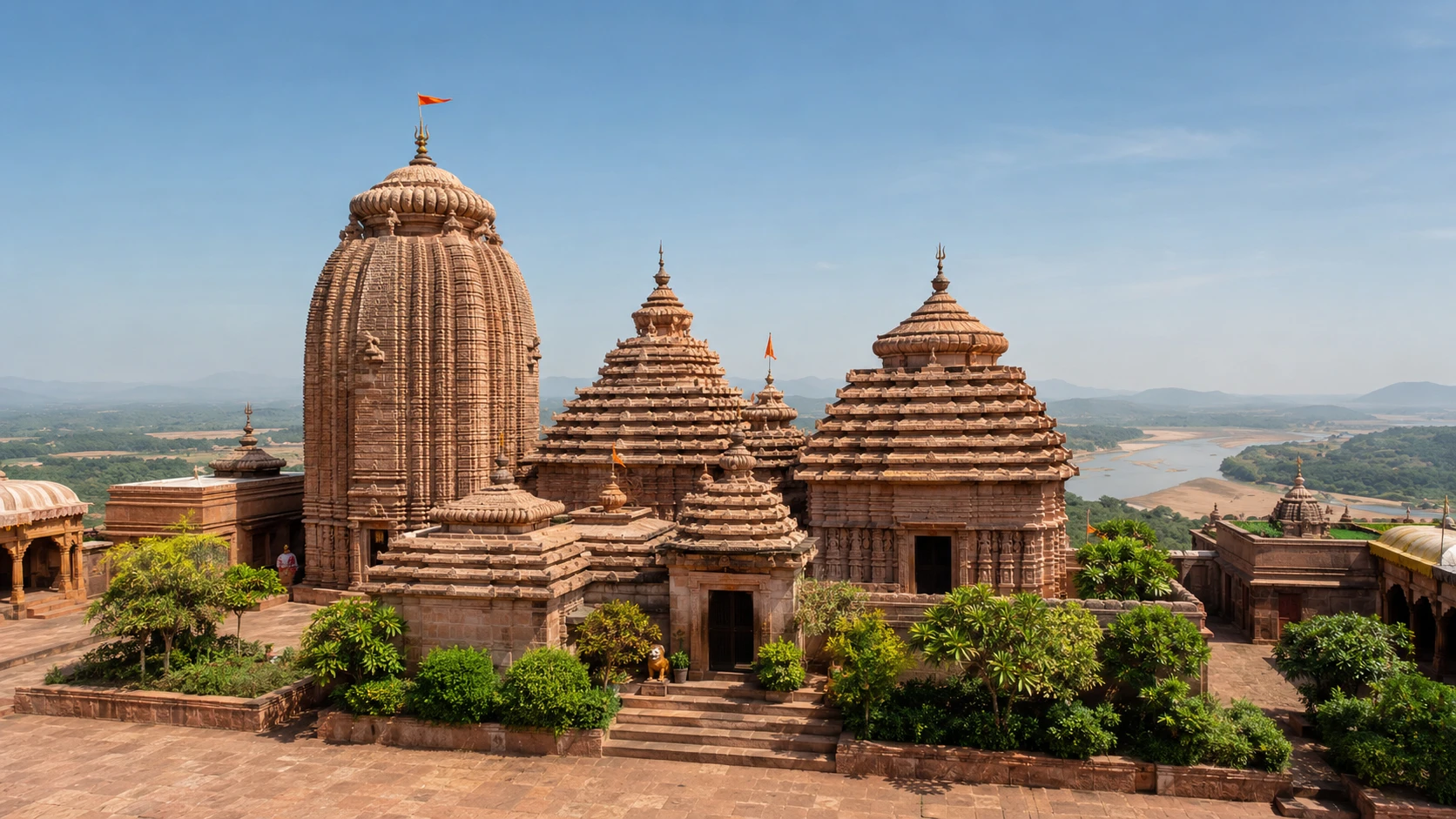
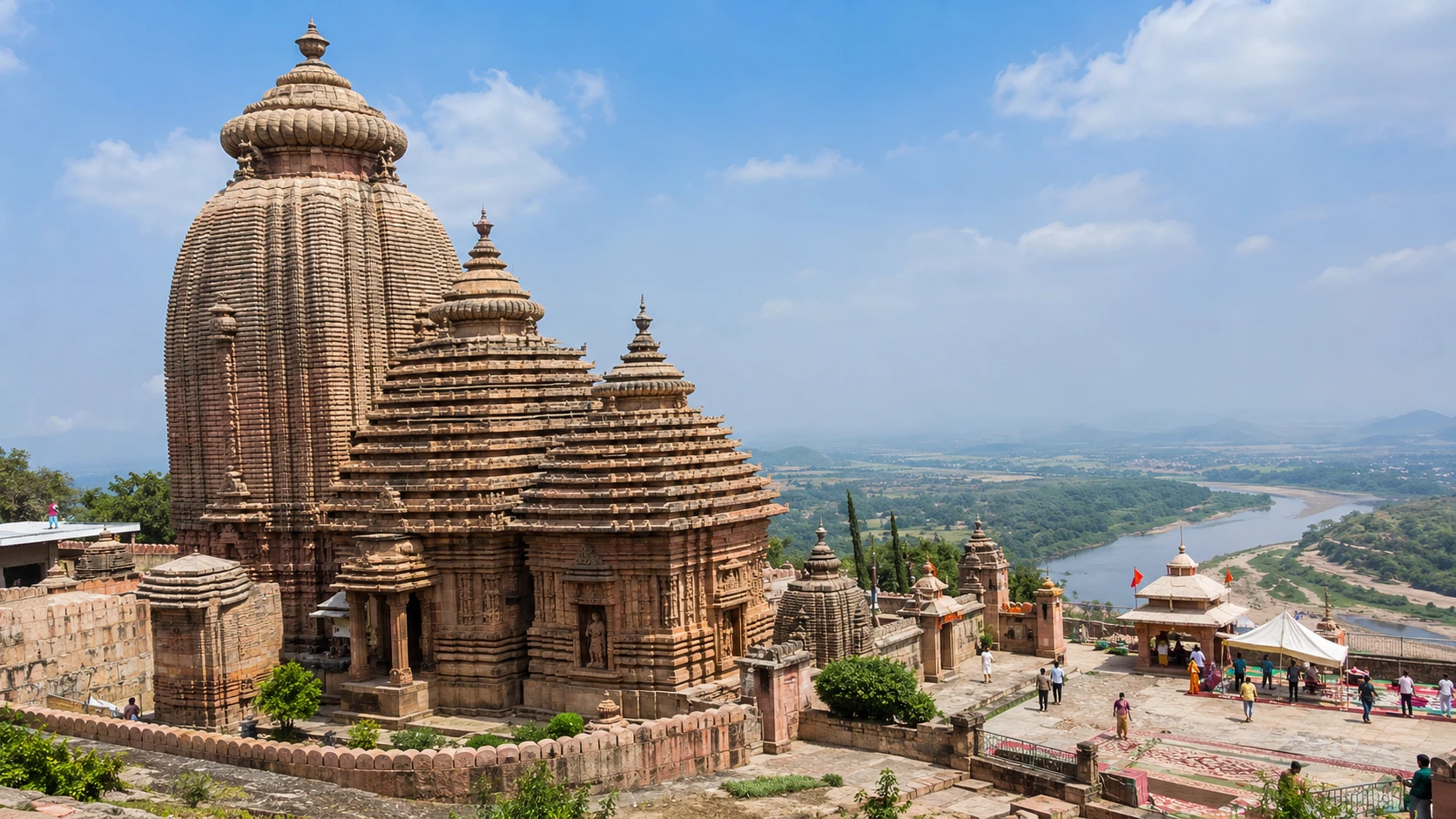
Kalinga style, characteristic Odia temple architecture with a curvilinear rekha-deula tower at modest scale; the temple is smaller than the great Kalinga temples of Konark or Jagannath Puri but exhibits the same architectural lineage
खुला
06:00 – 21:00
आरती
06:00 · 12:00 · 19:00
विशेष
Hilltop access is available by foot via 999 stone steps or by ropeway (cable car). The temple complex includes the main twin-goddess shrine, a separate small Bhairava shrine, the Mahaprasad kitchen and Bhog-mandap, and outer pilgrimage facilities. The four Tuesdays of Chaitra month draw the year's largest crowds; queues during this period can exceed five hours. Mundan (first hair-cutting) ceremonies for children are conducted daily in a designated outer area.
पवित्र कथा · पवित्र कथा
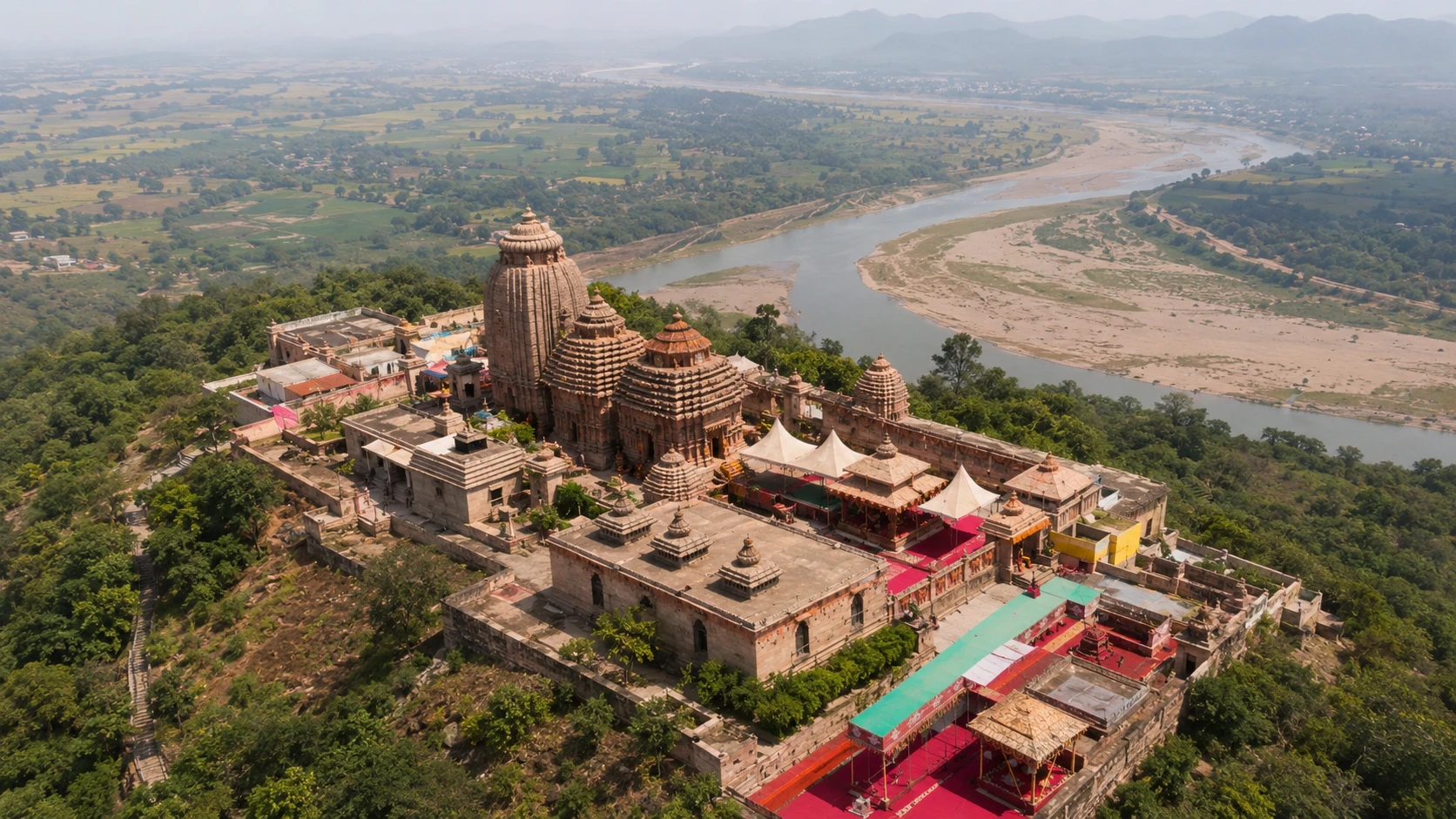
On a forested hill above the Rushikulya River in Ganjam district, Odisha, sit two goddesses, not one. Tara and Tarini, twin sisters, identical sculpted faces side by side in a small Kalinga-style shrine on the crest of what is locally called Kumari Hill or Tarini Hill. Where Sati's breasts fell during Vishnu's cosmic dismemberment of her corpse, the Mother Goddess took her seat as twins, for both breasts fell together, so both halves of her motherhood manifested at this site at once. This is the Stana Peetha, one of the four Adi Shakti Peethas, and the only place in the Hindu world where the Adi Shakti is worshipped as a pair rather than a single form. The two faces, traditionally identified as Tara on the left and Tarini on the right, sit so close they nearly touch. They wear identical red cloth, identical gold ornaments, identical sindoor; they are bathed together, fed together, and offered together. Pilgrims of coastal Odisha and the adjoining Andhra Telugu country have brought their children for first hair-cutting (mundan), their daughters for marriage blessings, their families for vow-fulfillment for at least a thousand years. The four Tuesdays of Chaitra month draw the largest pilgrim crowds in southern Odisha; on those days, queues stretch down the 999 stone steps of the hill, and the goddesses receive every form of devotion a regional Hindu tradition can compose.
Sacred Designationपवित्र पदनाम
Shakti Peeth
शरीर का अंग: Breasts (both breasts of Sati, Stana Peetha)
शक्ति: Tara and Tarini, twin goddesses
भैरव: Mahodadhi (local attribution; less canonically standardized than at the other Adi Shakti Peethas)
Sacred Origin Storyपवित्र उत्पत्ति कथा
Source: Pithanirnaya, Tantra Chudamani, Devi Bhagavata Purana, Kalika Purana, Brahmanda Purana, and the regional Odia Mahatmya tradition.
When Daksha Prajapati's great yajna ended in Sati's self-immolation and Shiva's grief-mad tandava, the gods sent Vishnu to halt the dance before it unmade the cosmos. Vishnu followed Shiva through the sky and from his Sudarshana chakra loosed precise cuts that severed Sati's body, piece by piece, while she still rested upon her lord's shoulder.
As each part fell to the earth below, Shiva's grief lightened, until at last he carried nothing, and the dance ended. The fifty-one places where Sati's body fell became Shakti Peethas, pillars of the goddess's presence on earth.
To a forested rise above the Rushikulya River, in the southern reaches of what is now Odisha, fell Sati's breasts. Both breasts together. The body part that nurtures, that feeds the world from its own body, that is the source of milk for every living child, fell as a pair onto a single place.
And so the Mother Goddess, manifesting at the place where she had landed, manifested as a pair: not one goddess but two, twin sisters who share a single body of grace divided into two faces of expression. Tara, whose name means 'she who carries one across', the saviour goddess who guides souls past the great waters of suffering.
And Tarini, whose name carries the same root, 'she who delivers', the goddess who completes what Tara begins. Together they form the unique theological configuration of this site: the Mother who came to feed her children manifests doubled, so that no single child shall be denied.
The Tantric tradition refers to this shrine as the Stana Peetha, the Peetha of the breasts, and counts it among the four Adi Shakti Peethas alongside Kamakhya (yoni), Kalighat (toes), and Bimala (feet).
The regional Mahatmya tradition adds a second layer to the cosmic Sati narrative. The sage Vasishtha is said to have established formal worship at this site after meditating on Tarini Hill in the ancient period; his presence sanctified the location for organized devotional practice.
A separate later narrative, preserved in Odia oral and written tradition, describes two merchant brothers, Basu and Sankhari (or in some versions Basu-Sankhachudi), who while traveling were visited by two divine girls who guided them and protected them on dangerous roads.
When the brothers tried to repay the girls with offerings, the girls transformed into stone at the hilltop, revealing themselves as Tara and Tarini. The brothers built the first organized shrine at the site. This merchant-vision narrative is regionally beloved and is performed in devotional song during the Chaitra Mela.
The twin form has profound theological significance in Tantric exegesis. Where most Shakti Peethas concentrate the goddess in a single localized presence, Tara Tarini disperses her across two co-equal forms, suggesting that the Mother's grace is not a scarce single beam but a redoubled abundance.
Devotees making manats at Tara Tarini sometimes phrase their requests to both goddesses together; sometimes to one specifically; sometimes addressing whichever sister 'is listening today'. The two faces, set so close on the shrine that the right ear of Tara and the left ear of Tarini are inches apart, are usually said in local tradition to whisper to each other after the priests close the temple at night.
उद्धृत स्रोत:
- Pithanirnaya (anonymous medieval Sanskrit text enumerating 51 Shakti Peethas)
- Tantra Chudamani (medieval Sanskrit Tantric text)
- Devi Bhagavata Purana, Skandha 7
- Kalika Purana, chapters 18 (Sati's dismemberment narrative)
- Brahmanda Purana (Stana-Peetha references)
- Skanda Purana, Utkala Khanda
- Regional Odia Tara Tarini Mahatmya (oral and written tradition)
अन्य परंपराएँ · अन्य परंपराएँ
The Vasishtha-ashram tradition and the Basu-Sankhari merchant-vision narrative, regional Odia Mahatmya layered onto the pan-Indian Sati account
The regional Odia tradition wraps a second narrative around the cosmic Sati account, locating the temple's specific founding in a series of events at the site itself. The sage Vasishtha is said to have come to Tarini Hill in the ancient period and meditated there; his meditation drew the goddess's specific localized manifestation, and he established the first sustained worship at the hilltop.
Generations later, the dating is loose in oral tradition, somewhere in the early medieval period, two merchant brothers named Basu and Sankhari (variant: Basu-Sankhachudi) traveling through the Ganjam forests on trading routes encountered two young girls who guided them past dangers and provided protection for several days.
When the brothers, on the final stretch of their journey, tried to repay the girls with gifts of cloth and food, the girls climbed Tarini Hill ahead of them and, upon reaching the crest, transformed into stone, revealing themselves as Tara and Tarini. The brothers built the first organized stone shrine to enshrine the relics.
The Basu-Sankhari narrative is performed in Odia devotional song during the Chaitra Mela and is woven into the temple's regional ritual memory.
Modern academic scholarship, Tara Tarini as a possible site of syncretic absorption of an earlier indigenous tribal or regional goddess cult into the pan-Indian Shakta framework
A second reading, articulated by scholars of Odia religious history including K.C. Panigrahi and subsequent fieldworkers in the Eastern Ganga-period temple ecology, suggests that the worship at Tarini Hill may layer pan-Indian Shakta theology atop an earlier indigenous goddess cult of the Ganjam-Rushikulya region.
The twin form is the principal evidence: pan-Indian Shakta enumerations of the Shakti Peethas describe single body parts producing single localized goddesses, but Tara Tarini's twin form suggests an underlying tradition where the goddess was already understood as a pair before being assimilated to the Sati framework.
The 'breasts fell together' explanation, in this reading, is a Sanskritic accommodation to a pre-existing dual-goddess local tradition. The region's tribal communities, particularly Saora and other adivasi groups whose territories border Ganjam, historically worship twin or paired feminine principles, suggesting one possible origin layer.
विद्वत संदर्भ
Modern scholarship on Tara Tarini draws on textual enumerations (Pithanirnaya, Tantra Chudamani, Brahmanda Purana, Devi Bhagavata) which uniformly identify the temple as the breasts-Peetha among the major Shakti Peetha lists; the Eastern Ganga-period architectural history of the broader Odisha coastal temple ecology (K.C. Panigrahi 1981, Hermann Kulke 2001); and the regional studies of the Eschmann-Kulke-Tripathi 1978 volume, where G.N. Dash and Hermann Kulke specifically address the regional Tarini cult. The body-part attribution (breasts at Tarini Hill) is uncontested across the major textual enumerations. The Bhairava attribution, given as Mahodadhi in local tradition, is less canonically standardized than at the other Adi Shakti Peethas; some sources omit a Bhairava name at this site, while others give alternative local attributions. The temple's relatively understudied status in pan-Indian scholarship (compared with Kamakhya or Kalighat) reflects its regional rather than pan-Indian devotional draw, pilgrims to Tara Tarini come predominantly from coastal Odisha and the adjoining Telugu country, with smaller representations from elsewhere in India.
Historyइतिहास
The temple's documented history reaches into the pre-medieval period through textual rather than epigraphic attestation. References to a Stana-Peetha at the site appear in the Brahmanda Purana and in the Skanda Purana's Utkala Khanda, both of which scholars generally date to the 6th, 10th century CE range, though specific layers may be older.
The Vasishtha-ashram tradition preserved in regional Odia Mahatmya extends the site's sacred reputation further back into oral tradition without firm dating.
The Bhanja dynasty of Ganjam (historically based in the Khinjali Mandala region of present-day southern Odisha) extended early-medieval royal patronage to various Shakta sites in their territory; specific Bhanja-era inscriptions referencing Tara Tarini are limited but the broader pattern of regional Hindu temple patronage in the Bhanja period (8th, 10th century) is well-documented.
By the Eastern Ganga dynasty period (12th, 15th century), when the great Odia temple-building boom produced the Konark Sun Temple and the Jagannath Puri complex, smaller regional temples including Tara Tarini received continued patronage and consolidated their architectural and ritual forms.
The Maratha era (mid-18th century) and the subsequent British colonial period saw the temple continue under hereditary Sebait administration, with British gazetteers, Hunter's 'Statistical Account of Bengal' Vol. 19 (1877) and Stirling's 'Account of an Orissa Province' (1825), providing the earliest formal documentation of pilgrim flow patterns and ritual cycles at the site.
These colonial-era observations are useful primary sources but reflect the framings of their compilers.
Through the 20th and into the 21st century, the temple's administrative framework was modernized in stages under successive Government of Odisha frameworks. The major modern transformation came in the early 2010s with the inauguration of a ropeway (cable car) connecting the base of the hill to the temple courtyard at the top, providing an alternative to the traditional foot-pilgrimage up 999 stone steps.
The ropeway has substantially altered the pilgrim demographics, opening the site to elderly pilgrims and those with mobility limitations who would previously have been unable to make the climb. The temple administration today operates under the Tara Tarini Temple Trust in coordination with the Odisha Endowments Department; major heritage and pilgrim-infrastructure projects have continued in stages through the 2010s and 2020s.
Tara Tarini's relationship to the broader Adi Shakti Peetha set is notable: of the four Adi Peethas (Kamakhya, Kalighat, Bimala, Tara Tarini), Tara Tarini is the smallest-scale and least pan-Indian in pilgrim draw. The temple's strength is regional concentration, coastal Odisha and the adjoining Telugu Andhra country provide an overwhelming majority of pilgrims, rather than the all-India pilgrimage demographics of Kamakhya or the urban embeddedness of Kalighat.
This regional rooting is itself a strength: Tara Tarini operates as the principal devotional anchor for an entire coastal cultural region, in a way that the more famous Adi Peethas, with their pan-Indian and global pilgrim flows, cannot.
Historical Timelineऐतिहासिक कालक्रम
Textual references to a Stana-Peetha at the site appear in the Brahmanda Purana and the Skanda Purana's Utkala Khanda, establishing the temple's status within pan-Indian Shakta sacred geography. The Vasishtha-ashram tradition preserved in regional Odia Mahatmya further extends the site's sacred reputation, though without firm chronological anchoring.
Dating of Purana strata is notoriously difficult; the 6th, 10th century range reflects mainstream scholarly consensus on the Brahmanda Purana's relevant layers. The 'discovery' type marks the earliest textual attestation rather than a singular discovery event. Oral tradition almost certainly predates textual codification.
Bhanja dynasty patronage of Shakta sites across the Ganjam-Khinjali Mandala region indirectly extends to Tara Tarini, though specific Bhanja-era inscriptions referencing the temple by name are limited. The broader pattern of Bhanja royal religious patronage establishes the institutional environment within which the Tara Tarini site was sustained and developed.
Direct Bhanja-era inscriptions specifically naming Tara Tarini are not abundant; the patronage claim rests on broader regional patterns rather than name-specific epigraphic evidence. This is a common situation for medium-scale regional temples in the period.
Eastern Ganga dynasty period brings substantial temple-building and ritual codification across coastal Odisha. The great Kalinga-style temples of the period, the Jagannatha temple at Puri (1135, 1147), the Konark Sun Temple (mid-13th century), the Lingaraj temple at Bhubaneswar (earlier but consolidated in this period), establish a regional architectural and ritual idiom that Tara Tarini's smaller temple absorbs and reflects. The temple's current architectural form is substantially of this period, with subsequent additions and renovations.
Colonial-era documentation begins with Andrew Stirling's 'Account of an Orissa Province' (1825), which surveys religious sites in the British-administered Ganjam district, and is consolidated in W.W. Hunter's 'Statistical Account of Bengal' Vol. 19 (1877), which provides the earliest systematic British documentation of pilgrim flow and ritual cycles at Tara Tarini. These records are valuable as primary observation but reflect the framings and limitations of their colonial compilers.
Colonial-era gazetteers and statistical accounts are useful primary sources for 19th-century pilgrim demographics and ritual observations, but they reflect the categorizations, ethnographic frames, and political imperatives of British colonial administration. They should be read critically, as observational records, not as authoritative accounts of devotional meaning.
Inauguration of the Tara Tarini ropeway (cable car) under joint Government of Odisha and Damodar Ropeways initiative; the system connects the foot of Kumari Hill to the temple courtyard at the top, providing pilgrim access alternative to the traditional 999-step climb. The ropeway substantially expands the temple's accessibility for elderly devotees and those with mobility limitations, and has measurably increased pilgrim numbers since inauguration. Subsequent stages of pilgrim infrastructure development under the Odisha Endowments Department have continued through the 2010s and 2020s.
The exact year of ropeway inauguration is approximately 2014; specific commissioning dates have varied in published reports. The ropeway's installation followed several years of feasibility study and construction beginning in the early 2010s. Eternal Raga is treating this as a modern infrastructure event rather than narrowly dating to a specific commissioning ceremony.
What You'll Seeदर्शन में
Inside the small Kalinga-style shrine at the crest of Kumari Hill, two stone face-images sit side by side, Tara on the left, Tarini on the right (in the traditional orientation). The two faces are nearly identical: both sculpted in dark stone, both bearing three almond-shaped eyes (the Devi's signature trinetra), both with sindoor-smeared foreheads, both crowned in silver and gold, both garlanded with red hibiscus.
The decorations are paired: one identical red cloth covers each, one identical set of ornaments hangs on each, one identical floral garland circles each. The visual register is of profound mirror-symmetry, the two goddesses are deliberately presented as co-equal, neither subordinated to the other, neither given visual priority.
They sit close enough that the right ear of Tara nearly touches the left ear of Tarini.
Unlike Kalighat (where the face-image is the entire deity and arms are appended) or Kamakhya (where the deity is a natural rock cleft and no anthropomorphic form is present), Tara Tarini follow the convention of paired sculpted face-images set within a worked silver-and-gold framework, with the framework providing the ornamental and architectural completion that pure face-images alone would lack.
The murtis are dressed daily, bathed regularly, fed and offered simultaneously, the ritual cycle treats them as a single goddess in two forms rather than as two separate goddesses sharing a shrine.
The temple itself is a modest Kalinga rekha-deula, much smaller than the great Odia temples at Konark or Puri but exhibiting the same architectural lineage. The outer mandapa accommodates pilgrim queues; outer pavilions and courtyards host the mundan (first hair-cutting) ceremonies, the Bhog-mandap (kitchen and food offering area), and a small subsidiary Bhairava shrine.
The hilltop position above the Rushikulya River provides views of the surrounding forests, the river bends, and on clear days the distant Bay of Bengal coastline, a sacred geography that locates the goddesses precisely between forest, river, and sea.
Distinctive Practicesविशिष्ट परंपराएँ
Mundan, first hair-cutting ceremony
मुंडन, प्रथम केश-छेदन समारोह
Year-round; particularly active during Chaitra Mela (March-April), Durga Puja, and on Tuesdays; the ceremony for an individual child happens once, typically at an age between six months and three years
Among the most distinctive Tara Tarini pilgrim experiences is the mundan ceremony, the ritual first cutting of a young child's hair, offered to the goddess. Families travel from across coastal Odisha and the adjoining Telugu Andhra country, bringing infants for this rite of passage. The ceremony is conducted by traditional barbers (operating under hereditary right at the temple) in a designated outer pavilion, with the child held by a parent. The shaved hair is gathered into a small cloth bundle and offered to the goddess as part of a vow-fulfillment or thanksgiving sequence. For many regional families, the Tara Tarini mundan is the only mundan a child receives, conducted at this specific temple regardless of where the family lives. Children's hair offerings have accumulated over centuries; legend holds that the goddesses themselves are clothed in their devotees' offered hair, though the empirical reality is that the hair is regularly cleared and traditionally disposed of in the Rushikulya River below.
The mundan rite at Tara Tarini operates at multiple symbolic levels. As a child's first ritual hair-removal it marks the body's transition from infancy into childhood proper, a Hindu samskara found in many traditions but unusually concentrated at this temple. The hair, freshly grown from the child's body, is offered as the most personal thing the child can give, the child's own substance, returned to the goddess who is theologically the mother of all bodies. For families who came to the goddess with a vow during a difficult pregnancy or a critical childhood illness, the mundan is the act that completes the vow: a healthy child grown enough to receive a haircut is proof that the goddess answered, and the offered hair acknowledges the receipt of grace. The twin form of the goddess intensifies this, the mother who comes to feed her children manifests doubled, so that no child shall be denied either the original blessing or the receipt of the returning offering.
Twin-goddess simultaneous worship, Yugma-Devi puja
युगल-देवी पूजा, एक साथ अर्पण
Daily, in every aarti and ritual cycle; the structure is built into the temple's basic ritual grammar
Unlike single-deity Shakti Peethas where the ritual cycle addresses one goddess in successive observances, Tara Tarini's ritual structure is built around simultaneous twin-goddess worship. Every offering, flowers, sindoor, cloth, food, lamps, is presented in two identical sets, one for each sister. The aarti lamps are pairs. The bhog vessels arrive in pairs. The mantra recitations name both goddesses in linked phrasing rather than addressing only one. Pilgrims approaching the shrine make a single combined pranama to both goddesses rather than two separate pranamas. The ritual grammar's underlying principle is theological precision: because Tara and Tarini are simultaneously co-equal aspects of a single Adi Shakti, addressing one to the exclusion of the other would falsify the goddess's manifestation at this site. The twin form requires twin offering.
The Tantric exegesis of Tara Tarini's twin form holds that the goddess at the breasts-Peetha must manifest as the principle of complete provision, and complete provision cannot be reduced to a single channel. Tara is 'she who carries one across', the saviour function; Tarini is 'she who delivers', the completing function. The two together represent the goddess as both the means and the end of grace, the carrying and the safe arrival. Worship that addresses only one would be incomplete: a saviour with nowhere to take the saved, or a destination without anyone to carry one there. Hence the ritual rule: the offerings are doubled because the grace is doubled, and the doubling is itself the theological teaching at this Peetha.
Mangalvar Vrat, Tuesday devotional observance
मंगलवार व्रत, मंगलवार का भक्ति-पालन
Every Tuesday; particularly intense during the four Tuesdays of Chaitra month (mid-March to mid-April), which form the Chaitra Mela peak
In regional Odia devotional grammar, Tuesday is the day of Tara Tarini's strongest responsiveness. Devotees observe a Tuesday vrat (devotional discipline), typically including pre-dawn bathing, abstention from certain foods, recitation of Tara Tarini stotras, and either an in-person darshan at the temple or a home-shrine observance facing the direction of Tarini Hill. The four Tuesdays of Chaitra month carry exceptional weight: the first Tuesday opens the Chaitra Mela season, and successive Tuesdays escalate in pilgrim density until Maha Tuesday (the fourth and final Tuesday of Chaitra) draws the year's largest single-day pilgrim crowd, sometimes exceeding 100,000 devotees. The Tuesday rhythm is woven into family planning across coastal Odisha: weddings are often timed around favorable Tuesdays, mundan ceremonies are scheduled for Tuesdays, and new business ventures are launched after Tuesday darshan.
Tuesday's association with the goddess across pan-Indian Hindu tradition draws on the planetary attribution of Tuesday to Mangal (Mars), whose energetic-protective quality aligns with the goddess's protective aspect. At Tara Tarini specifically, the Tuesday rhythm is reinforced by local devotional history: the regional Mahatmya tradition associates several of the goddesses' interventions in local memory with Tuesdays, and the Sebait families' ritual calendar gives Tuesday distinct ritual weight. The four-Tuesday Chaitra cycle additionally aligns with the agricultural calendar of coastal Odisha, the harvest of rabi crops and the preparation for the kharif sowing, making Chaitra Tuesdays both a devotional and an agrarian high point.
Did You Know?क्या आप जानते हैं?
Tara Tarini is the only Shakti Peetha in the Hindu world where the Adi Shakti is worshipped as a pair of co-equal twin goddesses rather than as a single deity. The 'breasts fell together' explanation in the Sati narrative is the canonical rationale: because both breasts came as a pair, both halves of the Mother's nurturing manifested as a pair. Across all fifty-one Shakti Peethas, Kamakhya's yoni, Kalighat's toes, Bimala's feet, the navels and arms and heads of the other Peethas, only at Tara Tarini does the goddess take a doubled form. The twin presentation is not iconographic ornament but structural theology: the rituals, the offerings, the mantras, and the pilgrim address all double accordingly.
Pithanirnaya; Tantra Chudamani; Tara Tarini Mahatmya (regional Odia tradition); comparative survey across the 51 Shakti Peetha enumerations
The traditional foot pilgrimage up Kumari Hill to Tara Tarini's shrine consists of exactly 999 stone steps, not 1000. The tradition holds that this number was deliberately chosen: the thousandth step is considered to be taken inside the temple itself, the moment of crossing the threshold into the goddess's presence. The arithmetic completes only when the pilgrim has entered the shrine, making the ascent both a physical climb and a count that must be completed devotionally. The ropeway installed in the early 2010s offers a faster alternative but is widely understood by traditionally-minded pilgrims as fundamentally different from the foot ascent, it bypasses the count, and therefore bypasses one of the rite's traditional functions.
Local Sebait family tradition; oral pilgrim accounts collected at the temple; Tara Tarini Temple Trust public communications
Tara Tarini is the most popular mundan (first hair-cutting) destination in eastern India. Families from coastal Odisha and the adjoining Telugu Andhra country bring infants here for the ritual in numbers that no other regional temple matches; during peak Chaitra Mela days, the mundan pavilion conducts hundreds of ceremonies per hour. The accumulated cultural memory is such that, for many coastal Odisha families, asking 'Was your mundan done?' is shorthand for 'Was your mundan done at Tara Tarini?', the temple has become the regional default such that mundan at any other location is implicitly the exception.
Tara Tarini Temple Trust pilgrim flow records; regional ethnographic surveys of Odia and Telugu Hindu samskara practices
The name 'Tara' at Tara Tarini and the name of the famous Tarapith temple in West Bengal are linguistically and theologically connected but refer to distinct goddesses. At Tarapith, Tara is one of the ten Mahavidyas, a fierce Tantric goddess in a specific iconographic form associated with the cremation ground. At Tara Tarini, Tara is the saviour-goddess of the twin Stana-Peetha tradition, paired with her sister Tarini. The shared name reflects a common Sanskrit-Pali root meaning 'star' or 'she who carries across', but the goddesses' iconographies, ritual traditions, and theological positions differ substantially. Devotees of Tarapith and Tara Tarini regard them as distinct deities, even if scholarly comparative work occasionally traces older linguistic and conceptual connections between the names.
David Kinsley, 'Tantric Visions of the Divine Feminine: The Ten Mahavidyas' (1997), for Tarapith Tara; Monier-Williams Sanskrit Dictionary; comparative Shakta scholarship
Among the four Adi Shakti Peethas (Kamakhya, Kalighat, Bimala, Tara Tarini), Tara Tarini has the smallest pan-Indian profile but the most concentrated regional devotion. Where Kamakhya draws Sadhus from across India to Ambubachi, Kalighat anchors urban Bengali religious life, and Bimala is folded into the global Jagannatha Puri pilgrimage, Tara Tarini draws its devotee base almost entirely from a single coastal cultural region, southern Odisha and the adjoining Telugu Andhra country. This regional concentration is not a limitation: Tara Tarini operates as the principal devotional anchor of an entire coastal region's family life, in a way that more pan-Indian Peethas, with their distributed and transient pilgrim flows, cannot.
Comparative survey of the four Adi Shakti Peethas; Tara Tarini Temple Trust pilgrim demographics; Odisha Tourism Department pilgrim circuit reports
Visitor Accessप्रवेश जानकारी
Tara Tarini is open to all visitors regardless of gender, caste, or religious background. There is no menstrual restriction on women entering the temple. Photography is generally permitted in the outer courtyards but prohibited inside the inner sanctum (garbhagriha) where the twin goddesses are enshrined; phones and cameras must be deposited or pocketed before entering the inner shrine. Footwear is removed at the prescribed outer boundary of the temple. The mundan ceremony pavilion is accessible to families with children participating in the ritual; observers are generally welcome but should not photograph individual families without consent. Hawkers, photographers, and unofficial guides operate around the base of the hill and along the ropeway approach, engage only with the official temple counters for ritual arrangements and ropeway tickets.
Pilgrims have two main approach options: the traditional 999-step foot climb (taking 30, 60 minutes depending on pace and crowd), or the ropeway (cable car, 4, 7 minutes one way; ticket purchase at the official counter at the hill base). The ropeway is strongly recommended for elderly pilgrims, those with mobility limitations, those traveling with infants for mundan, and those visiting during summer heat. Even with ropeway access, the temple courtyard at the top involves some walking on uneven stone paving. Queues during the four Chaitra Tuesdays can exceed five hours; in normal periods, expect 30, 60 minutes for darshan. The temple does not currently operate a paid priority-darshan system; queue position is determined by arrival order. Bring water; the hilltop has limited shade and the climb (or ropeway wait) can be dehydrating during summer.
Festivalsत्योहार
Chaitra Mela
चैत्र मेला
Mar-Apr (the four Tuesdays of Chaitra month, mid-March to mid-April)
The largest annual festival at Tara Tarini and the principal pilgrim event in southern Odisha. The Chaitra Mela unfolds across the four Tuesdays of Chaitra month: each Tuesday is a distinct festival day with intensified ritual at the hilltop shrine, mass pilgrim flow, and a fair-grounds atmosphere at the hill's base. The fourth and final Tuesday, Maha Tuesday, draws the year's largest single-day pilgrim crowd, regularly exceeding 100,000 devotees. The Chaitra Mela combines temple worship with regional cultural activity: folk performances of the Basu-Sankhari merchant-vision narrative, traditional Odia devotional song, and the year's most extensive mundan ceremony calendar. Pilgrims travel from across coastal Odisha and the adjoining Telugu Andhra country specifically for these Tuesdays.
Durga Puja / Navratri
दुर्गा पूजा / नवरात्रि
Sep-Oct (Ashwin Shukla Pratipada to Dashami)
The nine-night festival of the goddess is observed at Tara Tarini with intensified ritual at the twin-goddess shrine, each of the nine nights dedicated to one of the Navadurga aspects, with the worship doubled to address Tara and Tarini simultaneously. The festival concludes on Vijayadashami. Where Bengal's Durga Puja is centered on temporary pandals and visiting murtis, Tara Tarini's Navratri is centered on the permanent twin shrine itself, with the pilgrim flow that this anchors. Pilgrims time pre-wedding blessings, manat-fulfillment journeys, and major family gatherings around the festival.
Kali Puja / Deepavali
काली पूजा / दीपावली
Oct-Nov (Kartik Amavasya)
On the new-moon night of Kartik, Tara Tarini observes Kali Puja in the broader Shakta calendar's autumn cycle. Where western and northern India celebrate Lakshmi at Deepavali, eastern India and coastal Odisha honor the dark Devi forms; at Tara Tarini, this is observed as part of the twin-goddess ritual cycle, with the Kali aspect of the goddesses' identity foregrounded. The shrine receives night-long lamp lighting (the deepavali aspect, fitted to the goddess festival) and intensified Tantric mantra recitation. The festival is less spectacular than Chaitra Mela but is one of the year's other major peaks.
Magha Saptami
माघ सप्तमी
Jan-Feb (Magha Shukla Saptami)
The seventh day of the bright fortnight of Magha is observed as a Devi-centric festival across many regional Hindu traditions, and Tara Tarini honors the date with special abhishekam (ritual bathing of the murtis), full pushpanjali (flower offering), and intensified Tantric mantra recitation throughout the day. Magha Saptami marks the midwinter transition in coastal Odisha and provides a quieter, lower-crowd alternative to the high-pressure Chaitra Mela season for pilgrims wanting a more contemplative darshan. Many families schedule mundan ceremonies for Magha Saptami specifically to avoid the Chaitra Mela density.
Traditional Offeringsपारंपरिक अर्पण
प्राथमिक अर्पण
Red Hibiscus (Japa / Joba)
लाल जपा (गुड़हल)
जपाकुसुम
The red hibiscus is among the most-offered flowers at Tara Tarini, presented as a paired offering, one garland for each goddess, draped identically over both sister-shrines. The flower's crimson against the dark-stone faces of the twin goddesses provides the visual signature of the shrine. The offering carries the universal Shakta meaning (the goddess's blood-and-fertility iconography) inflected by the temple's specific doubled grammar: where most Devi shrines accept one hibiscus garland, Tara Tarini accepts two, paired, identical.
Red Saree / Cloth, offered in pairs
लाल साड़ी / वस्त्र, युगल में अर्पित
रक्ताम्बर
Devotees offering red cloth at Tara Tarini bring two pieces, a paired offering to be draped identically over both goddess-faces. Either two identical sarees, or one large length of red cloth cut into two equal halves at the shrine before draping. The doubled offering structure is non-negotiable in the temple's ritual grammar: a single saree offered to only one sister is structurally incomplete and the Sebaits will either divide it before draping or pair it with a temple-held second cloth to maintain the symmetry. Bengali, Odia, and Telugu pilgrim families include the paired-saree offering at Tara Tarini as a regional rite of female-life-passage observance.
Sindoor (Vermilion)
सिंदूर
सिन्दूर
Sindoor offered to Tara Tarini is applied to both goddesses' foreheads identically, and a portion is returned to women devotees who apply it in the central parting of their hair. The doubled application reflects the temple's structural insistence that the two goddesses receive everything in parallel; the returned sindoor carries the blessing of both sisters together. For women observing the Tuesday vrat, Tara Tarini sindoor applied weekly is a particularly powerful regional Shakta blessing.
Coconut (Narikela)
नारियल
नारिकेल
Whole coconut with husk and water intact is offered to the goddesses and ritually broken by the Sebait. As with cloth and flowers, the coconut offering at Tara Tarini commonly comes in pairs, one for each sister, though a single large coconut divided into two halves at the shrine is acceptable when the devotee is unable to bring two. The broken coconut is partly retained by the temple kitchen for use in bhog preparation, partly returned to the devotee as prasad. The Shakta symbolism of the coconut (the ego cracked open through devotion) is preserved at Tara Tarini alongside the temple's specific doubling grammar.
Ghee Diya (Clarified Butter Lamp)
घी का दीया
घृत-दीप
Lamps lit with ghee are offered at every aarti, presented as paired flames, one diya in front of Tara, one in front of Tarini, set close enough that the two flames sometimes appear to merge into a single brighter light. The paired diya format is one of the most striking visual signatures of the Tara Tarini darshan: at dusk and dawn aartis, when the shrine is otherwise dimly lit, the twin flames provide the central illumination, and the encounter between devotee and the twin goddess is staged in that doubled light.
Pan-Supari (Betel Leaf and Areca Nut)
पान-सुपारी
ताम्बूल
In Odia and Telugu Devi worship traditions, pan-supari is offered as a mark of welcome and hospitality to the goddess. At Tara Tarini, the betel-leaf-and-areca-nut offering is presented in two paired arrangements, one for each sister; for special pujas, devotees bring elaborate decorated pan-supari thalis to be presented at both goddess-faces. The offering belongs to the layer of practice that connects Tara Tarini's specific worship to the broader eastern Indian regional culture of goddess hospitality.
इस मंदिर की विशेषता
Paired Devi-Yugma Offering, the doubled ritual structure
देवी-युगल अर्पण, द्विगुणित अनुष्ठानिक संरचना
What makes offering at Tara Tarini structurally distinct from offering at any other Shakti Peetha is the temple's absolute insistence on paired offerings. Every gift to the goddess, every flower garland, every cloth, every sindoor box, every coconut, every diya, every food platter, must arrive in identical pairs. Devotees who arrive with single offerings are guided either to procure a second matching offering or to have the temple staff divide their single offering into two equal halves before presentation. This is not optional courtesy but ritual requirement: the doubling enacts the underlying theological truth that the goddess at the Stana-Peetha manifests as twins, and a worship that addresses only one half would be ritually incomplete. The temple's vendor stalls at the hill base are organized around this requirement; vendors sell offerings pre-paired as a matter of course.
Mundan Kesha, children's first-hair offering
मुंडन केश, बच्चों का प्रथम-केश अर्पण
The hair shaved from a child during the mundan ceremony at Tara Tarini is itself a sacred offering to the twin goddesses, the most personal substance the child can give, drawn from the child's own body and returned to the goddess who is theologically the mother of all bodies. The cut hair is gathered into a small white cotton bundle, blessed by the officiating priest, and either offered briefly at the shrine before being placed in a temple disposal vessel or, in traditional practice for some families, carried by the family to the Rushikulya River below and offered to the river current. The offering completes the manat (vow) sequence for families who came to the goddess during pregnancy or childhood illness. Among the temple's most consequential ritual exchanges, the goddess gave the child, and the child returns a portion of themselves in acknowledgment.
Standard paired offerings (hibiscus, red cloth, coconut, sindoor, ghee diya, pan-supari) are sold pre-paired by vendors at the hill base; the doubled-offering structure means that approximate pricing per visit can be higher than at single-deity temples. The Tara Tarini Temple Trust operates an official offering counter at the hilltop courtyard where pre-prepared paired thalis are available for direct presentation to the Sebaits. Mundan ceremonies require advance scheduling during peak Chaitra Mela season, families planning a mundan during the four Chaitra Tuesdays should contact the Trust 4, 6 weeks in advance. Outside-vendor pricing during Chaitra Mela has been reported to spike substantially; the Trust publishes recommended offering prices on noticeboards at the hill base. Animal sacrifice is not part of Tara Tarini's traditional ritual practice; the temple has not historically conducted bali in the way of some other Shakta sites.
How to Reachकैसे पहुँचें
Tara Tarini sits 30 km from Berhampur (Brahmapur) city in Ganjam district, on Tarini Hill above the Rushikulya River. By air, the nearest major airport is Biju Patnaik International Airport at Bhubaneswar (BBI, 175 km north), with Visakhapatnam International Airport (VTZ, 235 km south) as an alternative.
Pre-paid taxis from either airport take 4, 5 hours along well-maintained state highways; airport-to-Berhampur-to-temple is a standard route. By rail, Berhampur (Brahmapur) Railway Station sits 30 km from the temple and is well-connected to Bhubaneswar, Visakhapatnam, Chennai, Kolkata, and other major Indian cities via the East Coast Railway; from the station, app-based cabs, pre-paid taxis, and shared transport reach the temple base in approximately 45, 60 minutes via state road through the Ganjam district landscape.
Once at the temple base, pilgrims have two options: the traditional 999-step foot climb (30, 60 minutes), or the ropeway (4, 7 minutes one way; tickets at the official counter at the base). The hill base is the principal staging area, with parking for vehicles, vendor stalls, and the ropeway terminal.
Plan Your Visitयात्रा की योजना
🌤 सर्वोत्तम मौसम
October to February is the most comfortable period, temperatures range from 14, 28°C, humidity is moderate, and the festival cycle (Durga Puja in Sep-Oct, Kali Puja in Oct-Nov, Magha Saptami in Jan-Feb) anchors the season. Avoid peak summer (April-June): coastal Odisha temperatures regularly cross 38°C and the foot climb becomes seriously taxing. Monsoon (June-September) brings heavy rainfall, leech presence on hill paths, and slippery temple steps; the temple remains open but the experience is reduced. The Chaitra Mela period (March-April) is the most spiritually charged but also the most crowded, first-time visitors prioritizing unhurried darshan should choose November-January when weather is favorable and crowds are manageable.
👘 पहनावे का नियम
Modest, traditional attire is expected. For men: dhoti and shirt, or full-length trousers with a shirt or kurta; sleeveless garments are discouraged. For women: saree, salwar-kameez, or long skirt with covered shoulders; head covering is not strictly required but considered respectful. Leather items (belts, wallets, watches with leather straps) should be removed before entering the inner shrine area. Footwear is removed at the prescribed outer boundary of the temple at the hilltop. Practical note: comfortable walking footwear is essential for the climb if not using the ropeway; carry a separate small bag for footwear after removal at the temple boundary.
📱 फोन और फोटोग्राफी
Photography and videography are prohibited inside the inner sanctum (garbhagriha) where the twin goddesses are enshrined. Phones, cameras, and recording devices must be deposited or pocketed before entering the inner shrine. Photography is permitted in the outer courtyards, at the mundan pavilion (with discretion and consent from individual families being photographed), at the Bhairava shrine, and at the hilltop's outer viewing areas. During Chaitra Mela peak Tuesdays, photography may be further restricted by temple security to manage crowd flow; follow on-site guidance from the Tara Tarini Temple Trust staff and Odisha Police personnel.
🏨 आवास
Most pilgrims base themselves in Berhampur city (30 km away), which offers a range of hotel options from heritage properties to mid-range business hotels to budget options near the railway station. Berhampur is the principal commercial city of southern Odisha and has adequate infrastructure for pilgrim visits. The Odisha Tourism Development Corporation operates Panthanivas Berhampur, a recognized government-sector option. A smaller cluster of guest houses and dharamshalas operates closer to the temple base at the foot of Tarini Hill; these range from basic to comfortable and are most useful for pilgrims attending early-morning darshans or staying multiple days for mundan or vow-fulfillment sequences. During the four Chaitra Tuesdays and major festivals, Berhampur and the Tarini-foot lodges approach saturation; book at least 2, 4 weeks in advance for these windows. The Odisha Endowments Department publishes accommodation listings for pilgrims through the Tara Tarini Temple Trust.
Sacred Soundsपवित्र ध्वनि
Devi Suktam (Vāk Sūkta, Rig Veda 10.125)
stotram · 420
Mahishasura Mardini Stotram (Ayi Giri Nandini, attributed to Adi Shankara)
stotram · 540
Tara Tarini Stotram (regional Odia tradition)
stotram · 360
Devi Kavacham (from Durga Saptashati)
kavacham · 600
Lalita Sahasranama (Brahmanda Purana)
sahasranama · 2400
क्या आप जानते हैं? · Did You Know?
वही अनुवाद त्रुटि जिसने हिन्दू धर्म में '33 कोटि' को '33 करोड़' बनाया, बौद्ध धर्म में भी हुई। बौद्ध ग्रन्थों के चीनी अनुवाद ने 'सप्त कोटि बुद्ध' (7 श्रेष्ठ बुद्ध) का अनुवाद '7 करोड़ बुद्ध' कर दिया। तिब्बती अनुवाद ने सही किया: 7 प्रकार, 7 करोड़ नहीं। एक संस्कृत शब्द, दो प्रमुख विश्व धर्मों में गलत पढ़ा गया, ने दो एकसमान भ्रम स्वतन्त्र रूप से उत्पन्न किए।
Related Contentसंबंधित सामग्री
Related Scriptures
Community Reflections
🕉️
Be the first to share your reflection.