Manikyamba Devi
माणिक्यांबा देवी
The Ruby-Mother whose Pīṭha sits within the Pancharama Bhimeśvara complex at the eastern Godavari delta
Draksharamam, Andhra Pradesh, India
MāṇikyāmbāAlso known as: Manikyamba Devi, Sri Manikyamba, Manikyamba Amma, Manikya Devi, Mānikyāmbikā, Draksharama Manikyamba
युग
Pre-canonical Godavari delta sacred geography (continuous worship from at least the Sātavāhana period); canonical Pīṭha + Pañcārāma attestation by 8th, 12th c.; current temple structure substantially Eastern Chālukya (10th, 12th c.) with continuing Chola, Kakatiya, Vijayanagara and modern renovation phases. The Pañcārāma Bhīmeśvara Liṅga (one of the five Pañcārāma Kṣetras and the Pīṭha's canonical Bhairava-pair) is co-located with the Māṇikyāmbā Devī sanctum within an integrated temple complex
वास्तुकला
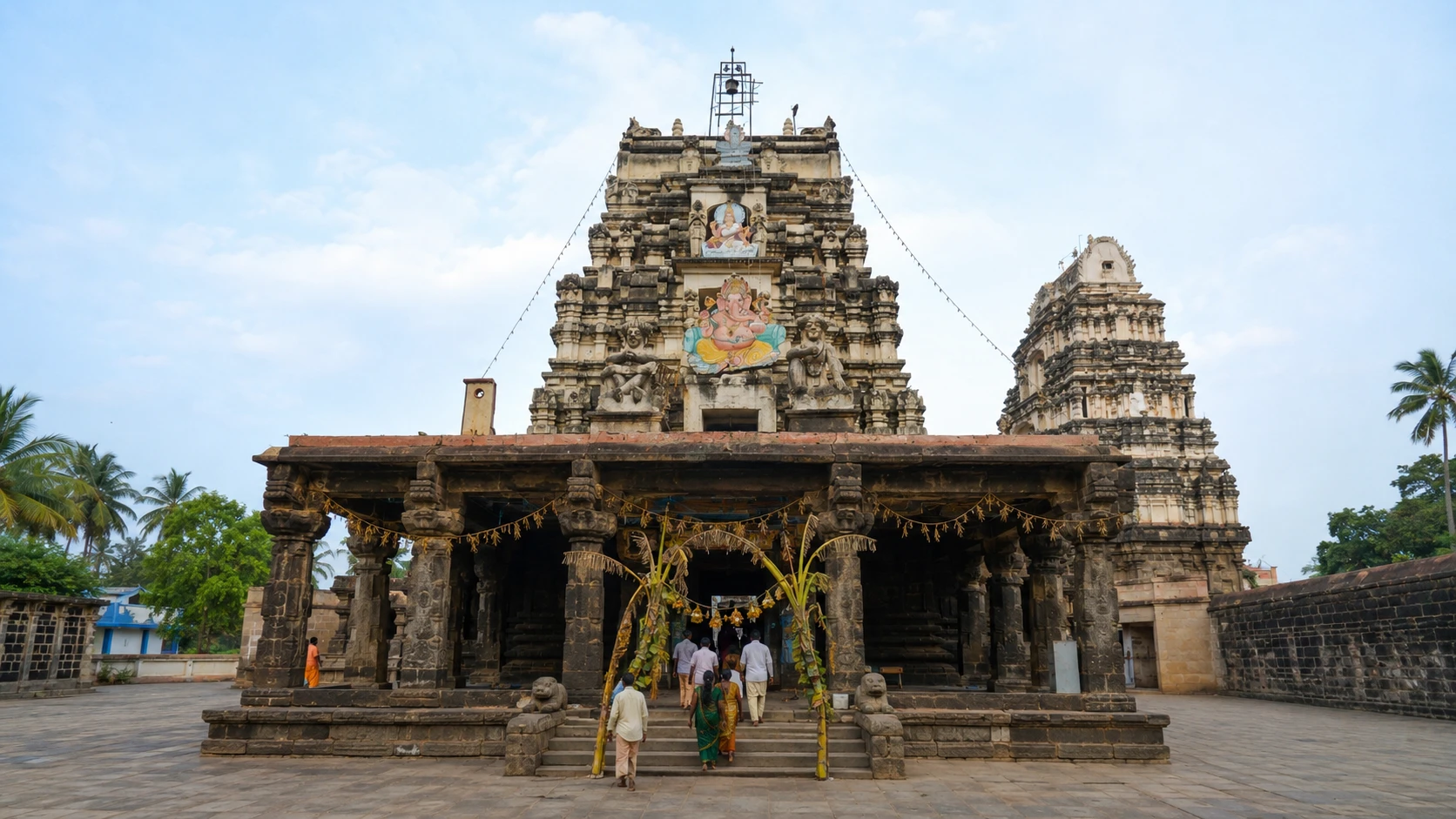
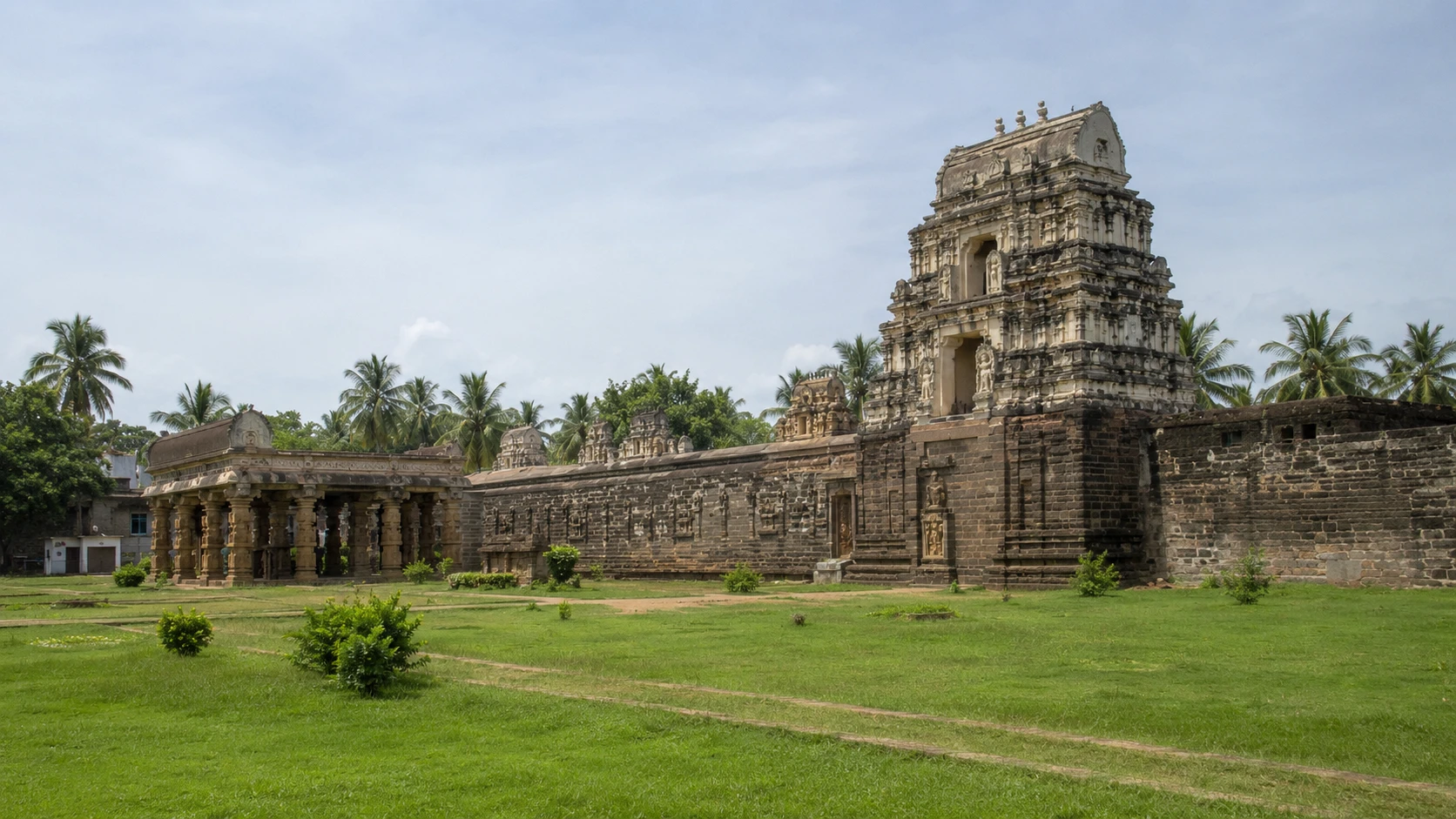
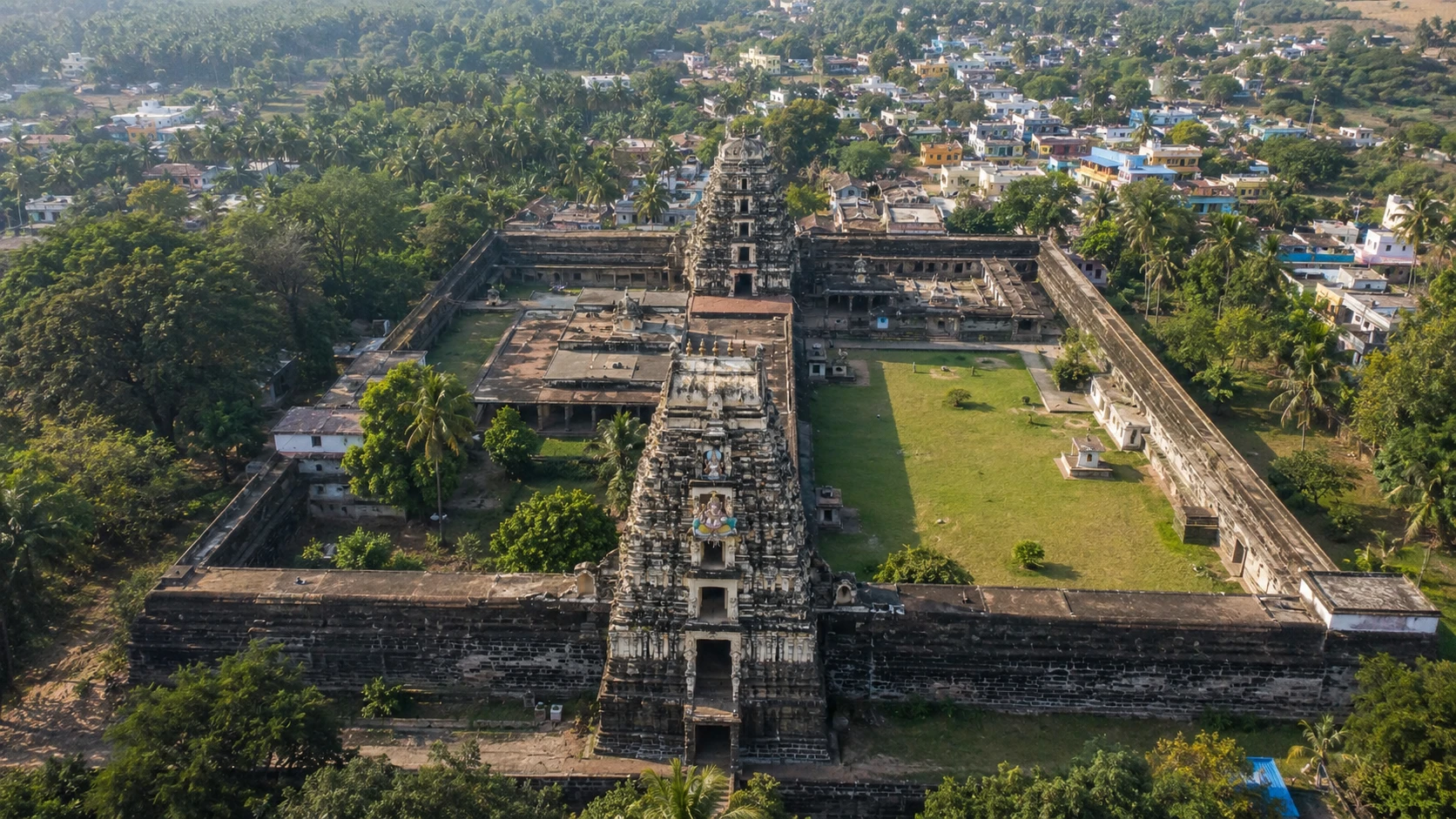
Eastern Chālukya (10th, 12th c.) Dravidian-tradition construction with characteristic Andhra-coastal regional features, with subsequent Chola, Kakatiya, and Vijayanagara renovation layers. The unusually tall Bhīmeśvara Liṅga (approximately 14 feet) is iconographically and architecturally distinctive, the temple's vimāna was constructed at the corresponding scale to accommodate the Liṅga's vertical dimension. The Māṇikyāmbā Devī sanctum is integrated into the broader Bhīmeśvara temple-precinct's spatial organization
खुला
05:00 – 21:00
आरती
05:30 · 11:00 · 12:00 · 18:00 · 20:30
विशेष
The Mahā Śivarātri night brings substantial pilgrim flow because of the joint Pañcārāma Bhīmeśvara + Māṇikyāmbā Pīṭha framing; the Māṇikyāmbā Brahmotsavam (Caitra month, Mar, Apr) is the principal Devī-focused festival; the Pañcārāma Yatra (the coordinated pilgrimage circuit across all five Pañcārāma Kṣetras) brings substantial regional Telugu pilgrim flow that includes Drākṣārāmam as the eastern pole; the Kārtika Pournami observance (the full moon of the Kārtika month) brings particular weight because of the broader Śaiva festival cycle in which Drākṣārāmam holds Pañcārāma significance
पवित्र कथा · पवित्र कथा
Drākṣārāmam sits in the eastern Godavari delta of coastal Andhra Pradesh, and the Māṇikyāmbā Pīṭha sits within an architectural-religious convergence that is distinct from any other in the corpus: the Devī's Pīṭha is co-located with the Bhīmeśvara Liṅga, one of the five Pañcārāma Kṣetras, five canonical Śaiva sites scattered across Andhra Pradesh that together hold the broken fragments of Tārakāsura's liṅga after his slaying by Kārttikeya/Subrahmaṇya. The Pañcārāma framework is its own distributed Śaiva network, five separately-located shrines (Amarārāma at Amaravati, Drākṣārāmam, Somārāma at Bhimavaram, Kṣīrārāma at Palakollu, Kumārārāma at Samalkota) that together constitute a 5-site Telugu Śaiva pilgrimage circuit, and Drākṣārāmam is the eastern-Godavari-delta pole of this circuit. Onto this Pañcārāma foundation arrives the Pīṭha attestation: the canonical 18-Aṣṭādaśa Stotram names Drākṣārāme Māṇikyāmbā at position 12, and the Pīṭhanirṇaya gives Bhīmeśvara as the canonical Bhairava-pair, the same Bhīmeśvara Liṅga that the Pañcārāma framework identifies as a fragment of Tārakāsura's liṅga at this site. The Devī's name Māṇikyāmbā (the Ruby-Mother, the gem-mother) reflects her radiant iconographic register; her body-part attribution at Drākṣārāmam is the left cheek (vāma kapola), a corpus-distinctive body-part that connects iconographically to face-adornment traditions (the kapola as the site of mukha-bhushana, the cheek-jewel, the rouge of beauty) and theologically to the radiant-gem identity the Devī's name encodes. The temple complex preserves the layered Eastern Chālukya, Chola, Kakatiya, and Vijayanagara construction phases that give the Pañcārāma Bhīmeśvara temple its present visual profile, the unusually tall Bhīmeśvara Liṅga (approximately 14 feet) is iconographically distinctive among Andhra Pradesh Śiva shrines and one of the Pañcārāma's principal devotional anchors.
Sacred Designationपवित्र पदनाम
Shakti Peeth
शरीर का अंग: Left Cheek (Vāma Kapola)
शक्ति: Māṇikyāmbā (the Ruby-Mother; also enumerated as Māṇikyāmbikā in some recension variants)
भैरव: Bhīmeśvara (the Pañcārāma Bhīmeśvara Liṅga at Drākṣārāmam; one of the five Pañcārāma Kṣetras)
Sacred Origin Storyपवित्र उत्पत्ति कथा
Source: Devī Bhāgavata Purāṇa, Skandha VII (canonical 51-Pīṭha enumeration); Kālikā Purāṇa, Chapters 18 and 60, 62 (52-list, vāma kapola body-part attribution); Pīṭhanirṇaya; Ashtadasha Shakti Pīṭha Stotram attributed to Ādi Śaṅkarācārya (Drākṣārāme Māṇikyāmbā, position 12); Skanda Purāṇa Pañcārāma narrative tradition (the breaking of Tārakāsura's liṅga into five fragments after his slaying by Kārttikeya); regional Telugu Sthala Purāṇa tradition on Drākṣārāmam; Eastern Chālukya inscriptional evidence
The Pīṭha-narrative at Drākṣārāmam converges with the prior Pañcārāma narrative cycle to produce a layered theological grounding for the site. The Pañcārāma cycle, anchored in the Skanda Purāṇa, recounts how Tārakāsura, a demon of formidable power, conducted austerities and obtained boons that made him invincible to all gods except a son of Śiva.
When Pārvatī and Śiva produced Kārttikeya/Subrahmaṇya, the divine son set out to slay Tārakāsura, and at the moment of slaying, Tārakāsura's liṅga (which he had carried as a source of cosmic power) broke into five fragments.
The fragments fell at five separate locations across what is now Andhra Pradesh, and each location became a Pañcārāma Kṣetra: Amarārāma (Amaravati) with Amareśvara, Drākṣārāmam with Bhīmeśvara, Somārāma (Bhimavaram) with Someśvara, Kṣīrārāma (Palakollu) with Kṣīra-Rāmaliṅgeśvara, and Kumārārāma (Samalkota) with Kumāra Bhīmeśvara.
The five sites together constitute the Pañcārāma Yatra, the canonical Telugu Śaiva 5-site pilgrimage circuit. Onto this Pañcārāma foundation arrived the Pīṭha narrative: Satī's left cheek (vāma kapola) fell at Drākṣārāmam, and the Pīṭha that arose was identified with Māṇikyāmbā, the Ruby-Mother.
The Devī's name reflects the iconographic register, māṇikya is the ruby gem, and the Devī's presence at the cheek-Pīṭha is the gem-radiance of the face's most ornament-receptive surface. The convergence of Pañcārāma + Pīṭha at Drākṣārāmam was canonically formalized in the 8th, 12th c. textualization period; the Adi Shankara Ashtādaśa Stotram's naming of Drākṣārāme Māṇikyāmbā at position 12 anchors the canonical convergence.
Pilgrims completing the Pañcārāma Yatra approach Drākṣārāmam with the dual recognition: it is one of the five Pañcārāma Kṣetras and it is one of the eighteen Aṣṭādaśa Śakti Pīṭhas, and the integrated darshan-flow at the site engages both dimensions through coordinated worship of Bhīmeśvara and Māṇikyāmbā within the shared temple complex.
उद्धृत स्रोत:
- Devī Bhāgavata Purāṇa, Skandha VII (canonical 51-Pīṭha enumeration)
- Kālikā Purāṇa, Chapters 18 and 60, 62 (52-list tradition; vāma kapola body-part attribution)
- Pīṭhanirṇaya
- Ashtadasha Shakti Pīṭha Stotram attributed to Ādi Śaṅkarācārya (Drākṣārāme Māṇikyāmbā, position 12)
- Skanda Purāṇa Pañcārāma narrative tradition (the breaking of Tārakāsura's liṅga into five fragments)
- Regional Telugu Sthala Purāṇa tradition on Drākṣārāmam and the Pañcārāma circuit
- Eastern Chālukya-period inscriptional evidence at the Drākṣārāmam Bhīmeśvara temple complex
- Sircar, D. C., 'The Śākta Pīṭhas' (Motilal Banarsidass, 1948; revised 1973)
- Bhattacharya, N. N., 'History of the Sakta Religion' (Manohar, 1974)
- Talbot, Cynthia, 'Precolonial India in Practice: Society, Region, and Identity in Medieval Andhra' (Oxford University Press, 2001)
अन्य परंपराएँ · अन्य परंपराएँ
Pre-canonical Godavari delta sacred-geography reading
Modern scholarship treats the Drākṣārāmam Pañcārāma + Pīṭha integration as the canonical formalization of a much older Godavari delta sacred-geography. The Godavari river's eastern delta has been a religious-cultural centre to at least the Sātavāhana period (c. 2nd c. BCE, 2nd c. CE), with Buddhist, Jain and Hindu religious activity coexisting in the broader delta region.
The Drākṣārāmam site itself was likely established as a Śaiva shrine in the pre-canonical period; the Eastern Chālukya 10th, 12th c. construction substantially elaborated an already-significant religious site rather than founding it ex novo.
On this scholarly reading, both the Pañcārāma narrative cycle and the canonical Pīṭha attestation are theological-geographical overlays onto a pre-existing Godavari-delta sacred-site that already carried regional religious significance.
Body-part attribution recension variability
The body-part attribution at Drākṣārāmam shows minor recension variability across primary sources. The dominant attestation is vāma kapola (left cheek), confirmed in Pīṭhanirṇaya, Kālikā Purāṇa, and Sircar's standard reference.
Some regional variants give 'lower cheek' or simply 'cheek region' (kapola without the specification of left); a small number of manuscript readings give 'lower lip' (adhara) as an essentially adjacent body-region attestation.
The variability is minor, all attestations cluster around the lower-face / cheek region, and the corpus uses vāma kapola as the dominant primary attestation while acknowledging the regional manuscript variability.
विद्वत संदर्भ
Māṇikyāmbā at Drākṣārāmam occupies a structurally distinctive position in the Pīṭha network through its integration with the Pañcārāma Kṣetra framework, five canonical Śaiva sites distributed across Andhra Pradesh that together constitute a 5-site regional Telugu Śaiva pilgrimage circuit. Drākṣārāmam is the eastern-Godavari-delta pole of the Pañcārāma circuit, and its Bhīmeśvara Liṅga functions as the canonical Bhairava-pair of the Māṇikyāmbā Pīṭha. The convergence structure is corpus-distinctive: where Bhramarāmbā's Pīṭha-Jyotirliṅga unity is co-located within a single canonical-Jyotirliṅga site (Mallikārjuna, 2nd of 12 Jyotirliṅgas) and Jogulāmbā's Pīṭha-Navabrahma integration is co-located within a 9-Liṅga localized Śaiva cluster (Chālukya-period Alampur), Māṇikyāmbā's Pīṭha-Pañcārāma convergence is co-located with a single Pañcārāma node (Bhīmeśvara) that is also part of a 5-site distributed Śaiva regional network. The three convergence patterns together demonstrate the corpus's emerging structural taxonomy of Pīṭha-Śaiva integration: canonical-Jyotirliṅga co-location, localized-cluster integration, and distributed-network integration. The Pañcārāma framework's theological coherence, the canonical narrative that the five sites together hold the broken fragments of Tārakāsura's liṅga after his slaying by Kārttikeya, gives the Bhīmeśvara at Drākṣārāmam a specific cosmological position within the broader Śaiva narrative architecture, and the Pīṭha attestation onto this Pañcārāma foundation creates the layered theological grounding that defines Māṇikyāmbā's corpus position. The body-part attribution (vāma kapola, left cheek) and the Devī's name Māṇikyāmbā (Ruby-Mother) together encode a corpus-distinctive iconographic register grounded in the face-adornment / cheek-jewel tradition; the Devī's gem-mother identity at the cheek-Pīṭha reflects the embodied iconography of the face's most ornament-receptive surface. Cynthia Talbot's 'Precolonial India in Practice' (2001) and the broader scholarly literature on Eastern Chālukya regional patronage and the Pañcārāma narrative tradition provide the principal modern academic treatments of the site's combined Pīṭha-Pañcārāma theological-architectural framework.
Historyइतिहास
Drākṣārāmam's historical depth as a sacred site is anchored in the Godavari delta's standing as a religious-cultural centre of coastal Andhra. The Sātavāhana period (c. 2nd c. BCE, 2nd c. CE) provided the broader Andhra regional substrate within which the Drākṣārāmam site likely existed as an early Śaiva shrine, with Buddhist establishments at nearby Amaravati and Jain centers in the broader delta region.
The Pañcārāma narrative tradition's canonical formalization through the Skanda Purāṇa textualization (placing the five sites within a coherent Śaiva theological framework) occurred during the 6th, 10th c. period of Purāṇa-corpus consolidation. The Eastern Chālukya dynasty (7th, 12th c.
CE, capital at Vengi in coastal Andhra) provided the foundational construction event for the present-day Drākṣārāmam Bhīmeśvara temple: the major temple structure was constructed under Eastern Chālukya patronage in the 10th, 12th centuries, with the unusually tall Bhīmeśvara Liṅga (~14 feet) at the structural centre.
The Māṇikyāmbā Pīṭha shrine's integration into the Eastern Chālukya temple-construction phase reflects the canonical Pīṭha attestation that arrived during the 8th, 12th c. textualization period through the Devī Bhāgavata, Kālikā Purāṇa, Pīṭhanirṇaya, and Adi Shankara's Ashtadasha Stotram.
The Chola period (11th, 13th c.) brought additional regional patronage as the Chola empire extended influence into the coastal Andhra region; Kakatiya patronage (12th, 14th c.) continued the regional Telugu engagement with Drākṣārāmam; the Vijayanagara period (14th, 16th c.) brought further renovation and expansion phases.
The Qutb Shahi (16th, 17th c.) and Asaf Jahi periods (18th, 20th c.) saw Drākṣārāmam's continued Hindu institutional life through the regional administrative transitions, the site's position in the coastal Andhra Godavari delta, distant from the principal Mughal and Sultanate power centres, supported continuity.
The Government of Andhra Pradesh administers the temple through the state's Endowments Department, with the temple operating as the principal Pañcārāma site in the eastern Godavari delta region and as one of the eighteen Aṣṭādaśa Śakti Pīṭhas. Post-2014 administrative reorganization placed Drākṣārāmam within Konaseema district (created from the earlier East Godavari district).
Historical Timelineऐतिहासिक कालक्रम
Pre-canonical establishment of the Drākṣārāmam site as a Godavari delta sacred location, within the broader Sātavāhana-period Andhra religious geography. The Godavari delta supported multi-tradition religious activity (Buddhist, Jain, Hindu) in this period, with Drākṣārāmam likely functioning as an early Śaiva shrine prior to the later Eastern Chālukya elaboration.
Skanda Purāṇa Pañcārāma narrative tradition's canonical formalization, placing Drākṣārāmam (with its Bhīmeśvara Liṅga) within the coherent five-site Telugu Śaiva framework of the Pañcārāma Kṣetras. The Pañcārāma narrative, the breaking of Tārakāsura's liṅga into five fragments after his slaying by Kārttikeya, gives the five sites their canonical theological coherence as a distributed Śaiva pilgrimage network across Andhra Pradesh.
Canonical Pīṭha attestation of Māṇikyāmbā at Drākṣārāmam through textualization in the Devī Bhāgavata Purāṇa (Skandha VII), Kālikā Purāṇa (Chapters 18, 60, 62; vāma kapola body-part attribution), Pīṭhanirṇaya, and the Ashtadasha Shakti Pīṭha Stotram attributed to Ādi Śaṅkarācārya (Drākṣārāme Māṇikyāmbā, position 12). The Pīṭha attestation arrived at the site within the same broader textualization period that consolidated the Pañcārāma framework, creating the combined Pīṭha-Pañcārāma theological grounding at Drākṣārāmam.
Eastern Chālukya dynasty foundational construction of the Drākṣārāmam Bhīmeśvara temple in its present form. The Eastern Chālukyas (capital at Vengi in coastal Andhra, 7th, 12th c.) provided substantial patronage for the temple-construction event that produced the present-day temple's structural form, including the unusually tall Bhīmeśvara Liṅga (~14 feet) at the architectural centre. Eastern Chālukya-period inscriptional evidence at the temple complex documents the dynasty's sustained engagement with Drākṣārāmam as a principal regional Śaiva site.
Sustained Chola, Kakatiya and Vijayanagara patronage of the Drākṣārāmam temple-complex through successive medieval dynastic phases. The Chola period (11th, 13th c.) brought Tamil-region patronage extending into coastal Andhra; the Kakatiya period (12th, 14th c.) brought regional Telugu engagement with grants and ritual sponsorships; the Vijayanagara period (14th, 16th c.) brought additional renovation and expansion phases including pilgrim-infrastructure development. The Pañcārāma circuit's pan-Telugu standing was consolidated during these medieval patronage phases, with Drākṣārāmam recognized as the eastern Godavari delta pole of the integrated 5-site network.
Modern administration of the Drākṣārāmam Bhīmeśvara + Māṇikyāmbā temple-complex under the Government of Andhra Pradesh Endowments Department, with continuing recognition as one of the five Pañcārāma Kṣetras and one of the eighteen Aṣṭādaśa Śakti Pīṭhas. Post-2014 administrative reorganization placed Drākṣārāmam within Konaseema district (created from the earlier East Godavari district through the 2022 Andhra Pradesh district reorganization). The 21st century has brought improvements in pilgrim infrastructure for the Pañcārāma Yatra circuit including coordinated darshan-management and improved access roads.
What You'll Seeदर्शन में
The Drākṣārāmam Bhīmeśvara temple complex is one of the architecturally distinctive Eastern Chālukya-period constructions of coastal Andhra Pradesh, with the unusually tall Bhīmeśvara Liṅga (approximately 14 feet) as the central structural anchor.
The Liṅga's vertical scale required a correspondingly tall vimāna and a two-level sanctum approach, pilgrims darshan the lower portion of the Liṅga from the ground-floor garbhagriha and the upper portion from an elevated platform accessed via internal steps.
This dual-level Liṅga-darshan is corpus-distinctive and reflects the Pañcārāma narrative tradition in which the Bhīmeśvara fragment of Tārakāsura's liṅga retained its full vertical scale at Drākṣārāmam. The Māṇikyāmbā Devī sanctum sits within the broader Bhīmeśvara temple-precinct's spatial organization, with the Devī's murti depicted in the canonical Pīṭha-Devī register: four-armed seated form, holding the standard Devī attributes (triśūla, ḍamaru, pāśa, abhaya-varada mudra), draped through the day in red silk and ornamented with substantial gold jewellery including the corpus-distinctive ruby and gem ornaments preserved at the shrine that resonate with the Devī's name Māṇikyāmbā (the Ruby-Mother).
The face-adornment iconographic register is particularly elaborated at this Pīṭha: the cheek-Pīṭha body-part attribution (vāma kapola) is reflected in the Devī's mukha-bhushana (facial ornaments) which receive particular weight in the daily and festival alaṅkāra cycles.
Subsidiary iconography in the temple-precinct includes the Sapta Mātṛkā shrine cluster, regional Bhairava and Gaṇeśa images, and the Pañcārāma sangam-pool (the temple's sacred-water tank). The Eastern Chālukya architectural register preserves the 10th, 12th-century construction phase with subsequent Chola, Kakatiya, and Vijayanagara renovation layers visible in the outer prākāra and gopuram constructions; the inner sanctum's architectural integrity is among the most-preserved Eastern Chālukya temple interiors in coastal Andhra.
Distinctive Practicesविशिष्ट परंपराएँ
Pañcārāma Yātra, Coordinated 5-Site Telugu Śaiva Pilgrimage Circuit
पंचाराम यात्रा, समन्वित 5-स्थल तेलुगु शैव तीर्थयात्रा परिक्रमा
Year-round; particularly weighted during Mahā Śivarātri (when the 5-site network operates in coordinated festival mode) and during Kārtika month observances
The corpus-distinctive practice at Drākṣārāmam is its standing as the eastern Godavari delta pole of the Pañcārāma Yātra, the canonical Telugu Śaiva pilgrimage circuit that coordinates darshan across all five Pañcārāma Kṣetras: Amarārāma (Amaravati), Drākṣārāmam, Somārāma (Bhimavaram), Kṣīrārāma (Palakollu), and Kumārārāma (Samalkota). The five sites together hold the canonically-narrated fragments of Tārakāsura's liṅga after his slaying by Kārttikeya, and pilgrims completing the Pañcārāma Yātra approach the integrated 5-site network as a single coherent devotional unit rather than five separate sites. The typical Yātra is undertaken across 3, 5 days covering approximately 350 kilometres across the coastal Andhra Pradesh delta region; the standard sequence varies by individual pilgrim tradition but commonly culminates at Drākṣārāmam given its standing as the largest and most-architecturally-elaborated of the five sites and its dual Pīṭha-Pañcārāma significance. For Drākṣārāmam specifically, the Pañcārāma Yātra pilgrim flow constitutes one of the principal pilgrim categories alongside dedicated Māṇikyāmbā Pīṭha pilgrims and the broader Eastern Chālukya heritage-site visitors.
The Pañcārāma narrative, the breaking of Tārakāsura's liṅga into five fragments and their canonical distribution across five Telugu Śaiva sites, gives the 5-site network its theological coherence as a single distributed Śaiva presence rather than five independent shrines. Pilgrims completing the Yātra recognize that the cosmic Śaiva presence the narrative encodes is not localized at a single site but is distributed across the network, and the full devotional approach requires engaging all five distribution points. Drākṣārāmam's additional Pīṭha standing makes it the Yātra's most-theologically-layered node, pilgrims here approach both the Pañcārāma Bhīmeśvara fragment AND the canonical Aṣṭādaśa Pīṭha Māṇikyāmbā in coordinated darshan-flow.
Joint Bhīmeśvara-Māṇikyāmbā Dual-Darshan
संयुक्त भीमेश्वर-माणिक्यांबा द्वि-दर्शन
Daily; particularly weighted during Mahā Śivarātri (joint Pañcārāma + Pīṭha night-vigil framing), Māṇikyāmbā Brahmotsavam (Caitra), and Kārtika Pournami
The integrated dual-darshan at Drākṣārāmam pairs the Pañcārāma Bhīmeśvara Liṅga with the Aṣṭādaśa Pīṭha Māṇikyāmbā Devī as poles of a single coordinated devotional experience. The standard pilgrim sequence approaches Bhīmeśvara first (with the corpus-distinctive dual-level Liṅga-darshan, lower-portion from ground-floor garbhagriha then upper-portion from elevated platform) and then proceeds to Māṇikyāmbā in the integrated temple-precinct. The dual-darshan reflects both the canonical Pīṭha-Bhairava pairing (Māṇikyāmbā's Bhairava IS the Bhīmeśvara Liṅga per Pīṭhanirṇaya) and the broader Pañcārāma + Pīṭha theological integration the site embodies. Pilgrims completing only Bhīmeśvara without Māṇikyāmbā have approached the Pañcārāma fragment without its corresponding Pīṭha pole; pilgrims completing only Māṇikyāmbā without Bhīmeśvara have approached the Devī without her canonical Bhairava-pair. The full integrated darshan is the canonical Drākṣārāmam pilgrim experience.
The Pīṭha-Bhairava pairing in the canonical Śākta-Śaiva theological architecture is not an abstract metaphysical claim but a geographically and ritually instantiated daily practice at Drākṣārāmam, the Bhairava-pair is co-located at the same temple-precinct as the Devī Pīṭha, and the canonical dual-darshan is the lived form of the pairing.
Mukha-Bhūṣaṇa Offering, Cheek Body-Part-Thematic Face-Adornment Tradition
मुख-भूषण अर्पण, कपोल शरीर-अंग-विषयक मुख-आभूषण परंपरा
Particularly weighted during Māṇikyāmbā Brahmotsavam (Caitra), Sharad Navrātri, and during personal pilgrim observance cycles when devotees undertake structured offering observances
The corpus-distinctive body-part-thematic offering at Māṇikyāmbā engages the Devī's cheek (vāma kapola) attribution through the mukha-bhūṣaṇa (face-adornment) tradition. The cheek is theologically and iconographically the seat of mukha-bhūṣaṇa, the cheek-jewel (kapola-maṇi), the rouge of beauty, the gem-radiance that the Devī's name Māṇikyāmbā (Ruby-Mother) directly encodes. Pilgrims bring offerings that engage this iconographic register: ruby and gem ornaments (preserved at the shrine across centuries of patronage), gold cheek-pendants, traditional face-adornment items, and silk vestments with specific facial-ornament motifs. Married women particularly approach Māṇikyāmbā for the suhāg-blessing transmitted through the consecrated face-adornments returned as prasad, the kumkum applied to the cheek of the devotee in the temple's blessing-rite carries the body-part-thematic theological resonance of the Devī's cheek-Pīṭha attribution. The mukha-bhūṣaṇa offering tradition is corpus-distinctive, the integration of body-part + Devi-name + face-adornment iconography forms a theologically coherent triad that no other corpus Pīṭha replicates.
The cheek-Pīṭha attribution at Māṇikyāmbā is uniquely integrated with the Devī's name (Māṇikyāmbā / Ruby-Mother) and the broader face-adornment iconographic tradition to create a corpus-distinctive embodied theology: the Devī presides over the face's most ornament-receptive surface, and her gem-radiance identity is theologically present at the kapola-Pīṭha as the embodied marker of feminine beauty-tradition. Pilgrims engaging the mukha-bhūṣaṇa offering tradition participate in this embodied theology directly, the offering is not generic but specifically aligned with the Devī's body-part + name + iconographic register.
Did You Know?क्या आप जानते हैं?
Māṇikyāmbā at Drākṣārāmam is the only Pīṭha in the corpus whose canonical Bhairava-pair (Bhīmeśvara) is also a Pañcārāma Kṣetra, one of five canonical Telugu Śaiva sites that together hold the broken fragments of Tārakāsura's liṅga after his slaying by Kārttikeya. This creates a corpus-distinctive structural convergence: the Pīṭha is co-located with a Pañcārāma node, and the Bhairava-pair is one of 5 Pañcārāma Liṅgas in a distributed regional Śaiva network spanning Andhra Pradesh. The convergence is structurally distinct from both Bhramarāmbā (Srisailam: Pīṭha + canonical Jyotirliṅga co-located) and Jogulāmbā (Alampur: Pīṭha + 9-Liṅga localized Navabrahma cluster co-located), Drākṣārāmam's convergence is Pīṭha + distributed 5-site regional network. The corpus now documents three distinct Pīṭha-Śaiva integration patterns through these three Telugu-state Ashtādaśa shrines.
Skanda Purāṇa Pañcārāma narrative; Pīṭhanirṇaya; Ashtadasha Shakti Pīṭha Stotram; Sircar, 'The Śākta Pīṭhas' (1948)
Māṇikyāmbā's body-part attribution (vāma kapola / left cheek) is corpus-unique, and the Devī's name Māṇikyāmbā (the Ruby-Mother) creates a corpus-distinctive integration of body-part + name + iconographic register: the cheek is theologically the seat of mukha-bhūṣaṇa (face-adornment) and the kapola-maṇi (cheek-jewel), and the gem-radiance the Devī's name encodes is iconographically present at the cheek-Pīṭha as the embodied marker of feminine beauty-tradition. No other corpus Pīṭha integrates body-part + name + iconography this tightly. Pilgrims engaging the mukha-bhūṣaṇa offering tradition (ruby ornaments, gold cheek-pendants, face-adornment items) participate in this embodied theology directly.
Pīṭhanirṇaya; Sircar, 'The Śākta Pīṭhas' (1948); regional Telugu Sthala Purāṇa tradition
The Bhīmeśvara Liṅga at Drākṣārāmam is approximately 14 feet tall, one of the tallest Śiva Liṅgas in continuous worship in southern India. The Liṅga's vertical scale required a correspondingly tall vimāna and a two-level sanctum approach: pilgrims darshan the lower portion of the Liṅga from the ground-floor garbhagriha and the upper portion from an elevated platform accessed via internal steps. This dual-level Liṅga-darshan is corpus-distinctive among Pancharama and Pīṭha sites and reflects the Pañcārāma narrative tradition in which the Bhīmeśvara fragment of Tārakāsura's liṅga retained its full vertical scale when it fell at Drākṣārāmam.
Hardy, 'Indian Temple Architecture' (1995); ASI documentation of the Drākṣārāmam Bhīmeśvara temple; Eastern Chālukya inscriptional evidence
Drākṣārāmam is one of two corpus-recognized Telugu Śaiva pilgrimage circuits, alongside the Bhramarāmbā-Jogulāmbā paired-pilgrimage (Ashtādaśa #5 and #6 along the Krishna river). The Pañcārāma Yātra integrates Drākṣārāmam (Māṇikyāmbā, position #12) with the four other Pañcārāma Kṣetras across the Godavari delta and broader Andhra Pradesh, and the two circuits together represent the structural-devotional architecture of Telugu Śaiva sacred geography in the corpus's documented framework. Pilgrims who undertake both circuits, the Krishna-valley Bhramarāmbā-Jogulāmbā paired-pilgrimage AND the Godavari-delta-and-broader Pañcārāma Yātra, engage the canonical Telugu Śaiva pilgrim infrastructure in its full structural form.
Skanda Purāṇa Pañcārāma narrative; Ashtadasha Stotram positions; regional Telugu pilgrim circuit literature
The Eastern Chālukya dynasty (7th, 12th c. CE, capital at Vengi in coastal Andhra) provided the foundational construction event for the Drākṣārāmam Bhīmeśvara temple in its present form during the 10th, 12th centuries. The Eastern Chālukyas were the principal patrons of coastal Andhra Śaiva temple architecture in this period, and Drākṣārāmam stands as one of the most-preserved examples of the dynasty's temple-construction style. The inner sanctum's architectural integrity through the unusually tall Bhīmeśvara vimāna and the surrounding mukhamaṇḍapa is among the most-intact Eastern Chālukya temple interiors in continuous worship, most other Eastern Chālukya temples have been substantially layered over by subsequent medieval and early-modern reconstruction, but Drākṣārāmam preserves the core 10th, 12th c. construction phase as its devotional anchor.
Hardy, 'Indian Temple Architecture' (1995); Talbot, 'Precolonial India in Practice' (2001); Eastern Chālukya inscriptional evidence
Visitor Accessप्रवेश जानकारी
The shrine is open to all pilgrims regardless of background. Photography and videography are strictly prohibited inside both the Bhīmeśvara garbhagriha and the Māṇikyāmbā Devī sanctum; phones should be carried switched off or deposited at the designated counter. Footwear is removed at the entrance to the temple precinct. The dual-level Bhīmeśvara Liṅga darshan requires pilgrims to ascend internal steps to view the upper portion of the Liṅga, the dual-level access is part of the canonical darshan-flow at this Pañcārāma site. The shrine operates from approximately 05:00 to 21:00 with five canonical aarti times.
आध्यात्मिक आधार
The photography prohibition reflects the standard sanctum-photography policy of major Pancharama and Pīṭha shrines. The dual-level Liṅga-darshan structure is integral to the Pañcārāma narrative tradition and pilgrims should observe the canonical sequence (lower-portion then upper-portion) rather than approaching the Liṅga selectively.
समकालीन संदर्भ
The Government of Andhra Pradesh Endowments Department administers the Drākṣārāmam Bhīmeśvara + Māṇikyāmbā temple complex with continuing recognition of its dual Pañcārāma Kṣetra + Aṣṭādaśa Śakti Pīṭha standing. The 21st century has brought improvements in pilgrim infrastructure for the Pañcārāma Yātra circuit including coordinated darshan-management. There are no caste, gender or sectarian access restrictions in modern practice.
व्यावहारिक मार्गदर्शन
For pilgrims completing the dual Bhīmeśvara + Māṇikyāmbā darshan, allow approximately 2, 3 hours at the site during off-peak periods (longer during Pañcārāma Yātra peaks and Mahā Śivarātri). The dual-level Liṅga-darshan requires ascending internal steps, which may be difficult for elderly pilgrims; auxiliary darshan from the ground level is also available. Pilgrims undertaking the full Pañcārāma Yātra typically allocate 3, 5 days to cover all five sites; the standard sequence varies but Drākṣārāmam is frequently the culmination given its dual Pīṭha-Pañcārāma significance. Modest, traditional dress is expected; head covering is customary at both sanctums.
Festivalsत्योहार
Mahā Śivarātri (Joint Pañcārāma + Pīṭha Observance)
महा शिवरात्रि (संयुक्त पंचाराम + पीठ आचरण)
Feb-Mar (Phālguna Kṛṣṇa Caturdaśī)
Mahā Śivarātri at Drākṣārāmam is observed as a joint Pañcārāma + Pīṭha festival, with the night-vigil extending across the Bhīmeśvara Liṅga sanctum and the Māṇikyāmbā Devī sanctum. The 5-site Pañcārāma network operates in coordinated festival mode during Mahā Śivarātri, with each of the five sites running parallel night-vigils that pilgrims completing the Pañcārāma Yātra during the festival period engage as integrated observance. Substantial regional Telugu pilgrim flow comes to Drākṣārāmam for the joint Bhīmeśvara-Māṇikyāmbā night-vigil.
Māṇikyāmbā Brahmotsavam (Caitra)
माणिक्यांबा ब्रह्मोत्सवम (चैत्र)
Mar-Apr (Caitra month)
The principal Māṇikyāmbā Devī-focused annual festival, a multi-day cycle in the Caitra month featuring elaborate processional rituals at the Devī's sanctum, the Devī's vāhana cycle, special abhiṣekas, and the corpus-distinctive mukha-bhūṣaṇa offering observances that engage the cheek-Pīṭha body-part attribution. The festival is a regional Telugu Devī festival of substantial significance, drawing pilgrim flow from across the Godavari delta and coastal Andhra Pradesh.
Kārtika Pournami
कार्तिक पूर्णिमा
Oct-Nov (Kārtika full moon)
The Kārtika Pournami observance carries particular weight at Drākṣārāmam because of the site's Pañcārāma standing, the broader Śaiva Kārtika month festival cycle integrates the five Pañcārāma Kṣetras through coordinated lamp-lighting observances and pilgrim flow. Kārtika Pournami at Drākṣārāmam brings substantial regional Telugu pilgrim flow and is one of the year's principal Śaiva-side observances at the site complementing the Devī-side Brahmotsavam.
Sharad Navrātri
शरद नवरात्र
Sep-Oct
The autumn Navrātri at Māṇikyāmbā is observed with full nine-night aarti liturgy, kanyā-pūjā observances on Aṣṭamī and Navamī, and substantial regional Telugu pilgrim flow. The Bhīmeśvara-side observances continue in parallel reflecting the dual-shrine architecture; the Sharad Navrātri at Drākṣārāmam particularly weights the corpus-distinctive mukha-bhūṣaṇa face-adornment offering observances that engage the Devī's cheek-Pīṭha body-part attribution.
Traditional Offeringsपारंपरिक अर्पण
प्राथमिक अर्पण
Red flowers, hibiscus, marigold, jasmine, red roses
लाल पुष्प, गुड़हल, गेंदा, चमेली, लाल गुलाब
पुष्प-माल्य; जपा-कुसुम
Red flowers are the canonical floral offering across the Shākta tradition. At Māṇikyāmbā the hibiscus (japā-kusum) and marigold carry standard Devī weight; jasmine and red roses carry additional resonance because the integrated Pañcārāma + Pīṭha offering ecology coordinates flower-offerings across the Bhīmeśvara Liṅga and the Māṇikyāmbā Devī sanctum. Flowers are placed at the parapet, before the murti, and incorporated into daily alaṅkāra; ruby-red flowers in particular carry iconographic resonance with the Devī's name Māṇikyāmbā (the Ruby-Mother).
Silk vestment (Pattu Sari) and Chunari
रेशम वस्त्र (पट्टु साड़ी) और चुनरी
क्षौम; उत्तरीय
Silk offerings at Māṇikyāmbā are the canonical Devī-vestment offering. The regional Andhra silk-weaving traditions (Uppada Jamdani, Pochampally, Venkatagiri silk) provide regional pilgrims with locally-significant offering options; the Uppada Jamdani silk weave is particularly associated with the Godavari delta region and pilgrims often offer Uppada-woven sarees as regional thematic offerings. The offered silk is incorporated into the Devī's daily alaṅkāra rotation with corpus-distinctive ruby-and-gem-pattern silk weaves preserved at the shrine appearing in major festival adornments.
Coconut
नारियल
नारिकेल
Coconut, offered whole or broken before the sanctum, represents the egoic self surrendered to the Devī. At Māṇikyāmbā the coconut offering follows the standard Andhra temple convention with coordination across the Bhīmeśvara and Māṇikyāmbā sanctums; pilgrims completing the integrated dual-darshan often offer coconut at both shrines as part of the canonical sequence reflecting the Pīṭha-Pancharama theological integration.
Sindoor and Kumkum (vermilion offerings)
सिंदूर और कुंकुम
सिन्दूर; कुङ्कुम-तिलक
Sindoor and kumkum are applied at the parapet, on the chunari, and as tilak on the pilgrim's forehead and cheek. At Māṇikyāmbā the kumkum offering carries corpus-distinctive body-part-thematic weight: the consecrated kumkum is applied not only to the forehead but specifically to the cheek (kapola) of the devotee, engaging the Devī's vāma kapola body-part attribution directly. The cheek-kumkum application is a canonical sub-practice at this Pīṭha and reflects the corpus-unique body-part-thematic integration that the Devī's cheek-Pīṭha attribution enables.
Akhand-Jyot ghee and wicks
अखंड-ज्योत हेतु घी और बत्तियाँ
अखण्ड-ज्योतिः घृत-वर्तिका
The shrine maintains continuously-burning lamps in both the Bhīmeśvara garbhagriha (the unusually tall Liṅga's dual-level configuration requires multiple lamps) and the Māṇikyāmbā Devī sanctum. Pilgrims offer ghee and wicks to be added to these lamps. The dual-shrine lamp-maintenance reflects the integrated Pīṭha-Pancharama devotional architecture, with the Bhairava-pair's lamp and the Devī's lamp constituting the dual visible markers of the shared sanctity.
इस मंदिर की विशेषता
Bilvapatra (Bel-leaves; joint Pīṭha-Pañcārāma acceptance)
बिल्वपत्र (बेल-पत्र; संयुक्त पीठ-पंचाराम ग्रहण)
Bilvapatra is the canonical Śaiva offering and at Drākṣārāmam the offering takes corpus-distinctive form because of the integrated Pīṭha-Pañcārāma architecture: bilvapatra offered at the Bhīmeśvara Liṅga is theologically held to be simultaneously received by the Māṇikyāmbā Devī through the canonical Pīṭha-Bhairava pairing AND through the broader Pañcārāma framework that connects the offering to the 5-site Telugu Śaiva distributed network. The dual-level Liṅga-darshan configuration requires coordinated bilvapatra offering, pilgrims canonically offer bilvapatra at both the ground-floor garbhagriha level and the upper-platform level reflecting the Liṅga's full vertical scale.
Mukha-Bhūṣaṇa Offering (Face-Adornment; corpus-distinctive cheek body-part-thematic offering)
मुख-भूषण अर्पण (मुख-आभूषण; संग्रह-विशिष्ट कपोल शरीर-अंग-विषयक अर्पण)
Mukha-bhūṣaṇa offerings at Māṇikyāmbā engage the cheek body-part attribution through the canonical face-adornment iconographic register. Pilgrims bring offerings of ruby and gem-set ornaments (manikya and other gems), gold cheek-pendants, traditional face-adornment items, and silk vestments with cheek-jewel motifs. The Devī's name Māṇikyāmbā (the Ruby-Mother) anchors the offering tradition iconographically, the ruby is the canonical gem associated with the Devī's identity, and ruby-set ornaments are particularly weighted offerings. The mukha-bhūṣaṇa offering is corpus-distinctive: the integration of body-part attribution (vāma kapola), Devi-name (Māṇikyāmbā / Ruby-Mother), and iconographic register (face-adornment / cheek-jewel) forms a theologically coherent triad that no other corpus Pīṭha replicates. The offering tradition reaches its peak during Māṇikyāmbā Brahmotsavam (Caitra) when devotees undertake structured mukha-bhūṣaṇa offering observances as part of the devotional cycle.
Offerings may be brought from outside or purchased at vendor counters near the temple precinct. The integrated dual-shrine offering coordination is structurally important, pilgrims completing the full Bhīmeśvara + Māṇikyāmbā circuit should understand the canonical offering sequence (bilvapatra at both Liṅga levels, mukha-bhūṣaṇa-themed offerings at Māṇikyāmbā, coconut across both, red flowers and silk at Māṇikyāmbā). The Government of Andhra Pradesh Endowments Department through the temple Devasthanam coordinates the offering ecology.
How to Reachकैसे पहुँचें
Drākṣārāmam is accessible from major coastal Andhra Pradesh transport hubs. By air, Rajahmundry Airport (RJA, 55 km) is the nearest airport with limited domestic connectivity; Visakhapatnam International Airport (VTZ, 175 km) offers full domestic and international connectivity.
By rail, Kakinada Town Junction (COA, 28 km) provides regular connectivity to the broader southern Indian rail network; Rajahmundry (RJY, 50 km) is the principal regional rail junction. From either railhead pilgrims complete the journey to Drākṣārāmam by road via local taxis or APSRTC bus services.
By road, Drākṣārāmam is in the Konaseema district on the Kakinada-Rajahmundry corridor, accessible via NH 16 (Chennai-Kolkata national highway). Andhra Pradesh State Road Transport Corporation (APSRTC) operates regular bus services from Visakhapatnam, Rajahmundry, Kakinada, and Vijayawada.
Pilgrims undertaking the Pañcārāma Yātra often base in Rajahmundry or Kakinada and travel to the five Pañcārāma sites via a coordinated 3, 5 day road itinerary covering approximately 350 kilometres across the coastal Andhra delta region.
Plan Your Visitयात्रा की योजना
🌤 सर्वोत्तम मौसम
October through February offers the most agreeable weather, cool, dry, and clear, ideal for the Pañcārāma Yātra circuit and the Drākṣārāmam dual-shrine darshan. March through June bring intense pre-monsoon heat and humidity in the Godavari delta region; the monsoon months (July-September) bring substantial rainfall that can complicate road travel through the delta. The major festival seasons, Mahā Śivarātri (Feb-Mar), Māṇikyāmbā Brahmotsavam (Mar-Apr), Sharad Navrātri (Sept-Oct), Kārtika Pournami (Oct-Nov), bring substantial pilgrim flow.
👘 पहनावे का नियम
Modest, traditional attire is expected, Andhra Pradesh temple convention permits both traditional and modern modest dress. Some pilgrims wear dhoti for entering the Bhīmeśvara Liṅga sanctum (especially for the dual-level upper-platform darshan). Comfortable walking footwear is essential for the temple-precinct circumambulation (footwear is removed at the precinct entrance). Head covering is customary at both sanctums.
📱 फोन और फोटोग्राफी
Mobile phones must be deposited at the cloak counter before entering either the Bhīmeśvara garbhagriha or the Māṇikyāmbā Devī sanctum, or carried in switched-off state. Photography and videography are strictly prohibited within both sanctums and on the dual-level Liṅga upper-platform. Photography is permitted in the outer prākāra and on the temple-precinct's exterior.
🏨 आवास
Drākṣārāmam has a limited local accommodation inventory, basic Devasthanam-administered guesthouse facilities and a few small private hotels in the town centre. Most pilgrims base in Rajahmundry (50 km, with substantially more elaborated accommodation) or Kakinada (28 km) and undertake Drākṣārāmam as a day-trip. Pilgrims completing the full Pañcārāma Yātra typically base in Rajahmundry as the central hub for accessing all five sites. APTDC Haritha Hotel facilities are available in Rajahmundry and Kakinada. During Māṇikyāmbā Brahmotsavam (Caitra) and Mahā Śivarātri the accommodation demand exceeds local supply; advance booking at Rajahmundry or Kakinada is recommended.
Book a Pujaपूजा बुक करें
Drākṣārāmam is a moderate-volume coastal Andhra Pradesh pilgrim site with substantial pilgrim flow during the Pañcārāma Yātra circuit and major festival periods. Third-party activity to navigate with care includes: travel-agency operators offering 'Pañcārāma Yātra 3-day combined coastal Andhra packages' that may charge significantly above market for routine arrangements; online booking aggregators selling 'guaranteed Māṇikyāmbā Brahmotsavam VIP darshan' or 'integrated dual-level Bhīmeśvara abhiṣeka coordination' outside official Devasthanam channels; and informal-vendor intermediaries at the temple precinct selling 'authenticated ruby and gem offerings' for the mukha-bhūṣaṇa tradition, pilgrims seeking mukha-bhūṣaṇa offering items should source through reputable jewellers or Devasthanam-recognized vendors rather than informal sellers, as the body-part-thematic offering carries particular devotional weight that justifies authenticity verification. Any third-party website or service claiming to offer 'guaranteed Māṇikyāmbā VIP darshan,' 'authenticated Sri Bhīmeśvara Swamy + Māṇikyāmbā Devasthanam ritual coordination,' or 'priority Pañcārāma Yātra circuit booking' should be verified through the Devasthanam's posted signage or Government of Andhra Pradesh Endowments Department channels before any payment.
Managed by: Sri Bhīmeśvara Swamy + Māṇikyāmbā Devasthanam, the temple's official trust under the Government of Andhra Pradesh Endowments Department. The Devasthanam coordinates major sevas, sponsored rituals, festival programming, and Pañcārāma Yātra pilgrim coordination
Booking information verified: 2026-05-17
Sacred Soundsपवित्र ध्वनि
Ashtadasha Shakti Pīṭha Stotram (attributed to Ādi Śaṅkarācārya; names Drākṣārāme Māṇikyāmbā at position 12 in the eighteen-shrine canonical sequence)
stotram
Durgā Saptaśatī / Devī Māhātmya Pāṭha (the 700-verse Shākta liturgy from the Mārkaṇḍeya Purāṇa), regularly recited at Māṇikyāmbā during the Brahmotsavam cycle and Sharad Navrātri
path
Skanda Purāṇa Pañcārāma narrative tradition (regional textual recensions; the breaking of Tārakāsura's liṅga into five fragments and their distribution across the five Pañcārāma Kṣetras of Andhra Pradesh including Drākṣārāmam)
purana
Pañcākṣarī Mantra (Om Namaḥ Śivāya), the five-syllable Śiva mantra recited at the Bhīmeśvara Liṅga sanctum as the Pīṭha's canonical Bhairava-pair and as the Pañcārāma Kṣetra Śaiva acceptance
mantra
Śrī Vidyā Tri-Bīja (Om Aim Hrīṁ Śrīm), the three-seed Devī mantra suitable for non-initiated recitation; the Pañcadaśākṣarī and longer Śrī Vidyā mantras require initiation and are not published
mantra
क्या आप जानते हैं? · Did You Know?
वही अनुवाद त्रुटि जिसने हिन्दू धर्म में '33 कोटि' को '33 करोड़' बनाया, बौद्ध धर्म में भी हुई। बौद्ध ग्रन्थों के चीनी अनुवाद ने 'सप्त कोटि बुद्ध' (7 श्रेष्ठ बुद्ध) का अनुवाद '7 करोड़ बुद्ध' कर दिया। तिब्बती अनुवाद ने सही किया: 7 प्रकार, 7 करोड़ नहीं। एक संस्कृत शब्द, दो प्रमुख विश्व धर्मों में गलत पढ़ा गया, ने दो एकसमान भ्रम स्वतन्त्र रूप से उत्पन्न किए।
Related Contentसंबंधित सामग्री
Related Scriptures
Related Temples
Bhramaramba Devi (Srisailam)
भ्रमरांबिका देवी (श्रीशैलम)
Srisailam, Andhra Pradesh
Jogulamba Temple
जोगुलाम्बा मंदिर
Alampur, Telangana
Mallikarjuna
मल्लिकार्जुन
Srisailam, Andhra Pradesh
Kamakshi Amman Temple
कामाक्षी अम्मन मंदिर
Kanchipuram, Tamil Nadu
Mookambika (Kollur)
मूकाम्बिका मंदिर
Kollur, Karnataka
Lanka Shankari Temple
लंका शंकरी मन्दिर
Trincomalee, Eastern Province
Chamundeshwari
चामुण्डेश्वरी
Mysore, Karnataka
Mahalakshmi Kolhapur
महालक्ष्मी कोल्हापुर
Kolhapur, Maharashtra
Avanti (Harasiddhi Mata)
अवंती शक्तिपीठ
Ujjain, Madhya Pradesh
Kamakhya Temple
कामाख्या मंदिर
Guwahati, Assam
Jwala Devi
ज्वाला देवी
Jwalamukhi, Himachal Pradesh
Vishalakshi Temple
विशालाक्षी मंदिर
Varanasi, Uttar Pradesh
Ambaji
अंबाजी
Ambaji, Gujarat
Community Reflections
🕉️
Be the first to share your reflection.