Jagannath Puri
जगन्नाथ पुरी
The Lord of the Universe, Krishna in wood, with brother and sister beside him
Puri, Odisha, India
JagannāthaAlso known as: Sri Mandira, Shri Jagannath Mandir, Purushottama Kshetra, Nilachala, Nilachal Dham, Shri Kshetra, Shrikshetra, Niladri, Jagannatha Dham
युग
12th-century construction by Anantavarman Chodaganga of the Eastern Ganga dynasty (foundation c. 1135 CE; completed under Anangabhima III by c. 1230 CE); continuous worship since with one major interruption in 1568; regular renovations through the Maratha and modern periods
वास्तुकला
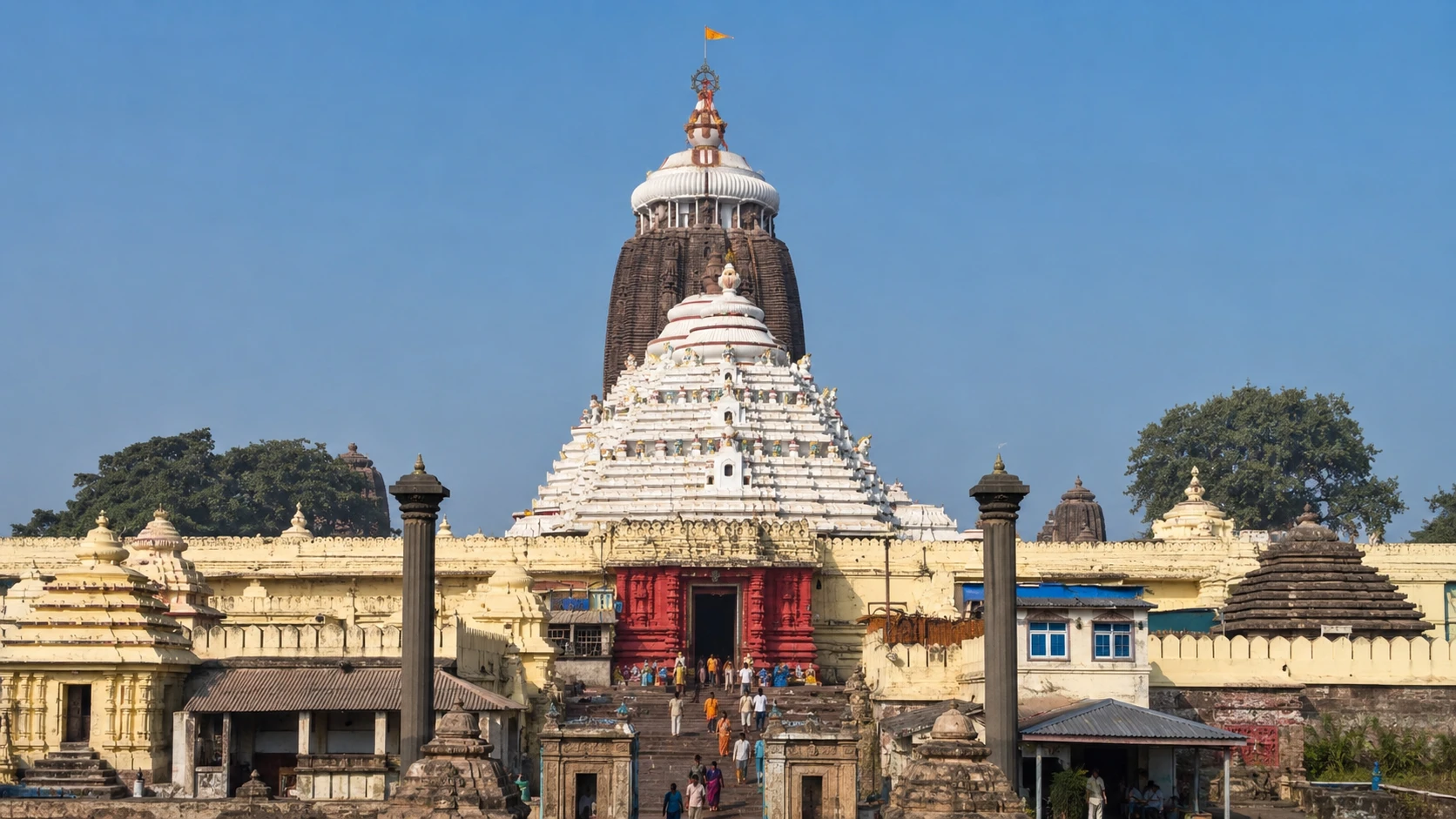
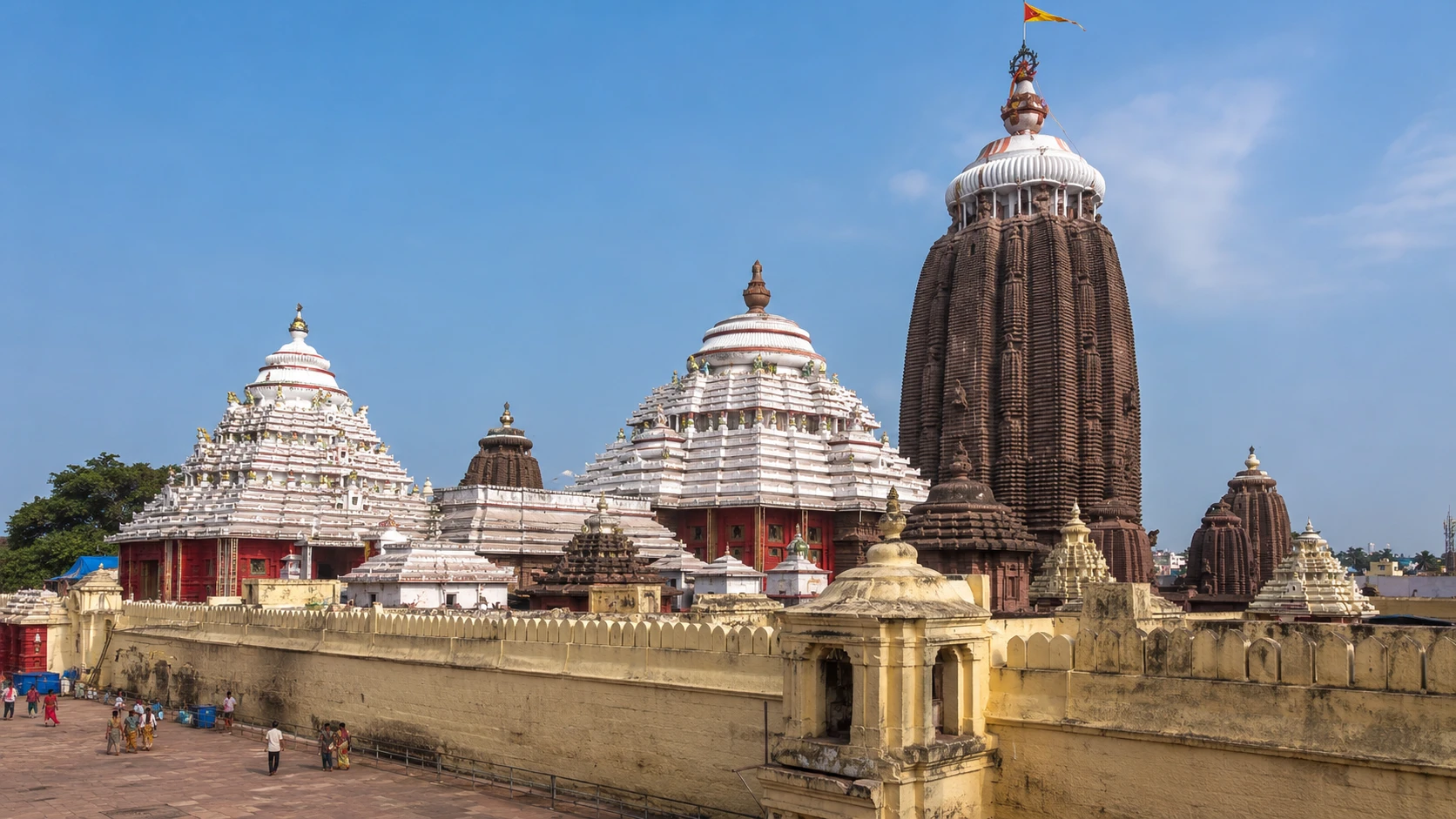
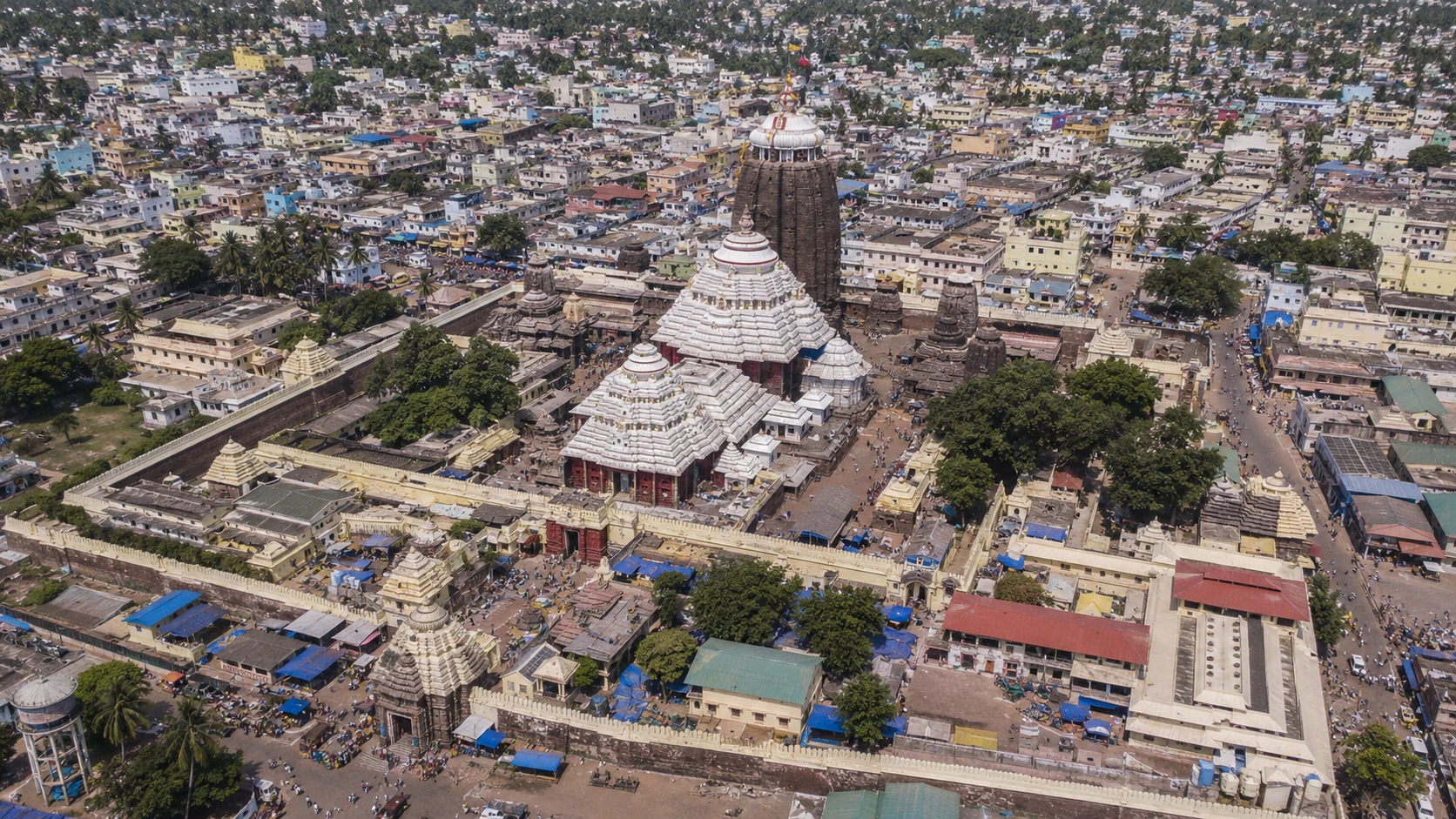
Kalinga (Odisha), the four-chambered classical Kalinga temple plan in its most monumental form: rekha-deula main shikhara rising approximately 65 metres, with jagamohana (assembly hall), nata-mandapa (dance hall), and bhoga-mandapa (offering hall) arranged on a single east-west axis; the temple complex enclosed by an outer Meghanada-prachira wall and an inner Kurma-prachira wall
खुला
Approx. 04:00 (Mangala Aarti, restricted access); main public darshan typically from ~06:30, 07:00 onwards – Approx. 22:30 (Pahuda, the rest ritual); multiple closures through the day between specific bhog and aarti rituals, the temple is rarely open continuously, and the daily rhythm is best understood through the seva-list rather than the wall clock
आरती
04:00 Mangala Aarti · 06:30 Mailam (changing of robes) · 07:00 Tadap-Lagi · 09:00 Gopal Vallabh Bhoga · 10:00 Sakal Dhupa · 12:00 Madhyahna Dhupa · 14:00 Sandhya Dhupa preparations · 20:00 Sandhya Dhupa · 22:00 Badasinghara Bhoga · 22:30 Pahuda
विशेष
Rath Yatra (Asadha Shukla Dwitiya), the only day the three deities leave the sanctum and the only day all communities may directly approach them; the nine-day Rath Yatra cycle including Snana Yatra (preceding fortnight), Anavasara (the deities' rest period), Bahuda Yatra (return), and Niladri Bije (the temple's re-entry); the Nabakalebara renewal (every 12, 19 years when Asadha contains two purnimas), the most consequential ritual cycle in the Jagannath calendar
पवित्र कथा · पवित्र कथा
Jagannath, Lord of the Universe, is Krishna in a form unlike any other temple in the country gives him: not the cowherd of Vrindavan or the king of Dwarka, but a wide-eyed wooden figure carved from a sacred neem tree, deliberately incomplete, with a face that no other deity in Hinduism wears. He stands on the high altar of the Sri Mandira at Puri between his elder brother Balabhadra and his sister Subhadra, with the Sudarshana chakra anchored beside Balabhadra, three siblings on one altar, a configuration unique in Hindu iconography. Once each year on Asadha Shukla Dwitiya, the three are carried out of the temple on giant wooden chariots in the Rath Yatra, the only day the deities leave the sanctum and the only day they may be approached, regardless of caste or community. The temple is the eastern dham of Adi Shankaracharya's pan-India Char Dham circuit; its kitchens, the Anandabazar, are among the largest temple kitchens in the world, with more than six hundred traditional chulhas serving Mahaprasada to tens of thousands of pilgrims daily. The wooden murtis are themselves ritually renewed every twelve to nineteen years in the Nabakalebara, the only major Hindu temple where the deities physically transfer their consciousness from one set of murtis to a newly carved pair of bodies. Continuous worship has been recorded here, with one major interruption in 1568, since the 12th-century construction of the present temple by the Eastern Ganga king Anantavarman Chodaganga.
Sacred Designationपवित्र पदनाम
east
चार धाम
Sacred Origin Storyपवित्र उत्पत्ति कथा
Source: Skanda Purana (Purushottama Khanda, the Indradyumna narrative is the principal Puranic source); Brahma Purana; Vishnu Purana; the Madala Panji (the Jagannath Temple's own continuous chronicle, in Odia, beginning roughly in the 12th century), widely-attested
In an age before this age, King Indradyumna of Avanti, the same Avanti where Mahakaleshwar would one day stand, heard from travellers of a hidden deity worshipped in a Sabara village in the forests of eastern Kalinga. The deity was called Nila Madhava, the dark blue lord, and the Sabara chief Vishvavasu had kept his shrine secret for generations.
The king sent his trusted Brahmin emissary, Vidyapati, to find the deity.
Vidyapati travelled east, befriended Vishvavasu, married his daughter Lalita, and after long entreaty was permitted to see Nila Madhava, though only blindfolded, and only by Vishvavasu's hand. Vidyapati had cleverly tied mustard seeds in his garment as he walked the forest path; when the seeds sprouted weeks later, he was able to retrace his steps and lead the king's emissaries to the place.
Indradyumna marched east with his army.
But when he reached the shrine, Nila Madhava had vanished. Only an empty stone seat remained, the deity gone into the deeper forest or, some say, into the waters off the Puri coast.
The king fasted in despair. Vishnu appeared to him in a dream and instructed: 'Wait at the shore at Puri. A great log of sacred Daru, neem wood charged with my presence, will float in from the sea. From this log you will carve me, my brother, my sister, and my chakra.' Indradyumna waited. The log came.
It was so heavy that nothing, neither royal elephants nor royal teams of bullocks, could move it. Only when the Sabara chief Vishvavasu and the Brahmanical king worked together, tribal hand and royal hand on the same rope, could the Daru be brought to land.
A carpenter appeared at the shore, ancient and silent, and offered to carve the four forms from the log. He set one condition: he was to be left undisturbed for twenty-one days; no one was to open his workshop until the work was complete. The king agreed and posted guards. For fourteen days the steady sound of chisel on wood was heard from inside.
On the fifteenth day the sound stopped. The queen, Gundicha, fearing the old carpenter had died of exhaustion, persuaded the king to open the door.
When they entered, the carpenter had vanished. The four deities stood unfinished: their faces broad and round, their eyes huge and unblinking, their arms truncated to stumps that ended where elbows would have been, their legs absent, their bodies columnar and tribal in bearing rather than smooth and Brahmanical.
The carpenter had been Vishvakarma, the architect of the gods, and he had left the deities in this state by design.
Brahma himself appeared to console the grieving king. The incompleteness, he explained, was the teaching: the Lord of the Universe cannot be reduced to fully-shaped form; the truncated arms are open arms unable to refuse any devotee; the great unblinking eyes watch the world without end; the column-body bears the same shape Adivasi communities have given their forest deities since long before the Vedas.
Indradyumna was instructed to consecrate the four, Jagannath (Krishna himself), Balabhadra (his elder brother Balarama), Subhadra (his sister), and Sudarshana (the chakra), and to renew their wooden bodies periodically, always carving them from the same Daru tradition that had brought them ashore.
The first temple was built by Indradyumna in that age, the texts say, and the deities have been worshipped at Puri ever since. The present Sri Mandira, the 65-metre shikhara temple pilgrims see today, was built much later by Anantavarman Chodaganga in the 12th century.
But the figures standing on the high altar, in their unfinished bodies, are held by tradition to be the same forms first carved on the shore: renewed many times by the Daita servitors who, alone in the world, are permitted to handle the Daru Brahma when the moment of Nabakalebara comes.
उद्धृत स्रोत:
- Skanda Purana, Purushottama Khanda, the principal Puranic source for the Indradyumna narrative
- Brahma Purana, companion narrative
- Vishnu Purana, Book 3
- Niladri Mahodaya, a regional compilation of Jagannath cult narratives
- Madala Panji, the official continuous chronicle of the Sri Mandira, in Odia, recording temple events from the 12th century onwards
अन्य परंपराएँ · अन्य परंपराएँ
Sabara / Adivasi origin tradition, embedded in the lived ritual practice of the Daita servitors and recognised in regional folk and academic accounts
An older layer of the Jagannath tradition, embedded in the ritual practice of the temple itself, holds that the deity is fundamentally of Sabara (a forest-dwelling community of eastern India) origin, and that the Brahmanical Indradyumna narrative records the absorption of an Adivasi forest deity into the Vaishnava fold rather than the discovery of a hidden Vishnu.
In this account, Nila Madhava was not Vishnu but a tribal forest spirit worshipped by Vishvavasu's people; the Vaishnava overlay came when the Eastern Ganga kings centralised the cult at Puri in the 12th century. The evidence cited for this older layer is the temple's own ritual structure: the Daita servitors, a hereditary community claiming descent from Vishvavasu, alone are permitted to handle the deities during Anavasara and Nabakalebara, when the deities are 'unwell' and outside the Brahmanical sanctum.
The wood-carving of the deities, the column-body iconography that resembles tribal-Adivasi shrine forms more than orthodox Vishnu icons, and the deities' annual willingness to leave the sanctum for the public Rath Yatra are read in this tradition as continuities from a pre-Brahmanical forest cult that the temple has never disowned.
In this account, the Indradyumna story is the Brahmanical recognition that the deity's actual ownership has always been shared.
विद्वत संदर्भ
Modern scholarship treats the Jagannath cult as the most complex syncretic tradition in mainland Hindu religion. Multiple distinct strands have been argued. The Vaishnava-Krishna identity is canonical and undisputed in lived devotional practice, Jagannath is Krishna, Balabhadra is Balarama, Subhadra is their sister. The Sabara/Adivasi forest-deity layer (developed academically in the 1978 Eschmann-Kulke-Tripathi volume and subsequent work) reads the temple's wooden murtis, the Daita servitors' hereditary role, and the column-body iconography as evidence of a pre-Brahmanical forest cult absorbed into Vaishnavism by the Eastern Ganga centralisation. A Buddhist-origin theory, most prominently advanced in colonial-era European scholarship, proposed that Jagannath was originally a tooth-relic shrine of the Buddha and that the triad represented the Triratna; this thesis has lost most academic ground but is occasionally cited. A pan-sectarian-synthesis reading frames the temple as a deliberate unification: Jagannath as Vaishnava, Subhadra as Devi (Shakta), and Sudarshana as a Shaiva-fire principle, with Balabhadra mediating between them. The 1135 CE foundation of the present temple by Anantavarman Chodaganga and its completion under Anangabhima III by 1230 CE are externally documented through Eastern Ganga inscriptions and the Madala Panji. The 1568 desecration by Kalapahar (a general of the Bengal Sultan Sulaiman Karrani) is recorded in both Hindu temple-chronicle and Persian-language Mughal-tributary sources; the deities' rescue and re-consecration over the following decade is the most consequential interruption in the temple's continuous worship. The 19th-century British colonial administration of the temple, controversial both in Hindu opinion and in Anglican missionary discourse of the time, is the subject of an extensive recent literature.
Historyइतिहास
The Jagannath cult's documented history begins in the 12th century with the foundation of the present Sri Mandira by Anantavarman Chodaganga of the Eastern Ganga dynasty (foundation traditionally placed at c. 1135 CE; substantive completion under his great-grandson Anangabhima III by c. 1230 CE), but the worship of the deity at this site is held by tradition to be considerably older.
The Madala Panji, the temple's own continuous chronicle in Odia, traces back to the early Eastern Ganga period and records temple events with a granularity unusual in pre-modern Hindu temple records.
Through the medieval period, the Sri Mandira was patronised by the Eastern Gangas, then by the Suryavamsi Gajapatis (15th, 16th century) under whom the Gajapati Maharaja's hereditary role as 'first servant' of Jagannath was formalised, a role whose ceremonial expression is the Chhera Pahanra, the king's sweeping of the chariot deck during the Rath Yatra, performed unbroken to this day.
In 1568, Kalapahar, a general of the Bengal Sultan Sulaiman Karrani, attacked Puri and desecrated the temple; the deities were hidden by the Daita and Patnaik servitor communities at Chilika Lake and other concealments, and worship was suspended for nearly a decade. The deities were re-consecrated under Ramachandra Deva (founder of the Khurda dynasty) around 1577.
From the late 16th to the 18th century, the temple weathered seventeen documented invasions and partial desecrations across the Mughal, Bengal Sultanate, and Maratha periods, chronicled in the Madala Panji with careful note of which murtis were hidden, where, and for how long.
The Marathas controlled Odisha from 1751 until the British East India Company annexation in 1803; the Gajapati's nominal sovereignty over the temple continued under the Marathas and the British, with formal British administrative oversight from 1809 to 1840 (a period widely contested in Hindu opinion at the time and the subject of considerable subsequent scholarly debate).
Modern administration is vested in the Shri Jagannath Temple Administration (SJTA) under the Government of Odisha, with hereditary servitor communities (the chhattisha niyoga, the thirty-six communities) retaining their traditional sevas under an evolving balance of state oversight and customary practice.
Cyclone Fani made landfall at Puri on 3 May 2019, among the most powerful cyclones in recorded Odisha history, causing significant damage to the temple precinct and surrounding town though the main shikhara of the Sri Mandira itself withstood the storm; reconstruction continued through 2020, 2022.
The Shri Mandir Heritage Corridor, a substantial precinct redevelopment widening pilgrim approach and creating new infrastructure around the temple, was inaugurated by the Government of India and the Government of Odisha on 17 January 2024.
On 14 July 2024, the Ratna Bhandara (the inner treasure room of the temple, sealed since 1978 with one failed re-opening attempt in 1985) was opened by the Odisha state government for ritual inspection and inventory; the contents and the inventory process have remained the subject of state and SJTA communications since.
Historical Timelineऐतिहासिक कालक्रम
Pre-temple worship of Nila Madhava and the Daru Brahma tradition. The Indradyumna narrative in the Skanda Purana's Purushottama Khanda, and the Sabara-origin layer embedded in the lived ritual practice of the Daita servitors, establish a pre-Brahmanical forest deity tradition centred at this site. Archaeological evidence for continuous shrine activity here in pre-medieval times is limited, consistent with the lower-permanence forest-cult phase the texts describe.
The dating of the Sanskrit texts in their current redacted forms remains the subject of scholarship; the Sabara-origin layer is not directly textually dated but is reconstructed from comparative ritual evidence and the Daita servitors' hereditary role. The Indradyumna narrative is consistent across the Puranic sources and is the canonical traditional account.
Construction of the present Sri Mandira by Anantavarman Chodaganga of the Eastern Ganga dynasty (foundation c. 1135 CE), with substantive completion under his great-grandson Anangabhima III by c. 1230 CE. The 65-metre rekha-deula shikhara, the four-chambered Kalinga temple plan (rekha-deula, jagamohana, nata-mandapa, bhoga-mandapa), and the outer Meghanada-prachira and inner Kurma-prachira walls take shape in this period. The Eastern Gangas establish the Gajapati's role as 'first servant' of Jagannath and centralise the cult's institutional structure.
The exact foundation date of 1135 CE is from temple-traditional sources; epigraphic evidence places substantive temple-building activity under Chodaganga's reign (c. 1077, 1147 CE). The completion under Anangabhima III is securely dated through Eastern Ganga inscriptions. Architectural studies generally accept the temple as the supreme example of mature Kalinga style.
Kalapahar, a general of the Bengal Sultan Sulaiman Karrani, attacks Puri and desecrates the Sri Mandira. The Daita and Patnaik servitor communities flee with the deities, hiding them at Chilika Lake (in the Sonepur region) and at other secret locations across coastal Odisha. Public worship at the temple is suspended for nearly a decade. The deities are re-consecrated at Puri under Ramachandra Deva, the founder of the Khurda dynasty, around 1577. The Madala Panji's account of the rescue and concealment is one of the most detailed in the chronicle.
The historicity of Kalapahar (also known as Kalachand Rai or Sukumar Sen, originally a Hindu Brahmin who converted to Islam under Karrani) is well-established from both Hindu and Muslim chronicles. The 1568 desecration is among the most consequential events in the temple's continuous-worship record. Casualty figures and the specific extent of damage to the temple structure derive from the Madala Panji and warrant scholarly cross-reading rather than direct quotation.
Re-consecration and continuous worship under the Khurda dynasty (founded 1577), through the Mughal-tributary period and seventeen further documented invasions and partial desecrations chronicled in the Madala Panji. The deities are repeatedly hidden and restored as conditions warrant. The Gajapati's ceremonial sovereignty over the temple is preserved through these centuries even as actual political control of Odisha shifts between Mughals, Bengal Sultanate residues, and (from 1751) the Marathas. The Chhera Pahanra ritual, the Gajapati Maharaja's symbolic sweeping of the Rath Yatra chariot deck, continues unbroken through this entire period.
British East India Company annexation of Odisha (1803); formal British administrative oversight of the Sri Mandira from 1809 to 1840 (subject of considerable Hindu and missionary contemporary debate); restoration of customary servitor management thereafter, with state oversight under the Government of Odisha after Independence. Modern administration is vested in the Shri Jagannath Temple Administration (SJTA). Cyclone Fani makes landfall at Puri on 3 May 2019, one of the most powerful Bay of Bengal cyclones on record, causing major damage to the temple precinct and surrounding town though the main shikhara of the Sri Mandira withstands the storm. The Shri Mandir Heritage Corridor, a substantial precinct redevelopment, is inaugurated on 17 January 2024 by the Government of India and Government of Odisha. The Ratna Bhandara (inner treasure room, sealed since 1978 with one failed re-opening in 1985) is opened by the state government on 14 July 2024 for ritual inspection and inventory.
The 1809, 1840 British administration period is the subject of an extensive specialist literature; the period was actively contested in Hindu opinion of the time and remains scholarly contested. The 2024 Ratna Bhandara opening is recent enough that the inventory process and formal findings remain in state and SJTA communication; pilgrims and researchers should refer to current official communications for the latest status.
What You'll Seeदर्शन में
On the Ratnavedi, the jewelled altar inside the Sri Mandira's garbhagriha, three siblings stand together, with the Sudarshana chakra anchored to one side. Jagannath, on the right of the viewer, is darkest: a roughly columnar wooden form, faintly over a metre and a half tall, his face painted black with two enormous round white eyes that meet pilgrims at their own height.
He has no neck. His arms are truncated to stumps that reach forward where elbows would be, the wrists and hands replaced by the cylindrical column of the body itself. He has no legs. Balabhadra, on the left, is identical in form and proportion but his face is painted white, the white of milk and conch and elder-brother seniority.
Subhadra, the smaller figure between them, is yellow-faced, her form even less articulated than her brothers'. Beside Balabhadra stands a fourth wooden pillar, the Sudarshana chakra, undecorated, columnar, marked only by ritual paint. All four are carved fresh from the same Daru-tradition neem trees during each Nabakalebara renewal.
The deities are dressed by the Pushpalaka servitors in different vesha (attire) several times each day, the Mailam morning robes, the Rajpana afternoon ornaments, the Badasinghara evening regalia, and on special days they are presented in defining besha including Hati Besha (elephant-form attire), Padma Besha (lotus attire), and the famous Suna Besha when the deities are arrayed in golden ornaments during Bahuda Yatra.
In front of the temple's main entrance stands the Aruna stambha, a 11-metre carved monolith originally from the Konark Sun Temple, relocated here in the 18th century. Photography is strictly prohibited throughout the temple complex.
Distinctive Practicesविशिष्ट परंपराएँ
Rath Yatra, the chariot festival, the only day the deities leave the sanctum
रथ यात्रा, रथ उत्सव, एकमात्र दिन जब देवता गर्भगृह छोड़ते हैं
Asadha Shukla Dwitiya (June, July), annually; the principal Rath Yatra day, with the wider 9-day cycle including Snana Yatra (preceding fortnight) and Bahuda Yatra (8 days later)
On Asadha Shukla Dwitiya, three giant wooden chariots stand on the Bada Danda, Nandighosha for Jagannath (45 feet tall, 16 wheels), Taladhwaja for Balabhadra (44 feet, 14 wheels), and Darpadalana (also Devadalana) for Subhadra (43 feet, 12 wheels). The chariots are built fresh each year by hereditary Maharana carpenter communities from neem and other specified woods, using no metal nails, only wooden joinery in the traditional method. The deities are carried out from the sanctum in the Pahandi procession, swaying in the arms of the Daita servitors, and installed on their respective chariots. The Gajapati Maharaja of Puri arrives in royal procession from his palace and performs the Chhera Pahanra, the king sweeping the chariot deck of each chariot with a gold-handled broom and sprinkling it with sandalwood-perfumed water. He performs this as the first servant of the deity; the gesture has been performed unbroken since at least the Suryavamsi Gajapati period (15th, 16th century). The chariots are then pulled down the three-kilometre Bada Danda by ropes drawn by lakhs of pilgrims; the deities reside at the Gundicha Temple for nine days before returning in the Bahuda Yatra. The Rath Yatra is the only day in the year when anyone, regardless of caste or community, may directly approach and worship the deities outside the sanctum.
The Rath Yatra is the temple's most public theological statement: that the Lord of the Universe is not confined to a sanctum to which only some communities have access. Once a year, by the deity's own willingness, the boundary dissolves. The Gajapati Maharaja's Chhera Pahanra, a king publicly sweeping in front of all his subjects, is the formal articulation of this dissolution: even the highest temporal authority is, in this moment, only a sevak. Pilgrims who pull the ropes participate in moving the deity; tradition holds that pulling even one inch of the chariot earns immense merit. The annual rhythm, sanctum withdrawal, public festival, return to sanctum, encodes the temple's understanding of how the divine relates to the world: not as constant openness or constant closure, but as a measured rhythm of both.
Nabakalebara, the periodic ritual renewal of the wooden murtis
नबकलेबर, काष्ठ-मूर्तियों का सामयिक अनुष्ठानिक नवीनीकरण
Held only when Asadha contains two purnimas, approximately every 12 to 19 years; recent occurrences in 1969, 1977, 1996, 2015 (the next predicted around 2034 by some calculations)
Nabakalebara, 'new body', is the most secret ritual in mainstream Hindu temple practice. When Asadha (June, July) contains two full moons in the same lunar month, the deities receive new wooden bodies. The Daita servitors set out in formal procession from the temple to find the four required Daru Brahma trees: large neem trees bearing specific natural marks (a conch, a chakra, a lotus, and a mace) and meeting strict ritual conditions (not used for human purposes, having serpents at their roots, surrounded by particular auspicious species). The trees are felled with a gold axe, transported to Puri, and the new murtis are carved over forty-two days in absolute seclusion at the Koili Vaikuntha workshop within the temple complex. On the night of the actual transfer, between midnight and dawn, in pitch darkness, the senior-most Daita is blindfolded with a long cloth, and with bare hands transfers the brahma-padartha (the divine essence) from the cavity of each old murti into the cavity of each new one. What the brahma-padartha physically contains is not known: every Daita who has performed this ritual has refused to describe it, and the secrecy is itself a vow taken at the moment of inheritance. The old murtis are buried in the Koili Vaikuntha cemetery within the temple precinct.
The Daru Brahma tradition holds that the deity's consciousness inhabits the wooden body for a finite span and then must move to a fresh form, a theological position embedded in the materiality of the wood itself. In every other major Hindu temple, the murti is treated as permanently consecrated stone or metal; at Puri, the wood's mortality is itself part of the theology. The Daita servitors' exclusive role in the transfer, and their inheritance of the secret of what the brahma-padartha contains, is the temple's continuous acknowledgement that the deity belongs partly to the Adivasi/Sabara tradition that has held this responsibility since long before the present temple was built.
Mahaprasada and the Anandabazar, the world's largest temple kitchen
महाप्रसाद और आनंदबाज़ार, विश्व की सबसे बड़ी मंदिर रसोई
Daily, year-round; the Anandabazar is open from morning through afternoon
Within the Sri Mandira's enclosure operates one of the largest temple kitchens in the world. Each day, more than six hundred chulhas (wood-fired clay hearths) prepare fifty-six bhog items, chappan-bhog, for offering to the deities at six daily seva times: Gopal Vallabh Bhog, Sakal Dhupa, Madhyahna Dhupa, Sandhya Dhupa, and the major bhogs at Rajbhog and Badasinghara. The Suara and Mahasuara cook communities, hereditary servitors with this exclusive privilege, work in shifts. The signature cooking method uses earthenware pots stacked seven high over a single fire, with the topmost pot cooking first and the bottom last, a counter-intuitive principle that defies modern thermodynamics and is read as one of the deity's many small daily miracles. Once the food is offered to the deities, it ceases to be food and becomes Mahaprasada, and Mahaprasada has no caste boundaries: the rule that no Hindu may share food with another of a different caste is suspended in front of Jagannath. The Mahaprasada is then sold at the Anandabazar, the open marketplace within the temple precinct, where pilgrims of every community sit together on the same stone floor and share the same bhog. Khaja, the layered fried sweet of Puri, is the signature take-home prasad.
The kitchen is, in effect, the temple's most radical public theology. The same caste system that governs daily Hindu social practice is dissolved at the moment Mahaprasada touches the lips: from that point, all those eating it are equal in front of the deity. The Anandabazar makes this dissolution physically visible, pilgrims across the entire Hindu social spectrum sit on the same floor, share the same leaf-plate, eat the same bhog. The seven-stack cooking miracle is read by tradition as the deity's continuous endorsement of this reordering: cooking is done by the deity's logic, not the world's, and the deity's logic does not honour the boundaries that the world maintains.
Did You Know?क्या आप जानते हैं?
The Sri Mandira's kitchen, the Anandabazar, is among the largest temple kitchens in the world: more than six hundred wood-fired chulhas in continuous operation prepare fifty-six bhog items daily, served at six seva times to the deities and then to tens of thousands of pilgrims. The signature cooking method uses earthenware pots stacked seven high over a single fire, with the topmost pot cooking first and the bottom last. Once offered to Jagannath, the food becomes Mahaprasada, and the rule that Hindus of different castes may not share food is suspended; in the Anandabazar, all communities sit together on the same stone floor.
Shri Jagannath Temple Administration (SJTA) records on the temple kitchen; Frédérique Apffel-Marglin, 'Wives of the God-King' (1985); journalistic studies including 'The Hindu' and 'Outlook' coverage of the temple kitchen
Atop the 65-metre shikhara of the Sri Mandira sits the Nilachakra, the 'blue wheel', a metal-cast disc roughly two metres across and weighing close to a ton, with eight Navagunjara figures around its rim. From below it appears as a circle from every direction, regardless of the viewer's position relative to the temple, a property of its eight-faced design rather than of any optical anomaly. Beside it flies the Patit Pavana Bana, the daily-changed temple flag, climbed and replaced each evening by a member of a hereditary climber family who scales the shikhara without harness or modern equipment. The flag is visible from kilometres along the Bay of Bengal coast and at sea.
O. M. Starza, 'The Jagannatha Temple at Puri' (1993); Archaeological Survey of India temple records; Devasthan Samiti / SJTA publications
Each year following the Snana Yatra (the deities' public bath on Jyestha Purnima), the deities are said to fall ill from over-bathing and are kept in seclusion for fifteen days during the Anavasara. They are not visible to the public during this period; the Daita servitors alone tend to them, applying medicinal herbs and traditional ayurvedic remedies. Public worship resumes only with the Rath Yatra, when the now-recovered deities emerge from the sanctum. The 'illness' tradition is one of the few in major Hindu temple practice that anthropomorphises the deities to this degree of physical embodiment.
Madala Panji entries on the Anavasara cycle; Eschmann, Kulke & Tripathi (eds), 'The Cult of Jagannath' (1978); SJTA seva schedules
Jagannath's wooden murtis are renewed approximately every twelve to nineteen years in the Nabakalebara ritual, the only major Hindu temple in mainland India where the deities physically transfer their consciousness from one set of bodies to a newly carved pair. The transfer of the brahma-padartha, the 'divine essence' contained in a small cavity at the heart of each murti, is performed in absolute darkness by a blindfolded senior Daita servitor, with bare hands. What the brahma-padartha physically contains is not known and has been kept secret across centuries by every Daita who has performed the rite. The most recent Nabakalebara took place in 2015.
Madala Panji; SJTA Nabakalebara records; specialist studies in the Eschmann-Kulke-Tripathi volume; Indian Express and Outlook coverage of the 2015 Nabakalebara
The Sri Mandira is administered by the chhattisha niyoga, thirty-six hereditary servitor communities, each with a specific exclusive ritual right that no other community may perform. The Daita and Patnaik communities handle the deities during Anavasara, Nabakalebara, and the Pahandi procession; the Pushpalakas dress them; the Suara and Mahasuara cook the bhog; the Maharanas build the chariots; the Pati Mahapatra performs particular sevas; the Karpati Niyoga supplies camphor; the Chamara Niyoga waves the yak-tail fly-whisk. The system is one of the most elaborate hereditary-rights structures in any continuously functioning Hindu institution and has been preserved with very limited modification through nearly nine hundred years of temple operation.
Madala Panji; SJTA niyoga records; Frédérique Apffel-Marglin, 'Wives of the God-King' (1985); G. C. Tripathi essays in the Eschmann-Kulke-Tripathi volume
Visitor Accessप्रवेश जानकारी
The Sri Mandira at Puri operates under more access restrictions than most other Char Dham temples, and pilgrims should plan accordingly. The temple's tradition restricts entry to the inner precinct to those of the Hindu faith, as determined by the temple administration; non-Hindu visitors of all communities may view the temple from outside, notably from the rooftop of the nearby Raghunandan Library, but may not enter the temple complex. Photography is strictly prohibited throughout the entire temple complex (not only the sanctum); mobile phones, cameras, and leather items must be deposited at lockers at the Singhadwara entrance before entry. Multiple darshan windows operate through the day separated by closures for specific bhog and aarti sevas; Sahanamela general darshan is available in defined morning and evening windows. During the Rath Yatra (Asadha Shukla Dwitiya), the entire town is reorganised around the chariot procession and pilgrim density along Bada Danda is extreme; advance planning, registration where required, and adherence to administration crowd-management instructions is essential.
आध्यात्मिक आधार
The temple's framing of its access policy rests on its understanding of the inner precinct as a continuously consecrated ritual space requiring formal Hindu initiation to enter. This position has been the subject of legal challenge and public debate at various points, and remains the temple administration's standing rule; pilgrims are asked to respect it whatever their personal view. The photography prohibition rests on a similar logic: the deities' daily seva, the changing of robes, the offering of bhog, the rest periods, is treated as private to the deity and the sevayat. Pilgrims are asked to receive the darshan as it is given, not to take it home in image.
Festivalsत्योहार
Rath Yatra
रथ यात्रा
June, July (Asadha Shukla Dwitiya)
The single most consequential festival in the Jagannath calendar, and one of the largest religious gatherings in the world. On Asadha Shukla Dwitiya, the three deities are carried in the Pahandi procession from the sanctum onto three giant wooden chariots, Nandighosha for Jagannath, Taladhwaja for Balabhadra, and Darpadalana for Subhadra, built fresh each year by the hereditary Maharana carpenters. The Gajapati Maharaja of Puri performs the Chhera Pahanra (sweeping the chariot deck with a gold-handled broom), and the chariots are pulled by lakhs of pilgrims down the Bada Danda to the Gundicha Temple, where the deities reside for nine days before returning in the Bahuda Yatra. Suna Besha, the gold-attire darshan of the deities on the chariots, takes place on the day after Bahuda Yatra and is the year's most photographed darshan moment. The festival is the only day when the deities may be approached and worshipped directly by all communities outside the sanctum.
Snana Yatra
स्नान यात्रा
June (Jyestha Purnima)
On the full-moon day of Jyestha, the fortnight preceding the Rath Yatra, the deities are brought out of the sanctum to a special bathing platform called the Snana Bedi, in full public view, and bathed with 108 pots of water drawn from a sacred well within the temple precinct. The deities are dressed in elephant attire (Hati Besha) for this darshan, among the most distinctive and photographed iconographic moments in the temple year. After the Snana Yatra, the deities are said to fall ill from over-bathing and enter the fifteen-day Anavasara seclusion, during which they are not visible to the public; the Daita servitors apply traditional remedies until the deities recover and emerge for the Rath Yatra. Snana Yatra and the Anavasara that follows are the conceptual prelude to the Rath Yatra cycle.
Chandan Yatra
चंदन यात्रा
April, June (42 days, beginning Akshay Tritiya)
A forty-two day festival beginning on Akshay Tritiya, during which the deities, in the form of their utsava-murtis (festival images, distinct from the main sanctum forms), are taken in daily processions to the Narendra Tirtha tank and other water bodies for boat rides on chappa boats and full-body sandalwood paste applications, mirroring summer cooling rituals. The first 21 days are called Bahara Chandan (outdoor processions); the next 21 are Bhitara Chandan (indoor application within the temple). The festival's purpose, according to tradition, is to cool the deities through the Odisha summer heat. Visitors during the open-air phase witness one of the few times the temple's processional ritual is fully visible from outside the sanctum.
Dola Purnima (Holi at Puri)
दोल पूर्णिमा (पुरी में होली)
March (Phalguna Purnima)
Dola Purnima is Puri's particular form of the Holi celebration, the deities are placed on a swing (dola) for ceremonial swinging; coloured powder (abeer and gulal) is showered on the deities and the assembled devotees through the day; traditional Odia Phagua songs are sung. The festival is among the year's most photographed darshan moments after Suna Besha and the Hati Besha of Snana Yatra. Pilgrim numbers are smaller than at Rath Yatra and Snana Yatra, making Dola Purnima a popular time for serious devotional pilgrims who want sustained darshan without the largest festival crowds.
Traditional Offeringsपारंपरिक अर्पण
प्राथमिक अर्पण
Tulsi Mala / Tulsi Patra
तुलसी माला / तुलसी पत्र
तुलसी
Tulsi is Vishnu's most beloved offering, identified in the Padma Purana as the gopi Vrinda who took plant form to remain at his feet. At the Sri Mandira, fresh tulsi is layered on the deities at multiple seva times; tulsi malas are distributed as prasad along with the chappan-bhog. Pilgrims take home a few leaves or a mala for household worship.
Sandalwood paste (Chandan)
चंदन (चंदन-लेप)
Chandan paste is applied to the deities daily and is the centrepiece of the 42-day Chandan Yatra festival, when the deities are smeared with sandalwood from head to base in a summer cooling ritual. Pilgrims may sponsor sandalwood for specific applications and may take home small quantities of consecrated chandan as prasad.
Vastra (cloth/fabric offerings)
वस्त्र (कपड़े का अर्पण)
Cloth offerings are central to the daily seva at Puri, the deities are dressed in different vesha at each major aarti and the robes are renewed each day. Pilgrims may sponsor specific vastra offerings, including the special silks for Suna Besha (the gold-attire darshan during Bahuda Yatra). Sponsorship is arranged through the SJTA office; the offering is publicly recorded.
Khaja and Mishri
ख़जा और मिश्री
Khaja, the layered, deep-fried sweet of Puri, is the temple's signature take-home prasad and one of the chappan-bhog items prepared in the Anandabazar daily. Crystalline mishri (rock sugar) is the standard Krishna offering and is included in most prasad packets distributed at the temple counters. Pilgrims often carry boxes of khaja home from Puri to share with family.
Coconut and incense
नारियल और धूप
Standard Hindu puja items, whole coconuts, joss sticks, and camphor, are offered at multiple stations within the temple precinct as part of the standard puja flow. The coconut, broken at specific points in the rite, is read in tradition as the breaking of the ego-shell to allow the inner sweetness to be received by the deity.
इस मंदिर की विशेषता
Mahaprasada / Chappan-Bhog Sponsorship
महाप्रसाद / छप्पन-भोग प्रायोजन
Sponsorship of all or part of a day's chappan-bhog (the 56-item offering prepared for the deities) is among the most spiritually weighted sevas at the Sri Mandira. Sponsorship covers preparation by the Suara and Mahasuara cook communities and includes distribution of Mahaprasada at the Anandabazar in the sponsor's name. Booking is through the SJTA office; advance scheduling is required, particularly for festival-period sponsorships.
Suna Besha / Special Vesha Sponsorship
सुना बेश / विशेष वेश प्रायोजन
Sponsorship of the gold ornaments and silks for the deities' Suna Besha (the gold-attire darshan during Bahuda Yatra) and other special besha including Hati Besha and Padma Besha. The sponsor's family is recorded in the SJTA register and may be invited to specific darshan slots associated with the besha. These sponsorships are heavily oversubscribed and are typically committed years in advance.
Niti / Specific Seva Sponsorship
निति / विशिष्ट सेवा प्रायोजन
Sponsorship of specific named ritual sevas, including the Mailam morning robe-changing, the Mangala Aarti participation slot, the Sandhya Dhupa attendance, and the Pahuda evening rest ritual, is offered through the SJTA. Each seva has a defined ritual function in the day's seva-list and a corresponding sponsorship cost; the sponsor is named in the temple records and receives a certificate.
Pilgrims may bring tulsi, fruit, mishri, sandalwood, and pure cotton cloth from outside, but in practice most purchase trust-vetted offering items at counters near the temple entrance. Mahaprasada is purchased at the Anandabazar after offering, pilgrims may not bring food into the temple complex. Sevas at the major aartis and chappan-bhog sponsorships should be booked well in advance through the SJTA; on-the-day availability is rare for the most coveted slots. Khaja for take-home is available at multiple licensed shops along the Bada Danda and outside the temple precinct.
How to Reachकैसे पहुँचें
Puri sits on the Bay of Bengal coast in eastern Odisha, about 60 km south of the state capital Bhubaneswar. The town is a major pilgrimage destination and is well-connected by rail, road, and (via Bhubaneswar) by air.
By rail: Puri Railway Station is in town, about 3 km from the temple, and serves as the terminus of the East Coast Railway's Howrah, Puri line. Direct trains operate from Kolkata (~9, 11 hours), Bhubaneswar (~1.5 hours), Hyderabad (~22 hours), New Delhi (~30+ hours), Mumbai (~36+ hours), and Chennai (~24+ hours), among others.
Train demand spikes around Rath Yatra (June, July) and the winter pilgrimage season (October, March); booking 30, 60 days in advance is recommended.
By road: NH-316 (Bhubaneswar, Puri) is the main road approach, a roughly 60 km drive of 1.5, 2 hours from Bhubaneswar. NH-203A is the coastal road from Konark (~35 km, ~1 hour) and is among the most scenic temple-circuit drives in India, connecting Puri with the Konark Sun Temple and via Bhubaneswar to the Lingaraj Temple, the classic 'Golden Triangle' of Odisha temple architecture.
State-run Odisha State Road Transport Corporation (OSRTC) buses operate from Bhubaneswar, Cuttack, and other Odisha cities.
By air: The nearest airport is Biju Patnaik International Airport at Bhubaneswar (~60 km, 1.5 hours by road), with extensive domestic connections to Delhi, Mumbai, Bengaluru, Kolkata, Chennai, Hyderabad, and others, and selected international flights to Bangkok, Dubai, and Singapore. From Bhubaneswar Airport, prepaid taxis and pilgrim shuttle services run to Puri.
Local access: Within Puri, the temple is at the centre of a pedestrian-oriented temple precinct that has been substantially expanded under the Heritage Corridor inaugurated in January 2024. Auto-rickshaws and battery-operated rickshaws run from the railway station to the temple.
The Bada Danda, the Grand Road from the Sri Mandira to the Gundicha Temple, is closed to most vehicle traffic during the Rath Yatra season; pilgrims walk the 3 km route. For day excursions, Konark Sun Temple (35 km), Pipili (the appliqué-craft town, 30 km), and Chilika Lake (75 km, the Asia's largest brackish-water lagoon) are standard add-ons.
Plan Your Visitयात्रा की योजना
🌤 सर्वोत्तम मौसम
October to March is by far the best window, clear skies, daytime temperatures of 20, 30°C, low humidity, and the major non-Rath-Yatra pilgrimage period. Within this window, December and January carry pleasant temperatures and lower pilgrim density than the festival peaks. April to mid-June is the southern Indian summer at the Bay of Bengal coast, hot (35, 40°C) and intensely humid; this overlaps with the Chandan Yatra period (April, June), so pilgrims who time their visit to the Chandan Yatra should plan for hydration and early-morning darshan. June, July is the south-west monsoon, which coincides with Snana Yatra and the headline Rath Yatra; pilgrim numbers reach hundreds of thousands during the principal Rath Yatra day, and weather contingencies must be planned for. August, October is the Bay of Bengal cyclone season; pilgrims travelling in October should monitor IMD and Government of Odisha advisories.
👘 पहनावे का नियम
Modest, traditional Indian dress is expected, full-length trousers, dhoti, salwar suit, or saree; covered shoulders. The temple administration discourages Western casual wear (shorts, sleeveless tops) and prohibits leather items inside the temple complex; leather belts, wallets, and shoes must be removed and deposited at the Singhadwara lockers. Footwear is removed at the outer step and stored at trust counters. Many male pilgrims, by Odia tradition, remove their shirts inside the temple and wear only a dhoti and angavastra. Women are not subject to a corresponding upper-body restriction.
📱 फोन और फोटोग्राफी
Mobile phones, cameras, smartwatches, and any photographic device are strictly prohibited inside the entire temple complex (not only the sanctum). Lockers are operated by the SJTA at the Singhadwara entrance for deposit before entry; collection is on exit. Photography is permitted only outside the temple precinct, the rooftops surrounding the temple, particularly the Raghunandan Library rooftop (which is also the principal viewing point for non-Hindu visitors), offer the best angles. Mobile signal at Puri is generally good; multiple operators maintain reliable coverage in the town.
🏨 आवास
The SJTA operates official Bhakta Niwas guest houses near the temple, bookable through the trust portal. Odisha Tourism Development Corporation (OTDC) runs the Panthanivas Puri and other tourist guest houses across price points. A wide range of private hotels, from beachfront luxury (close to Puri Beach) to budget dharamshalas in the temple precinct, operate year-round; capacity expands during Rath Yatra and the winter pilgrim season. Areas closer to the Sea Beach (about 1.5 km from the temple) offer better hotel infrastructure; the temple-side accommodations are convenient for darshan but quieter and simpler. During the Rath Yatra (June, July), advance booking by several weeks to months is essential and prices may rise sharply. Pipili and Konark have additional accommodation options for pilgrims combining the Golden Triangle circuit.
Book a Pujaपूजा बुक करें
Booking links and phone numbers are verified periodically but may change without notice. The official trust portal for all Sri Mandira sevas, donations, and Vesha sponsorships is the SJTA portal at shreejagannatha.in (with related Government of Odisha references at jagannath.nic.in). Multiple fraudulent websites mimic the SJTA's branding to accept payments for darshan slots, special Vesha sponsorships, and Rath Yatra rope-pulling registrations they cannot deliver, the SJTA has issued repeated advisories against these and the Odisha Police have filed cases in several documented instances. Always confirm the destination URL belongs to the SJTA before payment. Travel agents claiming to offer 'guaranteed' Rath Yatra darshan, Suna Besha viewing, or expedited entry on festival days should be treated with caution; the only path to such access is through the SJTA's own booking system. The temple's access policies, non-Hindu entry restriction, photography prohibition throughout the complex, leather-item restriction, are administration rules and not negotiable through any third party. Phone numbers and email contacts are not currently published on the trust portal in a single canonical place; verify on the SJTA website before contacting.
Managed by: Shri Jagannath Temple Administration (SJTA), under the Government of Odisha; chhattisha niyoga (thirty-six hereditary servitor communities) operate the daily ritual sevas
Sahanamela general darshan window
सहनामेल सामान्य दर्शन झरोखा
Mangala Aarti participation slot
मंगला आरती सहभागिता अवसर
Chappan-Bhog sponsorship (full or partial)
छप्पन-भोग प्रायोजन (पूर्ण या आंशिक)
Niti / specific named seva sponsorship (Mailam, Tadap-Lagi, Sandhya Dhupa, etc.)
निति / विशिष्ट नामित सेवा प्रायोजन (माइलम, ताडप-लागि, संध्या धूप, आदि)
Special Vesha sponsorship (Suna Besha, Hati Besha, Padma Besha)
विशेष वेश प्रायोजन (सुना बेश, हाथी बेश, पद्म बेश)
Rath Yatra rope-pulling registration
रथ यात्रा रस्सी-कर्षण पंजीकरण
Booking information verified: 2026-05-07
Sacred Soundsपवित्र ध्वनि
108 Japa Practice
Om Namo Bhagavate Vasudevaya
Chant 108 times in the spirit of this temple
क्या आप जानते हैं? · Did You Know?
वही अनुवाद त्रुटि जिसने हिन्दू धर्म में '33 कोटि' को '33 करोड़' बनाया, बौद्ध धर्म में भी हुई। बौद्ध ग्रन्थों के चीनी अनुवाद ने 'सप्त कोटि बुद्ध' (7 श्रेष्ठ बुद्ध) का अनुवाद '7 करोड़ बुद्ध' कर दिया। तिब्बती अनुवाद ने सही किया: 7 प्रकार, 7 करोड़ नहीं। एक संस्कृत शब्द, दो प्रमुख विश्व धर्मों में गलत पढ़ा गया, ने दो एकसमान भ्रम स्वतन्त्र रूप से उत्पन्न किए।
Related Contentसंबंधित सामग्री
Related Scriptures
Community Reflections
🕉️
Be the first to share your reflection.