Sri Mushnam Bhuvarahaswamy
श्री मुष्णम् भूवाराहस्वामी
One of the eight self-manifest abodes of Vishnu, the great shrine of the boar, where the Lord as Bhu Varaha lifts the earth goddess from the deep
Sri Mushnam, Tamil Nadu, India
Śrī Bhū Varāhasvāmī (Śrīmuṣṇam)Also known as: Sri Bhuvaraha Swamy Temple, Srimushnam Varaha Temple, Bhuvarahaswamy Srimushnam
युग
A self-manifest Varaha kshetra held to be of ancient sanctity, its present temple built and expanded largely under the Nayakas of Gingee in the sixteenth century, with later Maratha-period patronage
वास्तुकला
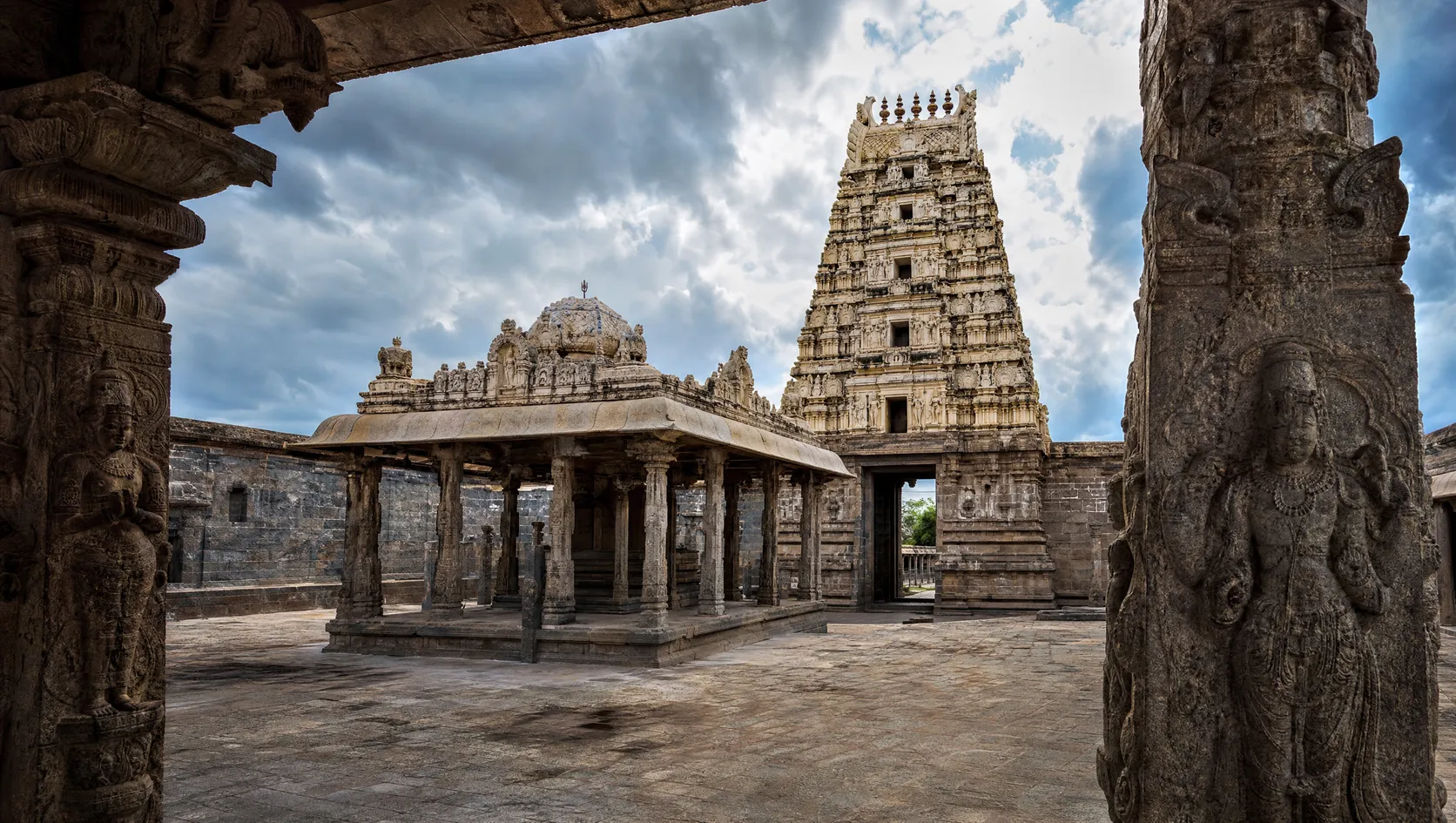
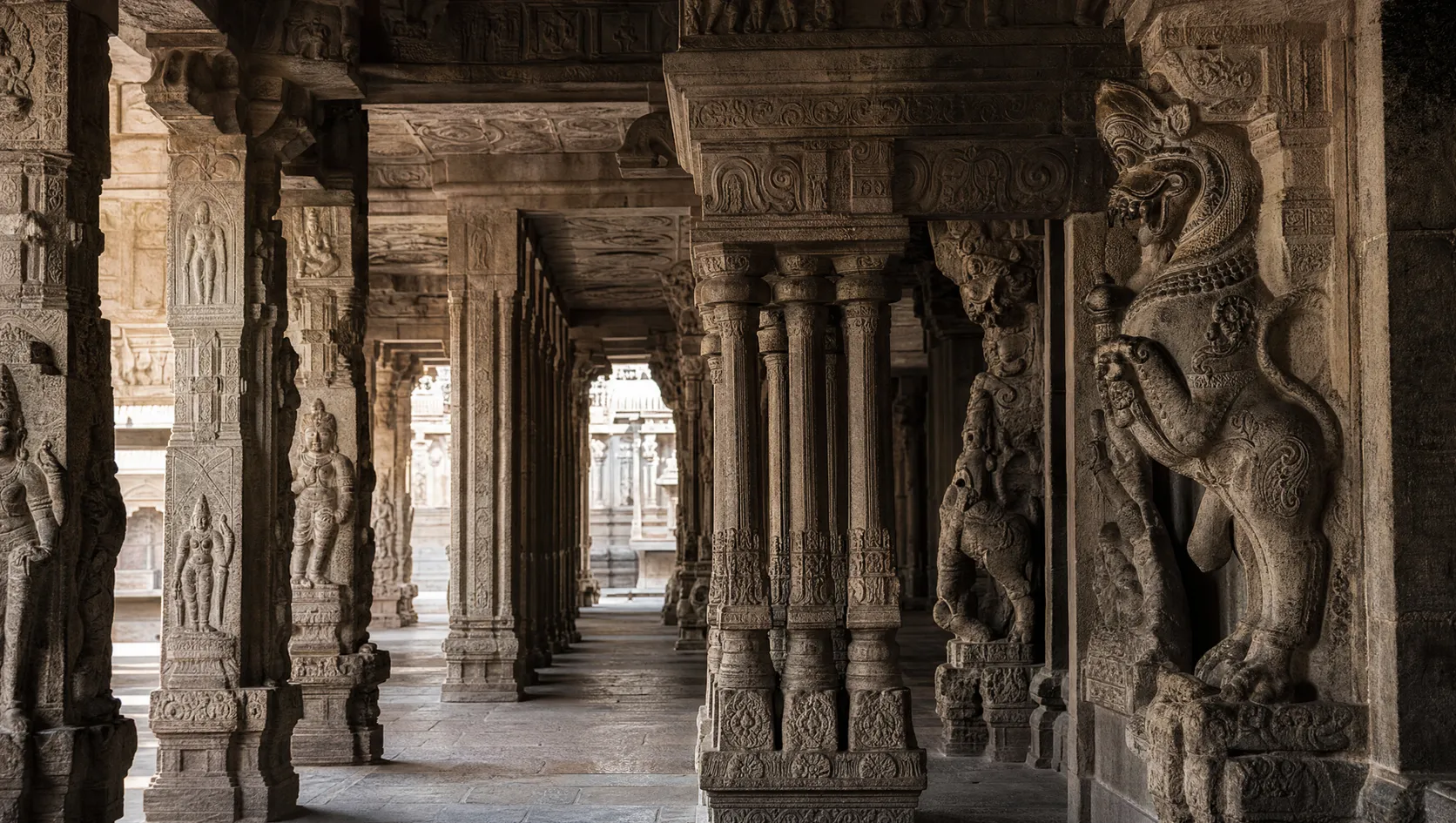
Dravidian of the Nayaka period: a walled temple with gopuram, sculptured mandapas and a hall noted for its finely carved pillars, some of which sound clear musical notes when struck
खुला
06:00 – 20:30
विशेष
The temple observes a full Srivaishnava round of daily worship to Bhu Varaha Swamy and to the goddess Ambujavalli, with services through the day and a midday break. Timings vary with the festival calendar, above all around Masi Magam and the annual Brahmotsavam, and should be confirmed locally.
पवित्र कथा · पवित्र कथा
Among the eight self-manifest abodes of Vishnu, the ashta swayamvyakta kshetras, the shrines where the tradition holds the Lord to have appeared of his own will and not by any human hand, Srimushnam stands as the great temple of the boar. Here Vishnu is worshipped as Bhu Varaha Swamy, the boar-formed avatar who plunged into the cosmic ocean, killed the demon Hiranyaksha, and lifted the earth goddess Bhudevi upon his tusk from the depths to which she had been dragged. The image at the still centre of the temple is this Varaha, the earth-bearer, and beside him is honoured his consort, called here Ambujavalli, the goddess of the earth herself. Srimushnam is not counted among the hundred and eight Divya Desams sung by the Alvar poet-saints; its glory is told in the Sthala Purana rather than in the Tamil Prabandham. The Srivaishnava tradition honours it instead as an Abhimana Sthalam, a shrine dear to the Lord and to his devotees though it lies outside the canon of the Alvars' hymns, and above all it is revered for what places it in the very first rank of Vishnu's shrines: it is one of only eight swayamvyakta kshetras, standing in that small company beside Srirangam and Tirupati, and it is among the foremost Varaha temples in all of India. The temple that a pilgrim sees today was raised in large part under the Nayakas of the sixteenth century, and it is famous for the beauty of its stone. A great sculptured hall carries pillars cut with gods and stories, and among them stands a set that answers with clear musical notes when struck, a marvel of the mason's art. About the shrine lies the Nithya Pushkarani, the ever-auspicious tank also called Nithya Kalyani, in whose waters the pilgrim bathes before coming to the boar who bore the world. To come to Srimushnam is to come to the place where the earth itself was saved.
Sacred Designationपवित्र पदनाम
Sacred Origin Storyपवित्र उत्पत्ति कथा
Source: The Srivaishnava tradition, the Sthala Purana of Srimushnam, and the Varaha avatar story of the Puranas
The story of Srimushnam is the story of the Varaha avatar itself. In the age of the world's making, the demon Hiranyaksha, the golden-eyed, brother of Hiranyakashipu, grew so mighty in his war against the gods that he seized the earth goddess Bhudevi and dragged her down beneath the waters of the cosmic ocean, hiding her in the deep so that the world of living things had no ground to stand upon.
To save the earth Vishnu took a form never seen before, the form of a great boar, Varaha, and plunged into the ocean. In the depths he found the demon and the hidden earth, and there followed a duel of enormous length, boar against titan in the dark water, until Varaha slew Hiranyaksha. Then, setting his tusk beneath the sunken goddess, he lifted Bhudevi from the depths and bore her up to the surface, restoring the earth to her place, and the gods rained flowers upon the boar who had carried the world upon his tusk.
At Srimushnam the tradition holds that this Varaha, the earth-bearer, chose to appear of his own will, unmade by any hand, so that the place is one of the swayamvyakta kshetras, the self-manifest abodes, and here the Lord is worshipped forever in the form in which he saved the earth, with Bhudevi, the goddess he lifted, honoured at his side as Ambujavalli. The whole shrine is thus a standing image of the earth's rescue, the boar and the goddess together at its heart.
उद्धृत स्रोत:
- Sthala Purana of Srimushnam
- The Varaha avatar tradition of the Puranas (Bhagavata and Varaha Purana)
- Srivaishnava tradition on the swayamvyakta kshetras
अन्य परंपराएँ · अन्य परंपराएँ
The Srivaishnava tradition on the eight self-manifest abodes and the name of the place
विद्वत संदर्भ
Srimushnam is studied both as a sacred Varaha kshetra and as a well-preserved example of Nayaka-period temple building in the far south. The site's sanctity as a self-manifest abode of Vishnu is attested in the Srivaishnava tradition and its Sthala Purana, which place it among the eight swayamvyakta kshetras and give it standing as an Abhimana Sthalam outside the canon of the 108 Divya Desams sung by the Alvars. The standing temple is chiefly a work of the sixteenth century, associated with the Nayakas of Gingee and in particular with Krishnappa Nayaka, under whom its great sculptured mandapas were raised; the temple carries inscriptions of the Vijayanagara and Nayaka period and received further patronage in the Maratha period, when Gingee and the surrounding country passed under Maratha rule. The temple is noted by art historians for the quality of its carving, especially the pillars of its hall, worked with figures of the avatars and Puranic scenes, and for the celebrated pillars that produce musical notes when struck, a feature it shares with a small number of other southern temples. Scholars treat Srimushnam as a case in which a site of deep Puranic sanctity, tied to one of the ten principal avatars, received in the late medieval centuries a monumental temple that fixed its importance in stone; the Varaha kshetra and the Nayaka masterpiece are, at Srimushnam, the same place.
Historyइतिहास
Srimushnam is one of the eight swayamvyakta kshetras, the self-manifest abodes of Vishnu, and one of the foremost Varaha temples in India, sacred to the Lord as Bhu Varaha Swamy, the boar avatar who lifted the earth goddess Bhudevi from the cosmic ocean. Its sanctity as a Varaha kshetra is told in its Sthala Purana and honoured in the Srivaishnava tradition, which counts it not among the 108 Divya Desams sung by the Alvars but among the Abhimana Sthalams, the shrines dear to the Lord and his devotees outside that canon.
While the sanctity of the site is held to be ancient, the temple that stands today is chiefly a monument of the sixteenth century. Under the Nayakas of Gingee, who ruled this country as governors of the Vijayanagara empire and then in their own right, the temple was built and greatly enlarged; tradition and the temple's inscriptions associate its construction above all with Krishnappa Nayaka, under whom its walls, gopuram and great sculptured halls took shape. The temple thus belongs to the last flowering of Dravidian temple architecture, when the Vijayanagara and Nayaka builders raised pillared mandapas of extraordinary richness across the Tamil country.
Srimushnam is famous for the beauty of its stone. Its mandapas carry pillars cut with the avatars of Vishnu, with gods, riders and Puranic scenes, and among them stands a set of musical pillars that sound clear notes when struck, a feature that places it with a small number of southern temples celebrated for this art. About the shrine lies the Nithya Pushkarani, the ever-auspicious temple tank also called Nithya Kalyani, central to the worship and to the great festivals.
In the seventeenth and eighteenth centuries, as Gingee and the surrounding country passed under Bijapur, the Marathas and then the wider struggles of the Carnatic, the temple continued to receive patronage, and it is remembered in the records of the Maratha period. The temple's endowments, its festivals and its worship were carried on through these changes, and it remained the chief shrine of its country.
Under later administration and in the modern era the temple has been maintained as a living centre of worship and recognised for its architectural importance. It draws its greatest crowds at the Masi Magam festival in the Tamil month of Masi, when vast numbers gather for the sacred bathing and the procession of the Lord, and observes the annual Brahmotsavam, Varaha Jayanti and Vaikuntha Ekadasi with the full round of Srivaishnava celebration. Srimushnam remains what it has long been: the great temple of the boar, where the tradition holds that the earth itself was saved.
Historical Timelineऐतिहासिक कालक्रम
The tradition holds that Vishnu as Bhu Varaha, the boar who lifted the earth, appeared at Srimushnam of his own will, making it one of the eight swayamvyakta kshetras, the self-manifest abodes; its sanctity is told in the Sthala Purana.
The self-manifest status places Srimushnam in the small company of eight swayamvyakta kshetras, among them Srirangam and Tirupati.
Srimushnam is honoured by the Srivaishnava tradition as an Abhimana Sthalam, a shrine dear to the Lord and his devotees though outside the 108 Divya Desams sung by the Alvars, and revered as a principal Varaha kshetra.
Abhimana Sthalams are temples held in high regard by Srivaishnavas though not among the Alvars' 108 Divya Desams.
The country around Srimushnam lies within the reach of Chola and later Vijayanagara authority, and the site is drawn into the temple-building and endowment of the medieval Tamil country before its great expansion under the Nayakas.
Under the Nayakas of Gingee, governors and then rulers under the Vijayanagara empire, the temple is built and greatly enlarged; tradition and inscriptions associate its construction above all with Krishnappa Nayaka.
The standing temple belongs to the Nayaka period, the last great flowering of Dravidian temple building in the Tamil country.
The temple's great sculptured mandapas are raised, their pillars carved with the avatars of Vishnu, gods and Puranic scenes, and including the celebrated set of musical pillars that sound clear notes when struck.
The musical pillars place Srimushnam with a small number of southern temples celebrated for this feat of stone-cutting.
The Nithya Pushkarani, the temple tank also called Nithya Kalyani, is established as the sacred water of the shrine, central to the worship and to the bathing of the Masi Magam festival.
As Gingee and the surrounding country pass through Bijapur, Maratha and Carnatic rule, the temple continues to receive patronage and is remembered in the records of the Maratha period, its worship and festivals carried on through the upheavals.
The temple and its sculptured halls are noted in colonial-era surveys and gazetteers of the South Arcot country, which record its standing as a major Varaha shrine and its architectural richness.
The temple is maintained as a living centre of Srivaishnava worship and recognised for its architectural importance, its sculptured mandapas and musical pillars drawing the attention of scholars and visitors alongside its pilgrims.
Periodic consecrations (kumbhabhishekam) renew the temple, and its worship, endowments and festival calendar are carried on under the Tamil Nadu Hindu Religious and Charitable Endowments administration.
Srimushnam remains one of the foremost Varaha temples of India and a swayamvyakta kshetra of the first rank, drawing its greatest crowds at the Masi Magam festival for the sacred bathing in the Nithya Pushkarani and the procession of Bhu Varaha Swamy.
What You'll Seeदर्शन में
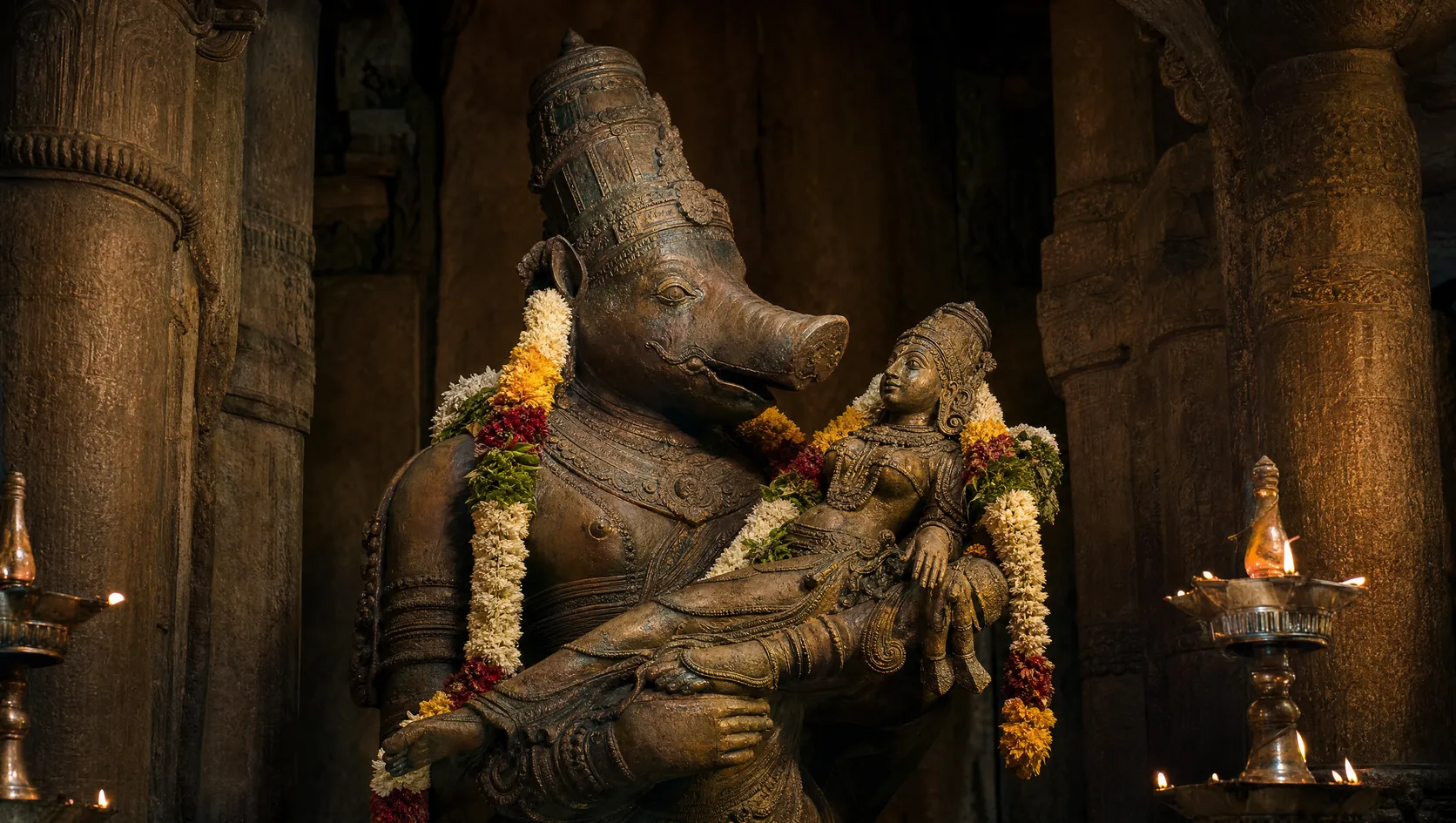
The presiding image of Srimushnam is Bhu Varaha Swamy, Vishnu in the form of the boar, the third of his ten great avatars, worshipped here as the earth-bearer who lifted Bhudevi from the deep. The Varaha is shown with the head of a boar upon the body of the Lord, and with him the earth goddess he rescued, called at Srimushnam Ambujavalli, so that the central image holds together the boar and the goddess, the saviour and the saved. This is the god in the very act for which he took the form, and the tradition holds the image to be swayamvyakta, self-manifest, appearing of its own will and not made by any hand.
The Varaha avatar is one of the most powerful of Vishnu's forms, the god descending into the ocean of dissolution to recover the ground of the world, and its iconography speaks of rescue and of the raising up of what has been lost. At Srimushnam the goddess Bhudevi, the earth, is not a distant consort but the very one the boar saved, her presence at his side the meaning of the shrine made visible.
Around the sanctum the temple's stone carries the fuller iconography of its Nayaka builders. The pillars of its mandapas are cut with the avatars of Vishnu, with gods, guardians, riders and Puranic scenes, and among them stand the celebrated musical pillars, slender shafts that sound clear notes when struck, so that the very stone of the temple can be made to sing. The image of the earth-bearing boar at the still centre, and about him the sculptured halls of the Nayaka masons, is the iconographic pattern of Srimushnam: the god who saved the earth, enshrined in one of the richest works of the southern stone-cutter's art.
Distinctive Practicesविशिष्ट परंपराएँ
Worship of the Self-Manifest Varaha
स्वयं-प्रकट वराह की उपासना
Year-round, in the daily worship of Bhu Varaha Swamy
The heart of worship at Srimushnam is the darshan of Bhu Varaha Swamy, the boar avatar held to be swayamvyakta, self-manifest, appearing of his own will. Devotees come to the sanctum to see the earth-bearing Lord with Bhudevi at his side, offering tulasi, flowers and the recitation of his names, in the belief that the god who saved the earth receives and upholds all who come to him.
That the image is held to be self-manifest changes the meaning of the darshan. The devotee does not come before a form that men shaped and consecrated, but before the Lord present of his own choosing, so that the shrine is felt as a place the god himself elected. To stand before the boar who lifted the earth is to stand before the very power that upholds the ground of the world; the worship at Srimushnam rests on the confidence that the god who once raised the sunken earth will raise up the devotee who casts himself upon his grace.
The Sacred Bath of Masi Magam in the Nithya Pushkarani
नित्य पुष्करणी में मासि मगम का पवित्र स्नान
Masi Magam, the Magha star in the month of Masi (Feb-Mar)
At Masi Magam vast numbers gather at Srimushnam to bathe in the Nithya Pushkarani, the ever-auspicious temple tank also called Nithya Kalyani, and to see the procession of Bhu Varaha Swamy. The sacred bath on this day is the most thronged observance of the temple's year, held to cleanse and to bring the grace of the earth-bearing Lord.
The sacred tank makes the water of the shrine a means of grace. To bathe in the Nithya Pushkarani at Masi Magam is to be washed in water held ever-auspicious, in the presence of the boar who raised the earth from the ocean; the bath enacts a small rescue of the self from its impurities, mirroring the great rescue of the earth that the shrine remembers. The gathering of the crowd is part of the observance: the whole country comes together at the tank, the collective turning of a people to the Lord who upholds their ground.
Recitation of the Vishnu Sahasranama and Varaha Praise
विष्णु सहस्रनाम और वराह स्तुति का पाठ
Daily in worship and on festival occasions
In keeping with the Srivaishnava tradition, the worship of Bhu Varaha Swamy carries the recitation of the Vishnu Sahasranama, the thousand names of Vishnu, and of praises of the Varaha avatar, offered before the god as a high form of worship alongside tulasi, flower and lamp.
In the Srivaishnava way the god is worshipped as much in sung and spoken word as in flower and food. To recite the thousand names of Vishnu before the boar of Srimushnam is to name the one Lord in his many aspects and to fold the earth-bearing avatar into the whole being of Vishnu, whom the names praise. The offering of the word carries the devotee's own mind and voice to the god, a worship that asks nothing material and gives the self in speech to the Lord who saved the earth.
Circumambulation of the Sculptured Halls
तराशे मंडपों की परिक्रमा
Year-round, in the course of darshan
Pilgrims move through the temple's sculptured mandapas on their way to the sanctum, past pillars cut with the avatars of Vishnu and Puranic scenes, and past the celebrated musical pillars that sound clear notes when struck. The passage through the carved stone is itself part of the pilgrimage to the boar at the centre.
The sculptured halls are not mere ornament but a teaching in stone. To pass among the avatars of Vishnu carved on the pillars, and to hear the musical stone sound, is to be led through the many forms and the very substance of the temple toward the one form at its heart, the boar who saved the earth. The Nayaka builders made the approach to the god a passage through beauty, so that the pilgrim's eye and ear are turned to the divine before the sanctum is reached.
Did You Know?क्या आप जानते हैं?
Srimushnam is one of only eight swayamvyakta kshetras, the self-manifest abodes of Vishnu, standing in that small company beside Srirangam and Tirupati.
Srivaishnava tradition on the swayamvyakta kshetras
It is one of the foremost Varaha temples in India, where Vishnu is worshipped as Bhu Varaha Swamy, the boar avatar who lifted the earth goddess Bhudevi from the cosmic ocean.
Sthala Purana of Srimushnam
Srimushnam is not one of the 108 Divya Desams sung by the Alvars, but is honoured by the Srivaishnava tradition as an Abhimana Sthalam, a shrine dear to the Lord and his devotees outside that canon.
Srivaishnava tradition
The central image shows the boar-formed Lord together with the earth goddess he rescued, called at Srimushnam Ambujavalli, so that saviour and saved are worshipped as one.
Temple iconography
Srimushnam is famous for its stone: sculptured mandapas cut with the avatars of Vishnu, and a celebrated set of musical pillars that sound clear notes when struck.
Architectural survey of the temple
The temple standing today was built and greatly enlarged in the sixteenth century under the Nayakas of Gingee, tradition associating it above all with Krishnappa Nayaka.
Vijayanagara and Nayaka inscriptions
The temple tank, the Nithya Pushkarani, also called Nithya Kalyani, is held to be ever-auspicious, and the sacred bath in it at Masi Magam draws vast crowds.
Temple tradition
The Varaha avatar honoured here is the third of Vishnu's ten great descents, the boar who dived into the ocean of dissolution to recover the ground of the world.
The Varaha avatar tradition of the Puranas
In the seventeenth and eighteenth centuries, as the Gingee country passed under Maratha rule, the temple continued to receive patronage and is remembered in the records of the Maratha period.
Maratha-period records
Visitor Accessप्रवेश जानकारी
The temple is open to all Hindus, and the inner sanctum of Bhu Varaha Swamy is reached through the sculptured halls of the temple. As at many major Vaishnava temples of the south, entry to the innermost precinct is restricted to Hindus, and this should be respected at the shrine. Worship runs in sessions through the day with a midday break, and timings vary with the festival calendar, above all around Masi Magam and the annual Brahmotsavam, when crowds are far larger and the sacred bathing in the Nithya Pushkarani draws great numbers. A dress code of traditional attire applies, and footwear is left outside the temple. Confirm current timings, festival dates and any restrictions locally before visiting, as these are set by the temple and change through the year.
आध्यात्मिक आधार
The passage inward through the sculptured halls to the self-manifest boar is itself a spiritual form. To reach the earth-bearing Lord one moves from the outer world, through the carved mandapas where the avatars of Vishnu look down from the pillars and the very stone can be made to sing, to the still centre where the boar and the goddess he saved are enshrined; the architecture makes the pilgrimage a graded approach from the ordinary toward the innermost. The restriction of the innermost precinct to Hindus follows the practice of the major Vaishnava temples of the south, which preserve the ritual purity of the sanctum according to their tradition. The god's accessibility is held to be real for all his devotees within these forms: Bhu Varaha Swamy is the Lord who raised the sunken earth, and the tradition holds that he receives and upholds any who come to him in trust, the graded halls ordering that approach rather than denying it.
समकालीन संदर्भ
Srimushnam is a temple town in Cuddalore district, reached most conveniently from Chidambaram, and its life turns around the temple of the boar. On ordinary days a visit is unhurried, allowing time to see the sanctum, the shrine of the goddess Ambujavalli and the sculptured halls with their musical pillars. At the great festivals, above all Masi Magam and the annual Brahmotsavam, the town fills with pilgrims and the temple draws far larger crowds, with the sacred bathing in the Nithya Pushkarani a particular focus. Visitors on those days should expect crowds and longer waits; a visit outside the festival season allows a quieter darshan of the earth-bearing Lord and an unhurried look at the temple's celebrated stone.
व्यावहारिक मार्गदर्शन
Allow time to see the principal parts of the temple: the sanctum of Bhu Varaha Swamy, the shrine of the goddess Ambujavalli, the sculptured mandapas and the celebrated musical pillars, and the Nithya Pushkarani tank. Non-Hindu visitors can see much of the temple and its architecture but should note the restriction at the innermost precinct. Dress traditionally and leave footwear outside. Srimushnam is most conveniently reached from Chidambaram, about 30 km away, and can be combined with a visit to the great temples of Chidambaram and the Kaveri delta. Avoid the peak of Masi Magam unless the festival itself is the aim, when crowds are very large; confirm timings and festival dates before travelling.
Festivalsत्योहार
Masi Magam
मासि मगम
Feb-Mar (Masi)
The greatest festival of Srimushnam, when the Magha star falls in the month of Masi and vast crowds gather for the sacred bathing in the Nithya Pushkarani and the procession of Bhu Varaha Swamy. It is the most thronged and celebrated day of the temple's year.
Brahmotsavam
ब्रह्मोत्सवम्
Annual (temple calendar)
The great annual festival of the temple, over which the processional Bhu Varaha Swamy is taken in procession on the many vahanas around the streets, the fullest celebration of the earth-bearing Lord's public presence in the town.
Varaha Jayanti
वराह जयंती
Bhadrapada (Aug-Sep)
The festival of the appearance of the Varaha avatar, observed with particular devotion at Srimushnam as the temple of the boar, marking the descent of Vishnu in the form in which he lifted the earth from the deep.
Vaikuntha Ekadasi
वैकुण्ठ एकादशी
Dec-Jan (Margazhi)
The great Vaishnava festival of the eleventh day, observed at Srimushnam as at all Vishnu temples, when the tradition holds the gate of the highest heaven to be opened and devotees seek the grace and the vision of Vaikuntha.
Traditional Offeringsपारंपरिक अर्पण
प्राथमिक अर्पण
Tulasi (holy basil)
तुलसी
तुलसी
Tulasi, the holy basil beloved of Vishnu, is the offering most proper to Bhu Varaha Swamy as to any form of Vishnu, laid at his feet and woven into his garlands. No worship of Vishnu is complete without it, and at Srimushnam it is offered to the boar who bore the earth.
Sacred food (naivedyam / prasadam)
नैवेद्य (प्रसाद)
नैवेद्यम्
Cooked food is offered to Bhu Varaha Swamy and shared with devotees as prasadam, the grace of the Lord made tangible. To receive the prasadam of the boar of Srimushnam is to carry away the blessing of the god who upholds the earth.
Garlands of flowers
पुष्प-मालाएँ
पुष्पमाला
Garlands of flowers, with tulasi, are offered to Bhu Varaha Swamy and to the goddess Ambujavalli, and garlands that have adorned the deities are returned to devotees as a blessing carrying the touch of the Lord.
Recitation of the Vishnu Sahasranama
विष्णु सहस्रनाम का पाठ
सहस्रनामपारायणम्
The recitation of the Vishnu Sahasranama, the thousand names of Vishnu, is held a high offering to Bhu Varaha Swamy, the god worshipped as much in spoken word as in flower and food. The names fold the earth-bearing avatar into the whole being of Vishnu whom they praise.
Offering of lamps (deeparadhana)
दीप-भेंट (दीपाराधना)
दीपाराधना
The offering of lamps before Bhu Varaha Swamy, the waving of the sacred flame in aradhana, is central to the worship, the light shown to the god and returned to the devotee as a blessing. At Srimushnam the lamp is offered to the boar who raised the earth from the dark of the ocean.
इस मंदिर की विशेषता
The Offering of Surrender to the Earth-Bearing Lord
पृथ्वी-धारक प्रभु को शरणागति की भेंट
What is particular to Srimushnam, the shrine of the boar who saved the earth, is that its deepest offering is surrender to the Lord who upholds the ground of the world. In the Srivaishnava tradition the highest offering is prapatti, the casting of oneself upon the grace of the Lord, and here that surrender takes on the special colour of the Varaha story: the god who once lifted the sunken earth is trusted to lift up the devotee who casts himself before him. A pilgrim brings tulasi, flowers, food and lamp as at any shrine of Vishnu, but the offering the tradition holds highest is the turning of the heart to the boar at the centre, the surrender of the self to the Lord who saved the earth, in the confidence that the same power that raised the world will raise the one who comes to him. The offering and the blessing meet in that surrender, and the whole meaning of the Varaha kshetra, the rescue of what was lost, is made personal to the devotee.
Offerings at Srimushnam follow the Srivaishnava tradition, with tulasi, flowers, garlands, cooked food and lamps central, and the recitation of the Vishnu Sahasranama and praises of the Varaha avatar held as offerings of word. Eternal Raga presents these practices as a devotional tradition; specific seva and offering arrangements should be confirmed with the temple.
How to Reachकैसे पहुँचें
Srimushnam lies in Cuddalore district in central Tamil Nadu, in the fertile country south of the Kollidam river, and is most conveniently reached from the nearby temple town of Chidambaram.
By air: Tiruchirappalli International Airport and Puducherry airport are the nearer airports, and Chennai is the major international gateway, connected onward by road and rail.
By rail: Chidambaram, about 30 km away, is the convenient railhead, on the line through the eastern Tamil country; Cuddalore is also nearby. From the railhead Srimushnam is reached by road.
By road: Srimushnam is served by buses and taxis from Chidambaram, Cuddalore and the surrounding towns, and lies within easy reach of the temple towns of the region. The temple is at the heart of the town.
Many pilgrims combine Srimushnam with the great temple of Chidambaram and with the shrines of the Kaveri delta, or with the coastal towns of Cuddalore and Puducherry.
Plan Your Visitयात्रा की योजना
🌤 सर्वोत्तम मौसम
October to March is the most comfortable time to visit, with milder temperatures in the coastal Tamil country. The Tamil month of Masi (February-March) brings the temple's greatest festival, Masi Magam, a spiritually rich but very crowded season, when the sacred bathing in the Nithya Pushkarani draws vast numbers. April to June is hot in this region, and the southwest and northeast monsoons bring rain, though the temple remains accessible. The annual Brahmotsavam and Varaha Jayanti are major draws in their seasons. Early morning and evening are the most atmospheric times, when the temple is active with worship and the heat of the day is least. On ordinary days a visit is unhurried; on the great festival days it becomes a large gathering.
👘 पहनावे का नियम
Traditional and modest dress is required. Men commonly wear a dhoti or trousers with a shirt; women a saree or salwar kameez. Footwear is left outside the temple. As a major Vaishnava temple, Srimushnam expects respectful traditional attire within its enclosures.
📱 फोन और फोटोग्राफी
Photography is restricted, and generally not permitted within the inner enclosures and the sanctum; cameras and phones may need to be kept away in the innermost areas. Follow the posted rules and the directions of temple staff, and keep phones silenced within the shrines.
🏨 आवास
Srimushnam is a small temple town, and while there are simple lodges near the temple, most visitors stay at the nearby town of Chidambaram, about 30 km away, which offers a fuller range of hotels and guest houses, or at Cuddalore. Being convenient to several temple towns, the area is easily visited as part of a wider pilgrimage. Demand rises sharply around Masi Magam and the annual Brahmotsavam, when booking ahead is advisable. Outside the great festivals the area absorbs its pilgrims easily.
Sacred Soundsपवित्र ध्वनि
क्या आप जानते हैं? · Did You Know?
वही अनुवाद त्रुटि जिसने हिन्दू धर्म में '33 कोटि' को '33 करोड़' बनाया, बौद्ध धर्म में भी हुई। बौद्ध ग्रन्थों के चीनी अनुवाद ने 'सप्त कोटि बुद्ध' (7 श्रेष्ठ बुद्ध) का अनुवाद '7 करोड़ बुद्ध' कर दिया। तिब्बती अनुवाद ने सही किया: 7 प्रकार, 7 करोड़ नहीं। एक संस्कृत शब्द, दो प्रमुख विश्व धर्मों में गलत पढ़ा गया, ने दो एकसमान भ्रम स्वतन्त्र रूप से उत्पन्न किए।
Related Contentसंबंधित सामग्री
Related Scriptures
Community Reflections
🕉️
Be the first to share your reflection.